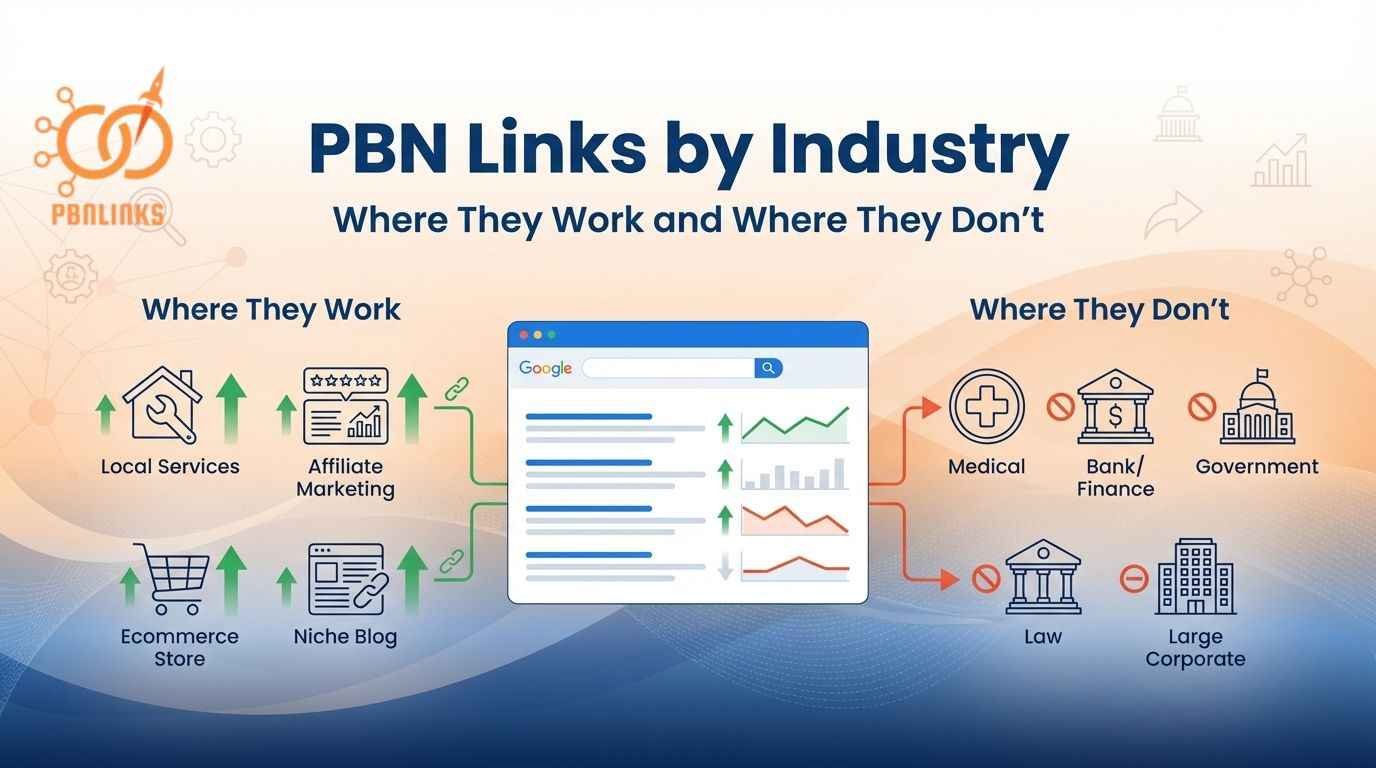
PBN Links by Industry: 11 Niches Where They Still Work (And 5 Where They Don’t)
Why do PBN links work well in some industries but fail in others?
Many beginners struggle with this question because the advice they see online is often contradictory. Some SEO professionals claim that PBN links still move rankings quickly. Others say they no longer work. The truth lies somewhere in between.
The effectiveness of PBN links by industry depends largely on the type of search results you are competing against. In some niches, rankings are still influenced strongly by backlinks. Smaller websites can gain visibility when they build authority through well placed links.
In other industries, the situation is different. Search results are often dominated by strong brands, large publishers, and highly trusted websites. When this happens, backlinks alone usually cannot push a site into top positions.
This guide explains which industries still respond well to PBN links and which ones are harder to influence. More importantly, it shows how to examine your own niche by looking at competition levels, the authority of ranking sites, and the structure of the search results.
When you understand PBN links by industry, you can decide whether this strategy is worth using in your SEO plan or whether other approaches should take priority.
What “PBN Links by Industry” Really Means
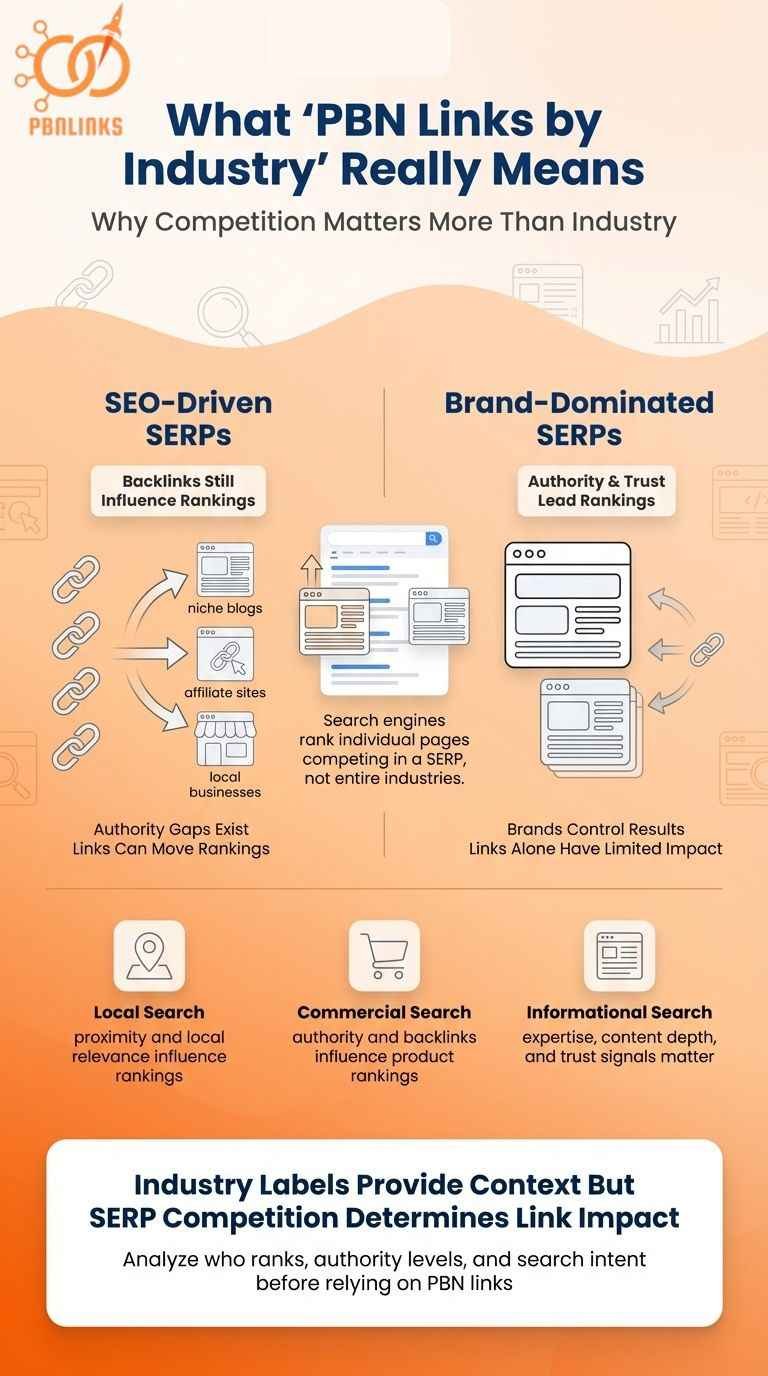
The phrase PBN links by industry does not mean that an entire industry always works or fails with PBN links. Instead, it is a way to describe how different markets behave in search results and how backlinks influence rankings within those markets.
In this article, the word industry refers to broad categories such as ecommerce, health, finance, real estate, or SaaS. These categories help provide context, but they do not control how rankings respond to backlinks.
Search engines do not rank industries. They rank individual pages that compete for a specific keyword. Because of this, the real factor that determines whether PBN links work is the competition inside a particular search result, not the industry label.
Even within the same industry, different keywords can produce very different search results.
For some keywords, the first page may contain smaller niche websites, affiliate blogs, or local businesses. In these situations, backlinks often remain an important ranking factor and PBN links can still influence positions.
For other keywords in that same industry, the results may be dominated by large brands, well known publishers, or trusted platforms. When this happens, authority, brand recognition, and trust signals often carry more weight than backlinks alone.
Search intent also changes how rankings behave. Different types of searches rely on different signals.
• Local searches often reward proximity and local relevance
• Commercial and affiliate searches usually respond strongly to authority and backlinks
• Informational searches often prioritize expertise, depth of content, and trust
All of these search types can exist inside the same industry at the same time.
Because of this, evaluating PBN links by industry should not focus on whether an industry allows or blocks PBN links. The real goal is to understand how a specific search results page works.
Look at who is ranking, what type of sites dominate the results, and which signals appear to influence those rankings.
Industry categories help set expectations, but competition and search intent are what truly determine whether PBN links can influence rankings in a given niche.
Why Competition Matters More Than Industry When Using PBN Links
Industry labels provide general context, but competition is what truly determines whether PBN links can influence rankings. Two keywords from the same industry can behave very differently in search results. This happens because search engines rank individual pages that compete for a query, not entire industries.
To understand this better, it helps to look at how different types of search results behave.
How SEO Driven SERPs Respond to PBN Links
In some search results, rankings are strongly influenced by SEO signals such as backlinks and topical authority. These SERPs often include websites that are built primarily for search visibility.
Common examples include:
• Affiliate websites
• Niche blogs
• Lead generation sites
• Smaller SEO focused projects
In these environments, backlink profiles are often uneven. Some pages may have very few strong links while others rely heavily on link building. Because of these gaps, additional authority from PBN links can still make a noticeable difference.
This is the type of competition where PBN links often perform best.
Why Brand Driven SERPs React Differently
Other search results are dominated by large brands, major publishers, and highly trusted platforms.
In these cases, the ranking signals are different. Reputation, trust, and brand recognition usually carry more weight than backlinks alone.
Even if these sites have strong backlink profiles, adding more links to a competing page often produces little movement. The authority of the ranking sites is already very high and supported by strong brand signals.
In this type of SERP, PBN links alone rarely shift rankings significantly.
The Role of Competitor Authority Levels
The authority of competing websites also affects how much influence PBN links can have.
When competitors have weaker domains and smaller link profiles, even modest improvements in backlinks can move rankings.
When competitors are highly authoritative, the situation changes. These sites often have:
• Strong domain history
• Diverse backlink profiles
• Extensive content coverage
Competing against them usually requires more than simply adding links.
This explains why the same link strategy may succeed in one search result but fail in another.
How Search Intent Changes Link Impact
Search intent also shapes how links affect rankings.
Different types of queries rely on different signals.
• Local intent searches often focus on location, relevance, and business signals
• Commercial searches usually compare pages based on authority and backlinks
• Informational searches often prioritize expertise, content depth, and trust
Because intent varies, the influence of backlinks can also vary within the same industry.
Why Mid Tier SERPs Are Often the Best Opportunity
PBN links tend to work best in mid tier search results.
These are searches where competition is present but not completely controlled by dominant brands or major institutions. Authority still matters, and backlink gaps often exist between competing pages.
In these situations, relevant and well placed backlinks can help close those gaps and influence rankings.
When those authority gaps disappear and strong brands dominate the results, PBN links usually have limited impact regardless of the industry.
11 Industries Where PBN Links Still Work Well (With the Right Competition)
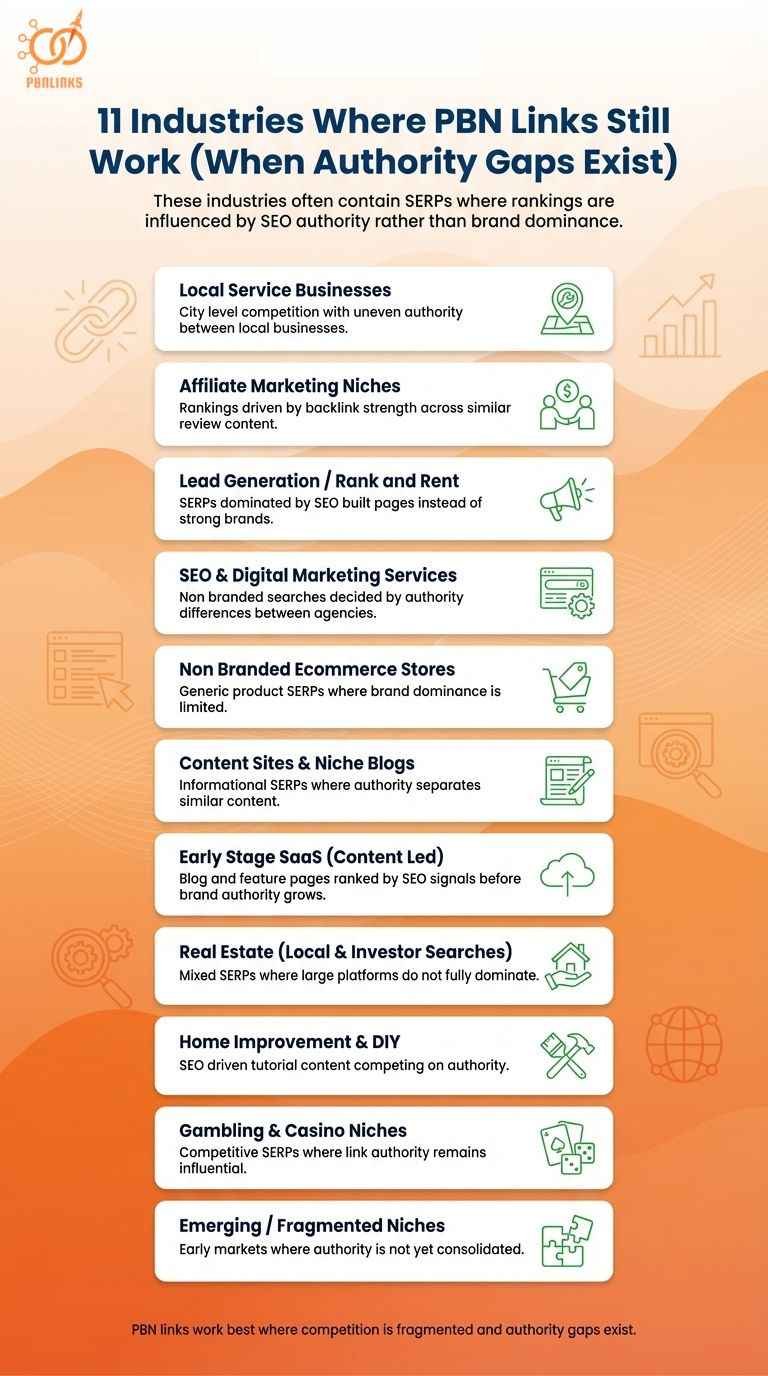
When analyzing PBN links by industry, the key question is not simply which industry you are in. The more important question is how competition behaves in that market. PBN links tend to work best in industries where search results are still shaped by SEO signals such as backlinks and topical authority rather than by strong brand dominance.
The industries below often contain SERPs where smaller websites compete with each other instead of with major brands. In these environments, authority gaps between pages are common. Because those gaps exist, backlinks can still influence rankings when they are relevant and placed carefully.
These examples do not mean every keyword in these industries will respond to PBN links. Instead, they represent industries where link driven competition appears frequently, making them more responsive to authority signals.
Local Service Businesses
Local services such as HVAC, plumbing, roofing, cleaning services, and electricians usually compete within specific cities or service areas. Large national brands rarely dominate these results.
Most competitors are small local businesses with uneven authority and limited backlink profiles. Once local relevance and proximity are established, the main difference between ranking pages often comes down to authority signals. In these cases, backlinks can still help influence visibility.
Affiliate Marketing Niches
Affiliate search results built around product reviews, comparisons, and “best product” queries remain heavily influenced by SEO signals.
Brand authority is usually limited in these SERPs. Many ranking pages are affiliate websites that follow similar content structures. Because content formats are similar, authority gaps often appear between competitors.
When one page has a stronger backlink profile than others, it can move ahead even if the content quality is similar. This makes affiliate niches one of the clearest environments where backlinks still affect rankings.
Lead Generation and Rank and Rent Websites
Lead generation and rank and rent projects are designed specifically to capture search traffic and convert it into calls or leads. Competition in these SERPs usually comes from other SEO built sites rather than established brands.
Because most competitors rely on similar strategies, authority differences often determine which pages rank higher. In these situations, backlinks can still influence visibility relatively quickly.
SEO Agencies and Digital Marketing Services
Searches related to SEO agencies and digital marketing services are competitive, but many non branded queries remain influenced by SEO strength.
Ranking pages often belong to agencies offering similar services with comparable messaging and content depth. When several providers appear equally credible, rankings are frequently determined by differences in authority.
Backlinks can therefore help strengthen topical authority and improve positioning in these searches.
Ecommerce Stores (Non Branded Products)
Non branded ecommerce stores, including dropshipping and private label businesses, often compete on generic product or category keywords.
When no single retailer dominates the search results, rankings frequently reward SEO strength rather than brand recognition. If technical SEO, internal linking, and category structure are already optimized, backlinks can help strengthen overall authority and improve visibility.
Content Sites and Niche Blogs
Content websites and niche blogs targeting informational queries often rank in environments where strong brands are not always present.
Long tail searches especially tend to reward topical coverage and authority rather than brand reputation. When multiple pages provide similar information, backlinks can become the factor that separates one page from another.
SaaS Websites (Early Stage or Content Led)
Early stage SaaS companies often lack the brand authority of established platforms.
While homepage rankings may favor stronger brands, blog content, educational resources, and feature explanations are usually evaluated based on SEO signals. In these cases, backlinks can help newer SaaS websites build authority while their brand recognition grows.
Real Estate (Local and Investor Niches)
Real estate search results vary depending on the query. Local property searches and investor focused informational queries often include smaller agencies and niche websites alongside larger platforms.
When the results include mixed competition and are not dominated entirely by large brands, backlinks can still influence rankings.
Home Improvement and DIY Niches
Home improvement and DIY searches often revolve around guides, tutorials, and informational content.
For non branded searches, multiple pages often provide similar instructions and advice. When content depth is comparable, authority signals such as backlinks can determine which guide ranks higher.
Gambling and Casino Niches
Gambling and casino markets are extremely competitive and strongly influenced by authority.
In many of these SERPs, backlink strength still plays a significant role in determining rankings. However, this industry also carries higher risk. Poor execution can lead to instability, while carefully managed authority signals can still influence results.
Emerging or Low Authority Niches
New or fragmented industries often lack established leaders.
In these early stage markets, search results are still developing and authority is not yet concentrated among a few dominant sites. Because competition is weaker, backlinks can influence rankings more noticeably.
These niches demonstrate how authority signals can shape visibility before stronger brands eventually enter the market.
Quick Scan: Where PBN Links Still Work
| Industry / Niche | Do PBN Links Work? | Why |
| Local Service Businesses | Yes | Local SERPs often have fragmented competition |
| Affiliate Marketing Niches | Yes | Rankings rely heavily on SEO authority |
| Lead Generation / Rank and Rent | Yes | SEO built sites compete directly on authority |
| SEO Agencies and Digital Marketing | Yes | Authority differences separate similar agencies |
| Ecommerce (Non Branded Products) | Yes | Generic product SERPs reward SEO strength |
| Content Sites and Niche Blogs | Yes | Informational queries often lack strong brands |
| SaaS (Early Stage or Content Led) | Yes, selectively | Content pages rank based on SEO signals |
| Real Estate (Local and Investor) | Yes, selectively | Mixed competition allows smaller sites to compete |
| Home Improvement and DIY | Yes | Guides compete on authority and topical coverage |
| Gambling and Casino | Yes, high risk | Authority driven SERPs |
| Emerging or Low Authority Niches | Yes | Competition is still developing |
5 Industries Where PBN Links Struggle in High Authority SERPs
The industries listed below do not mean that PBN links never work. Instead, they represent markets where rankings are largely controlled by strong brands, institutions, or regulated organizations. In these search results, backlinks alone rarely create significant ranking movement.
When analyzing PBN links by industry in these sectors, the main limitation is not link quality but the level of authority already present in the SERP. Trust, reputation, expert validation, and real world credibility play a stronger role in ranking decisions. Because of this, PBN links can only act as a small supporting signal and must be combined with strong brand authority, topical depth, and credible content.
Health and Medical Topics
Health and medical searches are among the most protected environments in Google’s ranking system. Many competitive keywords are dominated by hospitals, medical institutions, and well established health publishers.
These sites often feature expert authors, medically reviewed content, and strong credibility signals. In this environment, backlinks alone have limited influence.
PBN links may still help in smaller wellness or lifestyle related topics where competition is lighter. However, for topics related to treatments, diagnoses, or medical advice, rankings are heavily influenced by expertise and trust signals rather than backlinks.
Finance and Investment Topics
Finance related keywords such as banking, loans, credit, and investment advice operate under strict trust expectations. Search results are usually controlled by banks, financial platforms, and large financial publishers.
These websites benefit from long standing credibility and strong brand recognition. As a result, backlinks alone rarely move rankings in these SERPs.
PBN links may provide limited support for small informational topics such as beginner finance guides. However, competitive finance keywords usually require strong credibility signals and trusted brand authority.
Legal Services
Legal search results, especially for areas such as personal injury or criminal law, are strongly influenced by reputation and professional trust.
Established law firms often dominate these SERPs through reviews, citations, and long term authority built over years. In such environments, backlinks by themselves usually do not create meaningful ranking improvements.
PBN links may still help support informational articles or smaller local niches, but service pages in competitive legal markets require strong reputation signals along with SEO authority.
Government and Education Topics
Government and education related queries are often controlled by official institutions such as government websites, universities, and educational organizations.
These sites benefit from strong institutional trust and recognized authority. Because of this, search results in these areas are often resistant to SEO driven link strategies.
In most cases, PBN links have little to no impact unless they are supported by highly credible content and strong topical relevance.
Enterprise and Global Brand Markets
Large scale markets such as insurance, global marketplaces, and major technology platforms are dominated by powerful brands.
These companies have extensive backlink profiles, strong brand recognition, and years of accumulated authority. Their scale and reputation create a barrier that smaller sites struggle to overcome.
In these environments, backlinks alone rarely shift rankings. PBN links may still support smaller informational pages or niche content, but major commercial keywords usually require strong brand presence and broad authority signals.
Final Comparison: 5 Industries Where PBN Links Struggle
| Industry | What Mainly Controls Rankings | Effectiveness of PBN Links |
| Health and Medical Topics | Hospitals, health publishers, E-E-A-T signals | Very limited. Mostly useful only for low competition wellness content |
| Finance and Investment Topics | Banks, regulatory trust, brand credibility | Low. Backlinks alone rarely move core finance keywords |
| Legal Services | Firm reputation, reviews, professional authority | Limited. Mostly useful for informational or smaller local queries |
| Government and Education Topics | Official institutions and entity trust | Almost none. These SERPs are strongly protected by institutional authority |
| Enterprise and Global Brand Markets | Large brands, scale, long term authority | Very limited. Links may support secondary content but rarely move core commercial keywords |
How to Decide If PBN Links Will Work in Your Niche
Deciding whether PBN links can realistically influence rankings requires reading SERP signals carefully. Instead of relying on industry assumptions, the evaluation should focus on how authority is distributed and defended within your specific niche.
Analyze Top-Ranking Competitors
Start by examining who currently controls page one for your target keywords. The makeup of these results reveals whether rankings are still authority-driven or already protected by brands and institutions.
When top positions are occupied by affiliates, lead generation pages, niche blogs, or SEO-built sites, authority is usually fluid. Rankings in these environments tend to shift when relative strength changes. When page one is dominated by recognizable brands, platforms, or institutions with strong offline presence, backlink influence is naturally limited.
Review Backlink Profiles
Backlink profiles explain how competitors are supporting their rankings. Instead of focusing only on headline metrics, look at the structure and dependency of their links.
SERPs where ranking pages rely on uneven or modest backlink profiles tend to be more responsive to authority changes. In contrast, when backlinks appear secondary to brand mentions, citations, and long-standing trust signals, rankings are far more resistant to incremental link gains.
Identify Authority Gaps
Authority gaps exist when pages rank despite visible weaknesses. These gaps often appear when competitors have thin backlink coverage, shallow topical depth, or inconsistent authority signals.
When several ranking pages share similar limitations, rankings are usually decided by marginal authority differences rather than absolute trust. In such cases, backlinks can still act as a differentiating signal. When authority is already consolidated across strong brands and publishers, gaps are usually minimal or nonexistent.
Compare Local vs National Intent
Search intent strongly affects how backlinks influence rankings. Local intent queries typically prioritize proximity, relevance, and business legitimacy over pure authority. Backlinks may still help, but they usually play a supporting role.
National or broader commercial intent queries compare pages more directly on authority and depth. These SERPs are more likely to expose authority gaps where backlinks can influence movement. Informational queries vary, but many long-tail searches still reward authority when brand trust is not the dominant signal.
Key Takeaway
PBN links tend to work where rankings are driven by relative authority rather than brand or institutional trust. By analyzing competitors, backlink dependency, authority gaps, and search intent together, you can determine whether backlinks are likely to influence rankings in your niche before committing resources.
Best Practices for Using PBN Links Across Industries
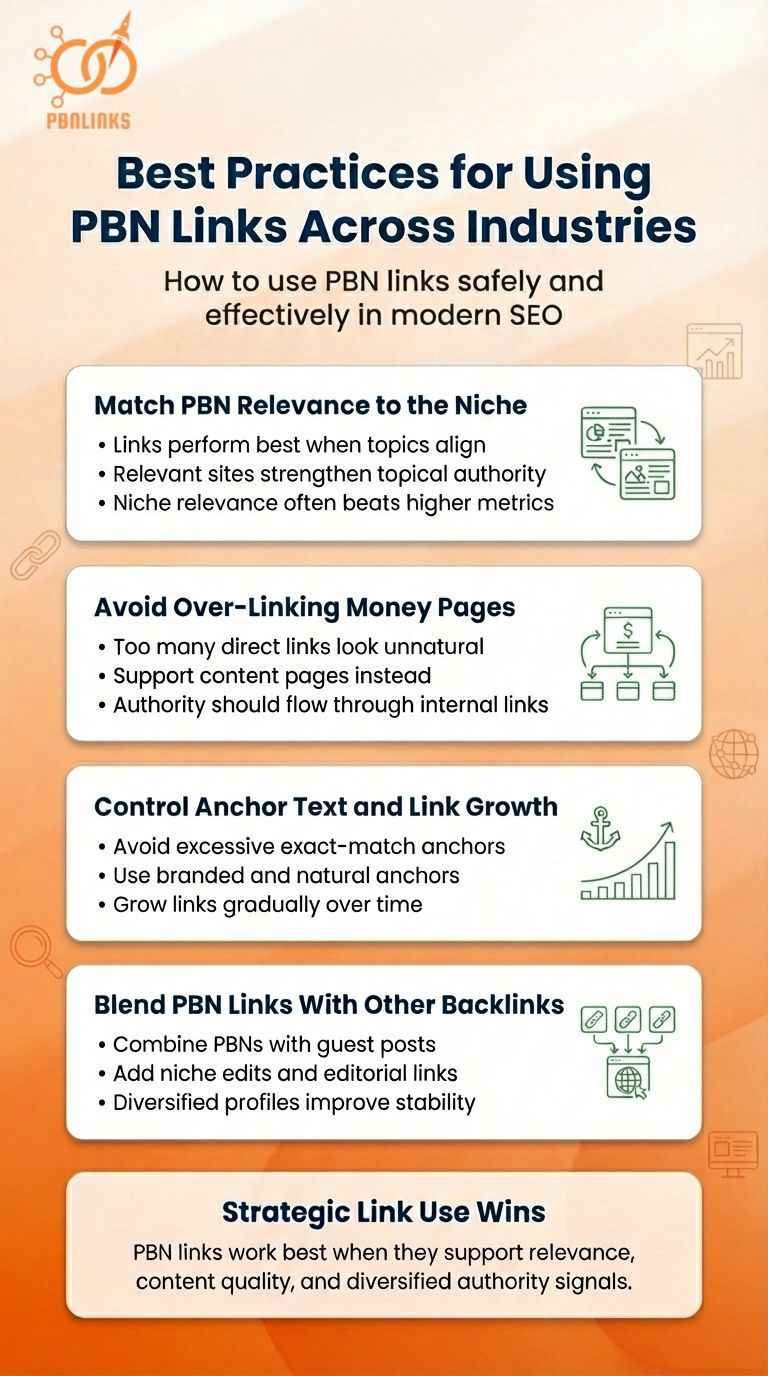
PBN links by industry can still support rankings, but they work best when they are used as part of a balanced SEO strategy. Links alone rarely sustain rankings over time. Strong results usually come when PBN links reinforce existing relevance, content depth, and site authority.
The following practices explain how PBN links are used more safely and effectively across industries where backlinks still influence search results.
Match PBN Relevance to the Niche
Topical relevance is one of the most important factors when using PBN links by industry. Links tend to carry more value when the linking site focuses on the same subject area as the target page.
When a PBN site shares a similar niche, audience intent, and content theme, the link strengthens topical authority instead of creating confusion. Search engines can more easily understand the relationship between the two sites.
Across many industries, niche relevant links often perform better than links from unrelated but higher metric domains. Relevance reinforces subject expertise and helps links contribute to ranking improvements instead of appearing disconnected.
Avoid Over Linking Money Pages
Another common mistake is sending too many PBN links directly to commercial or transactional pages. This creates unnatural link patterns that rarely reflect how real websites attract links.
In natural SEO environments, money pages usually rank because authority flows to them through internal links from other pages. Strengthening supporting content such as guides, category pages, or informational articles allows authority to move naturally through the site.
This approach reduces pressure on key commercial pages while still improving their ranking ability. Across industries, internal authority flow often produces more stable results than direct link concentration.
Control Anchor Text and Link Growth
Anchor text patterns and link growth speed often reveal unnatural link building activity. Even strong backlinks can lose value when anchors are overly optimized or when authority increases too quickly.
Healthy link profiles for PBN links by industry rely mainly on branded anchors, URL anchors, and natural language references. Partial keyword matches can support relevance when used carefully, while exact keyword anchors should remain limited.
Link growth should also match the natural development of the website. Gradual increases in authority look more believable than sudden spikes in backlinks.
Blend PBN Links With Other Backlink Types
PBN links are most effective when they are combined with other types of backlinks. A profile dominated by a single link source is easier for search engines to recognize and evaluate.
Mixing PBN links with guest posts, niche edits, editorial mentions, and other natural links creates a more balanced authority profile. Each type of link contributes different signals and context.
Across many industries, diversified backlink profiles tend to remain more stable during algorithm updates. When PBN links act as supporting signals rather than the main authority source, rankings are more likely to hold over time.
Final Thoughts on PBN Links by Industry
The effectiveness of PBN links by industry is not determined by simple categories or strict rules. What truly matters is the level of competition in the search results, how authority is distributed among ranking sites, and whether there is realistic room for backlinks to influence positions. In many cases, it is not the industry that limits PBN success but the strength of the competitors already ranking.
Well built PBN networks are very different from low quality spam setups. When links come from clean domains, relevant content, and carefully structured sites, they can strengthen topical authority and help close ranking gaps. On the other hand, networks built around volume, repetition, or shortcuts often produce unstable results and greater risk.
The best outcomes come from strategic use rather than aggressive scaling. PBN links work most effectively when they support topical relevance, integrate naturally within content, and are combined with other authority signals. Used thoughtfully, they can accelerate ranking momentum and improve return on investment while maintaining long term stability.
If you want to apply PBN links by industry based on real SERP competition and not guesswork, explore professional solutions from PBNLinks.agency and build authority with a strategy designed for your niche.
FAQs About PBN Links by Industry
Do PBN links still work in 2026?
Yes, PBN links can still work in 2026 when they are high quality and used strategically.
They work best in niches where rankings are influenced by backlinks rather than strong brand or entity dominance.
Do PBN links work the same in every industry?
No, PBN links do not work the same in every industry.
Effectiveness depends on competition level, SERP authority, and whether rankings are controlled by brands or institutions.
What does “PBN links by industry” mean?
PBN links by industry means evaluating link effectiveness based on niche-level competition within an industry.
It focuses on SERP behavior instead of assuming all keywords in the same industry respond the same way.
Why does competition matter more than industry for PBN links?
Competition matters because backlinks only influence rankings where authority gaps exist.
In SERPs dominated by strong brands or trusted entities, links alone usually have limited impact.
Which industries benefit most from PBN links?
Industries with SEO-driven competition benefit the most from PBN links.
These include local services, affiliate sites, lead generation, ecommerce, and content-focused niches.
Are PBN links effective for local service businesses?
Yes, PBN links are often effective for local service businesses.
Many local SERPs rely more on authority and relevance than national brand recognition.
Do PBN links work well for affiliate websites?
Yes, affiliate websites are one of the strongest use cases for PBN links.
Review and comparison keywords are highly competitive and frequently influenced by backlink authority.
Can PBN links help ecommerce sites rank?
Yes, PBN links can help ecommerce sites rank for non-branded and category keywords.
They are most effective when combined with strong content, internal linking, and diversified backlinks.
Are PBN links commonly used in gambling and casino niches?
Yes, PBN links are commonly used in gambling and casino niches.
These SERPs are highly competitive and often require strong authority signals, though risks are higher.
Why do PBN links struggle in some health or medical niches?
PBN links struggle when SERPs are dominated by hospitals, publishers, and authority brands.
They may still work in low-competition wellness or informational sub-niches.
Do PBN links work in finance and legal niches?
Yes, but mainly in selective low-competition sub-niches.
High-authority finance and legal SERPs rely more on trust and brand signals than backlinks alone.
How can I tell if my niche is suitable for PBN links?
A niche is suitable if top-ranking pages rely more on backlinks than brand authority.
When affiliates or SEO-built sites rank well, PBN links are more likely to work.