PBN Links for Ecommerce: How to Use Private Blog Networks for Product Pages
Your product pages have perfect on-page SEO. They still won’t rank. Google doesn’t trust new stores in commercial search results.
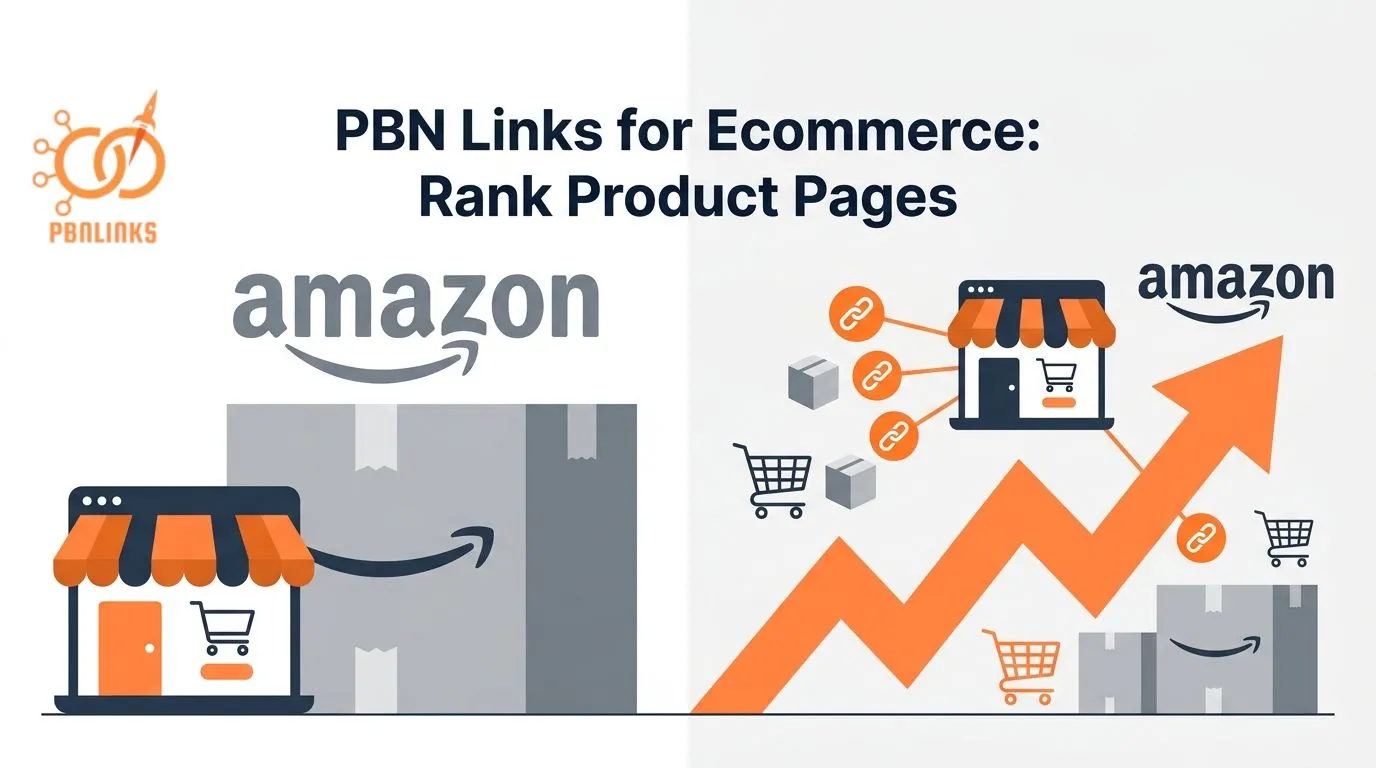
Product pages can’t earn backlinks naturally. No blogger links to a “Buy Running Shoes” page. Without backlinks, Google defaults to Amazon and established retailers with millions of existing links.
PBN links solve this problem. They give your product pages the authority signals needed to compete. This guide shows you how to use them safely for Shopify and WooCommerce stores.
You’ll learn which pages to link first. How many links you need in the first 90 days. Safe anchor text ratios that avoid penalties.
You’ll also learn seasonal link timing for Black Friday and holiday traffic. How to scale links across large catalogs. And how to mix PBN links with other link types to stay safe.
Why Product Pages Can’t Rank Without Backlinks
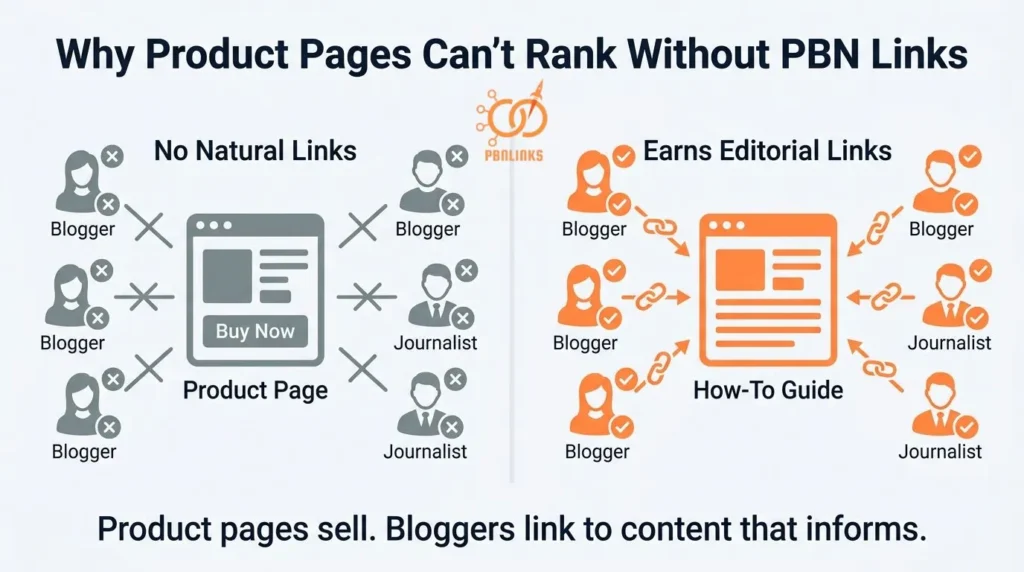
Product pages rarely earn organic backlinks. Thin content and transactional intent make them invisible to editorial sites, and without links they can’t compete in commercial SERPs.
Thin Content Attracts No Natural Links
Product pages contain specs, pricing, and buy buttons. Bloggers link to how-to guides and case studies. Journalists reference research and industry reports. Product listings get ignored because they exist to sell, not inform.
Your product description could be the best in your niche. It still won’t earn links. Editorial sites need educational value or data to justify a backlink. A page optimized for “buy vegan leather laptop bag” offers neither.
Amazon Owns Commercial Keywords
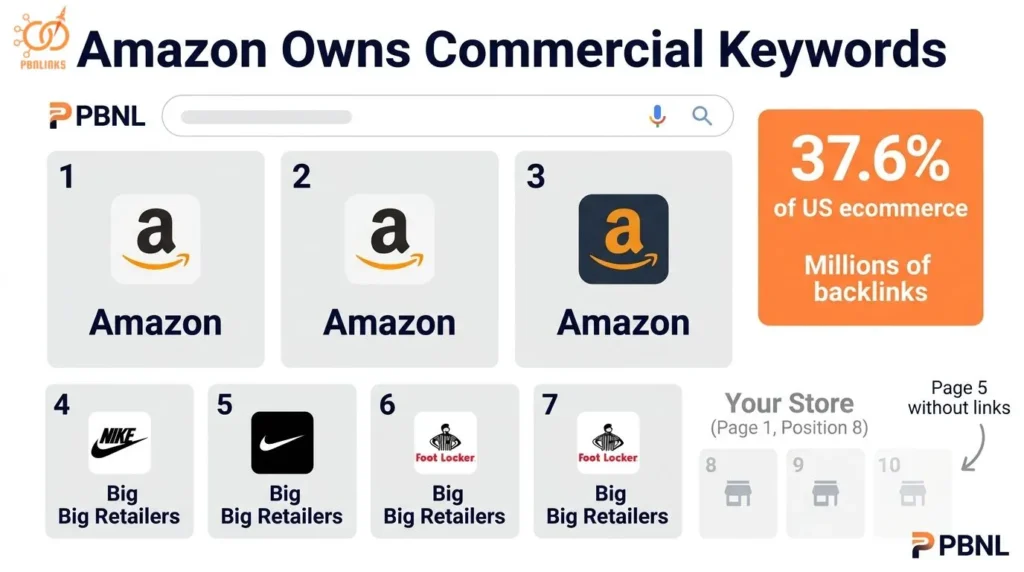
Amazon dominates commercial search with millions of backlinks built over decades. Small stores launch with zero authority. Google defaults to trusted retailers for commercial queries.
Search “buy running shoes” right now. Amazon owns the top three spots. Nike and Foot Locker fill positions four through seven. Your Shopify store with identical products sits on page five because you have no link equity. Amazon’s authority comes from years of PR coverage, partnership announcements, and natural editorial links. You’re competing against that foundation with product pages alone.
Amazon captures 37.6% of all US ecommerce sales according to eMarketer. Their decades of PR coverage, partnerships, and natural editorial links have built authority your new store can’t match organically.
New Stores Start with Zero Authority
New Shopify and WooCommerce stores have no backlink profile at launch. Google doesn’t trust new domains for commercial queries. Product pages take weeks to index and months to rank.
The timeline problem hits seasonal businesses hardest. Launch a Halloween costume store in August and you need rankings by September. Wait for organic link building and you miss the entire sales window. Christmas gift stores face the same compressed timeline. Black Friday merchants need authority built by October or they lose Q4 revenue.
Even non-seasonal stores can’t afford 6-to-12-month ranking delays. Competitors already own the SERPs. Your products sit invisible while established retailers capture every search conversion.
How PBN Links Level the Playing Field
PBN links give product pages instant authority signals. They close the gap with Amazon, accelerate indexing, and push your pages into commercial SERPs where organic outreach can’t reach.
Authority Signals Google Trusts
Contextual backlinks from aged domains signal trust to Google. The search engine weighs link equity heavily for commercial queries. Small stores can compete by stacking authority signals through strategic PBN placements.
External validation matters more than on-page optimization for transactional keywords. Google prioritizes pages with backlinks from established domains. At PBN Links Agency we place links on high-DA sites in relevant niches to transfer the trust signals Google uses for ranking commercial queries.
Faster Indexing for Deep Product Pages
Product pages buried deep in site structure get crawled slowly. Individual products three clicks from the homepage can take weeks to index. PBN backlinks create direct crawl paths that Google follows immediately.
External links signal priority to search engines. Pages with backlinks get crawled and indexed faster than orphaned pages with no external references. This matters for seasonal product launches and limited-time offers that need immediate visibility.
Displacing Amazon in Search Results
Commercial SERPs are zero-sum your page ranking higher means a competitor’s page dropping lower. PBN links shift this equilibrium by boosting your authority relative to established retailers.
Target long-tail queries where Amazon has less dominance. “Vegan leather laptop bag 15 inch” faces lower competition than “laptop bag.” Niche product variations give small stores an opening. Focused link velocity on specific keywords can displace established pages in 30 to 60 days.
Link Strategy for New Stores (First 90 Days)
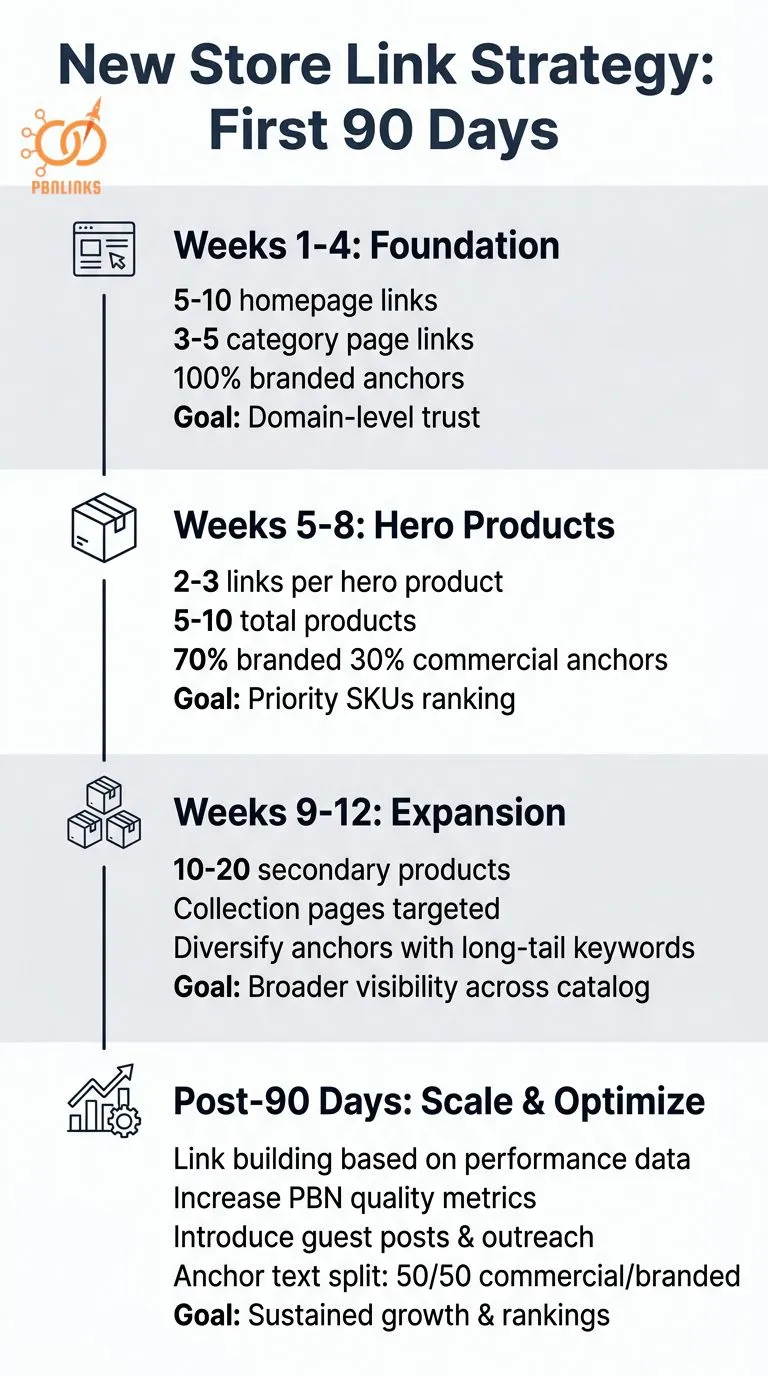
New stores need structured link building to establish authority fast. The first 90 days determine whether you rank for holiday traffic or stay invisible through your most critical sales window.
How to Identify Your Hero Products
Hero products are the 5 to 10 items that deserve your first PBN links. Pick them based on margin, search demand, competition, and timing.
Start with your highest-margin products. A leather jacket with 60% margin deserves links before a t-shirt with 15% margin. Check monthly search volume using Ahrefs or SEMrush. Target products with 500+ searches and moderate competition.
Avoid fighting Amazon on broad keywords. “Running shoes” needs hundreds of backlinks. “Vegan running shoes women size 8” ranks with 10 to 15 quality links. Seasonal products need immediate priority based on your launch date.
Weeks 1–4: Homepage and Category Pages
Place 5 to 10 PBN links to your homepage using branded anchors. Use your store name and variations like “Shop [Brand].”
Add 3 to 5 links to main category pages with a 70% branded, 30% category keyword anchor mix. Category pages distribute authority to product pages through internal links. Skip product pages entirely in month one. Google needs domain-level trust signals first.
Weeks 5–8: High-Priority Product Pages
Target your hero products with 2 to 3 PBN links per product spread across four weeks. Use commercial anchors like “buy [product name]” and “[product name] for sale” mixed with branded variations.
Link each hero product from its category page, homepage, and related products. At PBN Links Agency we help clients structure internal linking to maximize PBN impact. Track rankings weekly and adjust velocity based on movement.
Weeks 9–12: Secondary Products and Collections
Expand to 10 to 20 secondary products. Target collection pages like “Summer Dresses 2026” or “Minimalist Home Office Setup” for broader keywords.
Diversify anchor text with generic phrases like “click here” and “shop now” alongside commercial anchors. By day 90 you should have 30 to 50 backlinks across homepage, categories, and products.
What If You Don’t Have 90 Days?
Compressed timelines need aggressive velocity. For Black Friday launches in late October:
Week 1: 10 homepage links
Week 2: 5-8 category links
Week 3-4: 3-4 links to top 10 hero products
Mix PBN links with guest posts to reduce footprint risk. For emergency 2-week launches, skip homepage and categories entirely. Place 5 to 7 PBN links directly to your top 3 to 5 products. Emergency timelines sacrifice long-term profile cleanliness for short-term rankings.
Product Pages vs. Category Pages: Which to Link First
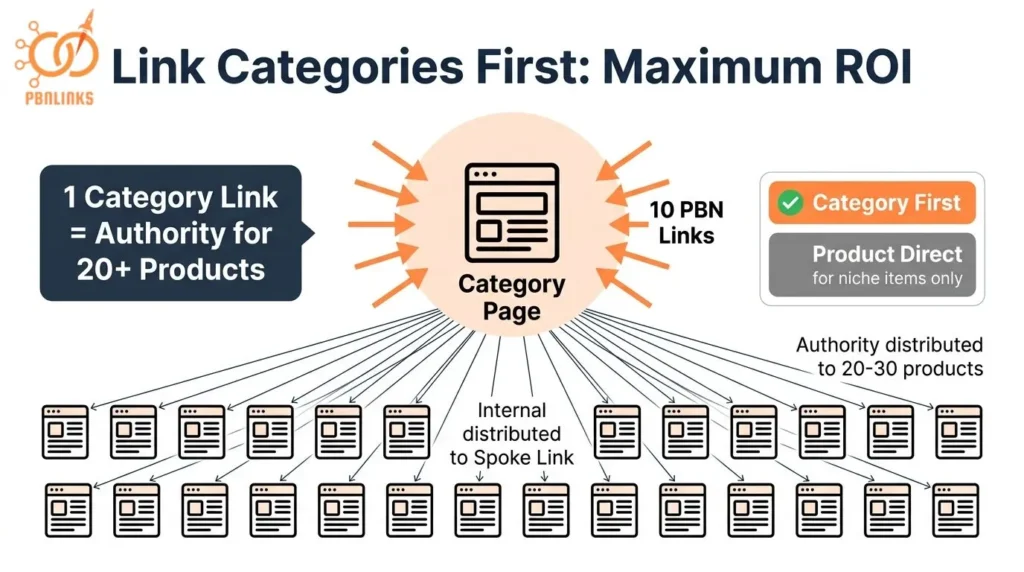
Category pages capture broad traffic. Product pages target buyers. Your link strategy should prioritize based on your store’s age, budget, and catalog size.
The Simple Answer: Categories First, Products Second
New stores should link to category pages before product pages. Category pages rank for high-volume keywords like “men’s running shoes” or “organic skincare” that product pages can’t capture alone. They also contain more content than individual product listings, which makes them easier to rank.
One category page with 10 PBN links distributes authority to 20 to 50 product pages through internal links. This creates better ROI than linking each product individually. Your “Leather Jackets” category passes link equity down to every jacket product page automatically.
Start with 3 to 5 main category pages in your first month. Add product page links in month two after your domain has baseline authority. Google trusts category pages faster because they look more like editorial content than transactional pages.
Use navigational anchors for category links. “Men’s Running Shoes,” “Shop Organic Skincare,” or “[Brand] Leather Jackets” signal topical relevance without triggering over-optimization filters.
Exception: When to Link Products Directly
Skip categories and link straight to products when you sell unique items with no direct competitors. Handmade goods, custom products, or specialized variations don’t benefit from category page rankings because buyers search for the exact product.
Someone searching “handmade Damascus steel chef knife 8 inch” wants that specific product, not a category page showing 15 different knives. Direct product links capture this intent faster.
High-margin niche products also warrant direct linking. If you’re the only seller of a particular item variation, place PBN links directly to the product page using commercial anchors like “buy [exact product name].” You’ll rank faster without building category authority first.
Limited catalog stores with under 20 products should link products directly. The category structure doesn’t provide enough distribution value when you only have a handful of items.
Scaling Strategy for Large Catalogs
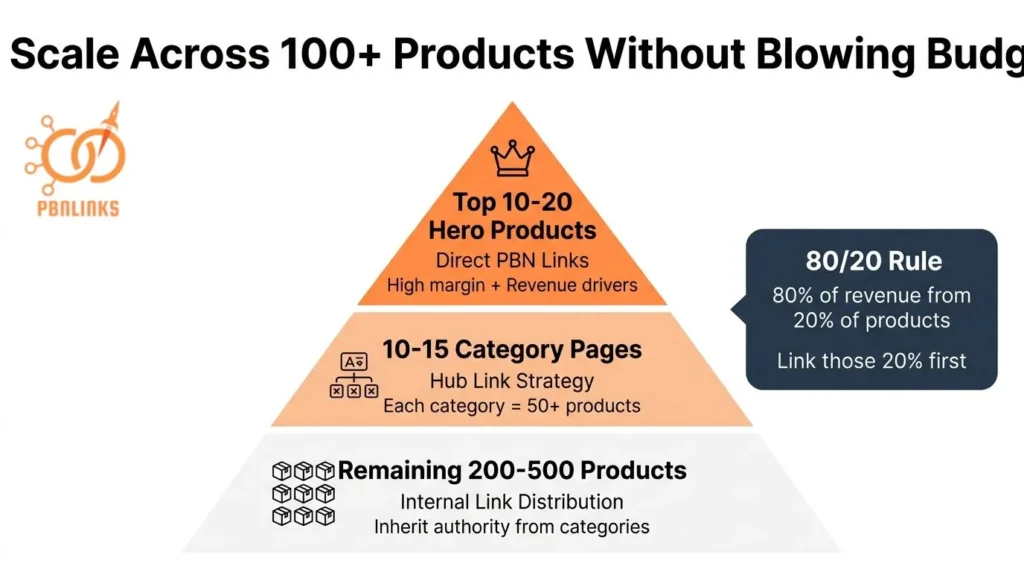
Stores with 100+ products need a hub-and-spoke approach. Link 5 to 10 category pages with PBN backlinks. Let internal links distribute that authority to hundreds of product pages.
The structure:
- 10 PBN links to “Women’s Running Shoes” category
- Category page links to 50 individual product pages
- Each product inherits authority without needing its own PBN links
This scales without blowing your link building budget. At PBN Links Agency we help ecommerce stores design multi-tier strategies that maximize ROI across large product catalogs.
Prioritize your best-selling categories. If 60% of revenue comes from three categories, those deserve most of your PBN links. Secondary categories can rely on homepage authority and internal linking until revenue justifies direct links.
Reserve direct product links for your top 10 to 20 hero products. These are your highest-margin items or seasonal bestsellers that need ranking urgency. Everything else gets authority through the category hub structure.
PBN Anchor Text Strategy for Ecommerce
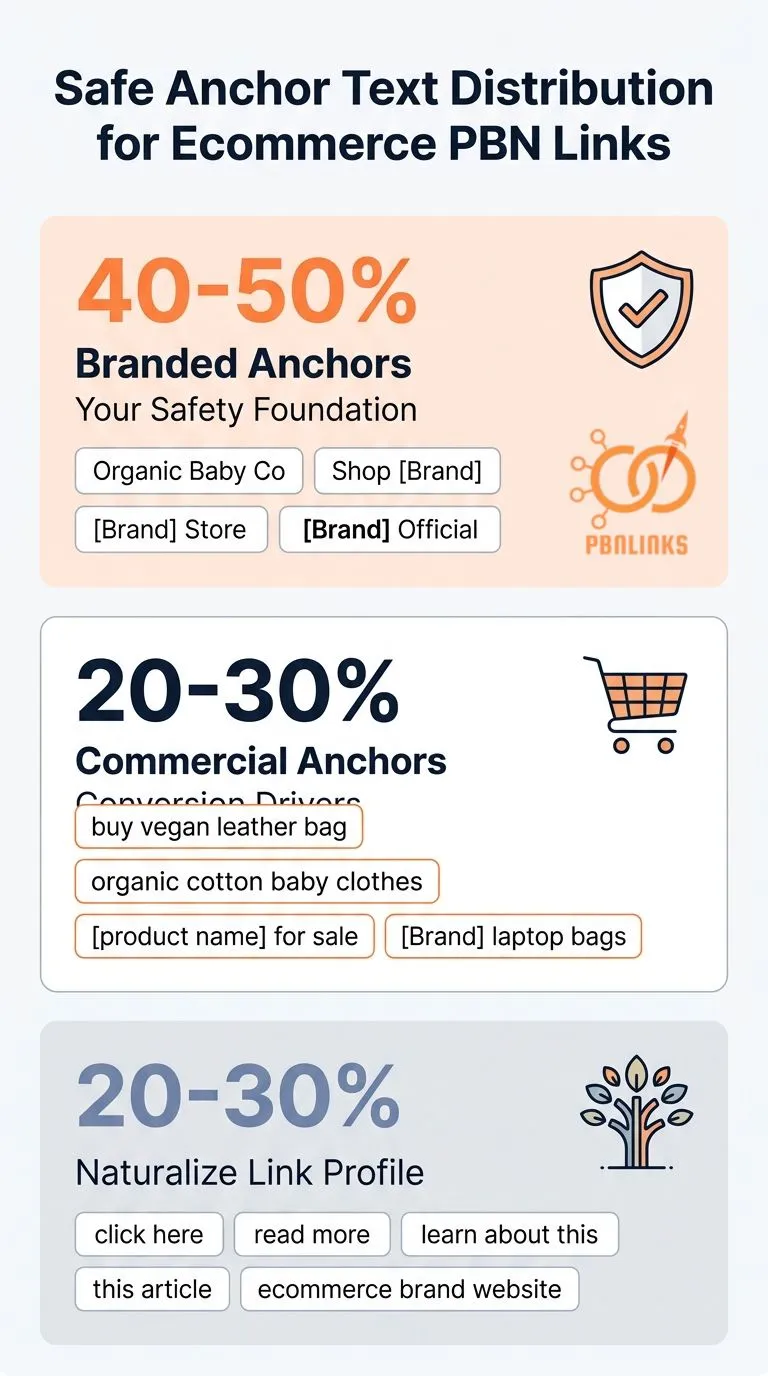
PBN anchor text for ecommerce carries higher risk than guest posts or editorial links. Google’s commercial query filters target product pages aggressively, and PBN footprints amplify when you repeat anchors across multiple domains. The safest distribution is 40 to 50% branded anchors, 20 to 30% commercial anchors, and 20 to 30% navigational or generic anchors. This balance delivers commercial intent while avoiding the anchor patterns that expose PBN networks.
Branded Anchors: Your 40-50% Foundation
Branded anchors form your PBN safety foundation. Use your store name and brand variations for nearly half your backlink profile. “Organic Baby Co,” “Shop Organic Baby Co,” or “[Brand] Clothing” create legitimate brand mention patterns that don’t trigger footprint detection.
PBN links need higher branded percentages than guest posts. Guest posts on real editorial sites can use more keyword anchors because they carry natural context. PBN links lack that editorial wrapper, so branded anchors provide cover. Push branded to 50 to 60% for new stores in the first 90 days.
Rotate branded variations across PBN domains. Don’t use “Organic Baby Co” on 10 different PBN sites. Alternate between your exact brand name, “Shop [Brand],” “[Brand] Store,” and “[Brand] Official” to avoid identical anchor repetition across your network.
Homepage links should be 90% branded. Category pages can drop to 60% branded mixed with category keywords. Product pages need commercial anchors but should still include 30 to 40% branded variations to dilute pure commercial patterns.
Commercial Anchors: Your 20-30% Conversion Driver
Commercial anchors drive product page rankings but expose PBN placements to higher scrutiny. “Buy vegan leather laptop bag,” “organic cotton baby onesie for sale,” or direct product names target transactional searches. Limit these to 20 to 30% of your PBN profile.
Never use the same commercial anchor on multiple PBN domains linking to one page. If you place 5 PBN links to your “Vegan Leather Laptop Bag” product, use 5 completely different anchor variations. “Buy vegan leather laptop bag,” “laptop bag vegan leather 15 inch,” “shop vegan leather bags,” “[Brand] laptop bags,” and “vegan leather computer bag” spread the anchor pattern.
PBN commercial anchors should be LESS aggressive than guest post anchors. Guest posts on real sites can handle exact-match product names because editorial context provides cover. PBN links need partial matches and modifiers. Use “leather laptop bags” instead of “buy vegan leather laptop bag 15 inch black” on PBN placements.
Mix brand into commercial anchors when possible. “[Brand] vegan leather bags” or “buy [Brand] laptop bags” combine commercial intent with brand signals that look more natural than pure product keyword anchors.
Navigational and Generic Anchors: Your 20-30% Safety Buffer
Navigational and generic anchors are critical for PBN footprint avoidance. These anchors create diversity that makes your backlink profile look natural rather than manipulated.
Use generic anchors more heavily on PBN links than you would on guest posts. “Click here,” “shop now,” “learn more,” and “visit site” provide zero keyword value but massive footprint protection. Real editorial sites use generic anchors frequently. Your PBN profile should mirror this.
Navigational anchors like “Men’s Running Shoes Collection” or “Winter 2026 Line” work well for category page PBN links. They describe the destination without keyword stuffing.
Reserve 20 to 30% of PBN backlinks for navigational and generic combinations. When you’ve already placed branded and commercial anchors to a page, use generic anchors for additional PBN links to avoid anchor clustering.
Avoiding PBN Anchor Footprints
Anchor text repetition across PBN domains creates detectable patterns. Using “buy Nike Air Max 90” on 8 PBN sites linking to the same product page signals network manipulation even if the domains appear unrelated.
PBN anchor rules:
- Never repeat exact anchors across PBN domains
- Maximum 1 commercial anchor per product page from your PBN network
- Rotate through branded variations across all PBN placements
- Save aggressive commercial anchors for guest posts and niche edits
Track anchor distribution separately for PBN links vs. other link types. Your total backlink profile might show healthy diversity, but if your PBN subset shows 60% commercial anchors, you’ve created a footprint. At PBN Links Agency we rotate anchors across placements and mix PBN links with guest posts to prevent anchor clustering that flags networks.
Mix your link types strategically. Use PBN links with branded and generic anchors. Place commercial anchors through guest posts on real editorial sites. This creates anchor diversity across link sources that Google expects to see.
Timing PBN Links for Seasonal Traffic
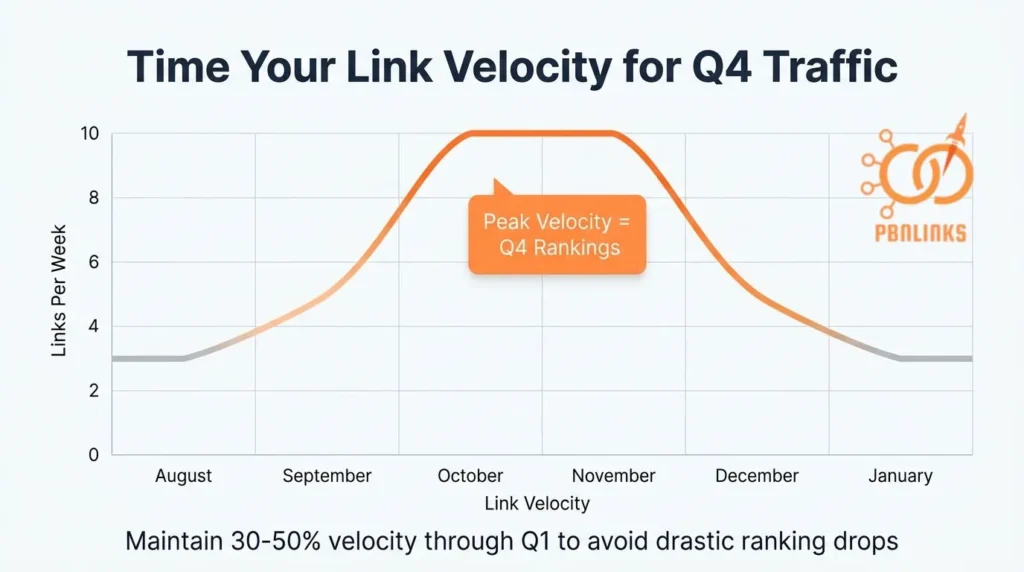
Ecommerce is seasonal and your link building should match demand curves. Q4 drives 30 to 40% of annual revenue for most online stores. Your product pages need to rank in October and November, not February when traffic is gone.
Why Seasonal Stores Need Link Velocity Spikes
Search volume for holiday keywords spikes 200 to 400% during peak months. “Christmas gifts for dad” gets 50 searches in July and 5,000 in November. Google prioritizes pages with recent backlink activity when queries trend upward.
Link velocity acts as a ranking signal during seasonal surges. A product page gaining 10 backlinks in October ranks faster for “Black Friday deals” than a page that gained the same 10 backlinks spread across 12 months. Fresh link growth signals current relevance.
PBN links solve the timing problem. Guest post outreach takes 6 to 8 weeks. Editorial placements take 3 to 4 months. You can’t wait that long when launching a Halloween store in August that needs September rankings. PBN placements happen within days, which lets you build velocity when seasonal windows are compressed.
According to National Retail Federation data, Q4 accounts for nearly 40% of annual retail sales in the United States. Missing October and November rankings means losing your most valuable revenue window.
August–November: The Q4 Link Timeline
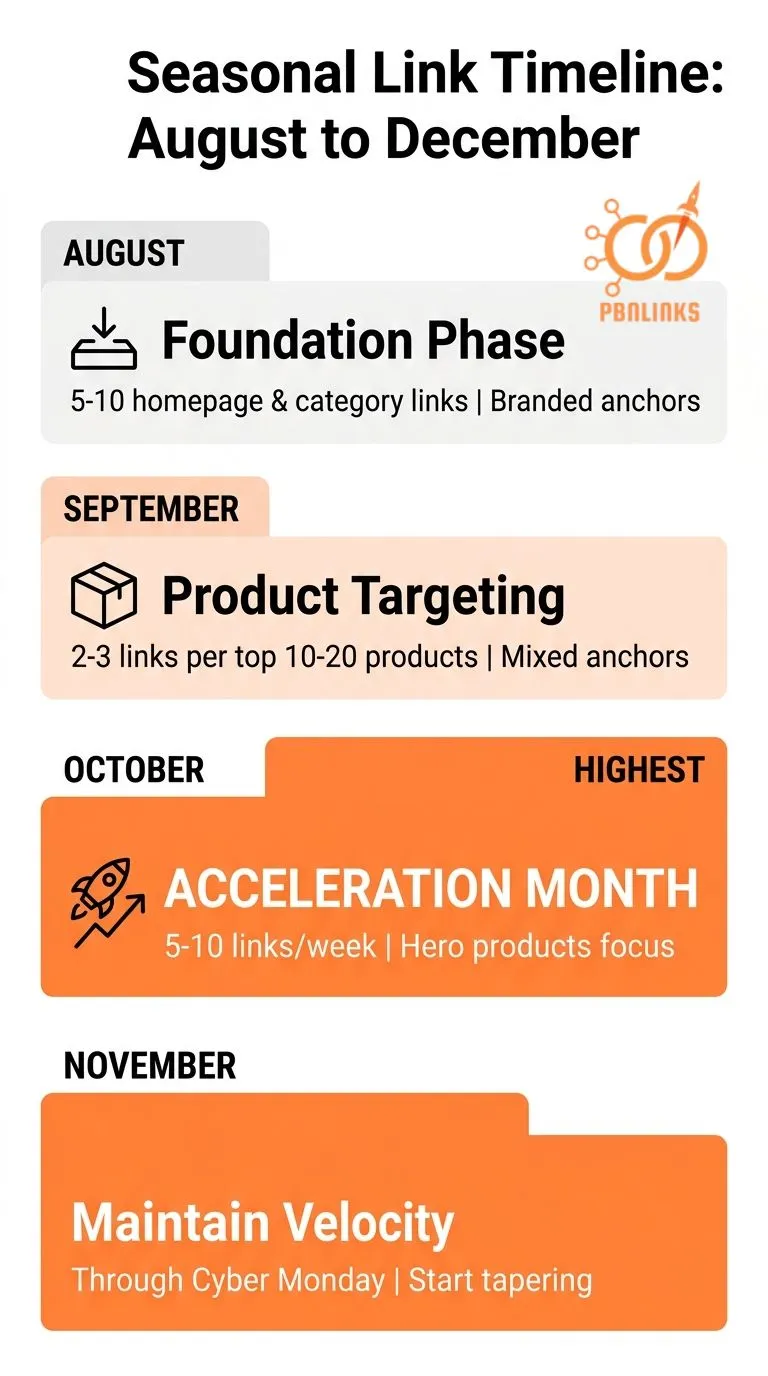
August builds your foundation. Place 5 to 10 backlinks to your homepage and main category pages. Use mostly branded anchors during this phase. You’re establishing domain trust before seasonal products launch.
September targets your top holiday products. Identify 10 to 20 items with the highest seasonal demand and place 2 to 3 links per product throughout the month. Spread placements across different weeks to keep velocity gradual.
October is acceleration month. Increase to 5 to 10 total links per week across your catalog. Focus on Black Friday target products and high-margin seasonal items. This is when link velocity matters most for pre-holiday rankings.
November maintains October’s pace through Cyber Monday. After Thanksgiving week, start tapering. Drop to 3 to 5 links per week in early December to avoid sudden velocity cliffs.
December focuses on maintenance. Place 2 to 4 links per week through the month. You’re creating a gradual decline that prevents January drop-off footprints while keeping authority signals active.
Post-Holiday Link Maintenance
Don’t stop building links in January. Sudden velocity drops from 40 links in October to 0 in January create detectable patterns. Maintain 30 to 50% of your Q4 velocity through Q1.
Shift targets from seasonal products to evergreen items and Valentine’s Day or Easter inventory if relevant. If you placed 10 links per week in October, drop to 3 to 5 per week in January. This creates continuous growth at varying speeds rather than boom-bust cycles.
Link building through slow months keeps your domain authority stable while competitors go silent. February and March prepare you for Mother’s Day, summer products, and back-to-school cycles depending on your niche.
Plan your link calendar around seasonal demand curves. High velocity during peak seasons, moderate velocity during transition months, consistent baseline activity year-round. This pattern looks natural to Google’s algorithms and avoids the footprint signals that trigger penalties.
Scaling PBN Links for Large Catalogs (100+ Products)
Stores with 500+ products can’t manually link every page. Scaling requires prioritization and internal distribution to maximize ROI without blowing your link building budget.
The first step is deciding which products deserve direct PBN links.
Prioritize High-Value Products
Not all products deserve PBN links. Your budget should go to items that drive revenue and profit. Direct your link building investment using these four criteria:
High Profit Margin
A leather jacket with 60% margin and $200 price point deserves links before a t-shirt with 15% margin at $15. Link building cost should match profit potential per unit.
Revenue Performance
Use the 80/20 rule. Identify the top 20% of products by revenue and prioritize those for PBN placements. Most stores see 80% of revenue come from 20% of SKUs.
Keyword Competition
Products facing Amazon on page one need more links than products in low-competition niches. Check SERP difficulty in Ahrefs or SEMrush before allocating budget.
Seasonal Timing
Prioritize products with compressed seasonal windows. Halloween costumes need links by August. Evergreen products can wait until later phases.
Batch Linking for Efficiency
Manual linking doesn’t scale past 20 products. Batch linking groups similar products and places links in waves to maintain safe velocity.
Group products by category or timing. Place 10 winter coat links in week one, 10 dress links in week two, 10 shoe links in week three. This creates consistent velocity without footprint risk from dumping 30 links to random products simultaneously.
Batching creates natural anchor variation. Ten winter coats get different commercial anchors like “buy wool coat,” “winter jacket for women,” and “cashmere coat sale” without repetition. At PBN Links Agency we handle batch placements for large catalogs by grouping products strategically and distributing links to maintain safe velocity patterns.
Internal Links Distribute Authority
Hub-and-spoke architecture amplifies PBN investment. Place PBN links on 10 to 20 category pages. Let those categories distribute authority to 50 to 200 product pages through internal links.
One category page with 10 PBN backlinks passes equity to every product it links internally. Your “Women’s Winter Coats” category with 5 PBN links distributes authority to 40 individual coat products. You’ve amplified 5 external links into authority for 40 pages.
Reserve direct PBN links for your top 10 to 20 hero products. Everything else gets authority through category distribution. This keeps costs manageable while ensuring your entire catalog benefits from link equity.
Avoiding Penalties on Transactional Pages
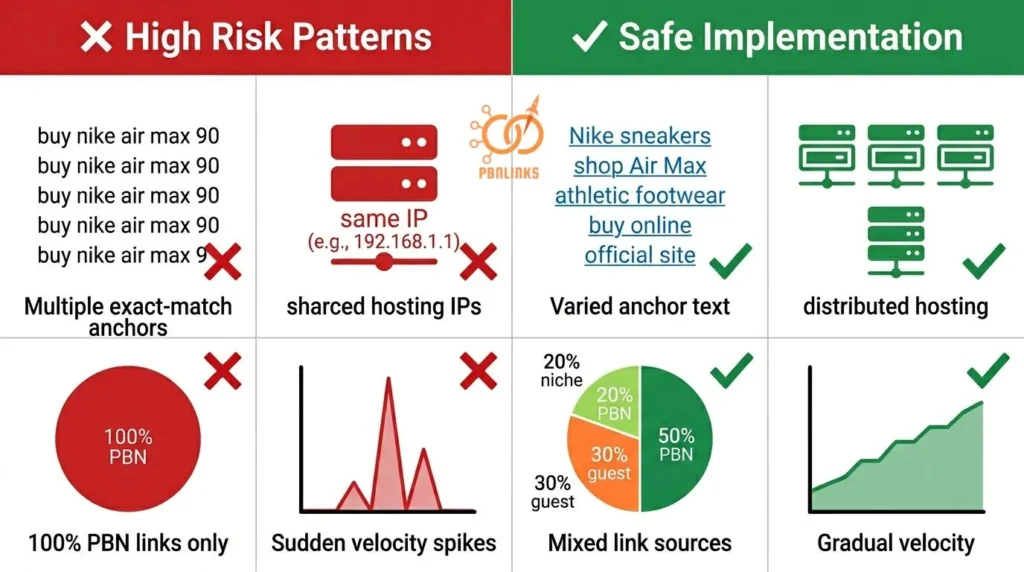
Google scrutinizes commercial queries harder than informational content. Product pages face higher penalty risk because they target money keywords where spam is rampant.
Google Watches Commercial Queries Closely
Google prioritizes user trust for transactional searches. Someone searching “buy running shoes” is about to spend money, so the algorithm filters commercial SERPs more aggressively than informational queries. Manual review teams target product pages and ecommerce sites specifically.
Transactional pages with aggressive link profiles get flagged faster than blog content. A product page with 20 backlinks using commercial anchors triggers scrutiny. A blog post with the same anchor pattern might not.
Link diversity is critical for ecommerce. Relying entirely on PBN links creates a detectable pattern. Mix PBN placements with guest posts on real editorial sites and niche edits from news outlets. This combination dilutes footprint risk while maintaining link velocity.
Exact-Match Product Anchors Trigger Filters
Exact-match product anchors repeated across multiple links trigger manual actions faster than any other pattern. “Buy Nike Air Max 90” used 15 times signals automated spam even if links come from different domains.
Google’s commercial query filters are more sensitive than informational filters. A how-to article can handle 5 to 7 exact-match anchors without penalty. A product page gets flagged after 3 to 4 exact matches on competitive keywords.
Vary every commercial anchor. Use partial matches, synonyms, and modifiers. “Nike Air Max 90 running shoes,” “Air Max 90 sneakers,” “buy Nike Air Max trainers,” and “athletic shoes Nike” spread the pattern. Mix branded elements like “[Brand] running shoes” to add safety.
This was covered in detail in the anchor text strategy section. The key point here is that product pages have lower tolerance for anchor repetition than other page types.
PBN Footprints: IP, Hosting, and Themes
Shared hosting infrastructure creates detectable PBN footprints. Domains on the same IP range, identical hosting providers, or matching WordPress themes signal network manipulation. Google’s algorithms detect these patterns when multiple sites link to the same product page.
Diversify your PBN infrastructure. Use different hosting companies across domains. Vary content management systems and themes. Unique content on each domain reduces similarity signals that flag networks.
Avoid linking multiple PBN domains to the same product page within short timeframes. Placing 5 PBN links to one product in the same week from domains that share any infrastructure creates a compound footprint. Spread placements across weeks and rotate through completely different network segments.
At PBN Links Agency we maintain clean infrastructure with distributed hosting, varied platforms, and staggered placement timing to prevent the footprints that trigger ecommerce penalties.
Mix PBN with Other Link Types
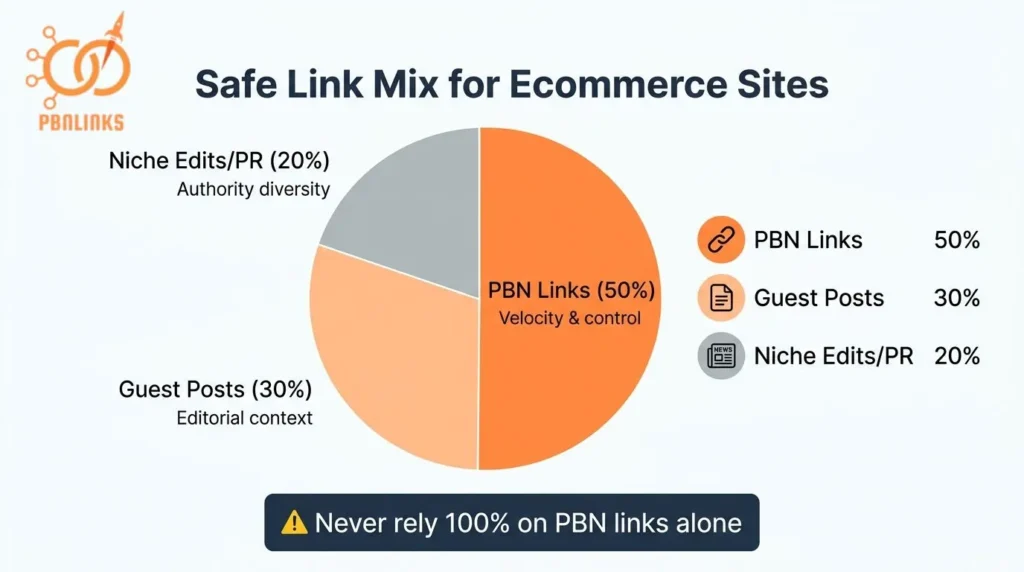
Don’t rely entirely on PBN links. A backlink profile showing 100% PBN placements with no editorial diversity creates obvious manipulation signals. Mix your link sources to create natural-looking growth.
A safe distribution for ecommerce is 50% PBN links, 30% guest posts, and 20% niche edits or PR placements. PBN links provide velocity and control. Guest posts on real editorial sites add natural context. Niche edits from established news sites bring authority diversity.
Editorial links dilute PBN footprints by adding legitimate sources to your profile. When Google analyzes your backlinks, it sees a mix of PBN domains and real publications rather than network-only patterns. This diversity signals organic growth rather than pure manipulation.
Link diversity creates sustainable rankings. Pure PBN strategies work short-term but carry long-term penalty risk. Blending link types builds authority that survives algorithm updates and manual review scrutiny
Conclusion
PBN links give ecommerce stores the authority needed to compete in commercial SERPs. Product pages don’t earn editorial backlinks naturally. PBN placements solve this by providing ranking power through strategic link building, seasonal velocity, and category page distribution.
New Shopify and WooCommerce stores close the authority gap with Amazon fast. You don’t wait 6 to 12 months for traditional outreach. Safe implementation requires anchor text diversity, footprint avoidance, and mixing PBN links with guest posts.
At PBN Links Agency we help ecommerce brands rank product pages in competitive queries. We place contextual backlinks on aged, high-authority domains while maintaining clean velocity patterns and link diversity. Contact us to build a custom PBN strategy for your store.
FAQs About PBN Links for Ecommerce
What are PBN links for ecommerce?
PBN links for ecommerce are backlinks from private blog networks that help product pages and category pages rank in commercial search results. They provide authority signals that new stores need to compete with Amazon and big retailers.
Do PBN links work for product pages?
Yes, PBN links work for product pages by providing authority signals that help them rank for transactional keywords. Product pages rarely earn natural backlinks, so PBN links fill this gap and accelerate rankings.
Can PBN links help me outrank Amazon?
PBN links can help you outrank Amazon on long-tail product queries where competition is lower. Target niche keywords like “vegan leather laptop bag 15 inch” instead of broad terms like “laptop bag.”
Should I link to product pages or category pages first?
Link to category pages first if you’re building foundational authority, then add product page links in weeks 5-8. Category pages rank for broader keywords and distribute link equity to products through internal links.
How many PBN links does a new ecommerce store need?
A new ecommerce store needs 30-50 backlinks in the first 90 days split between homepage, category pages, and top products. Start with 5-10 links to homepage and categories in month one, then add 2-3 links per hero product.
What anchor text should I use for product page links?
Use 40-50% branded anchors, 20-30% commercial anchors like product names or “buy [product],” and 20-30% generic anchors. Avoid repeating exact-match product names across multiple links.
When should I start building links for Q4 and Black Friday?
Start building links in August by targeting homepage and category pages, then accelerate to hero products in September. Ramp link velocity to 5-10 links per week in October to rank before Black Friday.
How do I scale PBN links for 500+ product pages?
Prioritize the top 20% of products by revenue and link to those first, then use category page internal links to distribute authority to remaining products. Batch similar products and place links in waves instead of one-by-one.
Are PBN links safe for transactional pages?
PBN links are safe if you maintain link diversity, natural anchor text ratios, and clean footprint hygiene. Mix PBN links with guest posts and niche edits, and avoid exact-match product anchors repeated across multiple links.
What happens if I only use PBN links and no other link types?
Relying 100% on PBN links creates an unnatural profile that increases penalty risk. Mix PBN links (50%), guest posts (30%), and niche edits (20%) to mimic organic growth.
Can I use PBN links for Shopify and WooCommerce stores?
Yes, PBN links work for both Shopify and WooCommerce because Google ranks based on content and authority, not platform type. New stores on both platforms start with zero authority and benefit equally from PBN links.
How long does it take for PBN links to rank product pages?
PBN links typically move product pages within 30-60 days if placed on high-authority relevant domains. Low-competition keywords may rank in 2-4 weeks while competitive queries take 60-90 days.
Do PBN links help with product page indexing?
Yes, PBN links accelerate indexing by creating external backlinks that signal crawl priority to Google. Product pages buried deep in site structure get indexed in days instead of weeks.
What’s the difference between linking to a homepage vs a product page?
Homepage links build domain-level authority that benefits the entire site, while product page links target specific buyer keywords. Start with homepage links for foundation, then add product links for high-priority SKUs.
Will PBN links trigger a Google penalty on my ecommerce site?
PBN links can trigger penalties if used with exact-match anchor spam, shared IP footprints, or 100% PBN reliance. Safe implementation requires link diversity, varied anchors, and clean infrastructure with different hosts.