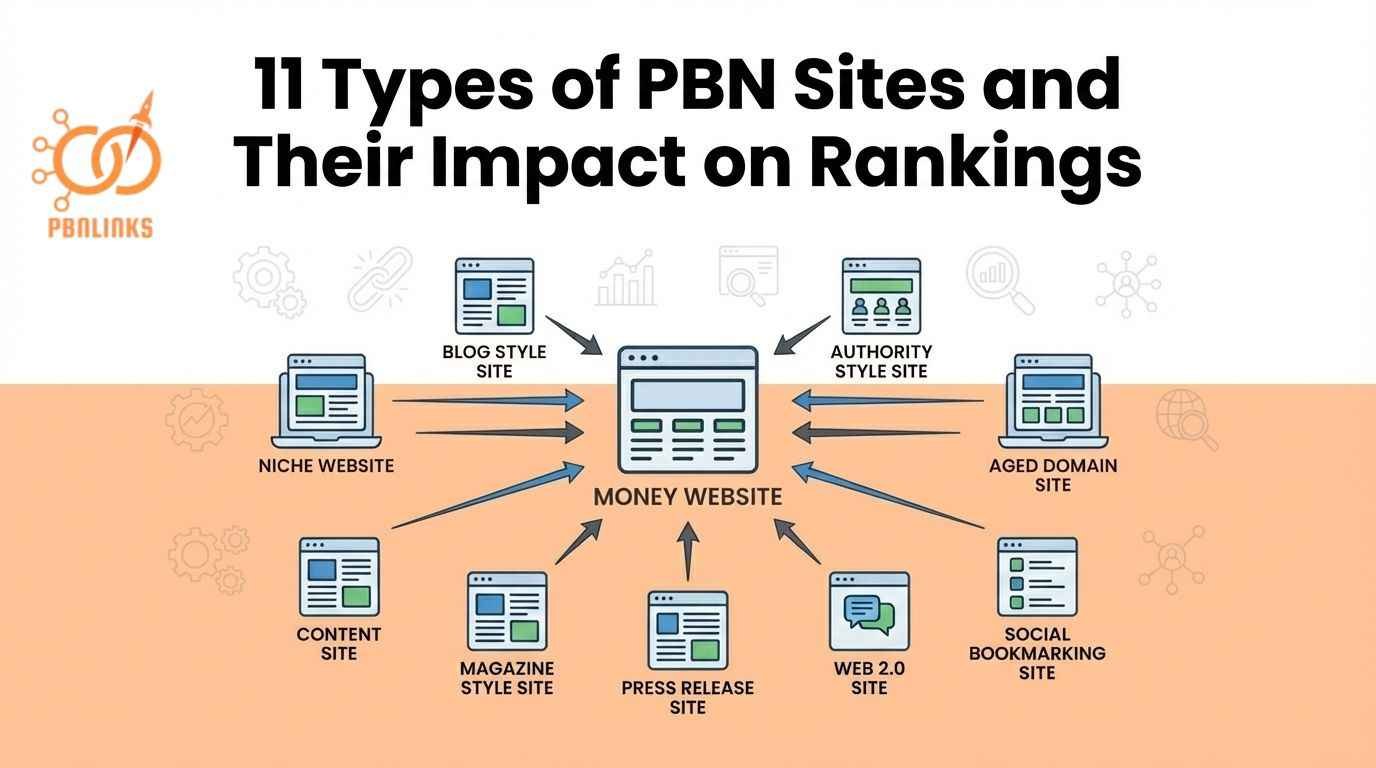
11 Types of PBN Sites Explained: How Different Structures Influence SEO Rankings
Why do some PBN links improve rankings quickly while others have little impact?
The answer often depends on the types of PBN sites used in the network. Many people think all PBN sites work the same way. In reality, different PBN site structures influence rankings in very different ways.
Some PBN sites pass authority quickly and can help pages move up in search results faster. Others work more slowly but help create stability over time. Certain types are safer for long term growth, while others can create risk if they are used too aggressively.
Because of this, the structure of a PBN site matters just as much as the link itself. When the wrong type is used, rankings may stay stuck or move very slowly. When the right type is used, the same link can produce much stronger results.
In this guide, you will learn the 11 main types of PBN sites and how each one affects search rankings. We will explain how these sites are usually built, how they influence authority, and when each type should be used in an SEO strategy.
Understanding the different types of PBN sites helps you build a smarter PBN strategy, reduce unnecessary risk, and achieve more predictable ranking improvements.
What PBN Site Types Are and Why They Matter
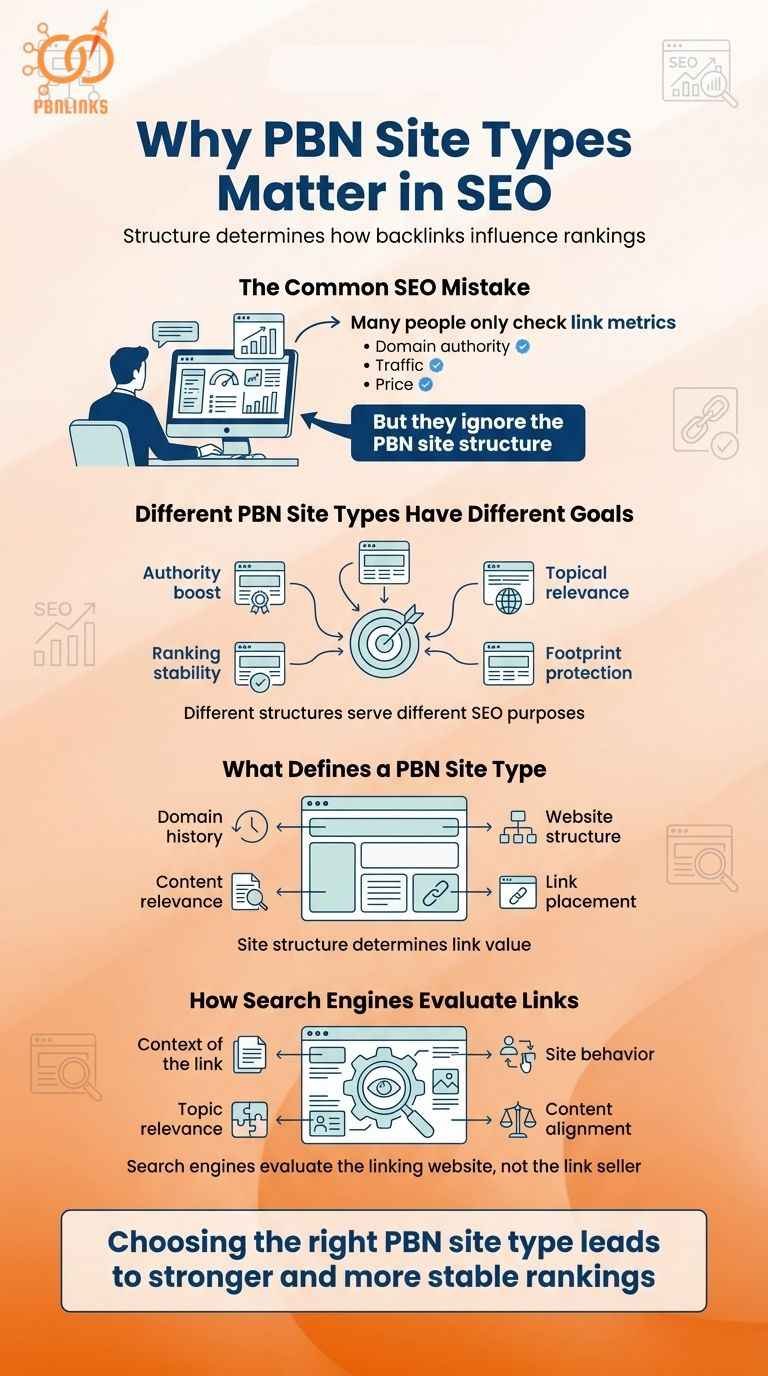
PBN site types explain how a PBN website is built and what role it plays in a link strategy. The type of site affects how a backlink passes authority, how stable the ranking impact is, and how search engines interpret the link.
Many people focus only on buying PBN links. They check metrics such as domain authority or traffic. But they often miss a more important question. What type of PBN site is the link coming from?
This detail matters because not all PBN sites are built the same way. Some are designed to push rankings quickly. Others are built to support long term stability. Some focus on relevance within a niche. Others are designed to reduce patterns that search engines may detect.
When the wrong type of PBN site is used, the link may have little effect. In some cases, it can even create instability in rankings. This is why understanding the types of PBN sites is an important part of building a reliable SEO strategy.
PBN sites are created with different goals. Common purposes include:
• Passing authority to competitive pages that need stronger ranking signals
• Supporting rankings gradually to maintain stability.
• Strengthening topical relevance between the linking site and the target site
• Reducing patterns that could expose a network footprint
• Supporting stronger backlinks instead of acting as the main authority link
Because these goals are different, the structure of PBN sites also varies.
Several factors usually define the type of a PBN site:
• Domain history and how the domain was used in the past
• Topical focus of the content and its relevance to the target site
• Website structure, including layout and internal pages
• Link placement, meaning where and how backlinks appear in the content
These elements influence how search engines evaluate the link. The impact of a PBN link does not depend only on the seller providing it. It depends on the website hosting the link and how that site is structured.
Relevance plays a major role in this evaluation.
• Search engines look beyond link strength or metrics
• They evaluate whether the linking site is related to the topic of the target site
• Even strong backlinks can lose effectiveness if the linking site is not relevant
At PBNLinks.Agency, this difference is considered before any links are placed.
• The target website is analyzed first
• Its niche, authority level, and growth stage are reviewed
• The most suitable types of PBN sites are selected based on structure and relevance
This approach helps create more stable ranking improvements because it matches how search engines evaluate links today.
Understanding the types of PBN sites removes guesswork from PBN strategies. It explains why the same PBN link can work very well for one website but produce little impact for another.
In the following sections, each PBN site type will be explained clearly. You will see how each type is built, what role it plays in a strategy, and when it should or should not be used.
Type 1: Expired Authority Blog PBN Sites
Expired authority blog PBN sites are created using domains that once hosted real blogs. These domains already have backlinks, a content history, and signals of trust. Because search engines have seen the domain before, the site can pass authority more quickly than a brand new domain.
The idea is simple. Instead of building a site from nothing, the strategy restores a domain that already has recognition. When the rebuild is done properly, the domain can help transfer authority to target pages much faster.
What Defines This Structure
The defining factor of this PBN type is the domain’s previous identity. A true expired authority blog was once active, published useful articles, and attracted natural links from other websites.
The goal when rebuilding is to restore that identity, not replace it with something unrelated.
A typical expired authority blog PBN site looks like a normal blog. It usually includes:
• Articles organized into clear categories
• Internal links connecting related posts
• A consistent publishing pattern that looks natural
This structure helps the site appear like a genuine blog rather than a network site created only for links.
How Expired Domains Are Rebuilt
Rebuilding begins by reviewing the domain’s history and topic. The new content should match the subject the domain previously covered. This keeps the site aligned with the backlinks that already point to it.
Content is added gradually to make the site appear active again. Pages may be recreated based on old content themes, and new articles are introduced over time.
A careful rebuild helps preserve the domain’s trust. When the rebuild ignores the original topic or changes direction suddenly, search engines may reduce the value of the domain.
How Authority Is Transferred
Authority is passed through contextual links placed inside relevant articles. These links benefit from the domain’s existing backlink profile and historical trust.
Because the domain already carries authority, the link signals can influence rankings faster than links from newly created sites.
Placement matters more than quantity. A few well placed links inside strong content often provide better results than placing many links across multiple pages.
Ranking Impact in Competitive Niches
Expired authority blog PBN sites are often used in competitive niches where weaker link structures struggle to move rankings.
They are especially useful when a page already has some authority but needs stronger signals to compete with established competitors.
When topical alignment is strong, ranking improvements can sometimes appear within a few weeks.
Structural Risks If Misused
The main risks come from poor domain selection or careless rebuilding.
Problems can occur when:
• The domain has a spam history
• Anchor text is used too aggressively
• The new content ignores the original topic of the site
Another risk appears when the same structure is repeated across too many sites, which can create patterns.
When expired authority blog PBN sites are selected carefully and rebuilt with attention to their history, they remain one of the strongest PBN structures for transferring authority.
Type 2: Niche Relevant Content PBN Sites
Niche relevant content PBN sites focus on a single topic and keep the entire website aligned with that subject. Instead of publishing content on many unrelated themes, these sites operate like small blogs or knowledge hubs dedicated to one niche. Every article, category, and page supports the same central theme, which helps search engines clearly understand the purpose of the site.
Because of this focused approach, niche relevant PBN sites often resemble real specialist websites. They appear more natural than general blogs that publish mixed content only for link placement. As a result, the links placed on these sites tend to align better with the pages they support.
Single Topic Focus and Content Alignment
The main characteristic of this PBN structure is strict topic consistency. The entire site stays within one niche, and every piece of content connects to related subtopics within that area.
Typical features include:
• Articles written around closely related topics
• Categories that organize content within the same niche
• Internal links connecting relevant pages across the site
When a backlink appears inside this type of content, it fits naturally within the discussion. The surrounding text supports the link, and the connection between the PBN site and the target page makes sense. This alignment helps search engines interpret the link as relevant rather than forced.
How Topical Consistency Strengthens Relevance
Topical consistency builds relevance over time. When a site repeatedly publishes content on the same subject, it gradually develops a clear topical identity.
Search engines often interpret this repeated focus as subject knowledge. Because of this, links coming from such sites carry stronger contextual signals.
Ranking improvements from niche relevant PBN sites tend to appear gradually. Instead of sudden jumps, pages usually move up slowly and maintain their positions more consistently, particularly in content driven niches.
Difference From Generic Blog PBNs
Generic blog PBN sites usually publish articles on many unrelated topics. A single site might cover technology, travel, finance, and health without a clear connection between them.
Although these sites may pass some authority at first, their links often lose effectiveness over time because the site lacks a clear subject focus.
Niche relevant PBN sites avoid this issue by maintaining strong alignment. The content, internal linking, and outbound links all support the same theme, which helps the site appear more natural and trustworthy.
Ranking Behavior and Stability Signals
Niche relevant content PBN sites are designed to support steady ranking growth rather than rapid spikes.
They are particularly useful for:
• Affiliate websites
• Content focused blogs
• Long term SEO projects that rely on stable traffic
Because these sites resemble real niche resources, their links often remain effective for longer periods. As long as the content stays relevant and the site continues to publish updates, the ranking signals tend to remain stable.
Type 3: Brand-Style PBN Websites
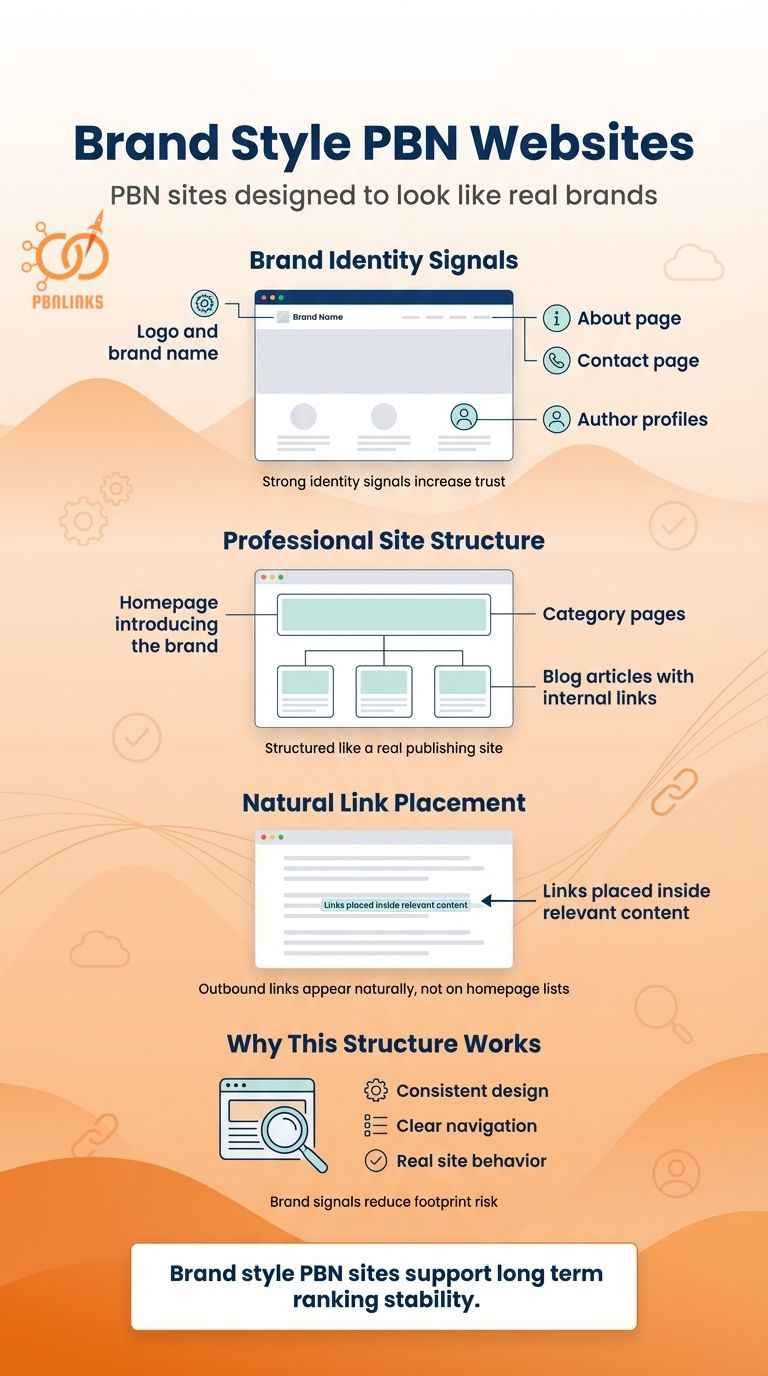
Brand-style PBN websites are built to look and behave like real brands instead of simple blogs. These sites focus on identity, trust, and presentation, making them appear as legitimate businesses, publishers, or niche media platforms rather than link sources.
Unlike other PBN types that rely on raw authority or speed, this structure is designed for credibility and longevity. When done correctly, brand-style PBNs blend naturally into the web and avoid the obvious signals that make weaker PBN setups easy to detect.
Brand-Like Layouts and Identity Signals
This PBN type relies heavily on consistent branding. Sites usually include a clear brand name, logo, about page, contact details, and a uniform design across all pages. Content follows a consistent voice and is often published under author names, which helps the site feel intentional and user focused rather than automated.
Homepage Trust and Internal Linking Patterns
In brand-style PBNs, the homepage plays a trust-building role rather than acting as a link hub. It introduces the brand and highlights important internal pages, while outbound links are placed carefully within relevant content pages. Internal links follow a logical structure that mirrors how real branded websites distribute authority.
How Google Interprets Brand Style Signals
Search engines look for signs that a website represents a real entity. Consistent design, clear navigation, author presence, and supporting pages help reinforce that perception. While branding alone does not guarantee rankings, brand-like behavior reduces the chances of links being treated as artificial.
When This Type Supports Long-Term Rankings
Brand-style PBN websites are best suited for long-term ranking support. They rarely create quick spikes, but they help maintain stability through updates. This makes them especially useful for established sites and competitive niches where reliability matters more than speed.
Type 4: Local and Geo Focused PBN Sites
Local and geo focused PBN sites are designed around a specific location instead of a broad topic. These sites focus on cities, regions, or service areas and often appear as local blogs, business resources, or community style websites. Their main purpose is to support rankings where location relevance plays an important role.
Unlike general PBN structures, this type depends heavily on geographic signals. When built carefully, geo focused PBN sites blend naturally into local search environments and help strengthen location relevance that generic backlinks usually cannot provide.
Location Based Structure and Content
A geo focused PBN site is organized around one main location. The content consistently references that city or region so the site clearly reflects a local theme.
Typical elements often include:
• Articles that mention local services and businesses
• References to neighborhoods, landmarks, or nearby areas
• Content that discusses regional topics or community activity
This structure helps the website appear genuinely tied to the location rather than artificially targeting it.
How Geo Signals Influence Local Rankings
Search engines rely on geographic signals when deciding where a page should appear in local results. When a geo focused PBN site links to a page that targets the same area, the shared location context strengthens the connection.
This geographic relevance helps search engines understand that the linked page belongs in that local environment. As a result, the link can support both standard organic rankings and visibility in map related search results.
Use Cases for Regional SEO
Geo focused PBN sites are commonly used in local SEO strategies where location specific rankings are essential.
They are particularly useful for:
• Service based businesses targeting specific cities
• Local lead generation websites
• Companies running campaigns across multiple locations
In competitive local markets, these sites can provide additional geographic relevance that general backlinks often fail to deliver.
Common Structural Mistakes to Avoid
Problems usually occur when location signals are forced instead of built naturally.
Common mistakes include:
• Repeating city names excessively throughout the content
• Publishing thin location pages with little useful information
• Creating multiple sites with identical layouts and structures
Local PBN sites work best when each one feels unique and genuinely connected to its location. When the content reads naturally and the structure reflects the area, the links appear more authentic and carry stronger local relevance.
Type 5: Homepage-Only PBN Sites
Homepage-only PBN sites are built around a specific strategy. All outbound links are placed on the homepage, rather than being distributed across blog posts or inner pages. The goal is to concentrate authority in one place and pass it directly from the site’s most trusted page.
This structure is used for maximum impact, not subtlety. Because search engines treat the homepage as the central reference point of a website, links placed here often influence rankings faster than links placed on inner pages. At the same time, this visibility makes the structure more sensitive to misuse, which is why control matters as much as power.
How homepage-only placement works
- Outbound links are deliberately restricted to the homepage
- Links are placed in natural homepage sections, such as featured resources
- Precision matters more than volume
Why homepage links pass strong authority
- Homepages attract the most backlinks and internal links
- They receive higher crawl priority and trust signals
- Authority is more concentrated than on inner pages
Because of this concentration, homepage-only PBN links often produce quick ranking movement. They are commonly used to push important pages that already have a foundation but need stronger signals to compete. This effect is usually front-loaded and may slow down if the site does not show realistic behavior over time.
Risk factors that require control
- Too many outbound links dilute trust
- Repeated homepage layouts create patterns
- Aggressive anchor usage increases detection risk
Homepage-only PBNs are not designed to replace contextual or niche-focused PBNs. They work best when used sparingly, with strong variation and clear limits, as part of a broader PBN mix.
Type 6: Contextual-Only PBN Blog Posts
Contextual-only PBN blog posts place links only inside regular blog articles. Links are not placed on homepages, sidebars, or footers. Instead, they appear naturally within content where they support the topic being discussed, similar to how links appear in real editorial or guest posts.
This structure focuses on relevance and safety rather than speed. It is commonly used when long-term stability matters more than quick ranking jumps. While it usually works more slowly than stronger PBN types, it blends better with natural link profiles and carries lower risk.
Links Placed Inside Editorial Content Only
In this setup, outbound links are added only within full articles written for users. The content comes first, and the link acts as a supporting reference inside the discussion. Because the link fits naturally within the text, it does not stand out as promotional or forced.
How Contextual Relevance Affects Trust
Context matters because search engines evaluate the text around a link. When the surrounding content closely matches the linked page, the link looks meaningful. This relevance helps search engines treat the link as a genuine recommendation rather than a manufactured placement.
Slower but Safer Authority Flow
Contextual-only PBN links usually pass authority more gradually. Rankings tend to improve over weeks instead of days, but the movement is smoother and more stable. This slower pace helps avoid sharp patterns that often lead to link value loss.
Ideal Role in a Mixed Link Profile
Contextual-only PBN blog posts work best as part of a balanced link profile. They support stronger links, reduce overall risk, and help maintain stable rankings. This makes them especially useful for affiliate sites and content-focused projects where consistency is important.
Type 7: Rebuilt Legacy Domain PBNs
Rebuilt legacy domain PBNs use older domains with an established history rather than freshly expired sites. These domains were once active websites, often for many years, and still carry historical signals that search engines recognize. The main goal is to revive past authority rather than build it from scratch.
This type relies on trust earned over time. When rebuilt carefully, legacy domains can pass authority quickly. When handled poorly, their value fades or creates instability, making proper restoration critical.
What Legacy Domains Are
Legacy domains are domains that have existed for a long time and previously hosted real websites. They often have old backlinks, mentions, and indexing history that survived multiple algorithm updates. Because of this longevity, search engines may still associate them with trust, even after periods of inactivity.
How Historical Backlinks Affect Rankings
Historical backlinks can still influence rankings if they come from clean and relevant sources. When the rebuilt site aligns with its original topic, these old links help reinforce authority and speed up ranking improvements. If the topic changes too much, the value of those backlinks weakens or disappears.
Restoration vs Repurposing Differences
Restoration means rebuilding the site around its original subject and structure. This approach preserves more authority because the historical context stays intact. Repurposing changes the topic entirely, which may work briefly but often reduces trust. Search engines respond better when a domain’s past and present make sense together.
Authority Decay Risks Over Time
Legacy domains face authority decay footprint risk
if they are not maintained. Old backlinks may disappear, content can become outdated, and trust signals slowly weaken. Without regular updates and realistic site behavior, the initial value of a legacy domain fades, making ongoing care important for long-term results.
Type 8: Multi Topic Authority PBN Sites
Multi topic authority PBN sites are designed to cover several related subjects within one broader theme. Instead of focusing on a single narrow topic, these sites publish content across connected areas, similar to how real authority blogs expand over time.
The purpose of this structure is flexibility while still maintaining relevance. A well managed site can support several pages or projects without appearing unnatural. When the structure is handled carefully, it balances authority and scale. When handled poorly, it can create patterns that increase footprint risk.
Sites Covering Several Related Topics
These sites usually publish content across a group of topics that naturally belong together. For example, a site might cover SEO, content marketing, and analytics because all three topics serve the same audience.
Content is organized into clear categories so the site remains structured and easy to understand.
Typical characteristics include:
• Multiple related categories under one main theme
• Articles that connect logically through internal links
• Content written for a similar audience across topics
This organization helps the site appear like a genuine authority resource instead of a network site built only for linking.
How Semantic Spread Affects Authority
Semantic spread refers to how widely the site expands across related topics. When the expansion stays within a clear theme, search engines can understand the site as knowledgeable across a broader subject area.
In this situation, authority flows naturally between articles and outbound links.
However, as the topic range expands too far, authority becomes less focused. When unrelated subjects are added, the connection between pages weakens and links lose relevance.
The goal is controlled expansion across related subjects, not unlimited topic coverage.
When This Structure Works Best
Multi topic authority PBN sites are especially useful when supporting larger websites or multiple related pages.
They work well in situations such as:
• Supporting several pages within the same niche
• Linking to different sections of a large site
• Supporting broader content strategies over time
In these cases, a single topic PBN may feel too limited, while a generic blog may look unnatural. A multi topic authority site allows gradual growth that looks realistic.
When It Becomes a Footprint Risk
Problems begin when the topic structure becomes inconsistent.
Risk increases when:
• Topics no longer relate to each other
• Similar category structures repeat across many network sites
• Content expands too quickly without a clear theme
Once the site loses a clear topical identity, both authority and safety decrease. Maintaining a consistent theme is what allows this structure to remain effective and natural.
Type 9: Parasite-Style PBN Assets
Parasite-style PBN assets work by placing links on already trusted, high-authority platforms instead of building and managing a full website. Rather than owning the domain, you publish content on an existing site and benefit from the authority it already has.
This structure is used when speed matters more than ownership. Because these platforms are already trusted and crawled frequently, links can influence rankings quickly. However, the lack of control makes this type powerful but naturally unstable if misused.
What Parasite Usage Means in PBN Context
In the PBN context, parasite usage means publishing content on a third-party site you do not fully control. The authority belongs to the host platform, and your link temporarily benefits from that trust. You are leveraging the platform’s strength, not building your own asset.
Leveraging Existing Authority Structures
Parasite-style assets rely on platforms that already have strong authority, traffic, and indexing priority. Because these sites are trusted by search engines, links placed within relevant content are noticed quickly and can pass value without long setup time.
Short-Term Ranking Gains
The biggest advantage of parasite-style assets is speed. They are often used to get quick visibility for new pages, validate keyword potential, or support short-term campaigns. Ranking movement can appear much faster than with owned PBN sites, but it is rarely permanent on its own.
Why Misuse Causes Instability
Instability occurs because the platform is not yours. Overusing the same hosts, placing weak content, or relying too heavily on parasite links increases the risk of removal or devaluation. Since policies and moderation are out of your control, links can disappear without warning.
Type 10: Aged Web 2.0-Based PBN Assets
Aged Web 2.0–based PBN assets rely on older Web 2.0 properties that already have history instead of freshly created accounts. These assets look more natural because they have been indexed before, may have past activity, and do not appear suddenly in search results.
This type is mainly used for support and balance. It does not aim to push rankings aggressively. Instead, it helps strengthen existing links and improve overall profile stability when used correctly.
Difference Between New and Aged Web 2.0s
The main difference comes down to trust and timing. New Web 2.0 sites start with no history and often struggle with indexing and impact. Aged Web 2.0s already have crawl history, which allows their content to be picked up more smoothly by search engines.
Because they look like revived or maintained sites rather than new creations, aged assets blend better into link profiles.
Authority Limitations and Support Role
Even with age, Web 2.0 assets have clear authority limits. They sit on shared platforms and cannot build authority the same way independent websites can. Their role is not to lead but to assist.
They work best by supporting stronger PBNs or contextual links, helping distribute authority and add variation without creating obvious signals.
Why They Cannot Stand Alone
Aged Web 2.0 assets are not designed to work alone. Their authority ceiling is low, and platform restrictions limit long-term impact. Using them as a primary link source usually results in weak or unstable rankings.
They are most effective when paired with stronger assets that carry the main authority.
Best Use as Secondary Reinforcement
The ideal use of aged Web 2.0–based PBN assets is secondary reinforcement. They strengthen existing links, improve link diversity, and help smooth authority flow across a profile.
When used in moderation, they support long-term stability. When overused, they add little value and increase risk.
Type 11: Hybrid PBN Network Structures
Hybrid PBN network structures combine multiple PBN site types instead of relying on a single approach. Rather than putting all authority into one kind of asset, hybrids spread links across different structures such as expired domains, niche sites, contextual posts, and supporting assets.
This type is built for balance and resilience. By mixing different structures, hybrids reduce reliance on any single pattern and create a more natural looking link profile that holds up better over time.
Combining Multiple PBN Site Types
In a hybrid setup, different PBN site types serve different roles. Stronger assets may carry the main authority, while safer or lighter assets provide support. This layered approach allows links to come from various sources and placements instead of repeating the same structure.
The result is a network that looks more organic because no single pattern dominates.
How Authority Flows in Hybrid Setups
Authority in hybrid networks flows through multiple paths rather than one direct route. Some links may point straight to important pages, while others support those links indirectly. This creates smoother authority distribution and avoids sudden spikes that can raise red flags.
Because authority is spread across layers, losses in one area do not collapse the entire structure.
Why Hybrid Structures Perform Better
Hybrid structures perform better because they combine speed, stability, and flexibility. Faster assets help with early movement, while safer assets maintain long-term balance. This mix produces more consistent ranking improvements than relying on one aggressive tactic.
They also adapt better to changes, as adjustments can be made to individual layers without rebuilding everything.
Complexity vs Control Tradeoff
The main tradeoff with hybrid networks is complexity. Managing multiple asset types requires planning, monitoring, and discipline. However, this complexity also provides greater control, allowing fine-tuning of authority flow and risk.
When managed properly, hybrids offer the highest level of control and the most reliable long-term performance.
How Different PBN Site Types Affect Rankings
Different types of PBN sites influence rankings in different ways. The main reason is that each structure passes authority differently, creates different link patterns, and carries a different level of risk. In most cases, the ranking impact depends more on the structure of the linking site than on the link itself.
Some PBN site structures are designed to move rankings faster because they sit on strong pages or established domains.
Examples include:
• Homepage only PBN sites
• Expired authority domains
• Parasite style assets
These structures can push rankings more quickly because they already exist on trusted or high authority pages. They are often used when a new page needs visibility or when an existing page needs an early boost.
Other types of PBN sites influence rankings more gradually. These structures focus more on stability than speed.
Common examples include:
• Contextual links inside blog posts
• Niche focused PBN websites
• Aged Web 2.0 properties
These links pass authority more slowly. However, they usually support steady ranking growth and tend to look more natural over time. For this reason, they are often used to maintain long term stability rather than to create fast ranking jumps.
Ranking behavior can also differ in terms of stability.
• More aggressive structures can cause rapid ranking changes
• Safer structures often lead to slower but more consistent growth
• Repeating the same structure too many times can create detectable patterns
Risk increases when a single PBN structure is scaled without variation. Some site types deliver strong authority but also carry higher exposure if overused. Other types are safer but cannot push rankings on their own.
Because of this, many successful strategies combine several types of PBN sites instead of relying on one structure. This approach helps balance authority, stability, and risk.
In the end, structure matters more than volume. A small number of well built PBN sites with relevant content and careful link placement can outperform a large group of weak links.
Search engines analyze how links appear within content, how websites develop over time, and whether patterns repeat across multiple sites. When the right types of PBN sites are used strategically, the effect on rankings is usually stronger than simply increasing the number of backlinks.
Common Structural Mistakes Across PBN Site Types

Most PBN failures happen because of structural mistakes, not because the concept itself stops working. These mistakes create repeated patterns that make even strong assets lose value quickly. When errors repeat across different PBN site types, risk compounds instead of spreading.
Avoiding these issues is more important than adding more links. Even high-quality PBN sites fail when structure is ignored.
Treating All PBNs the Same
One of the most common mistakes is using every PBN site in the same way. Different PBN site types exist for different purposes. Some are designed for speed, others for stability.
When the same placement style, anchor strategy, or usage pattern is applied to all PBNs, their strengths are wasted and weaknesses are exposed. Each site type should be used according to its role, not as a generic link source.
Overusing One Structure
Relying too heavily on a single PBN structure creates clear patterns. Even a powerful site type becomes risky when it dominates a link profile. Search engines do not need to detect every link. They only need to detect repetition.
Using multiple PBN site types spreads risk and makes authority flow appear more natural. Overuse is often the reason entire networks lose value at once.
Ignoring Topical Alignment
Topical alignment is critical for link value. When a PBN site does not clearly relate to the target page, authority weakens regardless of domain strength. Search engines evaluate relevance before trust.
Strong domains with weak topical alignment often pass less value than smaller sites with clear relevance. Ignoring this connection leads to wasted links and unstable rankings.
Repeating Link Placement Patterns
Repeating the same link placement patterns link profile across sites is another major mistake. Links placed in the same sections, using similar anchors, or appearing at the same frequency make structures easy to identify.
Variation in placement, anchor style, and timing helps links blend naturally. Repetition does the opposite and accelerates value loss.
How to Choose the Right PBN Site Type for Your SEO Goal
Selecting the right PBN site type does not require complicated technical knowledge. The key is using the correct structure at the right moment in your SEO strategy. When the PBN structure matches the current state of your website, ranking progress usually becomes more stable and easier to manage.
Many people ask which PBN site type is the most powerful. A better question is what your website actually needs at this stage. The right choice usually depends on three factors: the age of the site, the level of competition, and the timeline for results.
Site Age Influences How Much Authority a Site Can Handle
The age of your website affects how strongly it can respond to new authority signals.
• New websites tend to react more sensitively to strong authority links
• Supportive and moderate PBN structures help build trust gradually
• Established websites usually tolerate stronger authority signals more easily
As a site gains history and stability, stronger PBN site types can be introduced with less risk of ranking volatility.
Competition Level Determines the Strength of Support Needed
The difficulty of the search results should also guide your choice of PBN structure.
• In lower competition niches, relevant and well placed links may be enough to rank
• Competitive industries often require stronger authority signals
• The goal is not aggressive linking, but choosing a structure that fits the level of competition
When the PBN site type matches the difficulty of the keyword environment, links tend to perform more effectively.
Your Timeline Affects the Type of Structure That Works Best
The speed at which you want results also influences which PBN structures make sense.
• Faster acting PBN types can help with launches, testing, or short term campaigns
• Slower and steadier structures support long term ranking stability
• Mixing fast and slow approaches without planning can cause ranking fluctuations
A balanced strategy usually performs best.
Instead of relying on a single structure, many successful strategies use layered support.
• Some PBN site types focus on passing authority
• Others strengthen topical relevance and stability
• Together they create a more balanced and natural link profile
When different types of PBN sites are used together, the overall strategy becomes easier to control. If one part of the strategy needs adjustment, the entire link profile does not collapse.
How This Guide Helps You Choose a PBN Provider More Wisely
Selecting a PBN provider without understanding how PBN sites are structured often leads to disappointing results and unnecessary risk. This guide is designed to help you evaluate providers more carefully before spending money, so decisions are based on logic and strategy rather than promises or price alone.
When you understand how different PBN site types function, you gain more control over the decision process. Instead of purchasing links blindly, you can select structures that actually support your SEO goals.
Many PBN providers focus only on selling links. They rarely explain the structure behind those links or why a specific type of PBN site is being used.
Common problems buyers face include:
• Providers emphasizing the number of links instead of the structure behind them
• Little explanation about how the links will influence rankings
• Placements that do not match the niche or needs of the target website
Without understanding structure, it becomes easy to accept links that look good on the surface but do not truly support your strategy.
Learning about PBN site structures first helps you judge whether a provider’s offer actually fits your situation.
This knowledge also helps reduce risk when evaluating vendors. For example, it becomes easier to:
• Identify warning signs in a provider’s network
• Avoid relying too heavily on a single PBN structure
• Recognize when a link placement does not match your website’s needs
Instead of comparing providers based on marketing claims, you begin comparing them based on structural relevance and strategy. Resources such as a niche PBN providers guide can help with this process, since they focus on structure, relevance, and suitability rather than simple link availability.
This guide is intentionally educational. Its purpose is to explain how different PBN site types work and how they influence rankings. It does not tell you who to buy from or how to deploy links immediately.
That separation is important. Education should always come first. Once you understand the structures and their purpose, you can make better decisions about execution.
When structure is understood before choosing a provider, PBN strategies become more predictable and risks are easier to manage.
Conclusion
The effectiveness of a private blog network is determined by its structure, not the number of links it produces. Different types of PBN sites pass authority at different speeds, influence rankings in different ways, and carry varying levels of risk. When the right structure is selected, ranking improvements tend to be more stable and predictable.
Selecting the appropriate PBN site type strengthens results because it connects authority with the right level of relevance, competition, and timing. Some structures are ideal for pushing rankings during competitive stages, while others help maintain balance and protect long term stability. Combining multiple structures strategically is usually far more effective than relying on a single approach.
Successful PBN strategies always start with understanding. When SEO professionals know how different types of PBN sites behave, they can make more informed decisions, reduce unnecessary risk, and maintain greater control over link impact.
For businesses and marketers who want PBN strategies built around structure, relevance, and sustainable growth, PBNLinks.agency helps design and deploy the right types of PBN sites to support long term SEO performance.
FAQs About PBN Site Types
Are all PBN site types equally risky?
No, PBN site types carry different risk levels depending on structure, topical focus, and footprint control. Clean, aged, and well-focused site types are generally safer than mixed or repetitive setups.
Which PBN site structures survive algorithm updates longer?
PBN structures built on aged domains with consistent topics and natural linking patterns tend to survive longer. Stability comes from controlled variation, not from link volume or aggressive scaling.
What does “PBN site type” mean in SEO?
A PBN site type refers to how a PBN website is structured, including domain history, content focus, and link placement style. It does not refer to a provider, seller, or agency.
Can Google detect some PBN site structures more easily?
Yes, Google can detect PBN structures more easily when sites share hosting, layouts, or repeated linking patterns. Structural similarity increases footprint risk significantly.
Do homepage-only PBN sites pass more ranking power?
Yes, homepage-only PBN links often pass stronger authority because homepages carry more trust. However, they also carry higher risk if overused or poorly controlled.
Can multiple PBN site types be used together safely?
Yes, combining different PBN site types can improve stability when managed carefully. Hybrid structures reduce reliance on a single detectable pattern and balance risk.
How long does it take to see ranking impact from PBN sites?
Most PBN site types influence rankings within three to six weeks after indexing. Results depend on domain age, placement quality, and how well the structure fits the target site.
Do PBN site types matter more than link quantity?
Yes, structure matters more than quantity in modern SEO. A few well-built PBN sites often outperform many low-quality links.
Are PBN site types still relevant in AI-based search systems?
Yes, PBN site types remain relevant because AI-based systems evaluate context, consistency, and linking behavior. Poor structures lose value faster than clean, focused ones.
Can Google detect rented or shared PBN links?
Yes, rented or shared PBN links are easier to detect when the same sites link to many unrelated projects. Repeated usage patterns increase the chance of devaluation.
What happens if the wrong PBN site type is used?
Using the wrong PBN site type can lead to weak results or unstable rankings. Mismatched structures often waste authority and increase risk instead of improving performance.
Are niche-relevant PBN sites safer than generic PBN blogs?
Yes, niche-relevant PBN sites are generally safer because their content aligns closely with the target topic. Strong relevance helps links appear more natural.