PBN Domain Age: How Old Should a Domain Be for PBN Use?
Every PBN guide tells you to buy aged domains. Few explain what aged actually means. Even fewer tell you what separates a domain worth using from one that just looks old on paper.
Most people focus on one number. How old is the domain? A ten year old domain feels safer than a three year old one. Except age alone tells you nothing about trust, link quality, or whether Google will actually respect that domain’s authority.
A domain can be twelve years old and worthless for PBN use. Another domain half its age can outperform it completely. The difference comes down to what happened during those years, not the registration date itself.
This guide covers what domain age really means for PBN use and the exact thresholds worth targeting. You will learn why backlink history matters more than the age number. And you will get the complete vetting process to run before you buy any domain.
What Domain Age Actually Means for a PBN Domain
Domain age refers to how long a domain has been registered and actively used online. For PBN use specifically, it is not just the registration date that matters. It is the combination of active use, crawl consistency, content history, and backlink accumulation during those years that determines whether that age carries any real trust value.
Here is what that breaks down to in practice.
Registration Date vs Active History — They Are Not the Same Thing
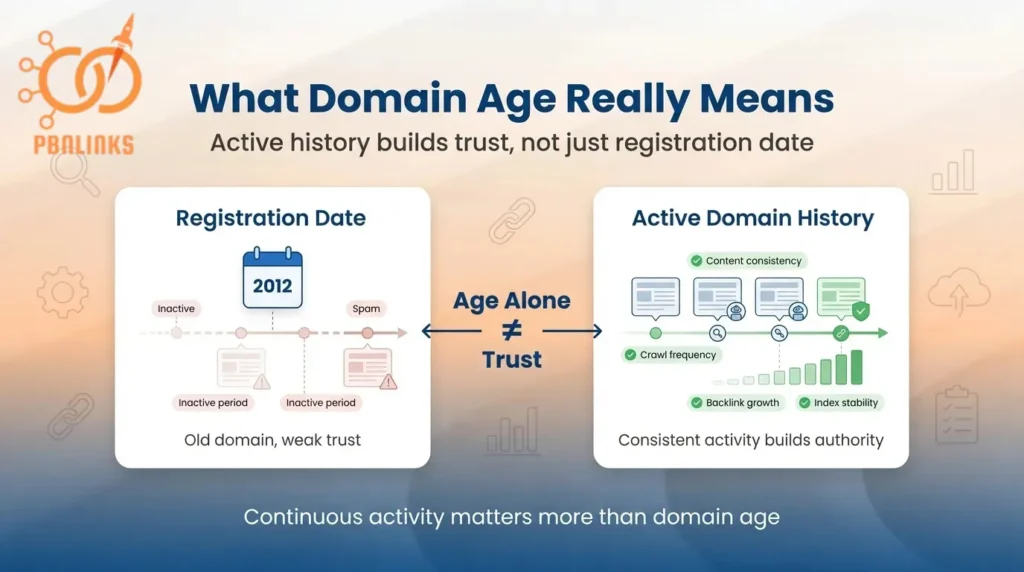
The registration date is simply when a domain was first purchased. It tells you nothing about what the site did during that time. A domain registered in 2012 could have sat completely inactive for eight of those years, hosted spammy content for two, and only recently been cleaned up. That registration date still reads as twelve years old.
What Google actually evaluates is closer to active history. Consistent crawling, real content, and genuine backlinks accumulated over time. A domain registered and built into a real website maintained steadily for four years carries far more trust signal than one registered a decade ago and barely used.
When you see a domain age figure in a vetting tool, treat it as a starting point for investigation, not a verdict.
How Google’s Crawl and Index History Shapes Domain Trust
Google builds trust in a domain through repeated crawling over time. Each time Googlebot visits, finds real content, and sees a consistent backlink profile growing naturally, that domain earns a stronger footprint in the index.
This is why content age in the index matters more than registration age. A domain consistently indexed for three years, with content that stayed on topic and links that grew gradually, signals genuine authority. A domain that disappeared from the index for two years and then resurfaced carries a gap that Google notices.
At PBN Links Agency, the first thing we check before recommending any domain is its Wayback Machine history alongside its Ahrefs crawl data. Those two sources together tell you far more than the registration date alone.
Why a Re-Registered Dropped Domain Is Not Truly Aged
This is the most misunderstood point in PBN domain selection. When a domain fully drops, meaning the previous owner did not renew it and it passed through the expiry process until it became publicly available again, the registration date resets to zero.
Some WHOIS tools still surface the original registration date, which creates confusion. But Google treats a re-registered dropped domain as a new domain carrying an inherited backlink profile. The age signal itself is gone.
The backlinks may still pass value. But the trust that comes from continuous ownership and consistent activity does not transfer. That distinction matters significantly when you are deciding what to pay for a domain and how much weight to give its age figure.
Aged Domains vs Expired Domains — The Distinction That Changes Everything
An aged domain and an expired domain are not the same thing. Knowing the difference determines how much trust a domain brings to your PBN from day one and how much you should pay for it.
Here is how the two compare.
What Is an Aged Domain vs an Expired Domain
These two domain types have one key difference. Whether the domain was ever dropped.
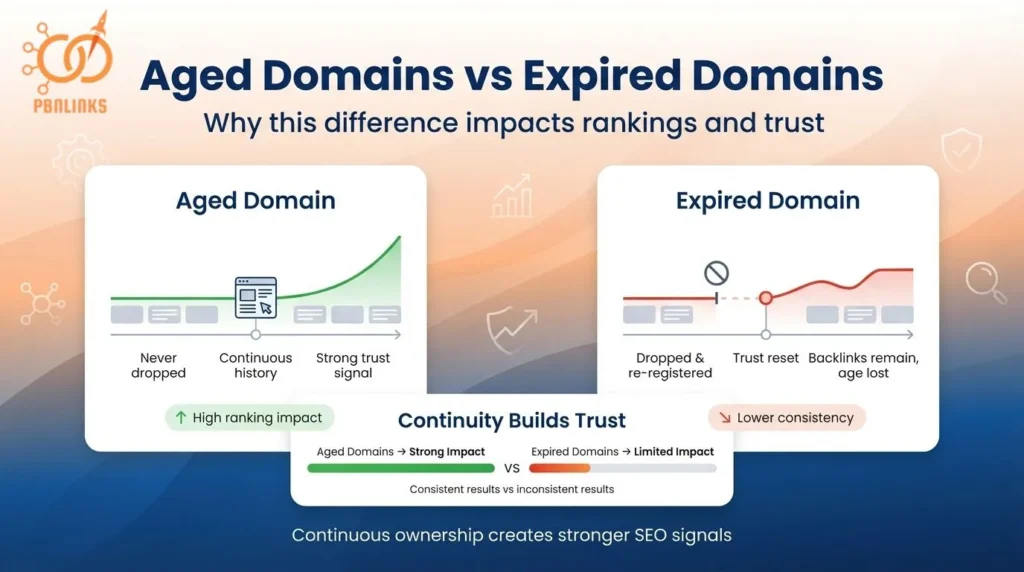
Aged domain: Never lapsed. The original owner kept it registered continuously. It was either held or sold directly without ever expiring. The registration date stays intact. The age signal is genuine.
Expired domain: Lapsed at some point. The owner stopped renewing it, the domain passed through the expiry cycle, and it became available for public registration again. The registration date resets when someone re-registers it. You are buying the backlink profile, not the age.
That single difference has a direct impact on how Google evaluates the domain inside your network.
Why Aged Domains Outperform Expired Domains in Practice
The performance gap is significant. Here is what real testing shows:
| Domain Type | Positive Ranking Boost Rate |
| Aged domain (never dropped) | ~9 out of 10 |
| Expired domain (re-registered) | ~1 out of 5 |
The reason comes down to trust continuity. An aged domain has an unbroken record of ownership, content, and crawl activity. Google has been evaluating it consistently throughout its life.
An expired domain has a gap in that record. Even with strong backlinks, the continuity signal is broken. That gap matters most in competitive niches where Google scrutinises link profiles carefully.
Why You Should Prioritise Aged Domains When Budget Allows
Aged domains cost more. A domain with clean history and three or more years of continuous ownership will cost significantly more than a comparable expired domain at auction.
That premium is worth paying. You get a stronger trust signal from day one, less seasoning time before placing links, and a lower overall risk profile.
Expired domains can still work well when the backlink history is clean and vetting is thorough. But when you have the choice, aged domains are the stronger asset.
At PBN Links Agency, we prioritise aged domains across our network for this reason. The upfront cost is higher but the consistency of results justifies it every time.
Does Domain Age Actually Matter to Google?
Yes, domain age matters to Google but not as a direct ranking signal. Google rewards what accumulates alongside age, which is consistent crawling, clean link growth, and topical content history. Age is simply the timeframe in which those signals built up.
Here is what that means for how you evaluate PBN domains.
What Google Says vs What SEOs Observe in Practice
Google has publicly downplayed domain age as a direct ranking factor.John Mueller confirmed in 2019 that domain age plays no role in rankings once a site is established.
Practitioners consistently observe something different though. Older domains with clean histories tend to rank faster, hold rankings more stably, and recover better after algorithm updates than newer domains with identical content and backlink counts.
The explanation is straightforward. Google is not rewarding age directly. It is rewarding everything that tends to accumulate alongside age. Age is the byproduct of doing things right over time.
Age Is a Proxy Metric — What Google Is Really Evaluating
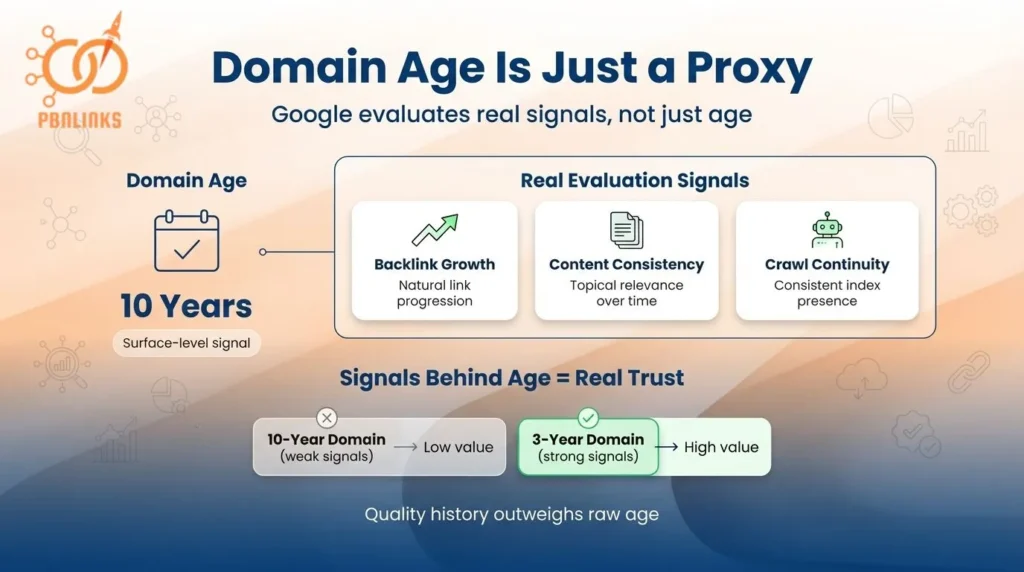
Domain age is a shortcut signal. What sits behind it is what Google actually measures.
For every aged domain, Google is evaluating:
• Backlink growth pattern — Did links accumulate gradually or spike suddenly?
• Content consistency — Did the site stay on topic throughout its history?
• Crawl continuity — Was the domain consistently active or did it vanish from the index?
• Link quality over time — Were referring domains legitimate sources or low quality directories?
A domain scoring well across all four signals over three years is more valuable than one that is simply ten years old with nothing behind it.
The Compounding Effect When Age and Clean Link History Align
When age and clean backlink history work together, the trust signal compounds. This is where aged domains become genuinely powerful for PBN use.
A domain with all of the following in place carries baseline authority that a new domain cannot replicate quickly:
• 3 or more years of continuous ownership
• Gradual natural link growth from relevant sources
• Consistent on-topic content throughout
• No gaps in Wayback Machine history
• No manual penalties or spam signals
That compounded trust is what makes aged domains worth the premium and what makes them more reliable performers inside a PBN network.
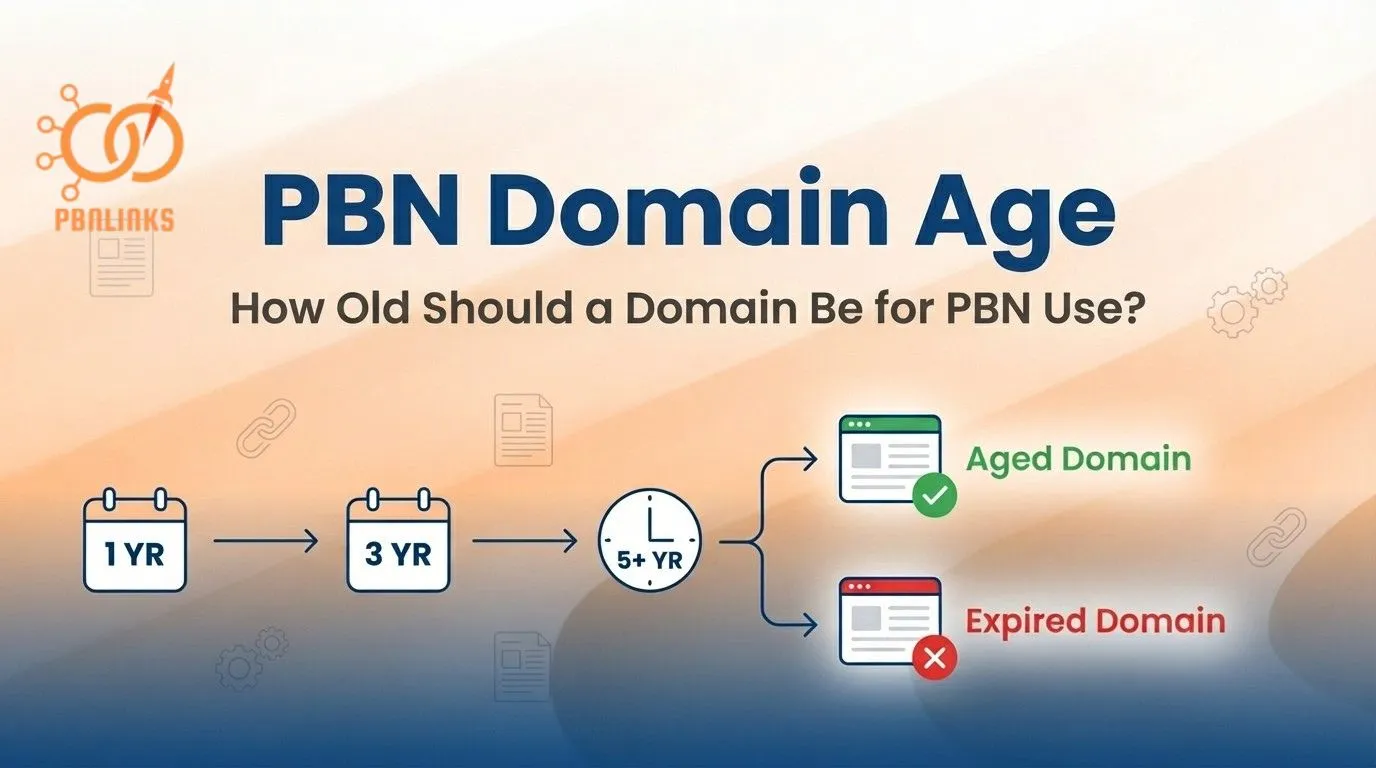
How Old Should a PBN Domain Be? Practical Age Thresholds
There is no fixed formula for the perfect PBN domain age. What matters is not the number itself but what sits behind it. A domain is worth using when its age is backed by clean link history, consistent content, niche relevance, and no penalty signals. Age without those factors is just an old number.
That said, certain age ranges consistently separate weak domains from strong ones. Here is how each range breaks down.
Under One Year — Why This Range Is Too Risky for PBN Use
A domain under one year old has not had enough time to build meaningful trust signals. The crawl history is shallow. The backlink profile is thin. Even if the domain was previously active, a re-registration after dropping resets the age clock entirely.
Using a sub-one-year domain in a PBN is a footprint risk. It looks new, behaves new, and Google treats it accordingly.
The only exception is a freshly transferred aged domain that never dropped. In that case the continuous ownership history stays intact regardless of who now holds it.
Two to Four Years — The Sweet Spot for Most Campaigns
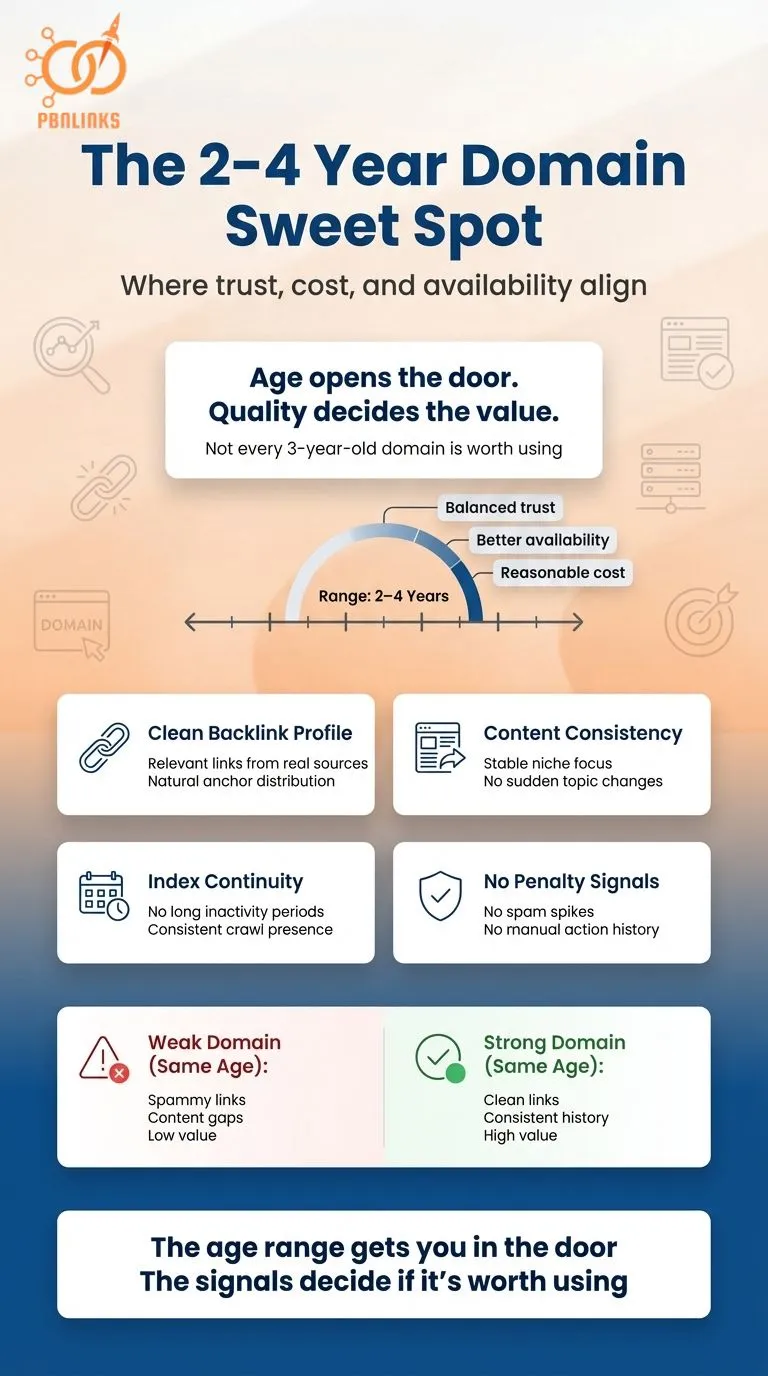
A domain in the two to four year range hits the right balance of trust signal, availability, and cost. But age alone does not make a domain in this range worth using.
For a domain in this range to be a strong PBN asset, it needs:
Clean backlink profile: Links from relevant, legitimate sources with natural anchor text distribution
Content consistency: The site stayed on topic throughout its history with no sudden niche changes
No index gaps: Wayback Machine shows consistent activity with no long periods of inactivity
No penalty signals: No manual actions, no spam score spikes, no sudden link drops
A three year old domain with spammy links and content gaps is a liability. A three year old domain with clean editorial links and consistent history is a strong asset. The age range gets you in the door. These factors determine whether the domain is actually worth using.
Five Years and Beyond — Strong but With Diminishing Returns
Domains over five years old with clean histories are strong PBN assets. The compounding effect of age plus clean link history is at its most powerful in this range.
But the returns diminish past a certain point. A seven year old domain does not dramatically outperform a four year old domain if both have comparable backlink profiles and clean histories. The meaningful performance gap exists between under two years and over two years, not between five years and ten years.
One important point here. A five year old domain with toxic links and content gaps is worse than a three year old domain with a clean history. Age never compensates for a poor backlink profile. It only amplifies a good one.
How Niche Competition Should Raise Your Minimum Threshold
Your target niche determines where your minimum age threshold should sit. More competitive niches require stronger trust signals across every factor including age.
| Niche Competition Level | Minimum Domain Age | Minimum DR |
| Low competition | 1 to 2 years | DR 10+ |
| Medium competition | 2 to 3 years | DR 20+ |
| High competition | 3 to 5 years | DR 30+ |
| Very high competition | 5 years+ | DR 40+ |
These are starting points, not guarantees. A domain hitting these thresholds still needs a clean backlink profile, consistent content history, and zero penalty signals to be worth using. At PBN Links Agency we use competition level as the baseline filter and then vet every domain individually against all quality factors before recommending it to a client.
Domain Seasoning — Why You Should Not Use a Domain the Day You Buy It
Domain seasoning is the warm up period between acquiring a domain and placing your first PBN link on it. A domain that goes live with outbound links pointing to a money site immediately after purchase is a clear footprint signal to Google.
Here is how to do it correctly.
What Domain Seasoning Means in a PBN Context
Seasoning means allowing a newly acquired domain to establish a natural activity pattern before it starts passing links. You are giving Google time to crawl the rebuilt site, index its content, and register it as an active legitimate website before any outbound links appear.
The goal is simple. You want the domain to look like a real website that happens to link out, not a link vehicle that someone just rebuilt and immediately pointed at a money site.
The Right Order of Operations — Content, Indexing, Then Links
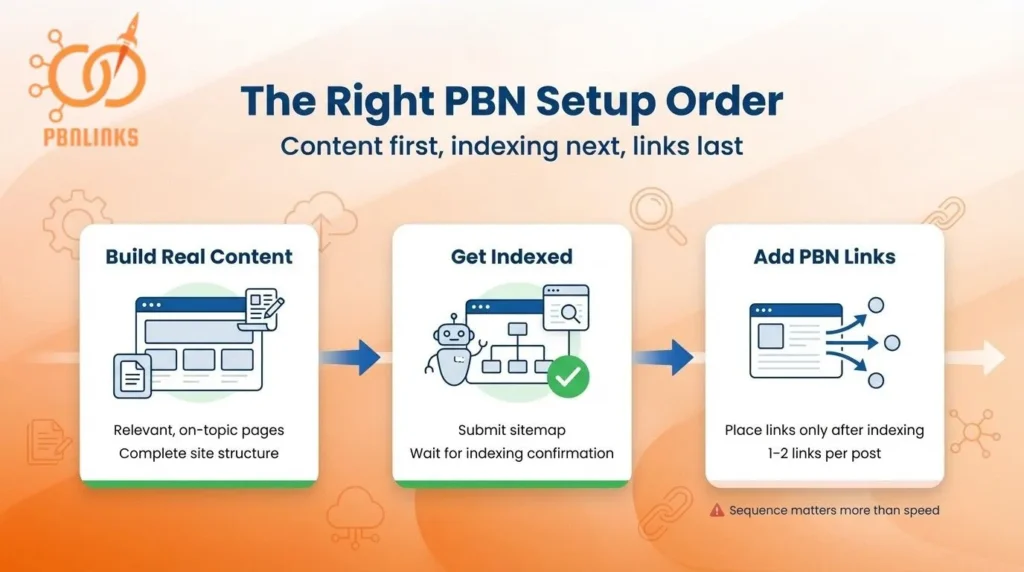
Seasoning is not just about waiting. It is about doing things in the right sequence.
Step 1: Rebuild with quality on-topic content
Publish three to five relevant pieces that match the domain’s original niche where possible. Add an about page, contact page, and basic navigation. The site needs to look like a real active website.
Step 2: Get the site indexed
Submit the sitemap via Google Search Console. Allow Google to crawl and index naturally. Depending on the domain’s crawl history this can take anywhere from a few days to a few weeks.
Step 3: Place outbound links only after indexing is confirmed
Once indexed and after the seasoning period outlined below, add your contextual PBN links. One to two links per post is the standard approach. Do not rush this step regardless of how strong the domain metrics look.
How Long to Season Based on Domain Type
Seasoning time varies depending on the type of domain you are working with.
| Domain Type | Recommended Seasoning Period |
| Aged domain (never dropped, strong history) | 2 to 4 weeks |
| Expired domain (clean history, good DR) | 4 to 8 weeks |
| Expired domain (gaps in history, lower DR) | 8 to 12 weeks |
Aged domains need less seasoning because Google already has an established crawl history for them. The trust baseline exists. You are re-establishing activity after an ownership change, not building trust from scratch.
Expired domains need more time because re-registration broke the continuity signal. The weaker the prior history, the longer you should wait. If a domain has significant Wayback Machine gaps or a patchy backlink profile, treat it like a new domain and give it three to six months before placing any links.
At PBN Links Agency the seasoning period is a standard part of every domain setup we handle for clients. The stronger the domain metrics, the shorter the wait. But we never skip it entirely.
How to Properly Vet a PBN Domain Before You Buy
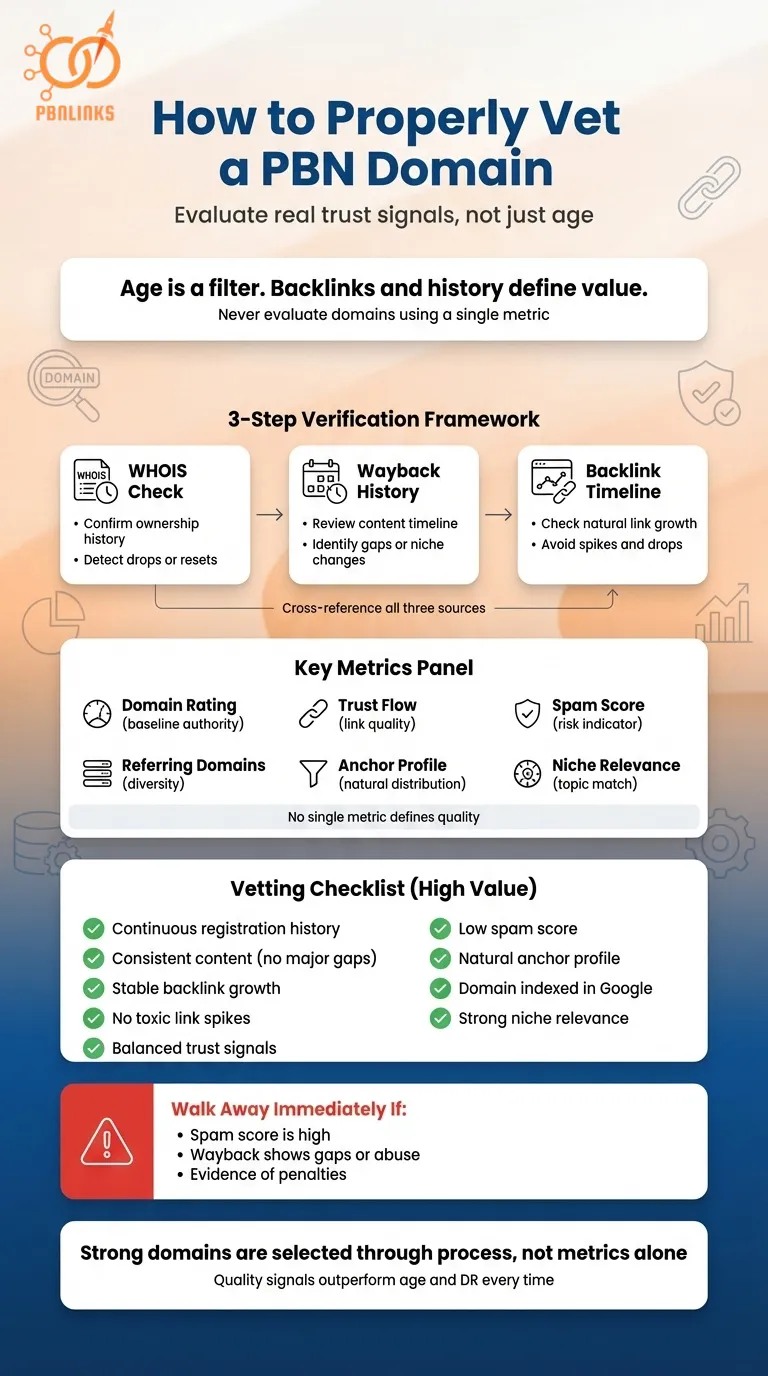
Vetting a PBN domain correctly means looking beyond the age figure. Age tells you how long the domain existed. The backlink profile, content history, and spam signals tell you whether those years were actually worth anything.
Here is the full vetting process we use at PBN Links Agency.
Why the Backlink Profile Matters More Than the Age Number
Age is the first filter. A domain under one year old with no continuous ownership history does not make the cut. But passing the age filter is just the starting point.
The backlink profile determines real value. A domain that earned links from legitimate, relevant, editorially placed sources over time carries genuine authority. A domain that accumulated links from directories, comment spam, and foreign language sites carries risk regardless of how old it is.
A younger domain with a clean relevant backlink profile will consistently outperform an older domain with a weak or toxic one.
How to Confirm a Domain’s Real Age Before Buying
Do not rely on a single tool to confirm domain age. Use three sources together.
WHOIS lookup
Check the original registration date. For aged domains this should show continuous ownership. For expired domains the date reflects the re-registration, not the original. Use a tool like DomainTools for a full ownership history.
Wayback Machine
Go to web.archive.org and check the earliest snapshot. This tells you when the site was first active, what it covered, and whether any sudden content changes or long gaps exist in the history.
Ahrefs referring domain timeline
Pull up the domain in Ahrefs and check the referring domains graph. Healthy domains show gradual link growth over time. Sudden spikes followed by drops are a red flag. Extended flat periods signal the domain was inactive or dropped at some point.
Cross referencing all three gives you a clear picture of what the domain age actually represents.
The Metrics to Check Alongside Age
Once age is verified run through these quality signals before making a purchase decision.
| Metric | What to Check | Minimum Threshold |
| Domain Rating (Ahrefs) | Overall backlink authority | DR 15+ |
| Trust Flow (Majestic) | Quality of linking sources | TF 10+ |
| Spam Score (Moz) | Percentage of spammy signals | Below 5% |
| Referring Domains | Number of unique linking sites | 20+ |
| Anchor Text Distribution | Branded vs exact match ratio | Mostly branded |
| Wayback Machine History | Content consistency and gaps | No major gaps |
| Niche Relevance | Domain topic vs money site niche | Strong match |
No single metric disqualifies a domain on its own. Look at the full picture. A slightly lower DR with a clean backlink profile and strong niche relevance can outperform a higher DR domain with mixed link quality.
A Practical Domain Vetting Checklist
• Registration history confirmed via WHOIS with no unexpected drops
• Wayback Machine shows consistent on-topic content with no major gaps
• No sudden niche changes in content history
• Ahrefs referring domain graph shows gradual natural growth
• No toxic backlink spikes or sudden link drops
• Trust Flow and Citation Flow are balanced with no extreme disparity
• Spam score below 5%
• Anchor text profile is mostly branded with natural variation
• Domain is still indexed — confirm with site:domain.com in Google
• Niche relevance matches your money site topic
Pay closest attention to spam score, penalty history, and Wayback Machine gaps. These are the critical signals. A domain that fails any of these three is not worth buying regardless of how strong the age or DR looks.
How PBN Links Agency Vets Domains So You Don’t Have To
Domain vetting at this level takes time, tools, and experience. Most in-house SEO teams and solo operators do not have the bandwidth to run every domain through a full audit.
At PBN Links Agency every domain in our network goes through this full vetting process before it is used for a client campaign. Age continuity, backlink profile quality, Wayback Machine history, spam signals, and niche relevance are all checked as standard. Domains that do not meet our thresholds are rejected regardless of their headline metrics.
The result is a network built on domains that carry genuine trust signals, not just impressive age figures or inflated DR scores.
Common Mistakes When Judging PBN Domain Age
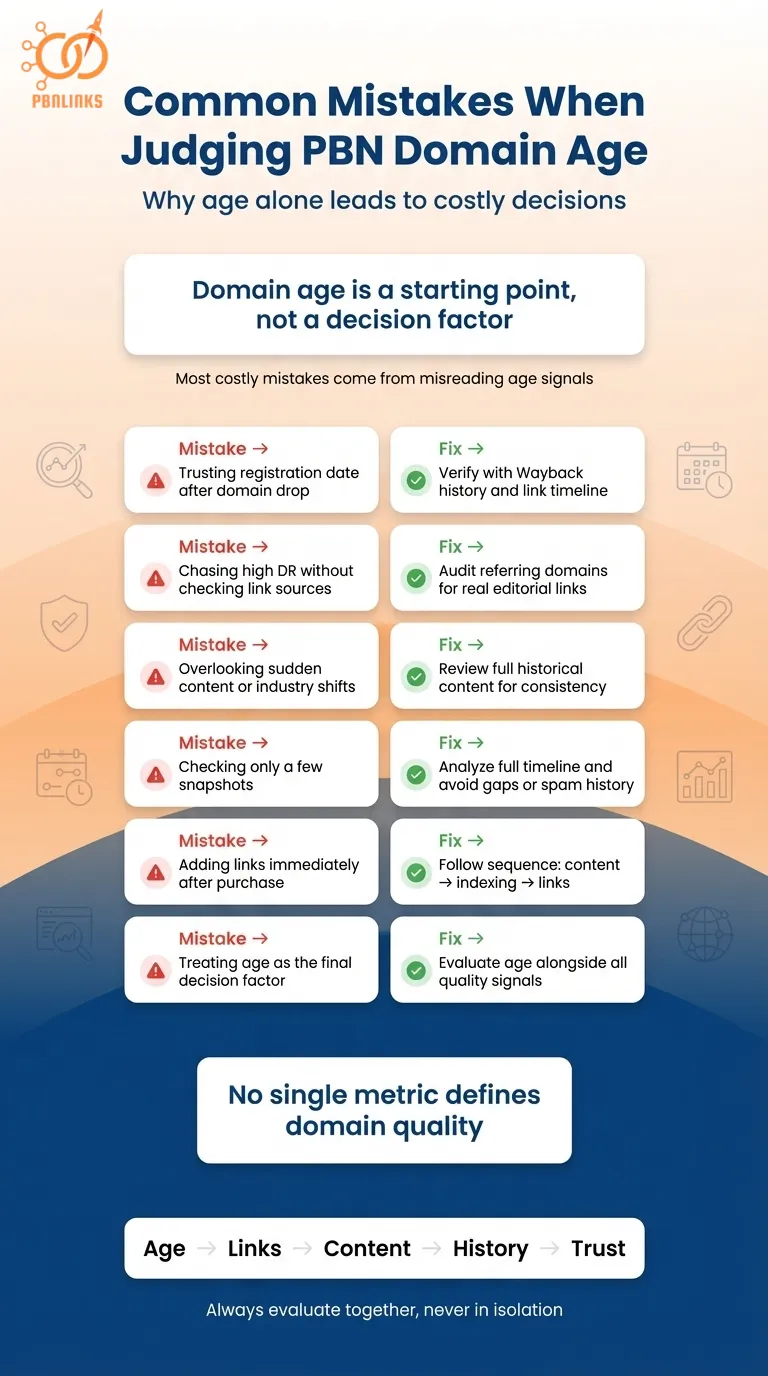
Most domain selection mistakes come down to one thing. People treat age as a guarantee rather than a starting point.
Mistake 1: Trusting the WHOIS Date on a Dropped Domain
When a domain drops and gets re-registered, the age signal resets. But many WHOIS tools still show the original registration date. You end up paying a premium for an age figure that no longer exists.
Fix: Always cross reference the WHOIS date with the Wayback Machine first snapshot and the Ahrefs referring domain timeline to confirm the domain never dropped.
Mistake 2: Chasing High DR Without Checking Link Sources
A high DR looks impressive but tells you nothing about where those links came from. DR 40 built from foreign language directories and comment spam carries minimal value and significant risk.
Fix: Open the referring domains list in Ahrefs and manually check the top twenty linking sites. You are looking for legitimate editorial placements from relevant sources, not inflated numbers.
Mistake 3: Ignoring Niche Changes in Content History
A domain that ran a legitimate business for five years then suddenly became a cryptocurrency blog is a red flag. Google values topical consistency. A sudden niche change breaks that signal entirely.
Fix: Check the full Wayback Machine timeline, not just the most recent snapshot. Look for sudden content shifts, foreign language pages, or keyword stuffed titles in later snapshots.
Mistake 4: Missing Critical Wayback Machine Red Flags
One or two snapshot checks is not enough. Long gaps with no snapshots signal the domain dropped. Spam or adult content appearing before expiry means the domain was already being abused before you found it.
Fix: Check the full Wayback Machine timeline year by year. Any gap longer than six months or any spam content is a reason to walk away.
Mistake 5: Buying an Aged Domain and Linking Immediately
Even strong aged domains need a warm up period. Pointing a domain straight at a money site within days of purchase is a footprint Google notices.
Fix: Always follow the seasoning sequence. Content first, indexing second, links third. Even the strongest aged domains need a minimum two to four week warm up period before placing any outbound links.
Mistake 6: Treating Domain Age as the Deciding Factor
Age is a filter, not a verdict. Paying more for a five year old domain without comparing backlink profiles and content histories often means paying more for a weaker asset.
Fix: Score domains across all vetting factors together. Age, DR, Trust Flow, spam score, content history, and niche relevance all carry weight. No single factor overrides the full picture.
Conclusion
Domain age matters for PBN use, but the number alone means nothing. What actually counts is the trust that built up during those years. Clean backlinks, consistent content, and zero penalty signals are what make an aged domain valuable.
A two year old domain with good editorial links will beat a five year old domain with spam links every time. Age makes quality stronger. It does not fix a weak foundation.Start with the age threshold that fits your niche competition level. Then check every domain against the full vetting list before you buy.
At PBN Links Agency we run this exact process on every domain in our network before we use it for client campaigns.
FAQS About PBN Domain Age
Does domain age matter for PBN links?
Yes, but only when backed by clean backlinks and consistent content history. A domain can be ten years old and still be worthless if it has spam links or content gaps. Age without quality signals means nothing.
How old should a PBN domain be?
Two to four years with clean history works best for most campaigns. Domains under one year carry too little trust. Domains over five years add diminishing returns unless the backlink profile is exceptional.
What is the difference between an aged domain and an expired domain?
An aged domain never dropped and kept continuous ownership throughout its life. An expired domain lapsed, got re-registered, and had its age reset to zero. You get the backlinks but not the original age signal.
Can I use a domain that is under one year old for a PBN?
No, unless it never dropped and was transferred with continuous ownership intact. Domains under one year lack the trust signals Google looks for. They also create footprint risks in competitive niches.
How long should I season a PBN domain before placing links?
Aged domains need two to four weeks minimum. Expired domains with clean histories need four to eight weeks. Domains with gaps or weak histories need eight to twelve weeks before you place any outbound links.
Does re-registering a dropped domain reset its age?
Yes, completely. Once a domain drops and becomes available for public registration again, the age signal resets to zero. Some tools still show the original registration date which creates confusion.
Why do aged domains outperform expired domains?
Aged domains keep trust continuity because ownership never broke. Google has been evaluating them consistently throughout their life. Expired domains have a gap in that record even with strong backlinks.
What matters more, domain age or backlink quality?
Backlink quality matters more every time. A younger domain with clean editorial links will beat an older domain with spam links consistently. Age only amplifies a strong backlink profile.
Can a five year old domain with toxic links still work for PBN use?
No, toxic links disqualify a domain regardless of age. A five year old domain with spam is worse than a three year old domain with a clean profile. Age never fixes poor link quality.
How do I verify a domain’s real age before buying?
Check three sources together. Run a WHOIS lookup for registration history, check Wayback Machine for the first snapshot, and pull the Ahrefs referring domain timeline. Cross referencing all three shows the real ownership history.
Should I pay more for an aged domain over an expired domain?
Yes, when budget allows. Aged domains cost more upfront but deliver stronger trust signals from day one. They also need less seasoning time and carry lower risk profiles in competitive niches.
What happens if I place links immediately after buying a domain?
You create a clear footprint signal that Google notices. Even strong aged domains need time to re-establish activity patterns after ownership changes. Always season before placing any outbound links.
Can domain age alone help me rank faster?
No, age alone does nothing. Google rewards what accumulated alongside age such as clean link growth, consistent content, and gradual crawl history. Age is just the timeframe those signals built up in.
How does niche competition affect minimum domain age requirements?
Higher competition requires older domains with stronger trust signals. Low competition niches can work with one to two year old domains. Very high competition niches need five years or more with exceptional metrics.
What is the biggest mistake people make when judging PBN domain age?
Trusting the WHOIS date on dropped domains without verification. When a domain drops the age resets but many tools still show the original date. Always cross check with Wayback Machine and Ahrefs.