PBN Domain Metrics: What DA, DR, and TF Scores to Look for Before Buying
You already know how to check DR. You know what DA means. You have probably looked at TF at least once before buying a domain.
But you still end up with domains that move nothing. The metrics looked fine. The rankings did not follow.
The problem is not the metrics themselves. The problem is reading them one at a time instead of together. A domain can pass every individual score and still be worthless if Google has already discounted it.
DA, DR and TF are third-party estimates. None of them are Google signals. They measure backlink patterns and try to model authority from the outside.
Most buyers use them as a simple pass or fail checklist. That approach misses the manipulation signals, the traffic reality, and the combinations that actually separate a strong domain from an expensive mistake.
This guide covers what each metric actually measures, where each one breaks down, and how to combine them into a real buy or pass decision. By the end you will have a clear evaluation process you can run on any domain before spending a dollar.
Why High Scores Don’t Always Mean a Good Domain
A high DR doesn’t always mean a good link. A high TF doesn’t always mean a safe domain. Numbers look convincing, but they rarely tell the full story.
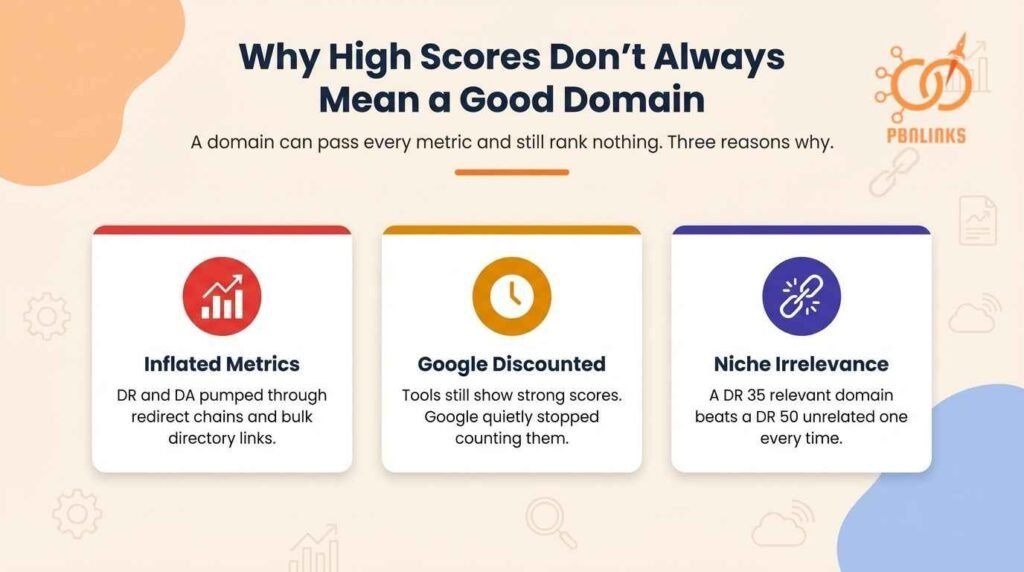
There are two ways a high-metric domain can fail you.
The first is inflated metrics. DR can be pumped through redirect chains. DA moves with bulk directory links. Sellers engineer these numbers to look strong. The scores are real — the authority behind them isn’t.
The second is quieter. Some domains have legitimate scores but Google has already discounted them. Ahrefs, Moz, and Majestic update on their own schedule. Google doesn’t share its data with them. So the tools show DR 40 and TF 22 while the domain passes close to nothing in practice.
Then there’s relevance and most buyers ignore it completely. A domain with strong metrics but zero connection to your niche is a weak link regardless of what the numbers say. Google evaluates links in context. A DR 35 domain from a topically relevant site will outperform a DR 50 domain from a completely unrelated one every time.
DA, DR, and TF are third-party estimates. Use them to eliminate bad domains — not to confirm good ones.
Domain Authority (DA) — What It Measures and Where It Falls Short
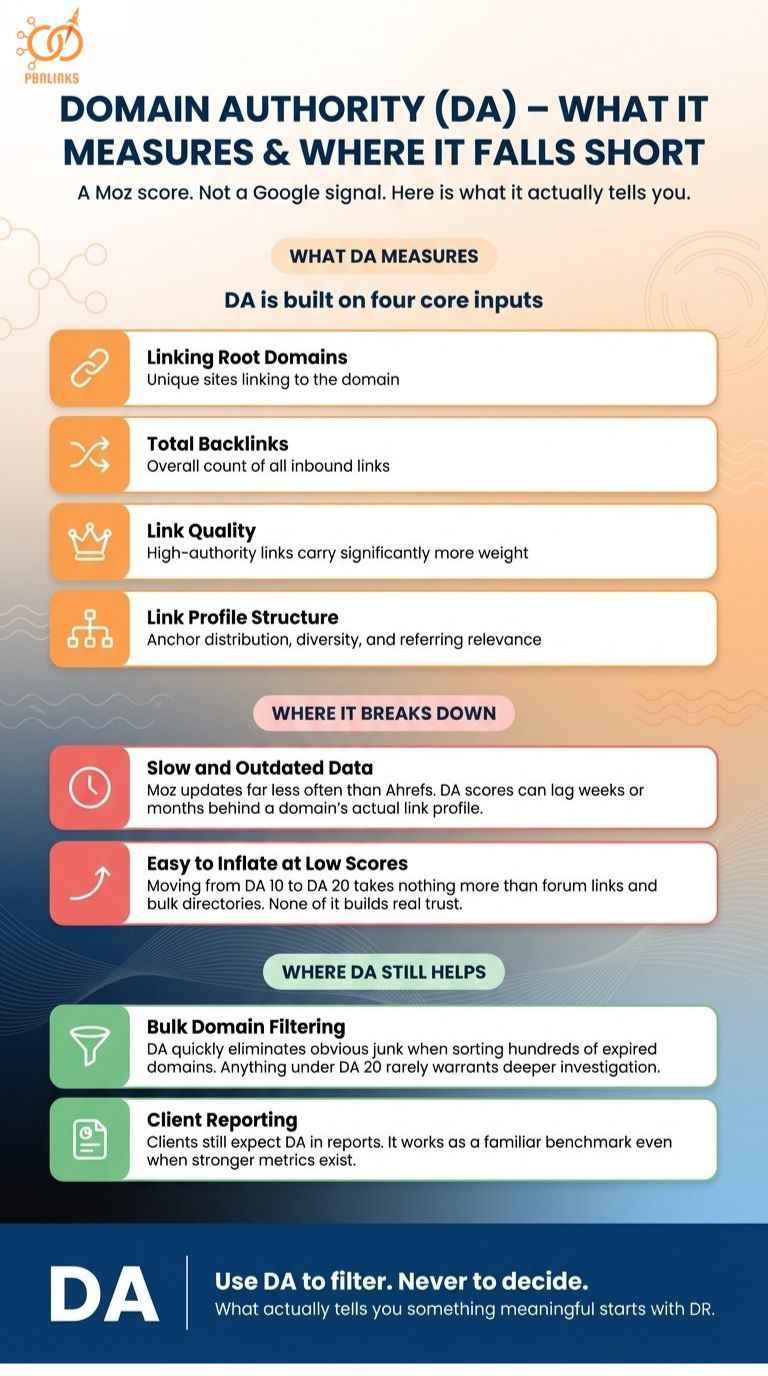
Domain Authority is a score developed by Moz. It runs on a scale of 1 to 100 and attempts to predict how well a domain will rank in search results. It is not a Google ranking factor — Moz calculates it independently using its own data and machine learning model.
DA is built on four main inputs:
- Linking root domains — the number of unique sites linking to the domain
- Total backlinks — the overall count of inbound links
- Link quality — links from high-authority sites carry more weight than low-quality ones
- Link profile structure — anchor distribution, link diversity, and referring site relevance
Where it breaks down for PBN evaluation
Moz’s crawler is significantly slower than Ahrefs. Its database is smaller and updates far less frequently meaning DA scores can lag weeks or months behind a domain’s actual link profile. You’re often looking at outdated data without knowing it.
DA also runs on a logarithmic scale. Moving from DA 10 to DA 20 is far easier than moving from DA 60 to DA 70. This makes low-to-mid DA scores easy to inflate with forum links, directory submissions, and bulk bought links none of which build real trust.
Where DA still earns its place
One situation , bulk filtering. When sorting through hundreds of expired domains, DA helps eliminate obvious junk fast. Anything under DA 20 rarely warrants further investigation. It also appears in client reporting where clients still expect to see it by habit.
Beyond that, DA should not influence your buying decision. What actually tells you something meaningful starts with DR.
What Is Domain Rating (DR) and Why Does It Matter for PBN Evaluation?
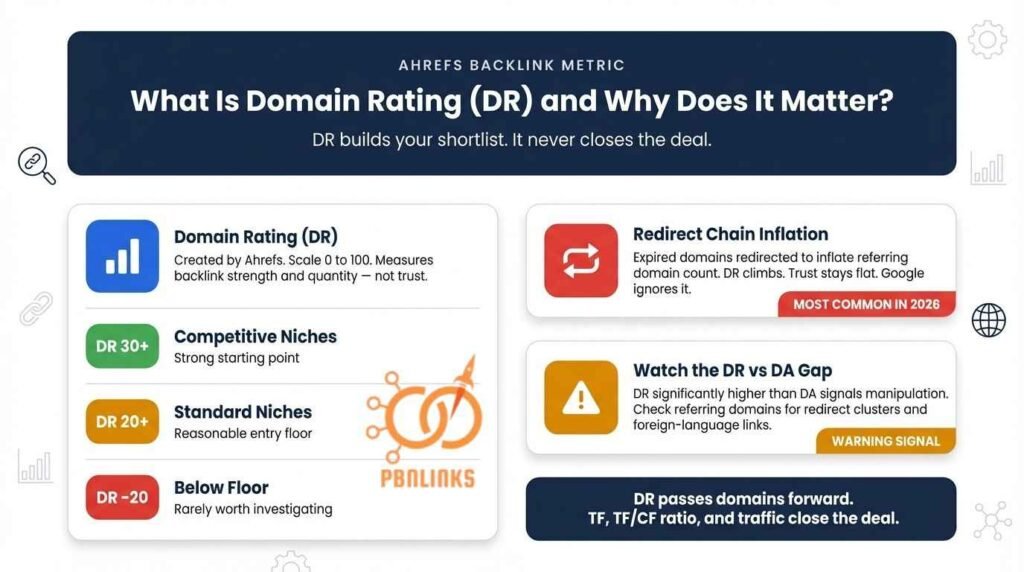
Domain Rating is a score created by Ahrefs. It runs on a scale of 0 to 100 and measures the strength of a domain’s backlink profile. It looks at how many dofollow links point to a domain and how strong those linking domains are.
DR asks one question: how many strong links does this domain have? It does not ask whether those links are trustworthy, relevant, or clean. That single limitation is what makes DR useful as a starting point , and dangerous as a final verdict.
Ahrefs runs one of the fastest and largest backlink crawlers in the world, updating far more frequently than Moz. This is why DR replaced DA as the default filter for most PBN builders. It reflects a domain’s current link profile more accurately and reacts faster to changes. For a quick first pass, nothing beats it.
Thresholds worth using:
- DR 20+ is a reasonable entry-level floor for most niches
- DR 30+ is a stronger starting point for competitive niches
- Anything below DR 20 rarely carries enough backlink weight to investigate further
Where DR breaks down:
DR measures link quantity and strength , not trust. This is its most significant weakness.
The most common manipulation method in 2026 is redirect chain inflation. Someone acquires expired domains with existing backlinks and redirects them to a target domain, inflating its referring domain count artificially. DR climbs. Trust stays low. Ahrefs counts the redirects as real links. Google frequently does not.
Your first warning signal is the DR-over-DA gap. When a domain’s DR is significantly higher than its DA, the backlink graph looks strong on paper but may not reflect real authority. In Ahrefs, check the referring domains list for patterns , large clusters of redirected domains, foreign-language sites, or links from completely unrelated niches all signal manipulation.
The hard rule:
DR builds your shortlist. It never closes the deal. Every domain that clears the DR threshold still needs to pass TF, the TF/CF ratio, and an organic traffic check before you commit to buying.
What Is Trust Flow (TF) and Why Is It the Most Important Metric for PBN Domains?
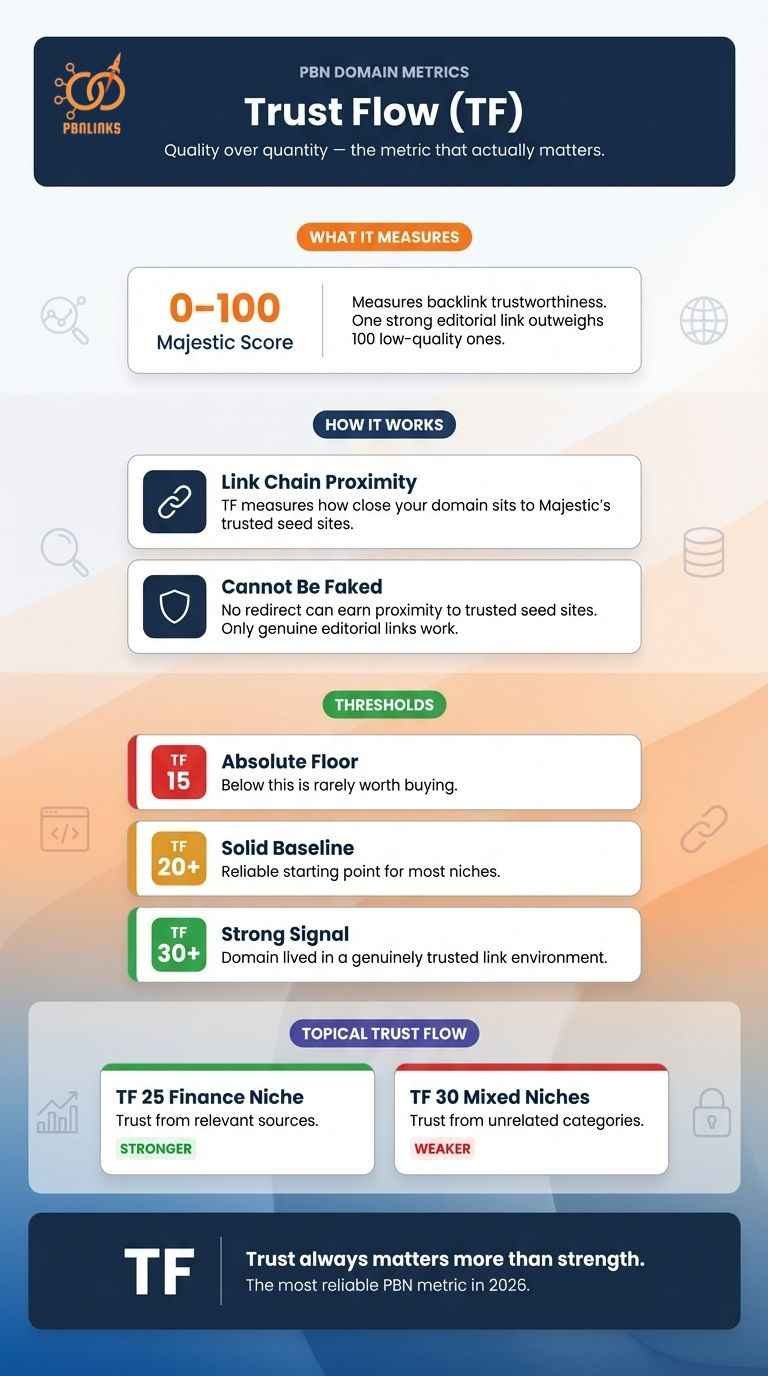
Trust Flow is a score created by Majestic. It runs on a scale of 0 to 100 and measures how trustworthy a domain’s backlink profile is. Quality of links matters more than quantity here. That single principle separates TF from every other metric in this guide.
How Majestic calculates Trust Flow
Majestic built a curated list of seed sites and highly trusted domains , including government websites, academic institutions, and established media outlets. You can read more about how this works directly on Majestic’s documentation.
TF measures how close your domain is to these seed sites through link chains. If a government site links to site A, and site A links to your domain, your TF benefits from that connection. One link from a high TF site moves your score more than 100 links from low quality sources.
This is also why TF is much harder to manipulate than DR. You cannot redirect your way into Majestic’s trust circle. Earning proximity to trusted seed sites takes time and genuine editorial links. Most inflated domains reveal themselves through a simple gap: high DR, low TF. That disconnect is one of the strongest warning signals in PBN domain evaluation.
Topical Trust Flow: The Detail Most Buyers Miss
Majestic also shows Topical Trust Flow alongside the main TF score. This breaks down which niche categories a domain’s trust comes from. A domain with TF 25 earned entirely from finance and business sources is a stronger PBN asset for a finance site than a domain with TF 30 earned from random unrelated categories. Always check where the trust is coming from, not just how much of it exists.
Thresholds worth using:
- TF 15 is the absolute floor anything below this is rarely worth buying
- TF 20+ is a solid starting point for most niches
- TF 30+ is strong and signals the domain existed in a genuinely trusted link environment
What a high TF actually tells you
A domain with strong TF earned its position inside a trusted link environment before it expired. When you rebuild it inside your PBN, that trust history carries real weight. Google’s systems evaluate link quality through similar proximity signals , which is exactly why TF remains the most reliable predictor of actual link power in 2026.
The distinction worth remembering
DR asks how many strong links a domain has.
TF asks how trusted those links actually are.
For PBN evaluation, the second question always matters more.
What Is the TF/CF Ratio and Why Is It Your Fastest Spam Check?
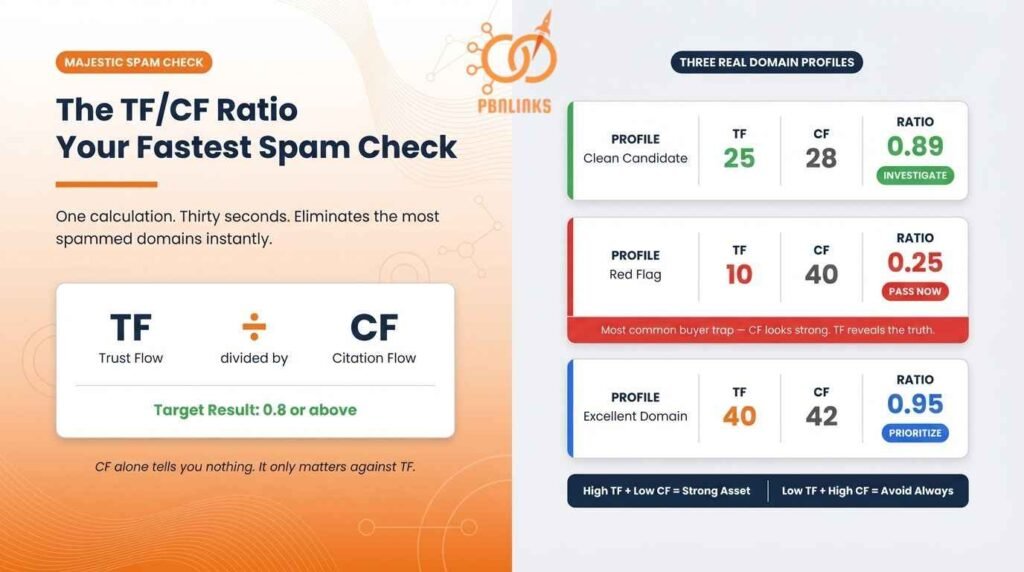
Before spending time on a deep backlink audit, there is one quick check that immediately separates clean domains from spammy ones. It is the ratio between Trust Flow and Citation Flow.
What Is Citation Flow (CF)?
Citation Flow is the second score Majestic provides alongside Trust Flow. It runs on a scale of 0 to 100 and measures the total quantity of links pointing to a domain. Quality is completely irrelevant to CF. A thousand spammy links from low quality directories move CF the same way one editorial link from a trusted news site does.
This is exactly why CF alone tells you nothing useful. It only becomes meaningful when you compare it against TF.
The Ratio Rule
Divide TF by CF. The result should be 0.8 or higher for a healthy domain. This single calculation tells you whether a domain earned its links from trusted sources or was pumped with bulk low quality links to inflate its numbers.
Three Real Examples
| Domain Profile | TF | CF | Ratio | Verdict |
| Clean candidate | 25 | 28 | 0.89 | Strong profile, worth investigating further |
| Red flag | 10 | 40 | 0.25 | Heavily spammed, pass immediately |
| Excellent domain | 40 | 42 | 0.95 | Rare find, very clean link environment |
The middle example is the most common trap buyers fall into. The CF looks impressive at 40. The DR might look strong too. But a TF of only 10 tells you those links came from completely outside Majestic’s trust circle. The domain was artificially inflated and will likely pass very little real value.
What a Collapsed Ratio Actually Reveals
When CF is significantly higher than TF, it means the domain accumulated a large volume of low quality links over time. Those links pushed CF upward while TF stayed flat because none of them came from trusted sources. This pattern is extremely common in domains that were previously used in spammy link schemes or sold through low quality PBN marketplaces.
The Signal Most Buyers Get Wrong
High TF with low CF is not a warning sign. It is actually a positive one. It means the domain earned its links selectively from high quality editorial sources rather than accumulating bulk links from anywhere available. A domain with TF 20 and CF 22 is a far stronger PBN asset than a domain with TF 15 and CF 50.
Always run this ratio check before doing anything else. It takes thirty seconds and immediately eliminates the weakest domains from your list.
How to Combine Metrics Into a Buy or Pass Decision
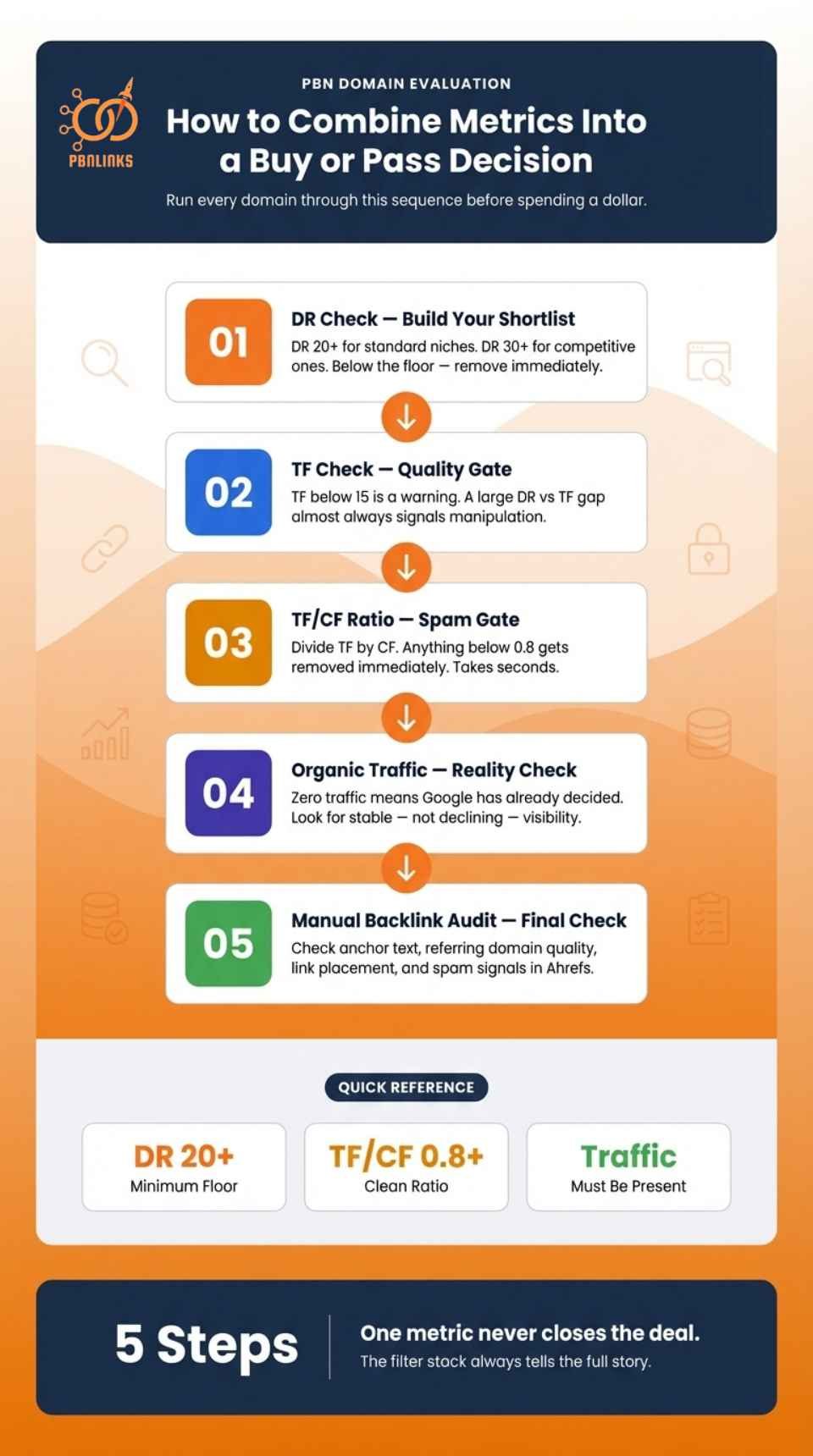
Reading metrics in isolation is exactly what leads buyers to spend money on domains that pass nothing. Each score you have learned so far answers a different question. The real evaluation happens when you run them in sequence , each step either moves a domain forward or removes it from your list.
Step 1: DR Check — Build Your Shortlist
Start with DR to build your initial list. Set a floor of DR 20+ for standard niches or DR 30+ for competitive ones. This eliminates the weakest domains quickly and saves time on deeper checks for domains that do not meet the minimum threshold. Any domain that clears this floor moves to Step 2.
Step 2: TF Check — Quality Gate
Check Trust Flow next. A domain that passed the DR check but shows TF below 15 is a warning sign worth taking seriously. Cross reference DR against TF at this stage. A large gap between the two almost always signals manipulation or a domain Google has already quietly discounted. The bigger the gap, the more cautious you should be before proceeding.
Step 3: TF/CF Ratio — Spam Gate
Divide TF by CF. Anything below 0.8 gets removed from your list immediately. This single calculation eliminates the most heavily spammed domains before you invest any more time in deeper analysis. It takes seconds and protects you from one of the most common traps in expired domain buying.
Step 4: Organic Traffic Check — Reality Check
Check the domain’s organic traffic in Ahrefs or Semrush. This is the step most buyers skip and the most consequential one. Third party tools cannot see what Google sees. Organic traffic is the one signal that cannot be faked through redirects or bulk links.
Two things to look for here.
First, does the domain have any organic traffic at all? A domain with strong metrics and zero traffic means Google has already made a quiet decision about that domain regardless of what the scores say.
Second, is the traffic stable or declining? A domain with steadily declining traffic is a different risk from one with modest but consistent visibility. Stable modest traffic is acceptable. A sharp downward trend is a warning sign worth investigating before buying.
Step 5: Manual Backlink Audit Final Confirmation
Every domain that clears the first four steps goes through a full backlink profile check in Ahrefs. This means checking anchor text distribution, referring domain quality, link placement, and spam signals. This process is covered in full in the next section.
Reading Common Metric Combinations
Most domains do not fit neatly into a clean pass after Step 2. Here is how to read the most common combinations before deciding whether to continue:
High DR with low TF means a large backlink graph with low trust. The links behind the DR score are likely inflated or spammy. Check the referring domains list closely before moving forward and expect to find redirect chains or foreign language links driving the score.
High TF with low DR means fewer links but from genuinely trusted sources. These domains are often overlooked because most buyers filter by DR first and never reach TF. They can be strong PBN assets at a lower price point than high DR domains.
High DR with high TF and a healthy TF/CF ratio is a strong candidate. Move it directly to the organic traffic check and backlink audit before making a final decision.
Why Organic Traffic Is Non-Negotiable
A DR 50 domain with zero organic traffic is not a strong domain. It is a domain Google has quietly discounted. Ahrefs and Majestic will still show the historical scores. The traffic data tells you what the tools cannot.
A domain does not need large traffic numbers to be a viable PBN asset. Modest consistent traffic from relevant keywords is a perfectly acceptable signal. What disqualifies a domain is a complete absence of traffic combined with otherwise strong looking metrics. That specific combination is the clearest sign that the scores and the reality no longer match.
Good Domain vs. Borderline vs. Reject: Real Metric Examples
Three realistic domain profiles side by side. Use these as a pattern reference when evaluating real domains.
| Good Domain | Borderline Domain | Reject | |
| DR | 35 | 40 | 45 |
| TF | 22 | 14 | 8 |
| CF | 26 | 30 | 38 |
| TF/CF Ratio | 0.85 | 0.47 | 0.21 |
| Organic Traffic | Present and stable | Low and declining | Zero |
| Decision | Proceed to backlink audit | Investigate anchor profile and Wayback history first | Pass immediately |
The reject has the highest DR of the three. It looks the strongest on the first metric most buyers check. It is the weakest domain in the group by every measure that actually matters.
The good domain has a lower DR than the reject but a TF/CF ratio four times healthier, stable organic traffic, and a trust profile that reflects genuine editorial links. That combination always outperforms a high DR score built on a collapsed trust profile.
One number never tells the full story. The filter stack does.
The Manual Checks No Metric Score Can Replace
Metrics give you a shortlist. They do not give you a verdict.
Every check covered so far DR, TF, TF/CF ratio, organic traffic , tells you whether a domain is worth investigating further. None of them tell you whether it is actually safe to buy. That decision comes from what you find when you look beyond the numbers.
This is where real domain evaluation happens. Tools show you data. Experience and careful manual analysis tell you what that data actually means. The checks below are things every buyer can run regardless of experience level. But the more domains you evaluate, the faster and sharper your judgment becomes. Pattern recognition develops through repetition. You start spotting unnatural anchor profiles faster.No tool can replicate that.
At Pbnlinks Agency, these are the exact checks we run on every domain before approving it.
What to Look for Inside the Backlink Profile
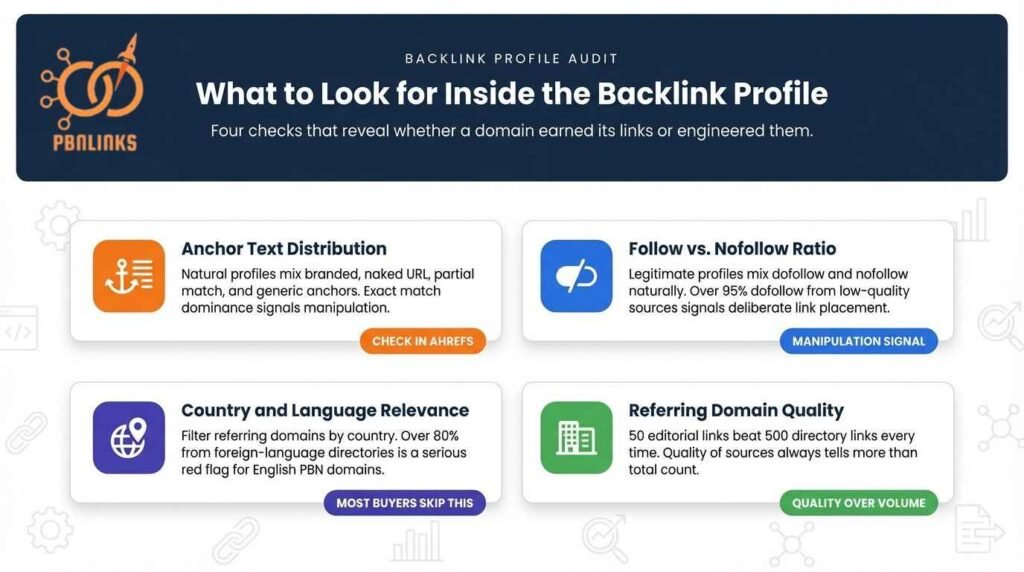
Anchor text distribution
A natural backlink profile contains a healthy mix of branded anchors, naked URLs, partial match phrases, and generic terms like “click here” or “read more.” Exact match keyword anchors dominate only in manipulated profiles.
Open the anchor text report in Ahrefs. If you see the same exact match keyword repeated across dozens of referring domains, that profile was built deliberately rather than earned naturally.
Pay close attention to anchor categories like pharma, adult, and essay writing. These do not automatically disqualify a domain but a high concentration of them across the backlink profile is worth treating as a serious warning before proceeding.
Follow vs. nofollow ratio
A legitimate domain earns a natural mix of dofollow and nofollow links over time. Forums, social platforms, and news sites regularly add nofollow tags. A profile showing 95% or more dofollow links from obscure or low quality sites is a manipulation signal. It suggests the links were placed deliberately rather than earned editorially.
Country and language relevance
This is the check most buyers skip entirely. Open the referring domains report and filter by country. A domain with 80% of its links coming from foreign language sites particularly Chinese, Russian, or Eastern European directories , is a quiet but serious red flag for an English language PBN domain. Those links may be moving metrics on paper while contributing nothing to real topical trust.
Referring domain quality
Volume means nothing without quality behind it. A domain with 500 referring domains from low quality directories, link farms, and irrelevant blogs is a significantly weaker asset than a domain with 50 referring domains from real editorial sites, niche publications, and established web properties. Always open the referring domains list and scroll through the actual sources. The quality of those sites tells you far more than the total count ever could.
Link Decay and Domain History
Link decay — the silent metric killer
Referring domains die over time. Sites get taken down, domains expire, pages get deleted. The metrics you see today in Ahrefs or Majestic may reflect a backlink profile that no longer exists at full strength.
Always compare the live referring domain count against the total reported referring domain count in Ahrefs. A domain showing 200 total referring domains but only 80 live ones has lost 60% of its backlink profile. The TF and DR scores will not immediately reflect that loss — but the actual link equity being passed already has.
This gap between reported metrics and live link reality is one of the most overlooked risks in expired domain buying. A domain that looked strong three months ago may have lost a significant portion of its value since the last tool crawl.
Wayback Machine history check
Go to the Wayback Machine and pull up several snapshots of the domain across different time periods. You are looking for three things.
First, topic consistency. Did the domain maintain a clear niche throughout its history or did it shift topics dramatically at some point? A technology site that suddenly became a health blog two years ago is a red flag. Google may have already disconnected the old link equity from the new content direction.
Second, layout and content quality. Does the archived site look like a real website with genuine content or does it show thin auto generated pages, foreign language spam, or obvious link farm structures?
Third, deindexation gaps. Long periods where the domain has no archived snapshots often indicate the site was taken down, possibly due to a penalty or deliberate removal before resale.
Previous PBN use signals
Most buyers check metrics. Fewer check whether the domain has already been used and exhausted inside someone else’s network.
Open several archived snapshots in the Wayback Machine and look at the outbound links on the pages. If you see repeated links pointing to unrelated money sites across multiple snapshots from different time periods, the domain has almost certainly been used in a PBN before. These outbound patterns do not appear naturally on real websites. They are a clear fingerprint of deliberate link placement.
A previously used PBN domain may still show decent metrics on the surface. But its ability to pass real ranking value has likely already weakened. Google evaluates link patterns over time. A domain that was heavily used to push unrelated sites will have already drawn scrutiny regardless of what Ahrefs or Majestic currently report.
At Pbnlinks Agency, confirmed previous PBN use is a serious red flag that triggers a much deeper review before we consider approving a domain. In most cases it leads to rejection. A strong metric profile does not outweigh a compromised link history.
What We Look for at PBNLinks.Agency Before Approving a Domain
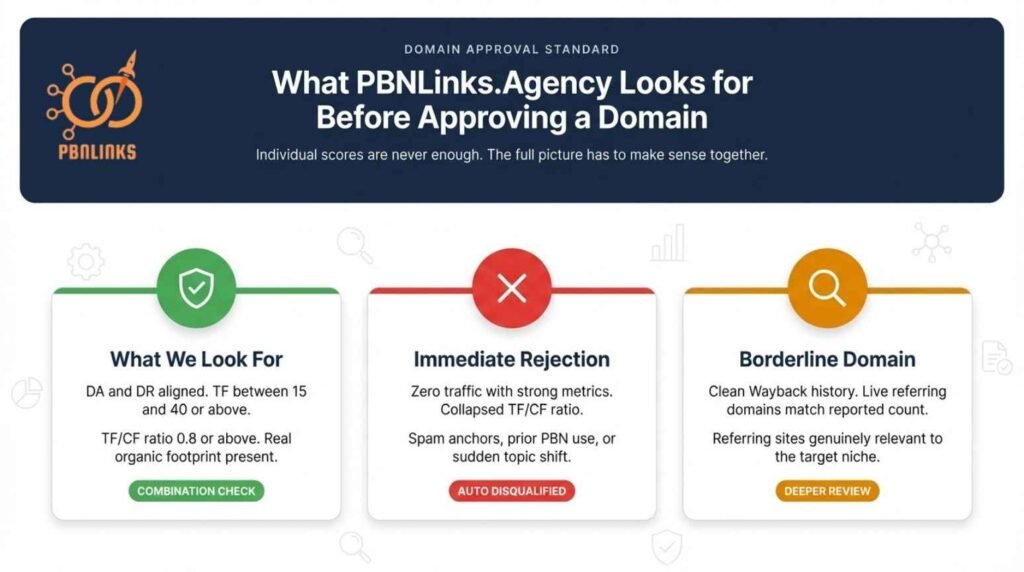
Most domain sellers set a number and call it a standard. A DR threshold here, a TF floor there. If the scores pass, the domain passes. At PBNLinks.Agency, that is not how we work.
Every domain that enters our network goes through a combination check. Individual scores passing in isolation are not enough. The full picture has to make sense together.
What We Generally Look For
We do not work from a rigid checklist. We look for a combination of signals that together indicate a domain with genuine authority. The ranges below give you a general idea — the combination always matters more than any single number.
- DA and DR that align with each other, generally somewhere between 20 and 70 depending on package tier and niche. A suspicious gap between the two is always a concern
- Trust Flow that reflects real editorial links rather than bulk manipulation, typically sitting between TF 15 and TF 40 or above
- A TF/CF ratio in a healthy range. A clean profile usually sits at 0.8 or above
- Referring domains from real, live, indexed sources rather than redirected junk or low quality directories
- At least some organic footprint confirming Google still values the domain
What Triggers an Immediate Rejection
Some signals disqualify a domain before we look at anything else:
- Zero organic traffic combined with otherwise strong looking metrics
- A TF/CF ratio that has completely collapsed
- A backlink profile dominated by exact match spam anchors across multiple referring domains
- Confirmed previous PBN use identified through Wayback Machine outbound link patterns
- A domain history showing sudden topic shifts or long deindexation gaps
What a Borderline Domain Needs to Pass
Borderline domains get a deeper review rather than an automatic rejection. To pass that review the domain needs:
- A clean and consistent Wayback history with no sudden topic shifts
- A live referring domain count reasonably close to the total reported count in Ahrefs
- Referring sites with genuine relevance to the niche it will serve
At PBNLinks.Agency, we reject more domains than we approve. That is not a limitation of our process. It is the point of it. Every domain that makes it through is hand selected, hosted on unique IPs, and placed manually — the same standard that has earned the trust of 500 or more SEO professionals who rely on our network for consistent ranking results.
If you are ready to get links from a network that has already done this vetting for you, explore our packages directly at PBNLinks.Agency.
Frequently Asked Questions About PBN Domain Metrics
What is the minimum Trust Flow (TF) for a PBN domain worth buying?
TF 15 is generally the accepted floor for a PBN domain worth considering. Anything below this rarely carries enough trust to pass meaningful link equity, though TF should always be read alongside the TF/CF ratio rather than in isolation.
Is DR or TF more important when evaluating a PBN domain?
TF is more important because it measures link quality and trust rather than just quantity and strength. A domain with moderate DR and strong TF will almost always outperform a domain with high DR and weak TF in terms of actual ranking power passed.
What TF/CF ratio should I look for before buying a PBN domain?
A TF/CF ratio of 0.8 or above indicates a clean and trustworthy backlink profile. Anything below 0.5 is a serious warning sign that the domain accumulated a large volume of low quality links that inflated CF while trust stayed flat.
Can a domain with low DA still be a strong PBN domain?
Yes. DA is the weakest and most easily manipulated of the main domain metrics. A domain with modest DA but strong TF and a healthy TF/CF ratio can be an excellent PBN asset — DA alone should never disqualify or qualify a domain.
Is a domain with high DR but zero organic traffic worth buying?
In most cases no. Zero organic traffic is a strong signal that Google has discounted that domain regardless of what third party tools report. Strong metrics without any search visibility is one of the clearest warning patterns in domain evaluation.
When is it worth paying a premium price for a higher metric domain?
A premium price is justified when high DR and high TF appear together alongside a healthy TF/CF ratio, stable organic traffic, and a clean backlink history. Paying more for a domain that scores well on only one metric rarely delivers proportional value.
What does a collapsed TF/CF ratio tell you about a domain?
It tells you the domain accumulated bulk low quality links over time that pushed CF upward while TF stayed flat. This pattern is a strong indicator the domain was used in low quality link building activity and its trust profile was never genuinely earned.
Can DR be manipulated and how do I spot it?
Yes. The most common method is redirect chain inflation where expired domains with existing backlinks are redirected to artificially inflate referring domain counts. In Ahrefs, check the referring domains list for large clusters of redirected domains, foreign language sites, or links from completely unrelated niches.
What is Topical Trust Flow and why does it matter for PBN evaluation?
Topical Trust Flow is a Majestic metric that shows which of over 800 niche categories a domain’s trust actually comes from. A domain with TF 25 earned from finance and business sources is a stronger PBN asset for a finance site than a domain with TF 30 earned from scattered unrelated categories.
What happens if I buy a PBN domain based on DR alone?
You risk spending money on a domain that looks strong on paper but passes little real value. DR measures backlink quantity and strength but ignores trust, topical relevance, and whether Google has already discounted the domain’s link equity.
How do I check if a domain has been previously used in a PBN?
Open the Wayback Machine and review archived snapshots for repeated outbound links pointing to unrelated money sites across different time periods. This outbound link pattern is a clear fingerprint of deliberate link placement that natural websites do not produce.
Does link decay affect PBN domain metrics over time?
Yes. Referring domains die as sites go offline or pages get deleted. Always compare the live referring domain count against the total reported count in Ahrefs to understand how much of the backlink profile still exists at full strength before making a buying decision.
Is Trust Flow still a reliable metric for PBN domains in 2026?
Yes, though with an important caveat. TF is more manipulation resistant than DR or DA because earning proximity to Majestic’s seed sites requires genuine editorial links. However TF can still be inflated — Majestic typically detects and resets manipulated scores over time, making it the most dependable single metric available for PBN evaluation in 2026.