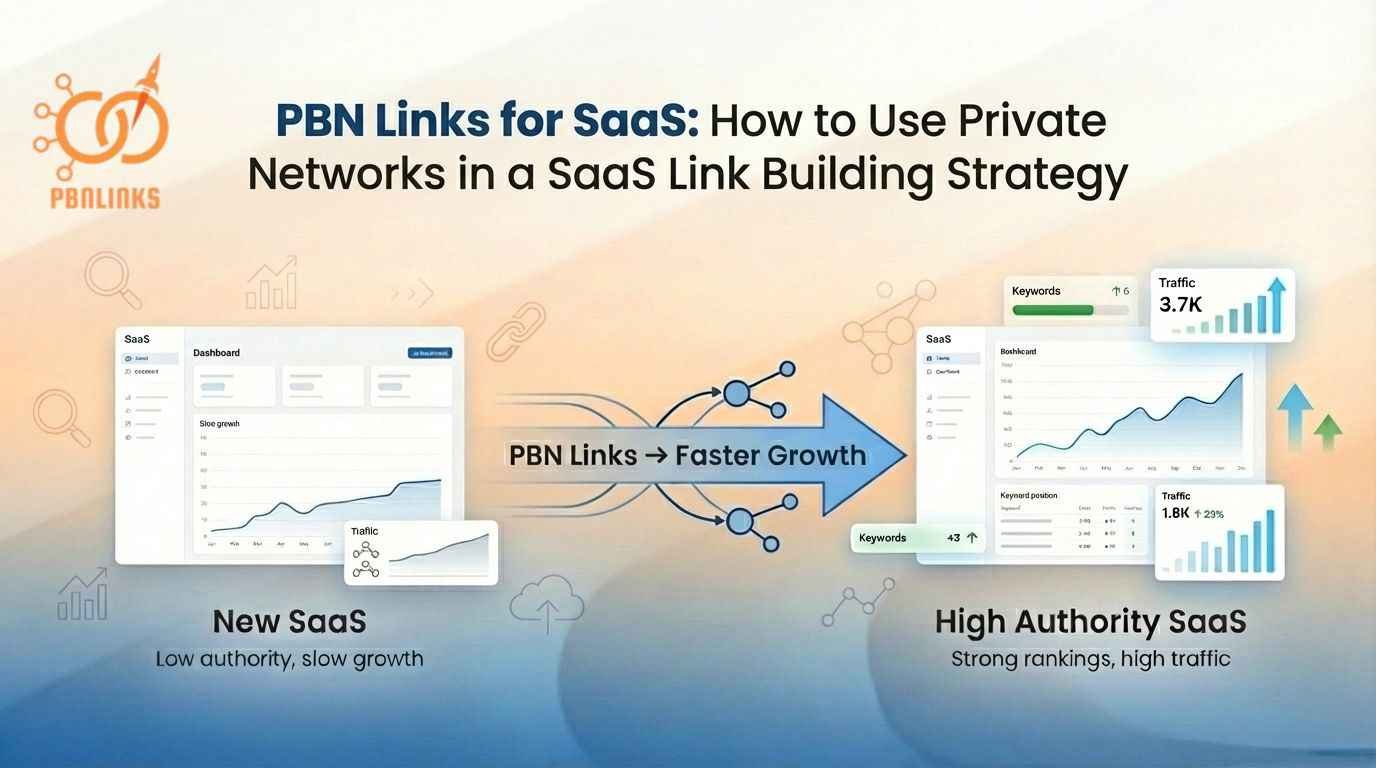
PBN Links for SaaS: How to Use Private Networks in a SaaS Link Building Strategy
Vibe coding has made launching a SaaS product trivially easy. The hard part now is ranking it. Every week hundreds of new products compete for the same keywords against sites with DR 60 and years of accumulated authority.
White-hat link building works. But it takes 6 to 12 months to compound and most early-stage SaaS products cannot wait that long. That is exactly the gap PBN links are built to close.
This guide covers how to use PBN links specifically for SaaS. Which pages to target, how to pick domains, how to manage anchor text, and how to run a campaign without putting your brand at risk.
Why SaaS Link Building Is Harder Than Most People Expect
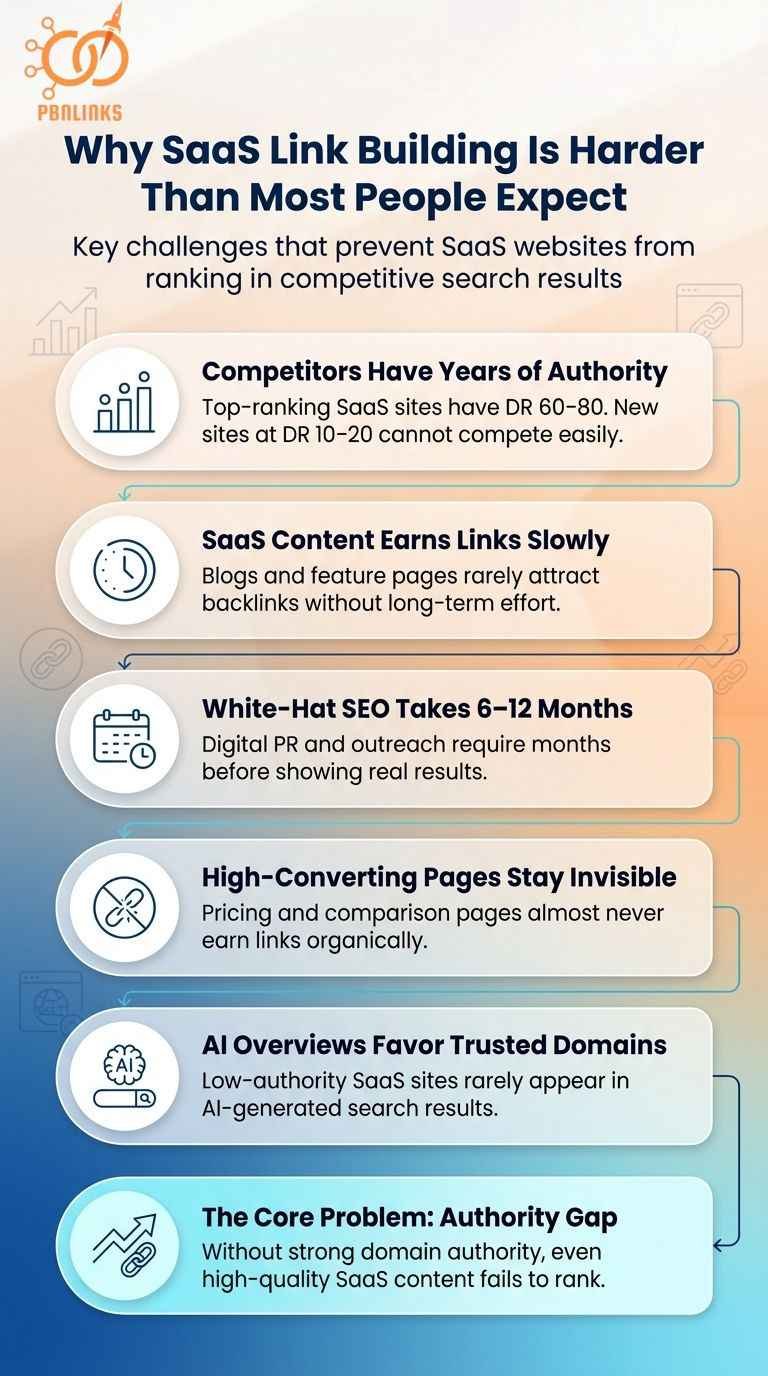
SaaS link building is harder than almost every other niche. The bar to enter competitive SERPs is high, the process is slow, and most standard tactics were not built for how SaaS products grow. Here is why.
Your Competitors Have Years of Authority You Cannot Shortcut
Open Ahrefs and check who is ranking for your target keywords. DR 60. DR 70. DR 80. Those sites have spent years building that authority. A new SaaS product at DR 15 is not losing because its content is worse. The authority gap is simply too large for Google to ignore.
DR 30 to DR 50 is where SaaS sites start competing meaningfully. Below that threshold even well-optimized pages rarely break into the top five positions where trial signups actually happen.
SaaS Content Earns Links Slowly
Blog posts, feature pages, and comparison pages do not attract links the way news content or viral tools do. SaaS content earns links through original research, free tools, and digital PR — all of which take months to produce results. Most SaaS pages earn very few links naturally and never reach the authority they need to rank.
White-Hat Tactics Take 6 to 12 Months to Compound
Digital PR, HARO outreach, and data-led content are the strongest white-hat SaaS link building tactics. All three work. All three take six to twelve months before the compounding effect produces meaningful DR movement. For a bootstrapped founder or a funded team burning runway that timeline is often not workable.
Commercial Pages Almost Never Earn Links Organically
Nobody links to your comparison page or your pricing page. Nobody writes “check out this alternatives page” in a blog post. The pages that drive SaaS conversions are the hardest to earn links to naturally. Without a way to push authority directly to those pages they stay invisible regardless of how good the content is.
AI Overviews Have Added a New Visibility Layer
Google’s AI Overviews pull from entities it already trusts. A SaaS product with weak domain authority and thin citation signals does not appear in AI Overview answers even for queries directly relevant to its product. In 2026 AI Overviews appear across a significant share of SaaS-relevant queries. Ranking on page one is no longer the only visibility target — the AI answer above it matters just as much.
The Gap PBN Links Are Built to Close
Every problem above comes back to one thing: authority.PBN links build domain authority faster than white-hat tactics alone, push equity directly to commercial pages that cannot earn links naturally, and contribute to the entity trust signals that feed AI Overview eligibility. Used correctly they close the gap while your long-term link building compounds in parallel.
What Role Do PBN Links Actually Play in SaaS SEO
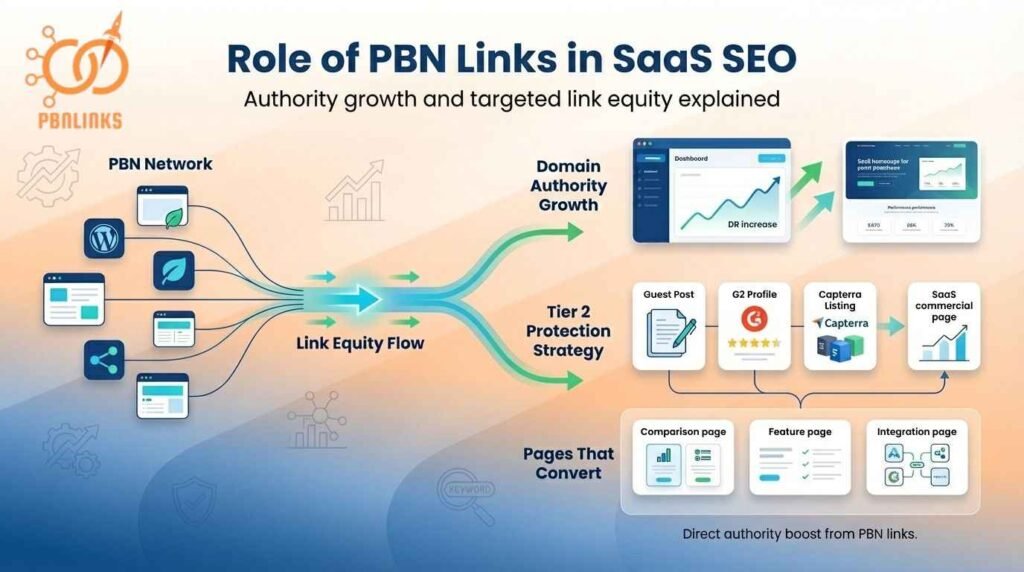
PBN links in SaaS serve two specific jobs: accelerating domain authority into the competitive range and pushing link equity directly to commercial pages that cannot earn it naturally. They are not a content strategy, a brand building tool, or a replacement for earned links. Here is exactly where they fit.
PBN Links as a DR Acceleration Tool
Pointing PBN links at your homepage or key pillar pages lifts overall domain authority faster than white-hat tactics alone. Once your domain crosses into the competitive DR range every earned link you build carries more weight and produces ranking movement it simply could not at DR 20.
PBNs create the conditions for white-hat link building to succeed. Not a replacement. An accelerant.
Using PBN Links as Tier 2 to Protect Your Money Site
Tier 2 means pointing PBN links at strong existing assets rather than directly at your SaaS site. Your G2 listing, Capterra profile, a guest post on a real publication, or a strong citation are all solid Tier 2 targets. Those assets absorb the PBN link equity and pass cleaner authority toward your money site through a natural-looking path.
For funded SaaS brands where direct PBN links carry higher brand and due diligence risk,tiered link building is often the smarter execution model. The authority still flows where you need it. The exposure is significantly lower.
The Pages That Convert Cannot Earn Links Naturally
Comparison pages, alternative pages, feature pages, and integration pages are where SaaS conversions happen. Nobody links to them organically. No blogger writes “check out this comparison page” in a roundup. These pages need link equity pushed to them directly or they stay invisible regardless of how well they are optimized.
PBN links solve this exactly. Targeted page-level authority delivered to the pages that actually convert, not just the blog content that earns links naturally.
Which SaaS Pages Should You Point PBN Links At
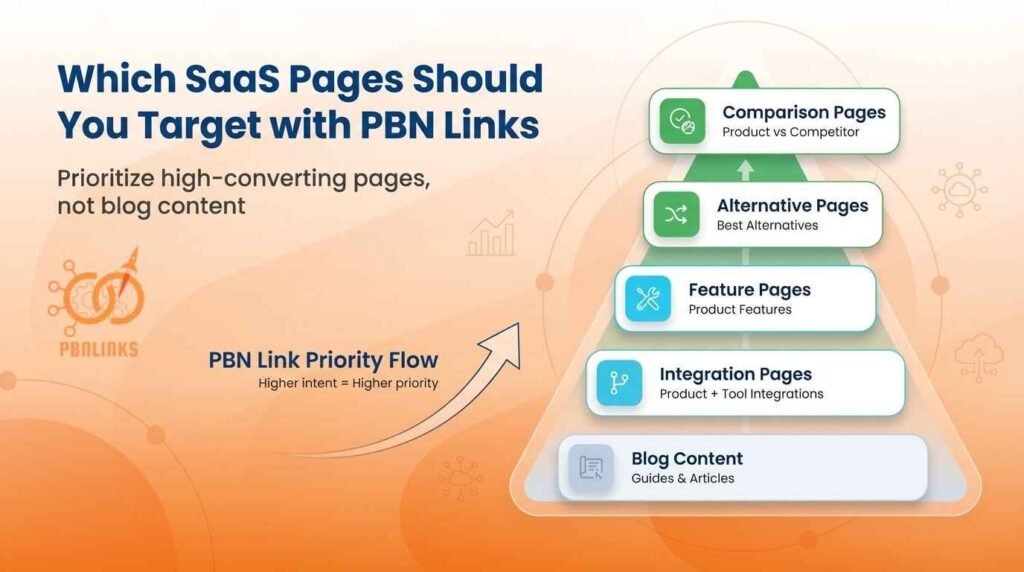
Target your commercial pages first. Informational blog content last. The closer a page sits to an actual conversion the stronger the case for pointing PBN links at it. Most people get this wrong by sending everything to the homepage ,here is the right way to think about it.
Comparison Pages Your Highest-Priority PBN Target
A “[Your Product] vs [Competitor]” page targets someone who has already done their research and is making a final decision. That intent level makes comparison pages some of the highest-converting pages on any SaaS site. One B2B SaaS company running 50 comparison pages saw conversion rates of 5 to 10 percent per month — far above what most informational content ever achieves.
The problem is nobody links to your comparison page organically. No third party ever writes “check out this comparison page” in a blog post. These pages need link equity pushed to them directly or they stay invisible. PBN links are the most practical way to do that.
Alternative Pages High Intent, Even Harder to Rank
“Best [Competitor] alternatives” pages capture a different but equally valuable searcher — someone actively looking to switch products. Users searching for alternatives are typically 3 to 5 times more likely to convert than general information seekers. The intent is clear. The problem is these pages compete directly against G2, Capterra, and review aggregators with DR ratings most SaaS sites will never match through content alone.
PBN links give alternative pages the authority needed to compete in those SERPs. Without that push even a well-written alternatives page rarely cracks the top five against established review platforms.
Feature Pages Rank for What Your Product Actually Does
Feature pages target specific use-case keywords that describe exactly what your product does. “Automated invoicing software.” “Client portal for agencies.” “Project tracking tool for remote teams.” These are high-intent searches from buyers looking for a solution to a specific problem.
Feature pages do earn some natural links over time but rarely enough to compete in commercial SERPs against established players. PBN links pointed at your strongest feature pages push them into top five positions. That is where trial traffic actually converts into paying customers.
Integration Pages Small Investment, Outsized Returns
“[Your Product] + [Popular Tool]” integration pages are the most underused PBN target in SaaS. Someone searching “[Your Product] Zapier integration” or “[Your Product] Slack integration” is not browsing. They are a committed buyer checking whether your product fits their existing stack before signing up.
Very few SaaS competitors build links to their integration pages. That gap means a small number of quality PBN links can produce faster ranking movement here than the same investment on more competitive page types. The traffic volume is lower but the intent is as high as it gets.
Blog Content Your Lowest PBN Priority
Blog content earns links more naturally than any other SaaS page type. Original research, data studies, and practical guides attract organic links over time without needing PBN support. That natural link-earning ability makes blog content your lowest priority.
Use PBN links on blog content only when you are targeting a highly competitive informational keyword where content quality alone is not breaking into the top three. Never point high-authority PBN links at blog posts while your comparison pages, alternative pages, and feature pages are sitting unlinked and invisible.
How to Choose the Right PBN Domain for a SaaS Campaign
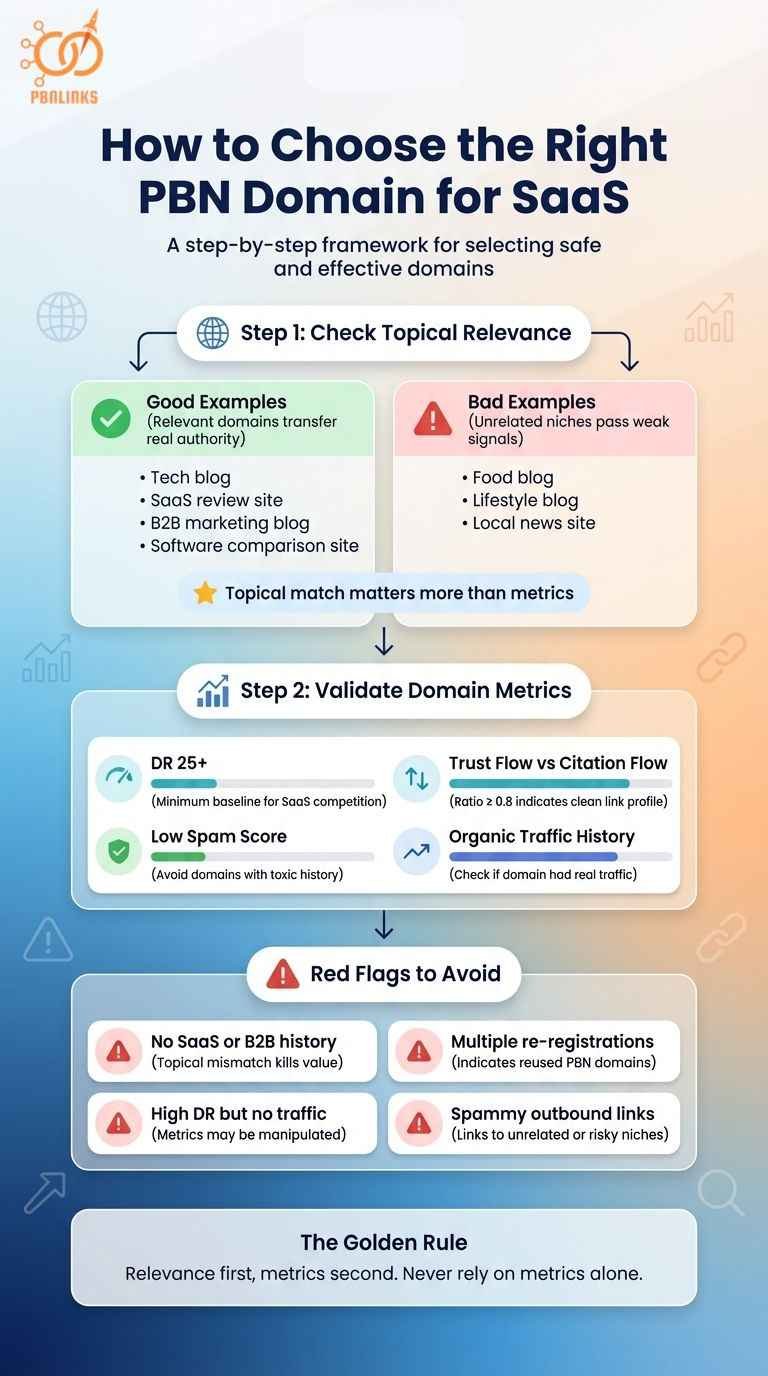
Domain selection is where most SaaS PBN campaigns fail before a single link is built. Topical relevance is your first filter. Metrics confirm quality after relevance is established — never before.
Topical Relevance Is Your First Filter
A good SaaS PBN domain previously existed as a genuine software or B2B content site. Former tech blogs, SaaS review sites, software comparison publications, B2B marketing blogs, and developer-focused sites all carry real topical authority that transfers meaningfully to a SaaS money site.
A former lifestyle blog or local news site does not. Before using any domain ask one question: would Google find it natural for this site to link to a SaaS product? If you have to think hard about it find a better domain. A former project management blog linking to your CRM tool makes sense. A former food blog doing the same does not.
One key difference from local SEO: geo-relevance does not apply in SaaS. Topical match is everything.
The Metrics That Confirm Quality
Once topical relevance is confirmed use metrics to validate the domain. Set DR 25 as your minimum baseline. Competitive SaaS SERPs require stronger domains than most local or affiliate niches.
Check Trust Flow against Citation Flow in Majestic. A ratio of 0.8 or above signals a clean natural link profile. Trust Flow 12 against Citation Flow 40 is a red flag. Keep spam score in Moz low. A dirty history hurts the campaign rather than helping it.
For the full vetting process including hosting setup, Wayback Machine checks, and re-registration patterns the same principles from our PBN links for local SEO guide apply directly.
Red Flags to Walk Away From
No software or B2B content history. Topical mismatch kills the signal value entirely. High DR does not compensate for a domain that spent its life in an unrelated niche.
Re-registered multiple times in short succession. This signals the domain has already been recycled through PBN networks. The value has likely been extracted and the footprint already exists.
High DR with zero real traffic history. Metrics can be gamed. A domain showing DR 35 but no organic traffic was never a real website. Check Ahrefs traffic history before making any decision.
Outbound links pointing to unrelated niches. A domain already linking to gambling, pharmaceuticals, or dozens of unrelated money sites is a liability not an asset.
Anchor Text Strategy for SaaS PBN Campaigns
Most of your PBN anchors for a SaaS site should be branded. Real websites reference SaaS products by name , not by keyword and your anchor distribution needs to reflect that natural pattern. Using the wrong anchors on a public-facing SaaS brand creates footprint signals that quality domains cannot protect you from.
The Right Anchor Text Ratio for SaaS
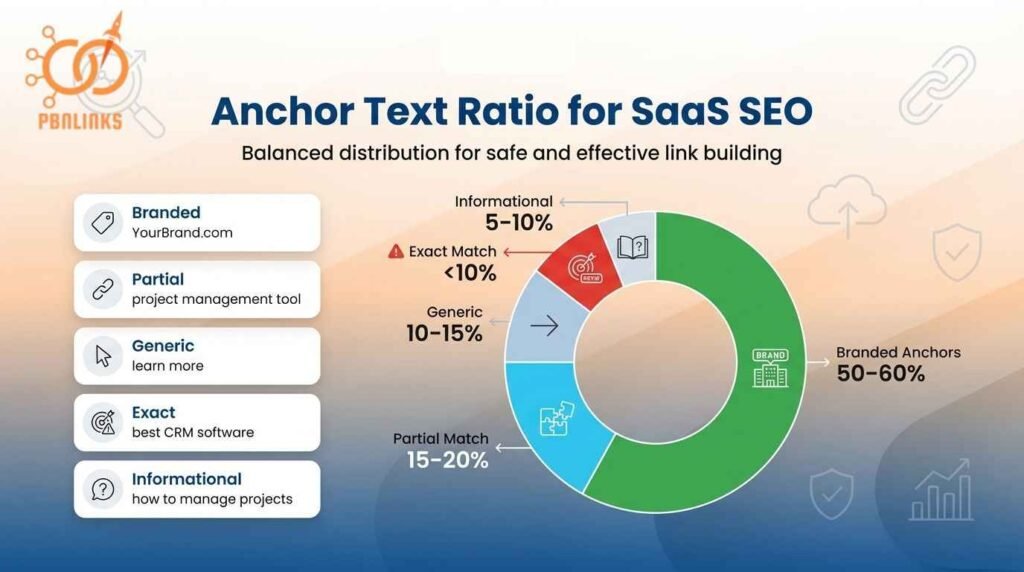
A healthy anchor text profile for SaaS is dominated by brand mentions with commercial keywords used sparingly. Here is the practical breakdown:
Branded Anchors: 50 to 60 Percent
Your product name, your domain, or a variation of both. This is what dominates genuine SaaS link profiles. Real press coverage, product reviews, and community mentions all reference brands by name.
Partial Match Anchors: 15 to 20 Percent
Product category keywords and use-case phrases. “Project management software” or “client reporting tool” rather than your exact target keyword. These carry ranking power without over-optimization risk.
Generic Anchors: 10 to 15 Percent
“Learn more”, “this tool”, “check this out.” These exist purely to add natural variation and dilution to your profile.
Exact Match Anchors: Below 10 Percent
Use sparingly and only on your highest authority PBN posts pointing at commercial pages. Overusing exact match on a named SaaS product is one of the clearest manipulation signals Google looks for.
Informational Anchors: 5 to 10 Percent
Natural phrase anchors for PBN links pointing at blog content. “How to manage client projects” rather than a commercial keyword.
Anchoring to Commercial Pages vs Informational Pages
Commercial pages and informational pages need completely different anchor treatment.
Commercial Pages
Use partial match and branded anchors almost exclusively. Exact match anchors on a named SaaS product’s comparison or alternative page trigger over-optimization signals immediately. The page is already optimized for that keyword on-page. The anchor does not need to repeat it.
Informational Pages
Use natural phrase anchors and generic anchors. Blog content already earns keyword-rich anchor text through normal link acquisition. Your PBN anchors pointing at blog content should blend into that natural pattern.
One Rule That Applies to Both
Never repeat the same anchor text across multiple PBN links pointing at the same page. Each link to the same page needs a different anchor variation.
The Branded SaaS Product Anchor Risk
A recognized SaaS brand is a public identity. Customers know it, competitors monitor it, and press covers it. Exact match commercial anchors on a known product name look manipulative to Google in a way that generic or unbranded sites never face.
Using “best [YourProduct] alternative” as a PBN anchor is an obvious footprint. No real website referencing your brand would ever write that anchor naturally. Branded anchors and partial match phrases are the safe zone. The more recognized your SaaS brand the more conservative your anchor strategy needs to be.
How Fast Should You Build PBN Links for a SaaS Site
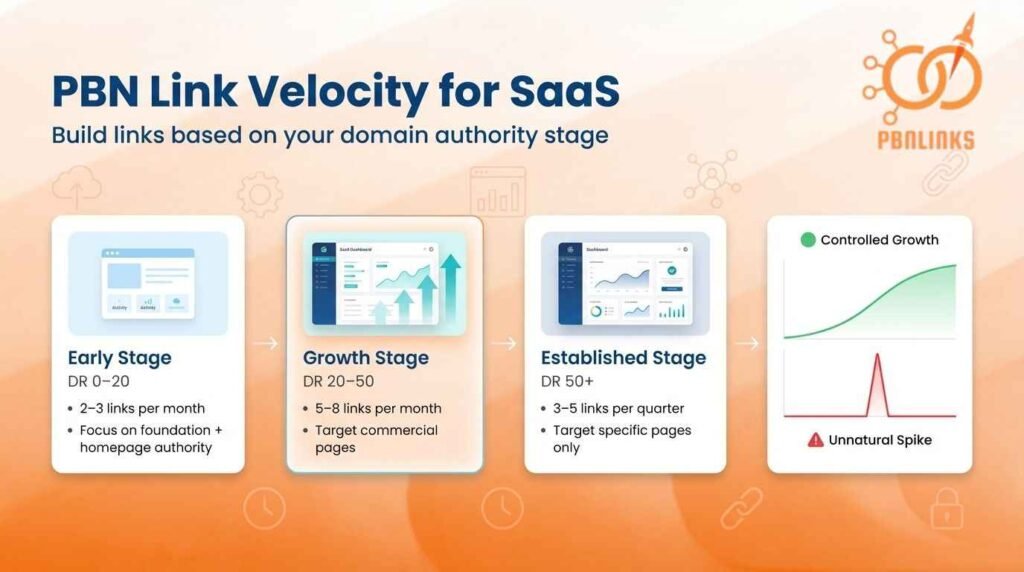
Link velocity is not a fixed number. How fast you build depends entirely on your current DR and how many backlinks your site already has. Build too fast and Google flags the pattern. Build too slow and you delay the ranking movement you are trying to create.
Why Velocity Matters More Than Most SaaS Teams Realise
A SaaS site at DR 15 might naturally earn one or two links per month. Adding ten PBN links in a single week creates a spike that is enormous relative to that baseline.Google’s SpamBrain processes link signals continuously in 2026, not at periodic updates. A pattern detected today gets devalued today.
The smaller your existing backlink profile the more visible every new link becomes. Velocity is not just about how many links you build. It is about how those links look against what already exists.
Early-Stage SaaS — DR 0 to 20
Your backlink profile is small at this stage. Every new link is highly visible to Google. Start with 2 to 3 PBN links per month maximum. Give each batch 30 days to index before adding more.
Before adding any PBN links build the foundation first. Get listed on G2 and Capterra. Complete on-page optimization across all key pages. Build basic citations and directory listings.
At this stage PBN links have one job: crossing the DR threshold. Do not target specific commercial pages yet. Focus entirely on homepage and pillar page authority.
Growth-Stage SaaS — DR 20 to 50
This is where PBN links deliver the strongest results for SaaS. Your domain is established enough to absorb links naturally. Aim for 5 to 8 PBN links per month.
Shift your targeting focus at this stage. Move from homepage DR building to commercial pages. Comparison pages, alternative pages, and feature pages sitting just outside the top five positions are your priority now.
Mix PBN links with white-hat outreach so the profile never looks one-dimensional. Do not stop building completely between batches. A sudden gap after consistent link acquisition looks just as unnatural as a sudden spike.
Established SaaS — DR 50 and Above
PBN links play a smaller role here. White-hat digital PR, niche edits, and partnership links compound more effectively at DR 50 and above. Use 3 to 5 targeted PBN links per quarter on specific pages stuck just outside top three positions.
New feature or integration pages are the strongest use case at this stage. These pages launch with zero authority and need a direct push to enter competitive SERPs quickly. A small number of well-placed PBN links gets them moving faster than waiting for organic link acquisition to catch up.
The Real Risks of Using PBN Links for SaaS Companies
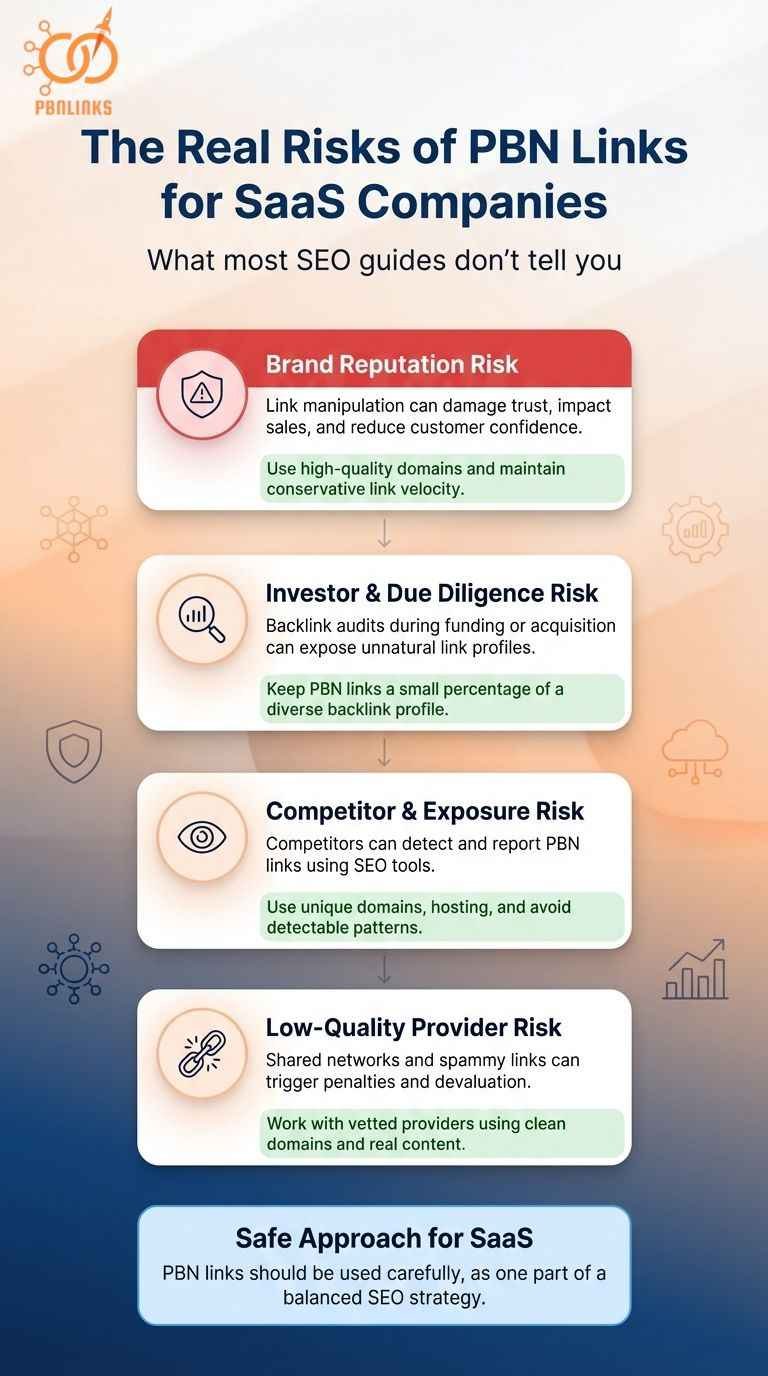
PBN links carry real risks. Anyone telling you otherwise is either uninformed or trying to sell you something without caring about the consequences. At PBN Links Agency we believe the best clients are informed ones.
Generic PBN risks like SpamBrain detection, algorithmic filters, and manual actions apply to every niche and are covered in depth in our PBN links for local SEO guide. This section covers the risks unique to SaaS brands. These are the ones most guides completely ignore.
Brand Reputation Risk
A SaaS product is a named public-facing brand. Customers know it, review it, and talk about it publicly. A penalty or a story about link manipulation damages that trust fast.
SaaS buyers research products heavily before committing to a subscription. Brand credibility is part of the purchase decision. Reputation damage hurts sales cycles and renewal rates, not just rankings.
The protection: Use quality domains with real content and conservative velocity. Never use cheap bulk networks shared across hundreds of unrelated clients. The more recognized your brand the more carefully the campaign needs to be run.
Investor and Due Diligence Risk
Funded SaaS companies go through technical due diligence during fundraising and acquisitions. Investors and acquirers increasingly run backlink profile analysis as part of standard SaaS due diligence in 2026. An unnatural profile raises serious questions about organic growth sustainability.
It can delay deals and affect valuations. That is a commercial consequence most SEO guides never mention. For any SaaS company actively fundraising this risk alone deserves careful consideration.
The protection: Keep PBN links as a small clean percentage of a diverse backlink profile. The rest of your profile should look entirely earned. A PBN campaign representing 20 percent of a healthy diverse profile reads very differently from one representing 80 percent of a thin one.
Competitor and Press Exposure Risk
SaaS competitors actively monitor each other. Tools like Ahrefs make backlink profiles partially visible to anyone who looks. A competitor spotting your PBN links can report them to Google or surface them publicly.
The SaaS industry has active trade press and tight online communities. Stories spread fast. The exposure risk here is higher than almost any other niche.
The protection: Use providers with individually vetted domains, unique hosting, and no shared network footprint. The less your campaign looks like a campaign the safer your brand is.
The Cheap Provider Risk
Low quality PBN providers operate large networks sold to hundreds of clients at once. The same domains link out to SaaS products, gambling sites, and health supplements simultaneously. That pattern is exactly what SpamBrain is trained to find.
A provider selling 50 links for thirty dollars is not a bargain. It is a fast path to devalued links or a penalty from a network already flagged before your campaign started. For a SaaS brand the damage goes beyond rankings.
The protection: Vet your PBN provider the way you would vet any SEO partner. Ask about domain metrics, hosting infrastructure, content standards, and how many clients share the same network. At PBN Links Agency we build on individually vetted domains with unique hosting and original niche-relevant content specifically to protect the SaaS brands we work with.
How to Build a Safe PBN Link Strategy for SaaS
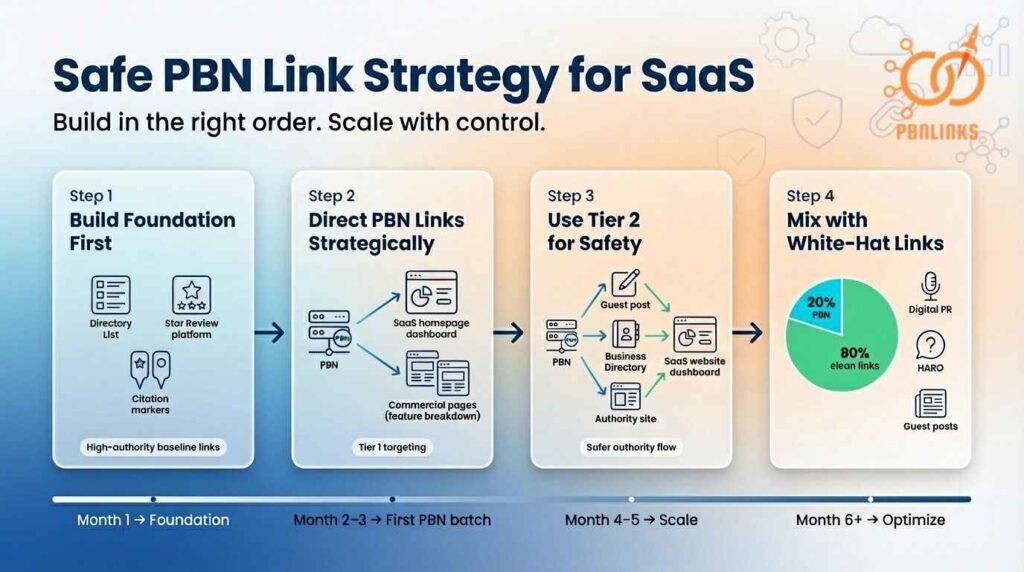
PBN links work best when you build in the right order and direct them at the right targets. Point them at the wrong pages too early and they produce almost nothing. Use them as your only link type and you create a fragile profile. Here is exactly how to structure a safe and effective PBN campaign for a SaaS site.
Step 1: Build Your Foundational Links First
Before a single PBN link goes live your site needs a baseline of clean high-authority links already in place. A site with zero existing authority looks unnatural the moment PBN links arrive.
The easiest foundational links for a SaaS product are software review platforms, SaaS directories, and product listing sites. These carry high domain authority and accept new product submissions without requiring an existing reputation. They are among the few places a brand new SaaS site can earn DR 70 to DR 90 backlinks quickly.
Submit to the strongest platforms first. Spread submissions over a few weeks — three to five per week looks natural.Domains listed on major software review platforms have 3x higher chances of appearing in AI Overview answers compared to products without that presence. In 2026 these listings serve two purposes: foundational link authority and AI visibility signals at the same time.
Once these links are live and indexed your site has a clean baseline. PBN links arriving into that context look proportional not suspicious.
Step 2: Decide Where to Direct Your PBN Links
This is where most SaaS PBN campaigns go wrong. Every link goes to the homepage and nothing else moves. You have three distinct targets and each serves a different purpose.
Direct Tier 1 to your homepage. Use this at early stage when crossing the DR threshold is the entire goal. Two to three PBN links per month pointing at your homepage lifts your domain into the competitive range faster than any other tactic.
Direct Tier 1 to your commercial pages. Once your domain is past DR 25 shift PBN links to commercial pages directly. Comparison pages, alternative pages, feature pages, and integration pages need page-level authority pushed to them. These pages almost never earn links organically. A PBN link pointing directly at your “[Product] vs [Competitor]” page gives it the authority boost it needs to enter competitive SERPs.
Use PBN links as Tier 2 to protect your money site. Instead of pointing PBN links directly at your SaaS site point them at strong existing assets. Your software directory listings, a guest post on a real publication, or a strong niche citation. Those assets absorb the PBN link equity and pass cleaner authority toward your money site through a natural-looking path.
This is the safest execution model for funded SaaS brands. The authority still reaches your domain. The direct connection between your money site and the PBN is removed entirely.
Step 3: Mix PBN Links With Clean Link Types
A profile built entirely on PBN links is fragile. One algorithm update or one network devaluation and your rankings collapse. PBN links should represent roughly 20 percent of your total link building activity. The remaining 80 percent should be clean and earned.
The strongest white-hat links to mix alongside PBN links for SaaS are HARO responses, digital PR placements, podcast appearance links, and niche edits on real tech publications. Each builds the kind of editorial authority that makes your PBN links look proportionally natural inside a diverse profile.
Never stop building clean links between PBN batches. A sudden gap in all link acquisition looks just as unnatural as a sudden spike.
Step 4: Follow a Safe Sequencing Timeline
Month 1: Foundation only. Directory and citation links across high-authority software platforms. On-page optimization across all commercial pages. No PBN links yet.
Month 2 to 3: First PBN batch. Two to three links pointing at your homepage or key commercial pages depending on your current DR. Let this batch index for 30 days and monitor DR movement before adding more.
Month 4 to 5: Second PBN batch. Four to five links targeting additional commercial pages or Tier 2 assets like your strongest directory listings. Identify which pages are responding and prioritize those.
Month 6 onward: Scale based on data. Pages responding get more links. Pages not responding get an on-page review first before additional links are added. Expect DR movement within 4 to 8 weeks and keyword ranking movement within 8 to 16 weeks for most SaaS campaigns.
How to Track PBN Link Results for a SaaS Site
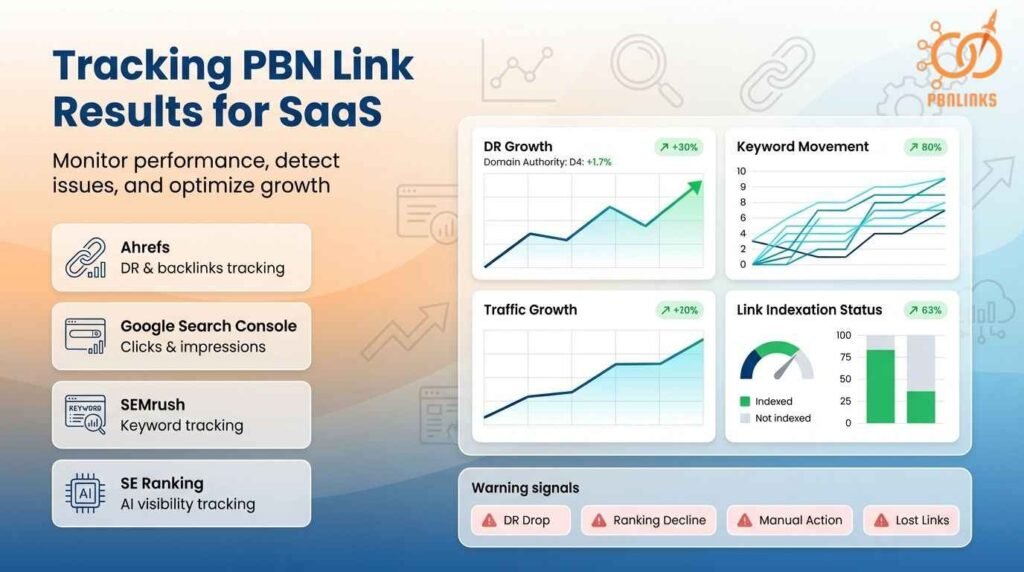
Tracking SaaS PBN results is different from local SEO. There is no Map Pack to monitor. You are tracking DR trajectory, commercial page keyword movement, organic traffic to high-intent pages, and AI Overview appearances. Without tracking you cannot tell if links are working or causing harm.
Your SaaS PBN Tracking Stack
Ahrefs is your primary tool. Use it to monitor DR trajectory after each batch, track referring domain count, check PBN link indexation status, and catch lost links early.
Google Search Console tracks organic click data and impression growth for your targeted commercial pages. It also flags manual action notifications immediately. Check it after every batch.
SEMrush or Ahrefs keyword tracking monitors ranking movement for your comparison, alternative, and feature pages week over week. Set up position tracking for every commercial page receiving PBN links before the first batch goes live.
For AI Overview monitoring use SE Ranking. It tracks whether your SaaS product begins appearing in AI answers as your domain authority and citation signals grow. In 2026 this is a metric worth watching alongside traditional rank tracking.
What to Monitor After Each Batch
DR movement. Expect 4 to 8 weeks for measurable DR growth after links are indexed. If DR stays flat after 10 weeks check whether PBN posts are actually indexed.
Keyword rankings. Are your commercial pages moving toward top five positions. Check weekly. Daily fluctuations are noise.
Organic traffic to commercial pages. Ranking movement should translate to click growth within 8 to 16 weeks. Rankings moving without traffic growth signals a title or meta description problem not a link problem.
PBN link indexation. Check every link 2 to 3 weeks after placement. An unindexed post passes zero value. At PBN Links Agency we check every link after placement and replace any that drop.
Warning Signals That Need Immediate Action
DR drops unexpectedly after a link batch. Check whether PBN posts have been deindexed before building anything new.
Keyword rankings fall below their starting point after new links arrive. Pause immediately and investigate the cause before adding more.
A manual action notification appears in Google Search Console. Stop all link building until the action is resolved.
Referring domain count declines without explanation. Silent deindexation of PBN posts is the most likely cause. Audit every link in your last batch before continuing.
If none of these signals appear after 8 weeks and DR is moving your campaign is on track. Keyword ranking movement for commercial pages typically follows 4 to 8 weeks after DR growth confirms the links are passing value.
Are PBN Links Worth It for SaaS SEO in 2026
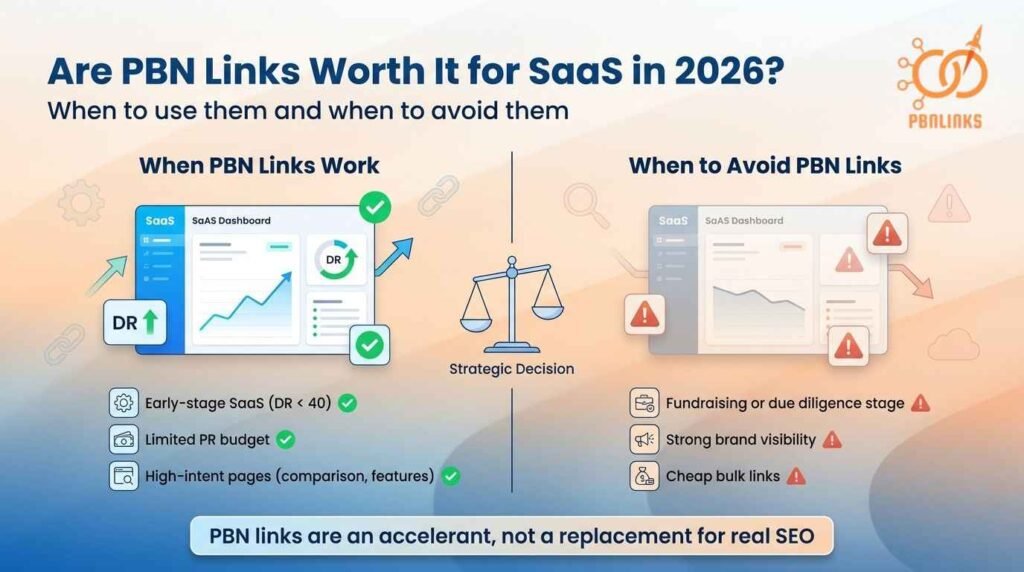
Quality PBN links built on clean aged domains still work for SaaS in 2026. But they are not the right call for every situation. Here is who should use them and who should not.
When PBN Links Are the Right Call
Early to growth stage SaaS stuck below DR 40 is the strongest use case. White-hat alone cannot close the authority gap fast enough at this stage. PBN links accelerate DR growth while earned links build in parallel.
Bootstrapped SaaS companies without budget for sustained digital PR get the clearest return from PBN links. A few quality links targeted at the right commercial pages deliver more ranking movement per dollar than most white-hat alternatives.
Commercial pages that cannot earn links naturally are always a strong target. Comparison pages, alternative pages, and integration pages need link equity pushed directly to them. No white-hat tactic solves this problem reliably.
Agencies managing SaaS clients with aggressive timelines use PBN links because white-hat compounding timelines rarely fit client expectations.
When PBN Links Are the Wrong Call
Funded SaaS companies in active fundraising or M&A should avoid direct PBN links. Due diligence backlink audits are standard in 2026. An unnatural profile discovered mid-deal creates real commercial risk.
SaaS brands with strong press presence and active competitor monitoring face higher exposure risk. The more visible your brand the more carefully gray-hat activity needs to be managed.
Cheap bulk links do not work.Google’s SpamBrain processes link signals continuously. Low quality networks get filtered fast. Only invest in PBN links when the budget allows for quality domains and real content.
Any site already under a manual action should resolve that first. Adding links to a penalized site makes the problem worse not better.
The Bottom Line for SaaS in 2026
Vibe coding has flooded the SaaS market. Organic authority is the moat that separates products that grow from ones that stay invisible. PBN links remain one of the fastest ways to build that moat.
Used correctly they are a surgical accelerant. Used carelessly they are a brand and commercial liability. Build your foundation first, target the right pages, keep PBN links as one layer within a diverse profile, and work with a provider who vets every domain individually. That approach is exactly what we follow at PBN Links Agency for every SaaS campaign.
Conclusion
The SaaS products that win in organic search are not the ones with the biggest budgets. They are the ones that build authority in the right order and treat every link as one calculated layer within a broader strategy. PBN links accelerate that process. They are not a replacement for solid foundations or earned links. They are what closes the gap when white-hat alone is too slow.
Quality and provider choice determine everything. The same strategy that builds lasting rankings for one SaaS product creates a liability for another the difference is always in the execution.
Ready to add PBN links to your SaaS strategy?Explore our SaaS PBN packages at PBN Links Agency and let our team build the authority your product needs to compete.
FAQS About PBN Links For Saas
What are PBN links for SaaS?
PBN links for SaaS are backlinks from private blog networks pointed at a software company’s website to accelerate domain authority and push commercial pages into competitive rankings. They are used as a gray-hat tactic to close the authority gap faster than white-hat link building alone allows.
Do PBN links actually work for SaaS SEO in 2026?
Yes, quality PBN links built on clean aged domains with topically relevant content still produce results for SaaS in 2026. Low-quality bulk networks get filtered or penalized quickly , domain quality and execution determine everything.
Which pages on a SaaS site should receive PBN links first?
Comparison pages, alternative pages, feature pages, and integration pages are the highest-priority targets because they drive conversions but almost never earn links organically. Blog content should be your lowest priority unless you are targeting a highly competitive informational keyword.
How many PBN links does a SaaS site need?
Early-stage SaaS sites at DR 0 to 20 should start with 2 to 3 quality PBN links per month to begin crossing the DR threshold. Growth-stage sites at DR 20 to 50 can absorb 5 to 8 links per month targeting specific commercial pages.
What is the difference between Tier 1 and Tier 2 PBN links for SaaS?
Tier 1 PBN links point directly from the PBN to your SaaS money site while Tier 2 links point at strong existing assets like directory listings or guest posts instead. Tier 2 is safer for funded SaaS brands because it removes the direct connection between your domain and the PBN.
Are PBN links safe for a funded SaaS company?
Direct PBN links carry higher risk for funded companies because investor due diligence increasingly includes backlink profile analysis. Tier 2 PBN links or pausing link building during active fundraising or M&A discussions is the safer approach.
What makes a good PBN domain for a SaaS campaign?
A good SaaS PBN domain previously existed as a genuine tech blog, SaaS review site, or B2B marketing publication with real topical authority. Domain Rating of 25 or above and a Trust Flow to Citation Flow ratio of 0.8 or higher confirm quality after topical relevance is established.
How long do PBN links take to work for SaaS SEO?
Most SaaS PBN links from quality domains produce measurable DR movement within 4 to 8 weeks of indexation. Keyword ranking movement for targeted commercial pages typically follows within 8 to 16 weeks.
What happens if my SaaS site gets a manual action from PBN links?
A manual action notification will appear in Google Search Console — stop all link building immediately and file a reconsideration request after disavowing the problematic links. Recovery typically takes 75 to 90 days and may not fully restore pre-penalty rankings.
Can PBN links help a SaaS product appear in Google AI Overviews?
Yes, building domain authority through PBN links contributes to the entity trust signals that feed AI Overview eligibility. Domains with stronger authority and citation signals have significantly higher chances of appearing in AI Overview answers.
Should I use PBN links or guest posts for SaaS?
Both serve different purposes and work best combined. PBN links deliver faster targeted authority to specific commercial pages while guest posts build editorial credibility over time.
What anchor text should I use for SaaS PBN links?
Branded anchors should make up 50 to 60 percent of your anchor profile and exact match anchors should stay below 10 percent. Over-optimizing with exact match commercial anchors on a recognized SaaS brand name is one of the clearest footprint signals Google detects.
What happens if I rely only on PBN links for SaaS SEO?
A backlink profile built entirely on PBN links is fragile and one algorithm update can collapse rankings overnight. PBN links should represent roughly 20 percent of your total link building activity with the remainder coming from clean earned sources.
How do I know if my PBN links are indexed?
Check every PBN post in Ahrefs or by running a site search in Google 2 to 3 weeks after placement. An unindexed post passes zero value and should be replaced immediately.
Will PBN links still work for SaaS in the future?
Quality PBN links on clean domains with real niche-relevant content will continue to pass value as long as domain authority remains a core Google ranking signal. The bar for quality will keep rising which means cheap bulk networks will become increasingly ineffective while high-quality targeted PBN links remain viable.