Best PBN Domain Auction Sites: Where to Buy Expired Domains for Your Network
What if you could skip 12 to 24 months of SEO work? What if you could start with a domain that already has backlinks, authority, and trust? That is exactly what the right expired domain gives you. That is why PBN domain auction sites have become essential tools for serious SEO professionals.
Instead of growing a new site from zero, you buy an aged domain with an existing backlink profile. That domain already has real referring domains, domain authority, and years of built-in trust signals. That authority transfers directly to your money site through your private blog network. A fresh domain registration cannot match that head start.
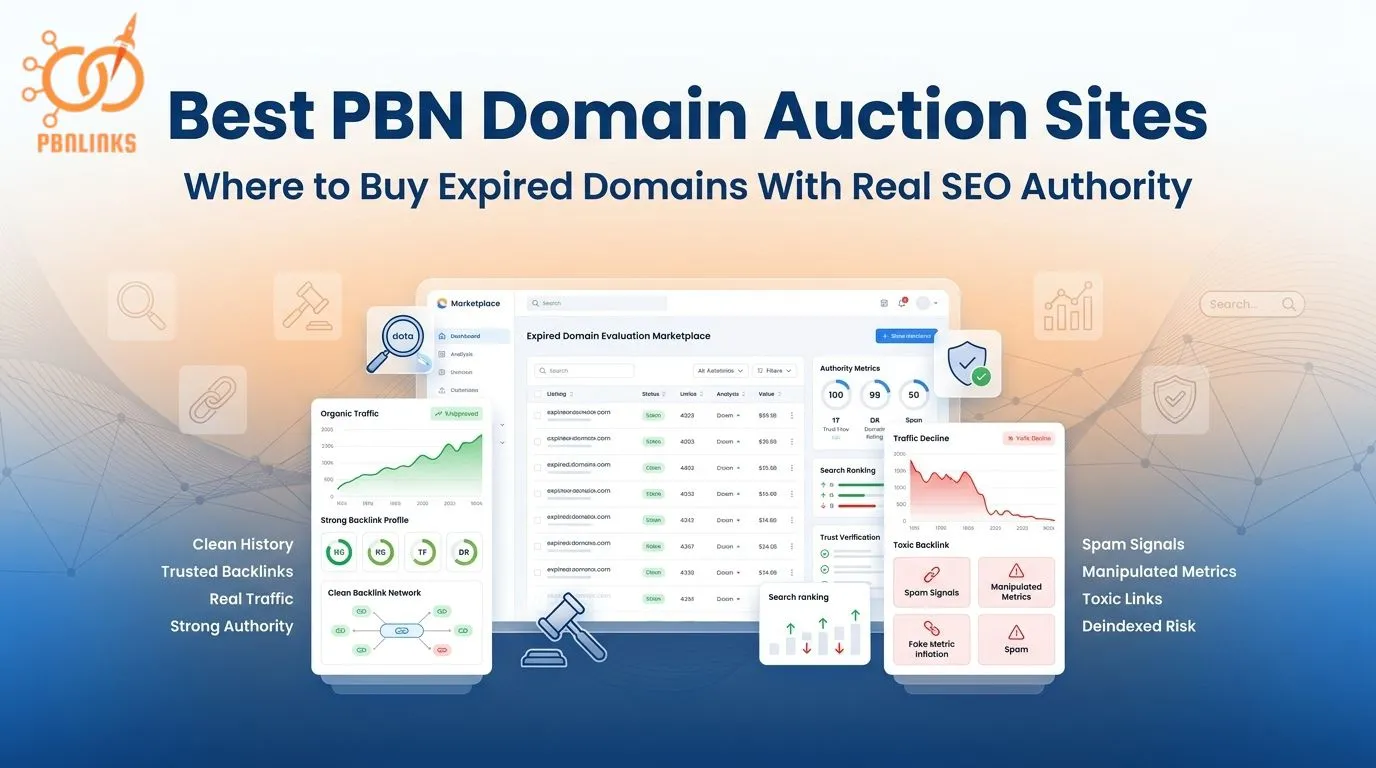
But there is a serious risk. Many expired domains look powerful on the surface. Under the surface they carry spammy backlinks, manipulated metrics, or a damaging history. Buying the wrong domain does not just waste money. It can get your entire PBN deindexed. It can damage the very money site you built your network to support.
That is why the platform you choose matters as much as the domain itself. Not all PBN domain auction sites offer the same quality, filtering tools, or spam protection. This guide covers all seven top platforms in full — plus a six-step vetting checklist, budget guidance, and the most costly buying mistakes to avoid.
What Is a PBN Domain Auction Site
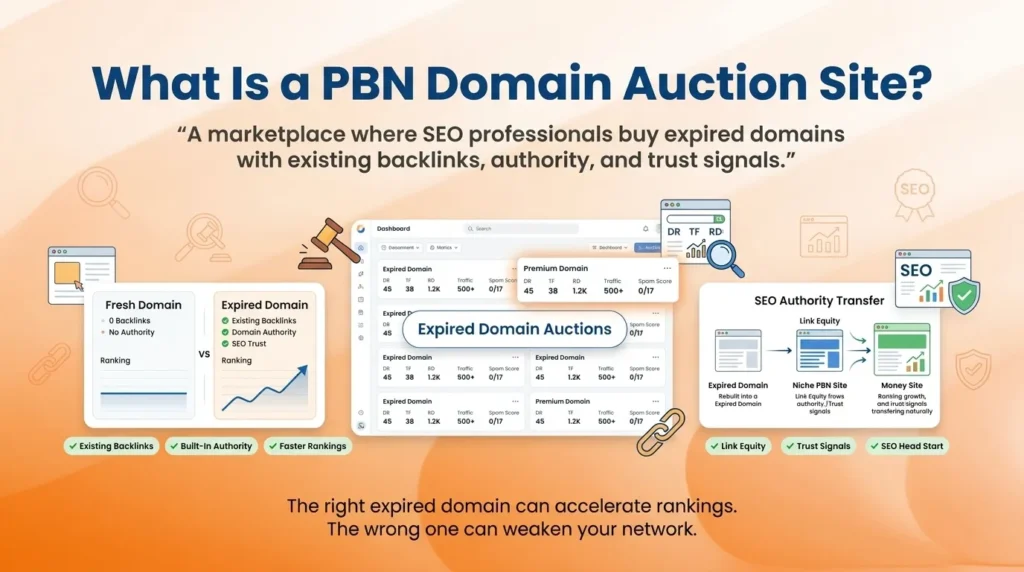
A PBN domain auction site is an online marketplace where expired domains are listed for competitive bidding. These platforms exist specifically because expired domains carry pre-built SEO authority that a fresh domain registration simply does not have.
When a domain owner stops paying their annual renewal fee, the registrar does not delete the domain immediately. It enters a structured expiry process and gets listed on a PBN domain auction site. SEO professionals then compete to acquire it before it returns to the public registry. The entire process exists because that domain still carries years of backlinks, domain authority, and trust signals — even after its owner walks away.
This is what makes PBN auction sites fundamentally different from standard domain registrars. When you register a fresh domain, you start with zero authority, zero backlinks, and zero trust. When you buy an expired domain through an auction platform, you inherit the full SEO history of that domain — including its backlink profile, Trust Flow, referring domains, and domain age. All of that link equity passes directly to your money site the moment you start building on it.
Domain Metrics You Must Check Before Buying
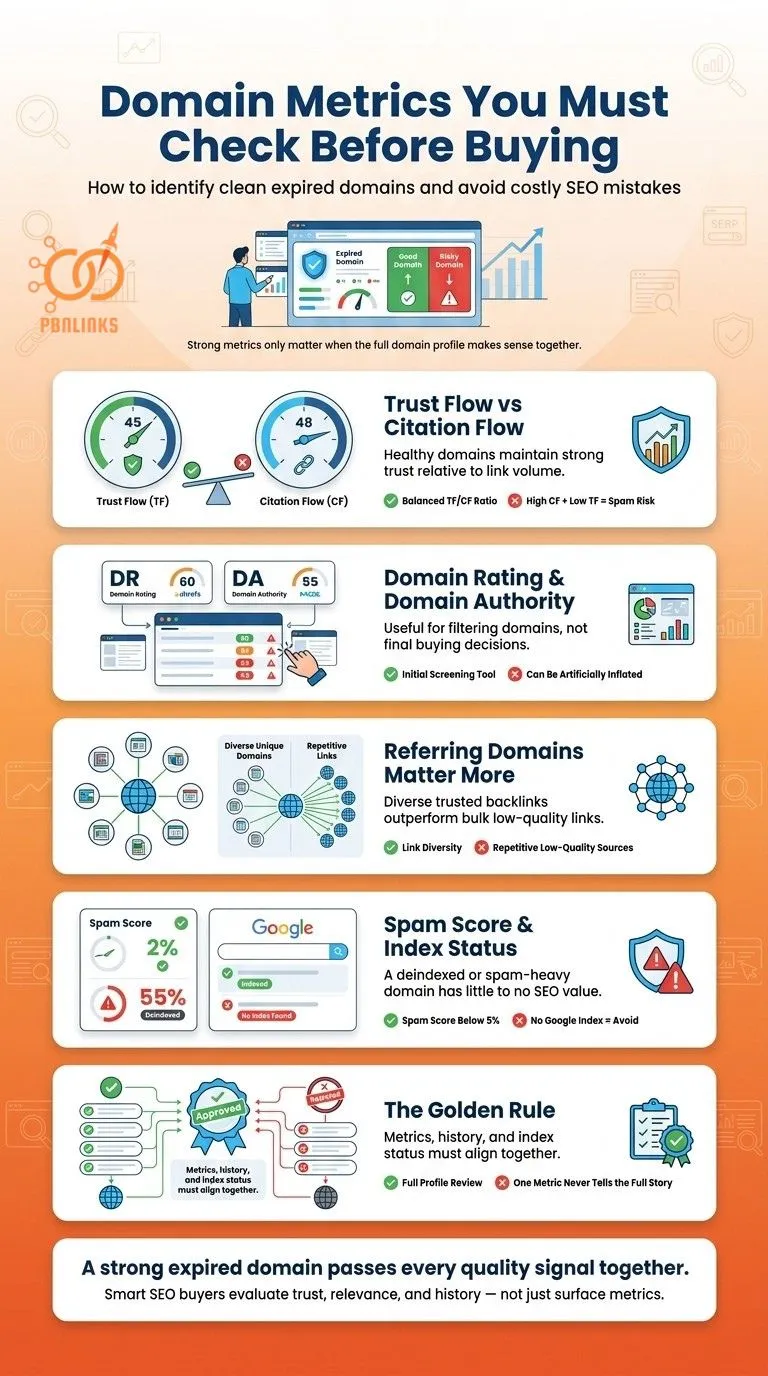
Metrics only matter when you read them together, not one by one. A domain that looks strong on paper can still be a dangerous buy if its link profile, history, or index status shows suspicious patterns.
Trust Flow and Citation Flow
Trust Flow measures link quality. Citation Flow measures link volume. Both come from Majestic SEO. A healthy domain has Trust Flow at least 50% of its Citation Flow. A much higher Citation Flow means low-quality or artificial links. Treat that gap as a warning sign and move on.
Domain Rating and Domain Authority
Domain Rating (Ahrefs) and Domain Authority (Moz) estimate ranking potential. Both can be manipulated with cheap links. Use them to filter a large list quickly. Never use them as your final buying decision.
Referring Domains and Backlink Count
Fifty links from fifty different sites beats five hundred links from three sites. Diversity matters more than volume. Search engines trust links from many independent sources. That is the signal that counts.
Spam Score and Index Status
Spam Score flags risky domains before you bid. Keep it under 5% for safe domains. Above 10% is a hard disqualifier. Also type site:domain.com into Google. No results means the domain is deindexed. Walk away immediately — a deindexed domain has zero SEO value.
The Golden Rule
A domain only makes sense when its metrics, history, and index status all check out together. One green light does not cancel three red flags.
How to Vet a PBN Domain Before You Place a Bid
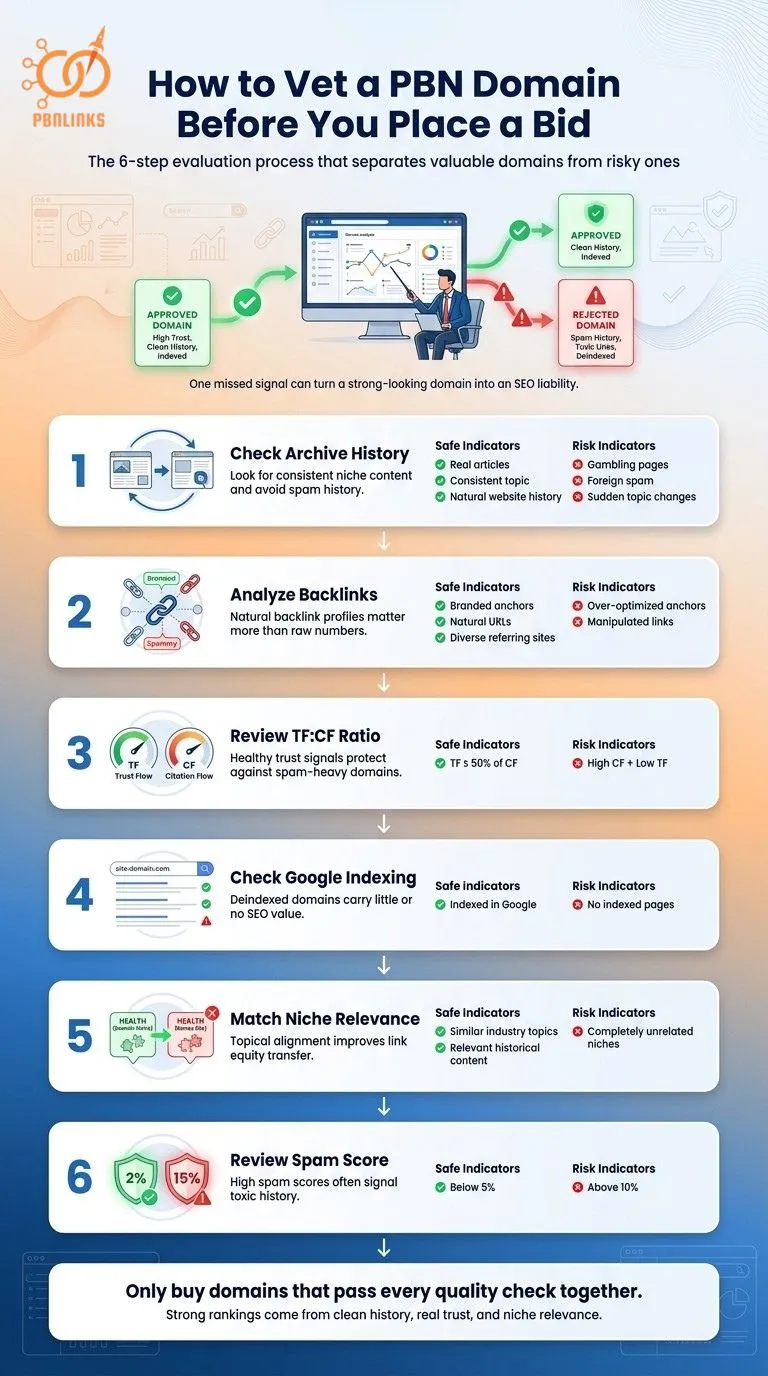
To vet a PBN domain correctly, check its archive history, backlink profile, TF:CF ratio, Google index status, niche relevance, and spam score — in that order. Every step matters. Skip even one and you risk buying a domain that hurts your money site instead of helping it.
Step 1 Check the Domain History
Go to web.archive.org and type in the domain name. Look at old snapshots of the site. You want to see real articles, a clear topic, and a consistent purpose over time. Walk away if you see spam pages, gambling content, foreign-language directories, or sudden topic changes.
Step 2 Analyze the Backlink Profile
Open Ahrefs or Majestic and look at where the domain’s links come from. A good backlink profile has mostly branded links, plain URLs, and natural phrases as anchor text. If most anchors are exact-match keywords, someone was manipulating those links. That is a red flag.
Step 3 Check the TF:CF Ratio
Look at the Trust Flow and Citation Flow numbers together. Trust Flow should be at least half of Citation Flow. If Trust Flow is 10 and Citation Flow is 40, that is a problem. It means the domain has lots of links but very few good ones.
Step 4 Confirm Google Index Status
Type site:domain.com into Google search. If Google shows pages from that domain, it is still indexed. If nothing shows up, Google has removed it. A deindexed domain has zero SEO value. Do not bid on it under any circumstances.
Step 5 Check Niche Relevance
Look at what the domain was about when it was active. Try to match that topic to your money site as closely as possible. A domain that covered health topics will pass stronger links to a health site than to a finance site. The closer the niche match, the better the link equity transfer.
Step 6 Review the Spam Score
Go to Moz Link Explorer and check the domain’s Spam Score. Under 5% is safe. Between 5% and 10% means look closer before deciding. Above 10% means skip it entirely. If the spam score is high and the archive or backlinks also look bad, move on without hesitation.
The Simple Buying Rule
Only buy a domain when all six steps check out. Clean archive. Natural backlinks. Healthy TF:CF ratio. Still indexed. Relevant niche. Low spam score. If even one of these fails, keep looking.
The Best PBN Domain Auction Sites Reviewed
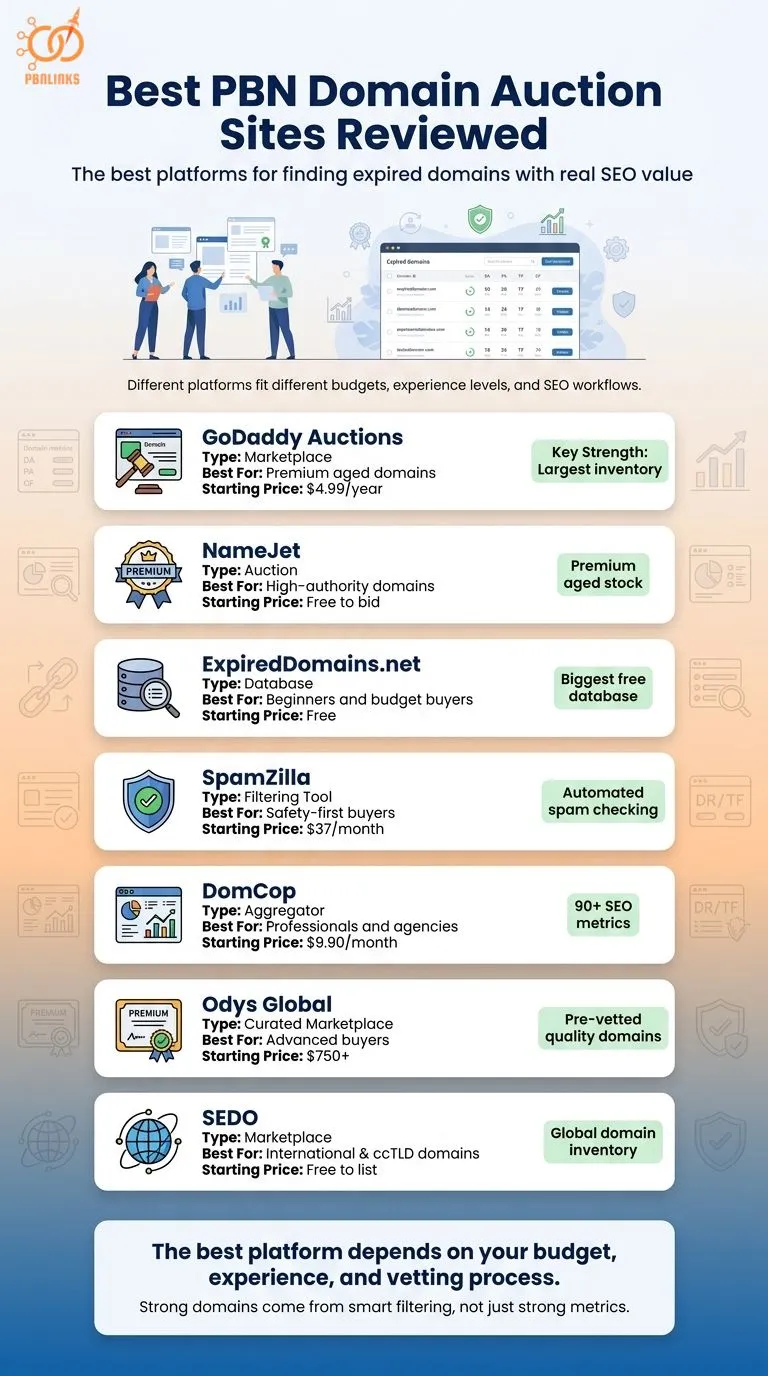
Not every platform works for every buyer. The right choice depends on your budget, experience level, and how much vetting work you want to do yourself. Below are the seven best PBN domain auction sites, each reviewed in equal detail to help you decide which one fits your situation best.
| Platform | Type | Best For | Starting Price | Key Strength |
| GoDaddy Auctions | Marketplace | Premium aged domains | $4.99/year | Largest inventory |
| NameJet | Auction | High-authority domains | Free to bid | Premium aged stock |
| ExpiredDomains.net | Database | Beginners and budget buyers | Free | Biggest free database |
| SpamZilla | Filtering tool | Safety-first buyers | $37/month | Automated spam checking |
| DomCop | Aggregator | Professionals and agencies | $9.90/month | 90+ metrics in one place |
| Odys Global | Curated marketplace | Advanced buyers | $750+ | Pre-vetted quality domains |
| SEDO | Marketplace | International and ccTLD domains | Free to list | Global domain inventory |
GoDaddy Auctions
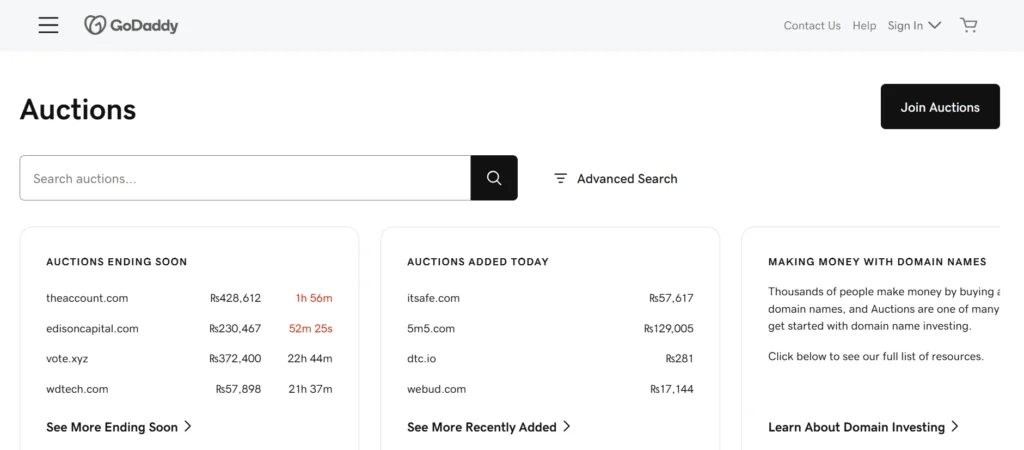
GoDaddy Auctions is the largest expired domain marketplace in the world, run by the world’s biggest domain registrar.
When a domain registered through GoDaddy expires, it gets listed on GoDaddy Auctions 26 days after the expiry date. It then runs through a 10-day live bidding window. The highest bid at the end wins. If no bids are placed, the domain moves into a 5-day closeout phase. The price starts at $11 and drops by $1 each day until it reaches $5. Domains with no bids during closeout return to the public registry. Membership costs $4.99 per year.
What makes it stand out:
- Largest expired domain inventory of any platform worldwide
- 5-day closeout phase regularly surfaces quality domains at very low prices
- Proxy bidding system automatically increases your bid by the minimum increment
- Partner registrar domains also appear here — expanding inventory beyond GoDaddy registrations
- Direct domain transfer process is smooth and reliable after winning
Perfect for: PBN builders looking for premium aged domains with long histories and strong backlink profiles. The closeout phase is ideal for budget buyers hunting quality domains at minimum cost.
NameJet
NameJet is a premium expired domain auction platform that sources inventory directly from major partner registrars across the industry.
NameJet works on a backorder system. You place a backorder on the domain you want before it expires. If you are the only backorder holder, you win it at the minimum bid price. If multiple buyers backordered the same domain, all parties enter a private three-day auction. The highest bid wins. The backorder fee is $79 but is fully refunded if the domain is not successfully caught.
Key advantages:
- Inventory sourced directly from top registrars — premium domains not found elsewhere
- Private auction format limits competition to serious backorder holders only
- Backorder fee fully refunded if the domain is not successfully acquired
- Covers expiring domains, pending delete domains, and buy-now listings
- Verified Bidder program unlocks higher bid limits for serious buyers
Who should use it: Experienced PBN builders targeting high-authority aged domains with strong backlink profiles that do not appear on other platforms.
ExpiredDomains.net
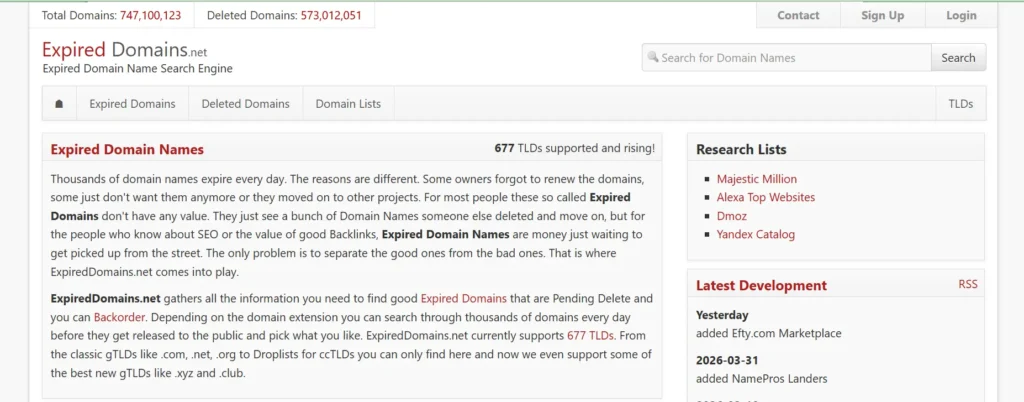
ExpiredDomains.net is the largest free expired domain database available — tracking over 700 TLDs across millions of daily records at zero cost.
You create a free account and use the platform’s filtering system to search expiring and dropped domains daily. You can filter by Trust Flow, Citation Flow, domain age, and backlink count. When you find a domain worth pursuing, the platform links you directly to the auction to place your bid.
Core strengths:
- Completely free — full database and filtering access with no paid tier
- Tracks 700+ TLDs including country-code and new extensions
- Aggregates listings from GoDaddy, NameJet, SnapNames, and Dynadot
- Advanced filtering by Majestic and SEMrush metrics included
- CSV data export available at no cost for offline analysis
- No built-in spam checking — manual verification required before bidding
Ideal for: Beginners learning how to find and evaluate expired domains, and budget buyers who want the largest possible database without a monthly subscription.
SpamZilla
SpamZilla is a domain research and filtering tool built specifically to find clean expired domains solving the biggest risk in PBN buying: hidden spam history.
SpamZilla processes over 350,000 domains daily and assigns every domain a proprietary spam score. It checks Wayback Machine snapshots, redirect history, backlink sources, and anchor text patterns automatically. It pulls listings from GoDaddy, NameJet, SEDO, DropCatch, and Dynadot into one dashboard. You set your filters once and receive a daily matching domain list by email.
What you get with SpamZilla:
- Proprietary spam score built specifically for expired domain vetting
- Automated Wayback Machine checking saves hours of manual research per domain
- Daily email alerts deliver filtered domain lists matching your exact criteria
- Bulk domain analysis allows up to 1,850 uploads per month
- Covers 70+ SEO metrics including Trust Flow, Domain Rating, and anchor text data
Right for: Safety-conscious PBN builders who want automated spam detection and history checking built into their research process from day one.
DomCop

DomCop is a professional-grade expired domain aggregator that pulls listings from multiple auction platforms and layers over 90 SEO metrics on top of every listing.
DomCop tracks over 10 million domains daily. It pulls data from Majestic, Moz, and SEMrush. It displays Trust Flow, Citation Flow, Domain Authority, referring domains, and traffic estimates in one dashboard. You set your filters once and DomCop surfaces only domains that meet your exact criteria.
Why professionals choose DomCop:
- Aggregates listings from GoDaddy, NameJet, Dynadot, and more in one place
- 90+ SEO metrics displayed per domain — no manual cross-checking needed
- Custom watchlists and real-time alerts for domains matching your criteria
- Advanced filtering by domain age, TLD, traffic, Trust Flow, and referring domains
- Personal crawler available on higher plans for finding hidden expired domains
Built for: Professional PBN builders, SEO agencies, and domain investors who evaluate large volumes of domains and need one data-rich platform to do it efficiently.
Odys Global
Odys Global is a premium curated marketplace that sells pre-vetted expired domains — removing the need for buyers to run their own vetting process entirely.
Every domain listed on Odys has been manually reviewed for backlink quality, spam history, niche relevance, and index status. Each listing includes a detailed profile page showing the domain’s niche history and top referring domains. Odys also provides a free logo design with every purchase. A live indexed version of each site is maintained while the domain is listed for sale. Prices start at $750 and increase based on domain authority and backlink strength.
What sets Odys apart:
- Every domain manually vetted before listing — no bad purchases slip through
- Detailed profile pages show niche history and top referring domains clearly
- Free logo design included with every domain purchase
- Live site maintained during the sale period to preserve Google indexing
- Around 500 curated domains available at any time across multiple niches
Made for: Advanced PBN builders and niche site owners who want guaranteed domain quality without spending hours on manual vetting — and are willing to pay a premium for that assurance.
SEDO
SEDO is one of the world’s largest domain marketplaces with a particularly strong inventory of international and country-code TLD domains.
SEDO operates as both an auction platform and a fixed-price marketplace. Sellers list domains with a set asking price or as an open auction. Buyers search by keyword, TLD, price range, and domain length. SEDO handles domain transfers and payment processing directly — making international domain purchases straightforward.
Reasons to use SEDO:
- Strong inventory of ccTLDs including .co.uk, .de, .fr, .it, and .com.au
- Both fixed-price and open auction formats available in one platform
- International payment processing and transfers handled directly by SEDO
- Free to list for sellers — no upfront listing fees required
- Best platform for sourcing geo-targeted domains for international PBN networks
A good match for: PBN builders targeting international markets or building geo-targeted networks using country-code TLDs not found on US-focused platforms.
How Much Should You Spend on a PBN Domain
A practical budget is usually $50 to $200 for a usable PBN domain. Cheaper options exist under $50 and premium domains start at $200 and above. The right amount depends on the domain’s history, backlink quality, and how much risk you are willing to take.
Under $50 — Entry Level Domains
At this price, you can still find usable domains. But they are usually lower quality or require more manual filtering. Good places to look include GoDaddy’s closeout phase and free databases like ExpiredDomains.net. Expect weaker metrics, inconsistent niche history, and more spam cleanup work. This tier works best if you are learning the process and can tolerate higher risk.
$50 to $200 — Mid-Range Domains
This is the most practical range for most PBN buyers. Domains here tend to have better history, stronger backlink profiles, and cleaner trust signals. They still need full vetting — but they are far more likely to carry real authority than entry level options. For most SEO professionals, this is the sweet spot. Platforms to use at this tier include GoDaddy Auctions, NameJet, and SpamZilla-filtered lists.
$200 and Above — Premium Domains
Above $200, you are paying for stronger authority, better link equity, and cleaner domain history. Premium domains come from competitive auctions on NameJet or curated inventories like Odys Global. The upfront cost is higher but the research burden is significantly lower. This tier makes sense when you need higher confidence and faster ranking impact on a competitive money site.
Budget by Use Case
If you are building a small test network, a lower budget can work. But you must accept more manual review and higher failure rates. If you want reliable domains for a serious PBN, spending in the mid-range is smarter than chasing the cheapest option. The biggest mistake is buying a cheap domain just because it is cheap — then discovering it has poor history or toxic backlinks.
The Simple Budget Rule
Treat domain price as a quality filter, not a success guarantee. Spend enough to avoid obvious low-quality domains
Mistakes to Avoid When Buying PBN Domains at Auction
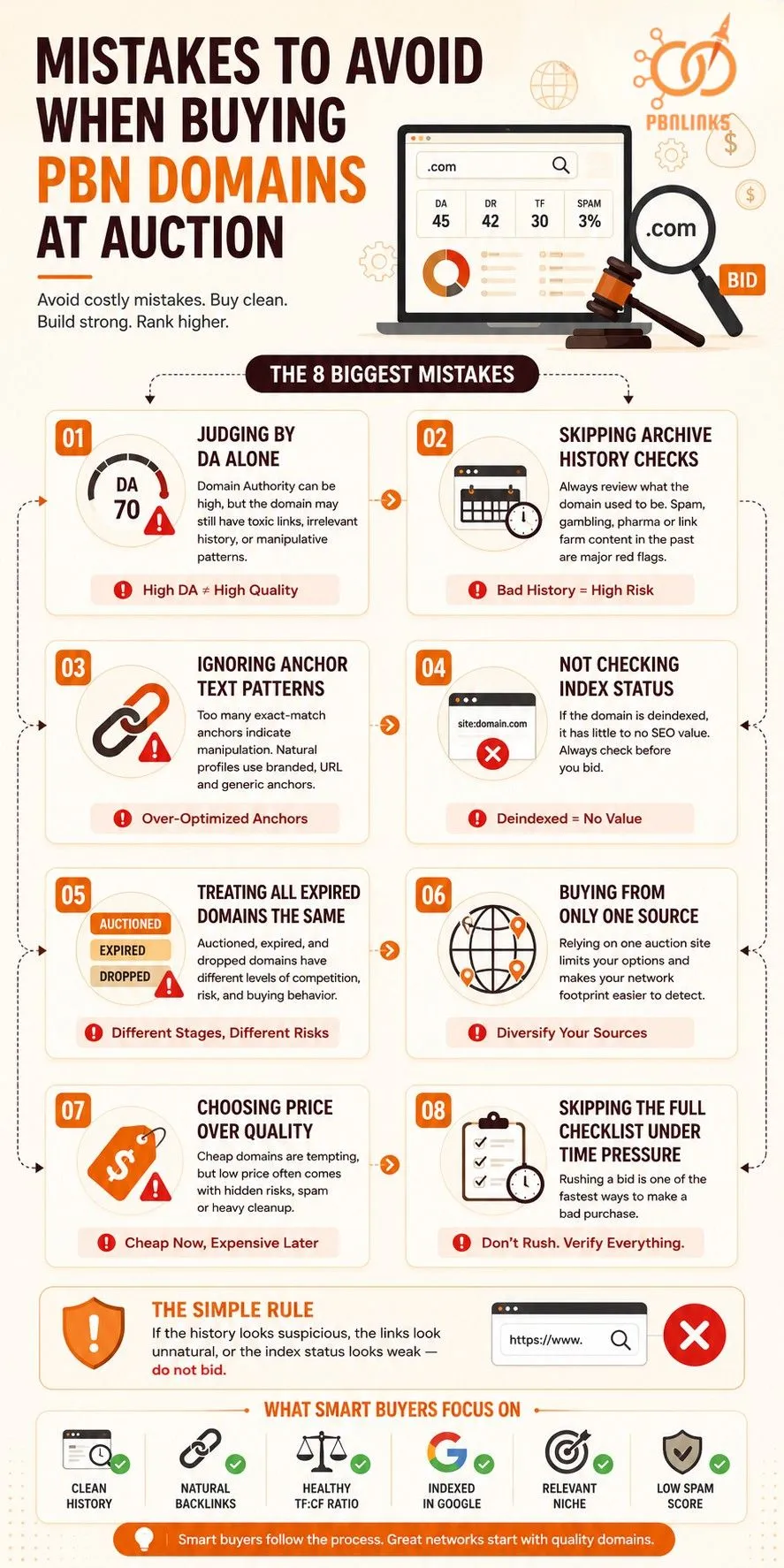
The biggest mistake is buying a domain based on one shiny metric instead of the full picture. A good-looking price or a high DA can hide spam history, weak backlinks, or even deindexing problems.
- Judging by DA alone.
Domain Authority can be useful, but it does not prove real quality. A domain can have a high DA and still have a toxic backlink profile, irrelevant history, or manipulative links. - Skipping archive history checks.
Always review what the domain used to be. If the old site was a pharmacy spam page, gambling site, or a broken link farm, the domain is usually not worth the risk. - Ignoring anchor text patterns.
Too many exact-match anchors are a warning sign. A natural profile should mostly contain branded, naked URL, and generic anchors. - Not checking index status.
If the domain is not indexed, that is a major red flag. A deindexed domain can be a wasted investment unless you have a very specific recovery strategy. - Treating all expired domains the same.
Auctioned, expired, and dropped domains are not identical. Each stage has different competition, risk, and buying behavior. - Buying from only one source.
Relying on one auction site limits your options and can make your network footprint easier to spot. Diversifying sources is smarter. - Choosing price over quality.
Cheap domains are tempting, but low price often means more cleanup and higher risk. It is better to pay a fair amount for a clean domain than to save money on a bad one. - Skipping the full checklist under time pressure.
Rushing a bid is one of the fastest ways to make a bad purchase. If a domain fails even one important check, walk away.
A simple rule: if the history looks suspicious, the links look unnatural, or the index status looks weak, do not bid.
How to Protect Your PBN From Footprint Detection
A PBN footprint is any repeated pattern that makes multiple sites look connected, and the safest way to reduce it is to keep every site as unique and human-like as possible. The main signals to avoid are shared hosting patterns, repeated site design, reused WHOIS details, and obvious content shortcuts.
What footprints are
Footprints are the clues search engines and reviewers use to connect sites in the same network. Common examples include the same registrar across every domain, the same hosting IP range, the same WordPress theme, and the same contact information. If those patterns repeat across many sites, the network becomes easier to detect.
Hosting and registrar variety
Using different hosts, IPs, registrars, and nameservers helps reduce obvious patterns. Mix up domain extensions and registration details instead of buying everything in one batch from one provider. The goal is not to hide badly built sites, but to avoid a uniform setup that looks engineered.
Site design and structure
Do not use the same theme, layout, sidebar structure, or plugin stack on every site. Vary the visual setup enough that each site looks like it was built independently, while still staying easy to manage. Repeated design patterns can be as telling as repeated hosting patterns.Content quality matters most
Thin, spun, scraped, or duplicate content is one of the biggest detection risks. Each site should look and behave like a real website with useful pages, normal navigation, and content that matches the domain’s historical topic. In practice, content quality is often the most visible footprint because it affects how the site reads to both humans and manual reviewers.
Links and behavior
Avoid unnatural linking patterns, especially if every PBN site points to the same page in the same way. Vary how often links appear, where they are placed, and how many outbound links each page has. Real sites do not all behave the same, so making each property feel independently maintained is safer
Practical rule
Treat each site like a standalone project rather than a cloned asset. If a pattern is repeated across several properties, assume it may become a footprint and break it up. The safest PBNs are the ones that look like ordinary websites first and network sites last.
Conclusion
In conclusion, the best PBN domain auction site depends on your budget, experience, and how thoroughly you can vet each domain. ExpiredDomains.net is the best place to learn filtering and spot patterns, while SpamZilla and DomCop become more useful as you need faster analysis and stronger risk control. No platform can make a bad domain safe, so the real difference comes from checking archive history, backlink quality, index status, niche relevance, and spam signals before you buy.
Start with the lowest-cost option that lets you practice proper filtering, then move up to paid tools only when you can use them to make better buying decisions. Use the same checklist on every domain, and never bid before the history, metrics, and index status all pass review.
Take the next step now: open ExpiredDomains.net, shortlist a few domains, and run them through the full vetting checklist before placing your first bid.
Frequently Asked Questions About PBN Domain Auction Sites
What is the best PBN domain auction site for beginners?
ExpiredDomains.net is the best starting point for beginners. It is completely free, tracks over 700 TLDs, and aggregates listings from GoDaddy, NameJet, and Dynadot in one place. Once comfortable with filtering, move to SpamZilla for automated spam checking.
What is the difference between an expired domain and a dropped domain?
An expired domain has passed its renewal deadline but the registrar grace period is still active. A dropped domain has completed the full expiry cycle and been released back to the public registry. Dropped domains cost less to acquire but require more vetting since no auction competition has filtered them.
How do I know if an expired domain has a Google penalty?
Type site:domain.com into Google. Zero results means the domain is deindexed — a hard indicator of a Google penalty. Cross-check with the Wayback Machine for spam content and Moz Spam Score for manipulative link patterns.
Is buying expired domains for PBN still effective in 2026?
Yes, expired domains for PBN are still effective in 2026. Domains with clean histories, strong Trust Flow, and natural backlink profiles continue to pass genuine link equity to money sites. Poor domain selection — not the strategy itself — is what causes failure.
What Trust Flow score should I look for in a PBN domain?
Target a minimum Trust Flow of 15 for entry level PBN use. Mid-range domains should sit between TF 15 and TF 30. Always verify the TF:CF ratio — Trust Flow must be at least 50% of Citation Flow to confirm link quality is genuine.
Can Google detect my PBN if I buy domains from the same auction site?
Yes. Buying all domains from one platform in a short time window creates a detectable pattern. Spread purchases across GoDaddy Auctions, NameJet, and ExpiredDomains.net. Use different registrars and stagger your buying timeline to reduce footprint risk.
What happens if I buy a deindexed domain for my PBN?
A deindexed domain passes zero link equity to your money site. Google has removed it from search entirely. Any links built from that domain have no ranking value — and the money spent acquiring it is completely wasted.
Is DomCop or SpamZilla better for finding PBN domains?
They serve different purposes. DomCop is better for high-volume filtering across 90+ metrics from multiple auction platforms. SpamZilla is better for automated spam and history checking. Most professionals use SpamZilla to verify domains discovered through DomCop or ExpiredDomains.net.
How many PBN domains do I need to see ranking improvements?
Start with five to ten quality domains for low-competition niches. Competitive niches typically require twenty or more. Five clean high-authority domains consistently outperform twenty weak or spammy ones.
What are the biggest mistakes buyers make on PBN domain auction sites?
The biggest mistakes are buying on Domain Authority alone, skipping the Wayback Machine check, ignoring anchor text distribution, and bidding on deindexed domains. Each mistake either wastes money or actively damages the money site your PBN was built to support.