What to Publish on PBN Sites: A Complete PBN Content Strategy Guide
Most people building a PBN spend weeks finding the perfect expired domains. They check Trust Flow, Domain Rating, and referring domains. Then they publish three thin articles, drop a link, and wonder why nothing moves. The domains were never the problem. The content always was.
A PBN is only as powerful as the content sitting on it. Google does not just count your links. It reads the pages those links live on and evaluates the entire site before deciding whether those links deserve to pass any value at all.
Getting your PBN content strategy right is not complicated. But it does require a clear plan before you publish a single article.
This guide covers exactly what to publish on PBN sites, how much to publish, how to build topical authority, and how to keep every site looking completely natural to Google. If you are tired of building PBNs that underperform or get deindexed, this is the guide that fixes it.
What Is a PBN
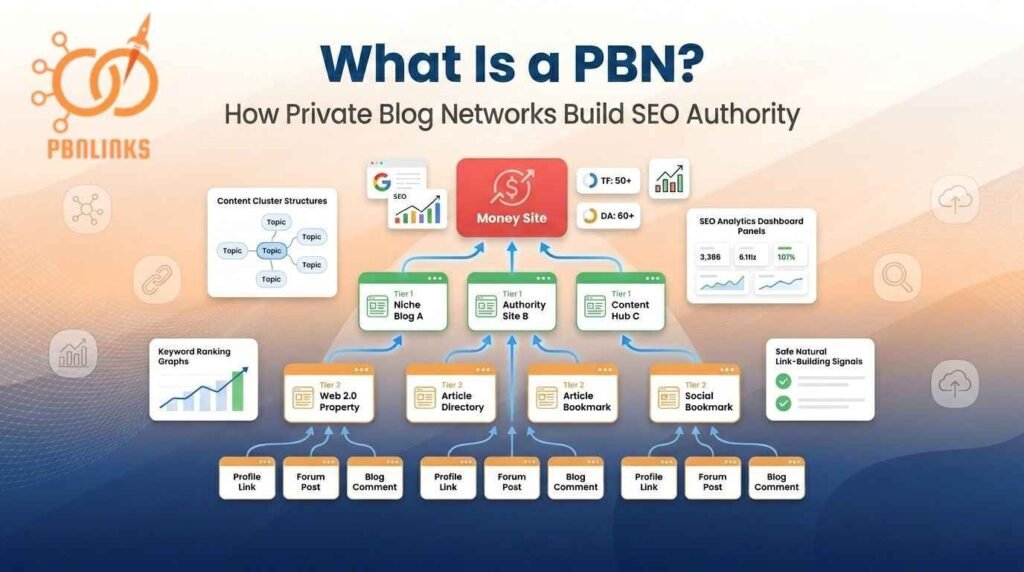
A Private Blog Network, or PBN, is a group of websites you own and control. You use these websites to build backlinks to your main website. That main website is called the money site. The whole point is simple. Instead of waiting for other websites to link to you naturally, you build and control those links yourself.
To make this clearer, consider this example. Say PBNLinks.Agency is your money site. You also run ten other websites around topics like SEO, link building, and digital marketing. You publish articles on those sites and add links pointing back to PBNLinks.Agency. Google finds those links and counts them as votes of trust for your site. The more trust signals your site collects, the higher it ranks in search results.
That is the core idea behind every PBN.
The reason this works is straightforward. Google still uses links as one of its strongest ranking signals. A website with strong and relevant links pointing to it looks more credible than one without. PBN operators use this to their advantage. Instead of hoping other sites will link to them, they build their own linking network and stay in full control.
How a Private Blog Network Passes Link Value to Your Money Site
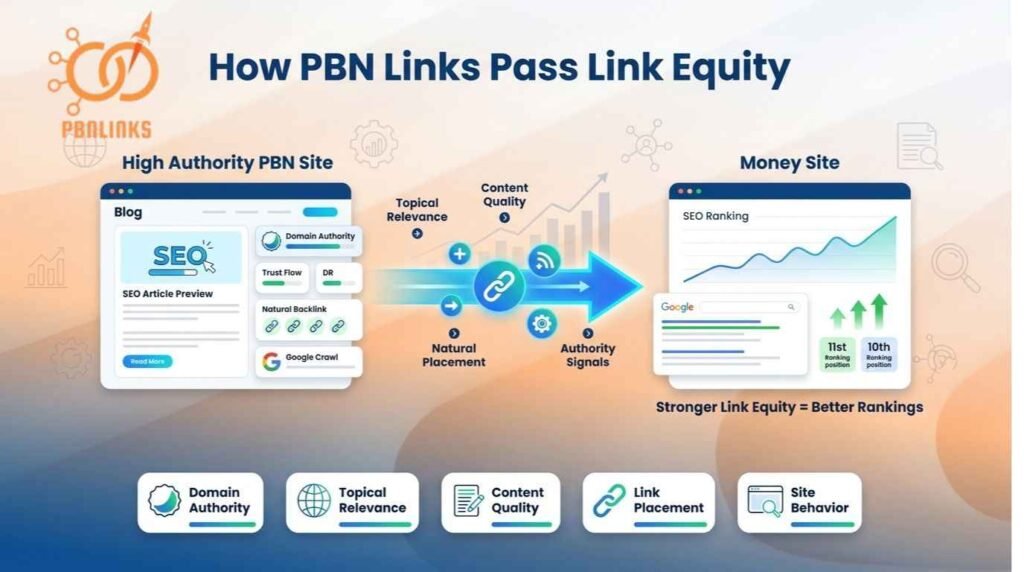
A PBN passes link value to your money site through backlinks. Every time a PBN site links to your money site, it transfers a portion of its authority through that link. SEO professionals call this link equity. Google uses link equity as a direct ranking signal. The stronger the link equity flowing to your money site, the higher it can rank in search results.
Not every PBN link passes the same amount of value though. These five factors decide how much link equity actually reaches your money site:
- Domain authority. A PBN site built on a strong expired domain Google algorithm updates passes more equity than one built on a weak domain. Metrics like Trust Flow and Domain Rating reflect this strength directly.
- Topical relevance. A link from a site covering SEO and link building passes stronger value to PBNLinks.Agency than a link from an unrelated niche. Google weighs topical alignment heavily.
- Content quality. A link inside a well-written, informative article carries more weight than one inside a thin or generic post. The content around the link tells Google what the link means.
- Link placement. In-content links placed naturally inside article body text pass more value than links placed in footers or sidebars. Natural placement looks intentional and editorial.
- Site behavior. A PBN site that publishes consistently and maintains a real site identity passes stronger signals. A static shell with two articles and no about page passes very little.
Think of it like a professional reference letter. A recommendation from a respected industry expert carries far more weight than one from someone with no credibility. PBN links work exactly the same way. The stronger, more relevant, and more credible the site giving the link, the more value it delivers to your money site.
Why Google Uses Content Quality to Detect and Devalue PBN Links
Google devalues PBN links by analyzing content quality across an entire site and network. If the content looks manufactured, thin, or unnatural, Google treats the links inside it as spam signals rather than genuine votes of confidence.
This matters because Google’s entire ranking system is built on trust. Links are supposed to represent real editorial endorsements. One website recommending another because its content genuinely helps people. When Google detects that links are manufactured rather than earned, it discounts them entirely.
Here is how Google identifies low quality PBN content specifically:
- Thin and generic articles. Posts with no real depth, no original insight, and no value to readers are a clear signal. A real niche website does not publish empty articles. A PBN built for links often does.
- Duplicate or spun content. Using the same article across multiple PBN sites, or spinning existing content to create variations, is one of the fastest ways to get a network flagged. Google’s systems are highly effective at detecting near duplicate content patterns.
- Repetitive article structures. When every article across multiple sites follows the same template, uses the same heading patterns, and has the same word count, it creates a detectable footprint across the network.
- Off topic content. A site that claims to be about SEO but publishes articles about cooking, travel, and fashion has no topical coherence. Google recognizes this as a sign that the site exists for links, not for readers.
- No content updates. Real websites update their content over time. A PBN site that publishes ten articles and never updates them looks static and artificial to Google’s crawlers.
- Unnatural outbound link patterns. A site where every article contains an outbound link to the same money site, using similar anchor text each time, is an obvious pattern that triggers algorithmic scrutiny.
Google uses SpamBrain, its AI powered spam detection system, to identify these patterns at scale. SpamBrain does not just look at individual pages. It analyzes behavioral patterns across entire domains and groups of domains simultaneously. This means even a well built PBN can get flagged if the content patterns across the network are too similar or too predictable.
The Five Core Rules of a PBN Content Strategy
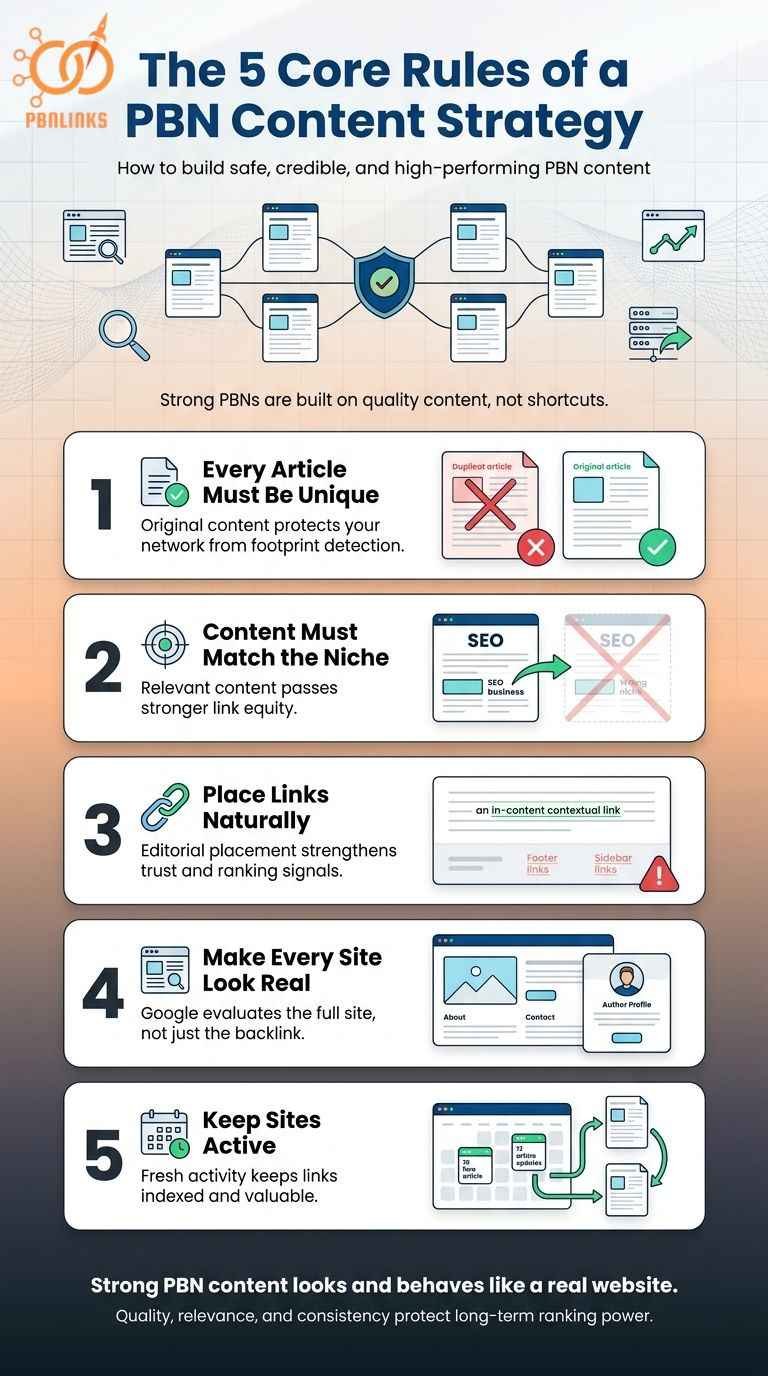
A successful PBN content strategy does not happen by accident. It follows a clear set of rules that keep your network safe, your content credible, and your links working. These five rules apply to every site in your network without exception.
Rule 1: Every Article Must Be Unique Across the Entire Network
Duplicate content is the fastest way to destroy a PBN. Every article must be completely original, written specifically for that site and niche. Google’s SpamBrain detects near duplicate content patterns across multiple domains simultaneously. One duplicated article can expose your entire network.
Rule 2: Content Must Match the Domain Niche
A topically aligned PBN link passes significantly more value than a link from an unrelated site. Every article must stay within the domain’s established subject area. Topical alignment works on two levels:
- The PBN site’s content must align with its own niche
- That niche must connect logically to the money site receiving the links
Rule 3: Links Must Be Placed Naturally Inside the Content
Natural link placement separates a convincing PBN article from an obvious one. Follow these principles on every article:
- Place links inside the article body, never in footers or sidebars
- Vary anchor text across different articles and different PBN sites
- Never repeat the same exact match anchor text across your network
- Limit outbound links to one or two per article maximum
Rule 4: Each Site Must Look and Read Like a Real Website
Google evaluates the entire site a link comes from. A site that looks fake gets treated as fake regardless of its domain authority. Every PBN site needs:
- An About page explaining what the site covers and who runs it
- A Contact page with a working contact method
- At least one author bio with a believable writing persona
- A clean professional design that does not look like a default template
Rule 5: Content Must Be Maintained and Updated Over Time
An active PBN site passes stronger link signals than a dormant one. Keep every site active by:
- Publishing two to four new articles every month per site
- Updating older posts when facts or industry information changes
- Adding internal links from new articles to older relevant posts
A dormant site loses crawl frequency and link value. Consistent publishing keeps your links indexed and working.
How to Match Your Content to the Expired Domain You Are Using
Match your content to the expired domain by researching its original niche and publishing articles that align with it. Every expired domain carries a content history that shaped its authority and topical signals. Publishing content that matches that history preserves the domain’s value. Ignoring it wastes that value from day one.
How to Find Out What an Expired Domain Was Originally About
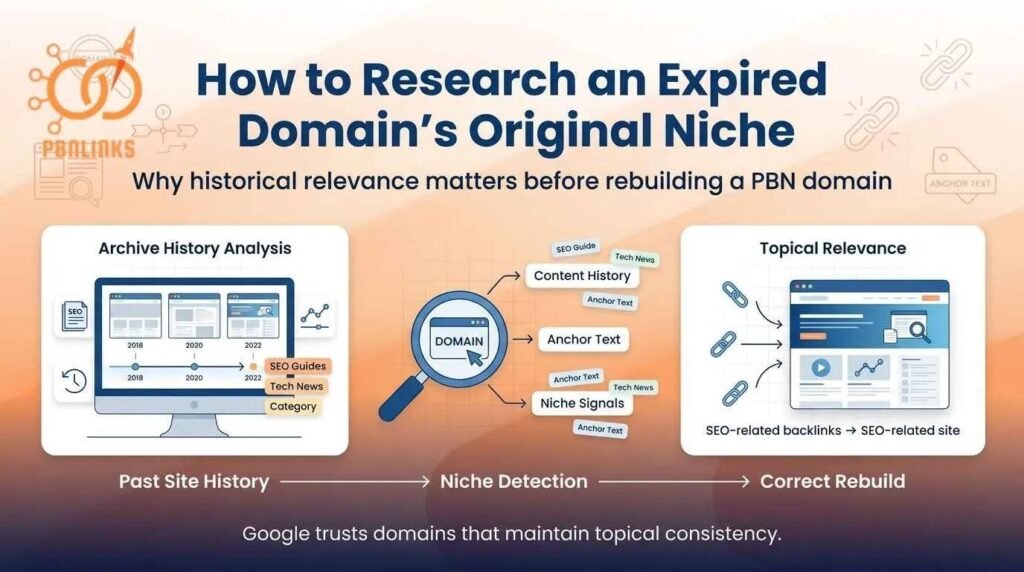
Before writing a single article, research what the domain covered in its previous life. The fastest way to do this is through the Wayback Machine at archive.org.
Here is what to look for:
- Enter the domain at archive.org and browse its most active period
- Identify the main topics, categories, and article subjects it covered
- Use Ahrefs or Majestic to review the anchor texts of backlinks pointing to the domain
- Note what niche those backlinks are associated with
The goal is simple. Find out what niche Google associated with this domain before it expired. Your content must match that niche.
How to Choose Article Topics That Match the Domain’s History
Once you know the domain’s original niche, your content plan becomes straightforward. Every article must fit naturally within that subject area.
Follow this simple process:
- List the main topics the domain covered during its active period
- Build a content cluster of four to six articles around those topics
- Avoid publishing articles on topics the domain never covered
For example, if the expired domain covered content marketing and SEO strategy, publish articles on those same subjects. Publishing travel or home improvement articles on that domain breaks its topical signals completely and weakens every link it passes.
What Types of Content to Publish on a PBN Site
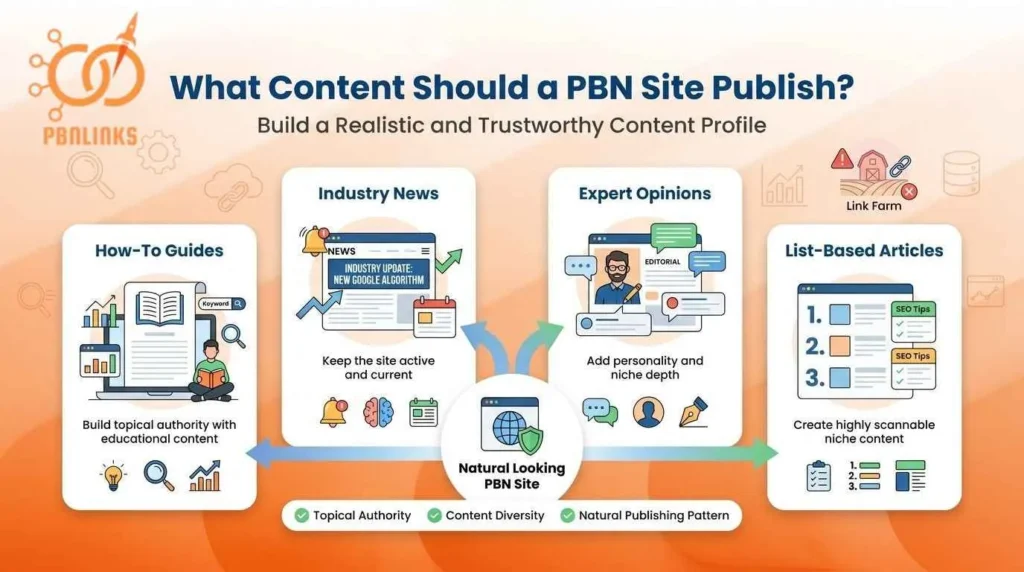
A PBN site should publish a mix of informational articles, news updates, opinion posts, and listicles. This content variety is what makes a PBN site look like a real, independently operated publication. A site that publishes only linking articles looks exactly like a link farm.
Informational Articles and How-To Guides
Informational articles are the backbone of any credible niche website. They answer specific questions, solve real problems, and build genuine topical authority. They also provide the most natural environment for placing links to your money site.
For a digital marketing PBN site, informational articles might cover:
- How to build a backlink profile for a new website
- How to choose the right keywords for a content strategy
- How to audit an existing SEO campaign
These articles add real depth to your site and give Google a reason to keep crawling it regularly.
News Updates and Industry Posts
News posts signal that a site is active, current, and engaged with its niche. They are short, timely, and easy to produce. They make a PBN site look like a publication that follows its industry rather than one that exists purely to host links.
For a digital marketing PBN site, news posts might cover:
- Recent Google algorithm updates and what they mean for SEO
- New tools or platform features worth knowing about
- Shifts in content marketing or link building practices
These posts rarely carry outbound links. Their job is to add publishing frequency and content diversity.
Opinion Posts and Listicles
Opinion posts and listicles add personality and variety to a PBN site. An opinion post takes a clear position on a niche topic. A listicle organizes useful information into a scannable, numbered format. Both formats look exactly like the content real niche bloggers publish every day.
Examples for a digital marketing PBN site include:
- 7 Link Building Mistakes Most SEO Beginners Make
- Why Topical Authority Matters More Than Domain Authority in 2026
- 5 Content Types Every Niche Website Should Publish
These formats work best as non-linking articles. They build content depth without drawing attention to your site’s linking pattern.
How Many Linking Articles vs Non-Linking Articles Should a PBN Site Have
To make a PBN site look natural, only 20 to 30 percent of your articles should link out to your money site. The remaining 70 to 80 percent should be completely non-linking or link only to high-authority, non-competing sites like Wikipedia or major industry publications.
Key Guidelines for PBN Content and Linking
Maintaining a natural looking footprint is essential to avoid raising red flags with Google’s detection systems.
- The 80/20 Rule. Keep the majority of your published content as informational articles with no outgoing links. This builds a baseline of trust and creates a natural site architecture that looks credible to Google.
- Limit Outbound Links. Never link to your money site from every article. A single PBN page should have a maximum of one to five outbound links, and only one of those should point to your money site.
- Diversify Link Destinations. Never let a single PBN domain link to all your money sites. The safest approach is to have one PBN site link strictly to one money site, or spread links across different network tiers.
- Prioritize Authority Citations. To make your PBN site appear genuine, mix your outgoing links with citations to high-trust authority sites like Wikipedia, industry news outlets, and well-known niche publications.
How to Build Topical Authority on a PBN Site
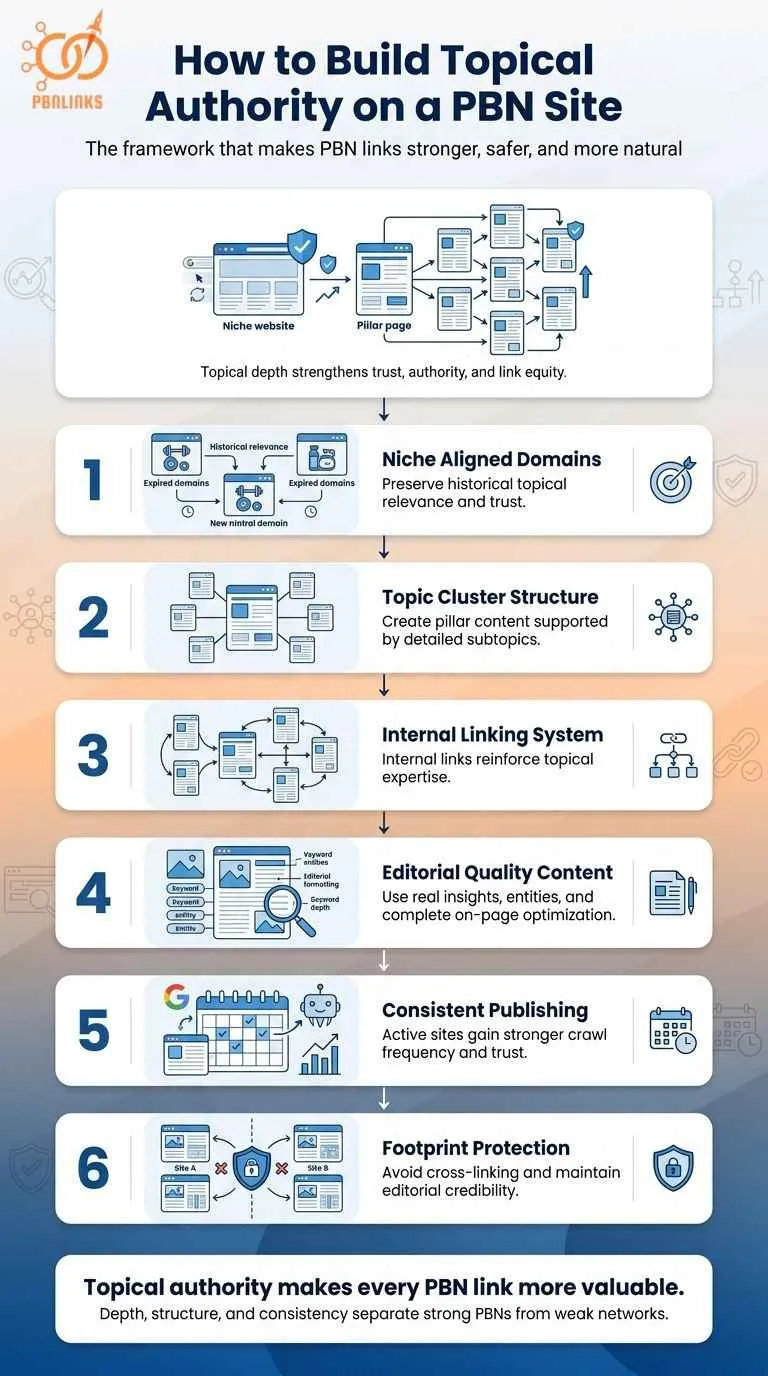
Topical authority on a PBN site is built by publishing focused, interlinked, niche-relevant content consistently. This makes your PBN look like a real authoritative site, protects its footprint, and passes much stronger link equity to your money site.
What Topical Authority Means for a PBN Site
Topical authority means Google recognizes your PBN site as a trusted expert on one subject. A topically strong PBN builds deep niche coverage and connects every piece of content through a structured internal linking system.
The six steps below show you exactly how to build it on any PBN site:
1. Start With Niche Aligned Domains
Always choose domains with existing historical relevance in your target niche. A domain that previously covered digital marketing should continue publishing digital marketing content. This preserves the domain’s topical signals and makes its authority look completely natural to Google.
2. Map Out Your Topic Clusters
Structure every PBN site around a clear content cluster with two core components:
- Pillar page. A broad, comprehensive guide covering the main subject of your niche. Example: “A Complete Guide to PBN Link Building Strategy.”
- Cluster articles. Hyper-specific articles covering subtopics that directly support the pillar page. Example: “How to Choose Expired Domains for a PBN.”
3. Build a Strict Internal Linking Structure
Internal links signal topical expertise to Google. Follow this structured linking flow on every PBN site:
- Link every cluster article back to the main pillar page
- Link the pillar page out to every supporting cluster article
- Point pillar pages to other related pillar pages for broader niche coverage
- Use natural, topic-relevant anchor text on every internal link
4. Optimize On-Page Content and Entities
Your PBN content must go beyond generic filler to establish genuine authority:
- Include unique insights, original data, and practical real-world examples
- Add relevant images and visuals to make every page look editorially complete
- Use natural keyword variations and related entity terms throughout every article
5. Establish Topical Authority Through Consistent Publishing
Publish new content consistently within your niche. A PBN site that regularly adds depth to its subject area looks like a genuine niche publication. A site that stops publishing after ten articles looks like an abandoned link placeholder. Consistent publishing also increases crawl frequency, which keeps your links indexed and working.
6. Protect the PBN Footprint
Two rules every PBN operator must follow without exception:
- No outbound cross-linking. Sites within your network must never link to each other. Cross-linking between PBN sites is one of the fastest ways to expose your entire network to Google’s SpamBrain detection system.
- Focus on outbound trust. Alongside links to your money site, regularly link out to high-authority sources like Wikipedia and major industry publications. This makes your PBN articles look genuinely researched, editorially credible, and completely natural.
A PBN site that follows all six steps does not just avoid detection. It actively builds the kind of topical depth that makes every link it passes more valuable to your money site.
How Much Content Does a PBN Site Need Before You Use It for Links
Before pushing a link to your money site, a PBN site needs 10 to 15 unique articles covering your target niche. Publishing a link on a thin, underdeveloped site is one of the fastest ways to get your network detected and deindexed.
The Minimum Number of Articles Before a PBN Site Is Ready
A PBN site needs at least 10 to 15 articles before it is ready for links.
- Initial build. Publish three to five articles immediately upon site launch
- Content depth. Each article must be 800 to 1200 words of unique niche content
- Drip feeding. Space remaining articles over four to six weeks naturally
- Essential pages. Add About, Contact, and Privacy Policy pages before linking
- Outbound trust. Link to authority sites like Wikipedia before linking to your money site
How to Plan Content Volume Across a Multi-Site PBN Network
Plan your content volume systematically to keep every PBN site active and credible.
- Launch phase. Publish three to five articles in week one then drip feed the rest
- Maintenance phase. Publish two to four new articles every month per site
- Linking ratio. Add one linking article for every three non-linking articles
- Stagger dates. Never publish on the same date across multiple PBN sites
- Content personas. Assign a unique writing style and author identity to each site
In short: A PBN site needs 10 to 15 articles, essential pages, and a natural publishing history before it is ready for links. Plan your content volume systematically, drip feed consistently, and maintain every site actively. That foundation is what makes a PBN network safe, credible, and effective over the long term.
How to Use Anchor Text Correctly Inside PBN Articles
Anchor text directly determines how Google interprets every link your PBN passes. Using the wrong anchor text pattern across your network is one of the fastest ways to trigger a manual penalty and lose all the ranking value your PBN has built.
The Four Anchor Text Types and When to Use Each One
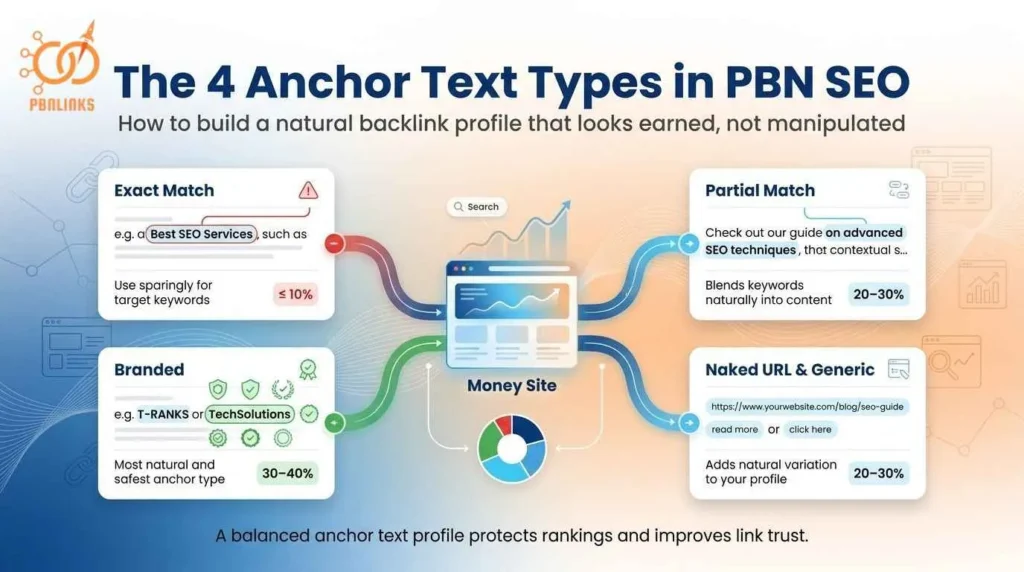
A natural anchor text mix is what makes your PBN link profile look earned, not manufactured.
- Exact match. Uses the precise keyword you want your money site to rank for. Example: “PBN link building service.” Limit this to a maximum of 10 percent of total links across your network.
- Partial match. Includes the target keyword alongside other natural words. Example: “effective PBN link building strategies.” Use this for 20 to 30 percent of your total links.
- Branded. Uses your brand name as the anchor. Example: “PBNLinks.Agency.” This looks completely natural to Google and should make up 30 to 40 percent of your links.
- Naked URL or generic. Uses the full URL or phrases like “read more” or “visit here.” Fill the remaining 20 to 30 percent of your anchor mix with these variations.
How to Spread Anchor Text Naturally Across Your Whole PBN Network
Never use the same anchor text twice across your entire PBN network.
Google’s SpamBrain system identifies coordinated anchor text patterns across networks instantly. A natural link profile never has every link pointing to the same page using the same words. Follow these rules to stay safe:
- Map your full anchor text plan before writing any linking articles
- Assign a unique anchor variation to each PBN site in your network
- Match every anchor text naturally to the surrounding article content
- Spread links across different pages on your money site, not just the homepage
- Audit your anchor text profile every three to six months using Ahrefs or Majestic
How to Create a Believable Identity for Each PBN Site
Every PBN site must look like a real, independently operated website. A site without a believable identity gets flagged by Google regardless of how strong its domain metrics are.
Every PBN site needs three essential identity pages before it is ready to use for links. Each page plays a specific role in making the site look credible and legitimate to both Google and real readers.
About Page
- Clearly explain what the site covers and who it serves
- Write in a natural tone that matches the site’s niche and content style
- Make it read like a genuine editorial publication with a real purpose
Author Bio
- Use a unique author name not used anywhere else in your network
- Include a short professional background relevant to the site’s niche
- Add a unique profile photo not used on any other PBN site
Contact Page
- Include a working contact form or active email address
- Match the page design and tone to the rest of the site
- Keep it simple, professional, and consistent with the site’s identity
Each site in your PBN network must also have a distinctly different writing voice and tone. Using the same writer or AI tool across your network creates a detectable content fingerprint that Google’s SpamBrain identifies instantly.
- Assign a unique writing persona to every site
- Vary sentence length and vocabulary between sites
- Never use the same AI prompt or template twice
- Rotate between different writers or AI tools per site
Should You Use AI Content on PBN Sites
Yes, you can use AI content on PBN sites but only if you edit and diversify it properly. Raw, unedited AI content published across multiple PBN sites creates a detectable network footprint and destroys the ranking value your network has built.
What Problems AI Generated Content Creates on PBN Sites
AI tools produce content with recognizable patterns. Using the same tool and prompt across multiple PBN sites creates articles that share identical sentence structures and vocabulary. Google’s SpamBrain identifies these uniform patterns across domains instantly.
Three specific problems raw AI content creates on PBN sites:
- Uniform writing patterns. The same AI tool used across ten sites creates ten sites that read identically. That is a network footprint.
- Thin content signals. AI content often lacks genuine depth and original insight. Thin content reduces the link value every article passes.
- Duplicate phrasing. AI tools reuse the same phrases across articles. Similar phrasing across multiple domains creates a detectable similarity signal.
How to Use AI Writing Tools Without Creating a Network Footprint
AI content is not the problem. Unedited, uniform AI content is. Follow these guidelines to use AI safely across your network:
- Edit every article. Rewrite at least 30 to 40 percent of every AI generated article before publishing
- Rotate AI tools. Never use the same tool with the same prompts across your entire network
- Add human sections. Include at least one human written paragraph in every article
- Vary your prompts. Different prompts produce different writing styles and reduce pattern similarity
- Never duplicate. Every article across your network must be completely unique
The Biggest PBN Content Mistakes That Destroy Link Value
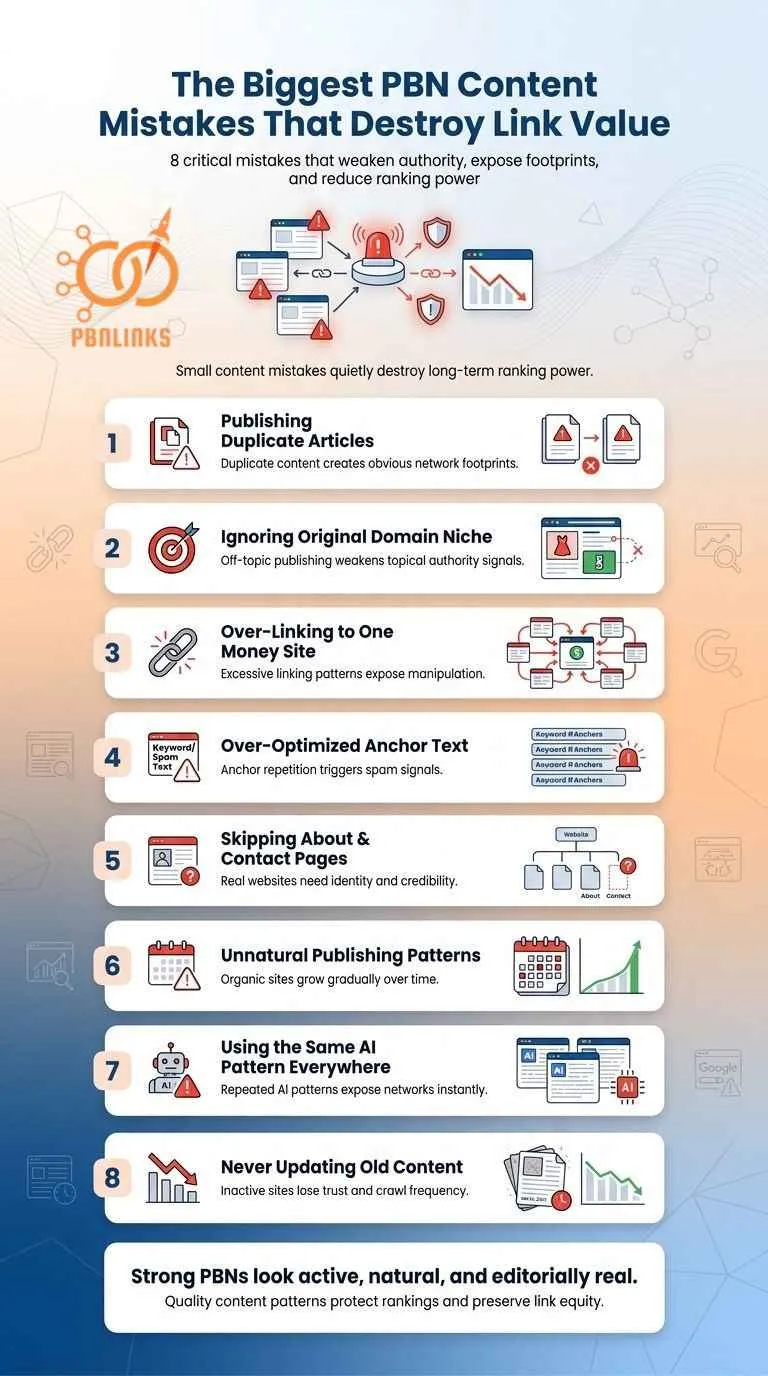
Even experienced PBN operators make content mistakes that silently destroy their network’s ranking power. Here are the most common and damaging ones to avoid:
1. Publishing duplicate content across multiple sites Using the same article on more than one PBN site is one of the clearest network footprints Google detects. Every article across your network must be completely unique.
2. Ignoring the expired domain’s original niche Publishing off-topic content on an expired domain breaks its topical signals immediately. Always match your content to the domain’s established niche history.
3. Linking to your money site in every article A site where every post contains a link to the same money site looks like a link farm. Follow the 80/20 ratio and keep most articles link free.
4. Using exact match anchor text repeatedly Over-optimized anchor text across multiple PBN sites is a direct trigger for Google’s spam detection systems. Vary your anchor text on every linking article.
5. Skipping essential site pages A PBN site with no About page, no Contact page, and no author bio does not look like a real website. Build all identity pages before placing any links.
6. Publishing all content at once Launching a site with ten articles published on the same day looks unnatural. Drip feed your content over several weeks to simulate organic site growth.
7. Using the same AI tool across every site Identical AI generated content patterns across multiple domains create an instant network footprint. Rotate tools, vary prompts, and edit every article before publishing.
8. Never updating older content A site that stops publishing and never updates its existing articles looks abandoned. Active maintenance keeps your site indexed and your links working.
A Simple Step-by-Step Content Plan for Any PBN Site
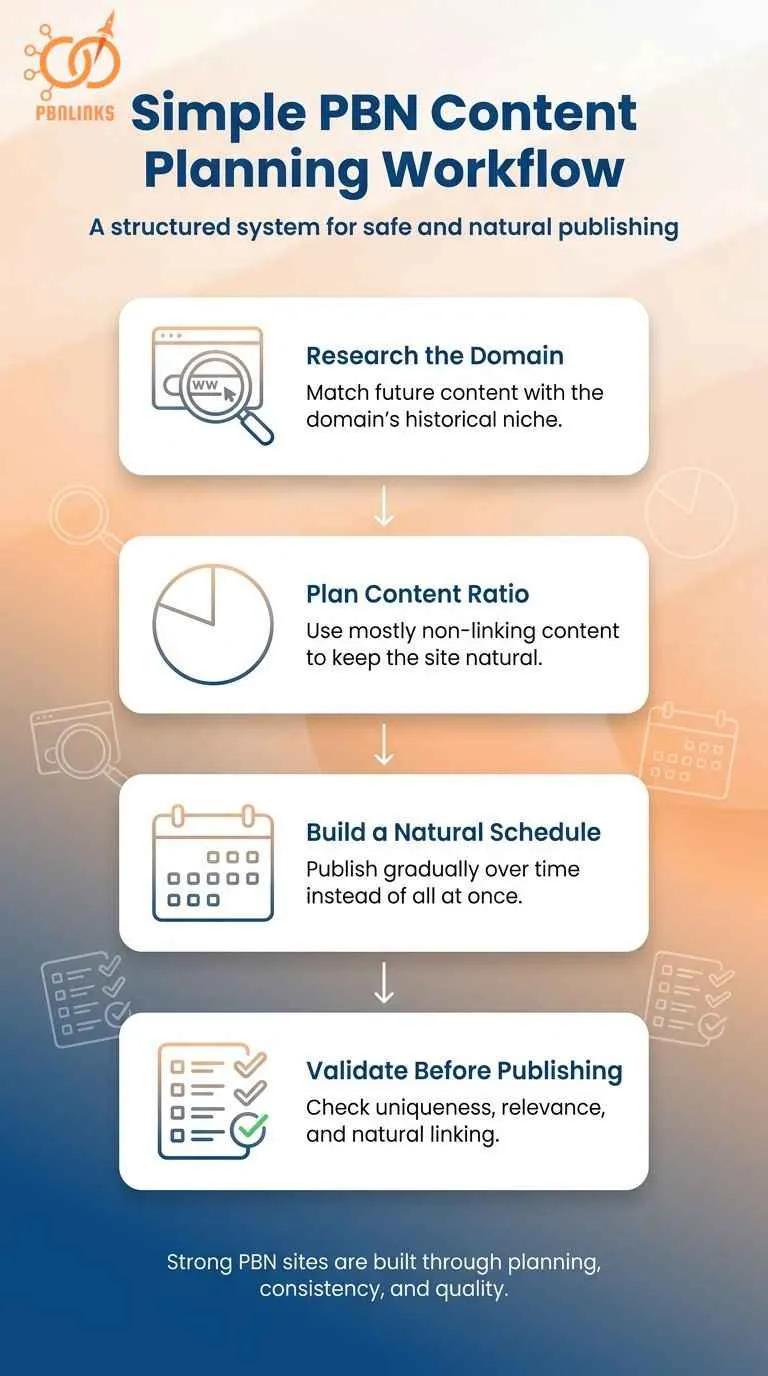
Every PBN site needs a repeatable content plan before a single article gets written. Without one, most operators publish inconsistently, over-optimize their links, and create footprints they could have easily avoided. Follow these four steps for every site in your network.
Step 1: Research the Domain and Define the Niche
Before writing anything, spend time understanding what the domain is about and what it should cover going forward.
- Visit archive.org and review the domain’s content history during its most active period
- Identify the primary niche and the main topics the domain consistently covered
- Use Ahrefs or Majestic to review the anchor texts of existing backlinks pointing to the domain
- Define a clear niche focus that aligns with both the domain’s history and your money site’s subject area
- Write down three to five core topic areas your PBN site will cover consistently
This research takes thirty minutes per domain. It saves months of wasted content effort.
Step 2: Plan Your Content Ratio Before You Write Anything
Once you know your niche, plan your content ratio before writing a single article.
- Decide how many total articles the site needs before going live for links
- Apply the 80/20 rule — plan eight non-linking articles for every two linking articles
- Assign a specific anchor text variation to each planned linking article in advance
- Map out which pages on your money site each linking article will point to
- Make sure no two linking articles use the same anchor text or target the same page
Planning your ratio in advance prevents over-optimization before it happens.
Step 3: Build a Content Calendar With Natural Publishing Dates
A content calendar keeps your publishing schedule natural and consistent across your entire network.
- Plan a minimum of ten to fifteen articles before the site goes live
- Publish three to five foundational articles in the first week of launch
- Space remaining articles across four to six weeks using irregular publishing dates
- Schedule two to four new articles per month after the initial launch phase
- Never publish on the same date across multiple sites in your network
Staggering your publishing dates across different sites is one of the simplest and most effective footprint prevention strategies available.
Step 4: Check Every Article Against This Pre-Publish Checklist
Before publishing any article on any PBN site, run it through this checklist:
- Is the article completely unique and not published anywhere else in the network?
- Is the content between 800 and 1200 words of genuine niche-relevant information?
- Does the article fit naturally within the site’s defined niche and topic focus?
- If it is a linking article, is the anchor text varied and placed naturally in the body?
- Does the article link to at least one authority source like Wikipedia or a major publication?
- Has the article been edited to remove any uniform AI writing patterns?
- Does the article include a natural internal link to another page on the same site?
If the answer to any of these questions is no, fix it before publishing. One weak article on a PBN site can undermine the credibility of every link the site passes.
Is a PBN Content Strategy Still Worth Building in 2026
Yes, a PBN content strategy is still worth building in 2026. The strategy works but only if you build it the right way. Low-quality PBNs no longer survive long enough to deliver results.
Google’s SpamBrain has made it nearly impossible to sustain a poorly built PBN. Sites that follow these patterns get detected and deindexed faster than ever before:
- Thin or duplicate content published across multiple sites
- Robotic publishing patterns and synchronized posting dates
- Over-optimized anchor text repeatedly pointing to the same money site
- Identical writing styles and templates used across the entire network
What has not changed is that Google still treats links as a powerful ranking signal. A well-built PBN with unique content, natural publishing, and strong site identities still delivers real results. For operators willing to meet the 2026 quality bar, PBNs remain one of the most effective link building strategies available.
Frequently Asked Questions About PBN Content Strategy
What is a PBN in SEO?
A PBN, or Private Blog Network, is a group of websites built on expired domains used to place backlinks to one target website. The goal is to pass link authority to that site and improve its Google rankings.
How many articles should a PBN site have before using it for links?
A PBN site needs at least 10 to 15 published articles before placing any links. This gives the site enough depth to appear as an active, established publication rather than a freshly built link placeholder.
Does PBN content need to match the niche of my money site?
Yes. The PBN site’s content must be topically relevant to your money site’s subject area. A fitness blog linking to a supplements store makes sense. A travel blog doing the same does not.
Can I use AI generated content on PBN sites?
Yes, but only with careful editing and variation across sites. Raw AI content published across multiple PBN sites creates uniform writing patterns that Google’s SpamBrain system detects and flags instantly.
What happens to my money site if Google detects my PBN?
Your money site risks a manual penalty that removes it from search results. At minimum, links from detected PBN sites get devalued and any rankings built on those links will drop.
What is the right ratio of linking to non-linking articles on a PBN site?
Follow the 80/20 rule. Eight out of every ten articles should have no outbound links. Two out of every ten should carry natural in-content links pointing to your money site.
Are PBN backlinks against Google’s guidelines?
Yes. Google’s spam policies classify PBN links as unnatural link schemes. Getting caught can result in a manual action against both the PBN sites and the money site receiving the links.
Should I use the same writer for all my PBN sites?
No. One writer across an entire network creates a consistent voice that acts as a detectable footprint. Every PBN site needs a distinct writing tone and style to appear independently operated.
Is a PBN content strategy still effective in 2026?
Yes, for well-built networks. PBNs built on strong expired domains with niche-relevant content, natural publishing patterns, and believable site identities continue to deliver real ranking improvements in 2026.