How Long Do PBN Links Take to Show an Impact on Search Rankings?
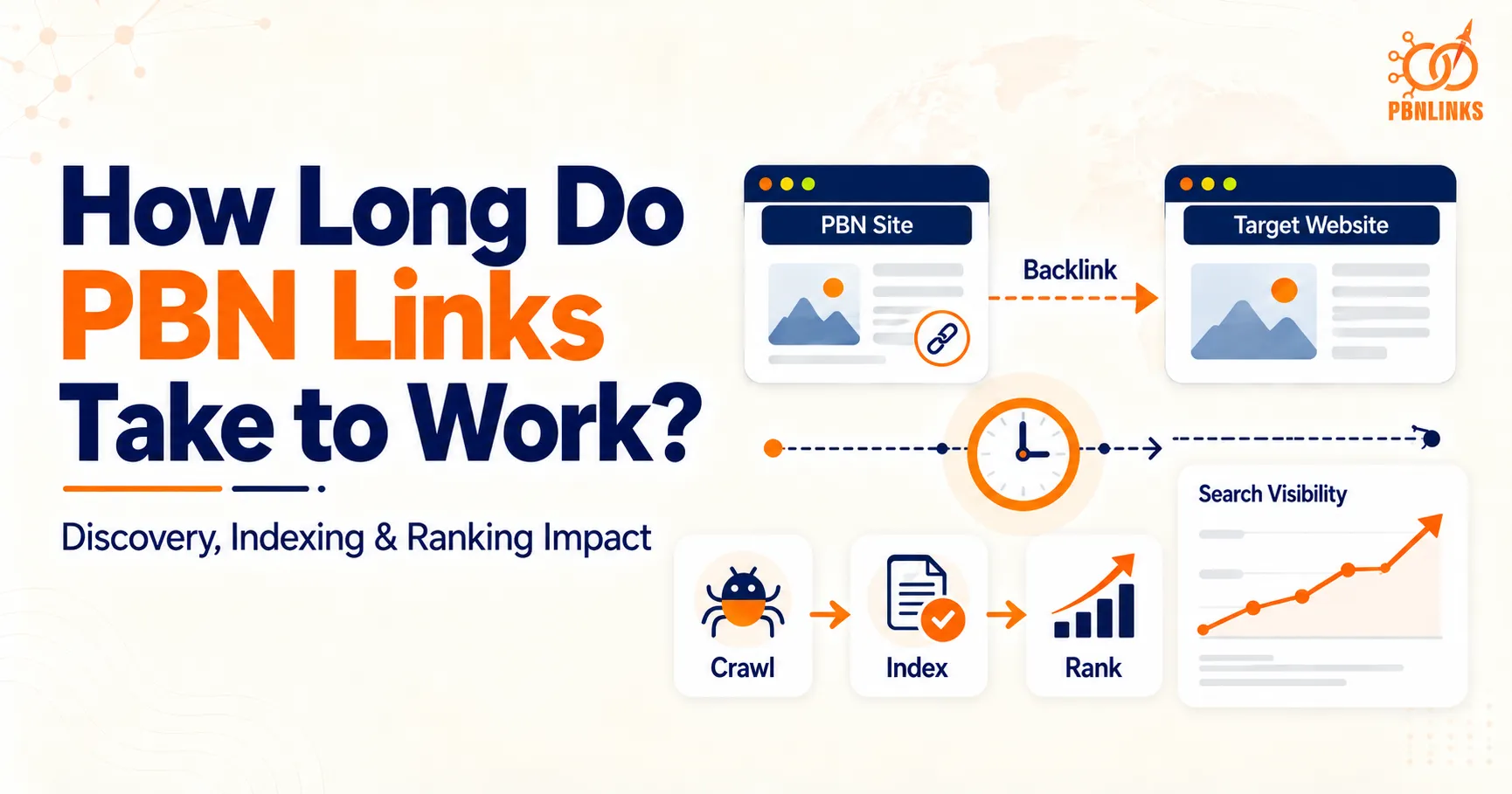
Many people expect a PBN link to move rankings soon after it goes live. Add the link, wait a few days, and the target page should climb. In reality, Google first has to discover, crawl, and process the linking page before any effect can become visible.
If you are asking how long do PBN links take to work, there is no fixed answer. Some links may show an impact within a few weeks, while others take longer or produce no clear standalone change. The timeline depends on crawl timing, indexing, keyword competition, source page strength, target page quality, and the site’s existing authority.
A PBN link can also be live and indexed without causing an immediate ranking change. Google still has to evaluate the link within its wider ranking systems, and the result depends on how much additional strength the target page needs to compete.
This guide explains the full PBN link timeline in simple terms. You will learn what happens after a link is placed, why indexing and ranking impact are different, what can speed up or delay visible results, and when it is better to wait or investigate further.
How Long Do PBN Links Take to Work?
PBN links can start showing an impact within a few weeks, but there is no fixed timeline that applies to every site. Some links may produce visible movement sooner, while others take longer or show no clear standalone effect.
The reason is simple. A PBN link has to be discovered, crawled, and processed before it can contribute to ranking signals. Even after that, the target page still has to compete against other pages in the search results.
The timeline can also change depending on keyword competition, the strength of the linking page, the quality of the target page, current ranking position, and the authority the money site already has.
This means the right question is not only how many days a PBN link takes to work. It is also whether Google has found the link, whether the page has been processed, and whether the target has enough support to move against its competitors.
Why There Is No Universal PBN Link Timeline
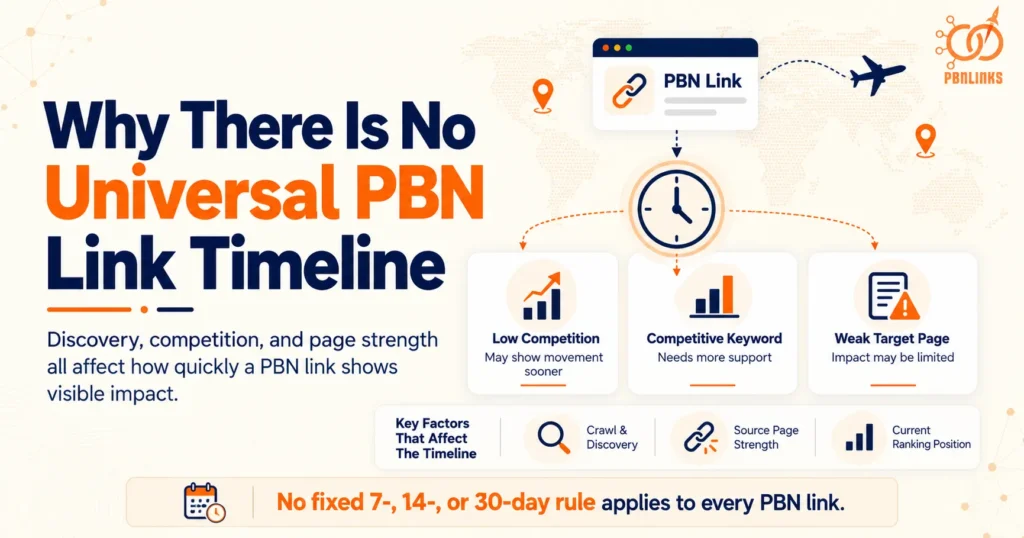
Every PBN link enters a different ranking situation. One link may point to an established page already ranking on page two, while another may point to a new site targeting a highly competitive keyword.
A low competition keyword may show visible movement with less additional authority. A competitive keyword may need several strong signals before any clear change appears. This does not mean Google necessarily processes the link more slowly. It means the ranking gap is harder to overcome.
Source page conditions also vary. Some PBN pages are crawled often and have strong internal support, while others are visited less frequently or carry less authority. These differences can change how quickly a new link is discovered and how much influence it may have.
For this reason, fixed rules such as 7 days, 14 days, or 30 days should be treated as rough practitioner checkpoints, not guaranteed PBN link timelines.
The PBN Link Timeline: From Placement to Ranking Movement
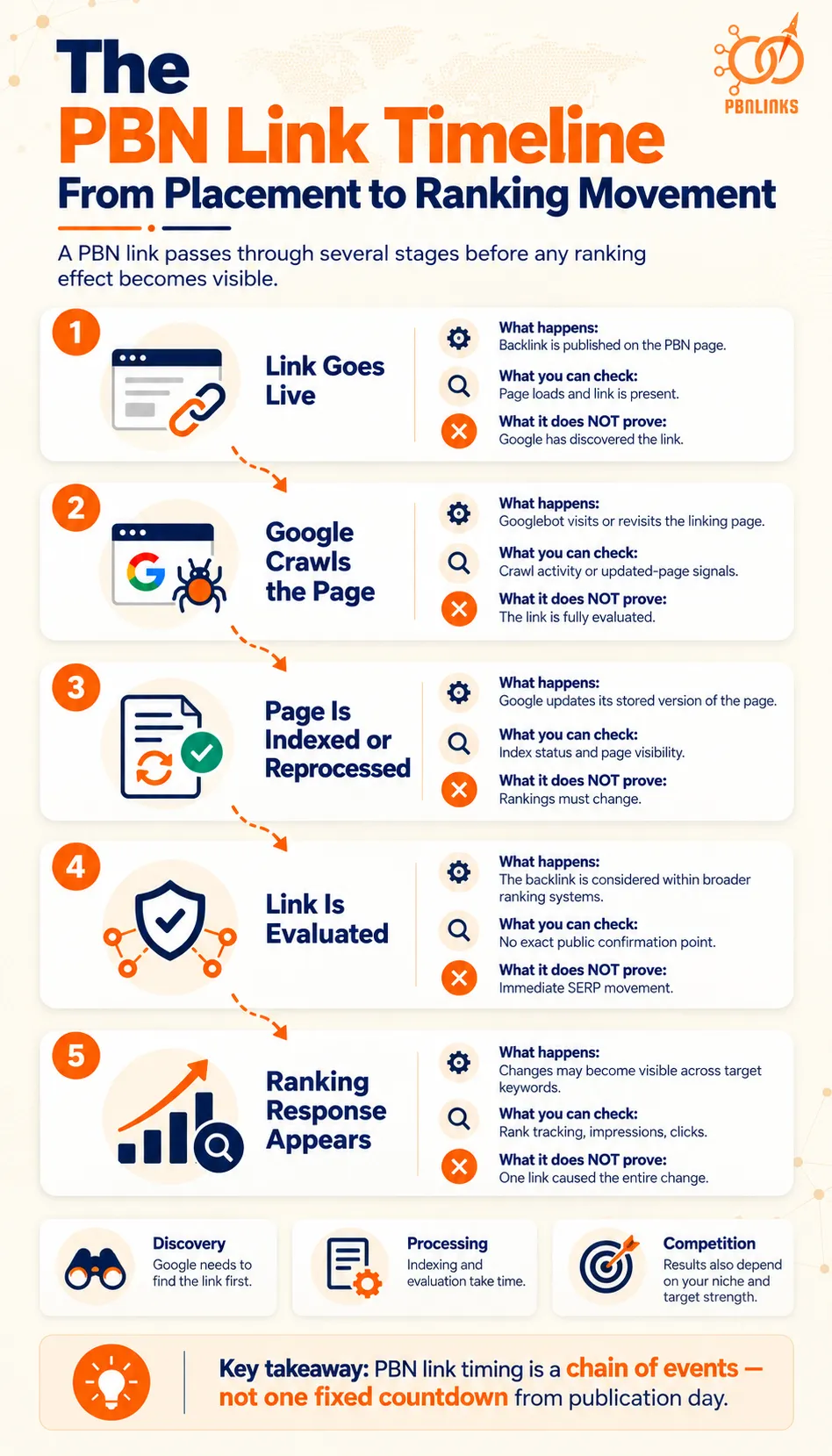
A PBN link usually passes through several stages before any ranking change becomes visible. The link first has to go live, then Google needs to discover or revisit the linking page, process that page, evaluate the link, and finally reflect any effect in the search results.
This is why PBN link timing should not be measured from publication alone. A link that has been live for two weeks may still be waiting on crawl discovery, while another may already be indexed and entering the ranking process.
| Stage | What Happens | What You Can Check | What It Does Not Prove |
| Link Goes Live | The backlink is published on the PBN page | Page loads correctly and link is present | Google has discovered the link |
| Google Crawls the Page | Googlebot visits or revisits the linking page | Crawl activity or updated page signals | The link is fully evaluated |
| Page Is Indexed or Reprocessed | Google updates its stored version of the page | Index status and page visibility | Rankings must change |
| Link Is Evaluated | The backlink is considered within Google’s wider link and ranking systems | No exact public confirmation point | Immediate SERP movement |
| Ranking Response Appears | Changes may become visible across target keywords | Rank tracking, impressions, clicks | The link caused the entire change |
Stage 1: The PBN Link Goes Live
The timeline starts when the backlink is added to the PBN page. At this stage, the link exists for users, but that does not mean Google has seen the change yet.
A newly published or edited page must still be discovered or revisited before the new link can enter Google’s systems.
Stage 2: Google Discovers or Recrawls the Page
Google needs to crawl the page containing the PBN link. How quickly this happens depends on how often the site is visited, how well the page is linked internally, and how easily Google can discover the update.
A frequently crawled page may be revisited sooner than a deep or rarely updated page. Faster crawling only shortens the discovery stage. It does not guarantee faster ranking movement.
Stage 3: The Page Is Indexed or Reprocessed
After crawling, Google may index a new page or update the stored version of an existing page.
This step matters because the search engine needs to process the changed content and outbound link. However, an indexed or reprocessed page does not mean the backlink has already produced its full ranking effect.
Stage 4: The Link Is Evaluated Within Google’s Systems
Once Google has processed the page, the backlink can be considered alongside other ranking signals.
There is no public timer showing exactly when this evaluation is complete. The effect can depend on the source page, target page, relevance, existing authority, competition, and many other signals.
Stage 5: Ranking Movement Becomes Visible
The final stage is the part most SEOs watch. Rankings, impressions, or search visibility may begin to change after the link has been discovered and processed.
The response may be clear, gradual, small, or difficult to isolate from normal SERP changes. This is why visible ranking movement should be treated as the end of the observation process, not proof that one backlink caused every change.
The key point is simple. PBN link timing is a chain of events, not one fixed countdown from the day the link is published.
How Long Does Google Take to Discover a PBN Link?
Google may discover a new PBN link within a few days, but crawling can also take longer. There is no fixed crawl schedule because Google revisits pages at different rates depending on how active, connected, and important those pages appear.
A link placed on a frequently crawled page may be found sooner than one placed deep inside a site with weak internal links. The key point is that discovery starts only when Google revisits the page and sees the new outbound link.
Google also states that recrawling can take from a few days to a few weeks. This means a PBN link can be live for some time before Google has actually seen the update.
What Can Speed Up Link Discovery
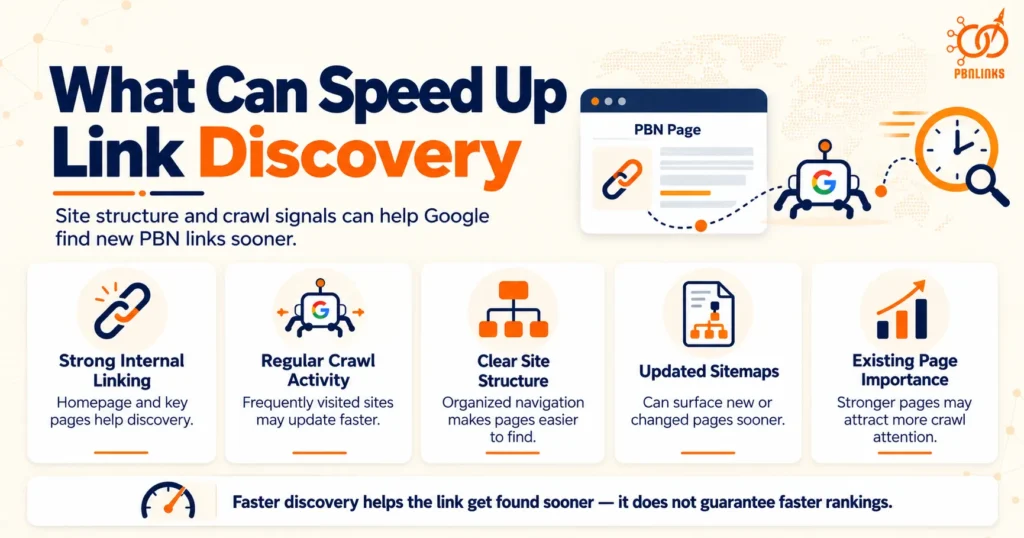
Several site level factors can help Google find a new PBN link sooner:
- Strong Internal Linking
Pages linked from the homepage, category pages, or other active content are easier for Google to find and revisit. - Regular Crawl Activity
Sites that Google already visits often may have new changes discovered sooner than rarely crawled domains. - Clear Site Structure
Pages that sit within normal navigation and topic sections are easier to discover than isolated URLs. - Updated Sitemaps
XML sitemaps can help Google discover new or changed pages, although submitting a sitemap does not guarantee immediate crawling. - Existing Page Importance
Pages with stronger internal support or existing backlinks may receive more crawl attention than weak or orphaned pages.
Why Crawl Speed Is Not Ranking Speed
Fast discovery does not mean fast ranking movement. Crawling only confirms that Google has visited the page and seen the new link.
The page may still need to be reprocessed, and the backlink still has to be evaluated within Google’s wider ranking systems. A page crawled within two days can still show no visible ranking change for weeks.
This is why crawl time should be treated as the first measurable stage of the PBN link timeline, not the final signal that the backlink is already working.
Indexing vs Link Processing: Why They Are Not the Same
Indexing and link processing are related, but they are not the same stage. Indexing means Google has stored or updated the page in its search systems. Link processing is the separate step where the backlink is considered as part of the wider ranking picture.
This difference matters because a PBN page can be indexed while the target site still shows no clear ranking movement. The link may have been discovered and stored, but that does not prove its full effect has already appeared in the SERPs.
Crawled Does Not Always Mean Indexed
Google can crawl a PBN page without adding or updating that page in the index immediately.
A crawl only means Googlebot visited the URL and saw the content. The page may still need more processing before Google decides how to store, update, or use that information in Search.
This is why a recently crawled page should not be treated as proof that the backlink is already influencing rankings.
Indexed Does Not Mean the Link Has Fully Worked
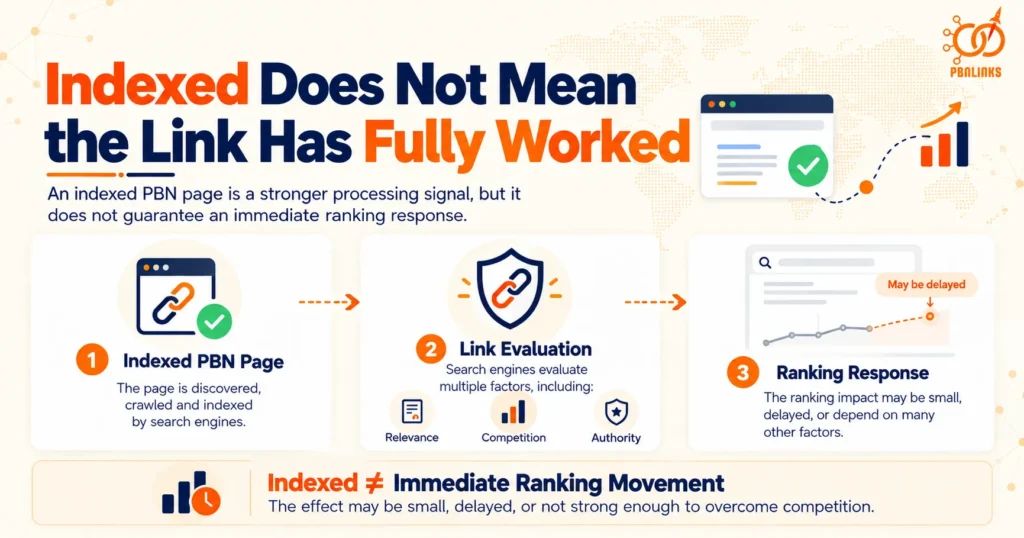
An indexed PBN page is a stronger sign that Google has processed the page, but it still does not guarantee an immediate ranking response.
The backlink still has to be evaluated alongside other signals connected to the source page, target page, anchor context, relevance, competition, and existing authority. Google does not publish a fixed timer showing when that process is complete.
For example, a PBN page may be indexed today while the target page shows no obvious ranking change for several weeks. That does not automatically mean the link failed. It may simply mean the ranking effect is small, delayed, or not strong enough to overcome the current competition.
The practical takeaway is simple. Use indexing as a checkpoint, not as proof that the backlink has already delivered its full ranking impact.
Why an Indexed PBN Link May Still Show No Ranking Change
An indexed PBN link can still show no immediate ranking change. Indexing confirms that Google has processed the source page, but it does not guarantee that the backlink is strong enough to move the target page against its current competitors.
Several factors can limit or delay the visible effect:
- The Keyword Is Too Competitive
A target page may need more authority before it can move against stronger pages. The link may be contributing, but the ranking gap can still be too large for a clear jump. - The Source Page Is Too Weak
An indexed page is not automatically a strong page. If the PBN page has little internal support, weak backlinks, or poor relevance, the link may have limited influence. - The Target Page Needs More Support
A weak target page may have thin content, poor internal linking, or very few backlinks. In that case, one PBN link may not be enough to create visible movement. - Topical Relevance Is Weak
A backlink from a closely related page usually gives clearer context than a link placed on an unrelated topic. Poor relevance can reduce how useful the placement is. - The Ranking Change Is Too Small to Notice
A link may help several related keywords move slightly without creating a dramatic jump for the main keyword. Looking at only one ranking can hide the wider effect. - Normal SERP Volatility Can Hide the Response
Competitors are also changing pages, gaining links, and moving in the results. Small improvements can be difficult to isolate when the SERP itself is unstable.
The key point is simple. An indexed PBN link should be treated as a checkpoint, not proof that rankings must move immediately. If the page is indexed but results remain flat, the next step is to review competition, source strength, target quality, relevance, and overall ranking movement before deciding the link has failed.
Link Strength vs Link Speed
Link strength and link speed are not the same thing. A strong PBN link may have more potential to influence rankings, while a fast link is simply one that Google discovers and processes sooner.
This distinction matters because SEOs often assume that a powerful PBN page should also produce faster results. In reality, a strong page can be crawled slowly, while a weaker page may be discovered quickly but have less ranking influence.
What Makes a PBN Link Strong
A PBN link is stronger when the source page has real authority, strong internal support, good topical relevance, and a natural placement within useful content.
Several factors can increase potential link strength:
- Strong Source Page
A page with useful content, internal support, and real backlinks usually has more potential value than an isolated page. - Topical Relevance
A link from a closely related page gives clearer context to the target than a link from an unrelated topic. - Internal Link Support
Pages that receive relevant internal links from the rest of the site are usually better connected than orphaned pages. - Natural Placement
A contextual link placed where it helps the reader is generally a stronger signal than a forced link added only for SEO. - Existing Authority
A source page that already has its own backlinks and history may carry more influence than a newly created page with little support.
What Affects Discovery and Processing Speed
Link speed depends more on how quickly Google finds and revisits the source page.
Several factors can affect that timing:
- Crawl Frequency
Pages Google visits often may have new links discovered sooner. - Page Location
Pages linked from the homepage, navigation, or active category pages may be easier to rediscover than deep pages. - Internal Linking
Strong internal links can help Google reach updated pages more efficiently. - Site Activity
Active sites may be crawled more regularly than domains that rarely change. - Page Importance
Important pages with strong internal and external signals may receive more crawl attention.
The key point is simple. A link can be strong without being fast, and fast without being strong. The best PBN placements combine both: a well supported, relevant page that Google can discover and process without unnecessary delay.
How Keyword Competition Changes the Ranking Timeline
Keyword competition can change how quickly the effect of a PBN link becomes visible. A link may be discovered and processed at the same speed in two different SERPs, but the ranking response can look very different because one keyword is easier to move than the other.
Low competition keywords often need less additional authority before rankings begin to change. Highly competitive keywords usually have stronger pages, more backlinks, and better established competitors, so one new link may not create an obvious jump on its own.
| Competition Level | What Usually Happens | What It Does Not Mean |
| Low Competition | Smaller authority gains may create visible movement sooner | Google necessarily processes the link faster |
| Moderate Competition | More support may be needed before movement becomes clear | Every link will take the same number of weeks |
| High Competition | Stronger or additional signals may be needed to close the ranking gap | The backlink itself is being processed more slowly |
A page ranking for an easier keyword may move from position 20 to page one after receiving additional support. The same link placed for a highly competitive keyword may produce little visible movement because the target is competing against stronger pages.
This is why keyword difficulty should be viewed as a ranking resistance factor, not a processing timer. The harder the SERP, the more difficult it may be for one backlink to create a noticeable change.
The practical takeaway is simple. If a PBN link has been crawled and indexed but rankings remain flat, competition should be checked before assuming the link has failed. In a difficult SERP, the link may be contributing without being strong enough to create a clear ranking jump by itself.
How Current Ranking Position Changes the Response
Current ranking position can change how quickly a PBN link appears to work because the amount of competition is different at each stage of the SERP. A page ranking at position 40 faces a different gap than a page already sitting in the top 10.
A PBN link may help a page move from position 40 to 25 without much resistance. The same amount of added authority may produce a much smaller change when the page is already competing around positions 5 to 10.
This does not mean Google processes backlinks differently based on ranking position. It means the target page may need more support to move past stronger competitors near the top of the results.
For example, moving from position 30 to 15 may only require the page to outperform a group of weaker results. Moving from position 6 to 3 may mean competing against pages with stronger backlinks, better content, stronger brands, or more established authority.
This is why PBN link timing should be judged together with the target page’s starting position. A small movement near the top of the SERP can still be meaningful, even when it looks slower than a larger jump from deeper rankings.
How Site Age and Existing Authority Affect PBN Link Results
Site age can influence how easy it is to observe the effect of a PBN link, but age alone does not determine how quickly rankings move. An older site may already have more backlinks, stronger internal pages, and a longer ranking history, while a newer site may still be building those signals.
Existing authority matters because a page that already ranks and has support from other links may need less additional strength to move. A new or weak site may require more than one backlink before any visible ranking change appears.
This is why two sites can receive similar PBN links and react very differently. The link may be discovered and processed at a similar speed, but the stronger site may show a clearer ranking response because it is already closer to competing pages.
Aged sites can also have more established crawl patterns and internal structures, which may make changes easier for Google to discover. However, that does not mean every old domain will respond faster than every new one.
The better way to judge timing is to look at the full condition of the money site, including existing backlinks, current rankings, internal linking, content quality, and competition. Site age should be treated as one part of that picture, not as a fixed ranking timer.
Site Age Changes Context, Not the Clock
An aged domain may have advantages that make PBN link results easier to observe, but those advantages usually come from the signals it has built over time rather than the age itself.
For example, an established site may already have:
- More Existing Backlinks
A stronger backlink profile can give the target page a better starting point before the new PBN link is added. - More Ranking History
Pages that already rank for related keywords may show movement more clearly than pages with little search visibility. - Stronger Internal Linking
Established sites often have more pages and internal links that can support the target URL. - More Crawl Activity
Google may already revisit important pages regularly, making changes easier to discover.
A new site may take longer to show a clear response because it has fewer accumulated signals, not because Google follows a fixed waiting period for newer domains.
The key point is simple. Site age can change the conditions around a PBN link, but it does not set the clock for when that link will affect rankings.
Does Source Page Strength Affect How Fast PBN Links Work?
Source page strength can affect how much influence a PBN link may have, but it does not create a guaranteed faster timeline. A strong page may pass more useful authority, while a frequently crawled page may simply be discovered sooner.
This distinction matters because SEOs often treat page strength and processing speed as the same thing. In reality, a powerful page can be crawled slowly, while a weaker page may be revisited quickly but produce less ranking impact.
Several source page factors can affect how useful the placement becomes:
- Internal Link Support
A page that receives relevant internal links from other parts of the PBN is usually better connected than an isolated page. Strong internal support can improve page importance and make the placement more useful. - Existing Backlinks to the Source Page
A page with its own external backlinks may carry more authority than a newly created page with no supporting links. This can increase the potential value of the outbound PBN link. - Topical Relevance
A source page that closely matches the target topic gives clearer context than a page with little connection to the money site. - Page Location
Homepage and important category pages may be crawled more often, while deeper pages can take longer to be revisited. Faster discovery does not automatically mean stronger ranking impact. - Crawl Activity
Pages Google revisits regularly may have new links discovered sooner. This affects the discovery stage more directly than the strength of the link itself.
The practical takeaway is simple. A strong source page can improve the potential value of a PBN link, but crawl activity determines how quickly that link is likely to be found. The best placements combine both strong page support and regular discovery.
Does Topical Relevance Affect the Timeline?
Topical relevance can affect how useful a PBN link is, but it does not create a guaranteed faster ranking timeline. A link from a closely related page may give Google clearer context about the target, while an unrelated link may be weaker or less useful.
For example, a roofing website receiving a link from a home improvement article has a clearer topical connection than the same website receiving a link from an unrelated finance page. The first placement may be more relevant to the target topic, but that does not mean Google will necessarily crawl or process it faster.
Relevance mainly affects the quality and context of the link rather than the speed of discovery. Crawl timing still depends more on how often Google visits the source page, how well that page is connected, and whether the page has already been indexed.
This is why a highly relevant link can still take time to show an effect, while a less relevant page may be crawled quickly but provide little ranking value.
The practical takeaway is simple. Choose relevant PBN placements because they make more sense for the target page and can strengthen the link context, not because relevance guarantees faster results.
How Long Should You Wait Before Adding Another PBN Link?
You should usually wait long enough to see whether the first PBN link has been discovered, indexed, and followed by any measurable ranking response before adding another link. There is no universal waiting period that applies to every campaign.
Adding another PBN link too quickly can make it harder to tell which placement caused the change. If several links are added within a short period, any later ranking movement becomes difficult to attribute to one source.
A practical approach is to first check whether the original link has been crawled and whether the source page is indexed. Then monitor rankings, impressions, and related keyword movement over the following weeks before deciding whether more support is needed.
When Waiting Makes More Sense
Waiting is usually the better option when:
- The Link Was Added Recently
If Google has not yet crawled or reprocessed the source page, adding another link may be premature. - Rankings Are Already Moving
If the target page is improving, give the campaign more time before changing the link profile again. - The SERP Is Volatile
Short term ranking changes can make it difficult to judge whether the backlink is having a real effect. - The Keyword Is Highly Competitive
A stronger SERP may need more time before the effect of one link becomes clearly visible.
When Another Placement May Be Justified
Another PBN link may make sense when the first placement has been live and processed for a reasonable observation period but the target still lacks enough authority to compete.
Before adding another link, review the source page, target page, keyword difficulty, topical relevance, and current ranking position. If those factors look healthy and the ranking gap is still large, another relevant placement may provide additional support.
The key point is simple. Do not add another PBN link because a few days have passed. Add it when the first link has had enough time to be discovered and evaluated, and the campaign still needs more support.
How to Tell if a PBN Link Is Working
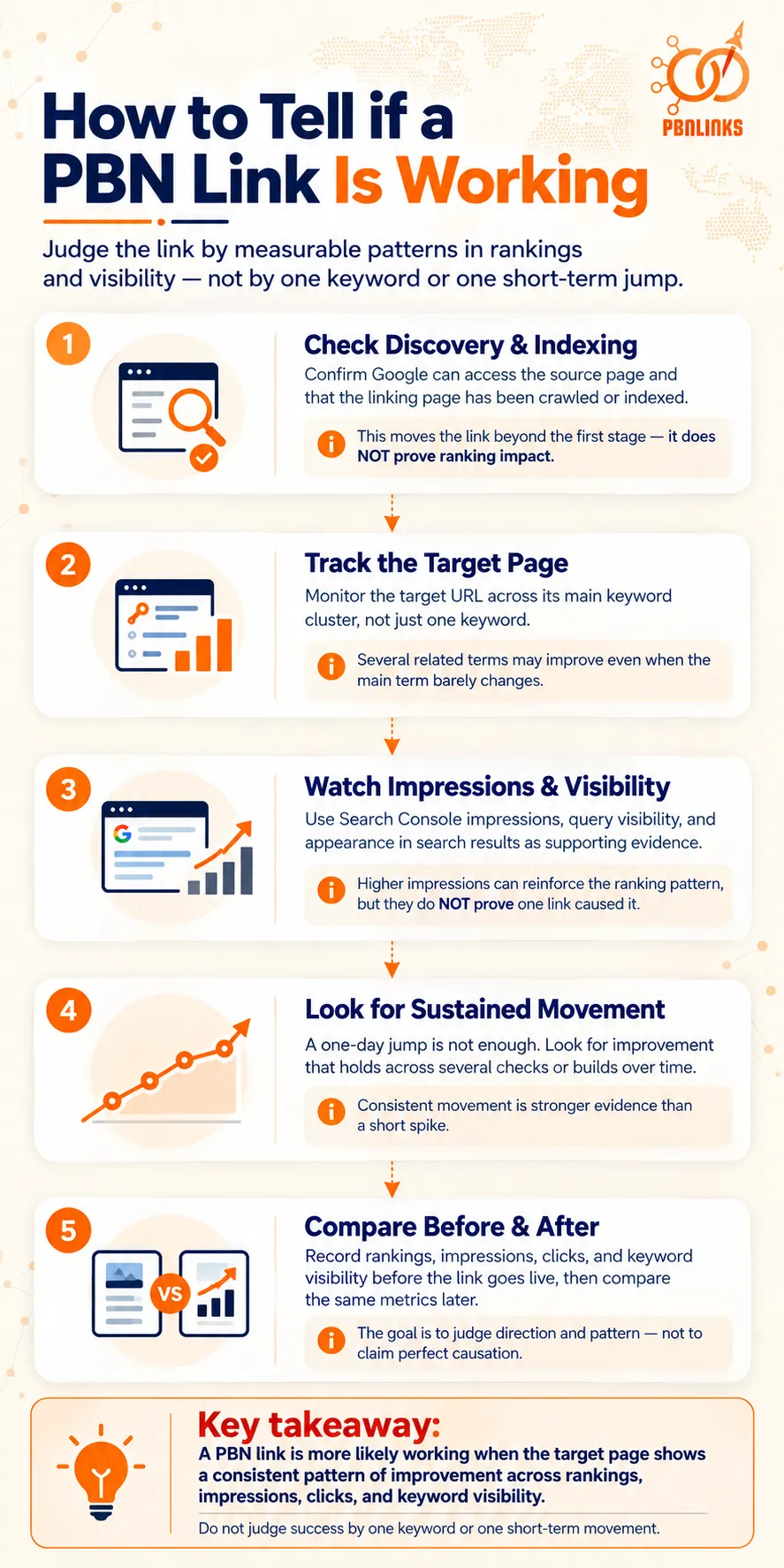
A PBN link is working when the target page begins showing measurable improvement after the link has been discovered and processed. That improvement may appear in rankings, impressions, clicks, or visibility across a group of related keywords.
One keyword should not be used as the only signal. Search positions change for many reasons, so the better approach is to compare several indicators over time and look for a consistent pattern.
Check Whether the Link Has Been Discovered and Indexed
Start by confirming that Google can access the source page and that the page containing the backlink has been crawled or indexed.
This does not prove the PBN link is affecting rankings, but it confirms that the placement has moved beyond the first stage of the timeline. If Google has not discovered the page, there is little reason to judge ranking impact yet.
Track the Target Page, Not Just One Keyword
Monitor the ranking performance of the target URL across its main keyword cluster.
A useful PBN link may support several related searches instead of creating one dramatic jump for the primary keyword. For example, the target page may improve by a few positions across five related terms even when its main keyword stays almost unchanged.
Watch Search Impressions and Visibility
Google Search Console impressions can show whether the target page is appearing more often in search results.
An increase in impressions does not prove one backlink caused the change, but it can provide supporting evidence when it appears alongside better rankings for relevant queries.
Look for Sustained Movement
A one day ranking jump is not enough to judge a PBN link. Rankings naturally move up and down, especially in competitive SERPs.
A stronger signal is improvement that remains visible across several checks or gradually strengthens over time. Consistent movement is easier to evaluate than a short spike followed by an immediate drop.
Compare Before and After Performance
Record the target page’s position, impressions, clicks, and relevant keyword visibility before the PBN link is added. Then compare the same metrics during the observation period.
The goal is not to prove that one link caused every change. It is to determine whether the target page is moving in the expected direction after the new backlink became part of the campaign.
The key point is simple. Judge a PBN link by a pattern of ranking and visibility changes, not by one keyword or one short term movement.
When to Wait vs When to Investigate
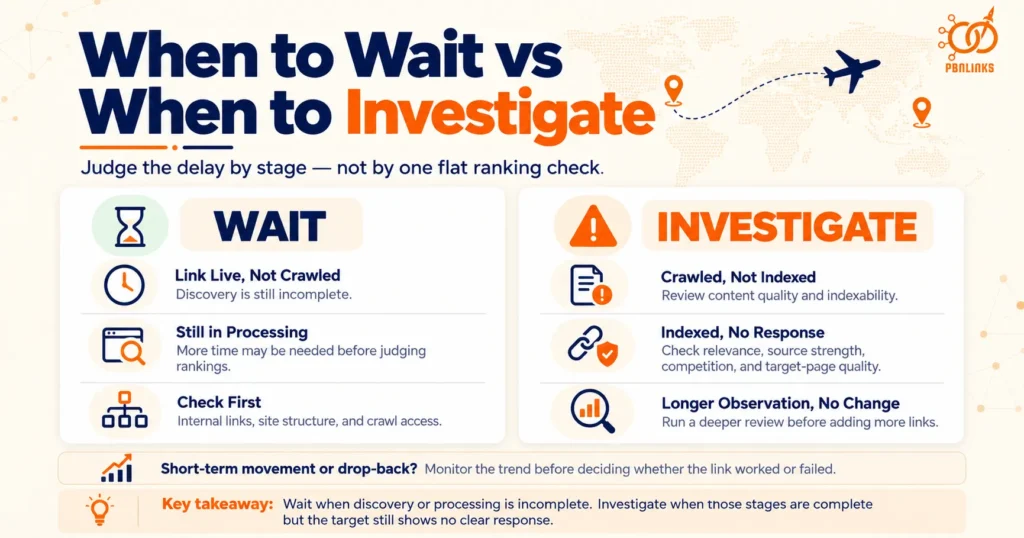
Not every PBN link needs immediate action when rankings stay flat. The right response depends on where the delay is happening.
If the link is still waiting to be crawled or processed, more time may be needed. If the source page is indexed but there is still no measurable response after a reasonable observation period, the issue may be related to source quality, relevance, competition, or the target page itself.
Link Is Live but Not Crawled
If the backlink is live but Google has not revisited the source page, waiting usually makes more sense than adding another link.
Check whether the page is internally linked, easy to reach, included in the site structure, and accessible to Google. A page that sits deep in the site or has weak internal support may take longer to be discovered.
Crawled but Not Indexed
If Google has crawled the page but it is not indexed, review the quality and indexability of the source page before judging the backlink.
Check for thin content, duplicate pages, technical blocks, weak internal linking, or other issues that may prevent the page from being included properly in Search.
Indexed but No Ranking Movement
If the PBN page is indexed but the target has not moved, the next step is to review the wider ranking situation.
Look at keyword competition, source page strength, topical relevance, target page quality, current ranking position, and existing authority. The link may be processed but still not strong enough to create a visible jump.
Rankings Move and Then Drop Back
Short term movement should not be treated as a final result.
SERPs can fluctuate because competitors change, Google reprocesses signals, or the target page moves within a normal range. Monitor the trend over several checks before deciding whether the link worked or failed.
No Measurable Change After a Longer Observation Period
If the source page has been crawled and indexed, the link has been live for a longer period, and the target still shows no meaningful change, deeper investigation makes sense.
Review whether the source page has enough authority, whether the link is relevant, whether the target page can compete, and whether another PBN placement would provide a stronger fit.
The key point is simple. Wait when the link is still moving through the discovery and processing stages. Investigate when those stages are complete but the target still shows no clear response.
Common PBN Link Timeline Mistakes
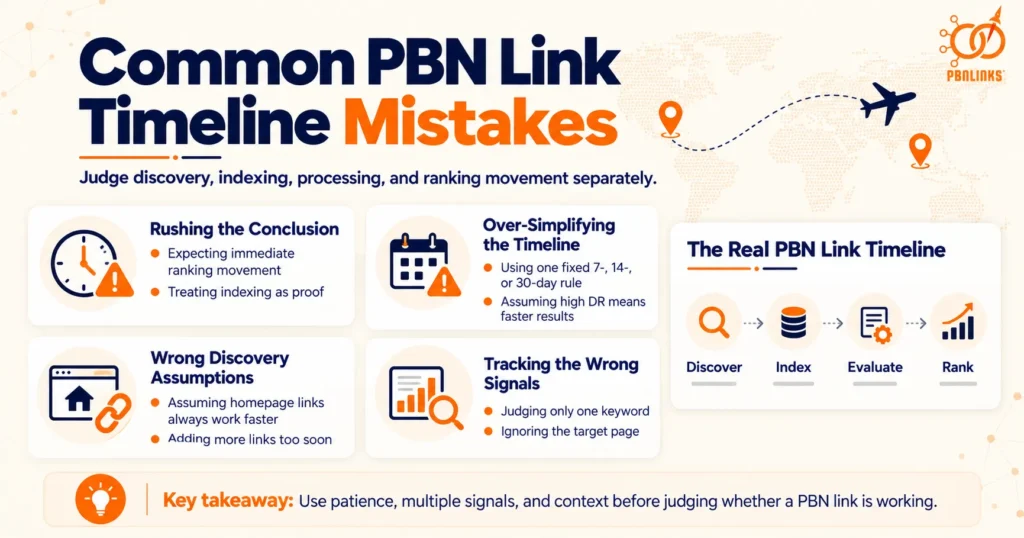
Most mistakes happen when PBN link timing is judged too quickly or with only one signal. A link can be live, crawled, indexed, and still need more time before any clear ranking response appears.
The better approach is to separate discovery, indexing, processing, and ranking movement instead of treating them as one event.
Common Mistakes That Lead to Wrong Conclusions
- Expecting Immediate Ranking Movement
A new PBN link does not usually create an instant ranking jump. Google first needs to discover and process the source page before any effect can become visible. - Treating Indexing as Proof the Link Has Fully Worked
An indexed page confirms that Google has processed the source page, but it does not prove the backlink has already produced its full ranking impact. - Using One Fixed Timeline for Every Campaign
Rules such as 7, 14, or 30 days are too simple. Competition, target strength, source quality, current position, and crawl timing can all change the response. - Assuming High DR Means Faster Results
DR is a third party metric. A high DR domain does not guarantee that Google will discover, process, or value the individual linking page faster. - Assuming Homepage Links Always Work Faster
A homepage may be crawled more often, but faster discovery does not guarantee stronger or faster ranking movement. - Adding More Links Too Soon
Adding several links before the first placement has been properly observed makes attribution much harder. Later ranking changes become difficult to connect to one specific link. - Judging Only One Keyword
A PBN link may help several related queries while the main keyword stays almost unchanged. Tracking the wider keyword cluster gives a clearer picture. - Ignoring the Target Page
A strong backlink cannot fully compensate for weak content, poor internal linking, technical problems, or a page that is not competitive enough for the SERP.
The key point is simple. PBN link timing should be judged with patience, multiple signals, and enough context to understand where the delay is actually happening.
Practical PBN Link Timeline Examples
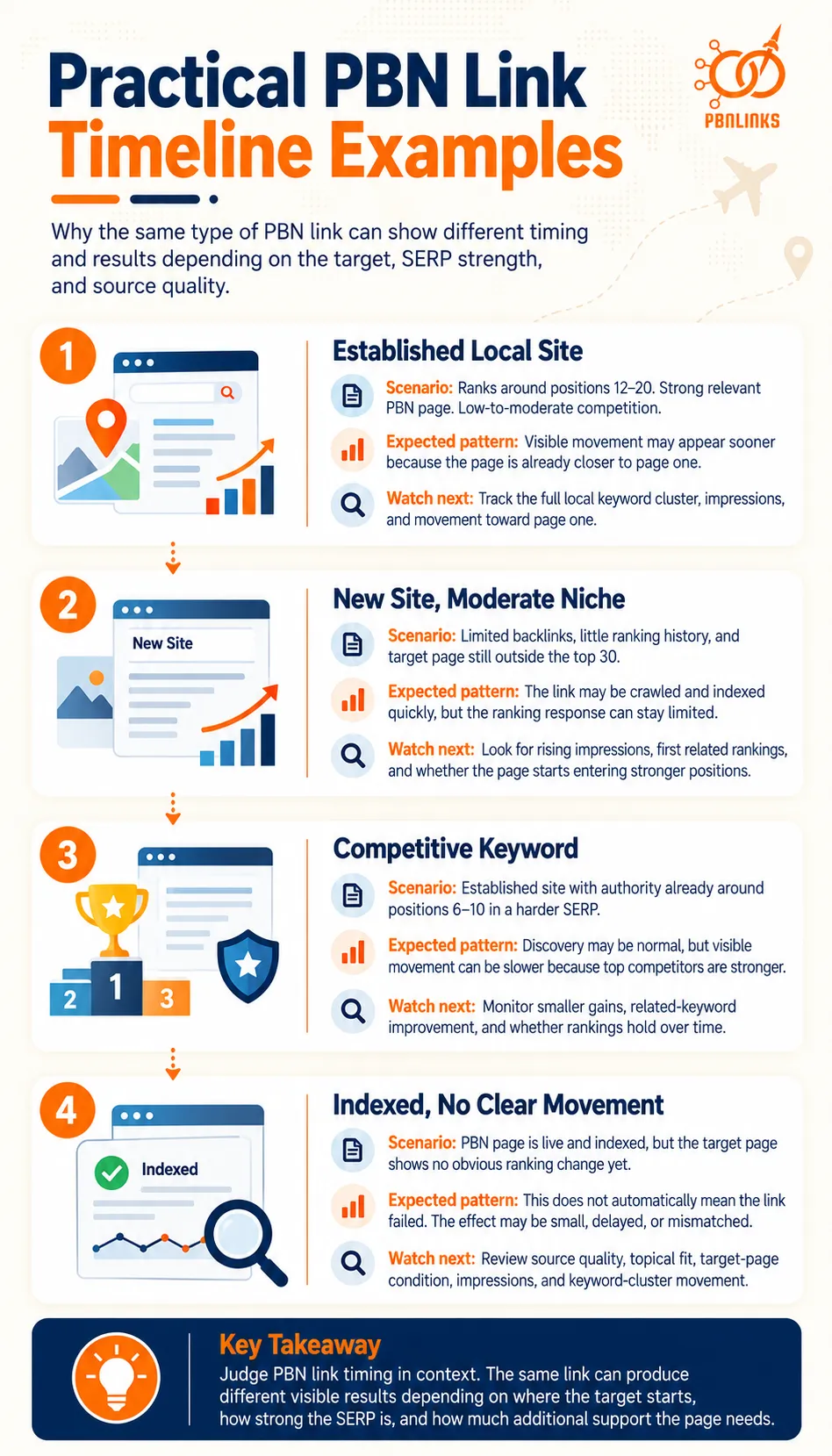
PBN link timelines vary because every campaign starts from a different position. A link added to an established local site may show a visible response sooner than the same type of link added to a new site targeting a highly competitive keyword.
The examples below show how source strength, target condition, competition, and current rankings can change what you should expect and what you should check next.
Example 1: Established Local Site in a Low Competition SERP
An established local business site is already ranking between positions 12 and 20 for several service keywords. A relevant PBN link is added from a strong page that Google crawls regularly.
Because the target is already close to page one and the competition is moderate, visible movement may appear sooner than it would in a harder SERP.
What to watch: ranking movement across the full local keyword cluster, impressions, and whether the target page moves closer to page one over the following weeks.
Example 2: New Site in a Moderate Competition Niche
A newer site has limited backlinks and little ranking history. The target page is technically sound, but it is still outside the top 30 for its main keywords.
A PBN link may be crawled and indexed quickly, but the ranking response can still be limited because the site has fewer supporting signals.
What to watch: whether impressions increase, related keywords begin ranking, and the target page starts moving into a stronger position before adding more links.
Example 3: Established Site Targeting a Highly Competitive Keyword
An established site already has authority and ranks around positions 6 to 10 for a difficult keyword. A strong PBN link is added from a relevant page.
The link may be discovered and processed normally, but visible movement can still be slow because the target is competing against stronger pages near the top of the SERP.
What to watch: smaller position gains, improvement across related keywords, and whether the page holds stronger rankings over time instead of expecting one large jump.
Example 4: Indexed PBN Link With No Visible Ranking Movement
A PBN page is indexed and the backlink is live, but the target page shows no clear ranking change after several checks.
This does not automatically mean the link failed. The problem may be weak source authority, poor topical fit, strong competition, a weak target page, or simply a ranking change that is too small to stand out.
What to watch: source page quality, target page condition, impressions, keyword cluster movement, and whether another placement would offer a stronger match.
These examples show why PBN link timing should be judged in context. The same link can produce different visible results depending on where the target starts, how strong the SERP is, and how much additional support the page needs.
Final Verdict: How Long Do PBN Links Take to Work?
In conclusion, there is no fixed timeline for how long PBN links take to work. Some links may show visible movement within a few weeks, while others take longer or produce no clear standalone change.
The timeline depends on several stages. Google first has to discover and crawl the source page, then index or reprocess it, evaluate the link, and finally reflect any effect in the search results.
Visible ranking movement also depends on keyword competition, current ranking position, source page strength, target page quality, topical relevance, and the authority the money site already has. A link can be indexed and still need more time before its effect becomes noticeable.
The best approach is to monitor the full process instead of judging the link by one fixed number of days. Check discovery, indexing, rankings, impressions, and keyword movement before deciding whether to wait, investigate, or add another placement.
If you want PBN links placed on relevant, well supported pages with proper campaign tracking, explore the managed PBN link services available at PBNLinks.Agency.
FAQs About PBN Link Timelines
How long do PBN links take to work?
PBN links may show a ranking impact within a few weeks, but there is no fixed timeline. Crawl timing, indexing, competition, source strength, target quality, and current rankings can all change how quickly results become visible.
Do PBN links work immediately after indexing?
No, indexing does not guarantee an immediate ranking change. The source page may be indexed while the backlink still produces only a small, delayed, or difficult to measure effect.
How long does Google take to discover a PBN backlink?
Google may discover a new or updated page within several days, but crawling can take longer. Discovery speed depends on crawl activity, internal links, page importance, and how easily Google can reach the source page.
Why is my PBN link indexed but rankings have not moved?
An indexed link may still show no clear movement if competition is strong, the source page is weak, the target page needs more authority, or the ranking change is too small to notice.
Do stronger PBN links work faster?
Not necessarily. A stronger source page may provide more potential ranking value, but strength does not guarantee faster crawling or processing.
Do PBN links take longer to work on new websites?
They can, but site age alone is not the reason. New websites often have fewer backlinks, less ranking history, and weaker internal support, which can make ranking changes harder to achieve or measure.
Does keyword competition affect how fast PBN links work?
Yes, competition affects how quickly ranking movement becomes visible. Harder SERPs usually require more authority to overcome competing pages, even if Google discovers and processes the link normally.
How long should I wait before adding another PBN link?
Wait long enough to confirm the first link has been discovered, indexed, and given a reasonable observation period. Adding more links too quickly can make it difficult to identify which placement contributed to later ranking changes.
How do I know if a PBN link is working?
Track the target page across rankings, impressions, clicks, and related keyword visibility. A consistent improvement across several signals is more useful than judging the link from one keyword or one short term ranking jump.
When should I consider a PBN link ineffective?
Consider investigating the link when the source page has been crawled and indexed, enough time has passed for observation, and the target still shows no meaningful improvement. Review source quality, relevance, competition, and target page strength before deciding the placement has failed.