How to Scale a PBN: From 10 to 100 Domains Without Losing Quality
Most PBN operators know how to build a network. Far fewer know how to scale one without losing the quality that made it work in the first place.
Adding more domains sounds straightforward. In practice it means managing more content, more hosting accounts, more domain acquisitions, and more footprint risks all at once. Without proper systems every new domain you add creates more problems than it solves.
If you want to scale PBN network from 10 to 100 domains without quality dropping at every stage this framework covers exactly how to do it.
Why Scaling a PBN Is Different From Building One
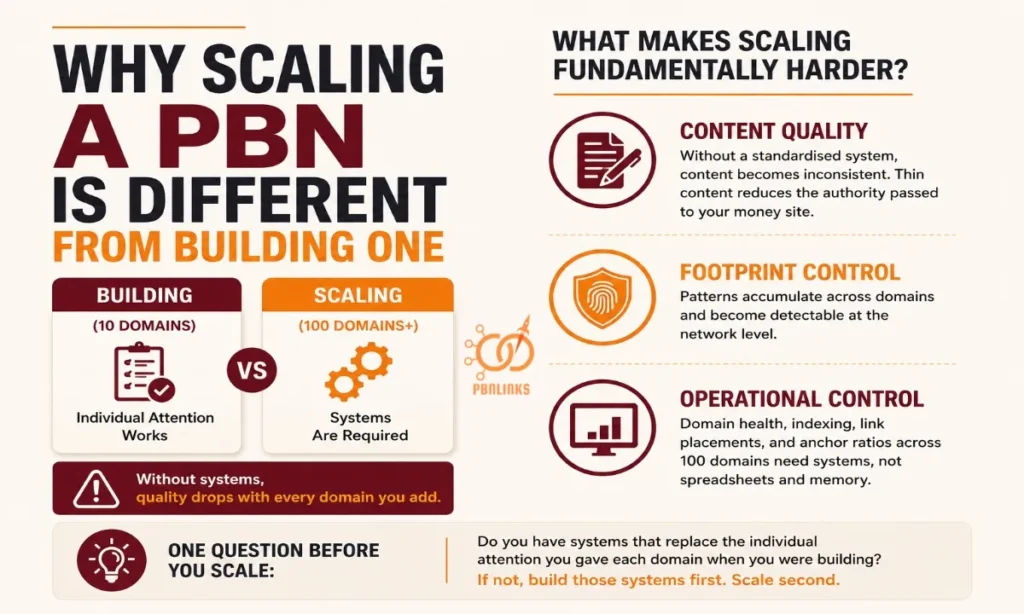
Scaling a PBN is different from building one because building requires individual attention while scaling requires systems. Without those systems quality drops with every domain you add.
When you build a PBN you manage each domain directly. Vetting, hosting, content, and links are handled one at a time. That level of attention is possible at 10 domains. It becomes impossible at 50 and completely unmanageable at 100.
What makes scaling fundamentally harder than building?
Three things that are manageable when building become serious problems when scaling:
- Content quality — When building you can review every piece of content personally. When scaling without a standardised system content quality becomes inconsistent and thin content on new domains reduces the authority they pass to your money site
- Footprint control — When building individual attention catches footprint issues early. When scaling patterns accumulate invisibly across dozens of domains until they become detectable at network level
- Operational control — When building you can track everything manually. When scaling domain health, indexing status, link placements, and anchor ratios across 100 domains require dedicated systems not spreadsheets and memory
Before adding a single new domain ask yourself one question. Do you have systems that replace the individual attention you gave each domain when you were building? If not build those systems first. Scale second.
When You Are Ready to Scale Your PBN
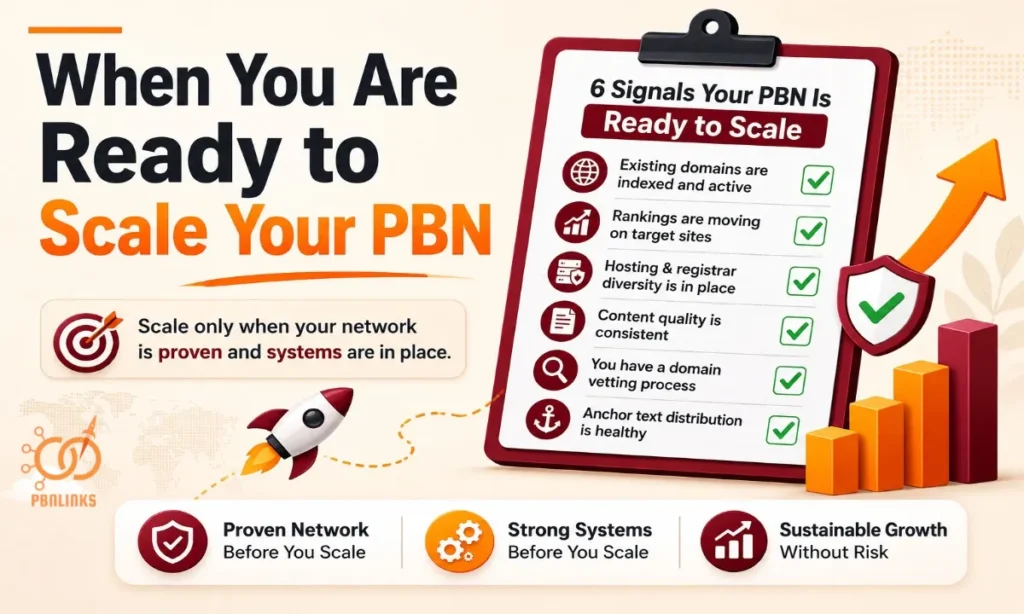
You are ready to scale your PBN when your existing network is performing consistently and the systems to manage more domains are already in place. Scaling before either condition is met multiplies problems not results.
Most operators scale too early. They add new domains because they want more links not because their current network has proven it is working. That approach spreads budget and attention across a larger number of underperforming assets instead of building on a foundation that is already delivering results.
How do you know your PBN is ready to scale?
Check these signals before committing to growth:
- Existing domains are indexed and active — every domain in your current network has indexed content, consistent publishing activity, and no deindexing issues
- Rankings are moving on target money sites — the links you have placed are producing measurable ranking movement. If current links are not working adding more domains will not fix the problem
- Hosting and registrar diversity is already in place — your current network does not share hosting providers or registrars in a way that creates a detectable pattern
- Content quality is consistent — every domain in the current network has genuine on topic content that meets the minimum standard. If content quality is already slipping on existing domains scaling will make it worse
- You have a domain vetting process — you can vet and acquire new domains consistently without cutting corners on quality thresholds
- Anchor text distribution is healthy — your current network anchor profile is within safe thresholds before you start adding more links through new domains
If all six signals are present your network is ready to scale. If any one of them is missing fix it before adding a single new domain. Our how to build PBN links guide covers the foundational standards every domain in your network should meet before you consider growing it.
How to Scale Your PBN in Three Phases
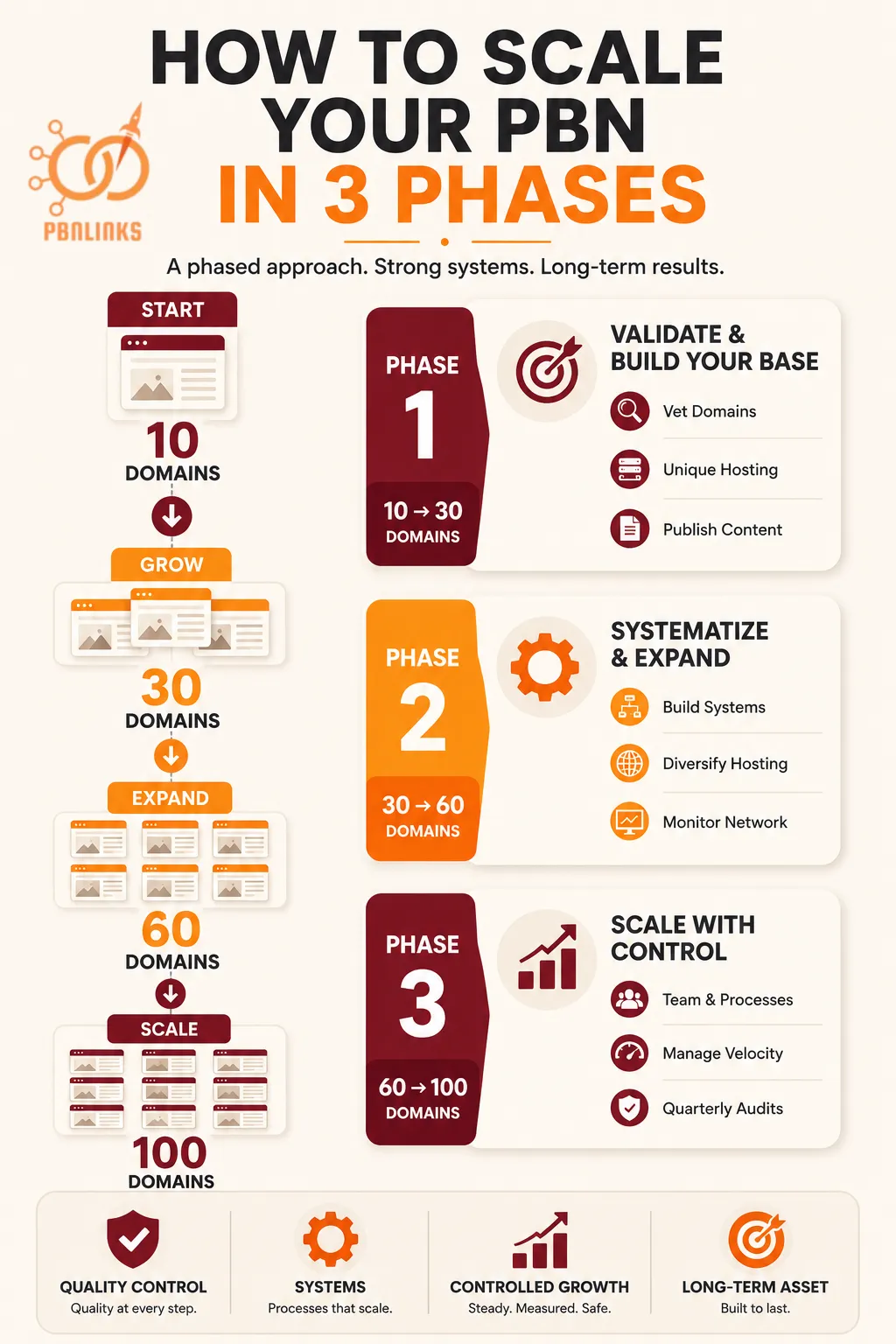
Scaling a PBN from 10 to 100 domains safely requires a phased approach. Each phase has a different focus, a different pace, and different quality controls. Trying to jump straight from 10 to 100 domains without moving through each phase is the fastest way to lose control of network quality.
Phase 1: 10 to 30 Domains
Phase 1 is about validating your systems before increasing volume. The goal is not speed. It is making sure every process that will carry the weight of a larger network actually works at this scale.
At this phase focus on:
- Domain acquisition pace — add 2 to 3 new domains per month maximum. Thorough vetting takes priority over speed
- Hosting setup — each new domain gets its own isolated hosting environment on a unique IP. Avoid using the same hosting provider across multiple domains at this stage
- Content standard — every domain publishes a minimum of 3 to 5 pieces of genuine on topic content before any links are placed
- Link deployment — new domains are seasoned for 4 to 8 weeks before placing any outbound links to money sites
- Tracking system — set up a domain tracking sheet covering indexing status, hosting details, content count, links placed, and anchor text used
Before moving to Phase 2 confirm every domain is indexed, active, and passing authority as expected. Identify and fix any underperforming domains before scaling further.
Phase 2: 30 to 60 Domains
Phase 2 is where systems get tested under real pressure. The domain count doubles and operational complexity increases significantly. Processes that worked informally in Phase 1 must be documented and systematised in Phase 2.
At this phase focus on:
- Domain acquisition pace — increase to 3 to 5 new domains per month as vetting becomes more efficient
- Content production — a standardised content brief system must be in place. Quality control moves to the brief level because individual content review is no longer practical at this volume
- Hosting diversification — spread domains across a minimum of 5 to 7 different hosting providers and IP ranges
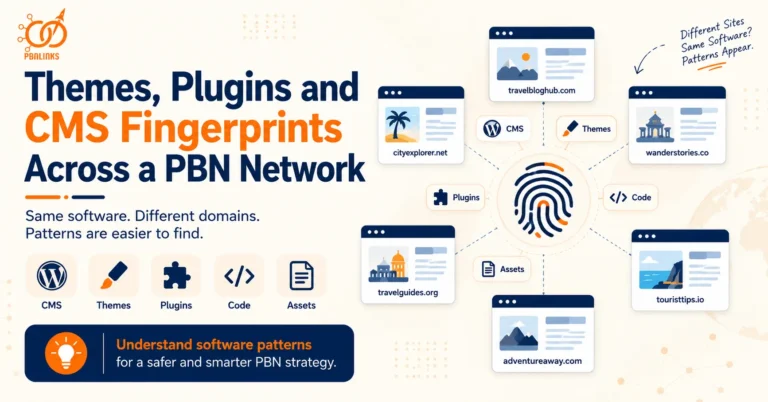
- Footprint audit — conduct a full network footprint audit before reaching 60 domains. Check site structures, themes, plugins, registrars, and anchor text distribution
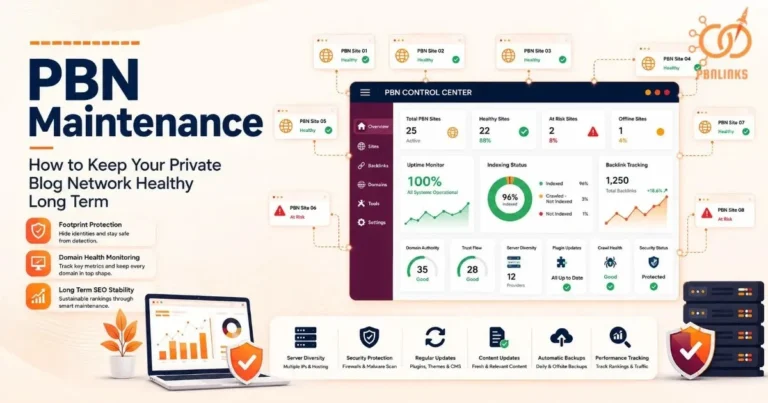
- Monitoring system — set up automated monitoring for indexing status and domain health across all active domains
Before moving to Phase 3 confirm content quality is consistent across all 60 domains and the anchor text profile is within safe thresholds. For managing the hosting side of a network this size our best PBN hosting guide covers the providers and configurations that work at scale.
Phase 3: 60 to 100 Domains
Phase 3 is where the network becomes a serious long term asset. It is also where the consequences of weak systems become most damaging. At this scale individual attention is completely replaced by process and automation.
At this phase focus on:
- Domain acquisition pace — 4 to 6 new domains per month with a fully systematised vetting and onboarding process
- Team management — at this scale most operators need at least one dedicated team member. They should cover content production, domain monitoring, and site maintenance
- Content automation — a fully documented content brief system with vetted writers or a managed outsourcing workflow is non-negotiable
- Link velocity management — with more domains available for linking the risk of over-linking money sites increases. Manage velocity carefully across all active money sites
- Quarterly network audits — conduct a full network audit every 90 days covering indexing, hosting, anchor text, content freshness, and outbound link health
A network that reaches 100 domains with consistent quality is a genuinely powerful long term SEO asset. Getting there requires treating each phase as a qualification checkpoint not just a number to hit.
Domain Acquisition Strategy at Scale
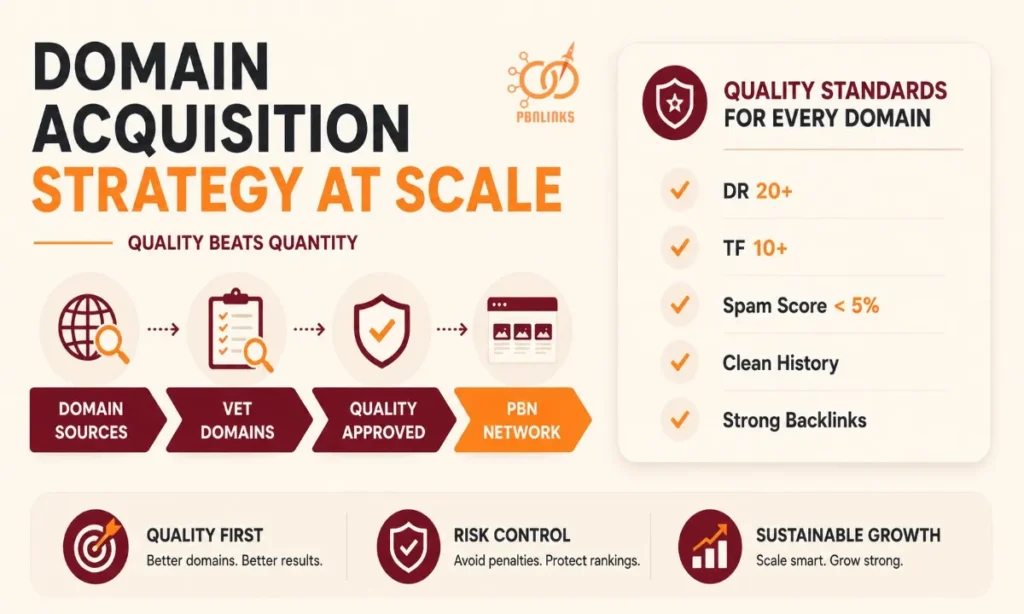
Domain acquisition strategy at scale means building a repeatable system for finding, vetting, and onboarding new domains. The goal is to maintain quality standards consistently regardless of how fast the network is growing.
The most common mistake at scale is treating domain acquisition as a volume game. More domains acquired faster feels like progress. In reality every weak domain dilutes network authority. It also multiplies management overhead without producing proportional ranking gains.
Quality Standards for Every Domain You Add
Quality thresholds must not drop as acquisition volume increases. The same standards that applied to your first 10 domains apply to your 100th.
Minimum thresholds to maintain at every phase:
- Domain Rating — DR 20 plus for low competition. DR 30 plus for medium to high competition
- Trust Flow — TF 10 minimum. TF 15 plus is preferable. TF to CF ratio must sit at 0.8 or above
- Spam Score — below 5 percent. Above 10 percent is an automatic disqualifier
- Wayback Machine history — minimum 3 years of consistent on topic content with no major gaps
- Backlink profile — gradual referring domain growth with no sudden spikes. Majority of referring domains from relevant niche sources
- No penalty signals — confirmed clean in Ahrefs Site Explorer before purchase
Research confirms 10 quality domains consistently outperform 50 low quality ones. Never cut quality thresholds to acquire domains faster. Our PBN domain metrics guide covers each threshold in full detail.
Where to Source Domains at Scale
Building a consistent pipeline of quality domains is one of the biggest operational challenges when scaling. Relying on one source creates bottlenecks. Use a combination of these sources to maintain a steady supply:
- GoDaddy Auctions — largest volume of expiring domains daily. Set saved searches with minimum metric filters to surface candidates automatically
- NameJet and DropCatch — higher quality domains with stronger competition. Use for domains with exceptional metrics that justify the premium price
- DomCop — aggregates domains from multiple sources. Applies pre-calculated quality scores. Saves significant vetting time at scale
- SpamZilla — built specifically for PBN domain hunters. Flags spam signals and prior PBN history automatically
- Karma.Domains — strong option in 2026 for deep history analysis alongside standard metrics
Hosting Strategy for a Large PBN Network
Hosting strategy for a large PBN network is the process of distributing domains across multiple hosting providers, IP ranges, and server locations to eliminate detectable patterns that reveal the network to Google.
At 10 domains hosting mistakes are manageable. At 100 domains the same mistake repeated across every domain creates a network wide footprint that Google’s pattern recognition identifies reliably.
How to Diversify Hosting at Scale
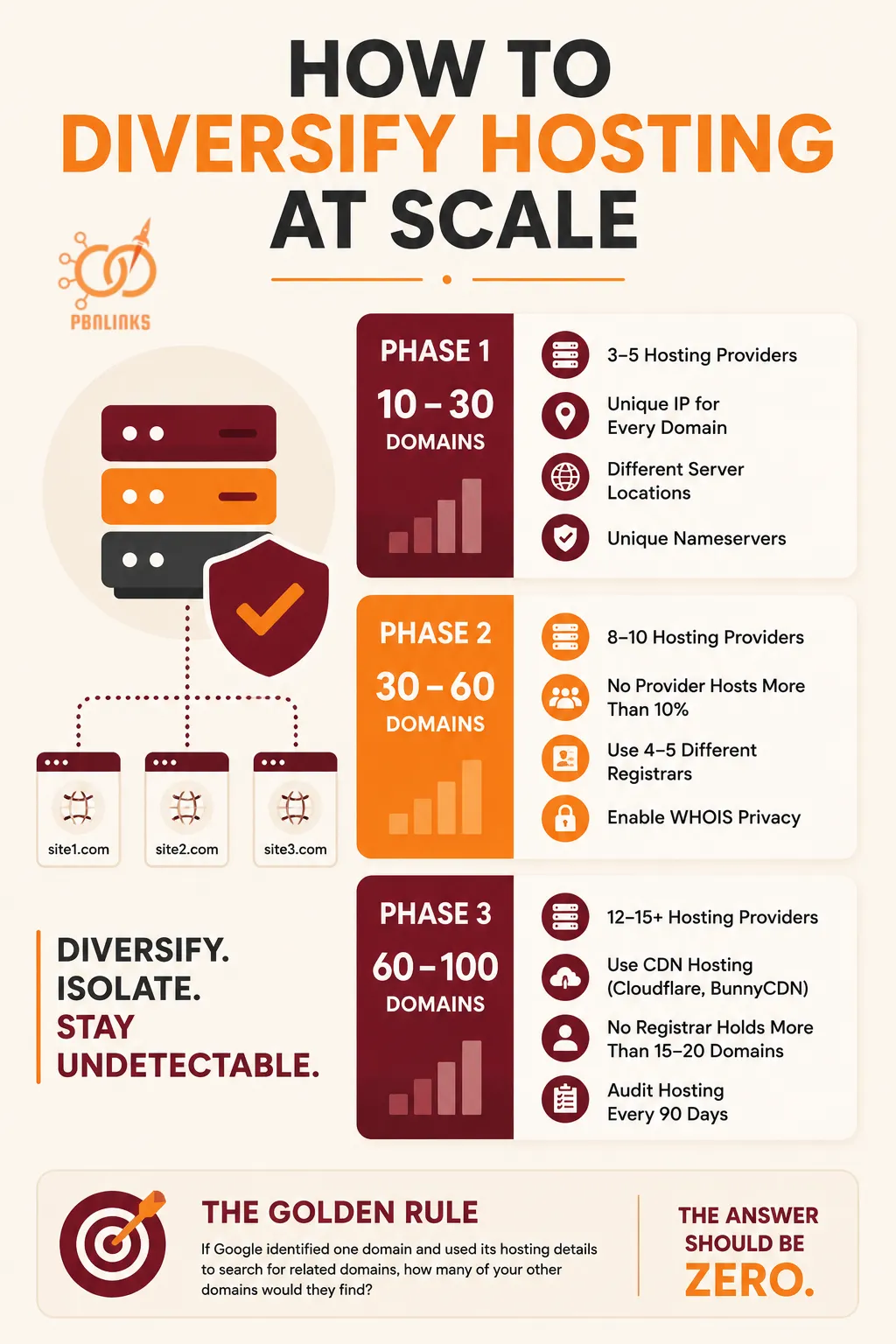
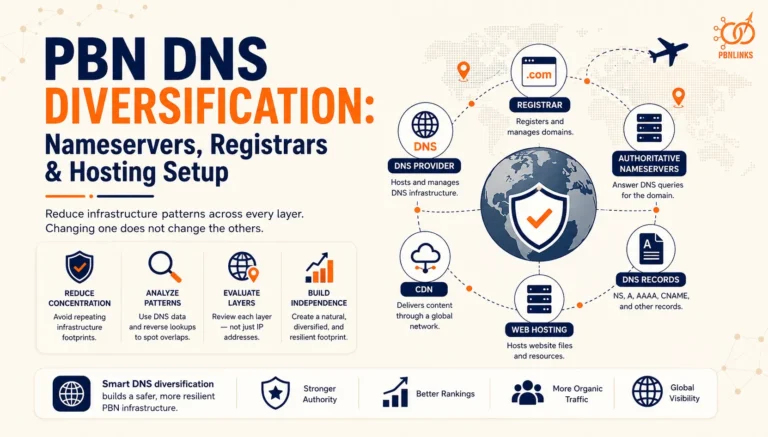
Hosting diversification means no two PBN domains share the same hosting provider, IP address, or nameserver configuration. Here is how to implement it at each scaling phase:
Phase 1 — 10 to 30 domains:
- Use a minimum of 3 to 5 different hosting providers
- Each domain gets a unique IP address
- Spread domains across different geographic server locations
- Never use the same nameserver configuration across multiple domains
Phase 2 — 30 to 60 domains:
- Increase to 8 to 10 different hosting providers
- No single provider should host more than 10 percent of your total domains
- Diversify registrars alongside hosting — use at least 4 to 5 different registrars
- Enable WHOIS privacy on every domain through the registrar not a third party service
Phase 3 — 60 to 100 domains:
- Spread across 12 to 15 or more hosting providers
- CDN based hosting becomes viable at this scale — providers like Cloudflare or BunnyCDN hide server IPs and spread sites across global locations
- No registrar should hold more than 15 to 20 domains from your network
- Conduct a hosting audit every 90 days to confirm no clustering patterns have developed
A simple rule for any phase. If Google identified one domain and used its hosting details to search for related domains how many of your other domains would they find? The answer should be zero.
Hosting Providers Worth Using at Scale
Not every hosting provider is suitable for large PBN networks. The key requirements are IP diversity, stealth infrastructure, and the ability to host multiple sites without creating detectable patterns.
Providers worth considering for large networks:
- Easy Blog Networks — built specifically for PBN hosting. Manages 10 to 100 WordPress based PBNs with strong hosting diversity and automation tools
- Bulk Buy Hosting — affordable IP diverse hosting designed for large scale PBNs. Good option for operators managing high domain volumes on a controlled budget
- LaunchCDN — CDN based hosting using Cloudflare, Amazon CloudFront, and BunnyCDN. Hides server IPs and reduces detectable patterns across the network
- Individual hosting accounts — at scale some operators open individual hosting accounts across multiple mainstream providers. More time intensive but produces the strongest IP diversity
For a full comparison of PBN hosting providers including pricing, features, and footprint safety ratings visit our best PBN hosting guide.
Content Production System for a Large PBN
Content production system for a large PBN is a standardised process for creating, briefing, and publishing content across every domain in the network at a consistent quality level regardless of how many domains are being managed.
At 10 domains you can review every piece of content personally. At 100 domains that is impossible. Without a system in place content quality becomes the first thing to drop when scaling — and thin content directly reduces the authority each domain passes to your money site.
How to Build a Content Brief System
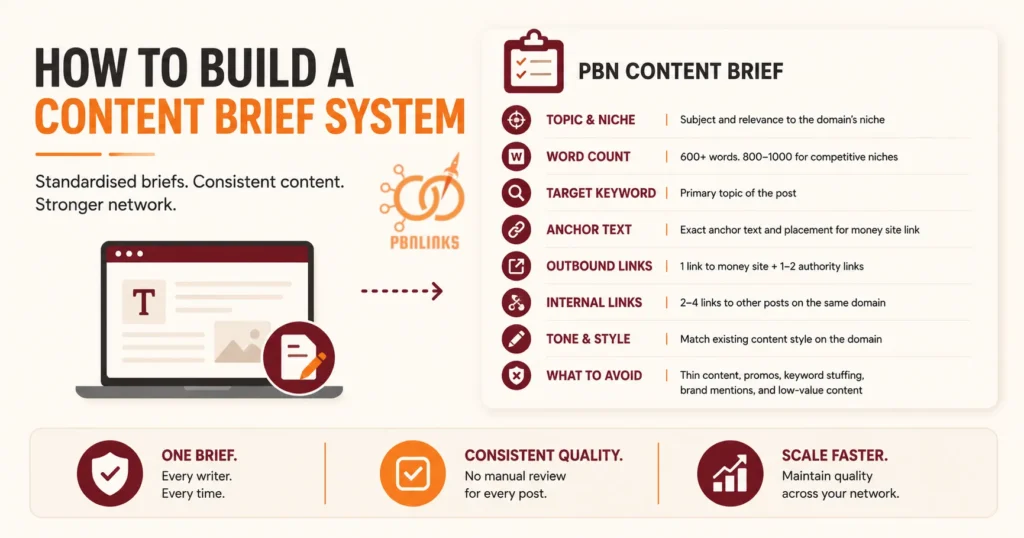
A content brief system replaces personal review with standardised instructions. Every writer or tool producing content for your network works from the same brief format. Quality control moves to the brief level not the review level.
A PBN content brief should include:
- Topic and target niche — the subject the post covers and how it relates to the domain’s established niche
- Word count — minimum 600 words. 800 to 1000 words for domains targeting competitive niches
- Target keyword — the primary topic the post is written around. Not necessarily the money site keyword
- Anchor text instruction — the exact anchor text to use for the money site link and where in the post it should appear
- Outbound link requirements — one link to the money site and one to two links to authority sources
- Internal link requirements — two to four links to other posts on the same PBN domain
- Content tone and style — match the existing content style on the domain to maintain consistency
- What to avoid — thin content, promotional language, exact match keyword stuffing, and any mention of the money site brand in an obvious way
When every piece of content is produced from this brief the network maintains consistent quality without requiring individual review of every post.
Outsourcing vs AI Content at Scale
At scale you have two practical options for content production — outsourced human writers or AI generated content. Both carry different risks and both require careful management.
Outsourced human content:
- Higher cost per piece but stronger topical depth and natural writing style
- Use vetted freelance writers with niche experience rather than general content mills
- Brief quality determines output quality — a weak brief produces weak content regardless of writer skill
- Realistic cost at scale — $15 to $50 per post depending on length and niche complexity
AI generated content:
- Lower cost and faster production but higher detection risk in 2026
- Google’s SpamBrain has significantly improved its ability to identify AI generated content patterns across networks
- AI content is acceptable when heavily edited and personalised before publishing
- Pure unedited AI content published at scale across a network is one of the strongest footprint signals in 2026
- Use AI for drafts only — always edit before publishing
Publishing frequency:
Domains that go dormant lose indexing frequency and appear artificial to Google. Maintain a minimum publishing schedule across every active domain:
- Phase 1 networks — one new post every 4 to 6 weeks per domain
- Phase 2 networks — one new post every 3 to 4 weeks per domain
- Phase 3 networks — one new post every 2 to 3 weeks per domain
Consistent publishing activity signals to Google that each domain is a legitimate active website rather than a dormant link vehicle.
Footprint Avoidance at Scale
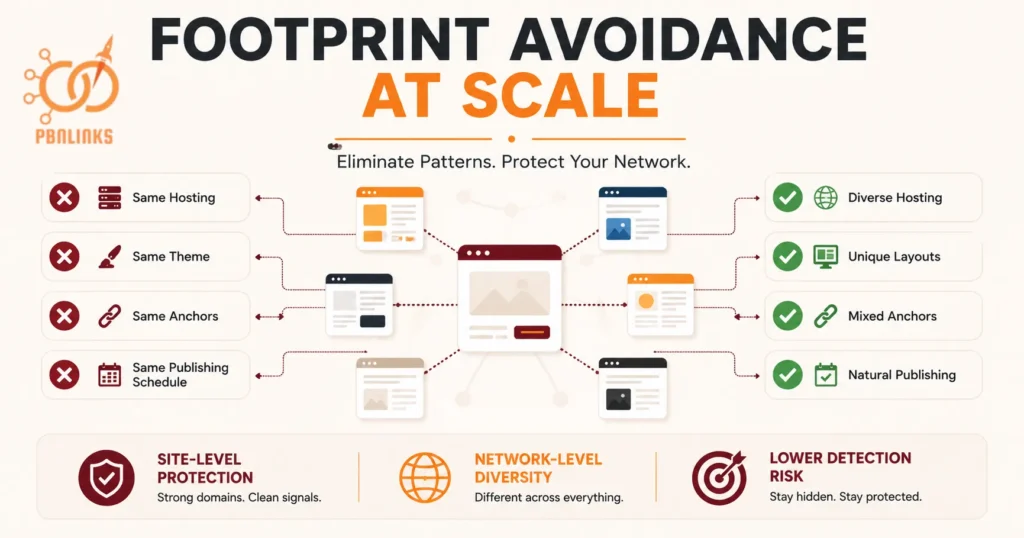
Footprint avoidance at scale means eliminating patterns across your network that reveal multiple domains are controlled by the same operator for the same purpose.
At 10 domains one footprint mistake affects a few sites. At 100 domains the same mistake repeated becomes a network wide signal Google identifies at pattern level.
One exposed domain becomes the starting point for identifying every other domain sharing the same pattern. That is why footprint avoidance becomes more critical not less critical as your network grows.
Site Level Footprint Risks
Site level footprints are detectable patterns that exist on individual domains. These are the signals Google evaluates when reviewing a single site.
The most common site level footprint risks at scale:
- Identical site structure — vary themes, layouts, and plugin configurations across every domain
- Identical content format — vary post length, heading structure, and content format across the network
- Identical registration details — use multiple registrars and enable WHOIS privacy on every domain
- Identical publishing patterns — vary publishing schedules so no two domains follow
- the same frequency
- Identical outbound link behaviour — vary anchor text, link position, and target pages across every postNetwork Level Footprint Risks
Network level footprints only become visible when Google looks across multiple domains simultaneously. These are the most dangerous because they are invisible at small scale.
The most critical network level footprint risks:
- Anchor text concentration — keep exact match anchor usage below 10 percent across the full network. Our anchor text optimization guide covers how to audit and correct anchor distribution across a large network
- Hosting clusters — multiple domains sharing the same hosting provider or IP range. One identified domain can expose every other domain on the same server cluster
- Outbound link patterns — majority of domains linking to the same small set of money sites creates a visible link graph pattern. Include authority site links on every post to break it
- Registration timing clusters — multiple domains registered in the same short window through the same registrar signals bulk acquisition. Spread registrations across different time periods and registrars
Link Velocity Management at Scale
Link velocity management at scale means controlling the rate at which links are placed across your network to avoid suspicious patterns that trigger Google spam detection.
At 10 domains managing velocity is straightforward. At 100 domains the number of available placements increases significantly. Without a controlled plan it is easy to over-link money sites and create unnatural growth patterns.
How to Calculate Safe Link Velocity
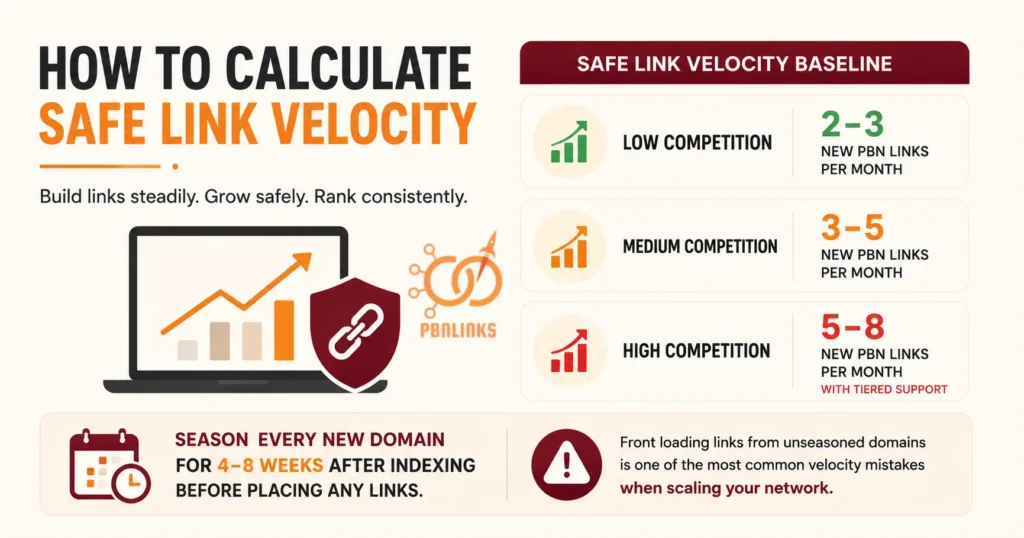
A confirmed safe baseline by competition level:
- Low competition — 2 to 3 new PBN links per month per money site
- Medium competition — 3 to 5 new PBN links per month per money site
- High competition — 5 to 8 new PBN links per month with tiered support
Season each new domain for 4 to 8 weeks after indexing before placing any links. Front loading links from unseasoned domains is one of the most common velocity mistakes when scaling.
Link Velocity and Multiple Money Sites
Each money site needs its own velocity plan managed independently. Follow these rules:
- One outbound money site link per domain per month — never use the same domain to link to two money sites in the same month
- Stagger deployments — do not add links to all money sites in the same week
- Track each money site separately — maintain an independent velocity tracker for each money site
- Adjust based on results — if rankings are moving well slow down. If they have plateaued assess quality before adding more links
Tools for Managing a Large PBN
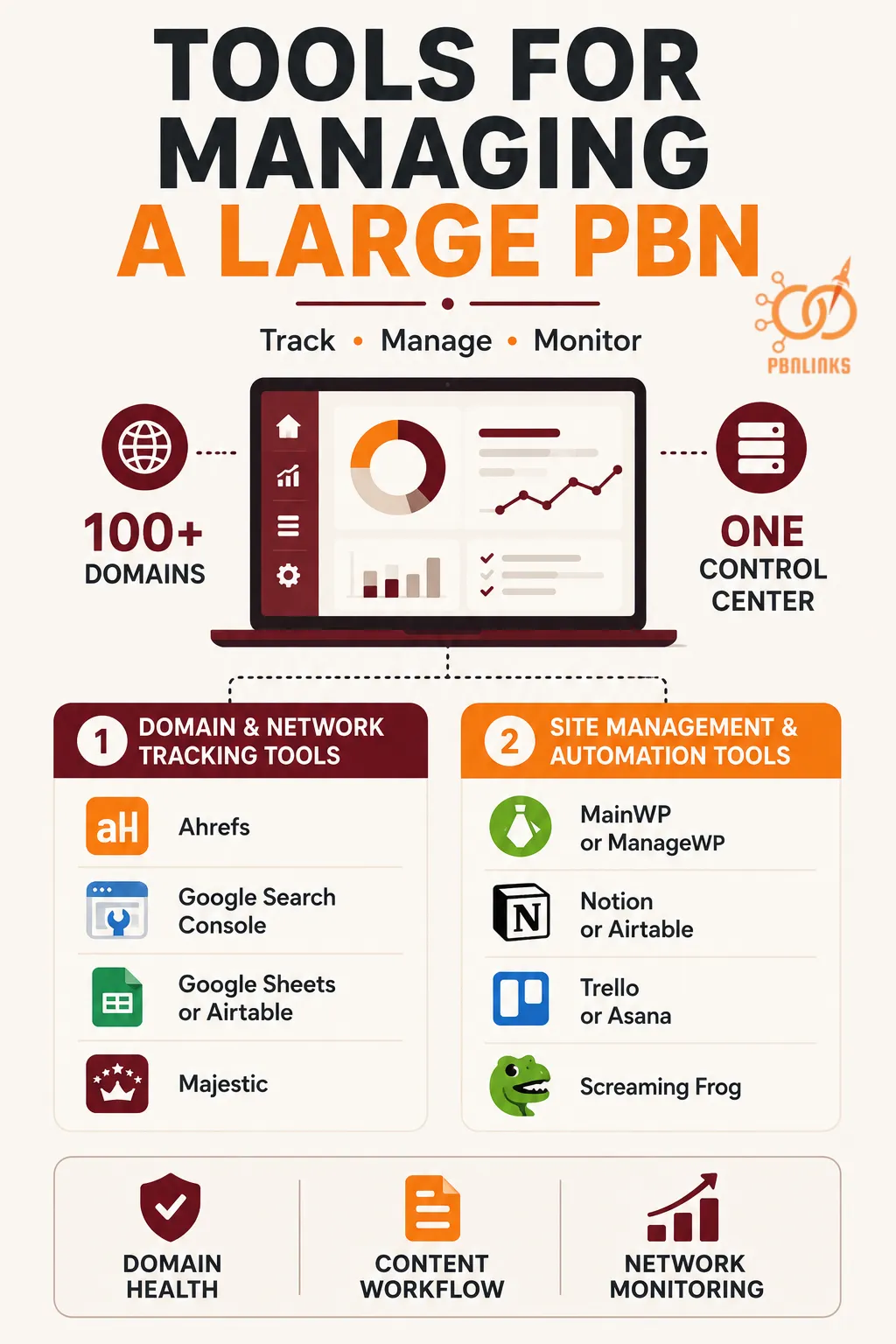
Managing a large PBN network without the right tools is the fastest way to lose track of domain health, content status, and link placements across the network.
At 10 domains a basic spreadsheet works. At 100 domains you need a dedicated tool stack covering domain tracking, site management, and network monitoring.
Domain and Network Tracking Tools
These tools help you track the health and performance of every domain in your network:
- Google Sheets or Airtable — build a domain management database tracking indexing status, hosting details, content count, links placed, anchor text used, and last audit date for every domain
- Ahrefs — monitor referring domain growth, DR changes, and backlink profile health across the network. Set up alerts for sudden changes in any domain
- Google Search Console — confirm indexing status and organic performance for every domain. Flag any manual action warnings immediately
- Majestic — track Trust Flow and Citation Flow changes across the network. Useful for identifying domains that are losing authority over time
Site Management and Automation Tools
These tools help you manage the operational side of running 100 WordPress based PBN sites:
- MainWP or ManageWP — bulk WordPress management tools that let you update plugins, themes, and core files across all domains from one dashboard. Essential for any network above 30 domains
- Notion or Airtable — build your SOP system here. Document every process in the network so team members can execute tasks consistently without supervision
- Trello or Asana — manage content production workflows. Track briefs, drafts, edits, and publishing status for every post across the network
- Screaming Frog — crawl individual PBN sites during audits to identify broken links, thin content pages, and indexing issues
How to Audit Your PBN Network
A PBN network audit is a systematic review of every domain in the network to confirm indexing status, hosting diversity, content quality, anchor text distribution, and link health are all within acceptable standards.
Auditing frequency increases at each scaling phase. Phase 1 networks need a full audit every 6 months. Phase 2 every 3 to 4 months. Phase 3 networks need a full audit every 90 days.
What to Check in a Network Audit
Follow these steps in order for every network audit:
Step 1 — Check Indexing Status
Confirm every active domain and every post containing a money site link is indexed. Use the site: operator or Google Search Console for each domain. Flag any unindexed pages for immediate action.
Step 2 — Review Hosting Distribution
Verify no hosting provider holds more than 10 percent of total network domains. Check for any IP clustering that has developed since the last audit. Redistribute domains if any clustering is found.
Step 3 — Assess Content Freshness
Confirm every domain has published new content within the required publishing window. Flag dormant domains immediately. A domain that has not published in 60 days or more needs a content update before the next audit.
Step 4 — Audit Anchor Text Distribution
Pull the full network anchor profile in Ahrefs. Confirm exact match anchor usage is below 10 percent across the entire network. Adjust the placement strategy for any money site showing over-optimisation signals.
Step 5 — Check Outbound Link Health
Confirm all money site links are still live and pointing to the correct pages. Replace any broken or redirected links immediately. A broken money site link is a wasted placement.
Step 6 — Review Domain Metrics
Check DR and TF for every domain in Ahrefs and Majestic. Flag any domain showing a significant metric drop for further investigation before the next link is placed from that domain.
When to Retire a PBN Domain
Retire a domain when:
- It has been deindexed and failed to recover after two indexing attempts
- DR or TF has dropped significantly with no recoverable cause
- A manual penalty has been confirmed in Google Search Console
- The domain has been identified as previously used in another PBN
- Hosting or registration details have been exposed in a public footprint investigation
When retiring a domain remove all outbound links to money sites before taking the site offline. Replace the lost link with a placement on a stronger domain in the network.
Conclusion
In conclusion scaling a PBN from 10 to 100 domains comes down to one principle. Build systems first. Scale into them second.
Quality standards must hold at every phase. Hosting must be diversified as the network grows. Content must be produced from a standardised brief not personal attention. Footprints must be managed more carefully at 100 domains than at 10. And every domain added must meet the same vetting thresholds as the first one you ever bought.
A smaller network of high quality domains will always outperform a larger network of weak ones. Scale for strength not just size.
If you are ready to expand your PBN with properly vetted high quality domains explore our packages at PBN Links Agency and build a network that grows in authority not just in number.
FAQs About Scaling PBN Network
When should I start scaling my PBN?
Start scaling when your existing domains are indexed, active, and producing measurable ranking movement. Adding more domains before the foundation is proven will multiply problems not results.
How many domains do I need in a PBN to see results?
5 to 10 high quality domains consistently outperform networks of 30 to 50 low quality sites. Quality matters more than quantity at every stage of network growth.
What is the right pace for adding new domains to a PBN?
Add 2 to 3 domains per month in Phase 1, 3 to 5 in Phase 2, and 4 to 6 in Phase 3. Never exceed the pace your vetting process can handle without cutting corners on quality.
Is a bigger PBN always better than a smaller one?
No. 10 quality domains consistently outperform 50 low quality ones. A larger network only outperforms a smaller one when every domain added meets the same quality thresholds as the existing network.
What is the biggest mistake when scaling a PBN?
Sacrificing domain quality for acquisition speed is the biggest mistake. Every weak domain dilutes network authority, increases management overhead, and creates additional footprint risk. Quality thresholds must remain non-negotiable at every phase.
Can Google detect a large PBN network?
Yes. Large networks are more detectable than small ones because patterns invisible at 10 domains become clear at 100. Shared hosting clusters, consistent anchor profiles, and identical site structures all become visible as the network grows.
What happens if I scale my PBN too fast?
Scaling too fast leads to weak domains entering the network, footprint patterns accumulating undetected, and content quality dropping. Each problem compounds the others and becomes significantly harder to fix at scale than at the point of entry.
How do I avoid footprint detection when scaling a PBN?
Vary site structures, themes, hosting providers, registrars, and publishing schedules across every domain. Keep exact match anchor usage below 10 percent and ensure no single hosting provider holds more than 10 percent of your total domains.
Is AI generated content safe to use across a PBN network at scale?
AI content is acceptable as a draft starting point but not as a finished product. Pure unedited AI content published across a large network is one of the strongest footprint signals in 2026. Always edit and personalise before publishing.
How often should I audit a large PBN network?
Audit every 6 months for Phase 1 networks, every 3 to 4 months for Phase 2, and every 90 days for Phase 3 networks. More frequent auditing prevents small problems from compounding across the network.
When should I retire a domain from my PBN?
Retire a domain when it has been deindexed and failed to recover after two attempts or when a manual penalty has been confirmed. Never keep a liability in your network hoping it will recover on its own.
How do I track the ROI of individual domains in a large PBN?
Record which money site pages each domain links to and track ranking movement at 30, 60, and 90 day intervals. Domains with no measurable impact after 90 days need reviewing before further investment.