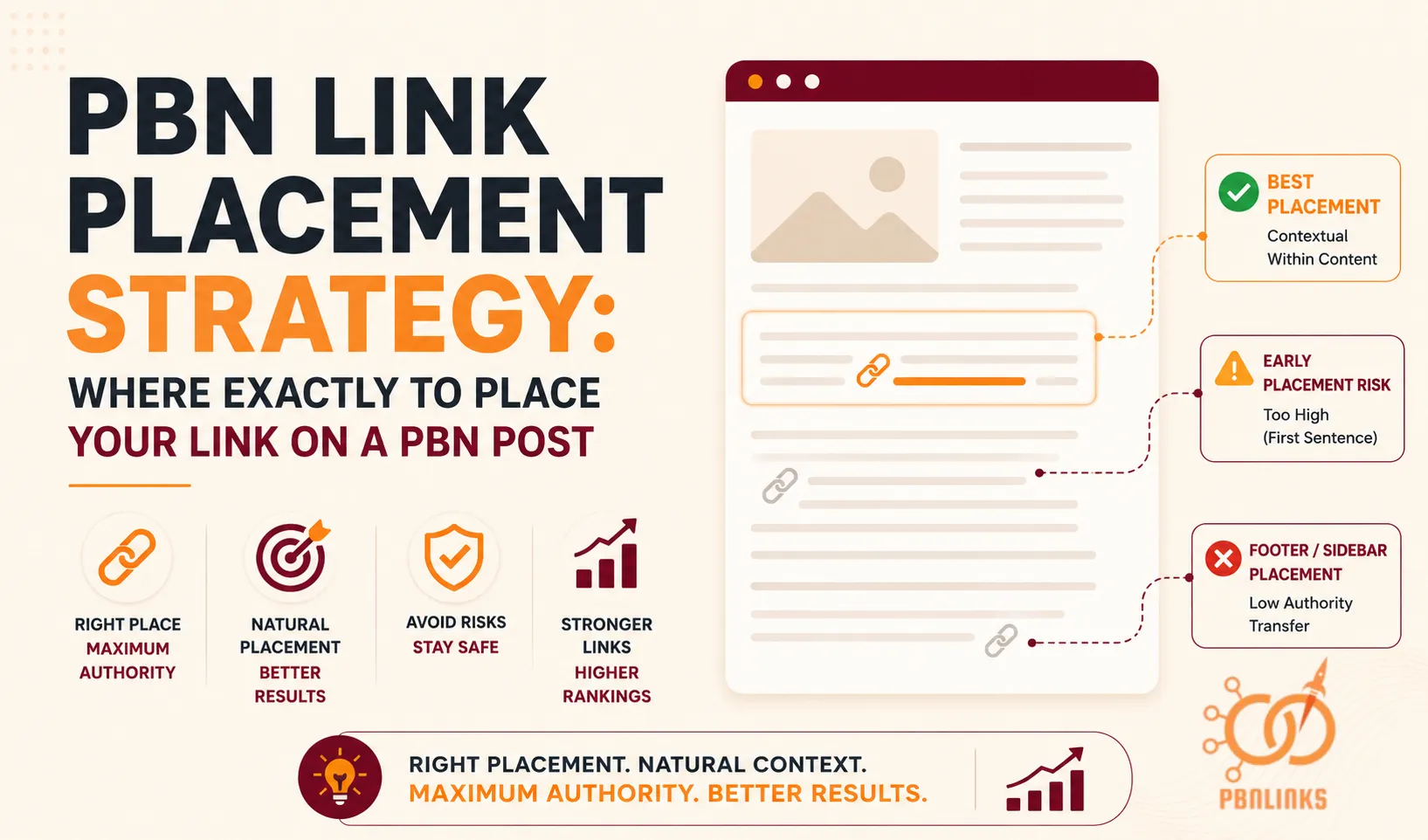
PBN Link Placement Strategy: Where Exactly to Place Your Link on a PBN Post
Most PBN link builders focus on domain metrics, anchor text, and content quality. Few stop to think carefully about where exactly the link sits inside the post. That oversight costs them authority they are paying for.
Link position is the most overlooked part of any PBN link placement strategy. A link buried in a footer passes less value than one placed contextually inside a relevant paragraph. A link in the first sentence reads as manipulative to Google. Getting placement right is the difference between a link that works and one that quietly underperforms.
This guide covers exactly where to place your PBN links for maximum authority transfer. The positions to use, the positions to avoid, how to write content around your link naturally, and how to vary placement across your network.
What Is PBN Link Placement and Why It Matters
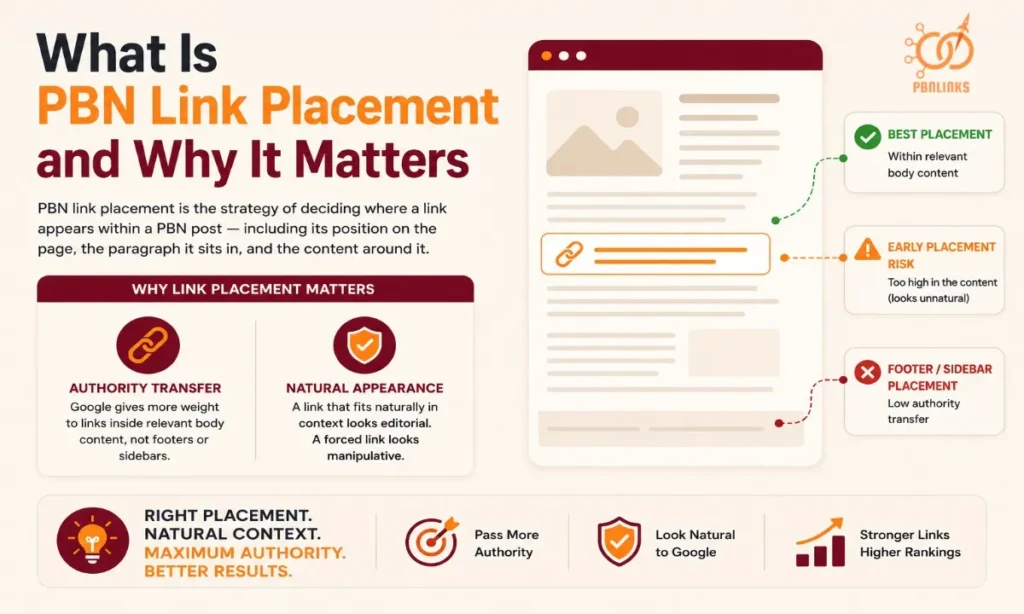
PBN link placement is the strategy of deciding where a link appears within a PBN post. This includes its position on the page, which paragraph it sits in, and what content surrounds it.
Where a link is placed affects how much authority it passes. It also affects how natural the placement looks to Google. Poor placement is one of the most common reasons PBN links underperform despite strong domain metrics.
Link placement matters for two specific reasons:
- Authority transfer — Google assigns more weight to links inside relevant body content than to links in footers or sidebars with no topical context
- Natural appearance — a link placed where a reader would genuinely expect a reference looks editorial. A link inserted purely for SEO looks exactly like what it is
In 2026 Google evaluates more than the link itself. It looks at the position on the page. It looks at the relevance of the surrounding content. It also looks at whether placement patterns are consistent across a network.
Getting placement right does not require a complex system. It requires a clear set of rules applied consistently. The rest of this guide gives you exactly that.
Where Not to Place Your PBN Link
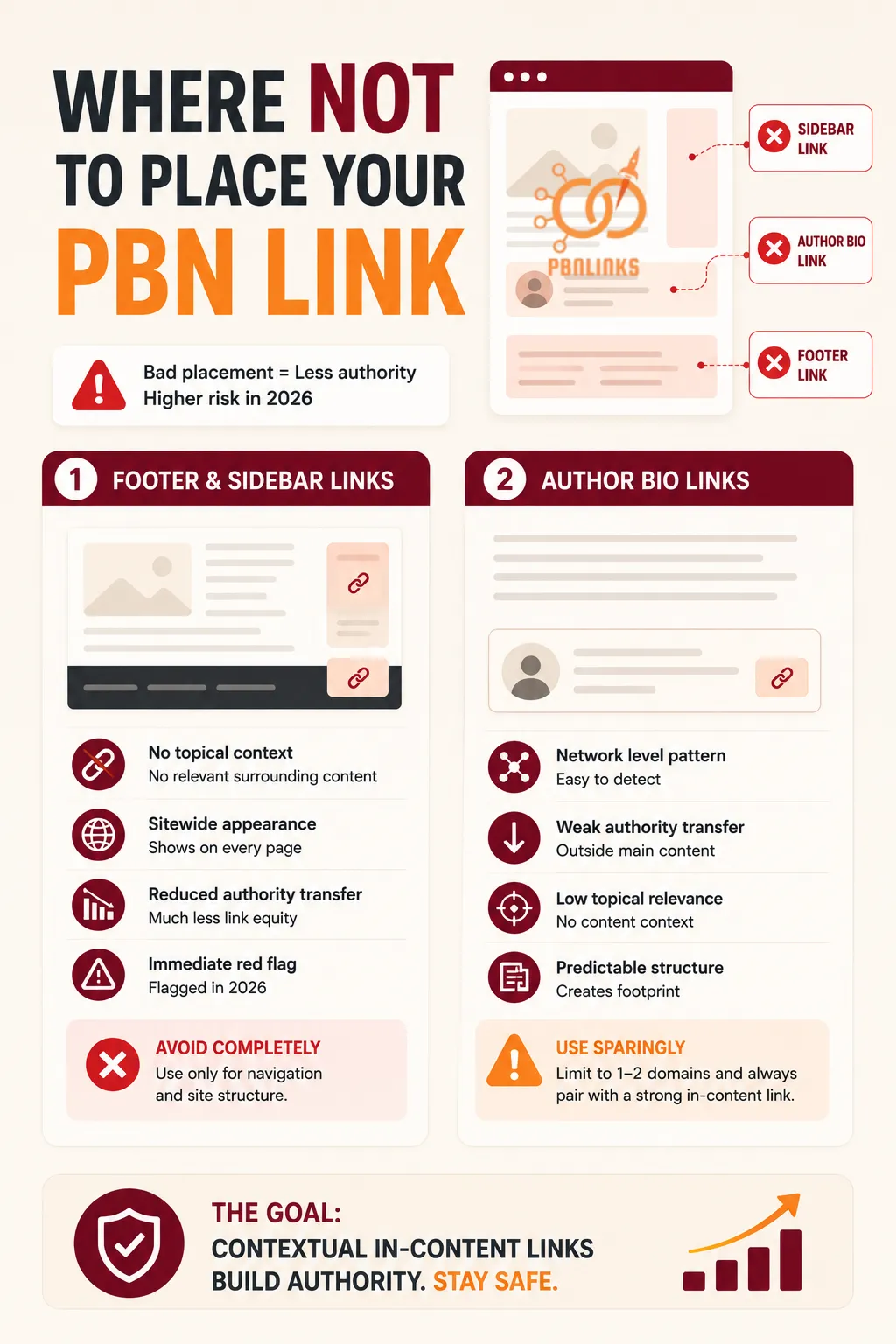
The position of a link on a page determines how much authority it passes and how natural it appears to Google. Footer links, sidebar links, and author bio links are the three placements that consistently underperform and increase detection risk in 2026.
Footer and Sidebar Links
Footer and sidebar links are the clearest red flags in PBN link placement. They sit outside the main content area and carry no topical context around them.
Here is why these placements hurt your campaign:
- No topical context — footer and sidebar links sit in isolation with no relevant surrounding content to strengthen the relevance signal
- Sitewide appearance — these links appear on every page of the domain which multiplies the footprint signal across the entire site
- Reduced authority transfer — a footer link on a high DR domain passes considerably less link equity than a contextual in-content link on the same domain
- Immediate red flag — confirmed by multiple sources that links in footers and sidebars are flagged for both algorithmic and manual review in 2026
Real editorial websites rarely place meaningful outbound links in footers or sidebars. When Google sees money site links consistently appearing in these positions across multiple domains it becomes one of the most reliable PBN detection signals available.
Never use footer or sidebar positions for money site placements. Reserve them for navigational links and standard site structure elements only.
Author Bio Links
Author bio links sit in a grey area of PBN link placement. On real websites authors genuinely link to their own sites from bio sections which makes them look legitimate on the surface.
The risks of overusing author bio links include:
- Network level pattern — if every post across your network uses an author bio link to the same money site the pattern alone is enough to flag the network
- Weak authority transfer — bio links sit outside the main content area and pass less link equity than contextual placements
- Low topical relevance — the bio section has no content context connecting the link to your money site topic
- Predictable structure — using the same bio format across multiple PBN domains creates a detectable footprint
Author bio links are acceptable occasionally as part of a varied placement strategy. They should never be the default. If you use them at all limit them to one or two domains in the network and always pair them with a strong in-content contextual placement on the same domain.
Where Exactly to Place Your Link in a PBN Post
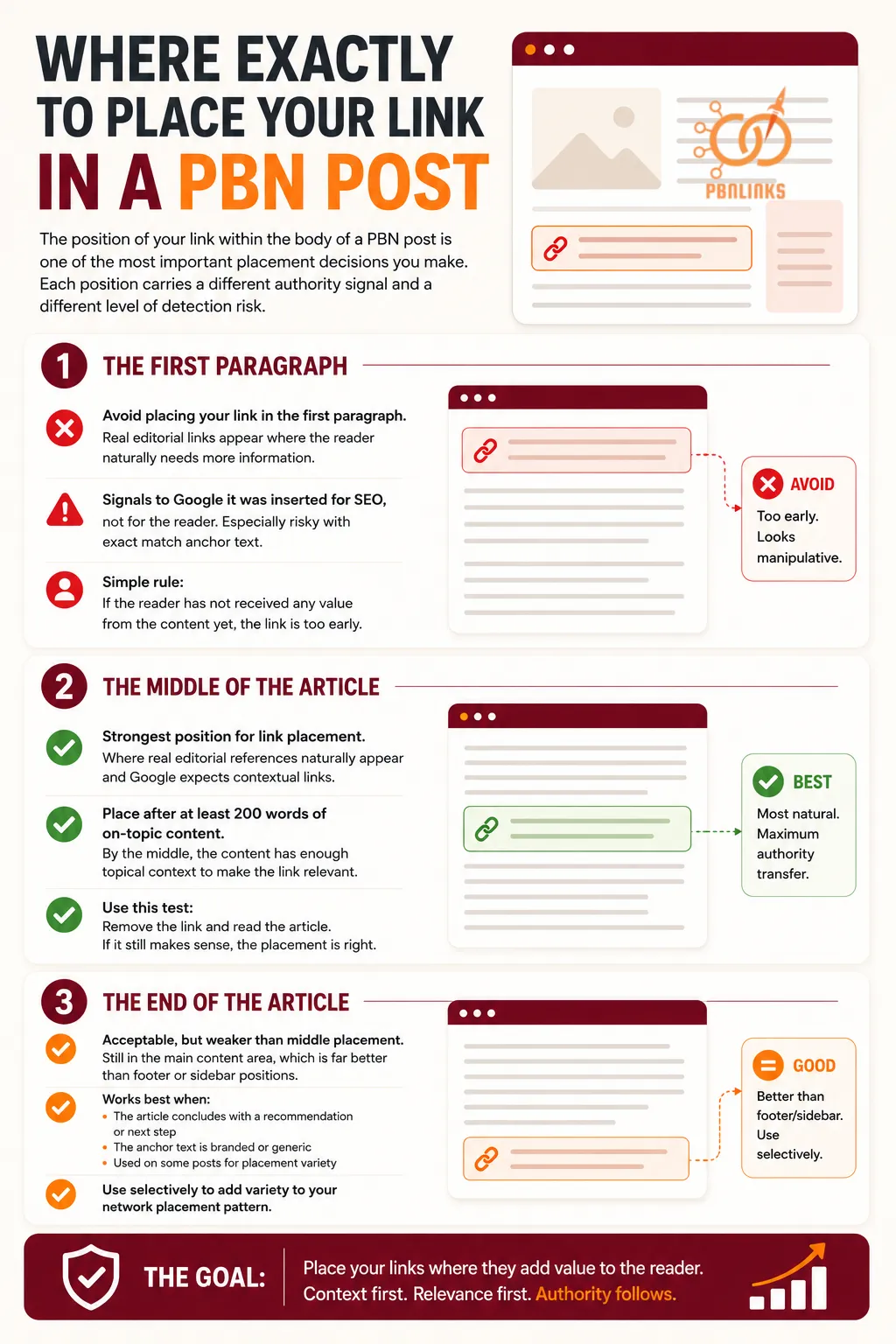
The position of your link within the body of a PBN post is one of the most important placement decisions you make. Each position carries a different authority signal and a different level of detection risk.
The First Paragraph
Avoid placing your PBN link in the first paragraph. In real editorial writing outbound links appear where the reader naturally needs more information. That moment almost never happens in the opening sentences.
First paragraph placement signals to Google the link was inserted for SEO purposes not for the reader. When combined with exact match anchor text it becomes one of the clearest over-optimisation signals in PBN link building.
A simple rule — if the reader has not received any value from the content yet the link is too early.
The Middle of the Article
The middle of the article is the strongest position for PBN link placement. It is where real editorial references naturally appear and where Google expects contextual outbound links to sit.
By the middle of the post the content has established enough topical context to make the link feel relevant and earned. Place your link after at least 200 words of on-topic content.
Use this test — remove the link and read the article. If the content still makes complete sense without it the placement is right. If the article feels hollow without the link it is too prominent.
The End of the Article
End placement is acceptable but weaker than middle placement. Links at the end still sit in the main content area which is far better than footer or sidebar positions.
End placement works best when:
- The article naturally concludes with a recommendation or next step
- The anchor text is branded or generic rather than exact match
- It is used on some posts while middle placement is used on others
Use end placement selectively to add variety to your network placement pattern.
How to Write the Paragraph Around Your PBN Link
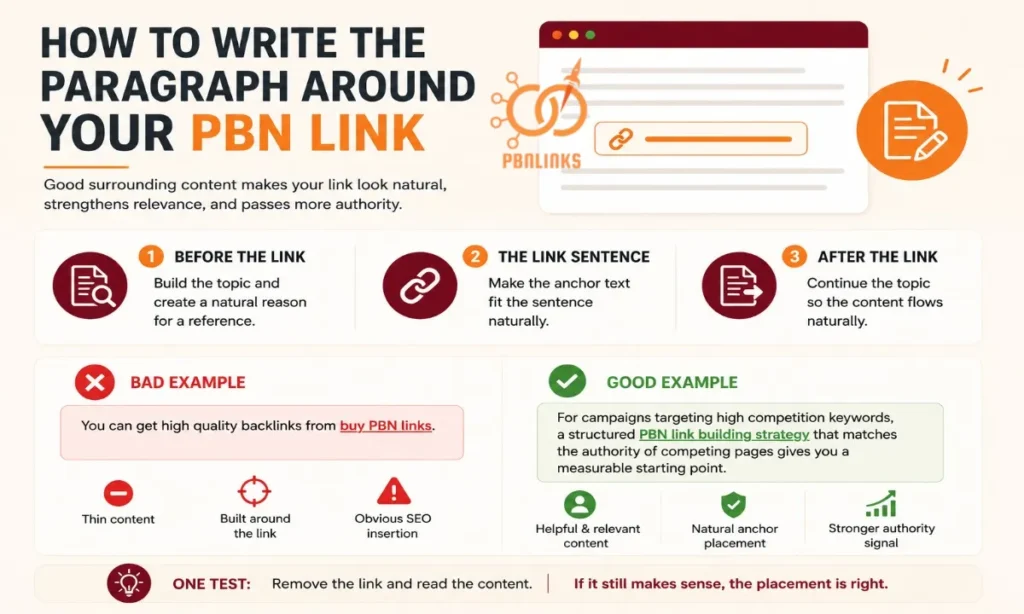
The content surrounding a PBN link determines whether it reads as a natural editorial reference or an obvious SEO insertion. Good surrounding content strengthens the relevance signal. Poor surrounding content wastes the authority the domain is passing.
How to Write Around Your Link Naturally
Writing naturally around a PBN link means the content should make complete sense with or without the link present. Structure the surrounding content in three parts:
- Before the link — establish the topic and create a natural reason for a reference. The reader should feel they are about to need more information before the link appears
- The sentence with the link — the anchor text must fit the sentence naturally. If the sentence feels like it was built around the anchor rewrite it
- After the link — continue the topic. Content that drops off immediately after the link signals it was written for SEO not for the reader
One test covers all three. Remove the link and read the content. If it still flows and delivers value the placement is correct. If it feels incomplete without the link the content needs rewriting.
Before and After Examples
The difference between bad and good PBN link placement comes down to one question — does the content serve the reader or the link?
Bad example:
“There are many ways to improve your website rankings. One of the best ways is to use strong backlinks. You can get high quality backlinks from buy PBN links. This will help your site rank better in Google.”
What is wrong — thin content with no depth, the link is the only purpose of the paragraph, and the sentence is built around the anchor not the topic.
Good example:
“Building authority in competitive niches requires more than on-page optimisation. Domains with strong backlink profiles consistently outperform those relying on content alone. For campaigns targeting high competition keywords a structured PBN link building strategy that matches the authority of competing pages gives you a measurable starting point.”
What is right — the topic is established before the link appears, the anchor fits the sentence naturally, and the content delivers value with or without the link present.
How Many Links Per PBN Post Is Safe
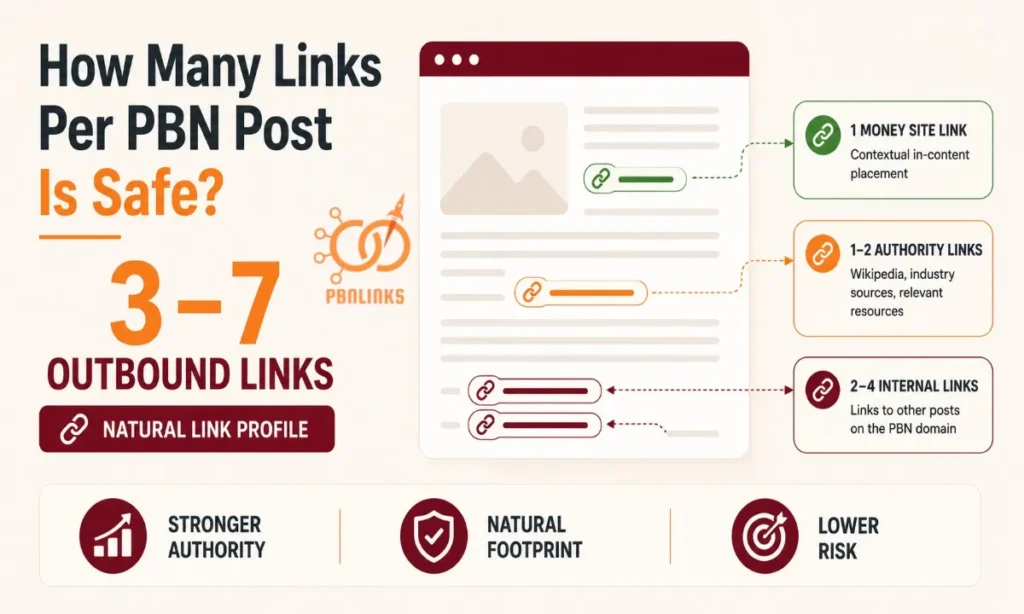
A PBN post should have 3 to 7 total outbound links. This range looks natural to Google. It also ensures your money site link receives the strongest possible share of link equity from the page.
Every outbound link on a page shares the available link equity. The fewer outbound links on the page the more authority passes through each one. Keeping outbound link count within the safe range is not just a safety measure. It protects the value of the money site link you are paying for.
Here is how to distribute those links across the post:
- 1 link to your money site — contextual in-content placement in the middle of the article
- 1 to 2 links to authority sources — Wikipedia, industry publications, or niche relevant resources that make the page look like genuine editorial content
- 2 to 4 internal links — linking to other posts on the PBN domain. Real websites link internally more than externally
Can I place two links to the same money site in one PBN post?
No. Two links to the same destination from one post is a clear manipulation signal. If you need to build authority to multiple pages on your money site use separate posts on separate PBN domains for each target page.
Anchor Text Strategy for PBN Link Placement
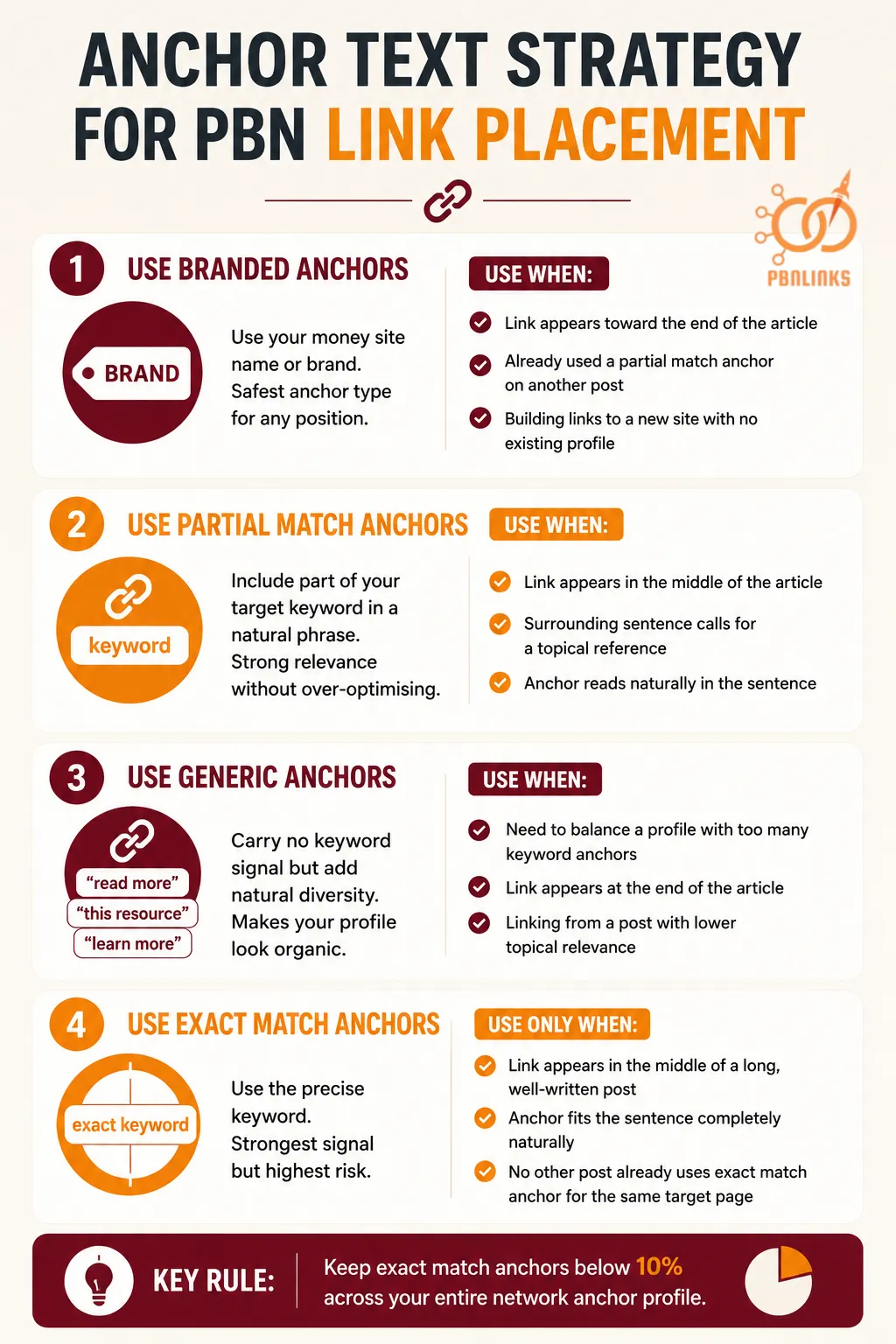
Anchor text strategy for PBN link placement is the process of selecting the right anchor type for each link based on position, context, and network level diversity. Using the wrong anchor in the wrong position is one of the fastest ways to trigger an over-optimisation flag in 2026.
Choosing the Right Anchor Text for Each Position
Strategy 1 — Use Branded Anchors for Safety and Diversity
Branded anchors use your money site name or brand as the clickable text. They are the safest anchor type for any position in a PBN post and should make up the largest share of your anchor profile across the network.
Use branded anchors when:
- The link appears toward the end of the article
- You have already used a partial match anchor on another post linking to the same page
- You are building links to a new site with no existing backlink profile
Strategy 2 — Use Partial Match Anchors for Authority Transfer
Partial match anchors include part of your target keyword naturally inside a longer phrase. They pass strong topical relevance signals without triggering the over-optimisation flags that exact match anchors create.
Use partial match anchors when:
- The link appears in the middle of the article
- The surrounding sentence naturally calls for a topical reference
- The anchor reads as a normal part of the sentence without the link
Strategy 3 — Use Generic Anchors for Natural Diversity
Generic anchors like “read more”, “this resource”, or “learn more” carry no keyword signal but add natural diversity to your anchor profile. Real editorial websites use generic anchors frequently — their presence makes your backlink profile look organic.
Use generic anchors when:
- You need to balance out a profile with too many keyword anchors
- The link appears at the end of the article as a closing reference
- You are linking from a post where topical relevance is lower
Strategy 4 — Use Exact Match Anchors Sparingly
Exact match anchors use the precise keyword you want to rank for as the clickable text. They pass the strongest direct ranking signal but carry the highest over-optimisation risk. Keep exact match usage below 10 percent across your entire network anchor profile.
Use exact match anchors only when:
- The link appears in the middle of a long well written post
- The anchor fits the sentence completely naturally
- No other post in your network already uses an exact match anchor for the same target page
For a complete breakdown of how to distribute these anchor types across your full campaign visit our anchor text optimization guide.
How to Write Natural Anchor Text in Context
Natural anchor text fits the sentence without the sentence feeling constructed around it.
Test for natural anchor text:
Remove the link and read the sentence aloud. If it sounds like something a real writer would write for a real reader the anchor is natural. If a keyword feels forced into the sentence rewrite it before placing the link.
Forced vs natural anchor text:
Forced: “If you want to rank higher you should buy PBN links today.”
Natural: “Sites competing in high authority niches typically require targeted PBN links to close the gap on established competitors.”
Three rules for every PBN post:
- Anchor text should describe what the reader finds at the destination not what you want to rank for
- The surrounding sentence should make sense if the anchor is replaced with a generic phrase
- No two posts linking to the same page should use identical anchor text across your network
How to Vary Link Placement Across Your PBN Network
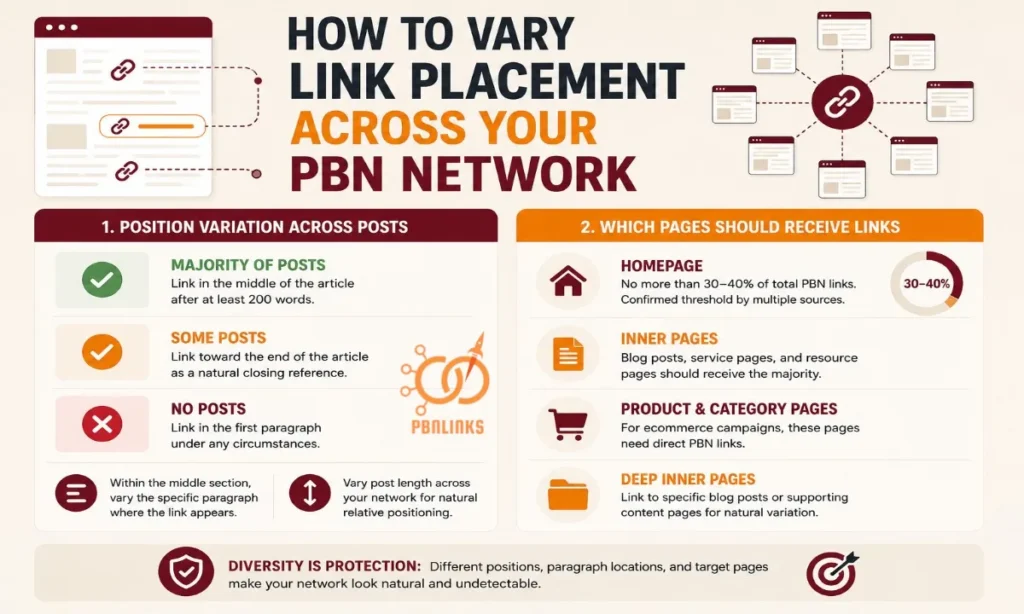
Varying link placement across a PBN network means using different link positions, paragraph locations, and money site target pages across every post you publish. Using the same placement pattern on every post creates a detectable footprint that Google identifies at network level not just page level.
Position Variation Across Posts
Varying link position across your network means no two consecutive posts should have the link sitting in the exact same paragraph position. Here is a practical distribution guide to follow:
- Majority of posts — link placed in the middle of the article after at least 200 words of content
- Some posts — link placed toward the end of the article as a natural closing reference
- No posts — link placed in the first paragraph under any circumstances
Within the middle section vary which specific paragraph the link appears in. A link in paragraph three of one post and paragraph five of another post on the same domain creates natural variation that is impossible to detect as a pattern.
Also vary the post length across your network. A link appearing at the 300 word mark in a 600 word post and at the 500 word mark in a 1000 word post occupies different relative positions even if both are technically in the middle of their respective articles.
Which Pages on Your Money Site Should Receive Links
Linking every PBN post to your money site homepage is one of the most recognised PBN patterns Google looks for. Real websites receive links to all kinds of pages — blog posts, product pages, category pages, and occasionally the homepage.
Here is how to distribute PBN links across your money site:
- Homepage — no more than 30 to 40 percent of total PBN links. Confirmed threshold by multiple practitioner sources
- Inner pages — blog posts, service pages, and resource pages should receive the majority of your PBN links
- Product and category pages — for ecommerce campaigns these pages need direct PBN links since they rarely earn links naturally
- Deep inner pages — occasionally linking to specific blog posts or supporting content pages adds natural variation that makes the overall link profile harder to identify as a network
The Complete PBN Link Placement Checklist
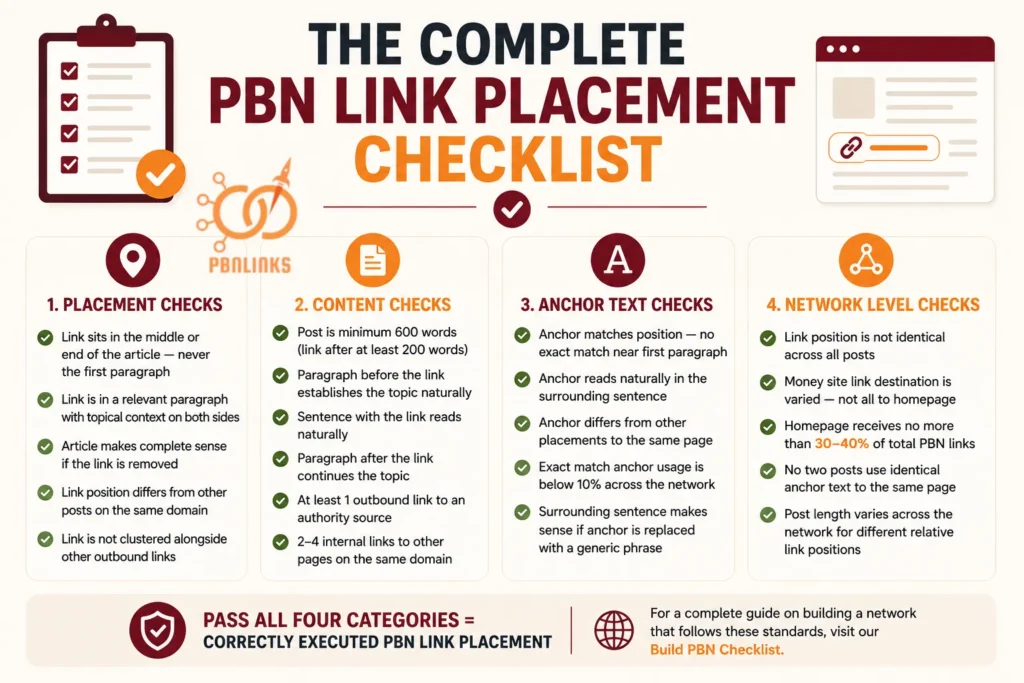
A PBN link placement checklist is a set of checks that confirm every link is positioned correctly, surrounded by natural content, using the right anchor text, and varied correctly across the network before it goes live.
What should I check before placing a PBN link?
Run every placement through all four categories below. A link that passes every check is ready to go live. A link that fails any check needs adjusting first.
Placement Checks
- Link sits in the middle or end of the article — never the first paragraph
- Link is inside a relevant paragraph with topical context on both sides
- The article makes complete sense if the link is removed
- Link position differs from other posts on the same PBN domain
- Link is not clustered alongside other outbound links in the same paragraph
Content Checks
- Post is minimum 600 words with the link appearing after at least 200 words
- The paragraph before the link establishes the topic naturally
- The sentence containing the link reads naturally without feeling constructed around the anchor
- The paragraph after the link continues the topic — does not drop off after the link appears
- Post includes at least one outbound link to an authority source
- Post includes 2 to 4 internal links to other pages on the same PBN domain
Anchor Text Checks
- Anchor text matches the link position — no exact match anchor near the first paragraph
- Anchor text reads naturally in the surrounding sentence
- Anchor text differs from other placements on the same domain pointing to the same page
- Exact match anchor usage is below 10 percent across the full network
- The surrounding sentence makes sense if the anchor is replaced with a generic phrase
Network Level Checks
- Link position is not identical across all posts in the network
- Money site link destination is varied — not all links pointing to the homepage
- Homepage receives no more than 30 to 40 percent of total PBN links
- No two posts use identical anchor text pointing to the same money site page
- Post length varies across the network so links occupy different relative positions
A placement that passes all four categories is correctly executed. For a complete guide on building a network that follows these standards from the ground up visit our build PBN checklist.
Conclusion
In conclusion, where you place your PBN link matters as much as the quality of the domain carrying it. A strong domain with poor placement wastes authority. A well placed link on the same domain extracts every bit of value that domain has to offer.
The rules are straightforward. Place links contextually in the middle of well written posts. Avoid footers, sidebars, and first paragraphs. Match your anchor text to your link position. Vary placement across your network so no pattern becomes detectable.
Every link you place is an investment. Getting the placement right protects that investment and makes sure the authority you are paying for actually reaches your money site.
If you want PBN links placed to this standard on every campaign explore our packages at PBN Links Agency and start building authority that actually moves rankings.
FAQs About PBN Link Placement Strategy
Where is the best place to put a link in a PBN post?
The middle of the article is the best position for a PBN link. This is where real editorial references naturally appear and where Google expects contextual outbound links after enough topical context has been established.
Should I place my PBN link in the first paragraph?
No. First paragraph placement signals to Google the link was inserted for SEO not for the reader. When combined with exact match anchor text it becomes one of the clearest over-optimisation signals in PBN link building.
How many outbound links per PBN post is safe?
3 to 7 total outbound links per post is the safe range. This includes 1 link to your money site, 1 to 2 links to authority sources, and 2 to 4 internal links to other pages on the same PBN domain.
Does link position affect how much authority a PBN link passes?
Yes. Links placed inside relevant body content pass more authority than links in footers, sidebars, or positions with no topical context. Google assigns significantly more weight to contextual in-content links than any other placement type.
Can I place two links to my money site in one PBN post?
No. Two links to the same destination from one post is a clear manipulation signal. Use separate posts on separate PBN domains for each target page on your money site.
What anchor text should I use in a PBN post?
Use branded or partial match anchors for most placements. Exact match anchor text should stay below 10 percent of your total network anchor profile and should never appear in or near the first paragraph of a post.
Can Google detect unnatural link placement in PBN posts?
Yes. Google evaluates link position, surrounding content relevance, and placement consistency across a network. Identical placement patterns, links with no topical context, and first paragraph exact match anchors are all detectable signals.
How do I make a PBN link look natural in content?
Write the paragraph before the link to establish the topic. Use anchor text that fits the sentence without the sentence feeling constructed around it. If the content makes complete sense without the link the placement is natural.
What happens if all my PBN links point to the same page on my money site?
It creates a recognisable pattern that signals network activity. Distribute your PBN links across inner pages, blog posts, product pages, and category pages with the homepage receiving no more than 30 to 40 percent of total links.
How do I vary link placement across my PBN network?
Place the majority of links in the middle of articles and some toward the end. Vary which paragraph the link appears in across different posts. Cap homepage links at 30 to 40 percent and distribute the rest across inner pages, product pages, and blog posts on your money site.