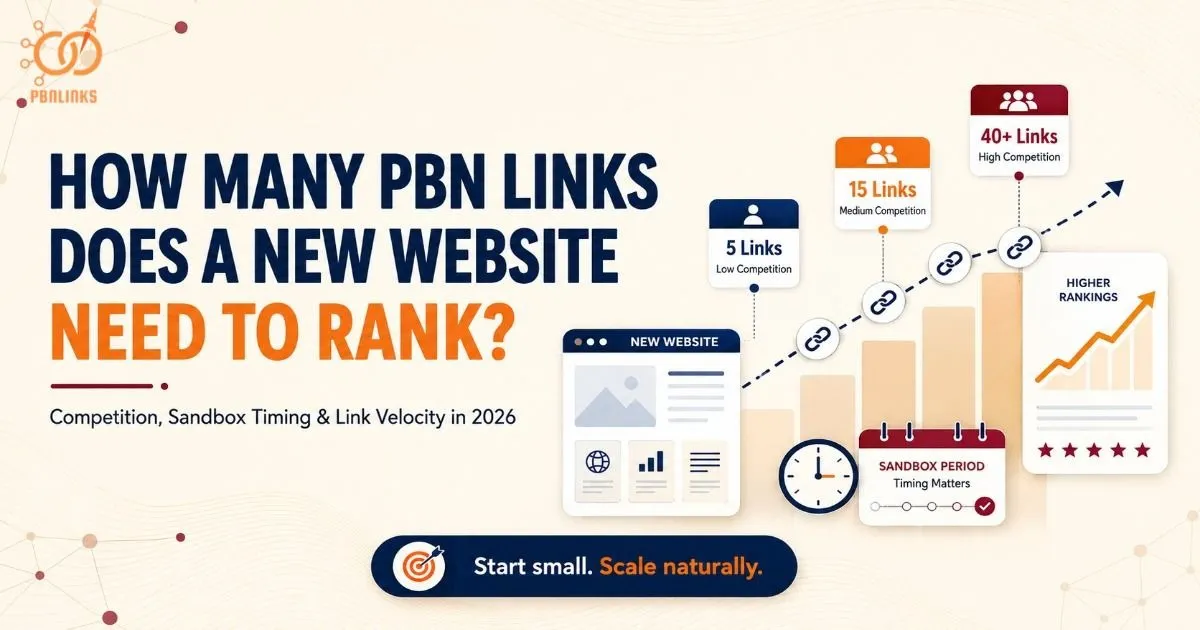
How Many PBN Links Does a New Website Need to Rank?
So your new website just launched and you are already wondering how many PBN links it needs to start ranking. That question matters more than most new site owners realize.
You already understand the appeal. PBN links pass authority faster than waiting months for organic backlinks and natural mentions to build up on their own. They also give you control over anchor text, timing, and which pages get the boost first.
But how many links does a brand new domain actually need? Five? Fifteen? Forty? The number that works for an aged site with hundreds of referring domains can be completely wrong for a domain that went live last week.
In this article you will learn exactly how many PBN links your new site needs by competition level, how the Google Sandbox period changes the timing, and what to do about PBN link velocity as your site matures in 2026 and beyond.
What Determines Your PBN Link Count
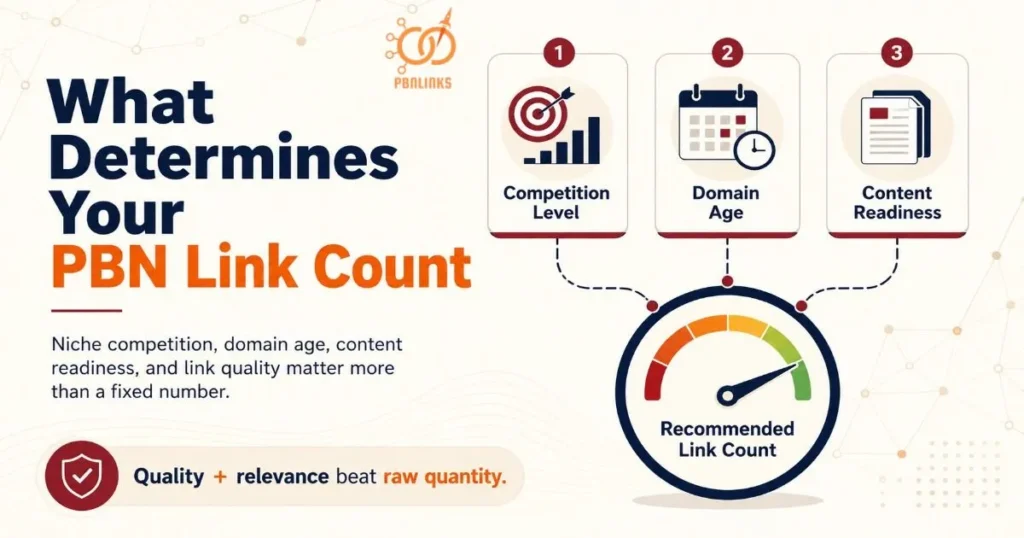
There is no universal number that works for every website. The right count depends on three things: how competitive your niche is, how old your domain is, and how much content you have already published.
Most new site owners ask the wrong question first. They want a number they can write down and chase. They want it before they understand what actually moves that number up or down.
Here is the part most advice skips entirely. Link count alone does not equal rankings. Ten PBN links from relevant, well vetted domains can outperform thirty links pulled from random unrelated sites. Referring domain quality and topical relevance carry more weight than raw count ever will.
So before you ask how many links you need, ask yourself something else first. Is your domain old enough to absorb links safely? Is your content ready to support the authority those links will pass? Once your domain metrics and content readiness are solid, the competition level question becomes much easier to answer.
Why New Sites Need a Different Link Strategy
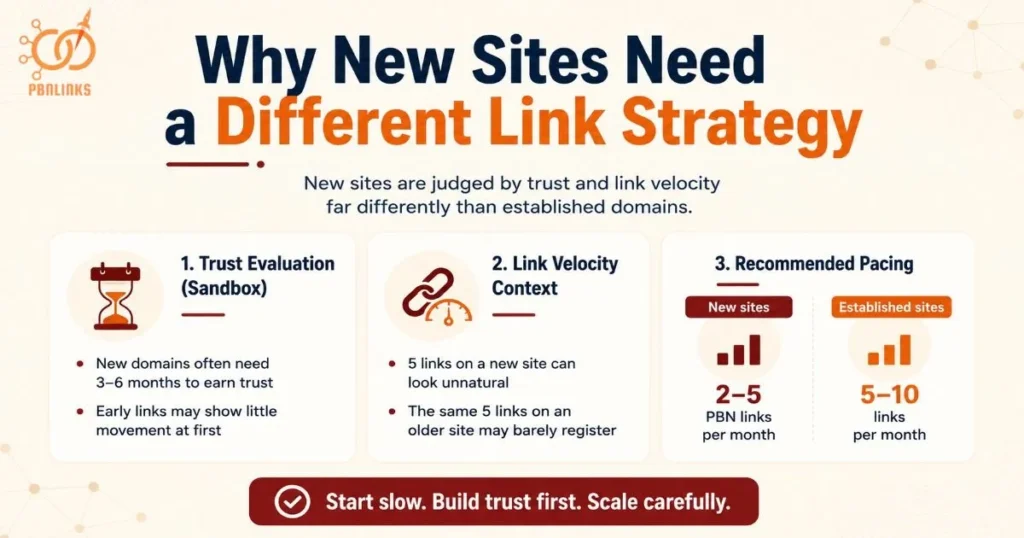
New sites need a different link strategy for two reasons. They are still inside Google’s trust evaluation period, and every link is judged against a much smaller existing profile.
The first reason is trust. A new domain has not earned any yet. Most SEOs still call this stretch of time the Google Sandbox, even though Google has never officially confirmed it exists. According to Strategic Websites’ 2026 analysis, this evaluation period typically lasts 3 to 6 months. During it new domains see suppressed rankings even with solid content and links already in place.
The practical effect is simple to see. An established site outside this period can add a link and see movement within days. A new site inside it can receive the same link and see almost nothing change for weeks. The link is not wasted. It is simply being held against a higher bar of trust.
The second reason is link velocity. Velocity is never judged in isolation. It is judged against what your site already has. Five new PBN links on a domain with three hundred existing referring domains barely register. Five new links on a domain with zero existing links change the entire backlink profile overnight.
That sudden shift is exactly the kind of pattern Google’s SpamBrain system is built to catch on small, unproven domains. Together these two factors explain why brand new sites should start conservatively. Aim for 2 to 5 PBN links per month maximum. Established domains can usually absorb 5 to 10 links monthly without standing out. Getting this pacing right is what PBN link velocity management is built around.
Is Your New Website Ready for PBN Links
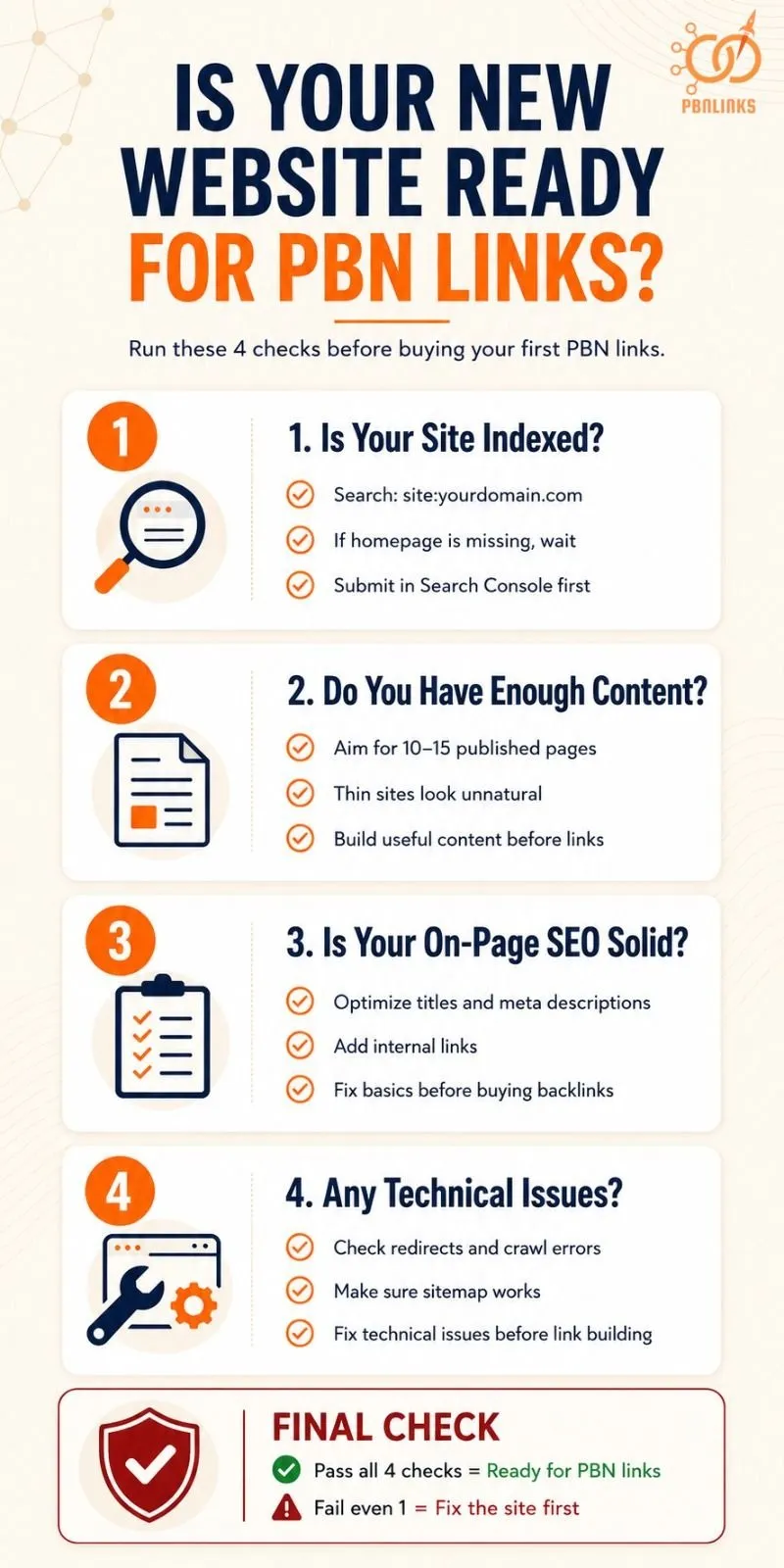
Before you spend a single dollar on links, ask yourself something honest. Is your site actually ready to receive them?
Most new site owners skip this question entirely. They get excited, find a seller, and place an order on day one. That is backwards.
Run through these four checks first.
1. Is Your Site Indexed?
Search site:yourdomain.com in Google right now. Go on, try it.
If your homepage does not show up, stop. Do not buy a single link yet. Google has not even acknowledged your site exists, so there is nothing for a backlink to boost. Submit your site through Search Console and wait.
2. Do You Have Enough Content?
How many pages does your site actually have? Be honest.
Two pages and a contact form will not cut it. Aim for at least 10 to 15 published pages before your first PBN link goes live. A site that thin looks like it exists purely to receive links, not to serve anyone.
3. Is Your On-Page SEO Solid?
Title tags. Meta descriptions. Internal links. Have you actually done this work yet?
A lot of new site owners skip straight to backlinks because links feel more exciting than fixing a meta description. But weak on-page SEO wastes the authority a link sends. Fix what is free and in your control before you pay for what is not.
4. Are There Any Technical Issues Lurking?
Run a quick crawl. Broken redirects, missing sitemaps, crawl errors, they all hide quietly until they cost you.
I have seen sites with a single broken sitemap quietly waste an entire month of link building. Do not let that be you.
Pass all four checks and you are ready. Fail even one, and every link you buy is fighting an uphill battle before it even starts.
How Many PBN Links by Competition Level
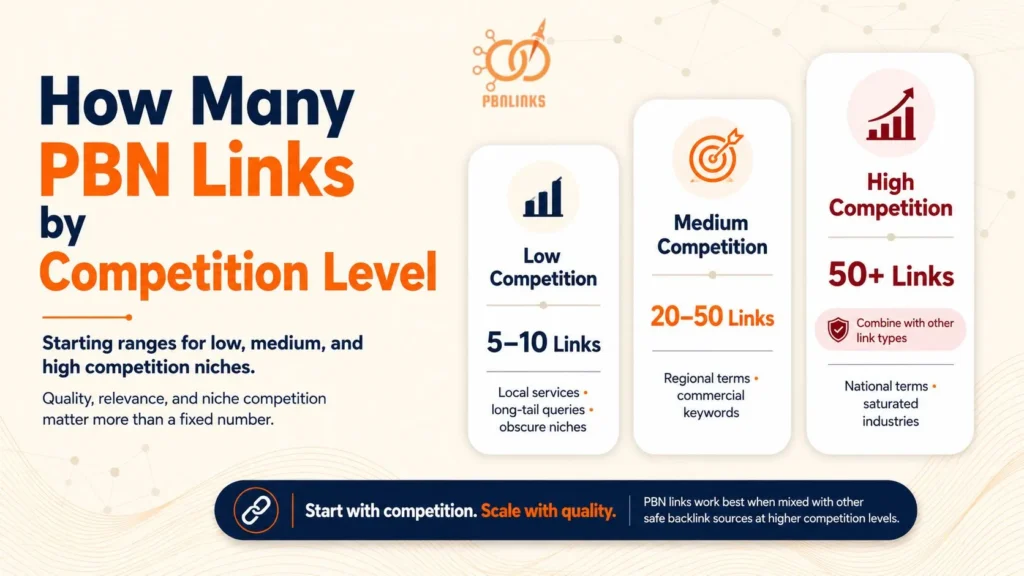
Low competition niches need 5 to 10 PBN links. Medium competition needs 20 to 50. High competition niches need 50 or more combined with other link types. Those are starting ranges, not an exact formula.
Competition level is simply the single biggest factor in the equation, and it is worth seeing why.
Think about it this way. There are roughly 1,500 dating sites and apps in the world. According to IBISWorld there are over 437,000 law firms in the United States alone. Ranking a dating site and ranking a law firm site are not the same game.
| Competition Level | PBN Links Needed | Examples |
| Low | 5 to 10 | Local services, long tail queries, obscure niches |
| Medium | 20 to 50 | Regional terms, moderately competitive commercial keywords |
| High | 50 plus, combined with other link types | National commercial terms, saturated industries |
Low Competition Niches
If your niche looks more like dating apps than law firms, you are in luck. Low competition keywords typically need just 5 to 10 PBN links to move the needle.
Local service pages, long tail queries, and obscure niches all fall here. Your on-page SEO still has to hold up its end, but the link side of the equation is light.
Medium Competition Niches
Step up to medium competition and the math changes fast. You are now looking at somewhere between 20 and 50 links depending on how saturated your specific keywords are.
This is the zone most new commercial sites actually compete in. Five links will not cut it here, but you do not need fifty from day one either.
High Competition Niches
Now for the hard part. High competition keywords can require 50 or more links, and PBN links alone usually will not get you there.
You will need to combine them with other strategies. Guest posts. Niche edits. Natural citations. A backlink profile built entirely from one source type starts to look suspicious the moment volume gets serious. Running every link through a buy PBN links checklist matters even more at this tier. One weak link in a large batch is easy to miss.
A Phased PBN Link Schedule for New Websites
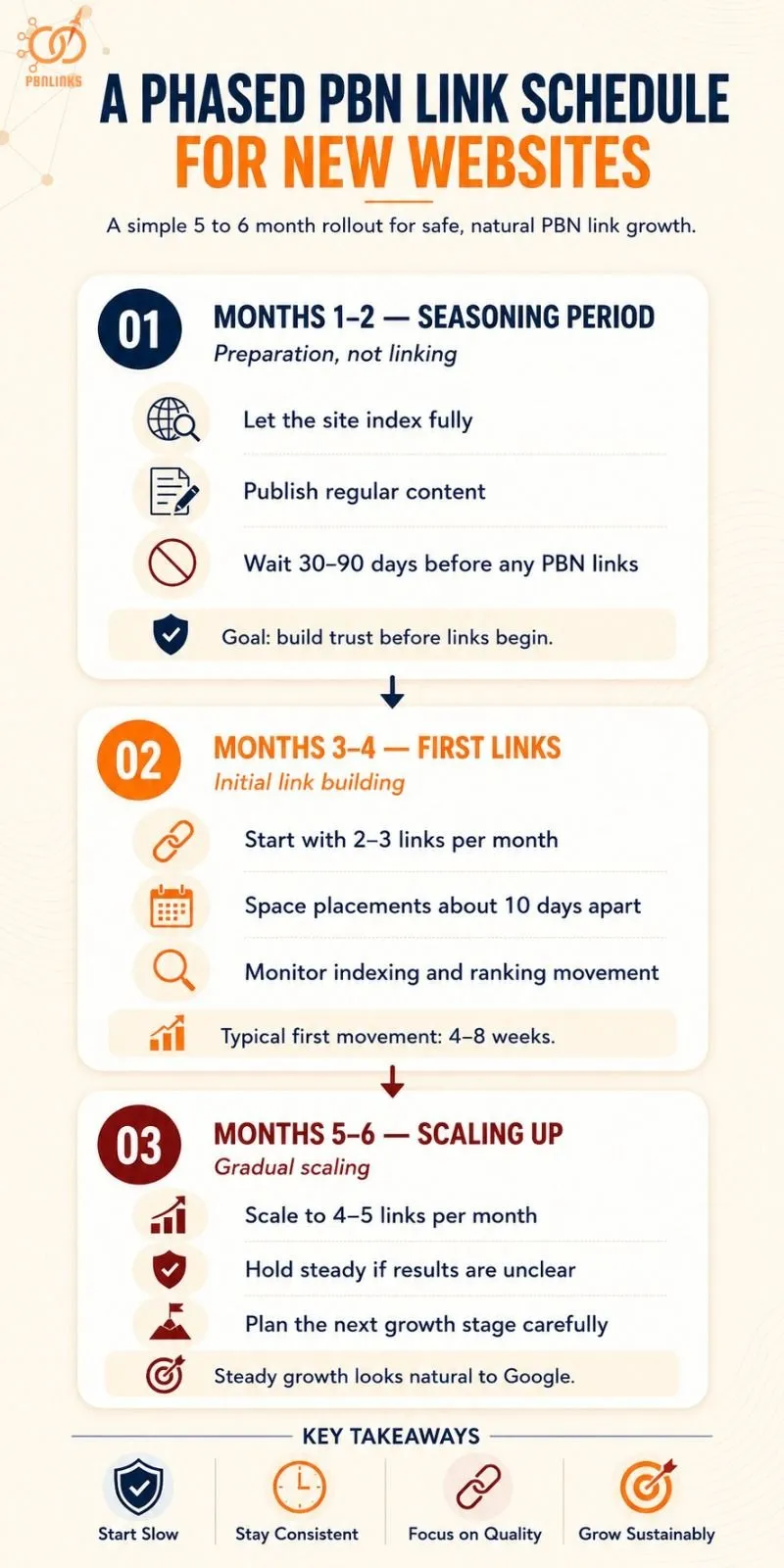
A new website should follow a five to six month phased schedule before reaching full PBN link velocity. This schedule moves from a no-link seasoning period through gradual scaling. Each new domain earns trust before it carries weight.
Months 1 to 2: Seasoning Period
The first phase focuses entirely on preparation rather than linking. No PBN links should be placed during this window.
Let the site index fully. Confirm every key page appears in Google before considering any link activity.
Publish regular content. Add new articles consistently so the site looks active and genuine, not dormant.
Avoid all money site links. According to PBN LTD, a new site should sit for at least 30 days, ideally 60 to 90. No link should be added before that window closes.
This phase will feel like nothing is happening. That is expected. Seasoning does not produce visible movement, it builds the domain trust every later phase depends on.
Months 3 to 4: First Links
Once the foundation checks pass, the site is ready for its first PBN links.
Start with 2 to 3 links per month. This pace keeps the new link pattern well within safe limits for a young domain.
Space placements roughly 10 days apart. Spreading links evenly avoids the kind of cluster that looks manufactured to Google.
Monitor each link after placement. Confirm indexing and ranking movement before adding the next one.
Most sites start showing the first signs of ranking movement 4 to 8 weeks after links go live. That window lines up almost exactly with this phase.
Months 5 to 6: Scaling Up
By this stage, early performance data should guide the next decision.
Scale to 4 to 5 links per month if results are positive. Indexed links and visible ranking movement justify increased velocity.
Hold steady if results are unclear. Check indexation first rather than adding volume to compensate for a lack of movement.
Plan for further growth beyond month six. Scaling a PBN network properly becomes the next consideration once this phase is complete.
Following this five to six month structure keeps a new site’s link profile growing at a steady pace. Google reads that pace as natural rather than manufactured.
Common Mistakes New Site Owners Make With PBN Links
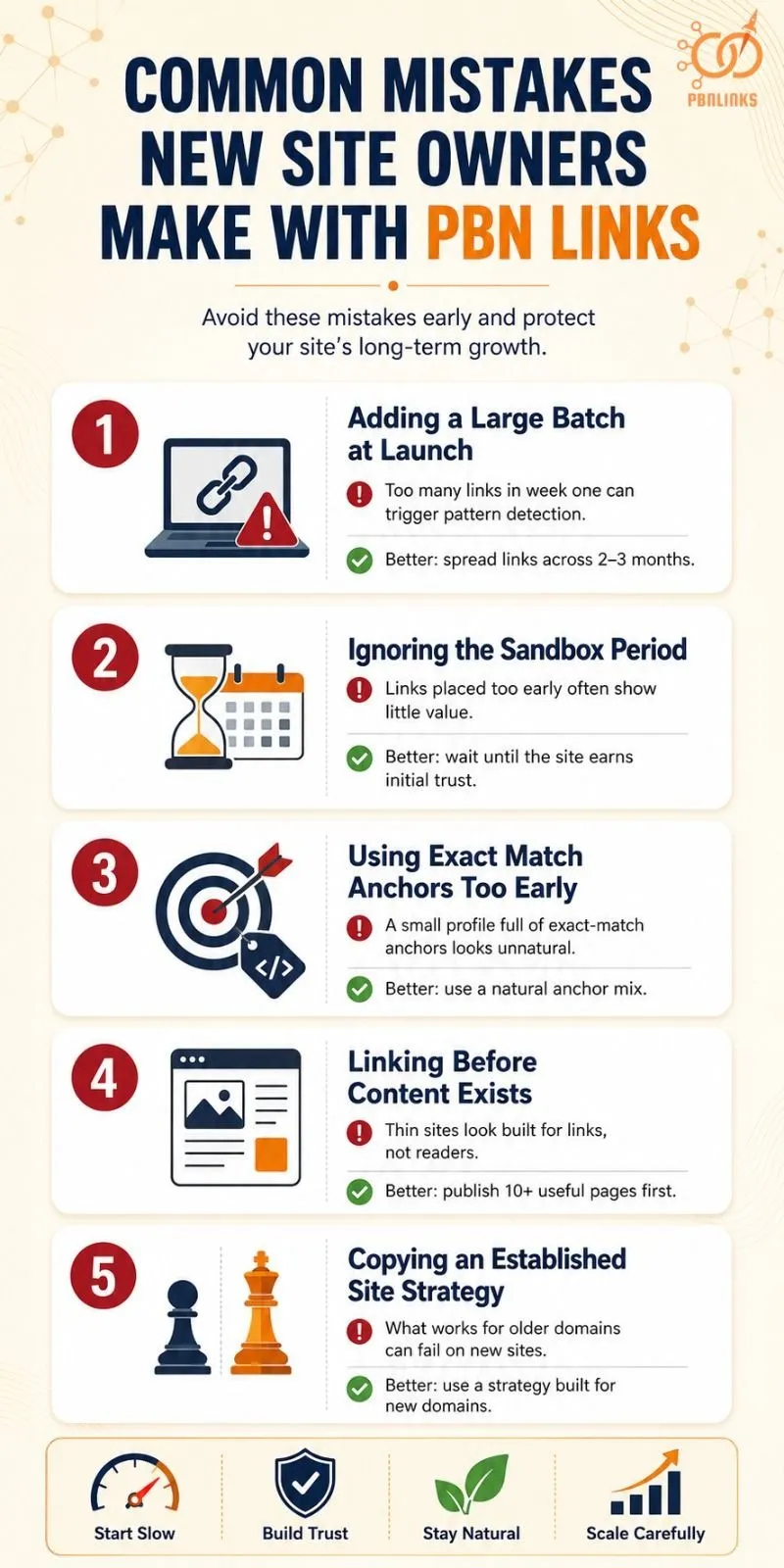
The most common PBN link mistakes on a new site are over-linking at launch, ignoring the sandbox period, using exact match anchors too early, linking before content exists, and copying an established site’s strategy.
Adding a Large Batch at Launch
Ten links the same week a site launches is the fastest way to trigger pattern detection. Spread the same links across two to three months instead, and the pattern disappears entirely.
Ignoring the Sandbox Period
Links placed before trust is earned rarely show value right away, no matter how strong the domains are. Waiting until the evaluation period passes protects the value of every link added afterward.
Using Exact Match Anchors Too Early
Three exact match anchors out of five total links looks manufactured on a profile this small. The anchor text optimization guide covers the safer mix to use instead.
Linking Before Content Exists
A two page site with a link pointing at it looks built for the link, not for readers. Publish at least 10 pages first so the site has somewhere real to send authority.
Treating New Site Strategy the Same as Established Site Strategy
Copying a plan built for years of history onto a month old domain is the most common mistake on this list. What works at scale almost always fails on a domain still earning trust.
PBN Links vs Content Growth for New Sites
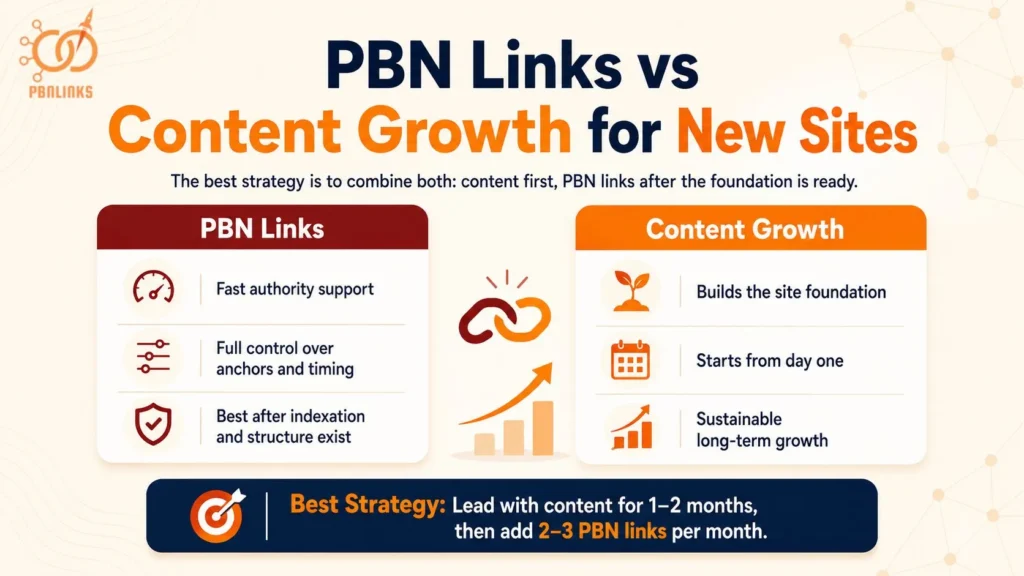
For a new site, the strongest strategy combines both. Content growth leads, and PBN links support once a foundation exists.
Most new site owners treat this as an either or decision, and that mistake costs them months of wasted effort. A site that only builds content waits too long for momentum. A site that only buys links has nothing solid for those links to support.
PBN Links
How it works: Private Blog Networks link from aged, expired domains to pass authority directly to a target page. Each domain carries inherited trust from its previous life, which transfers through the link.
Pros: Full control over anchor text and link velocity, and faster authority transfer than waiting for organic backlinks to accumulate. A well placed PBN link can move rankings within weeks once indexed.
Cons and risks: Requires careful pacing on a new domain, and a poorly managed network can create detectable patterns. Domain quality varies widely, and a weak provider can damage rankings instead of building them.
Verdict: Effective as a supporting layer once content and indexation are in place. Not effective as the first move on a brand new site with nothing for the link to support.
Content Growth
How it works: Publishing genuinely useful, topic specific content that earns indexation and gives Google something worth ranking. Every new page adds to the site’s overall topical relevance.
Pros: Builds a sustainable foundation, attracts natural mentions over time, and gives every future link somewhere meaningful to land. Strong content also improves how every other SEO signal performs.
Cons and risks: Takes longer to show results on its own, and slow content alone rarely competes in time sensitive niches. Competitors with an established link profile can still outrank strong content for months.
Verdict: The required baseline for every new site, regardless of what link strategy follows. No amount of links fixes a site with nothing worth linking to.
| Factor | PBN Links | Content Growth |
| Speed | Fast once active and indexed | Slow but compounding |
| Control | Full control over anchors and timing | No control over external signals |
| Risk level | Moderate, depends on pacing and provider | Low |
| Role for a new site | Supporting layer | Required foundation |
| When to start | After indexation and structure exist | From day one |
The Recommended Strategy
Lead with content for the first one to two months. Once indexation and structure are solid, introduce PBN links at 2 to 3 per month and scale from there. Content alone is slow. Links alone with nothing to support them are wasted. Together, they compound faster than either approach used in isolation.
Conclusion
In conclusion the right number of PBN links for a new website depends on competition level, domain readiness, and patience. It is never a fixed number chased from day one.
Low competition niches need 5 to 10 links. Medium competition needs 20 to 50, and high competition niches need 50 or more combined with other link types. None of that matters until the site passes basic readiness checks. It must also earn its way through the sandbox period with genuine content.
A phased schedule protects every dollar spent. Seasoning first, a handful of links next, then scaling once results confirm the foundation is solid. Skipping that order is the single biggest reason new site link campaigns fail.
Content growth should always lead. PBN links work best as support, not as a substitute for a site Google has no reason to trust yet.
If you are ready to add PBN links to a new website the right way, explore our packages at PBN Links Agency. Build authority your site can actually keep.
FAQs About How Many PBN Links New Site
How many PBN links does a new website need to rank?
Low competition niches need 5 to 10 PBN links, medium competition needs 20 to 50, and high competition niches need 50 or more combined with other link types. The exact number also depends on domain age and content readiness.
How soon can I add PBN links to a new website?
Wait at least 30 days after launch, ideally 60 to 90 days, before adding any PBN links. This seasoning period lets the site index and build content before carrying any link weight.
Is it safe to use PBN links on a brand new domain?
Yes, when paced correctly and combined with genuine content. New domains should start with 2 to 5 links per month rather than the 5 to 10 an established site can absorb.
Does the Google Sandbox affect PBN link timing?
Yes. The Google Sandbox is a trust evaluation period that typically lasts 3 to 6 months, during which links placed on a new domain show suppressed value even when the domains are strong.
How many PBN links per month is safe for a new site?
A safe starting point is 2 to 5 PBN links per month for the first several months. Established domains can usually absorb 5 to 10 links monthly without standing out.
What happens if I add too many PBN links too fast to a new site?
A sudden spike in referring domains on a small profile is one of the clearest manipulation signals Google’s systems detect. It can trigger SpamBrain pattern detection and devalue the links instead of helping rankings.
Should I wait for content before adding PBN links?
Yes. A new site needs at least 10 to 15 published pages before its first PBN link goes live, since links pointing at a thin site look built for the link, not for readers.
How many PBN links does a new affiliate site need?
A new affiliate site in a low to medium competition niche typically needs 5 to 25 PBN links, following the same phased schedule as any other new site. Content depth matters as much as link count.
Do new ecommerce sites need more PBN links than new blogs?
Often yes, since ecommerce category and product pages tend to compete in higher competition niches. A new ecommerce site may need links toward the medium to high competition range rather than the low end.
Can a new website recover from an aggressive PBN link campaign?
Yes, but recovery takes time. Stop adding links immediately, wait 4 to 6 weeks, and monitor whether rankings stabilize before resuming a slower, phased approach.
Can Google detect PBN links on a new website?
Yes, more easily than on an established site. Sudden link spikes, shared hosting patterns, and unnatural anchor distributions are all more visible against a small, new backlink profile.
How long does it take for PBN links to show results on a new site?
Most sites start showing the first signs of ranking movement 4 to 8 weeks after links are indexed. High competition niches and sites still inside the sandbox period may take longer.
What tools help track PBN link results on a new website?
Google Search Console confirms indexing, Ahrefs tracks referring domains and rankings, and a simple tracking sheet records anchor text and placement dates for every link added.