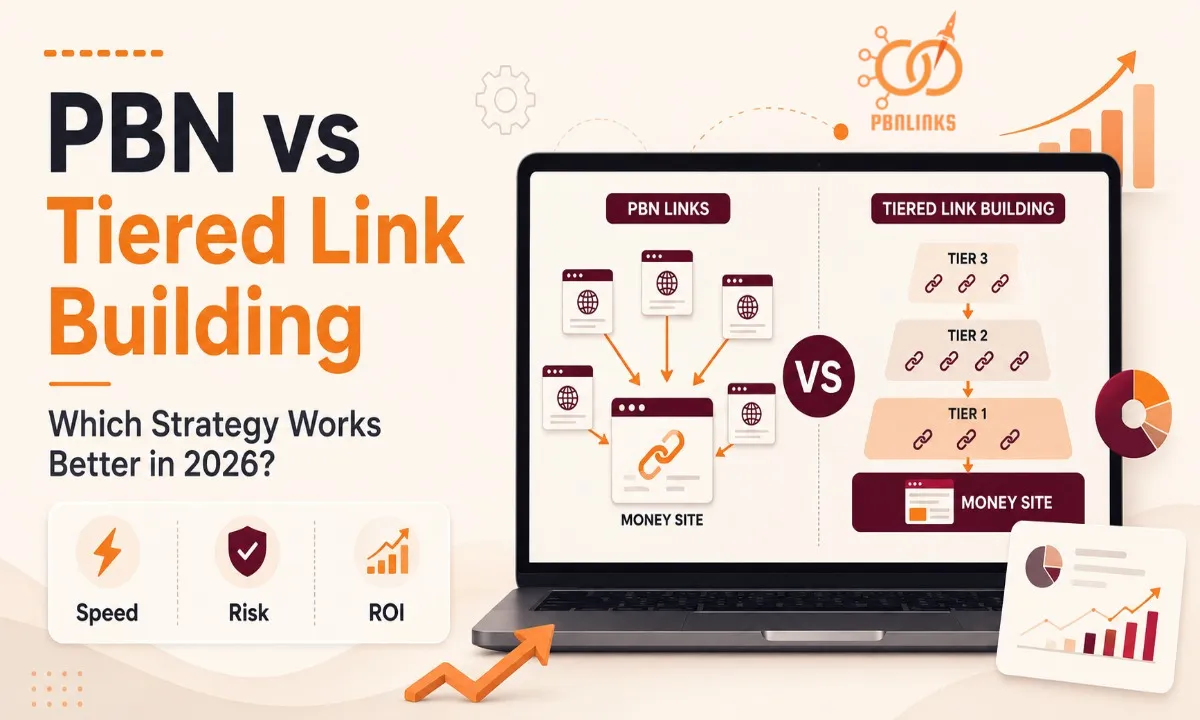
PBN vs Tiered Link Building: Which Strategy Works Better in 2026?
Both PBN links and tiered link building work. The real question is which one suits your situation and which risk is worth taking on.
Most SEOs treat them as completely separate strategies. The smarter approach is understanding what each one does, where each one fails, and when using both together gives you an advantage neither delivers alone.
This guide gives you a direct comparison across risk, speed, cost, and results so you can make the right call for your campaign.
What Is PBN Link Building
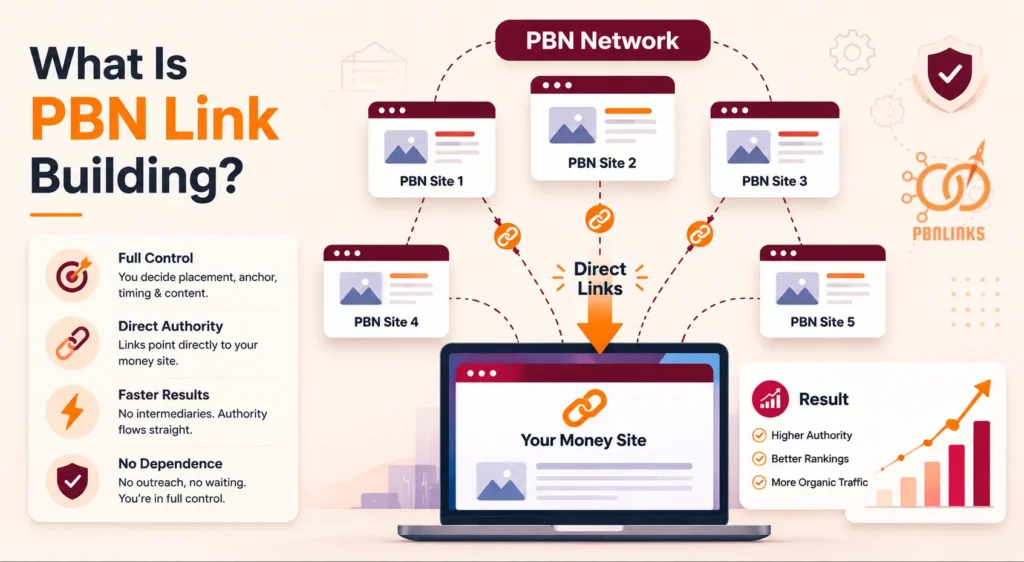
PBN link building is a strategy where a network of privately owned websites is used to place backlinks pointing to a target site in order to boost its search engine rankings.
A Private Blog Network is a collection of websites built specifically to pass link authority to a target site. Each domain in the network links directly to your money site and carries whatever authority that PBN domain has built up over time.
The core advantage of PBN links is control. You decide:
- Which page on your money site gets the link
- What anchor text is used on every placement
- When the link goes live
- What content surrounds the link
No outreach, no waiting for approval, no dependency on a third party. When a link goes live it is live.
PBN links pass authority directly with no intermediate layer between the domain and your money site. That direct connection is what makes them fast and it is also what makes them a concentrated risk if Google identifies the domain as part of a network.
For a full breakdown of how PBN campaigns are structured our guide on how to build PBN links covers everything from domain selection through to placement.
What Is Tiered Link Building
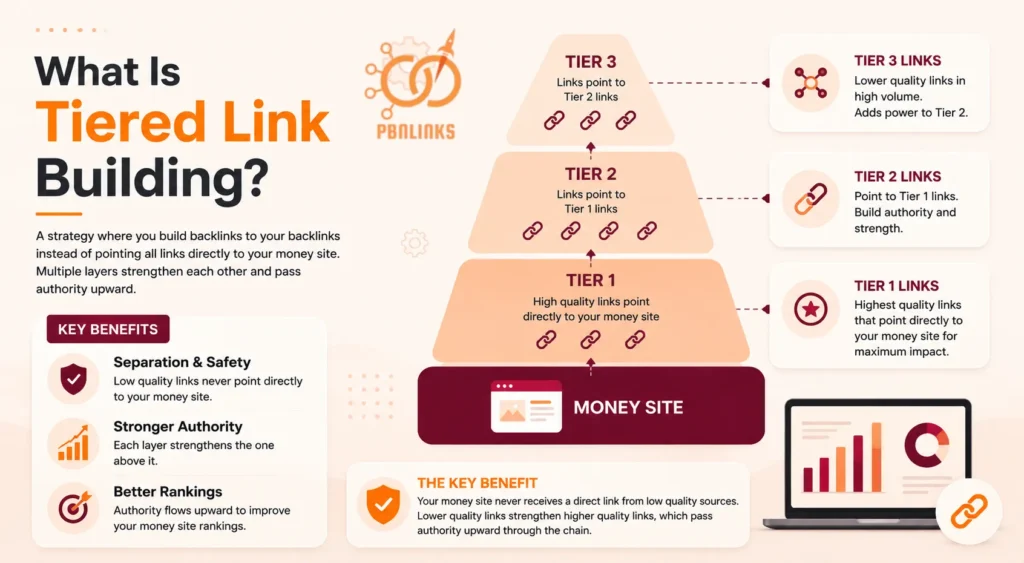
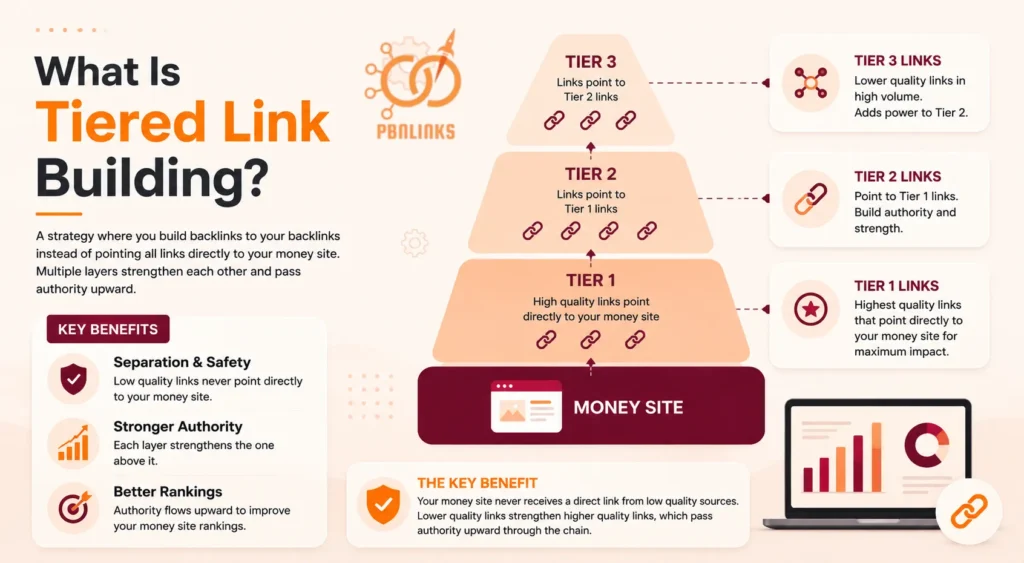
Tiered link building is a strategy where you build backlinks to your backlinks rather than pointing all links directly to your money site. Instead of one layer of links the strategy creates multiple layers where each tier strengthens the one above it.
The structure works like this:
- Tier 1 links point directly to your money site. These are your highest quality links and carry the most direct ranking impact. Examples include guest posts, niche edits, and PBN links.
- Tier 2 links point to your tier 1 links not your money site. Their job is to strengthen the authority of the tier 1 links above them.
- Tier 3 links point to tier 2 links. These are typically lower quality and higher volume. For most campaigns tier 3 is rarely worth the added complexity.
The key benefit of this structure is separation. Your money site never receives a direct link from a low quality source. Instead lower quality links power up higher quality links which then pass authority upward through the chain.
How the Tier Structure Actually Works
When a tier 2 link points to a tier 1 link it increases the authority of that tier 1 page. A stronger tier 1 page passes more link equity to your money site than a weaker one would on its own.
Think of it this way. A guest post on a DR 40 site passes a certain amount of authority to your money site. If you build ten quality tier 2 links pointing to that guest post page the DR 40 page becomes more authoritative. It then passes more value to your money site than it would have without the tier 2 support.
This is why tiered link building is particularly useful in competitive niches. A small number of high quality tier 1 links supported by strong tier 2 links can outperform a larger number of unsupported tier 1 links over time.
PBN vs Tiered Link Building — The Direct Comparison
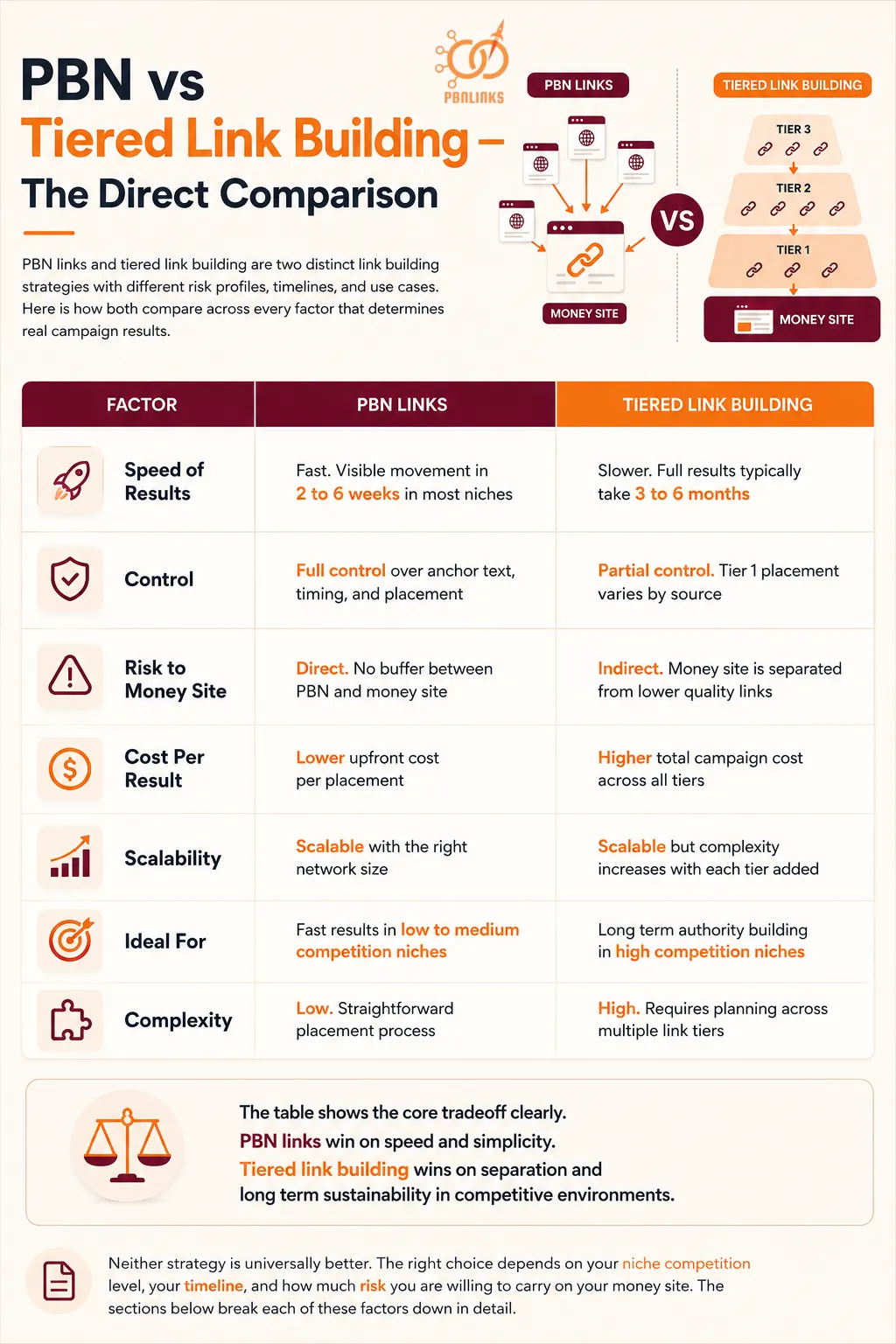
PBN links and tiered link building are two distinct link building strategies with different risk profiles, timelines, and use cases. Here is how both compare across every factor that determines real campaign results.
| Factor | PBN Links | Tiered Link Building |
| Speed of Results | Fast. Visible movement in 2 to 6 weeks in most niches | Slower. Full results typically take 3 to 6 months |
| Control | Full control over anchor text timing and placement | Partial control. Tier 1 placement varies by source |
| Risk to Money Site | Direct. No buffer between PBN and money site | Indirect. Money site is separated from lower quality links |
| Cost Per Result | Lower upfront cost per placement | Higher total campaign cost across all tiers |
| Scalability | Scalable with the right network size | Scalable but complexity increases with each tier added |
| Ideal For | Fast results in low to medium competition niches | Long term authority building in high competition niches |
| Complexity | Low. Straightforward placement process | High. Requires planning across multiple link tiers |
The table shows the core tradeoff clearly. PBN links win on speed and simplicity. Tiered link building wins on separation and long term sustainability in competitive environments.
Neither strategy is universally better. The right choice depends on your niche competition level, your timeline, and how much risk you are willing to carry on your money site. The sections below break each of these factors down in detail.
PBN Links vs Tiered Link Building — Which Is Riskier
Both strategies carry risk. The difference is where that risk sits and how it reaches your money site when something goes wrong.
How Google Detects PBN Links
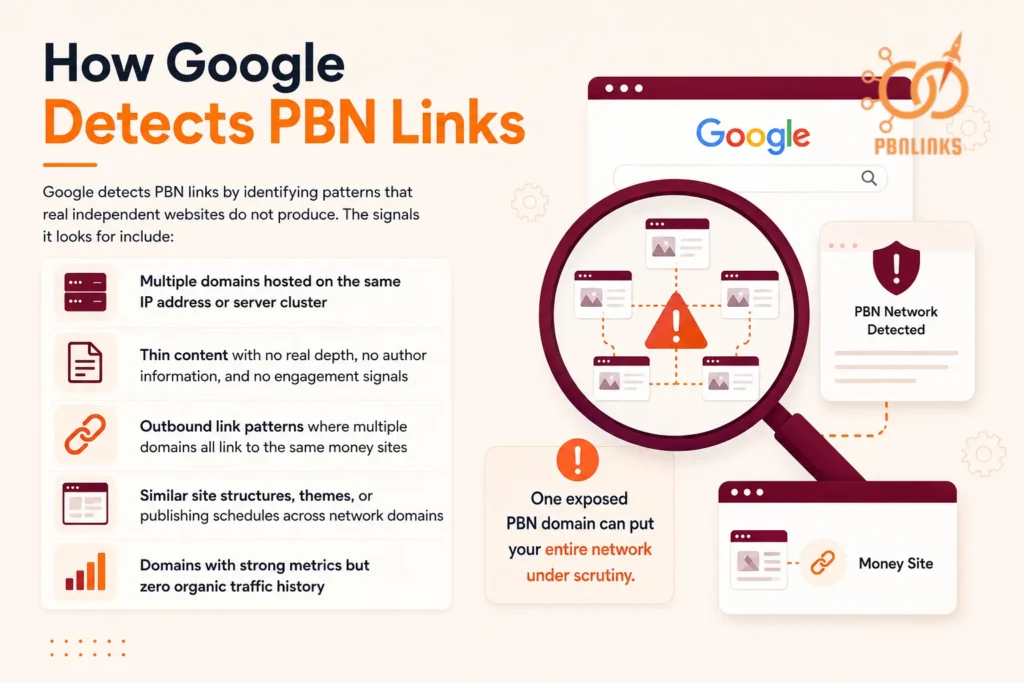
Google detects PBN links by identifying patterns that real independent websites do not produce. The signals it looks for include:
- Multiple domains hosted on the same IP address or server cluster
- Thin content with no real depth, no author information, and no engagement signals
- Outbound link patterns where multiple domains all link to the same money sites
- Similar site structures, themes, or publishing schedules across network domains
- Domains with strong metrics but zero organic traffic history
When Google identifies one domain in a network it does not just penalise that domain. It uses that domain as a signal to investigate other sites with similar patterns. One exposed PBN domain can put your entire network under scrutiny.
How Google Detects Tiered Link Building
Google detects tiered link building through coordinated patterns across multiple link sources. The main detection signals are:
- Velocity spikes where tier 2 and tier 3 links appear too quickly after tier 1 placements
- Identical or near identical anchor text repeated across multiple tiers pointing to the same page
- Automated link building tools leaving digital fingerprints through shared IP ranges and identical posting patterns
- Cross linking between tier 2 properties in ways that reveal a coordinated structure
- Low quality tier 2 sources that Google has already flagged as spam networks
Google’s SpamBrain system has significantly improved its ability to detect coordinated link patterns in 2026. Campaigns that would have passed undetected two years ago are now being caught through machine learning pattern recognition across link graphs.
What Happens When Tiered Link Building Goes Wrong
This is the risk most people underestimate about tiered link building. When a tier 2 source is identified as spam it does not just lose its value. It can actively pass negative signals upward to the tier 1 link it was supporting.
A weakened tier 1 link then passes less authority to your money site. If enough tier 2 sources are compromised the tier 1 link can be devalued entirely. You lose not just the tier 2 links but the tier 1 investment they were supposed to strengthen.
This is the risk multiplier effect of tiered link building. One bad source at the bottom of the chain creates downward pressure that compounds through every tier above it.
PBN link risk is more direct but more contained. If a single PBN domain is identified the damage is limited to that domain and the links it placed. The rest of your network remains intact as long as footprint signals are properly managed. For a full breakdown of how to manage PBN link velocity to reduce detection risk read our dedicated guide.
Speed of Results — Which Strategy Ranks Faster
PBN links rank faster than tiered link building in most scenarios. Links point directly to the money site with no intermediate layer. Authority transfers immediately and ranking movement typically appears within 2 to 6 weeks of indexing.
Tiered link building takes longer because authority compounds through multiple layers before reaching your money site.
How long does tiered link building take to show results?
A standard tiered campaign follows this timeline:
- Weeks 1 to 6 — Tier 1 links are placed and indexed
- Weeks 6 to 14 — Tier 2 support links are built pointing to tier 1 placements
- Weeks 14 to 22 — Ranking movement becomes measurable as authority compounds through the tiers
Most tiered campaigns show meaningful results between 3 and 6 months from launch.
How long do PBN links take to show results?
PBN link speed depends on competition level:
- Low competition — visible ranking movement in 2 to 3 weeks
- Medium competition — movement typically appears in 4 to 8 weeks
- High competition — PBN links alone often hit a ceiling regardless of how many are added
In high competition niches PBN links deliver early movement. But without tiered support rankings are harder to hold long term.Tech PBN links campaigns are a good example — fast early gains that need tiered authority behind them to stick.
Cost Comparison — PBN Links vs Tiered Links
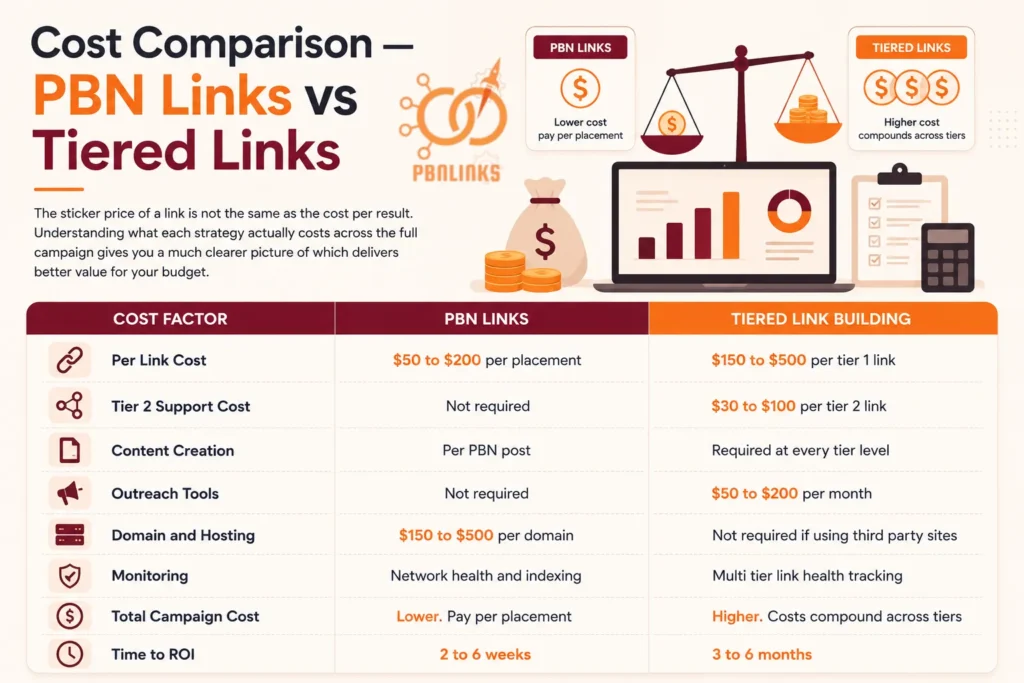
The sticker price of a link is not the same as the cost per result. Understanding what each strategy actually costs across the full campaign gives you a much clearer picture of which delivers better value for your budget.
| Cost Factor | PBN Links | Tiered Link Building |
| Per Link Cost | $50 to $200 per placement | $150 to $500 per tier 1 link |
| Tier 2 Support Cost | Not required | $30 to $100 per tier 2 link |
| Content Creation | Per PBN post | Required at every tier level |
| Outreach Tools | Not required | $50 to $200 per month |
| Domain and Hosting | $150 to $500 per domain | Not required if using third party sites |
| Monitoring | Network health and indexing | Multi tier link health tracking |
| Total Campaign Cost | Lower. Pay per placement | Higher. Costs compound across tiers |
| Time to ROI | 2 to 6 weeks | 3 to 6 months |
What PBN Links Actually Cost
A single PBN link placement typically costs between $50 and $200 depending on domain metrics, niche relevance, and network quality. The total campaign cost depends on how many links your target keywords need to move and hold rankings. Use our PBN links pricing calculator to estimate your campaign cost based on competition level.
The hidden costs most buyers overlook include:
- Domain acquisition — quality expired domains cost $150 to $500 at auction
- Hosting — each domain needs isolated hosting to avoid footprint detection
- Content — every PBN post needs genuine on topic content
- Management — monitoring indexing, link velocity, and network health over time
What a Tiered Campaign Actually Costs
Tiered link building has a higher total campaign cost in most scenarios. The cost compounds across every tier because each layer requires its own links, content, and placement fees.
A realistic tiered campaign budget breakdown looks like this:
- Tier 1 links — guest posts and niche edits on DR 40 plus sites cost $150 to $500 per placement
- Tier 2 links — lower quality threshold but still require real placements at $30 to $100 each
- Content creation — each tier 1 and tier 2 placement needs supporting content
- Outreach tools — prospecting and email tools add $50 to $200 per month
- Monitoring — tracking link health and velocity across multiple tiers requires ongoing tool investment
Which Strategy Gives You Better ROI
For most campaigns PBN links deliver better cost per result in the short to medium term. You pay per placement, results appear faster, and there are no compounding costs across multiple tiers.
The simplest way to decide based on your situation:
- Limited budget and need results fast — PBN links give you more ranking movement per dollar
- Competitive niche and playing long term — tiered link building costs more upfront but compounds in value over time
- Both objectives — combining PBN links with tiered support gives you speed now and sustainability later
When to Use PBN Links vs Tiered Link Building
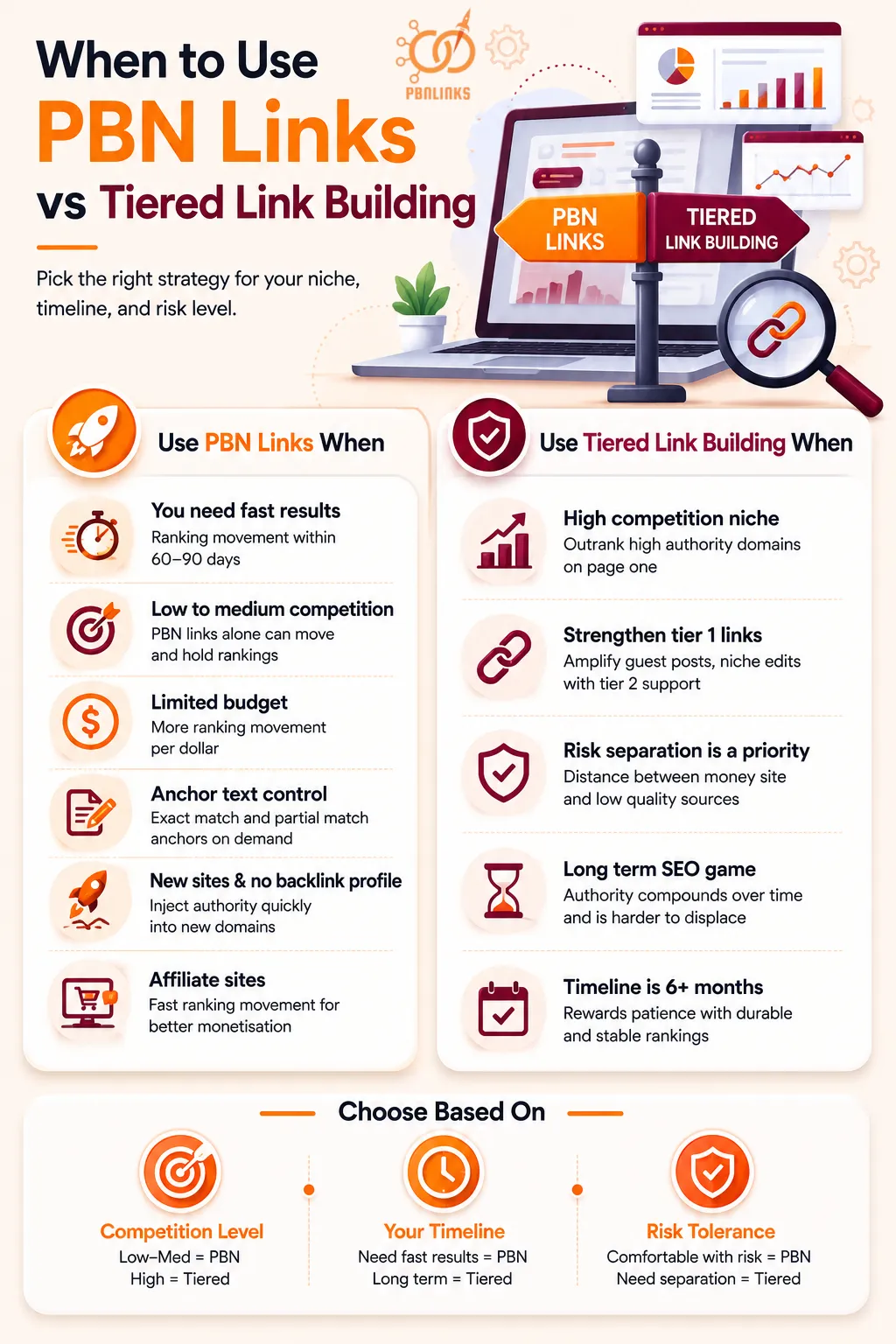
PBN links and tiered link building are not interchangeable. Each strategy suits a specific situation and choosing the wrong one for your campaign wastes both time and budget.
The right choice comes down to three things — your competition level, your timeline, and how much risk you are comfortable carrying on your money site. Here is a clear breakdown of when each strategy makes sense.
Use PBN Links When
PBN links are the right choice when speed and control matter more than anything else. Choose PBN links when:
- You need fast results — client expects ranking movement within 60 to 90 days
- Your niche is low to medium competition — PBN links alone are enough to move and hold rankings
- Your budget is limited — PBN links deliver more ranking movement per dollar than a full tiered campaign
- You need anchor text control — exact match and partial match anchors placed on demand without outreach
- You are building authority for a new site — PBN links inject authority quickly into a domain with no existing backlink profile
- You manage affiliate sites — fast ranking movement is critical for monetisation. Our PBN links for affiliate sites are built specifically for this use case
Use Tiered Link Building When
Tiered link building is the right choice when long term sustainability matters more than speed. Choose tiered link building when:
- You are in a high competition niche — page one is dominated by high authority domains that PBN links alone cannot displace
- Your tier 1 links need strengthening — existing guest posts or niche edits that are not passing enough authority can be amplified with tier 2 support
- Risk separation is a priority — you want distance between your money site and lower quality link sources
- You are playing a long term SEO game — tiered authority compounds over time and produces rankings that are harder for competitors to displace
- Your campaign timeline is 6 months or more — tiered link building rewards patience with durable results
Use Both Together When
Combining both strategies gives you the speed of PBN links and the sustainability of tiered link building. Use both together when:
- You are in a high competition niche and need early movement — PBN links deliver fast gains while the tiered structure builds long term authority behind them
- You have existing PBN links that have plateaued — tier 2 support can re-energise PBN links that stopped moving rankings
- You are running ecommerce campaigns — product and category pages need fast visibility and sustained rankings. Our PBN links for ecommerce combined with tiered support is the most effective approach for competitive product categories
- Your client needs both short term results and long term retention — PBN links satisfy the 90 day reporting window while tiered link building builds the authority base that keeps the client renewing
- You want a resilient link profile — combining both strategies creates a diverse authority base that is harder for algorithm updates to displace in a single hit
How to Combine PBN Links With Tiered Link Building Safely
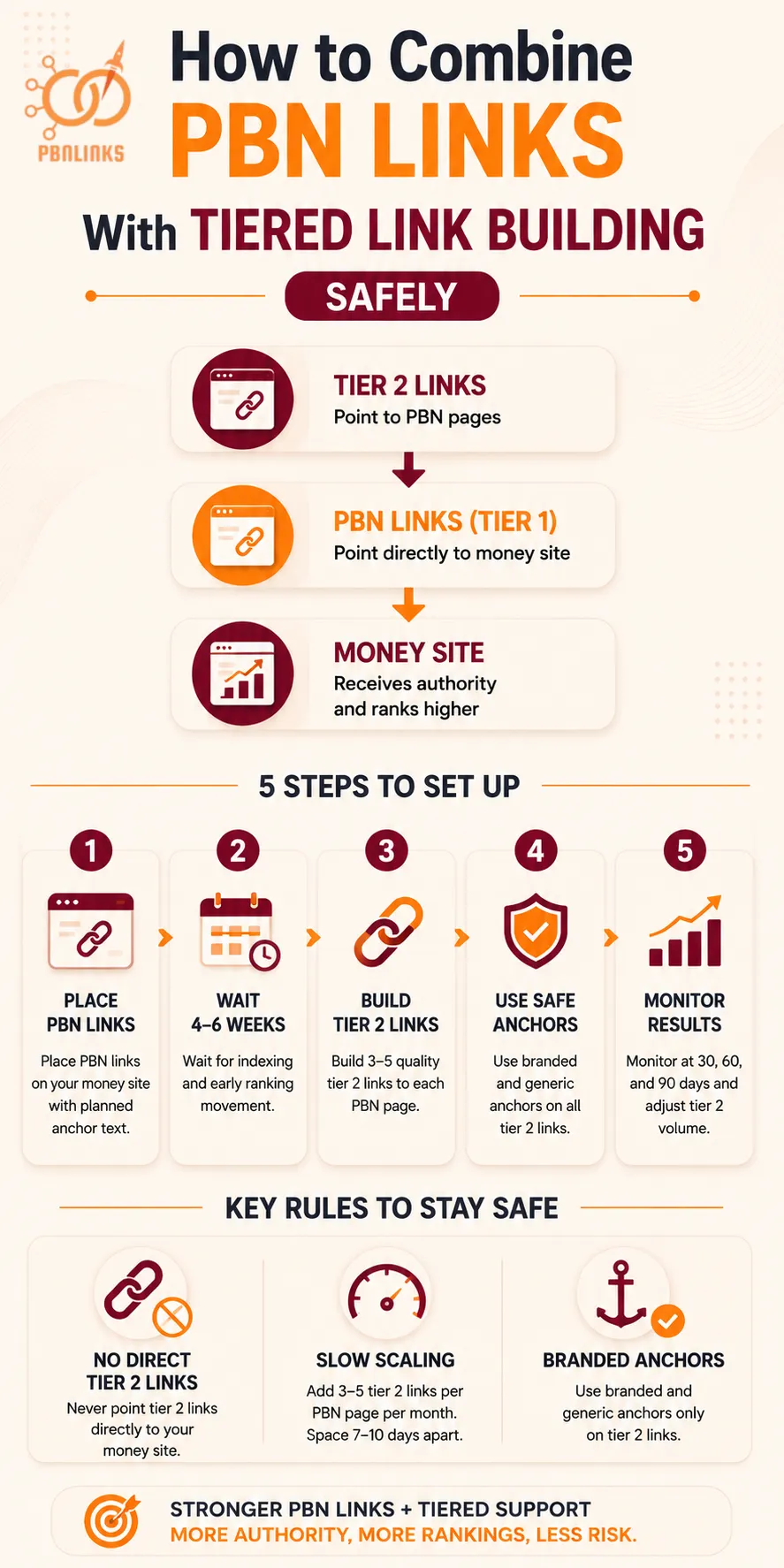
Using PBN links and tiered link building together is one of the most effective advanced link building strategies available in 2026. But combining them incorrectly creates more risk than using either strategy alone. The difference comes down to structure, anchor text discipline, and velocity control.
How to Structure a Combined Campaign
The correct structure is straightforward. PBN links act as your tier 1 pointing directly to your money site. Quality tier 2 links then point to the PBN domain pages not to your money site.
This works because it strengthens the PBN link itself. A stronger PBN page passes more authority to your money site. The tier 2 links never touch your money site directly which means the separation benefit of tiered link building is preserved throughout the campaign.
Here is how to set it up step by step:
- Step 1 — Place PBN links on your target money site pages with a planned anchor text optimization guide from the start
- Step 2 — Wait 4 to 6 weeks for PBN links to be indexed and for early ranking movement to appear
- Step 3 — Build 3 to 5 quality tier 2 links pointing to each PBN domain page as a starting guideline — scale based on competition level
- Step 4 — Use branded and generic anchors on all tier 2 links without exception
- Step 5 — Monitor ranking movement at 30, 60, and 90 days and adjust tier 2 volume based on results
Rules to Follow When Combining Both Strategies
Anchor text rules:
- Use branded and generic anchors on all tier 2 links pointing to PBN pages
- Never repeat the same anchor text used on your PBN tier 1 link in the tier 2 links pointing to that same page
- Keep exact match anchor usage below 10 percent across the entire combined link profile
- Review your full anchor text distribution using our types of anchor text guide before placing any tier 2 links
Velocity rules:
- Never build tier 2 links before tier 1 PBN links are confirmed indexed
- Add no more than 3 to 5 tier 2 links per PBN page per month in the first 3 months
- Space placements at least 7 to 10 days apart — do not cluster all tier 2 links in the same week
- Avoid automated tools at any tier level — coordinated patterns are the fastest way to trigger SpamBrain detection in 2026
What to avoid:
- Pointing tier 2 links directly to your money site — this defeats the purpose of the combined structure
- Using the same tier 2 sources across multiple PBN pages — creates a detectable cross linking pattern
- Building tier 2 links from sites with thin content and no organic traffic — these pass negative signals not positive ones
- Scaling too fast before you have ranking data to justify it — add more links based on evidence not assumption
Conclusion
In conclusion, PBN links and tiered link building both work — the difference is knowing which one your campaign actually needs.
PBN links deliver speed, control, and direct authority transfer with no intermediate layer. Tiered link building delivers depth, separation, and sustainable rankings in competitive niches. Used together they produce results neither strategy achieves alone.
Your competition level, timeline, and risk tolerance determine the right choice. Low to medium competition favours PBN links. High competition favours a combined approach. Either way the quality of your links and how you manage them matters more than which strategy you choose.
If you are ready to run a link building campaign that actually moves rankings explore our niche specific packages at PBN Links Agency and get started today.
FAQs About PBN vs Tiered Link Building
What is the difference between PBN links and tiered link building?
PBN links point directly to your money site from privately owned domains giving you full control over placement and timing. Tiered link building creates multiple layers where tier 2 links strengthen tier 1 links which then pass authority to your money site.
Which is better PBN links or tiered link building in 2026?
It depends on your goal. PBN links are better for speed and control in low to medium competition niches while tiered link building is better for long term authority building in high competition environments.
Can Google detect PBN links in 2026?
Yes. Google detects PBN links through shared hosting patterns, thin content, unnatural outbound link structures, and domains with strong metrics but zero organic traffic history. Networks with proper footprint management are significantly harder to detect.
How fast do PBN links work?
PBN links typically show ranking movement within 2 to 6 weeks of being indexed. Low competition niches can see movement in as little as 2 to 3 weeks while medium competition niches typically show movement in 4 to 8 weeks.
How long does tiered link building take to show results?
Most tiered campaigns show meaningful ranking movement between 3 and 6 months from launch. Tier 1 placement and indexing takes 4 to 6 weeks, tier 2 support takes another 4 to 8 weeks, then ranking movement follows over the next 4 to 8 weeks after that.
Can I use PBN links as tier 1 links in a tiered campaign?
Yes and it is one of the most effective combined strategies available. PBN links act as tier 1 pointing to your money site while tier 2 links point to the PBN pages strengthening them without ever touching your money site directly.
How many tier 2 links do I need per PBN tier 1 link?
3 to 5 quality tier 2 links per PBN page is a reliable starting guideline for most campaigns. Scale based on competition level and ranking data rather than adding more links without results to justify the increase.
Can tiered link building get my site penalised?
Yes. Building tier 2 links too fast, using automated tools, or sourcing from low quality networks can trigger algorithmic devaluation or a manual action. The risk grows significantly when coordinated patterns across tiers become visible to Google SpamBrain.
Should I use PBN links or tiered link building for a new site?
PBN links are the better starting point for a new site. They inject authority quickly into a domain with no existing backlink profile and produce ranking movement significantly faster than a tiered campaign which requires strong tier 1 links to amplify.
What is the risk multiplier effect in tiered link building?
It is when one compromised tier 2 source passes negative signals upward to the tier 1 link it supports weakening it. A weakened tier 1 link then passes less authority to your money site meaning one bad source creates downward pressure through every tier above it.