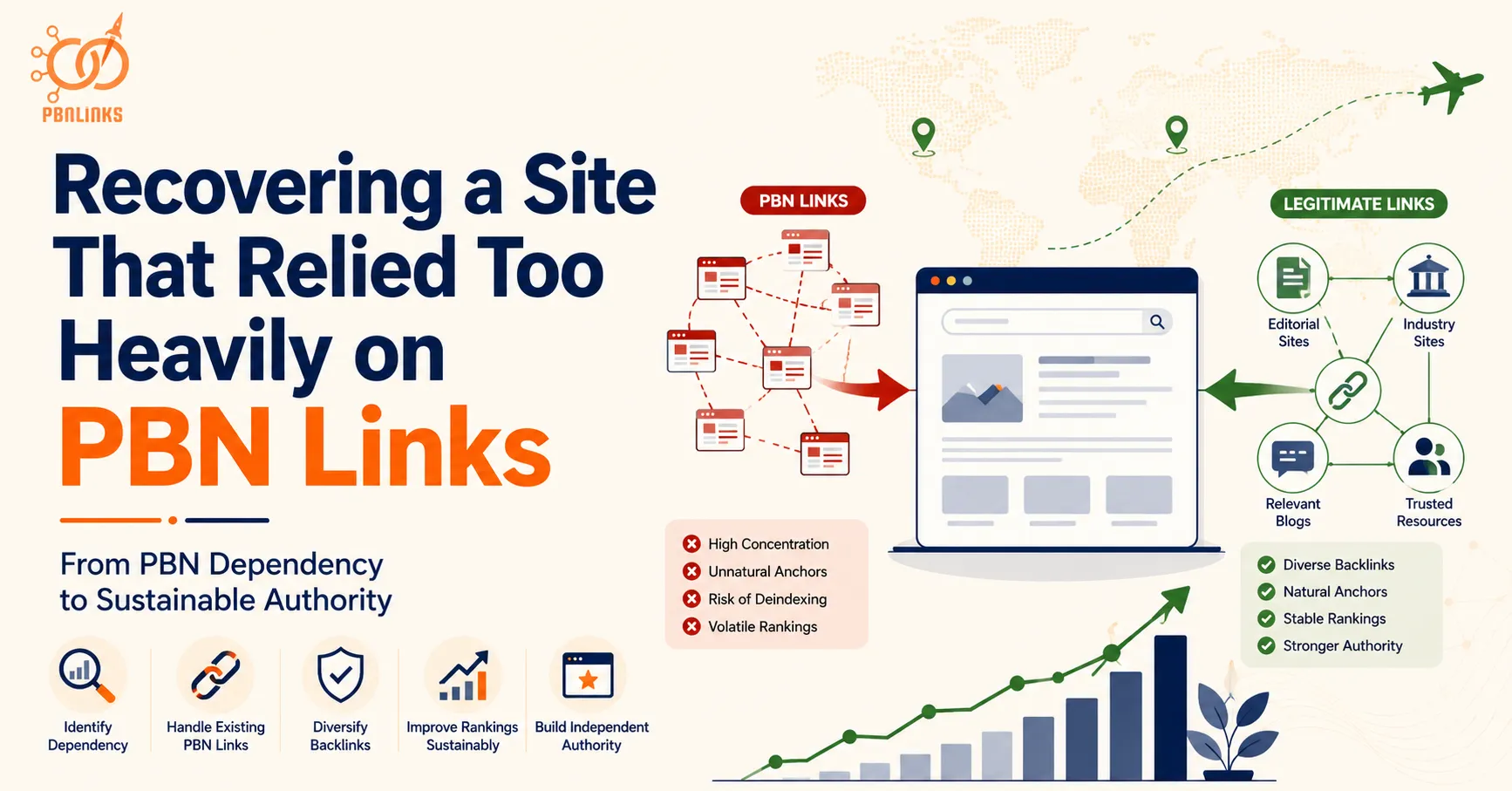
Recovering a Site That Relied Too Heavily on PBN Links
PBN links can make SEO feel easy at first. You place the links, choose the anchor text, and rankings start moving without spending weeks on outreach. But when too much of your site’s ranking strength comes from those links, that shortcut can quickly become a weakness.
The challenge with recovering PBN dependent site rankings starts when important PBN links disappear, get deindexed, or stop providing the same value. If the site has very few strong links outside the network, rankings can become harder to maintain.
Recovery does not mean removing every PBN link immediately. First, you need to understand how dependent the site really is by checking referring domains, anchor text distribution, link concentration, legitimate backlinks, and changes in rankings over time.
This guide explains how to identify PBN dependency, find out whether those links are actually connected to your ranking problems, diversify your backlink profile, handle existing PBN links, and build enough legitimate authority so your site no longer relies heavily on PBNs.
What Does It Mean for a Site to Be Too Dependent on PBN Links?
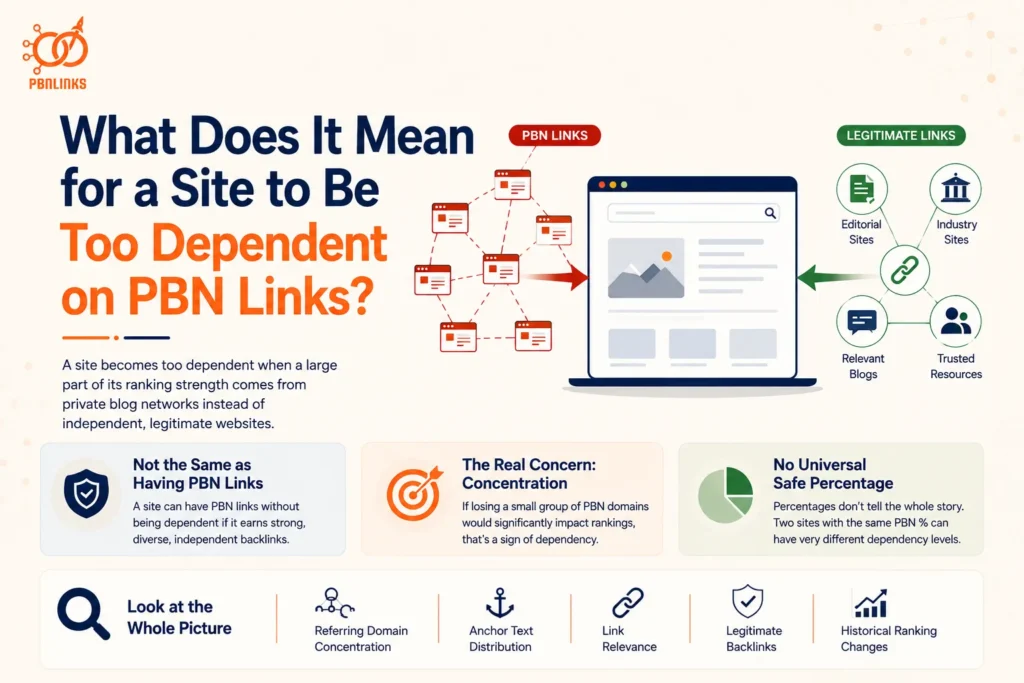
A site becomes too dependent on PBN links when a large part of its backlink strength relies on links from private blog networks rather than independent, legitimate websites. The problem is not simply that PBN links exist in the backlink profile. It is how much the site relies on them to support its rankings.
This dependency can appear in different ways. PBNs may account for many of the site’s important referring domains, provide most of its keyword focused anchor text, or represent a large share of the links pointing to its most important pages.
Having PBN Links Is Not the Same as Depending on Them
A website can have PBN links without being heavily dependent on them. If the site also earns relevant links from independent websites, has a diverse anchor text profile, and does not rely on a small group of domains for most of its backlink strength, the situation is very different.
The real concern is concentration. If removing or losing a relatively small group of PBN domains would significantly change the site’s backlink profile, anchor distribution, or ranking support, that can indicate a higher level of dependency.
Why There Is No Universal Safe PBN Percentage
There is no verified percentage that tells you when a website has too many PBN links. A rule such as “20% is safe” or “more than 30% is dangerous” oversimplifies how backlink profiles and Google’s ranking systems work.
Two websites can have the same percentage of PBN links but very different levels of dependency. One may have hundreds of strong, independent referring domains, while the other has very little authority outside its PBN network.
Instead of looking for a safe ratio, examine the whole backlink profile. Referring domain concentration, anchor text distribution, link relevance, legitimate backlinks, and historical ranking changes provide a much clearer picture of whether the site has become too dependent on PBN links.
How Can You Tell If Your Site Relies Too Heavily on PBN Links?
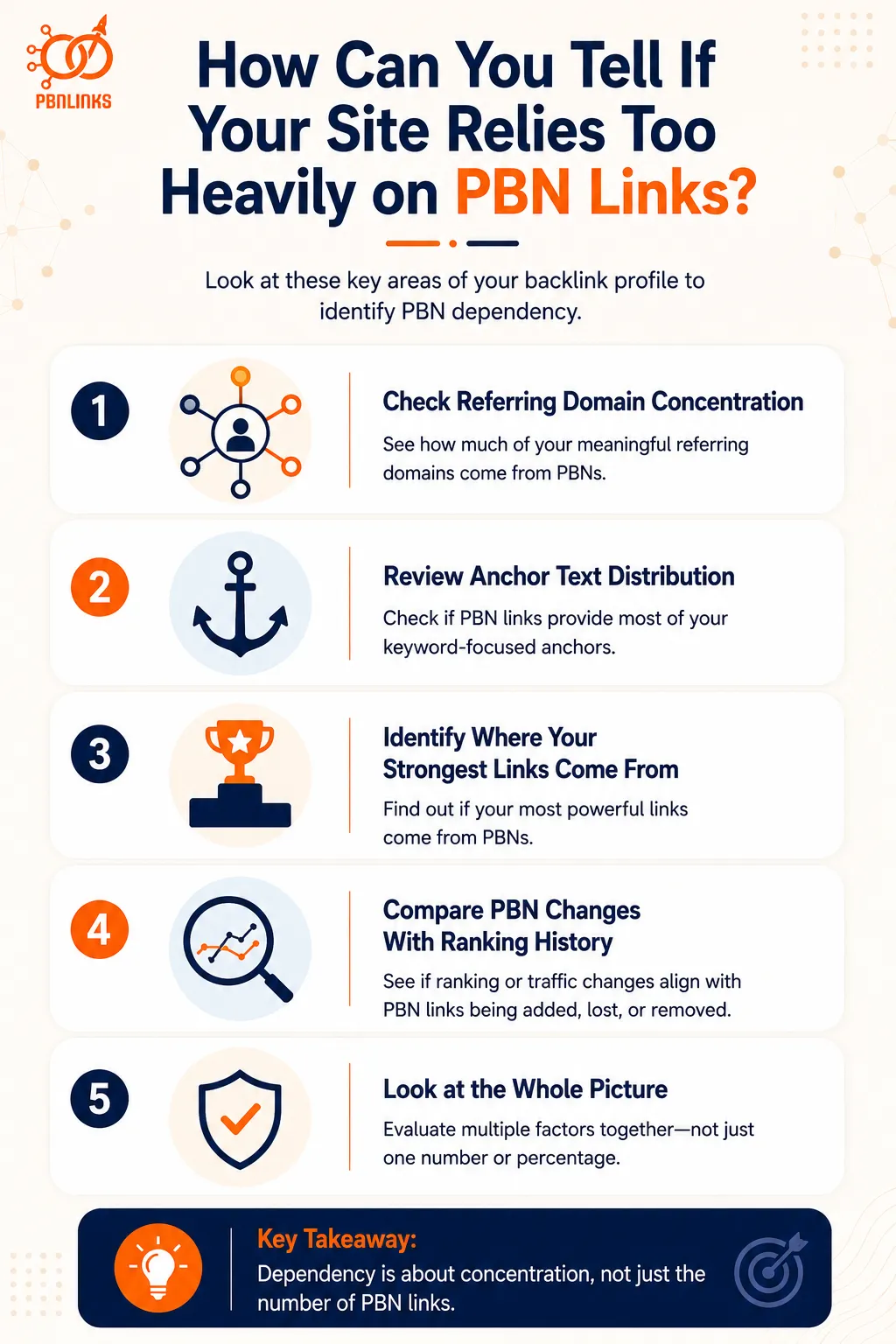
You cannot measure PBN dependency by backlink count alone. A site may have hundreds of PBN links but still have a strong base of independent referring domains, while another site may have fewer PBN links but rely on them for most of its important backlink signals.
The best way to diagnose the problem is to look at several parts of the backlink profile together. Referring domains, anchor text, link sources, and ranking history can show where the dependency is concentrated.
Check Referring Domain Concentration
Start by separating known or suspected PBN domains from legitimate referring domains. Then look at how much of the site’s meaningful referring domain profile comes from each group.
For example, 500 PBN backlinks may look significant, but if they come from only 10 domains within a profile containing hundreds of independent referring domains, the situation is different from a site where 40 of its 60 meaningful referring domains are PBNs.
Do not use this calculation as a fixed safe ratio. Its purpose is to show how concentrated the site’s link sources are.
Review Anchor Text Distribution
Next, examine which anchors the PBN links are providing. Pay particular attention to exact match and other keyword focused anchors pointing to commercially important pages.
A site may have a diverse backlink profile overall but still depend heavily on PBNs for its most aggressive keyword anchors. Compare the anchor text coming from PBN domains with branded, URL, and naturally descriptive anchors from independent websites.
Identify Where Your Strongest Links Come From
Not every referring domain contributes the same signals, so raw numbers can hide the real problem. Look at which websites provide the most relevant and prominent links to your important pages.
If many of the links you previously considered your strongest come from PBNs, the site’s dependency may be greater than the backlink count suggests. Third party authority metrics can help organize this review, but they should not be treated as Google’s own measurement of link value.
Compare PBN Changes With Ranking History
Finally, compare your backlink history with changes in organic rankings and traffic. Look at what happened when major PBN links were added, removed, or disappeared because pages or domains went offline.
If rankings repeatedly moved around the same periods, the relationship deserves closer investigation. However, timing alone does not prove that the PBN links caused the changes, so content updates, algorithm changes, technical problems, and other SEO factors should also be considered.
The goal is not to find one number that labels the site PBN dependent. It is to determine how much of the site’s backlink profile and ranking support is concentrated in links that may not provide a stable long term foundation.
Are PBN Links Actually Causing Your Ranking Problems?
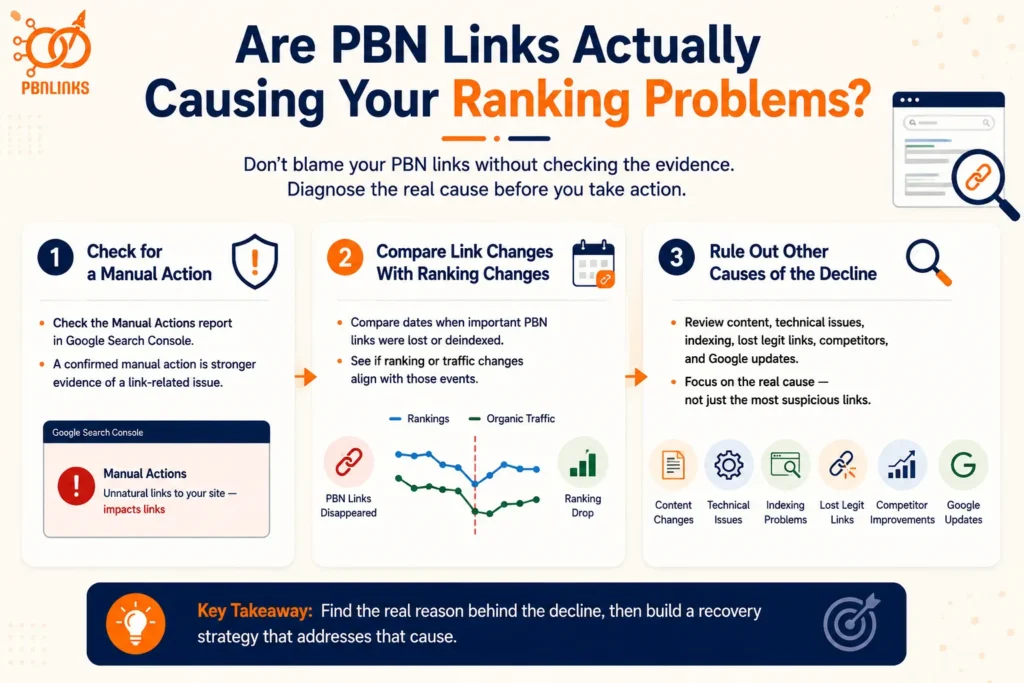
A PBN heavy backlink profile does not automatically mean PBN links caused your rankings to drop. Rankings can change for many reasons, so blaming the links without checking the evidence can lead you to fix the wrong problem.
Before changing the backlink profile, determine what happened around the time performance declined. A manual action, lost links, content changes, technical issues, or stronger competitors can require very different responses.
Check for a Manual Action
Start with the Manual Actions report in Google Search Console. If Google has taken manual action against your site for unnatural links, the report should identify the issue and affected areas.
A confirmed manual action is much stronger evidence of a link related problem than a ranking drop alone. If no manual action appears, do not assume the site has received a hidden manual penalty simply because traffic or rankings declined.
Compare Link Changes With Ranking Changes
Review when important PBN links were added, removed, deindexed, or otherwise became unavailable, then compare those dates with your ranking and organic traffic history.
If rankings declined around the same time that several important PBN links disappeared, those links may have been contributing signals that the site no longer receives. But timing alone does not prove causation, especially when other SEO changes happened during the same period.
Rule Out Other Causes of the Decline
Look beyond backlinks before deciding that PBN dependency is responsible. Review major content changes, technical problems, indexing issues, lost legitimate backlinks, changes in search intent, competitor improvements, and relevant Google ranking updates.
This distinction matters because reducing PBN dependency will not fix a technical indexing problem or weak content. The recovery plan should address the cause you can actually identify, not simply the most suspicious part of the backlink profile.
How Do You Recover a PBN Dependent Site?
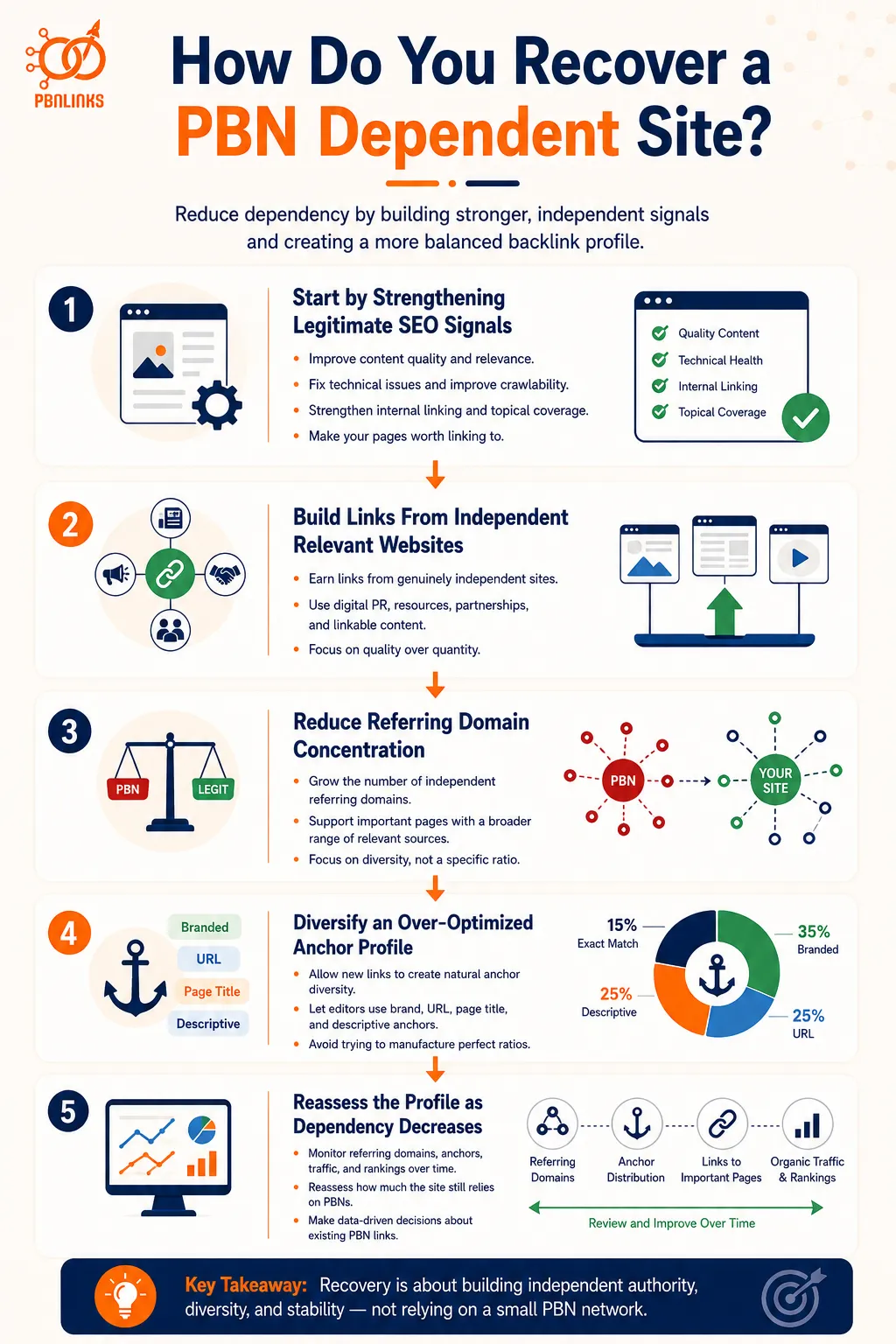
Once you know the site relies too heavily on PBN links, the goal is to reduce that dependency by building stronger signals outside the network. Recovery should focus on creating a backlink profile that does not rely on a small group of controlled domains to support important pages.
This does not mean replacing every PBN link with another backlink one for one. The better approach is to strengthen the site’s legitimate authority, improve link source diversity, and reduce concentration over time.
Start by Strengthening Legitimate SEO Signals
Before focusing only on backlinks, make sure the pages you want to rank are worth linking to and technically accessible. Improve weak content, internal linking, topical coverage, crawlability, and other site issues that may be limiting organic performance.
This matters because backlinks cannot compensate indefinitely for weak pages. A stronger site also gives publishers and other websites better reasons to reference your content naturally.
Build Links From Independent Relevant Websites
Focus new link acquisition on websites that are genuinely independent of the PBN network and relevant to your topic or audience. Editorial mentions, digital PR, useful resources, industry publications, partnerships, and linkable content can all help expand the site’s sources of authority.
Quality matters more than simply increasing the backlink count. Building hundreds of weak links just to make the PBN percentage look smaller does not solve the underlying dependency.
Reduce Referring Domain Concentration
As legitimate referring domains grow, the backlink profile becomes less concentrated around the PBN network. Pay particular attention to important pages that currently receive most of their external links from PBNs.
The goal is not to reach an arbitrary PBN to non PBN ratio. It is to make sure the site’s important pages and overall backlink profile are supported by a broader range of relevant, independent sources.
Diversify an Over Optimized Anchor Profile
If PBNs provide a large share of exact match or keyword focused anchors, allow new legitimate links to broaden the profile naturally. Editorial links may use your brand name, URL, page title, or descriptive phrases rather than the exact keyword you would choose yourself.
Avoid trying to manufacture a perfect anchor text percentage. Replacing one controlled pattern with another does not create genuine diversification.
Reassess the Profile as Dependency Decreases
Recovery should be reviewed over time rather than judged after a few new links. Monitor new and lost referring domains, anchor text distribution, links to important pages, organic traffic, and rankings.
As independent authority grows, reassess how much the site still relies on PBNs. This gives you a stronger basis for deciding what to do with the existing PBN links instead of making that decision before you understand the site’s changing backlink profile.
What Should You Do With Your Existing PBN Links?
Once you have diagnosed the site’s dependency and started strengthening legitimate signals, the next question is what to do with the PBN links already pointing to your site. There is no single action that applies to every link or every website.
The decision should depend on the evidence you have, whether you control the links, and whether Google has identified a link related problem. Removing or disavowing links simply because they come from a PBN can create unnecessary changes without addressing the real issue.
Identify Which Links You Control
Start by separating links you control from links you cannot directly change. If you own the PBN sites or have access to the placements, you may be able to remove or change those links yourself.
Keep a record of the referring domain, target URL, anchor text, and action taken. This becomes especially useful if you later need to investigate ranking changes or address a manual action.
Decide Which Links Actually Need Attention
Review the links in context rather than treating every PBN backlink as identical. Look for patterns that clearly exist to manipulate rankings, such as heavily optimized anchors, irrelevant placements, or large groups of controlled sites pointing to the same pages.
Do not rely on DA, DR, spam scores, or toxicity scores alone to decide which links are harmful. These are third party metrics and do not tell you exactly how Google evaluates a backlink.
Consider Removal or Disavowal When Appropriate
If problematic links can be removed and there is a clear reason to address them, removal is one option. Disavowal is different because the link can remain live while you ask Google not to take it into account when assessing your site.
Google says most sites do not need the Disavow Links tool and warns that using it incorrectly can harm search performance. It is primarily intended for situations involving a considerable number of spammy, artificial, or low quality links when those links have caused, or are likely to cause, a manual action.
Do Not Follow an Arbitrary Removal Schedule
There is no verified rule that says you should remove a certain percentage of PBN links every week or month. Likewise, “never remove all PBN links at once” is not a Google rule.
If there is no manual action, make decisions based on the backlink audit and the site’s actual dependency rather than an invented tapering formula. If there is a confirmed unnatural links manual action, addressing the violating links becomes the priority rather than keeping them simply to protect short term rankings.
The objective is not to preserve PBN links forever or remove them according to a fixed schedule. It is to move the site toward a backlink profile that can support its search visibility without depending heavily on artificial links.
How Does a Manual Action Change the Recovery Strategy?
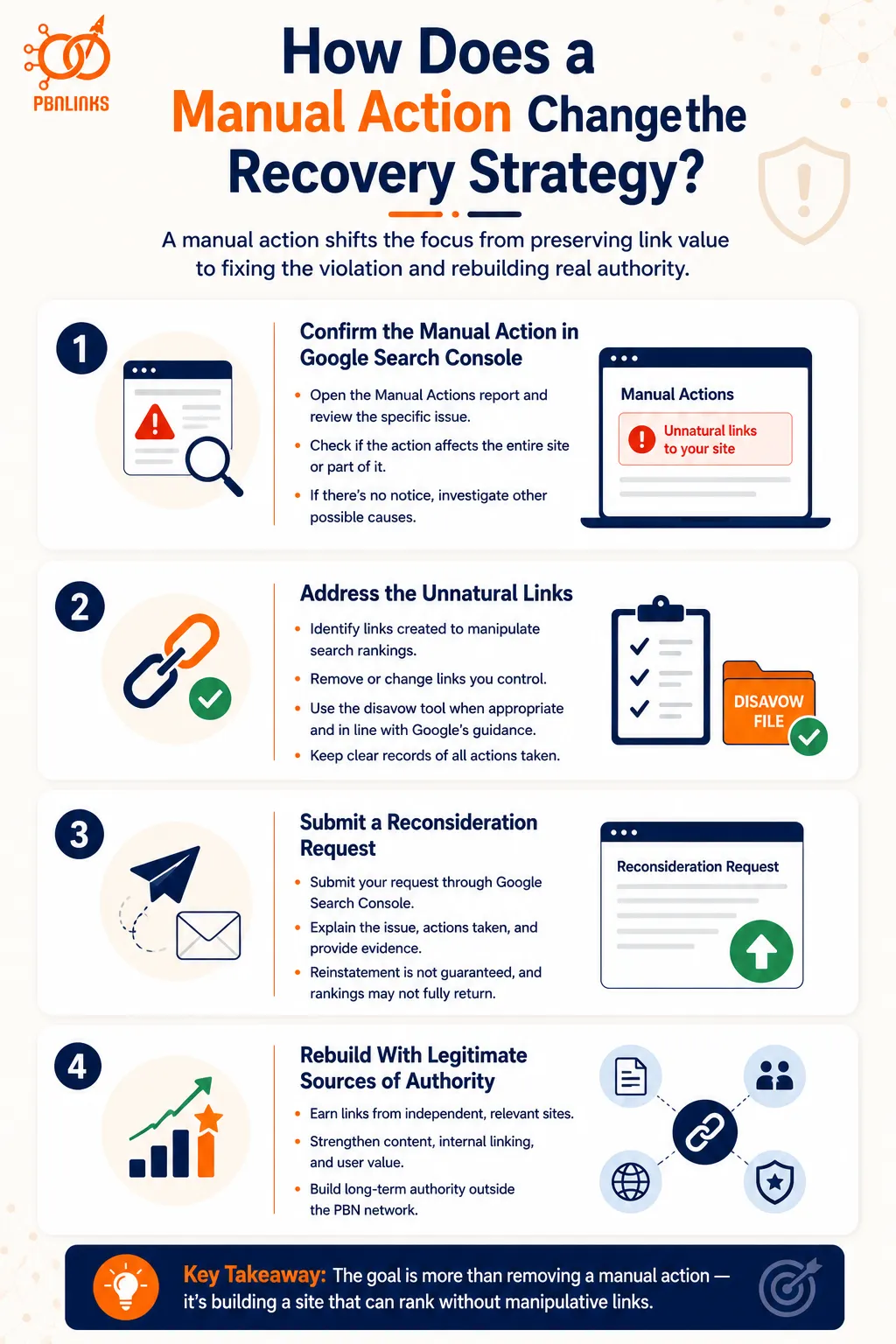
A manual action changes the priority of PBN recovery. If Google Search Console confirms an unnatural links manual action, the problem is no longer just that your site depends too heavily on PBNs. Google has identified links associated with the site that violate its spam policies.
In this situation, protecting the short term ranking value of questionable links should not be the main goal. The priority is to address the violation, show that meaningful cleanup has taken place, and build a backlink profile that does not depend on manipulative links.
Confirm the Manual Action in Google Search Console
Open the Manual Actions report in Google Search Console and review the specific issue Google has identified. The report can show whether the action affects the entire site or only part of it.
Do not diagnose a manual action from a ranking or traffic decline alone. If there is no notice in the Manual Actions report, investigate other possible causes instead of assuming that Google has manually penalized the site.
Address the Unnatural Links
Review the backlinks associated with the problem and identify links created to manipulate search rankings. If you control those links, remove them or make appropriate changes. For links you cannot remove, Google’s disavow tool may be relevant when the circumstances meet its guidance.
Keep records of the links reviewed, removal attempts, changes made, and any domains or URLs included in a disavow file. This gives you a clear record of the cleanup and can support the next stage of recovery.
Submit a Reconsideration Request
After addressing the violation, submit a reconsideration request through Google Search Console. Explain the problem clearly, describe the corrective actions taken, and provide evidence of the work completed.
A reconsideration request does not guarantee that previous rankings will return. If the site previously benefited from links that violated Google’s policies, removing or disregarding those links can also mean losing the ranking value they once appeared to provide.
Rebuild With Legitimate Sources of Authority
Removing problematic links addresses the violation, but it does not replace the authority the site may have depended on. Recovery should therefore continue by earning relevant links from independent websites, strengthening important content, improving internal linking, and developing sources of authority outside the PBN network.
The long term objective is not simply to get the manual action revoked. It is to build a site that can compete without needing the same manipulative link signals that created the problem in the first place.
What Happens If Your PBN Links Lose Their Ranking Value?
If a site relies heavily on PBN links, losing the value of those links can expose that dependency. Rankings may decline if links that previously contributed useful signals are removed, become unavailable, or are no longer counted in the same way.
However, a PBN link losing value does not automatically mean the site has been penalized. The effect depends on whether the link was contributing meaningful ranking value in the first place and how much legitimate authority the site has outside the network.
Rankings Can Change When Important Link Signals Disappear
If several important PBN links are removed or their pages disappear, the site may lose signals that previously supported its rankings. A website with few independent referring domains can be more exposed because there are fewer legitimate links supporting the affected pages.
The impact is not always immediate or easy to isolate. Rankings can change for many reasons, so backlink losses should be compared with organic traffic, ranking history, content changes, and other SEO factors before drawing conclusions.
A Live PBN Link May Not Provide the Same Ranking Value
Seeing a backlink still live on a PBN page does not tell you how Google is treating it. A link can remain visible to users while contributing little or no useful ranking value.
This is why checking whether a PBN page is online is not enough to determine whether the link is still helping. Third party backlink tools can confirm that a link exists, but they cannot tell you exactly how much ranking value Google assigns to it.
A Diversified Profile Reduces Link Source Dependency
The more a site depends on a narrow group of PBN domains, the more exposed it can be if those links stop contributing value. Building relevant links from independent websites reduces the site’s reliance on any single network or link source.
The goal is not to make the site immune to every lost backlink. It is to build enough legitimate authority that losing a group of PBN links no longer determines whether the site can maintain its search visibility.
How Do You Know If PBN Recovery Is Working?
PBN recovery is working when the site becomes less dependent on the network and more of its backlink strength comes from relevant, independent sources. Rankings matter, but they should not be the only measure of progress.
Look at how the backlink profile changes over time. Growth in legitimate referring domains, broader anchor text distribution, stronger links to important pages, and more stable organic performance can provide a clearer picture of whether the dependency is actually decreasing.
Track Growth in Legitimate Referring Domains
Monitor how many new, independent websites are linking to your site and which pages receive those links. The goal is to increase the number of relevant referring domains outside the PBN network, not simply inflate the total backlink count.
Pay particular attention to pages that previously depended heavily on PBN links. Gaining legitimate links to those pages can reduce their reliance on a small group of controlled domains.
Monitor Referring Domain and Anchor Concentration
Repeat the same checks you used when diagnosing the original problem. Compare the share of meaningful referring domains associated with PBNs and review how much keyword focused anchor text still comes from those sites.
You do not need to reach a specific PBN ratio or anchor percentage. What matters is whether the profile is becoming less concentrated and more supported by independent sources.
Watch Rankings and Organic Visibility
Track rankings, impressions, clicks, and organic traffic alongside backlink changes. If visibility becomes more stable while legitimate authority grows and PBN dependency falls, that can be a useful sign of progress.
Do not attribute every ranking movement to backlinks. Content changes, technical issues, competitors, search intent, and Google’s ranking systems can also affect performance.
Do Not Expect a Fixed Recovery Timeline
There is no standard number of days or months for recovering a PBN dependent site. The timeline depends on how heavily the site relied on PBNs, whether ranking value has already been lost, whether a manual action exists, and how effectively the site builds legitimate authority.
Focus on measurable improvement rather than a promised recovery date. The strongest sign of recovery is not simply getting rankings back. It is reaching a point where those rankings no longer depend heavily on PBN links.
Common Mistakes When Recovering a PBN Dependent Site
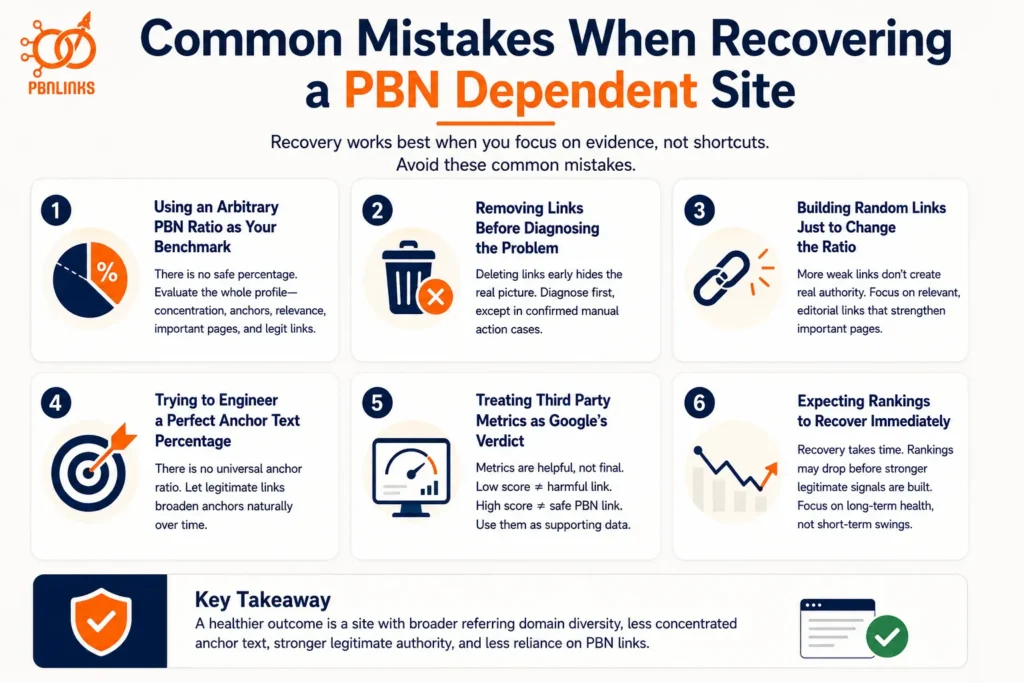
Recovery can go wrong when decisions are based on backlink counts, third party metrics, or ranking fear instead of evidence. The objective is not to make the backlink profile look perfect in an SEO tool. It is to reduce dependence on PBNs while building stronger and more legitimate sources of authority.
Avoid these common mistakes when deciding what to change.
Using an Arbitrary PBN Ratio as Your Benchmark
There is no verified percentage that determines when a site has too many PBN links. A profile with 20 percent PBN referring domains is not automatically safe, just as a higher percentage does not by itself prove that Google has taken action.
Look at referring domain concentration, anchor text, link relevance, important pages, and legitimate backlinks together rather than relying on one ratio.
Removing Links Before Diagnosing the Problem
Deleting PBN links immediately can make it harder to understand how dependent the site actually was. First establish which links exist, where they point, what anchors they use, and whether there is evidence of a link related problem.
The exception is a confirmed manual action, where addressing violating links becomes part of the required cleanup process.
Building Random Links Just to Change the Ratio
Adding large numbers of weak backlinks does not create meaningful diversification. It may change the numbers in a backlink report without giving important pages stronger independent authority.
Focus on relevant referring domains and editorially useful links instead of trying to dilute PBN links with volume.
Trying to Engineer a Perfect Anchor Text Percentage
There is no universal branded, exact match, or partial match anchor ratio that every site should follow. Trying to manufacture one percentage simply replaces one controlled pattern with another.
Let legitimate links broaden the anchor profile naturally through brand names, URLs, page titles, and contextual phrases.
Treating Third Party Metrics as Google’s Verdict
Metrics such as DR, DA, spam scores, and toxicity scores can help organize a backlink review, but they are not Google’s own measurements. A low score does not automatically make a link harmful, and a high score does not make a PBN link safe.
Use these metrics as supporting information, not as the final reason to remove or keep a backlink.
Expecting Rankings to Recover Immediately
Reducing PBN dependency does not guarantee an immediate ranking increase. If the site previously benefited from links that are removed or stop contributing value, rankings may even decline before stronger legitimate signals are established.
Measure recovery by more than short term ranking movement. A healthier outcome is a site with broader referring domain diversity, less concentrated anchor text, stronger legitimate authority, and less reliance on PBN links for its search performance.
What Should You Do If You Are Still Unsure About Your PBN Dependency?
If the evidence is unclear, do not start removing or disavowing links just because the backlink profile looks risky. Uncertainty is a reason to investigate further, not a reason to make large changes without understanding what those changes could affect.
The goal is to determine whether the site is genuinely dependent on PBN links, whether those links are connected to an actual search performance problem, and which issues deserve attention first.
Return to the Evidence
Review the same signals used during the initial diagnosis. Look at referring domains, anchor text distribution, links to important pages, backlink history, rankings, organic traffic, and any manual action reported in Google Search Console.
Look for several signals pointing in the same direction. One suspicious domain, a high third party toxicity score, or a single ranking drop is not enough to explain the site’s overall dependency.
Prioritize the Problems You Can Verify
Focus first on issues supported by clear evidence. This could include a confirmed manual action, a backlink profile dominated by a small group of PBN domains, heavily concentrated keyword anchors, or important pages with almost no legitimate referring domains.
Avoid trying to fix every questionable backlink at once. Separating confirmed problems from assumptions makes it easier to decide where legitimate link building, removal, or other recovery work is actually needed.
Get a Second Review for a Complex Backlink Profile
Some backlink profiles are difficult to evaluate, especially when a site has years of link building history involving PBNs, paid links, organic backlinks, redirects, and lost domains.
In those cases, an experienced SEO professional can provide a second review of the backlink data, ranking history, and Search Console information before major changes are made. The objective should be to understand the site’s real dependency and choose a recovery strategy based on evidence rather than fear.
If you cannot clearly explain why a link should be removed, retained, or disavowed, investigate further before making the decision.
Conclusion
In conclusion, recovering a PBN dependent site starts with understanding how much of its backlink strength actually relies on the network. Referring domain concentration, anchor text distribution, link sources, ranking history, and Google Search Console can help separate real dependency from assumptions.
Recovery should focus on building legitimate authority and reducing reliance on a small group of artificial links. That means earning links from independent, relevant websites, improving backlink diversity, strengthening important pages, and deciding what to do with existing PBN links based on evidence rather than arbitrary ratios or removal schedules.
If there is a confirmed manual action, addressing the violating links becomes the priority. If there is no manual action, diagnose the backlink profile carefully before making major changes. In either case, the long term goal is the same: build a site that can maintain its search visibility without depending heavily on PBN links.
If your site has become too dependent on PBNs and you are unsure which links are supporting or putting your rankings at risk, get a professional backlink assessment before making major changes to your link profile.
FAQs About Recovering PBN Dependent Site
How do I know if my site relies too heavily on PBN links?
Check referring domain concentration, anchor text distribution, important linked pages, and how much legitimate authority exists outside the PBN network. There is no single metric that proves PBN dependency.
What percentage of PBN links is too high?
There is no verified safe or dangerous percentage of PBN links. Dependency should be assessed using the overall backlink profile, referring domains, anchor text, link patterns, and legitimate links rather than an arbitrary ratio.
Should I remove all my PBN links at once?
Not automatically. There is no Google rule requiring gradual or immediate removal of all PBN links, so the decision should depend on the backlink audit and whether a manual action or other clear link related problem exists.
Can removing PBN links cause rankings to drop?
Yes, rankings can decline if removed links were contributing ranking signals. However, that does not mean links violating Google’s spam policies should be kept solely to preserve rankings, particularly when resolving a manual action.
Should I build legitimate backlinks before removing PBN links?
There is no universal rule requiring legitimate links to be built first. Building independent authority is important for reducing PBN dependency, while the timing of removal should depend on the site’s circumstances and any confirmed manual action.
Should I disavow PBN links if there is no manual action?
Usually not solely because they are PBN links. Google says most sites do not need the disavow tool, so disavowal should be considered only when there is a clear reason rather than used as routine backlink cleanup.
What happens if Google stops giving value to my PBN links?
Rankings may decline if those links were previously contributing meaningful signals. A site with strong legitimate referring domains is generally less dependent on any one group of links for its search visibility.
What tools can help audit a PBN dependent backlink profile?
Google Search Console can show links and confirm manual actions, while backlink platforms such as Ahrefs or Semrush can help analyze referring domains, anchors, and lost links. Their proprietary authority or toxicity scores are not Google’s own assessments.
How long does it take to recover a PBN dependent site?
There is no fixed recovery timeline. It depends on the extent of the dependency, whether ranking value has already been lost, whether a manual action exists, and how the site’s legitimate authority develops over time.
Can a site recover after relying heavily on PBN links?
Yes, recovery is possible, but it is not guaranteed. The goal is to reduce PBN dependency by building legitimate authority, improving backlink diversity, and addressing problematic links when there is a clear reason.