Link Devaluation vs Manual Action: What Actually Happens to a Detected PBN
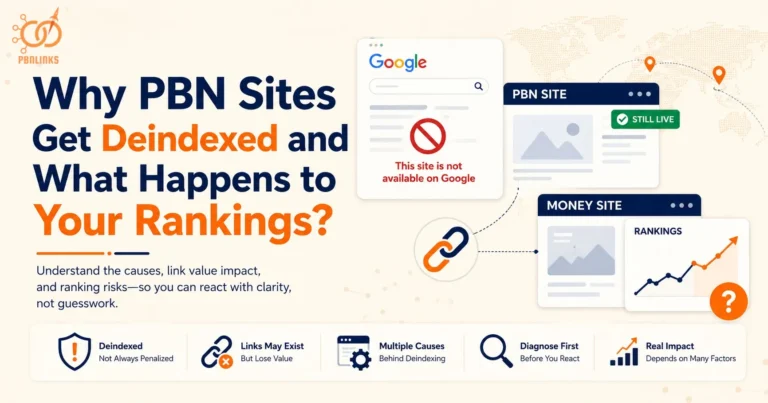
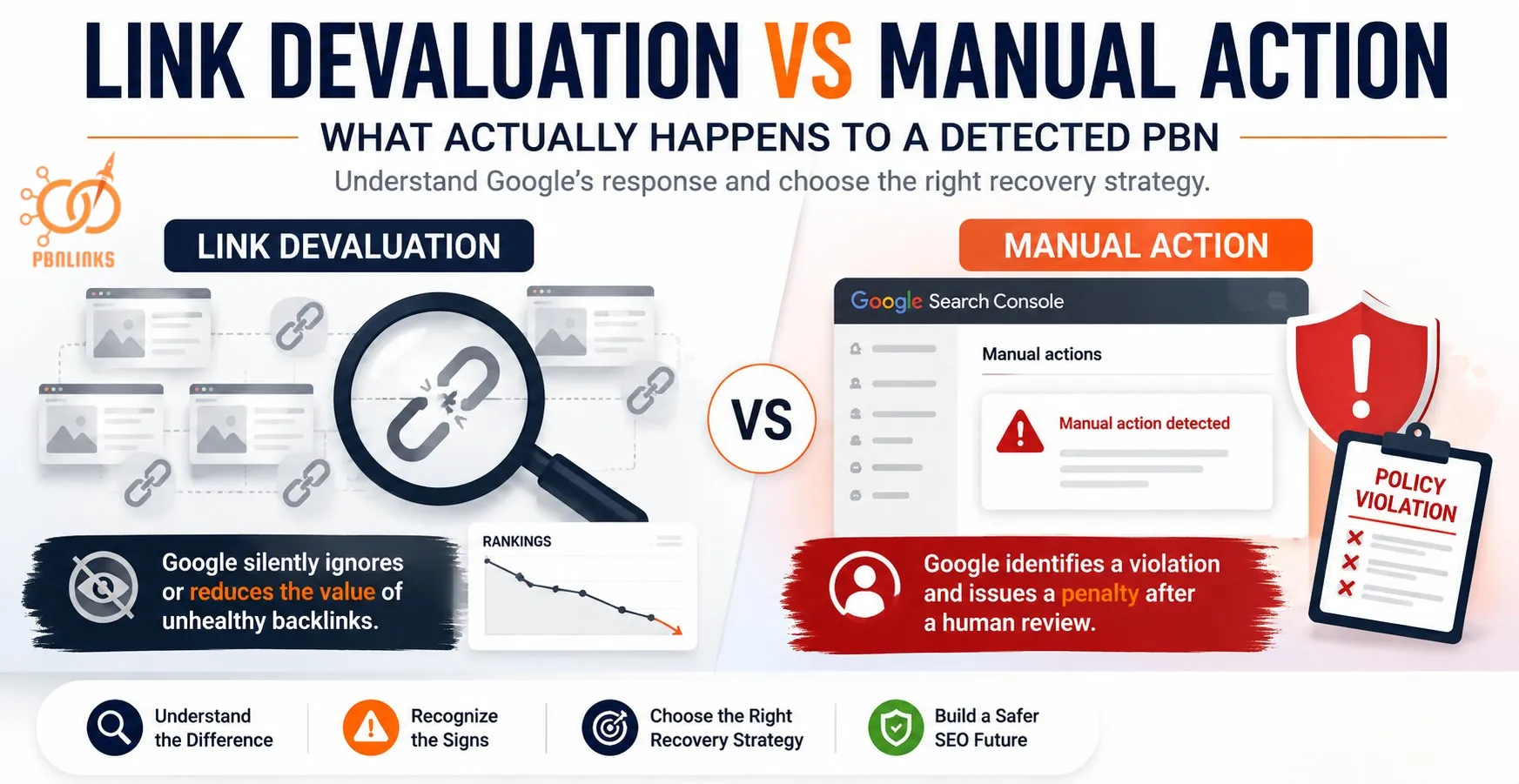
Your rankings dropped, but Google didn’t send a penalty notification. So what actually happened? In many cases, Google simply stops counting unnatural backlinks instead of penalizing your website. This process is known as link devaluation, and it is very different from receiving a manual action.
The difference between Link Devaluation vs Manual Action is often misunderstood, even by experienced SEO professionals. When Google detects suspicious PBN backlinks, it may quietly ignore those links so they no longer pass SEO value, or it may issue a manual action after a human review. Knowing which response affected your website is the first step toward choosing the right recovery strategy.
Choosing the wrong recovery approach can make the problem worse. Removing backlinks, submitting a reconsideration request, or changing your SEO strategy without first identifying what happened may delay recovery and waste valuable time.
This guide explains how Google responds to detected PBN backlinks, how to recognize the signs of each outcome, and the practical steps you can take to recover while building a safer long-term SEO strategy.
What Is Link Devaluation?
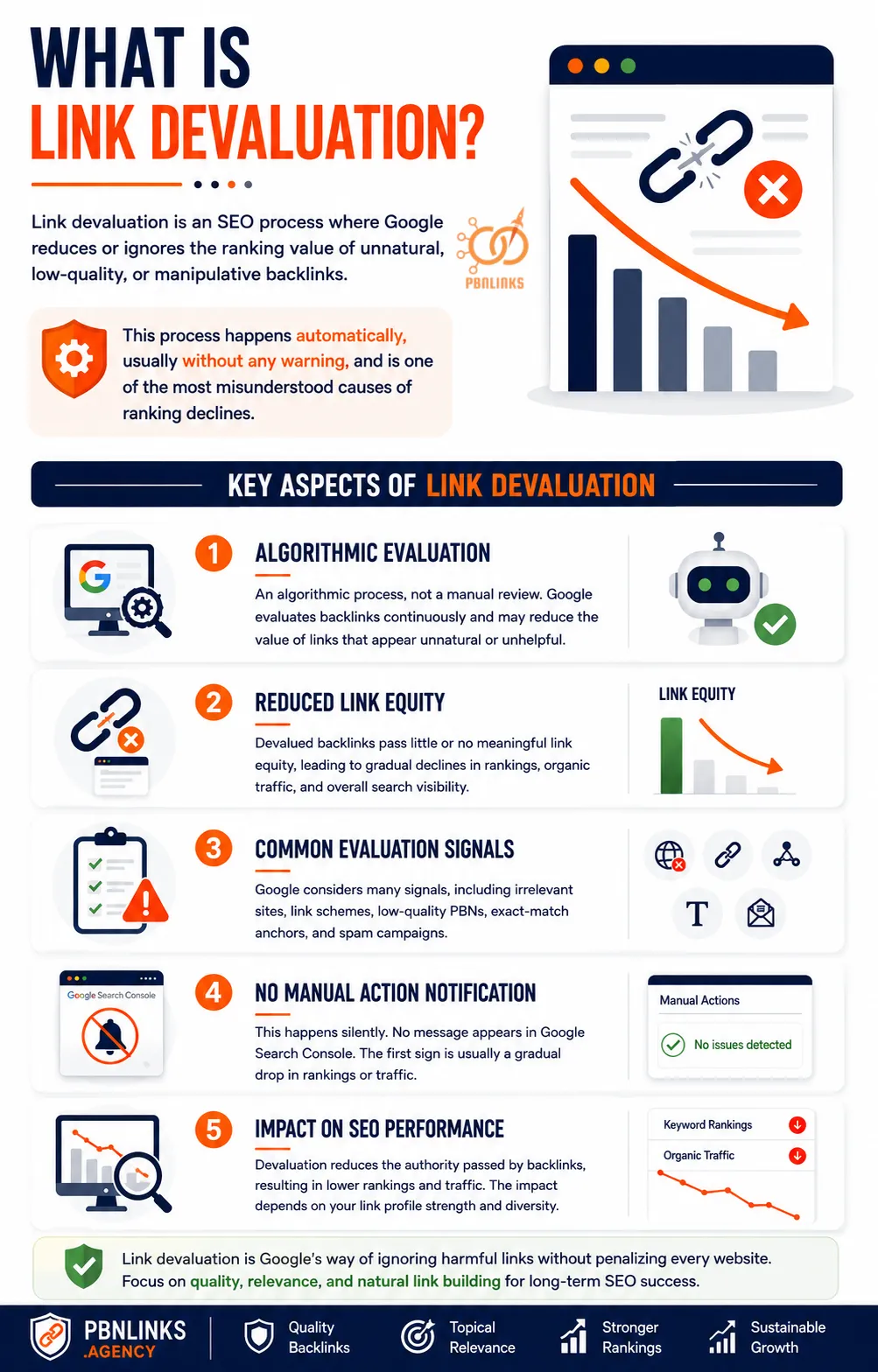
Link devaluation is an SEO process where Google reduces or ignores the ranking value of unnatural, low-quality, or manipulative backlinks. Instead of issuing a manual penalty, Google’s ranking systems simply stop those links from passing meaningful SEO value, reducing their influence on search rankings.
Link devaluation allows Google to reduce the impact of unnatural backlinks without penalizing every website associated with them. Because this process happens automatically, website owners usually receive no warning, making it one of the most commonly misunderstood causes of ranking declines.
Key Aspects of Link Devaluation
Algorithmic Evaluation
Link devaluation is an algorithmic process rather than a manual review. Google’s ranking systems evaluate backlinks continuously and may reduce the value of links that appear unnatural or unhelpful. Unlike a manual action, this process does not generate a notification in Google Search Console.
Reduced Link Equity
When a backlink is devalued, it passes little or no meaningful link equity to the linked page. As a result, pages that rely heavily on those backlinks may experience gradual declines in keyword rankings, organic traffic, and overall search visibility.
Common Evaluation Signals
Google evaluates many signals when assessing backlink quality. Links from topically irrelevant websites, obvious link schemes, low-quality Private Blog Networks, excessive exact-match anchor text, and large-scale spam campaigns are examples of patterns that may reduce a backlink’s SEO value. Google does not publicly disclose the exact signals or thresholds used by its ranking systems.
No Manual Action Notification
One of the defining characteristics of link devaluation is that it happens silently. Website owners are not notified when backlinks lose value, and no message appears in the Manual Actions section of Google Search Console. In most cases, the first indication is a gradual decline in rankings or reduced effectiveness of existing backlinks.
Impact on SEO Performance
Link devaluation can reduce the authority passed by backlinks, resulting in lower keyword rankings and decreased organic traffic over time. The impact depends on how much a website relies on the affected links and the overall strength and diversity of its backlink profile. Although the symptoms may resemble a Google penalty, the website has not received a manual action.
What Is a Manual Action?
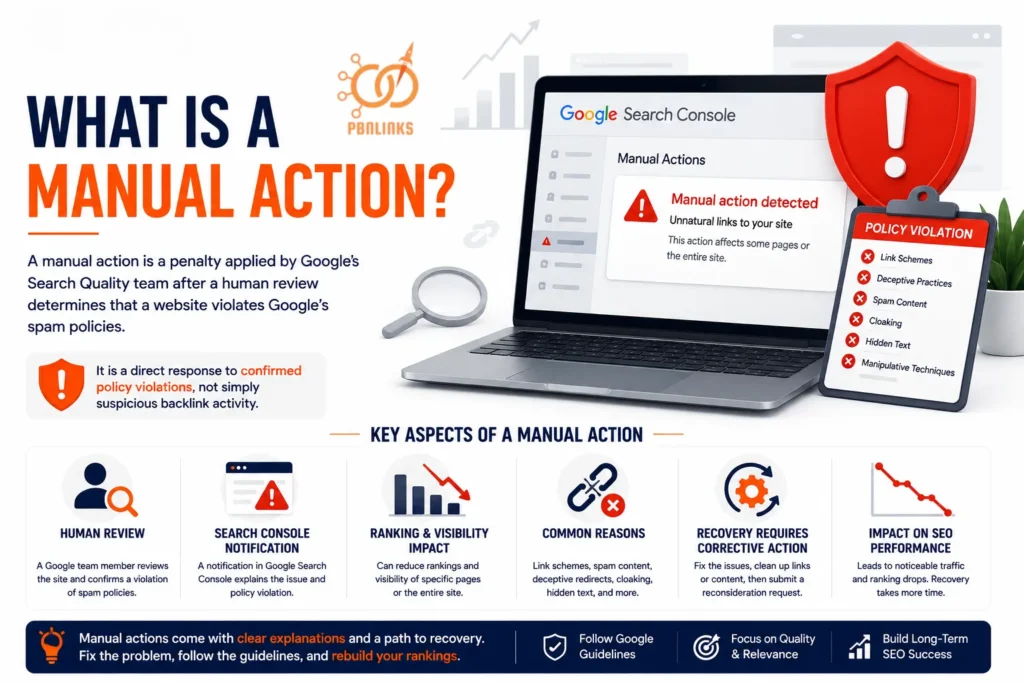
A manual action is a penalty applied by Google’s Search Quality team when a website is found to violate Google’s Search Essentials or spam policies. Unlike link devaluation, a manual action results from a human review and is accompanied by a notification in Google Search Console, explaining the issue that needs to be addressed.
Manual actions are typically reserved for more serious or repeated violations, such as participating in link schemes, using deceptive SEO practices, or creating spam intended to manipulate search rankings. Depending on the severity of the issue, Google may reduce the rankings of specific pages or take action against the entire website.
Key Aspects of a Manual Action
Human Review
A manual action is applied after a member of Google’s Search Quality team reviews a website and determines that it violates Google’s spam policies. Unlike algorithmic systems, this process involves human judgment before any penalty is issued.
Google Search Console Notification
One of the clearest signs of a manual action is a notification in the Manual Actions section of Google Search Console. The message explains the reason for the action and identifies the type of policy violation affecting the website.
Ranking and Visibility Impact
A manual action can reduce the visibility of individual pages or an entire website in Google Search. The severity of the impact depends on the type of violation and whether the action is applied at the page level or site level.
Common Reasons for Manual Actions
Google may apply a manual action for practices that violate its spam policies. Examples include participating in link schemes, using deceptive redirects, publishing automatically generated spam content, cloaking, hidden text, or engaging in other manipulative SEO techniques. The specific reason is usually described in the Google Search Console notification.
Recovery Requires Corrective Action
Recovering from a manual action requires identifying and fixing the underlying issue before requesting another review. Depending on the violation, this may involve removing or updating problematic backlinks, improving website content, correcting technical issues, or resolving other policy violations. Once the necessary changes have been made, a reconsideration request can be submitted through Google Search Console.
Impact on SEO Performance
Manual actions often cause noticeable declines in keyword rankings, organic traffic, and search visibility because Google actively limits the affected website’s presence in search results. Recovery usually takes longer than algorithmic changes because Google must review the corrective actions before removing the manual action.
A manual action is Google’s direct response to confirmed policy violations, not simply suspicious backlink activity. Because Google explains the issue through Google Search Console, website owners have a clear starting point for recovery. This makes manual actions fundamentally different from link devaluation, where backlinks lose value silently without any notification.
Link Devaluation vs Manual Action: Key Differences
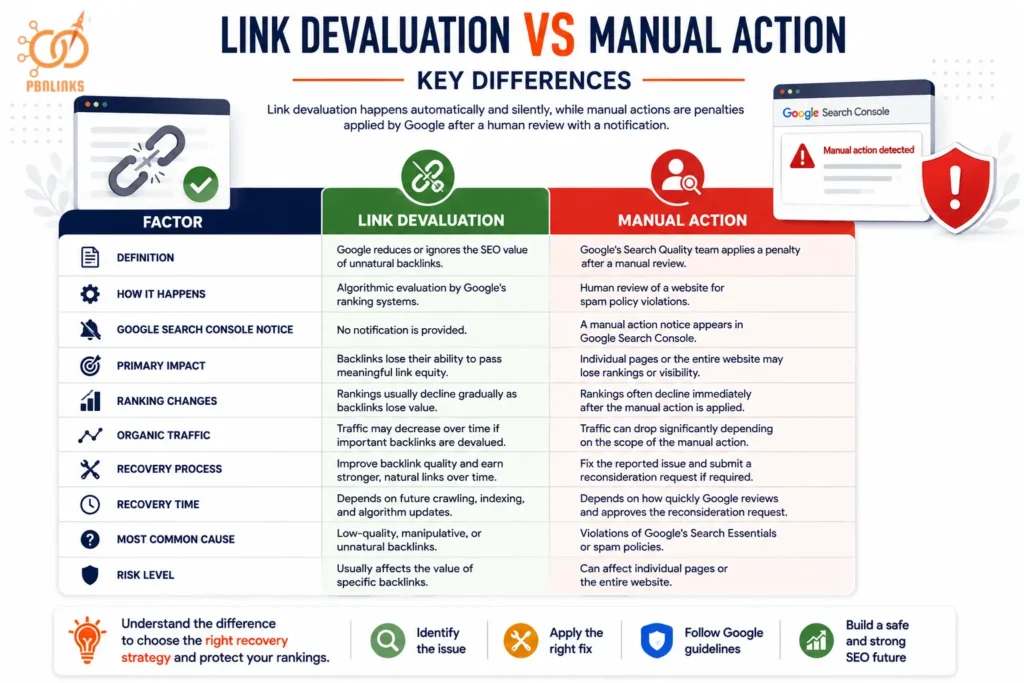
Link devaluation and manual actions both affect a website’s SEO performance, but they are not the same. Link devaluation is an automatic process where Google reduces or ignores the value of unnatural backlinks without notifying the website owner. A manual action is a penalty applied after a human review and is always accompanied by a notification in Google Search Console.
The table below highlights the main differences between the two.
| Factor | Link Devaluation | Manual Action |
| Definition | Google reduces or ignores the SEO value of unnatural backlinks. | Google’s Search Quality team applies a penalty after a manual review. |
| How It Happens | Algorithmic evaluation by Google’s ranking systems. | Human review of a website for spam policy violations. |
| Google Search Console Notice | No notification is provided. | A manual action notice appears in Google Search Console. |
| Primary Impact | Backlinks lose their ability to pass meaningful link equity. | Individual pages or the entire website may lose rankings or visibility. |
| Ranking Changes | Rankings usually decline gradually as backlinks lose value. | Rankings often decline immediately after the manual action is applied. |
| Organic Traffic | Traffic may decrease over time if important backlinks are devalued. | Traffic can drop significantly depending on the scope of the manual action. |
| Recovery Process | Improve backlink quality and earn stronger, natural links over time. | Fix the reported issue and submit a reconsideration request if required. |
| Recovery Time | Depends on future crawling, indexing, and algorithm updates. | Depends on how quickly Google reviews and approves the reconsideration request. |
| Most Common Cause | Low-quality, manipulative, or unnatural backlinks. | Violations of Google’s Search Essentials or spam policies. |
| Risk Level | Usually affects the value of specific backlinks. | Can affect individual pages or the entire website. |
How the Two Outcomes Affect SEO
Although both situations can reduce rankings, they affect websites in different ways. Link devaluation primarily reduces the value of backlinks, which weakens the authority those links pass to your pages. A manual action directly targets the website because Google has determined that it violates its spam policies.
Which Outcome Is More Common?
For most websites, link devaluation is far more common than a manual action. Google’s ranking systems are designed to ignore or reduce the value of many unnatural backlinks automatically rather than applying manual penalties. Manual actions are generally reserved for more serious or repeated violations that require human review.
Why the Difference Matters
Correctly identifying whether your website has experienced link devaluation or a manual action is the first step toward recovery. A website affected by link devaluation should focus on improving backlink quality and overall SEO, while a website with a manual action must resolve the reported issue before requesting another review from Google.
Understanding the difference between link devaluation and manual action helps you choose the right recovery strategy and avoid unnecessary SEO changes. Instead of assuming every ranking decline is a Google penalty, use Google Search Console, backlink analysis, and traffic data to identify what actually happened before taking action.
How Google Detects Unnatural PBN Links
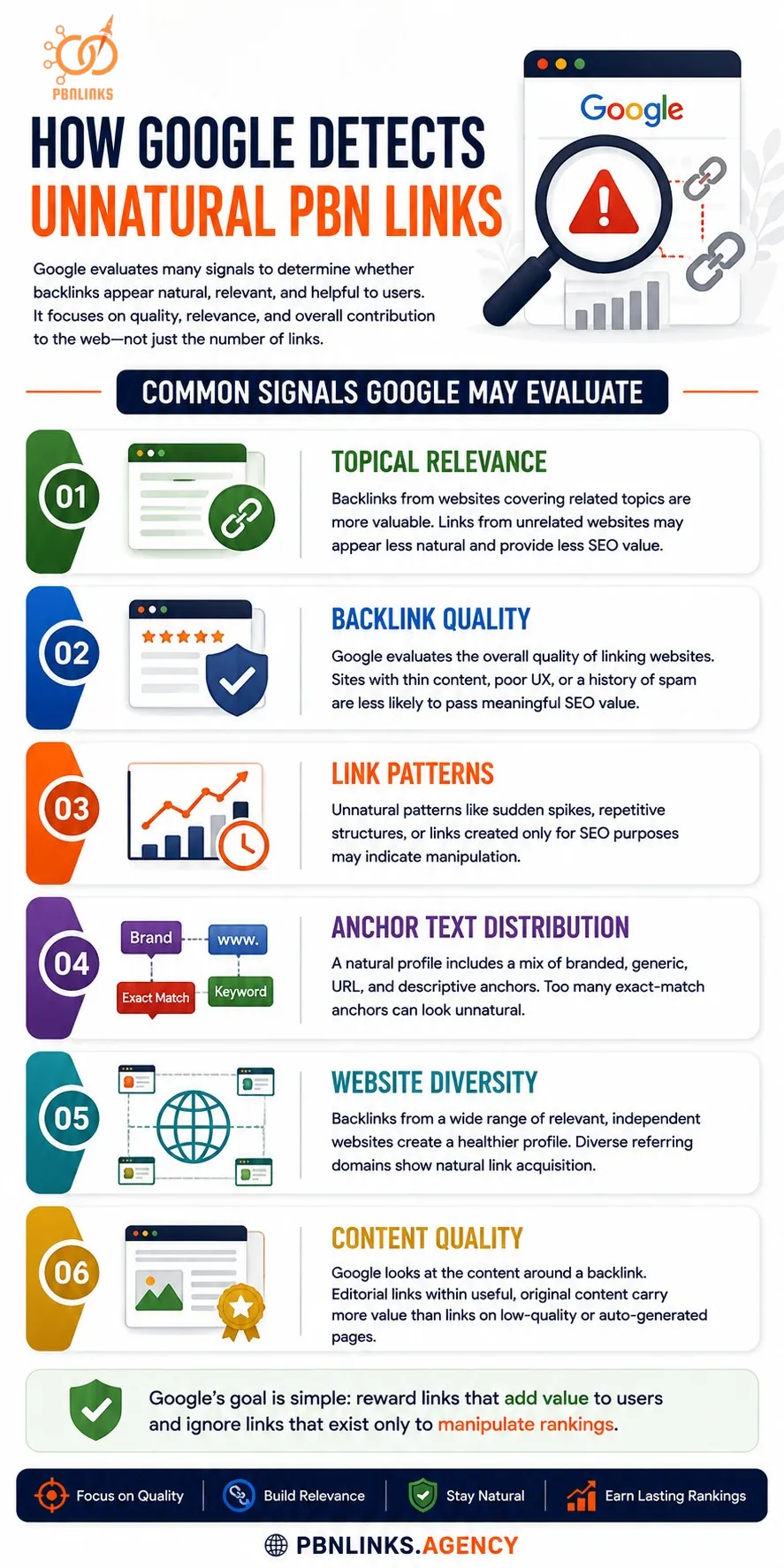
Google detects unnatural PBN links by evaluating backlink patterns, website quality, and signals that may indicate attempts to manipulate search rankings. Instead of relying on a single factor, Google’s ranking systems assess multiple signals to determine whether backlinks appear natural, relevant, and helpful to users.
Google does not publish the exact methods used to identify unnatural backlinks. However, through its Search Essentials, spam policies, and public statements, it is clear that the search engine evaluates backlinks based on their quality, relevance, and overall contribution to the web ecosystem rather than simply counting the number of links pointing to a website.
Common Signals Google May Evaluate
Topical Relevance
Backlinks are more valuable when they come from websites that cover related topics. Links between unrelated websites may appear less natural and provide less SEO value than links from relevant sources.
Backlink Quality
Google evaluates the overall quality of linking websites rather than treating every backlink equally. Websites with thin content, poor user experience, or a history of spam are less likely to pass meaningful SEO value.
Link Patterns
Unnatural backlink patterns may indicate attempts to manipulate rankings. Large numbers of backlinks appearing within a short period, repetitive linking structures, or links that exist primarily for SEO purposes may receive additional scrutiny.
Anchor Text Distribution
A natural backlink profile contains a mix of branded, generic, URL, and descriptive anchor text. Excessive use of exact-match anchor text can make backlink profiles appear less natural.
Website Diversity
Backlinks from a wide variety of relevant websites generally create a healthier backlink profile than links concentrated within a small group of closely related websites. Diverse referring domains help demonstrate natural link acquisition.
Content Quality
Google also considers the quality of the content surrounding a backlink. Editorial links placed naturally within useful, original content generally provide more value than links embedded in low-quality or automatically generated pages.
What Google Does After Detecting Unnatural Links
After identifying suspicious backlinks, Google may respond in different ways depending on the overall situation. In many cases, its ranking systems simply reduce or ignore the SEO value of the affected links through link devaluation. For more serious or repeated violations of Google’s spam policies, the website may receive a manual action after a human review.
This distinction explains why two websites with similar backlink profiles can experience very different outcomes. One may simply lose the benefit of certain backlinks, while another may receive a manual penalty if Google’s Search Quality team determines that its practices violate Google’s policies.
Google evaluates backlinks based on overall quality and natural linking patterns rather than any single signal. Building relevant, editorially placed backlinks from trustworthy websites remains the most effective way to reduce long-term SEO risk. Instead of trying to avoid individual detection signals, focus on creating a backlink profile that appears natural because it is built on quality, relevance, and sustainable SEO practices.
How to Tell Which One Affected Your Website
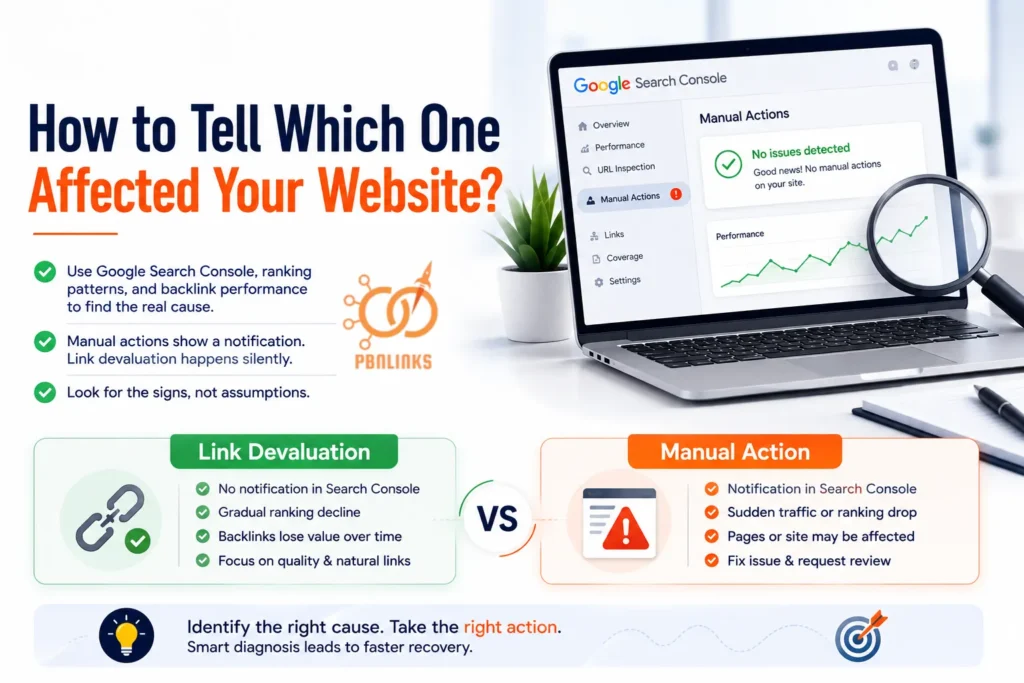
The easiest way to identify whether your website has experienced link devaluation or a manual action is to review Google Search Console, ranking patterns, and backlink performance together. A manual action always includes a notification in Google Search Console, while link devaluation happens silently and is usually identified through gradual declines in rankings and reduced backlink effectiveness.
Instead of assuming every traffic loss is a penalty, look for evidence that matches the symptoms of each situation. The comparison below highlights the most common indicators.
| Diagnostic Signal | Link Devaluation | Manual Action |
| Google Search Console Notification | No notification. | A manual action notice appears in Google Search Console. |
| Ranking Changes | Usually gradual as backlinks lose value. | Often sudden after the manual action is applied. |
| Organic Traffic | May decline over weeks or months. | Can drop sharply depending on the scope of the penalty. |
| Backlink Performance | Existing backlinks stop contributing meaningful SEO value. | Backlinks may remain live, but rankings are limited by the manual action. |
| Recovery Method | Improve backlink quality and strengthen overall SEO. | Fix the reported issue and submit a reconsideration request. |
Signs of Link Devaluation
Several indicators suggest that your backlinks have been devalued rather than your website being penalized.
No Manual Action Notice
The Manual Actions section of Google Search Console shows no reported issues, even though rankings have declined.
Gradual Ranking Decline
Keyword rankings slowly decrease over time instead of dropping immediately after a specific event.
Backlinks Remain Live
Your backlinks are still indexed and visible, but they no longer appear to improve rankings or organic traffic.
No Major Technical Problems
The website remains indexed, pages continue to appear in search results, and no significant crawling or indexing issues are reported.
Signs of a Manual Action
A manual action usually provides much clearer evidence because Google explains the issue directly.
Manual Action Notification
Google Search Console displays a message describing the policy violation and the type of manual action affecting the website.
Sudden Loss of Visibility
Individual pages or the entire website may lose rankings quickly after the manual action is applied.
Policy Violation Identified
The notification typically references issues such as unnatural links, spam, or other violations of Google’s Search Essentials.
Reconsideration Required
The issue will generally remain until the reported violations are corrected and a successful reconsideration request is reviewed by Google.
What to Check Before Taking Action
Before removing backlinks or changing your SEO strategy, review the following areas:
- Google Search Console for manual action notifications.
- Organic traffic trends in Google Analytics or other analytics platforms.
- Keyword rankings to identify whether declines were gradual or sudden.
- Backlink profile to evaluate link quality, relevance, and recent changes.
- Recent Google algorithm updates that may explain ranking fluctuations.
Diagnosing the problem correctly is the most important step before attempting recovery. Acting without evidence can lead to unnecessary backlink removal, wasted time, or changes that do not address the real issue. A careful review of Google Search Console, backlink data, and ranking trends will usually provide enough information to determine whether your website has experienced link devaluation or a manual action.
Recovery Strategies for Link Devaluation vs Manual Action
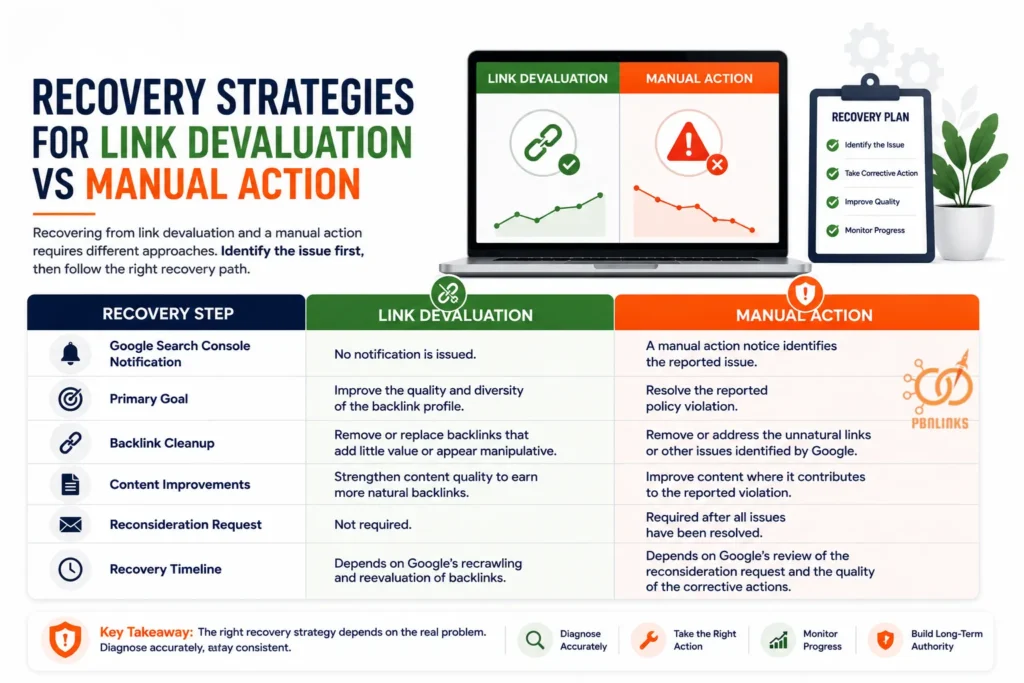
Recovering from link devaluation and recovering from a manual action require different approaches because the underlying problems are different. Link devaluation focuses on rebuilding backlink quality and overall website authority, while a manual action requires fixing the reported violation before Google will reconsider the website.
Before making changes, identify which situation applies to your website. Removing valuable backlinks or submitting a reconsideration request without understanding the actual problem can delay recovery and create unnecessary work.
Recovery Comparison
| Recovery Step | Link Devaluation | Manual Action |
| Google Search Console Notification | No notification is issued. | A manual action notice identifies the reported issue. |
| Primary Goal | Improve the quality and diversity of the backlink profile. | Resolve the reported policy violation. |
| Backlink Cleanup | Remove or replace backlinks that add little value or appear manipulative. | Remove or address the unnatural links or other issues identified by Google. |
| Content Improvements | Strengthen content quality to earn more natural backlinks. | Improve content where it contributes to the reported violation. |
| Reconsideration Request | Not required. | Required after all issues have been resolved. |
| Recovery Timeline | Depends on Google’s recrawling and reevaluation of backlinks. | Depends on Google’s review of the reconsideration request and the quality of the corrective actions. |
Recovering from Link Devaluation
Improve Backlink Quality
Focus on earning backlinks from trustworthy, relevant websites instead of relying on links that Google may no longer value. A stronger backlink profile helps rebuild authority over time.
Strengthen Content Quality
Publish helpful, original, and comprehensive content that naturally attracts editorial backlinks. High-quality content supports long-term SEO growth and reduces dependence on artificial link building.
Diversify Your Link Profile
Build backlinks from a variety of relevant sources using natural anchor text. A diverse backlink profile is generally more resilient than one that relies heavily on a single type of link.
Monitor SEO Performance
Track keyword rankings, organic traffic, and backlink quality regularly. Monitoring performance helps determine whether Google’s evaluation of your website is improving over time.
Recovering from a Manual Action
Review Google’s Notice Carefully
Read the manual action report in Google Search Console to understand exactly which policy has been violated. Every recovery plan should begin with Google’s explanation of the problem.
Resolve the Reported Issues
Correct the issues identified in the manual action notice. Depending on the violation, this may include removing unnatural backlinks, updating website content, or fixing other practices that violate Google’s Search Essentials.
Submit a Reconsideration Request
Once the reported issues have been resolved, submit a reconsideration request through Google Search Console. Clearly explain the corrective actions taken and provide accurate information about the improvements made.
Continue Following Google’s Guidelines
Even after a manual action is removed, continue building backlinks naturally and maintaining a high-quality website. Long-term compliance with Google’s Search Essentials helps reduce the likelihood of future manual actions.
Recovery starts with an accurate diagnosis, not immediate action. Websites affected by link devaluation benefit from stronger backlink quality and long-term SEO improvements, while websites with a manual action must first resolve the reported violation before recovery can begin. Choosing the correct recovery strategy saves time, protects valuable backlinks, and supports more sustainable search performance.
Best Practices to Reduce the Risk of Link Devaluation and Manual Actions
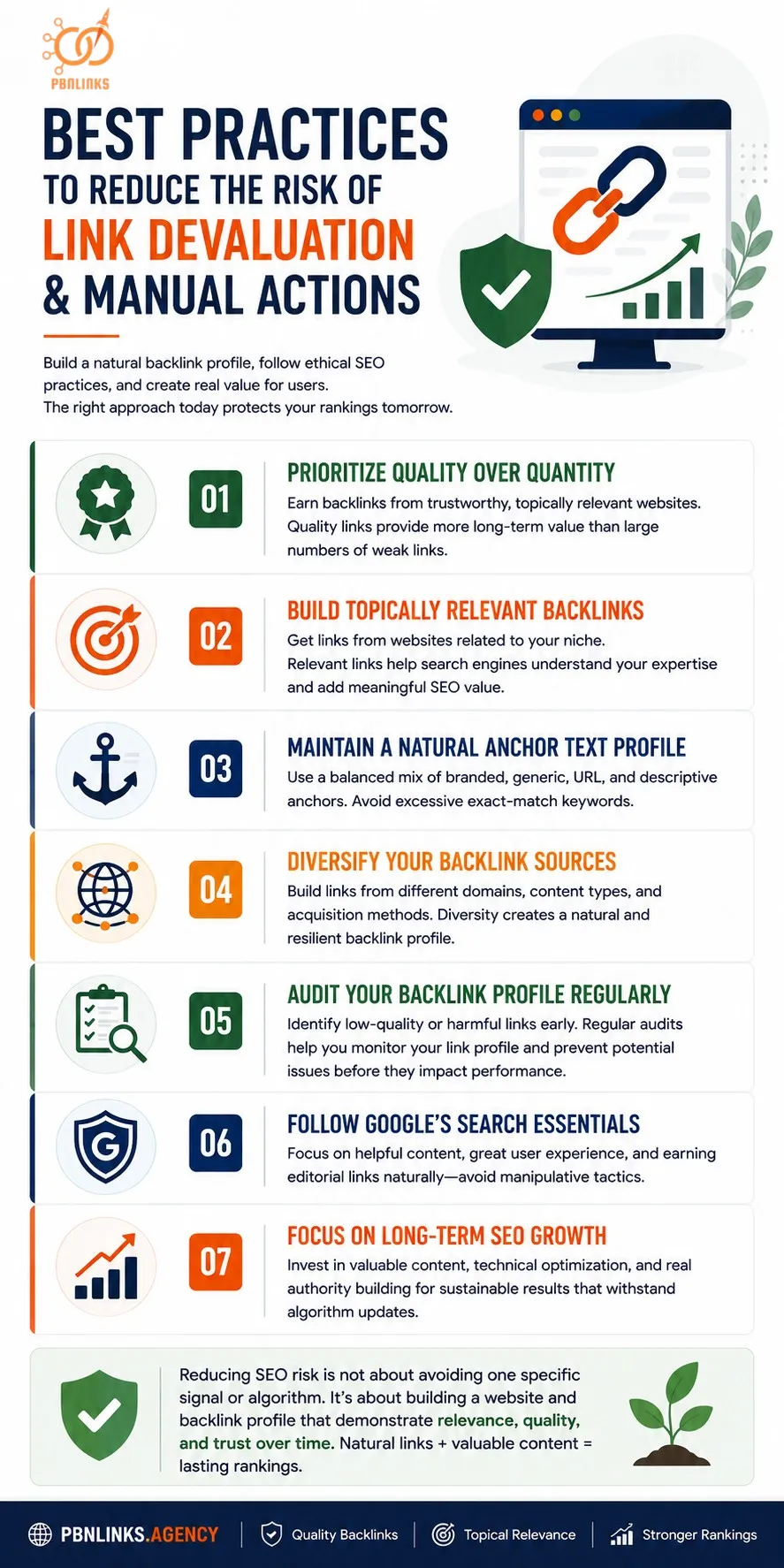
The best way to reduce the risk of link devaluation or a manual action is to build backlinks that provide genuine value instead of trying to manipulate search rankings. A natural backlink profile supported by high-quality content, relevant websites, and ethical SEO practices is far more likely to remain effective over the long term.
Google’s ranking systems continue to evolve, but their overall goal remains the same: reward websites that earn trust naturally and reduce the influence of manipulative link-building practices. Following sustainable SEO practices helps protect your website from both algorithmic link devaluation and manual actions.
Prioritize Quality Over Quantity
Focus on earning backlinks from trustworthy and topically relevant websites instead of collecting large numbers of low-quality links. A smaller number of high-quality backlinks generally provides more long-term SEO value than hundreds of weak or unrelated links.
Build Topically Relevant Backlinks
Backlinks should come from websites that are closely related to your niche or industry. Relevant links help search engines understand your website’s expertise and are more likely to contribute meaningful SEO value than links from unrelated sources.
Maintain a Natural Anchor Text Profile
Use a balanced mix of branded, generic, URL, and descriptive anchor text. Relying too heavily on exact-match keywords can make a backlink profile appear manipulated and increase the likelihood of links losing value.
Diversify Your Backlink Sources
Avoid depending on a single type of backlink or a small group of websites. A healthy backlink profile includes links from different domains, content types, and acquisition methods, creating a more natural and resilient SEO foundation.
Audit Your Backlink Profile Regularly
Review your backlinks on a regular basis to identify low-quality, irrelevant, or potentially harmful links. Regular backlink audits help you monitor changes in your link profile and identify issues before they affect search performance.
Follow Google’s Search Essentials
Build your SEO strategy around Google’s published guidance instead of short-term ranking tactics. Creating helpful content, improving user experience, and earning editorial backlinks naturally are more sustainable approaches than relying on manipulative link-building techniques.
Focus on Long-Term SEO Growth
Successful SEO is built through consistent improvements rather than quick wins. Investing in valuable content, technical optimization, and natural authority building creates a stronger website that is less vulnerable to algorithm updates and manual reviews.
Reducing SEO risk is not about avoiding one specific signal or algorithm. It is about building a website and backlink profile that continue to demonstrate relevance, quality, and trust over time. When backlinks are earned naturally and support useful content, they are far more likely to retain their value regardless of future changes to Google’s ranking systems.
Conclusion
In conclusion, link devaluation and manual actions are two very different ways Google responds to unnatural backlinks. Link devaluation is an algorithmic process that quietly reduces or ignores the SEO value of suspicious links, while a manual action is a human-reviewed penalty that appears in Google Search Console. Understanding the difference helps you diagnose ranking problems more accurately and choose the correct recovery strategy.
Building a sustainable SEO strategy means focusing on high-quality, relevant backlinks rather than relying on manipulative link-building techniques. Regular backlink audits, natural anchor text, strong topical relevance, and compliance with Google’s Search Essentials all help reduce the risk of losing rankings through either algorithmic link devaluation or manual actions. Long-term SEO success comes from earning trust instead of trying to manipulate search results.
Whether you’re managing a Private Blog Network or evaluating an existing backlink profile, identifying the real cause of ranking changes should always come before making major SEO decisions. A careful review of your backlinks, search performance, and Google Search Console data will help you respond more effectively and protect your website’s long-term search visibility.
Ready to Build a Safer Backlink Strategy?
If you’re looking for professionally managed PBN backlinks, expert guidance, and sustainable link-building solutions, visit PBNLinks.Agency. Our team focuses on quality, relevance, and long-term SEO strategies designed to help websites build authority while reducing unnecessary risk.
FAQs About Link Devaluation VS Manual Action
1. What is the difference between link devaluation and a manual action?
Link devaluation reduces or ignores the SEO value of unnatural backlinks, while a manual action is a penalty applied after a human review. Link devaluation happens silently, whereas a manual action appears in Google Search Console with a notification explaining the violation.
2. Does Google always issue a manual action for PBN backlinks?
No, Google does not always issue a manual action for PBN backlinks. In many cases, Google’s ranking systems simply devalue or ignore unnatural links instead of applying a manual penalty.
3. How can I tell if my website has experienced link devaluation?
Check your rankings, backlink performance, and Google Search Console. If rankings decline gradually, backlinks stop improving SEO performance, and no manual action notification appears, link devaluation is the more likely explanation.
4. How do I know if I have a manual action?
Check the Manual Actions report in Google Search Console. If Google has applied a manual action, it will display a notification describing the policy violation and the affected pages or website.
5. Can link devaluation cause a drop in rankings?
Yes, link devaluation can reduce rankings if important backlinks lose their SEO value. The impact depends on how much your website relies on the affected backlinks and the overall strength of your backlink profile.
6. Can a website recover from link devaluation?
Yes, websites can recover from link devaluation by improving backlink quality and strengthening overall SEO. Earning relevant, high-quality backlinks and publishing valuable content helps rebuild authority over time.
7. Do I need to submit a reconsideration request after link devaluation?
No, a reconsideration request is only required for manual actions. Link devaluation is handled algorithmically, so recovery depends on improving your backlink profile rather than requesting a manual review.
8. What usually causes a manual action for unnatural links?
Manual actions are typically caused by link schemes or other violations of Google’s spam policies. Google may take manual action when it determines that a website is intentionally manipulating search rankings through unnatural linking practices.
9. Can Google ignore bad backlinks instead of penalizing a website?
Yes, Google often ignores or reduces the value of low-quality backlinks instead of penalizing the entire website. This approach helps limit the influence of manipulative links while avoiding unnecessary manual actions.
10. Which is more common: link devaluation or a manual action?
Link devaluation is generally more common than a manual action. Google’s ranking systems frequently reduce the value of unnatural backlinks automatically, while manual actions are usually reserved for more serious or repeated violations that require human review.