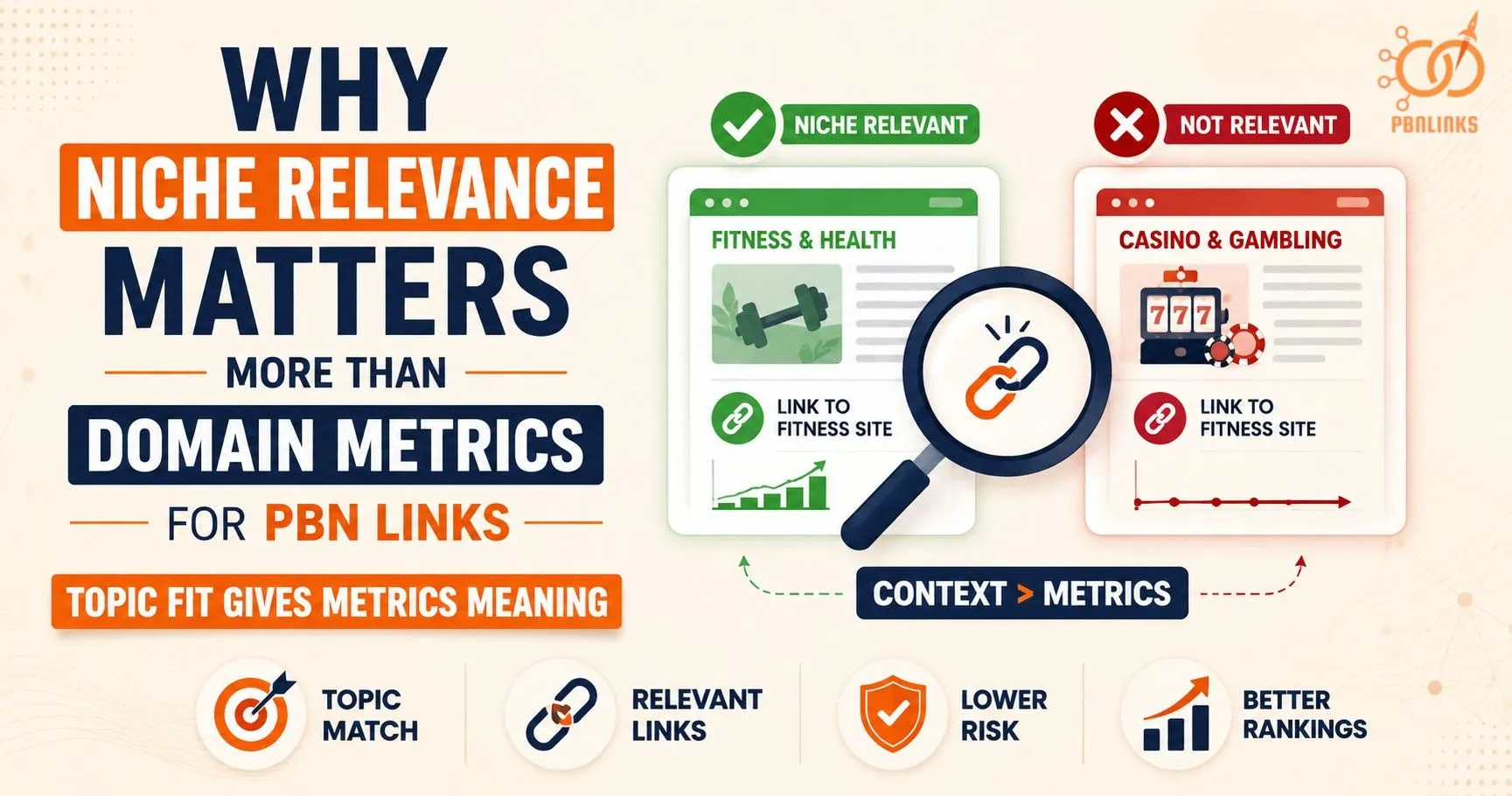
Why Niche Relevance Matters More Than Domain Metrics for PBN Links
A powerful-looking PBN domain can still be a poor backlink choice if it has no real connection to your niche. Many buyers check DR, DA, TF, or CF first and relevance second, but that order creates weak decisions because metrics cannot explain topical fit.
The real pbn link niche relevance importance is that topic fit gives domain metrics meaning. If a domain is disconnected from the target site’s subject, its strong numbers may look valuable but pass little practical SEO value.
This mistake can waste budget and reduce link quality. A domain may meet every metric threshold, yet still fail because its current content, historical content, backlink sources, language, location, audience, or outbound-link pattern does not match the target website.
Search engines evaluate links through context, not numbers alone. This guide explains how to judge niche relevance before trusting metrics, including current content, historical topic checks, backlink-source review, strictness levels, adjacent niches, anchor text, content repair, and what to do when a perfect niche match is not available.
What Niche Relevance Actually Means for a PBN Domain
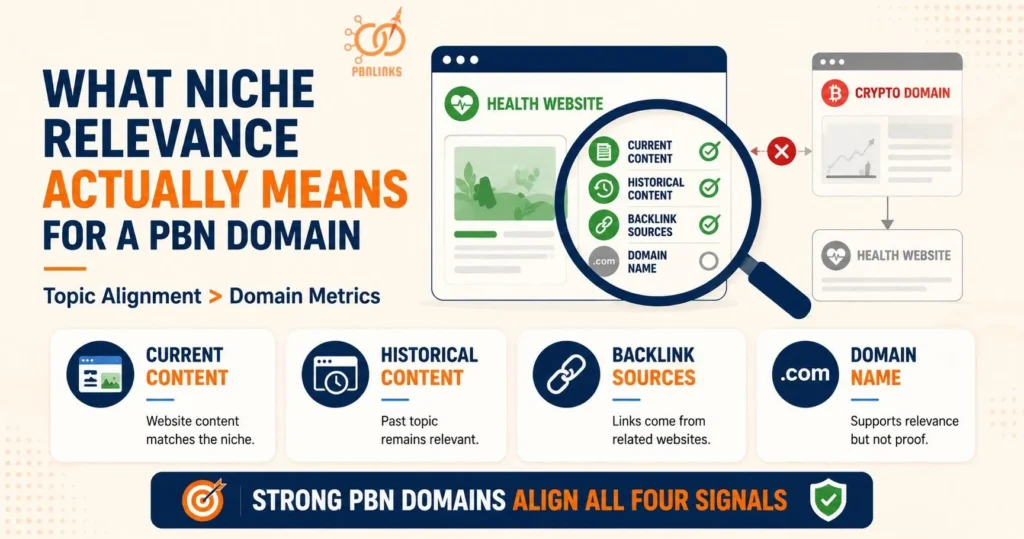
Niche relevance means a PBN domain genuinely matches the target site’s subject area through its current content, historical content, and backlink sources. It is not about a domain name that sounds related. It is about whether the domain’s real topic supports the money site.
This matters because a relevant PBN domain creates a believable topical connection. A health website, for example, fits naturally with health, fitness, nutrition, or wellness content. The same health website gets a weaker signal from gaming, crypto, automotive, or unrelated general content.
To judge niche relevance properly, look at four main signals:
- Current content: The domain should publish topics that match the target niche.
- Historical content: The domain’s past content should support the same or a closely related topic.
- Backlink sources: The domain should have links from related websites, blogs, or industry sources.
- Domain name: The name can support the relevance check, but it is only a weak signal.
The strongest PBN domain has alignment across all these signals. If the domain name sounds relevant but its old content and backlinks belong to another niche, the relevance is weak. Real niche relevance comes from consistent topic alignment, not surface-level wording.
Why PBN Link Niche Relevance Beats Identical DR Scores
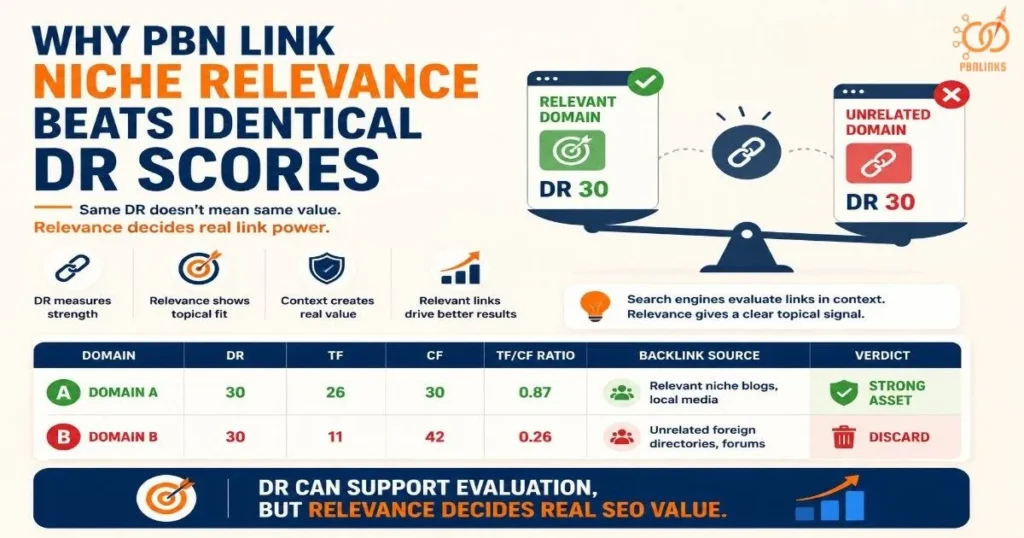
PBN link niche relevance beats identical DR scores because two domains can show the same rating but pass very different SEO value. DR shows backlink strength, but relevance shows whether that strength fits the target site’s topic.
This is where many buyers make the wrong decision. A beginner may see two DR 30 domains and assume they are equal. An experienced buyer checks trust quality, backlink sources, topical fit, and whether the domain’s link profile supports the money site’s niche.
The difference matters because search engines evaluate links in context. A relevant domain gives the target page a clearer topical signal. An unrelated domain can send weak or confusing signals, even when its headline metrics look strong.
| Domain | DR | TF | CF | TF/CF Ratio | Backlink Source | Verdict |
| Domain A | 30 | 26 | 30 | 0.87 | Relevant niche blogs, local media | Strong asset |
| Domain B | 30 | 11 | 42 | 0.26 | Unrelated foreign directories, forums | Discard |
Domain A is the stronger asset because its backlinks come from related and trusted sources. Its DR is supported by niche-relevant links, so the metric has useful topical context.
Domain B has the same DR, but its lower trust ratio and unrelated backlink sources weaken the domain. The score may look equal, but the link value is not equal.
This is why relevance must be checked before metrics decide anything. DR can support evaluation, but PBN link niche relevance decides whether the link strength actually makes SEO sense.
Why PBN Link Metrics Can’t See Niche Relevance
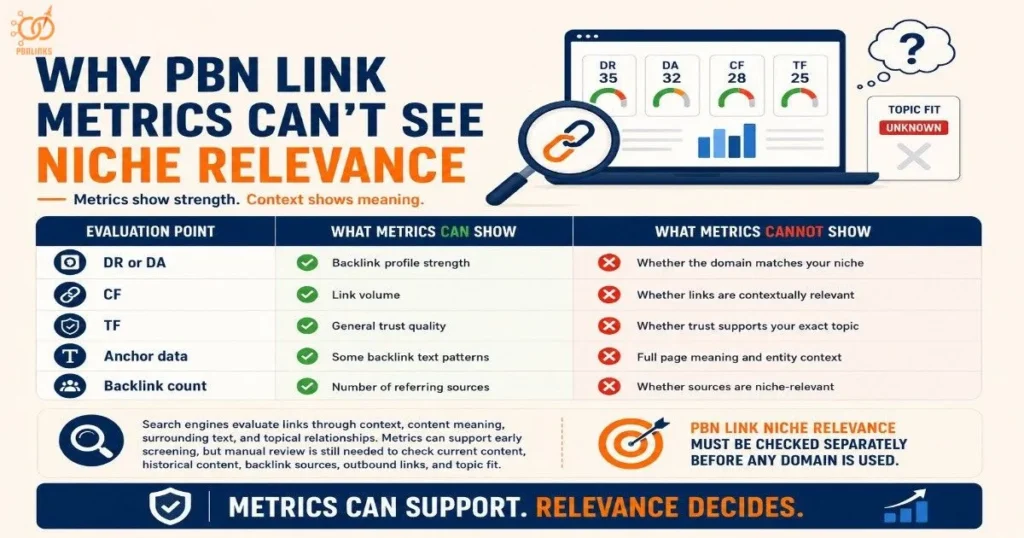
PBN link metrics cannot see niche relevance because DR, DA, CF, and TF measure backlink strength, not topical meaning. These scores can show how strong a domain appears, but they cannot confirm whether the domain matches the target site’s subject.
A domain may have strong metrics because it earned links in an old niche. If that expired domain is later rebuilt for another topic, the score can still look strong while the real topical connection becomes weak.
This is why metrics alone can mislead buyers. Third-party tools count links, estimate authority, and show trust patterns, but they do not fully understand page meaning, entity context, audience intent, or whether the domain naturally belongs in your niche.
| Evaluation Point | What Metrics Can Show | What Metrics Cannot Show |
| DR or DA | Backlink profile strength | Whether the domain matches your niche |
| CF | Link volume | Whether links are contextually relevant |
| TF | General trust quality | Whether trust supports your exact topic |
| Anchor data | Some backlink text patterns | Full page meaning and entity context |
| Backlink count | Number of referring sources | Whether sources are niche-relevant |
Search engines evaluate links through context, content meaning, surrounding text, and topical relationships. Metrics can support early screening, but manual review is still needed to check current content, historical content, backlink sources, outbound links, and topic fit.
This is a structural limitation, not a small tool flaw. PBN link niche relevance must be checked separately before any domain is treated as a useful link asset.
How PBN Link Niche Relevance Relates to Topical Trust Flow
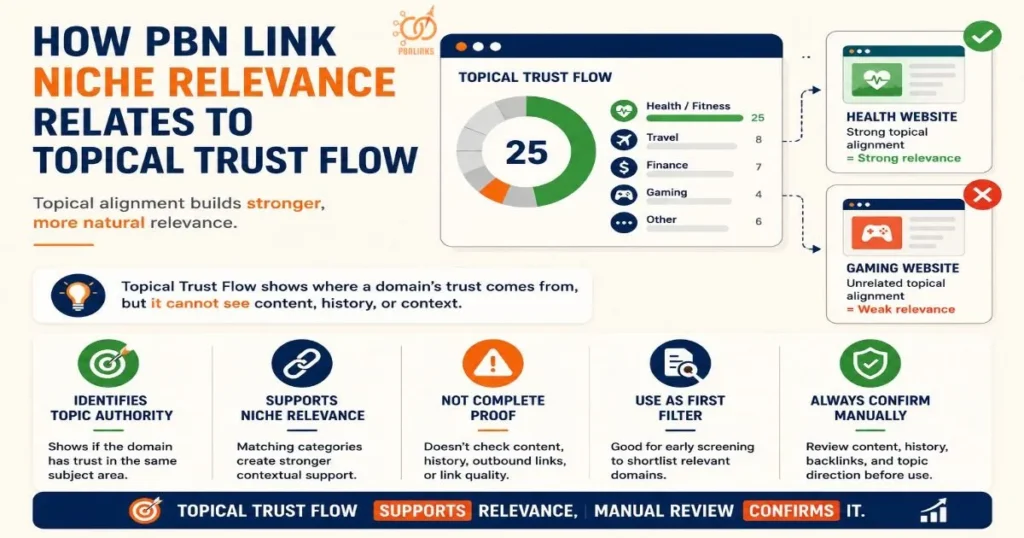
Topical Trust Flow relates to PBN link niche relevance because it shows which topic categories a domain’s backlink trust comes from. It is one of the closest supporting metrics for checking relevance, but it should not be treated as final proof.
Topical Trust Flow helps identify whether a domain has authority in the same subject area as the target site. For example, a health domain with health-based trust is more relevant for a health website than a domain whose trust comes from gaming, travel, finance, or unrelated sources.
This matters because PBN link niche relevance depends on topical alignment, not just backlink strength. If the domain’s trust comes from a matching category, the link has stronger contextual support. If the category is unrelated, the domain may look powerful but still send a weak relevance signal.
However, Topical Trust Flow can miss important details. A domain may show a relevant category while its current content, archived history, outbound links, or backlink sources are mixed. This is why the metric should support manual review, not replace it.
The best approach is to use Topical Trust Flow as the first relevance filter. Then confirm the domain’s current content, historical content, backlink sources, and topic direction before treating it as a strong PBN asset.
How to Check a PBN Domain’s Niche Relevance
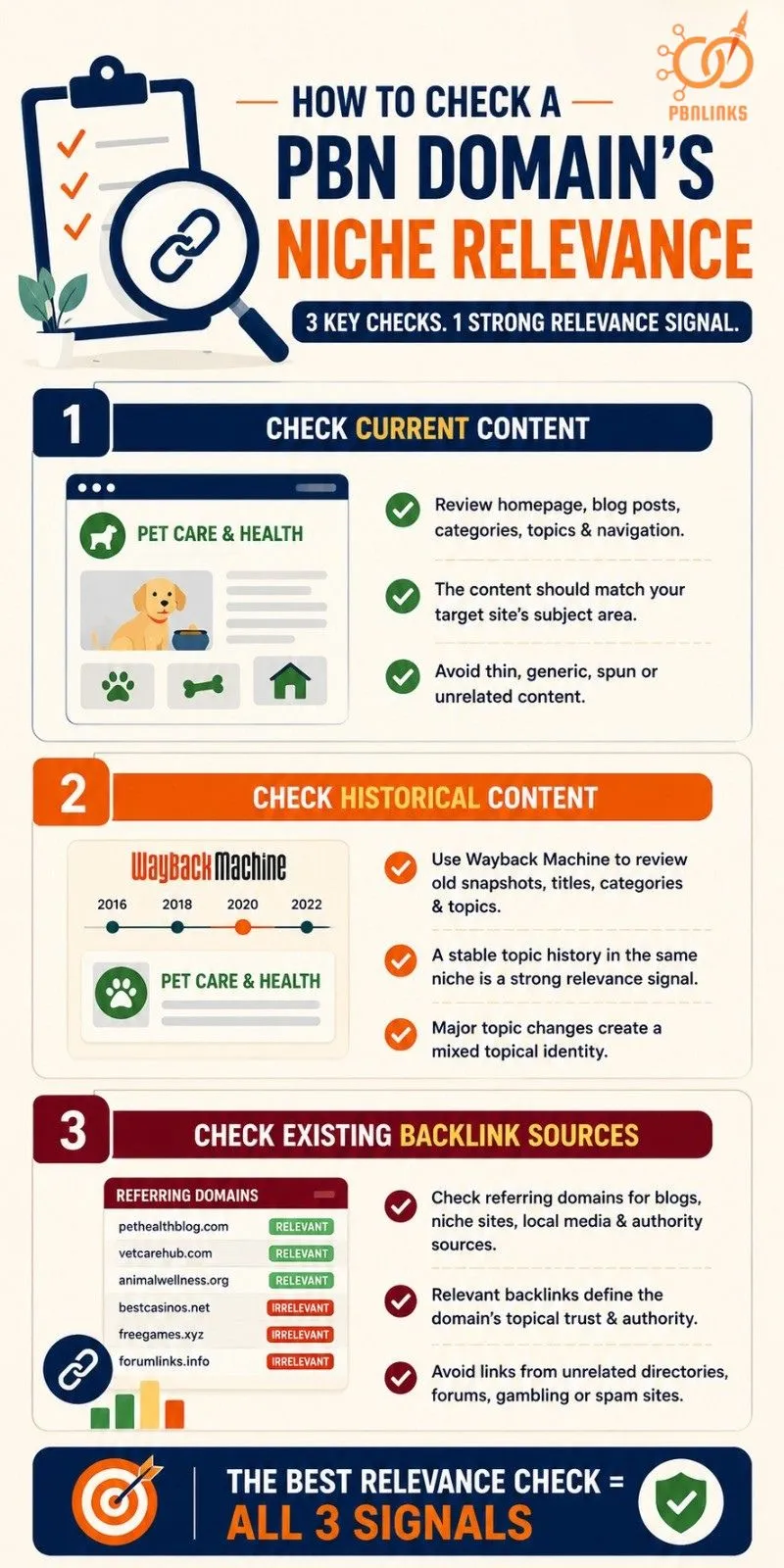
To check a PBN domain’s niche relevance, review its current content, historical content, and existing backlink sources before trusting its metrics. These three checks show whether the domain truly matches the target site’s subject area or only looks useful on the surface.
This process matters because DR, DA, TF, or CF cannot confirm topical fit alone. A strong PBN domain should show the same niche direction across live content, archived history, and referring domains before it is treated as a useful link asset.
Checking Current Content
Current content is the first and fastest relevance check. Review the homepage, blog posts, categories, article topics, navigation, and outbound links to see whether the domain’s live content matches the target site.
The content should feel like it belongs in the same subject area. For example, a pet care target site fits better with animal health, grooming, veterinary, pet food, or breeder-related content than with finance, gaming, or crypto content.
If the live content is thin, generic, spun, or unrelated, the domain is a weak candidate. Strong metrics cannot fix a domain whose current topic does not support the money site’s niche.
Checking Historical Content with Wayback Machine
Historical content shows what the domain was originally about before it was acquired, rebuilt, or repurposed. Use the Wayback Machine to review old snapshots, page titles, categories, article themes, and language patterns.
A stable topic history is a strong relevance signal. If the domain has always covered health, pets, finance, travel, or another clear category, it is easier to trust within that same subject area.
A domain with dramatic topic changes is weaker. If it moved from gaming to health to finance, its current content may look relevant, but the historical mismatch creates a mixed topical identity.
Checking Existing Backlink Sources
Existing backlink sources show where the domain’s trust and topical signals come from. Review the referring domains to see whether they come from related blogs, niche publications, local media, industry directories, or authority sites in the same topic area.
A domain with backlinks from genuinely relevant sources is stronger than one with scattered links from unrelated directories, forums, foreign sites, gambling pages, or spam-heavy sources. Backlinks help define the domain’s real topical profile.
This connects directly to the earlier DR comparison. Domain A was stronger because its backlinks came from relevant niche blogs and local media, while Domain B relied on unrelated directories and forums.
The best PBN relevance check combines all three signals. Current content shows what the domain is now, historical content shows what it was before, and backlink sources show where its topical trust comes from.
How Strict Does PBN Link Niche Relevance Need to Be
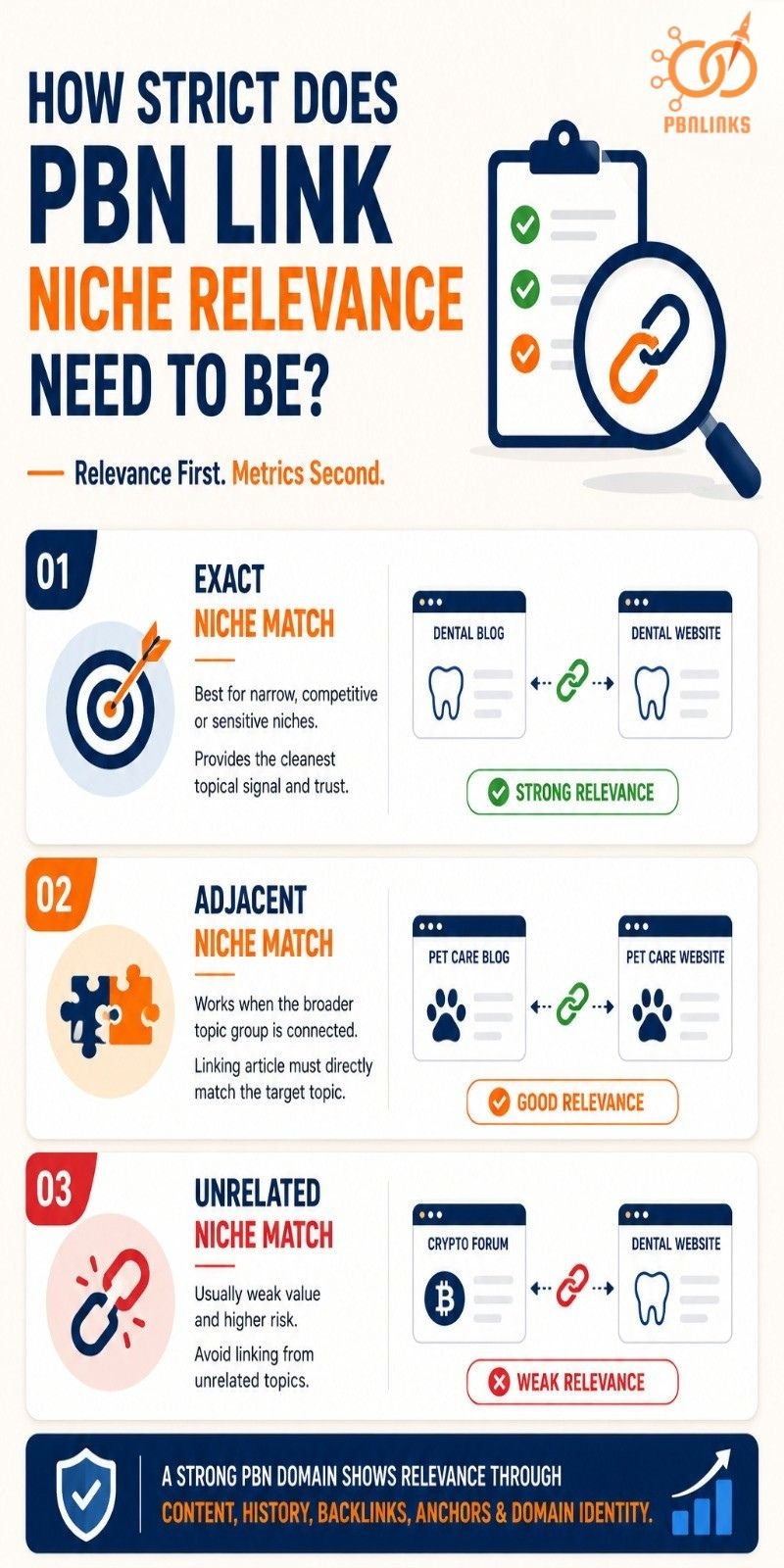
PBN link niche relevance should be as strict as your niche, competition level, and risk level require. Exact niche match is ideal, but adjacent niches can still work when the topic cluster is logical and the backlink sources support the same subject area.
The best way to judge strictness is to separate three levels: exact match, adjacent match, and unrelated match. Exact match gives the cleanest topical signal, adjacent match gives controlled flexibility, and unrelated match usually creates weak value and higher risk.
Exact Niche Match
Exact niche match matters most in narrow, competitive, or sensitive niches. Health, finance, legal, medical, and other Your Money or Your Life niches usually need stronger topical precision because trust signals matter more.
For example, a pediatric dentistry website gets stronger topical support from dental, oral health, pediatric care, or medical domains. A broad lifestyle domain may look related, but it does not create the same focused relevance.
Adjacent Niche Match
Adjacent niche match works when the broader topic group is still connected. A pet care domain with backlinks from veterinary blogs, pet food brands, and dog breeder directories can support a pet-related target site because the category is coherent.
This is different from a pet domain with backlinks from cryptocurrency forums, casino pages, or unrelated directories. Those sources do not show adjacency. They suggest the domain has been reused, weakened, or pushed into unrelated topics.
The linking article also matters. Even when the domain is only adjacent, the page placing the link should directly match the target topic. A strong contextual article can make an adjacent domain more useful.
Language and Geographic Match
Topical relevance is not the only strictness factor. Language and geography should be checked separately because they affect how natural the domain’s backlink profile looks beside the target site.
An English-language target site should ideally be supported by domains with mostly English-language content and backlinks. If most referring domains come from another language, the topical signal may become less clear.
Geography works the same way. A local UK service site usually benefits more from UK-relevant domains than unrelated foreign sources. This check should run alongside topical relevance, not replace it.
Fixing PBN Link Niche Relevance with New Content
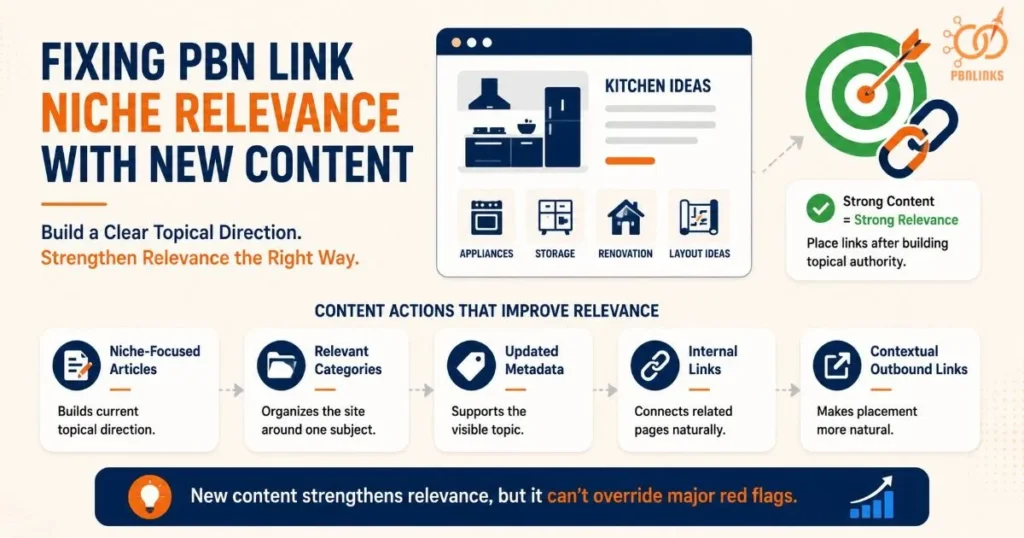
New content can improve PBN link niche relevance when a perfectly matched domain is not available. The goal is to build a clearer topical direction through original articles, relevant categories, natural internal links, updated metadata, and page-level context.
This should be treated as a content strategy, not a way to disguise an irrelevant domain. One article cannot fix weak history, spammy backlinks, deindexation, or unrelated outbound links. Relevance needs a consistent content pattern across the whole domain.
The strongest approach is to publish niche-focused content before placing links. For example, a kitchen-related domain should first build content around appliances, storage, renovation, buying guides, layout ideas, and design before linking to a kitchen target site.
| Content Action | What It Improves | What It Cannot Fix Alone |
| Niche-focused articles | Builds current topical direction | Completely unrelated domain history |
| Relevant categories | Organizes the site around one subject | Spammy old backlinks |
| Updated metadata | Supports the visible topic | Thin or low-quality content |
| Internal links | Connects related pages naturally | Random outbound-link patterns |
| Contextual outbound links | Makes placement more natural | A burned or deindexed domain |
New content works best when the domain already has some possible topical connection. It should strengthen relevance, not force a domain into a subject it was never connected to.
Does Relevance Affect Anchor Text Strategy
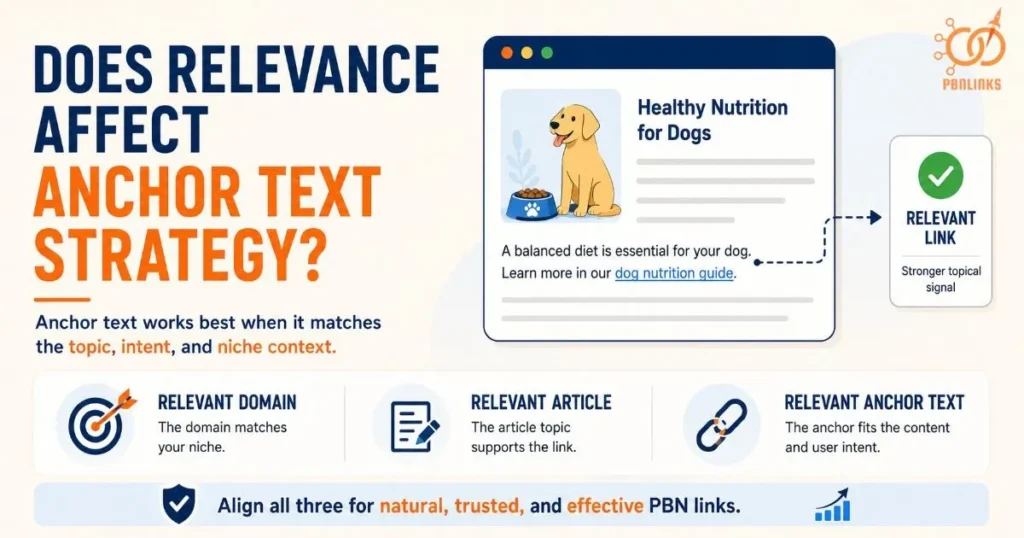
Yes, relevance affects anchor text strategy because anchor text helps explain how the linking page connects to the target page. A strong anchor should match the article topic, the target page intent, and the wider niche context.
Anchor text does not work alone. The surrounding paragraph, article topic, and domain niche all support the meaning of the link. For example, a pet health article linking to a dog nutrition guide creates a clearer topical signal than the same anchor placed inside unrelated content.
The safest approach is to avoid forcing exact-match keywords into pages where they do not belong. Branded anchors, partial-match anchors, naked URLs, and natural phrase anchors can all work when they fit the page context and user intent.
A strong PBN link should have three aligned parts: a relevant domain, a relevant article, and relevant anchor text. If one part feels disconnected, the link becomes weaker, less natural, and less useful for topical authority.
Why Paying for PBN Link Niche Relevance Beats Paying for Metrics Alone
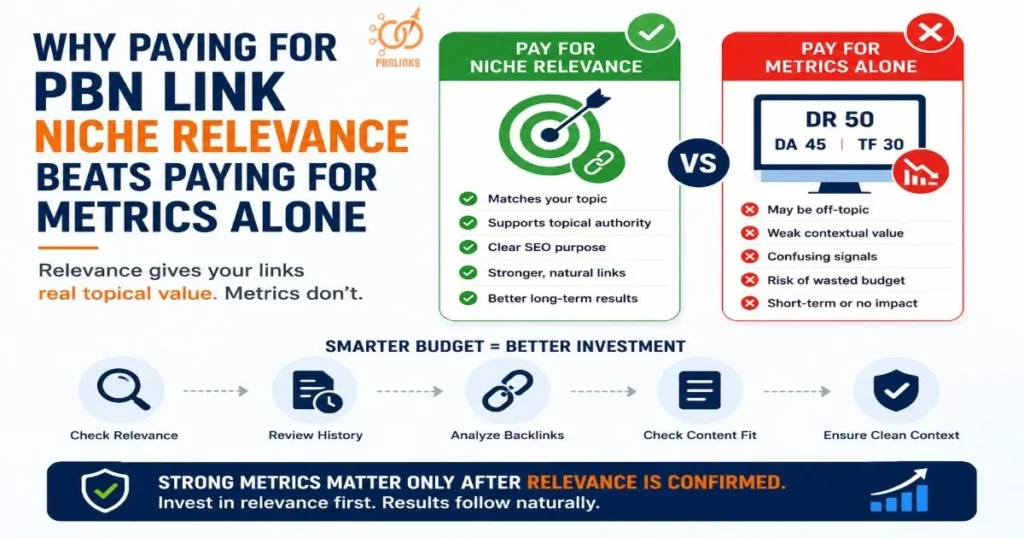
Paying for PBN link niche relevance is smarter because relevance decides whether a domain’s authority can support your target topic. Metrics like DR, DA, and TF show backlink strength, but they do not prove topical value.
A high-metric domain can still be a poor investment if its content, backlinks, anchors, and outbound links are off topic. In that case, the buyer is paying for numbers that look strong, while the link may pass weak contextual value.
A relevant domain gives the link a clearer SEO purpose. When the domain topic, article content, anchor text, and target page all align, the link supports topical authority more naturally than a random high-metric placement.
The smarter budget decision is to pay for relevance checks, historical review, backlink-source quality, content fit, and clean topical context before chasing higher metrics. Strong metrics matter only after the domain proves it belongs in the niche.
Common PBN Link Niche Relevance Mistakes
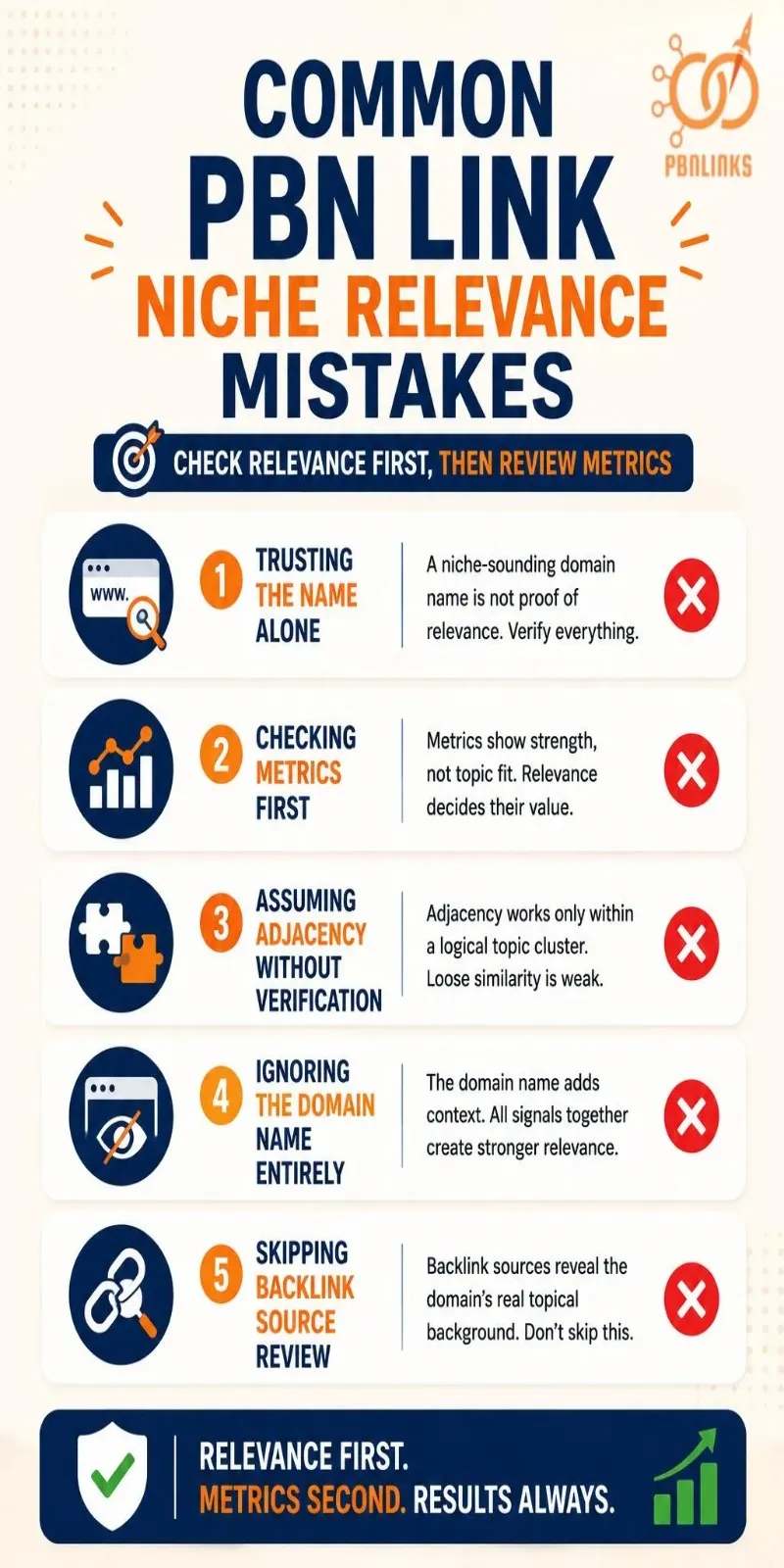
Common PBN link niche relevance mistakes happen when buyers trust one signal instead of checking the full domain context. A relevant PBN domain should match the target site through current content, historical content, backlink sources, anchor patterns, and overall topic direction.
The correct order is simple: check relevance first, then review metrics. DR, DA, TF, and CF only matter after the domain proves it belongs in the target niche.
Trusting the Name Alone
A niche-sounding domain name is not proof of relevance. A domain may include words like “health,” “tech,” “pets,” or “finance,” but its old content and backlink profile may belong to another topic.
The domain name should only support the relevance check. It should be compared with live content, archived content, backlink sources, and the current site structure before any decision is made.
Checking Metrics First
Metrics show backlink strength, not topical fit. A high-metric domain can still be weak if its backlinks, articles, anchors, and outbound links are unrelated to the target niche.
This mistake often leads buyers to overpay for domains that look powerful in reports. Relevance should decide whether the metrics are useful, not the other way around.
Assuming Adjacency Without Verification
Adjacent niches can work, but only when the topic cluster is logical. A pet care domain with veterinary, pet food, and breeder-related backlinks is relevant because the sources belong to the same broader category.
Loose similarity is not enough. A pet domain with crypto, casino, payday loan, or unrelated directory backlinks is not adjacent. It is topically mixed and weaker for niche relevance.
Ignoring the Domain Name Entirely
The domain name is not final proof, but it still gives weak supporting context. When the name, content, history, and backlinks all point in the same direction, the relevance signal becomes cleaner.
Ignoring the name completely can create mismatch problems. A domain name that strongly suggests one industry may look unnatural if the site suddenly publishes content for a completely different niche.
Skipping Backlink Source Review
Live content can look relevant while backlinks remain unrelated. Always check where the domain’s trust comes from before treating it as a strong PBN asset.
Backlink sources reveal the domain’s real topical background. If most referring domains come from unrelated directories, forums, foreign sites, or spam-heavy pages, the domain may pass weak relevance even with good current content.
The safest approach is to avoid single-signal decisions. A strong PBN domain should show relevance through its content, history, backlinks, anchors, and domain identity before metrics are used as supporting evidence.
In Conclusion
in conclusion, PBN link niche relevance should come before domain metrics. DR, DA, TF, and CF can help with screening, but they only matter after the domain proves a real topical connection.
A relevant domain carries value through current content, historical content, backlink sources, anchor context, and category consistency. The DR 30 comparison shows this clearly: identical metrics can produce different outcomes when one domain has trusted niche sources and the other relies on unrelated links.
Exact niche match is ideal, but it is not always required. A coherent adjacent niche can still work when the topic, language, geography, and backlink profile support the target site naturally.
Before buying or using a PBN domain, check relevance first, review its history, inspect its backlink sources, and confirm that the link context makes sense. For niche-relevant PBN link support, visit pbnlinks.agency and choose domains based on topical fit, not metrics alone.
FAQ About Why Niche Relevance Matters More Than Domain Metrics for PBN Links
Does niche relevance matter more than domain metrics like DR or DA?
Yes, niche relevance usually matters more than DR or DA because it gives metrics real context. A moderate-metric domain that fits the target niche is often more valuable than a high-metric domain that is off topic.
Can a domain still work for a PBN if its history does not match my niche?
Yes, but only when new, original content builds a clear topical direction going forward. A history mismatch does not always disqualify a domain, but the new content must be focused, useful, and consistent.
How do I check if a domain’s content history is relevant to my niche?
Use the Wayback Machine to review archived snapshots of the domain. Check old page titles, categories, articles, navigation, and site themes to see whether the past content matches the current or intended niche.
Is Topical Trust Flow the same as niche relevance?
No, Topical Trust Flow is not the same as niche relevance. It estimates where a domain’s trust comes from, but it should support manual content, history, and backlink checks, not replace them.
Does anchor text need to match the domain’s niche?
Yes, anchor text should match the niche context of the linking page and the target page. Niche-relevant anchors send clearer topical signals than generic, forced, or unrelated anchors.
Can an unrelated niche domain still pass PBN link value?
Rarely, because search engines evaluate links in context. An unrelated domain may show strong metrics, but it usually sends a weaker or more confusing topical signal than a relevant domain.
What happens if I use a high-metric domain that is off topic?
A high-metric off-topic domain may pass little real value. Authority tools can show backlink strength, but they cannot prove topical fit, which is why identical metrics can produce different outcomes.
Is an adjacent niche close enough for a PBN domain?
Yes, an adjacent niche can work when the topic cluster is coherent. For example, a pet care domain with veterinary, pet food, or breeder-related backlinks can support a pet-related target site.
Should I prioritize relevance or domain age when evaluating a PBN domain?
Prioritize relevance first. Domain age can support evaluation, but an aged domain with no topical connection still sends a weak signal. Age matters more after relevance is already confirmed.
Do backlink sources affect niche relevance?
Yes, backlink sources strongly affect niche relevance. A domain with links from related blogs, niche publications, local media, or industry sites has a stronger topical profile than one with links from unrelated directories or forums.
Does language match matter for PBN niche relevance?
Yes, language match matters because it affects how natural the link profile looks. An English target site should ideally receive support from domains with mostly English-language content and backlinks.
Can new content improve weak niche relevance?
Yes, new content can improve relevance when the domain has some logical connection to the target niche. It should build a consistent topic cluster, not disguise a completely unrelated or spam-heavy domain.
What is the biggest warning sign of poor niche relevance?
The biggest warning sign is mixed topical identity. If the domain publishes one niche, has backlinks from another niche, and links out to unrelated industries, its relevance signal is weak.