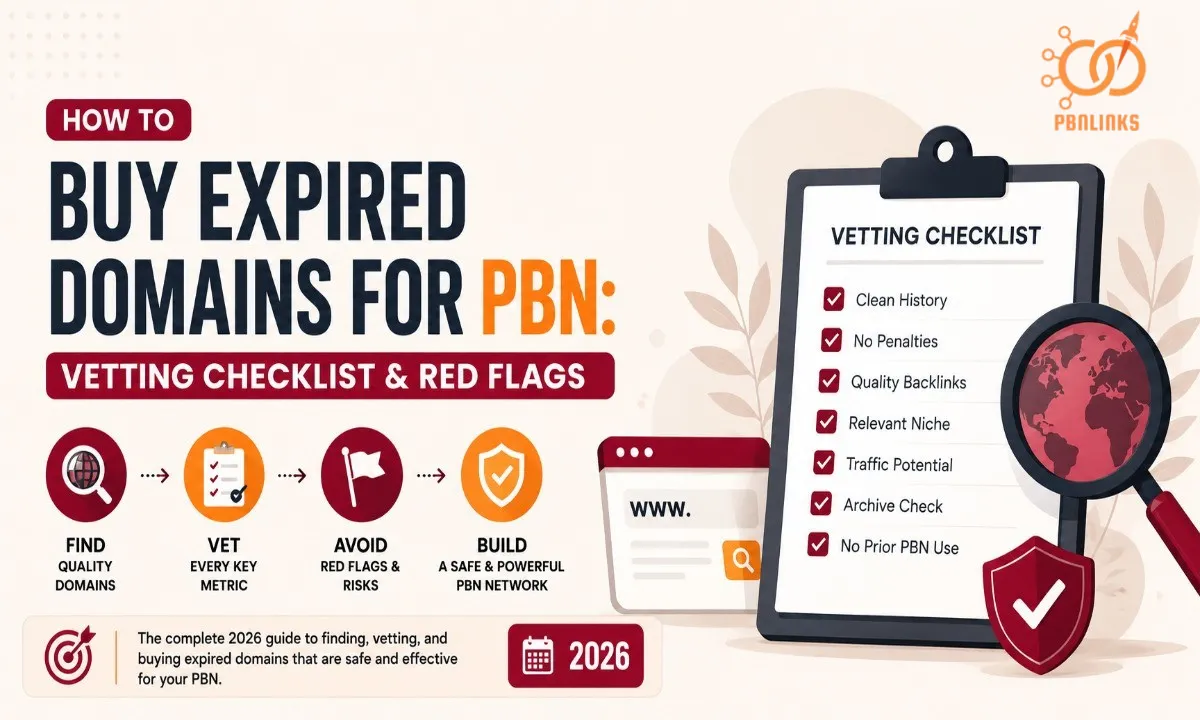
How to Buy Expired Domains for PBN: Vetting Checklist & Red Flags (2026)
Most expired domains look good on paper. Strong DR, decent referring domains, clean enough metrics to pass a quick glance. Then you buy one, build it into your network, and nothing moves. Or worse your money site takes a hit.
The problem is almost never the domain age or the DR. It is what those numbers are hiding. Penalty history, prior PBN use, and toxic backlink profiles do not show up in a basic metrics check , and they are what kill campaigns.
This guide walks you through the complete process of finding, vetting, and buying expired domains that are genuinely safe to use in a PBN. Every check that matters is covered before you spend a single dollar.
Why Most Expired Domains Are Not Worth Buying
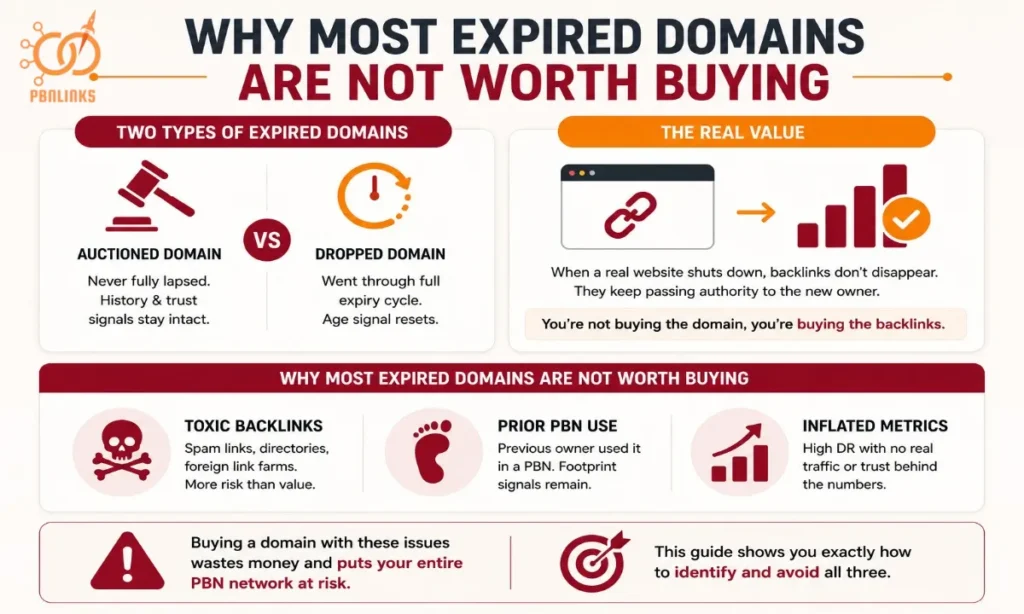
When a domain expires and goes unrenewed it either gets listed at auction while still in a grace period or fully drops and becomes available at standard registration price.
That distinction matters. An auctioned domain never fully lapsed so its crawl history and trust signals stayed intact. A dropped domain went through a complete expiry cycle which resets the age signal even if the backlinks remain. You can read more about how PBN domain age affects trust signals and what thresholds actually matter before buying.
The backlinks are what most PBN builders are actually paying for. When a real website shuts down the links pointing to it do not disappear immediately. Those referring domains keep passing authority to whoever now controls the domain — and that inherited link equity is what makes expired domains valuable for PBN use.
The problem is that most expired domains reaching the market have one or more of these issues:
- Toxic backlink profiles built from spam campaigns, directory links, or foreign language link farms that carry more risk than value
- Prior PBN use by a previous owner leaving footprint signals that Google has already flagged or is likely to flag
- Inflated metrics with high DR numbers backed by zero real trust signal or organic traffic history
Buying a domain with any of these issues does not just waste money. It introduces a liability into your network that affects every money site that domain links to. The rest of this guide walks you through exactly how to identify and avoid all three.
Where to Find Expired Domains for PBN Use in 2026
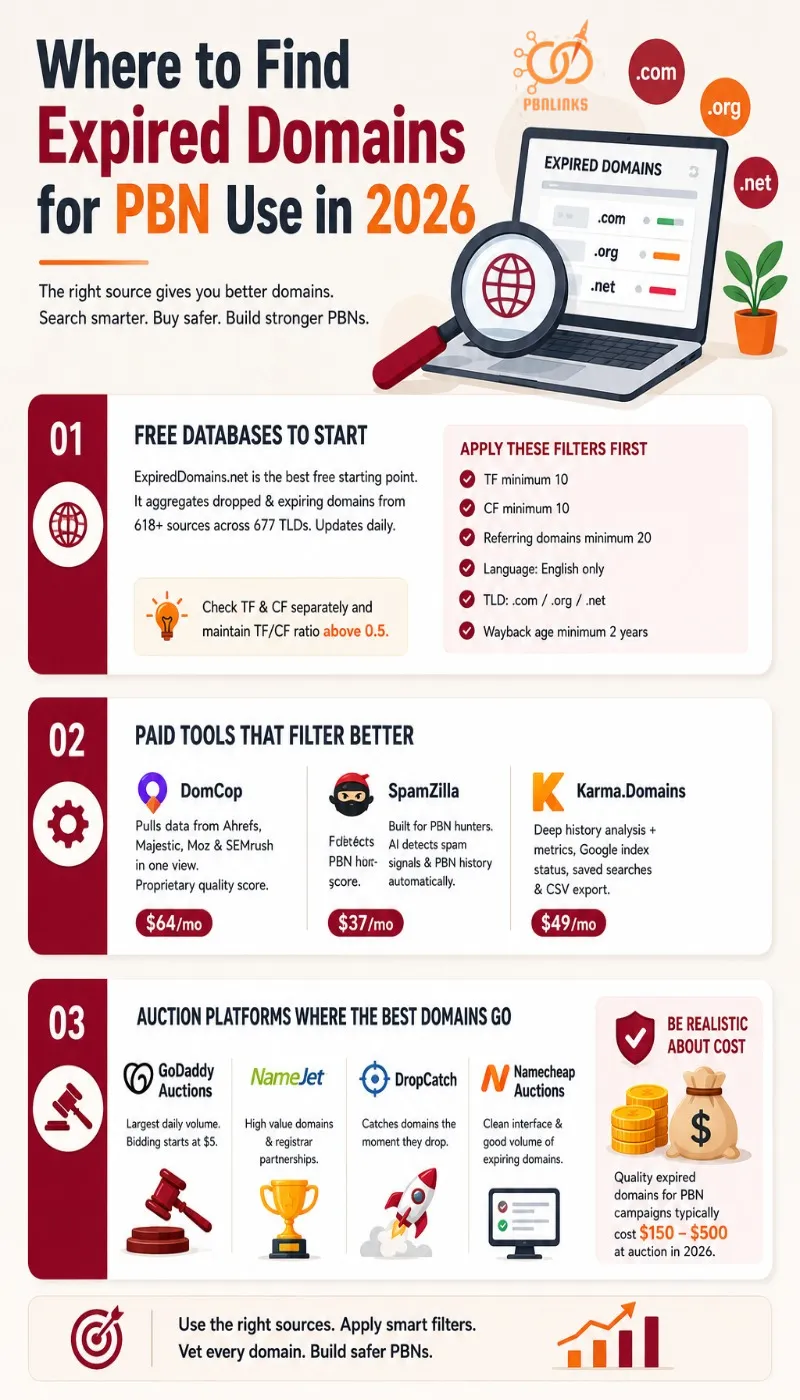
Not every platform gives you the same quality of domains. Where you search determines what you find. Here is how to use each source effectively.
Free Databases to Start Your Search
ExpiredDomains.net is the best free starting point. It aggregates dropped and expiring domains from over 618 sources across 677 TLDs and updates daily. The volume is enormous which means filtering correctly from the start is essential.
Apply these filters before browsing to cut through the noise:
- TF minimum 10
- CF minimum 10
- Referring domains minimum 20
- Language set to English only
- TLD filtered to .com .org or .net
- Wayback age minimum 2 years
Check TF and CF separately then calculate the ratio manually — a TF to CF ratio above 0.5 is what you are looking for. Anything below that suggests low quality links inflating the CF number.
Paid Tools That Filter Better
Three tools are worth knowing in 2026 — each serves a slightly different purpose.
DomCop pulls data from Ahrefs, Majestic, Moz, and SEMrush simultaneously and lets you filter across all four metric sets in one view. It also applies a proprietary quality score to help prioritise domains. Pricing starts at around $64 per month. One important limitation — DomCop covers deleted domains only and does not pull auction listings from GoDaddy or DropCatch.
SpamZilla is built specifically for PBN domain hunters. It uses machine learning to flag domains with spam signals and PBN history automatically. Plans start at $37 per month. The key limitation is the same as DomCop — it only covers dropped domains not live auction listings.
Karma.Domains has become a strong option in 2026 for buyers who want deep history analysis alongside standard metrics. It includes Google index status checks, saved searches, and CSV export. Worth considering if speed and risk reduction are priorities.
Auction Platforms Where the Best Domains Go
The highest quality expired domains rarely make it to free databases. They get caught at auction before fully dropping. For a full breakdown of how each platform works check our guide on best PBN domain auction sites.
GoDaddy Auctions has the largest daily volume with thousands of domains listed every day. Bidding starts at $5 but quality domains with clean backlink profiles and real traffic history regularly sell for $500 to $2,000 or more. Set your maximum bid before entering any auction and do not exceed it regardless of competition.
NameJet specialises in higher value expiring domains and is partnered with multiple registrars. Competition is stronger here but domain quality tends to be more consistent.
DropCatch works differently from standard auctions. It attempts to register a domain the moment it enters the public deletion queue — useful for catching domains that did not attract auction attention but still hold genuine value.
Namecheap Auctions is a solid alternative to GoDaddy with a clean interface and a decent volume of expiring domains worth filtering through.
Be realistic about cost. Quality expired domains suitable for competitive PBN campaigns typically cost $150 to $500 at auction in 2026. Anything significantly cheaper needs extra scrutiny before you commit.
The Metrics That Matter Before You Buy
Metrics are your first filter not your final decision. A domain that passes the numbers check still needs a full vetting process before you commit. But a domain that fails here does not deserve any more of your time.
Domain Rating Trust Flow and Spam Score
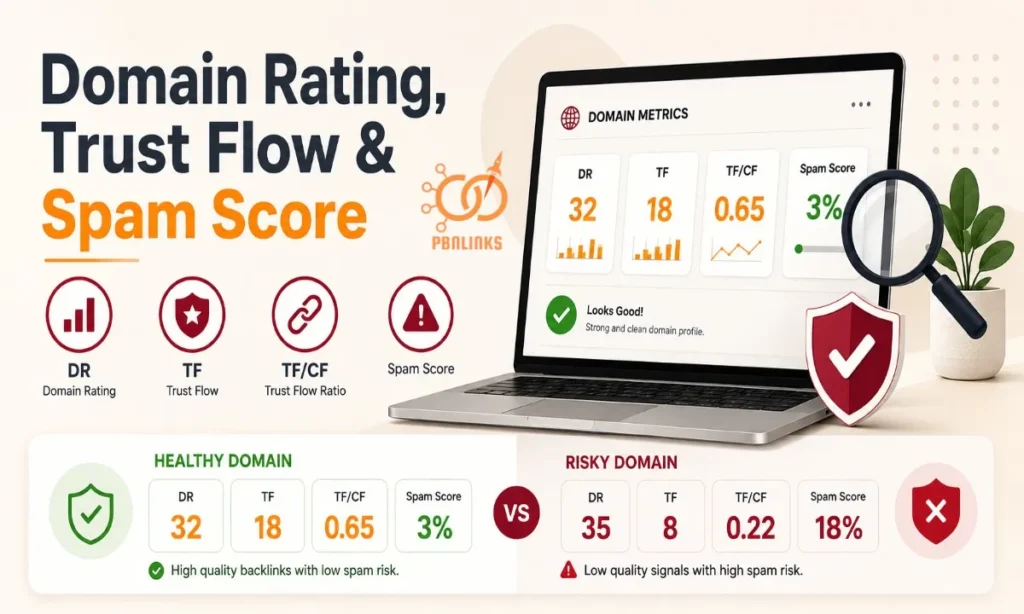
Domain Rating
Domain Rating from Ahrefs measures the overall strength of a domain’s backlink profile. For PBN use target a minimum DR of 20 for low competition niches and DR 30 plus for medium to high competition campaigns. A full breakdown of what thresholds to target by campaign type is in our PBN domain metrics guide.
DR alone tells you very little. It is a starting filter not a quality signal on its own.
Trust Flow
Trust Flow from Majestic measures the quality of links pointing to the domain based on proximity to trusted seed sites. This is more meaningful than DR because it reflects genuine link quality not just quantity.
A domain with DR 30 and TF 8 is a warning sign. The authority number looks good but the quality signal behind it does not support it.
TF to CF Ratio
Citation Flow measures how many links point to a domain. Trust Flow measures how good those links actually are. The ratio between the two is one of the most reliable quality signals available.
A healthy TF to CF ratio sits at 0.5 or above. Below 0.5 means the domain has far more links than it has quality — a classic sign of artificial link building. Below 0.3 is a near automatic disqualifier.
Spam Score
Spam Score from Moz should sit below 5 percent for any domain you consider using in a PBN. Above 10 percent is a serious warning sign. Above 30 percent disqualifies the domain regardless of how strong the DR or TF looks.
Never let a high DR override a high spam score. That combination almost always means the authority is inflated by low quality links and the domain carries more risk than value.
Referring Domains and Traffic History
Referring Domains
A high referring domain count means nothing without quality assessment. One hundred referring domains from relevant editorial sources is worth far more than five hundred from directories and comment spam.
In Ahrefs open the referring domains report and check two things. First the growth pattern — gradual accumulation over time signals organic link earning. A sudden spike followed by a plateau or drop signals a paid link campaign that Google may have already discounted or penalised.
Second check the language of referring domains. For English language PBN campaigns the majority of referring domains should be from English language sources. A backlink profile dominated by foreign language sites is a red flag regardless of the DR number.
Organic Traffic History
A domain with strong metrics but zero organic traffic history is one of the most reliable warning signs in expired domain vetting.
Real websites that earned real links also earned real traffic. If the organic traffic flatlined years ago or never existed at all the links behind those metrics may carry far less value than the numbers suggest. Pull the traffic history graph in Ahrefs and look for consistent organic activity over time ,not just a healthy current DR with nothing behind it.
How to Read Wayback Machine History Before Buying
Metrics tell you what a domain looks like right now. Wayback Machine tells you what it actually was. Those two things are often very different.
Go to web.archive.org and enter the domain. You will see a calendar view showing every year the domain was crawled and archived. Start from the earliest available snapshot and work forward to the most recent one checking a minimum of five to eight snapshots spread across the full history.
What you are looking for is a consistent story. A domain that spent five years as a legitimate business in one niche, built links naturally during that time, and maintained regular content throughout is exactly what you want. Anything that deviates from that pattern needs a closer look.
Red Flags to Look for in Wayback Machine
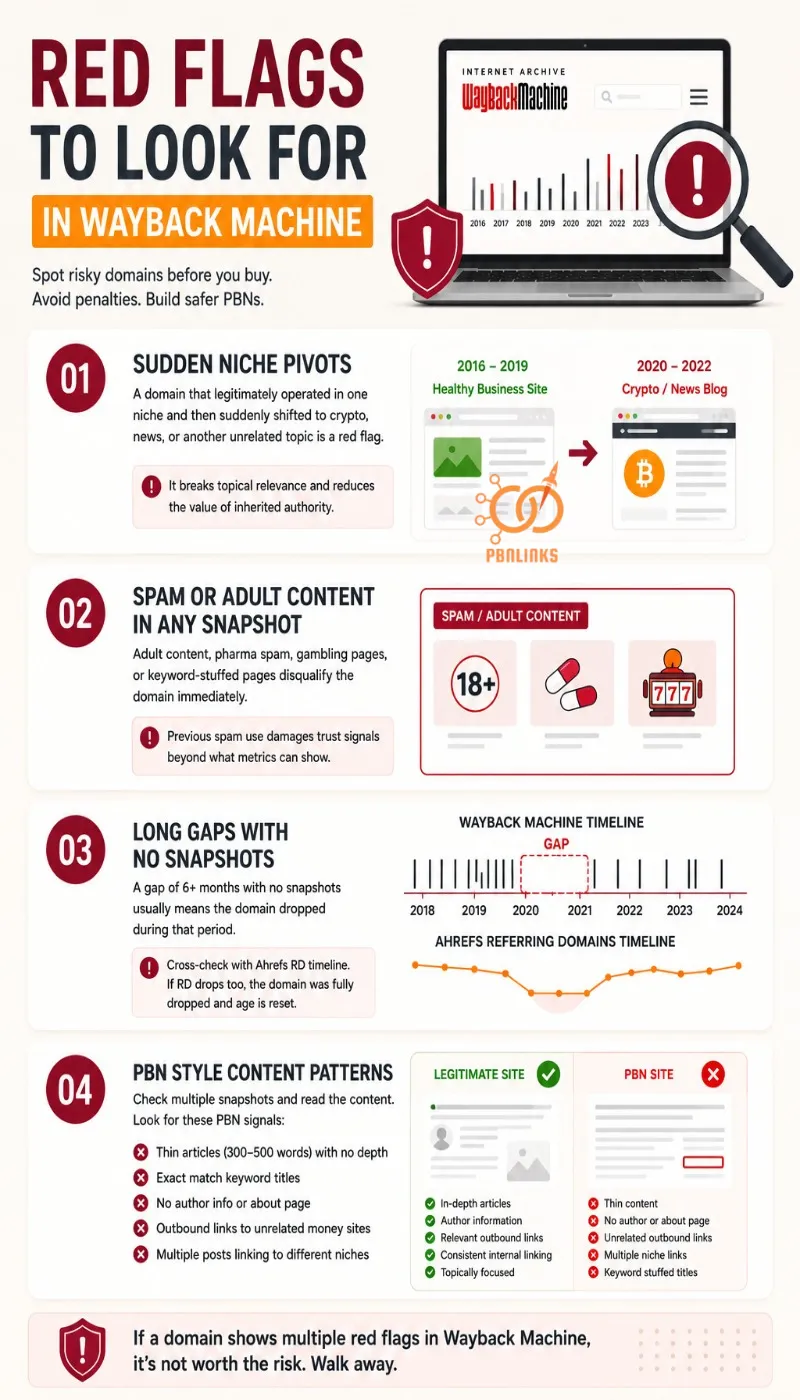
Sudden Niche Pivots
A domain that operated as a legitimate business for four years and then suddenly became a cryptocurrency blog or a generic news site is a red flag. That kind of pivot usually signals the domain was sold or repurposed specifically to exploit its accumulated authority.
The niche that gave the domain its authority is the niche it earned links in. A sudden shift away from that topic breaks the topical relevance signal and makes the inherited authority far less useful for PBN purposes.
Spam or Adult Content in Any Snapshot
If any snapshot shows adult content, pharmaceutical spam, gambling pages, or keyword stuffed pages with no real value the domain is disqualified immediately.
It does not matter how clean the current metrics look or how long ago that snapshot was taken. Previous spam use damages the trust signal at a level that metrics do not fully reflect. Move on and do not spend further time vetting that domain.
Long Gaps With No Snapshots
A gap of six months or more with no Wayback Machine activity is a strong signal the domain dropped during that period.
This matters because a dropped domain has its age signal reset entirely even if the WHOIS registration date still shows the original year. That is one of the most common ways buyers overpay for a domain that does not actually carry the trust they think it does.
Cross reference any gap you find with the Ahrefs referring domain timeline. If the referring domain count also dips during the same period that confirms the domain went through a full expiry cycle.
PBN Style Content Patterns
This is the most important check and the one most buyers skip entirely.
Open several snapshots from across the domain history and read the actual content. Legitimate websites have real articles with depth, author information, consistent internal linking, and outbound links to relevant sources in the same niche.
PBN content looks completely different. Watch for these specific signals:
- Thin articles of 300 to 500 words with no real depth or original information
- Exact match keyword titles with no natural variation
- No author information or about page
- Outbound links pointing to completely unrelated money sites embedded in the text
- Multiple posts linking to different niches from the same domain
If several snapshots across different years show these patterns the domain was used in a PBN before. Walk away. Prior PBN use carries footprint risk that no amount of vetting can eliminate once it is confirmed.
How to Vet the Backlink Profile of an Expired Domain
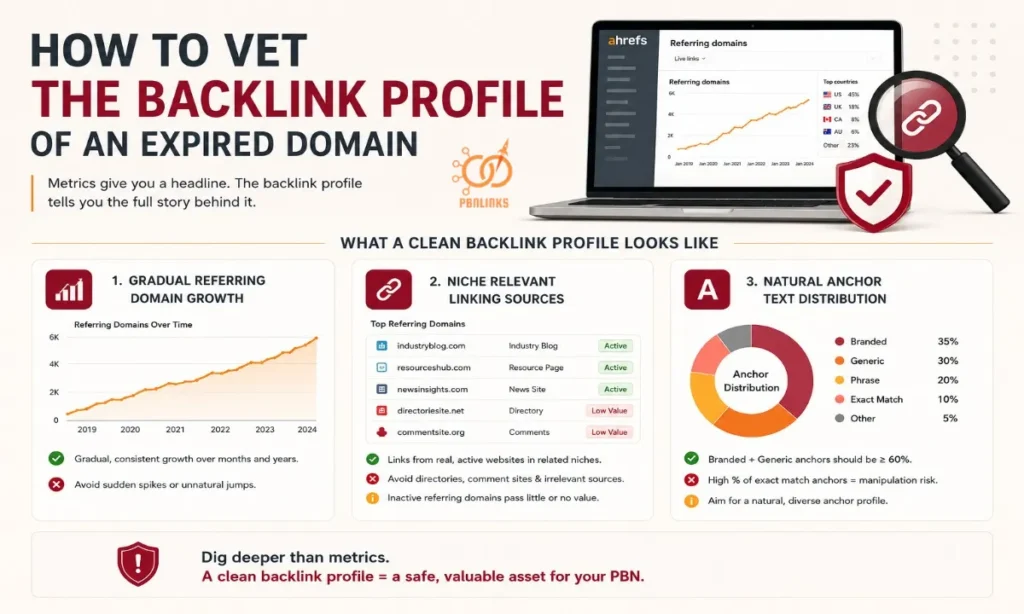
Metrics give you a headline. The backlink profile tells you the full story behind it. A domain can show DR 35 and TF 20 and still be completely unusable once you look at where those numbers actually came from.
Open the domain in Ahrefs and go to the referring domains report. This is where you spend the most time in the vetting process.
What a Clean Backlink Profile Looks Like
Gradual Referring Domain Growth
Pull up the referring domains graph and look at the shape of growth over time. A clean domain shows a gradual upward curve that built over months and years. Links accumulated naturally as the site published content and earned mentions from relevant sources in its niche.
Flat lines are acceptable on older domains that were not actively building links. What you do not want to see is a sudden vertical spike at any point in the timeline.
Niche Relevant Linking Sources
Open the full referring domains list and manually check the top 20 to 30 linking sites. Ask one question for each one. Does this look like a real website in a related niche that would naturally link to this domain?
Editorial links from legitimate blogs, industry publications, and relevant resource pages are what you are looking for. Links from directories, comment sections, and sites with no clear topic or audience are not.
Also check whether the linking sites are still active. A referring domain that no longer exists passes significantly reduced link equity. Understanding how that equity flows is explained in our PBN link juice guide.
Natural Anchor Text Distribution
Go to the anchors report in Ahrefs. A clean domain has mostly branded anchors, generic anchors like “click here” or “read more”, and a small percentage of topically relevant phrase anchors. As a general rule branded and generic anchors combined should make up at least 60 percent of the anchor profile.
If you see a high concentration of exact match commercial keywords the domain was built for link manipulation at some point. Use our anchor text optimization guide to understand what a natural distribution looks like and how to compare it against what you are seeing.
What a Toxic Backlink Profile Looks Like
Sudden Backlink Spikes
A sharp increase in referring domains over a short period followed by a plateau or decline is one of the clearest signals of an artificial link building campaign. Google almost certainly discounted those links when the spike happened.
A domain where 80 percent of its referring domains appeared within a three month window and then nothing followed is not earning natural authority. It is a domain that was manipulated.
Foreign Language Links Dominating the Profile
A small number of foreign language links on an otherwise clean profile is not automatically disqualifying. What is a red flag is when the referring domains list is dominated by sites in Russian, Chinese, Portuguese, or any other language unrelated to the domain niche.
Foreign language link farm dominance actively signals a manipulated profile not just a weak one. These links carry no real value for an English language PBN campaign and their presence suggests the backlink profile was never clean to begin with.
Over Optimised Anchor Text
If the anchor text report shows that 30 percent or more of links use the same commercial keyword phrase the profile was built for manipulation. That kind of anchor distribution does not happen naturally.
This is also a strong indicator the domain was previously used in a PBN where anchor text is tightly controlled to push specific keywords — which leads directly into the next check.
Links From Known Spam Networks
Some referring domains are instant disqualifiers on their own. Link farms with thousands of outbound links, sites with spam score above 30 percent, and domains that appear across hundreds of unrelated backlink profiles all signal active risk not just weak value.
If you see more than a handful of these in the top referring domains list the entire backlink profile is compromised regardless of the headline metrics.
How to Check If an Expired Domain Has a Google Penalty
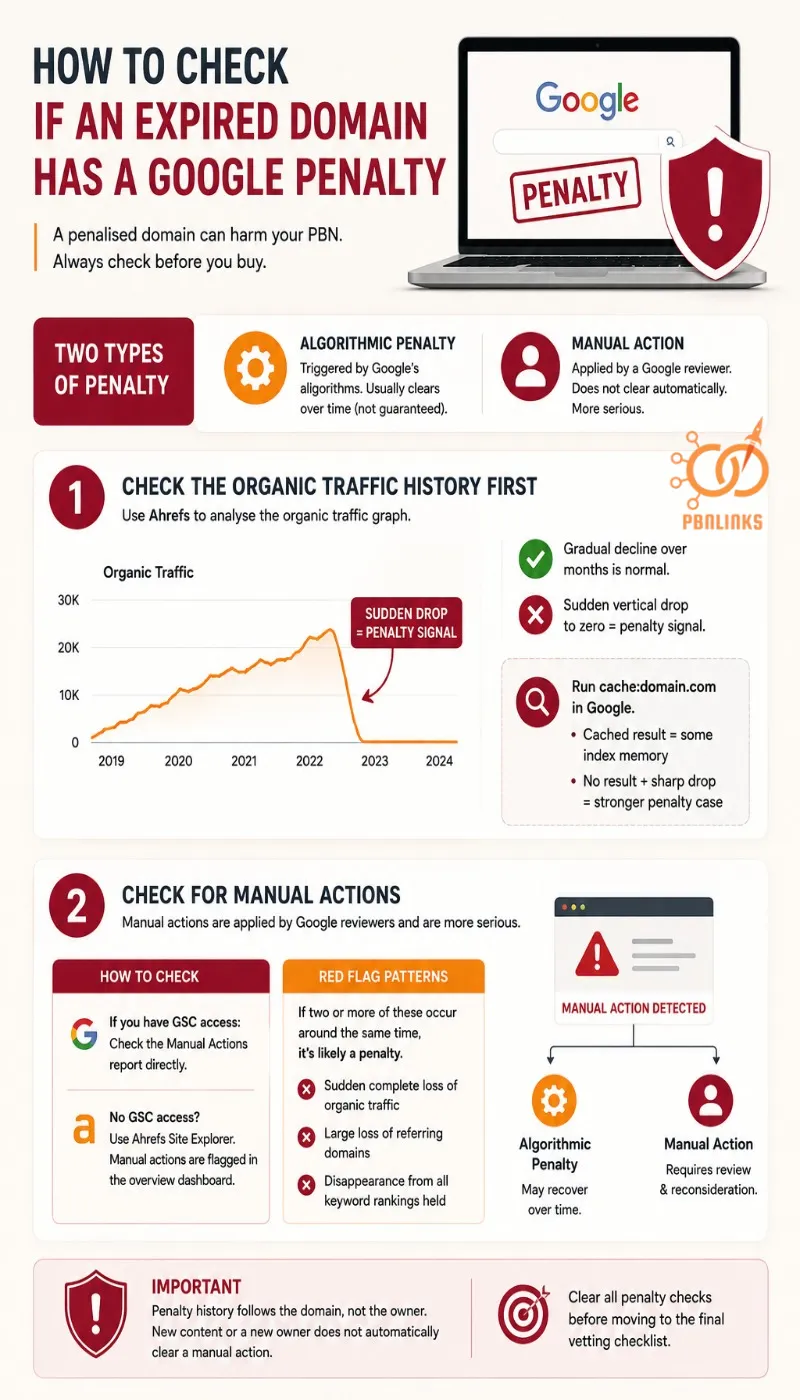
A domain carrying a Google penalty is the single most damaging thing you can introduce into a PBN. Unlike a weak backlink profile which can be assessed and priced accordingly a penalised domain actively works against every money site it links to.
There are two types of penalty to check for and they require different approaches.
Check the Organic Traffic History First
For an expired domain with no live content the site: operator will almost always return nothing — which tells you very little on its own. The more reliable starting point is the organic traffic history in Ahrefs.
Pull the domain into Ahrefs and open the organic traffic graph. A domain that earned genuine authority should show real organic traffic at some point in its history. What you are looking for is how that traffic ended.
A gradual fade over months is normal for a site that simply stopped publishing. A sudden vertical drop to zero at a specific point in time is a penalty signal. That kind of sharp drop almost always corresponds with either an algorithmic update hitting the site or a manual action being applied.
You can also run cache:domainname.com in Google. If Google returns a cached version the domain has some recent index memory. If nothing appears alongside a sharp traffic drop in Ahrefs that combination strengthens the penalty case.
Check for Manual Actions
A manual action is a direct penalty applied by a Google reviewer. It is more serious than an algorithmic hit and does not automatically clear when the domain changes hands.
If you have access to Google Search Console for the domain check the manual actions report directly. For domains you are vetting before purchase use Ahrefs Site Explorer which flags known manual actions in the overview dashboard — this is the most direct check available without GSC access.
Also look for these patterns together in the traffic and backlink history:
- A sudden complete loss of organic traffic at a specific point in time
- A large scale loss of referring domains around the same period
- The domain disappearing from all keyword rankings it previously held
One of these signals alone is not confirmation of a penalty. Two or more appearing together around the same date is. Walk away from any domain showing that combination regardless of how strong its current metrics look.
Penalty history follows the domain not the owner. A new owner and fresh content does not automatically clear a manual action. If the previous owner never submitted a reconsideration request that penalty may still be sitting on the domain waiting to affect whoever uses it next.
Once a domain clears all penalty checks it is ready for the final consolidated vetting checklist.
The Complete Expired Domain Vetting Checklist for PBN Use
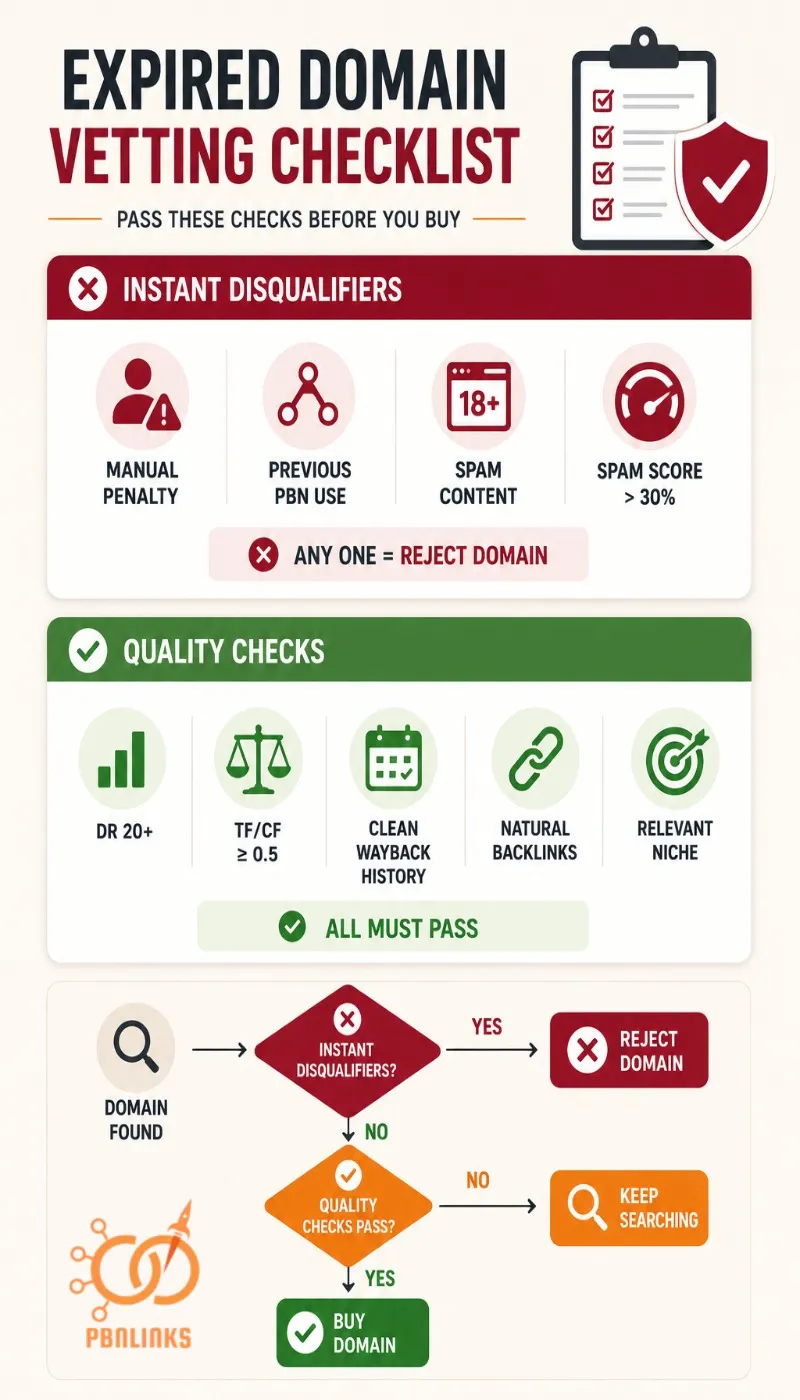
Everything covered in this guide comes down to this checklist. Run every domain you are considering through both tiers before making a purchase decision. A domain that passes all of these checks is worth buying. A domain that fails any instant disqualifier is not worth another minute of your time regardless of its metrics.
Instant Disqualifiers — Walk Away Immediately
If any of the following are confirmed stop vetting and move to the next domain.
- Manual penalty confirmed in Ahrefs Site Explorer or Google Search Console
- Domain was previously used in a PBN — confirmed via hosting history, content patterns, or outbound link analysis
- Adult, gambling, or pharmaceutical spam content visible in any Wayback Machine snapshot
- Foreign language links dominating the backlink profile with no relevance to your target niche
- Zero Wayback Machine history — no snapshots exist at all
- Spam Score above 30 percent in Moz
- Sudden complete traffic loss in Ahrefs history combined with mass referring domain loss at the same point in time
- High DR combined with TF below 8 and CF significantly higher than TF — classic inflated metrics profile
Quality Checks — Must Pass Before Buying
If the domain cleared the instant disqualifiers above run it through these quality checks next.
Metrics
- DR meets the minimum threshold for your competition level — DR 20 plus for low competition, DR 30 plus for medium to high
- TF minimum 10 with a TF to CF ratio of 0.5 or above
- Spam Score below 5 percent
- Referring domains minimum 20 from relevant niche sources
Wayback Machine History
- Minimum 3 years of consistent on topic content with no major gaps
- No sudden niche pivots at any point in the history
- No gaps longer than 6 months in snapshot activity
- Content looks like a real website — depth, author information, natural internal linking
- No PBN style content patterns visible across snapshots
Backlink Profile
- Referring domain growth is gradual and natural over time
- Top 20 to 30 referring domains are from real websites in relevant niches
- Referring sites are still active and passing link equity
- Anchor text profile is at least 60 percent branded and generic anchors
- No sudden backlink spikes followed by mass link loss
- No over optimised exact match anchor text concentration above 30 percent
Penalty and Index Status
- No manual action flags in Ahrefs Site Explorer
- Organic traffic history shows gradual decline not a sudden crash
- No combined traffic and referring domain loss at the same point in time
- Domain is not currently redirecting to another site
Niche Relevance
- Domain topic during its active years matches or is closely adjacent to your money site niche
- Majority of referring domains come from relevant niche sources
- No evidence of topical inconsistency across different periods of the domain history
A domain that passes every check in both tiers is a genuine asset worth paying for. Use this checklist alongside our build PBN checklist to make sure the domain integrates correctly into your network once you have made the purchase decision.
What to Do After You Buy an Expired Domain
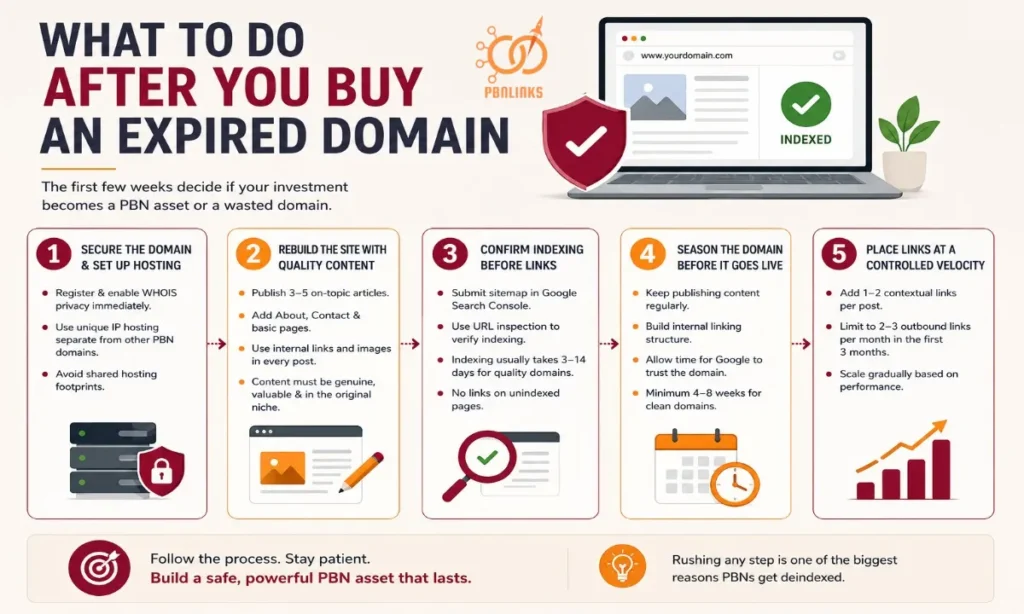
Buying the domain is not the finish line. What you do in the first few weeks after purchase determines whether that domain becomes a reliable PBN asset or a wasted investment.
Follow these steps in order. Skipping any of them or rushing the sequence is one of the most common reasons good domains underperform inside a PBN network.
Step 1 — Secure the Domain and Set Up Hosting
Register the domain immediately after winning an auction or completing a purchase. Enable WHOIS privacy protection straight away to keep ownership details off public lookup tools.
Transfer it to your preferred registrar and set up hosting on a unique IP address separate from your other PBN domains. Shared hosting across multiple PBN domains is one of the most detectable footprints Google looks for. Every domain in your network needs its own isolated hosting environment. Our guide on best PBN hosting covers exactly how to set this up safely and what configurations to avoid.
Step 2 — Rebuild the Site With Quality On Topic Content
Do not place any links until the site looks like a real active website. Publish three to five articles relevant to the domain’s original niche. Add an about page, a contact page, and basic navigation.
Set up internal links between your articles and add images to each post. A real website has a logical content structure — a PBN that only has isolated text articles with no internal linking or visuals looks thin and manufactured.
The content needs to be genuine. Thin AI generated articles with no depth are a footprint signal in 2026. Write or commission content that matches the quality and topic of what the domain originally covered in its active years.
Step 3 — Confirm Indexing Before Placing Any Links
Submit the sitemap through Google Search Console and wait for the site to be indexed. Use the URL inspection tool to confirm individual pages are being crawled.
Quality expired domains with an existing crawl history typically index within 3 to 14 days. Domains with weaker histories or longer inactivity gaps can take 3 to 4 weeks. Do not place any PBN links on a page that is not yet confirmed as indexed. An unindexed page passes zero authority regardless of how strong the domain metrics are.
Step 4 — Season the Domain Before It Goes Live
Indexing confirmation is not the signal to start placing links immediately. The domain still needs a seasoning period to establish a natural activity pattern before any outbound links appear.
During seasoning continue publishing content on a regular schedule and build out the internal linking structure further. You are giving Google time to register the domain as an active legitimate website before it starts linking to money sites.
Allow a minimum of 4 to 8 weeks for a clean expired domain. Domains with history gaps or weaker metrics need 8 to 12 weeks minimum. Our PBN domain age guide covers exact seasoning timelines for different domain types.
Step 5 — Place Links at a Controlled Velocity
Once the domain is seasoned and all pages are confirmed indexed start placing links at a controlled rate. One to two contextual links per post is the standard approach.As a general velocity guide add no more than 2 to 3 outbound links to money sites per month in the first 3 months. After that you can scale gradually based on how the domain is performing. Front loading all your links immediately after seasoning is one of the most common mistakes even experienced PBN builders make. Managing PBN link velocity correctly from the first placement protects both the domain and every money site it supports.
Conclusion
Buying expired domains for PBN use is not complicated but it is unforgiving. One bad domain does not just underperform — it puts your entire network at risk.
The vetting process in this guide eliminates that risk before you spend a dollar. Check metrics, Wayback Machine history, backlink profile, and penalty signals in that order. A domain that passes every check is a genuine long term asset.The best PBN networks are built on disciplined acquisition not speed. If you want domains already vetted to this standard explore our packages at PBN Links Agency or follow our build PBN checklist to structure your network correctly from day one
FAQs About Buying Expired Domains for PBN Use
What is the difference between an expired domain and a dropped domain?
An expired domain was caught at auction before fully lapsing so its age signal and crawl history stay intact. A dropped domain completed the full expiry cycle which resets the age signal to zero even though the backlinks remain.
Do expired domains still work for PBN in 2026?
Yes when the domain has a clean backlink profile, consistent content history, and no penalty signals. Domains with inflated metrics and toxic link profiles are significantly less effective as Google spam detection has improved.
What spam score is too high for a PBN domain?
Keep Spam Score below 5 percent for any domain you consider using in a PBN. Above 10 percent is a serious warning sign and above 30 percent is an automatic disqualifier regardless of other metrics.
What is a good Trust Flow for an expired PBN domain?
TF 10 is the minimum worth considering, TF 15 plus is preferable, and TF 20 plus is suitable for competitive niches. More important than the number alone is the TF to CF ratio which should be 0.8 or above.
How do I know if an expired domain was previously used in a PBN?
Run an IP history lookup on ViewDNS.info and look for shared server clusters with unrelated domains. Then check Wayback Machine snapshots for thin content, exact match keyword titles, and outbound links pointing to unrelated money sites.
How much should I pay for an expired domain for PBN use?
Quality expired domains for competitive PBN campaigns typically sell for $150 to $500 at auction in 2026. Anything below $50 should be treated with serious caution — cheap domains almost always fail the vetting checklist.
Is it worth paying more for an auctioned domain versus a dropped domain?
Yes because auctioned domains retain their age signal and crawl history which dropped domains lose entirely. For competitive niches that continuity is worth the premium.
How many referring domains should a good PBN expired domain have?
Twenty referring domains is a reasonable minimum but quality matters far more than quantity. Twenty editorial links from relevant niche sources will outperform two hundred directory links every time.
How long should I season an expired domain before placing PBN links?
A clean expired domain needs 4 to 8 weeks minimum after indexing is confirmed. Domains with history gaps or weaker metrics need 8 to 12 weeks before placing any outbound links to money sites.
Can a bad expired domain get my money site penalised?
Yes — a domain carrying an undetected manual penalty or a flagged backlink profile transfers that risk to every money site it links to. This is why skipping the vetting checklist is never worth the time saved.