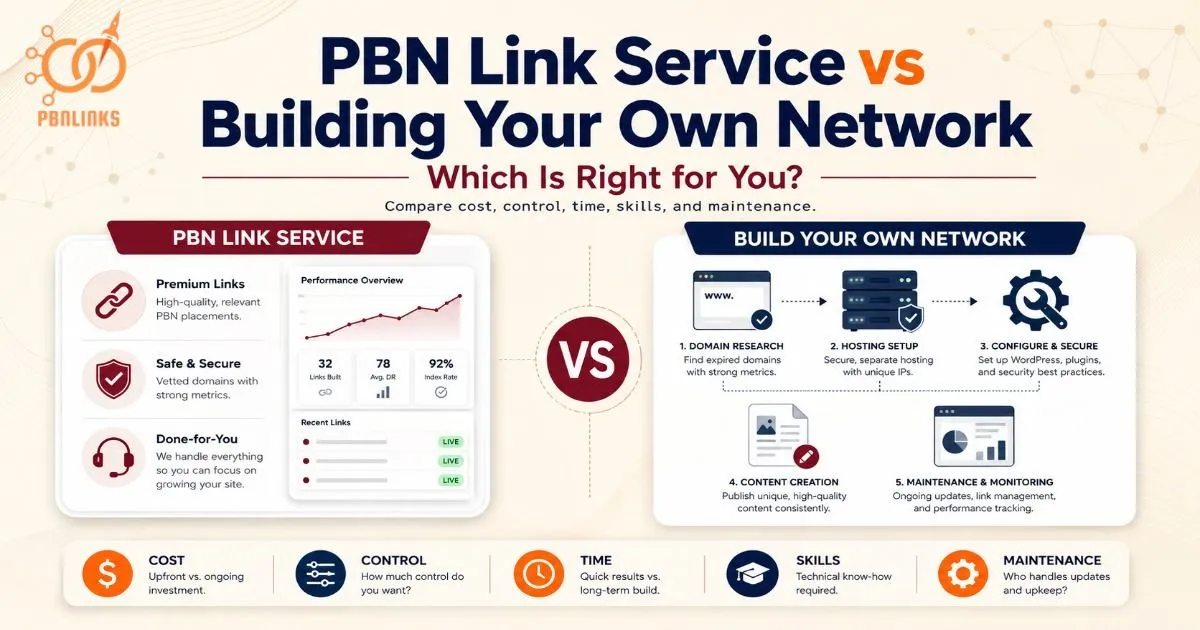
PBN Link Service vs Building Your Own Network: Which Is Right for You
Most SEO strategies fail when the decision between a PBN link service and building your own network is treated as a simple shortcut versus cost-saving choice. In reality, this decision is far more complex because it involves trade-offs between control, time, technical skill, and long-term maintenance.
The comparison of PBN Link Service vs DIY PBN is often oversimplified as paying for backlinks versus building your own system. However, both approaches require deeper operational inputs such as SEO tools, expired domain sourcing, hosting infrastructure, content creation, and ongoing management that directly impact real cost and effort.
Once these factors are properly considered, the gap between using a service and building your own network becomes much smaller than most people expect. The real difference is not just pricing, but who is responsible for execution, technical setup, and continuous maintenance.
This guide breaks down both approaches in detail, including cost, time, skill requirements, risk exposure, and scalability, so you can clearly understand which model actually fits your SEO strategy and long-term goals.
PBN Link Service vs DIY PBN, the Real Decision
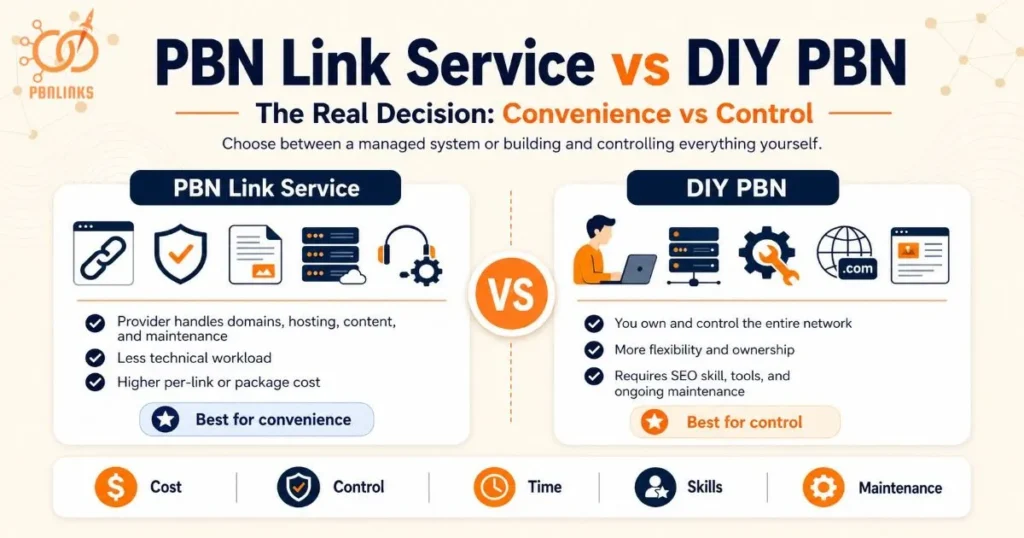
The real decision in a PBN link service vs DIY PBN setup is not simply about cost, but about choosing between paying for a managed system or building and controlling everything yourself. It is ultimately a trade-off between convenience and control.
A PBN link service works by removing the technical workload completely. It handles domain sourcing, hosting setup, content creation, and ongoing maintenance, which allows you to focus only on strategy. In exchange, you pay a higher per-link or package cost and rely on the provider’s infrastructure and processes.
A DIY PBN gives you full ownership of every part of the system, including expired domains, hosting configuration, content structure, and long-term network management. While this provides maximum control and flexibility, it also requires strong SEO knowledge, ongoing tool investment, and continuous maintenance to keep the network stable and effective.
When both options are evaluated realistically, the cost difference between them is often smaller than expected once hidden expenses like SEO tools, hosting, content production, and time investment are included. The real decision comes down to how much control you want versus how much operational work you are willing to handle yourself.
The Three Real Options in PBN Link Service vs DIY PBN
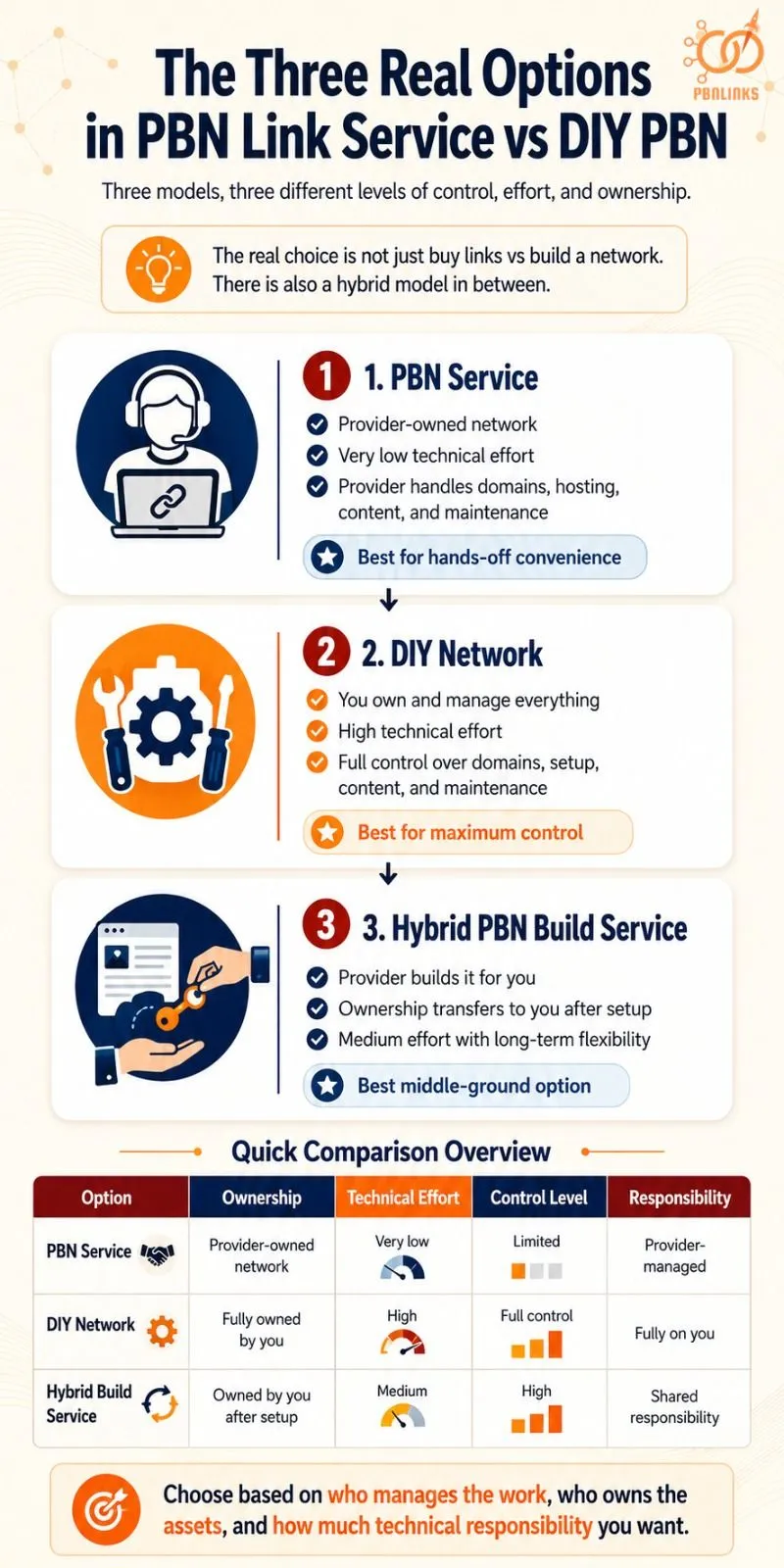
The decision between a PBN link service and a DIY PBN is not just a single choice, because there are actually three different ways this model can be implemented in practice. Each option represents a different balance of control, effort, and ownership.
Most people think of it as either buying links or building a network, but that misses the hybrid model that sits between both approaches. Understanding all three options is important before comparing cost, risk, or long-term value.
Instead of focusing only on price, the real difference comes down to who manages the work, who owns the assets, and how much technical responsibility you are willing to handle. These factors shape how each model performs in real-world SEO use.
PBN Service
A PBN service is the most convenience-focused option.
You pay a provider to place links on an existing private blog network that they already own and operate.
The provider handles domain sourcing, hosting setup, content creation, and ongoing maintenance. You only provide target URLs and anchor instructions, which makes the process simple and hands-off.
This model reduces technical involvement but also limits transparency and direct control over the network.
DIY Network
A DIY PBN gives you full control over every part of the system.
You are responsible for building and managing the entire network from scratch.
This includes expired domain selection, hosting setup, website configuration, content publishing, and ongoing maintenance.
Since everything is handled internally, it requires consistent effort and strong SEO knowledge.
This approach offers maximum flexibility but also demands ongoing operational discipline.
Hybrid PBN Build Service
A hybrid PBN build service sits between the two models.
A provider builds the network for you, but ownership is transferred to you after setup is complete.
The provider handles domain sourcing, infrastructure setup, and initial configuration.
After delivery, you take full control and manage the network yourself.
This model reduces upfront complexity while still giving you long-term ownership and flexibility.
Quick Comparison Overview
| Option | Ownership | Technical Effort | Control Level | Responsibility |
| PBN Service | Provider-owned network | Very low | Limited | Provider-managed |
| DIY Network | Fully owned by you | High | Full control | Fully on you |
| Hybrid Build Service | Fully owned by you after setup | Medium | High | Shared responsibility |
What DIY Actually Costs
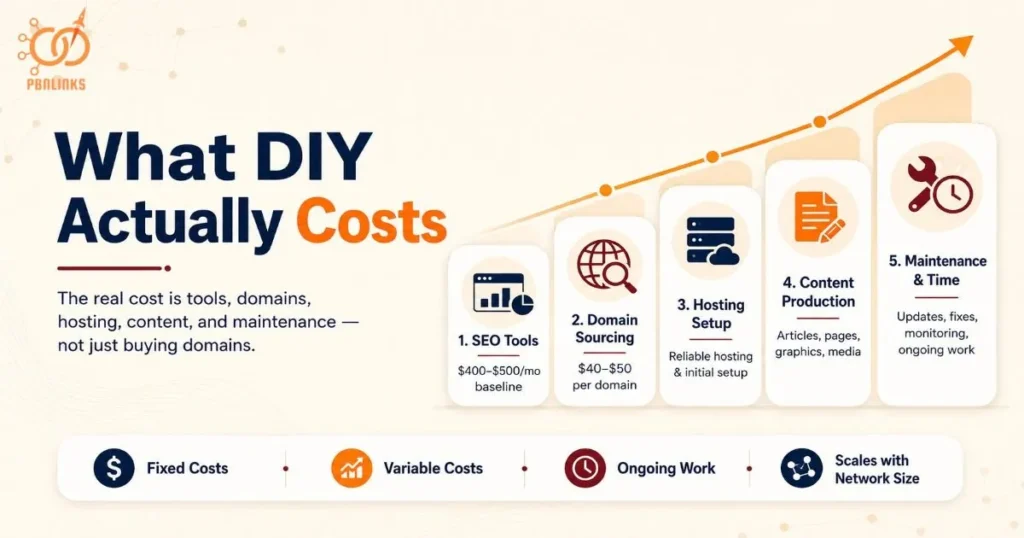
DIY PBN cost is not just about buying domains, but about running a continuous system of tools, sourcing, hosting, content, and maintenance that scales with every new site you add. The real cost is a combination of fixed expenses, variable acquisition costs, and ongoing operational effort rather than a one-time investment.
The first fixed expense is SEO tooling. Platforms like Ahrefs, Majestic, and similar backlink analysis tools typically cost around $400 to $500 per month, even for a small network. This is a baseline cost that remains constant regardless of how many domains you manage, making it a required operational foundation rather than an optional upgrade.
The second layer is domain sourcing, which becomes more expensive when tooling is factored in. When evaluating expired domains properly, sourcing around 10 quality domains per month can effectively translate into an estimated $40 to $50 per domain in allocated tool cost, before registration fees and time investment. This reflects the effort required to analyze backlink profiles, filter spam history, and avoid penalized or low quality domains.
Beyond acquisition, DIY costs continue across multiple operational areas, including:
- Hosting infrastructure setup and diversification to avoid footprint detection across multiple sites
- Content production required to maintain indexing, relevance, and ongoing site activity signals
- Maintenance work such as updates, monitoring, and replacing deindexed or underperforming domains
These costs scale directly with the number of domains, making DIY a continuously expanding system rather than a fixed one-time investment.
In practice, DIY cost is not defined by a single monthly number but by how large and active your network becomes over time. As the system grows, both financial cost and time commitment increase proportionally, making scalability the real hidden expense.
What a PBN Service Actually Costs
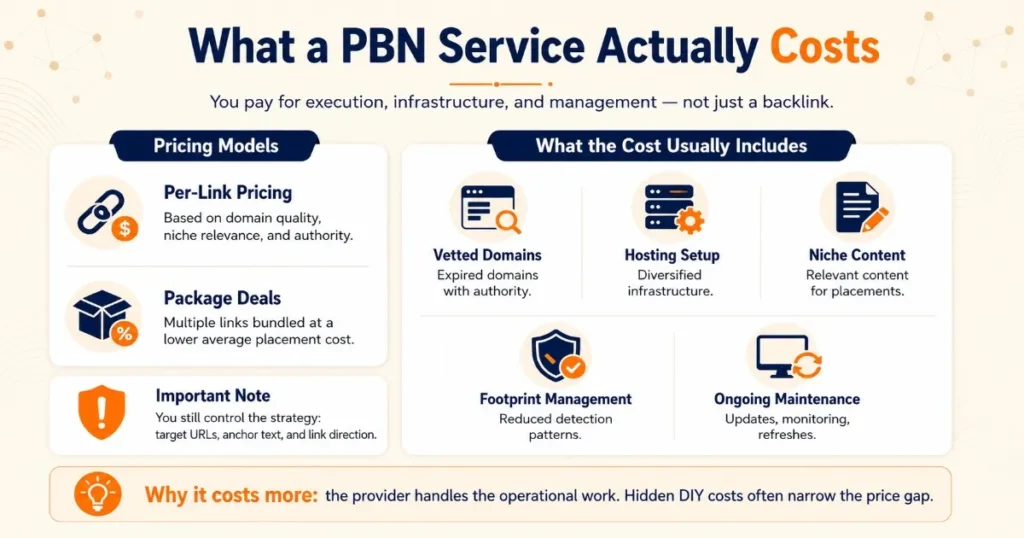
A PBN service typically costs more per link than building a network yourself, but this price reflects a fully managed system where the provider handles domain sourcing, hosting, content creation, and ongoing maintenance. In simple terms, you are paying for execution, infrastructure, and operational management rather than doing the technical work yourself.
Most providers structure pricing in two main ways:
- Per link pricing based on domain quality, niche relevance, and authority signals
- Package based deals that bundle multiple links at a lower average cost per placement
Per link pricing varies depending on the strength and exclusivity of the network, while packages are designed to offer better value at scale, especially for ongoing campaigns.
What you actually get for this cost is more than just a backlink. A standard PBN service usually includes:
- Vetted expired domains with existing authority signals
- Diversified hosting setups to reduce footprint overlap
- Niche relevant content tailored to the target site
- Footprint management designed to minimize detection patterns
Higher tier providers may also include ongoing maintenance such as updates, security monitoring, and content refreshes to keep sites stable and indexed over time.
Even with a fully managed service, the buyer still controls the strategy. You are typically responsible for providing target URLs, defining anchor text distribution, and guiding how links fit into your overall SEO plan. The provider executes the work, but the direction and intent remain on your side.
When compared with DIY, the price difference often appears large at first, but it narrows once the hidden costs of DIY are considered, including SEO tooling, domain sourcing inefficiencies, hosting setup, and ongoing maintenance workload that must be managed continuously.
Time and Skill Required for Each Option
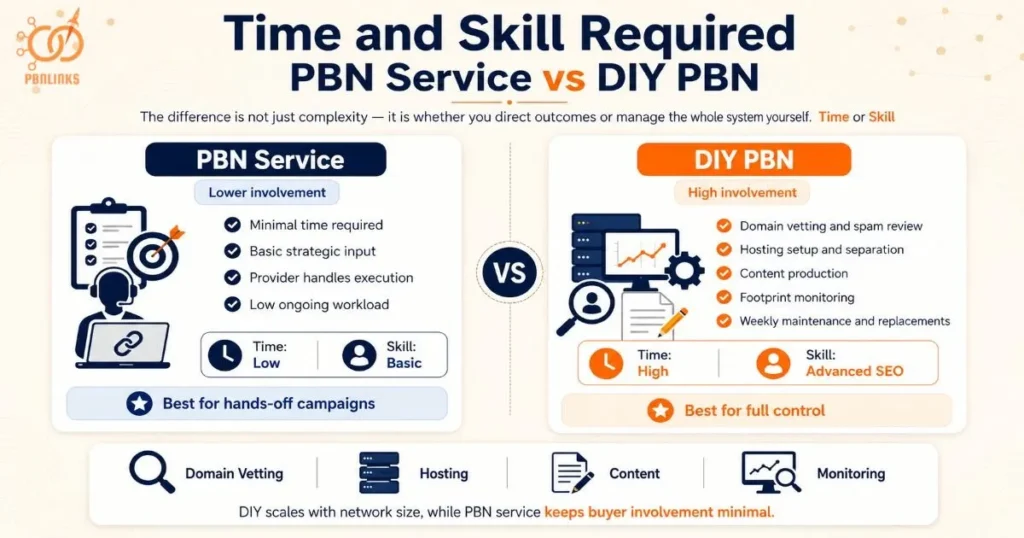
DIY requires ongoing time and strong SEO skill, while a PBN service requires minimal involvement beyond initial setup and basic strategic direction. The key difference is not just complexity, but whether you are actively managing the system or simply directing outcomes.
For DIY, the skill requirements are broad and technical. You need experience in domain vetting, hosting configuration, content management, and footprint monitoring. Each area directly affects the stability of the network, and weaknesses in any one part can compromise performance or expose the entire setup.
In practice, DIY involves several core operational tasks:
- Domain vetting, including backlink profile analysis, spam history review, and quality filtering before purchase
- Hosting setup using diversified environments to avoid footprint patterns across multiple sites
- Content production through regular publishing or outsourcing to maintain indexing and relevance
- Footprint monitoring to identify technical or structural patterns that could reveal network connections
Time-wise, DIY is not a one-time setup but a continuous operational process. It requires regular weekly attention for site health checks, updates, content publishing, and replacing underperforming or deindexed domains. The workload scales with network size, making it an ongoing management commitment rather than passive ownership.
In contrast, a PBN service requires minimal time from the buyer. Your involvement is usually limited to providing target URLs, defining anchor strategy, and approving placement direction, while the provider handles execution, maintenance, and infrastructure management.
How PBN Service and DIY Networks Get Detected
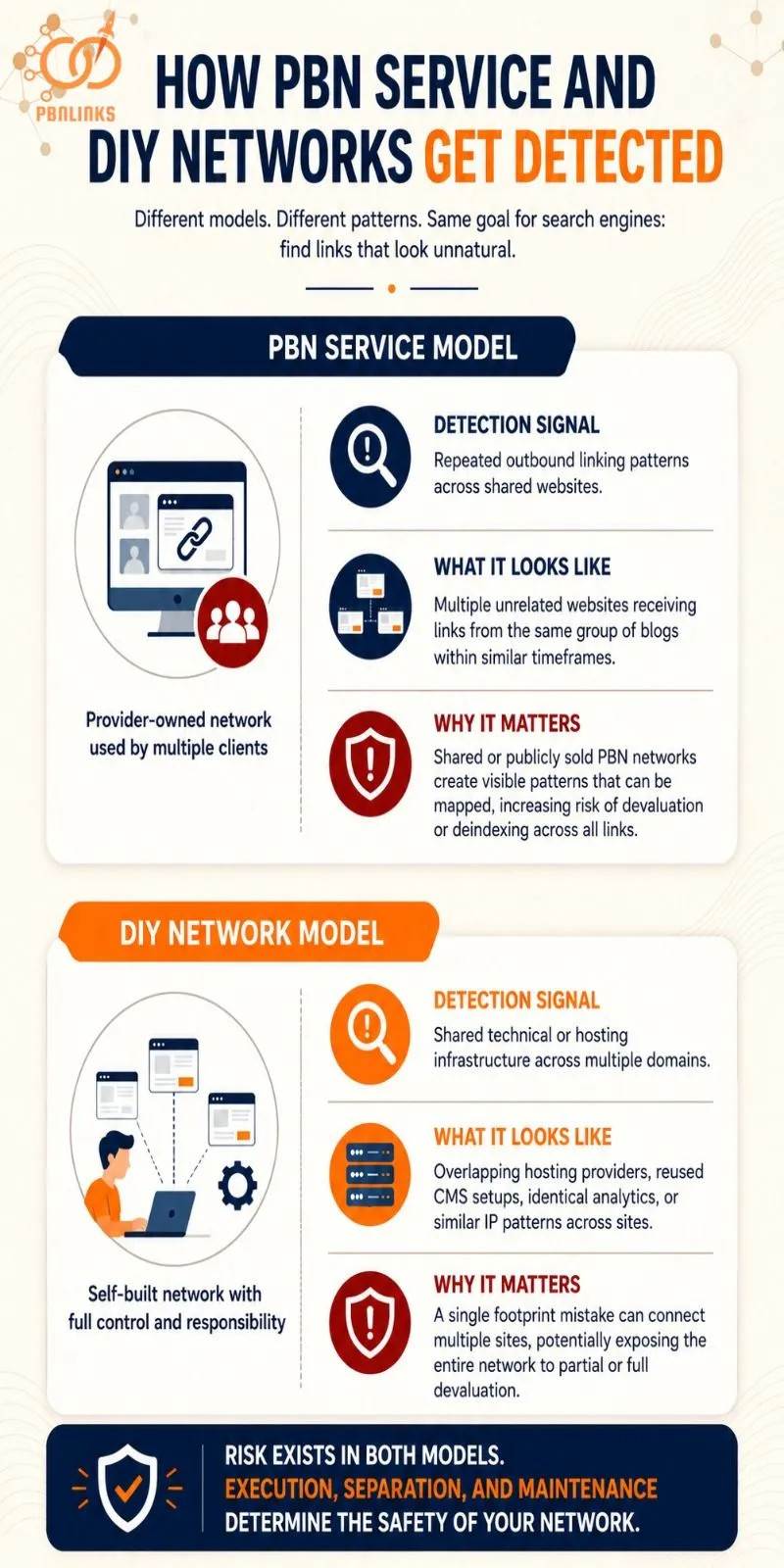
Both PBN service and DIY networks carry real detection risk, but the way that risk appears and is managed is different in each model. PBN services depend on shared provider infrastructure, while DIY networks rely entirely on the builder’s technical setup and ongoing maintenance discipline.
Search engines detect these systems by identifying repeated patterns, shared footprints, and unnatural linking behavior over time. Because of this, the safety of either approach depends on how well those patterns are controlled, separated, and maintained.
How a PBN Service’s Risk Gets Managed
In a PBN service model, detection risk depends on the provider’s infrastructure quality and how widely the network is shared across clients. If the same set of sites is used for multiple buyers, linking patterns become easier to identify at scale.
Detection signal: Repeated outbound linking patterns across shared websites
What it looks like: Multiple unrelated websites receiving links from the same group of blogs within similar timeframes
Why it matters: Shared or publicly sold PBN networks create visible patterns that can be mapped by automated systems, increasing the risk of devaluation or deindexing across all connected links
How a DIY Network’s Risk Gets Managed
In a DIY model, detection risk depends on how well the builder separates and maintains technical infrastructure across all sites. This gives more control, but also increases responsibility for avoiding footprint overlap.
Detection signal: Shared technical or hosting infrastructure across multiple domains
What it looks like: Overlapping hosting providers, reused CMS configurations, identical analytics setups, or similar IP patterns across sites
Why it matters: A single footprint mistake can connect multiple sites, potentially exposing the entire network to partial or full devaluation
When to Choose a PBN Service or DIY
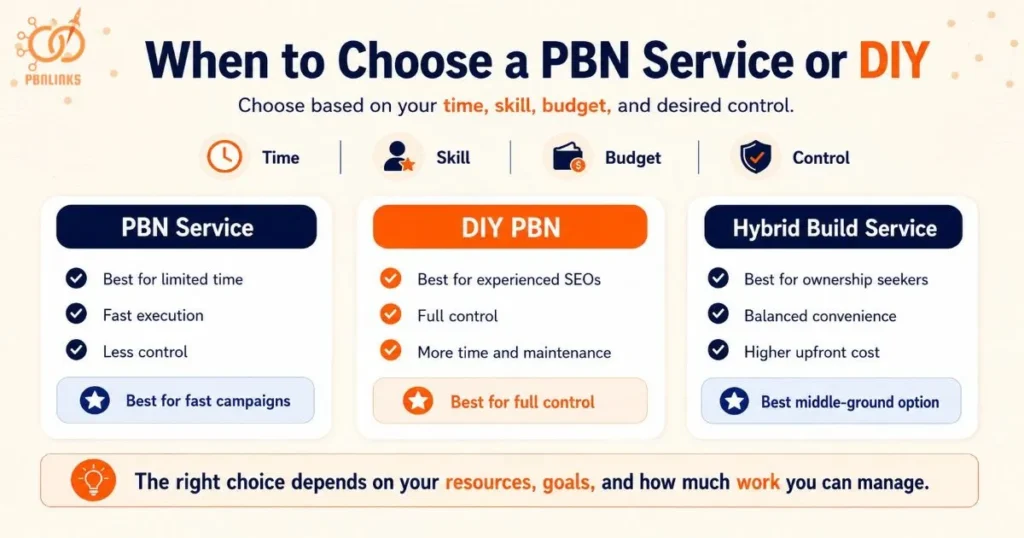
The decision between a PBN service, DIY network, or a hybrid build approach depends on your available time, technical skill, and budget rather than a universal rule. Each option fits a different SEO situation, and the right choice comes from matching your resources with the level of control, effort, and ownership you are actually prepared to handle.
A PBN service makes more sense when you have limited time, limited experience with SEO infrastructure, or need faster backlink results without dealing with technical setup. It is best for users who want to test campaigns quickly or scale rankings without managing domain sourcing, hosting, content creation, or ongoing maintenance.
DIY makes more sense when you have long term plans to build multiple sites, already understand technical SEO workflows, and are willing to invest significant setup time and tooling costs upfront. It is designed for users who want full control over domains, hosting structure, content strategy, and ongoing network management.
The hybrid PBN build service is the middle ground and makes sense when you want ownership of the network but do not want to handle sourcing and technical setup yourself. In this model, the provider builds the infrastructure while you retain control of the final assets, balancing convenience with ownership and long term flexibility.
Comparison Table
| Option | Best For | Key Strength | Main Tradeoff |
| PBN Service | Limited time users or fast campaigns | Fast execution without technical work | Less control over network and infrastructure |
| DIY PBN | Experienced SEOs with long term plans | Full control and long term cost efficiency | High time, skill, and maintenance requirement |
| Hybrid Build Service | Users wanting ownership without setup burden | Balance of control and convenience | Higher upfront cost than DIY |
Common PBN Service and DIY Mistakes
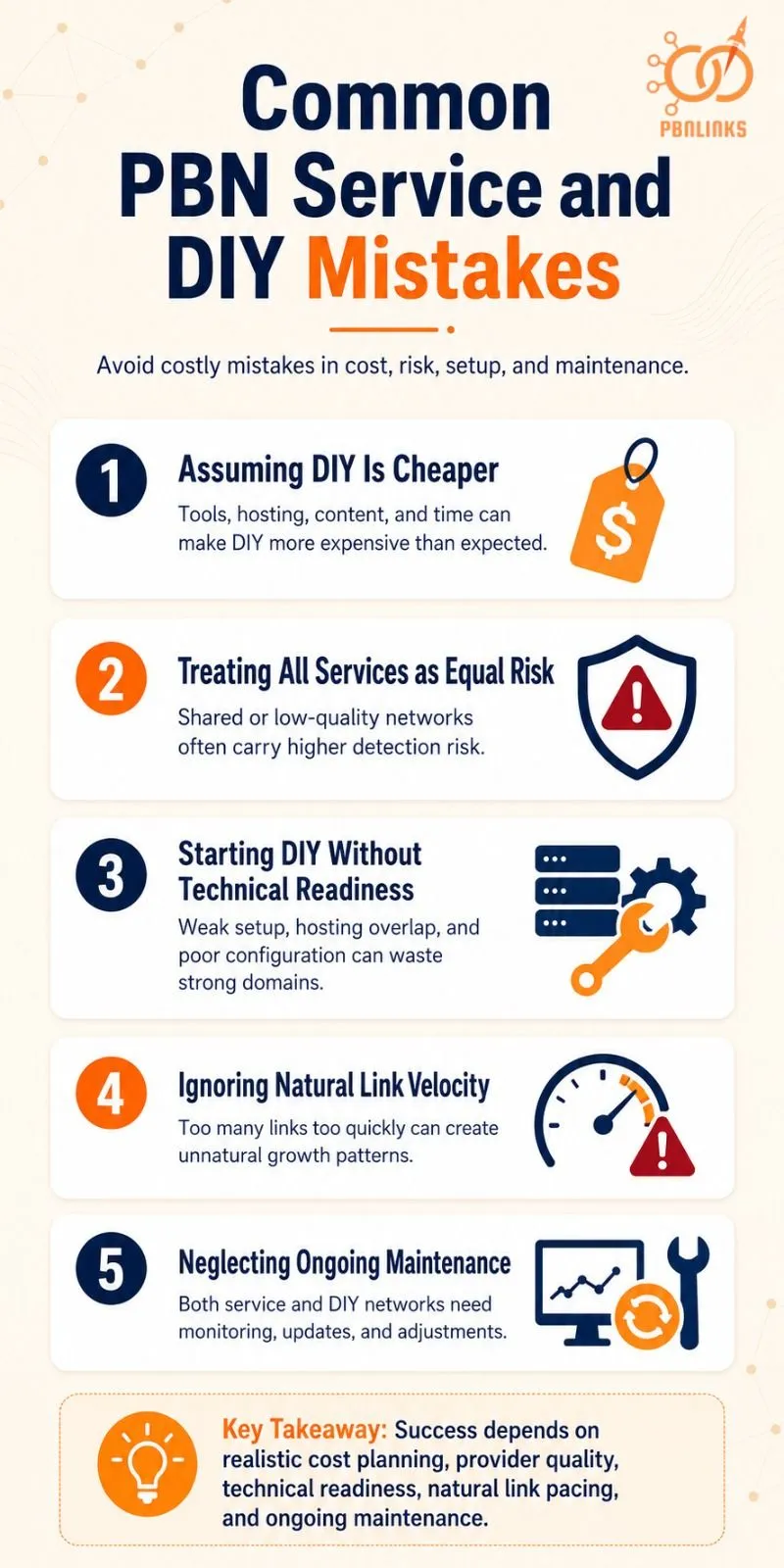
Most failures in PBN strategies come from incorrect assumptions about cost, risk, and execution rather than the choice between a PBN service or a DIY network. Mistakes usually happen during implementation when users underestimate the ongoing technical work, maintenance requirements, and long-term operational demands involved in both models.
Assuming DIY is automatically cheaper
One of the most common mistakes is assuming DIY will always be cheaper without calculating the full operational cost. This includes SEO tools, expired domain research, hosting setup, proxy usage, and the time required to manage and maintain the network. When these factors are ignored, DIY often ends up costing more in real terms than expected and creates budget pressure mid-execution.
Treating all PBN services as equal risk
Another frequent mistake is assuming all PBN services carry the same level of risk. In reality, risk varies depending on whether the network is privately managed or widely shared across multiple clients. Choosing low-quality, mass-sold services increases exposure to detection patterns and can reduce the long-term value of links across the entire campaign.
Starting DIY without technical readiness
A major mistake is starting a DIY network without verifying technical capability. DIY requires knowledge of hosting isolation, domain vetting, CMS configuration, and footprint management. Without this foundation, even strong expired domains can lose value due to setup errors, misconfiguration, or detectable infrastructure overlap.
Ignoring natural link velocity
Another overlooked mistake is ignoring natural link velocity when deploying links from either a service or DIY network. Adding too many links to a single page at once can create unnatural growth patterns that do not reflect organic linking behavior, increasing the likelihood of devaluation over time.
Neglecting ongoing maintenance
Finally, many users underestimate the importance of continuous maintenance. Both PBN services and DIY networks require monitoring, updates, and strategic adjustments over time. Treating PBNs as a one-time setup instead of an ongoing system often leads to declining performance and reduced long-term effectiveness.
In Conclusion
In conclusion, choosing between a PBN service and building your own network depends on your goals, resources, and ability to manage the process effectively. Neither option is automatically better because each comes with different advantages and challenges related to cost, control, time, and technical requirements.
A DIY network may offer more ownership and control, but the real costs are often higher than expected once SEO tools, domain sourcing, hosting, content, and ongoing management are included. Tools alone can cost around $400 to $500 per month, which significantly reduces the assumed savings of building a network yourself.
A PBN service removes much of the technical workload by handling network setup, maintenance, and operational tasks, but the quality of the service depends on the provider’s practices. In both models, risk and performance are determined by execution quality, management standards, and how carefully the network is handled.
The right choice ultimately comes down to your available time, technical expertise, and budget. If you need a managed solution that simplifies the process while focusing on quality link placements, explore pbnlinks.agency to find a PBN service that aligns with your SEO requirements.
FAQ About PBN Link Service vs Building Your Own Network: Which Is Right for You
Should I build my own PBN or use a service?
It depends on your available time, technical skill, budget, and need for control. A PBN service is usually better for those who want to avoid network management, while DIY suits users with the skills and resources to handle everything themselves.
Is it cheaper to build my own PBN?
Not necessarily. Once you include SEO tools, domain sourcing, hosting, content, and maintenance, DIY costs can become much higher than expected. SEO tools alone can cost around $400 to $500 per month for managing even a small network.
Do I need technical skills to build a PBN?
Yes. A DIY network requires knowledge of domain evaluation, hosting setup, content management, and footprint monitoring. Without these skills, mistakes during setup and maintenance can reduce performance and increase costs.
Which is safer, a PBN service or a DIY network?
Neither option is automatically safer because risk depends on execution and management quality. A carefully managed network can have a different risk profile than a shared, openly sold network with multiple users.
What is a PBN build service?
A PBN build service is a hybrid option where a provider creates the network, but ownership and control remain with the buyer. It combines the convenience of a service with the long term control of a private network.
Can I switch from a PBN service to my own network later?
Yes. Some users start with a service to avoid the initial learning curve and later build their own network once they have the required knowledge, tools, and resources.
What happens if a shared PBN service network gets detected?
If a shared network loses value, multiple buyers using links from the same network may be affected because the same assets are reused across campaigns. This is why evaluating a provider’s network management practices is important before purchasing.
How do I check if a PBN service’s domains are shared with other clients?
There is no completely reliable public way to confirm this. Ask providers about their network ownership, client overlap, and management practices before making a decision.
Does building my own PBN guarantee better results than a service?
No. Results depend on domain quality, execution, maintenance, and overall strategy. A poorly managed DIY network can perform worse than a carefully managed service.