PBN Links for Finance Sites: Building Authority in a YMYL Niche
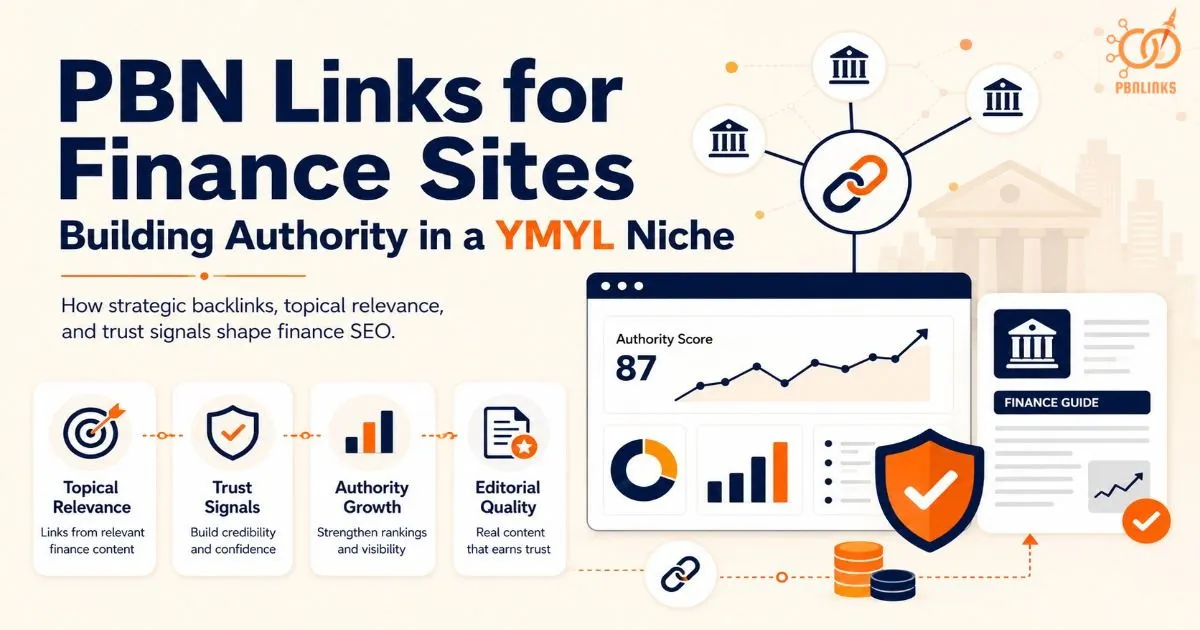
Ranking a finance website is one of SEO’s toughest challenges. Google expects stronger trust, expertise, and topical relevance because finance is a Your Money or Your Life (YMYL) niche where users rely on accurate and credible information before making financial decisions.
PBN links finance authority strategies can still support finance SEO when used with realistic expectations. Their purpose is to strengthen topical authority through finance-relevant domains, credible editorial content, and careful implementation rather than replacing the trust established by financial institutions.
The greatest opportunities come from beginner finance guides, budgeting resources, savings advice, and other informational topics. These pages are more accessible for independent websites, while highly competitive commercial keywords usually require broader authority signals beyond PBN links alone.
In this guide, you’ll learn where PBN links can realistically build finance authority, why topical relevance matters more than domain metrics, how E-E-A-T strengthens linking sites, and how domain selection, anchor text, and Tier 2 strategies contribute to sustainable finance SEO growth.
Why PBN Links for Finance Authority Face Structural Limits
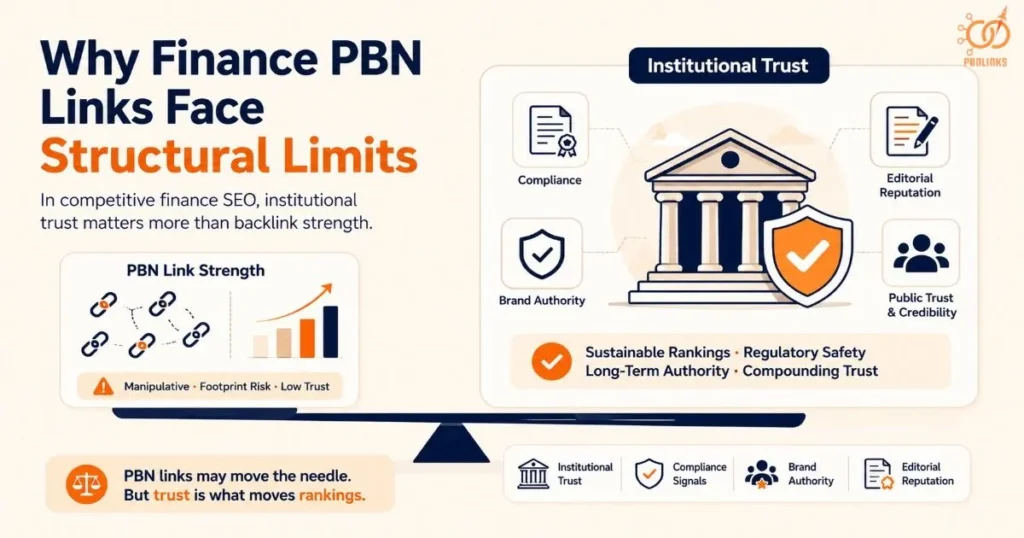
PBN links can strengthen finance authority, but they cannot overcome the structural advantages that established financial brands already possess. In finance SEO, rankings depend on far more than backlinks because Google evaluates trust, expertise, topical authority, and long-term credibility across the entire website.
Finance is one of Google’s most heavily scrutinized YMYL categories. Search results for loans, investments, insurance, and other commercial finance topics are dominated by organizations that have built authority over many years through:
- Regulatory compliance
- Recognized financial expertise
- Strong brand reputation
- Consistent editorial quality
- Long-term customer trust
These advantages create structural limits that backlinks alone cannot overcome. Even a high-quality PBN campaign cannot replace established brand recognition, financial credibility, or comprehensive topical coverage that has developed over years of publishing.
That does not mean PBN links have no value. They are most effective where independent websites still have realistic opportunities to compete, including:
- Beginner finance guides
- Personal budgeting resources
- Savings and debt management content
- Financial education and explainers
- Long-tail informational topics
The key takeaway is simple. PBN links should strengthen an existing authority strategy, not replace one. When combined with finance-relevant domains, strong E-E-A-T signals, topical relevance, and quality content, they can meaningfully support finance authority without overcoming the structural advantages held by major financial brands.
Where PBN Links for Finance Authority Actually Work
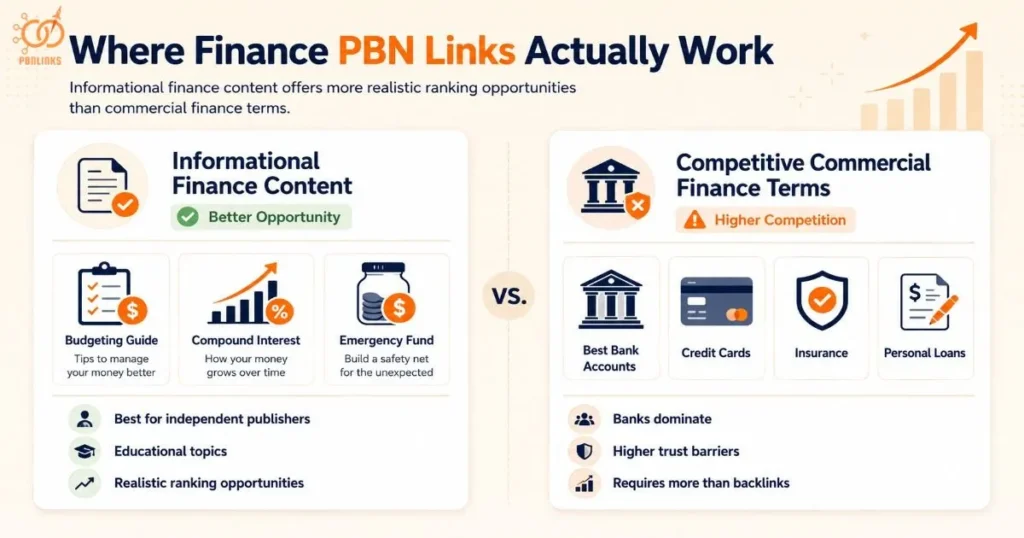
PBN links for finance authority deliver the strongest results on informational finance content rather than highly competitive commercial pages. Independent websites have a better chance of ranking educational resources because these searches rely more on topical relevance and helpful content than institutional reputation alone.
The success of any finance PBN strategy depends on search intent, not backlink volume. Informational queries create opportunities for smaller publishers, while commercial finance keywords require stronger brand authority, established expertise, and long-term trust signals that backlinks alone cannot replace.
Beginner and Informational Finance Content
Educational finance content offers the greatest opportunity for sustainable growth. Users searching these topics want clear explanations and practical guidance instead of financial products or regulated services, allowing independent publishers to compete alongside larger websites.
Typical examples include:
- Budgeting and money management
- Emergency funds and saving strategies
- Compound interest and investing basics
- Credit scores and debt management
- Personal finance and financial literacy
Supporting these pages with finance-relevant PBN links, helpful content, and strong topical relevance helps build authority across the entire finance section instead of improving only a single page.
Competitive Commercial Finance Content
Commercial finance pages operate under a different ranking environment. Searches related to loans, mortgages, insurance, credit cards, banking services, and investment products are dominated by organizations that combine strong backlink profiles with years of accumulated trust and expertise.
These websites benefit from advantages that extend beyond link building, including:
- Established brand recognition
- Regulatory compliance
- Demonstrated financial expertise
- Editorial consistency
- Comprehensive topical coverage
Rather than pointing PBN links directly to these highly competitive pages, use them to strengthen supporting educational content that naturally passes authority through contextual internal links. This creates a safer and more sustainable authority-building strategy while protecting your most valuable commercial pages.
The key takeaway is straightforward. PBN links perform best when they support informational content that matches user intent. In finance SEO, choosing the right content target consistently produces better long-term results than simply increasing backlink volume.
Why Topical Relevance Matters More Than Metrics in Finance PBN Links
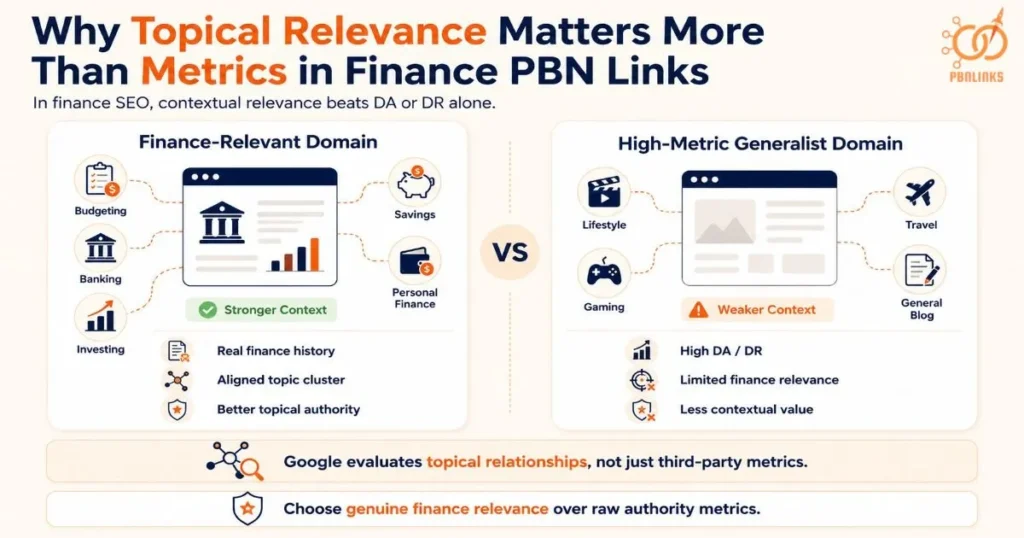
Topical relevance matters more than domain metrics because Google evaluates how naturally a backlink fits within a website’s subject expertise. A finance-related domain with genuine historical content often contributes stronger contextual value than a higher-metric website that has no connection to financial topics.
Third-party metrics such as Domain Authority (DA) and Domain Rating (DR) estimate backlink strength, but they do not measure topical alignment. Google focuses on whether the referring website reinforces the destination page’s expertise within the same subject area.
A finance-focused domain naturally strengthens semantic relationships between connected topics. Historical coverage of personal finance, banking, investing, credit, or insurance creates content continuity that supports Google’s understanding of financial expertise.
Consider the difference below:
| Finance-Relevant Domain | High-Metric General Domain |
| Previous history in personal finance, banking, or investing | Previous history in unrelated industries such as technology, travel, or lifestyle |
| Reinforces finance-specific topical signals | Primarily passes general link authority |
| Strengthens contextual relevance | Provides limited subject alignment |
| Better supports long-term finance authority | Less effective for building finance expertise |
This distinction becomes especially important in a YMYL niche. A backlink should strengthen both authority and topical consistency instead of increasing backlink metrics alone. Choosing domains with genuine financial relevance creates a stronger foundation for sustainable finance rankings.
The key takeaway is simple. In finance SEO, contextual relevance consistently outperforms raw domain metrics. A domain that already belongs to Google’s finance topic cluster will usually provide greater long-term value than a higher-scoring website with no meaningful financial history.
E-E-A-T Signals a Finance PBN Site Needs
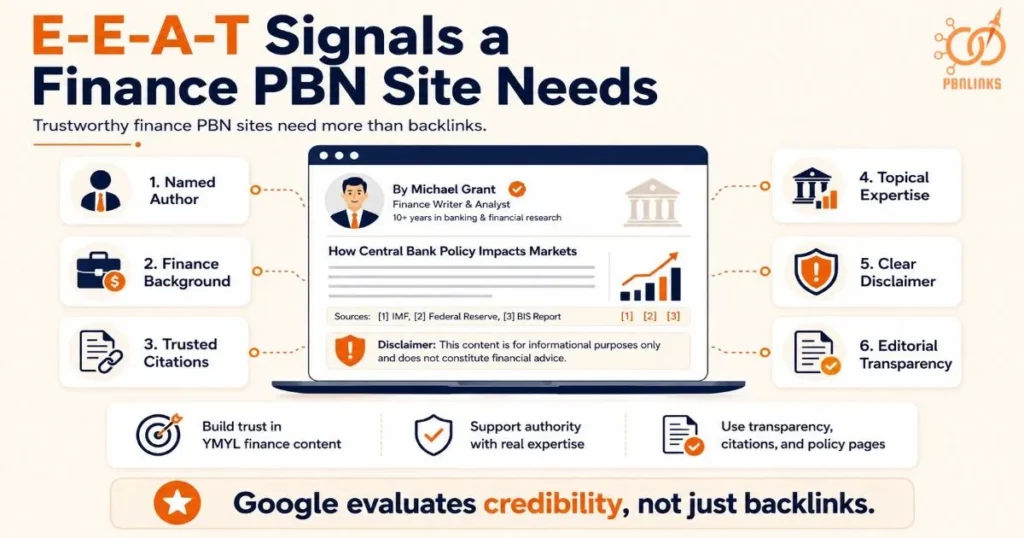
Finance PBN sites need strong E-E-A-T signals because Google evaluates the credibility of both the linking website and the destination website in Your Money or Your Life (YMYL) topics. A trustworthy finance publication provides stronger contextual authority than a website created solely to distribute backlinks.
Building trust goes beyond publishing finance articles. Google looks for signals that demonstrate genuine expertise, transparent editorial practices, reliable sourcing, and consistent topic coverage. Together, these elements help a finance PBN appear as a legitimate publication instead of an artificial link network.
Financial Writing Background and Citations
Credible authorship forms the foundation of financial E-E-A-T. Every article should be published under a named author with a believable background, such as a personal finance writer, former banking professional, or financial planning enthusiast whose expertise aligns with the subject.
Financial data, market statistics, and factual claims should always reference reliable sources. Citing recognized financial publications, government agencies, or established industry research strengthens editorial credibility while reinforcing the accuracy of the content.
Disclaimers and Editorial Transparency
Finance content discussing investments, loans, banking products, or financial decisions should include a clear disclaimer stating that the information is educational rather than personalized financial advice. This demonstrates transparency while reflecting the higher trust standards expected within YMYL content.
A finance PBN should also demonstrate consistent editorial practices through:
- A detailed About page
- A Contact page with clear information
- Privacy Policy and Terms pages
- An Editorial Policy explaining publishing standards
- Regular publishing that maintains topical consistency
Together, these signals help the website resemble a genuine finance publication instead of a network built primarily for backlinks. Strong editorial transparency supports long-term credibility and increases the contextual value of every finance-related backlink.
Domain Selection for Finance PBN Links
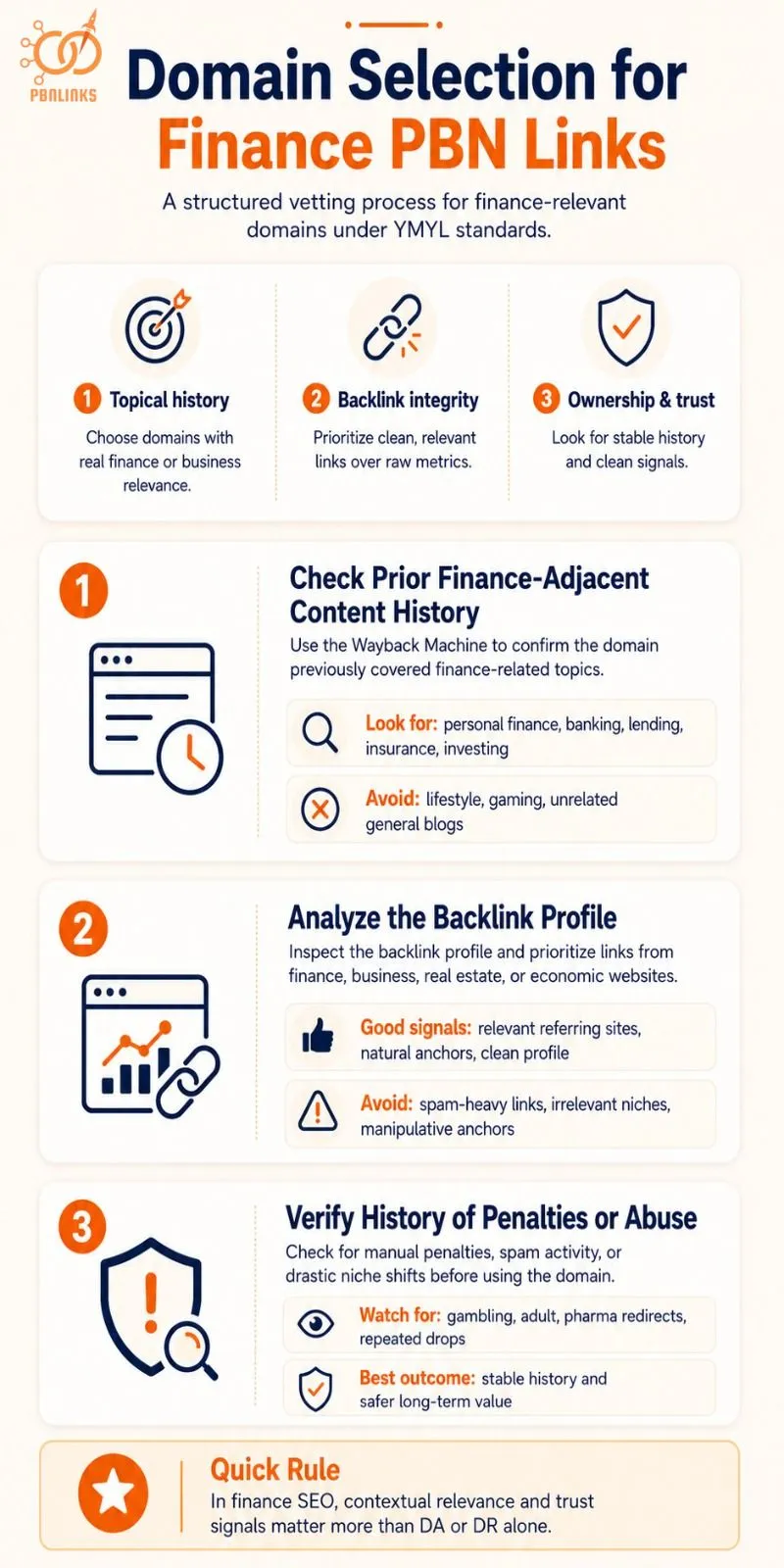
Selecting the right domain is the foundation of every successful finance PBN campaign. A finance-relevant domain with a clean history, trusted backlinks, and consistent topical relevance provides stronger authority than a higher-metric domain with an unrelated background.
The goal is not simply to buy expired domains. It is to choose assets that already fit naturally within the finance ecosystem. Domains with genuine financial history create stronger contextual signals and reduce unnecessary SEO risk.
Evaluate every domain using the following three-step process before adding it to your finance PBN network.
Step 1: Verify Historical Finance Relevance
Review the domain using the Wayback Machine to confirm it previously published finance-related content. Prior coverage should include topics such as personal finance, banking, investing, lending, insurance, or financial planning.
Avoid domains that have shifted from unrelated industries such as gaming, entertainment, travel, or lifestyle. Strong topical continuity helps preserve contextual relevance and supports finance-specific authority.
Step 2: Review the Backlink Profile
Analyze the backlink profile with trusted SEO tools and prioritize domains earning links from finance, business, accounting, real estate, or economic publications. These backlinks reinforce topical authority and strengthen trust signals.
Reject domains with spam backlinks, manipulated anchor text, or links from unrelated niches. A natural https://pbnlinks.agency/backlink-audit-guide/ is more valuable than inflated third-party metrics.
Step 3: Confirm a Clean Domain History
Check whether the domain has been affected by spam, manual actions, repeated ownership changes, or unrelated niche transitions. Past abuse often weakens long-term SEO value, even when authority metrics appear strong.
Choose domains with stable ownership, consistent publishing history, and no evidence of previous link schemes. Clean historical signals make the domain safer for long-term finance authority building.
Domain Vetting Checklist
| Evaluation Factor | What to Look For | Why It Matters |
| Historical Content | Previous finance or business articles | Preserves topical relevance |
| Backlink Sources | Finance, business, accounting, and economic websites | Strengthens contextual authority |
| Anchor Profile | Natural branded and descriptive anchors | Indicates organic backlink growth |
| Domain History | No spam, penalties, or unrelated niche changes | Protects long-term trust |
| Ownership Stability | Consistent registration and publishing history | Reduces footprint and risk |
A finance PBN is only as strong as the domains behind it. Careful domain selection creates a stronger foundation for topical authority, safer link building, and more sustainable rankings than relying on high DA or DR alone.
Anchor Text Risk for Finance Authority PBN Links
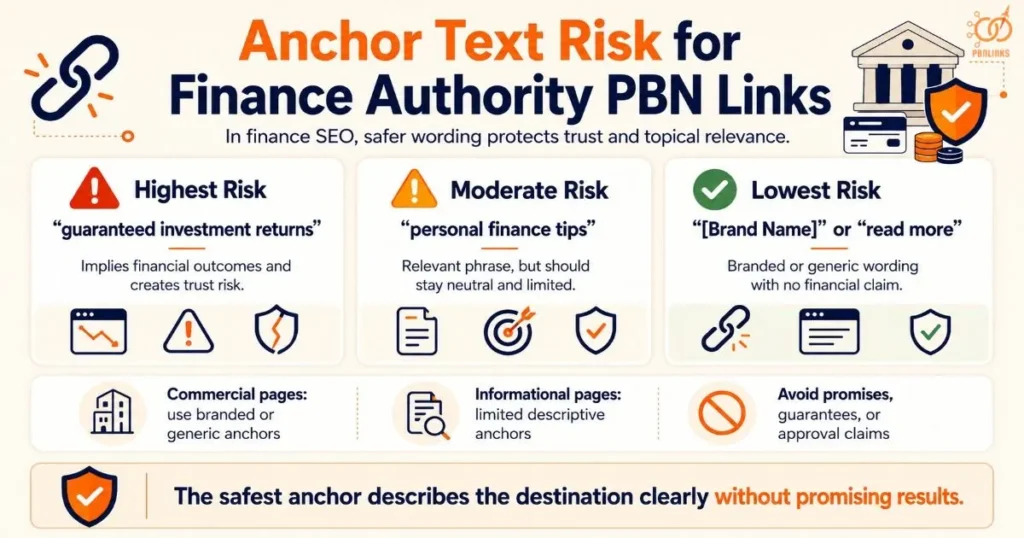
Anchor text becomes risky in finance when it implies financial claims or guaranteed outcomes rather than simply describing the destination page. In a YMYL niche, Google evaluates anchor text alongside its surrounding context, making neutral, descriptive wording far safer than promotional or outcome-based anchors.
Unlike many industries, finance anchor text influences both topical relevance and perceived trust. Every anchor should accurately reflect the linked page without suggesting guaranteed returns, loan approvals, investment performance, or regulated financial advice.
| Content Type | Preferred Anchor | Avoid | Why It Matters |
| Commercial finance pages | Branded and generic anchors | Exact-match commercial or outcome-based anchors | Protects trust signals and reduces over-optimization risk. |
| Informational finance content | Descriptive, branded, and generic anchors | Anchors implying guarantees or financial promises | Maintains topical relevance while keeping the content neutral and trustworthy. |
Anchor strategy should always match the purpose of the destination page. Educational articles provide greater flexibility because they explain financial concepts rather than promote financial products. Commercial pages targeting loans, insurance, investments, or credit products require a far more conservative approach.
This follows the same framework established earlier in Where PBN Links for Finance Authority Actually Work. Informational content can use carefully written descriptive anchors, while commercial finance pages should rely primarily on branded and generic anchors to minimize unnecessary risk.
Google also evaluates the words surrounding a hyperlink, not just the clickable text itself. Relevant financial context naturally reinforces topical relevance and helps the link appear editorial rather than manipulative. A well-written paragraph discussing budgeting, savings, or investing provides stronger semantic signals than an isolated keyword-rich anchor.
The safest finance anchor strategy is straightforward: use branded and generic anchors for commercial pages, reserve descriptive anchors for informational content, and avoid wording that promises financial outcomes or regulated advice. This approach supports stronger topical authority while protecting long-term trust signals in finance SEO.
How PBN Links Support Finance Authority Without Targeting Money Pages Directly
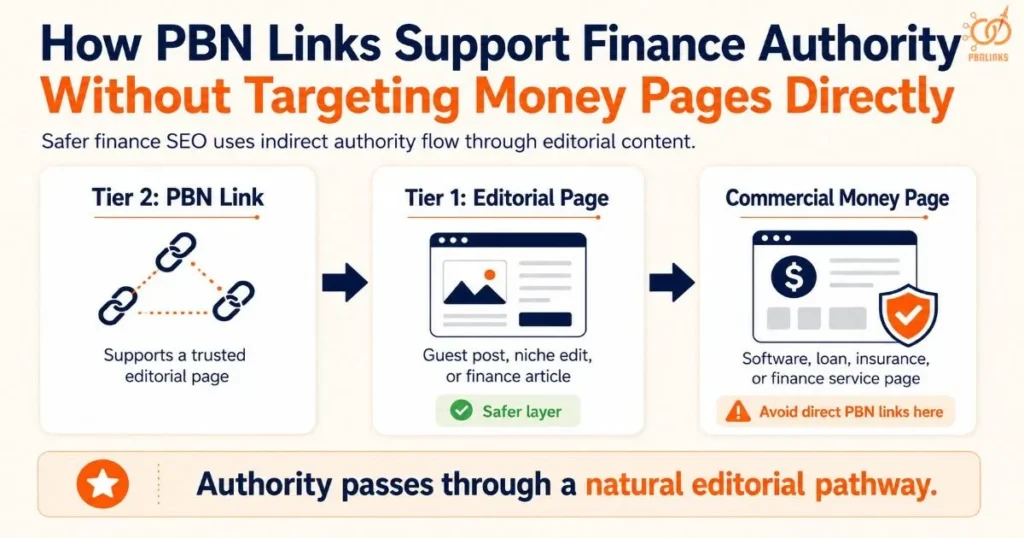
Supporting editorial content instead of linking directly to commercial finance pages is the safer way to use PBN links in finance SEO. This approach strengthens topical authority through trusted editorial pathways while keeping high-value money pages separated from direct PBN exposure.
Instead of pointing PBN links at commercial pages, finance websites often use a layered authority structure. Tier 1 consists of genuine editorial backlinks, including guest posts, niche edits, and mentions on finance or business websites. Tier 2 consists of PBN links that strengthen those editorial pages, allowing authority to flow naturally toward the destination page through existing contextual links.
How Authority Flows
| Layer | Purpose |
| Tier 2 | PBN links strengthen trusted editorial content. |
| Tier 1 | Editorial pages pass contextual authority through natural outbound links. |
| Money Page | Commercial finance page benefits indirectly without receiving direct PBN links. |
Authority Flow
Tier 2 PBN Link
↓
Editorial Finance Article or Guest Post
↓
Commercial Finance Page
↓
Authority passes through a trusted editorial pathway
A practical example is a budgeting guide published on a respected personal finance website that naturally links to a budgeting software page. Rather than sending PBN links directly to the software page, the links strengthen the budgeting guide first. The additional authority then flows through the existing editorial link, improving topical relevance while maintaining a cleaner backlink profile.
This structure is particularly effective for finance because commercial pages targeting loans, insurance, investments, and credit cards receive greater algorithmic scrutiny than informational content. Supporting editorial assets first helps strengthen overall finance authority without exposing the site’s most valuable pages to unnecessary risk.
The strategy also complements the content framework established earlier in this guide. Informational resources build topical authority, editorial pages distribute that authority naturally, and commercial pages benefit through contextual internal and external links. This layered approach creates a more balanced backlink profile and aligns better with how authority develops across finance websites over time.
Why Finance PBN Links Cost More
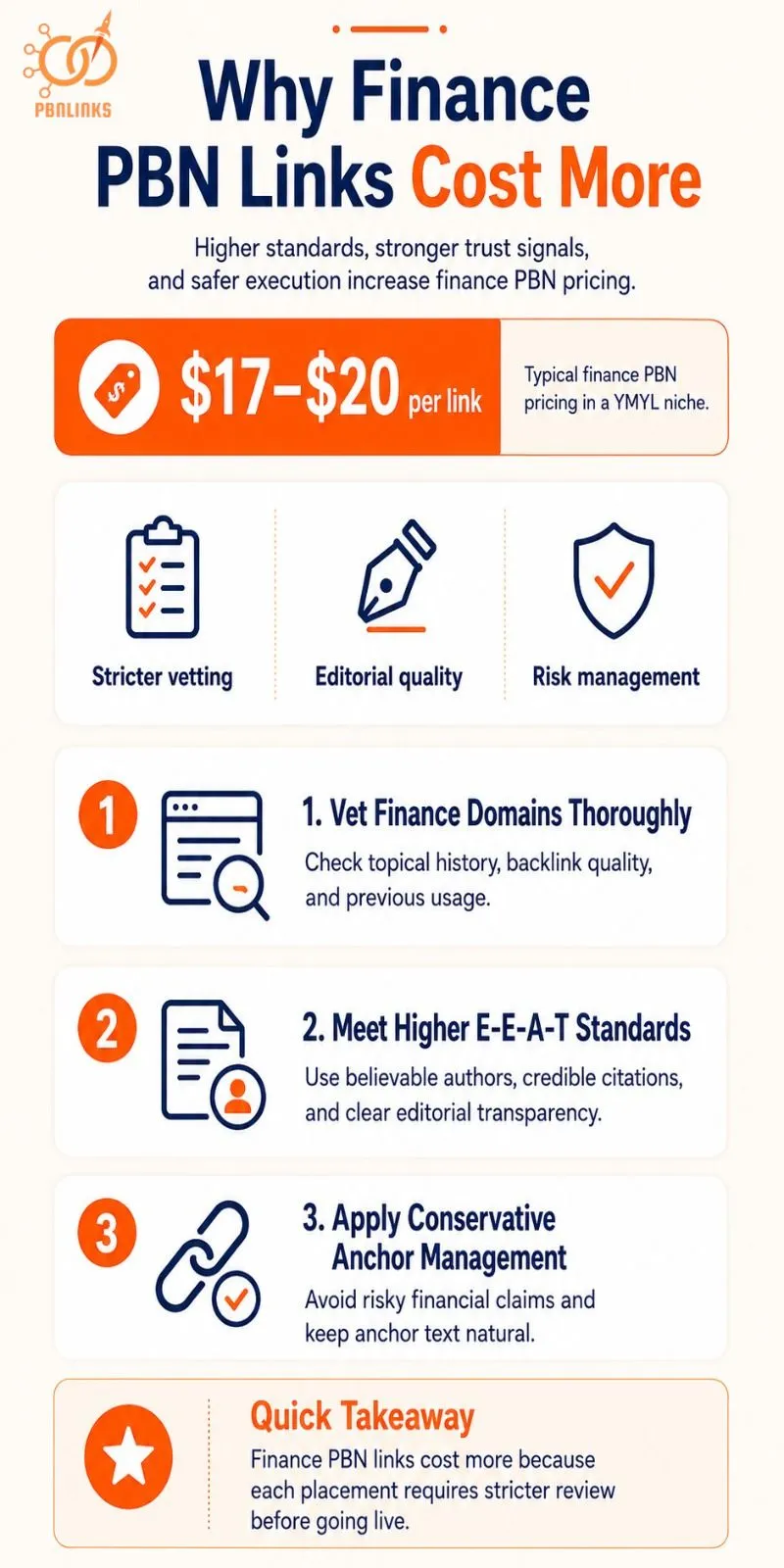
Finance PBN links cost more because every placement must satisfy stricter quality, editorial, and trust requirements than standard niche backlinks. At PBNLinks.Agency, finance PBN links typically cost $17 to $20 per link, reflecting the additional work required to build authority safely in a YMYL environment rather than a simple pricing markup.
Unlike general niches, finance backlinks require extensive domain research, higher editorial standards, conservative anchor strategies, and multiple quality checks before publication. Each requirement has already been explained throughout this guide and directly contributes to the overall cost of every placement.
Domain Vetting
Every finance domain must pass a detailed review before it becomes part of a PBN network. As discussed in Domain Selection for Finance PBN Links, domains are evaluated for historical finance relevance, backlink quality, ownership history, and previous website usage.
Because genuinely relevant finance domains are far less common than general websites, sourcing suitable domains requires significantly more time, expertise, and manual verification.
Editorial Standards
Finance content is held to higher trust expectations than most industries. As explained in E-E-A-T Signals a Finance PBN Site Needs, every article should demonstrate believable authorship, credible financial references, editorial transparency, and clear informational intent.
Producing this level of content requires additional research, editing, fact-checking, and quality assurance, making finance publications considerably more expensive than standard PBN content.
Anchor Text Management
Finance anchor text demands far greater precision because it can influence both search relevance and perceived financial credibility. As covered in Anchor Text Risk for Finance Authority PBN Links, anchors should remain branded, generic, or carefully descriptive while avoiding wording that implies guaranteed returns, approvals, or financial promises.
Each placement requires manual review to ensure both the anchor text and the surrounding context appear natural, relevant, and consistent with finance-specific trust expectations.
Rather than paying for the finance niche itself, you are paying for the additional work required to build safer, more credible, and topically relevant backlinks. Every placement undergoes stricter quality control before publication, helping maintain stronger trust signals within one of Google’s most competitive YMYL categories.
| Quality Factor | General-Niche PBN Links | Finance PBN Links |
| Domain Selection | Broader selection with standard vetting. | Requires finance history, contextual relevance, and clean backlink profiles. |
| Editorial Content | Basic niche content with limited review. | Higher E-E-A-T standards, credible financial citations, and editorial transparency. |
| Anchor Strategy | Greater flexibility with keyword-rich anchors. | Conservative branded and descriptive anchors that avoid financial claims. |
| Quality Assurance | Standard publishing checks. | Additional reviews for topical relevance, trust signals, and YMYL compliance. |
| Operational Effort | Lower research and maintenance requirements. | More manual sourcing, editorial review, and risk management throughout the process. |
| Typical Price | Lower due to simpler quality requirements. | $17 to $20 per link because of stricter vetting, higher editorial standards, and safer implementation practices. |
Key Takeaway
Finance PBN pricing reflects the additional expertise required at every stage of the process. From sourcing historically relevant domains to publishing trustworthy financial content and managing conservative anchor text, each quality requirement increases the time and effort needed to produce backlinks that align with finance SEO best practices.
Common Mistakes When Using PBN Links for Finance
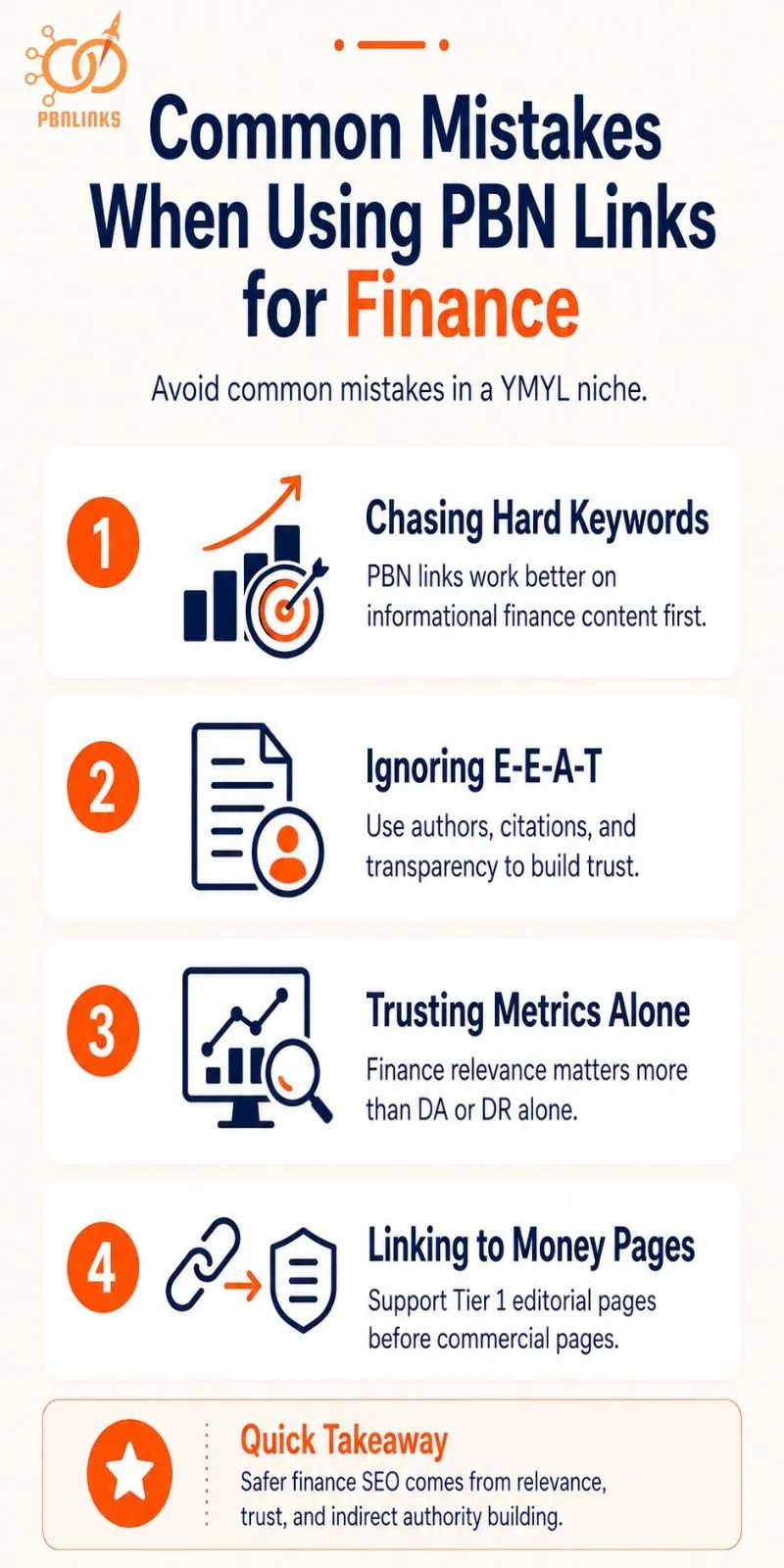
Most finance PBN campaigns fail because they ignore the trust and topical requirements of a YMYL niche. Success depends less on building more backlinks and more on choosing realistic content targets, maintaining editorial credibility, and following a structured authority-building strategy.
Mistake 1: Expecting PBN Links to Rank Competitive Commercial Keywords
One of the most common mistakes is relying on PBN links alone to rank highly competitive keywords related to loans, insurance, investments, or credit cards. These search results are dominated by financial institutions with years of accumulated trust, editorial authority, and brand recognition.
A more effective approach is to use PBN links to strengthen beginner guides, educational resources, and informational content where independent websites have realistic ranking opportunities.
Mistake 2: Treating PBN Sites as Link Sources Instead of Finance Publications
Many website owners focus only on the destination website while ignoring the credibility of the linking website. In finance SEO, both websites contribute to topical authority and trust.
Every finance PBN should demonstrate believable authorship, reliable financial citations, editorial transparency, and clear informational intent. A trustworthy linking website naturally provides stronger finance-specific authority than a thin website created solely to publish backlinks.
Mistake 3: Choosing Domains Based Only on DA or DR
High authority metrics do not guarantee topical relevance. A domain with genuine finance history, clean backlinks, and consistent subject matter usually contributes more finance-specific authority than a higher-metric website from an unrelated niche.
Successful domain selection prioritizes contextual relevance, historical content, and backlink quality before considering third-party authority metrics.
Mistake 4: Pointing PBN Links Directly at Commercial Money Pages
Sending PBN links directly to high-value commercial pages creates unnecessary risk because these pages receive greater algorithmic scrutiny within finance search results.
A safer strategy is to strengthen Tier 1 editorial content first, allowing authority to flow naturally toward commercial pages while maintaining a cleaner backlink profile and reducing direct PBN exposure.
Key Takeaway
Every mistake in finance PBN SEO has the same root cause, treating backlinks as the primary ranking factor while overlooking trust, topical relevance, and editorial quality. The strongest long-term results come from realistic content targeting, finance-relevant domains, credible editorial standards, and a structured authority-building strategy rather than simply increasing backlink volume.
In Conclusion
In conclusion, PBN links can support finance authority when they are used with realistic expectations and a structured strategy. They work best for beginner guides and informational content supported by finance-relevant domains, strong E-E-A-T signals, conservative anchor text, and a Tier 2 authority-building approach.
For highly competitive finance keywords, backlinks alone are rarely enough. Long-term success depends on combining topical relevance, editorial quality, brand credibility, and genuine trust signals with a well-planned link-building strategy.
The typical $17 to $20 per link pricing reflects the additional work required to source relevant domains, publish trustworthy finance content, and maintain stricter quality standards throughout every stage of the process. It represents the higher operational requirements of finance SEO rather than a simple pricing premium.
If you are ready to build finance authority with carefully vetted, niche-relevant PBN links, PBNLinks.Agency provides placements designed specifically for finance websites and YMYL industries. Explore the available finance packages at PBNLinks.Agency, or contact the team to develop a strategy tailored to your website, content goals, and long-term organic growth.
FAQs About PBN Links for Finance Sites
Do PBN links work for finance sites?
Yes, but only for the right content types. PBN links finance authority is most effective for beginner guides, educational resources, and informational finance topics, while highly competitive commercial pages require broader authority-building strategies.
Why don’t PBN links work for competitive finance keywords?
Competitive finance keywords are dominated by trusted financial institutions with established authority, strong editorial signals, and long-term brand recognition. PBN links alone cannot replicate those trust signals or compete with institutional credibility.
What finance content can PBN links realistically support?
PBN links work best for informational content, including budgeting guides, savings tips, financial education, and beginner finance resources. These topics face less brand dominance and provide more realistic ranking opportunities.
Why do finance PBN links cost more than other niches?
Finance PBN links typically cost $17 to $20 per link because they require stricter domain vetting, stronger E-E-A-T signals, finance-focused content, and careful anchor text management. These higher standards increase sourcing and maintenance costs.
What is the difference between finance PBN links and health PBN links?
Both finance and health are YMYL niches that require stronger trust signals. However, finance rankings are influenced more by institutional authority and regulatory credibility, while health rankings rely more heavily on medical expertise and content accuracy.
Can a PBN link hurt a finance site’s trust signals?
Yes. Low-quality or easily detectable PBN links can weaken trust signals and reduce link value. Because finance is a high-scrutiny niche, unnatural link patterns carry greater risk than they do in many other industries.
What should a finance PBN site include to look credible?
A finance PBN site should include a named author with relevant financial experience, citations from trusted financial sources, clear editorial pages, and an informational disclaimer. These signals help the linking site appear more trustworthy.
Is it safe to use exact-match anchor text on a finance PBN link?
Exact-match anchors should be used very sparingly and should never imply guaranteed financial outcomes or regulated advice. Branded and generic anchors remain the safest choice, especially for commercial finance pages.
What happens if Google detects a PBN link on a finance site?
If Google identifies a PBN link as manipulative, it may simply ignore the link or reduce its value. In finance, repeated unnatural patterns can also weaken overall trust signals, making recovery more difficult.
Does topical relevance matter more than domain metrics for finance PBN links?
Yes. A domain with genuine finance-related history usually provides stronger topical authority than a higher-metric domain from an unrelated niche. Contextual relevance is often more valuable than DA or DR alone.
Should I point PBN links directly at my finance money pages?
No. A safer strategy is to use PBN links to strengthen Tier 1 editorial content that already links to your commercial pages. This indirect approach helps pass authority while reducing direct exposure to PBN-related risks.