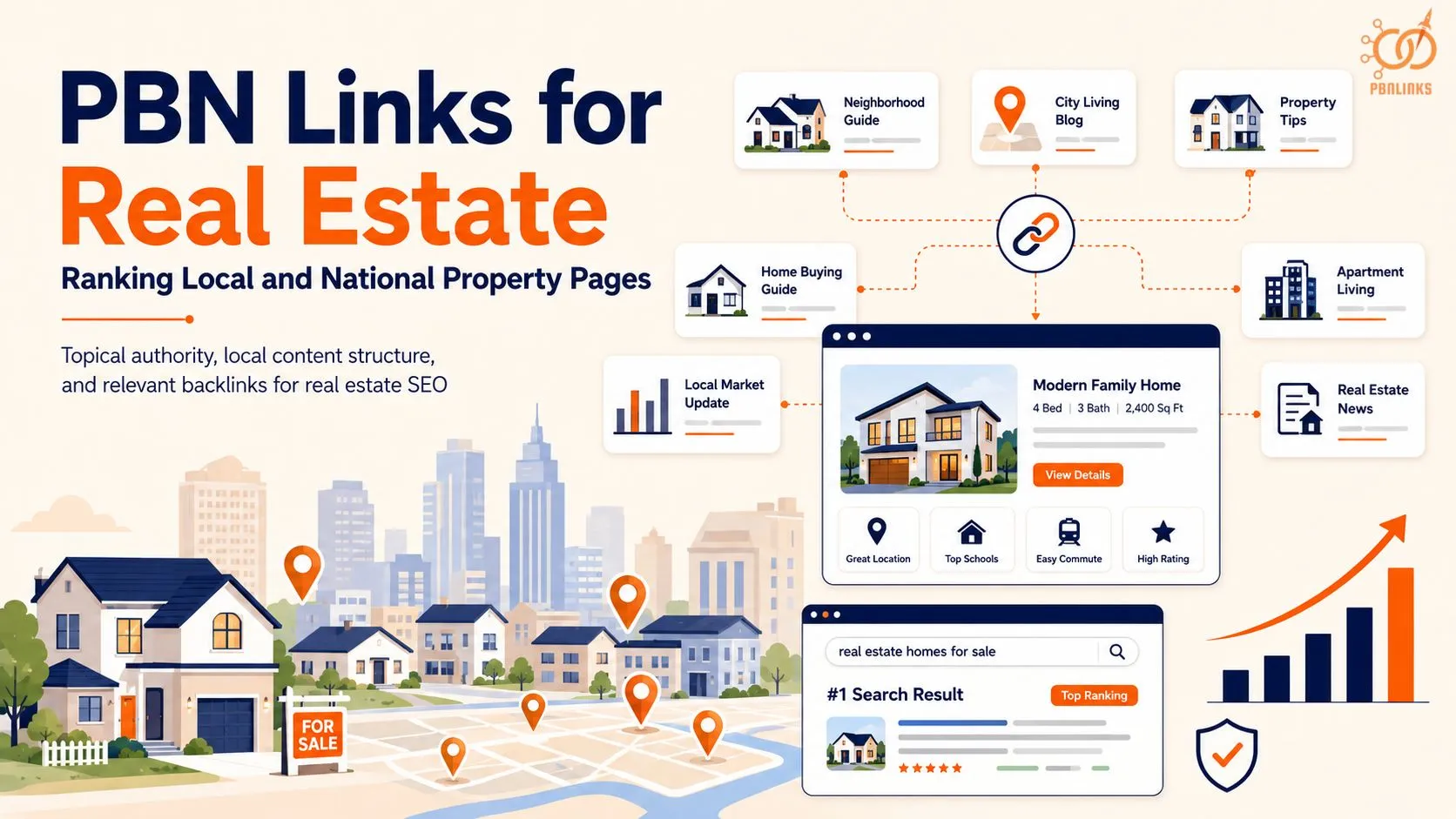
PBN Links for Real Estate: Ranking Local and National Property Pages
Most competitive industries leave little room for smaller websites to compete with established brands. Real estate is different. Local search results often include independent agencies, regional brokerages, and national property portals together, creating genuine opportunities where the right backlink strategy can improve rankings.
PBN links for real estate SEO can strengthen local agent pages, neighborhood guides, city-level resources, and investor content because these searches often feature mixed competition instead of complete portal dominance. That makes real estate one of the few competitive industries where relevant backlinks can still create measurable ranking improvements.
The opportunity, however, depends on targeting the right pages. While local and informational property searches remain highly accessible, broad keywords dominated by Zillow, Realtor.com, and Trulia require far more than backlinks alone. Understanding this difference is the foundation of every successful real estate PBN campaign.
This guide explains where PBN links deliver the strongest results, how to build a three-layer local content structure, choose topically relevant domains, evaluate E-E-A-T signals, and develop an anchor text strategy that supports sustainable organic growth.
Why PBN Links Work Better for Real Estate SEO Than Legal or Finance
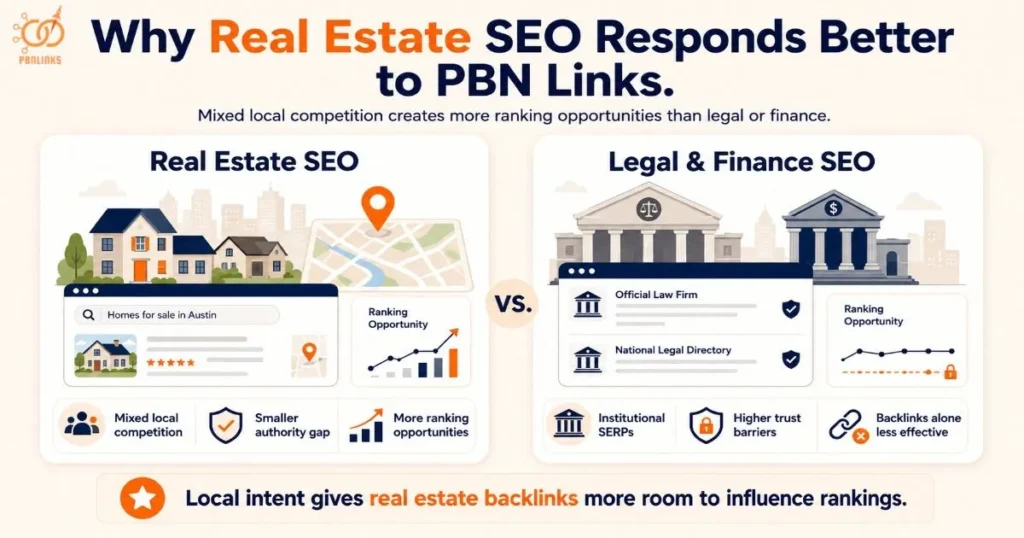
PBN links work better for real estate SEO because many property searches still give smaller websites room to compete. Local agencies, neighborhood guides, investor websites, and regional brokerages often rank beside larger property portals. That balanced competition gives relevant backlinks more influence than they usually have in legal or finance.
The biggest difference is search intent. Legal and finance SERPs are dominated by established firms, financial institutions, and government websites. Real estate searches are far more localized. People search for agents, neighborhoods, housing markets, investment opportunities, and buyer resources in specific locations.
This creates genuine authority gaps between competing websites. Local agencies often compete against other regional businesses instead of billion-dollar brands. When authority levels are similar, stronger topical relevance and quality backlinks can make a measurable ranking difference.
Real estate also benefits from thousands of valuable long-tail searches. Queries such as “best real estate agent in [city],” “homes for sale in [neighborhood],” and “first-time home buyer guide [city]” spread competition across many pages. This creates far more ranking opportunities than industries focused on a small group of highly competitive national keywords.
The commercial value reflects this opportunity. According to Paperless Pipeline, citing industry SEO benchmark research, real estate generates an estimated 1,389% return on investment from SEO. As explained in our PBN Links by Industry analysis, this combination of mixed competition, recurring local demand, and high-value transactions makes real estate one of the strongest industries for strategic PBN link building.
Where PBN Links for Real Estate SEO Actually Work
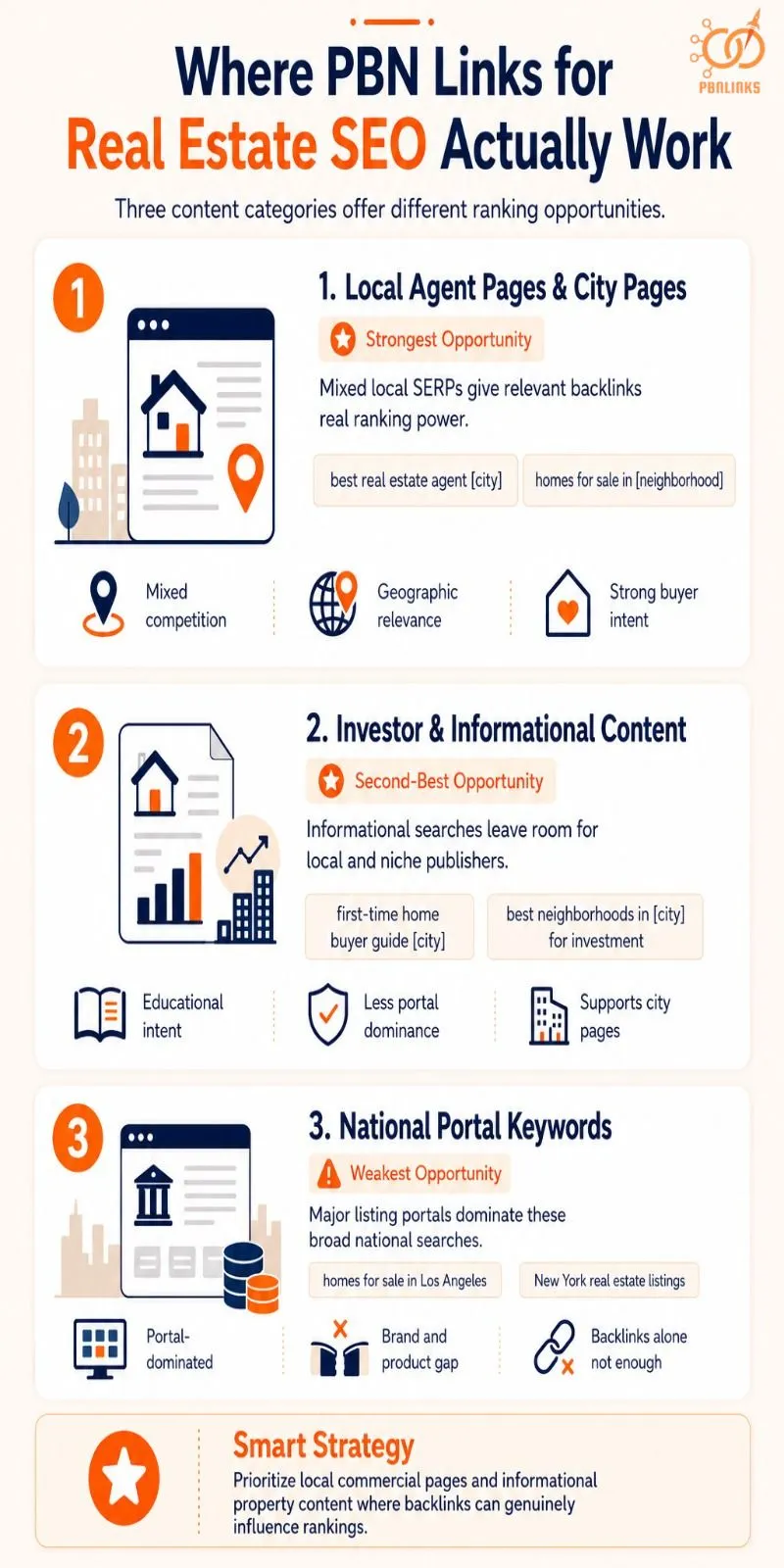
PBN links for real estate SEO deliver the strongest results on local commercial pages and informational property content. Local agent pages and city-level resources benefit the most because authority gaps still exist between competing websites. Broad national property keywords dominated by Zillow, Realtor.com, and Trulia remain the one category where PBN links alone rarely improve rankings.
The three categories below show exactly where PBN links create the greatest SEO value and where they deliver the strongest ranking improvements.
Local Agent Pages and City-Level Content
Local agent pages are the strongest target for real estate PBN links because local authority gaps still exist. Independent agencies, regional brokerages, and franchise offices often compete within the same local search results. When competing websites have similar authority, relevant backlinks can make a measurable ranking difference.
Typical targets include:
- Best real estate agent in [city]
- Homes for sale in [neighborhood]
- Property management company in [city]
- Neighborhood guides and city resource pages
These pages combine commercial intent with local search intent. They reward businesses that demonstrate geographic relevance, local expertise, and topical authority. As a result, they remain the highest-return targets for real estate PBN campaigns.
Investor and Informational Property Content
Investor and informational property content offers the second-best opportunity for PBN link building. These searches focus on education, research, and market analysis instead of active property listings. Search results often include investment blogs, local agencies, housing analysts, and niche property websites rather than major listing portals.
Topics such as “how to invest in real estate with no money down,” “first-time home buyer guide [city],” and “best neighborhoods in [city] for investment” regularly compete in these SERPs. Housing market reports, rental investment guides, neighborhood comparisons, and property explainers also perform well because they satisfy informational search intent while expanding topical authority.
These assets generate more than organic traffic. They strengthen topical authority across cities, neighborhoods, and property markets. Internal links can then pass that authority to commercial pages, improving the visibility of the entire content cluster.
National Portal Keywords
Broad national property keywords belong to a completely different competitive category. Searches such as “homes for sale in Los Angeles,” “New York real estate listings,” and “Miami condos for sale” are consistently dominated by Zillow, Realtor.com, and Trulia.
Their advantage comes from far more than backlinks. These platforms combine proprietary property databases, continuously updated listings, trusted brands, user-generated content, and years of accumulated authority. The challenge is a product, data, and brand gap, not simply a backlink gap.
The smarter strategy is to focus on pages where backlinks still influence rankings. Prioritize local commercial pages, neighborhood resources, and informational property content instead of competing directly with national property portals. Once these opportunities are identified, the next step is connecting them through a structured local content architecture that distributes authority across the entire website.
The Local Real Estate Content Structure PBN Links Support Best
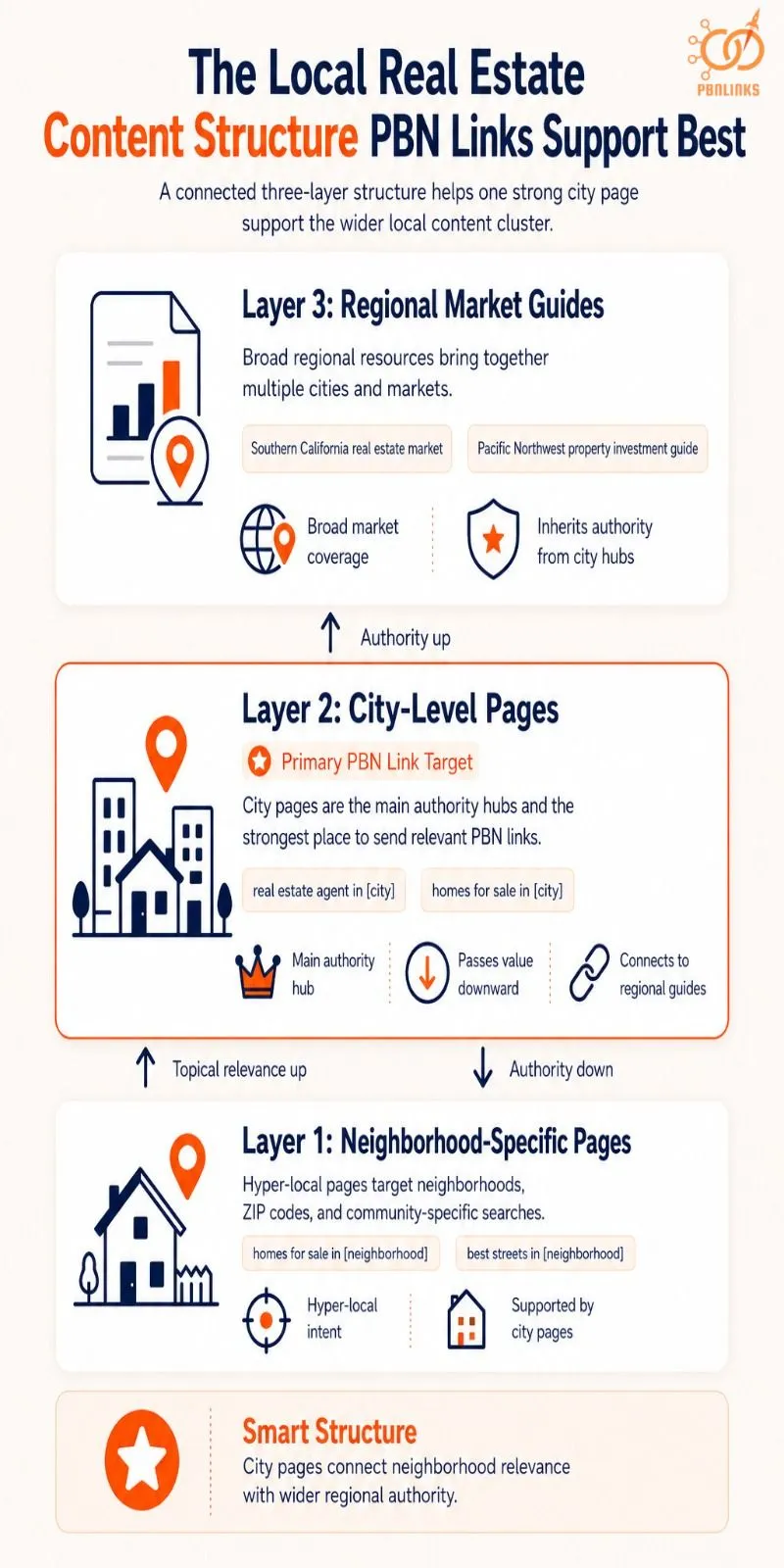
PBN links support local real estate SEO most effectively when they target city-level pages within a connected three-layer content structure. Neighborhood pages pass topical relevance to city hubs, while city pages distribute authority across the entire cluster. This approach amplifies multiple related pages through internal linking instead of strengthening a single URL.
Layer 1: Neighborhood-Specific Pages (Bottom Layer)
Neighborhood-specific pages form the foundation of a local real estate website. They target highly specific searches such as “homes for sale in [neighborhood],” “best streets in [neighborhood] for families,” or “[ZIP code] real estate.” Because these pages satisfy hyper-local search intent, they generate the strongest geographic relevance signals and establish topical coverage for individual communities.
These pages should primarily receive authority through internal links from city-level hubs rather than direct PBN links. A well-connected city page naturally distributes link equity downward, allowing dozens of neighborhood pages to benefit from a single authoritative source.
Layer 2: City-Level Pages (Middle Layer)
City-level pages are the primary PBN link targets in a local real estate SEO campaign. They focus on valuable commercial searches such as “real estate agent in [city],” “homes for sale in [city],” and “[city] property market guide,” making them the central authority hubs within the website.
This layer delivers the greatest return because every quality PBN link strengthens more than the target page. Through strategic internal linking, authority flows downward to neighborhood pages and upward to broader regional resources, increasing the visibility of the entire content cluster. This is the same principle discussed in our PBN Links for Local SEO Guide, where city pages act as the foundation for stronger local search performance.
Industry research also shows that one comprehensive city page with 1,500+ words consistently outperforms several thin location pages using the same template. The winning pages combine local market statistics, neighborhood summaries, school information, lifestyle insights, buying or selling guidance, and clear connections to supporting neighborhood pages. The objective is comprehensive local coverage, not unnecessary word count.
Layer 3: Regional Market Guides (Top Layer)
Regional market guides represent the broadest layer of the content hierarchy. These pages target wider topics such as “Southern California real estate market,” “Pacific Northwest property investment guide,” or county-wide housing trends, bringing together insights from multiple cities and communities.
Instead of making these pages the primary PBN destinations, allow them to inherit authority from strong city-level hubs. Neighborhood pages should link to their parent city page, city pages should link to both neighborhood content and regional guides, and regional guides should link back to the strongest city pages. This bidirectional internal linking keeps topical authority flowing throughout the website, enabling every PBN link earned by a city page to strengthen the broader local real estate ecosystem rather than an isolated piece of content.
E-E-A-T Signals a Real Estate PBN Site Needs
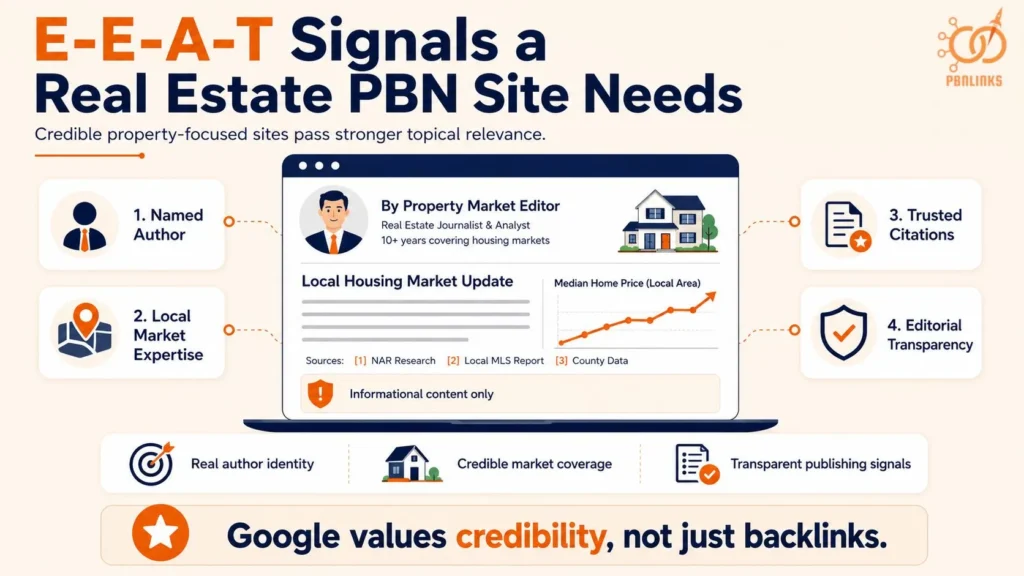
Most E-E-A-T advice focuses on the real estate website receiving the link, but the PBN site providing that link needs credibility signals too. A property-focused website with recognizable authors, genuine local market knowledge, transparent editorial practices, and consistent topical coverage sends stronger topical relevance than a generic blog publishing occasional real estate articles.
A credible real estate PBN site should demonstrate:
- A named author with a believable property-related background
- Local market expertise reflected throughout the content
- Credible sources supporting housing data and market trends
- A consistent editorial focus on real estate topics
Together, these signals help a real estate PBN read like a genuine property publication rather than a website created primarily for link placement.
Local Market Knowledge and Property Author Background
Every real estate PBN should have a named author whose background naturally fits property-related topics. A property investor, former real estate agent, mortgage advisor, or home renovation specialist creates a believable editorial identity because each has practical experience with housing markets.
The content should also reflect genuine local expertise. References to neighborhoods, housing demand, buyer preferences, schools, and community developments make articles more credible than generic property advice. Whenever discussing market prices, inventory, or investment trends, support those claims with reliable sources such as local real estate associations or recognized property research firms. For detailed guidance on author pages, see our PBN Content Strategy Guide.
Editorial Transparency and Site Credibility
A real estate PBN should operate like a genuine property publication, not a general blog with a few real estate articles. Consistent publishing across neighborhood guides, market reports, buyer resources, renovation topics, and investment content creates the topical focus expected from an authoritative property website.
A clear About page, contact information, privacy policies, and simple disclaimers further strengthen credibility by showing who publishes the content and why it exists. Combined with consistent topical publishing, these signals make the linking website a stronger source of authority for your real estate SEO campaign.
Even the strongest editorial signals cannot compensate for a poor-quality domain, making domain selection the next critical step.
Domain Selection for Real Estate PBN Links
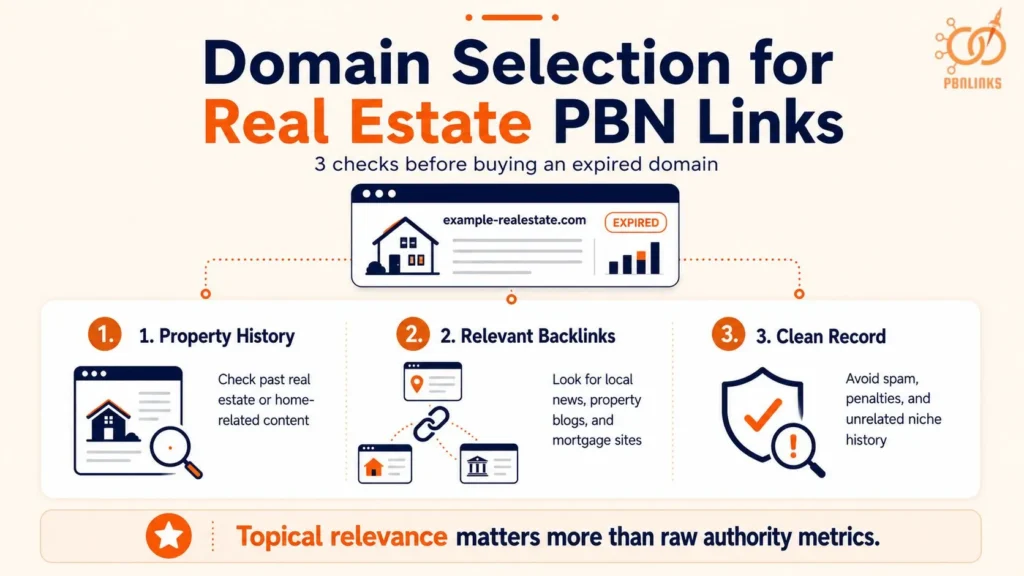
Not every high-authority expired domain is a good fit for real estate SEO. The strongest real estate PBN domains combine relevant property history, clean backlink profiles, and a trustworthy ownership record. Without those signals, even impressive DR or DA metrics provide little long-term SEO value.
The three checks below help you identify domains that strengthen topical authority instead of simply adding another backlink.
Prior Real Estate or Property Content History
The first check is confirming that the domain has a genuine history of publishing property-related content. Use the Wayback Machine to verify that it previously covered real estate, neighborhood guides, home buying advice, mortgage topics, renovation projects, or local housing market reports.
Domains that previously belonged to real estate agencies, property blogs, construction companies, or local housing publications provide the strongest topical relevance. Closely related niches such as home improvement, architecture, interior design, mortgage advice, and community news also make strong alternatives.
A domain with relevant property history sends a much stronger topical signal than one previously covering food, travel, or fashion, regardless of its authority metrics. Once content history is confirmed, the next step is reviewing the backlink profile. Our PBN Pricing page explains why sourcing domains that meet these standards requires additional vetting.
A Clean Backlink Profile From Property-Adjacent Sources
The second check is confirming that existing backlinks come from property-related websites. Review the domain in Ahrefs or Majestic to evaluate referring domains and historical anchor text. Strong candidates earn links from local housing news, real estate blogs, mortgage resources, home improvement websites, property investment publications, and trusted local directories.
Natural branded, URL, and property-related anchors indicate healthy editorial links, while spam anchors connected to gambling, payday loans, pharmaceuticals, or unrelated industries often reveal previous abuse. In most cases, a domain with slightly lower metrics but stronger topical relevance is the better long-term investment.
No History of Penalized or Unrelated Use
The final check is confirming that the domain has a clean ownership and indexing history. Previous use for gambling, adult content, link farms, or aggressive SEO campaigns can weaken trust signals even after ownership changes.
Review historical ownership using WhoisFreaks or DomainTools to identify suspicious registration patterns. As a practical guideline, domains that changed ownership three or more times within two years deserve additional scrutiny. Before purchasing, verify that the domain still has indexed pages and check for any history of penalties, deindexing, or manual actions.
Only domains that satisfy all three checks—relevant content history, property-focused backlinks, and a clean historical record—are strong candidates for a real estate PBN campaign. Once the right domains are selected, the next step is using anchor text that reinforces topical relevance without creating geographic over-optimization.
Anchor Text Strategy for Real Estate PBN Links
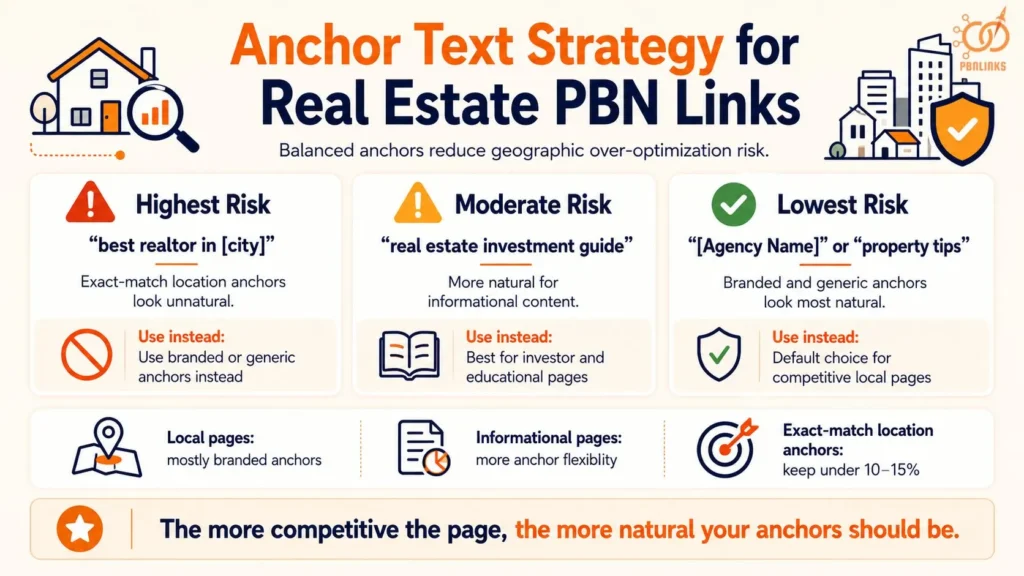
Anchor text influences how naturally your backlink profile appears to search engines. In real estate SEO, location-specific anchors carry a higher risk than most other industries because exact city-based keywords rarely appear naturally in editorial links. A balanced anchor strategy protects rankings while reinforcing topical relevance.
The table below shows which anchor types carry the greatest risk and where each fits naturally within a real estate PBN campaign.
| Risk Level | Anchor Example | Why | Recommended Alternative |
| Highest | best realtor in [city] | Strong geographic over-optimization signal | Branded, URL, or generic anchors |
| Moderate | real estate investment guide | Topically relevant without exact location targeting | Partial-match anchors |
| Lowest | [Agency Name] or property tips | Matches natural editorial linking patterns | Default choice for competitive pages |
Local agent pages require the most conservative anchor strategy because they target highly competitive commercial keywords. Branded, naked URL, and generic anchors should form the majority of links pointing to these pages, while exact-match location anchors should remain uncommon.
Investor guides, neighborhood resources, and housing market reports allow greater anchor flexibility because they compete in less commercially aggressive SERPs. Partial-match anchors fit naturally within informational content, but anchor diversity should always take priority over repeating the same keyword pattern.
As a practical guideline, exact-match location anchors should represent no more than 10–15% of your overall anchor profile. The most specific combinations, such as an exact keyword paired with a city or neighborhood, should remain the rarest because they create the strongest geographic over-optimization signals. Distribute links naturally across city pages, neighborhood guides, service pages, and supporting content instead of concentrating everything on the homepage.
Anchor text should become more natural as page competitiveness increases. Conservative anchors work best for local money pages, while informational content allows greater flexibility. A balanced anchor profile reinforces topical authority, supports a natural link profile, and prepares your campaign for the broader link-building strategy covered in the next section.
Using PBN Links as One Layer in Your Real Estate SEO Strategy
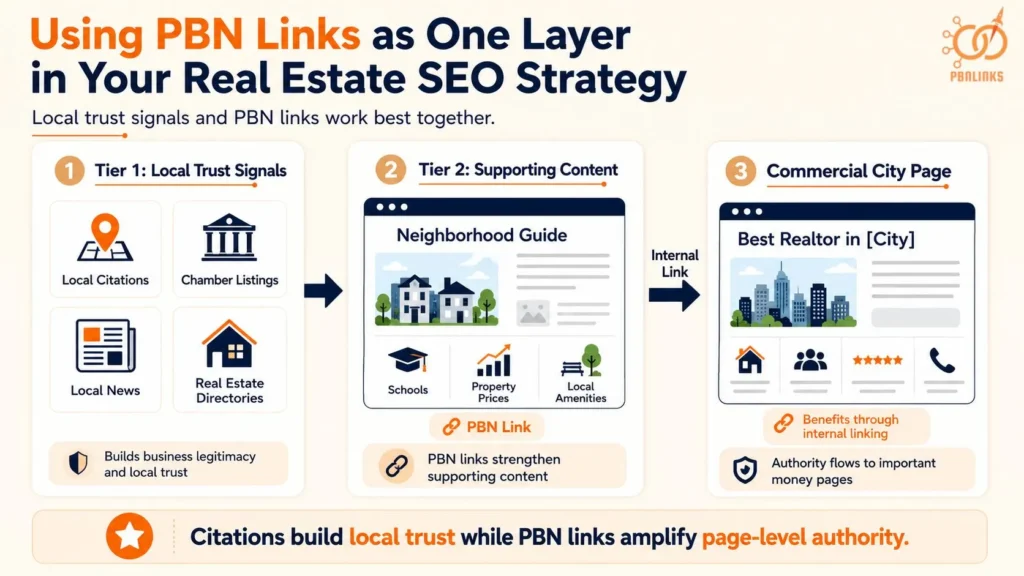
PBN links work best as one layer within a complete real estate SEO strategy, not as the entire strategy. Local citations, chamber of commerce listings, local news mentions, and real estate directory profiles establish business legitimacy, while PBN links strengthen page-level authority. Together, they create stronger ranking signals than either approach can deliver alone.
Understanding the difference between Tier 1 and Tier 2 links makes this strategy much easier to apply.
Tier 1 links point directly to your important pages through editorial placements, local citations, chamber of commerce listings, real estate directories, and local news coverage. Tier 2 links point to supporting content instead of money pages, allowing authority to flow naturally through your internal linking structure. For a deeper explanation, see our Tiered Link Building Guide.
A practical example is linking a PBN article to a neighborhood guide covering local schools, property prices, and lifestyle amenities. That guide then links internally to a city-level page targeting “best realtor in [city]”, allowing the commercial page to benefit without receiving the PBN link directly.
Local citations and PBN links perform different but complementary roles within a real estate campaign. Citations from Google Business Profile, Zillow, Realtor.com, and local chambers of commerce strengthen local entity signals and confirm your business operates in a specific location.
PBN links strengthen the authority of individual pages within your content cluster, helping city pages, neighborhood guides, and other high-value resources compete more effectively. Combined with strong internal linking, citations build local trust while PBN links improve topical authority across the entire website.
The strongest real estate SEO campaigns combine both approaches instead of relying on either one alone. This layered strategy strengthens local visibility, supports commercial pages, and creates a more natural authority profile before considering the investment required for higher-quality real estate PBN links.
.
Why Real Estate PBN Links Cost More Than General Network Link
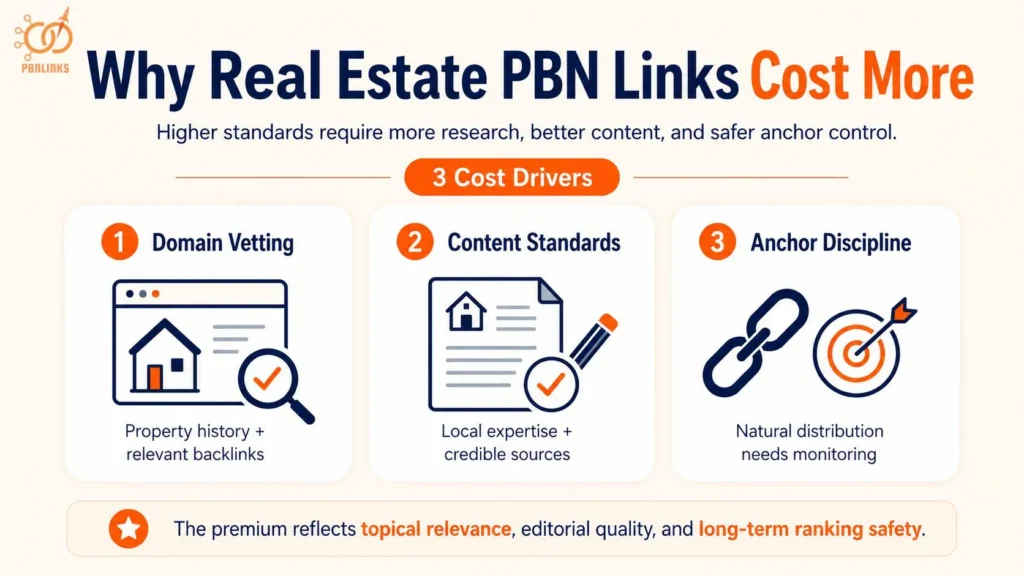
Real estate PBN links cost more because every stage of building them requires stricter quality standards. Finding relevant domains, creating credible property content, and managing natural anchor profiles all demand significantly more time than building a general-purpose network.
The higher price reflects the additional work required to build topical authority, not an arbitrary markup.
Domain Vetting
Finding a genuine real estate domain is the largest cost driver. Expired domains with established histories in real estate, home improvement, local housing markets, mortgage topics, or property investing are much harder to source than general lifestyle domains and are often more competitive at auction.
Every domain also requires manual verification beyond DR or DA. Historical content should be reviewed in the Wayback Machine, while backlink profiles should be checked in Ahrefs or Majestic to confirm genuine property relevance. As explained in the Domain Selection section, this additional sourcing effort is the primary reason real estate PBN links cost more than general network placements.
Content Standards
Property-focused content requires genuine local expertise instead of generic advice. Strong articles include neighborhood insights, market trends, buyer behavior, schools, local amenities, and housing information that reflect the target location rather than reusable content.
Editorial quality also increases production costs. Believable author profiles, credible market references, and consistent real estate publishing all contribute to stronger E-E-A-T signals, but they also require more research, planning, and editorial review.
Anchor Discipline
Anchor management is an ongoing investment rather than a one-time task. Maintaining exact-match anchors within the recommended 10–15% range while keeping location-specific anchors to a minimum requires continuous monitoring as new links are added.
This is especially important in real estate because campaigns naturally target city and neighborhood keywords, making geographic over-optimization easier to create accidentally. As discussed in the previous section, maintaining a balanced anchor profile protects competitive pages while supporting long-term rankings.
These three factors—domain vetting, content quality, and anchor discipline—explain why real estate PBN links command higher prices than general network links. They also explain why the most common campaign mistakes usually begin when shortcuts are taken in one of these areas, leading naturally into the next section.
Common Mistakes When Using PBN Links for Real Estate
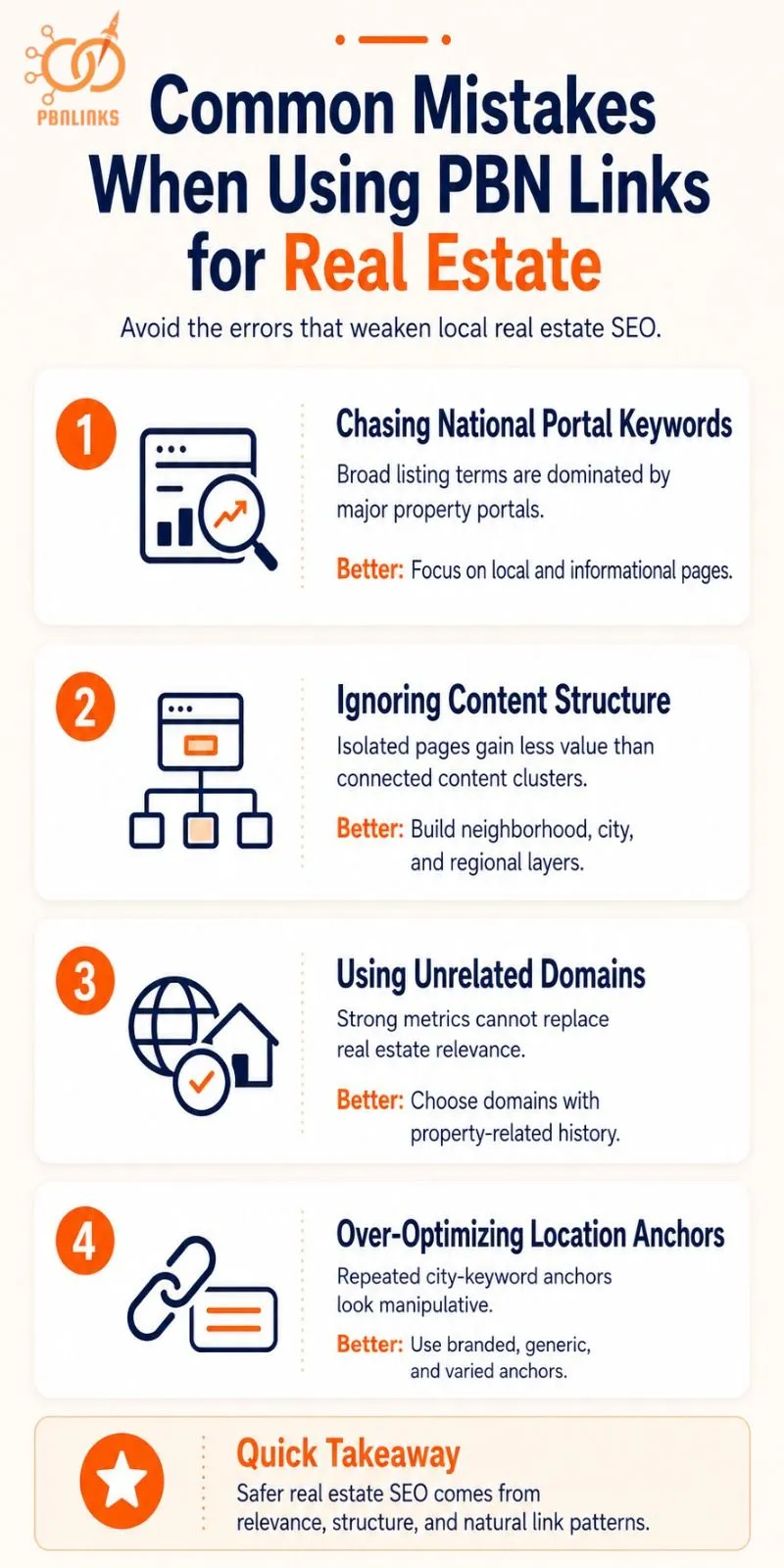
Most real estate PBN mistakes happen because general SEO tactics are applied to a highly localized industry. Targeting the wrong keywords, ignoring content structure, choosing unrelated domains, and overusing location-specific anchors all weaken topical relevance and reduce ranking potential.
Avoiding the four mistakes below creates a stronger, more sustainable real estate SEO campaign.
Targeting National Portal Keywords Expecting PBN-Only Results
The biggest mistake is expecting PBN links alone to outrank national property portals. Keywords such as “homes for sale in Los Angeles” or “New York real estate listings” are dominated by Zillow, Realtor.com, and Trulia, whose advantage comes from proprietary listing data, trusted brands, and years of accumulated authority rather than backlinks alone.
The better approach is to follow the three-category framework discussed earlier by focusing first on local agent pages, city-level service pages, and informational property content where backlinks can genuinely influence rankings.
Ignoring the Three-Layer Local Content Structure
Another common mistake is pointing PBN links to isolated pages instead of a connected content cluster. Without supporting neighborhood pages and regional market guides, authority remains concentrated on one page instead of strengthening the entire website.
Build the neighborhood-to-city-to-regional structure first, then direct PBN links to city-level pages where authority naturally flows throughout the content cluster.
Using Generic Domains With No Real Estate History
Many campaigns fail because domains are selected for their metrics instead of their topical relevance. Expired domains previously covering food, travel, fashion, or unrelated lifestyle topics send much weaker semantic signals than domains with established real estate or property-related content.
Prioritize verified history in property investing, neighborhood guides, home improvement, mortgage advice, or local housing markets. As explained in the Domain Selection section, topical relevance should always outweigh impressive DR or DA metrics.
Over-Optimizing Location-Specific Anchor Text
Repeating the same location-focused anchors across multiple PBN links creates an obvious optimization pattern. Even when every anchor accurately matches the destination page, excessive repetition makes the backlink profile appear manipulated instead of naturally earned.
Use a balanced mix of branded, generic, and partial-match anchors for competitive local pages. A diverse anchor profile supports stronger long-term rankings while reducing geographic over-optimization signals.
In Conclusion
In conclusion, real estate remains one of the most responsive industries for PBN link building because local agent pages, neighborhood guides, city-level resources, and investor content compete in mixed search results where relevant backlinks can still influence rankings. The strongest campaigns combine topically relevant domains, a connected local content structure, credible property-focused content, and a natural anchor strategy instead of relying on links alone.
The one consistent limitation is broad national property keywords. Platforms such as Zillow, Realtor.com, and Trulia compete through brand authority, proprietary listing data, and scale, making them unrealistic targets for a PBN-only strategy.
If you’re looking for real estate PBN links built on carefully vetted domains with strict quality standards and a local-first approach, pbnlinks.agency can help. Visit pbnlinks.agency to build a strategy that strengthens topical authority, supports your local content clusters, and delivers sustainable rankings for the property pages that matter most.
FAQs About PBN Links Real Estate SEO
Do PBN links work for real estate websites?
Yes. PBN links work best for local agent pages, neighborhood guides, city-level content, and investor resources where mixed competition allows backlinks to influence rankings. They are far less effective for broad national property keywords dominated by major real estate portals.
Can PBN links help outrank Zillow or Realtor.com?
Not for broad national property searches. Platforms like Zillow and Realtor.com combine brand authority, massive listing databases, and user-generated content that backlinks alone cannot match. Focus PBN campaigns on local and informational property pages instead.
What real estate content responds best to PBN links?
Local agent pages, city service pages, neighborhood guides, first-time buyer resources, and real estate investment articles respond best. These content types compete in mixed SERPs where authority gaps still exist, allowing quality backlinks to improve rankings.
What anchor text is safest for real estate PBN links?
Branded and generic anchors are the safest choice. Exact-match location anchors should remain a small part of your overall backlink profile because repeated geographic keywords create clear over-optimization signals in local search results.
Is real estate a good niche for PBN link building?
Yes. Real estate is one of the most responsive industries because local and informational search results include agencies, blogs, and niche websites instead of only institutional brands. That creates realistic opportunities for backlinks to influence rankings.
What happens if a real estate PBN link gets detected by Google?
Detected PBN links can lose their ranking value, and affected pages may experience lower search visibility or manual actions. The same risks apply in real estate as every other niche, making quality domains and natural link patterns essential.
How many PBN links does a local real estate agent page need?
For lower-competition local keywords, five to ten quality PBN links per month is often a reasonable starting point. The ideal number ultimately depends on your competitors’ authority, backlink profiles, and the difficulty of your target keywords.
What domains work best for real estate PBN links?
Domains with previous content about real estate, home improvement, property investing, mortgage advice, or local market news perform best. Always verify archived content with the Wayback Machine and confirm that backlinks come from property-related sources.
How is real estate PBN link building different from legal or finance?
Real estate offers more ranking opportunities because many local and informational queries feature mixed competition. Legal and finance remain more heavily influenced by institutional authority, limiting where backlinks alone can realistically move rankings.
What is the safest way to use PBN links for a real estate site?
The safest strategy is supporting neighborhood guides, city resources, or other informational pages that internally link to your primary service pages. This strengthens your content cluster while reducing direct exposure on your most competitive commercial pages.