IP Diversity for PBNs: Class C, Shared vs Dedicated, and What Actually Matters
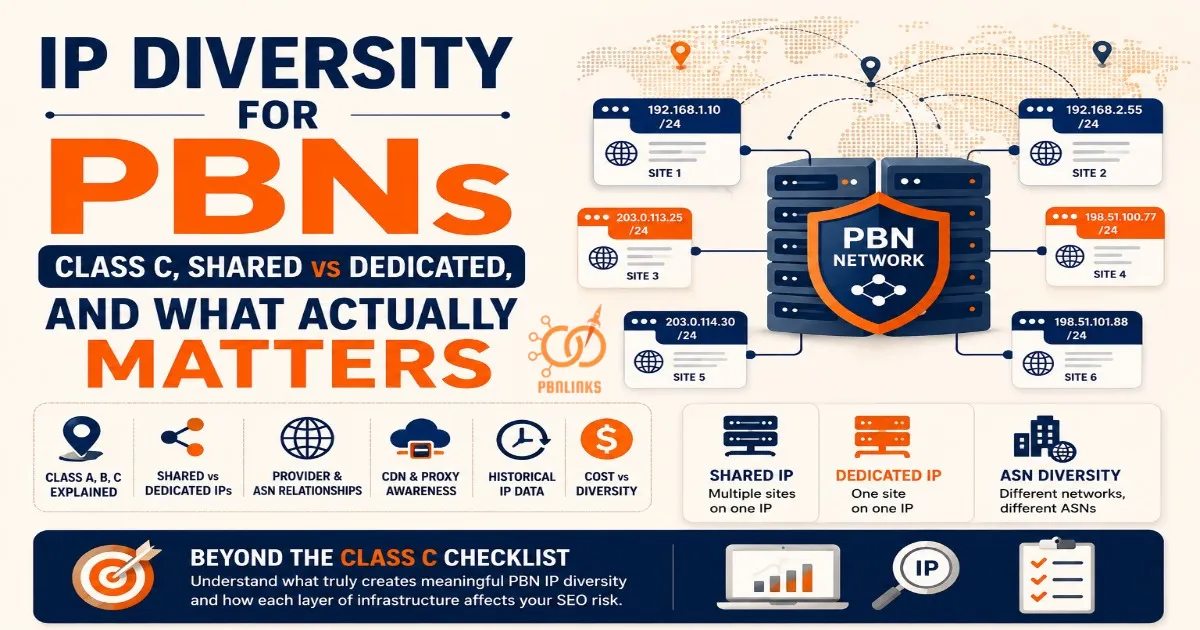
PBN IP diversity is frequently discussed as a basic hosting requirement, but what actually counts as meaningful diversity is often misunderstood. Terms such as Class C IPs, unique IPs, shared hosting, dedicated IPs, and ASN diversity are commonly used without explaining what they mean technically or how these network relationships fit together.
For years, the standard advice was simple: place PBN sites on different Class C IPs. The problem is that this reduces a much broader infrastructure question to a single part of an IPv4 address. Class A, B, and C belong to the historical classful addressing model, while modern networks use CIDR prefixes. Even two IPs in different /24 ranges can still belong to the same hosting provider or autonomous system.
Shared and dedicated IPs also require context. Multiple unrelated websites can legitimately share an IP, while a dedicated IP does not automatically mean a dedicated server, separate provider, or independent network. CDNs and reverse proxies complicate the picture further because the publicly visible IP may belong to an intermediary network rather than the website’s origin server.
This guide provides a practical foundation for evaluating PBN IP diversity beyond the old Class C checklist. It explains Class A, B, and C correctly, whether /24 separation still matters, shared versus dedicated IP trade-offs, provider and ASN relationships, reverse and historical IP data, CDN visibility, and the cost of greater infrastructure separation.
What Is PBN IP Diversity?
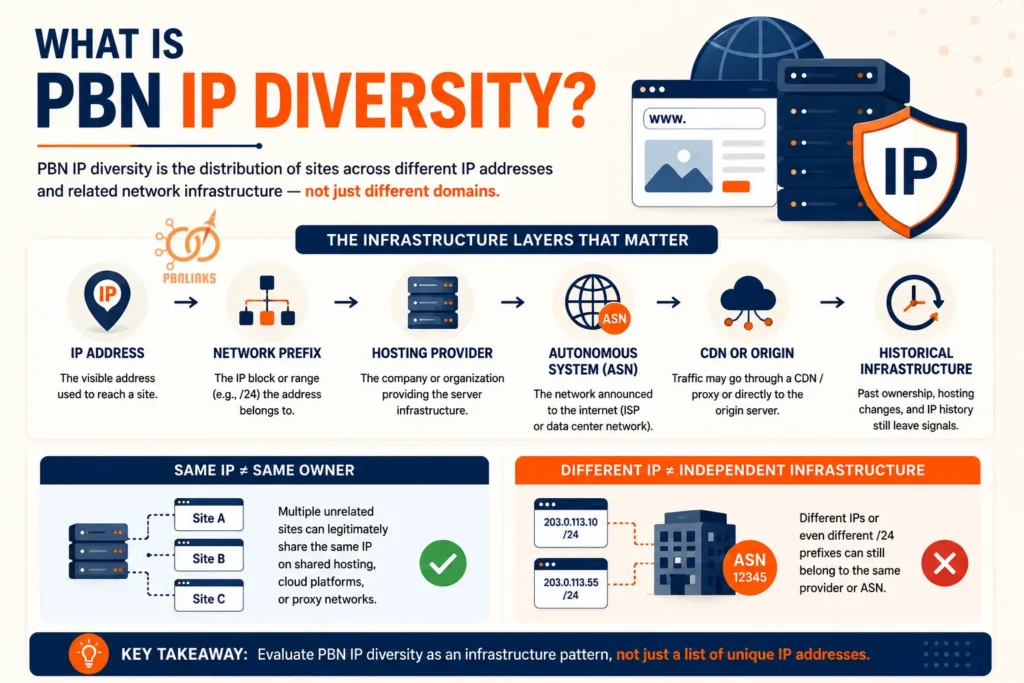
PBN IP diversity is the distribution of websites across different IP addresses and related network infrastructure rather than concentrating every site on the same visible hosting endpoint. The concept is broader than simply giving each domain a different IP address because different addresses can still have important infrastructure relationships.
At the most basic level, every publicly accessible website needs network infrastructure that allows visitors to reach it. A domain’s DNS records can point directly to a web server or to an intermediary such as a CDN or reverse proxy. The publicly visible address is therefore one part of the site’s infrastructure, not necessarily a complete picture of where or how the website is hosted.
Meaningful IP analysis looks at several connected layers:
IP Address → Network Prefix → Hosting Provider → ASN → CDN or Origin → Historical Infrastructure
For example, two PBN sites may use different IP addresses and even different /24 prefixes while both ranges are announced through the same Autonomous System Number (ASN). Conversely, unrelated websites can share the same public IP through shared hosting, cloud platforms, or proxy infrastructure. Neither pattern establishes common ownership on its own.
This is why PBN IP diversity should be evaluated as an infrastructure pattern rather than a count of unique IP addresses. The visible IP matters, but its network prefix, provider, ASN, hosting model, CDN status, and historical relationships provide the context needed to understand what that address actually represents.
How Do IP Addresses Relate to PBN Hosting?
An IP address identifies a network endpoint used to route traffic to website infrastructure, while a domain name provides the human-readable address visitors use to reach it. For PBN hosting, the important point is that the IP visible in DNS may represent the web server itself, shared hosting infrastructure, or an intermediary such as a CDN or reverse proxy.
Understanding that request path makes it easier to see why an IP address should not be treated as a complete description of a site’s hosting environment.
Domain to Server Request Path
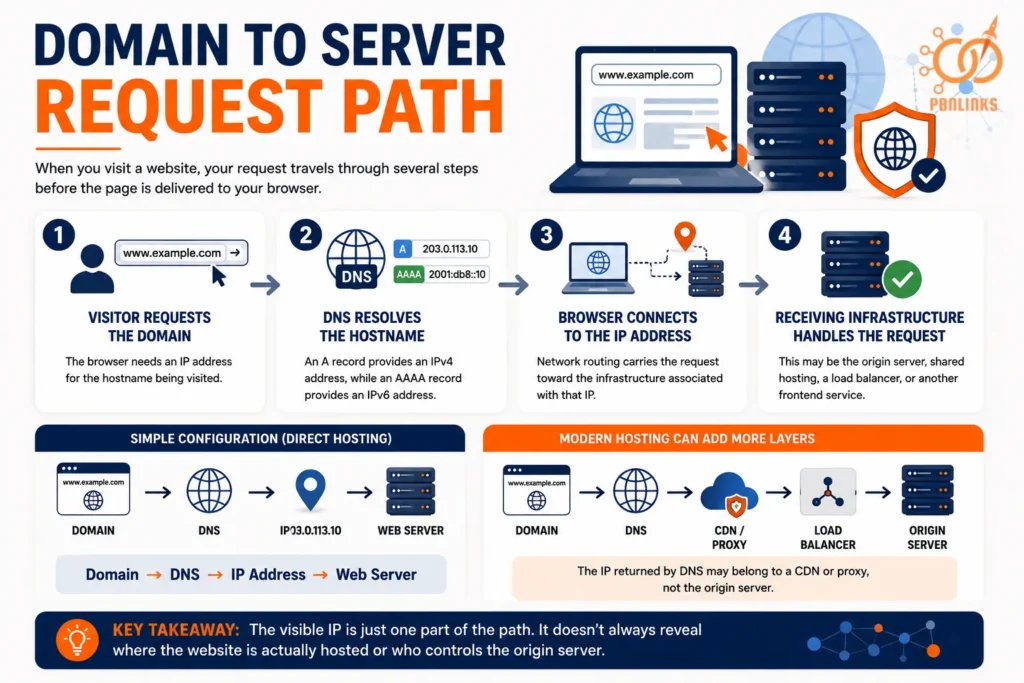
When someone visits a website, the browser first needs to translate the domain into an address it can use to reach the site’s infrastructure.
A simplified direct-hosting request follows these steps:
- The visitor requests the domain. The browser needs an IP address for the hostname being visited.
- DNS resolves the hostname. An A record can provide an IPv4 address, while an AAAA record can provide an IPv6 address.
- The browser connects to the returned address. Network routing carries the request toward the infrastructure associated with that IP.
- The receiving infrastructure handles the request. Depending on the configuration, this may be the origin server, shared web hosting, a load balancer, or another frontend service.
In a simple configuration, the relationship may look like:
Domain → DNS → IP Address → Web Server
Modern hosting can add more layers, which is why the IP returned by DNS does not always identify the origin server directly.
Public IP and Hosting Environment
A public IP tells you where traffic is being directed at the network level, but it does not automatically tell you everything behind that address.
For example:
Site A → 203.0.113.20
Site B → 203.0.113.20
Both sites appear on the same public IP, but this does not prove they have the same owner. A shared web server can host many unrelated domains using the same address.
The opposite can also occur:
Site A → 203.0.113.20
Site B → 203.0.114.40
The IPs are different, but they could still belong to the same hosting provider or autonomous system. Different IP addresses therefore show address-level separation, not necessarily infrastructure independence.
IPv4 and IPv6 Addresses
Websites can be reachable through IPv4, IPv6, or both. IPv4 addresses use the familiar dotted-decimal format:
203.0.113.20
IPv6 uses a much larger address space and hexadecimal notation, such as:
2001:db8::20
DNS normally connects them to a hostname through different record types:
A record → IPv4 address
AAAA record → IPv6 address
This distinction matters when auditing PBN IP diversity because checking only A records can provide an incomplete view when domains also publish AAAA records. The historical Class A, B, and C terminology applies to the old IPv4 classful addressing system, not IPv6.
With that relationship established, the next step is understanding where Class A, Class B, and especially Class C came from, and why “Class C IP diversity” remains common SEO terminology even though modern networks no longer use the old classful model.
What Are Class A, Class B, and Class C IP Addresses?
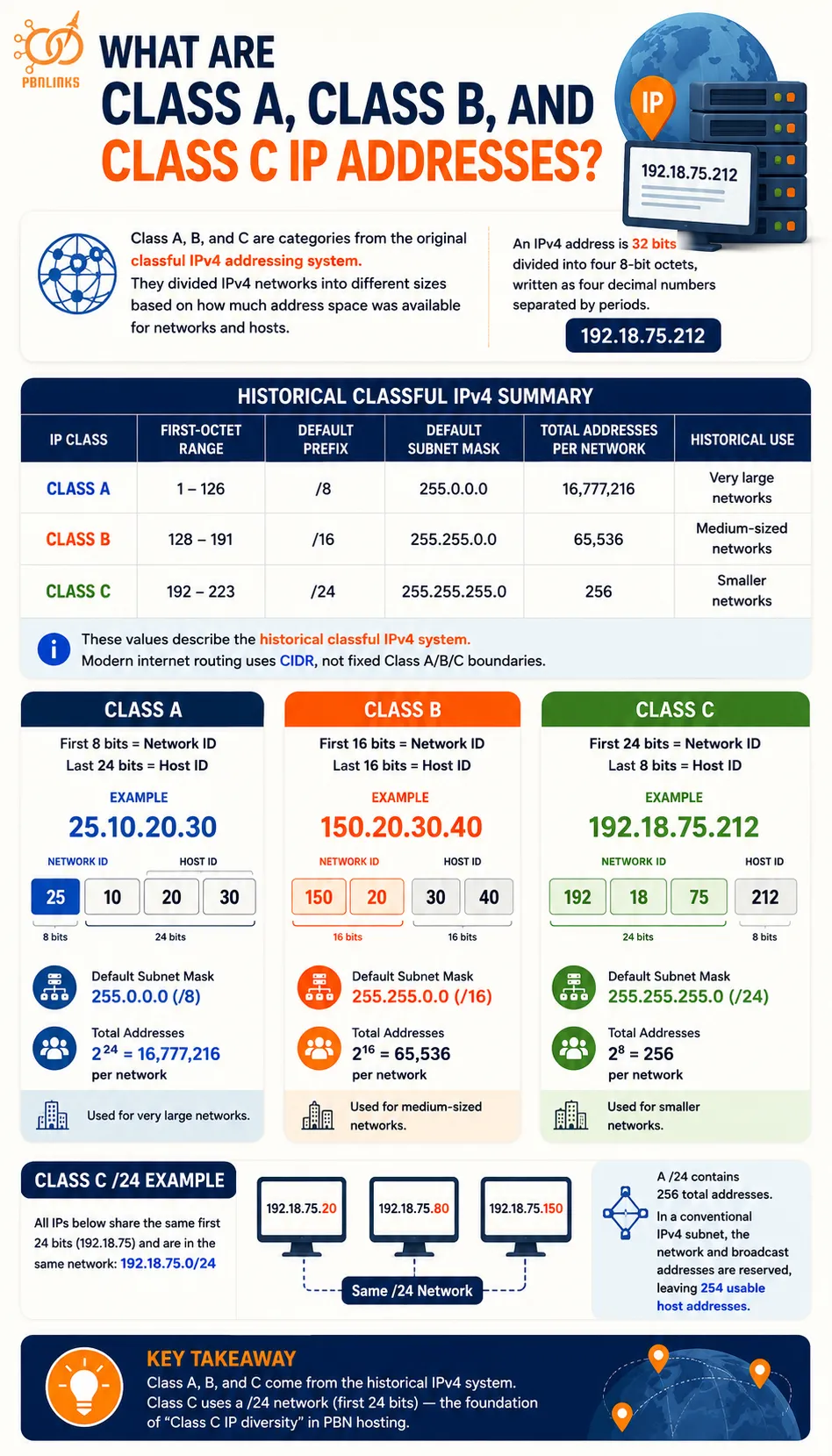
Class A, Class B, and Class C are categories from the original classful IPv4 addressing system. They divided IPv4 networks into different sizes based on how much address space was available for networks and hosts.
Class A was designed for very large networks, Class B for medium-sized networks, and Class C for smaller networks. The main difference was the boundary between the Network ID, which identified the network, and the Host ID, which identified an address within that network.
An IPv4 address contains 32 bits divided into four 8-bit octets, normally written as four decimal numbers separated by periods:
192.18.75.212
The table below shows the key differences between the three historical IPv4 classes.
| IP Class | First-Octet Range | Default Prefix | Default Subnet Mask | Total Addresses per Network | Historical Use |
| Class A | 1–126 | /8 | 255.0.0.0 | 16,777,216 | Very large networks |
| Class B | 128–191 | /16 | 255.255.0.0 | 65,536 | Medium-sized networks |
| Class C | 192–223 | /24 | 255.255.255.0 | 256 | Smaller networks |
These values describe the historical classful IPv4 system. Modern internet routing uses CIDR rather than fixed Class A, B, and C boundaries.
Class A IP Addresses
Class A used the first 8 bits for the network portion and the remaining 24 bits for hosts. This gave each Class A network a very large address space.
Consider:
25.10.20.30
Under the historical Class A model:
25 = Network ID
10.20.30 = Host ID
Its default subnet mask was:
255.0.0.0
which corresponds to:
/8
With 24 bits remaining after the network portion, a Class A network contained 2²⁴, or 16,777,216 total IPv4 addresses. This large address capacity was why Class A networks were intended for organizations requiring very large networks.
Class B IP Addresses
Class B used the first 16 bits for the network portion and the remaining 16 bits for hosts. It provided a middle ground between the much larger Class A networks and smaller Class C networks.
For example:
150.20.30.40
Under the historical Class B model:
150.20 = Network ID
30.40 = Host ID
Its default subnet mask was:
255.255.0.0
or:
/16
With 16 bits available for addresses within the network, a Class B network contained 2¹⁶, or 65,536 total IPv4 addresses.
Class C IP Addresses
Class C used the first 24 bits for the network portion and the final 8 bits for hosts. This is the historical class most relevant to PBN hosting because it is the origin of the familiar term “Class C IP diversity.”
Consider:
192.18.75.212
Under the historical Class C model:
192.18.75 = Network ID
212 = Host ID
Its default subnet mask was:
255.255.255.0
or:
/24
Now compare these addresses:
192.18.75.20
192.18.75.80
192.18.75.150
All three share the same first 24 bits and therefore fall within:
192.18.75.0/24
A /24 contains 256 total IPv4 addresses. In a conventional IPv4 subnet, the network and broadcast addresses are normally reserved, traditionally leaving 254 addresses available for ordinary host assignment.
This fixed 24-bit network boundary is why the first three octets became important in older discussions about PBN hosting and IP separation.
Classful Addressing vs Modern CIDR
The fixed A/B/C system eventually became too restrictive for efficient address allocation. Modern networking therefore uses Classless Inter-Domain Routing (CIDR), which allows network boundaries to be defined explicitly rather than determined by a fixed address class.
CIDR places the prefix length after the address:
203.0.112.0/23
203.0.113.0/24
203.0.113.128/25
203.0.113.192/26
The number after the slash tells you how many leading bits belong to the network prefix. This allows address blocks to be allocated and divided much more flexibly than the historical /8, /16, and /24 class boundaries.
Class D and Class E ranges also existed in the historical addressing system, primarily for multicast and reserved or experimental purposes. They were not ordinary host-address classes like A, B, and C, so they are not relevant to the traditional PBN Class C discussion.
Class C vs /24
A historical Class C network used a /24 prefix, but Class C and /24 are not technically the same concept.
Class C refers to a category in the historical classful IPv4 system.
/24 is CIDR notation indicating that the first 24 bits form the network prefix.
This distinction matters because modern networks are classless. A /24 is therefore better understood as a 24-bit network prefix, rather than automatically being described as a Class C network.
For PBN IP diversity, the practical takeaway is that when SEO practitioners talk about placing sites on “different Class C IPs,” they usually mean putting those IP addresses in different /24 prefixes. That explains the terminology, but different /24s alone do not establish whether the sites use different providers, ASNs, servers, or independent hosting infrastructure.
What Does “Different Class C IPs” Mean in PBN SEO?
In PBN SEO, “different Class C IPs” usually means hosting sites on IP addresses that fall within different /24 network prefixes. The phrase comes from the historical Class C addressing model, but today it is mostly used as SEO shorthand rather than precise networking terminology.
The idea became popular because placing many related websites on the same IP or within the same narrow address range creates an obvious infrastructure similarity. PBN operators therefore began separating sites across what they called different Class C ranges, with the goal of reducing repeated hosting patterns across the network.
Same /24 vs Different /24
The easiest way to understand the concept is with two examples.
Consider these addresses:
203.0.113.20
203.0.113.80
Both fall within:
203.0.113.0/24
The individual IP addresses are different, but their first 24 bits are the same. In common PBN terminology, these would usually be described as being on the same Class C.
Now compare:
203.0.113.20
203.0.114.80
These belong to:
203.0.113.0/24
and:
203.0.114.0/24
The addresses are therefore in different /24 prefixes, which is what PBN hosting providers and SEO practitioners generally mean when they advertise or recommend “different Class C IPs.”
| Example | IP Relationship | Common PBN Terminology |
| 203.0.113.20 and 203.0.113.80 | Different IPs, same /24 | Same Class C |
| 203.0.113.20 and 203.0.114.80 | Different IPs, different /24s | Different Class C |
The technically cleaner description today is same /24 or different /24, because modern networks use CIDR rather than the historical classful addressing system.
Why Different Class C IPs Became a PBN Rule
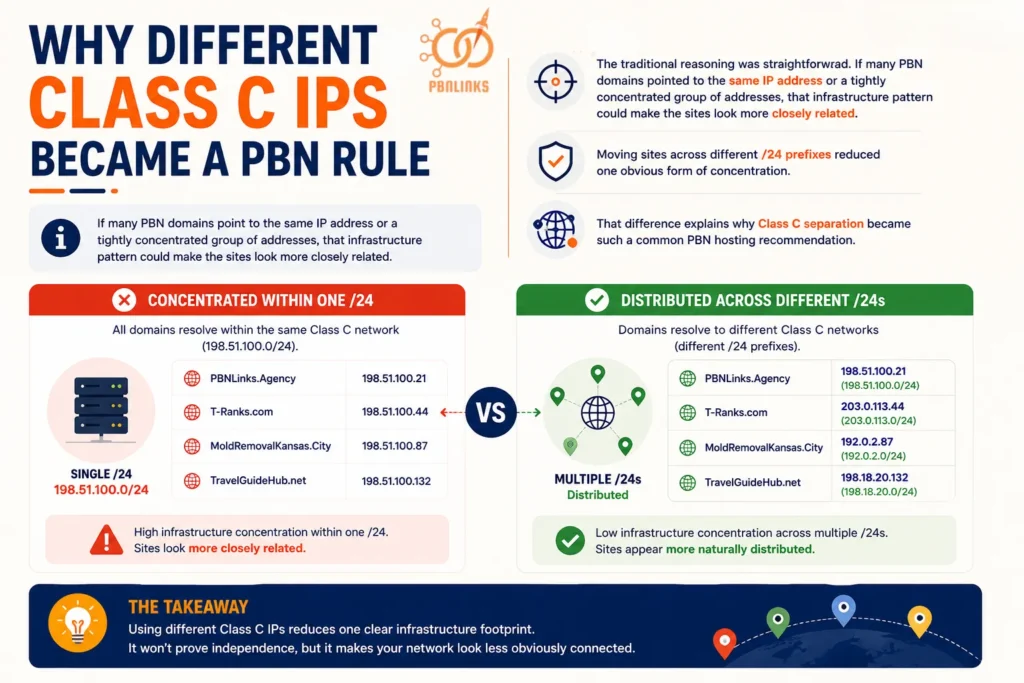
The traditional reasoning was straightforward. If many PBN domains pointed to the same IP address or a tightly concentrated group of addresses, that infrastructure pattern could make the sites look more closely related.
Moving sites across different /24 prefixes reduced one obvious form of concentration.
For example, compare a network where four domains resolve to:
198.51.100.21
198.51.100.44
198.51.100.87
198.51.100.132
with one where they resolve to:
198.51.100.21
203.0.113.44
192.0.2.87
198.18.20.132
The first group is concentrated within a single /24. The second is distributed across different address ranges.
That difference explains why Class C separation became such a common PBN hosting recommendation.
Different /24s Do Not Necessarily Mean Different Infrastructure
The limitation is that IP separation and infrastructure separation are not the same thing.
A hosting company can control many different IP ranges. Two domains may therefore use addresses in different /24s while still being connected through the same hosting provider or Autonomous System Number (ASN).
For example:
Site A → IP A → /24 A → ASN 64500
Site B → IP B → /24 B → ASN 64500
The /24s are different, but both addresses are still associated with the same autonomous-system routing context.
The reverse is also important. Two unrelated websites may legitimately share an IP through shared hosting, a CDN, or reverse-proxy infrastructure. An IP relationship by itself therefore does not prove common ownership.
For PBN IP diversity, “different Class C IPs” is best understood as one layer of address separation, not a complete measure of hosting diversity. The more important question is whether /24 separation still provides meaningful value when modern hosting providers, ASNs, shared infrastructure, and CDNs are taken into account.
Does Class C IP Separation Still Matter for PBNs?
Class C IP separation can still show whether sites are concentrated within the same /24 prefix, but it is not a complete measure of PBN IP diversity. Modern hosting infrastructure makes provider, ASN, shared-hosting, CDN, and historical relationships important alongside the visible IP range.
The old rule focused heavily on changing the third octet. That can separate two IPv4 addresses into different /24 prefixes, but it does not establish that the sites run on unrelated infrastructure. A single hosting company or autonomous system can operate many address blocks, including numerous /24s.
What /24 Separation Actually Shows
A /24 identifies an IPv4 prefix containing 256 addresses. If two addresses fall into different /24s, you can establish one specific fact: they do not share that particular 24-bit network prefix.
For example:
203.0.113.25 → 203.0.113.0/24
203.0.114.25 → 203.0.114.0/24
These addresses are in different /24 prefixes.
That information is useful when examining infrastructure concentration. If a large group of domains repeatedly resolves to addresses within the same narrow prefix, the pattern is different from a group distributed across several prefixes.
But /24 separation tells you about the address relationship, not the entire hosting relationship.
What /24 Separation Does Not Show
Two different /24s can still sit within broader related infrastructure.
Consider:
PBNLinks.Agency → 203.0.113.25 → /24 A → Provider X → ASN 64500
T-Ranks → 203.0.114.40 → /24 B → Provider X → ASN 64500
The two sites use different IP addresses and different /24 prefixes, yet both routes may still be associated with the same provider and ASN.
A different /24 therefore does not automatically prove:
- a different hosting provider
- a different ASN
- a different physical server
- a different data center
- unrelated ownership
- completely independent infrastructure
This is where the traditional “different Class C = diversified hosting” assumption becomes too simplistic.
Why the Third Octet Is Not a Complete Test
Older PBN advice often reduced Class C diversity to checking whether the third octet changed:
203.0.113.25
versus:
203.0.114.25
Visually, the addresses look separated. Technically, they are in different /24s. But the third octet alone tells you nothing about who operates those ranges or how they are routed.
A provider could control:
203.0.112.0/24
203.0.113.0/24
203.0.114.0/24
203.0.115.0/24
Giving four sites one address from each range would produce four different /24s without necessarily creating four independent hosting environments.
This is why counting third-octet differences should not be treated as a complete infrastructure audit.
When /24 Separation Is Still Useful
The fact that Class C terminology is outdated does not make prefix relationships meaningless. /24 concentration can still provide useful context when comparing multiple domains.
The key is to interpret it alongside broader network information:
IP address → Prefix → Provider → ASN → CDN or Origin → Historical Infrastructure
If several domains share multiple infrastructure characteristics, that pattern provides more context than any single IP attribute viewed alone.
For PBN IP diversity, the practical shift is therefore from asking “Does every site have a different Class C?” to asking “What network relationships remain after the IP addresses are compared?”
That leads directly to the next distinction: same IP, same subnet, and same ASN are three different relationships, and each tells you something different about the underlying infrastructure.
Same IP vs Same Subnet vs Same ASN
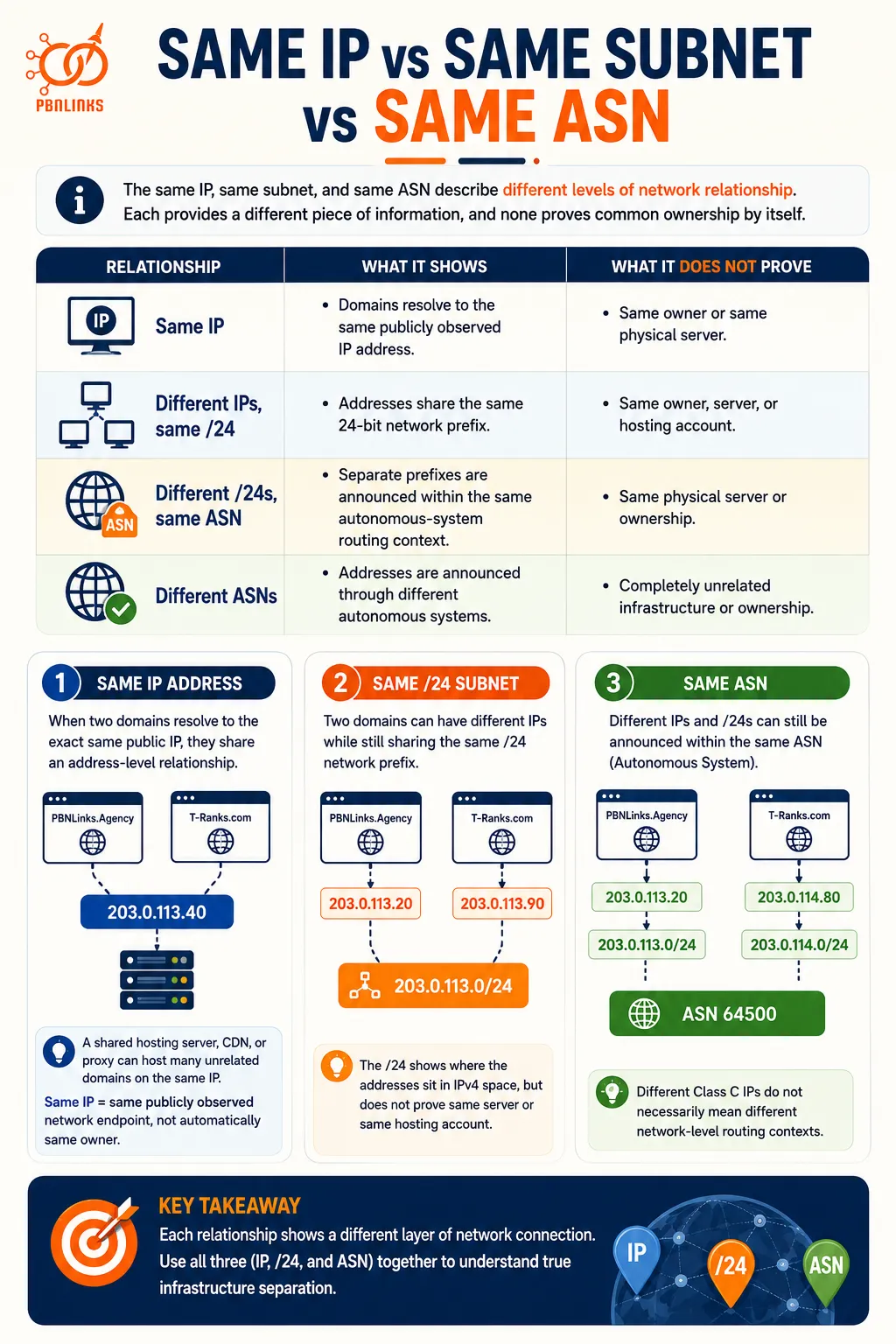
The same IP, same subnet, and same ASN describe different levels of network relationship. A shared IP shows that domains resolve to the same public address, a shared subnet shows that their addresses fall within the same network prefix, and a shared ASN shows that the addresses are announced within the same autonomous-system routing context.
For PBN IP diversity, these relationships should not be treated as interchangeable. Each provides a different piece of information, and none proves common ownership by itself.
| Relationship | What It Shows | What It Does Not Prove |
| Same IP | Domains resolve to the same publicly observed IP address | Same owner or same physical server |
| Different IPs, same /24 | Addresses share the same 24-bit network prefix | Same owner, server, or hosting account |
| Different /24s, same ASN | Separate prefixes are announced within the same autonomous-system context | Same physical server or ownership |
| Different ASNs | Addresses are announced through different autonomous systems | Completely unrelated infrastructure or ownership |
Same IP Address
When two domains resolve to the exact same public IP, they share an address-level relationship.
For example:
PBNLinks.Agency → 203.0.113.40
T-Ranks → 203.0.113.40
At first glance, that looks like a strong infrastructure overlap. But context matters.
A shared hosting server can serve hundreds or thousands of unrelated domains from one IP using name-based virtual hosting. CDNs and reverse proxies can also place unrelated websites behind shared public addresses.
The accurate conclusion is therefore:
Same IP = same publicly observed network endpoint, not automatically same owner.
Same /24 Subnet
Two domains can have different IP addresses while still sharing the same /24 prefix.
For example:
PBNLinks.Agency → 203.0.113.20
T-Ranks → 203.0.113.90
Both fall within:
203.0.113.0/24
This establishes a closer address-range relationship than two addresses in different /24s, but it still does not establish that both sites use the same server or hosting account.
The /24 tells you where the addresses sit within IPv4 address space. Additional information is required to understand who operates or announces that space.
Same ASN
An Autonomous System Number (ASN) identifies an autonomous system used in internet routing. An autonomous system can announce multiple IP prefixes rather than being limited to one /24.
This creates an important scenario:
PBNLinks.Agency
→ 203.0.113.20
→ 203.0.113.0/24
→ ASN 64500
T-Ranks
→ 203.0.114.80
→ 203.0.114.0/24
→ ASN 64500
The domains have different IPs and different /24s, but their prefixes are shown here within the same ASN.
This demonstrates why different Class C IPs do not necessarily equal different network-level routing contexts.
Different ASN Does Not Mean Completely Unrelated Infrastructure
Moving one level further, suppose the comparison looks like this:
PBNLinks.Agency → /24 A → ASN 64500
T-Ranks → /24 B → ASN 64501
MoldRemovalKansas.City → /24 C → ASN 64502
There is now separation at both the /24 and ASN levels. But even this should not be interpreted as proof that the sites have completely unrelated infrastructure.
Organizations can operate multiple ASNs, hosting brands can depend on upstream networks, and CDNs or cloud platforms can change what infrastructure is publicly visible. ASN diversity is therefore another analytical layer, not a standalone test of ownership or independence.
The useful way to interpret these relationships is as a hierarchy:
IP Address → Network Prefix → Provider → ASN → Broader Infrastructure
The further you investigate, the more context you gain about how the addresses relate. This is more informative than simply counting unique IPs or different third octets.
For PBN hosting, the next practical question is where shared and dedicated IPs fit into this picture, because having a unique address does not necessarily mean having unique infrastructure.
Shared vs Dedicated IPs for PBN Hosting
A shared IP can serve multiple websites, while a dedicated IP is assigned exclusively to a particular hosting account, server, or service. For PBN hosting, a dedicated IP provides address-level exclusivity, but it does not automatically mean a dedicated server, different hosting provider, different ASN, or completely independent infrastructure.
The practical difference is therefore not simply that dedicated IPs are “better.” Shared and dedicated IPs have different costs, hosting characteristics, and implications when analyzing PBN IP diversity.
| Factor | Shared IP | Dedicated IP |
| IP usage | Multiple websites can use the address | Address is assigned exclusively within the hosting setup |
| Typical cost | Lower | Usually higher |
| Common with shared hosting | Yes | Possible, but less typical |
| Requires a dedicated server | No | No |
| Guarantees a different provider | No | No |
| Guarantees a different ASN | No | No |
| Proves independent infrastructure | No | No |
Shared IP Hosting
Shared IP hosting allows multiple websites to receive traffic through the same public IP address. This is common in conventional shared hosting because modern web servers can determine which website a visitor requested from the hostname supplied with the request.
For example:
PBNLinks.Agency → 203.0.113.50
T-Ranks → 203.0.113.50
MoldRemovalKansas.City → 203.0.113.50
All three domains could technically resolve to the same address while the server delivers different websites for each hostname.
This is also why a shared IP is weak evidence of ownership by itself. A single address may be associated with many completely unrelated customers.
Shared hosting is generally cheaper because server and network resources are distributed among multiple accounts. The trade-off is that the public IP provides less address-level separation between websites using that infrastructure.
Dedicated IP Hosting
A dedicated IP gives a hosting account, server, or service exclusive use of a particular public address within that configuration.
For example:
PBNLinks.Agency → 203.0.113.20
T-Ranks → 203.0.114.40
Each site now has its own visible address rather than sharing one public IP.
That provides IP-level separation, but the addresses could still belong to:
Provider X → ASN 64500 → multiple /24 prefixes → multiple dedicated IPs
In other words, giving every site a dedicated IP can remove an exact-IP overlap while leaving broader provider or ASN relationships unchanged.
Dedicated IP Is Not the Same as a Dedicated Server
This distinction is particularly important.
A dedicated IP describes how an IP address is assigned.
A dedicated server describes the computing environment allocated to a customer.
A shared hosting account can sometimes receive a dedicated IP, while a dedicated server can have one or multiple IP addresses. The two terms describe different layers of infrastructure.
So:
Dedicated IP ≠ Dedicated Server
and:
Unique IP ≠ Unique Hosting Infrastructure
Treating these terms as interchangeable can make an IP-diversity audit look more diversified than the underlying setup actually is.
Shared vs Dedicated IP: What Actually Changes?
The main advantage of a dedicated IP in this context is straightforward: another unrelated customer is not intentionally sharing that specific assigned address within the hosting configuration.
What it does not automatically change is equally important.
A dedicated IP may still sit within the same:
- /24 prefix
- larger IP allocation
- hosting provider
- ASN
- data center
- server environment
Shared IPs sit at the opposite end of the spectrum. They provide less address exclusivity, but sharing an IP is normal across large parts of the web and does not by itself establish a relationship between domains.
For PBN IP diversity, the useful comparison is therefore not simply shared = bad and dedicated = good. A dedicated IP gives clearer address-level separation, while shared hosting generally reduces cost and resembles common web-hosting architecture. In either case, the IP needs to be interpreted alongside the network prefix, provider, ASN, CDN status, and broader infrastructure before drawing conclusions about how separated the hosting actually is.
How Are IP Addresses, Hosting Providers, and ASNs Connected?
An IP address identifies a network interface or endpoint, a hosting provider supplies the infrastructure used to host a website, and an ASN identifies an autonomous system that announces IP prefixes to the wider internet. Together, these layers help explain where a website is reachable and how its network is connected to the internet.
For PBN IP diversity, this relationship matters because two domains can have different IP addresses and different /24 prefixes while still sharing the same hosting provider or ASN.
The Core Roles
- IP Address: A numeric address assigned to a network interface. For a website, DNS may resolve the domain to a public IP used to reach the server, load balancer, CDN, reverse proxy, or other frontend infrastructure.
- Hosting Provider: The company or service supplying the hosting environment. A provider may operate its own servers and network resources or rely partly on data centers, upstream carriers, cloud platforms, or other infrastructure providers.
- ASN: An Autonomous System Number uniquely identifies an autonomous system participating in internet routing. An autonomous system can announce multiple IP prefixes under a common routing policy.
The relationship can be simplified as:
Domain → IP Address → IP Prefix → Autonomous System (ASN)
The hosting provider sits within this picture as the service or organization responsible for the hosting environment, but the provider and ASN are not necessarily the same entity.
How They Connect Together
IP addresses are allocated and routed as blocks, not simply as isolated addresses. Network operators receive or use address space and announce reachable prefixes through the global routing system. BGP, or Border Gateway Protocol, is used between autonomous systems to exchange information about which prefixes can be reached through which networks.
For example:
203.0.113.20 → 203.0.113.0/24 → ASN 64500
203.0.114.40 → 203.0.114.0/24 → ASN 64500
The individual IP addresses are different. Their /24 prefixes are also different. But in this simplified example, both prefixes are announced through the same ASN.
This is why checking only whether two PBN sites have different IPs or different /24s can miss a broader network relationship.
For PBN hosting, the practical takeaway is simple: IP addresses show the visible endpoints, prefixes show how those addresses are grouped, and ASNs add routing context around those prefixes. Looking at these layers together provides a more complete picture of network concentration than counting unique IP addresses alone.
How Do CDNs and Reverse Proxies Affect IP Visibility?
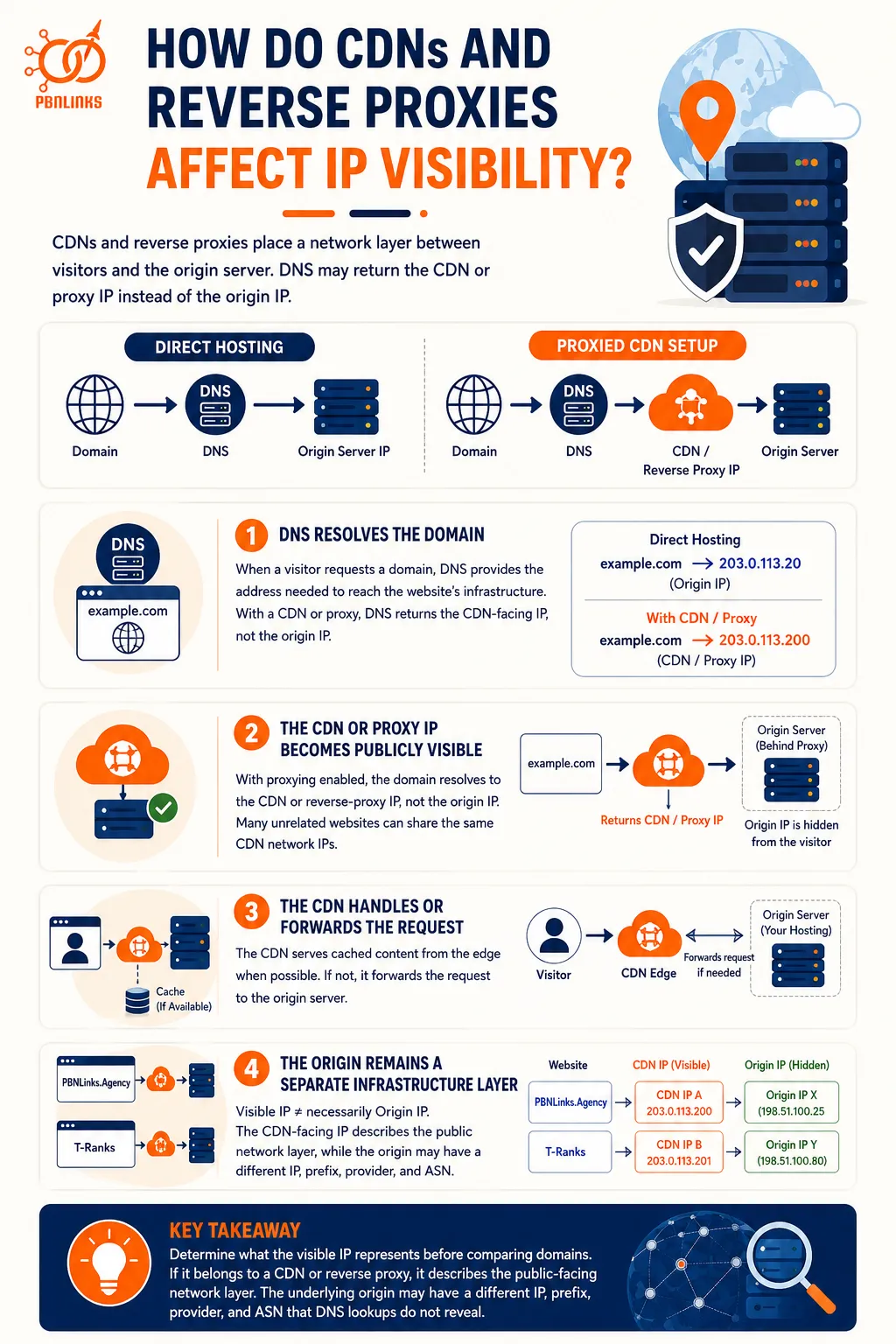
CDNs and reverse proxies can hide the origin server’s public IP by placing another network layer between visitors and the hosting server. When this happens, a DNS lookup may return an IP associated with the CDN or proxy rather than the IP of the server where the website is actually hosted.
This distinction matters for PBN IP diversity because comparing visible IP addresses without identifying proxy infrastructure can produce a misleading picture of the underlying hosting setup.
A simplified direct-hosting setup looks like:
Domain → DNS → Origin Server IP
With a proxied CDN configuration, the path becomes:
Domain → DNS → CDN or Reverse Proxy IP → Origin Server
Step 1: DNS Resolves the Domain
When a visitor requests a domain, DNS provides the address needed to reach the website’s publicly exposed infrastructure.
With direct hosting, an A record might point toward the origin infrastructure:
example.com → 203.0.113.20
A lookup of that domain therefore exposes an address associated with the infrastructure receiving the website request directly.
When a proxy service sits in front of the origin, however, DNS can return an entirely different address.
Step 2: The CDN or Proxy IP Becomes Publicly Visible
With proxying enabled, the domain may resolve to an IP operated by the CDN or reverse-proxy network.
The relationship becomes:
example.com → CDN IP
rather than:
example.com → Origin IP
A standard DNS or IP lookup may therefore identify the edge or proxy network, not the underlying web host.
This also means multiple unrelated websites can appear on IP addresses belonging to the same large CDN network without sharing the same origin server or owner.
Step 3: The CDN Handles or Forwards the Request
After receiving the request, the CDN decides how it should be handled.
If suitable content is cached at the edge, the CDN may serve it directly. If the requested content needs to come from the website’s backend, the CDN forwards the request to the origin infrastructure.
The request path may therefore look like:
Visitor → CDN Edge → Origin Server
The visitor communicates primarily with the CDN-facing address, while the CDN communicates separately with the origin.
A reverse proxy follows the same broad principle: the proxy is publicly exposed while the backend server sits behind it.
Step 4: The Origin Remains a Separate Infrastructure Layer
The important distinction is:
Visible IP ≠ necessarily Origin IP
Suppose:
PBNLinks.Agency → CDN IP A → Origin IP X
T-Ranks → CDN IP B → Origin IP Y
Looking only at the publicly returned IPs tells you about the CDN-facing layer. It does not necessarily reveal where the two sites are actually hosted.
The opposite issue can also occur. Several domains using the same CDN may expose addresses from the same CDN network even though their origins are hosted by completely different providers.
For this reason, CDN IP relationships should not be interpreted in exactly the same way as direct origin-hosting relationships.
For PBN IP diversity, the practical takeaway is to determine what the visible IP actually represents before comparing it across domains. If it belongs to a CDN or reverse proxy, it primarily describes the public-facing network layer. The underlying origin infrastructure may have a different IP, prefix, provider, and ASN that cannot necessarily be determined from ordinary public DNS alone.
How Do Reverse IP Lookups and Historical IP Data Reveal Hosting Relationships?
Reverse IP lookups and historical IP data can reveal hosting relationships by connecting an IP address with domains observed using it now or in the past. Combined with passive DNS and other infrastructure datasets, they can show shared hosting, previous IP assignments, hosting changes, and relationships that are no longer visible in current DNS records.
For PBN IP diversity, this provides an important second layer of analysis. A group of domains may use completely different IP addresses today while historical records show that some previously shared an address, /24 prefix, provider, or other network infrastructure.
How Reverse IP Lookups Work
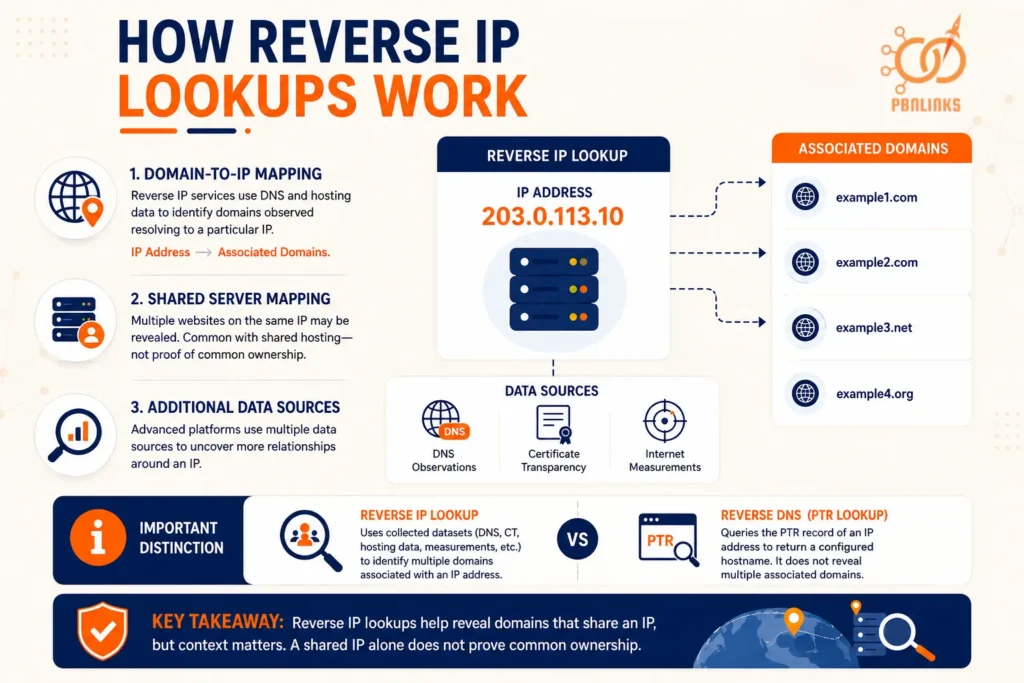
- Domain-to-IP Mapping: Reverse IP services use collected DNS and hosting data to identify domains observed resolving to a particular IP address. The basic relationship is IP Address → Associated Domains.
- Shared Server Mapping: When multiple websites use the same public IP, a reverse IP dataset may expose those co-hosted domains. This is common with shared hosting, so a shared address should not automatically be interpreted as evidence of common ownership.
- Additional Data Sources: More advanced infrastructure platforms may supplement DNS observations with sources such as certificate transparency data and other internet measurements to identify additional relationships around an IP.
One distinction is important here: reverse IP lookup is not the same as reverse DNS. Reverse DNS queries a PTR record to map an IP address to a configured hostname, while reverse IP services generally rely on collected datasets to identify multiple domains associated with an address.
How Historical IP Data Enhances the Analysis
- Infrastructure Timeline: Historical DNS data can show when a domain moved between IP addresses, prefixes, or hosting environments, creating a timeline that cannot be reconstructed from current DNS alone.
- Previous Infrastructure Overlap: Domains that appear separated today may have previously resolved to the same IP or nearby address ranges. Historical observations can make those earlier relationships visible.
- Hosting Migration Patterns: If several domains change IPs around similar periods or repeatedly appear within related network infrastructure, historical records can provide additional context for investigating those movements.
- Current vs Historical Comparison: Comparing present and previous records helps distinguish infrastructure that exists now from relationships that existed only at an earlier point.
For example:
Earlier records
PBNLinks.Agency → 203.0.113.20
T-Ranks → 203.0.113.40
Both addresses are within:
203.0.113.0/24
Current records
PBNLinks.Agency → 198.51.100.25
T-Ranks → 192.0.2.80
A current lookup shows separate address ranges. Historical data, however, adds the context that both domains were previously observed within the same /24.
Historical and reverse IP databases are not complete records of the internet. They reflect what each provider observed and retained, so a recorded relationship is useful evidence of an observation, while the absence of a record does not prove that a relationship never existed.
For PBN IP diversity, the most useful approach is to combine current and historical layers:
Current IP → /24 Prefix → Provider → ASN → Reverse IP Associations → Historical IP Data
This provides a clearer view of hosting relationships than relying only on the IP address a domain uses today.
What Does PBN IP Diversity Cost?
The cost of PBN IP diversity generally rises as you add dedicated IPs, separate hosting environments, additional providers, and greater network separation. Shared hosting usually sits at the lower-cost end, while more isolated and distributed setups require additional hosting spend and more hands-on management.
The important point is that higher cost does not automatically mean better IP diversity. What matters is what the additional expense actually changes: the visible IP, network prefix, provider, ASN, hosting environment, or some combination of these.
Shared Hosting: The Lowest-Cost Layer
Shared hosting is generally the lowest-cost option because multiple customers share server and network resources. Multiple websites may also use the same public IP address.
This model keeps costs relatively low because infrastructure expenses are distributed across many hosting accounts. Server administration, networking, updates, and other operational tasks are also largely handled by the provider.
The trade-off is less control over the surrounding infrastructure and less address-level exclusivity. A site’s public IP may be shared with many unrelated domains, which is normal for shared hosting but provides little IP separation at that layer.
Dedicated IPs: Paying for Address Exclusivity
A dedicated IP generally adds cost in exchange for exclusive use of a public address within the hosting arrangement. Pricing and availability vary by provider, particularly because public IPv4 addresses are a limited resource.
The distinction is straightforward:
Shared IP → multiple customers or sites may use the address
Dedicated IP → the address is assigned exclusively within the relevant hosting setup
But paying for a dedicated IP does not automatically create:
Dedicated IP → Different Provider → Different ASN → Different Data Center
A hosting provider may assign many dedicated addresses from the same network or broader address space. Dedicated IPs can therefore remove exact-IP overlap while leaving other infrastructure relationships unchanged.
This is why the cost of a dedicated IP should be evaluated against the specific layer of separation it actually provides.
Separate Hosting Environments Increase the Cost Further
Greater infrastructure separation normally requires more than assigning each site a different IP address.
The general cost curve looks like this:
Shared Hosting
↓
Multiple Shared Hosting Environments
↓
Dedicated IPs
↓
VPS or More Isolated Hosting
↓
Multiple Providers and Network Environments
↓
Higher Cost and Operational Complexity
As the infrastructure becomes more distributed, the expense extends beyond the hosting plans themselves. Multiple environments can mean additional accounts, billing cycles, control panels, DNS configurations, backups, monitoring, security maintenance, renewals, and troubleshooting.
That management burden is part of the real cost. Managing ten sites through one provider is relatively straightforward; maintaining the same sites across numerous independent environments requires considerably more administration.
The practical cost is therefore better viewed as:
Hosting Cost + Infrastructure Cost + Management Time + Maintenance Complexity
There is also a point of diminishing returns. Moving sites away from one heavily concentrated environment can materially change the infrastructure pattern, but paying progressively more simply to make every observable technical field different may provide much less additional value.
There is no universal technical rule requiring one ASN per site or one hosting provider per domain. Those formulas simply replace the old Class C checklist with another rigid rule.
For PBN IP diversity, the better question is not simply “How much does another IP cost?” It is “What meaningful infrastructure relationship does the additional expense actually change?”
The practical goal is to understand the trade-off between cost, address exclusivity, network separation, and management complexity, rather than assuming the most expensive or fragmented hosting setup is automatically the best one.
How Do You Audit IP Diversity Across Multiple Domains?
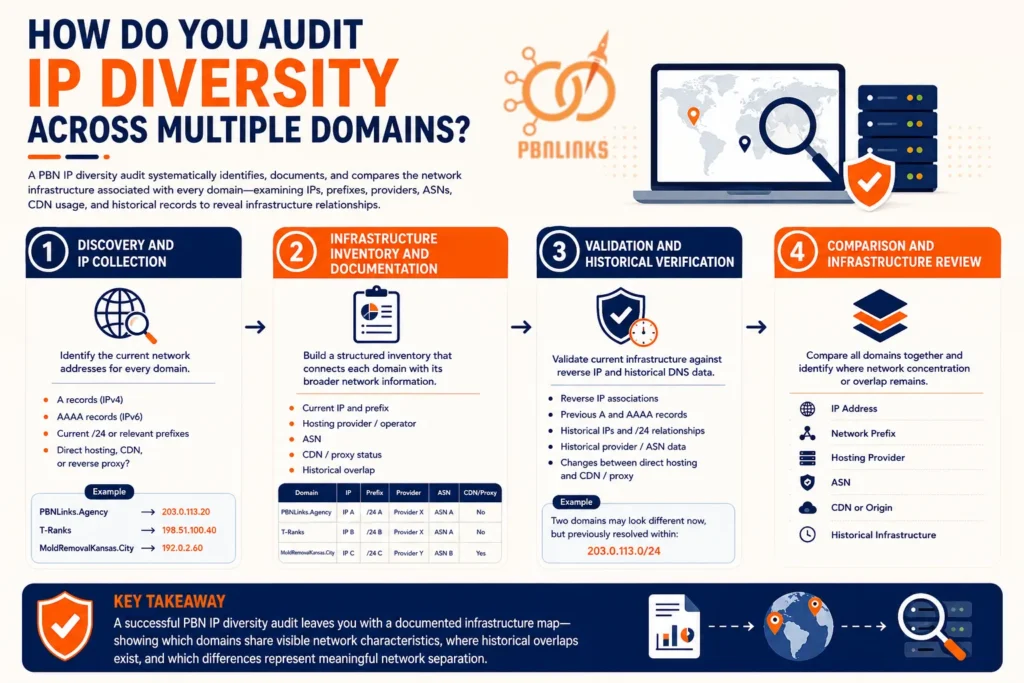
A PBN IP diversity audit systematically identifies, documents, and compares the network infrastructure associated with every domain in a network. Instead of checking only whether each site has a unique IP, the audit examines IP addresses, network prefixes, hosting providers, ASNs, CDN usage, and historical records to identify where infrastructure relationships exist.
A successful IP diversity audit can be divided into four practical stages:
Discovery and IP Collection
Start by identifying the current network addresses associated with every domain. DNS lookups provide the basic data needed to establish the current infrastructure snapshot.
For each domain, collect:
- A records for IPv4 addresses
- AAAA records for IPv6 addresses
- Current /24 or other relevant network prefixes
- Whether the visible address belongs to direct hosting, a CDN, or a reverse proxy
For example:
PBNLinks.Agency → 203.0.113.20
T-Ranks → 198.51.100.40
MoldRemovalKansas.City → 192.0.2.60
At this stage, the objective is discovery rather than interpretation. Record what is publicly visible before deciding what those relationships mean.
Infrastructure Inventory and Documentation
Build a structured inventory that connects each domain with its broader network information.
The inventory should document more than the IP itself. For each domain, record the current address, relevant prefix, hosting provider or network operator where identifiable, ASN, and CDN or proxy status.
A simple audit sheet can use this structure:
| Domain | Current IP | Prefix | Provider | ASN | CDN/Proxy | Historical Overlap |
| PBNLinks.Agency | IP A | /24 A | Provider X | ASN A | No | None found |
| T-Ranks | IP B | /24 B | Provider X | ASN A | No | Shared old /24 |
| MoldRemovalKansas.City | IP C | /24 C | Provider Y | ASN B | Yes | None found |
Putting every domain into one table makes repeated patterns much easier to identify than checking each site independently.
Validation and Historical Verification
Validate the current infrastructure against reverse IP and historical DNS data. Current records provide only a snapshot, so this stage checks whether apparently separate domains had different relationships in the past.
Review:
- Reverse IP associations
- Previous A and AAAA records
- Historical IP addresses
- Previous /24 relationships
- Historical provider or ASN information where available
- Changes between direct hosting and CDN or proxy infrastructure
For example, two domains may currently use completely different IP ranges but historical records may show that both previously resolved within:
203.0.113.0/24
That does not prove common ownership, but it adds infrastructure context that the current DNS records alone would miss.
Historical datasets should also be treated carefully. A recorded relationship shows what the data provider observed, while a missing record does not prove that a relationship never existed.
Comparison and Infrastructure Review
The final stage is to compare all domains together and identify where network concentration remains.
Review the infrastructure layer by layer:
IP Address → Network Prefix → Hosting Provider → ASN → CDN or Origin → Historical Infrastructure
For example, a network may have unique IP addresses across every site but still show repeated providers or ASNs. Another network may contain some shared IPs because sites use common CDN infrastructure while their underlying hosting environments are unrelated.
The purpose of the audit is therefore not to produce an arbitrary “IP diversity score.” It is to understand what each relationship actually represents.
A successful PBN IP diversity audit should leave you with a documented infrastructure map showing which domains share visible network characteristics, where historical overlaps exist, and which apparent differences represent meaningful network separation rather than different IP addresses alone.
What Are the Most Common PBN IP Diversity Mistakes?
The most common PBN IP diversity mistakes come from concentrating sites within the same infrastructure or assuming that one changed network attribute creates complete separation. Repeated /24 prefixes, providers, hosting accounts, ASNs, nameservers, and DNS configurations can all reveal infrastructure relationships when examined together.
The key mistake is treating PBN IP diversity as a matter of collecting different-looking IP addresses rather than understanding the broader network behind them.
Common IP and Infrastructure Mistakes
- Concentrating sites within the same /24 prefix: Giving multiple sites different IPs within a range such as 203.0.113.x changes the individual host address but leaves them within the same /24. A unique IP therefore does not automatically provide prefix-level separation.
- Relying on one hosting environment: Placing many domains under the same hosting account, server environment, or narrowly concentrated provider infrastructure can create repeated relationships even when individual IP addresses differ.
- Assuming cheap SEO hosting is automatically diverse: Low price itself is not the problem. The concern is whether a hosting service repeatedly assigns sites from a limited set of providers, prefixes, servers, or ASNs. Infrastructure should be evaluated from the resulting network data rather than the marketing label or price.
- Ignoring nameserver relationships: IP addresses are only one infrastructure signal. Repeated nameserver patterns across many domains can create another visible relationship, particularly when the same uncommon or custom nameservers appear repeatedly.
- Leaving unnecessary DNS patterns identical: A, AAAA, MX, TXT, and other DNS records should reflect the services each domain actually uses. Repeated configurations may provide additional infrastructure context, but DNS records should never be changed or randomized merely to make them look different.
- Assuming different /24s mean different providers: A single hosting company or autonomous system can operate many address ranges. Sites can therefore occupy different /24 prefixes while still sharing the same provider or ASN.
- Ignoring CDN and proxy infrastructure: A visible IP may belong to a CDN or reverse proxy rather than the origin server. Comparing those addresses as though they were direct hosting IPs can lead to incorrect conclusions about the underlying infrastructure.
- Checking only current IP addresses: Current DNS provides only a present-day snapshot. Reverse IP and historical DNS datasets can add context about previous IPs, shared address ranges, and hosting migrations that are no longer visible today.
- Treating geographic dispersion as network independence: Hosting sites in different cities or countries does not automatically create provider or ASN diversity. Large hosting and cloud networks can operate infrastructure across many regions.
- Paying for dedicated IPs without checking the broader network: A dedicated IP provides address exclusivity, but several dedicated addresses can still belong to the same prefix, provider, ASN, or broader hosting environment.
The practical lesson is that no single infrastructure attribute should be treated as a pass-or-fail test. A more useful review compares the complete relationship:
IP Address → Network Prefix → Hosting Provider → ASN → DNS/Nameservers → CDN or Origin → Historical Infrastructure
This makes the mistakes section much tighter while also reinforcing the article’s central argument: PBN IP diversity is about understanding network relationships, not simply making every IP address look different.
What Factors Actually Matter for PBN IP Diversity?
The factors that matter most for PBN IP diversity are IP and /24 separation, hosting-provider and ASN relationships, DNS and nameserver infrastructure, CDN or proxy usage, and current versus historical hosting data. No single factor proves that websites use completely independent infrastructure. The useful picture comes from examining how these relationships overlap across multiple domains.
PBN IP diversity is therefore better understood as an infrastructure-footprint consideration rather than a direct ranking factor. A unique IP removes one obvious overlap, but the analysis should not stop at the address itself.
1. IP and /24 Separation
Unique IP addresses remove exact-IP overlap, while different /24 prefixes provide separation at the network-prefix level. This is the foundation of what SEO practitioners historically called Class C diversity.
Consider:
203.0.113.20 → 203.0.113.0/24
203.0.114.40 → 203.0.114.0/24
These addresses are different and belong to different /24s. That confirms prefix-level separation, but it does not tell you who operates or announces those address ranges.
This is why Class C diversity still provides useful information, but different /24s should be treated as a starting point rather than proof of independent hosting.
2. Hosting Provider and ASN Relationships
Hosting providers and ASNs add broader network context around apparently different IP addresses. A single provider or autonomous system can operate or announce many separate IP prefixes.
For example:
Site A → /24 A → Provider X → ASN 64500
Site B → /24 B → Provider X → ASN 64500
The sites use different /24s, but the example still shows a relationship at the provider and ASN levels.
That does not mean every site needs a different provider or ASN. Large networks legitimately host enormous numbers of unrelated websites. Provider and ASN diversity should add context to an infrastructure analysis, not become another rigid pass-or-fail rule.
3. DNS and Nameserver Infrastructure
IP diversity should be evaluated alongside DNS and nameserver relationships because they represent another visible part of a site’s infrastructure.
Common nameservers from major registrars, hosting companies, or DNS providers naturally appear across many unrelated domains. Their presence alone therefore says little about ownership.
Repeated custom or unusual nameserver configurations can provide more context, particularly when they appear alongside repeated IP, provider, or ASN relationships.
DNS records should reflect the services each domain actually uses rather than being artificially changed for the sake of appearing different. The important principle is that different IP addresses do not erase repeated infrastructure patterns elsewhere.
4. CDN and Origin IP Visibility
The visible IP needs to be identified as either direct hosting infrastructure or an intermediary such as a CDN or reverse proxy before it is interpreted.
Direct hosting may look like:
Domain → Origin-facing Infrastructure
A proxied configuration looks more like:
Domain → CDN/Proxy → Origin Infrastructure
This distinction matters because large CDN networks serve enormous numbers of unrelated websites. Two domains appearing within the same CDN infrastructure therefore has a different meaning from two directly hosted domains sharing a small hosting environment.
Likewise, different CDN-facing IPs do not necessarily tell you whether the underlying origins are separated.
5. Current and Historical IP Relationships
Current DNS shows where a domain resolves today, while historical data can reveal infrastructure relationships that existed previously.
Domains move between IP addresses, providers, ASNs, and proxy configurations. Two sites that appear completely separated today may therefore have shared an IP or address range at an earlier point.
Reverse IP and historical DNS datasets can add useful context, but they are not complete records. A historical match shows that a provider observed a relationship, while the absence of one does not prove that no relationship ever existed.
Current and historical infrastructure should therefore be examined together rather than as competing sources of truth.
6. Overall Infrastructure Concentration
The combined infrastructure pattern matters more than maximizing the number of unique technical values.
A PBN can have different IPs and /24s while repeatedly using the same provider, ASN, nameserver configuration, or other infrastructure. At the same time, one shared attribute does not automatically establish that a group of websites is commonly owned.
The useful analysis is therefore:
IP Address → /24 Prefix → Hosting Provider → ASN → DNS/Nameservers → CDN or Origin → Historical Infrastructure
There is no universal formula requiring:
One Site = One IP = One /24 = One Provider = One ASN
Real websites commonly share infrastructure, and making every field unique can add substantial cost and management complexity without necessarily producing an equivalent increase in meaningful separation.
For PBN IP diversity, the practical priority is to evaluate infrastructure as a collection of relationships rather than a collection of unique values. Different IPs and /24s establish address-level separation, while provider, ASN, DNS, CDN, and historical data determine how much broader network concentration remains.
How Should You Build a Practical PBN IP Diversification Setup?
A practical PBN IP diversification setup should distribute sites across IP addresses and hosting environments without relying on Class C separation alone. The objective is to avoid unnecessary infrastructure concentration while keeping hosting costs, maintenance, and management complexity under control.
There is no universal formula for how many IPs, /24s, providers, or ASNs a network needs. A better approach is to build the infrastructure in layers and verify what each layer of diversification actually changes.
Step 1: Map the Existing Infrastructure
Infrastructure mapping establishes a baseline showing how every domain is currently connected at the IP, network, hosting, and DNS levels. Without this starting point, it is difficult to know where meaningful concentration actually exists.
For every domain, record the current:
- IP address
- /24 prefix
- Hosting provider
- ASN
- Nameservers
- CDN or proxy status
Put this information into one spreadsheet rather than reviewing sites individually. Patterns become much easier to identify when all domains can be compared side by side.
A network may already have unique IPs, for example, while still placing most domains within a small number of providers or ASNs. Mapping exposes those relationships before any infrastructure changes are made.
Step 2: Separate Obvious IP Concentration
IP-level separation addresses the most visible form of hosting concentration: multiple domains sharing the same address or sitting within tightly grouped IPv4 prefixes. This is where traditional Class C diversification provides its most practical value.
Do not confuse different individual addresses with different network prefixes.
Consider:
203.0.113.20
203.0.113.40
203.0.113.80
All three IPs are unique, but they remain within:
203.0.113.0/24
By comparison:
203.0.113.20
203.0.114.40
occupy different /24 prefixes.
Moving across /24s provides prefix-level separation, but keep the interpretation precise: different /24s do not automatically mean different providers, ASNs, servers, or hosting environments.
Step 3: Check Provider and ASN Distribution
Provider and ASN analysis shows whether apparently different IP addresses still belong to broader related network infrastructure. This step moves the audit beyond visible addresses and into the routing and provider relationships behind them.
For example:
Site A → /24 A → Provider X → ASN 64500
Site B → /24 B → Provider X → ASN 64500
Site C → /24 C → Provider Y → ASN 64501
Sites A and B have different /24s, but the example still shows concentration at the provider and ASN levels.
The goal is not to force every domain onto a unique provider or ASN. Large hosting networks legitimately serve many unrelated websites. Instead, identify where provider or ASN concentration exists and decide whether it represents a meaningful infrastructure relationship worth changing.
Step 4: Review DNS and Nameserver Patterns
DNS and nameserver review checks whether IP-diverse domains still repeat distinctive infrastructure configurations elsewhere. Different IP addresses provide little insight into DNS relationships, so this layer should be evaluated separately from the hosting-address comparison.
Look for repeated patterns such as unusual custom nameservers or distinctive DNS configurations appearing across many domains.
Common nameservers from major registrars, DNS platforms, and hosting companies naturally appear across large numbers of unrelated websites, so repetition alone should not automatically be treated as evidence of common ownership.
DNS records should also represent the services each domain genuinely uses. Do not create incorrect or arbitrary DNS records simply to manufacture differences between sites.
Step 5: Identify CDN and Proxy Layers
CDN and proxy identification determines whether the IP visible in DNS represents the hosting origin or an intermediary network. Without this distinction, an IP-diversity comparison can measure CDN infrastructure instead of the underlying hosting environment.
For direct hosting, the relationship may be:
Domain → Origin-facing Infrastructure
When proxying is active:
Domain → CDN/Proxy → Origin Infrastructure
Large CDN networks can serve huge numbers of unrelated websites, so shared CDN-facing infrastructure needs different interpretation from several directly hosted sites sharing a small network.
If the origin cannot be reliably established from available information, record it as unknown rather than assuming the CDN-facing address represents the backend server.
Step 6: Balance Separation Against Cost
Greater infrastructure separation usually increases both hosting expenses and operational complexity. This step determines whether each additional provider, IP, or hosting environment creates enough meaningful separation to justify its ongoing financial and management cost.
The general cost curve tends to move from:
Shared Hosting
↓
Multiple Hosting Environments
↓
Dedicated IPs
↓
VPS or More Isolated Environments
↓
Multiple Providers and Network Environments
As the infrastructure becomes more distributed, you may also need to manage more accounts, control panels, billing cycles, DNS configurations, backups, renewals, monitoring systems, and support channels.
Before adding another layer, ask:
What infrastructure relationship will this additional cost actually change?
If an expensive change gives a site another IP but leaves the same broader provider or network relationship, the practical difference may be smaller than the price suggests.
Step 7: Re-Audit the Final Setup
A final audit verifies whether the intended diversification is actually visible in the resulting infrastructure. Hosting plans and marketing descriptions can sound diverse, but the resulting IP, provider, ASN, and DNS data show what separation was really achieved.
Repeat the same checks used during the initial mapping:
IP → /24 → Provider → ASN → DNS/Nameservers → CDN or Origin → Historical Data
Compare the results with the original infrastructure map.
Look specifically for concentration that remains across several layers rather than expecting every individual field to be unique.
A practical PBN IP diversification setup is not about reaching an arbitrary number of IPs, /24s, providers, or ASNs. It is about identifying unnecessary infrastructure concentration, changing the relationships that genuinely matter, verifying the result, and balancing that separation against the cost and complexity required to maintain it.
Is PBN IP Diversity Still Important in 2026?
Yes, PBN IP diversity is still relevant in 2026, but it should be viewed as an infrastructure consideration rather than a direct ranking factor. Google continues to use automated systems to detect spam and explicitly classifies links created primarily to manipulate search rankings as link spam. However, Google does not publish a rule saying that backlinks from different IP addresses or /24 prefixes receive more ranking value.
What has changed is the way IP diversity should be understood. The old PBN advice focused heavily on putting every site on a different “Class C” IP. Different /24 prefixes can still reduce obvious address-level concentration, but Class C separation alone does not establish independent infrastructure. Different IPs can still be associated with the same provider or ASN, while completely unrelated websites can legitimately share infrastructure through shared hosting, cloud platforms, and CDNs.
IP diversity also matters differently because today’s hosting environment is more complex. A public IP may represent a shared server, CDN edge, reverse proxy, or origin-facing infrastructure, and historical DNS databases can retain observations of addresses a domain used previously. As a result, simply checking whether two sites currently have different IPs gives only a partial picture. Google’s public ranking documentation likewise describes Search as relying on many signals and multiple spam-detection systems rather than a single infrastructure metric.
So, PBN IP diversity still matters in 2026, but “different Class C for every site” should not be treated as the complete strategy or as a ranking advantage by itself. /24 separation remains useful for reducing address-level concentration, while provider, ASN, DNS, CDN, and historical hosting relationships provide broader infrastructure context. More importantly, IP diversity cannot make manipulative links compliant with Google’s policies; links created primarily to manipulate rankings can still be treated as link spam regardless of how diversified the hosting infrastructure appears.
Shared vs Dedicated IPs for PBNs: Which Is Better?
Shared and dedicated IPs can both be used for PBN hosting, but they provide different levels of address-level separation. A shared IP is used by multiple websites or hosting accounts, while a dedicated IP is assigned exclusively within a particular hosting arrangement.
The important distinction is that a dedicated IP provides address exclusivity, not automatically a dedicated server, different hosting provider, separate /24 prefix, or different ASN. For PBN IP diversity, the surrounding network infrastructure matters alongside whether the IP itself is shared or dedicated.
| Factor | Shared IP | Dedicated IP |
| IP usage | Used by multiple websites or accounts | Assigned exclusively within the hosting arrangement |
| Address exclusivity | Lower | Higher |
| Typical cost | Lower | Higher |
| Other domains on exact IP | Common | Normally no |
| Dedicated server | No | Not necessarily |
| Different /24 guaranteed | No | No |
| Different hosting provider guaranteed | No | No |
| Different ASN guaranteed | No | No |
| Main benefit | Lower-cost shared infrastructure | Exclusive use of the IP address |
Shared IPs are common across ordinary web hosting. One public IP can serve many unrelated websites, so finding multiple domains on the same address does not by itself establish common ownership. The main trade-off is that the website has no exclusivity over that individual IP.
Dedicated IPs remove this exact-IP overlap. However, several dedicated IPs can still come from the same hosting provider, address range, data center, or ASN. This is why dedicated IP should not be confused with dedicated infrastructure.
Cost is another practical difference. Shared IP hosting is generally less expensive because server and network resources are distributed across multiple customers. Dedicated IPs typically add cost for address exclusivity, but that extra expense does not necessarily create separation at every other infrastructure layer.
Shared or Dedicated IPs: Which Is Better for PBNs?
Dedicated IPs are better when the objective is individual IP-address exclusivity, while shared IPs are the lower-cost option and can legitimately place a site among unrelated websites. Neither option is automatically better for overall PBN IP diversity.
A dedicated IP becomes more meaningful when it also changes relevant infrastructure relationships rather than merely changing the individual address. If several dedicated IPs still sit within closely related provider or ASN infrastructure, the separation is primarily at the IP level.
For PBN IP diversity, shared versus dedicated status should therefore be evaluated alongside the IP address, /24 prefix, hosting provider, and ASN. The better option is the one that provides the level of meaningful infrastructure separation required without adding unnecessary cost or complexity.
Does Class C IP Diversity Still Matter for PBNs?
Yes, Class C IP diversity still matters for PBNs as a basic way to reduce obvious IP-level concentration, but it is not a complete measure of infrastructure diversity. In modern networking terms, what PBN hosting discussions usually call “Class C diversity” generally means placing sites across different IPv4 /24 prefixes rather than within the same address range.
Why Class C IP Diversity Is Still Relevant
- Reduces obvious IP clustering: If multiple sites use addresses such as 203.0.113.20, 203.0.113.40, and 203.0.113.80, they all sit within 203.0.113.0/24. Moving across different /24s removes that particular concentration.
- Provides baseline prefix separation: Different /24 ranges create a meaningful distinction at the IP-prefix level. This is more useful than simply assigning different host addresses within the same /24.
- Makes infrastructure easier to evaluate: Once sites are separated at the /24 level, provider and ASN data can be compared to determine whether broader network relationships still remain.
Class C diversity therefore has not become irrelevant. Its role is simply narrower than older PBN advice often suggests.
Why Class C Diversity Is Not Enough on Its Own
The main limitation is that different /24 prefixes can still belong to the same broader network infrastructure.
For example:
Site A → 203.0.113.20 → /24 A → Provider X → ASN 64500
Site B → 203.0.114.40 → /24 B → Provider X → ASN 64500
The sites have different IP addresses and different /24s, but the simplified example still shows the same provider and ASN.
Class C diversity also says nothing by itself about nameservers, DNS configurations, CDN usage, historical IP relationships, or other characteristics of the sites. This is why /24 separation should not be treated as a standalone test of whether infrastructure is independent.
What Matters Beyond Class C Diversity
Modern PBN IP diversity is better evaluated as several connected infrastructure layers:
IP Address → /24 Prefix → Hosting Provider → ASN → DNS/Nameservers → CDN or Origin → Historical Infrastructure
A different /24 answers one specific question: are these IPv4 addresses concentrated within the same 24-bit prefix? Provider and ASN information then adds broader network context, while DNS, CDN, and historical data reveal relationships that the current IP address cannot show by itself.
So, Class C IP diversity still matters for PBNs, but as a baseline infrastructure layer rather than a complete solution. Different /24 prefixes remove obvious address-range concentration; the broader hosting relationships determine how meaningful that separation actually is.
How Much IP Diversity Does a PBN Actually Need?
There is no universal number of IP addresses, /24 prefixes, hosting providers, or ASNs that every PBN needs. The appropriate level of PBN IP diversity depends on the size of the network, how concentrated its existing hosting infrastructure is, and what additional separation actually changes. Fixed formulas such as “one ASN per site” or a specific number of providers are not universal technical requirements.
A practical approach is to look for concentration in layers. Start with exact IP overlap, then check whether different addresses still fall within the same /24 prefixes. After that, compare hosting providers and ASNs to see whether apparently different IP ranges still share broader network relationships. DNS, nameservers, CDN usage, and historical IP data can provide additional context where needed. The goal is not to make every infrastructure value unique, but to avoid unnecessary clustering across several layers at once.
As a PBN grows, infrastructure management generally becomes more important because repeatedly adding sites to the same environment can increase concentration even when each receives a different IP. At the same time, more diversity brings higher hosting costs and management complexity. The right amount of PBN IP diversity is therefore enough to reduce obvious infrastructure concentration without pursuing arbitrary separation that adds cost but little meaningful difference.
Can Google Detect PBNs Through IP Addresses?
Google can use infrastructure-related signals as part of broader spam analysis, but there is no public evidence that a shared IP, same /24, or same ASN alone is enough to identify a PBN. Google publicly states that its automated systems, including SpamBrain, detect link spam, but it does not disclose a specific IP-based formula for identifying private blog networks.
IP addresses can still provide useful relationship data. Multiple domains may share an exact IP, appear within related address ranges, use the same hosting provider, or have prefixes announced through the same ASN. However, these relationships require context because ordinary websites routinely share hosting infrastructure, cloud platforms, CDNs, and network operators.
This is why statements such as “Google detects PBNs because they share a Class C IP” are too absolute. Different /24 prefixes do not guarantee independent infrastructure, while sharing a provider or ASN does not prove common ownership. Infrastructure information is better understood as one possible category of evidence alongside Google’s broader systems for evaluating links and web spam.
For PBN IP diversity, the practical takeaway is that changing an IP address should not be viewed as a way to make manipulative links undetectable. Google’s spam policies classify links created primarily to manipulate rankings as link spam regardless of the hosting arrangement. IP diversity can change visible infrastructure relationships, but it does not make a PBN compliant with Google’s link-spam policies.
Does IPv6 Change PBN IP Diversity?
Yes, IPv6 changes how PBN IP diversity should be evaluated because the old Class A, B, and C model applies to IPv4, not IPv6. IPv6 uses a 128-bit address space and CIDR prefix lengths, so concepts such as “different Class C IPs” cannot simply be transferred to IPv6.
For IPv4, PBN discussions commonly compare /24 prefixes as the modern equivalent of the old Class C concept. With IPv6, the relevant questions become which IPv6 prefixes the addresses belong to, how those prefixes are allocated, and which provider or ASN announces them. A large number of visually different IPv6 addresses does not necessarily represent a large number of independent networks.
This matters because IPv6 adoption is no longer marginal. Google continuously measures IPv6 connectivity among its users, and IPv6 briefly exceeded 50% in its measurements in March 2026. Internet Society described this as an important deployment milestone, although adoption still varies considerably by network and country.
For PBN IP diversity, IPv6 therefore does not eliminate the underlying infrastructure question; it changes the addressing model used to analyze it. Instead of trying to reproduce old Class C rules, evaluate IPv6 prefix relationships, hosting-provider allocation, ASN relationships, and whether the visible address belongs to an origin server, CDN, or proxy. IPv4 /24 diversity remains relevant where IPv4 is used, while IPv6 should be assessed according to its own prefix-based network structure.
How Often Should You Audit PBN IP Diversity?
PBN IP diversity should be audited whenever hosting infrastructure changes and periodically as the network grows. IP assignments, DNS records, hosting providers, CDN configurations, and network routing can change over time, so a setup that was diversified when created may not remain identical indefinitely.
A useful audit compares the network’s current IP addresses, /24 prefixes, hosting providers, ASNs, nameservers, and CDN or proxy status against the previous infrastructure map. The purpose is to identify new concentration, such as several domains moving into the same address range or a hosting migration unexpectedly placing multiple sites within related infrastructure. Current PBN-hosting guidance similarly emphasizes infrastructure mapping and monitoring rather than relying only on the host’s claim of “unique IPs.”
There is no evidence-based universal rule that every PBN must be audited every 30, 60, or 90 days. Event-based auditing is more defensible: recheck the network after changing hosts, migrating sites, adding a large group of domains, changing DNS or CDN configurations, or receiving new IP assignments. Larger networks may also justify scheduled reviews because infrastructure relationships become harder to track manually as the number of sites increases.
The goal is not to continually change IP addresses simply to make the network look different. A good PBN IP diversity audit verifies that the infrastructure you intended to use is still the infrastructure actually visible: IP → /24 → Provider → ASN → DNS → CDN/Origin → Historical Data. If those relationships have changed, the audit tells you where and why before you decide whether any action is necessary.
What Tools Can You Use to Check PBN IP Diversity?
PBN IP diversity can be checked with DNS lookup, IP intelligence, ASN lookup, reverse IP, and historical DNS tools. No single tool provides the complete picture, so the most useful approach is to combine several data sources and compare their results across all domains in the network.
DNS Lookup Tools
DNS lookup tools provide the starting point by showing the records currently associated with a domain. The most relevant records for an IP diversity audit are A records for IPv4, AAAA records for IPv6, and NS records for authoritative nameservers.
Tools such as dig and nslookup can retrieve this information directly. Web-based DNS checkers can provide similar data when command-line access is not convenient.
IP and ASN Lookup Tools
Once the current IP is known, IP and ASN lookup services can provide broader network context. They can help identify the IP prefix, network operator, ASN, and registration information associated with an address.
This is useful when two domains have different IPs or /24s but you want to determine whether their prefixes are associated with the same broader network.
Reverse IP Lookup Tools
Reverse IP services attempt to identify other domains that have been observed using a particular IP address.
They are particularly useful for distinguishing an address associated with many domains from one with a much smaller observed set. Results should be interpreted carefully because shared hosting and CDN infrastructure can legitimately associate large numbers of unrelated domains with the same address.
Historical DNS and IP Tools
Historical DNS platforms add the time dimension that current DNS lookups cannot provide. Depending on the dataset, they may show previous A or AAAA records, earlier IP addresses, and changes in hosting infrastructure.
This can reveal relationships that disappeared after a domain changed hosts or IP addresses. Historical databases are observational, however, so missing records do not prove that a particular configuration never existed.
Use the Tools Together, Not Independently
The strongest audit combines the results into one infrastructure map:
Domain → Current IP → /24 Prefix → Provider → ASN → Nameservers → CDN/Origin → Historical IPs
For PBN IP diversity, the tool itself matters less than the data being verified. DNS tools establish the current configuration, IP and ASN databases add network context, reverse IP tools reveal observed co-hosting relationships, and historical DNS services show how that infrastructure has changed over time.
Using those datasets together provides a much clearer picture than relying on a single “Class C checker” or counting unique IP addresses alone.
PBN IP Diversity Checklist
A PBN IP diversity checklist helps verify the main infrastructure relationships across a network before and after hosting changes. It should go beyond checking whether every domain has a different IP and include the broader network, DNS, and historical context covered throughout this guide.
Use this checklist when reviewing your setup:
- Check current IP addresses: Record the A and AAAA records for every domain and identify exact IP overlap.
- Compare /24 prefixes: Determine whether multiple IPv4 addresses remain concentrated within the same /24.
- Identify hosting providers: Check which provider or network operator is associated with each address.
- Compare ASNs: Determine whether different prefixes are announced through the same autonomous system.
- Review shared vs dedicated status: Confirm whether an IP is shared or exclusively assigned, without assuming a dedicated IP means dedicated infrastructure.
- Check nameservers: Look for repeated DNS and nameserver relationships across domains.
- Identify CDN or proxy usage: Determine whether the visible IP represents the origin-facing infrastructure or an intermediary network.
- Run reverse IP checks: Review other domains observed on the same addresses, while accounting for normal shared hosting.
- Review historical IP data: Compare previously observed IPs and hosting relationships with the current setup.
- Check provider concentration: Look at the network as a whole rather than evaluating each domain independently.
- Consider cost: Confirm that additional infrastructure separation provides a meaningful difference rather than only increasing hosting expense.
- Re-audit after changes: Repeat the comparison after migrations, IP changes, DNS changes, or major network expansion.
A useful final infrastructure map should read:
Domain → IP → /24 → Provider → ASN → DNS/Nameservers → CDN or Origin → Historical Infrastructure
The purpose of the checklist is not to make every value unique. A strong PBN IP diversity review identifies where infrastructure relationships exist, determines what those relationships actually mean, and avoids relying on a single metric such as Class C separation as proof of complete diversity.
Common Myths About PBN IP Diversity
PBN IP diversity is surrounded by rules that sound technical but often oversimplify how internet infrastructure actually works. The most common myths treat IP addresses, /24 prefixes, dedicated IPs, or ASNs as standalone measures of hosting independence.
Myth 1: Every PBN Site Needs a Different Class C IP
Different “Class C” IPs, more accurately different /24 prefixes in modern terminology, provide useful prefix-level separation. But they do not guarantee different hosting providers, servers, or ASNs.
Reality: /24 diversity is one infrastructure layer, not proof of complete network separation.
Myth 2: A Dedicated IP Means Dedicated Hosting
A dedicated IP means the address is assigned exclusively within a hosting arrangement. The underlying server, provider, or broader network may still be shared.
Reality: Dedicated IP ≠ dedicated server. Address exclusivity and server isolation are different concepts.
Myth 3: Shared IPs Are Automatically Bad for PBNs
Shared IPs are normal across the web. Shared hosting, cloud infrastructure, and reverse proxies can place many unrelated websites on the same public address.
Reality: Sharing an IP establishes an address-level relationship, but it does not by itself establish common ownership.
Myth 4: Different ASNs Mean Completely Independent Infrastructure
Different ASNs provide routing-level separation, but they do not prove that two websites are independently owned or operated. The opposite is also true: unrelated websites can legitimately use the same large ASN.
Reality: ASN information adds context; it should not become another pass-or-fail diversity rule.
Myth 5: Using a CDN Solves the IP Diversity Problem
A CDN changes the infrastructure visible to the public by placing an intermediary network between visitors and the origin.
Reality: A CDN changes what an IP lookup sees; it does not automatically establish that the underlying origin infrastructure is independent.
Myth 6: More IP Diversity Is Always Better
Greater separation can increase hosting cost and management complexity. Making every IP, provider, and ASN different does not automatically create an equivalent improvement in meaningful infrastructure separation.
Reality: The useful goal is to reduce unnecessary concentration, not maximize uniqueness for its own sake.
The central lesson is simple: PBN IP diversity should be evaluated through relationships, not myths or fixed formulas. IP address, /24, provider, ASN, DNS, CDN, and historical data each reveal one part of the infrastructure, and none should be treated as the complete answer on its own.
Final PBN IP Diversity Best Practices
PBN IP diversity works best when it is treated as infrastructure management rather than a checklist of unique IP addresses. The priority is to understand how sites relate across IPs, /24 prefixes, hosting providers, ASNs, DNS, and historical infrastructure without adding unnecessary cost or complexity.
Start With IP and /24 Separation
Check for exact IP overlap first, then compare /24 prefixes. Different /24s provide useful address-level separation, but they should be treated as the beginning of the analysis rather than proof that hosting environments are independent.
Evaluate Provider and ASN Relationships
Look beyond the visible IP to determine which provider and ASN sit behind each address range. Different IPs can still belong to related network infrastructure, while sharing a large provider or ASN does not automatically prove common ownership.
Keep DNS Part of the Infrastructure Review
Review authoritative nameservers and relevant DNS records alongside IP information. Common provider nameservers are normal, but repeated distinctive configurations can add context when combined with other infrastructure relationships.
Distinguish CDN Addresses From Origins
Determine whether the visible IP represents direct hosting or a CDN/reverse proxy. CDN-facing addresses should not automatically be interpreted as origin-server infrastructure.
Use Dedicated IPs for the Right Reason
A dedicated IP provides address exclusivity, not guaranteed server, provider, or ASN independence. Pay for one when that specific benefit is useful rather than assuming “dedicated” means completely separate infrastructure.
Audit the Network as It Changes
Recheck IPs, prefixes, providers, ASNs, DNS, and CDN status after significant hosting changes or network expansion. Historical DNS information can also provide context that a current lookup no longer shows.
The best practice for PBN IP diversity is ultimately simple: measure relationships before trying to eliminate them. Use /24 diversity as one layer, examine provider and ASN context, account for DNS and CDN infrastructure, and balance additional separation against its real financial and operational cost.
Conclusion
In conclusion, PBN IP diversity is about understanding and reducing unnecessary infrastructure concentration, not simply assigning every site a different IP address. Traditional Class C separation still has practical value, but modern networking makes /24 prefixes, hosting providers, ASNs, DNS relationships, CDN infrastructure, and historical IP data equally important for understanding how sites are connected.
Shared and dedicated IPs also serve different purposes. Shared IPs are common across normal web hosting, while dedicated IPs provide address exclusivity without automatically providing a dedicated server, different provider, or separate ASN. The right setup depends on what infrastructure relationship actually changes and whether that additional separation justifies the cost and management complexity.
The key is to evaluate PBN IP diversity as a collection of infrastructure relationships rather than a checklist of unique values. Map the network, identify meaningful concentration, verify changes through regular audits, and avoid treating Class C diversity or dedicated IPs as standalone solutions.
Need a hosting setup built around practical IP and infrastructure diversity? Explore our PBNLinks.Agency PBN hosting solutions to compare your options and choose an approach that fits your network size, budget, and management requirements.
FAQs About PBN IP Diversity
1. What is PBN IP diversity?
PBN IP diversity is the distribution of PBN sites across different IP addresses and network environments to reduce infrastructure concentration. A complete assessment can include IPs, /24 prefixes, hosting providers, ASNs, DNS, CDN usage, and historical hosting relationships.
2. Does Class C IP diversity still matter for PBNs?
Yes, Class C diversity still provides useful address-level separation, but it is not a complete measure of hosting diversity. Modern networking uses CIDR, so the legacy Class C concept is more accurately discussed as /24 prefix separation.
3. Is a dedicated IP better than a shared IP for PBNs?
A dedicated IP provides greater address exclusivity, but it is not automatically better for overall PBN IP diversity. Dedicated IPs can still belong to the same provider, network range, or ASN, while shared IPs commonly host unrelated websites.
4. Does every PBN site need a unique IP address?
There is no published Google requirement that every PBN site must have a unique IP address. Unique IPs remove exact-IP overlap, but they do not guarantee different /24 prefixes, hosting providers, ASNs, or servers.
5. How much IP diversity does a PBN need?
There is no universal number of IPs, /24s, providers, or ASNs that a PBN needs. The appropriate level depends on network size, existing infrastructure concentration, cost, and what meaningful separation additional hosting actually provides.
6. Can two different IP addresses belong to the same ASN?
Yes, different IP addresses and even different /24 prefixes can be announced through the same ASN. IP diversity and ASN diversity measure different network relationships, so different-looking addresses do not necessarily represent different autonomous systems.
7. Can Google detect a PBN from its IP address?
Google has not publicly stated that a shared IP, /24, or ASN alone identifies a PBN. IP relationships can reveal infrastructure connections, but shared hosting, cloud platforms, and CDNs also create legitimate overlap among unrelated websites.
8. Does using a CDN provide IP diversity for PBNs?
A CDN changes the publicly visible IP layer, but it does not necessarily diversify the origin hosting infrastructure. For example, proxied Cloudflare domains return Cloudflare addresses rather than their origin-server IPs, and those proxy ranges are shared across many hostnames.
9. What tools can check PBN IP diversity?
DNS, ASN, reverse-IP, WHOIS/RDAP, and historical DNS tools can be combined to audit PBN IP diversity. Check current IPs and /24s first, then compare providers, ASNs, nameservers, CDN status, and historical IP relationships for broader context.
10. Is more PBN IP diversity always better?
No, more IP diversity is not automatically better. Additional IPs, providers, and isolated hosting environments can increase cost and management complexity without providing equivalent infrastructure separation. The better approach is to prioritize meaningful differences rather than making every technical value unique.