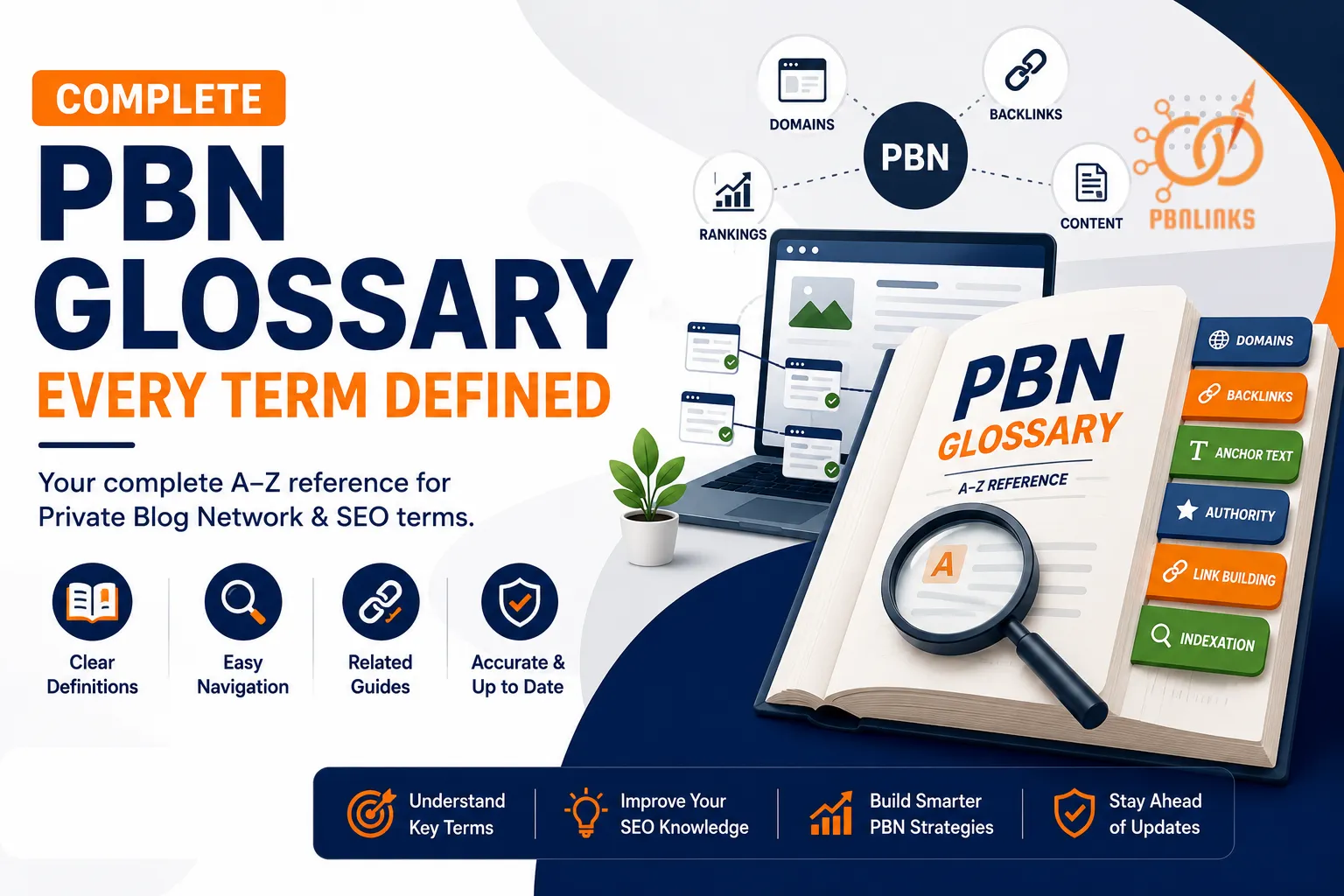
Complete PBN Glossary: Every Term Defined
Understanding PBN terminology doesn’t have to be difficult. Whether you’re learning SEO for the first time or managing a Private Blog Network, knowing what each term means makes it easier to understand strategies, avoid confusion, and make better decisions.
This pbn-glossary brings together the most important Private Blog Network and SEO terms in one easy-to-use reference. Instead of searching multiple websites for individual definitions, you can quickly find clear explanations that help you understand how each term fits into the bigger picture of PBN SEO.
Every definition is written in simple language and explains both the meaning of the term and why it matters. Where available, you’ll also find links to detailed PBNLinks.Agency guides, making it easy to explore related topics and continue learning at your own pace.
Whether you’re looking up a single definition or building your knowledge step by step, this pbn-glossary is designed to be a reliable resource you can return to anytime. The terms are organized alphabetically for quick navigation and are reviewed regularly to keep the glossary accurate, relevant, and up to date.
How to Use the PBN Glossary
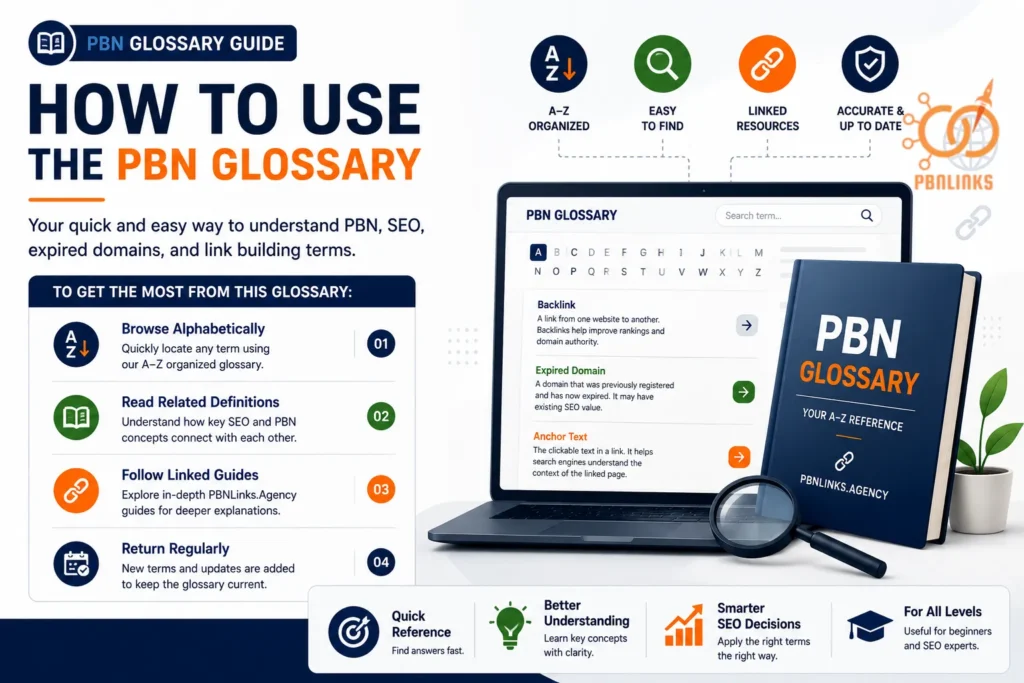
The PBN Glossary is designed to help you quickly understand the terms commonly used in Private Blog Networks, expired domains, link building, and technical SEO. Whether you’re looking up one definition or learning multiple concepts, you can use this page as a quick reference whenever you come across unfamiliar terminology.
The glossary is organized alphabetically, making it easy to find any term without reading the entire page. Each definition explains what the term means, why it matters, and how it relates to other SEO and PBN concepts.
Many terms also include links to more detailed PBNLinks.Agency guides where available. If you want to learn more about a specific topic, simply follow the related guide for a deeper explanation and practical examples.
To get the most from this glossary:
- Browse the glossary alphabetically to quickly locate any term.
- Read related definitions to understand how important SEO concepts connect.
- Follow linked guides whenever you want a more detailed explanation.
- Return regularly, as new terms and definitions are added to keep the glossary current.
This glossary is designed to grow alongside the PBNLinks.Agency knowledge base, making it a reliable resource for both beginners and experienced SEO professionals.
PBN Glossary (A–E)
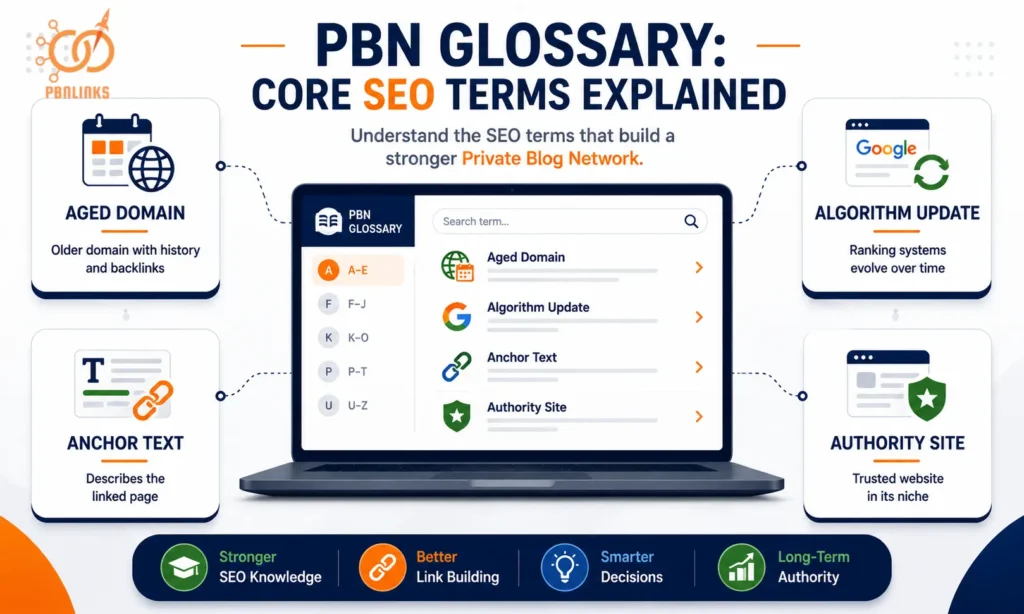
This section explains the most important PBN and SEO terms that begin with the letters A through E. Each definition is written in simple language to help you understand what the term means, why it matters, and how it is used in Private Blog Network and SEO strategies.
A
Aged Domain
An aged domain is a domain name that has been registered for several years, whether it is still active or has expired. Older domains may have backlinks, search history, and topical relevance that make them more valuable than newly registered domains. However, age alone does not determine quality, so every domain should be reviewed carefully before it is used for SEO or a Private Blog Network.
See Also: PBN Domain Age
Algorithm Update
An algorithm update is a change Google makes to improve how websites are ranked in search results. Some updates reward helpful content, while others reduce the visibility of spam or low-quality websites. Understanding algorithm updates helps you adjust your SEO strategy and build websites that perform well over the long term.
See Also: Google Algorithm Updates
Anchor Text
Anchor text is the clickable word or phrase in a hyperlink. It tells users and search engines what the linked page is about. Using natural and relevant anchor text helps create a healthy backlink profile and improves the overall quality of your link-building strategy.
See Also: Anchor Text Guide
Authority Site
An authority site is a website that is trusted and respected within a particular topic or industry. These websites usually publish high-quality content and earn backlinks naturally from other trusted sources. Links from authority sites often carry more SEO value because they come from credible and relevant websites.
See Also: Topical Authority
B
Backlink
A backlink is a link from one website to another website. Backlinks help search engines discover webpages and measure how trustworthy and relevant a website is. High-quality backlinks remain one of the strongest ranking factors in SEO, making them an important part of every successful PBN strategy.
See Also: Backlinks
Backlink Profile
A backlink profile is the complete collection of backlinks pointing to a website or webpage. It shows where your links come from and helps search engines evaluate your website’s authority and trustworthiness. A strong backlink profile is built from relevant, high-quality, and naturally earned links.
See Also: Backlink Profile Guide
Black Hat SEO
Black Hat SEO refers to techniques that try to manipulate search engine rankings by breaking search engine guidelines. Common examples include keyword stuffing, cloaking, hidden text, and spam link schemes. These methods may produce short-term results, but they also increase the risk of penalties and ranking losses.
See Also: Black Hat SEO
Blog Network
A blog network is a group of websites owned or managed by the same person or organization. Some blog networks are created for legitimate publishing, while others are used to build backlinks for SEO purposes. A Private Blog Network is a specific type of blog network designed to support one or more money sites.
See Also: What Is a PBN?
Broken Link
A broken link is a hyperlink that no longer leads to a working webpage. This usually happens when a page is deleted, moved, or its URL changes without a proper redirect. Fixing broken links improves user experience and helps search engines crawl your website more effectively.
See Also: 301 Redirect vs PBN Site
C
Canonical Tag
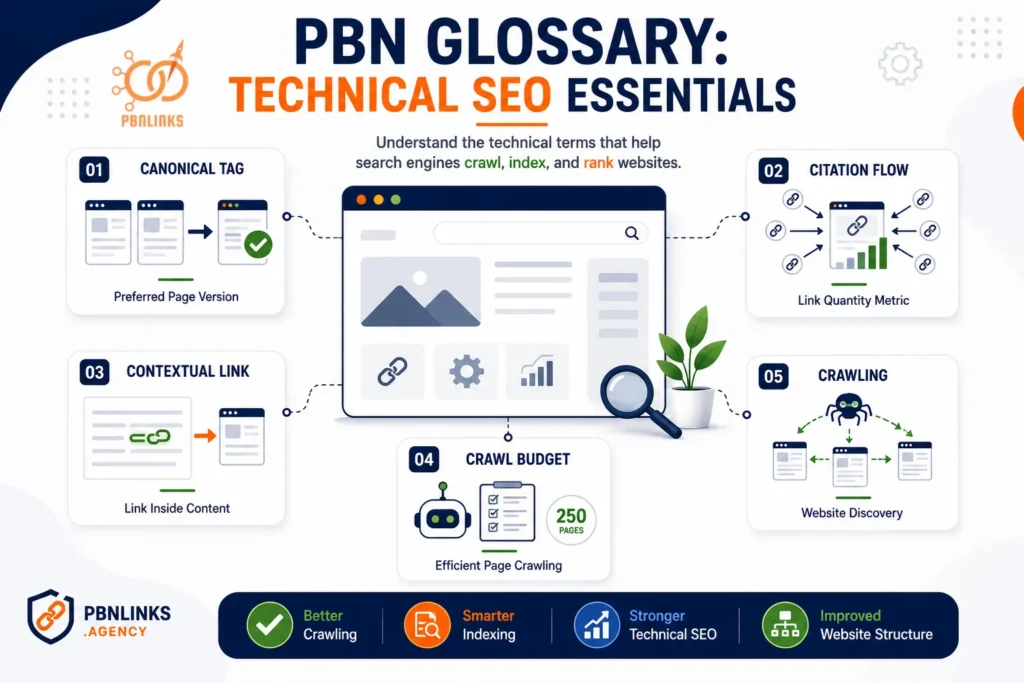
A canonical tag tells search engines which version of a webpage should be treated as the main version. It helps prevent duplicate content issues when similar pages exist on the same website. Using canonical tags correctly makes it easier for search engines to understand which page should appear in search results.
See Also: Canonical Tags Guide
Citation Flow
Citation Flow is an SEO metric created by Majestic that measures the strength of a webpage based on the number of backlinks pointing to it. It focuses on link quantity rather than link quality. SEO professionals often compare Citation Flow with Trust Flow to better evaluate a website’s backlink profile.
See Also: PBN Domain Metrics
Contextual Link
A contextual link is a hyperlink placed naturally within the main content of a webpage. Because it appears inside relevant content, it usually provides stronger SEO value than links placed in sidebars or footers. Contextual links are widely considered one of the most valuable types of backlinks.
See Also: Contextual Link Building
Crawl Budget
Crawl budget is the number of pages Google is willing to crawl on a website within a certain period. Good website structure and internal linking help search engines crawl important pages more efficiently. Crawl budget becomes especially important for large websites with thousands of pages.
See Also: Technical SEO Guide
Crawling
Crawling is the process search engines use to discover webpages across the internet. Search engine bots follow links, read page content, and collect information before deciding whether a page should be indexed. Crawling is the first step in getting a webpage into search results.
See Also: Google Crawling and Indexing
D
Deindexing
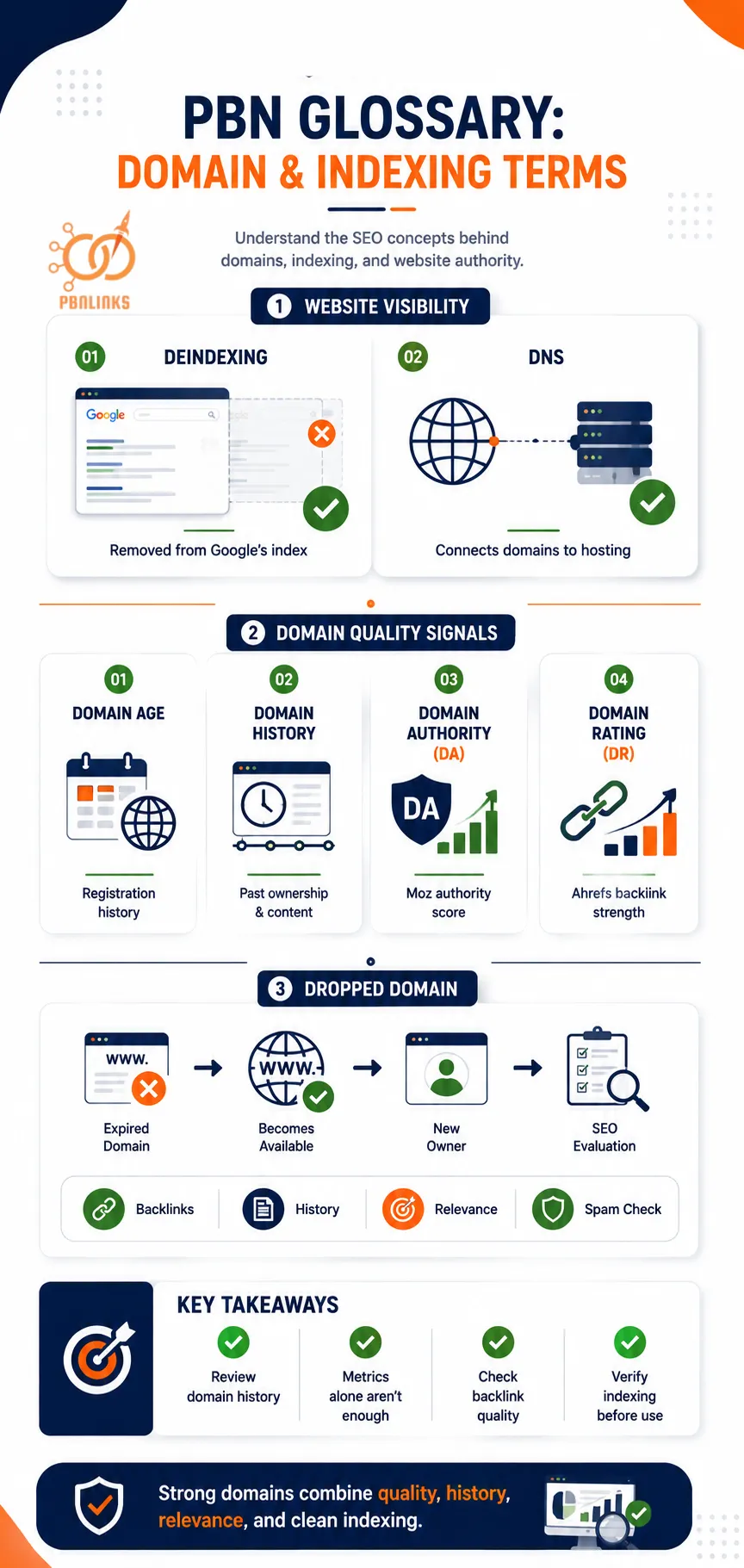
Deindexing happens when a webpage or website is removed from a search engine’s index. Once a page is deindexed, it can no longer appear in search results. This may happen because of technical problems, manual actions, or intentional removal requests.
See Also: Google Indexing Guide
DNS (Domain Name System)
DNS, or Domain Name System, connects a domain name to the server where a website is hosted. It allows users to visit websites using domain names instead of numerical IP addresses. Every website depends on DNS to be accessible on the internet.
See Also: PBN Hosting
Domain Age
Domain age is the amount of time that has passed since a domain was first registered. Although older domains may have an established history, age alone does not improve rankings. Domain quality should always be evaluated together with its backlinks, history, and topical relevance.
See Also: PBN Domain Age
Domain Authority (DA)
Domain Authority (DA) is an SEO score developed by Moz that estimates how strong a website is from an SEO perspective. The score ranges from 1 to 100, with higher scores generally indicating stronger websites. Many SEO professionals use Domain Authority to compare websites, but Google does not use it as a direct ranking factor.
See Also: PBN Domain Metrics
Domain History
Domain history is the record of how a domain has been used over time. It includes previous website content, ownership, backlinks, and any history of spam or penalties. Reviewing domain history is an important step before buying an expired domain or adding it to a PBN.
See Also: Buy Expired Domains
Domain Rating (DR)
Domain Rating (DR) is an SEO score developed by Ahrefs that measures the strength of a website’s backlink profile. It uses a scale from 0 to 100 based mainly on the quality and number of referring domains. Like Domain Authority, Domain Rating is a third-party metric and not a Google ranking factor.
See Also: PBN Domain Metrics
Dropped Domain
A dropped domain is a domain name that becomes available after its previous owner does not renew the registration. Some dropped domains keep valuable backlinks and authority, while others may have spam or a poor history. Always review a dropped domain carefully before using it for SEO.
See Also: Buy Expired Domains
E
Entity SEO
Entity SEO is the practice of helping search engines understand people, places, brands, and concepts instead of relying only on keywords. It improves how search engines understand relationships between topics and helps build stronger topical authority. Entity SEO has become an important part of modern search optimization.
See Also: Semantic SEO
Expired Domain
An expired domain is a domain name whose registration has ended because the previous owner did not renew it. Some expired domains retain valuable backlinks, authority, and topical relevance, making them useful for SEO. Every expired domain should be checked carefully before being used in a Private Blog Network.
See Also: Buy Expired Domains
External Link
An external link is a hyperlink that points from one website to a different website. External links help users find additional information and help search engines understand relationships between websites. Linking to trustworthy and relevant sources can improve both content quality and user experience.
See Also: External Links Guide
PBN Glossary (F–J)
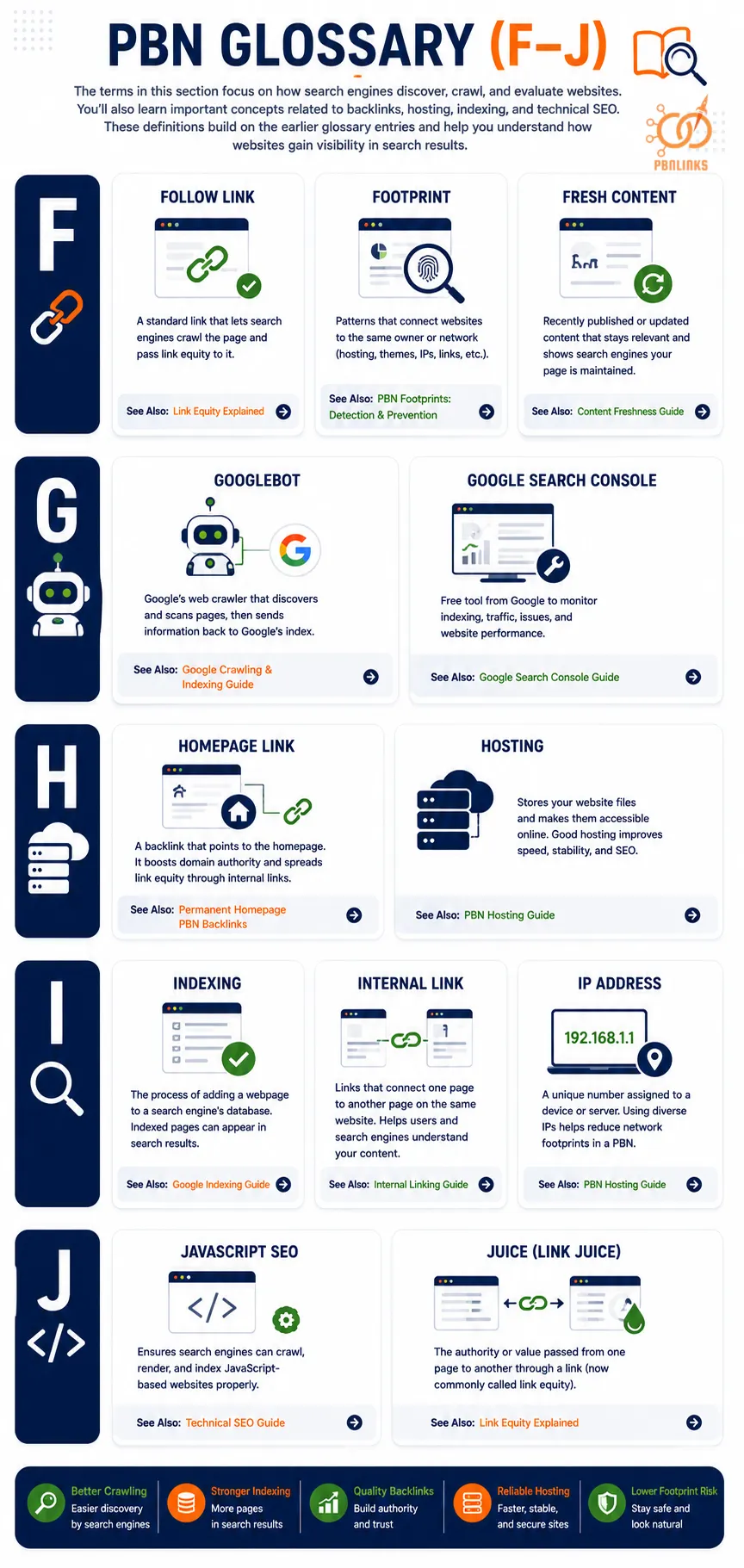
The terms in this section focus on how search engines discover, crawl, and evaluate websites. You’ll also learn important concepts related to backlinks, website hosting, indexing, and technical SEO. These definitions build on the earlier glossary entries and provide a deeper understanding of how websites gain visibility in search results.
F
Follow Link
A follow link is a standard hyperlink that allows search engines to crawl the linked page and pass link equity to it. Most links on the web are follow links unless they use attributes such as nofollow, sponsored, or ugc. High-quality follow links from relevant websites can strengthen a site’s authority and improve its ability to rank in search results.
See Also: Link Equity Explained
Footprint
A footprint is a pattern that makes different websites appear connected to the same owner or network. Similar hosting, themes, plugins, IP addresses, or linking patterns can all create footprints. Reducing obvious footprints helps a Private Blog Network look more natural and lowers the risk of detection.
See Also: PBN Footprints: Detection & Prevention
Fresh Content
Fresh content is content that has been recently published or updated. Updating content keeps information accurate and relevant for readers while showing search engines that a page is actively maintained. Fresh content is especially valuable for topics that change over time.
See Also: Content Freshness Guide
G
Googlebot
Googlebot is Google’s web crawler that discovers and scans webpages across the internet. It follows links, reads page content, and sends information back to Google’s index. If Googlebot cannot crawl a page, that page is unlikely to appear in Google Search.
See Also: Google Crawling & Indexing Guide
Google Search Console
Google Search Console is a free tool from Google that helps website owners monitor and improve their presence in search results. It provides information about indexing, search traffic, technical issues, and website performance. SEO professionals use it to identify problems and measure the impact of optimization efforts.
See Also: Google Search Console Guide
H
Homepage Link
A homepage link is a backlink that points to the homepage of a website instead of an internal page. Homepage links can strengthen the authority of the main domain and help distribute link equity across the website through internal links. They are commonly used as part of a balanced backlink strategy.
See Also: Permanent Homepage PBN Backlinks
Hosting
Hosting is the service that stores a website’s files and makes them available on the internet. Every website needs hosting so users and search engines can access its pages. Choosing reliable hosting improves website speed, stability, and overall SEO performance.
See Also: PBN Hosting Guide
I
Indexing
Indexing is the process of adding a webpage to a search engine’s database after it has been crawled. Only indexed pages are eligible to appear in search results. Proper technical SEO and high-quality content improve the chances of successful indexing.
See Also: Google Indexing Guide
Internal Link
An internal link connects one page of a website to another page on the same website. Internal links help visitors navigate your content and help search engines understand the relationship between different pages. A strong internal linking structure also helps distribute link equity throughout a website.
See Also: Internal Linking Guide
IP Address
An IP address is a unique number assigned to a device or server connected to the internet. Websites use IP addresses so browsers and search engines can locate them. In PBN management, using different hosting environments can help reduce obvious network footprints.
See Also: PBN Hosting Guide
J
JavaScript SEO
JavaScript SEO is the practice of making sure search engines can properly crawl, render, and index websites that use JavaScript. If important content cannot be processed correctly, search engines may not index it properly. Good JavaScript implementation helps improve visibility and search performance.
See Also: Technical SEO Guide
Juice (Link Juice)
Link juice is an informal SEO term for the authority or value passed from one page to another through a hyperlink. Today, SEO professionals more commonly use the term link equity, but both refer to the same general concept. The amount of value passed depends on factors such as link quality, relevance, and placement.
See Also: Link Equity Explained
PBN Glossary (K–O)
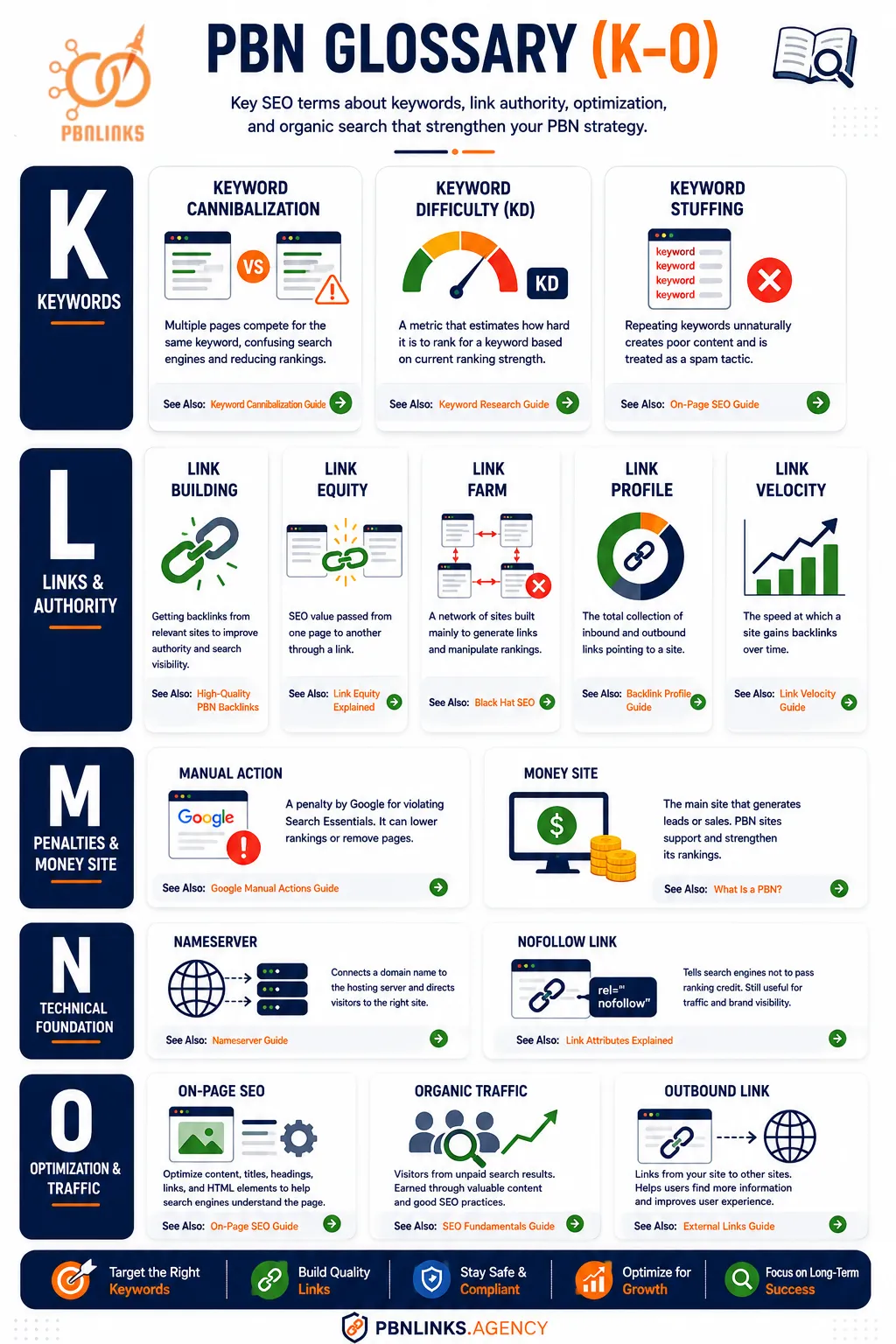
This section introduces terms related to keywords, link authority, website optimization, and organic search. These concepts help explain how search engines understand content, measure website authority, and evaluate the quality of backlinks. Learning these terms will give you a stronger understanding of both everyday SEO and Private Blog Network strategies.
K
Keyword Cannibalization
Keyword cannibalization happens when two or more pages on the same website compete for the same keyword. This can confuse search engines about which page should rank, reducing the visibility of both pages. Organizing content properly and using a clear internal linking strategy helps prevent keyword cannibalization.
See Also: Keyword Cannibalization Guide
Keyword Difficulty (KD)
Keyword Difficulty (KD) is an SEO metric that estimates how difficult it may be to rank for a particular keyword. Most SEO tools calculate this score by analyzing the strength of the pages already ranking in search results. Although useful for research, Keyword Difficulty is a third-party metric and is not used directly by Google.
See Also: Keyword Research Guide
Keyword Stuffing
Keyword stuffing is the practice of repeating keywords unnaturally in an attempt to improve search rankings. This creates poor-quality content that is difficult for people to read. Modern search engines recognize keyword stuffing as a spam tactic, so content should always be written naturally.
See Also: On-Page SEO Guide
L
Link Building
Link building is the process of getting backlinks from other websites to improve search visibility and authority. High-quality backlinks from relevant websites help search engines understand that your content is trustworthy. Successful link building focuses on quality and relevance rather than simply collecting large numbers of links.
See Also: How to Build High-Quality PBN Backlinks
Link Equity
Link equity is the SEO value or authority that one webpage passes to another through a hyperlink. The amount of link equity passed depends on factors such as link quality, relevance, placement, and the authority of the linking page. Understanding link equity is essential when planning any backlink strategy, including Private Blog Networks.
See Also: Link Equity Explained
Link Farm
A link farm is a group of websites created mainly to exchange or generate backlinks for search rankings. These websites usually provide little or no value to users and are considered a spam technique. Search engines actively discourage link farms because they attempt to manipulate rankings.
See Also: Black Hat SEO
Link Profile
A link profile is the complete collection of inbound and outbound links associated with a website. Search engines evaluate a link profile to understand the quality, diversity, and relevance of a site’s backlinks. A natural and balanced link profile is an important indicator of long-term SEO health.
See Also: Backlink Profile Guide
Link Velocity
Link velocity is the speed at which a website gains new backlinks over time. A steady and natural growth pattern usually appears more trustworthy than sudden spikes in link acquisition. Monitoring link velocity helps identify unusual backlink patterns that could affect SEO performance.
See Also: Link Velociy Guide
M
Manual Action
A manual action is a penalty applied by Google’s review team when a website violates Google’s Search Essentials. It can reduce rankings or remove pages from search results until the issue is fixed. Google Search Console usually notifies website owners when a manual action has been applied.
See Also: Google Manual Actions Guide
Money Site
A money site is the main website that generates leads, sales, or other business results. In a Private Blog Network strategy, supporting websites are built to strengthen the rankings of the money site through carefully planned backlinks. Protecting the money site is always the highest priority.
See Also: What Is a PBN?
N
Nameserver
A nameserver connects a domain name with the hosting server where a website is stored. It helps direct visitors and search engines to the correct website when they enter a domain name. Every website relies on nameservers to function properly on the internet.
See Also: Nameserver Guide
Nofollow Link
A nofollow link is a hyperlink that includes the rel=”nofollow” attribute. This attribute tells search engines that the link should not be treated as a normal endorsement for ranking purposes. Nofollow links can still bring visitors and create brand visibility even though they usually pass little or no link equity.
See Also: Link Attributes Explained
O
On-Page SEO
On-page SEO is the process of optimizing the content and HTML elements of individual webpages. It includes improving titles, headings, keywords, internal links, images, and content quality to help search engines understand the page. Strong on-page SEO supports better rankings and a better user experience.
See Also: On-Page SEO Guide
Organic Traffic
Organic traffic is the number of visitors who reach a website through unpaid search engine results. Unlike paid advertising, organic traffic is earned by creating helpful content and following good SEO practices. Increasing organic traffic is one of the main goals of long-term search engine optimization.
See Also: SEO Fundamentals Guide
Outbound Link
An outbound link is a hyperlink that points from your website to another website. Outbound links help users find additional information and can strengthen content by referencing trustworthy sources. Linking to relevant and authoritative websites also helps create a better user experience.
See Also: External Links Guide
PBN Glossary (P–T)
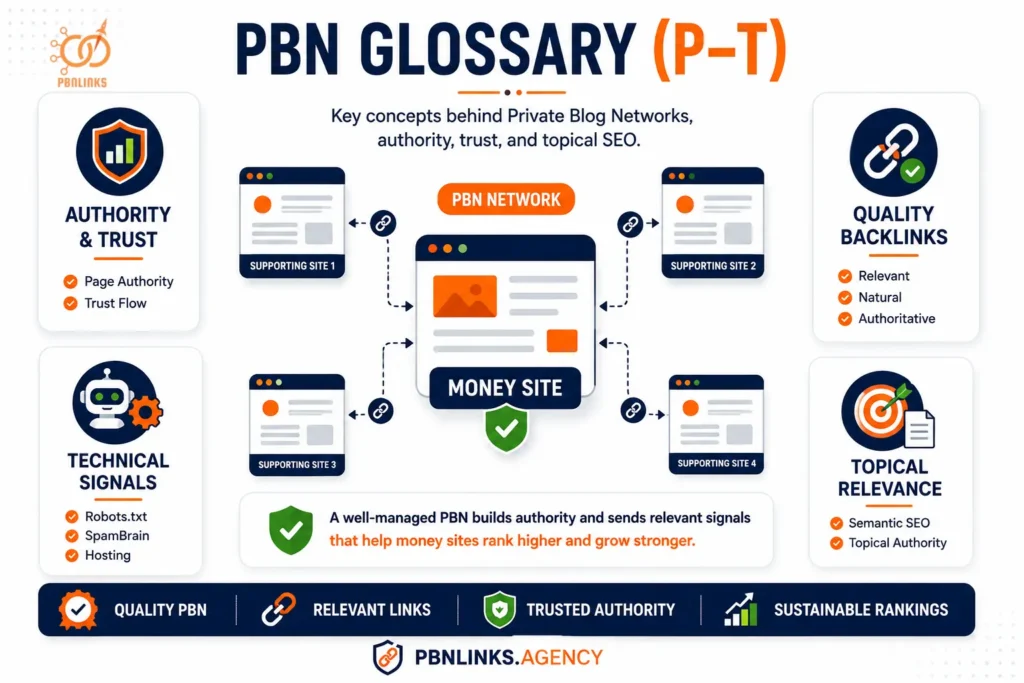
The terms in this section explain how Private Blog Networks work in practice. You’ll learn the concepts behind building a PBN, passing link authority, improving topical relevance, and understanding the signals search engines use to evaluate websites. Whether you’re managing a PBN or learning advanced SEO, these definitions will help you understand the strategies that influence rankings and long-term search performance.
P
Page Authority (PA)
Page Authority (PA) is an SEO score developed by Moz that predicts how well an individual webpage may rank in search results. The score ranges from 1 to 100, with higher scores generally indicating stronger pages. Page Authority is useful for comparing pages, but Google does not use it as a direct ranking factor.
See Also: PBN Domain Metrics
PageRank
PageRank is Google’s original algorithm for measuring the importance of webpages based on backlinks. Although Google’s ranking systems have become much more advanced, the idea of passing authority through links is still an important part of SEO. Many modern SEO concepts, such as link equity, are based on the same principle.
See Also: PageRank guide
PBN (Private Blog Network)
A Private Blog Network (PBN) is a group of websites created to build backlinks for one or more target websites. These websites are usually built on expired or aged domains that already have existing authority. A well-managed PBN focuses on quality, relevance, and natural website management instead of obvious linking patterns.
See Also: What Is a PBN?
PBN Footprint
A PBN footprint is any pattern that reveals multiple websites are connected or controlled by the same owner. Similar hosting, themes, plugins, WHOIS information, or linking patterns can all create detectable footprints. Reducing these similarities helps make a Private Blog Network appear more natural.
See Also: PBN Footprints: Detection & Prevention
PBN Hosting
PBN hosting is the hosting setup used for websites within a Private Blog Network. Many SEO professionals use different hosting providers, IP addresses, and DNS settings to reduce obvious connections between websites. A carefully planned hosting strategy supports better network diversity.
See Also: PBN Hosting Guide
Q
Quality Backlink
A quality backlink is a backlink from a trustworthy, relevant, and authoritative website. High-quality backlinks provide more SEO value than links from low-quality or unrelated websites. Relevance, authority, and natural placement are more important than simply collecting a large number of backlinks.
See Also: How to Build High-Quality PBN Backlinks
R
Referring Domain
A referring domain is a unique website that links to your website. If one website links to you multiple times, it still counts as one referring domain. Search engines often value backlinks from a variety of relevant referring domains more than many links from the same website.
See Also: Backlink Profile Guide
Referring IP
A referring IP is the IP address of a website that links to your website. Having backlinks from different IP addresses can indicate that links come from a wider range of independent websites. This is one of several factors SEO professionals review when analyzing backlink diversity.
See Also: Referring IP guide
Relevance
Relevance describes how closely a webpage, backlink, or website matches the topic being discussed. Search engines prefer links and content that are topically related because they provide more value to users. Building backlinks from relevant websites is generally more effective than acquiring unrelated links.
See Also: Topical Relevance Guide
Robots.txt
Robots.txt is a file that tells search engine crawlers which parts of a website they can or cannot access. It helps control crawling but does not prevent pages from being indexed in every situation. Using the robots.txt file correctly is an important part of technical SEO.
See Also: Robots.txt guide
S
Semantic SEO
Semantic SEO is the practice of creating content that helps search engines understand topics, relationships, and user intent instead of relying only on keywords. It focuses on covering a subject naturally and completely. Semantic SEO helps build topical authority and improves the overall quality of search results.
See Also: Semantic SEO Guide
Spam Score
Spam Score is a metric developed by Moz that estimates the likelihood of a website displaying spam-like characteristics. It is commonly used when evaluating expired domains and backlink quality. Spam Score is a third-party metric and is not used directly by Google.
See Also: Spam Score guide
SpamBrain
SpamBrain is Google’s AI-based spam detection system that identifies and reduces spam in search results. It helps detect manipulative practices such as spam links and other forms of search abuse. Following Google’s Search Essentials is the best way to reduce the risk of SpamBrain-related issues.
See Also: Google SpamBrain Guide
Supporting Site
A supporting site is a website that helps strengthen the rankings of a money site by providing relevant backlinks. Within a Private Blog Network, supporting sites are managed carefully to appear as genuine, independent websites. Their role is to pass authority naturally without creating obvious patterns.
See Also: What Is a PBN?
T
Thin Content
Thin content is content that provides little value because it lacks useful information, originality, or depth. Pages with thin content often struggle to perform well in search results because they do not fully satisfy user intent. Creating helpful, comprehensive content is the best way to avoid thin content issues.
See Also: Helpful Content Guide
Topical Authority
Topical authority is the level of expertise and trust a website builds by publishing high-quality content around a specific subject. Search engines are more likely to trust websites that cover a topic thoroughly instead of publishing unrelated content. Building topical authority is a long-term SEO strategy that supports sustainable rankings.
See Also: Topical Authority Guide
Topical Relevance
Topical relevance describes how closely content, backlinks, or websites relate to the same subject. Search engines use topical relevance to understand whether a page is a good match for a user’s search. Relevant backlinks and content usually provide more SEO value than unrelated ones.
See Also: Topical Relevance Guide
Trust Flow
Trust Flow is an SEO metric developed by Majestic that measures the quality and trustworthiness of a website’s backlinks. Websites that receive links from trusted sources generally have higher Trust Flow scores. This metric is useful for evaluating backlink quality, but it is not a Google ranking factor.
See Also: Trust Flow guide
PBN Glossary (U–Z)
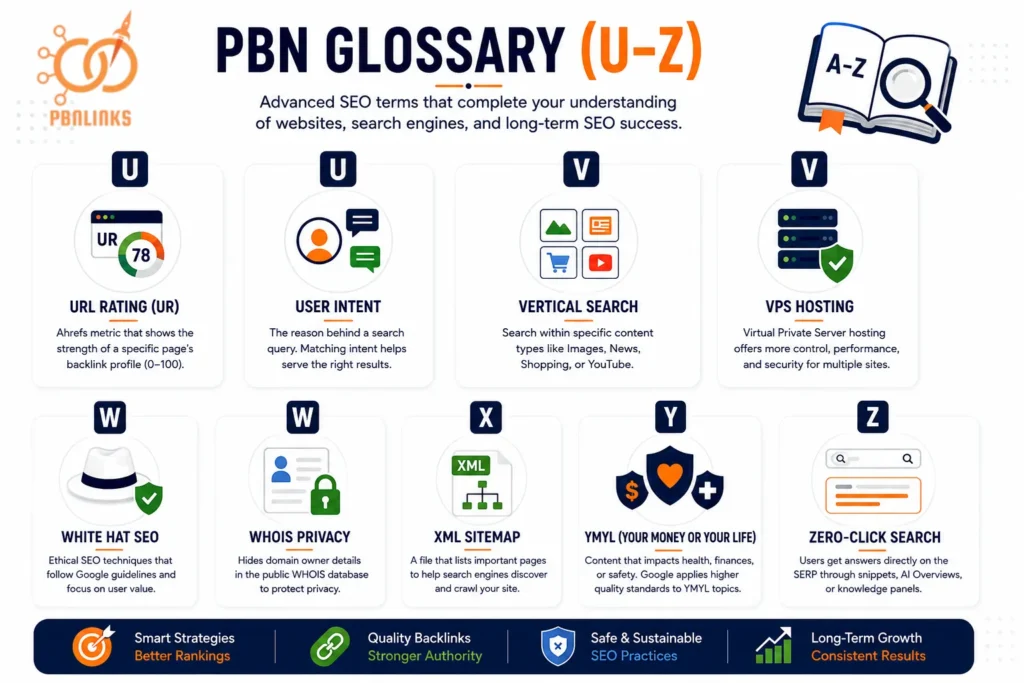
This final section completes the PBN Glossary with terms related to advanced SEO, website management, and search engine optimization. Although these terms appear less frequently than earlier glossary entries, they are still important for understanding how websites perform, how search engines evaluate quality, and how long-term SEO strategies succeed. Together, they complete the foundation of the terminology every PBN and SEO professional should know.
U
URL Rating (UR)
URL Rating (UR) is an SEO metric developed by Ahrefs that measures the strength of a specific webpage’s backlink profile. It uses a scale from 0 to 100 based on the quality and number of backlinks pointing to that page. Unlike Domain Rating, URL Rating evaluates individual pages rather than the entire website. It is a third-party metric and is not used directly by Google.
See Also: PBN Domain Metrics
User Intent
User intent is the reason behind a person’s search query. It explains what the user is trying to find, learn, or accomplish. Creating content that matches user intent helps search engines understand that a page provides the right answer, improving its chances of ranking well.
See Also: Search Intent Guide
V
Vertical Search
Vertical search focuses on a specific type of content instead of searching the entire web. Examples include Google Images, Google News, Google Shopping, and YouTube Search. Optimizing for vertical search helps websites reach users looking for specialized content.
See Also: Vertical Search
VPS Hosting
VPS hosting, or Virtual Private Server hosting, provides dedicated resources within a shared physical server. Many SEO professionals use VPS hosting because it offers better performance, security, and control than standard shared hosting. It is commonly used when managing multiple websites, including Private Blog Networks.
See Also: PBN Hosting Guide
W
White Hat SEO
White Hat SEO refers to optimization techniques that follow Google’s Search Essentials and focus on providing value to users. It includes creating helpful content, improving website quality, and earning natural backlinks. White Hat SEO supports sustainable rankings with minimal risk of search engine penalties.
See Also: White Hat vs. Black Hat SEO
WHOIS Privacy
WHOIS Privacy is a service that hides a domain owner’s personal information from the public WHOIS database. It helps protect privacy by replacing personal details with information provided by the domain registrar. Many website owners use WHOIS Privacy to reduce spam and protect their personal information.
See Also: WHOIS Privacy guide
X
XML Sitemap
An XML sitemap is a file that lists the important pages on a website for search engines. It helps search engines discover and crawl pages more efficiently, especially on large websites. Submitting an XML sitemap through Google Search Console can improve the crawling and indexing process.
See Also: Google Crawling & Indexing Guide
Y
YMYL (Your Money or Your Life)
YMYL stands for “Your Money or Your Life,” a term Google uses for content that can affect a person’s health, finances, safety, or well-being. Google applies higher quality standards to YMYL content because inaccurate information can have serious consequences. Websites covering these topics should demonstrate expertise, trust, and accuracy.
See Also: Google Search Quality Guidelines
Z
Zero-Click Search
A zero-click search is a search result where users find the information they need without clicking through to a website. This often happens through featured snippets, AI Overviews, knowledge panels, or direct answers shown in search results. Optimizing content for these search features can increase visibility even when users do not visit the website.
See Also: AI Overviews & SEO Guide
Common PBN Terms Beginners Often Confuse
Many PBN and SEO terms sound similar, but they have different meanings and purposes. Understanding these differences helps you make better SEO decisions, avoid common mistakes, and use the correct strategy when building or managing a Private Blog Network. Below are some of the terms that beginners confuse most often.
| Commonly Confused Terms | Key Difference |
| Aged Domain vs. Expired Domain | An aged domain is simply an older domain, while an expired domain is one that was not renewed and became available for registration again. Not every aged domain has expired, and not every expired domain is valuable. |
| Backlink vs. Referring Domain | A backlink is a single link pointing to your website. A referring domain is the unique website that provides one or more backlinks. One referring domain can create many backlinks. |
| Domain Authority vs. Domain Rating | Domain Authority (DA) is a metric developed by Moz, while Domain Rating (DR) is developed by Ahrefs. Both estimate website authority, but neither is a direct Google ranking factor. |
| Link Equity vs. Link Juice | Both terms describe the value passed through a hyperlink. Link equity is the modern industry term, while link juice is the older, informal name for the same concept. |
| Crawling vs. Indexing | Crawling is how search engines discover webpages. Indexing is the process of storing those pages in the search engine’s database so they can appear in search results. |
| Follow Link vs. Nofollow Link | A follow link can pass link equity to another page. A nofollow link tells search engines not to treat the link as a normal ranking endorsement. |
| Homepage Link vs. Contextual Link | A homepage link points from a website’s homepage, while a contextual link is placed naturally within the main content of a webpage. Both have different SEO strengths depending on the situation. |
| White Hat SEO vs. Black Hat SEO | White Hat SEO follows search engine guidelines and focuses on long-term growth. Black Hat SEO uses manipulative techniques that increase the risk of penalties. |
| Topical Authority vs. Topical Relevance | Topical authority measures a website’s overall expertise in a subject, while topical relevance measures how closely a specific page or backlink matches a particular topic. |
| Page Authority vs. Domain Authority | Page Authority predicts the ranking strength of a single webpage, while Domain Authority estimates the overall strength of an entire domain. |
Understanding these differences makes it easier to read SEO documentation, evaluate backlink opportunities, and communicate using the correct terminology. As you continue learning about Private Blog Networks, these concepts will become the foundation for more advanced SEO strategies.
Conclusion
In conclusion, understanding PBN and SEO terminology is essential for making informed decisions about link building, expired domains, website management, and long-term search engine optimization. Knowing the difference between similar concepts, recognizing how they work together, and using the correct terminology will help you avoid common mistakes and build a stronger foundation for every stage of your SEO strategy.
Whether you’re researching your first Private Blog Network or managing a large portfolio of websites, a clear understanding of these terms makes it easier to evaluate opportunities, communicate with confidence, and apply proven SEO practices. As search engines continue to evolve, staying familiar with these concepts will help you adapt your strategy and make better decisions over time.
Use this glossary as a long-term reference whenever you come across an unfamiliar PBN or SEO term. Revisit it as new concepts emerge and continue expanding your knowledge through practical learning and real-world experience.
Ready to Build a Smarter PBN Strategy?
If you’re looking for trusted PBN backlinks, expert guidance, or professionally managed SEO solutions, visit PBNLinks.Agency. Our team helps businesses build safer, higher-quality link strategies with carefully managed PBN networks designed for long-term SEO growth.
FAQs About PBN Glossary
1. Are PBN links safe for CBD supplement SEO?
Yes, but only when they are built carefully using high-quality, niche-relevant domains and natural link patterns. Low-quality PBNs, spammy anchors, and obvious footprints increase the risk of losing rankings or having links ignored.
2. Why is link building difficult for CBD supplement websites?
CBD websites face stricter advertising and marketing restrictions than many other industries. As a result, earning natural backlinks can be slower, making strategic outreach and high-quality link acquisition more important.
3. What makes a good PBN backlink for a CBD website?
A good PBN backlink comes from a relevant, trusted website with clean history and natural content. The domain should have quality backlinks, topical relevance, and editorial-style link placement instead of obvious SEO manipulation.
4. Can Google detect PBN links in the CBD niche?
Yes, Google can identify low-quality or poorly managed PBNs. Common signals include shared footprints, spammy expired domains, repetitive anchor text, and unnatural linking patterns. High-quality network management helps reduce these risks but cannot eliminate them.
5. Should CBD websites use exact-match anchor text?
No, exact-match anchor text should be used sparingly. A natural backlink profile should primarily contain branded, URL, and partial-match anchors to reduce over-optimization risks.
6. How many PBN links does a CBD supplement website need?
There is no fixed number of PBN links that guarantees rankings. The right amount depends on your competition, website authority, content quality, and overall backlink profile rather than a specific link count.
7. Are PBN links better than guest posts for CBD SEO?
Neither strategy is universally better because they serve different purposes. Guest posts help build brand authority and referral traffic, while carefully managed PBN links can strengthen authority when used as part of a balanced backlink strategy.
8. What should I check before buying CBD PBN links?
Review domain quality, backlink history, topical relevance, traffic signals, and network diversity before buying any PBN links. Avoid providers using recycled spam domains, duplicate content, or obvious network footprints.
9. Can PBN links improve rankings for competitive CBD keywords?
Yes, they can contribute to stronger rankings when combined with high-quality content and a balanced SEO strategy. PBN links alone are rarely enough to rank competitive CBD keywords without technical SEO, on-page optimization, and additional authoritative backlinks.
10. What is the safest way to use PBN links for CBD supplement SEO?
Use PBN links as one part of a diversified backlink strategy rather than your only source of links. Combine them with quality content, internal linking, digital PR, guest posts, and natural backlinks to build a more resilient SEO profile.