AI Content on PBN Sites: SEO Risks, Quality and Spun Content
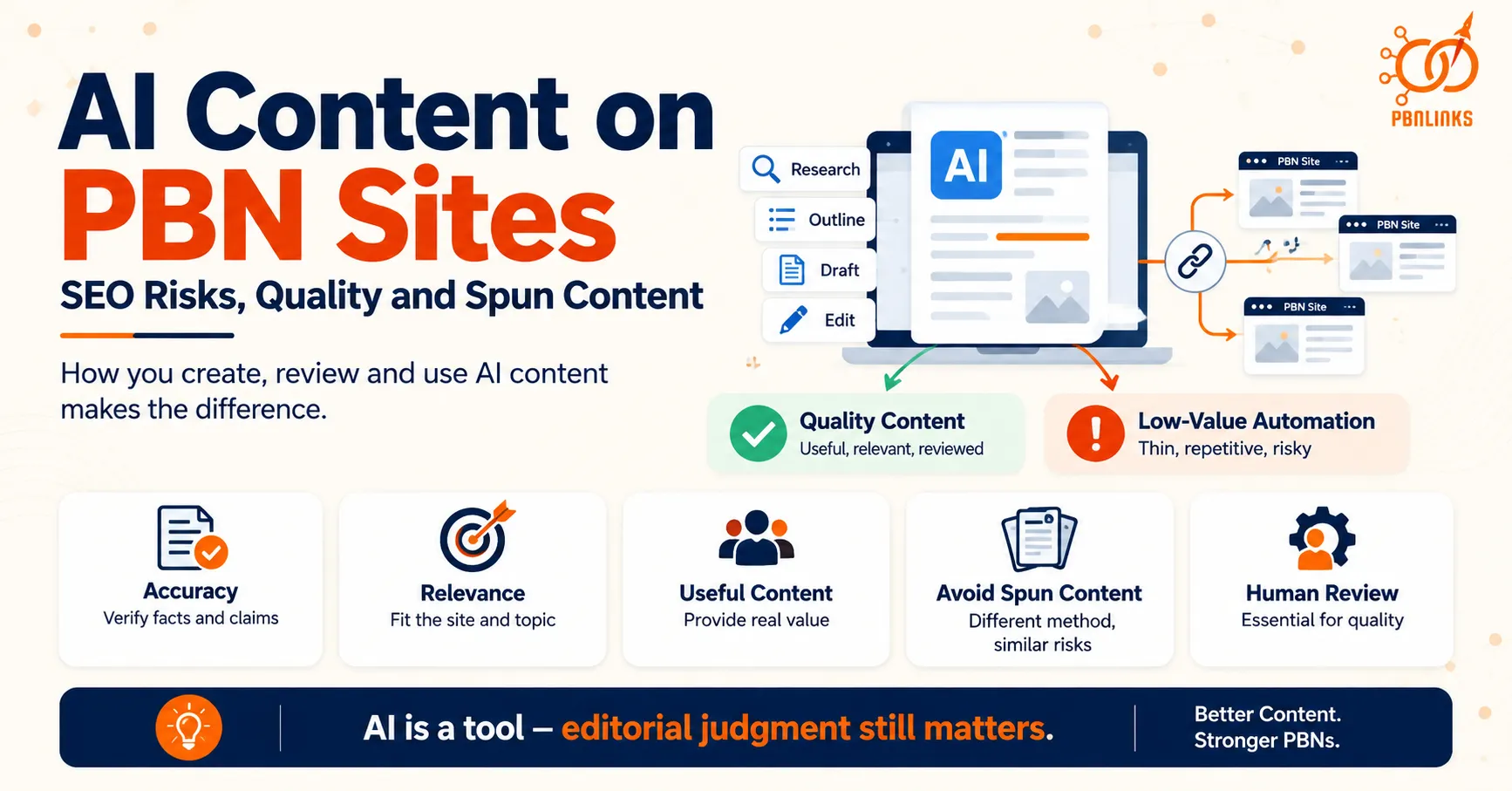
AI content on PBN sites is not automatically an SEO problem because artificial intelligence was used to create it. The real concern is how the content is produced and used. Its purpose, accuracy, usefulness, scale, and editorial quality all matter. Automated publishing can also create problems when it conflicts with Google’s spam policies.
For PBN operators, this distinction is important. AI can make research, outlining, drafting, and editing faster. However, publishing large volumes of thin or lightly reviewed content can create serious quality issues. Common problems include factual errors, generic information, repeated structures, and weak topical relevance. Content created mainly to support backlinks can also provide little value to readers.
AI generated content is also different from traditional spun content. The two methods create content in different ways. However, both can produce low value pages when automation replaces research, useful information, and editorial judgment.
This guide examines AI content on PBN sites from a practical SEO perspective. It explains how Google’s guidance applies to AI generated and scaled content. It also compares AI content with spun content and examines the main quality and footprint concerns. Finally, it explains where human review should fit into an AI assisted PBN content workflow.
Is AI Content on PBN Sites Safe for SEO?
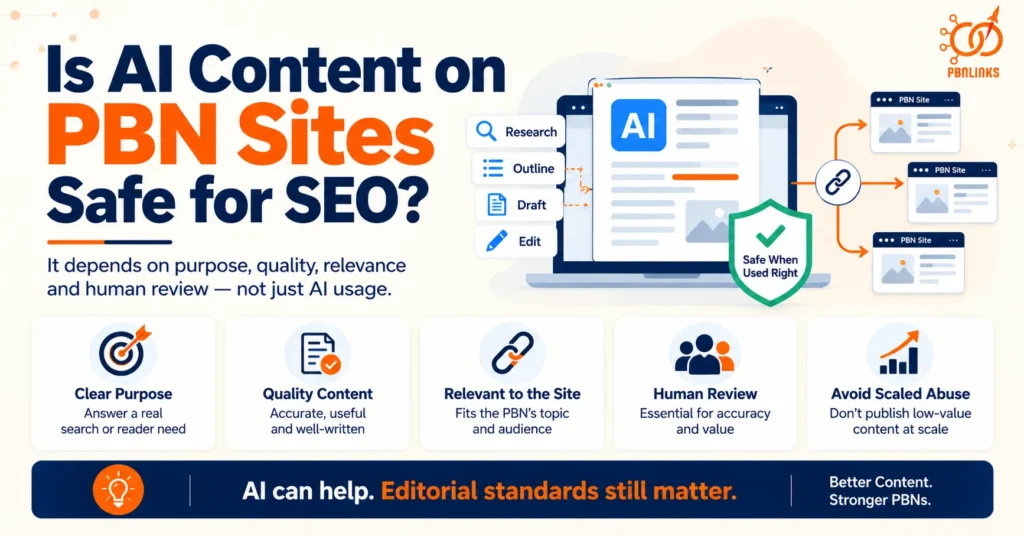
AI content on PBN sites can be used for SEO, but using AI does not make the content automatically safe or risky. What matters more is the purpose of the content, its quality, its relevance to the site, and how much editorial review it receives.
AI can support research, topic development, outlining, and drafting. It can also help PBN operators produce content more efficiently. However, efficiency should not replace quality control. An AI generated article can contain inaccurate claims, shallow explanations, repeated ideas, or information that does not fit the site’s topic.
The PBN context also matters. A page may eventually contain a backlink to another website, so the article should have a clear purpose beyond providing a place for that link. The topic should fit the PBN, answer a genuine search or reader need, and provide enough useful information to stand on its own.
Scale is another factor. Publishing many AI generated pages is not automatically a violation simply because AI was involved. The risk becomes more relevant when large amounts of content are created primarily to influence search rankings while providing little value to users. This distinction is important when evaluating AI assisted publishing across multiple PBN sites.
For this reason, AI should be treated as a content production tool rather than a shortcut around editorial standards. The final page still needs accurate information, topical relevance, useful coverage, and human quality control.
To understand where the actual SEO boundary lies, it is necessary to look at how Google treats AI generated content in Search.
How Google Treats AI Generated Content in Search
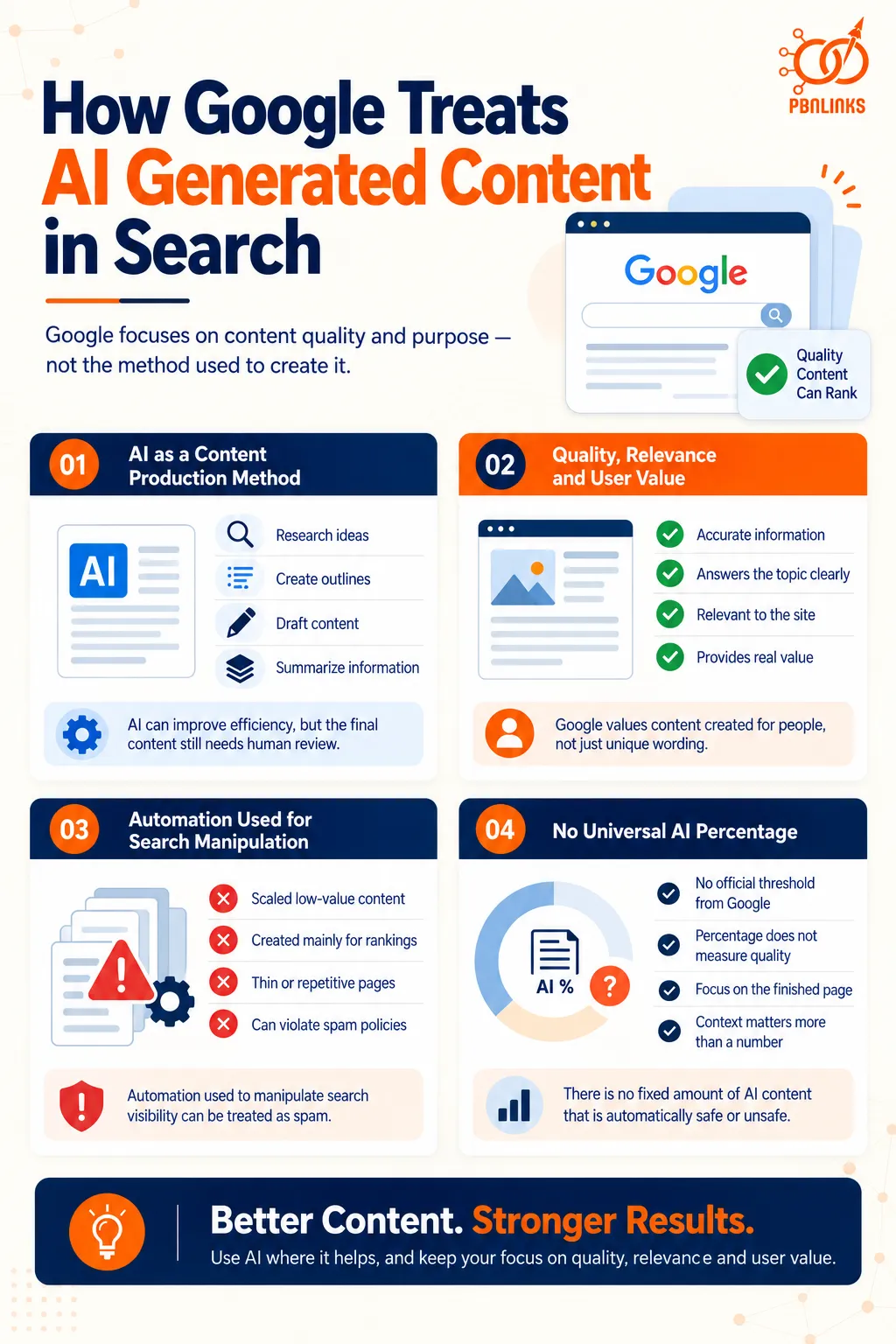
Google does not treat content as spam simply because AI was used to create it. Its published guidance focuses on the purpose and quality of the content. AI can be used to assist content creation, but automation does not remove the need for accuracy, relevance, and value for users.
This distinction is important for AI content on PBN sites. The question is not only whether AI helped create a page. The finished content and the reason it exists are more important considerations. A useful and carefully reviewed article is different from content produced mainly to influence search rankings.
AI as a Content Production Method
Generative AI can support several stages of content production. It can help with research, topic ideas, outlines, summaries, and first drafts. These uses do not automatically make the resulting page low quality.
The final article still needs editorial judgment. AI output can contain factual mistakes, weak explanations, repeated ideas, or unsupported claims. A publisher should therefore evaluate the finished page rather than assume that the production method determines its SEO quality.
For a PBN site, the same principle applies. AI may assist the writing process, but the content should still fit the site’s topic and provide useful information. The presence of a backlink should not be the only reason the page exists.
Quality, Relevance and User Value
Google’s guidance places importance on content created for people rather than content designed mainly to manipulate search visibility. This makes quality and relevance central to the discussion.
A strong page should answer its topic clearly and accurately. It should provide enough context for the reader to understand the subject. The information should also match the purpose and topical direction of the website.
Simply generating unique wording is not enough. Content can be technically original while still being shallow, repetitive, inaccurate, or unhelpful. Human review is therefore important when AI contributes to the writing process.
Automation Used for Search Manipulation
The SEO risk becomes more serious when automation is used primarily to create content for ranking manipulation. This concern is not limited to generative AI. Google’s spam policies can apply to scaled content created through AI, automated transformations, human writers, or combinations of different methods.
For PBN operators, this means the focus should not be on finding a particular amount of AI content that is considered safe. There is no universal percentage that separates acceptable AI use from spam. The more useful question is whether the publishing process creates valuable pages or produces content mainly to influence search results.
This distinction leads to a more specific issue for PBNs. When automation is used to produce large numbers of low value pages, the discussion moves from ordinary AI assisted publishing to scaled content abuse.
When AI Content Becomes Scaled Content Abuse
AI content can become part of scaled content abuse when many pages are created primarily to manipulate search rankings rather than help users. The use of AI alone does not create this violation. The purpose of the publishing activity and the value provided by the resulting pages are more important.
Google’s spam policies apply this principle regardless of how the content is produced. Large numbers of pages may be created with generative AI, traditional automation, human writers, or a combination of methods. The concern arises when content is produced at scale mainly for ranking purposes and offers little original value.
This distinction is especially relevant to PBNs. AI makes it possible to populate websites quickly, but publishing speed should not become the main measure of progress. Each page should still have a clear topic, useful information, and a legitimate reason to exist.
Scale, Purpose and Added Value
Publishing a large amount of content does not automatically mean a website is engaging in scaled content abuse. A large site may legitimately need hundreds or thousands of useful pages. The key issue is why those pages were created and what they provide to users.
Problems can arise when AI is used to generate many articles with minimal research or editorial review. The pages may target different keywords while offering nearly the same information. Some may simply restate material already available elsewhere without adding useful context.
For a PBN operator, this means content volume should not replace editorial purpose. Ten useful and relevant articles can provide a stronger site foundation than a much larger collection of generic pages created simply to make the domain appear active.
Low Value Content Produced Across Multiple Sites
Scale can extend beyond a single website. A publishing process may produce similar content across many domains. This can result in repeated structures, shallow coverage, and pages that differ mainly in wording.
The problem is not that several websites use the same AI tool. The larger concern is the quality and purpose of what is being published. If numerous sites contain low value articles created mainly to target search queries or support backlinks, the publishing model becomes difficult to justify on user value alone.
Content should therefore be evaluated at both the page and site level. Each article should contribute something useful to its own website rather than functioning as interchangeable material across a network.
Scaled Publishing in a PBN Environment
PBNs require particular care because content and backlinks are closely connected. AI can make it easy to generate supporting articles around target links. That efficiency can become a weakness when the article exists mainly as a container for a backlink.
A stronger approach is to decide first whether the topic belongs on the site. The article should then be developed to answer that topic properly. Any outbound link should fit naturally within the discussion and provide relevant context for the reader.
There is also no documented number of AI generated pages that automatically crosses a safe or unsafe threshold. The same applies to publishing frequency. Arbitrary limits do not replace an assessment of purpose, quality, relevance, and user value.
Understanding scaled content abuse also helps clarify an older SEO practice. Automated content existed long before modern generative AI. Traditional spun content is one example, but it works differently from today’s AI generated content. That distinction is important when comparing their SEO risks.
AI Generated Content vs Spun Content
AI generated content and spun content are not the same, although both can produce low quality results when they are used without meaningful editorial control. Traditional spinning modifies existing text to create variations. Generative AI produces new responses from prompts, context, and patterns learned during training.
This difference matters for SEO. It would be inaccurate to classify every AI generated article as spun content. At the same time, using a more advanced technology does not guarantee that the final page will be useful, accurate, or original in the ways that matter to readers.
For PBN operators, the better comparison is not simply which technology created the article. The quality, purpose, and editorial value of the finished page are more useful factors to evaluate.
Traditional Article Spinning
Article spinning starts with existing content and creates alternative versions of it. Older spinning methods often replaced words with synonyms or rearranged sentences. More advanced tools can rewrite larger passages while attempting to preserve the original meaning.
The main weakness is that changing wording does not necessarily create new information. A spun article may look different at the sentence level while communicating almost exactly the same ideas as the source.
Poor spinning can also damage readability and accuracy. Synonyms may not fit the original context. Sentences can become unnatural, and important details may change during repeated rewriting.
For PBN content, this becomes a problem when spun articles are used mainly to populate sites quickly. Different wording across domains does not automatically give those pages independent editorial value.
Generative AI Content Creation
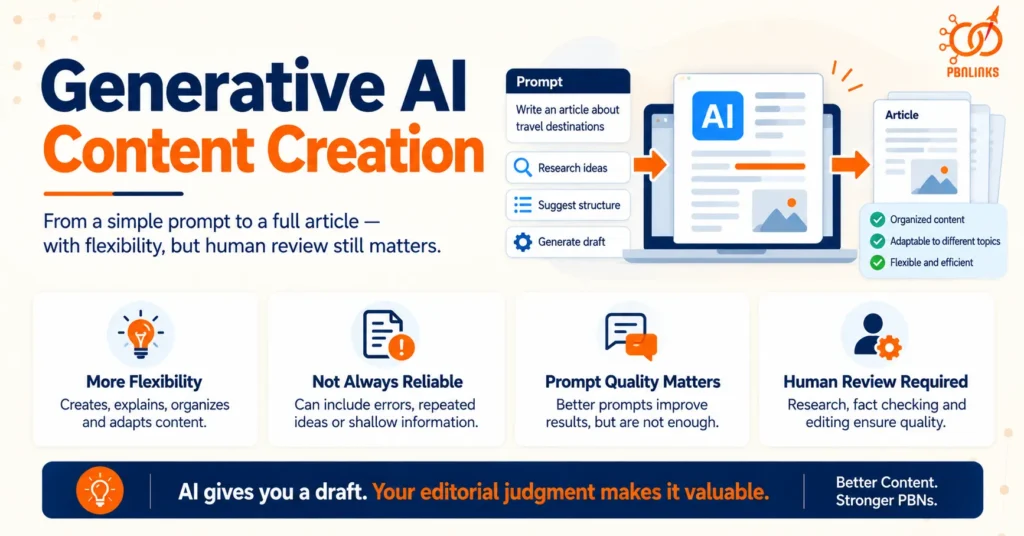
Generative AI works differently. It can create a response from instructions rather than requiring one article to be mechanically transformed into another version. It can also organize information, explain concepts, suggest structures, and adapt content to different contexts.
This gives AI more flexibility than traditional spinning. However, flexibility should not be confused with reliability. AI can generate fluent text that contains factual errors, unsupported claims, repeated ideas, or shallow explanations.
The quality of the prompt can influence the output, but a strong prompt does not remove the need for review. Research, fact checking, topical judgment, and final editing still determine whether the finished article is suitable for publication.
Where Both Approaches Can Produce Similar Quality Problems
The production methods are different, but their weaknesses can overlap. Both can be used to create large amounts of content without adding meaningful information.
Common outcomes can include repetitive ideas, generic explanations, weak topical depth, and content that mainly rephrases information already available elsewhere. Both approaches can also produce pages designed around keywords or backlinks rather than a genuine reader need.
This is why uniqueness at the wording level should not be treated as the main quality test. A page can contain unique sentences and still offer little value. What matters is whether the article explains its topic accurately, contributes useful context, and fits naturally within the website.
For AI content on PBN sites, this distinction provides a better way to assess risk. AI should not be treated as modern article spinning by default. It should also not receive a free pass simply because the technology is more sophisticated.
Once the production method is separated from the final outcome, the next issue becomes clearer. The most practical risks come from the quality problems that AI generated PBN content can introduce.
Quality Risks of AI Content on PBN Sites
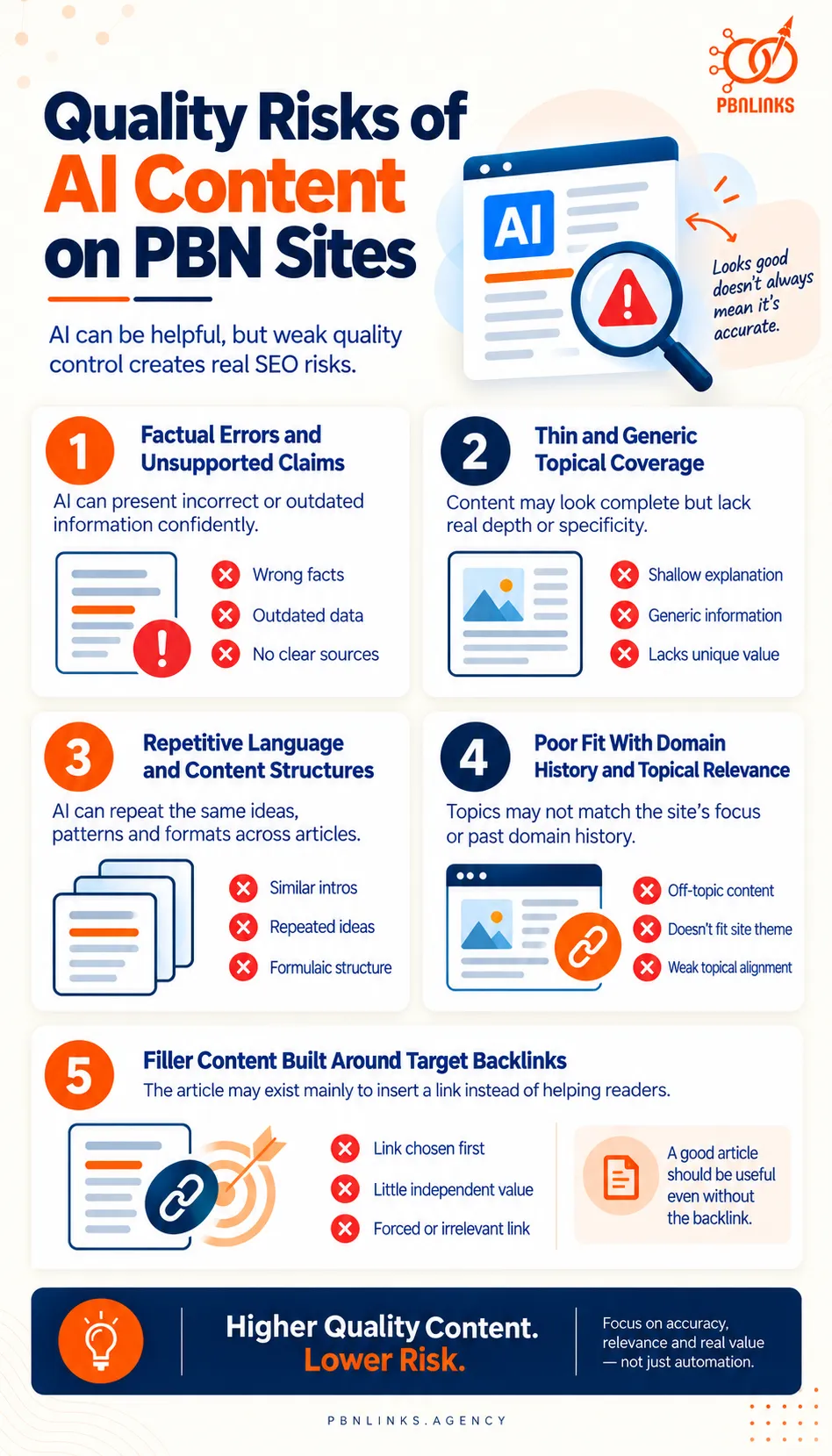
The main risks of AI content on PBN sites come from weak quality control rather than AI use alone. AI can produce clear and useful drafts, but it can also introduce errors, shallow coverage, repetition, and poor topical alignment. These weaknesses become more important when the content also supports a target backlink.
A polished writing style can make these problems easy to miss. An article may read naturally while still containing weak information. PBN content should therefore be reviewed for substance, not just grammar and readability.
Factual Errors and Unsupported Claims
AI can present incorrect information in a confident and convincing way. It may also provide outdated details, misinterpret a source, or make a claim without reliable support.
This creates a clear editorial risk. Important facts should be checked against trustworthy sources before publication. Statistics, dates, technical claims, policy statements, and named studies deserve particular attention.
The same standard applies when discussing SEO. Claims about how Google evaluates websites should not be presented as confirmed facts unless reliable documentation supports them.
Thin and Generic Topical Coverage
AI can produce an article that looks complete without exploring the topic in enough depth. The page may contain several headings and paragraphs while offering only basic information.
Generic coverage is especially weak when it could apply to almost any website. A useful article should address the specific topic, audience, and context of the PBN site.
Adding more words does not automatically solve the problem. Useful depth comes from relevant explanations, accurate examples, supporting details, and clear answers to the questions a reader is likely to have.
Repetitive Language and Content Structures
AI generated articles can repeat the same ideas in slightly different language. Similar introductions, paragraph patterns, conclusions, and heading structures may also appear when the same workflow is used repeatedly.
This can make individual articles feel formulaic. Across several sites, it can also reduce editorial distinction between publications.
The solution is not simply to replace words or rearrange sentences. Editors should remove repeated ideas, vary the way topics are developed, and make sure each article follows the structure that best suits its subject.
Poor Fit With Domain History and Topical Relevance
A PBN article should make sense within the broader context of the website. This is especially important when an expired or previously used domain has been rebuilt around an existing topical history.
AI can generate content on almost any subject. That flexibility can encourage publishers to choose topics simply because they provide an opportunity for a target backlink. The result may be an article that feels disconnected from the rest of the site.
Before creating a page, the topic should be checked against the site’s current focus, existing content, and relevant domain history. A logical topical relationship gives the article a clearer reason to exist.
Filler Content Built Around Target Backlinks
One of the most important PBN specific risks appears when the backlink is chosen before the article has a meaningful purpose. The content may then be written mainly to create a place where the target link can be inserted.
This often produces filler. The article may contain enough words to look complete, but the surrounding discussion provides little independent value. The target link can also feel forced if the destination does not genuinely support the topic.
A better process starts with the page purpose and reader need. The article should work as useful content even without the target backlink. If a link is added, it should fit the surrounding discussion and provide relevant context.
These quality problems can occur on a single page. When similar patterns are repeated across multiple sites, however, another concern appears. The next question is whether repeated AI assisted publishing can contribute to a broader PBN footprint.
AI Content Patterns and PBN Footprint Risk
Repeated AI content patterns can make a group of PBN sites look less editorially independent, but there is no documented Google rule that defines a specific AI writing pattern as a PBN footprint. The practical concern is broader. Heavy reuse of templates, structures, topics, and publishing methods can reduce variation across a network.
This distinction matters because PBN footprint discussions often mix confirmed information with SEO speculation. Similar AI writing alone should not be presented as proof that search engines have identified a network. It is more useful to examine the overall publishing patterns and quality of the sites.
Repeated Templates and Editorial Patterns
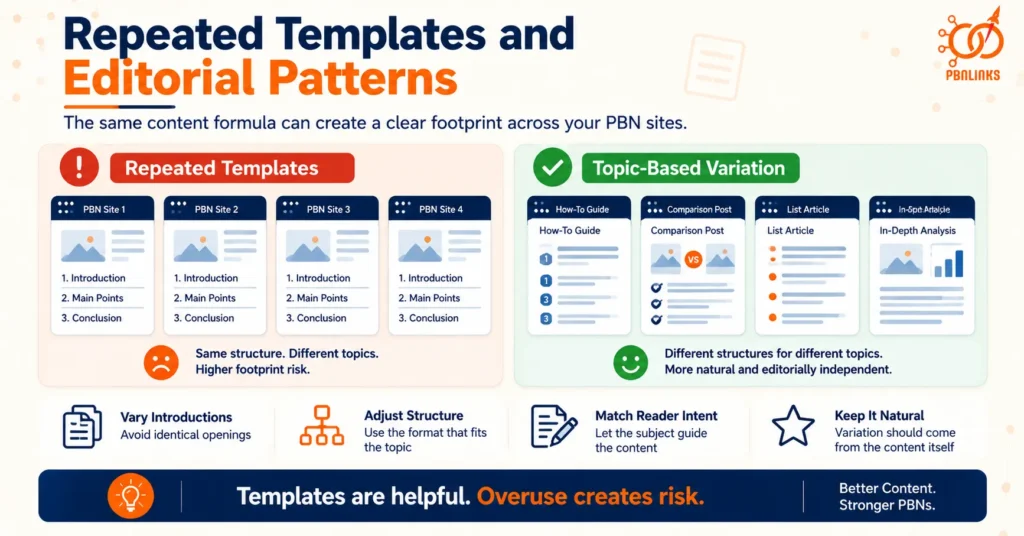
AI workflows can encourage publishers to use the same content formula repeatedly. Articles may begin with similar introductions, follow the same heading sequence, use similar paragraph lengths, and end with nearly identical conclusions.
Templates are not inherently a problem. Many legitimate websites use consistent editorial formats. The concern grows when nearly every article follows the same formula regardless of topic or reader intent.
Editors should allow the subject to determine the structure. Some topics need comparisons. Others are better explained through steps, examples, definitions, or detailed analysis. Natural structural variation should come from the content itself rather than artificial attempts to make pages look different.
Network Wide Content Similarity
Content similarity becomes more noticeable when the same production process is applied across many PBN sites. Different domains may cover similar topics, use comparable headings, repeat the same examples, or present information in almost identical ways.
AI can increase this problem when prompts and source material are reused without enough editorial input. The result may be multiple sites that appear different at the domain level but provide very similar content experiences.
The goal should not be to create random differences simply to hide similarity. Each site should have its own topical purpose and useful content. Articles should be developed around that context rather than copied from a single network wide formula.
Documented Signals vs Speculative AI Footprints
It is important to separate Google’s published policies from assumptions made within the SEO industry. Google has documented policies covering spam practices such as scaled content abuse and link spam. However, that does not mean every suspected AI footprint discussed by SEOs is a confirmed ranking or detection signal.
For example, there is no reliable basis for claiming that using the same AI model or prompt across several sites will automatically expose a PBN. Similar wording or structure may be worth reviewing from an editorial perspective, but it should not be presented as a documented Google detection mechanism.
This distinction helps PBN operators focus on issues they can evaluate directly. Content quality, relevance, publishing purpose, site consistency, and backlink context are more useful areas for review than trying to predict an undocumented AI detection formula.
That also raises a related question. If AI writing patterns are not reliable proof of SEO quality or risk, how useful are AI detection tools when evaluating PBN content?
AI Detection vs SEO Quality
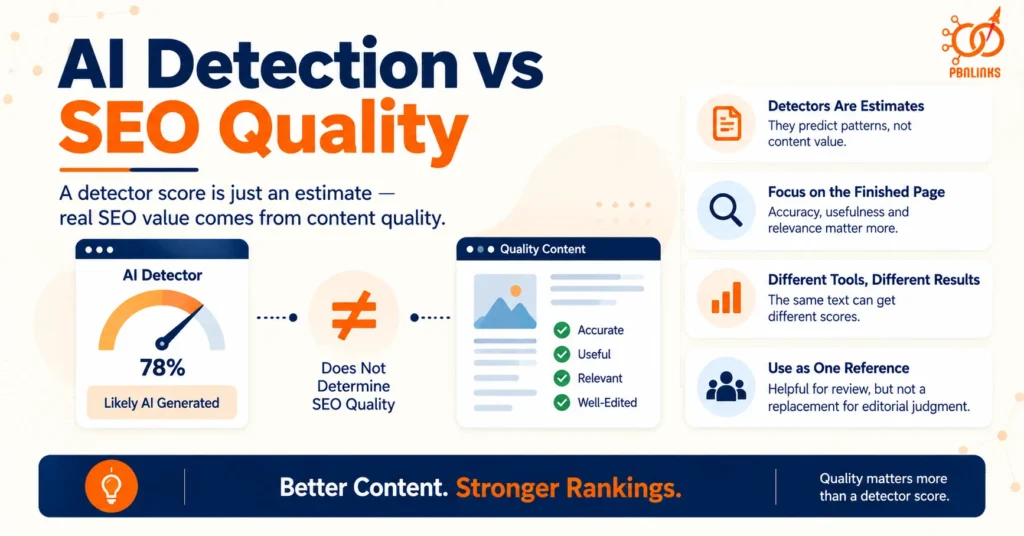
An AI detection score does not determine whether content is good or bad for SEO. Third party detectors estimate whether text may have been generated by AI. They do not measure the full quality, usefulness, relevance, or search value of a page.
This distinction is important for AI content on PBN sites. A low AI score does not make weak content valuable. A high score also does not prove that a useful article violates Google’s spam policies. The final page should be judged on stronger editorial and SEO criteria.
Google’s Evaluation of AI Assisted Content
Google’s public guidance focuses on the quality and purpose of content rather than treating AI use itself as a reason for poor rankings. Automation becomes a spam concern when it is used in ways that violate Google’s spam policies.
This means the useful questions are about the finished page. Does it satisfy the topic? Is the information accurate? Does it provide value to readers? Was the content created mainly to help users, or is it part of a publishing process designed primarily to manipulate rankings?
These questions are more meaningful than trying to determine whether every sentence was written by a person or generated with AI assistance.
Limitations of Third Party AI Detectors
AI detectors usually analyze patterns in text and estimate the likelihood of AI involvement. Their results should be treated as estimates rather than definitive proof of authorship.
Different tools can also produce different results for the same passage. Human written text may sometimes be classified as AI generated. Edited AI content may receive a different result even when its underlying information has barely changed.
For this reason, detector scores are weak evidence for making important SEO decisions. They can be used as one editorial reference point, but they should not replace a proper content review.
Why a Human Score Does Not Prove SEO Quality
Trying to make content appear human to an AI detector can distract from the real work of improving the page. Changing sentence patterns or replacing words may reduce a detector score without improving accuracy, depth, or usefulness.
A better review asks whether the content contains verified information, answers the reader’s questions, fits the website’s topic, and avoids unnecessary repetition. The editor should also check whether examples and claims add meaningful context.
For PBN content, the target backlink requires another layer of review. The surrounding content should make the link relevant and useful within the discussion. Passing an AI detector cannot establish that relationship.
The more practical objective is therefore not to make AI content look human to a detection tool. It is to make the final article accurate, useful, relevant, and editorially complete. Achieving that standard depends heavily on human editing and quality control.
Human Editing and Quality Control for AI PBN Content
Human editing should improve the substance of AI PBN content, not simply make the writing appear less automated. A proper review checks facts, topical depth, search intent, domain relevance, and the context of any target backlink.
This approach is more useful than changing words only to reduce an AI detection score. The goal is to turn an AI assisted draft into a page that is accurate, relevant, useful, and suitable for the website where it will be published.
Fact Checking and Source Verification
Every important factual claim should be checked before publication. AI can produce incorrect details even when the writing sounds confident and polished.
Editors should pay particular attention to statistics, dates, technical information, quotations, studies, and policy claims. Current information should be checked against reliable and relevant sources.
Source quality matters as well. A claim repeated across several websites is not necessarily accurate. Whenever possible, important information should be traced back to an original or authoritative source.
Topical Depth and Original Editorial Value
AI drafts often cover the obvious points first. Human editing should determine what the article still needs to explain.
This may involve adding useful examples, clarifying difficult concepts, answering follow up questions, or including context that is specific to the topic. Repeated or generic passages should be removed rather than expanded simply to increase word count.
Original editorial value does not require every fact to be new. It can come from clearer explanations, stronger organization, useful comparisons, practical observations, or a better connection between related ideas.
Search Intent and Content Structure
The article should satisfy the reason a reader searched for the topic. A page targeting an informational query should answer the main question early and then develop the subject in a logical order.
Headings should also reflect that progression. Each H3 should support its parent H2, and each section should prepare the reader for the next idea. Important answers should not be buried beneath long introductions.
Editors should also remove unnecessary repetition. One clear explanation is usually more useful than the same point repeated in several sections.
Domain Context and Topical Consistency
Before publishing AI content on a PBN, check whether the topic belongs on that website. The article should fit the site’s current subject, existing content, and overall editorial direction.
Domain history can also provide useful context, especially when an expired domain has been rebuilt. A sudden shift into unrelated subjects can make the site less coherent for readers.
This does not mean every article must cover the same narrow keyword set. Related topics can expand a site’s coverage when they have a logical connection to its main subject.
Contextual Backlink and Outbound Link Review
The target backlink should be reviewed as part of the article rather than treated as a separate SEO element. Its destination should be relevant to the surrounding discussion.
Anchor text should also make sense within the sentence and page context. The paragraph should remain useful even if the SEO objective behind the link is ignored.
Other outbound links deserve the same review. Relevant references can support explanations or direct readers to useful resources. Links added only to make a page appear natural do not automatically improve its quality.
Human review is therefore more than a final proofreading step. It connects factual accuracy, topical depth, reader intent, site relevance, and link context into one editorial process.
Once these elements are in place, the next question is how the quality of the finished article affects the PBN page that actually contains the backlink.
How AI Content Quality Affects a PBN Linking Page
The quality of AI content can affect whether a PBN linking page is useful, relevant, and capable of supporting a meaningful backlink. A backlink does not exist in isolation. It appears within a page that search engines must first discover, understand, and evaluate.
However, high quality writing does not guarantee that a backlink will improve rankings. Link outcomes depend on many factors. These include the linking domain, page relevance, indexing, link placement, and the broader quality of the site.
For this reason, the linking page should be evaluated as a complete page rather than as a container for anchor text.
Linking Page Relevance and Usefulness
The linking article should have a clear relationship with the page it references. Strong topical context helps readers understand why the destination is relevant to the discussion.
AI can help develop this context, but it can also create broad articles that mention a topic only briefly before inserting a target link. This weakens the connection between the article and the linked page.
A better linking page covers its own topic properly. The backlink should support a point that already belongs in the article. It should not determine the entire purpose of the page.
Indexing and Page Level Visibility
A backlink cannot provide normal search visibility from a page that remains outside Google’s index. This makes the status of the actual linking URL more relevant than simply checking whether other pages from the PBN are indexed.
AI generated content is not automatically excluded from indexing. However, publishing a page does not guarantee that Google will index or retain it. Crawlability, canonical signals, content quality, internal linking, and other site factors can influence whether a URL is discovered and indexed.
Indexing should also not be confused with authority or backlink effectiveness. It confirms that a page is included in the search index at that time. It does not prove that the page will rank well or that every link on it will produce measurable SEO value.
Natural Context Around the Target Link
The text surrounding a backlink helps establish what the link is about and why it appears on the page. The anchor text, sentence, paragraph, and broader article should support the same topical relationship.
AI drafts sometimes create a paragraph specifically to accommodate a predetermined anchor. This can make the link feel separate from the main discussion.
A stronger approach is to develop the topic first. The target link can then be placed where the destination genuinely adds context or supports the reader. The sentence should remain natural even when read without considering the SEO objective behind it.
Site Quality Beyond the Individual Article
A well edited linking page does not exist independently from the rest of the PBN site. The site’s topical focus, internal linking, existing content, technical accessibility, and overall publishing quality provide additional context.
This is why improving one AI generated article cannot compensate for a site filled with weak or unrelated content. The linking page may be strong, but the surrounding website still affects how credible and coherent that page appears.
PBN operators should therefore review both levels. The individual article needs useful content and a relevant backlink context. The website itself needs enough consistency and substance to support the page naturally.
Once the linking page is viewed as part of a complete website, the next step is practical. AI can be integrated into a structured publishing process without allowing automation to replace the editorial decisions that determine content quality.
A Practical Workflow for Using AI Content on PBN Sites
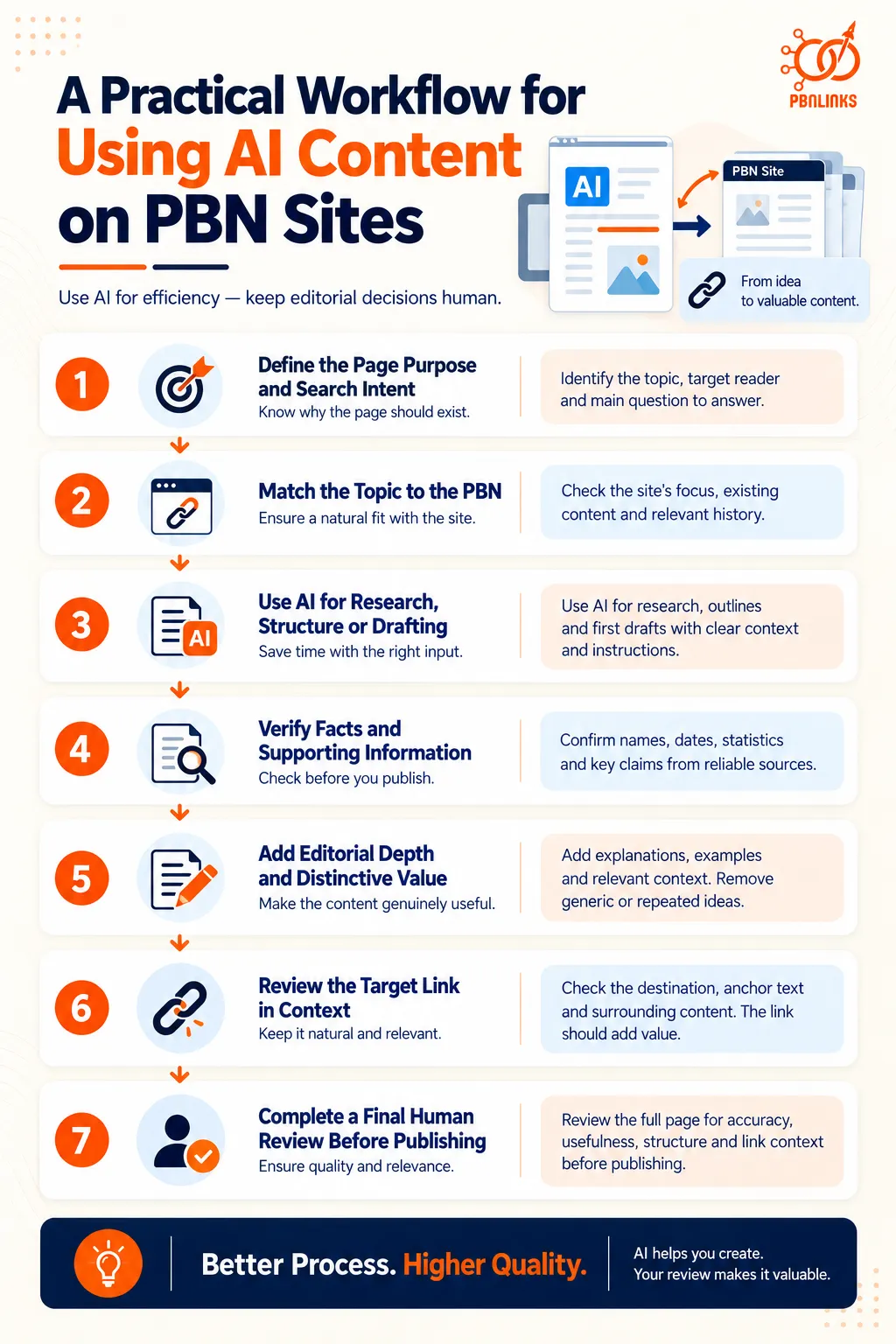
The best way to use AI content on PBN sites is to treat AI as a production assistant, not as the final publisher. AI can speed up research, planning, and drafting. Human review should control topic selection, factual accuracy, editorial value, and backlink placement.
A strong workflow should answer three questions before publication:
- Does this page have a clear purpose?
- Does it provide useful and accurate information?
- Does the target link belong naturally within the content?
The following seven step process turns those principles into a practical publishing workflow.
Step 1: Define the Page Purpose and Search Intent
Start with the reason the page needs to exist. Define its main topic, intended reader, and search intent before generating content.
Ask what question the page should answer. Then identify the information a reader would need to leave with a useful answer.
Do not begin with the target backlink and build an article around it. That approach can lead to filler content with little purpose beyond hosting the link.
Quality check: The article idea should still make sense if the target backlink is removed.
Step 2: Match the Topic to the PBN
Next, determine whether the topic belongs on the PBN site.
Review the site’s main subject, existing articles, categories, and current editorial direction. For a rebuilt domain, relevant historical context may also help determine whether the topic is a logical fit.
The relationship should be clear:
PBN topic → article topic → reader intent → target page
If one part of that relationship feels forced, reconsider the topic or backlink opportunity.
Quality check: A visitor should understand why this article exists on this particular website.
Step 3: Use AI for Research, Structure or Drafting
Once the topic is validated, decide where AI can improve efficiency.
AI can assist with:
- Topic research and question discovery
- Content briefs and outlines
- Heading development
- First drafts
- Summaries and explanations
- Editing and readability improvements
Provide enough context for each task. Include the audience, search intent, required topics, source material, and editorial expectations when relevant.
Do not treat the first output as publication ready. AI generated text is a draft until its information and purpose have been reviewed.
Quality check: AI should accelerate the workflow without making the key editorial decisions.
Step 4: Verify Facts and Supporting Information
Check important factual claims against reliable sources.
Review dates, statistics, studies, technical details, names, definitions, and policy statements. Information that can change over time deserves extra attention.
Primary and authoritative sources should be preferred when they are available. This is especially important for claims about Google policies or other documented search guidelines.
Remove unsupported statements. If a claim cannot be verified, do not make it sound certain simply because the AI presented it confidently.
Quality check: Every important factual claim should be accurate, current, and supportable.
Step 5: Add Editorial Depth and Distinctive Value
After fact checking, evaluate what the draft actually contributes.
AI content can be grammatically strong while remaining generic. Look for sections that repeat common information without explaining the topic in enough depth.
Improve the article with useful context. This may include examples, comparisons, clearer explanations, practical observations, or connections between related concepts.
Remove repetition instead of increasing word count unnecessarily. Each section should have a clear job within the article.
The objective is not to make the text look human to a detector. The objective is to make the page more useful to a reader.
Quality check: The final article should provide more value than a basic AI response to the same query.
Step 6: Review the Target Link in Context
Evaluate the backlink only after the article has been developed around its own purpose.
Start with topical relevance. The destination page should have a logical relationship with the point being discussed.
Then review four elements together:
- Target page
- Anchor text
- Surrounding sentence
- Broader paragraph and article topic
These elements should support the same context. Avoid creating an unrelated paragraph simply to accommodate a predetermined anchor.
The link should help the reader move to relevant supporting information. It should not feel like an interruption to the article.
Quality check: The backlink should remain logical when judged from the reader’s perspective rather than only from an SEO perspective.
Step 7: Complete a Final Human Review Before Publishing
The final review should evaluate the page as a complete publishing asset.
Read the article from beginning to end. Check whether the main question is answered early and whether each section develops the topic logically. Remove unnecessary repetition and unclear statements.
Then complete a final publishing check:
- Is the information accurate and properly verified?
- Does the article satisfy its main search intent?
- Does the topic fit the PBN?
- Does each heading develop the subject logically?
- Has generic AI filler been removed?
- Does the article provide useful editorial value?
- Is the backlink relevant to its surrounding context?
- Are other internal and external links useful where included?
- Does the page work as valuable content without relying on the target backlink?
If several answers are no, the page needs more work before publication.
The complete process can be summarized as:
Purpose → Topical Fit → AI Assistance → Fact Checking → Editorial Value → Link Context → Human Review
This workflow does not create a guaranteed safe formula for AI content on PBN sites. No publishing process can remove every SEO risk associated with PBNs or automated content. Instead, the framework keeps AI focused on efficiency while human judgment controls the decisions that require context, verification, and editorial responsibility.
The final question is where that division should be drawn. AI can handle some content tasks efficiently, while other decisions should remain under human control. Those boundaries define the practical limits of using AI content on PBN sites.
Practical Limits of AI Content on PBN Sites
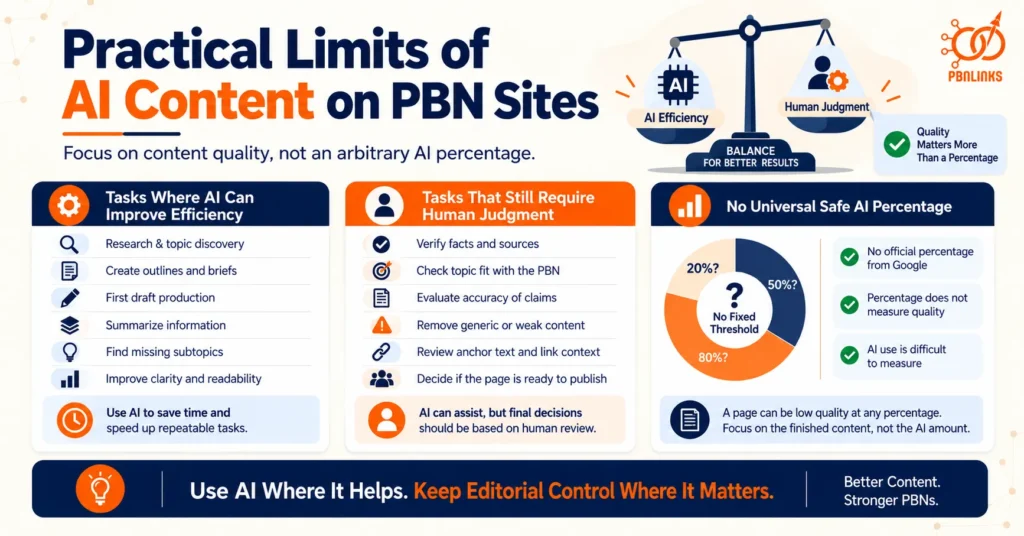
There is no universal amount of AI content that makes a PBN site safe or unsafe for SEO. A more useful approach is to decide which tasks AI can handle effectively and which decisions still require human judgment.
AI works well when it supports repeatable parts of content production. Its limitations become more important when a task requires factual verification, editorial judgment, site specific context, or decisions about backlinks.
For this reason, practical limits should be based on content quality rather than an arbitrary percentage of AI involvement.
Tasks Where AI Can Improve Efficiency
AI can reduce the time required for several stages of content production. It is particularly useful for organizing information and developing an initial structure.
Common uses include:
- Research assistance and topic discovery
- Search question identification
- Content brief development
- Outline creation
- First draft production
- Summarizing source material
- Identifying missing subtopics
- Improving clarity and readability
These tasks can make the editorial process faster. However, the output still needs to be checked against the purpose and requirements of the page.
The goal is to use AI where speed provides a real benefit without allowing speed to determine what gets published.
Tasks That Still Require Human Judgment
Some decisions depend heavily on context. AI can provide suggestions, but it should not be the only source of judgment.
Human review is especially important for:
- Verifying important facts and sources
- Deciding whether a topic fits the PBN
- Evaluating the accuracy of technical claims
- Identifying weak or generic information
- Adding useful editorial insight
- Reviewing anchor text and backlink context
- Determining whether the final page deserves publication
These decisions affect more than writing quality. They determine whether the page has a clear purpose and whether it fits naturally within the website.
AI can assist with each task, but the final decision should be based on evidence and editorial context.
Why There Is No Universal Safe AI Percentage
There is no documented Google threshold stating that a particular percentage of AI generated text is safe for SEO.
A page that is 20 percent AI assisted is not automatically safer than one created mostly with AI. The opposite is also true. Percentage alone does not tell you whether the information is accurate, useful, relevant, or created primarily to manipulate search rankings.
AI involvement is also difficult to measure consistently. Research, outlining, drafting, rewriting, and editing may all involve AI to different degrees.
Instead of asking, “How much AI is safe?” ask, “Does the final page meet the required editorial standard?”
That question produces a more useful quality assessment.
Quality Thresholds Instead of AI Thresholds
A practical publishing standard should evaluate the finished page rather than estimate how much of it came from AI.
Before publication, check four core areas:
Accuracy: Are important claims correct and supported?
Usefulness: Does the page answer the reader’s question and provide meaningful information?
Relevance: Does the topic fit the website, and does the backlink fit the discussion?
Editorial Quality: Has the content been reviewed for depth, clarity, repetition, and context?
If the page fails these checks, reducing an AI detection score will not solve the underlying problem. The content itself needs improvement.
This creates a clearer boundary for AI content on PBN sites. Use AI where it improves efficiency. Use human judgment where accuracy, relevance, context, and publishing decisions matter.
The practical limit is therefore not a fixed percentage of AI generated text. It is the point where automation begins to replace the editorial judgment needed to produce a useful and credible page.
Conclusion
In conclusion, AI content on PBN sites can improve content production, but its SEO value depends on how it is created, reviewed, and published. AI itself is not the main issue. Quality, purpose, relevance, scale, and editorial control matter more.
AI generated content is different from traditional spun content, although both can produce low value pages when automation replaces research and human judgment. There is also no documented safe AI percentage or detector score that guarantees SEO performance. Each page should be accurate, useful, relevant to the site, and strong enough to serve a purpose beyond hosting a backlink.
The most practical approach is to use AI for efficiency while keeping fact checking, topical decisions, quality control, and link placement under human review.
If you want backlinks placed within relevant, carefully reviewed content, PBNLinks.agency can help you build a more controlled PBN link building strategy. Contact us to discuss the right approach for your SEO campaign.
FAQs About AI Content on PBN Sites
Can AI Generated Content Rank on Google?
Yes, AI generated content can rank on Google. Using AI is not automatically a spam violation. The content still needs to be useful, relevant, accurate, and compliant with Google’s search policies.
Does Google Penalize AI Generated Content?
No, Google does not penalize content simply because AI was used to create it. Problems arise when content violates spam policies, such as when many low value pages are created primarily to manipulate search rankings.
Can AI Content Cause a PBN Site to Be Deindexed?
AI content alone does not automatically cause a PBN site to be deindexed. A site may lose search visibility when it violates Google policies or develops other serious quality or indexing problems. PBNs also carry separate risks related to link spam.
Is AI Generated Content the Same as Spun Content?
No, AI generated content and spun content are different production methods. Spinning usually modifies existing text, while generative AI creates responses from prompts and learned patterns. Both can still produce low value content when used poorly.
What Is Scaled Content Abuse?
Scaled content abuse is the creation of many pages primarily to manipulate search rankings rather than help users. Google states that this can involve AI, automation, human produced content, or other methods when large amounts of low value content are created.
Does Every AI Generated PBN Article Need Human Editing?
AI generated PBN content should receive human review before publication. Editors should check facts, topical relevance, useful depth, search intent, and backlink context rather than simply changing words to make the content appear human written.
Can Google Detect AI Generated Content?
Google can evaluate content created with AI, but there is no public rule stating that an AI detection score determines rankings. SEO decisions should therefore focus on content quality, purpose, relevance, and compliance with search policies rather than trying to achieve a specific detection score.
Are AI Content Detectors Reliable for SEO?
AI detectors should not be treated as reliable measures of SEO quality or Google compliance. They estimate whether text may be AI generated, but they do not determine whether a page is useful, accurate, relevant, or eligible to rank.
Does Passing an AI Detector Make Content Safe for SEO?
No, passing an AI detector does not make content safe for SEO. A low detection score cannot correct thin information, factual errors, poor topical relevance, or spam policy violations. The finished page itself needs to meet appropriate quality standards.
Is There a Safe Amount of AI Content to Publish on a PBN?
No documented safe percentage or fixed number of AI generated articles exists for a PBN. The better standard is whether each page provides useful information and whether publishing at scale is primarily intended to manipulate rankings rather than help users.