Cloudflare and CDNs on PBN Sites: Protection or Footprint?
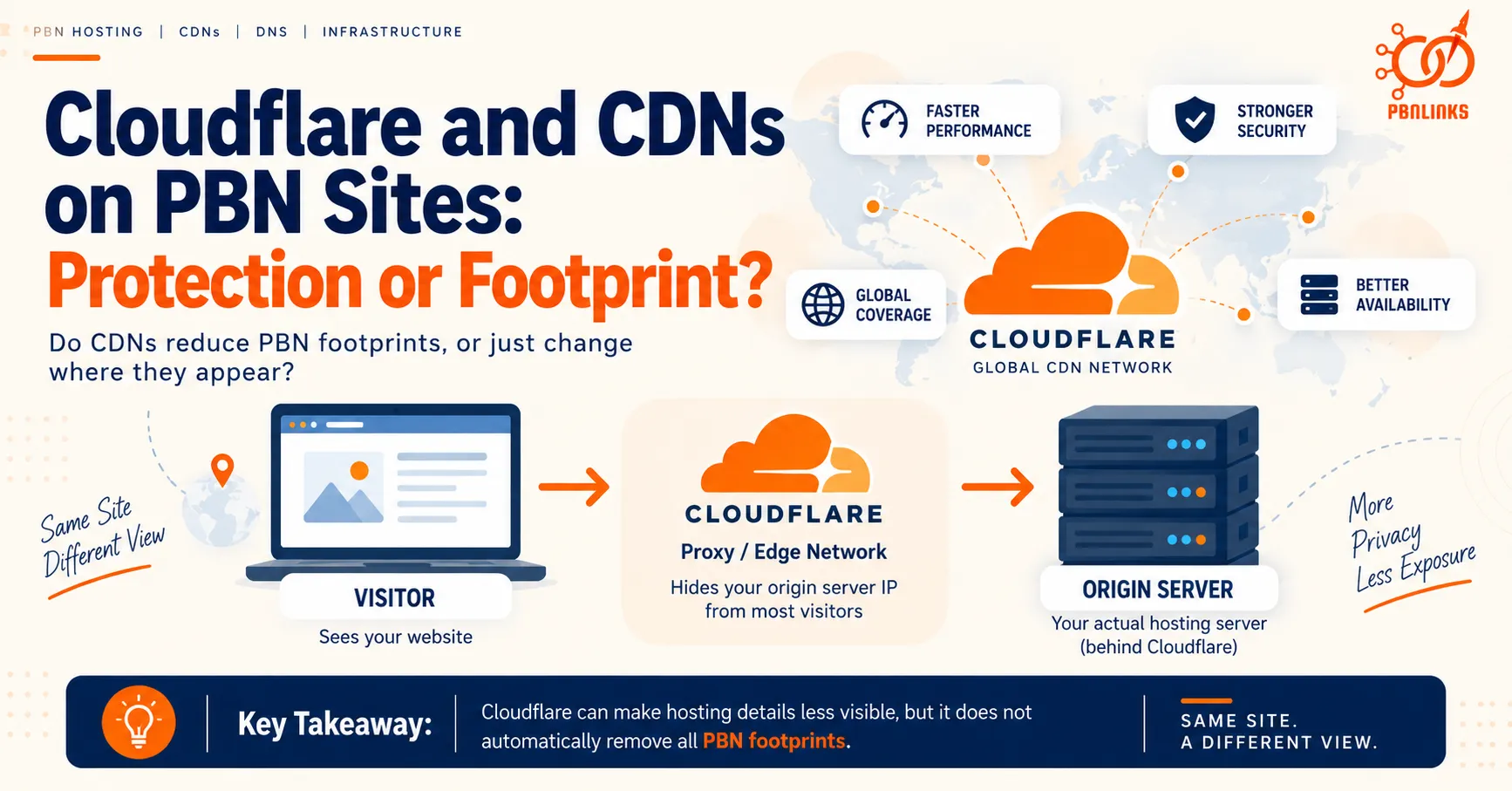
Cloudflare can put a massive global network between your PBN site and the server actually hosting it. To a normal visitor, the site may resolve through Cloudflare instead of exposing the origin server directly. That sounds useful for reducing obvious hosting connections, but it raises an important question: does Cloudflare actually reduce PBN footprints, or does it simply change where those footprints can appear?
That is the real issue behind a Cloudflare CDN PBN setup. A CDN can make direct IP and hosting relationships less visible while also improving speed, caching, availability, and security. But moving a site behind Cloudflare does not automatically erase DNS history, previously exposed IP addresses, unproxied records, or other infrastructure relationships.
The opposite assumption can be misleading too. Two sites using Cloudflare, resolving through its edge network, or showing other common Cloudflare characteristics are not automatically part of the same PBN. Cloudflare serves a huge and diverse part of the web, so the value of any similarity depends on how specific the signal is and what other evidence supports it.
In this guide, we’ll examine how Cloudflare and CDNs affect PBN hosting visibility, what they can and cannot hide, whether DNS, nameservers, shared accounts, and plan types can create meaningful patterns, and which infrastructure signals actually matter when evaluating PBN footprints.
The Traditional PBN Hosting Problem
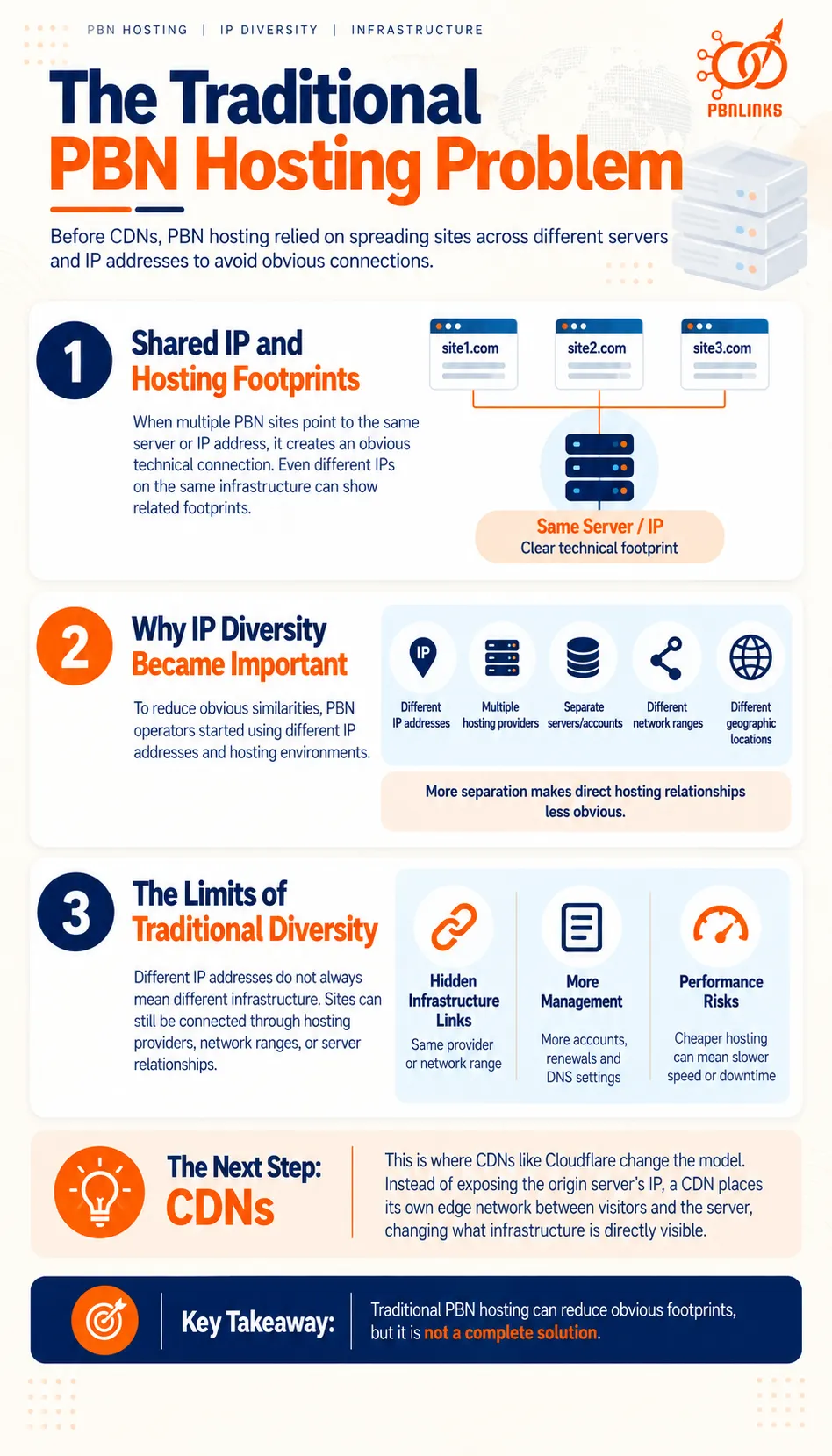
Before CDNs became a common part of PBN hosting, infrastructure diversity usually meant spreading sites across different servers, IP addresses, and hosting providers. The goal was straightforward: avoid creating an obvious technical pattern that connects multiple sites in the same network.
That approach can still provide diversity, but simply assigning different IP addresses does not automatically make the underlying infrastructure independent. Hosting providers, network ranges, server relationships, and other technical data can still add context when several domains are compared.
Shared IP and Hosting Footprints
One of the most obvious hosting similarities occurs when several PBN sites point directly to the same server or IP address. If those sites also link to the same target websites, the shared infrastructure becomes another relationship that can be examined alongside their backlink patterns.
The same principle can extend beyond an exact IP match. Several sites may use different IP addresses while still sitting within closely related hosting infrastructure. This is why looking only at the visible IP can give an incomplete picture of how technically diverse a network really is.
Why IP Diversity Became Important for PBNs
To reduce these obvious similarities, PBN operators traditionally distributed sites across different IP addresses and hosting environments.
A more diverse setup could involve:
- Different IP addresses
- Multiple hosting providers
- Separate servers or hosting accounts
- Different network ranges
- Different geographic hosting locations
This made direct hosting relationships less obvious than placing an entire network on one server. However, maintaining that level of separation across dozens or hundreds of sites can quickly become expensive and difficult to manage.
The Limits of Traditional PBN Hosting Diversity
The biggest limitation is that different IP addresses do not necessarily mean different infrastructure. Sites can appear separated at the IP level while still sharing other technical relationships.
Traditional diversification can also introduce practical problems. Using many hosting companies means managing more accounts, renewals, credentials, DNS settings, and server environments. Choosing cheap hosting purely for IP diversity can also lead to slower performance or unreliable uptime.
This is where CDNs change the model. Instead of relying only on the origin server’s IP and hosting location, a service such as Cloudflare can place its own edge network between visitors and the server hosting the site. That changes which infrastructure is directly visible and leads to the next question: why are Cloudflare and other CDNs attractive for PBN hosting in the first place?
Why Use Cloudflare or a CDN for PBN Sites?
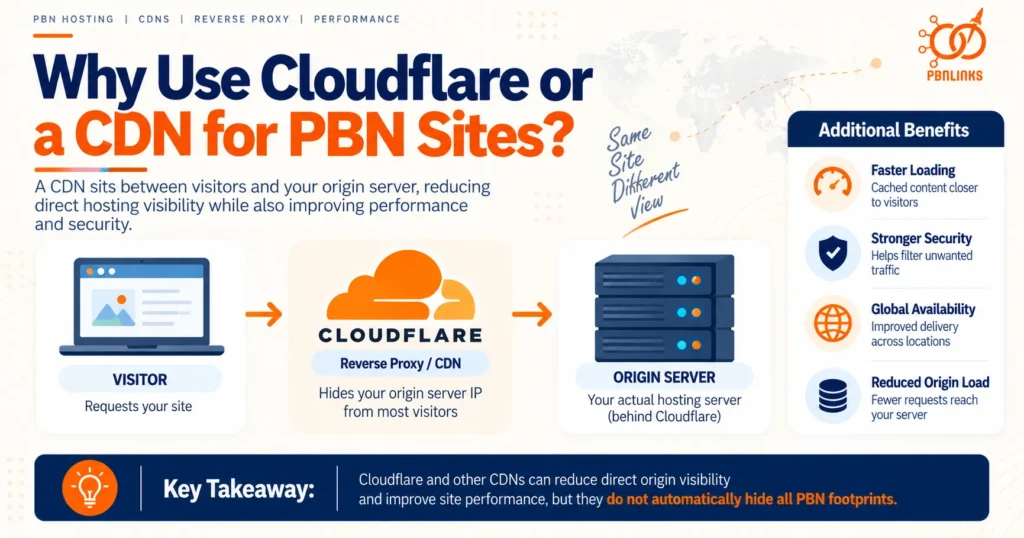
The appeal of a CDN is that it changes how a website is presented to visitors. Instead of every request going directly to the server hosting the PBN site, a service such as Cloudflare can sit between the visitor and that origin server.
For PBN hosting, this matters because the infrastructure visible at the edge can be different from the infrastructure where the website is actually hosted. At the same time, CDNs offer the same performance and security benefits that make them common across ordinary websites.
Hiding the Origin Behind a Reverse Proxy
When Cloudflare proxying is enabled for a website, requests can pass through Cloudflare before reaching the origin server.
The basic path looks like this:
Visitor → Cloudflare → Origin Server
This means the IP address returned for a proxied web record can belong to Cloudflare rather than directly revealing the origin server’s IP.
From a PBN perspective, that changes an important part of the hosting footprint. If several sites are hosted on related origin infrastructure but their web traffic is properly proxied, a simple lookup of their public web records may show Cloudflare infrastructure instead of those origin addresses.
However, this should be understood as reducing direct origin visibility, not making the origin impossible to discover. Other records, services, configurations, or historical data may still provide information about the underlying infrastructure.
Sharing Large Scale CDN Infrastructure
Traditional PBN hosting often tries to create separation by assigning sites to different servers and IP addresses. A CDN approaches the problem differently.
Cloudflare operates shared infrastructure used by a very large number of unrelated websites. As a result, two domains resolving through Cloudflare infrastructure do not have the same meaning as two domains directly resolving to the same origin server.
This distinction is important when interpreting technical similarities:
Same Cloudflare infrastructure: may simply reflect use of the same widely adopted provider.
Same underlying origin infrastructure: can represent a more specific technical relationship and deserves closer examination.
A CDN therefore does not make infrastructure analysis irrelevant. It changes which layer of the infrastructure is being observed.
Performance, Caching and Availability
Cloudflare and other CDNs are not used only to change hosting visibility. They can also improve how quickly and reliably content reaches visitors.
Depending on the site’s configuration, a CDN can:
- Cache content closer to visitors
- Reduce requests reaching the origin server
- Improve page delivery across different locations
- Absorb or filter some unwanted traffic
- Help keep cached content available when the origin is under load
These are normal reasons for millions of websites to use CDN and reverse proxy services. That widespread legitimate use is also why Cloudflare usage alone is a weak basis for connecting multiple domains to the same PBN.
The important question is therefore not simply whether a site uses Cloudflare. It is what Cloudflare changes between the visitor and the origin server, and which technical information remains visible despite that layer.
How Does Cloudflare Work on a PBN Site?
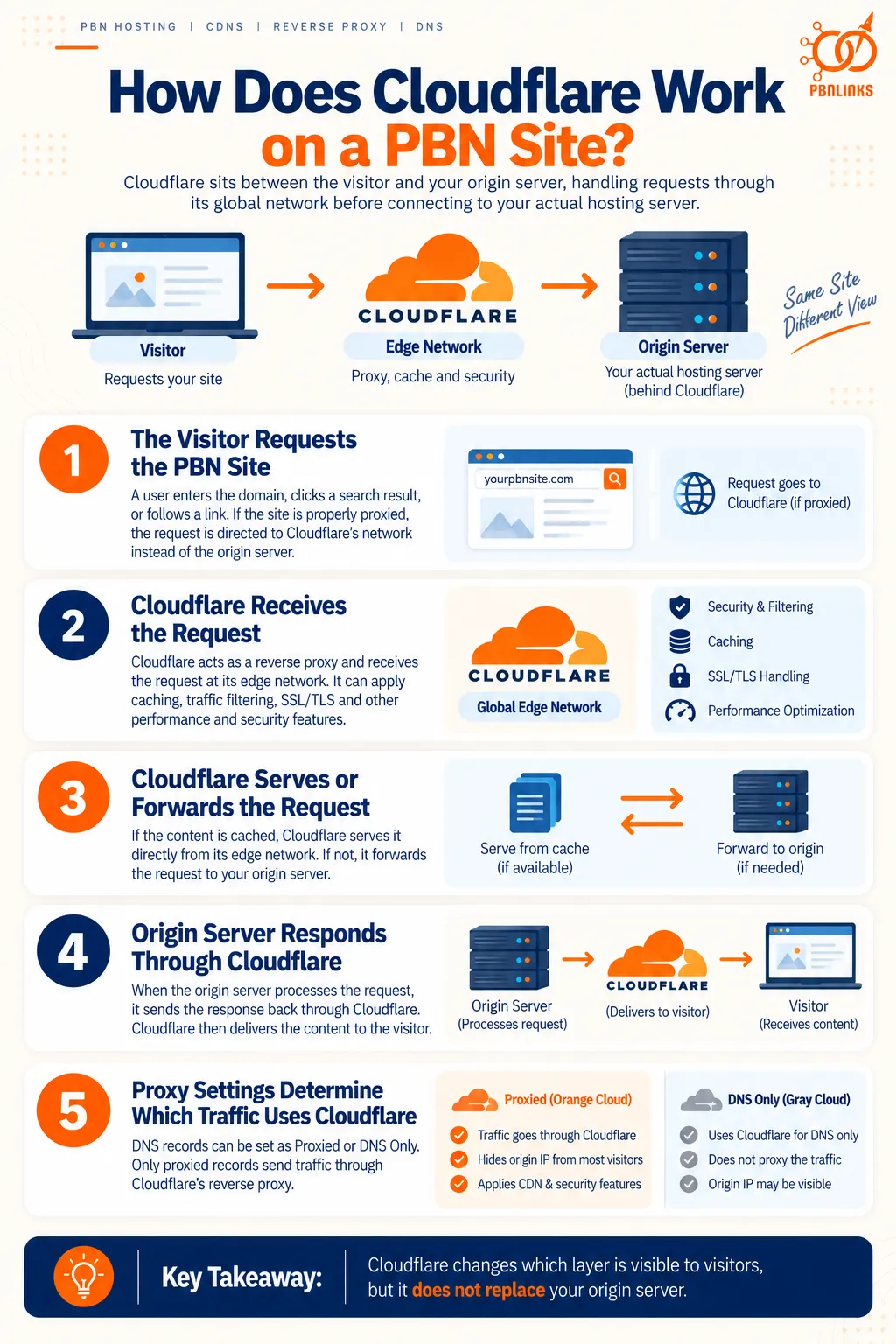
Cloudflare adds a layer between the person visiting a PBN site and the server where that site is actually hosted. Instead of treating Cloudflare and the hosting server as the same thing, it is easier to understand the setup as a short request path.
Visitor → Cloudflare Edge Network → Origin Server
Here is how that process works step by step.
Step 1: The Visitor Requests the PBN Site
The process starts when someone enters the domain, clicks a search result, or follows a link to the PBN site.
If Cloudflare is properly configured and the relevant web record is proxied, the visitor is directed toward Cloudflare’s network rather than connecting directly to the website’s origin server.
Step 2: Cloudflare Receives the Request
Cloudflare acts as a reverse proxy in front of the website. The request reaches Cloudflare’s edge network first, where Cloudflare can apply functions such as caching global edge network , traffic filtering, SSL/TLS handling, and other performance or security features.
This is the key architectural change introduced by Cloudflare: the visitor interacts with the CDN layer before the origin hosting layer.
Step 3: Cloudflare Serves or Forwards the Request
Cloudflare can serve eligible cached content from its edge network. If the requested content needs to come from the website itself, Cloudflare forwards the request to the origin server.
The origin server remains the place where the PBN site is actually hosted. Cloudflare does not replace that server simply because the domain is using its CDN and proxy services.
Step 4: The Origin Server Responds Through Cloudflare
When the origin needs to process the request, it sends the response back through Cloudflare. Cloudflare then delivers the resulting content to the visitor.
The complete path can therefore be understood as:
Visitor → Cloudflare → Origin Server → Cloudflare → Visitor
From the visitor’s perspective, Cloudflare is the public facing layer, while the origin server continues operating behind it.
Step 5: Proxy Settings Determine Which Traffic Uses Cloudflare
An important part of this setup is that DNS records can be configured as proxied or DNS only.
A supported proxied record sends applicable traffic through Cloudflare’s reverse proxy. A DNS only record uses Cloudflare for DNS resolution without sending that connection through the proxy.
This distinction matters because simply adding a domain to Cloudflare does not mean every service or DNS record associated with that domain follows the same traffic path.
With the basic process clear, we can now look at the question that matters most for PBN hosting: what does placing Cloudflare between the visitor and origin server actually hide?
What Does Cloudflare Hide About PBN Hosting?
Once a PBN site’s web traffic is properly proxied through Cloudflare, the infrastructure visible to a normal visitor changes. Instead of connecting directly to the hosting server, the visitor reaches Cloudflare first. This can reduce some of the most obvious hosting signals, but it is important to be precise about what Cloudflare actually hides and what it does not.
Origin IP Visibility
The most important change is the visibility of the origin IP address.
When an eligible DNS record is proxied through Cloudflare, public DNS queries return Cloudflare IP addresses rather than the origin IP configured behind the proxy. Visitors then connect to Cloudflare, which communicates with the origin on the site’s behalf.
For a PBN, this means a basic lookup of the proxied website may no longer directly reveal the server IP where the site is hosted.
This matters when several sites use related origin infrastructure. If those origin IPs are not directly exposed through the proxied web records, comparing the websites by their visible web IP addresses may show Cloudflare’s shared infrastructure instead of the underlying servers.
However, hidden from normal proxied DNS resolution does not mean impossible to discover. Other records, services, configuration choices, or previously collected data may still reveal information about an origin. We will cover those separately in the next sections.
Direct Hosting Provider Visibility
An exposed origin IP can often provide clues about the network or hosting environment behind a website. Once Cloudflare proxies the web connection, the immediately visible IP belongs to Cloudflare’s network rather than directly representing the origin hosting server.
As a result, a basic IP based check may identify Cloudflare as the public facing network instead of directly revealing the infrastructure hosting the website itself.
For PBN analysis, this can make straightforward hosting comparisons less useful. Two sites may appear behind Cloudflare even though their actual origins are hosted by completely different providers. Conversely, two sites appearing on different Cloudflare edge addresses could still have relationships elsewhere in their underlying infrastructure.
Cloudflare therefore obscures the direct path to the origin hosting environment rather than replacing that environment.
Cloudflare IP vs Origin IP
This distinction is essential when interpreting a Cloudflare CDN PBN setup.
A Cloudflare IP belongs to the public facing CDN or reverse proxy layer. Many unrelated websites can use Cloudflare’s shared network.
An origin IP belongs to the infrastructure behind Cloudflare where the website or service is actually hosted.
So these two findings should not be treated equally:
Two sites use Cloudflare infrastructure
This mainly establishes that both use the same widely adopted service provider.
Two sites share identifiable origin infrastructure
This can represent a much more specific technical relationship and may deserve closer examination alongside other signals.
Does Cloudflare Completely Hide PBN Hosting?
No. Cloudflare can reduce direct visibility of origin hosting, but it should not be treated as a complete infrastructure hiding system.
Its reverse proxy changes what visitors and basic DNS lookups see for proxied records. It does not automatically erase every technical relationship associated with the domain, nor does enabling Cloudflare remove information that may already have been recorded elsewhere.
That distinction is critical. Cloudflare can hide one layer of PBN hosting from direct view without making the entire underlying infrastructure invisible.
The next question is therefore more important than whether Cloudflare “hides hosting”: what can still remain exposed after a PBN site is placed behind Cloudflare?
What Can Cloudflare Still Leave Exposed?
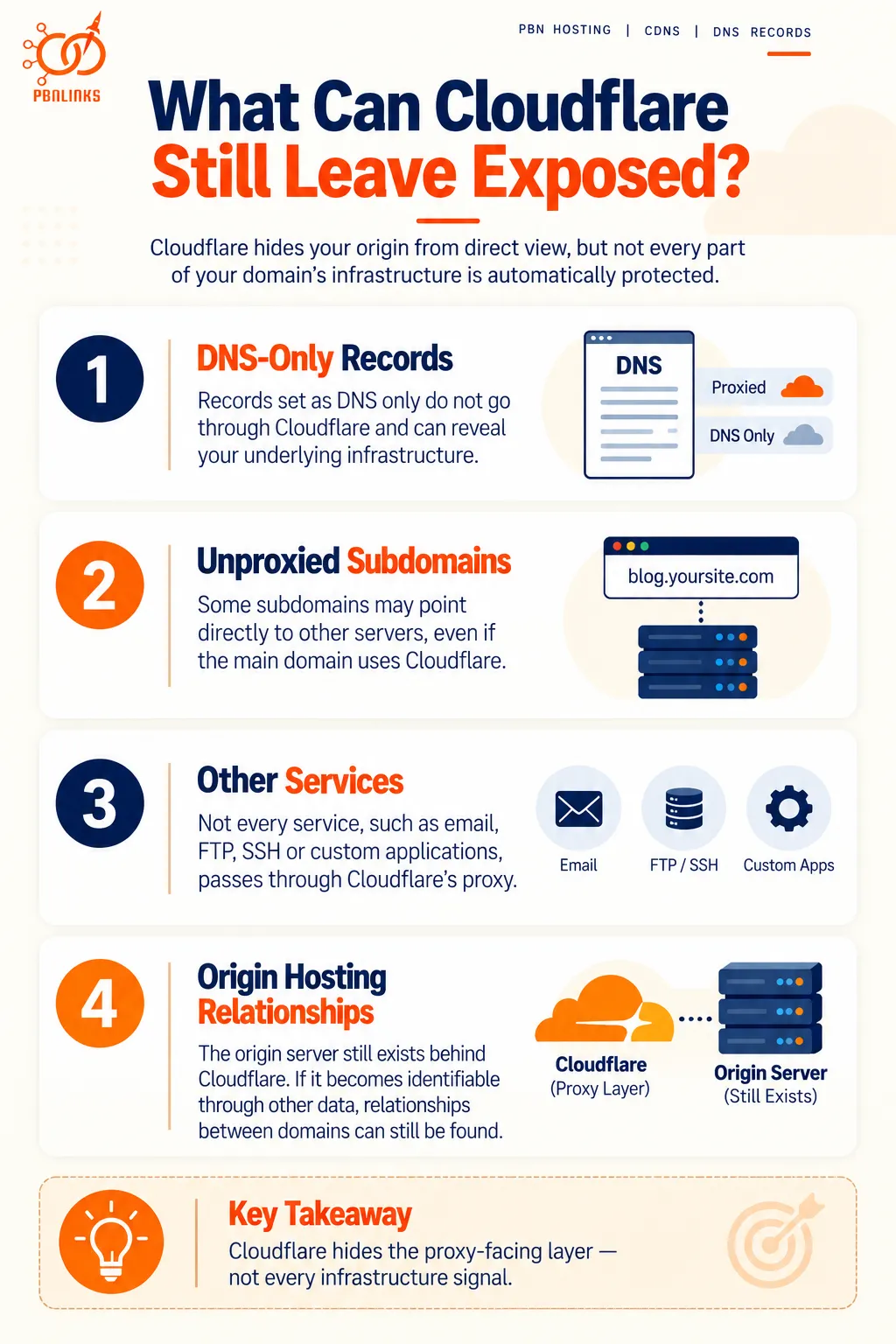
Putting a PBN site behind Cloudflare changes what is directly visible, but it does not automatically place every part of the domain’s infrastructure behind the proxy. The main website may use Cloudflare correctly while other DNS records, subdomains, or services still point toward underlying infrastructure.
For this section, the important question is what can remain exposed in the current setup. Historical DNS and previous hosting records are a separate issue that we will cover in the next section.
DNS Only Records and Unproxied Subdomains
One of the first areas to consider is the domain’s other DNS records.
Cloudflare allows supported records to be proxied, but records can also remain DNS only. In that case, Cloudflare answers the DNS query without proxying the connection through its network.
For example, a domain could have its main website behind Cloudflare while a subdomain points directly to another server. If that record leads to the same infrastructure used by the website, it can provide additional information about the underlying setup.
The important point is that seeing Cloudflare on the main domain does not mean every hostname associated with that domain is hidden behind Cloudflare.
Services That Do Not Pass Through the Proxy
A domain can support more than ordinary website traffic. Depending on how the site is configured, other services may use DNS records or connections that do not pass through Cloudflare’s standard reverse proxy.
This creates an important distinction:
Website traffic behind Cloudflare does not necessarily mean all domain related traffic behind Cloudflare.
For PBN infrastructure analysis, those other services matter only when they reveal a meaningful relationship to the origin or another part of the network. Their existence alone is not evidence of a PBN connection.
DNS and Infrastructure Configuration
Cloudflare can only proxy traffic that has been configured to use its proxy service. The broader DNS setup therefore affects how much of the underlying infrastructure remains directly observable.
A site may have its primary web records proxied while other records still reference external servers, third party services, or underlying infrastructure. Some of these are completely normal and may have nothing to do with the site’s web origin.
This is why individual DNS records should be interpreted according to what service they represent and where they actually point, rather than assuming every visible IP belongs to the PBN site’s main hosting server.
Origin Hosting Relationships
Even when Cloudflare successfully sits in front of the main website, the origin server still exists behind that layer. Cloudflare changes the public facing route to the site; it does not eliminate the underlying hosting environment.
If that origin infrastructure becomes identifiable through other current technical data, relationships between domains may still be examined at the hosting layer rather than the Cloudflare edge layer.
This distinction is especially important when comparing multiple PBN sites. A shared Cloudflare service is broad and common, while a specific relationship between underlying origins can be much more informative.
Current configuration is only one part of the picture, however. Even if a site’s origin is no longer directly visible today, information collected before Cloudflare was enabled may tell a different story. That brings us to the next question: can historical DNS reveal PBN hosting behind Cloudflare?
Can Historical DNS Reveal PBN Hosting Behind Cloudflare?
Yes. A PBN site may show only Cloudflare infrastructure today while historical DNS data still contains IP addresses and hosting relationships that were visible before the site was placed behind the proxy.
This makes current DNS and historical DNS two different parts of the analysis. Cloudflare can change what a domain exposes now, but enabling it does not automatically remove records that third party services may have collected in the past.
Previous IP Address Records
DNS records change over time. A domain might originally point directly to its hosting server and later move behind Cloudflare.
For example:
Earlier setup:
example.com → Origin IP
Current setup:
example.com → Cloudflare → Origin IP
A current DNS lookup may therefore return Cloudflare IP addresses, while a historical DNS dataset may contain an IP previously associated with the domain.
For a single site, an old IP mainly provides historical context. It becomes more interesting when the same historical infrastructure appears across several domains being compared.
Hosting Data From Before Cloudflare
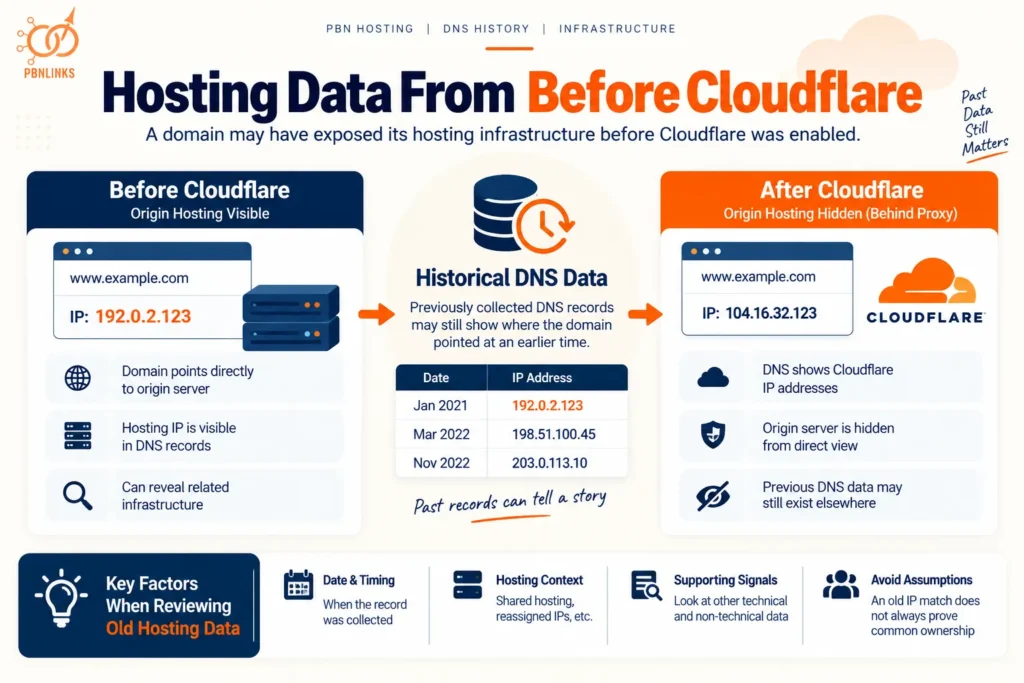
The timing of Cloudflare adoption matters because a domain may have exposed its hosting infrastructure before proxying was enabled.
Suppose several PBN sites were initially hosted on related infrastructure and later moved behind Cloudflare. Their current DNS records may no longer show that relationship directly, but previously collected DNS data could preserve evidence of where those domains pointed at an earlier time.
This does not mean every historical IP match proves common ownership. IP addresses can be reassigned, shared hosting is common, and websites can change providers. The date, hosting context, and other supporting signals all matter when interpreting an old record.
Shared Historical Origin Infrastructure
Historical data becomes more useful when it reveals repeated relationships across multiple domains.
Consider two situations:
Current similarity:
Several domains use Cloudflare.
This is broad because many unrelated websites use the same CDN provider.
Historical similarity:
Several domains previously resolved to the same or closely related origin infrastructure during overlapping periods.
That relationship can be more specific because it concerns the infrastructure behind the sites rather than Cloudflare’s widely shared edge network.
Even then, historical infrastructure should be treated as evidence to investigate rather than automatic proof of ownership. A shared IP may have hosted many unrelated customers, especially in a shared hosting environment.
Current DNS vs Historical DNS
The easiest way to understand the difference is:
| Current DNS | Historical DNS |
| Shows how a domain resolves now | Shows previously observed DNS relationships |
| May return Cloudflare infrastructure | May contain pre Cloudflare IP addresses |
| Helps evaluate the current setup | Adds context about earlier hosting |
| Can change when configuration changes | May preserve previously collected observations |
For PBN footprint analysis, looking only at the current configuration can therefore miss part of the infrastructure story.
Cloudflare can change what is visible today, but it cannot retroactively erase DNS observations already collected by independent third parties. The value of those historical records depends on their accuracy, timing, specificity, and whether other evidence supports the same relationship.
Historical hosting is only one side of the footprint question. The next issue is whether Cloudflare’s own DNS, nameservers, accounts, and configuration patterns can create similarities across PBN sites.
Can Cloudflare Create Its Own PBN Footprints?
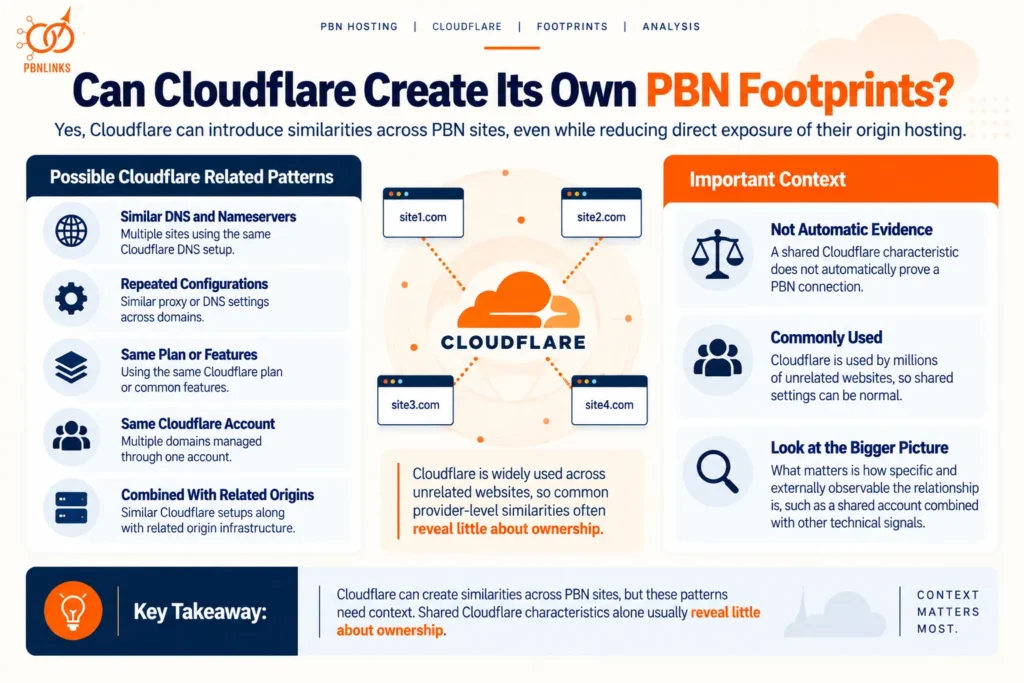
Yes, Cloudflare can introduce similarities across PBN sites, even while reducing direct exposure of their origin hosting. These similarities may appear in DNS, nameservers, account setup, or repeated configurations.
However, a shared Cloudflare characteristic is not automatically a meaningful PBN footprint. Cloudflare is widely used across unrelated websites, so common provider-level similarities often reveal little about ownership.
Possible Cloudflare related patterns include:
- Cloudflare DNS and nameserver similarities
- Repeated proxy or DNS configurations
- Use of the same plan or common Cloudflare features
- Multiple domains managed through the same Cloudflare account
- Similar Cloudflare setups combined with related origin infrastructure
Each pattern needs context. A shared Cloudflare account is an internal administrative relationship, but that does not automatically make it a publicly visible cross-domain identifier. Likewise, Free or paid plan usage alone says little about common ownership. What matters is how specific and externally observable the relationship is, which we will examine in the next section.
Which Cloudflare and CDN Signals Actually Matter for PBN Footprint Analysis?
Not every Cloudflare similarity carries the same weight. A useful Cloudflare CDN PBN analysis should distinguish common characteristics shared by millions of websites from more specific relationships involving the underlying infrastructure.
Same CDN Provider: Weak Signal
Several PBN sites using Cloudflare is a weak signal on its own. Cloudflare provides CDN, DNS, proxy, and security services to a huge number of unrelated websites.
The same principle applies to other major CDN providers. Provider overlap shows that sites use the same service, not that they have the same owner.
Cloudflare Edge IP Similarities: Limited Signal
Cloudflare edge IPs belong to shared CDN infrastructure rather than directly representing the origin server. Multiple unrelated websites can therefore appear on the same or related Cloudflare network infrastructure.
For this reason, an edge IP similarity should not be interpreted like an origin IP match. The first reflects the CDN layer, while the second can reveal a more direct hosting relationship.
Repeated DNS and Configuration Patterns: Contextual Signal
Repeated DNS or Cloudflare configuration patterns can provide additional context, but their value depends on how distinctive they are.
A common default setting may appear across many unrelated websites. A less common pattern repeated across the same group of domains can be more informative, especially when other technical relationships appear alongside it.
Historical Origin Relationships: Stronger Context
Historical DNS can reveal infrastructure that was visible before a domain moved behind Cloudflare. This becomes more relevant when several domains were connected to the same or related hosting infrastructure during overlapping periods.
Historical matches still require context. Shared hosting, IP reassignment, and hosting migrations can produce legitimate overlaps, so an old IP relationship should not be treated as automatic proof of common ownership.
Shared Origin Infrastructure: More Specific Signal
An identifiable relationship at the origin layer is generally more specific than simply finding several domains on the same CDN. This could involve sites pointing toward the same underlying server or closely related hosting infrastructure.
The key distinction is Cloudflare edge versus website origin. Shared edge infrastructure is expected on a large CDN, while a specific origin relationship can reveal much more about how the sites are actually hosted.
Why Corroboration Matters More Than a Single Match
No individual Cloudflare signal should be evaluated in isolation. Its value increases when independent technical evidence points toward the same relationship.
A useful way to think about the signals is:
Same CDN → Edge IP similarity → Repeated configuration → Historical origin relationship → Shared origin infrastructure
This is not a fixed detection formula. It simply shows why common provider-level similarities generally carry less information than specific, corroborated infrastructure relationships.
Cloudflare vs Other CDNs for PBN Hosting
Cloudflare is one option for placing a CDN or reverse proxy layer in front of a PBN site, but it is not the only one. Other CDN providers can also separate the public facing delivery layer from the origin server, although their networks, DNS requirements, proxy behavior, and available features can differ.
For PBN hosting, the important comparison is not simply Cloudflare vs another CDN. It is whether the chosen service changes what infrastructure is directly visible while still providing the performance, reliability, and security the site needs.
Some practical differences to consider include:
- Network coverage: CDN providers operate different edge networks and locations.
- DNS requirements: Some services integrate closely with authoritative DNS, while others can work with different DNS arrangements.
- Proxy behavior: How traffic reaches the CDN and then the origin varies by provider and configuration.
- Caching and performance: Available caching controls and delivery features can differ.
- Security features: DDoS protection, SSL/TLS options, firewall capabilities, and access controls vary between services.
- Management: Pricing, dashboards, automation, and configuration complexity can affect how practical a CDN is across multiple sites.
Using several CDN providers may create more diversity at the CDN layer, but that should not be confused with complete infrastructure diversity. Sites distributed across different CDNs can still share origin hosting, historical IP relationships, DNS patterns, ASN connections, or certificate data.
The provider name therefore matters less than the complete setup. Cloudflare, CloudFront, or another CDN can change the public facing infrastructure, but none should be treated as an automatic solution to every PBN footprint. The broader technical relationships between the domains still need to be considered.
How Does Cloudflare Fit Into the Bigger PBN Footprint Picture?
Cloudflare data is most useful when it is viewed alongside the rest of a site’s technical history. A Cloudflare similarity may be common on its own, but DNS, hosting, network, certificate, and domain history can provide additional context about whether several sites have more specific infrastructure relationships.
DNS and IP History
Current DNS shows how a domain is configured today, while historical DNS can reveal IP addresses and records observed in the past. This matters when a site currently sits behind Cloudflare but previously exposed different infrastructure.
Comparing current and historical records can help distinguish ordinary Cloudflare usage from relationships that existed before the CDN layer was added.
Hosting Provider and ASN Data
An IP address can also be examined in the context of the network that announces it. ASN and hosting provider information can help show whether apparently different IP addresses belong to related network infrastructure.
However, sharing a hosting provider or ASN is not proof of common ownership. Large networks host many unrelated websites, so these signals become more useful when they support other, more specific relationships.
SSL Certificates and Certificate Transparency
SSL certificates and Certificate Transparency records provide another layer of technical information. Depending on the certificate setup, they can reveal certificate history, issuance details, domain relationships, and other publicly recorded information.
A common Certificate Authority is generally a broad similarity. More specific certificate relationships can provide additional context when they align with DNS, IP, or hosting evidence.
Domain Registration and Historical WHOIS
Current WHOIS information may be privacy protected, redacted, or limited, but historical registration records can sometimes preserve older domain data.
As with Cloudflare, the key distinction is current visibility versus historical evidence. Moving a site behind a CDN does not change registration information that may already have been recorded by independent services.
The strongest analysis therefore does not ask whether Cloudflare alone reveals a PBN. It asks whether Cloudflare, DNS history, origin hosting, ASN data, SSL records, and domain history point toward the same relationship. A single broad similarity may mean little, while several independent and specific connections can provide much stronger context.
Common Cloudflare CDN PBN Myths
Cloudflare is often discussed in PBN hosting as either a complete footprint solution or a footprint problem of its own. Both views are too simple. Understanding what Cloudflare actually changes helps separate common assumptions from technically meaningful signals.
Myth 1: Cloudflare completely hides the origin server.
Cloudflare can reduce direct origin visibility when web traffic is properly proxied, but that does not guarantee the origin can never be identified. DNS configuration, unproxied services, and previously collected infrastructure data may still provide clues about the underlying hosting.
Myth 2: Every PBN site using Cloudflare shares a footprint.
Using the same major CDN is a broad similarity, not proof of common ownership. Many unrelated websites use Cloudflare, so provider overlap alone carries limited information.
Myth 3: One Cloudflare account is automatically publicly detectable.
Cloudflare can know which domains are managed within the same customer account, but an internal account relationship should not automatically be treated as a publicly visible cross-domain identifier. Public visibility and provider-side account data are different things.
Myth 4: Cloudflare Pro is automatically safer than Free.
Paid plans provide additional features and capabilities, but more features do not automatically mean fewer PBN footprints. Plan choice should not be used as a substitute for evaluating the actual infrastructure relationships between sites.
Myth 5: Moving a site to Cloudflare erases its old hosting history.
Cloudflare can change what is visible in the current setup, but it cannot retroactively remove DNS or IP observations already collected by independent third parties. Historical records may still show infrastructure used before Cloudflare was enabled.
Myth 6: Using different CDNs removes infrastructure connections.
Different CDN providers can create diversity at the public facing delivery layer, but the sites may still share relationships through origin hosting, DNS history, ASN data, certificates, or other infrastructure. CDN diversity and complete infrastructure independence are not the same thing.
How to Evaluate Cloudflare Footprints Across PBN Sites
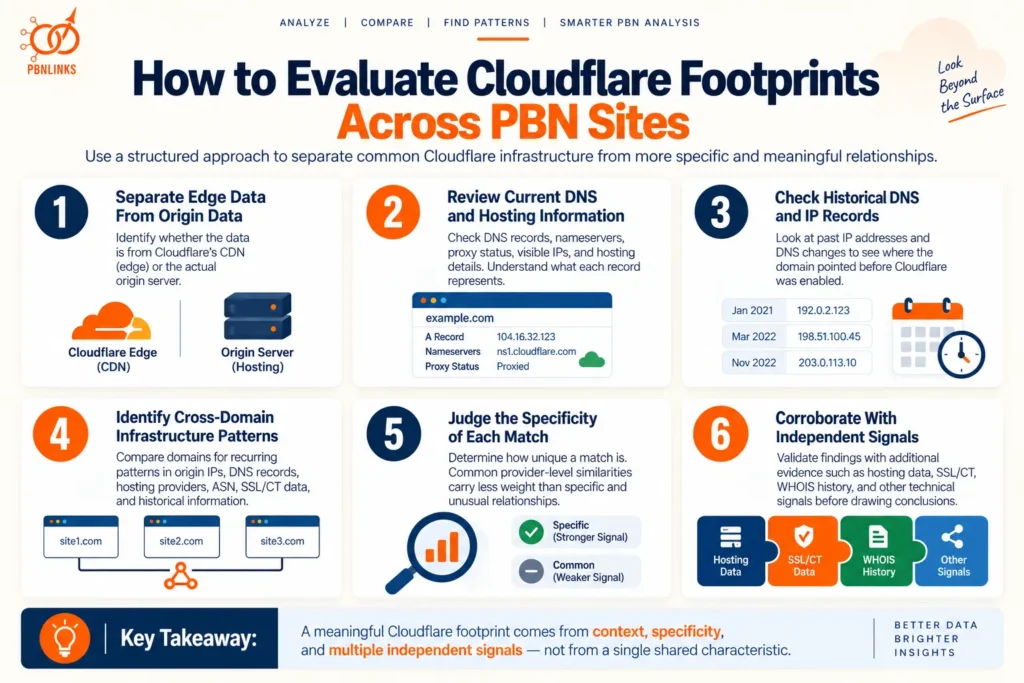
Evaluating Cloudflare footprints requires more than checking whether several domains use the same CDN. The goal is to separate common Cloudflare infrastructure from more specific relationships involving origin hosting, DNS, network data, and historical records.
A structured review also helps prevent weak signals from being given too much importance. The following six-step process moves from the public facing CDN layer toward more specific and corroborated infrastructure relationships.
Step 1: Separate Cloudflare Edge Data From Origin Data
Start by identifying what the technical data actually represents. A Cloudflare edge IP belongs to the CDN layer, while an origin IP relates to the infrastructure hosting the website behind Cloudflare.
This distinction matters because many unrelated websites can use Cloudflare’s shared edge network. Finding two domains on Cloudflare infrastructure therefore does not mean they share the same web server, hosting account, or owner.
The origin layer is different. If reliable data connects multiple domains to the same or closely related origin infrastructure, that relationship can provide more specific information about how the sites are hosted.
Before evaluating any IP based similarity, ask one question first: is this Cloudflare infrastructure or actual origin infrastructure?
Step 2: Review Current DNS and Hosting Information
Next, examine what each domain exposes in its current configuration. This creates a snapshot of the site’s infrastructure as it exists today.
Relevant information can include DNS records, Cloudflare nameservers, proxy status, visible IP addresses, hosting information, and records associated with subdomains or other services. Not every visible record will necessarily point to the main web origin, so each record needs to be interpreted according to its purpose.
It is also useful to distinguish provider-level similarities from domain-specific relationships. Two sites using Cloudflare DNS is very different from two sites exposing a more specific connection at the origin or hosting layer.
The purpose of this step is therefore not to find as many similarities as possible. It is to establish what is currently visible and what each piece of data actually represents.
Step 3: Check Historical DNS and IP Records
Current infrastructure only shows part of the picture. Historical DNS and IP data can reveal how a domain was configured before Cloudflare was enabled or before its hosting setup changed.
Look for previously observed IP addresses, changes in DNS records, and earlier hosting relationships. If several domains were associated with the same or related infrastructure during overlapping periods, that historical connection may provide useful context that is no longer visible through current Cloudflare resolution.
Timing is especially important. An IP used by two domains years apart may have a very different meaning from several domains pointing toward related infrastructure during the same period.
Historical matches also require caution because IP addresses can be reassigned and shared hosting can place unrelated sites on the same server. Historical data becomes more useful when the timing, infrastructure, and other signals support the same relationship.
Step 4: Identify Cross Domain Infrastructure Patterns
Once each domain has been reviewed individually, compare the sites to identify relationships that repeat across the network.
Useful comparisons can include:
- Origin IP and hosting relationships
- Current and historical DNS records
- Hosting provider and ASN information
- Nameserver and DNS configuration patterns
- SSL and Certificate Transparency data
- Historical domain registration information
Do not simply count how many fields match. A common characteristic appearing across hundreds of thousands of unrelated websites carries very different weight from a specific technical relationship repeatedly appearing within the same group of domains.
The goal is to identify patterns that persist across different infrastructure layers, rather than treating one shared Cloudflare characteristic as the entire footprint.
Step 5: Judge the Specificity of Each Match
After identifying similarities, determine how distinctive each one actually is.
Several sites using Cloudflare is a broad provider-level relationship. The same can apply to common nameservers, widely used certificate authorities, popular hosting companies, or other infrastructure shared by large numbers of unrelated websites.
More specific relationships deserve closer attention. These may include repeated historical origin connections or other technical patterns that are much less likely to result simply from using a popular service.
A useful principle is:
The more common a characteristic is across the wider web, the less useful it generally becomes as a standalone ownership signal.
Specificity should still be considered alongside context. Even a seemingly strong match can have an innocent explanation, particularly on shared infrastructure.
Step 6: Corroborate With Independent Signals
The final step is to avoid drawing a conclusion from one Cloudflare, DNS, or hosting match. Instead, compare the finding with independent technical evidence.
For example, a broad Cloudflare similarity becomes more interesting if the same domains also show related historical origins, DNS patterns, hosting or ASN relationships, certificate data, or historical WHOIS connections.
The strongest analysis therefore looks for agreement across different data sources rather than repeatedly counting variations of the same underlying signal. Several Cloudflare related observations may still represent only one provider-level relationship.
When independent and reasonably specific signals point toward the same group of domains, the overall relationship becomes more meaningful than any individual match considered alone.
The practical framework is:
Edge vs Origin → Current Data → Historical Data → Cross Domain Patterns → Specificity → Corroboration
This approach keeps Cloudflare CDN PBN footprint analysis in the proper context. The key question is not simply whether multiple PBN sites use Cloudflare, but what the observed similarities actually represent, how specific they are, and whether independent infrastructure evidence supports the same relationship.
Frequently Asked Questions About Cloudflare CDN PBNs
Does Cloudflare hide a PBN’s origin IP?
Yes. When eligible web records are proxied, Cloudflare returns its own anycast IPs instead of the origin server’s IP. However, DNS-only records or other exposed services can still reveal the origin.
Can Cloudflare create a PBN footprint?
Yes, but Cloudflare usage alone is a weak footprint. Repeated DNS, configuration, or infrastructure relationships become more meaningful when they are specific and supported by other independent signals.
Do Cloudflare nameservers create a PBN footprint?
Cloudflare nameservers can create a visible similarity between domains, but they do not prove common ownership. Cloudflare automatically assigns standard nameservers, and similar nameserver assignments can occur across zones.
Is using Cloudflare on every PBN site a footprint?
It creates a common provider-level pattern, but that pattern alone is weak. Cloudflare is widely used, so stronger analysis requires more specific evidence from DNS, origin hosting, historical records, or other infrastructure.
Can websites in the same Cloudflare account be publicly connected?
Not simply from the fact that they share an account. Account membership is internal Cloudflare information, although publicly observable configuration details, such as nameserver patterns, may sometimes create similarities between domains.
Is Cloudflare Free suitable for PBN sites?
Technically, Cloudflare Free provides DNS and proxy functionality that can place Cloudflare between web visitors and an origin server. Whether it is suitable depends on the site’s performance, security, and configuration requirements rather than PBN footprint concerns alone.
Is Cloudflare Pro safer for PBNs than the Free plan?
Not automatically. A paid Cloudflare plan provides additional capabilities, but upgrading does not by itself remove DNS, hosting, historical, or other infrastructure relationships between sites.
Can historical DNS reveal an origin IP behind Cloudflare?
Yes. Historical DNS databases may contain IP addresses observed before a domain was proxied through Cloudflare. These records can reveal earlier hosting relationships, although shared hosting, IP reassignment, and timing must be considered before drawing conclusions.
Does Cloudflare completely hide the real hosting provider?
No. Cloudflare can obscure the origin IP from normal DNS resolution for proxied records, but it does not guarantee that the underlying hosting infrastructure can never be identified through other current or historical data.
Is sharing a Cloudflare IP evidence that websites have the same owner?
No. Cloudflare uses shared anycast infrastructure, so unrelated websites can resolve through Cloudflare IP addresses. A shared Cloudflare edge IP should not be treated like a shared origin server IP when evaluating ownership relationships.