WHOIS Privacy vs Public Registration for PBN Domains
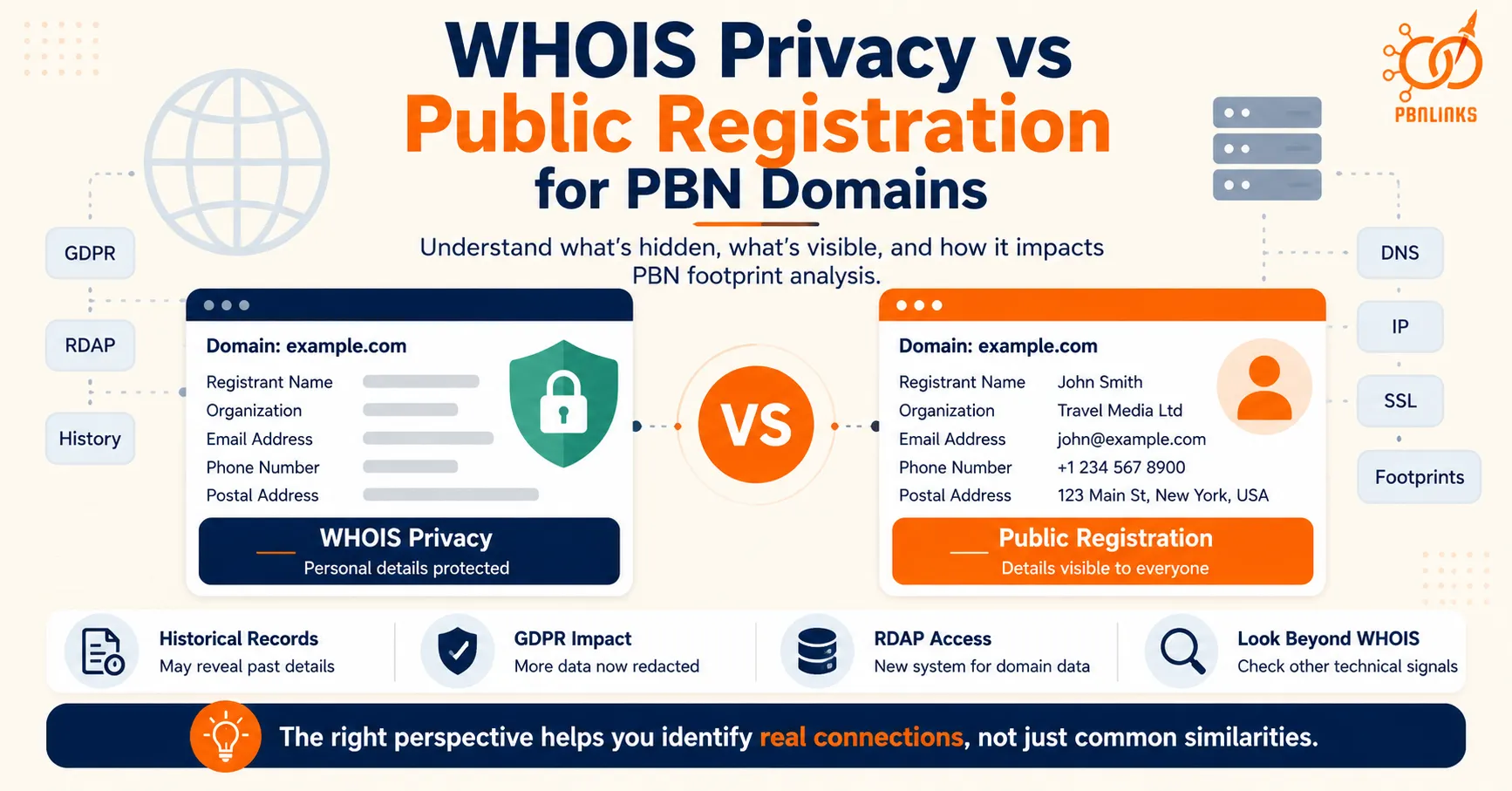
When setting up PBN domains, one of the basic decisions is whether to keep the registration details private or leave them publicly visible. It may seem like a small setting, but the information connected to a domain can reveal useful clues about who registered it and whether it shares patterns with other domains.
PBN WHOIS privacy helps keep details such as a registrant name, email address, phone number, and physical address out of public view. Public registration can expose some of this information and create a much clearer connection when the same details appear across several domains. At the same time, simply using the same registrar or privacy provider does not automatically mean those domains belong to the same network.
There is also more to check than the registration record you see today. Historical WHOIS data may preserve details that were publicly available before privacy was enabled or ownership changed. GDPR has also changed how much personal registration information is normally displayed, while RDAP has changed how current domain registration data is accessed.
So the real question is not simply whether WHOIS privacy or public registration is better. It is which registration details create meaningful connections and which are only common similarities. In this guide, we will compare both approaches and explain how current WHOIS data, historical records, GDPR, RDAP, and other technical signals fit into PBN footprint analysis.
What Is PBN WHOIS Privacy and What Does It Actually Hide?
PBN WHOIS privacy is domain privacy protection used to keep a domain owner’s personal registration details from being publicly visible. When privacy protection is enabled, identifying information associated with the registrant can be hidden or replaced with details provided by a privacy or proxy service.
For PBN domains, the purpose is simple. If the same personal information appears publicly across several domains, it can create a clear connection between them. WHOIS privacy reduces this direct exposure by limiting the registrant details available through public domain registration lookups.
What Information Does WHOIS Privacy Hide?
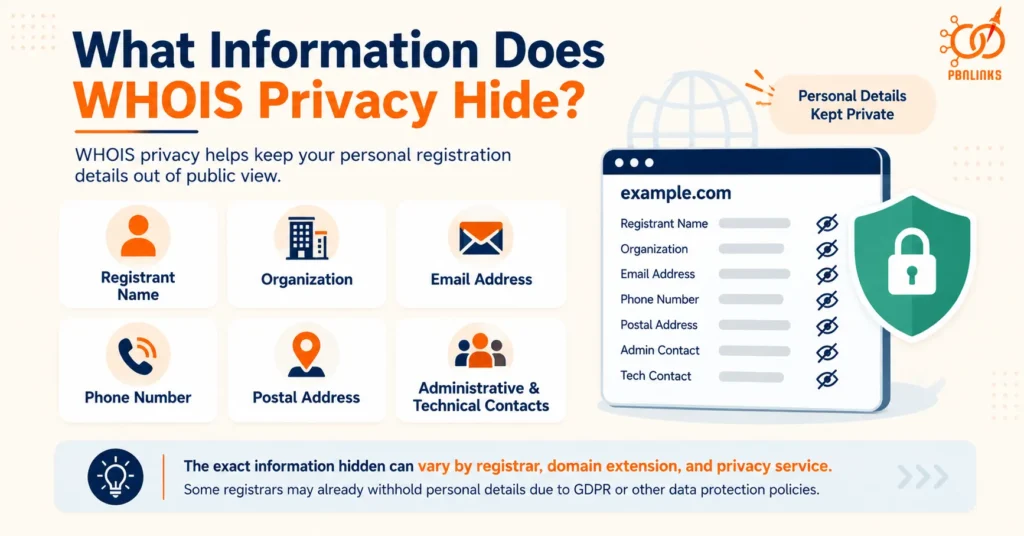
The exact information protected depends on the registrar, domain extension, and privacy service. Common details that may be hidden or replaced include:
- Registrant name: The name of the person associated with the domain registration.
- Organization: Business or organization details associated with the registrant.
- Email address: The registrant’s direct contact email.
- Phone number: The telephone number provided with the registration.
- Postal address: The registrant’s street address, city, and postal information.
- Administrative and technical contacts: Additional contact details where these fields apply.
What appears publicly can vary between registrars and domain extensions. In some cases, personal registration information may already be withheld from public view even when a separate privacy service is not being used. We will explain this distinction later when looking at GDPR and registration data redaction.
What Information Can Still Remain Visible?
WHOIS privacy does not make the entire domain registration invisible. Depending on the registry and registrar, public registration data can still include nonpersonal information such as:
- Registrar
- Domain creation date
- Last updated date
- Expiration date
- Domain status
- Nameservers
This distinction is important. WHOIS privacy mainly protects personal registrant information. It does not hide every registration detail associated with a domain.
How Does WHOIS Privacy Compare With Public Registration for PBN Domains?
The main difference between WHOIS privacy and public registration is whether identifying registrant information is publicly visible. WHOIS privacy limits the personal details shown in public registration data, while public registration may leave those details accessible when they are not otherwise redacted.
For PBN domains, this difference matters because publicly visible ownership information can make relationships between domains easier to identify. Privacy reduces that direct exposure, but it does not make the entire registration record disappear.
WHOIS Privacy for PBN Domains
With WHOIS privacy enabled, personal registrant information is generally hidden or replaced with details associated with a privacy or proxy service.
This can include information such as:
- Registrant name
- Organization details
- Email address
- Phone number
- Postal address
For a PBN, the main advantage is that the owner’s personal information is not openly repeated across multiple domain records. If several domains belong to the same person, privacy can therefore reduce obvious ownership connections created by identical public contact details.
However, other registration information may still remain visible, so WHOIS privacy should not be treated as complete anonymity.
Public Registration for PBN Domains
With public registration, identifying information about the registrant may be visible when the registrar and registry make those fields publicly available.
This creates a different situation for PBN domains. If the same name, organization, email address, phone number, or postal address appears across several domains, those records can provide a direct connection between them.
Public registration does not automatically mean that a domain is connected to a PBN. The concern arises when identifying information is repeated across domains that are supposed to appear independently operated.
In simple terms, WHOIS privacy reduces the public exposure of personal ownership details, while public registration can make those details visible. Neither should be evaluated in isolation. What matters is the information that can actually be seen and how specifically it connects one domain to another.
Which WHOIS Signals Matter Most for PBN Footprint Analysis?
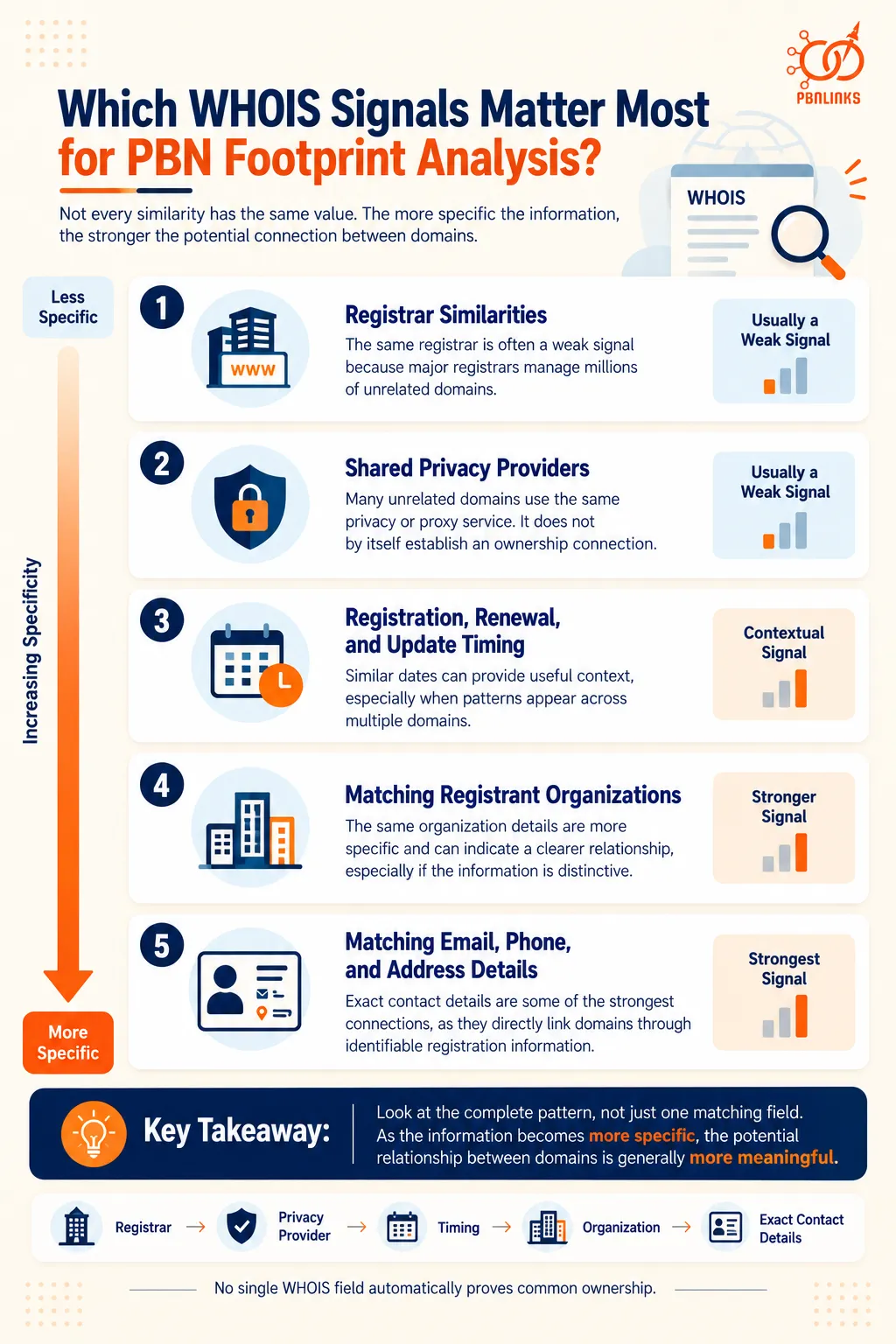
Not every similarity in domain registration data has the same value. Some WHOIS signals are common across thousands of unrelated domains, while others can create a much more specific connection between a group of sites.
For PBN footprint analysis, the useful approach is to look at how specific each match is. A shared registrar or privacy provider is usually a broad similarity. Matching ownership or contact details can provide a much clearer relationship between domains.
Registrar Similarities
Several PBN domains using the same registrar can create a visible pattern, but the registrar alone is generally a weak ownership signal.
Large registrars manage millions of unrelated domains. Finding five sites registered with the same major provider does not tell you that the same person owns them.
Registrar similarity becomes more useful when it appears repeatedly alongside other connections, such as similar registration dates or matching registrant information.
Shared Privacy Providers
The same principle applies to privacy providers. Multiple domains can display the same privacy or proxy service simply because that provider protects a large number of customers.
Therefore, using the same WHOIS privacy provider does not by itself establish a connection between PBN domains.
A shared privacy provider becomes more interesting when the same group of domains also shows other unusual registration or technical similarities.
Registration, Renewal, and Update Timing
Domain dates can provide additional context when patterns repeatedly appear across several domains.
For example, a group of domains may show:
- Similar registration dates
- Renewals within the same period
- Closely matched update dates
- Repeated changes around the same time
A single matching date can easily be a coincidence. A repeated timing pattern across the same group of domains can be more meaningful, especially when other similarities are present.
For this reason, registration timing is better treated as a contextual signal rather than direct evidence of common ownership.
Matching Registrant Organizations
Matching organization details are more specific than simply using the same registrar or privacy provider.
If several publicly available registration records list the same business or organization, there is a clearer reason to investigate whether the domains are related.
The value of the match still depends on how distinctive the organization information is. A specific organization consistently appearing across several domains generally provides a stronger connection than a broad registration characteristic shared by many unrelated websites.
Matching Email, Phone, and Address Details
Exact contact details can provide some of the strongest connections available in public registration data.
Examples include several domains showing the same:
- Email address
- Phone number
- Postal address
- Registrant name combined with matching contact details
These matches are much more specific because they can connect domains through identifiable registration information rather than a commonly used service.
A useful way to think about the progression is:
Registrar → Privacy Provider → Timing → Organization → Exact Contact Details
As the information becomes more specific, the potential relationship between domains generally becomes more meaningful. No single field should automatically be treated as proof of PBN ownership, but exact and repeated registrant details deserve much more attention than broad similarities shared by large numbers of unrelated domains.
What Can Historical WHOIS Reveal About PBN Domains?
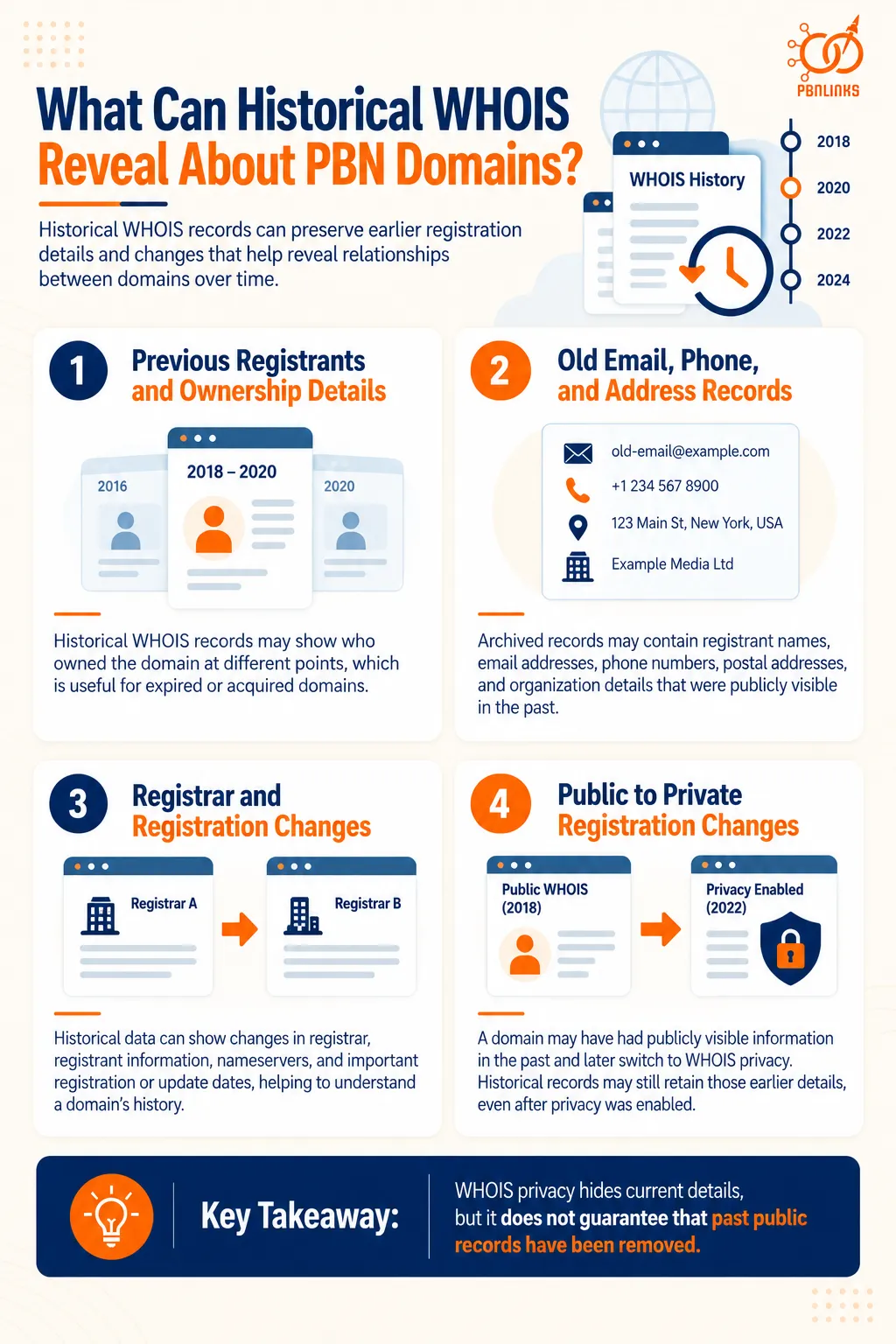
Current registration data shows what is publicly available about a domain now, but it does not necessarily show what was visible in the past. Historical WHOIS records can preserve earlier registration details and changes that help reveal relationships between domains over time.
This matters for PBNs because enabling privacy today does not necessarily erase information that was previously public. An older WHOIS record may contain registrant details that are no longer visible in the current record.
Previous Registrants and Ownership Details
Historical WHOIS records may show who was associated with a domain at different points in its registration history.
This can be particularly useful with expired or acquired domains. A domain may have belonged to one person or business before being dropped, auctioned, transferred, or purchased by a new owner.
Looking at previous registrants can therefore help separate old ownership information from details connected to the current registration period.
Old Email, Phone, and Address Records
Personal contact information that is hidden today may have appeared publicly in older registration records.
Depending on what was historically available, archived records may contain:
- Registrant names
- Email addresses
- Phone numbers
- Postal addresses
- Organization details
If the same specific contact information appeared across several domains during the same ownership period, it can provide a more direct historical connection between them.
The timing is important. A matching address or email from a previous owner should not automatically be attributed to the person who controls the domain today.
Registrar and Registration Changes
Historical records can also show how a domain’s registration setup changed over time.
For example, they may reveal:
- Changes from one registrar to another
- Updates to registrant information
- Changes in nameservers
- Important registration or update dates
- Changes associated with a transfer or new ownership period
These changes help provide context around a domain’s history. A registrar change alone does not establish common ownership, but a series of similar changes across several domains can be worth examining alongside other evidence.
Public to Private Registration Changes
A domain that uses WHOIS privacy today may previously have had publicly visible registrant information.
For example, a domain could initially display an owner’s name and contact details and later switch to privacy protection. The current record may hide those details, but historical WHOIS services may still retain earlier snapshots.
This is why turning on WHOIS privacy should not be assumed to remove past public registration data. Privacy mainly affects what is exposed now rather than guaranteeing that older records disappear.
Current Records vs Historical Records
Current and historical registration data answer different questions.
Current records help show what registration information is publicly available now. Historical records can show how that information looked and changed in the past.
For PBN footprint analysis, the two are more useful when considered together. A current record may reveal very little identifying information, while an older record may provide important context about previous ownership or registration changes.
Historical WHOIS should still be interpreted carefully. Old information can belong to a previous owner, and historical databases may not contain a complete record for every domain. The goal is therefore not to treat every old match as proof, but to understand when the information appeared, who it likely belonged to, and whether it is supported by other evidence.
How Has GDPR Changed WHOIS and Domain Registration Data?
GDPR changed how personal information in domain registration records is made available to the public. Before these privacy rules took effect, WHOIS lookups often exposed registrant details such as names, email addresses, phone numbers, and postal addresses. Today, much of that personal information is commonly withheld from public registration results.
For PBN analysis, this means that missing registrant information does not necessarily mean a domain owner enabled WHOIS privacy. The information may instead be unavailable because of registrar or registry data protection practices.
Reduced Public Access to Personal Registration Data
Since GDPR took effect in 2018, public access to personal domain registration information has become much more limited.
Depending on the domain and registration provider, details such as the following may no longer appear publicly:
- Registrant name
- Personal email address
- Phone number
- Street address
- Other personal contact information
As a result, modern registration records often provide less direct ownership information than older WHOIS records did.
This is one reason historical WHOIS data can be useful. Older records may contain information that is no longer publicly displayed today.
Registrar and Registry Redaction
Registrars and registries may withhold certain registration fields from public view. A lookup may therefore show terms such as “REDACTED FOR PRIVACY” or provide limited information instead of the registrant’s actual personal details.
This is important because redaction can occur without the domain owner using a separate WHOIS privacy or proxy service.
In other words, seeing hidden information in a registration record does not tell you by itself why that information is unavailable.
WHOIS Privacy vs GDPR Era Redaction
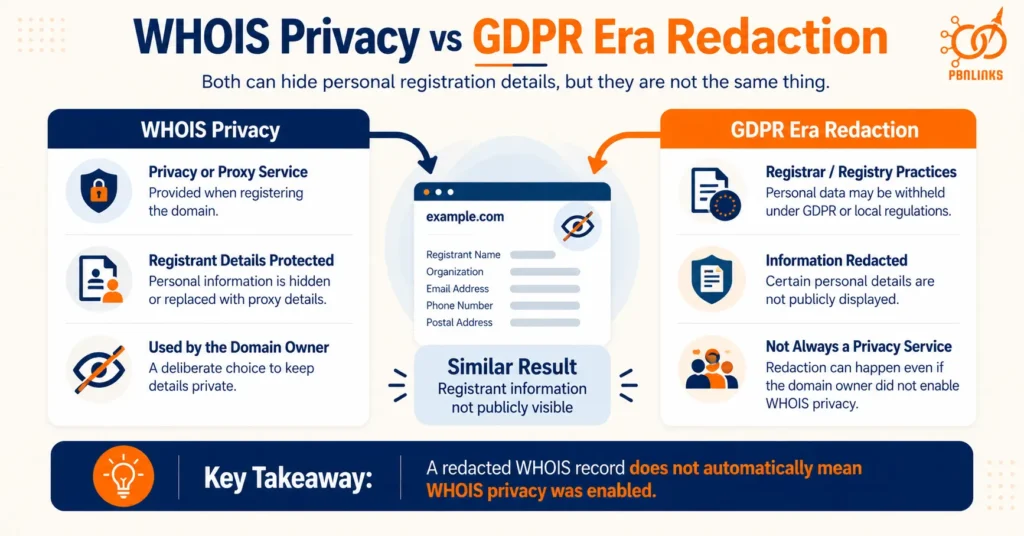
WHOIS privacy and GDPR related redaction can produce a similar result for someone viewing a domain record, but they are not the same thing.
WHOIS privacy involves privacy or proxy protection associated with the domain registration. Redaction occurs when personal registration information is withheld from public disclosure under the registrar’s, registry’s, or applicable data protection practices.
For PBN domains, this distinction matters because a redacted record should not automatically be interpreted as evidence that the owner deliberately configured WHOIS privacy.
PBN Footprint Analysis After GDPR
GDPR has made direct comparisons of current public registrant information more limited. Names, emails, phone numbers, and addresses that were once easier to compare may now be unavailable.
That does not mean WHOIS related footprints have disappeared. It means the available information needs to be interpreted differently.
Current registration data can still provide useful nonpersonal information, while historical WHOIS records may add context about information that was previously public. When current registrant details are unavailable, WHOIS data also becomes more useful when considered alongside other relevant domain and technical information.
The key point is simple: GDPR reduced the amount of personal registration data available publicly, but it did not make domain registration data useless for PBN footprint analysis.
What Is the Difference Between WHOIS and RDAP?
WHOIS and RDAP are both associated with accessing domain registration information, but they are not the same system. WHOIS is the older protocol that people have used for decades to look up domain registration records, while RDAP is the newer, standardized system designed to provide registration data in a more structured way.
For PBN analysis, understanding this difference matters because many SEOs still use the term “WHOIS” when discussing domain ownership and registration footprints, even though current registration data for generic top level domains is now delivered through RDAP.
WHOIS
WHOIS is the older protocol traditionally used to retrieve domain registration information. Depending on the domain and the period being examined, WHOIS records could contain information such as:
- Registrar
- Registrant details
- Registration and expiration dates
- Domain status
- Nameservers
- Administrative and technical contacts
One limitation of WHOIS was that the format and availability of information could vary between registries and registrars. Privacy changes and data protection requirements also reduced how much personal registrant information remained publicly accessible.
RDAP
RDAP stands for Registration Data Access Protocol. It was developed as a modern replacement for WHOIS and provides registration information in a more standardized, structured format.
For generic top level domains, RDAP became the standard source for registration data after WHOIS services were phased out under ICANN requirements in January 2025.
RDAP can provide information such as the registrar, registration dates, domain status, nameservers, and other available registration data. Personal information may still be withheld or redacted, so RDAP does not restore registrant details that are restricted from public access.
Why SEOs Still Talk About “WHOIS”
Despite the move to RDAP, WHOIS remains the familiar term in SEO and domain research. Phrases such as WHOIS privacy, WHOIS history, and WHOIS footprints are still widely used when discussing domain registration information.
There is also an important distinction between current registration data and historical WHOIS records. RDAP provides a modern way to access current registration information, while historical WHOIS databases may contain older registration snapshots collected before current privacy and redaction practices.
What Registration Patterns Can Appear Across Multiple PBN Domains?
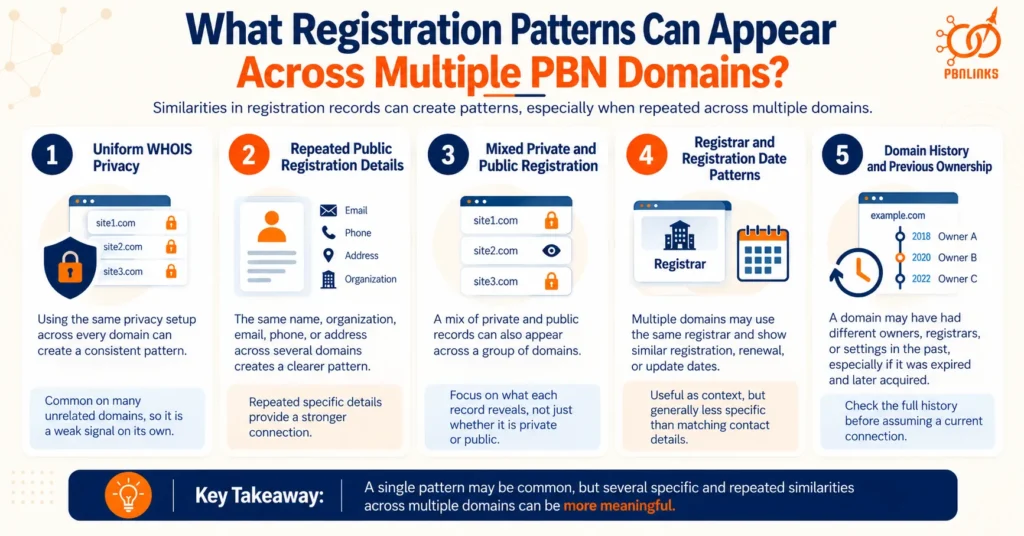
When several PBN domains are managed by the same person or team, similarities can sometimes appear in their registration records. These patterns do not automatically prove that the domains belong to the same network, but they can become more noticeable when the same setup is repeated across multiple sites.
The most relevant patterns involve how domains are registered, whether registrant information is private or public, and when registration activity takes place.
Uniform WHOIS Privacy
One possible pattern is using the same privacy setup across every domain in a network.
For example, all domains may have privacy protection enabled and display the same widely used privacy provider. This creates consistency across the network, but the pattern needs context.
A common privacy provider may appear on thousands or millions of unrelated domains. For that reason, uniform WHOIS privacy alone is usually not enough to establish a meaningful connection.
The pattern becomes more relevant when it repeatedly appears alongside other similarities across the same group of domains.
Repeated Public Registration Details
Public registration can create a much clearer pattern when the same identifiable information appears across several domains.
Repeated details may include:
- Registrant name
- Organization
- Email address
- Phone number
- Postal address
The more specific the repeated information is, the easier it becomes to associate the domains with the same registrant.
This is different from a broad pattern such as using the same registrar. Repeated personal or organizational details create a more direct connection because they relate to the registrant rather than a service used by many domain owners.
Mixed Private and Public Registration
A group of domains may also contain a mixture of private and public registration records.
At first glance, this can look less uniform than making every domain private. However, a mixed setup should not automatically be considered more natural or less detectable.
If the publicly registered domains expose the same identifiable information, they may create a stronger connection regardless of how the remaining domains are configured.
The important factor is therefore what each record reveals, rather than whether the network follows one registration setup or several.
Registrar and Registration Date Patterns
Registration patterns can also appear through registrar choice and timing.
For example, several domains might:
- Use the same registrar
- Be registered within a short period
- Be renewed around similar dates
- Show updates during the same period
These patterns are generally less specific than matching registrant contact details. Many unrelated domains use the same major registrar, and similar dates can occur naturally.
However, repeated combinations across the same group of domains can provide additional context when other connections are already present.
Domain History and Previous Ownership
Current registration patterns do not always tell the full story, especially when PBNs are built with expired or previously owned domains.
A domain may have changed owners, registrars, nameservers, or privacy settings before becoming part of its current setup. As a result, an older registration pattern may belong to a previous owner rather than the current one.
This is why domain history should be considered before treating a registration similarity as a current PBN connection. The timing and ownership period behind the information can be just as important as the matching detail itself.
Overall, registration patterns are most useful when viewed in context. A single shared characteristic may be common, while several specific and repeated similarities across the same domains can create a much clearer relationship.
How Should WHOIS Data Be Compared With Other PBN Footprints?
WHOIS data is more useful when it is not evaluated in isolation. A registration similarity may be common on its own, but it can become more meaningful when the same domains also share related DNS, hosting, network, or certificate signals.
For PBN footprint analysis, the goal is to look for corroboration. If several independent technical signals point toward the same relationship, that connection deserves more attention than a single shared WHOIS field.
WHOIS and DNS or Nameserver Data
WHOIS or registration data can be compared with the DNS configuration of the same domains.
For example, domains may share registration characteristics while also using:
- The same nameservers
- Closely related nameserver patterns
- Similar DNS providers
- Other repeated DNS configurations
Using the same popular DNS provider or nameserver service is not unusual by itself. The pattern becomes more relevant when it appears across the same domains that already share more specific registration information.
WHOIS and IP or Hosting Data
Hosting information provides another layer of context.
If domains with similar registration records also resolve to the same IP address or closely related hosting infrastructure, the combined pattern may provide a stronger connection than either signal alone.
The context still matters. Shared hosting platforms can place many unrelated websites on the same infrastructure, so an IP or hosting match should not automatically be treated as proof of common ownership.
WHOIS and ASN Data
An Autonomous System Number, or ASN, identifies a network operated by a hosting provider, ISP, or other organization.
Several domains using infrastructure within the same ASN can indicate that they rely on the same network provider. However, large hosting companies can operate networks containing huge numbers of unrelated websites.
ASN overlap is therefore usually more useful as supporting context. If the same domains also share distinctive registration, DNS, or hosting patterns, the combined relationship becomes more informative.
WHOIS and SSL Certificate Data
SSL certificates can provide another technical layer for comparison.
Registration information can be reviewed alongside certificate details such as:
- Certificate relationships between domains
- Subject Alternative Names
- Certificate issuance information
- Validity periods
- Certificate activity over time
Common certificate characteristics do not always indicate common ownership. For example, many unrelated websites use the same Certificate Authority. More specific certificate relationships can provide stronger context when they align with WHOIS and infrastructure similarities.
WHOIS and Certificate Transparency Records
Certificate Transparency records provide public information about SSL certificates issued for domains. They can sometimes reveal certificate relationships or historical activity that is not obvious from the current website alone.
For example, if several domains already share relevant registration characteristics, CT records may provide additional context through certificate relationships, SANs, or certificate history.
The key principle is corroboration rather than simple matching. A shared registrar, nameserver, hosting provider, ASN, or Certificate Authority can occur naturally across unrelated websites. When several independent and sufficiently specific signals repeatedly connect the same domains, however, the overall relationship becomes more meaningful.
For PBN footprint analysis, WHOIS is therefore best treated as one layer of evidence within a broader technical picture, rather than a standalone test for determining whether domains belong to the same network.
What Are the Most Common PBN WHOIS Privacy Mistakes?
Most WHOIS mistakes happen when one registration detail is treated as more meaningful than it actually is. PBN WHOIS privacy should be evaluated based on the specificity of the information, its history, and the other signals surrounding it, rather than relying on simple rules such as “private is safe” or “public is risky.”
Here are the most common mistakes to avoid when interpreting WHOIS information across PBN domains.
Treating WHOIS Privacy as Complete Anonymity
WHOIS privacy mainly limits the personal registrant information displayed publicly. It does not make a domain anonymous or remove every piece of registration data associated with it.
Information such as the registrar, important registration dates, domain status, and nameservers may still be available. Other technical data connected to the domain can also exist outside registration records.
The mistake is assuming that enabling privacy removes every possible connection between domains. WHOIS privacy protects certain registration details, not the entire technical footprint of a website.
Assuming Every Shared Privacy Provider Is a Footprint
Seeing the same privacy provider across several domains can look suspicious at first, but this is often a broad similarity.
Popular privacy and proxy services can appear across large numbers of unrelated domains. A shared provider therefore has limited value when there is nothing else connecting the sites.
It becomes more relevant when the same domains also share other, more specific registration or technical characteristics.
Treating the Same Registrar as Proof of Common Ownership
The same registrar across multiple domains does not prove that those domains have the same owner.
Major registrars manage enormous numbers of domains, so overlap is expected. Registrar similarity can provide context, but it should not be treated like matching personal registrant information.
The more common the service, the weaker the similarity usually is on its own.
Assuming Public Registration Always Looks More Natural
Making some domains public simply to create variation does not automatically make a network look more natural.
Public registration can actually expose stronger connections if the same name, organization, email, phone number, or address appears across several domains.
The important question is not whether a record is private or public. It is what information the record exposes and how specifically that information connects the domains.
Ignoring Historical WHOIS Records
Checking only the current registration record can leave out important context.
A domain that is private today may have previously displayed registrant information publicly. Historical records can also show earlier owners, contact details, registrar changes, and changes from public to private registration.
This is especially important for expired or acquired domains because older information may belong to a previous owner. Historical data should therefore be considered together with the period in which it appeared.
Assuming GDPR Eliminated WHOIS Footprints
GDPR significantly reduced public access to personal registration information, but it did not make all domain registration data disappear.
Registrars, dates, domain status, nameservers, and other nonpersonal information may still be available. Historical WHOIS databases may also contain older records from periods when more information was publicly accessible.
GDPR changed what can commonly be seen, rather than eliminating WHOIS related analysis altogether.
Treating Every Matching WHOIS Field Equally
This is one of the biggest mistakes in WHOIS footprint analysis.
A shared registrar is not equivalent to a shared email address. Likewise, using the same popular privacy provider is not equivalent to several domains displaying the same phone number or specific organization.
WHOIS matches should therefore be judged by how distinctive and identifying they are. Broad similarities may provide little information, while exact registrant details can create much clearer connections.
The key is to avoid making conclusions from a single field. Specificity, timing, history, and supporting technical evidence all help determine how meaningful a WHOIS similarity actually is.
How Can You Evaluate WHOIS Footprints Across PBN Domains?
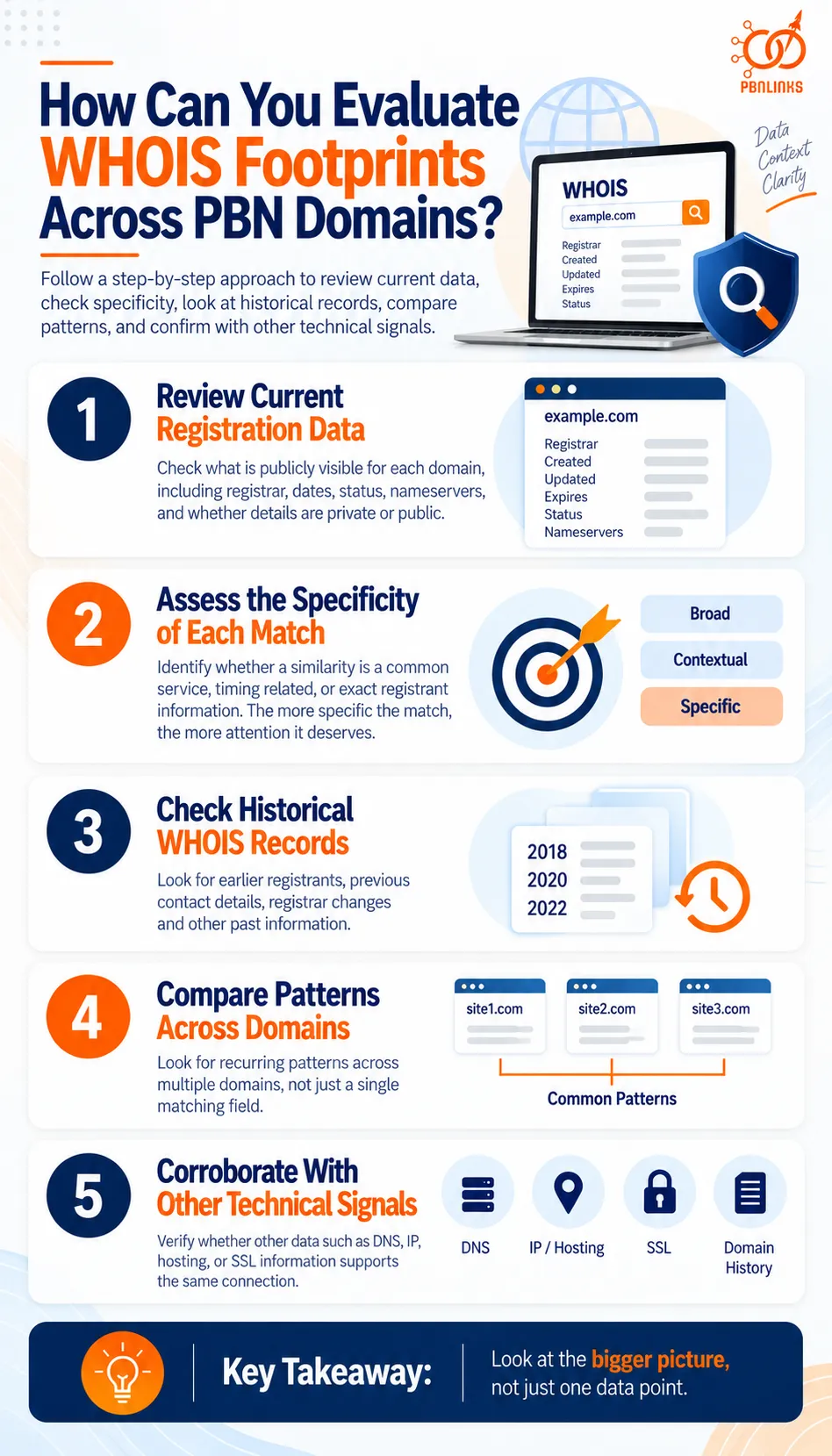
Evaluating WHOIS footprints is not about finding one matching field and immediately assuming the domains are connected. A better approach is to review what is visible now, how specific each similarity is, what appeared historically, and whether other technical data supports the same connection.
The following process provides a practical way to evaluate WHOIS information across multiple PBN domains.
Step 1: Review Current Registration Data
Start by checking the current registration data available for each domain.
Look at information such as:
- Registrar
- Creation date
- Last updated date
- Expiration date
- Domain status
- Nameservers
- Available registrant or organization details
- Whether personal information is private, redacted, or publicly visible
The purpose at this stage is simply to understand what each domain currently exposes. Avoid drawing conclusions from a single similarity.
Step 2: Assess the Specificity of Each Match
Next, consider how distinctive each matching detail actually is.
A useful way to think about the difference is:
Broad signals: Same major registrar or commonly used privacy provider.
Contextual signals: Similar registration, renewal, or update timing.
More specific signals: Matching organization or identifiable registrant information.
Direct signals: Exact email addresses, phone numbers, postal addresses, or combinations of matching personal details.
The more specific a match becomes, the more attention it deserves. Common services shared by large numbers of unrelated domains should carry less weight than exact identifying information.
Step 3: Check Historical WHOIS Records
Current records may not show information that was publicly available in the past. Historical WHOIS data can help fill in that gap.
Check whether older records reveal:
- Previous registrants
- Earlier email addresses
- Old phone numbers or addresses
- Previous organizations
- Registrar changes
- Changes from public to private registration
Pay close attention to when the information appeared. With expired or acquired domains, an old registrant may have no connection to the current owner.
Step 4: Compare Patterns Across Domains
Once each domain has been reviewed individually, compare the findings across the network.
Instead of asking whether two domains share one characteristic, look for patterns that repeatedly appear across the same group of domains.
For example, a single registrar match may mean very little. If the same domains also have closely related registration activity and more specific ownership similarities, the combined pattern becomes more informative.
This helps separate common coincidences from relationships that deserve closer examination.
Step 5: Corroborate WHOIS With Other Technical Signals
Finally, compare the registration findings with other available domain and infrastructure data.
Relevant signals can include:
- DNS and nameserver patterns
- IP addresses and hosting infrastructure
- ASN information
- SSL certificate data
- Certificate Transparency records
- Domain history
The purpose is not to count every similarity as another footprint. It is to see whether independent sources of information point toward the same relationship.
A practical WHOIS review therefore follows a simple process:
Current Data → Specificity → History → Cross Domain Patterns → Corroboration
This approach provides a more reliable picture than treating WHOIS privacy, a shared registrar, or any other single registration detail as proof that multiple domains belong to the same PBN.
Frequently Asked Questions About PBN WHOIS Privacy
Does WHOIS Privacy Create a PBN Footprint?
Not by itself. WHOIS privacy is widely used by unrelated domains, so privacy protection alone is a weak ownership signal. It becomes more meaningful only when the same domains also share more specific registration or technical patterns.
Is Public WHOIS Better Than Private WHOIS for PBN Domains?
Not necessarily. Public registration may expose identifying details, while WHOIS privacy limits the personal information shown publicly. The important factor is what information is visible and whether it creates a specific connection between domains.
Can Historical WHOIS Reveal PBN Ownership?
Yes, historical WHOIS can reveal past ownership connections when older records contain matching registrant names, emails, phone numbers, addresses, or organizations. However, the dates must be checked because older information may belong to a previous domain owner.
Does Enabling WHOIS Privacy Remove Old Registration Records?
No. Enabling WHOIS privacy does not guarantee that previously public registration information disappears from historical databases. Older WHOIS snapshots may still contain registrant details that are no longer visible in current records.
Is Using the Same Registrar for Multiple PBN Domains a Footprint?
It can be a pattern, but it is usually a weak signal by itself. Large registrars manage many unrelated domains, so registrar overlap becomes more meaningful only when supported by more specific connections.
Is Using the Same WHOIS Privacy Provider a Footprint?
Not necessarily. Popular privacy and proxy providers serve many unrelated domain owners, so sharing the same provider does not establish common ownership. More specific registration or technical evidence is needed to strengthen the connection.
Does GDPR Hide All WHOIS Information?
No. GDPR and related registration data policies have restricted public access to much personal registrant data, but domain registration information has not disappeared. Nonpersonal information can still be available, while certain personal fields may be redacted from public results.
What Is the Difference Between WHOIS Privacy and WHOIS Redaction?
WHOIS privacy uses a privacy or proxy service to limit the customer’s information displayed publicly, while redaction withholds registration data under applicable policies or data protection requirements. A domain can therefore show hidden information without the owner using a separate privacy service.
Has RDAP Replaced WHOIS?
Yes, RDAP became the definitive source for gTLD registration information on January 28, 2025, replacing traditional WHOIS services under ICANN requirements, with limited exceptions. The term “WHOIS” is still commonly used when discussing domain privacy and historical registration records.
Which WHOIS Details Provide the Strongest Ownership Signal?
Exact registrant details generally provide the strongest ownership signals. Matching emails, phone numbers, addresses, or specific organization details are more meaningful than broad similarities such as using the same major registrar or privacy provider.