How Does PBN Link Building Differ for New and Aged Websites?
Many people assume an aged website can handle stronger PBN link building simply because the domain is older. They also assume a new website needs to build links very slowly. In reality, domain age alone does not decide the right strategy.
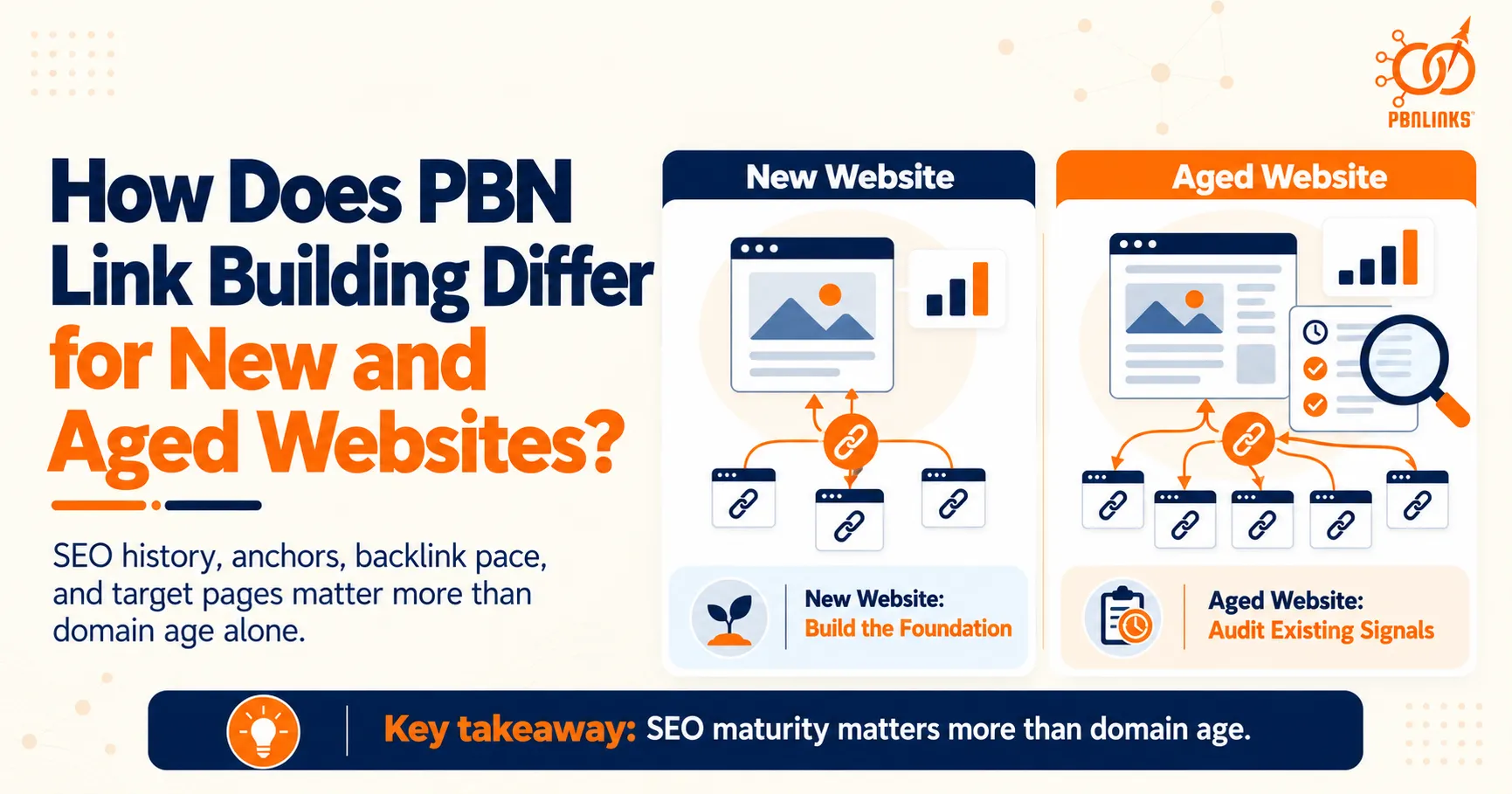
When comparing PBN links for new and aged domains, the real difference is the SEO history behind each site. A new domain may have limited backlinks, little ranking history, and fewer established target pages. An aged domain may already have authority, existing anchors, ranking URLs, and older backlink patterns that need to be reviewed first.
This means new sites usually need a stronger foundation before adding more external authority, while aged sites require a deeper audit of what already exists. Link pace, anchor text, target pages, and ranking expectations should all be based on the site’s current SEO condition, not on age alone.
This guide explains how PBN strategy changes for new and aged websites, including backlink velocity, anchor text, target-page selection, ranking timelines, competition, and the main risks to review before building more links.
How Do PBN Links Differ for New and Aged Domains?
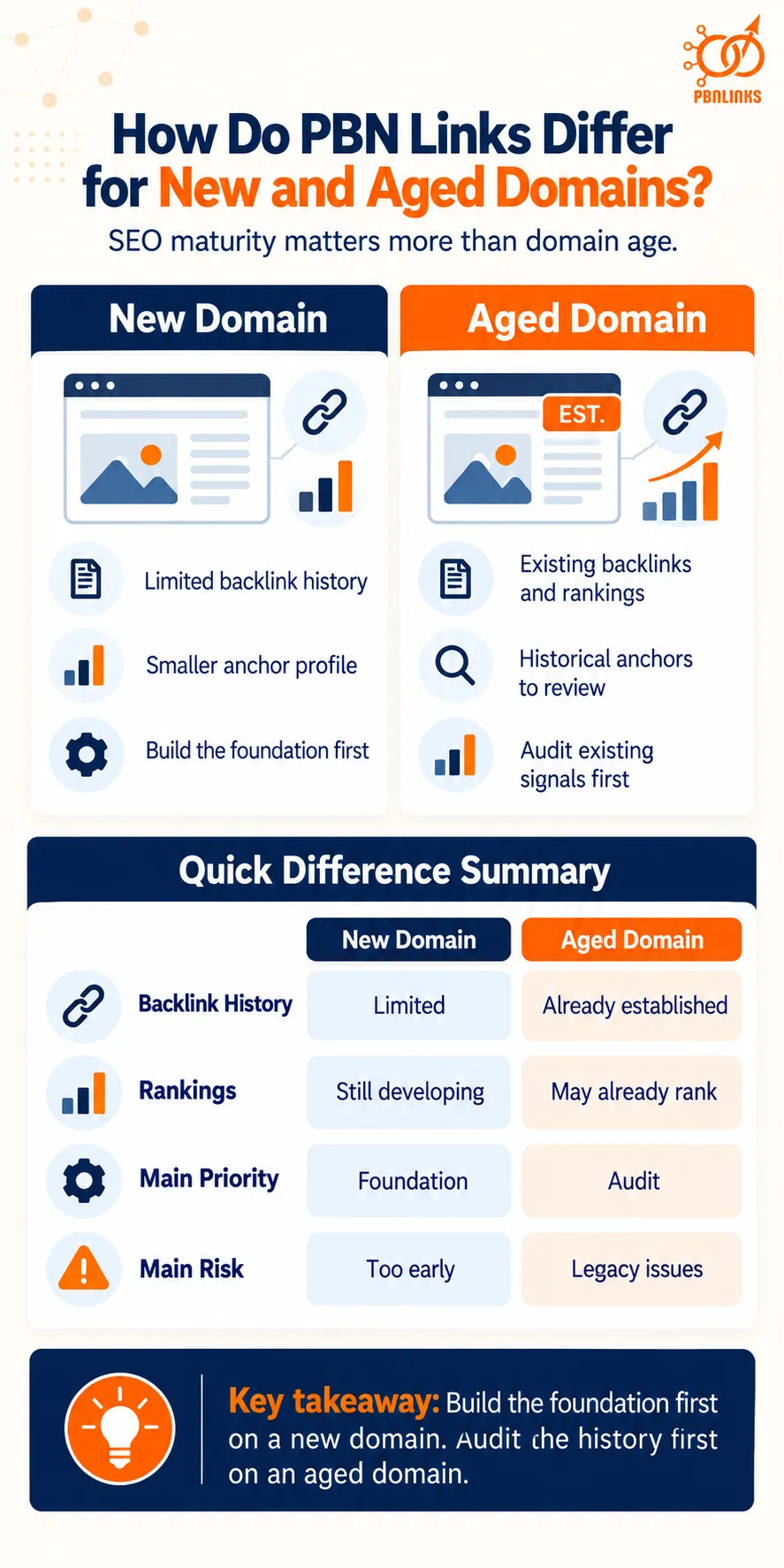
PBN links should be planned differently for new and aged domains because the two sites usually begin with very different SEO histories. A new website may have little backlink data, few established rankings, and limited anchor history. An aged website may already have years of links, ranking pages, redirects, and anchor patterns that affect what should happen next.
The key difference is not simply how old the domain is. It is how much SEO maturity the site has already developed.
A one-year-old website with strong content, relevant backlinks, and established rankings can be more mature than an eight-year-old domain with weak pages and almost no authority. For that reason, PBN strategy should start with the site’s current condition rather than its registration date.
| Factor | New Domain | Aged Domain |
| Backlink History | Usually limited, so there is less historical context | Existing backlinks should be reviewed before adding more |
| Anchor Profile | Often small or undeveloped | May contain branded, commercial, legacy, or overused anchors |
| Ranking History | Rankings may still be developing | Some pages may already have stable positions |
| Target Pages | Priority pages usually need to be established first | Existing ranking opportunities can guide link allocation |
| Link Pace | Should fit the site’s early growth and development | Should be compared with the site’s previous backlink pattern |
| Main SEO Priority | Build a strong foundation | Audit and understand existing signals |
| Main Risk | Adding authority before the site is ready | Ignoring legacy problems or existing over-optimization |
| Expected Response | May require more supporting signals before movement becomes clear | May show movement sooner if pages already have authority and rankings |
New Domains Need Foundation Before More Authority
A new website usually has fewer signals supporting it. The site may still be establishing its main pages, internal linking, content depth, and early backlink profile.
That does not mean a new domain must wait for a fixed number of months before receiving PBN links. There is no universal age threshold that makes a site ready.
The more useful question is whether the website itself is ready.
For example, a new local business site with complete service pages, clear internal links, proper indexing, and several pages already appearing in search is in a very different position from a newly launched site with unfinished content and weak structure.
In the first case, a carefully selected PBN link may support a page that is already prepared to compete. In the second case, adding backlinks may simply place more authority behind a site that still has basic SEO problems to fix.
For new domains, the first priorities are therefore usually to establish strong target pages, create a clear site structure, and avoid concentrating early links or anchors around only one commercial keyword.
Aged Domains Need an Audit Before More Authority
Aged websites have the opposite problem. They usually provide more historical data, but that history must be understood before new PBN links are added.
An established site may already have hundreds of referring domains, several ranking pages, old redirects, commercial anchors, and links created by previous SEO campaigns. Some of those signals may be useful, while others may limit how aggressively the next campaign should be handled.
For example, an aged service page may already rank near the bottom of page one and have a healthy backlink profile. A relevant PBN link could provide useful additional support.
Another aged page may have many exact-match anchors and years of aggressive link building behind it. Adding another keyword-rich PBN link to that page would require much more caution, even though the domain itself is older.
This is why an aged domain should not automatically be treated as safer or stronger. Its history can create both opportunities and problems.
SEO Maturity Matters More Than Domain Age
The most important comparison is therefore not simply new versus old. It is less mature versus more mature.
SEO maturity includes the site’s existing backlinks, rankings, content quality, internal structure, anchor history, and the strength of the pages being targeted.
This changes the role of PBN links in each situation. On a new website, PBN links usually support a foundation that is still developing. On an aged website, they are added to an existing system that already has authority, weaknesses, and historical patterns.
That difference affects nearly every later decision, including backlink velocity, anchor text, target-page selection, ranking expectations, and risk.
The practical rule is simple. Build the foundation first on a new domain, and audit the history first on an aged domain. Then plan the PBN campaign around the site’s actual SEO maturity rather than its age alone.
Domain Age vs SEO Maturity
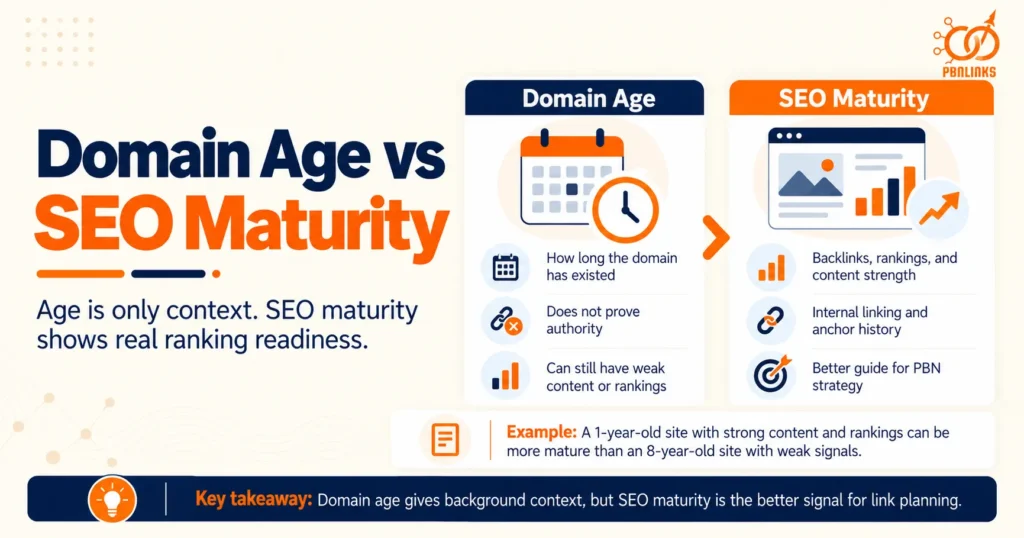
Domain age and SEO maturity are different concepts. Domain age only tells you how long a domain has existed, while SEO maturity reflects how much useful search history, authority, content strength, and ranking progress the website has developed over time.
This distinction matters when planning PBN links for new and aged domains. An older website is not automatically stronger, and a newer website is not automatically weaker. The condition of the site matters more than the number of years the domain has existed.
| Factor | Domain Age | SEO Maturity |
| What It Measures | How long the domain has existed | How developed the site is from an SEO perspective |
| Backlink Profile | Age alone says nothing about backlink quality | Considers backlink strength, relevance, and history |
| Ranking History | An old domain may have little visibility | Mature sites usually have clearer ranking history |
| Content Strength | Older sites can still have weak or outdated content | Includes the quality and depth of current pages |
| Internal Linking | Not determined by domain age | Reflects how well important pages are connected |
| Anchor History | Age does not show whether anchors are healthy | Reviews existing branded, commercial, and other anchors |
| PBN Strategy Value | Useful as background information | More useful for deciding link pace, anchors, and target pages |
For example, an eight-year-old website with weak content, few relevant backlinks, and almost no rankings may be less developed than a one-year-old website with strong service pages, quality referring domains, and established search visibility. The younger site is newer chronologically but more mature from an SEO perspective.
For PBN planning, domain age should therefore be treated as context rather than proof of strength. Backlink history, existing rankings, content quality, internal structure, anchor profile, and competition provide a much clearer picture of how the next PBN links should be used.
PBN Strategy for New Websites
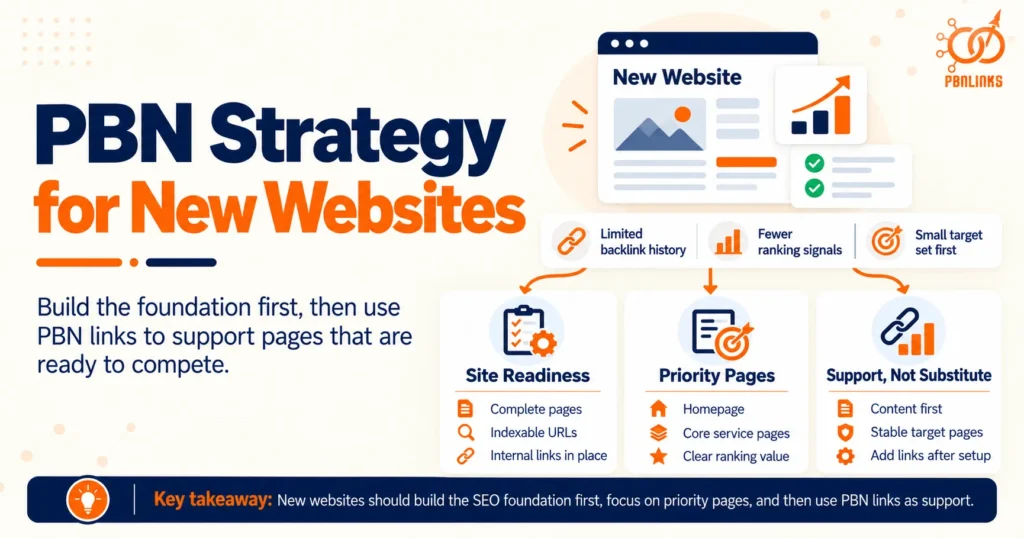
PBN strategy for a new website should start with site readiness, not link quantity. A new domain usually has limited backlink history, fewer ranking signals, and less established authority, so the first priority is making sure the site is technically and structurally ready to benefit from external links.
This does not mean a new website has to wait for a fixed number of months before using PBN links. The more useful question is whether the important pages are complete, indexable, internally connected, and aligned with the keywords they are supposed to rank for.
Build the SEO Foundation First
Before adding more authority, the site should already have a clear structure and stable target pages. Core service, category, product, or commercial pages should be complete enough to compete and should not still be changing every few days.
A new website with unfinished pages, weak internal links, or unclear search intent is not ready for aggressive link building. In that situation, backlinks may add authority without fixing the main reason the site is struggling.
Establish Priority Target Pages
New websites should also avoid trying to push every page at the same time. It is usually better to identify the URLs with the clearest ranking and business value first.
For example, a local business may prioritize its homepage and two main service pages rather than spreading early PBN links across ten weak location pages. A smaller set of strong targets makes the campaign easier to manage and measure.
Use PBN Links as Support, Not a Substitute
PBN links should strengthen a site that already has useful content, clear internal structure, and stable pages. They should not be used as a shortcut for missing content, poor targeting, or incomplete technical SEO.
The practical rule is simple. On a new website, build the foundation first, choose a small number of strong target pages, and then use PBN links to support pages that are already ready to compete.
PBN Strategy for Aged Websites
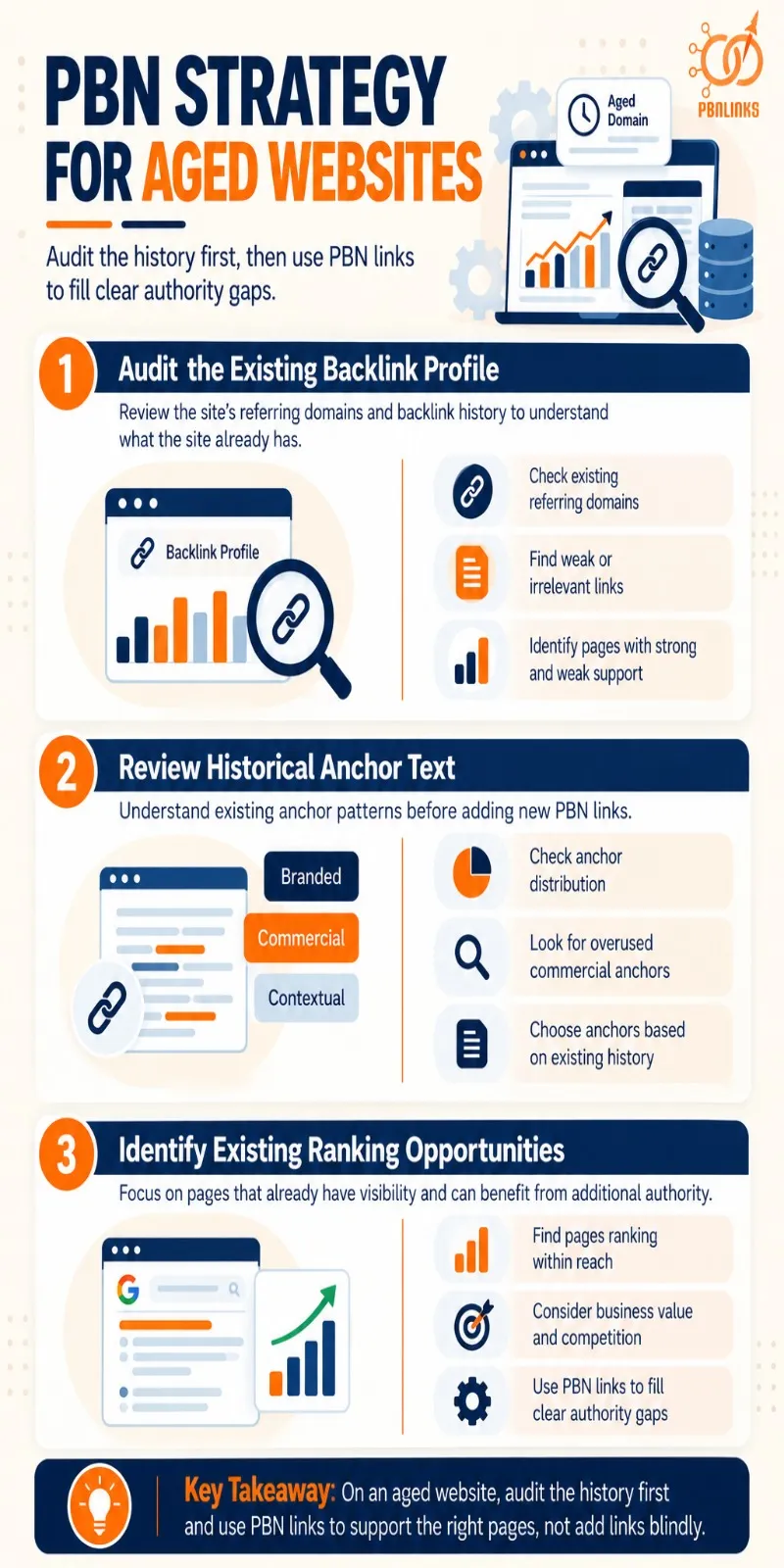
PBN strategy for an aged website should start with an audit of what the site has already built. An older domain may have years of backlinks, anchor-text history, ranking pages, redirects, and previous SEO activity, so adding new links without reviewing that history can create unnecessary overlap or strengthen the wrong areas.
The main advantage of an aged website is not age by itself. It is the amount of existing SEO data available to guide the campaign. For most established sites, the strategy should focus on understanding the backlink profile, reviewing anchor concentration, and identifying pages where additional authority has the best chance of improving rankings.
Audit the Existing Backlink Profile
Before adding new PBN links, review the site’s existing referring domains and backlink history. An aged domain may already have strong links supporting certain pages, while other important URLs have much less external authority.
The audit should also look for weak, irrelevant, or historically aggressive links that may affect how new placements are planned. The goal is not to remove links simply because they are old, but to understand the context in which the next PBN links will be added.
Review Historical Anchor Text
Anchor history is especially important on established domains because years of link building may already have created strong patterns around certain keywords.
If a page already has many commercial or exact-match anchors, repeating the same anchor through new PBN links may add unnecessary concentration. In contrast, a page with a broader branded and contextual profile may provide more flexibility when choosing the next anchor.
The anchor decision should therefore be based on what already exists rather than on a fixed ratio for aged domains.
Identify Existing Ranking Opportunities
Aged websites often have pages that already rank within reach of stronger positions. These pages can provide useful opportunities because they may need less additional support than URLs with no visibility at all.
For example, a service page ranking around positions 8 to 15 may be a more practical target than a weak page outside the top 50. Existing rankings, business value, competition, and backlink support should all be reviewed before deciding where the next PBN link should go.
The practical rule is simple. On an aged website, audit the history first, understand which pages and anchors are already strong, and then use PBN links to fill clear authority gaps rather than adding links blindly.
Should Backlink Velocity Differ for New and Aged Domains?
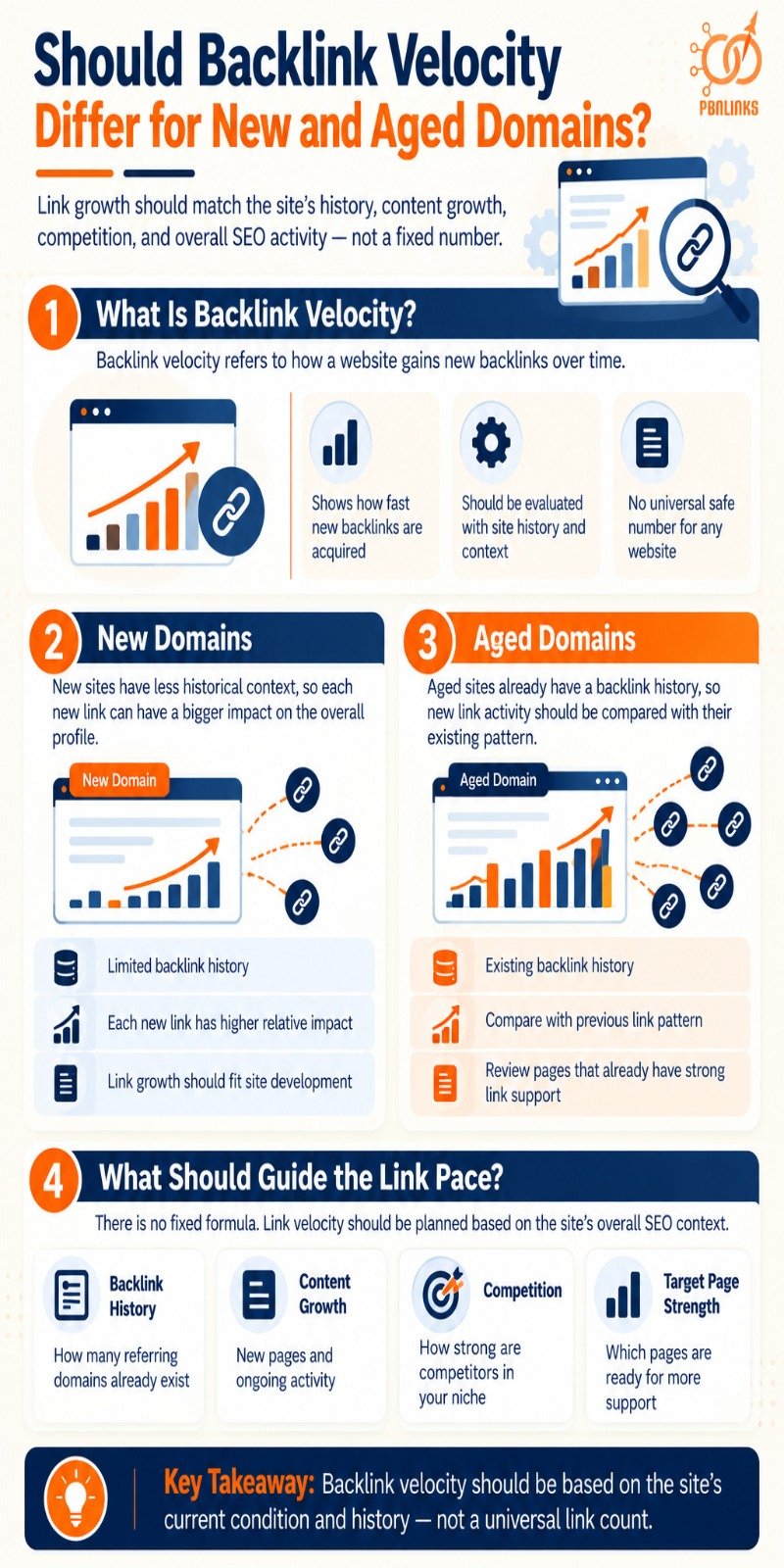
Backlink velocity can differ between new and aged domains, but there is no universal safe number of PBN links that applies to either group. The right pace depends on the site’s existing backlink history, content growth, competition, ranking progress, and how much link activity already surrounds the domain.
A new site usually has less historical context, so sudden concentration around a few commercial pages can become a larger part of its overall profile. An aged site has more history to compare against, but that history can also include aggressive link growth, repeated anchors, or pages that already receive heavy external support.
New Domains Have Less Historical Context
A new domain may have only a small number of referring domains and little previous link growth. Because the profile is still developing, every new PBN placement can represent a larger share of the site’s total backlink activity.
That does not mean new sites must follow an artificially slow schedule. The better approach is to make sure link growth fits the wider development of the website, including new content, indexing progress, internal linking, citations, and other backlinks appearing over time.
For example, a new local business site publishing service pages and gradually gaining citations has a different backlink context from a site that remains almost unchanged while receiving several commercial PBN links in a short period.
Aged Domains Should Be Compared With Their Existing Pattern
An aged website already has a backlink history, so new link activity should be evaluated against what has happened before.
If the domain regularly gains new referring domains and already has a broad link profile, several additional placements may fit naturally into that pattern. If the site has shown almost no new link activity for years, a sudden change may represent a much bigger shift in its historical profile.
This is why aged domains should not automatically be treated as capable of handling more PBN links. Existing backlink growth, anchor concentration, target-page saturation, and current rankings still need to be reviewed.
There Is No Universal Safe Link Velocity
Rules such as a fixed number of links per week or month are too simple for PBN planning. Two websites of the same age can have completely different backlink histories, authority levels, and competitive needs.
The better approach is to judge link pace in context. A campaign should consider how quickly the site itself is growing, how many referring domains already exist, which pages are being strengthened, and whether the new links fit the broader SEO activity around the site.
The practical rule is simple. New domains should build links in line with their developing profile, while aged domains should compare new link growth with their existing history. In both cases, context matters more than a fixed backlink velocity formula.
How Anchor Text Strategy Changes for New and Aged Domains
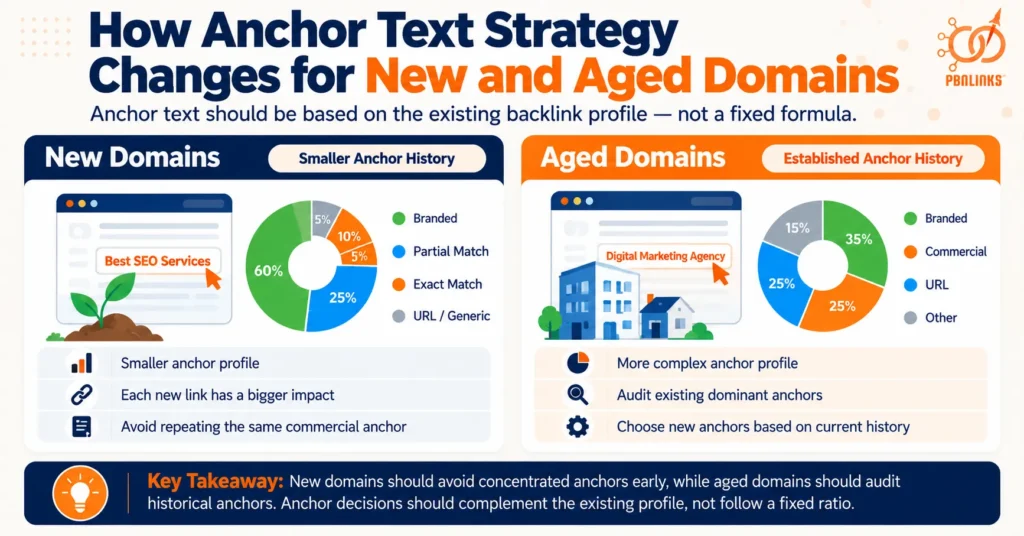
Anchor text strategy should differ between new and aged domains because the amount of existing anchor history is usually very different. A new site may have only a small number of backlinks, while an aged site may already have years of branded, commercial, URL, and legacy anchors shaping its profile.
This means anchor decisions should be based on the current backlink profile rather than on a fixed formula. The same exact-match anchor can create very different levels of concentration on two sites depending on what already exists.
New Domains Have Less Anchor History
A new domain usually starts with a small anchor profile, so each early backlink has a greater influence on the overall pattern.
If several early PBN links all use the same commercial keyword, that phrase can quickly become a large part of the site’s anchor profile. This is why early anchor selection should avoid unnecessary repetition and support a broader, more natural mix as the site develops.
The goal is not to force specific percentages for branded, partial-match, or exact-match anchors. It is to avoid creating a concentrated pattern before the site has built enough backlink history to provide wider context.
Aged Domains Need an Existing Anchor Audit
An aged domain may already have a much more complex anchor profile. Previous campaigns, natural links, old redirects, and legacy pages can all contribute anchors that still influence the current backlink pattern.
Before choosing a new PBN anchor, review what is already dominant. If a target page already has many exact-match or commercial anchors, adding more of the same may increase concentration without adding much strategic value.
In other cases, an aged page may have a broad mix of branded, URL, and contextual anchors, giving the campaign more flexibility. The decision should still be based on the existing profile rather than on the age of the domain itself.
The practical rule is simple. New domains need to avoid shaping an overly concentrated anchor profile early, while aged domains need to audit historical anchors before adding more. In both cases, the next PBN anchor should complement what already exists rather than follow a generic ratio.
Homepage vs Inner Page PBN Targeting
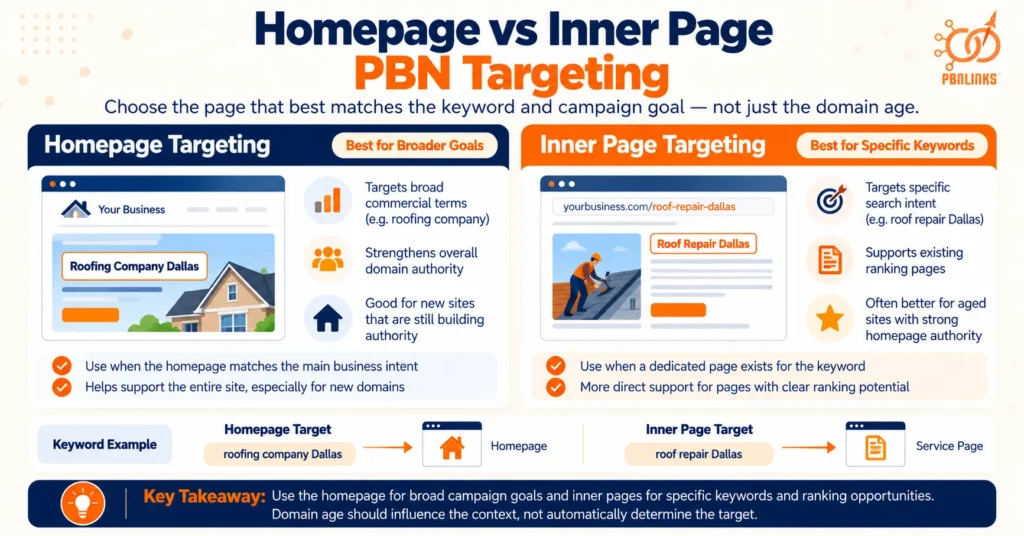
Homepage and inner-page targeting can differ between new and aged domains, but the decision should not be based on domain age alone. The better target is usually the page that best matches the keyword, already has enough relevance to compete, and supports the wider campaign goal.
A new website may still be building authority across the whole site, while an aged domain may already have a strong homepage and several established inner pages. This means the same targeting strategy should not automatically be used for both.
When the Homepage Makes Sense
The homepage can be a useful PBN target when it is the main page representing the business and already matches broad commercial or branded search intent.
For a new site, homepage links may help strengthen the overall domain while the site is still developing. However, this does not mean every early PBN link should go to the homepage. If a specific service or category page is the correct ranking page for an important keyword, that inner page may deserve direct support.
On aged sites, the homepage may already have a strong backlink profile. In that case, adding more links to it may create less value than supporting an inner page that is closer to a ranking breakthrough.
When an Inner Page Is the Better Target
Inner pages usually make more sense when the keyword has a specific search intent and the site already has a dedicated page built around that topic.
For example, a local business homepage may target a broad term such as “roofing company Dallas,” while an inner page may target “roof repair Dallas.” If the campaign goal is to improve the second keyword, the service page is usually the more direct target.
The same logic applies to aged websites. If an inner page already ranks on page two and has clear commercial value, a relevant PBN link may be more useful there than on a homepage that already has strong authority.
The practical rule is simple. Use the homepage when it matches the broad campaign goal, and use an inner page when that URL is the better match for the keyword and ranking opportunity. Domain age should influence the context of the decision, not automatically determine the target.
Do PBN Links Work Faster on Aged Domains?
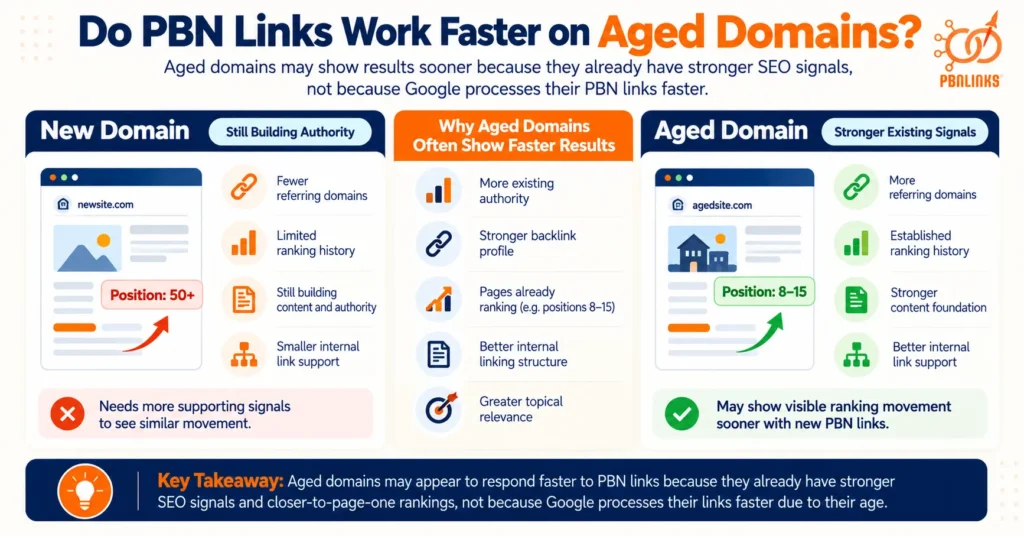
PBN links may appear to work faster on some aged domains, but that does not mean Google automatically processes backlinks faster because the website is older. In many cases, the aged site simply starts from a stronger SEO position, with more authority, established backlinks, better internal support, and pages that are already ranking for relevant keywords.
A new domain may still be trying to establish its first meaningful rankings, while an aged website may already have pages sitting close to page one. Because of that difference, the same additional PBN link can create a more visible ranking response on the aged site. A page already ranking around positions 8 to 15 may need less additional authority to move upward than a new page sitting far outside the top results.
The important point is that faster visible movement should not be confused with faster link processing. Google still has to discover, crawl, and process the source page before the backlink can influence rankings. There is no documented rule stating that links pointing to aged domains are processed faster simply because the receiving domain is older.
What usually changes is the starting condition of the target site. An aged domain may already have more referring domains, stronger ranking history, better internal linking, and greater topical relevance. When a new PBN link is added, it can build on those existing signals, which can make ranking movement easier to notice.
A new website may need more supporting signals before the same level of movement becomes visible. This does not mean the PBN link is weaker or slower. It means the target page has a larger ranking gap to overcome, so aged domains may show results sooner because of stronger existing SEO signals, not because Google automatically processes their PBN links faster.
Does Crawl and Indexing Behavior Differ on New and Aged Sites?
Crawl and indexing behavior can differ between new and aged websites, but domain age alone does not determine how quickly Google revisits or processes a site. Established websites may be crawled more regularly because they already have more pages, stronger internal links, existing backlinks, and a longer history of updates that make their content easier to discover.
A new website often has fewer discovery paths. It may have limited backlinks, a smaller site structure, and less historical activity, so Google may need more time to revisit some pages after changes are made. This does not mean every new domain is crawled slowly. A well-structured new site with strong internal linking and active content can still be discovered and revisited efficiently.
Aged websites usually give Google more existing signals to work with. Their important pages may already be connected through internal links, referenced by external sites, and visited regularly by search crawlers. As a result, changes on an established site may sometimes be noticed sooner, especially on pages that already receive consistent crawl activity.
The same principle applies to PBN links. A backlink placed on a frequently crawled source page may be discovered sooner than one placed on a weak or rarely visited page, regardless of whether the target domain is new or aged. Crawl speed mainly depends on the source page and site activity, while the target domain’s age affects the wider SEO context rather than the discovery of the backlink itself.
The practical rule is simple. Established sites may experience more regular crawling because they usually have stronger discovery paths and more activity, but age itself does not guarantee faster crawling or indexing. Site structure, backlinks, content activity, and page importance matter more than the number of years a domain has existed.
PBN Risks for New vs Aged Domains
PBN risks differ between new and aged domains because each type of site has a different SEO history. New websites usually have less backlink context and fewer established signals, while aged websites may already carry years of links, anchor patterns, redirects, and previous SEO activity.
The key difference is not that one type of domain is automatically safer. The risk comes from how new PBN links interact with the site’s existing content, backlink profile, anchor history, and overall SEO condition.
Key Risk Differences
New Domains: Weak SEO Foundation
The main risk on a new website is adding external authority before the site itself is ready. If important pages are thin, internal linking is weak, URLs are still changing, or indexing is incomplete, PBN links may strengthen pages that still have basic SEO problems.
A new domain should therefore have stable target pages, useful content, and a clear internal structure before link building becomes more aggressive.
New Domains: Early Link and Anchor Concentration
New websites usually have very small backlink and anchor profiles. Because of that, a few PBN links can quickly become a large part of the site’s overall backlink pattern.
If several early links use the same commercial anchor or point to the same page, the profile can become concentrated quickly. The issue is not simply fast growth, but how much of the site’s early backlink history is being shaped by a small group of similar links.
Aged Domains: Legacy Backlink Problems
Aged domains may already have years of backlinks from previous campaigns, natural mentions, directories, old partnerships, or earlier SEO work. Some of those links may still be useful, while others may be irrelevant, low quality, or connected to outdated pages.
Before adding new PBN links, the existing backlink profile should be reviewed so that new authority is not added blindly on top of historical problems.
Aged Domains: Historical Anchor Over-Optimization
An established website may already have a concentrated anchor profile around important commercial keywords. Adding more exact-match or keyword-heavy PBN anchors can increase that concentration further.
This is why aged sites need an anchor audit before new links are added. The next anchor should complement the existing profile rather than repeat patterns that are already dominant.
Aged Domains: Old URLs and Previous SEO Activity
Aged sites may also contain redirected URLs, outdated ranking pages, old site structures, or pages that have changed purpose over time. Previous SEO campaigns can make the current link profile more complex than it first appears.
New PBN links should therefore be directed toward stable, relevant pages after the site’s historical structure and existing authority have been reviewed.
Neither new nor aged domains are automatically protected from PBN risk. New domains require more attention to foundation and early concentration, while aged domains require more attention to legacy backlinks, anchors, and historical SEO patterns.
Aged Domain vs Expired Domain
An aged domain and an expired domain are not automatically the same from an SEO perspective. An aged website may have continuous content, rankings, backlinks, and crawl history, while an expired domain may have changed ownership, changed topic, lost pages, or remained inactive for a period of time.
That difference matters when planning PBN links because historical continuity can affect how useful the existing SEO signals are. A continuously active site gives you a clearer picture of its backlink profile, ranking history, and topical relevance. A repurposed expired domain usually requires more investigation before new links are added.
Why Continuous History Matters
A continuously active aged website may already have established authority around a consistent topic. Its existing backlinks, internal structure, and ranking pages can provide useful context for deciding where additional PBN links should go.
The key advantage is not simply that the domain is old. It is that the site has a more stable and understandable SEO history.
Why Expired Domains Need More Review
An expired domain can carry useful backlinks, but it can also come with old anchors, lost pages, irrelevant links, ownership changes, or a completely different previous niche.
Before treating an expired domain like an established website, review whether its historical backlinks still match the current topic, whether important old URLs still have value, and whether the domain has been repurposed in a way that changes its original context.
The practical rule is simple. Treat continuously active aged domains and repurposed expired domains as different SEO situations. Age can provide useful history, but only when that history is relevant, stable, and worth building on.
How Competition Changes PBN Strategy
Competition can influence PBN strategy more than domain age because every website is trying to overcome a different ranking gap. A new domain targeting a low-competition local keyword may need less external authority than an aged site competing in a much stronger national SERP.
This is why new and aged domains should not be compared only by how old they are. The level of competition, quality of the ranking pages, backlink strength of competitors, and current position of the target page all affect how much additional support may be needed.
A newer website already ranking around positions 12 to 20 for an easier keyword may respond well to a limited number of strong links. In contrast, an aged site targeting a highly competitive keyword may already have substantial authority and still need more support because the pages above it have stronger content, more backlinks, and greater overall visibility.
The same logic applies when deciding where PBN links should go. A page with a smaller ranking gap and clear commercial value may offer a better opportunity than another page targeting a much harder SERP, even if the second page belongs to an older domain.
The practical rule is simple. Use competition, current ranking position, and the authority gap to guide PBN strategy instead of assuming that a new site always needs more caution or an aged site always needs fewer links.
How Many PBN Links Should New and Aged Domains Get?
There is no fixed number of PBN links that every new or aged domain should receive. The right amount depends on the site’s backlink history, current rankings, competition, target-page quality, and how much additional authority is actually needed.
A new domain may need fewer links if it targets low-competition keywords and already has strong content, while an aged domain may still need more support in a difficult SERP. Domain age alone does not determine link quantity.
Why Fixed PBN Link Counts Do Not Work
Rules such as “three links for a new site” or “ten links for an aged domain” are too simple because websites start from very different SEO positions. Two domains of the same age can have completely different backlink profiles, ranking gaps, target-page strength, and levels of competition.
For example, a new local website already ranking on page two for an easier service keyword may need relatively little additional authority. Another new site targeting a competitive national keyword may require much more support before rankings move meaningfully.
How to Estimate How Many Links a Page Needs
The better approach is to judge the target page against the pages already ranking above it. Review the current ranking position, strength of competing pages, existing referring domains, page quality, internal support, and whether previous backlinks have already produced movement.
The goal is not to copy a competitor’s backlink count exactly. It is to understand the size of the ranking gap and whether another PBN link is likely to provide useful additional support.
When to Stop Adding More PBN Links
More links are not always the best next step. If the target page is already improving, has a strong backlink profile, or is close to its desired position, it may make more sense to monitor the result before adding another placement.
For aged domains, this is especially important when a page already has heavy backlink or anchor concentration. For new domains, it helps prevent too much early authority from being focused on one URL before the wider site has developed.
The practical rule is simple. Use as many PBN links as the ranking gap reasonably justifies, not as many as the domain’s age supposedly allows. Link quantity should be based on competition, existing authority, target-page readiness, and actual campaign needs.
Practical New vs Aged Domain Examples
The difference between new and aged domains becomes easier to understand when you look at real campaign situations. Two websites can have very different PBN needs even when one is much older than the other.
The examples below show how site readiness, backlink history, current rankings, and anchor patterns can change the strategy.
Brand-New Local Website
A newly launched local service website has complete service pages, proper internal linking, and all important URLs indexed, but it has very few referring domains and almost no ranking history.
In this situation, the priority should be to strengthen a small number of important pages rather than spread PBN links across the whole site. The site is new, but it is structurally ready, so carefully selected links can support pages that already have a clear ranking purpose.
Young Website With Strong Existing Rankings
A one-year-old website already ranks on page one or page two for several commercial keywords and has built a healthy backlink profile from multiple sources.
Even though the domain is relatively young, it may be more SEO mature than many older websites. PBN strategy can therefore be based on current ranking gaps, existing anchor text, and the pages that need additional authority rather than treating the site as weak simply because of its age.
Old Domain With Weak Authority
An eight-year-old domain has existed for a long time but has few useful backlinks, weak content, poor internal linking, and almost no meaningful rankings.
This site should not be treated as strong just because it is old. Its PBN strategy may look much closer to that of a newer website because the underlying SEO foundation is still weak and the site has little authority to build on.
Established Site With Aggressive Legacy Anchors
An aged website has strong rankings and many referring domains, but its most important commercial pages already have a high concentration of exact-match anchors from previous SEO campaigns.
In this case, adding more keyword-heavy PBN links may increase an existing imbalance. The better approach is to review the historical anchor profile, identify where authority is genuinely needed, and avoid repeating patterns that are already heavily represented.
These examples show why PBN links for new and aged domains should be planned around SEO maturity, not chronological age alone. A young site can be ready for targeted link building, while an older site may still need foundation work or a careful audit before more authority is added.
New vs Aged Domain PBN Checklist
Before adding PBN links, the site should be reviewed differently depending on whether it is new or already established. A new domain needs a readiness check, while an aged domain needs a history and profile audit.
The checklist below helps confirm whether the site is prepared for additional authority and where the next links should be directed.
Before Building PBN Links to a New Site
Check whether:
- core service, product, or category pages are complete,
- important URLs are indexed and technically stable,
- internal linking supports the main target pages,
- priority keywords and ranking pages are clearly defined,
- the early anchor profile is not overly concentrated,
- the site already has some broader backlink context,
- and PBN links are supporting the SEO strategy rather than replacing basic site development.
A new domain does not need to reach a fixed age before link building begins. It needs enough content, structure, and target-page readiness for the new links to have a clear purpose.
Before Building PBN Links to an Aged Site
Check whether:
- the existing backlink profile has been reviewed,
- historical anchors are understood,
- important ranking pages and weak pages have been identified,
- legacy links or old SEO campaigns create any obvious problems,
- target URLs are still relevant and stable,
- highly linked pages are not receiving unnecessary additional concentration,
- and new PBN links are filling real authority gaps rather than repeating old patterns.
An aged site offers more historical data, but that data must be understood before new links are added. Old backlinks, anchors, rankings, and previous campaign activity can all change which pages deserve the next placement.
The practical rule is simple. Check readiness on a new domain and check history on an aged domain. In both cases, the goal is to make sure every PBN link supports a clear ranking opportunity rather than being added without context.
Final Verdict: PBN Links for New and Aged Domains
In conclusion, PBN links for new and aged domains should be planned differently because the two sites usually start with different backlink histories, ranking positions, anchor profiles, and levels of SEO maturity. A new domain often needs a stronger foundation, while an aged domain needs a clearer audit of the signals it has already built.
For new websites, the priority should be to complete and stabilize important pages, strengthen internal linking, confirm indexing, and identify the URLs with the strongest ranking potential. PBN links should then support those pages rather than act as a substitute for incomplete content, weak targeting, or basic technical SEO.
For aged websites, the priority should be to review existing backlinks, historical anchors, ranking pages, redirects, and previous SEO activity before adding more authority. Link velocity, anchor text, target-page selection, and ranking expectations should be based on the site’s current SEO condition, competition, and ranking gap rather than domain age alone.
The practical takeaway is simple: build the foundation first on a new domain, audit the history first on an aged domain, and base each PBN decision on SEO maturity rather than age.
FAQs About PBN Links for New and Aged Domains
Are PBN links safe for new websites?
PBN links carry SEO risk on new websites when they are created primarily to manipulate rankings. New sites should first have strong content, stable target pages, internal linking, and a clear SEO foundation before any additional link strategy is considered.
Do aged domains respond faster to PBN links?
Not necessarily. Aged domains may show ranking movement sooner when they already have stronger backlinks, rankings, and internal authority, but there is no documented rule that Google processes links faster simply because a domain is older.
How many PBN links should a new website get?
There is no fixed number of PBN links that every new website should receive. Link quantity should depend on competition, current rankings, backlink history, target-page strength, and the size of the ranking gap.
Can aged domains handle more PBN links than new domains?
Not automatically. An aged domain may have more backlink history, but it can also have legacy spam, concentrated anchors, or heavily linked pages that make additional links less useful or more risky.
Should backlink velocity differ for new and aged domains?
Yes, the context can differ, but there is no universal safe backlink velocity. New sites have less historical link data, while aged sites should be compared with their existing backlink-growth pattern.
Should anchor text strategy differ by domain age?
Yes, but the existing anchor profile matters more than age alone. New domains usually have little anchor history, while aged domains may already contain branded, URL, commercial, and legacy anchors that should be reviewed before adding more.
Should new websites build PBN links to the homepage first?
Not always. The homepage can be a suitable target for broad or branded queries, but a service, category, or product page may be better when it more closely matches the search intent.
Is SEO maturity more important than domain age for PBN strategy?
Yes. Backlink history, rankings, content quality, internal structure, and existing authority provide more useful planning information than the number of years a domain has existed.
How do legacy backlinks affect PBN strategy on aged domains?
Legacy backlinks can change which pages, anchors, and link quantities make sense. Review old referring domains, anchor concentration, redirects, and previous SEO activity before adding more authority to an aged site.
Is an expired domain the same as an aged website?
No. A continuously active aged website may have stable content, rankings, and backlink history, while an expired domain may have changed ownership, topic, or purpose. Google specifically treats repurposing expired domains primarily to manipulate rankings as expired-domain abuse.