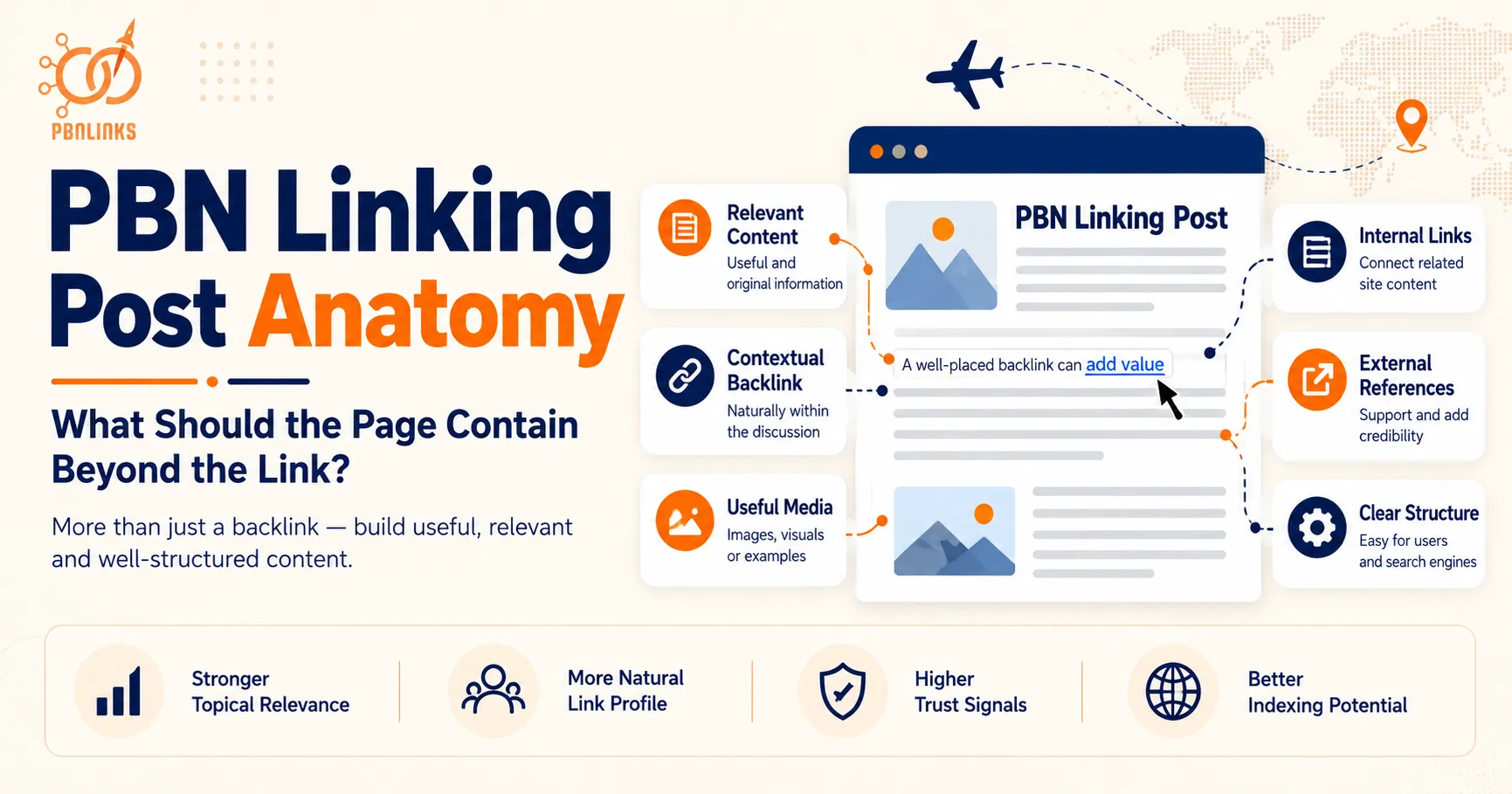
PBN Linking Post Anatomy: What Should the Page Contain Beyond the Link?
A backlink may be the primary purpose of a PBN linking post, but it should never be the page’s only reason to exist. When an article is created solely to host a target link, it often becomes thin, repetitive, and disconnected from the reader’s needs. Stronger content starts with a relevant topic, offers genuine value, and integrates the backlink naturally within useful, well-structured information.
A stronger PBN linking post starts with a topic that makes sense for the site and serves a clear search intent. The content should cover that topic with enough depth to stand on its own, while creating a logical connection between the PBN site, the linking article, and the target page. The backlink should support something already being discussed rather than feel added after the content was written.
That is why the quality of a linking post cannot be reduced to word count or where the backlink appears. Surrounding context, anchor text, internal links, relevant external references, useful media, page structure, crawlability, and indexing all contribute to the page as a whole. A longer article or an earlier link placement cannot compensate for weak relevance or poor content.
This guide breaks down what a PBN linking post should contain beyond the backlink. It covers topical relevance, content depth, link context, backlink placement, anchor text, supporting page elements, and indexing, along with a practical review process to use before publishing.
What Should a PBN Linking Post Contain Beyond the Backlink?
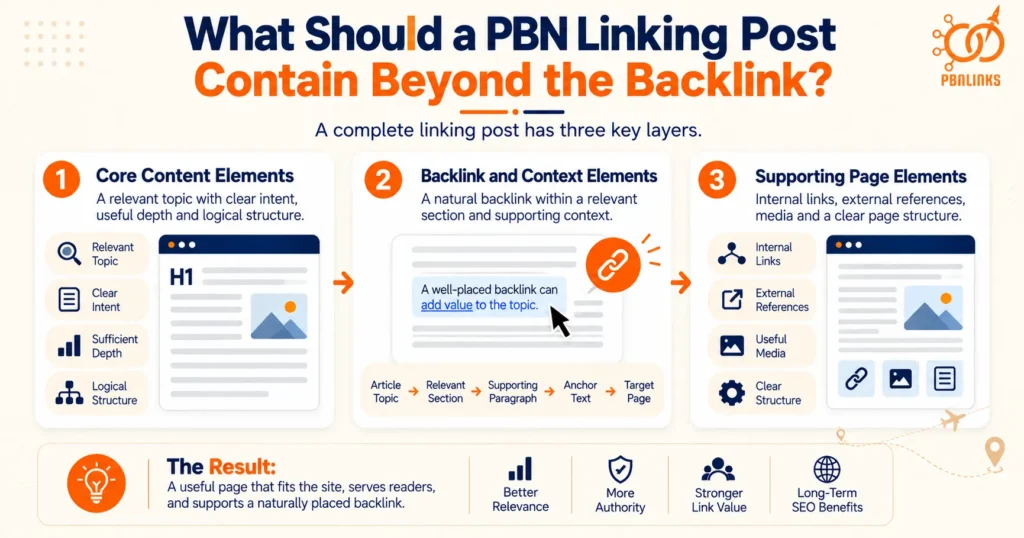
A PBN linking post should contain enough relevant content and supporting page elements to function as a useful article even without the target backlink. The link is one part of the page, not a substitute for the topic, information, structure, or context that gives the page a reason to exist.
A complete linking post can be viewed in three layers. First comes the content itself, including the topic, search intent, depth, and organization of the information. Next comes the backlink and the context that connects it to the discussion. Finally, supporting elements such as internal links, relevant external references, media, and a clear page structure help make the article part of the wider site rather than an isolated link placement.
Core Content Elements
The content foundation begins with a topic that fits the broader subject of the PBN site. That topic should address a recognizable reader need and provide enough information to cover the main question without padding the article simply to reach a particular length.
A clear title and heading structure should organize that information logically. Each section should contribute something distinct to the topic, while the article as a whole should remain focused on the same search intent.
This creates a simple content foundation:
Relevant topic → Clear intent → Sufficient depth → Logical structure
The backlink should be able to sit inside that foundation without becoming the reason every paragraph exists.
Backlink and Context Elements
The target backlink needs a clear relationship with the information around it. The sentence containing the link should make sense with the anchor text, while the surrounding paragraph should provide enough context for the reader to understand why the linked page is relevant.
That relationship should extend beyond a single sentence. The section containing the backlink should relate to the destination, and the broader article should provide a logical topical path to that section.
In practice, the relationship should remain coherent from the page to the destination:
Article topic → Relevant section → Supporting paragraph → Anchor text → Target page
This is what makes contextual relevance more meaningful than simply placing a backlink at a predetermined point in the article.
Supporting Page Elements
A linking post also needs to fit naturally within the rest of the website. Relevant internal links can connect it with related articles and provide useful navigation. External references can support facts or direct readers to additional information when there is a genuine reason to include them.
Images, tables, diagrams, screenshots, or other media can strengthen the page when they help explain the subject. They do not need to be added simply to satisfy a fixed content formula.
The page should also have a clear structure and remain accessible to search engines. These supporting elements do not make a weak article strong on their own, but they help turn useful content and a relevant backlink into a more complete linking page.
Why a PBN Linking Post Needs Its Own Purpose
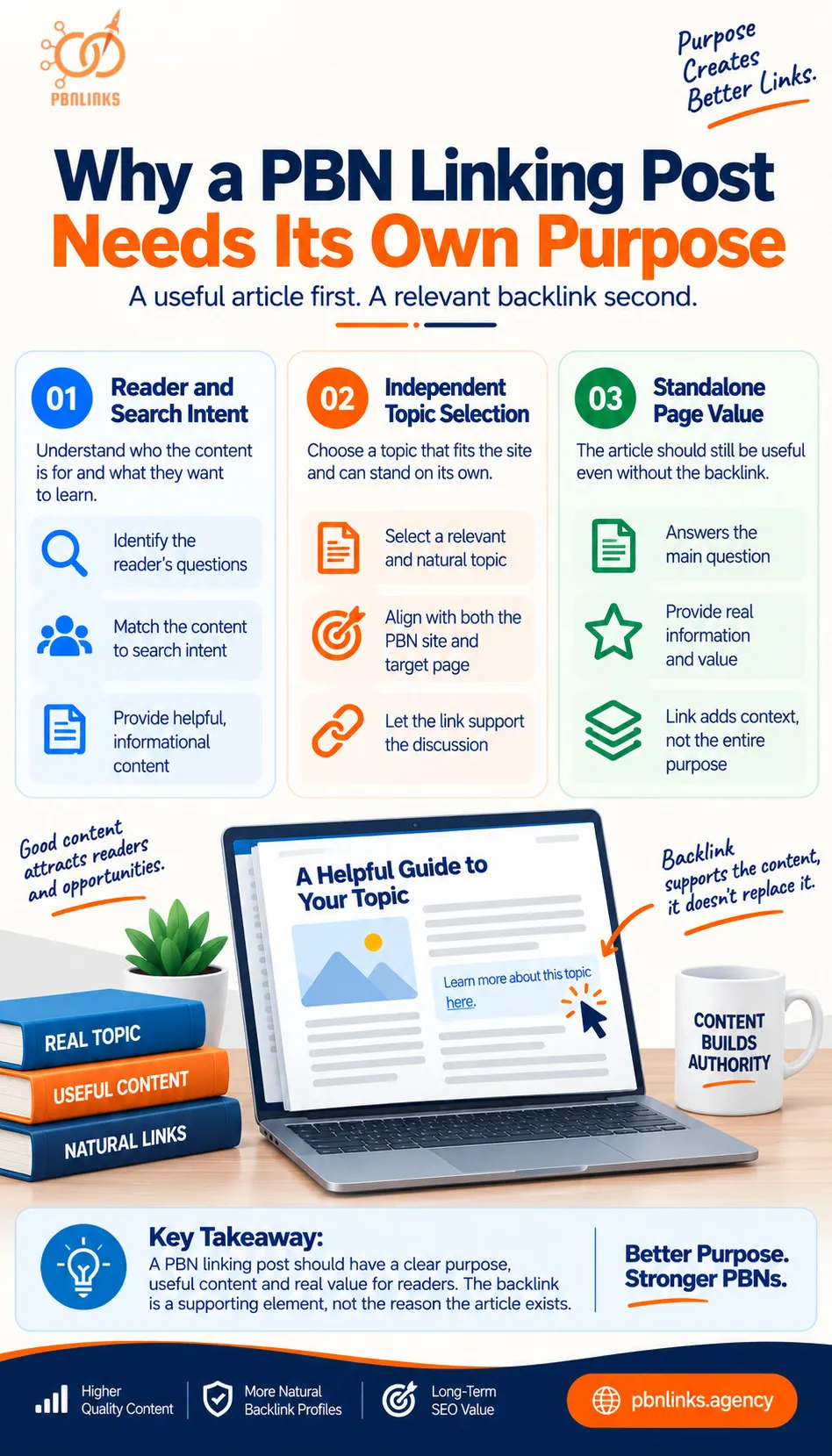
A PBN linking post needs its own purpose because the page should provide useful information beyond hosting a backlink. Its topic, audience, and content should make sense on their own. The target link can then support the discussion where it is genuinely relevant.
Starting with page purpose also changes how the content is developed. Instead of choosing an anchor text and filling space around it, the writer begins with a real topic and decides what the reader needs to understand. This creates a clearer relationship between search intent, topical coverage, and the eventual backlink.
Reader and Search Intent
Every linking post should have a clear idea of who the content is for and what that reader wants to learn. Search intent provides that direction. It helps determine which questions need answering, how deeply the subject should be covered, and which information belongs on the page.
For example, an informational topic should primarily explain the subject rather than repeatedly push the reader toward a commercial destination. If a target page is relevant, the backlink can appear at the point where it provides useful additional information.
A defined intent therefore gives the article an editorial direction before link placement begins.
Independent Topic Selection
The topic should fit the existing subject of the PBN site and be broad enough to support a useful article. It should not be selected only because a particular anchor text needs somewhere to appear.
A better approach is to identify a topic that naturally overlaps with both the publishing site and the target page. The article can then explore that topic on its own terms, with the backlink introduced where the destination genuinely extends the discussion.
This creates a more coherent relationship:
PBN topic → Linking post topic → Relevant discussion → Target page
The link becomes part of the content rather than the content being built entirely around the link.
Standalone Page Value
A useful quality check is to consider the page without its target backlink. If removing that link leaves an article that still answers its main question and provides useful information, the page has a stronger independent purpose.
This does not mean the backlink is unimportant. It means the surrounding content has its own informational value. The target link should add context, evidence, a useful resource, or a relevant next step instead of carrying the entire purpose of the article.
That distinction is important because a complete linking post should make sense as a page first and as a backlink placement second.
How Topical Relevance Connects the PBN, Post and Target Page
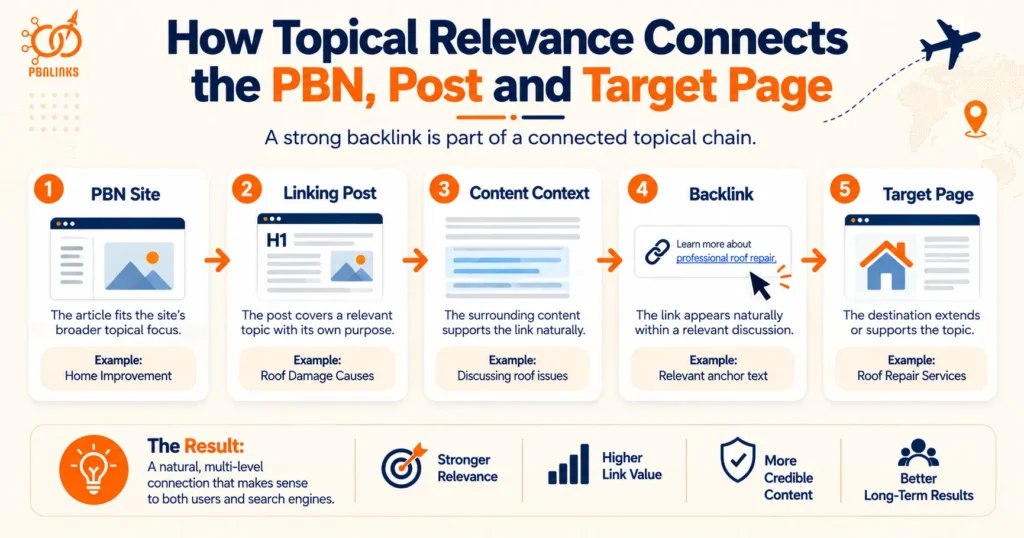
Topical relevance is strongest when the PBN site, linking post, surrounding content, and target page share a clear subject relationship. A backlink can appear naturally within a sentence, but that alone does not make the entire linking page relevant. The connection should make sense at several levels.
This is why relevance should be evaluated as a chain rather than a single match between anchor text and destination:
PBN Site → Linking Post → Content Context → Backlink → Target Page
If one part of that chain is disconnected, the overall relationship becomes harder to justify. A relevant target page cannot fully compensate for an article that does not belong on the publishing site, just as a relevant article cannot make an unrelated destination fit naturally.
Site Level Relevance
The linking post should first make sense within the broader subject of the PBN site. A site that consistently covers home improvement, for example, has a logical reason to publish content about roofing, plumbing, insulation, or property maintenance. A sudden article about an unrelated financial product would create a much weaker topical connection.
Site level relevance does not require every article to discuss exactly the same subject. Real websites normally cover related subtopics. The important point is that the linking post should fit within a recognizable topical area that the site already covers or can reasonably expand into.
Existing categories, previous articles, internal links, and the general editorial direction of the site can all help establish that relationship.
Page Level Relevance
Once the topic fits the publishing site, the linking post should also have a logical relationship with the target page.
The two pages do not need to cover identical information. In many cases, a useful backlink connects related topics rather than duplicates them. The target page may provide a deeper explanation, a specific service, supporting research, or another resource that extends something already discussed in the linking article.
The key is that a reader should be able to understand why moving from the linking post to the target page makes sense.
For example, an article discussing common causes of roof damage could naturally reference a page about professional roof repair. The subjects are not identical, but the relationship between the information and destination is clear.
Contextual Relevance
Contextual relevance brings the relationship down to the actual point where the backlink appears. The surrounding sentence and paragraph should establish why the linked resource is relevant at that moment in the discussion.
Anchor text also forms part of this context. It should describe or signal the destination naturally without forcing wording that disrupts the sentence. The content before and after the link should continue discussing the same idea rather than changing topics simply to accommodate the backlink.
A well connected PBN linking post therefore creates relevance at multiple levels. The article belongs on the site, the target page relates to the article, and the backlink fits the specific discussion surrounding it. Topical relevance becomes stronger when these relationships reinforce one another instead of relying on the anchor text alone.
How Much Content Should a PBN Linking Post Contain?
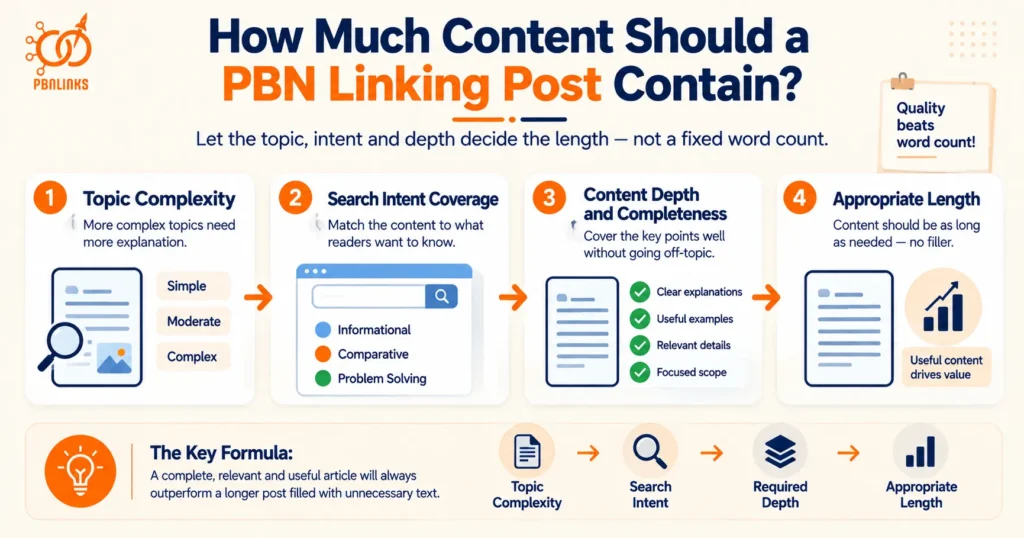
A PBN linking post should contain enough content to cover its topic clearly and satisfy the main search intent, rather than aiming for a fixed word count. A simple subject may need relatively little explanation, while a broader or more technical topic may require considerably more depth.
Word count can describe the size of an article, but it does not measure whether the page is useful or complete. Adding extra paragraphs simply to make a linking post longer can introduce repetition and filler without improving the context around the backlink.
Topic Complexity
The amount of content needed begins with the complexity of the topic. A focused question can often be answered within a relatively narrow scope. A subject involving several concepts, comparisons, steps, or decisions usually needs more explanation.
The important question is whether the reader receives enough information to understand the subject properly. If important aspects of the topic are missing, the article may feel incomplete regardless of its word count.
Topic complexity should therefore determine how far the content needs to develop.
Search Intent Coverage
Content depth should also reflect what the reader expects from the page. An informational query may require definitions, explanations, examples, or practical guidance. A comparison topic may need clear differences between available options. A problem focused article may need causes, implications, and possible solutions.
Each major section should contribute to that intent. Content that moves into unrelated subjects merely to increase length can weaken topical focus rather than strengthen the page.
For a PBN linking post, this also helps create a more meaningful environment for the backlink. The target link can be introduced within a developed discussion instead of being surrounded by generic filler.
Content Depth and Completeness
Content depth comes from covering the important parts of a topic with enough explanation to make the page useful. It can include definitions, supporting details, examples, distinctions, and practical considerations where the subject requires them.
Completeness does not mean answering every remotely related question. The article should stay within its intended scope. The goal is to cover the main topic sufficiently without expanding into unrelated areas that deserve separate pages.
A useful way to evaluate depth is to ask whether a reader would need another page simply because an essential part of the original question was left unexplained.
Length Without Filler
Longer content is not automatically stronger content. Repeating the same idea with different wording, adding unnecessary background, or stretching simple explanations can increase word count without adding meaningful value.
The better approach is to let the topic determine the length. Once the article has satisfied its search intent, explained the necessary concepts, and provided enough context for the reader, additional text should only be added when it contributes something useful.
For that reason, there is no universal word count that makes a PBN linking post complete. The more useful standard is:
Topic complexity → Search intent → Required depth → Appropriate length
This keeps content length tied to what the page actually needs rather than an arbitrary publishing formula.
What Should Surround the Backlink in a PBN Linking Post?
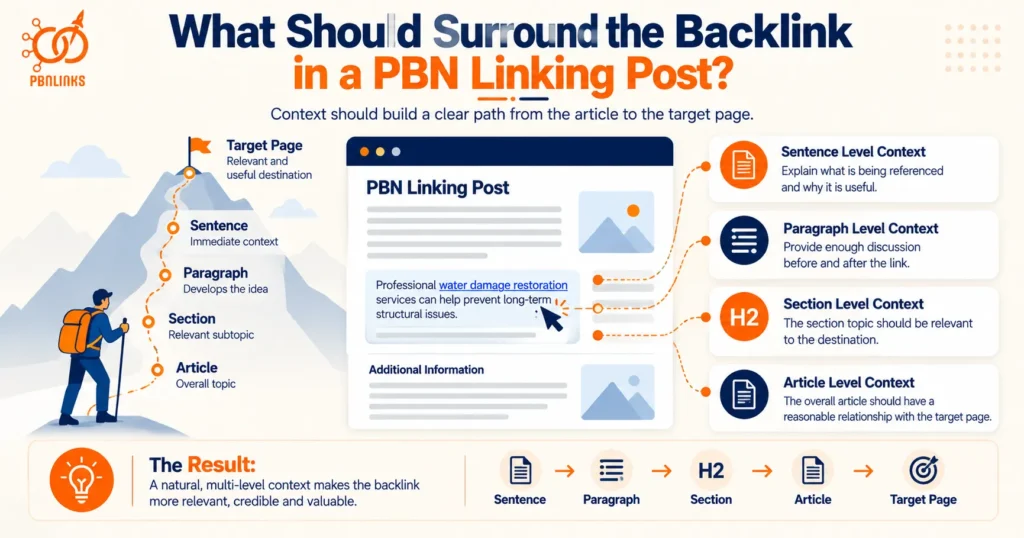
The content surrounding a PBN backlink should explain why the linked page is relevant to the topic being discussed. That context should exist beyond the anchor text itself. The sentence, paragraph, section, and wider article should create a logical path between the reader’s current topic and the target page.
This is what makes a backlink contextual rather than simply inserted into an article. A link can use relevant anchor text and still feel forced if the discussion around it does not support the destination.
A useful way to evaluate the relationship is:
Sentence → Paragraph → Section → Article → Target Page
Each level should reinforce the same general subject instead of relying on a single keyword near the backlink.
Sentence Level Context
The sentence containing the backlink provides the closest context for the link. It should make clear what is being referenced and why the linked destination may be useful to the reader.
Anchor text should fit naturally within that sentence. It should not require awkward wording or a sudden change in subject simply to include a target phrase.
For example, if an article discusses the causes of water damage, a reference to a relevant restoration service can make sense when the discussion moves from identifying the problem to dealing with serious damage. The link follows the idea already being explained.
The sentence therefore establishes the first connection between the content and destination.
Paragraph Level Context
The paragraph should develop the idea that gives the backlink meaning. Rather than placing the link inside an isolated sentence, the surrounding discussion should provide enough information for the reader to understand the relationship.
Content before the link can introduce the issue or concept. Content after it can explain the implication, provide additional detail, or continue the same line of reasoning.
This does not mean a backlink needs a predetermined number of sentences around it. The goal is simply to ensure that the paragraph has a coherent purpose and that the link belongs within that purpose.
Section Level Context
The section containing the backlink should also be relevant to the destination. If an H2 or H3 discusses one subject but the backlink points to something only loosely connected, a relevant sentence alone may not create a strong contextual relationship.
Section level relevance gives the link a broader semantic setting. The heading establishes the subject, the paragraphs develop it, and the backlink connects the reader with a related destination where appropriate.
This is one reason link context should be considered during content planning rather than only after the article has been written.
Article Level Context
The broadest level is the topic of the complete linking post. The target page should have a reasonable relationship with that overall subject, even when the backlink appears within a more specific subsection.
A strong article level connection does not require the linking post and target page to cover identical topics. The relationship can be complementary. One page may explain a broader problem while the other provides a specialized resource, service, example, or deeper explanation.
When all four levels work together, the backlink becomes part of a coherent information path:
Article Topic → Relevant Section → Supporting Paragraph → Contextual Sentence → Backlink → Target Page
This is a stronger way to evaluate backlink context than simply checking whether the target keyword appears close to the link.
Where Should the Backlink Appear in a PBN Linking Post?
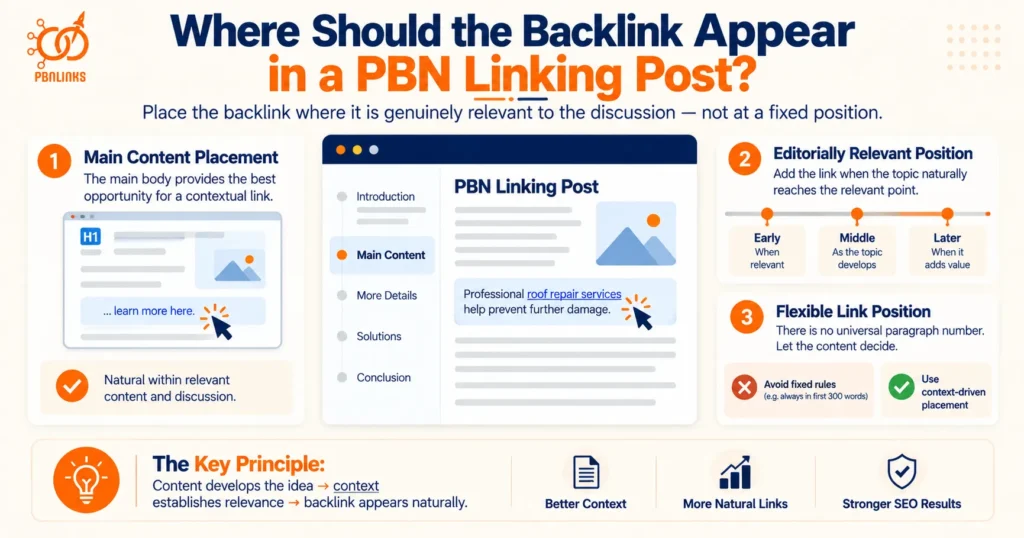
A backlink in a PBN linking post should appear within the main content where the target page is genuinely relevant to the discussion. There is no universal paragraph number or word position that makes a backlink more effective. The better placement is the point where a reader can understand why the linked resource belongs there.
This makes placement different from context. Context establishes the relationship between the content and destination. Placement determines where that relationship is expressed on the page. The two should work together rather than being treated as separate SEO formulas.
Main Content Placement
For a contextual backlink, the main body of the article provides the clearest opportunity to connect the link with relevant information. The link can sit within a sentence and paragraph that explain the subject before directing the reader to a related page.
This gives the backlink meaningful surrounding text and keeps it connected to the article’s primary content. Links placed in unrelated page areas, such as generic sitewide elements, do not provide the same article specific context.
Main content placement alone, however, does not make a link relevant. The surrounding discussion still needs to support the destination.
Editorially Relevant Position
The backlink should appear when the article reaches the idea that the target page can genuinely support, expand, or continue. That point may occur early, in the middle, or later in the article depending on how the topic develops.
For example, a guide may first explain a problem and its causes before discussing possible solutions. If the target page provides a relevant service or deeper resource, the natural placement may occur when the solution becomes part of the discussion rather than in the opening paragraph.
This approach lets the content determine the placement instead of reshaping the content around a predetermined backlink position.
Flexible Link Position
Fixed rules such as placing every backlink within the first few paragraphs or before a particular word count can create repetitive patterns without guaranteeing better context. Different topics develop in different ways, so the most relevant position can vary from one linking post to another.
The link also does not need to be pushed unnecessarily far down the page simply for the sake of variation. The objective is not random placement. It is context driven placement.
A practical rule is straightforward: introduce the backlink after the article has established enough context for the destination to make sense, and place it at the point where following the link would be useful to the reader.
In other words:
Content develops the idea → Context establishes relevance → Backlink appears at the appropriate point
This keeps backlink placement tied to the structure and meaning of the PBN linking post rather than an arbitrary position on the page.
How Anchor Text Should Fit the PBN Linking Post
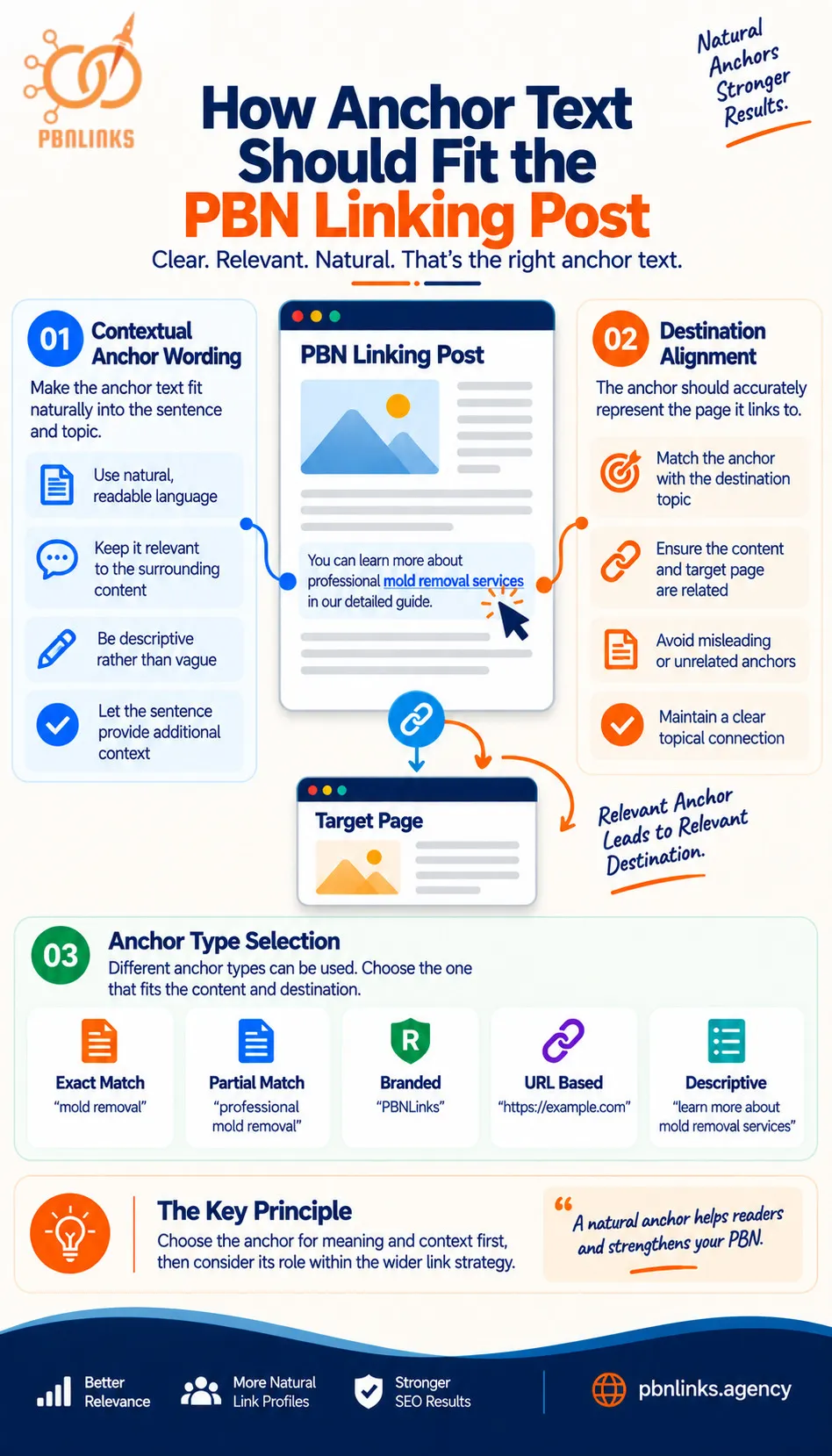
Anchor text should describe the linked destination clearly while fitting naturally into the sentence and topic of the PBN linking post. The words used for the link should help the reader understand what they can expect after clicking, without making the sentence feel as though it was written only to accommodate a target keyword.
Anchor text therefore works at the intersection of three elements: the surrounding content, the wording of the link, and the destination page. When those elements support the same idea, the backlink becomes easier to understand in context.
Contextual Anchor Wording
Anchor text should read naturally within the sentence that contains it. The wording needs to follow the grammar and meaning of the surrounding content rather than forcing an exact phrase into a sentence where it does not fit.
Descriptive wording is usually more informative than vague anchors because it gives readers context about the destination. At the same time, the anchor does not need to repeat the full title or primary keyword of the target page.
The surrounding sentence should do part of the contextual work. This allows the anchor to remain concise while the complete statement explains why the linked resource is relevant.
Destination Alignment
The wording of the anchor should accurately represent the page it links to. If the anchor suggests one subject while the destination primarily covers another, the connection becomes less clear for the reader.
Alignment also extends beyond individual keywords. The topic being discussed around the anchor should have a meaningful relationship with the information, service, product, or resource available on the destination page.
A useful relationship is:
Surrounding Topic → Anchor Text → Target Page
Each element should reinforce the next rather than creating an unexpected change in subject.
Anchor Type Selection
Exact match, partial match, branded, URL based, and descriptive anchors can all appear in a backlink profile. Their suitability depends on the sentence, destination, and wider linking context rather than one anchor type being universally best.
An exact match anchor uses the target keyword directly. A partial match anchor includes part of the target phrase within broader wording. A branded anchor uses the brand or website name, while descriptive anchors explain the destination without necessarily repeating its primary keyword.
For an individual PBN linking post, the immediate priority is whether the chosen anchor fits the content and accurately represents the destination. Broader decisions about anchor distribution should be evaluated across the backlink profile rather than determined by a single article.
The practical principle is simple:
Choose the anchor for meaning and context first, then consider its role within the wider link strategy.
What Other Links Should a PBN Linking Post Include?
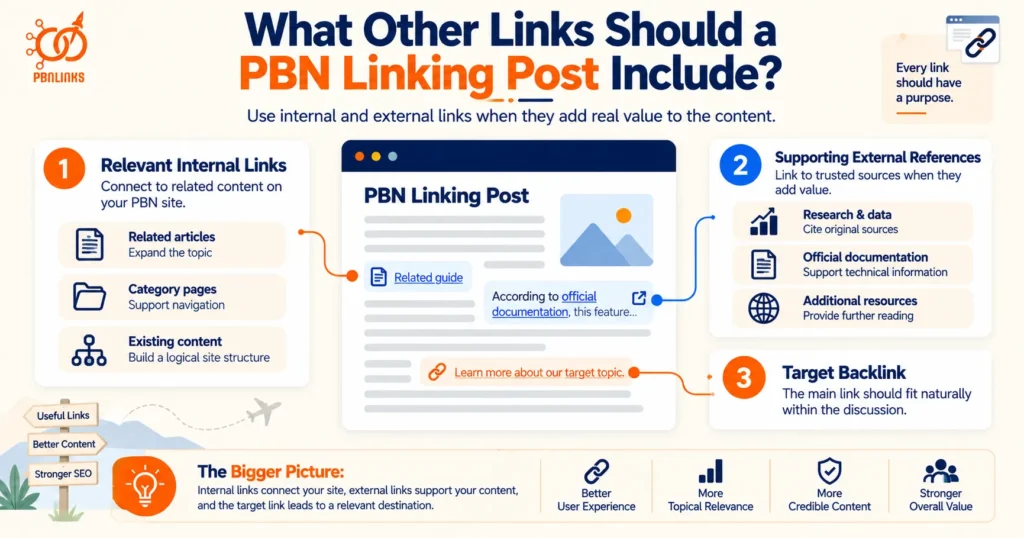
A PBN linking post can include relevant internal links and useful external references when they genuinely support the reader or the topic. These links should have an editorial purpose rather than being added to satisfy a fixed ratio or make the target backlink appear more natural.
The target backlink is therefore only one part of the page’s link structure. Internal links can connect the article with related content on the PBN site, while external links can provide sources or additional information when the subject calls for them.
Relevant Internal Links
Internal links help connect the linking post with other useful pages on the same website. They can direct readers to related articles, supporting explanations, category pages, or other resources that extend the current topic.
They also reduce the chance that the linking post becomes an isolated page with little connection to the rest of the site. A new article can link to relevant existing content, while appropriate older pages can also link back to the new post where the relationship makes sense.
The emphasis should remain on relevance. Internal links are most useful when they help create a logical path between related information rather than being inserted simply to increase the number of links on the page.
Supporting External References
External links can be useful when another website provides evidence, original research, documentation, statistics, definitions, or information that strengthens the article.
For example, a post discussing a technical SEO feature may reference official documentation when readers would benefit from seeing the original source. A data based claim may link to the organization that published the underlying research.
Not every PBN linking post needs an external reference. Its inclusion should depend on whether the content actually benefits from one.
Natural Outbound Link Context
Outbound links should make sense within the same editorial context as the rest of the article. Adding a link to a well known website simply because it appears authoritative does not automatically improve the page or make another backlink look natural.
There is also no universal requirement for a linking post to contain a particular number or ratio of outbound links. One article may need several references because it discusses research or data, while another may need very few.
The more useful principle is:
Internal links connect relevant site content → External links support the discussion → Target links lead to relevant destinations
Each link should have a reason to exist. This produces a more coherent page structure than adding links according to a predetermined PBN formula.
Does a PBN Linking Post Need Images or Other Media?
A PBN linking post does not need a fixed number of images or other media, but relevant visuals can improve the page when they help explain the topic or make information easier to understand. The type and amount of media should depend on what the article actually needs.
A simple topic may work well with only one useful image, while a detailed guide may benefit from diagrams, tables, screenshots, or several supporting visuals. Adding media without a clear purpose can make a page look busier without making the content more useful.
Relevant Images
Images should have a clear relationship with the section in which they appear. They may illustrate a concept, show an example, provide visual context, or make a complex subject easier to understand.
For example, an article about website structure could use a simple visual showing how pages connect through internal links. A generic stock image that contributes nothing to the explanation offers much less informational value.
Images should also be placed near the content they support so the relationship between the visual and surrounding text remains clear.
Tables and Diagrams
Tables are useful when readers need to compare information quickly. They can organize differences, features, criteria, or other structured information that would be harder to scan in several paragraphs.
Diagrams are better suited to relationships, processes, and sequences. A linking post discussing contextual relevance, for example, could visualize the connection between the publishing site, article, backlink, and target page.
The format should follow the information. A table should not replace an explanation when the subject requires context, and a diagram should not be added when plain text communicates the idea more clearly.
Screenshots and Supporting Media
Screenshots can add practical value when an article discusses an interface, report, configuration, search result, or process that readers may need to recognize visually.
Other supporting media can also be appropriate when the topic benefits from it. The important consideration is whether the media helps the reader understand, verify, or apply something discussed in the article.
When screenshots or other visuals are used, they should remain relevant to the surrounding section rather than functioning as decorative filler.
Media Based on Page Need
There is no universal image count or media formula that determines whether a PBN linking post is complete. The decision should come from the topic, content format, and reader need.
Before adding a visual, ask whether it performs a useful function. Does it explain something more clearly, make information easier to compare, demonstrate a process, or provide meaningful context? If not, the page may not need it.
The practical principle is:
Content need → Appropriate media → Better understanding
Media should support the article already being developed, not become another box to check when building a PBN linking post.
Should a PBN Linking Post Be Optimized Like a Normal Article?
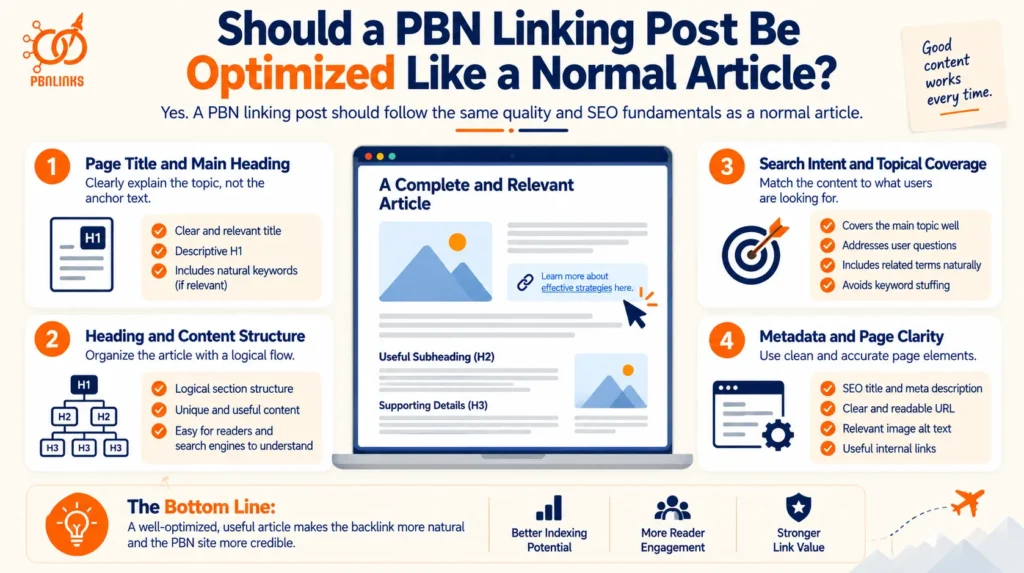
A PBN linking post should be structured and optimized like a normal article, with a clear topic, useful content, logical headings, descriptive page elements, and a defined search intent. The presence of a backlink should not replace the basic editorial and SEO work expected from a complete webpage.
This does not mean every post needs aggressive keyword optimization. The goal is to make the page easy for readers and search engines to understand while keeping the content focused on its actual subject.
Page Title and Main Heading
The page title and main heading should clearly communicate what the article covers. They should reflect the central topic rather than being written around the anchor text of the target backlink.
The main heading should give the article a clear subject, while the page title can present that subject in a concise form suitable for search results and browser tabs.
If a relevant search term fits naturally, it can be incorporated into these elements. The wording should still prioritize clarity and accurately represent the content readers will find on the page.
Heading and Content Structure
Headings should divide the article into logical sections that develop the main topic in a clear sequence. Each section should have a distinct purpose rather than repeating the same idea under slightly different headings.
The hierarchy should also remain meaningful. The main heading defines the page topic, H2 headings develop its major components, and H3 headings explain narrower aspects within those sections.
This creates a straightforward semantic structure:
Main Topic → Major Subtopics → Supporting Details
The backlink can then appear within the section where its destination is contextually relevant instead of influencing the entire heading structure.
Search Intent and Topical Coverage
Optimization should begin with the reason someone would read or search for the article. Once that intent is clear, the content can address the main questions, concepts, and supporting details needed to satisfy it.
Relevant terms and related concepts will often appear naturally when a topic is covered properly. There is little value in repeatedly inserting a target phrase if doing so makes the writing awkward or adds nothing to the explanation.
The linking post can also target a useful topic of its own. This gives the page a clearer editorial purpose and keeps its content focused on something more substantial than the backlink alone.
Metadata and Page Clarity
Basic page elements such as the SEO title, meta description, URL, headings, image descriptions where appropriate, and internal links should accurately represent the content and help users navigate or understand the page.
Metadata should describe the article rather than make claims the content does not support. URLs should remain clear and readable, while internal links should connect the post with relevant areas of the website.
These elements do not guarantee rankings or indexing, but they contribute to a page that is easier to interpret and navigate.
The objective is therefore not to make a PBN linking post look optimized through a checklist of keywords. It is to build a clear, focused article whose topic, structure, content, and page elements work together before the backlink is considered.
Does a PBN Linking Post Need to Be Indexed?
Ideally, the exact PBN linking post should be indexed if you expect search engines to discover, process, and evaluate the page containing the backlink. A domain having other pages in the index does not confirm that the specific URL carrying the target link has also been indexed.
Indexing is therefore a useful checkpoint, but it should not be confused with link quality or ranking impact. A page can be indexed and still provide little meaningful SEO value, while indexing itself does not guarantee that a backlink will improve rankings.
Domain Level Indexing
Checking whether the PBN domain appears in search can provide a broad indication that search engines know about the site. The homepage and some existing articles may already be indexed, particularly when the domain has an established content history.
However, domain level indexing tells you little about the status of a newly published linking post. Search engines evaluate and process individual URLs, so one indexed page does not automatically mean every other page on the domain is indexed.
The distinction is important:
Indexed Domain ≠ Indexed Linking URL
The actual page containing the backlink therefore needs separate attention.
Linking URL Indexing
The indexing status of the exact linking URL is more relevant when evaluating whether the page containing the backlink has entered the search index.
If the linking post is not indexed, investigate the page itself rather than assuming the domain has a general problem. A recently published article may simply require more time for discovery and processing, while persistent indexing problems can point to technical restrictions, weak discovery signals, duplication, or broader page quality issues.
An indexed URL confirms that the page has been processed and included in the index at that point in time. It does not confirm that the backlink carries a particular amount of value.
Page Discovery and Crawlability
Before a page can be indexed, search engines generally need to discover and crawl it. Internal links can help connect a new linking post with other pages on the site, giving crawlers a path to the URL.
Technical settings also matter. The page should not be unintentionally blocked from crawling or indexing through robots.txt, a noindex directive, access restrictions, or other configuration problems.
Canonical signals should also represent the intended URL correctly. If a linking post points search engines toward another URL as the canonical version, the indexing outcome may differ from what the publisher expects.
These checks help separate a discovery or technical problem from a broader content or indexing issue.
Indexing and Backlink Value
Indexing should not be treated as proof that a backlink is valuable. Search engines consider many signals when evaluating pages and links, and there is no public formula that assigns a predictable amount of ranking value simply because a linking URL appears in the index.
The more accurate relationship is:
Page Discovery → Crawlability → Processing → Possible Indexing → Link Evaluation
Even then, ranking impact is not guaranteed.
For a PBN linking post, confirming the status of the exact URL is more useful than checking only whether the domain appears in search. Indexing shows that the page has entered the index, not that the backlink is authoritative, trusted, or guaranteed to influence rankings.
Anatomy of a Complete PBN Linking Post
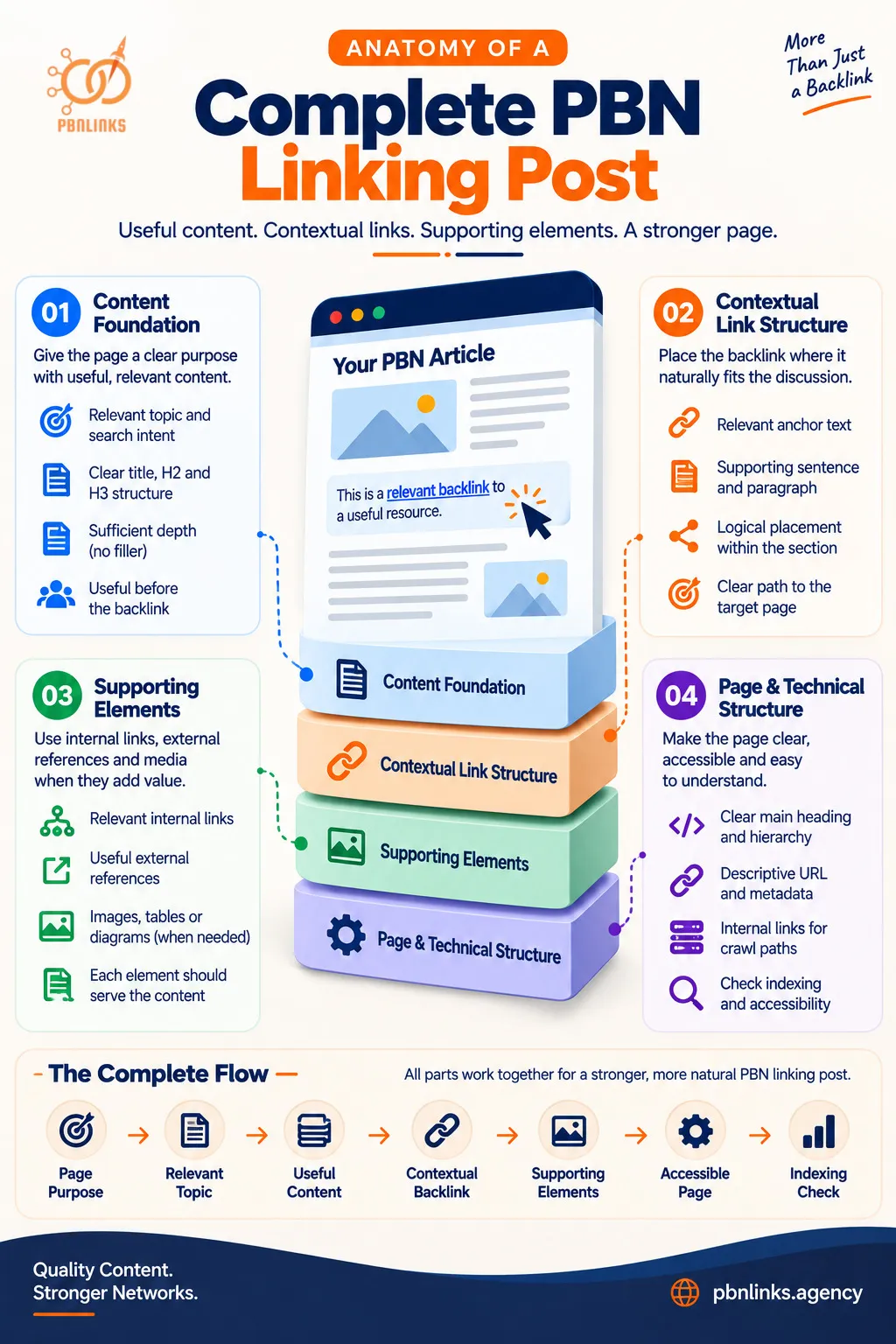
A complete PBN linking post combines useful content, contextual link placement, supporting page elements, and a technically accessible page structure. These components should work together so the article functions as a coherent webpage rather than a piece of content built around one backlink.
The anatomy can be understood as four connected layers. The content foundation gives the page its purpose. The contextual link structure connects the discussion with the target page. Supporting elements strengthen navigation and understanding. The page structure makes the content clear and accessible.
Content Foundation
The foundation starts with a topic that belongs on the publishing site and serves a recognizable reader or search intent. The article should then cover that topic with enough depth to answer its central question without unnecessary filler.
A clear title introduces the subject, while H2 and H3 headings organize the major ideas and supporting details. Each section should contribute to the same overall purpose rather than existing simply to create additional places for keywords or links.
At this level, the page should already be useful before the target backlink is considered.
Contextual Link Structure
The target backlink should connect with an idea already being developed in the article. Its anchor text, surrounding sentence, paragraph, and section should collectively explain why the destination is relevant.
The placement should follow the discussion rather than a predetermined position on the page. When the article reaches a point where the target resource can genuinely expand, support, or continue the topic, the backlink has a logical reason to appear.
The relationship should remain clear from beginning to end:
Article Topic → Relevant Section → Supporting Context → Anchor Text → Target Page
Supporting Content Structure
Internal links can connect the post with relevant pages elsewhere on the PBN site. External references can support claims or provide additional information when a credible source is useful. Images, tables, diagrams, and screenshots can improve understanding when the topic benefits from visual support.
None of these elements requires a fixed quantity. Their value depends on whether they serve the content.
A complete article may therefore contain several supporting elements or only a few. What matters is that each one contributes to navigation, explanation, evidence, or usability rather than being included as decoration.
Page and Technical Structure
The page should have a clear main heading, logical content hierarchy, descriptive page elements, and a readable URL. Its structure should make the subject and relationships between sections easy to understand.
The linking post should also be discoverable and technically accessible. Relevant internal links can provide crawl paths, while indexing directives, canonical signals, and other page settings should not unintentionally prevent the intended URL from being processed.
Once published, the exact linking URL can be checked separately from the indexing status of the wider domain.
Taken together, the anatomy follows a clear sequence:
Page Purpose → Relevant Topic → Useful Content → Contextual Backlink → Supporting Elements → Accessible Page → Indexing Check
No single component makes a PBN linking post complete on its own. The page becomes stronger when its content, link context, supporting elements, and technical setup all serve the same coherent purpose.
PBN Linking Post Checklist Before Publishing
Before publishing a PBN linking post, review the content quality, backlink context, supporting elements, and technical setup as one complete page. The purpose of this final check is to catch weak relevance, forced link placement, unnecessary content, and technical issues before the article goes live.
The review should focus on whether every major element has a clear reason to be there. A post should not pass simply because it reaches a certain word count, contains the target backlink, or includes a predetermined number of images and links.
Content Quality Review
Start by reading the article without focusing on the backlink. The topic should fit the site, address a clear reader or search intent, and provide enough information to stand on its own.
Before publishing, confirm that:
- The topic fits the broader subject of the PBN site.
- The article has a clear purpose and identifiable search intent.
- Important aspects of the topic are covered with sufficient depth.
- Headings organize the information in a logical sequence.
- Repetitive paragraphs and unnecessary filler have been removed.
- The content remains useful even if the target backlink is temporarily ignored.
This review helps determine whether the page is a genuine content asset rather than an article whose only meaningful element is the link.
Backlink Context Review
Next, evaluate the target backlink from the destination outward. The anchor text should accurately represent the linked page, and its surrounding content should explain why that destination belongs in the discussion.
Check whether:
- The target page is relevant to the article topic.
- The anchor text fits naturally into the sentence.
- The surrounding paragraph supports the linked subject.
- The section containing the backlink is relevant to the destination.
- The link appears where the topic naturally creates a reason to reference it.
- The sentence does not feel rewritten or distorted simply to accommodate the anchor.
Reading the paragraph aloud can also reveal awkward anchor placement that may not be obvious during editing.
Supporting Elements Review
Review the other elements that help the article function within the wider site. Internal links, external references, and media should be present because they improve the page, not because a publishing formula requires them.
Confirm that relevant internal links connect the article with useful existing content. Check external references for relevance and accuracy where they are used. Review images, tables, diagrams, and screenshots to make sure they genuinely support the surrounding information.
There is no need to add another link or image simply to reach a predetermined quantity.
Technical Page Review
Finally, check whether the intended page can be discovered, crawled, and processed correctly.
Review the URL, title, main heading, metadata, internal crawl paths, indexing directives, and canonical configuration. Make sure the page is not unintentionally restricted through robots.txt, a noindex directive, access controls, or an incorrect canonical signal.
After publication, the status of the exact linking URL can be monitored separately from the domain as a whole.
A practical final review therefore follows four questions:
Is the content useful? → Does the backlink belong? → Do the supporting elements help? → Is the page technically accessible?
If each answer can be supported by the page itself, the PBN linking post has passed a more meaningful review than any checklist based only on word count, link position, or fixed content ratios.
Conclusion
In conclusion, a strong PBN linking post should function as a useful, relevant page first and a backlink placement second. Its topic should fit the site, satisfy a clear search intent, provide sufficient depth, and create a logical connection between the content and target page.
The backlink should appear where the discussion naturally supports it, with appropriate anchor text and clear surrounding context. Relevant internal links, useful external references, supporting media, logical page structure, crawlability, and indexing should strengthen the page where needed rather than follow fixed formulas.
The goal is simple: create a complete page where the backlink has a genuine contextual reason to exist.
If you need carefully selected PBN links placed within relevant, contextual content, explore PBNLinks.agency to find a link building solution aligned with your SEO goals.
FAQs About PBN Linking Posts
How Long Should a PBN Linking Post Be?
A PBN linking post should be long enough to cover its topic properly, with no fixed word count required. The appropriate length depends on search intent, topic complexity, and how much explanation the subject needs.
Where Should a PBN Backlink Be Placed?
A PBN backlink should appear within the main content where it is genuinely relevant to the discussion. There is no universal paragraph or page position that guarantees greater link value, so context should determine placement.
How Much Content Should Surround a PBN Backlink?
A PBN backlink needs enough surrounding content to make its relevance clear, not a predetermined number of words. The sentence, paragraph, and section should logically connect the anchor text with the target page.
Should Every PBN Post Contain a Backlink?
No, every PBN post does not need a target backlink. Some articles can build topical coverage, support internal linking, or answer related questions without linking to a target site.
Should a PBN Linking Post Target Its Own Keyword?
Yes, a PBN linking post can target its own relevant keyword when that term matches the page topic and search intent. The article should have an independent purpose rather than existing solely to accommodate an anchor text or backlink.
Should PBN Linking Posts Include Internal Links?
Yes, relevant internal links can connect a PBN linking post with related content and provide additional discovery paths for search engines. Internal links should be based on useful topical relationships rather than a fixed number per post.
Should PBN Posts Link to Authority Websites?
PBN posts can link to authoritative sources when those sources genuinely support the content, but doing so is not a requirement. External links should provide evidence, documentation, data, or useful additional information rather than being added simply to make the post appear natural.
Do PBN Linking Posts Need Images?
No, a PBN linking post does not require a specific number of images. Images, screenshots, tables, and diagrams should be included when they improve understanding or add useful context to the topic.
Does the Exact PBN Linking Page Need to Be Indexed?
Ideally, the exact page containing the backlink should be indexed if you expect Google to process that page in Search. An indexed domain does not guarantee that every individual URL is indexed, and indexing alone does not prove that a backlink will improve rankings.
Does Longer Content Make a PBN Backlink Stronger?
No, making a PBN linking post longer does not automatically make its backlink stronger. Additional content is useful only when it improves topical coverage, relevance, or reader value rather than adding filler around the link.