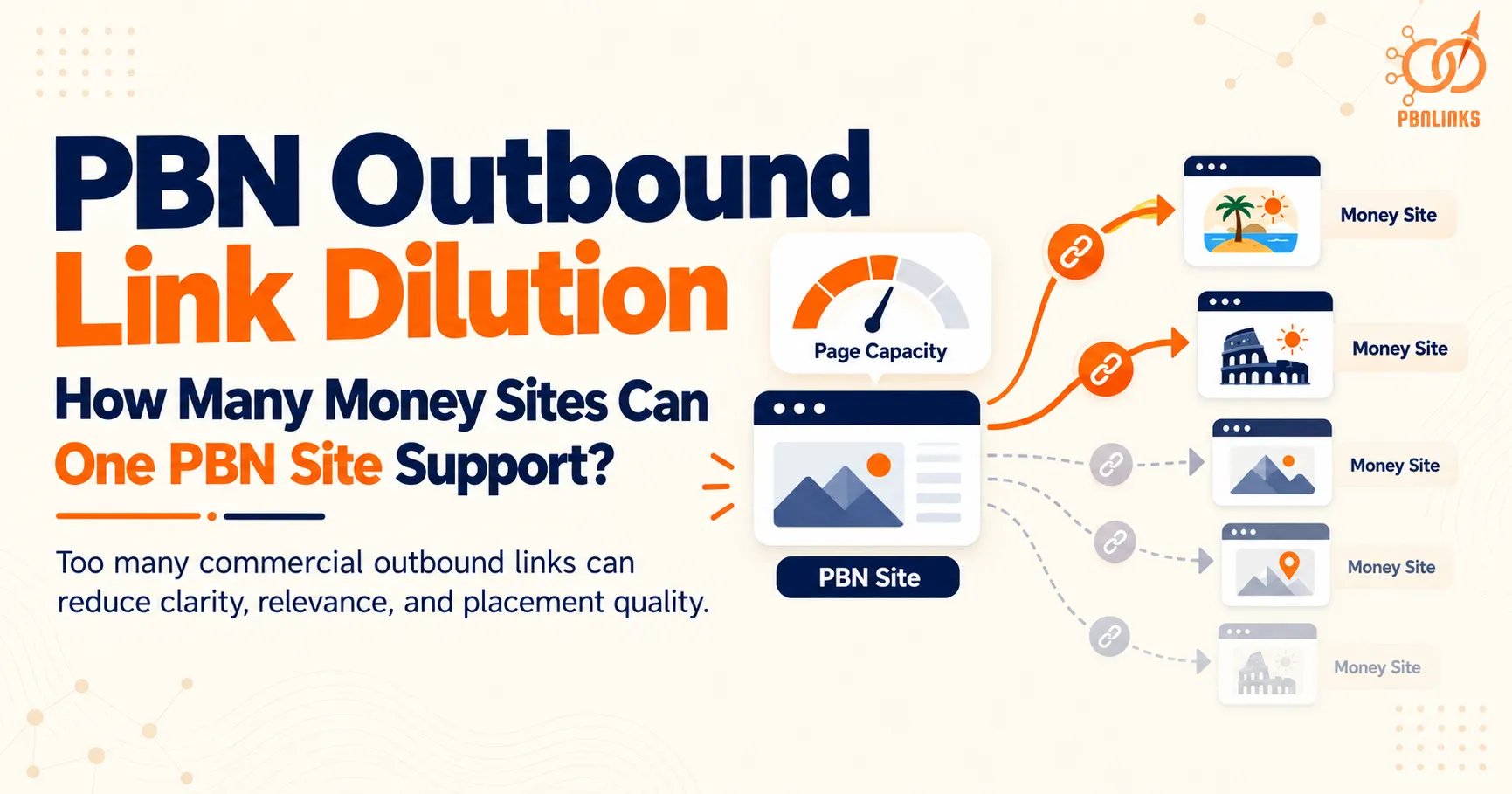
PBN Outbound Link Dilution: How Many Money Sites Can One PBN Site Support?
A strong PBN site can lose effectiveness if too many money site links are added without a clear plan. More client links do not always mean more value. At some point, the site can become too focused on commercial links and less useful as a natural content source.
PBN outbound link dilution is not just about how many external links appear on a page. It also depends on where those links are placed, how many point to money sites, how relevant the target sites are, and how the rest of the page links to useful sources and related information.
The number of money sites one PBN can support depends on page strength, topical relevance, internal linking, existing outbound links, and the number of suitable pages available. A larger site may have more room for relevant placements, while a smaller or heavily used site can reach its limit much faster.
This guide explains how PBN outbound link dilution works, how page capacity differs from domain capacity, how to balance commercial and editorial links, and when it is better to use another PBN domain instead of adding more client links to the same site.
What Is PBN Outbound Link Dilution?
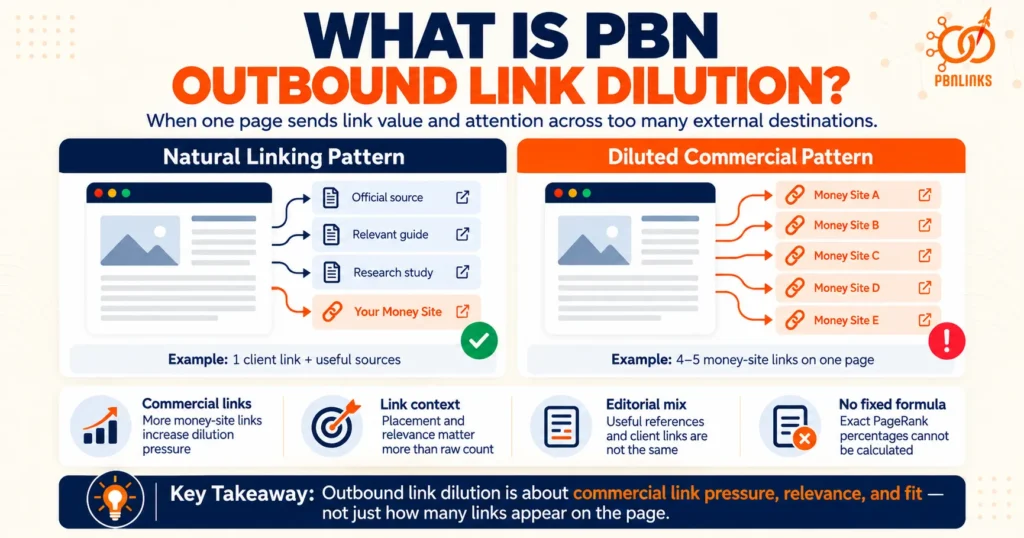
PBN outbound link dilution happens when a page links to several external websites instead of focusing on only one target. As more outbound links are added, the page spreads its linking signals and attention across more destinations.
This does not mean every outbound link is bad. Real websites naturally link to sources, tools, references, related businesses, and other useful pages. The important question is why those links are there and whether they support the content or mainly benefit client sites.
For PBNs, the bigger issue is how much of the page is being used for commercial links. A page with several useful references and one client link has a different linking pattern from a page where most external links point to money sites.
Link Equity Dilution vs Simple Link Count
Link equity dilution is not just about counting how many outbound links appear on a page. Link type, relevance, placement, and context also matter.
For example, one page may contain six outbound links to useful sources and related resources. Another page may also contain six outbound links, but most of them point to client websites. The number is the same, but the purpose and linking pattern are very different.
This is why outbound link dilution should be judged by more than a fixed link count. The better approach is to look at how many links are commercial, how relevant they are, and whether they fit naturally within the page.
Why Exact PageRank Percentages Cannot Be Calculated
It is common to see PageRank explained with simple formulas, such as saying four outbound links pass 25 percent of the value each. That is too simple for modern SEO.
Google still uses link analysis as part of its ranking systems, but there is no public formula that shows exactly how much PageRank an individual outbound link receives. SEOs cannot reliably calculate an exact percentage for each link.
The practical takeaway is simple. More outbound destinations can spread link value more broadly, but fixed percentage formulas should not be treated as confirmed Google rules.
How Many Money Sites Can One PBN Site Support?
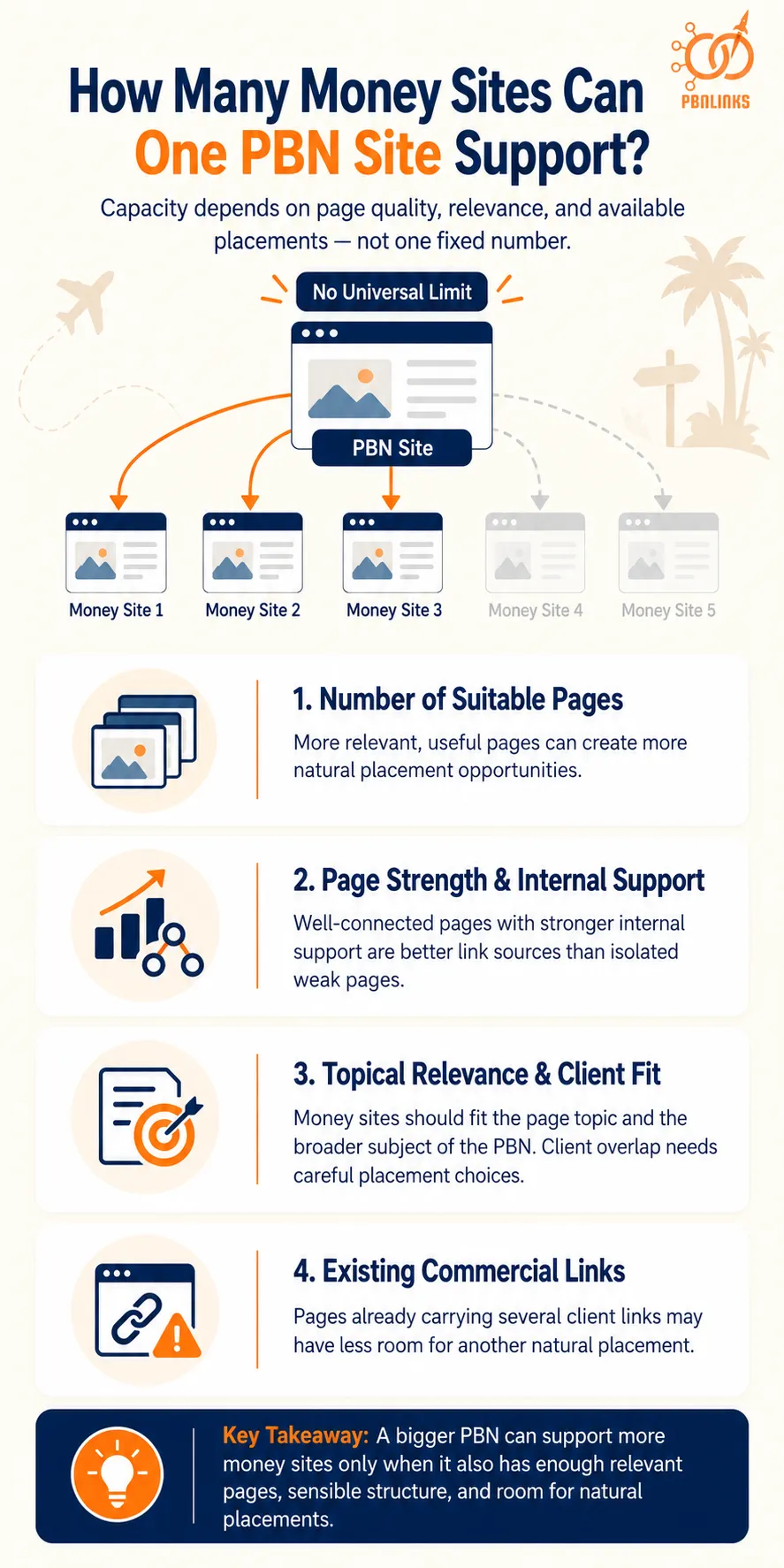
There is no fixed number of money sites that every PBN can support. One domain may have room for several relevant placements, while another may become overloaded after only a few client links.
The real limit depends on the structure and condition of the site. A larger PBN with many useful pages may have more placement options than a small site with only a handful of strong pages. The quality of those pages, their relevance, and the number of existing commercial links also matter.
The goal is not to fit as many money sites as possible onto one domain. The goal is to use each PBN where it can provide a relevant and well placed link without making the site too commercial or forcing links into pages where they do not belong.
Why There Is No Universal Client Limit
Rules such as one client per PBN or three money sites per domain may be useful as internal guidelines, but they are not universal limits.
A five page local business style site has fewer natural placement opportunities than a larger niche publication with dozens of relevant articles. Even when both domains are strong, their ability to support multiple money sites can be very different.
This is why money site capacity should be based on the site itself rather than one number applied across the whole network.
What Actually Determines Money Site Capacity
Several factors help determine how many money sites a PBN can support:
- Number of suitable pages: More relevant and useful pages can create more placement opportunities.
- Page strength: Stronger pages that are well connected inside the site may be better link sources.
- Topical relevance: The target website should fit naturally with the page and the broader subject of the site.
- Existing commercial links: Pages already carrying several client links may have less room for additional placements.
- Internal linking: Well connected pages usually fit more naturally into the site than isolated pages created only for backlinks.
- Client overlap: Multiple sites competing in the same niche may require more careful placement decisions.
A larger PBN can support more money sites only when it also has enough relevant pages and a sensible link structure. Site size alone does not create unlimited capacity.
Page Capacity vs Domain Capacity
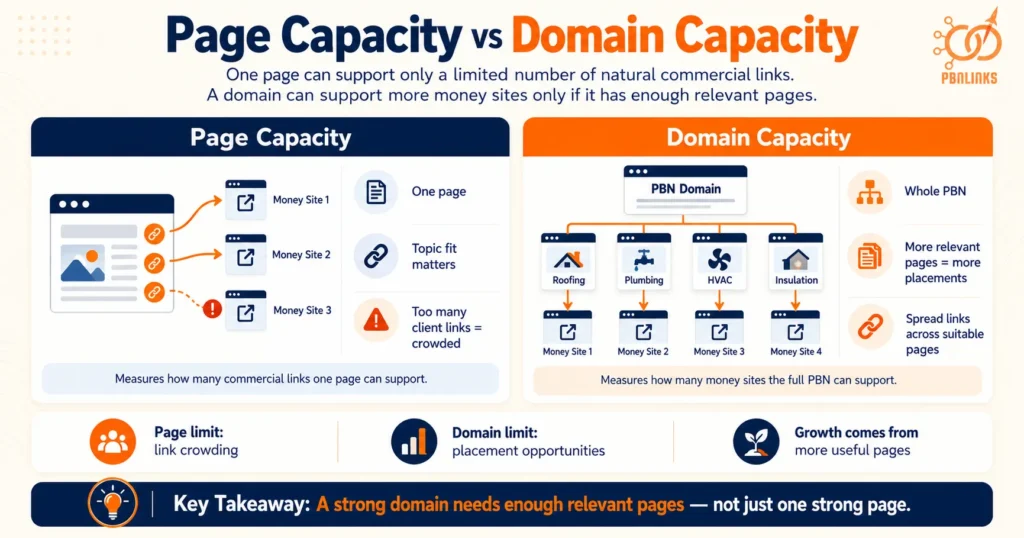
Page capacity and domain capacity are not the same thing. Page capacity is how many commercial links one specific page can support, while domain capacity is how many money sites the entire PBN can support across different relevant pages.
This distinction matters because one strong domain can still have limited placement space if only a few pages are suitable for client links. A larger site may support more money sites only when it has enough relevant pages to spread those placements naturally.
| Factor | Page Capacity | Domain Capacity |
| What it measures | How many commercial links one page can support | How many money sites the full PBN can support |
| Main limit | Topic fit, existing client links, page purpose, and link crowding | Number of relevant pages, site structure, and available placement opportunities |
| Typical problem | Too many client links on one page | Reusing the same small group of pages for too many money sites |
| How capacity grows | Better content depth and stronger topical fit | More useful, relevant, and well connected pages |
| Best approach | Keep each placement natural to the page | Spread relevant placements across different suitable pages |
What Limits the Capacity of a Single PBN Page?
A PBN page starts reaching its practical limit when additional client links no longer fit naturally with the topic or make the page too commercial.
Several factors can reduce page capacity:
- Existing client links: A page already used for several money sites has less room for more commercial placements.
- Topical fit: Each new link should match the subject of the page.
- Page purpose: An informational article should still feel useful, not built mainly to send links elsewhere.
- Existing outbound links: Other references and external resources also shape the page’s overall linking pattern.
- Content depth: A short page has less space for multiple relevant external links than a detailed resource.
For example, a short roofing article with several client links can become crowded quickly. A deeper roofing guide may have more room for one relevant commercial link alongside useful references and supporting information.
How Multiple Relevant Pages Increase Domain Capacity
A PBN can support more money sites when the domain has several relevant pages that can carry separate placements.
For example, a home improvement site may have different pages about roofing, plumbing, HVAC, and insulation. Each page can link to a different relevant money site without forcing several unrelated client links into one article.
This is why domain capacity should be judged by the number of useful placement pages, not only by the strength of the domain. A strong PBN with only a few relevant pages may have limited capacity, while a larger and well structured site may support several money sites across different topics.
The key point is simple. A PBN should support only as many money sites as its relevant pages can handle without forcing too many client links into the same limited set of pages.
Commercial Link Density Matters More Than Raw Outbound Link Count
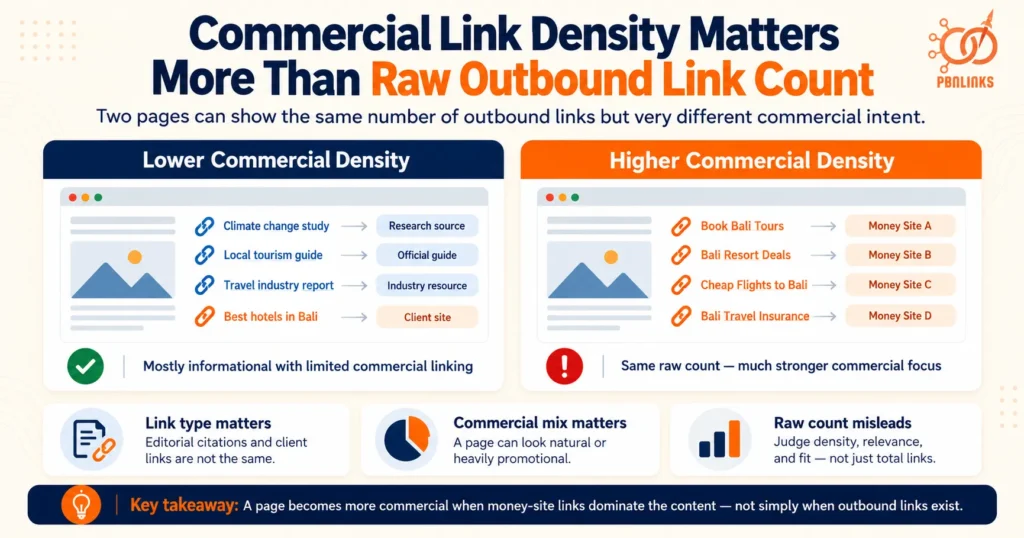
Raw outbound link count does not show how commercial a PBN page really is. Two pages can have the same number of external links but serve very different purposes.
A page with several useful references and one client link can still look like normal informational content. A page with the same number of links pointing mostly to money sites has a much stronger commercial focus.
This is why commercial link density is often more useful than simply counting outbound links. The important question is not only how many links leave the page, but how many of them exist mainly to benefit client websites.
| Outbound Link Pattern | What It Suggests |
| Several source links plus one client link | Mostly informational with limited commercial linking |
| Several authority references plus two relevant client links | Mixed editorial and commercial purpose |
| Most outbound links point to money sites | High commercial concentration |
| Multiple unrelated client links on one page | Weak topical fit and stronger commercial focus |
Editorial Citations vs Client Links
Editorial links usually help explain, support, or expand the content. They may point to research, tools, statistics, official sources, industry resources, or related information.
Client links serve a different purpose. They usually point to a money site that the PBN is intended to support.
For example, an article may link to a government report, an industry study, a useful calculator, and one relevant service website. Another article may contain four external links, all pointing to client sites. Both pages have four outbound links, but their linking patterns are very different.
This is why total outbound link count should not be used alone when judging PBN capacity. The type and purpose of each link matter just as much as the number.
When a Page Becomes Too Commercial
A page becomes too commercially focused when client links start to dominate the content or appear where they do not naturally help the reader.
Common signs include several money site links on a short article, unrelated client links placed in the same content, repeated links to commercial destinations, or sections written mainly to create another backlink opportunity.
The issue is not a fixed number such as three or five links. The better test is whether the page still works as useful content without depending on its client links.
If commercial links begin to control the structure or purpose of the page, it is usually better to use another relevant page or another PBN asset instead of adding more placements.
How Topical Relevance Changes PBN Money Site Capacity
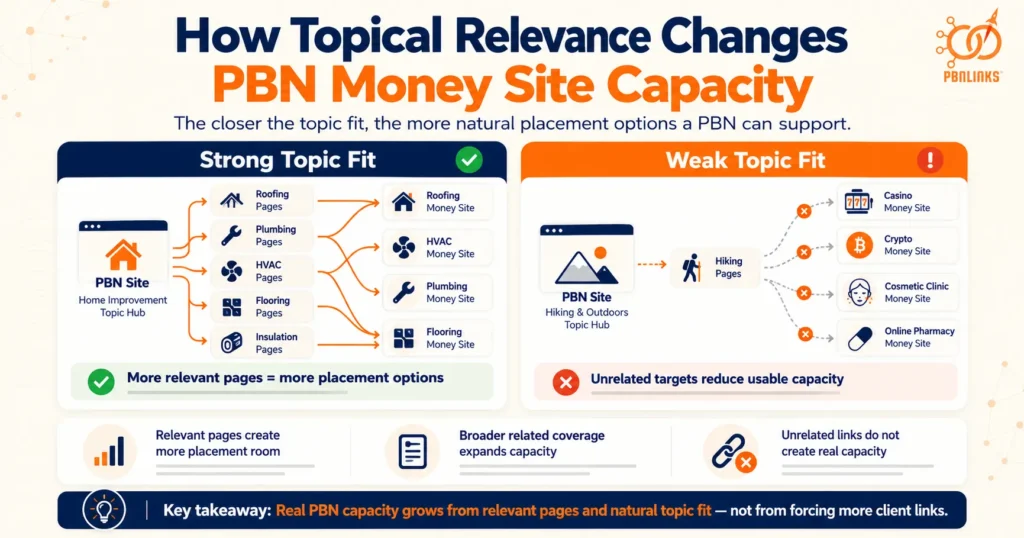
Topical relevance affects how many money sites one PBN can support because it determines how many pages can naturally connect with different target websites. The closer the money sites are to the PBN’s existing topics, the more useful placement opportunities the domain can create.
A PBN with broad but related topic coverage usually has more practical capacity than a site focused on one narrow subject. When the target websites fall outside the site’s main topics, fewer pages can support those links naturally and the usable capacity becomes lower.
How Topical Relevance Controls PBN Money Site Capacity
A PBN’s practical capacity depends on how well its content matches the money sites it is expected to support:
- Relevant Pages Create More Placement Options
A PBN can support more money sites when it has several pages that closely match different targets. A home improvement site with separate roofing, plumbing, HVAC, flooring, and insulation pages can place links across those topics instead of using the same article repeatedly. - Weak Topic Fit Reduces Available Capacity
A strong page is not automatically suitable for every client. A home improvement article may be valuable, but that does not make it a natural place for casino, crypto, or cosmetic surgery links. Poor topic fit reduces the number of pages that can be used without forcing the placement. - Broader Relevant Coverage Expands Capacity
A tightly focused roofing site may mainly support roofing, gutters, and nearby services. A broader home improvement site may also cover plumbing, HVAC, insulation, landscaping, and flooring. The broader site has more relevant areas where different money sites can fit. - Adjacent Niches Can Add Placement Room
Money sites do not always need to match one exact niche. Related subjects can still fit when the PBN already covers them naturally. For example, accounting, payroll, invoicing software, and business insurance can all fit within a broader business publication. - Unrelated Links Do Not Create Real Capacity
Adding more client links does not increase capacity if those links do not match the site. Real capacity comes from having enough relevant pages and topics to support different money sites without changing the purpose of the content.
When topical relevance is strong, a PBN has more room to support different money sites across separate pages. When relevance becomes weak, adding more clients does not increase capacity. It only makes suitable placement options harder to find.
Homepage Capacity vs Contextual Inner Page Capacity
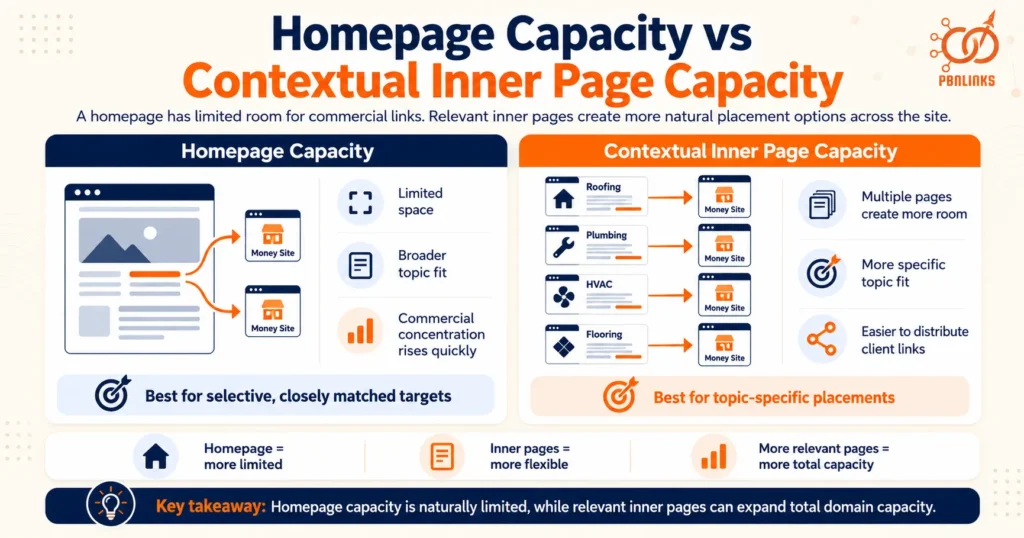
Homepage capacity and inner page capacity affect how many money sites one PBN can support. A homepage has limited space for commercial links, while relevant inner pages can create more placement opportunities across the site.
This means a PBN should not judge capacity only by how many links can be added to the homepage. The total capacity of the domain depends on how many suitable inner pages can support different money sites without forcing several client links into the same place.
| Factor | Homepage Capacity | Contextual Inner Page Capacity |
| Available space | Limited | Spread across multiple pages |
| Topical relevance | Usually broader | Usually more specific |
| Commercial concentration | Can increase quickly | Easier to distribute |
| Placement flexibility | Lower | Higher when several relevant pages exist |
| Best use | Selective links to closely matched targets | Topic specific money site placements |
| Effect on domain capacity | Limited if heavily used | Can increase total capacity across the site |
How Homepage and Inner Page Capacity Affect Money Site Placement
A PBN should use homepage and inner page links differently when deciding how many money sites the domain can support:
- Homepage Capacity Is More Limited
A homepage has limited space and usually serves many purposes. Adding several client links can make commercial activity more concentrated, especially when the targets are unrelated. Homepage placements should therefore be more selective. - Contextual Inner Pages Create More Capacity
Relevant inner pages allow money site links to be spread across different topics. A roofing article can support a roofing target, while a plumbing page can support a plumbing target. This creates additional capacity without placing several client links on one page. - Topic Fit Should Decide the Placement
The best page is the one where the money site fits naturally with the content. A homepage may be suitable for a broad brand or closely related target, while a detailed inner page may provide stronger context for a specific service or topic. - More Relevant Inner Pages Reduce Commercial Concentration
A PBN with several useful topic pages does not need to rely on the homepage for every client link. Distributing placements across relevant pages keeps commercial links from becoming concentrated in one part of the site and increases practical domain capacity.
The key point is simple. Homepage capacity is naturally limited, while contextual inner pages can expand the number of money sites a PBN can support when those pages are relevant and well integrated into the site.
How Internal Linking Affects Outbound Link Capacity
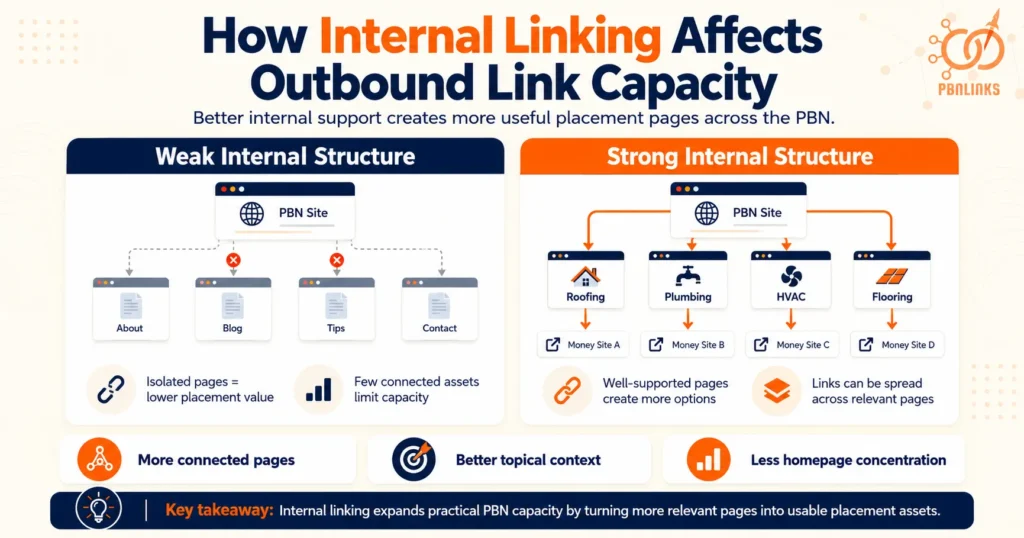
Internal linking affects how much support a PBN page receives from the rest of the site. A page that is well connected through relevant internal links is usually a stronger placement asset than a page that sits isolated with little connection to the site.
This matters for money site capacity because a PBN with several well supported pages has more useful places to add relevant outbound links. A site with weak internal structure may have many pages, but only a small number of them may be strong enough to use for client placements.
How Internal Linking Changes PBN Money Site Capacity
Internal structure influences how many pages inside the PBN can become useful placement assets:
- Well Supported Pages Create More Placement Options
Pages that receive relevant internal links from other parts of the site are easier to discover and are more clearly connected to the wider topic. When several pages are well supported, the domain has more places where different money site links can be added. - Isolated Pages Have Lower Practical Value
A page created only to hold a backlink but receiving little internal support may not contribute much to overall capacity. If only a few pages are properly connected, the PBN still has limited placement space even when the site contains many URLs. - Topical Internal Links Strengthen Context
Internal links between related pages help show how different topics connect inside the site. A roofing guide linked from other roofing and home improvement pages has stronger topical context than a page that sits outside the main content structure. - Internal Structure Helps Spread Placements Across the Site
Strong internal linking allows money site links to be distributed across several relevant pages instead of being concentrated on the homepage or the same small group of articles. - Page Count Alone Does Not Increase Capacity
Adding more pages does not automatically create more room for money site links. Those pages need to be useful, relevant, and connected well enough to become real placement options.
The key point is simple. Internal linking can increase practical PBN capacity when it helps create more relevant and well connected pages that can support separate money site placements.
Shared PBN vs Dedicated PBN Asset
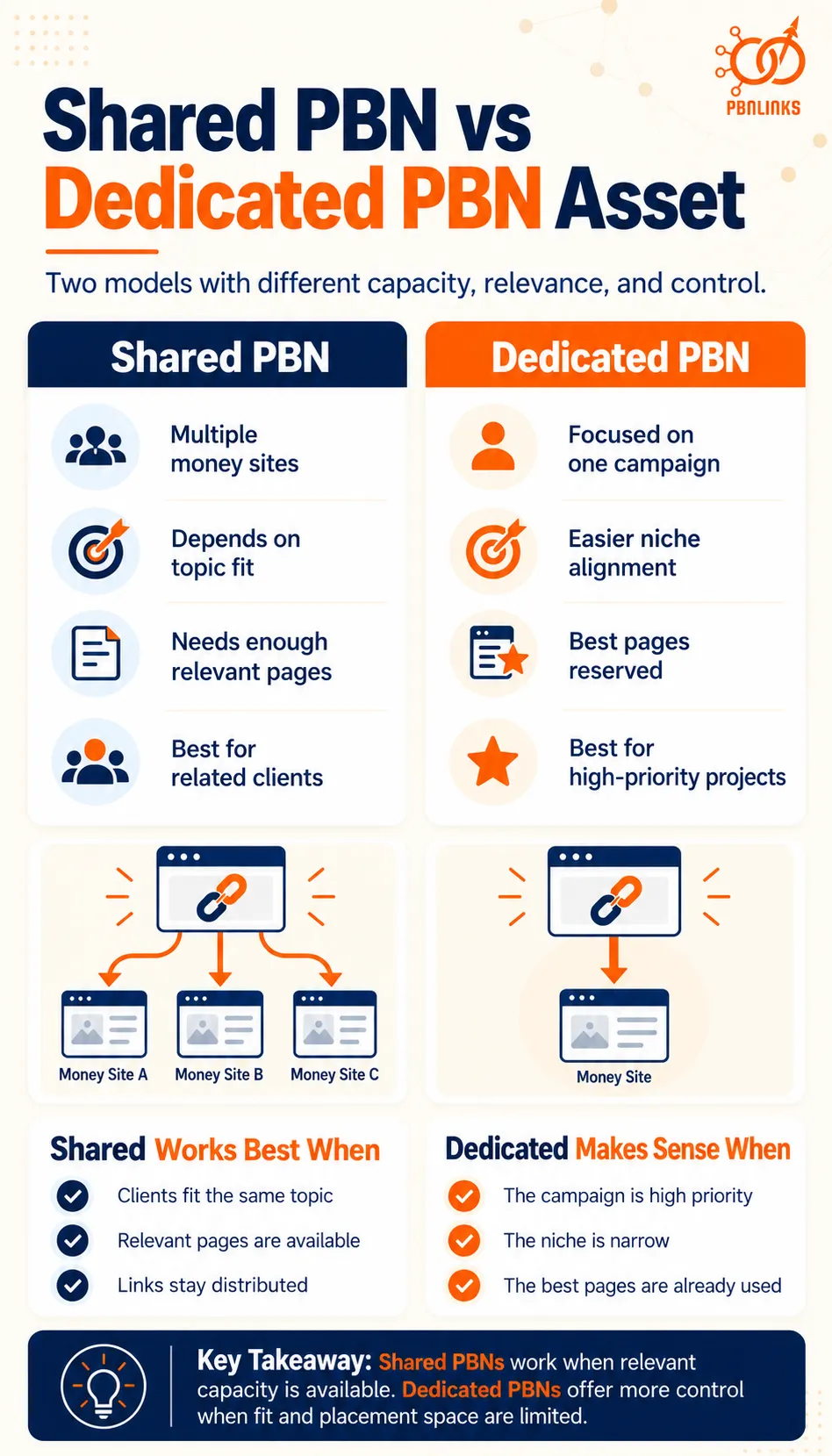
A shared PBN is used to support more than one money site, while a dedicated PBN is mainly reserved for one client, project, or campaign. Both models can work, but they offer different levels of capacity, relevance, and control.
A shared PBN can be more efficient when several money sites fit the same topic and there are enough suitable pages for separate placements. A dedicated PBN gives more control because the strongest pages and available link capacity can be focused on one campaign.
| Factor | Shared PBN | Dedicated PBN |
| Money site capacity | Supports multiple compatible targets | Focused mainly on one target or campaign |
| Topical relevance | Depends on how well different clients fit the site | Easier to keep closely aligned with one niche |
| Placement flexibility | Requires enough relevant pages for several clients | Strong pages can be reserved for one project |
| Commercial link pressure | Can increase as more clients are added | Easier to keep client links concentrated around one campaign |
| Client overlap | More likely when several clients share the same asset | Lower because the asset is more controlled |
| Best use | Related clients with enough available capacity | High priority, narrow, or highly controlled campaigns |
The better choice depends on the remaining capacity of the PBN. If a shared site still has relevant pages, low commercial concentration, and good topic fit, it may support additional money sites without needing another domain.
A dedicated asset becomes more useful when relevant pages are already occupied, the new target does not fit the existing site well, or the campaign needs greater control over where and how links are placed.
When One PBN Can Support Multiple Clients
A shared PBN can support multiple clients when the domain has enough relevant pages and the placements remain well distributed:
- Clients Fit the Same Topic Area
Related money sites are easier to place across different pages without changing the identity of the PBN. - Relevant Pages Are Still Available
Each client should have a suitable page instead of forcing several placements into the same small group of articles. - Commercial Links Stay Distributed
Client links should not become concentrated on the homepage or a few strong pages. - Client Overlap Is Limited
Multiple clients are easier to manage when they do not compete directly for the same keywords, markets, or pages.
When a Dedicated PBN Makes More Sense
A dedicated asset becomes more practical when the campaign needs more control or the shared domain is running out of suitable capacity:
- The Campaign Is High Priority
Important projects may benefit from having the strongest relevant pages reserved for one target. - The Niche Is Narrow
A tightly focused money site may be easier to support with a PBN built around the same subject. - Existing Pages Are Already Used
If the best pages already contain client links, adding another money site can reduce placement quality. - Clients Compete Directly
Separating competing money sites can make link allocation and campaign management easier.
The key point is simple. Shared PBNs work best when relevant capacity is still available, while dedicated PBNs offer more control when topic fit, placement space, or client overlap becomes harder to manage.
Can Competing Money Sites Share the Same PBN?
Competing money sites may share the same PBN when there is enough separation between their topics, locations, and placement needs. The problem starts when both sites depend on the same small group of strong pages.
A PBN can support several clients in the same niche when each money site has different relevant pages available. For example, two roofing companies in different markets may be easier to manage than two businesses targeting the same city and the same services.
As client overlap increases, practical PBN capacity becomes lower. Two money sites targeting the same keywords, services, or locations often need links from the same topical sections, which leaves fewer unique placement opportunities for each campaign.
Competition also reduces future flexibility. If the strongest pages are already being used for one client, adding more support for another competing site may require weaker pages or repeated use of the same sections.
The better approach is to share a PBN only when each money site can be supported with separate and relevant placement opportunities. When both clients compete for the same pages, topics, or market, using another PBN asset gives cleaner control and preserves more capacity for each campaign.
The PBN Money Site Capacity Framework
PBN money site capacity should not be decided by one fixed number. A better approach is to review the page, the site, and the target before adding another client link.
The framework below helps decide whether a PBN still has room for another money site or whether it is better to use a different page or another domain.
| Capacity Factor | What to Check | Why It Matters |
| Page Strength | Is the page useful, relevant, and well connected internally? | Stronger pages make better placement assets |
| Existing Outbound Links | How many external links already exist and what are they for? | Shows how crowded the page already is |
| Commercial Link Density | How many links point to client or money sites? | Helps measure how commercial the page has become |
| Topical Fit | Does the target site match the page and wider site topic? | Better relevance creates more natural placements |
| Internal Link Support | Does the page receive links from related pages? | Strong internal support improves page integration |
| Placement Type | Is the link on the homepage or a contextual inner page? | Different page types have different practical capacity |
| Client Overlap | Does the new target compete with existing clients? | High overlap can reduce future placement options |
| Better Asset Availability | Is another page or PBN a stronger fit? | Prevents forcing another link onto the wrong asset |
How to Use the Capacity Framework
Before adding another money site, review these factors in order:
- Check Page Strength First
Start with the actual page, not only the domain. A strong domain can still have weak or poorly connected pages that are not good placement choices. - Review Existing Outbound Links
Look at how many external links already appear on the page and why they are there. A page with several useful references is different from one already carrying several client links. - Measure Commercial Link Density
Check how much of the page’s outbound linking is commercial. If client links already dominate the page, adding another money site may reduce placement quality. - Confirm Topical Fit
The target site should make sense within the topic of the page and the wider PBN. Strong relevance creates more usable capacity, while poor fit reduces it. - Check Internal Support
A page should be connected to the rest of the site through relevant internal links. Isolated pages may exist, but they do not add the same practical capacity as well integrated pages. - Choose the Right Placement Type
Decide whether the target belongs on the homepage or a contextual inner page. In many cases, a relevant inner page offers better topic fit and reduces homepage pressure. - Review Client Overlap
If the new money site competes with an existing client for the same pages, keywords, or market, the PBN may have less usable capacity than it first appears. - Compare Other Available Assets
Before forcing another placement, check whether a different PBN or another relevant page provides a cleaner fit.
The framework does not produce one universal number. Its purpose is to show whether another money site can be added without weakening relevance, increasing commercial concentration, or overusing the same limited pages.
When Should You Stop Adding Money Sites to One PBN?
You should stop adding money sites to one PBN when the domain no longer has enough relevant pages to support new placements naturally. The limit is reached when additional client links begin to reduce relevance, increase commercial concentration, or force the same pages to be reused.
A strong domain can still run out of practical capacity. High authority does not mean every page should carry another client link. Capacity depends on how many suitable pages are still available and whether those pages match the new target.
Another warning sign is when new money sites no longer fit the PBN’s main topics. If a link needs to be placed on an unrelated page just because the domain is strong, another PBN with better topical fit is usually the better option.
The same applies when the homepage or strongest inner pages already carry several commercial links. Reusing the same pages again can concentrate client links in a small part of the site and reduce future placement flexibility.
The better approach is to stop before the PBN becomes overloaded. When relevant pages are already used, topic fit becomes weak, or another domain offers a cleaner placement, moving the next money site to a different PBN usually gives better control.
Signs a PBN Has Reached Its Practical Capacity
Several signals can show that it is time to stop adding new money sites:
- Relevant Pages Are Already Used
The strongest pages that match the target topic already contain client links, leaving fewer natural placement options. - New Targets Have Weak Topic Fit
The next money site does not match the PBN’s existing content closely enough to support a natural contextual link. - Commercial Links Are Becoming Concentrated
The homepage or a small group of strong pages already carries most of the client links. - The Same Pages Keep Being Reused
Repeatedly placing new money site links on the same articles shows that the domain is running out of useful placement space. - Client Overlap Is Increasing
New money sites compete with existing clients for the same pages, topics, keywords, or markets. - Another PBN Offers Better Relevance
If another domain has a cleaner topical match and unused placement pages, forcing another link onto the current site makes little sense.
The key point is simple. A PBN has reached its practical capacity when another money site cannot be added without weakening relevance, increasing commercial pressure, or overusing the same limited pages.
Common PBN Outbound Link Dilution Mistakes
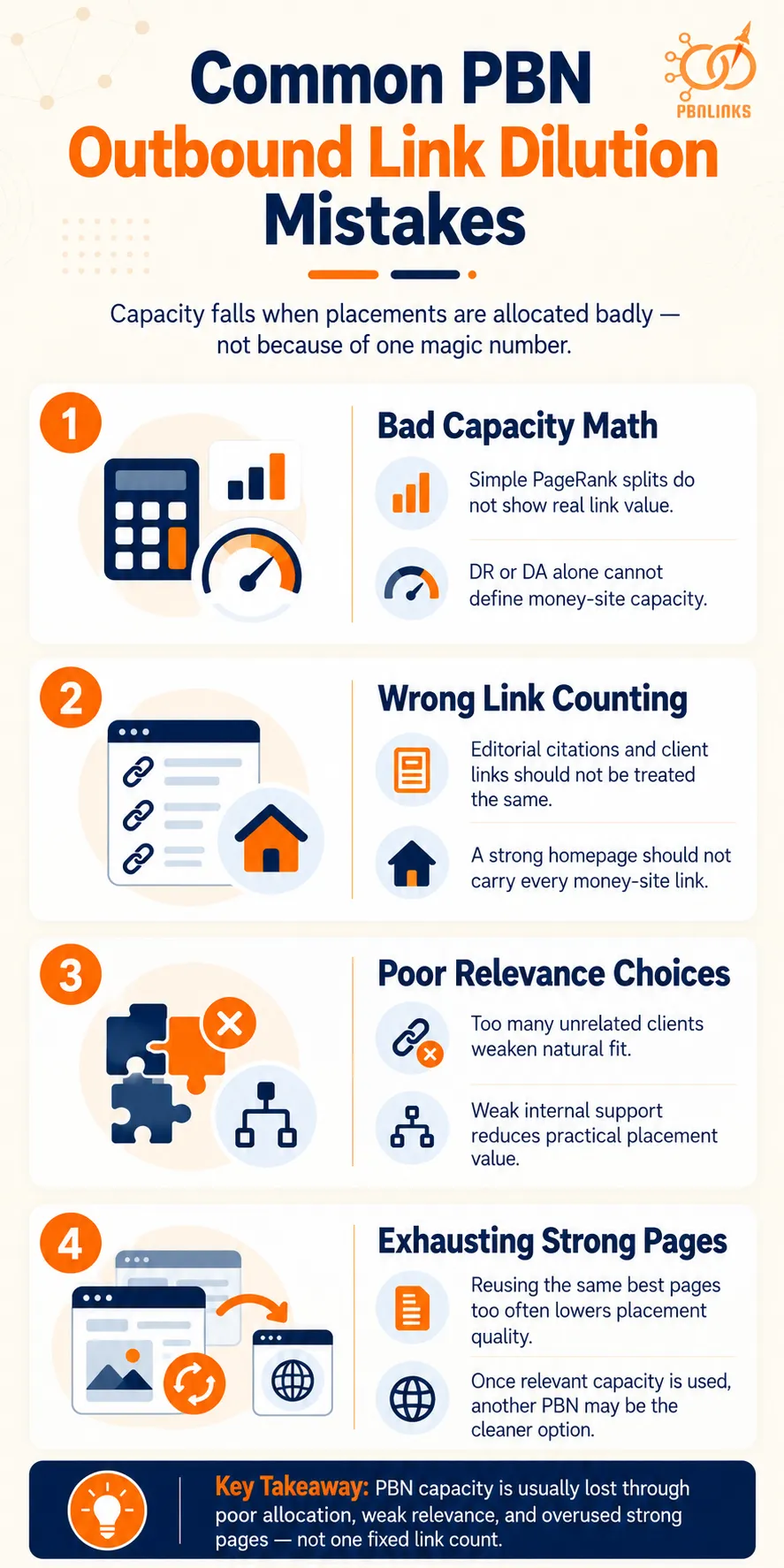
Most outbound link dilution problems happen when PBN capacity is judged by simple numbers instead of page quality, relevance, and existing commercial use. A strong domain can still be misused if too many client links are added to the wrong pages.
The biggest mistakes usually come from treating every page the same, relying too heavily on domain metrics, or continuing to add money sites after the best placement opportunities are already used.
Common Mistakes That Reduce PBN Money Site Capacity
- Using Simple PageRank Percentages
A common mistake is assuming that four outbound links pass exactly 25 percent of the value each. Google does not provide a public formula that allows SEOs to calculate exact PageRank percentages for individual links. - Judging Capacity Only by DR or DA
Strong third party domain metrics do not show how many relevant pages are available, how commercial those pages already are, or whether the new target fits the site. Domain strength alone does not determine money site capacity. - Treating Every Outbound Link the Same
A citation to a research source is not the same as a client link. Total outbound link count can be misleading if editorial references and commercial placements are grouped together. - Overloading the Homepage
Adding several money site links to the homepage can concentrate commercial activity in one place. A strong homepage does not mean it should support every client connected to the domain. - Mixing Too Many Unrelated Clients
A PBN may have strong pages, but those pages still need to match the target websites. Adding unrelated clients reduces the number of placements that fit naturally within the site. - Ignoring Internal Link Support
A page may look suitable for a backlink but still be weakly connected to the rest of the PBN. Pages with poor internal support add less practical placement value than pages that are properly integrated into the site. - Reusing the Same Strong Pages Too Often
Repeatedly adding client links to the same articles can exhaust those pages even when the domain still looks strong overall. More suitable pages should be used when available. - Adding New Clients After Relevant Capacity Is Used
The final mistake is treating unused domain authority as unused link capacity. Once the strongest relevant pages are already occupied, another PBN may provide a cleaner and more useful placement.
The key point is simple. PBN outbound link dilution is usually caused by poor allocation, not by one fixed number of links. Capacity works best when each placement is based on page relevance, commercial use, internal support, and the availability of better pages.
Practical PBN Money Site Capacity Examples
PBN money site capacity changes from one domain to another because every site has a different structure, topic range, page strength, and outbound link profile. A small niche site may have only a few useful placement pages, while a larger publication may support several money sites across different sections.
The examples below show how page availability, topical relevance, and commercial link use can change practical capacity.
Example 1: Small Local Business Style PBN
A small local business style PBN may have a homepage, several service pages, a contact page, and a few blog posts. Its total page count may be low, and only a small number of pages may be suitable for outbound client links.
If the site focuses on roofing, the strongest placement opportunities may be limited to roofing services, storm damage, roof repair, gutters, or nearby topics. Adding several unrelated money sites would quickly use the limited available space.
Best approach: Keep client placements limited to closely related targets and avoid forcing multiple money site links into the same small group of pages.
Example 2: Evergreen Niche Blog
An evergreen niche blog may have dozens of useful articles covering different subtopics within one industry. This creates more placement options because different money sites can be matched with separate relevant pages.
For example, a home improvement blog may have strong content about roofing, plumbing, insulation, flooring, and HVAC. Each section can support a different relevant target without concentrating all client links on the homepage.
Best approach: Spread placements across the strongest relevant articles and keep commercial links balanced with normal editorial references.
Example 3: Large Editorial Publication
A large editorial PBN may have hundreds of pages, multiple categories, and strong internal linking. This can create higher domain capacity because there are more pages that may fit different money sites.
However, size alone does not create unlimited capacity. If the same strong pages are used repeatedly or the target sites fall outside the publication’s main topics, practical capacity still becomes limited.
Best approach: Use separate relevant sections for different money sites and avoid treating the domain as a source for unlimited client links.
Example 4: Shared Multi Client PBN
A shared PBN may support several clients across one broad niche. For example, a business publication could have separate sections for accounting, software, insurance, marketing, and finance.
This model can work when each client has its own relevant placement opportunities. Problems start when too many clients compete for the same pages, when unrelated money sites are added, or when commercial links become concentrated in a small part of the site.
Best approach: Review page capacity, topical fit, commercial link density, and client overlap before adding each new placement.
These examples show why PBN money site capacity cannot be reduced to one fixed number. The real limit depends on how many relevant and well supported pages are available and whether new client links can be added without forcing the same pages or topics to carry too much commercial weight.
Final Verdict: How Many Money Sites Can One PBN Site Support?
In conclusion, there is no fixed number of money sites that every PBN can support. Practical capacity depends on page strength, topical relevance, commercial link density, internal linking, available placement pages, and how closely each target fits the site.
A PBN can support multiple money sites when links are spread across separate relevant pages and the site still has enough room for natural placements. A larger domain may offer more capacity, but only when those additional pages are useful, well connected, and suitable for the target sites.
The limit is reached when the strongest pages are already used, commercial links become concentrated, new targets no longer fit the topic, or several clients compete for the same placement opportunities. At that point, using another PBN asset usually gives better control and cleaner relevance.
The goal is not to place as many money site links as possible on one domain. The better approach is to use each PBN where it can provide a relevant, well placed link without forcing additional clients into pages that are already carrying too much commercial weight.
If you want PBN placements matched by relevance, page quality, and available capacity instead of simply adding more links to the same domains, explore the PBN link services available at PBNLinks.Agency.
FAQs About PBN Outbound Link Dilution
What is PBN outbound link dilution?
PBN outbound link dilution is the spread of a page’s linking value across multiple external destinations. It becomes more important when several commercial links compete for placement on the same page or across the same limited group of pages.
How many money sites can one PBN support?
There is no fixed number of money sites that every PBN can support. Capacity depends on relevant pages, existing commercial links, topical fit, internal linking, and whether each new placement can be added naturally.
Does every outbound link reduce link equity?
Not in a simple or measurable percentage. Additional outbound links can change how link value is distributed, but Google does not provide a public formula showing exactly how much PageRank each link receives.
Can one PBN link to multiple clients?
Yes, one PBN can link to multiple clients when enough relevant pages are available and the placements do not become overly concentrated. Capacity becomes lower when clients compete for the same pages or fall outside the site’s topic.
Are unrelated outbound links bad for a PBN?
Unrelated outbound links are not automatically harmful. However, repeated commercial links to unrelated websites can weaken topical coherence and make it harder to place new links naturally within the existing content.
Should one PBN site be dedicated to one money site?
Not always. A dedicated PBN offers more control, while a shared PBN may support several compatible money sites when it has enough relevant pages and unused placement capacity.
How many outbound links should a PBN page have?
There is no documented universal maximum. The right number depends on the page’s purpose, existing references, commercial link density, topical relevance, and whether each outbound link genuinely fits the content.
Does internal linking affect PBN backlink strength?
Yes, internal linking affects how well a page is connected and supported within the site. A relevant page with strong internal links is generally a better placement asset than an isolated page with little connection to the rest of the PBN.
Should homepage PBN links be more limited?
Yes, homepage placements should usually be more selective because the homepage has limited space and commercial links can become concentrated quickly. Relevant inner pages often provide better context for specific money site links.
When should you use another PBN domain?
Use another PBN when relevant pages are already occupied, commercial links are becoming concentrated, the new target has weak topical fit, or another domain offers a cleaner and more relevant placement opportunity.