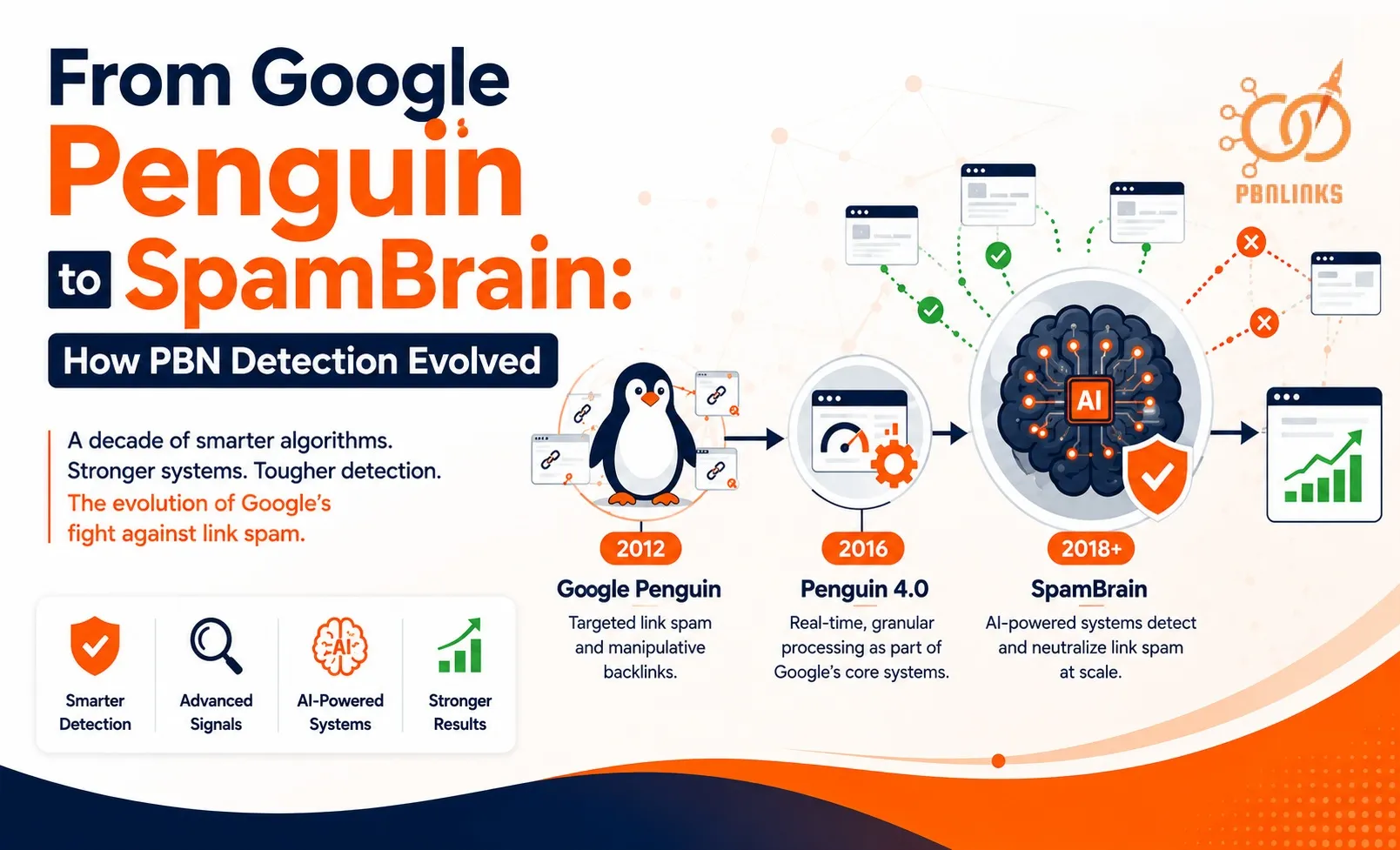
From Google Penguin to SpamBrain: How PBN Detection Evolved
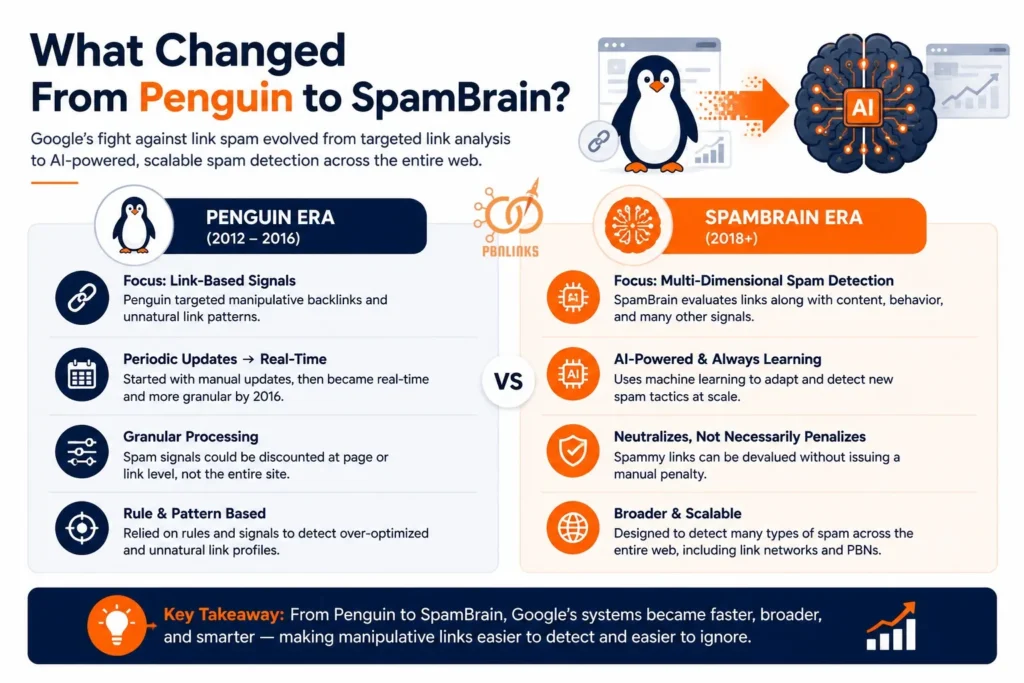
What Changed From Penguin to SpamBrain?
How Google Fought Link Spam Before Penguin
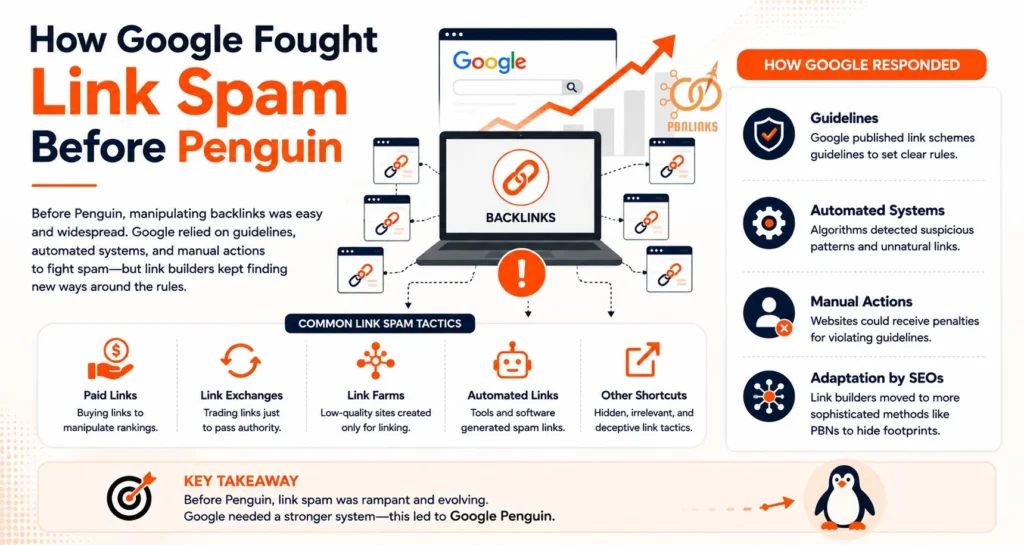
Before Penguin, links were much easier to manipulate. Google treated backlinks as an important sign of authority, so getting more links could help a page rank higher. SEOs quickly found ways to take advantage of this. Paid links, link exchanges, link farms, automated links, and other shortcuts became common ways to influence rankings.
The problem was simple. Google wanted links to act like genuine recommendations, but many links were being created only to improve search positions. A website could build or buy hundreds of backlinks without earning real attention from readers or trusted websites. The more this happened, the less reliable links became as a measure of authority.
Google was already fighting link spam through its guidelines, automated systems, and manual actions. But link builders kept adapting. Some moved from obvious link farms to networks of websites that looked separate but were controlled for the same purpose. These networks could publish content, place backlinks where needed, and pass authority toward selected websites. This approach helped lay the foundation for what became widely known as Private Blog Networks.
Google needed a better way to separate links that represented genuine recommendations from links created mainly to manipulate rankings. That challenge set the stage for Google Penguin, which changed how aggressively Google dealt with link spam.
How Google Penguin Changed Link Spam Detection
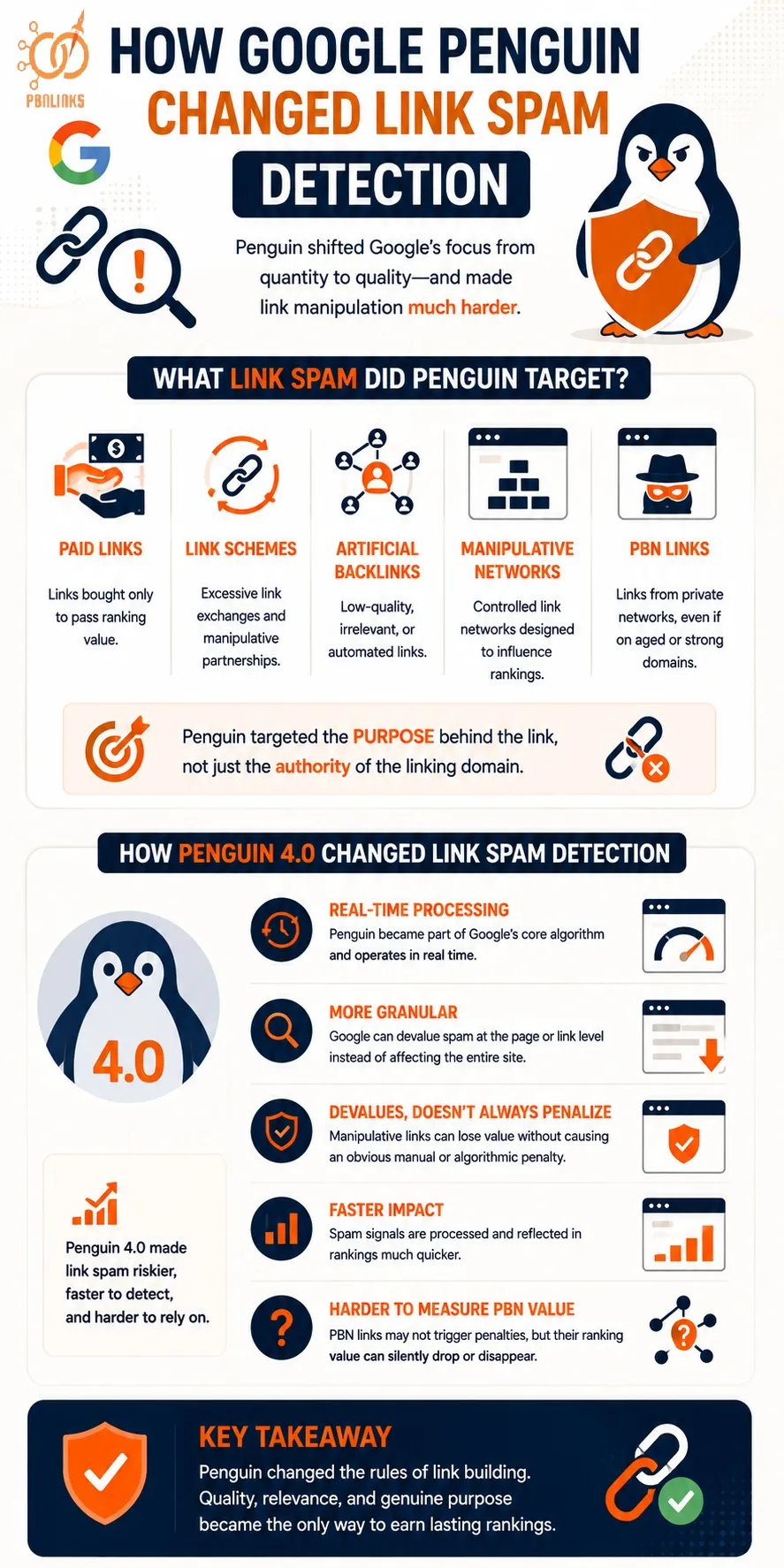
Google Penguin changed link spam detection by making the quality and purpose of backlinks more important than simply having a large number of them. Before Penguin, websites could often improve rankings by building links at scale through paid placements, link networks, and other manipulative methods. Penguin made those strategies much riskier.
The update gave Google a stronger way to deal with links created mainly to influence search rankings. Instead of treating every backlink as a positive signal, Google could reduce the advantage gained from link spam. This changed link building across the SEO industry and made artificial backlink profiles much less dependable.
What Link Spam Did Penguin Target?
Penguin focused on links created to manipulate search rankings. The problem was not simply that a website had many backlinks. The problem was when those links existed mainly to make a website appear more authoritative than it really was.
Paid links created to pass ranking value, link schemes, artificial backlinks, and links built through manipulative networks all belonged to the wider link spam problem Penguin was designed to address. This was particularly important for PBNs because their main SEO purpose is often to create controlled backlinks to selected websites.
A PBN link could come from an aged or established domain and still be manipulative. The important factor was not just the apparent authority of the linking domain, but why the link had been created in the first place.
Penguin therefore changed an important assumption in SEO. Building more backlinks was no longer enough. Links created mainly to manipulate rankings could lose their value and create greater risk for the sites relying on them.
How Penguin 4.0 Changed Link Spam Detection
Penguin 4.0 brought another major change in September 2016. Google made Penguin part of its core ranking systems and moved it to real time processing. This allowed the effects of Penguin to become visible much faster as Google recrawled and reindexed pages.
Penguin also became more granular. Google explained that it could devalue spam by adjusting rankings based on spam signals rather than necessarily affecting the ranking of an entire website.
This changed how link spam could affect a site. A manipulative backlink did not always need to result in an obvious sitewide penalty. Google could reduce or remove the ranking benefit associated with spam instead.
For PBNs, this made link performance harder to judge from penalties alone. A site could avoid an obvious Penguin related drop while some of its backlinks were no longer providing the value expected from them.
Penguin 4.0 was therefore an important step in the evolution of link spam detection. Google had moved from slower, periodic Penguin updates toward faster and more precise treatment of spam signals. The next major development would take spam detection beyond Penguin and into the era of SpamBrain.
What Is Google SpamBrain?
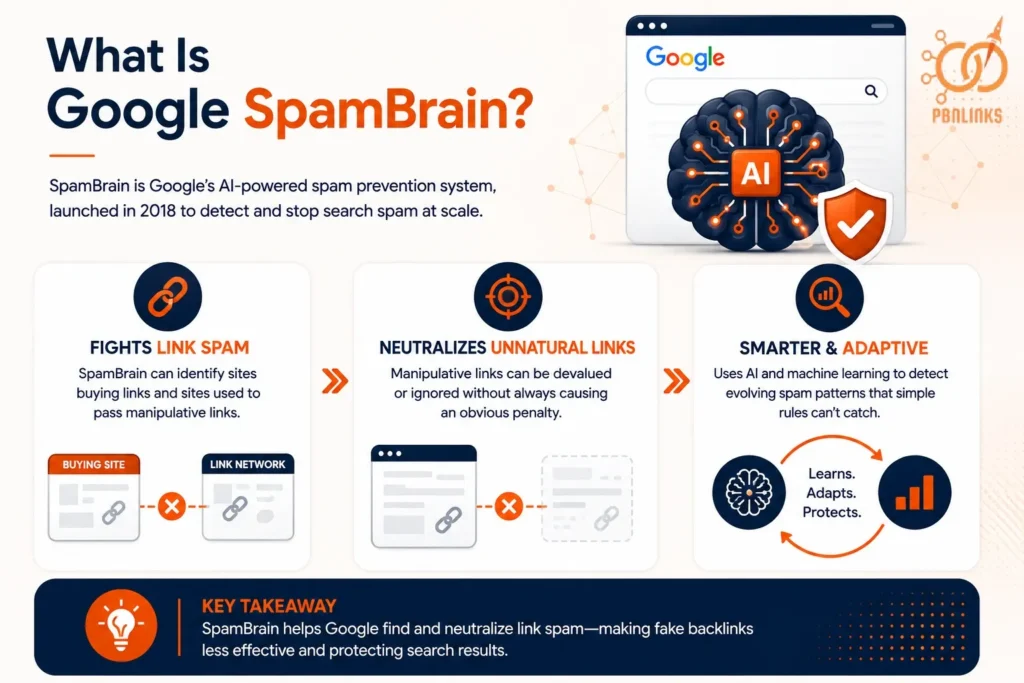
Google SpamBrain is an AI based spam prevention system designed to help Google identify different types of search spam. Google launched SpamBrain in 2018 and has continued improving the system as spam tactics have changed.
SpamBrain is broader than a system built only for backlinks. Its purpose is to help Google recognize spam across search, including patterns that may be difficult to address with simple rules alone. This allows Google to respond as spammers change their methods instead of depending only on fixed signals or occasional major updates.
For link builders, SpamBrain became especially important when Google expanded its ability to deal with link spam. This brought the system directly into the discussion around paid links, artificial backlinks, and networks created mainly to pass ranking value.
How SpamBrain Fights Link Spam
Google confirmed that SpamBrain can identify both sites buying links and sites used for passing outgoing links. This matters because link spam involves both sides of the relationship. Google can look beyond the website receiving a backlink and consider the sites being used to create and distribute manipulative links.
When Google identifies unnatural links through its spam systems, those links can be neutralized. In simple terms, the ranking credit they were intended to provide may be removed. A website therefore does not always need to receive an obvious penalty for a spammy backlink to become ineffective.
This makes modern link spam harder to judge from rankings alone. A link may still exist, appear in a backlink tool, and look powerful based on third party metrics while providing little or no ranking benefit in Google.
Does SpamBrain Specifically Detect PBNs?
SpamBrain is often described in SEO discussions as a system that can detect PBNs, but that description needs some context. Google does not publicly call SpamBrain a dedicated PBN detection system.
What Google has confirmed is that SpamBrain can identify link spam, including sites buying links and sites created or used to pass spammy links. Since many PBNs are built specifically to create controlled backlinks and pass ranking value, their activity can fall within the broader type of link manipulation Google is trying to detect.
Google does not publish a complete list of the signals SpamBrain uses to identify these relationships. Common PBN footprints such as similar hosting, repeated site designs, ownership patterns, anchor text, and linking behavior are widely discussed within the SEO industry, but they should not automatically be presented as confirmed SpamBrain signals.
The important distinction is simple. SpamBrain fights link spam, and PBNs can be a source of link spam, but Google has not described SpamBrain as a tool built only to find PBNs. This distinction becomes important when comparing SpamBrain with the earlier role of Google Penguin.
Penguin vs SpamBrain: What’s the Difference?
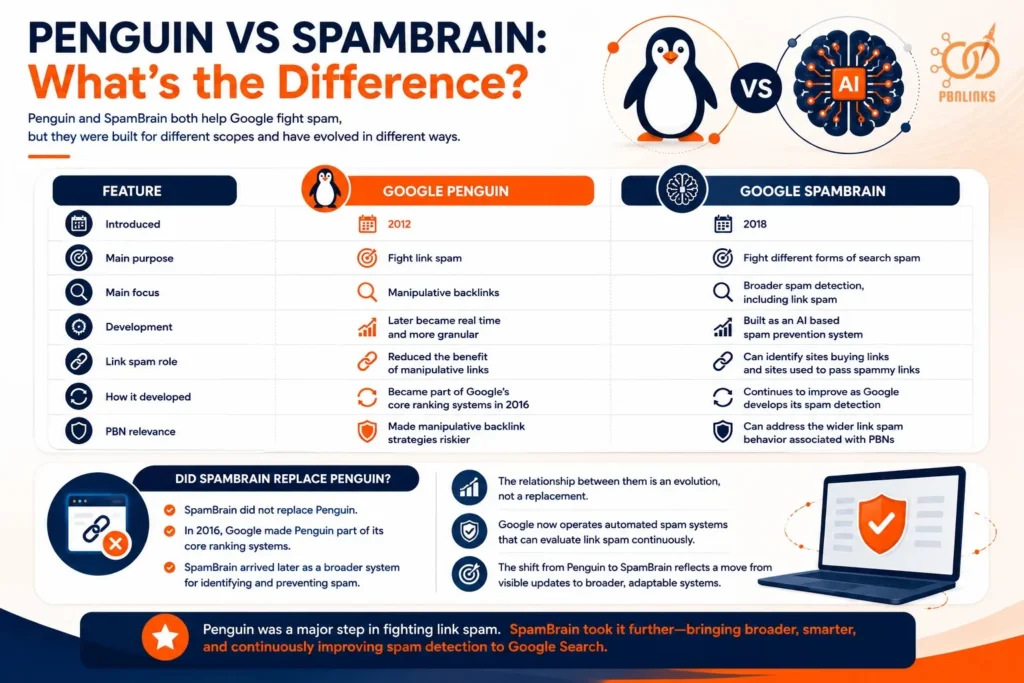
The following comparison makes the differences easier to understand:
| Feature | Google Penguin | Google SpamBrain |
| Introduced | 2012 | 2018 |
| Main purpose | Fight link spam | Fight different forms of search spam |
| Main focus | Manipulative backlinks | Broader spam detection, including link spam |
| Development | Later became real time and more granular | Built as an AI based spam prevention system |
| Link spam role | Reduced the benefit of manipulative links | Can identify sites buying links and sites used to pass spammy links |
| How it developed | Became part of Google’s core ranking systems in 2016 | Continues to improve as Google develops its spam detection |
| PBN relevance | Made manipulative backlink strategies riskier | Can address the wider link spam behavior associated with PBNs |
Did SpamBrain Replace Penguin?
How Google’s PBN Detection Has Evolved
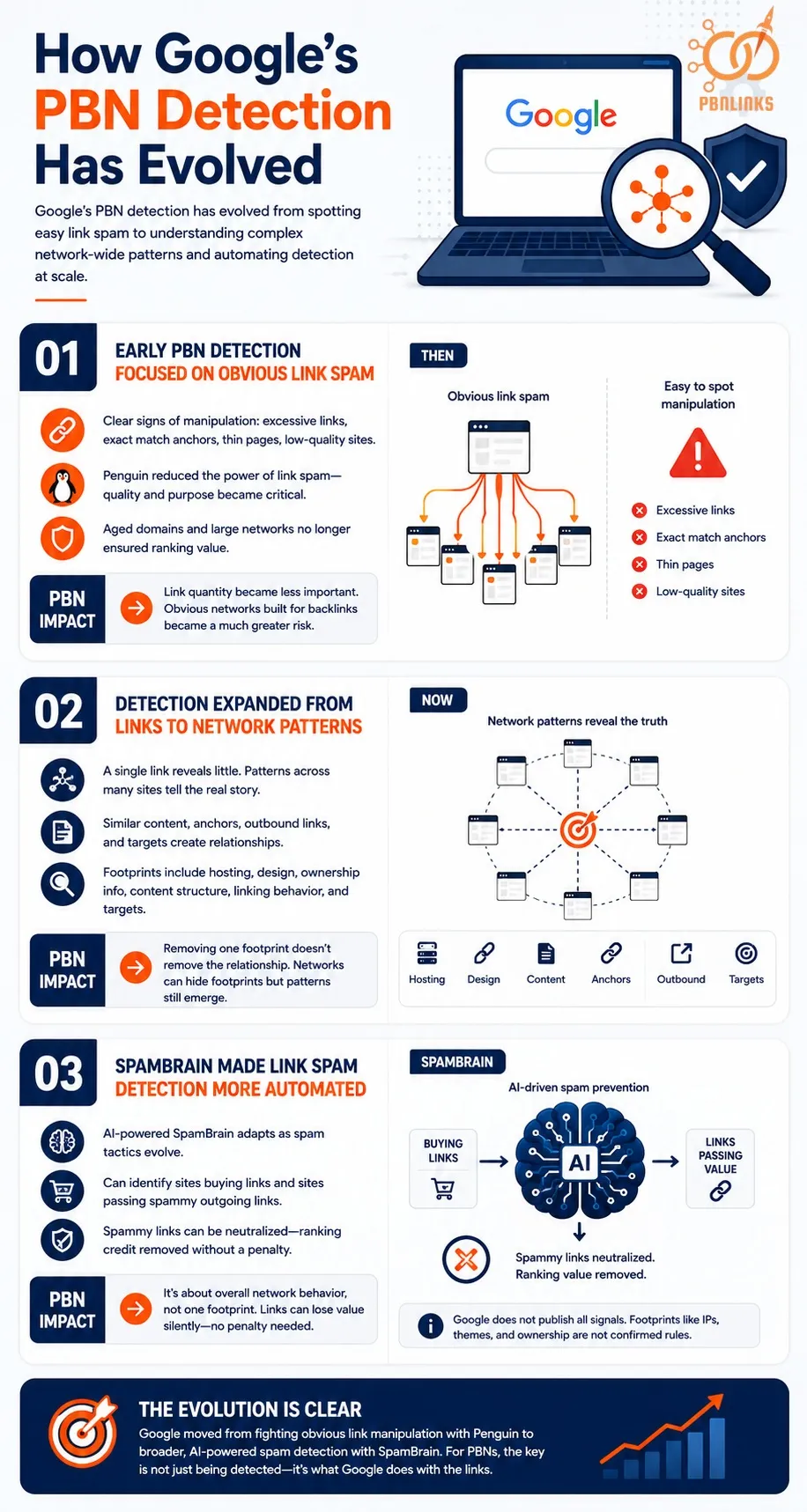
Google’s approach to PBN detection has changed along with its ability to understand link spam. In the early days, obvious backlink manipulation was easier to identify through visible patterns. Today, looking at one backlink or one footprint tells only part of the story. The wider relationship between websites, links, content, and linking behavior matters much more.
This is important because a PBN is not simply a collection of backlinks. It is a network of websites used to create controlled links toward selected pages. Even when each site looks different on its own, repeated behavior across the network can create patterns that make the links look less like genuine recommendations and more like an attempt to influence rankings.
Early PBN Detection Focused on Obvious Link Spam
Early link networks often left clear signs of manipulation. Large numbers of artificial backlinks, repeated exact match anchor text, thin pages built around outbound links, and links from low quality sites could create backlink profiles that looked very different from naturally earned links.
Penguin made these strategies much less dependable. Google had a stronger way to deal with link spam, so simply increasing the number of backlinks was no longer enough. The purpose and quality of those links became more important.
For PBNs, this changed the basic strategy. A network could no longer rely only on having aged domains or a large number of sites. If the links created an obvious pattern of manipulation, their apparent authority did not guarantee that Google would continue giving them ranking value.
PBN Impact: Link quantity became less important than the quality and purpose of the links. Obvious networks built mainly to generate backlinks became a much greater risk.
Detection Expanded From Links to Network Patterns
Modern PBN detection is better understood by looking beyond individual backlinks. A single link may appear completely normal. The picture can change when similar behavior appears repeatedly across a group of websites.
Imagine ten websites that appear unrelated. One link from one of those sites may reveal very little. But if the same sites repeatedly link to the same commercial domains, use similar anchor text, publish similar types of content, and follow similar outbound linking patterns, the relationship becomes easier to notice.
This is where PBN footprints become important. SEOs commonly look for patterns involving hosting, site design, content structure, ownership information, anchor text, outbound links, and the websites receiving those links.
None of these signals alone proves that a website belongs to a PBN. Many legitimate websites share hosting providers, WordPress themes, authors, or similar linking habits. The concern becomes stronger when several unusual patterns appear together and consistently support the same group of target websites.
PBN Impact: Removing one obvious footprint does not remove the underlying relationship between sites. A network can use different hosting or designs and still create recognizable patterns through the way its sites publish and link.
SpamBrain Made Link Spam Detection More Automated
SpamBrain represents another major step in this evolution. Google now uses an AI based spam prevention system that can improve as spam tactics change rather than depending only on fixed rules or occasional named updates.
For link spam, Google has confirmed an important capability. SpamBrain can identify sites buying links as well as sites used for passing spammy outgoing links. Google can therefore address the wider link spam relationship instead of focusing only on the website receiving the backlink.
This has direct implications for PBNs. A network built mainly to publish controlled links sits within the broader link spam problem Google is trying to solve. If Google determines that those links should not influence rankings, it can neutralize the ranking credit they were intended to provide.
Google does not publish a complete list of the signals SpamBrain uses to identify link spam. There is no official checklist confirming that one shared IP address, WordPress theme, hosting provider, ownership pattern, or anchor text ratio automatically identifies a PBN. These are commonly discussed SEO footprints, not confirmed SpamBrain rules.
PBN Impact: Modern PBN detection is less about avoiding one known footprint and more about the overall behavior of the network. A PBN does not need to receive an obvious penalty to fail. If Google stops giving its links meaningful ranking value, the network has already lost much of its SEO purpose.
The evolution is clear. Google moved from fighting obvious link manipulation with systems such as Penguin toward broader and more automated spam detection. For PBNs, the important question is no longer simply whether Google can identify the network. It is what Google does with the links once it decides they should not influence rankings.
What Happens When Google Detects Link Spam?
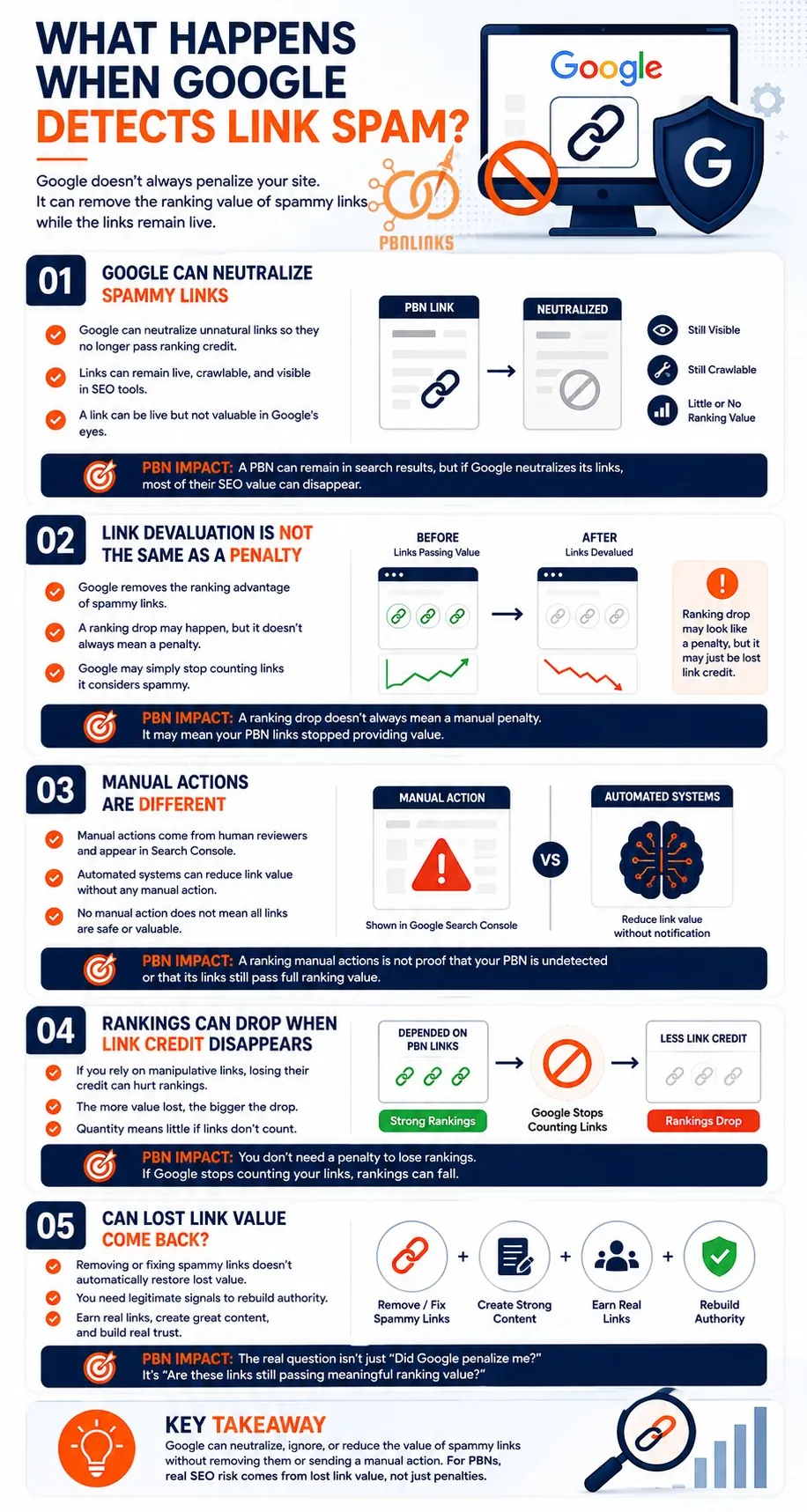
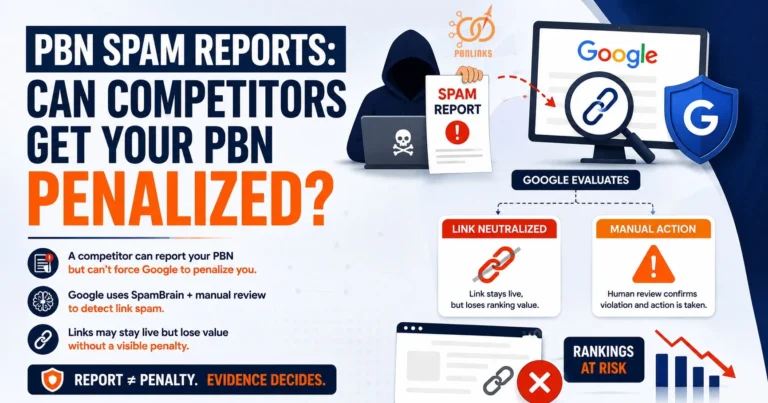
When Google detects link spam, it does not always penalize the entire website. In many cases, Google can simply remove the ranking value that manipulative links were created to provide.
This distinction is important for PBNs. A backlink can remain live, appear in backlink tools, and look strong based on third party metrics while providing little or no ranking benefit in Google.
Google Can Neutralize Spammy Links
Google can neutralize unnatural links so they no longer provide the ranking credit they were intended to create. The backlink itself does not necessarily need to disappear.
A PBN link may still exist on the page, remain crawlable, and continue appearing in tools such as Ahrefs or Semrush. What changes is the value Google gives that link when calculating rankings.
This creates an important difference between a link being live and a link being valuable. Third party SEO metrics can help evaluate a backlink, but they cannot confirm how much ranking credit Google currently assigns to it.
PBN Impact: A PBN does not need to disappear from search results to become less effective. If Google neutralizes its links, much of their SEO value can disappear while the links themselves remain visible.
Link Devaluation Is Not the Same as a Penalty
When Google devalues or neutralizes a spammy link, it removes the ranking advantage associated with that link. This does not automatically mean the entire website has received a Google penalty.
Suppose a page ranks partly because several PBN backlinks are passing ranking value. If Google later stops counting those links, the page may lose positions because some of the authority supporting its rankings has disappeared.
From the outside, the ranking decline may look like a penalty. In reality, Google may simply have stopped giving credit to links it considers spammy.
PBN Impact: A ranking drop does not automatically prove that Google penalized the website. It may mean that backlinks which previously helped the page are no longer being counted.
Manual Actions Are Different
A manual action happens when human reviewers at Google determine that pages or a website violate its spam policies. This is different from automated systems identifying and neutralizing link spam.
When a website receives a manual action, information about the issue can appear in the Manual Actions report in Google Search Console.
The important point is that no manual action does not mean every backlink is safe or valuable. Google’s automated systems can reduce the value of manipulative links without sending the website owner a manual action notification.
PBN Impact: Avoiding a visible manual action is not proof that a PBN remains undetected or that its backlinks continue passing full ranking value.
Rankings Can Drop When Link Credit Disappears
If a website depends heavily on manipulative backlinks, losing the credit from those links can affect its rankings.
The more ranking value a page received from links that Google later neutralizes, the more noticeable the change may be. A site with a stronger mix of legitimate links and other ranking signals may be less dependent on the links that stop counting.
This is why backlink quantity alone can give a misleading picture. Hundreds of links provide little advantage if Google decides that many of them should not influence rankings.
PBN Impact: The risk of PBN links is not limited to receiving a penalty. Rankings can decline simply because the links that once supported them stop contributing value.
Can Lost Link Value Come Back?
When Google removes the ranking benefit created by spammy links, removing or fixing those links does not automatically restore the authority they previously provided.
The website needs legitimate ranking signals to replace the value that was lost. Strong content, relevant editorial backlinks, genuine citations, and naturally earned links can help build authority without depending on the same manipulative links.
This makes link neutralization particularly important for websites that depend heavily on PBNs. Even without a dramatic penalty, the loss of link credit can weaken the rankings those links were originally purchased or created to support.
PBN Impact: The real question is not only whether Google has penalized a website. It is whether the backlinks are still passing meaningful ranking value. That distinction helps explain why some PBN links can appear to work while others provide little or no measurable benefit.
Why Do Some PBN Links Still Appear to Work?
If Google has become much better at detecting link spam, one question naturally follows: why do some PBN links still appear to improve rankings?
The simple answer is that link spam detection is not an all or nothing process. Google does not claim that every manipulative backlink is identified the moment it goes live. Different websites, links, and networks create different signals, and Google does not reveal how it evaluates each individual backlink.
This makes PBN performance difficult to judge from rankings alone. A page may move higher after receiving a PBN link, but that does not prove the backlink was the only reason. Content changes, other backlinks, competitors losing positions, indexing changes, and broader ranking systems can all affect search visibility at the same time.
Timing can also create a misleading picture. A link may appear to provide value for a period and later stop contributing the same benefit as Google recrawls pages and reassesses spam signals. The backlink can remain live throughout this process, which makes it easy to assume that it is still passing the same ranking value.
Another problem is that PBNs are not all identical. Networks vary in domain history, content quality, outbound linking behavior, backlink profiles, and the way their sites are connected. This does not make a well built PBN undetectable. It simply means that Google is dealing with different patterns rather than one universal PBN footprint.
Third party SEO metrics can make the picture even more confusing. A PBN domain may show strong authority, a healthy backlink profile, and good estimated traffic in an SEO tool. Those metrics describe what the tool can measure. They do not confirm how Google currently values links from that domain.
This is why “the PBN still works” is difficult to prove from a single ranking increase. The more useful question is whether the links continue to provide value over time without becoming dependent on patterns Google considers manipulative.
PBN links may still appear effective in some situations, but their visible presence, strong third party metrics, or lack of a manual action does not guarantee that Google trusts them. As spam detection continues to improve, the long term value of any link depends less on how powerful it looks and more on whether Google believes that link deserves to influence rankings.
What Penguin to SpamBrain Means for PBNs Today
The move from Penguin to SpamBrain changed the way PBN risk should be understood. In the early Penguin years, SEOs often watched for major algorithm updates and tried to connect sudden ranking drops with specific Google actions. That way of thinking is much less useful today because Google’s automated spam detection systems operate continuously.
For PBNs, this means avoiding an obvious penalty is no longer a reliable measure of success. A network can remain indexed, its links can stay live, and the target website can show no manual action in Google Search Console. Yet some of those links may still provide less ranking value than expected if Google decides they should not influence search results.
The focus has also moved beyond simple footprints. Using different hosting providers, themes, domain registrars, or site designs may remove obvious similarities, but these changes do not alter the purpose of a network. If a group of websites repeatedly exists to create controlled backlinks and pass ranking value, the linking behavior itself remains important.
This also changes how PBN performance should be measured. Domain authority, domain rating, traffic estimates, and backlink counts can help evaluate a website, but none of these third party metrics shows exactly how Google values a particular link. A strong looking PBN domain is useful only if its backlinks actually contribute meaningful ranking value.
The biggest lesson from Penguin to SpamBrain is that link spam detection has become faster, broader, and more automated. Google does not need to issue a visible penalty for a manipulative link strategy to lose value. Neutralizing the links can be enough.
For SEO in 2026, this makes dependence on PBN links harder to evaluate and less predictable. The more a ranking strategy depends on links created mainly to influence Google, the more exposed it is to improvements in spam detection. Links earned through genuine relevance, useful content, editorial decisions, and real relationships provide a more durable foundation because their value does not depend on staying ahead of the next spam detection improvement.
Conclusion
In conclusion, Google’s approach to link spam has changed significantly from Penguin to SpamBrain. Penguin made manipulative backlinks much harder to rely on, while Penguin 4.0 introduced real time and more granular handling of spam. SpamBrain took this further with a broader system capable of identifying different forms of spam, including link spam.
For PBNs, the biggest change is that detection does not always result in an obvious penalty. Google can neutralize spammy links so they stop passing meaningful ranking value, even when those links remain live and the target website receives no manual action.
Modern PBN detection also goes beyond looking for one simple footprint. Linking patterns, relationships between sites, and the wider purpose of the links all matter. At the same time, Google does not reveal every signal it uses, so common PBN footprints should not be confused with confirmed SpamBrain detection rules.
If PBN links are part of your SEO strategy, focus on link quality, relevance, natural placement, and long term value rather than relying on shortcuts or third party metrics alone. Review your backlink strategy regularly and build a link profile that can remain valuable as Google’s spam detection continues to evolve.
FAQs About Penguin, SpamBrain, and PBN Detection
1. Is Google Penguin Still Used Today?
Penguin is no longer a separate update that SEOs wait for. Google made Penguin part of its core ranking systems in 2016 and changed it to work in real time with more granular handling of link spam.
2. Did SpamBrain Replace Google Penguin?
No, SpamBrain did not simply replace Penguin. Penguin became part of Google’s core ranking systems, while SpamBrain was introduced later as a broader AI based spam prevention system that also helps Google fight link spam.
3. Does SpamBrain Detect PBN Links?
SpamBrain can detect link spam, but Google does not describe it as a dedicated PBN detector. Google confirms that SpamBrain can identify sites buying links and sites used to pass spammy outgoing links.
4. How Does Google Detect PBNs?
Google does not publish the exact signals it uses to detect PBNs. SEOs commonly analyze linking patterns, anchor text, site relationships, ownership, hosting, and outbound links, but these should not be treated as a confirmed list of Google detection signals.
5. What Happens When Google Detects PBN Links?
Google can neutralize manipulative links so the ranking credit they pass is lost. This means a PBN backlink can remain live while providing little or no ranking benefit.
6. Does Google Penalize Every Site Using PBN Links?
No, manipulative links do not automatically result in a sitewide penalty. Google can neutralize unnatural links algorithmically, while manual actions are a separate enforcement process used when human reviewers find violations of Google’s spam policies.
7. Can PBN Links Trigger a Google Manual Action?
Yes, PBN links can contribute to a manual action if they form part of an unnatural or manipulative linking pattern. Google specifically lists buying links and participating in link schemes to manipulate rankings as violations of its spam policies.
8. Can SEO Tools Tell If Google Has Detected a PBN?
No, third party SEO tools cannot confirm whether Google or SpamBrain has classified a network as spam. They can identify suspicious backlink patterns and other risk signals, but they do not have access to Google’s internal spam classifications.
9. Are PBN Footprints Still Important?
Yes, PBN footprints remain useful risk indicators, but no single footprint proves that a site belongs to a PBN. Shared hosting, similar designs, anchor patterns, or related linking behavior should be evaluated together rather than treated as confirmed SpamBrain rules.
10. Can PBN Links Still Work in 2026?
Some PBN links may appear to influence rankings, but their value cannot be guaranteed. A live backlink, strong third party metrics, or the absence of a manual action does not prove that Google is giving the link meaningful ranking credit.