PBN Spam Reports: Can Competitors Get Your PBN Penalized?
What if a competitor discovers your PBN and reports it directly to Google? It is a serious concern because the backlinks supporting your rankings could suddenly come under attention. But a competitor cannot simply submit a report and force Google to penalize your website. Google still needs to determine whether its spam policies have actually been violated.
The risk of PBN spam reports has become more important in 2026. Google now states that spam reports may be used to take manual action against violations. Google also uses automated systems such as SpamBrain to detect link spam, so a competitor report is not the only way suspicious backlinks can come to Google’s attention.
Being reported also does not mean an immediate penalty will follow. Google may neutralize manipulative links so they stop passing ranking value, while a manual action is a separate form of enforcement. This means a PBN backlink can remain live even if it no longer provides the SEO value it once did.
The real question is not simply whether a competitor can report your PBN. It is what Google does after receiving that report and how much risk it creates for the PBN, its backlinks, and the website receiving those links. Understanding that process makes it much easier to separate genuine SEO risk from unnecessary fear.
Can a Competitor Really Get Your PBN Penalized?
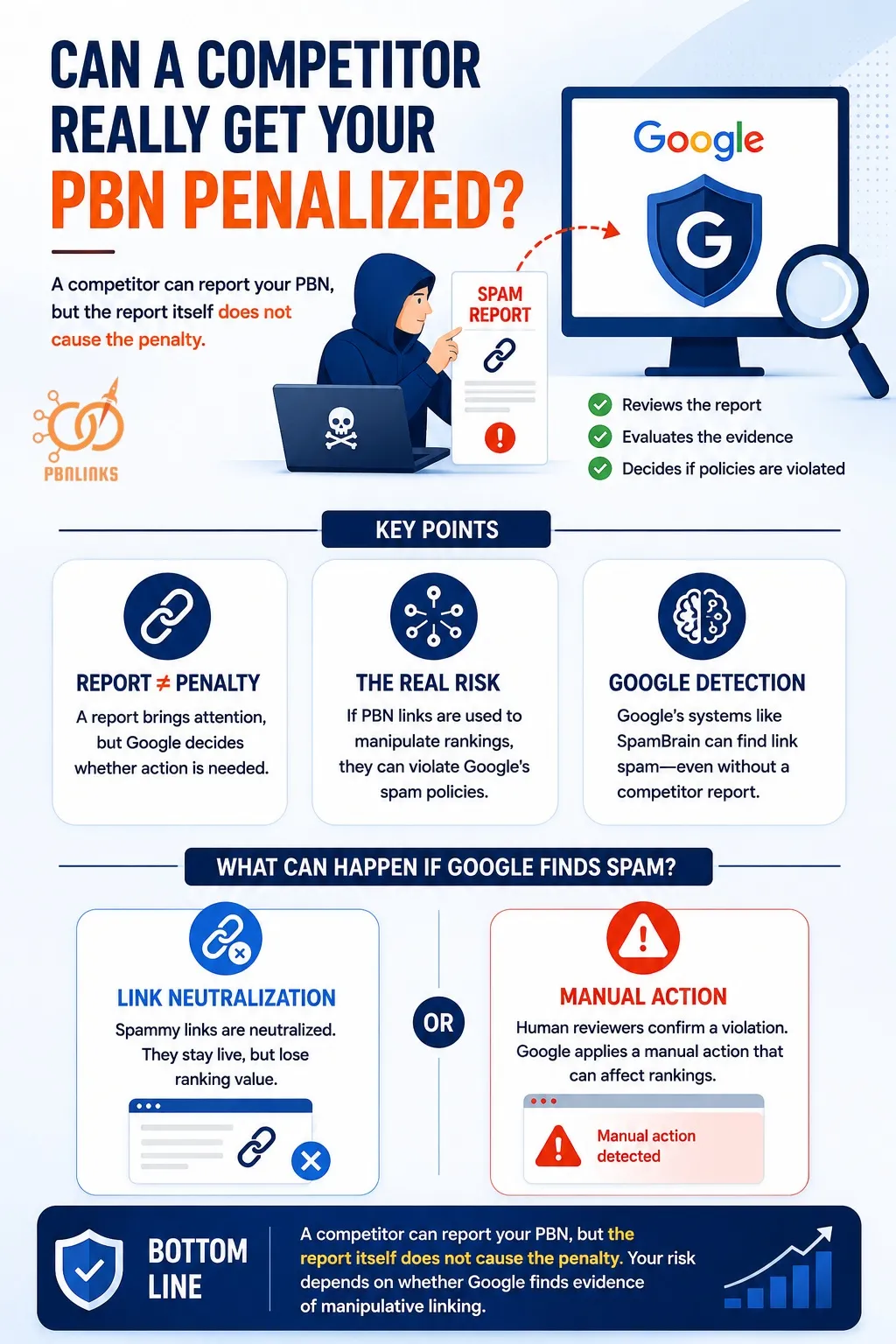
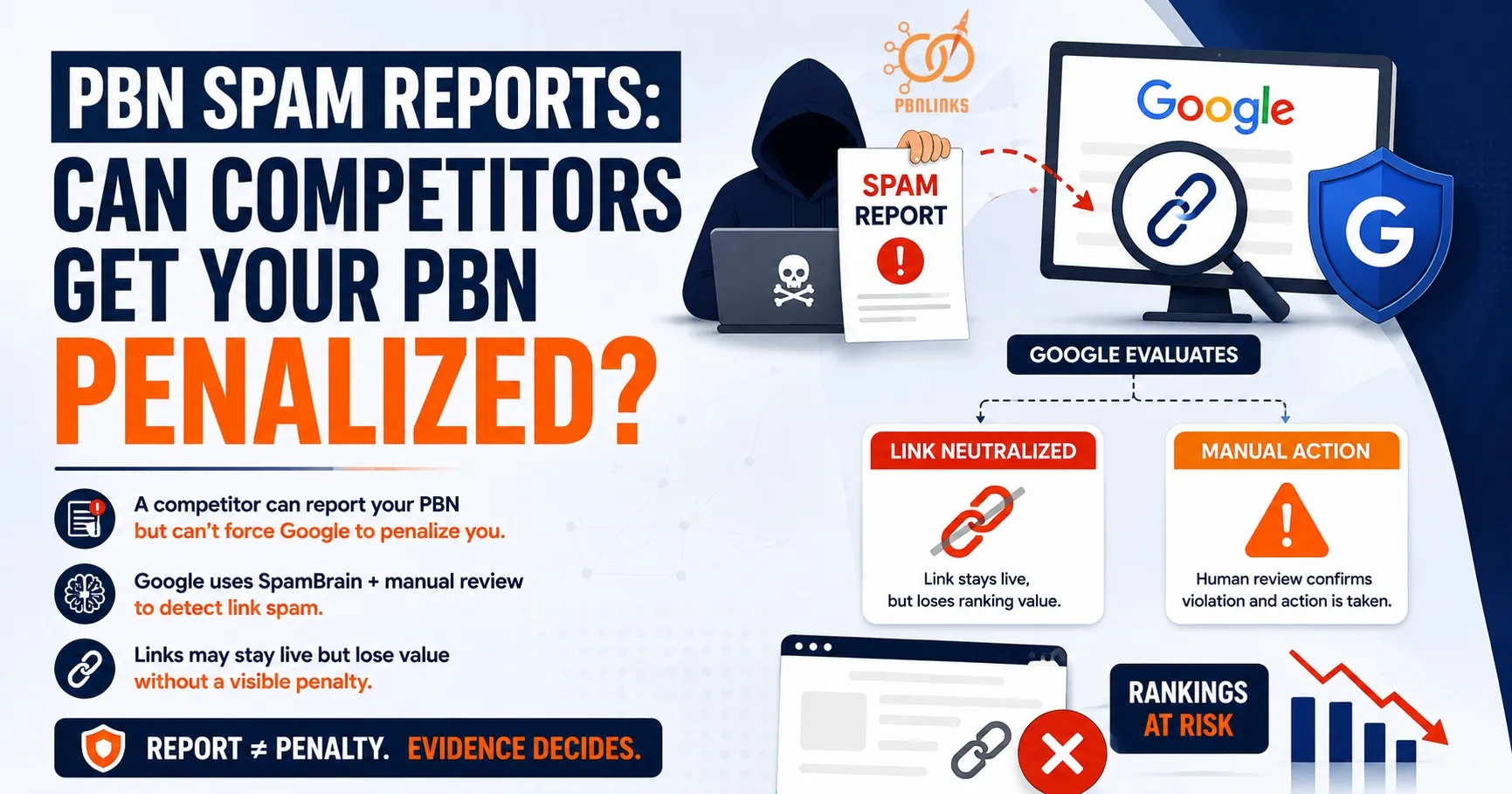
Yes, a competitor can report a suspected PBN to Google, but they cannot directly get it penalized. A spam report can bring suspicious links or websites to Google’s attention, but Google decides whether the activity actually violates its spam policies and whether any action is needed.
This distinction matters because submitting a report is not the same as proving link spam. A competitor may identify websites they believe belong to a PBN and report the links connecting those sites to a money site. That gives Google information about suspected manipulation, but the competitor does not control what happens next.
The real risk comes from the links themselves. If a PBN is being used to create backlinks mainly to manipulate search rankings, those links can fall under Google’s definition of link spam. In that situation, a competitor report may draw additional attention to activity that already carries risk under Google’s spam policies.
Google also does not need a competitor report to find manipulative links. Its automated spam detection systems can identify link spam independently. This means a PBN may come under scrutiny even when nobody reports it.
If Google determines that the links are spam, the result does not always have to be a visible penalty. Google can neutralize spammy links so they stop passing ranking value. Manual action is a separate possibility when Google determines through human review that a site violates its spam policies.
So the practical answer is simple. A competitor can report your PBN, but the report itself does not cause the penalty. The real exposure comes from whether Google finds evidence that the PBN and its links are being used to manipulate rankings. To understand that risk properly, the next question is what a PBN spam report actually is and what information it can bring to Google’s attention.
What Is a PBN Spam Report and Why Would Someone Submit One?
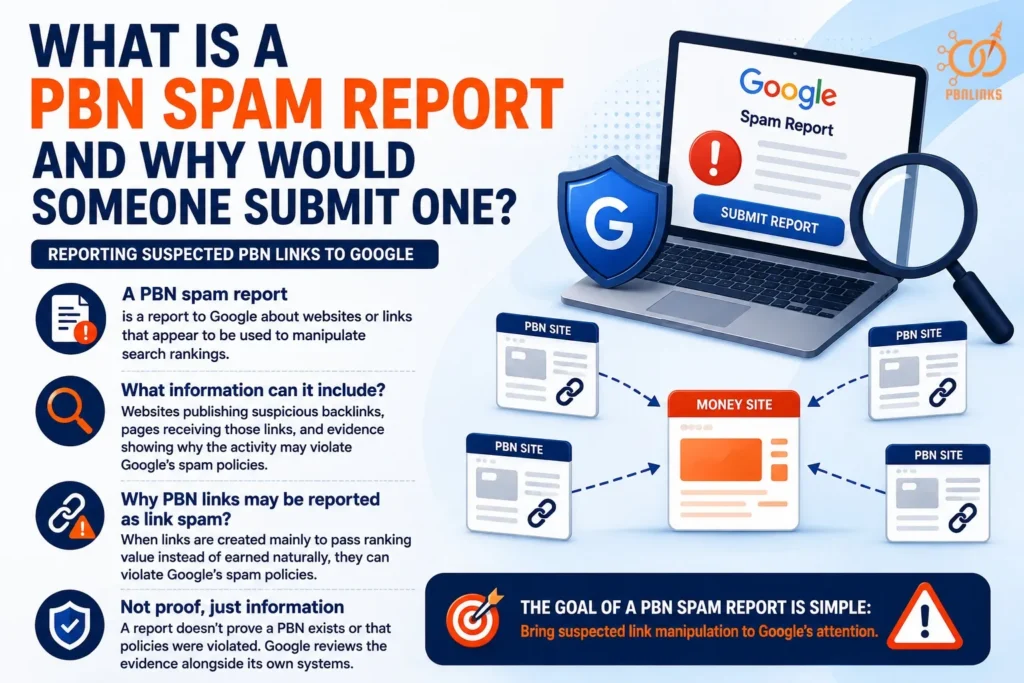
A PBN spam report is a report submitted to Google about websites or links that appear to be used to manipulate search rankings. In the case of a Private Blog Network, the concern is usually that a group of websites is being used to create controlled backlinks to another site rather than earning those links naturally.
Competitors may submit these reports when they believe another website is gaining an unfair ranking advantage through PBN links, paid links, or other forms of link manipulation. The report itself does not prove that a PBN exists or that Google’s policies have been violated. It gives Google information about suspected spam that can be evaluated alongside its own detection systems.
What Information Can a PBN Spam Report Include?
A useful spam report focuses on the suspected violation and the pages or links involved. For PBN activity, this could include the websites publishing the suspicious backlinks, the pages receiving those links, and information showing why the linking activity appears to violate Google’s spam policies.
The important part is evidence rather than accusation. Simply telling Google that a competitor “uses a PBN” does not explain what is happening. The relevant issue is whether the reported links appear to have been created primarily to manipulate search rankings.
Google also advises users not to include personally identifying information in spam reports. The focus should remain on the search result, website, link, or behavior being reported rather than personal information about the people involved.
Why PBN Links May Be Reported as Link Spam
PBN links become relevant to Google’s spam policies when they are created mainly to influence rankings rather than represent genuine editorial recommendations. Google defines link spam broadly around links to or from a site that are created primarily for manipulating search rankings.
This means the existence of several websites under common control is not, by itself, the main issue. The SEO risk comes from how those sites are being used. If they repeatedly publish controlled backlinks designed to pass ranking value to selected money sites, that linking behavior can fall within the broader category of link spam.
The same principle applies beyond PBNs. Paid links that pass ranking credit, excessive link exchanges, automated link creation, and other manipulative linking practices can also violate Google’s spam policies. A PBN spam report is therefore best understood as a specific reporting scenario within Google’s broader approach to link spam.
Once a report has been submitted, the next question becomes much more important: how does Google actually use that information? That is where Google’s approach to spam reports, including its 2026 changes, becomes important.
How Does Google Use Spam Reports?
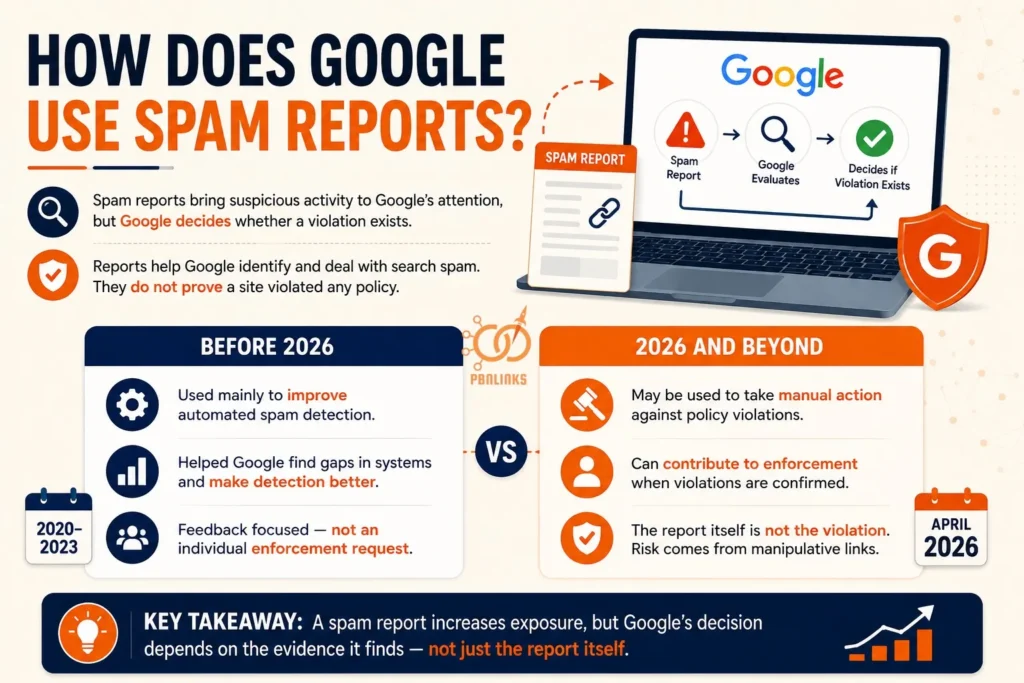
Google uses spam reports as a source of information about search results, websites, and practices that may violate its spam policies. A report can point Google toward suspicious activity, but submitting one does not mean the reported site has already been found guilty of spam. Google still determines whether a violation exists.
For PBNs, this distinction is important. A competitor may report suspicious backlinks or websites they believe are part of a link network, but Google does not simply accept that claim as proof. The report becomes information that can support Google’s broader efforts to identify and deal with search spam.
Google’s public explanation of how these reports are used has also changed over time. That change matters because older SEO advice about spam reports does not fully reflect Google’s current position.
How Google Used Spam Reports Before 2026
For several years, Google emphasized the role of spam reports in improving its automated spam detection. In its 2020 guidance, Google explained that reports helped identify areas where its spam detection systems might need improvement.
The idea was simple. If users repeatedly identified spam that Google’s systems were not catching effectively, those reports could help Google understand where its automated detection needed to improve. This made spam reports useful even when users did not see an immediate action against the website they reported.
Google continued emphasizing this broader feedback role when it introduced its updated Search Quality User Report in 2023. The reporting system allowed users to submit information about several types of search quality problems, including spam, paid links, and other behavior that could affect search results.
This is why older SEO discussions often say that reporting a PBN does not directly cause a penalty. That interpretation came largely from Google’s emphasis on using reports to improve its automated systems rather than treating every report as an individual enforcement request.
What Changed With Google Spam Reports in 2026?
Google made an important clarification in April 2026. Its current documentation now states that spam reports may be used to take manual action against violations of Google’s spam policies.
This does not mean every PBN spam report now leads to human review or a manual action. It means reports can contribute to enforcement when Google determines that the reported activity actually violates its policies.
For PBN owners, that distinction makes competitor reporting more relevant. A report is still not an automatic penalty, but it can do more than simply provide general feedback for improving future spam detection. Information in a report may also become relevant when Google takes manual action against a confirmed violation.
The underlying rule, however, has not changed. The report itself is not the violation. The risk comes from the linking activity Google finds when it evaluates the reported websites and links.
Understanding that distinction leads to the next practical question: what actually happens after a competitor submits a PBN spam report?
What Happens After a Competitor Reports Your PBN?
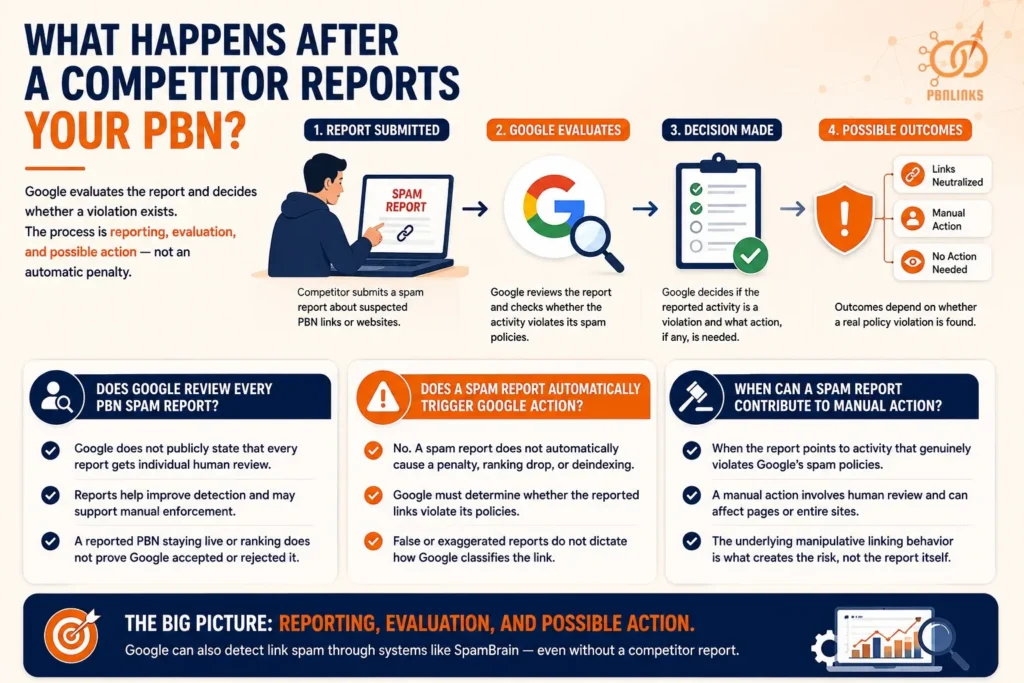
When a competitor submits a PBN spam report, Google receives information about suspected search spam. That report may identify websites, pages, or links that the reporter believes are being used to manipulate rankings. What happens next depends on whether Google finds activity that actually violates its spam policies.
A report should not be viewed as a request that automatically starts a penalty process. Google already uses automated systems to detect spam, and spam reports provide another source of information about possible violations. The important question is not simply whether a report was submitted, but what Google finds when the reported activity is evaluated.
Does Google Review Every PBN Spam Report?
Google does not publicly state that every PBN spam report receives an individual human review. Its reporting system collects information about suspected search quality problems, while automated systems continue working independently to detect spam across Google Search.
This means a report can be useful without necessarily resulting in a person immediately investigating the reported PBN. Google can use reporting data to understand spam patterns, improve detection, and, under its current guidance, potentially support manual enforcement against violations.
There may also be no visible response to the person who submitted the report. A reported PBN remaining indexed or continuing to rank shortly afterward does not prove that Google accepted or rejected the report.
Does a Spam Report Automatically Trigger Google Action?
No. Submitting a PBN spam report does not automatically cause a ranking drop, link devaluation, deindexing, or manual action.
The report identifies suspected spam. Google still needs to determine whether the reported links or websites violate its policies. If the evidence does not establish a violation, the fact that a competitor submitted a report is not enough on its own to justify enforcement.
This distinction also matters with false or exaggerated reports. A competitor can describe a backlink as manipulative, but that description does not determine how Google classifies the link.
When Can a Spam Report Contribute to a Manual Action?
A spam report can become more significant when it points Google toward activity that genuinely violates its spam policies. Google’s current reporting guidance states that spam reports may be used to take manual action against violations.
A manual action involves human review. If a reviewer determines that pages or a site are using techniques that violate Google’s spam policies, Google can apply a manual action that affects how those pages or the site appear in search.
For PBNs, the underlying linking behavior remains the key issue. If the reported websites are being used primarily to create manipulative backlinks, the report may bring that activity to Google’s attention. If there is no actual violation, the report itself does not create one.
So the process is best understood as reporting, evaluation, and possible action, rather than reporting followed automatically by a penalty. Google can also identify link spam without any competitor report at all, which raises the next important question: how do PBN spam reports fit alongside automated systems such as SpamBrain?
How Do Spam Reports and SpamBrain Work Together?
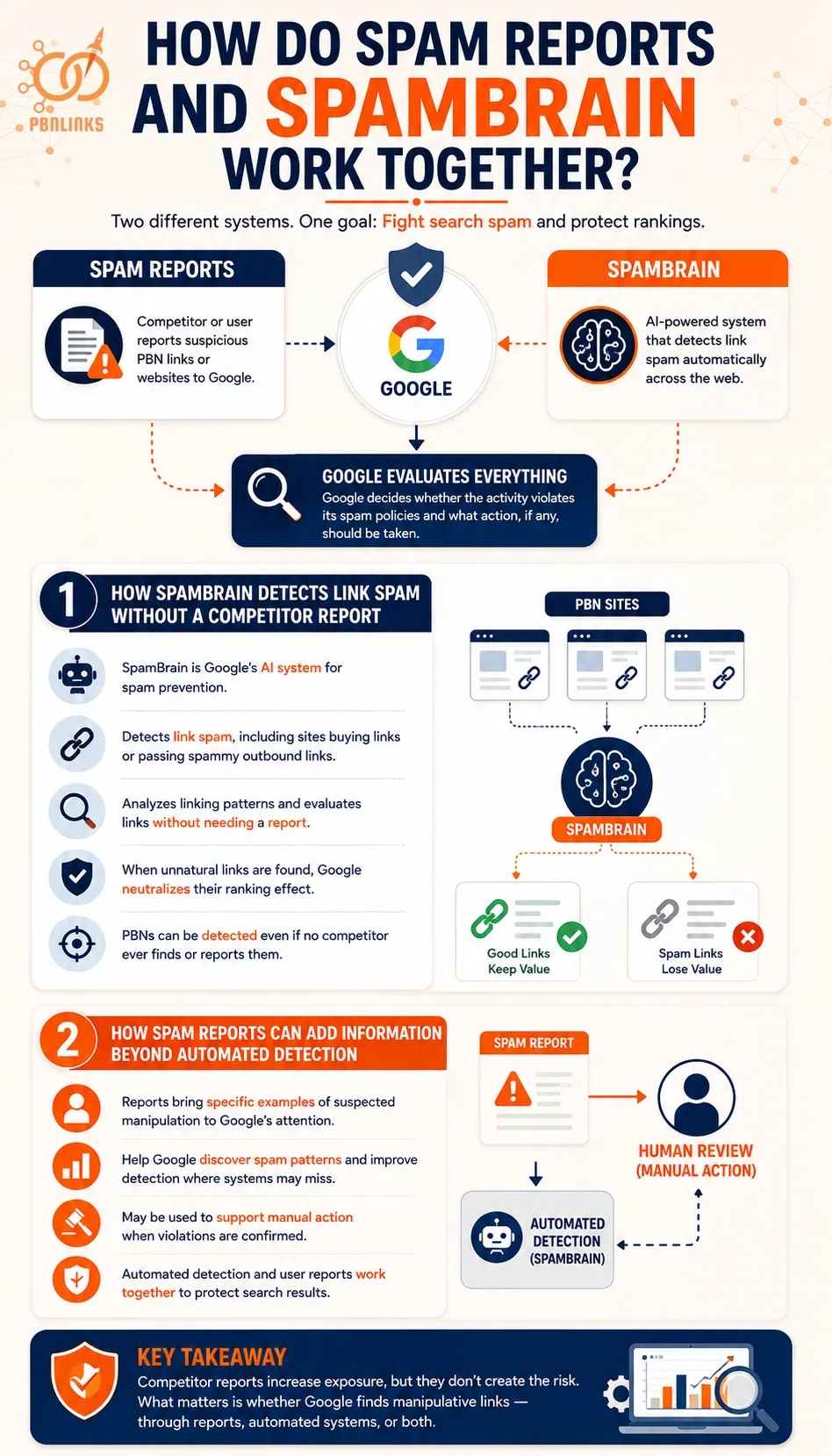
Spam reports and SpamBrain are different parts of Google’s broader approach to fighting search spam. A competitor report gives Google information about suspected manipulation, while SpamBrain helps Google identify spam automatically across the web. Google does not need to wait for someone to report a PBN before its systems can evaluate suspicious links.
This distinction matters because competitor reporting is only one source of risk for a PBN. Even if nobody discovers or reports the network, Google’s automated systems can still analyze linking activity and determine whether certain links should influence rankings.
How SpamBrain Detects Link Spam Without a Competitor Report
SpamBrain is Google’s AI based spam prevention system. Google uses it to improve its ability to identify different forms of search spam, including link spam. In its December 2022 link spam update, Google specifically explained that SpamBrain could detect both sites buying links and sites being used to pass spammy outgoing links.
For PBNs, this means detection does not depend on a competitor identifying the network first. If websites are being used to create backlinks mainly to manipulate rankings, Google’s systems can evaluate those links as part of their normal spam detection process.
When SpamBrain identifies unnatural links, Google can neutralize their ranking effect. The backlinks may remain live on the websites where they were placed, but the ranking credit they were intended to provide can be lost.
This is why keeping a PBN hidden from competitors does not necessarily keep it hidden from Google. Competitor discovery and Google detection are two different things.
How Spam Reports Can Add Information Beyond Automated Detection
Spam reports give Google another source of information about possible violations. A competitor may identify a group of websites, pages, or backlinks that they believe form part of a manipulative link network and bring those specific examples to Google’s attention.
Historically, Google has explained that spam reports can help reveal areas where its automated systems may not be catching spam effectively. This makes user reports useful even when Google already has large scale automated detection systems operating across Search.
Google’s current guidance also makes these reports more relevant to enforcement. A spam report may be used to support manual action when the reported activity is found to violate Google’s spam policies. That does not mean a report overrides SpamBrain or automatically starts a manual review. It means automated detection and user supplied reports can both contribute to Google’s broader efforts against search spam.
For PBN owners, the practical point is simple. Avoiding a competitor report does not remove the underlying detection risk, and receiving a report does not automatically mean a penalty will follow. What matters most is whether Google determines that the links were created to manipulate rankings.
Once Google does classify PBN links as spam, the next question is what can actually happen to those links and the websites connected to them.
What Happens If Google Determines the PBN Links Are Spam?
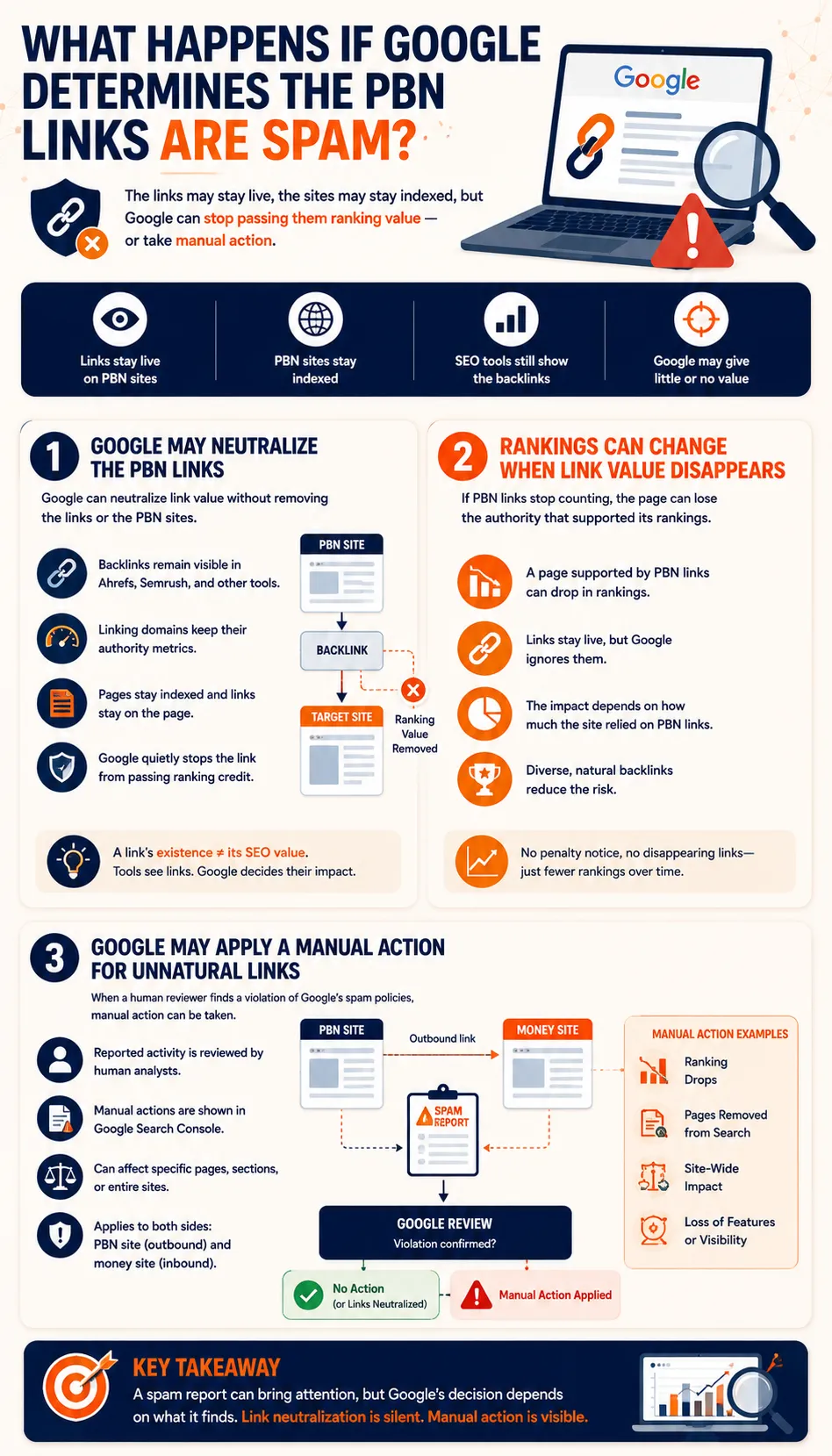
The biggest risk is not always a dramatic penalty. A PBN site can remain indexed, its backlinks can stay live, and every major SEO tool can continue showing those links while Google gives them little or no ranking value. From the outside, almost nothing appears to have changed. What matters is whether Google still counts the links when evaluating the target site.
This is why link neutralization and a Google penalty should not be treated as the same thing. One removes the value a manipulative link was supposed to provide. The other is a more direct form of enforcement. Understanding that difference explains why some PBN links appear perfectly normal but stop producing the ranking effect expected from them.
Google May Neutralize the PBN Links
When Google identifies a backlink as link spam, it can neutralize the ranking credit associated with that link. The link does not necessarily need to disappear, and the PBN site does not necessarily need to be removed from search. Google can simply stop allowing that backlink to influence rankings in the way it was intended to.
From the site owner’s perspective, this can be difficult to see. The backlink may still appear in Ahrefs or Semrush. The linking domain may retain the same third party authority metrics. The page containing the link may remain indexed. Even Google’s own discovery of a link does not mean that the link is receiving full ranking credit.
The important distinction is between a link’s existence and its SEO value. Backlink tools can observe that a link exists on a page. They cannot see Google’s internal decision about how much ranking credit that link should receive.
For a PBN, that creates a quiet failure mode. The network can continue looking healthy while the links it was built to provide are no longer producing the expected ranking benefit. This is why the absence of a manual action does not automatically mean that every PBN backlink is still working.
Rankings Can Change When PBN Link Value Disappears
If PBN backlinks helped a page rank higher and Google later stops counting those links, the page can lose some of the authority that supported its position. The result may be a ranking decline even though Google has not applied a visible manual action.
Imagine that a page is supported by ten PBN backlinks. The links remain live, but Google decides that several of them should no longer influence rankings. Nothing has been physically removed from the backlink profile, yet the ranking signals reaching the target page have changed.
This can make the decline look like a penalty when the underlying process is different. Google may not be pushing the page below where it deserves to rank. The page may simply be returning closer to the position supported by the signals Google still trusts.
The effect depends on how much the site relied on those links. A page supported by a diverse set of genuine editorial backlinks and other strong signals may see a smaller change. A page whose authority depends heavily on PBN links has more ranking value at risk if those links stop counting.
That is why backlink quantity alone can be misleading. A site can show hundreds of backlinks in an SEO tool while receiving useful ranking credit from only part of that profile.
Google May Apply a Manual Action for Unnatural Links
Link neutralization is not the only possible outcome. Google can also take manual action when a human reviewer determines that a site violates its spam policies.
This is a more visible situation. Manual actions are reported through Google Search Console, and they can affect specific pages, sections of a site, or a broader portion of the website depending on the violation.
For PBNs, there are two sides of the linking relationship to understand. The PBN site is publishing the outbound link, while the money site is receiving the backlink. Manipulative linking can therefore create concerns around unnatural links coming from a site as well as unnatural links pointing to a site.
A competitor report becomes relevant here because it can bring suspected manipulation to Google’s attention. But the sequence still matters. The competitor submits information, Google evaluates the activity, and enforcement depends on what Google determines about the underlying links. The competitor does not create the violation simply by reporting it.
The difference between the two outcomes is important. Link neutralization means the PBN backlink stops providing the ranking benefit expected from it. A manual action means Google has taken direct action after human review finds a spam policy violation.
For many PBN owners, the first outcome can be harder to recognize because there may be no warning, no disappearing backlink, and no obvious penalty notice. The links can still look normal while their value has changed.
That leads to the next issue: if Google acts on PBN link spam, which part of the setup carries the greatest risk: the PBN site, the backlinks, the money site, or the wider network?
What Parts of a PBN Setup Can Be Affected?
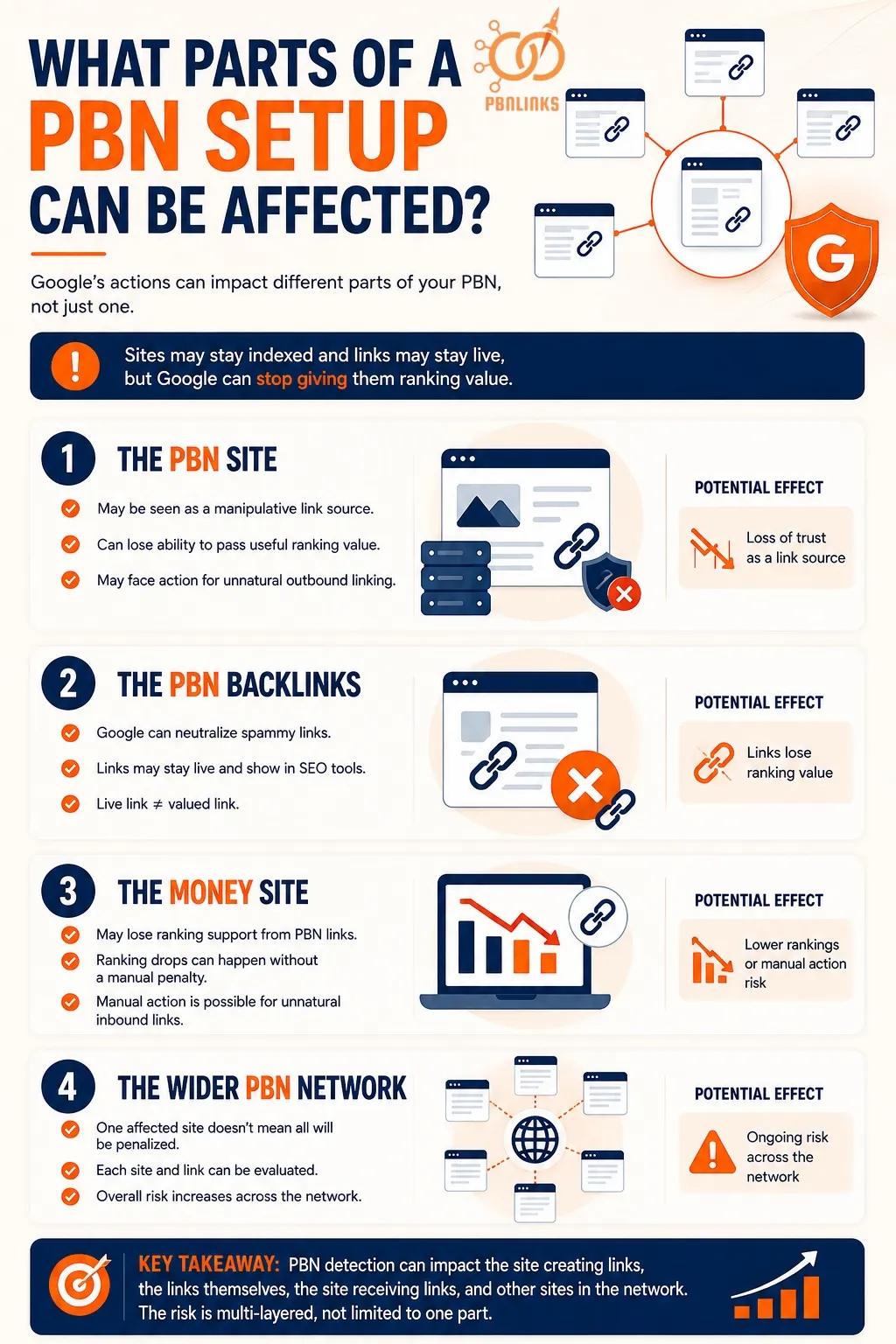
When Google identifies manipulative PBN linking, the impact can appear across different parts of the setup. The PBN site, the backlinks it publishes, the money site receiving those links, and potentially the wider network do not necessarily face the same outcome.
Understanding these parts separately is important because a PBN can appear normal from the outside even when its SEO value has changed. A domain may remain indexed, its backlinks may stay live, and the money site may still rank, while Google treats some of those links differently.
The PBN Site
The PBN site is the domain publishing the backlinks. If Google determines that the site is being used primarily to create manipulative links, its ability to pass useful ranking value can be affected.
The site does not necessarily need to disappear from search. It may remain indexed, continue publishing content, and retain third party authority metrics. What matters for the PBN is whether Google continues to trust the links coming from it.
More serious cases can involve action against unnatural outbound linking. This makes the linking site itself one part of the overall PBN risk rather than simply a container for backlinks.
The PBN Backlinks
The backlinks are often the most directly affected part because their purpose is to transfer ranking value to another website.
Google can neutralize links it considers spammy so they no longer provide the intended ranking benefit. The links may still exist on the page and continue appearing in backlink tools, but their presence does not guarantee that Google is giving them useful ranking credit.
This creates a clear distinction between a live backlink and a valued backlink. For SEO purposes, the second matters much more than the first.
The Money Site
The money site is the website receiving the PBN backlinks. Its main risk is losing the ranking support those links were intended to provide.
If Google stops counting PBN links that previously contributed authority, pages on the money site may lose some of their ranking advantage. The effect can be greater when a large part of the site’s backlink profile depends on links Google no longer trusts.
A loss of rankings does not automatically mean the money site received a manual penalty. In some cases, it may simply be ranking without the credit previously coming from neutralized PBN backlinks. Manual action is a separate possibility when Google determines that unnatural inbound linking violates its spam policies.
The Wider PBN Network
The final layer is the wider network of sites used to create controlled backlinks.
One affected PBN domain does not automatically mean every site in the network will receive the same treatment. Google does not publish a rule stating that identifying one PBN site automatically causes every connected domain to be penalized.
However, each site and the links it creates can still be evaluated. If several domains are being used for the same manipulative linking purpose, the overall SEO risk is not limited to the first site that loses value.
This is why the impact of PBN detection should be viewed at several levels. The PBN site can lose usefulness as a link source, its backlinks can lose ranking value, the money site can lose the benefit of those links, and other sites within the network can remain exposed to evaluation.
Can a Competitor Hurt Your Site With a False Spam Report?
A competitor can submit a false or exaggerated spam report, but the report itself does not prove that your site violated Google’s spam policies. Reporting a website brings suspected activity to Google’s attention. It does not give the person submitting the report the power to decide how Google treats the site.
This matters because competitors may interpret backlinks differently. A competitor might believe that several links belong to a PBN, are paid placements, or were created to manipulate rankings. That claim alone does not make the links spam. Google still evaluates the reported activity according to its own policies and systems.
Submitting the same accusation repeatedly does not turn it into stronger evidence. Google has safeguards intended to prevent misuse of its reporting system, and its documentation notes that identical reports from the same user may be disregarded. The important factor remains the activity being reported, not simply how many times someone complains about it.
The risk becomes more meaningful when a report points to genuine evidence of link manipulation. If the reported backlinks were created primarily to influence rankings, the problem is the underlying linking practice rather than the competitor’s report. Google may already be able to identify that activity through its own spam detection systems.
A false report should therefore be separated from a valid report about real link spam. Competitors can report suspected violations, but they cannot create a Google spam violation simply by making an accusation. The more important risk is whether the site and its backlink profile contain manipulative patterns that Google can independently identify.
Can You Find Out Who Reported Your PBN?
No, Google does not provide a way to see who submitted a spam report about your PBN or website. If a competitor reports suspected link spam, the site owner does not receive the reporter’s name, account details, or a notification identifying who submitted the report.
Google’s current reporting guidance also tells users not to include personally identifying information in spam reports. The report should focus on the search result, website, links, or behavior that may violate Google’s spam policies rather than the identity of the people involved.
If a report contributes to a manual action, Google may provide information about the violation through the Manual Actions report in Google Search Console. That information is intended to help the site owner understand the problem and does not mean Google reveals who originally reported it.
This creates an important distinction between knowing that Google took action and knowing who submitted a report. A manual action can provide evidence that Google found a policy issue, but it does not identify the competitor or other user who may have brought the activity to Google’s attention.
For PBN owners, trying to identify a possible reporter is therefore less useful than checking whether Google has actually taken action or stopped giving value to the links. The next step is understanding what evidence can show that either of those things has happened.
How Can You Tell If Google Took Action Against Your Site?
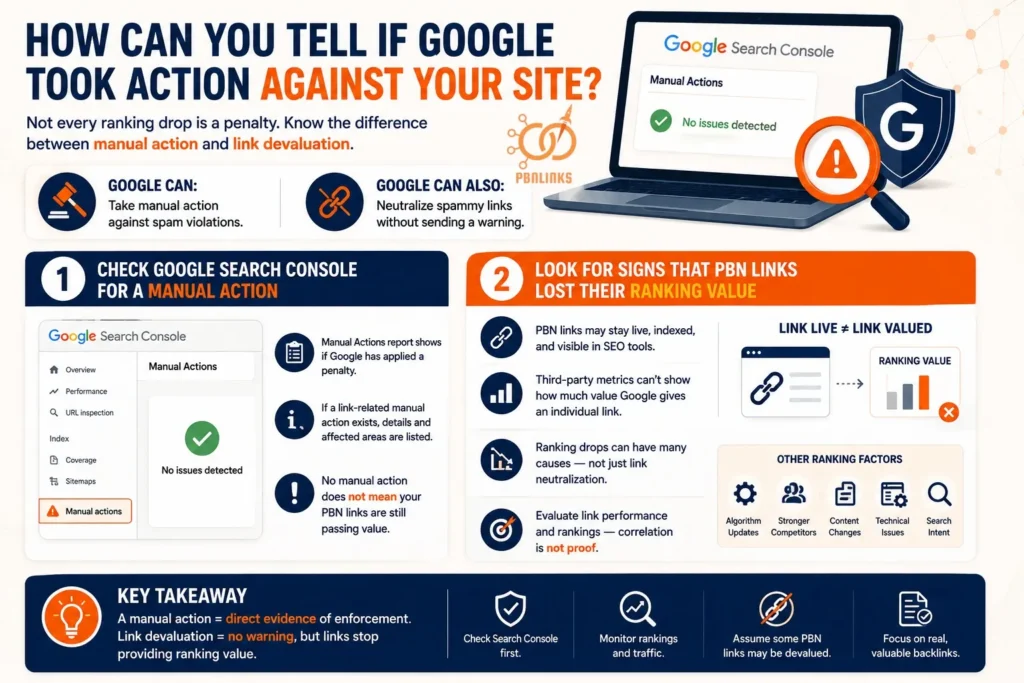
The clearest evidence that Google has taken direct manual action is a notice in Google Search Console. However, not every change in PBN link value produces a warning. Google can neutralize spammy links without issuing a manual action, which makes some effects much harder to identify.
This is why rankings, backlink counts, and third party authority metrics should not be treated as proof on their own. The first step is to determine whether there is a confirmed manual action or whether the site may simply have lost ranking credit from links Google no longer values.
Check Google Search Console for a Manual Action
Google Search Console includes a Manual Actions report that shows whether a human reviewer has determined that pages or a site violate Google’s spam policies.
If a link related manual action has been applied, the report can provide information about the issue and which parts of the site are affected. This is much stronger evidence than assuming a penalty occurred because rankings declined.
If Search Console shows no manual action, it means there is no manual action currently reported there. It does not prove that every PBN backlink is still passing value.
That distinction is important. No manual action does not mean no link devaluation.
Look for Signs That PBN Links Lost Their Ranking Value
Link neutralization is harder to confirm because Google does not provide a Search Console report listing every backlink it has decided to ignore or discount.
A PBN link may remain live, indexed, and visible in Ahrefs, Semrush, or other backlink tools even when it no longer provides the ranking benefit expected from it. Third party metrics can describe the linking domain, but they cannot reveal exactly how Google values an individual link internally.
Ranking changes can provide context, especially when pages that depended heavily on PBN backlinks lose visibility. But a ranking drop alone cannot prove that Google neutralized those links. Rankings can change for many reasons, including algorithm updates, stronger competitors, content changes, technical problems, and shifts in search intent.
The most reliable distinction is therefore between what can and cannot be confirmed. A Search Console manual action is direct evidence of manual enforcement. Link devaluation may have no equivalent warning and often has to be evaluated through changes in link performance and rankings without assuming that correlation proves the cause.
This difference is important when judging the real threat from competitor reporting. A PBN can lose SEO value without receiving a visible penalty, but being reported does not automatically mean either outcome has occurred.
How Real Is the Risk of Competitor Reporting for PBNs in 2026?
Competitor reporting is a real risk for PBNs in 2026, but the risk should not be confused with an automatic Google penalty. A competitor can report suspected link spam and bring specific websites or backlinks to Google’s attention. What they cannot do is decide whether those links violate Google’s policies or force Google to take action.
The risk becomes more serious when the reported network is actually being used to manipulate search rankings. If PBN links are created primarily to pass ranking value, a spam report can point Google toward activity that already carries risk under its link spam policies. Google’s current guidance also states that spam reports may be used to take manual action against confirmed violations.
Competitor reporting is only one part of that exposure. Google does not need a spam report to identify suspicious backlinks. Automated spam detection systems such as SpamBrain can evaluate link spam independently, which means a PBN may lose link value even if no competitor discovers or reports it.
The consequences are also not limited to visible penalties. Google can neutralize spammy links so they stop providing useful ranking credit. If a money site depends heavily on those links, rankings may decline when that value disappears. A manual action is a separate possibility when human review finds a violation of Google’s spam policies.
False or repeated reports should therefore be viewed differently from reports that point to genuine manipulation. An accusation alone does not create a spam violation. The underlying linking activity remains the main factor that determines whether there is anything for Google to act on.
So, how real is the risk? A competitor report increases exposure, but it does not create the underlying SEO risk. The real risk comes from the PBN links themselves, how they are being used, and whether Google determines that they were created to manipulate rankings. In 2026, competitor reporting matters because it gives Google another source of information, while automated detection means the same activity can still be identified without a report.
Conclusion
In conclusion, PBN spam reports are a real consideration, but a competitor cannot force Google to penalize a PBN simply by submitting a report. Google determines whether the reported links or websites violate its spam policies, and the underlying linking activity matters more than the report itself.
Google can identify link spam through automated systems such as SpamBrain without waiting for a competitor report. When PBN links are classified as spam, they may lose their ranking value while remaining live and visible in backlink tools. Rankings can decline as that link credit disappears, while manual action remains a separate possibility when human review confirms a violation.
Competitor reporting therefore increases exposure rather than creating the underlying risk. The PBN site, its backlinks, the money site, and the wider network can face different effects depending on how the links are being used and how Google evaluates them.
If you use PBN links as part of your SEO strategy, focus on link quality, relevance, and a backlink profile that supports long term search visibility. PBNLinks.Agency can help you evaluate your backlink strategy and build stronger SEO authority with carefully selected, relevant link opportunities.
FAQs About PBN Spam Reports
Can a Competitor Report My PBN to Google?
Yes. A competitor can report suspected PBN links or other search spam to Google. The report can bring the activity to Google’s attention, but Google decides whether its spam policies have actually been violated.
Can One PBN Spam Report Get My Site Penalized?
No, one spam report does not automatically cause a penalty. Google may use a report for manual enforcement, but action depends on whether Google finds an actual spam policy violation.
Does Google Manually Review Every PBN Spam Report?
Google does not state that every spam report receives individual human review. Reports help Google identify suspected spam, while its automated systems also detect violations independently.
Can Google Detect PBN Links Without a Competitor Report?
Yes. Google uses automated spam detection systems to identify link spam without waiting for someone to report it. A competitor report is an additional source of information, not a requirement for detection.
Can PBN Links Lose Value Without a Manual Action?
Yes. Google can neutralize spammy links so they stop providing the intended ranking benefit without issuing a manual action. The backlinks may still remain live and visible in backlink tools.
Can Google Apply a Manual Action for PBN Links?
Yes, if Google determines that manipulative links violate its spam policies. Manual actions can apply to unnatural links pointing to a site or unnatural links coming from a site.
Can a False Competitor Spam Report Hurt My Rankings?
A false report alone does not establish a spam violation. Google determines whether the reported website or links actually violate its policies rather than treating the competitor’s accusation as proof.
How Do I Know If Google Applied a Manual Action?
Check the Manual Actions report in Google Search Console. Google uses this report to notify verified site owners when a human reviewer has found a spam policy violation affecting their site.
Does a Live PBN Backlink Mean Google Still Counts It?
No. A backlink can remain live and visible while providing little or no ranking benefit. Third party backlink tools can show that the link exists, but they cannot confirm how Google values it internally.
Will Google Tell Me Who Reported My PBN?
No. Google does not provide site owners with the identity of a spam reporter. If a manual action is issued, Google provides information about the violation rather than identifying the person who submitted the report.