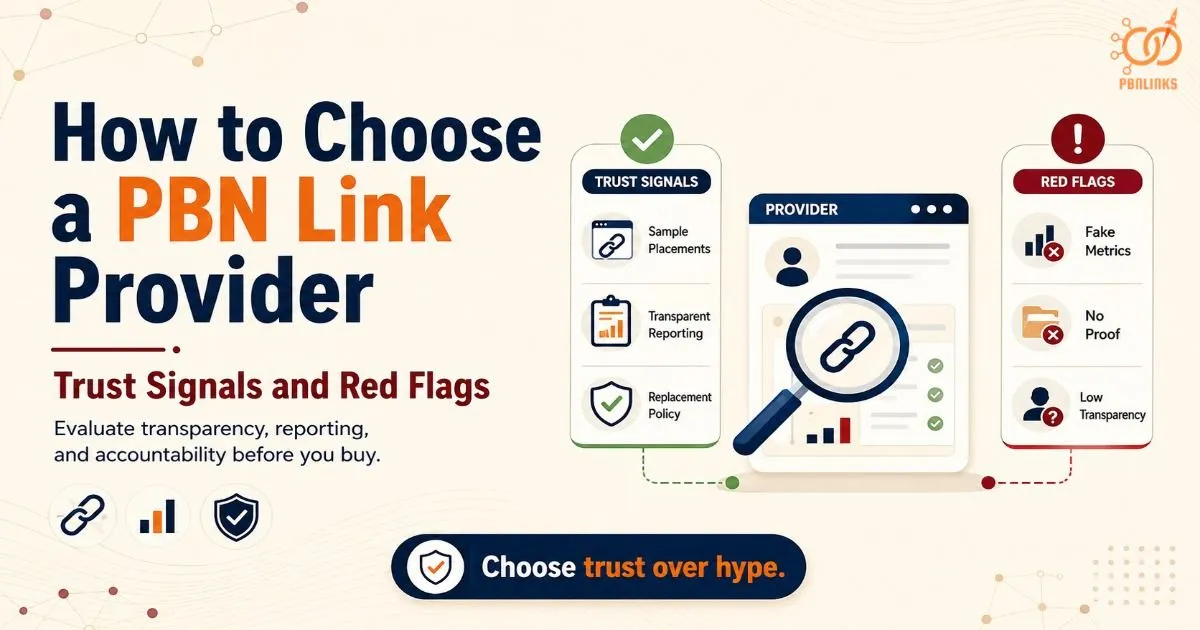
How to Choose a PBN Link Provider: Trust Signals and Red Flags
You pay for links, and weeks later you still do not know if they were ever placed. This is the real risk buyers face, and it rarely comes down to price. The actual problem is choosing a provider without checking who you are really paying.
If you are trying to figure out how to choose pbn link provider services, start with the business behind the links, not just the domain list. Many buyers judge a provider only by metrics like Domain Rating (DR), Domain Authority (DA), or estimated traffic. These numbers cannot show whether a provider manages hosting, content, and footprint properly, or supports you after a link goes live.
The better approach is to judge the business, not just the domains. Strong trust signals include verified sample placements, transparent reporting, realistic timelines, and clear replacement policies. Red flags include vague answers, refusal to show proof, and promises no provider can actually keep.
In this guide, you will learn how to evaluate a PBN link provider before buying, the warning signs that indicate a risky service, the questions to ask during the selection process, and the steps to test a provider before committing to a larger investment.
How to Choose a PBN Link Provider Over Just Vetting the Network
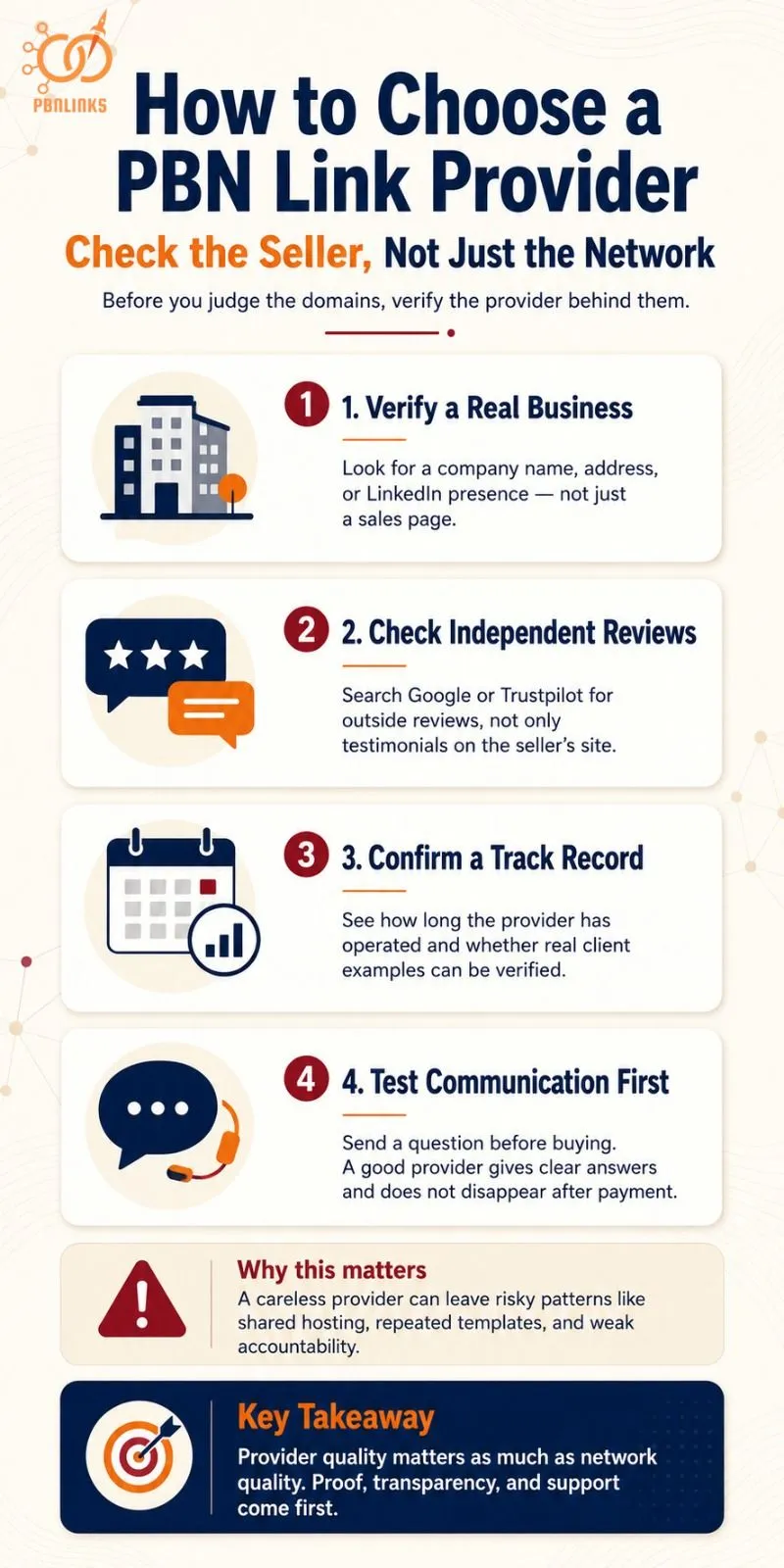
Before you hand over your budget, check the seller, not just the sites they’re selling. A provider can show you great looking domains and still go quiet the moment you’ve paid.
Most buyers stop at the websites. They run a quick check on Domain Rating, Domain Authority, and traffic, and call it a day. Here’s the catch, those numbers tell you almost nothing about the person actually running the network.
This is the part that trips people up. Google does not like networks of linked sites built just to game rankings, and it actively hunts for the signs. Think shared hosting, copy paste templates, the same handful of domains showing up across dozens of different clients. If your provider runs that network carelessly, your site is the one that takes the hit, not theirs.
So before you even glance at a single domain, check the provider first. Here’s what to look for:
- A real business outside their own sales page. Check for a company name, an address, or a LinkedIn presence, not just a storefront with no history behind it
- Reviews somewhere other than their own website. Search the company name plus “review” on Google or Trustpilot, since testimonials they wrote themselves don’t count
- A track record you can actually dig into. Look for how long the business has operated and whether past clients are named anywhere public
- A way to reach them that doesn’t go silent after payment. Test this before you buy by sending a question and seeing how they respond
Get this part right first. Everything else in this guide, the warning signs, the questions to ask, and how to test a provider safely, builds on it.
Trust Signals to Look For
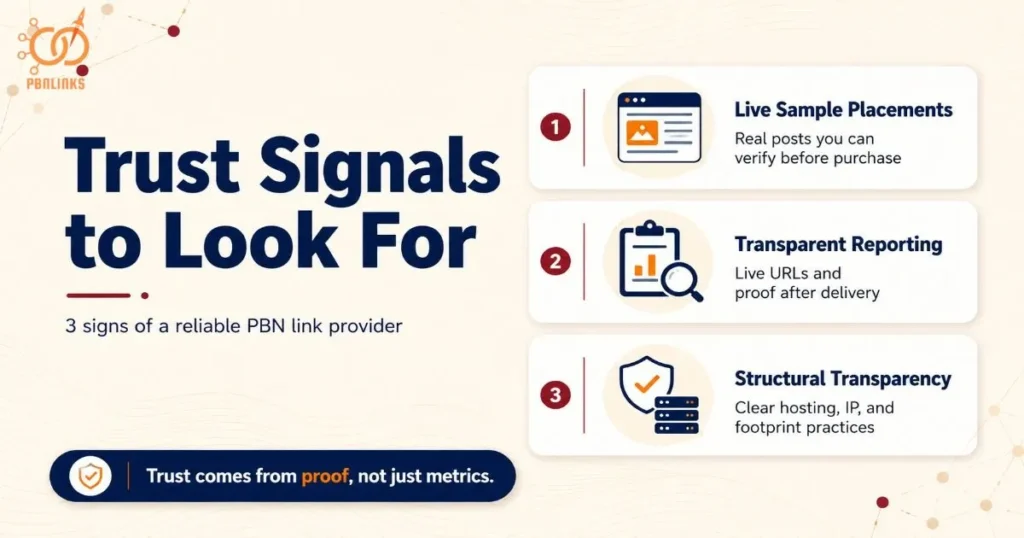
Trust signals in a PBN link provider are verifiable indicators of reliability. They show how transparently the provider manages their network. They help distinguish real operational quality from providers who rely only on inflated domain metrics like DR or traffic. These signals reflect actual service integrity, not just SEO numbers.
Proof of Live Sample Placements
Strong providers show real PBN posts before purchase, not just metric screenshots. Verifying these samples independently confirms the network is genuine before any money changes hands.
Transparent Reporting After Delivery
Quality providers share full live URLs once links go live, allowing independent verification of indexing and placement. Consistent, measurable proof separates real providers from those offering vague claims.
Structural Transparency
Clear explanations of hosting diversity, IP variation, and footprint management signal real operational discipline. Providers who explain their setup openly are more trustworthy than those who give generic or evasive answers.
Red Flags to Avoid
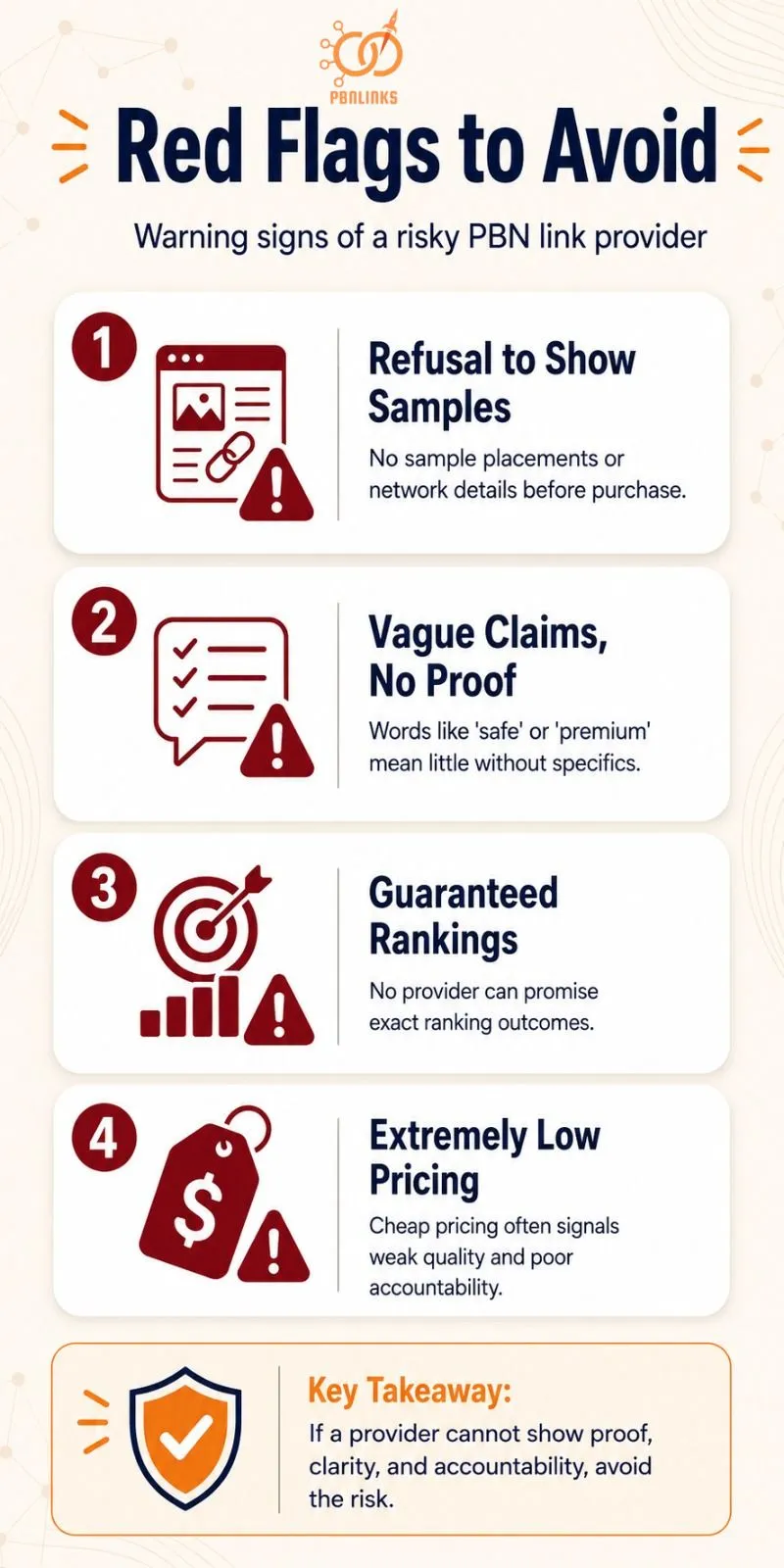
Red flags in a PBN link provider are warning indicators that reveal poor transparency, weak infrastructure, or unreliable business practices. These signs appear as the opposite of trust signals and help buyers identify providers that may create long-term SEO risks through poor management, unclear processes, or limited accountability.
Refusal to Show Samples or Details
A provider that refuses to share sample placements, content examples, or basic network details before purchase is a major warning sign. This often indicates hidden quality issues, weak site structures, or artificially created domains that cannot be independently evaluated.
Using Vague Reassurance Instead of Proof
Generic claims like “safe network,” “premium links,” or “high authority” without specific explanations are another red flag. Reliable providers should explain their processes clearly instead of avoiding questions about content quality, hosting setup, or footprint management.
Promising Guaranteed Rankings
Providers that guarantee specific rankings or fixed SEO results should be approached carefully. Search performance depends on many factors outside a provider’s control, making absolute ranking promises unrealistic and misleading.
Extremely Low Pricing With Poor Accountability
Unusually low prices combined with limited reporting or no post-sale support often indicate compromised quality. These providers may rely on reused domains, weak infrastructure, or automated content, increasing the risk of unstable links and poor long-term results.
Questions to Ask a Provider Before You Buy
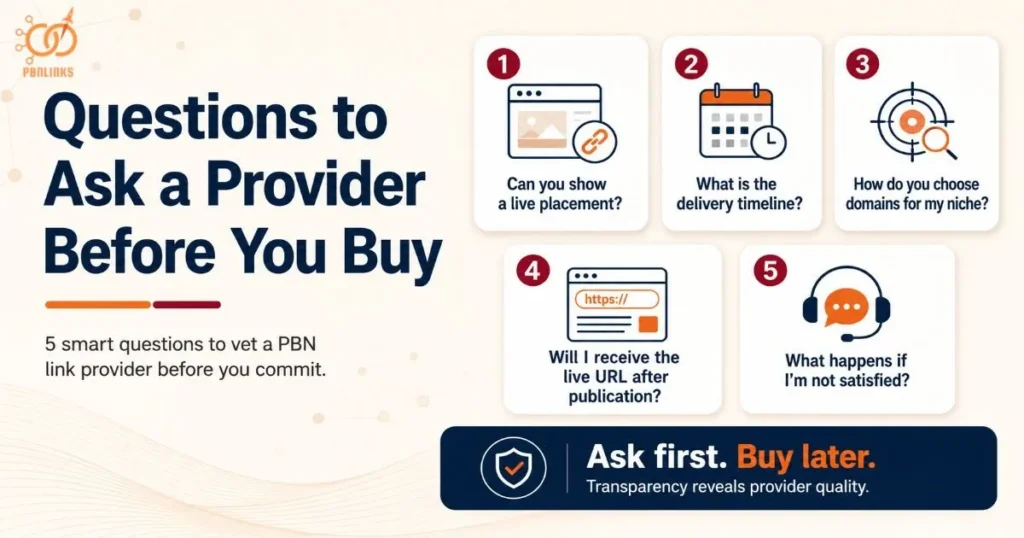
Before purchasing PBN links, asking the right questions helps you evaluate a provider’s process, transparency, and ability to deliver consistent placements. These questions allow buyers to verify important details before making a financial commitment.
Can You Show a Live Example of a Recent Placement?
Ask the provider for a recent, active placement example before buying. A live example helps you evaluate content quality, link placement style, and whether their actual work matches the claims they make.
What Is the Expected Timeline From Order to Live Link?
Understanding the expected delivery timeline helps you determine whether the provider has a structured process. A clear timeframe shows how they handle content creation, publishing, and project completion.
How Do You Select Domains for My Industry?
Ask how the provider chooses domains for your specific niche or industry. This helps determine whether placements are strategically selected for relevance or assigned randomly without considering topical alignment.
Will I Receive the Live URL After Publication?
Confirm that you will receive the complete live URL once the link is published. Access to the exact placement allows you to independently verify the page, indexing status, and overall quality.
What Happens If I Am Not Satisfied With the Placement?
Ask about the provider’s process for handling unsatisfactory placements or content issues. A reliable provider should have a clear solution, such as revisions, replacements, or another agreed resolution process.
What PBN Link Pricing Actually Tells You
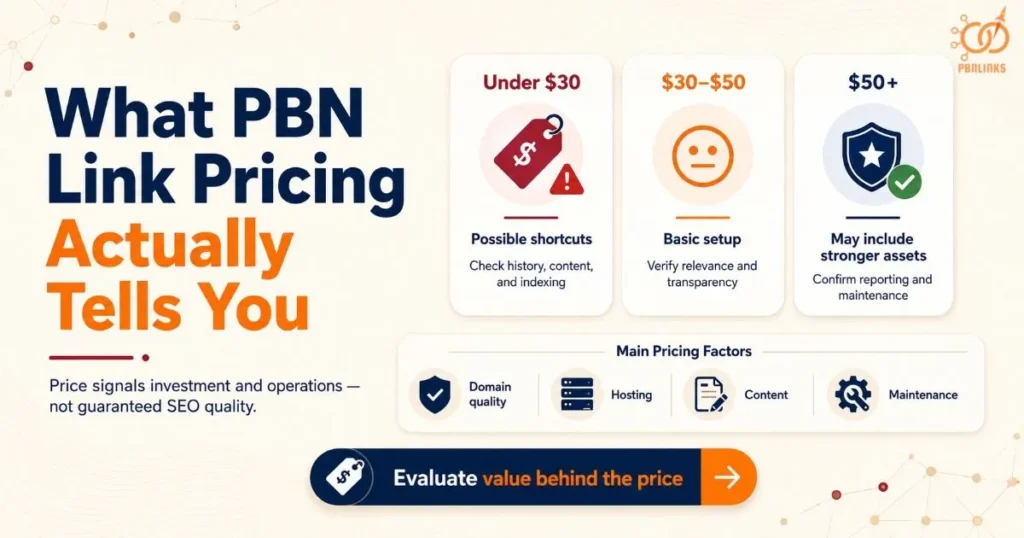
PBN link pricing refers to the cost of acquiring backlinks from private blog networks and reflects the resources required to create and maintain those placements. Factors such as domain acquisition, hosting, content creation, and ongoing management influence the final price, making pricing an important signal when evaluating different providers.
The cost of PBN links varies depending on quality level, niche, and provider practices. Extremely low prices may indicate reduced investment in domains, content, or maintenance, while higher prices do not automatically guarantee better quality. Buyers should evaluate what is included behind the price rather than assuming cost alone determines link value.
PBN Link Pricing Signals
| Pricing Range | What It May Indicate | What Buyers Should Evaluate |
| Under $30 per link | May indicate low-cost production methods, limited quality control, or reduced investment in domains and content. | Check domain history, content quality, indexing status, and placement consistency before purchasing. |
| $30–$50 per link | Often reflects basic PBN setups where essential costs like domains, hosting, and content are covered. | Verify niche relevance, link placement quality, and provider transparency. |
| $50+ per link | Higher pricing may include stronger domains, better content, or additional management, but does not guarantee quality. | Confirm that higher costs are supported by better assets, reporting, and maintenance. |
| Extremely low package pricing | Often signals shortcuts in content creation, domain selection, or network management. | Evaluate the provider process instead of choosing based only on price. |
| Main pricing factors | Domain quality, hosting setup, content standards, and ongoing maintenance affect the true cost. | Focus on the value and operational quality behind each placement. |
Pricing should be treated as an indicator of investment and operational quality, not a guarantee of SEO results. A reliable evaluation considers the provider’s overall process, transparency, and maintenance standards rather than focusing only on the lowest or highest price point.
Test Before You Scale
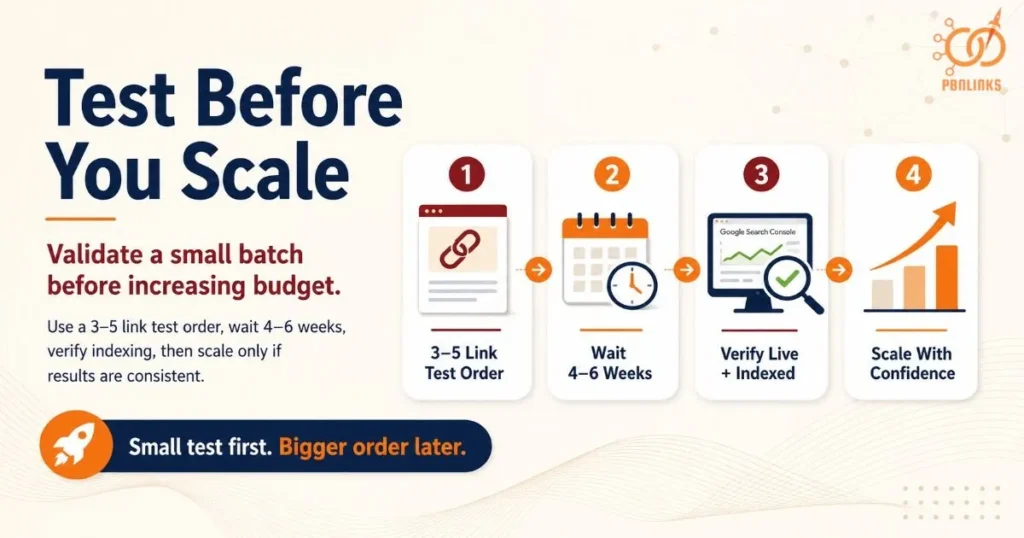
Testing before scaling is a structured validation process used to reduce risk when working with a PBN link provider. Instead of committing a large budget upfront, you first evaluate a small batch of links to confirm whether the provider delivers real, indexable, and consistent placements that match their claims.
This process typically begins with a controlled test order of around 3 to 5 links placed on a single secondary or supporting page. The purpose is to observe how the provider handles execution, including content quality, publishing accuracy, and link indexing behavior under real conditions.
After the links are published, a waiting period of at least 4 to 6 weeks is necessary before evaluating results. This timeframe allows search engines sufficient time to crawl, index, and process the backlinks, as well as reflect any measurable SEO impact in tools and ranking signals.
Verification should then be done using tools like Google Search Console and Ahrefs to confirm that each link is live, indexed, and properly recognized. Only after confirming both indexing and delivery consistency should you consider scaling to a larger order, ensuring the provider is reliable before increasing investment.
Reporting and Link Monitoring After You Buy
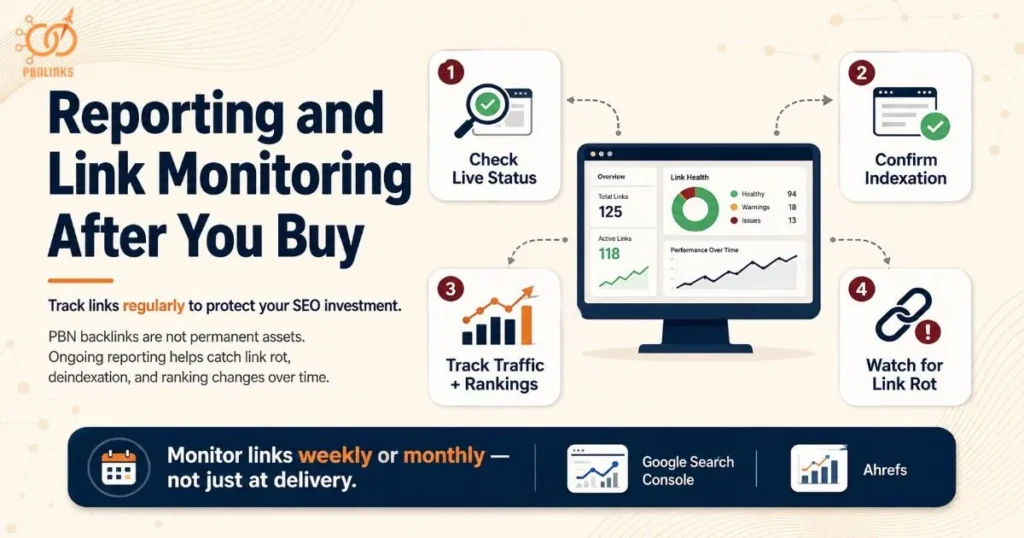
Reporting and link monitoring after purchase is essential because PBN backlinks are not permanent assets. A proper system includes weekly or monthly reporting that tracks indexation status, referral traffic, and ranking changes instead of relying on a one-time delivery confirmation.
Link rot is a real long-term issue in backlink ecosystems, with industry data showing that a significant portion of links gradually disappear or lose indexation over time. This makes continuous monitoring necessary even after successful placement.
Ongoing tracking means regularly verifying each link using Google Search Console and Ahrefs to ensure it remains live, indexed, and counted. This helps detect silent link loss or deindexation that can affect SEO performance.
A provider without ongoing reporting is effectively a one-time seller, not a long-term partner. Continuous monitoring ensures link stability and protects your SEO investment over time.
Key Monitoring Practices
- Check link status weekly or monthly for indexation and visibility changes
- Use Google Search Console and Ahrefs to confirm backlinks remain active
- Track referral traffic and ranking shifts over time, not just at delivery
- Watch for link rot or deindexation as part of ongoing maintenance
- Treat link building as a continuous process, not a one-time purchase
Common Mistakes Buyers Make
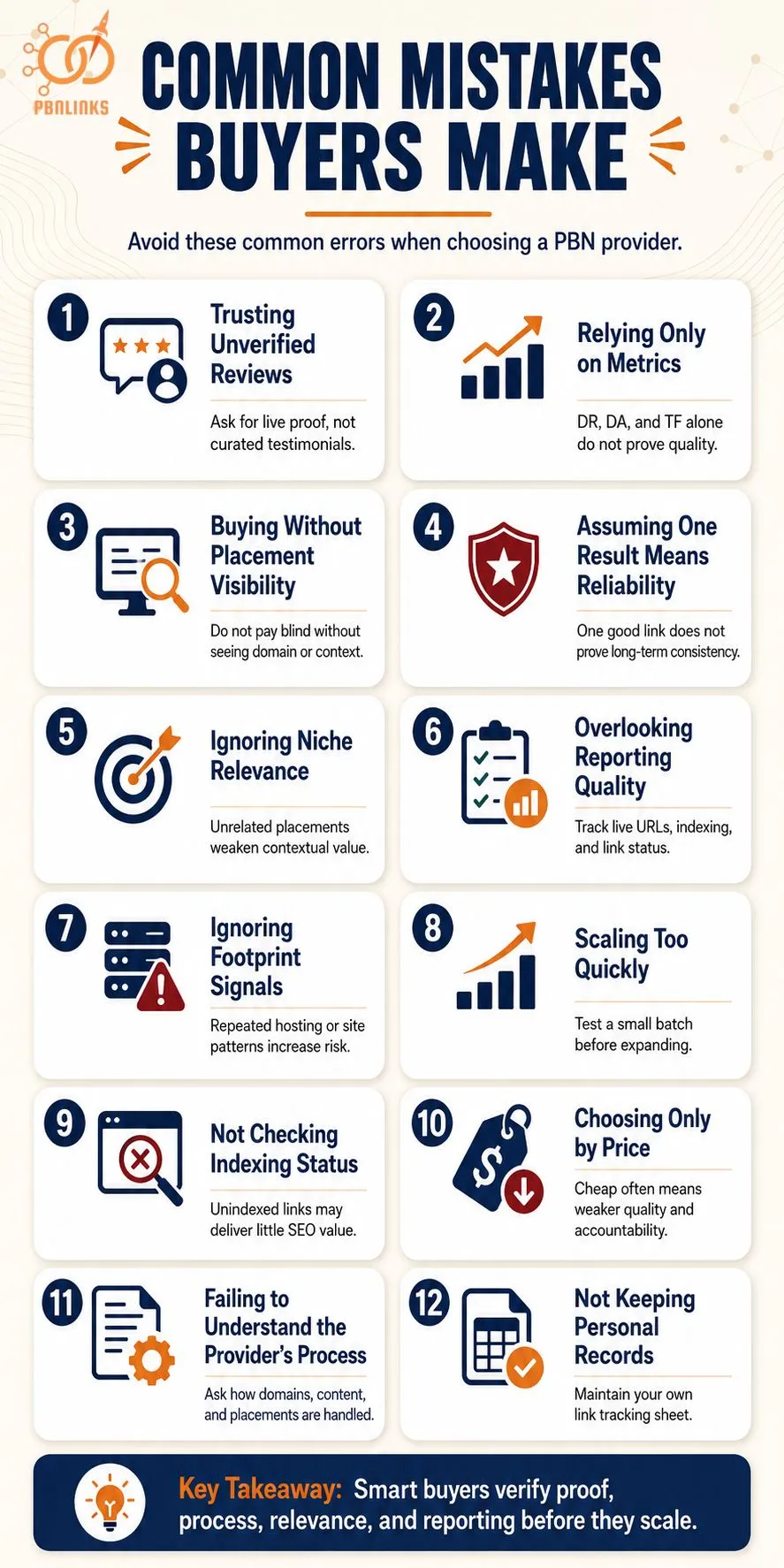
Common mistakes buyers make when choosing PBN providers are avoidable errors that can lead to poor link quality, wasted investment, and unstable SEO outcomes. Many buyers focus on surface-level factors while overlooking important details that determine whether a provider can deliver consistent and reliable placements.
Trusting Unverified Reviews
Trusting reviews or testimonials without verification can lead buyers to rely on selective feedback rather than real performance evidence. Always look for live examples, independent mentions, or verifiable placements that confirm the provider’s actual work quality.
Relying Only on Metrics
Judging PBN quality only through metrics like DA, DR, or TF is a common mistake. These scores can be manipulated or inflated and do not guarantee that a domain has genuine authority, stable indexing, or long-term SEO value.
Buying Without Placement Visibility
Paying before seeing where the link will appear creates a blind purchase. Without reviewing the actual domain or placement details, buyers cannot evaluate content quality, relevance, or whether the link placement matches their expectations.
Assuming One Result Means Reliability
A single successful placement does not prove that a provider is reliable over time. Consistent quality should be evaluated across multiple links, including indexing stability, content standards, and delivery consistency.
Ignoring Niche Relevance
Accepting placements from unrelated websites can reduce the contextual value of backlinks. Buyers should ensure that the linking domains and published content align naturally with their industry or target audience.
Overlooking Reporting Quality
Failing to check reporting practices after purchase can leave buyers unaware of link performance changes. Proper reporting helps track live URLs, indexing status, and whether placements remain available over time.
Ignoring Footprint Signals
Assuming every PBN network operates the same way can create unnecessary risk. Repeated hosting patterns, identical site structures, or obvious network similarities may indicate poor management and increase the chance of devaluation.
Scaling Too Quickly
Expanding a campaign immediately after the first order is a common mistake. Buyers should validate a small test batch first to confirm link quality, indexing behavior, and provider consistency before increasing investment.
Not Checking Indexing Status
Many buyers assume published links automatically provide SEO value. However, links that are not indexed may have limited impact, making regular checks through tools like Google Search Console or Ahrefs important.
Choosing Only by Price
Selecting a provider based only on the lowest cost often results in compromised quality. Cheap services may reduce investment in domains, content, maintenance, or reporting, which can affect long-term link stability.
Failing to Understand the Provider’s Process
Some buyers focus only on the final backlink instead of understanding how the provider operates. Knowing how domains are selected, content is created, and placements are maintained provides better insight into overall service quality.
Not Keeping Personal Records
Relying completely on the provider’s tracking system can create visibility issues later. Maintaining your own record of purchased links, URLs, dates, and performance checks helps monitor the long-term value of your investment.
Conclusion
In conclusion, choosing a PBN link provider requires evaluating more than domain metrics or pricing alone. A reliable decision depends on transparency, proven placements, realistic expectations, proper testing, and ongoing monitoring after purchase. Trustworthy providers demonstrate clear processes, while unreliable ones often show warning signs through vague answers, poor accountability, or unrealistic promises.
Before scaling any campaign, test a small batch of links, verify their quality and indexing, and confirm that the provider consistently delivers what was promised. The relationship with the provider matters as much as the network itself because long-term link stability depends on proper management and support.
If you are looking for a transparent PBN link service with clear placement options and professional support, explore PBN Links Agency to learn more about available solutions and services.
FAQs About How to Choose a PBN Link Provider
Is it safe to buy PBN links from a provider?
Yes, if the provider is transparent about placements, reporting, and hosting. Most risk comes from poor vetting, not the purchase itself.
How much should PBN links cost?
Pricing varies by niche and domain quality. Costs far below market reality usually mean cut corners somewhere.
How do I know if a PBN provider is legitimate?
Legitimate providers show sample placements and give live URL reporting on request. A small test order confirms this before you commit further.
Should I trust a provider that guarantees rankings?
No, since no provider controls Google’s algorithm. Treat any ranking guarantee as a red flag, not a normal sales claim.
Can Google detect PBN links from a provider?
Yes, through shared hosting, repeated templates, and unnatural anchor patterns. A reputable provider actively manages these footprints to reduce that risk.
What happens if a PBN link gets deindexed after I buy it?
A reliable provider replaces or repairs it at no extra cost. Providers with no replacement policy leave you with no recourse.
How many PBN links should I buy from a provider to start?
Start with a small test batch, not a full package. This lets you verify placement and indexing before scaling up.
Are cheap PBN link providers worth the risk?
Rarely, since quality domains and hosting carry real costs that low prices cannot cover. Cheap pricing usually means weaker domains or no replacement guarantee.
What tools can I use to verify a provider delivered real links?
Google Search Console and Ahrefs both confirm if a link is live and indexed. Check the exact URL the provider sends against both.
Do reputable PBN providers offer refunds or replacements?
Yes, most offer replacement links if a placement fails to index or gets removed. No stated replacement policy is a clear red flag.