Why PBN Sites Get Deindexed and What Happens to Your Rankings?
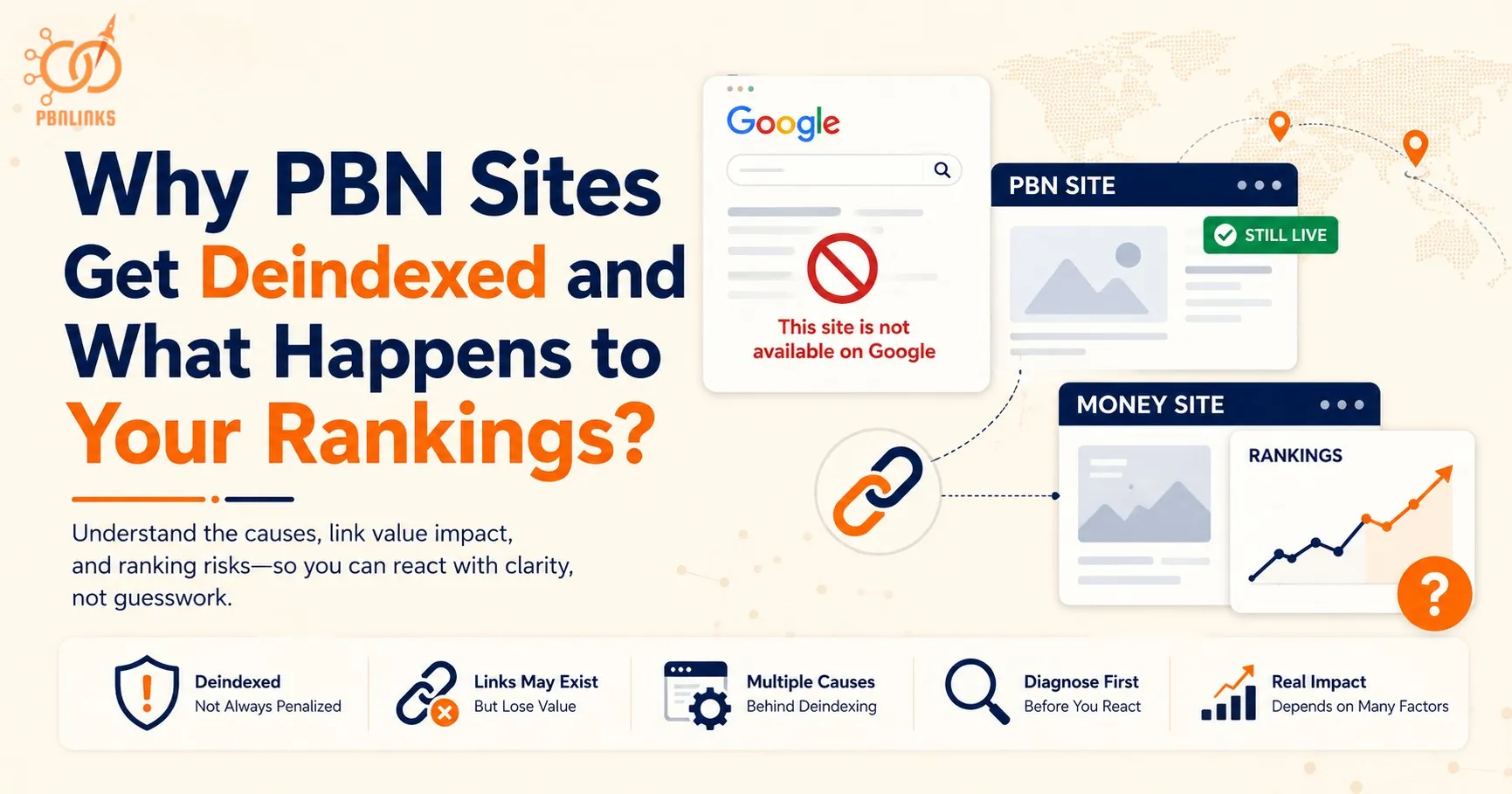
You built the PBN. You published the content. You placed the links and watched the rankings move. Then one day, the PBN site deindexed warning becomes a reality. The site disappears from Google, even though the website itself is still online and the backlinks are still visible.
That is when the real questions start. Did Google penalize the PBN? Are the backlinks still passing value? Will the money site’s rankings drop? And how quickly will you notice the impact?
The answer is not always straightforward. A PBN can become deindexed because of spam issues, thin content, hacked pages, crawling problems, noindex directives, hosting failures, or other technical issues. And even when a PBN disappears from Google, the effect on your rankings is not necessarily immediate.
The key is knowing what actually happened before reacting. Once you understand why a PBN site deindexed, what happens to its links, and how Google may treat those signals afterward, you can assess the real ranking risk instead of guessing.
What Does It Mean When a PBN Site Is Deindexed?
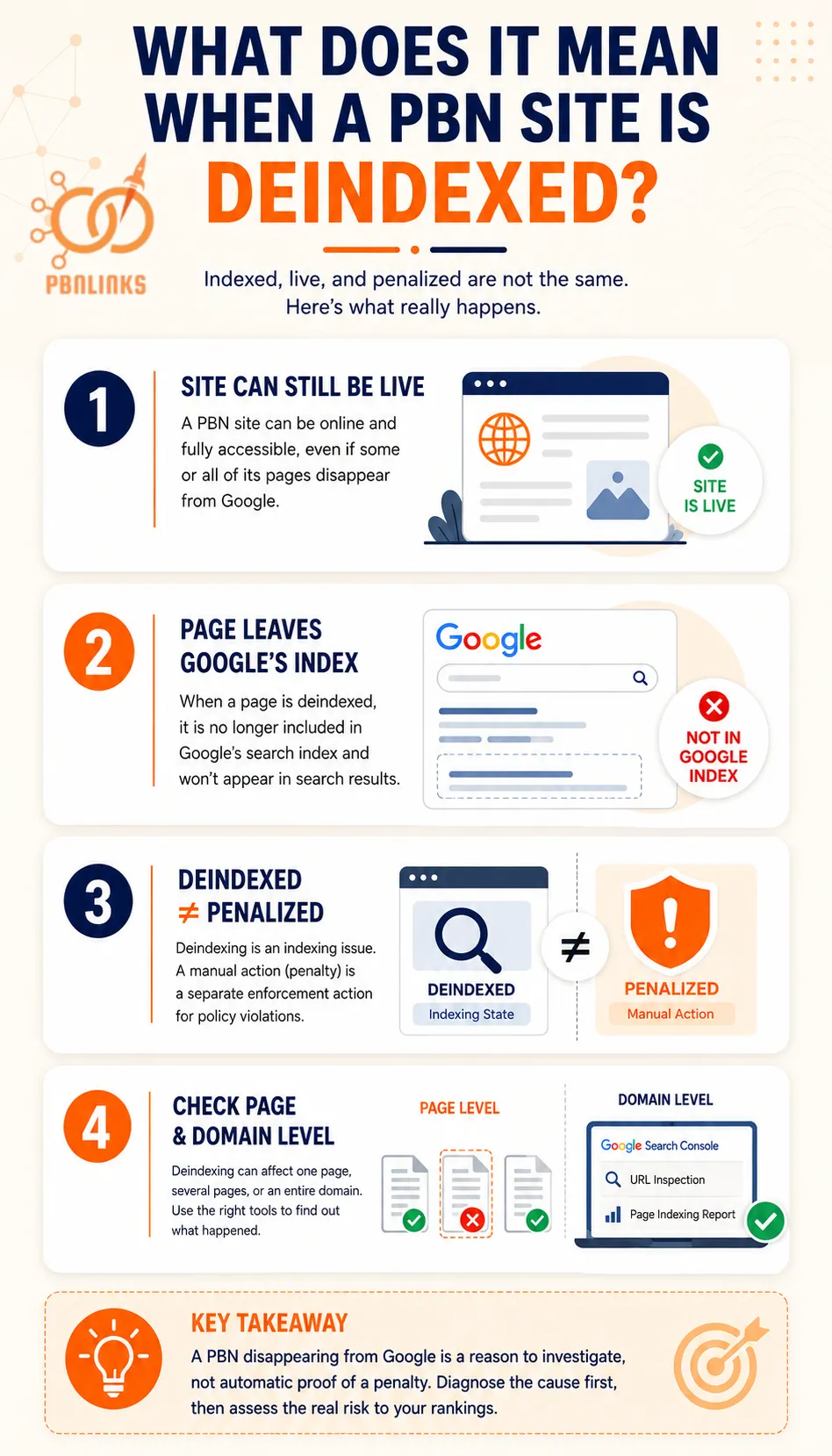
To understand what happens when a PBN gets deindexed, we first need to understand what deindexing actually means. When a PBN site is deindexed, one or more of its pages are no longer included in Google’s search index. The website itself can still be online, and visitors may still be able to open those pages normally.
This matters because an indexed page and a live page are not the same thing. A backlink can remain visible on a webpage even after that page disappears from Google’s search results. The important question is whether Google is still processing that page and the signals associated with its links.
Deindexed Does Not Automatically Mean Penalized
A deindexed PBN is not automatically a penalized PBN. Deindexing describes an indexing state, while a manual action is an enforcement action related to a violation of Google’s spam policies. A page can disappear from Search because of technical problems, crawling restrictions, a noindex directive, or other indexing issues without receiving a manual action.
This distinction is important because a ranking drop does not prove that Google penalized the site either. Rankings can change because of algorithmic changes, stronger competitors, content changes, technical problems, or changes in how Google evaluates links. If a manual action is suspected, the Manual actions report in Google Search Console provides much stronger evidence than simply seeing a page disappear from Search.
A PBN Can Lose Individual Pages Without Losing the Entire Domain
Deindexing does not always affect an entire PBN domain. Google may exclude one article or several URLs while continuing to show the homepage and other pages in Search.
For example, if a PBN has 40 published pages and one article disappears from Google, that does not mean the entire domain has been deindexed. The affected URL could have a technical issue, an indexing restriction, a quality related problem, or another reason for exclusion.
That is why the problem should be checked at both the page level and domain level. Google Search Console’s URL Inspection and Page Indexing reports can help identify whether specific URLs are excluded and provide information about their indexing status. Technical checks such as robots.txt, noindex, canonical tags, redirects, and server responses can then help determine what actually happened.
The key point is simple: a PBN disappearing from Google is a reason to investigate, not automatic proof of a penalty. First establish why the pages disappeared. Only then can you properly assess what happened to the backlinks and whether there is a genuine risk to your rankings.
Why Do PBN Sites Get Deindexed?
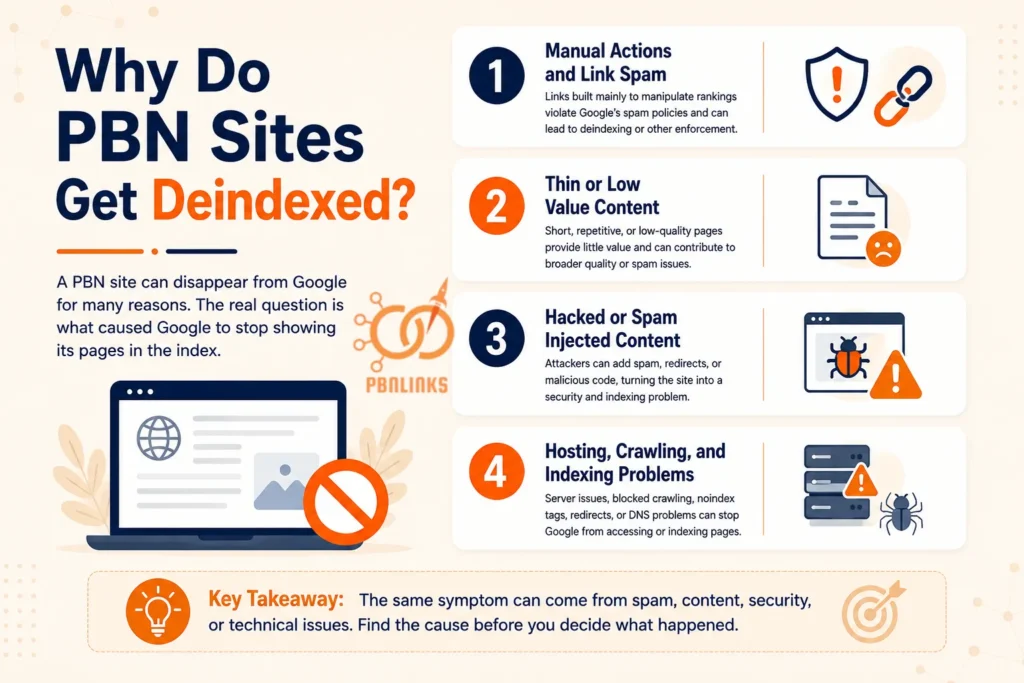
Let us slow down before assuming Google has penalized the PBN. A site disappearing from Google can happen for several different reasons, and the cause determines what happens next. Some problems are related to spam or content quality. Others are caused by security or technical issues.
The important question is not simply why the PBN disappeared. It is what caused Google to stop showing its pages in the index.
Manual Actions and Link Spam
PBNs create a particular risk because their links are typically built to influence search rankings. Google considers links created primarily to manipulate rankings to be link spam, and violations of its spam policies can result in reduced visibility or other enforcement.
That does not mean every deindexed PBN received a manual action. If Google has actually issued one, it should appear in the Manual actions report in Search Console. A domain disappearing from Search by itself is not enough to prove that a manual penalty occurred.
Thin or Low Value Content
Content quality is another possible problem. A PBN filled with short, repetitive, poorly written, or heavily templated pages gives those pages little independent value beyond the links they contain.
Thin content does not automatically mean Google will deindex a site. The bigger concern is when the overall website provides little useful information and appears to exist primarily to manipulate rankings or host links. In that situation, weak content can become part of a broader quality or spam problem.
Hacked or Spam Injected Content
Sometimes the PBN owner did not create the problem at all. The site was hacked.
An attacker can add spam pages, unwanted redirects, malicious code, or large amounts of unrelated content. This can turn an otherwise normal domain into a security and indexing problem very quickly.
If that happens, check Google Search Console’s Security Issues report and inspect the affected URLs. A hacked PBN should first be treated as a security problem rather than automatically being labeled a Google penalty.
Hosting, Crawling, and Indexing Problems
This is the cause that is easiest to overlook. Google may not be penalizing the PBN at all. It may simply be unable to access or properly process the pages.
Server outages, DNS problems, blocked crawling, accidental noindex directives, incorrect redirects, and hosting changes can all interfere with indexing. Google expects pages to be accessible to Googlebot, return a successful HTTP response, and contain indexable content.
Before blaming an algorithm update or assuming the PBN has been caught, check the technical basics. The same symptom can come from a spam problem, a content problem, a security issue, or a simple technical failure. Finding the cause is what tells you what actually happened.
What Happens to PBN Links After the Site Is Deindexed?
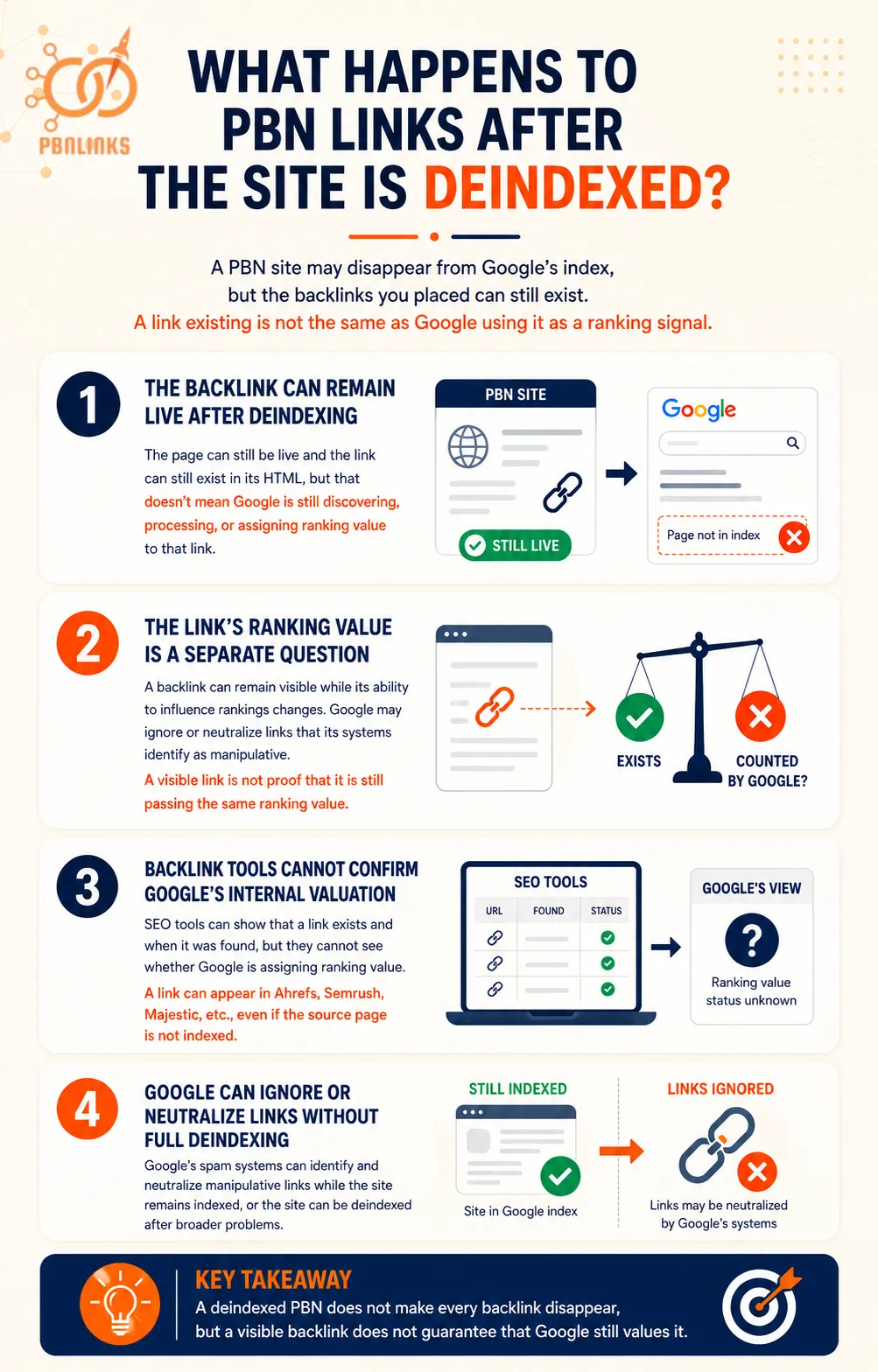
This is where the situation becomes more complicated. The PBN site may disappear from Google’s index, but the backlinks you already placed can still be sitting on the pages exactly where you left them. The website is live, the links are visible, and yet their SEO value is no longer something you can judge simply by looking at the page.
The important distinction is between a link existing and Google using that link as a ranking signal. Those are not the same thing.
The Backlink Can Remain Live After Deindexing
A deindexed page does not necessarily disappear from the internet. If the page still loads and the backlink is still present in its HTML, the link technically exists.
But that does not tell you whether Google is still discovering, processing, or assigning ranking value to that link. Google uses links for discovery and understanding relationships between pages, but its systems also evaluate links for spam and manipulation.
The Link’s Ranking Value Is a Separate Question
This is the part that causes the most confusion. People often assume that if they can still see the backlink, the SEO value must still be there.
That is not necessarily true.
A backlink can remain visible while its ability to influence rankings changes. Google may ignore or otherwise neutralize links that its systems identify as manipulative, so the physical presence of a link should never be treated as proof that it is still passing the same ranking value.
Backlink Tools Cannot Confirm Google’s Internal Valuation
Third party SEO tools can tell you that a backlink exists, when they discovered it, and whether the source domain is still visible in their own databases. They cannot directly tell you whether Google is currently assigning ranking value to that particular link.
This is why a backlink can continue appearing in Ahrefs, Semrush, Majestic, or another tool even when the source page is no longer indexed by Google. The tool is reporting what it can observe; it is not showing Google’s internal ranking decision.
Google Can Ignore or Neutralize Links Without Full Deindexing
A PBN does not necessarily have to disappear from Google’s index before its links lose their ability to influence rankings. Google’s spam systems can identify manipulative links while the source website itself remains indexed.
Google has specifically described its systems as becoming better at detecting and neutralizing link spam. That means these are two separate situations: a PBN can remain indexed while its links are ignored, or a PBN can become deindexed after broader problems affect the site.
The key takeaway is simple: a deindexed PBN does not make every backlink disappear, but a visible backlink does not guarantee that Google still values it. The next question is whether losing that link value can actually affect the rankings of the site it was pointing to.
What Happens to Your Rankings After a PBN Site Is Deindexed?
This is where the concern becomes real for the money site. A PBN can disappear from Google’s index without your rankings dropping immediately. The effect depends on whether Google was actually using those links as ranking signals and how important those links were to the overall strength of your backlink profile.
The mistake is assuming that PBN deindexed today means rankings fall tomorrow. Search does not work that mechanically.
Rankings May Not Drop Immediately
There is no fixed timeline between a PBN becoming deindexed and a ranking change on the site it was linking to. Google has to crawl, process, and evaluate information before changes are reflected in Search, so the impact may not appear at the same time as the indexing change.
You might see no obvious change at all, a gradual movement over time, or a more noticeable decline if several important links stop contributing value.
Ranking Loss Depends on How Much the Links Were Contributing
Not every PBN backlink has the same importance. If the affected links were already providing little or no ranking value, losing them may make almost no difference.
The situation is different when a site’s backlink profile depends heavily on links from PBNs. If Google stops counting a meaningful portion of those links, the site may lose some of the signals that were supporting its rankings.
This is why the number of links alone does not tell you the likely impact. Their relevance, quality, strength, and role within the wider backlink profile matter more than simply counting how many disappeared.
A Ranking Drop Does Not Prove the PBN Caused It
A ranking decline after a PBN disappears can look like a clear connection, but timing alone does not prove causation. Your rankings can change because of algorithmic changes, stronger competitors, content changes, technical problems, changes in search intent, or other changes to your backlink profile.
Google itself recommends looking at broader Search Console data and comparing the timing of traffic and ranking changes before deciding what caused a decline.
The practical takeaway is simple: watch the timing, compare the affected keywords, and look at the wider backlink and search picture before blaming the deindexed PBN. A ranking change may be related to lost link value, but you need evidence before treating it as the cause.
How Can You Tell If a PBN Site Has Been Deindexed?
Before assuming a PBN has been removed from Google’s index, you need to confirm what is actually happening. A domain can be online and working normally while some of its pages are excluded from Google. It can also have a technical problem that looks like deindexing from the outside.
The goal is to determine whether the problem affects one URL, several pages, or the entire domain, and then identify why those pages are not appearing in Search.
Start by Checking the Domain and Important URLs
Begin with several important pages rather than checking only the homepage. Search for the domain and specific URLs in Google to see whether the pages are still appearing.
A missing result is a useful warning sign, but it is not enough by itself to prove deindexing. Google can change which pages it shows, and search operators are not a replacement for checking the actual indexing status in Search Console.
Use Google Search Console to Confirm the Problem
Google Search Console gives you much stronger evidence than a simple Google search. Use URL Inspection to examine individual pages and the Page Indexing report to look for broader patterns across the site.
Also check the Manual actions and Security Issues reports. These can help distinguish a possible spam enforcement issue from an indexing or security problem. Google specifically provides these reports to help site owners diagnose problems affecting their presence in Search.
Check Technical Signals Before Assuming Spam
Before blaming Google, check the basic technical signals. Look at the page’s HTTP status, robots.txt, noindex directives, canonical tags, redirects, DNS configuration, and hosting availability.
A simple technical mistake can prevent Google from accessing or indexing a page. Google explains that pages need to be accessible to Googlebot and contain indexable content before they can be considered for indexing.
The important thing is to confirm the problem before interpreting it. If only one URL is missing, investigate that URL. If hundreds of important pages disappear together, look for a broader technical, security, indexing, or spam related cause.
Can a Deindexed PBN Site Be Recovered?
A deindexed PBN site can sometimes be recovered, but recovery depends entirely on why the site disappeared from Google’s index in the first place. Fixing a technical problem is very different from recovering from a manual action, and simply asking Google to index the site again does not solve the underlying issue.
The first step is always to identify the cause. Once you know what went wrong, you can take the appropriate recovery path.
Fix the Actual Cause First
If the problem is technical, fix the technical issue. If the site was hacked, remove the malicious content and secure the website. If an accidental noindex directive is preventing indexing, remove it. If Googlebot is being blocked, restore access.
The same principle applies to spam related problems. If the site has violated Google’s spam policies, the underlying violations need to be addressed before expecting normal search visibility to return.
Request Indexing Only After the Problem Is Fixed
Once the underlying problem has been corrected, Google Search Console’s URL Inspection tool can be used to check the affected URL and request indexing where appropriate. The request does not guarantee that Google will index the page, but it tells Google that the page has been updated and is ready to be considered again.
Do not confuse this with Google’s Indexing API. The Indexing API is intended for specific supported content types, such as job posting and livestream pages, rather than ordinary PBN articles.
Reindexing Does Not Guarantee the Old Ranking Value Returns
Getting the PBN back into Google’s index is only one part of the process. It does not guarantee that the backlinks placed on the site will regain the ranking value they appeared to have before the deindexing.
Google may continue to evaluate those links differently after the site returns. Reindexing is not the same as ranking recovery, and ranking recovery is not the same as restoring previous backlink value.
That is why the goal should not simply be to make the PBN appear in Google again. The real question is whether the underlying problem has been resolved and whether the site’s pages and links are still being treated as valuable signals.
What Should You Do When a PBN Site Gets Deindexed?
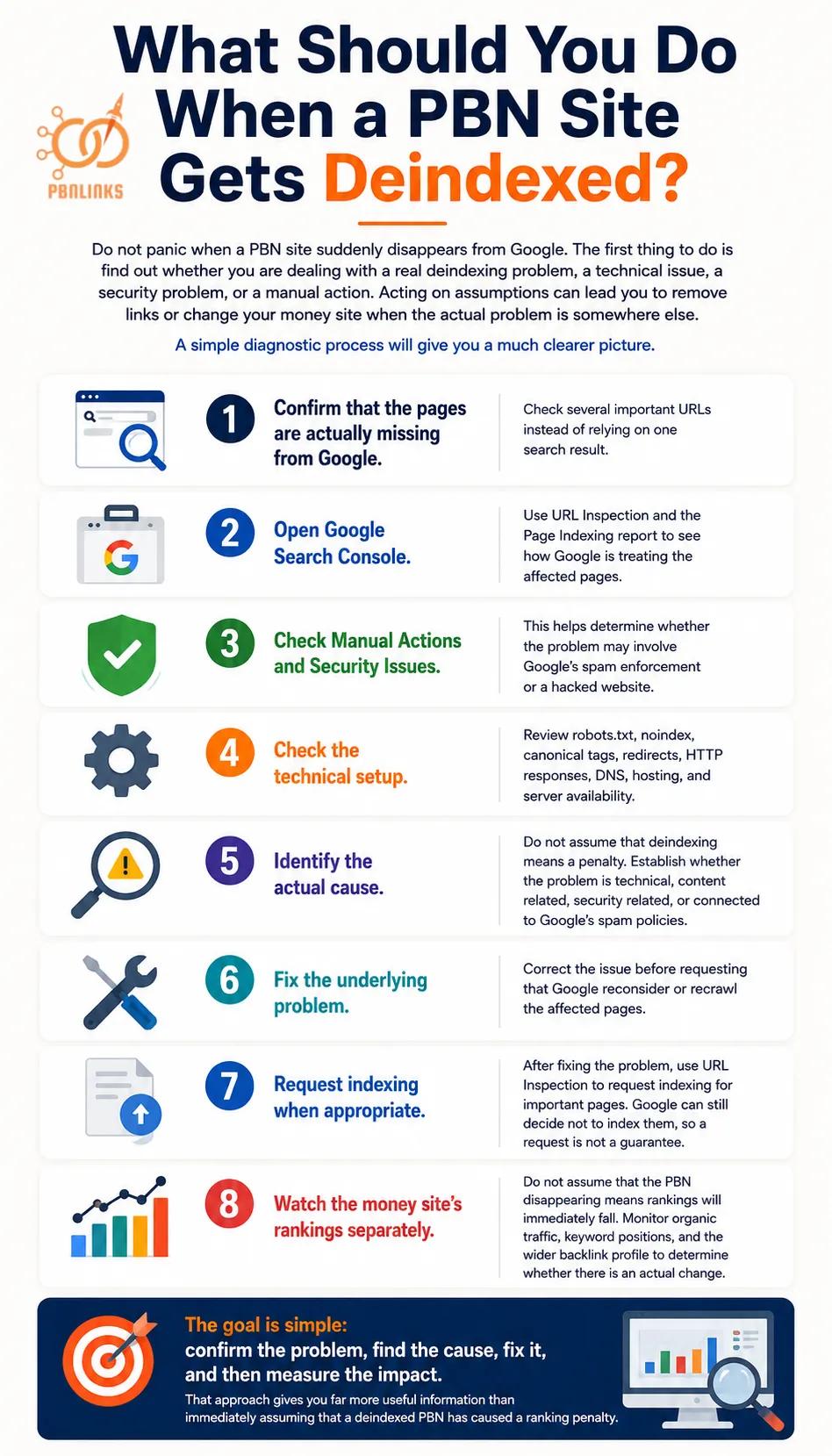
Do not panic when a PBN site suddenly disappears from Google. The first thing to do is find out whether you are dealing with a real deindexing problem, a technical issue, a security problem, or a manual action. Acting on assumptions can lead you to remove links or change your money site when the actual problem is somewhere else.
A simple diagnostic process will give you a much clearer picture.
1. Confirm that the pages are actually missing from Google.
Check several important URLs instead of relying on one search result.
2. Open Google Search Console.
Use URL Inspection and the Page Indexing report to see how Google is treating the affected pages.
3. Check Manual Actions and Security Issues.
This helps determine whether the problem may involve Google’s spam enforcement or a hacked website.
4. Check the technical setup.
Review robots.txt, noindex, canonical tags, redirects, HTTP responses, DNS, hosting, and server availability.
5. Identify the actual cause.
Do not assume that deindexing means a penalty. Establish whether the problem is technical, content related, security related, or connected to Google’s spam policies.
6. Fix the underlying problem.
Correct the issue before requesting that Google reconsider or recrawl the affected pages.
7. Request indexing when appropriate.
After fixing the problem, use URL Inspection to request indexing for important pages. Google can still decide not to index them, so a request is not a guarantee.
8. Watch the money site’s rankings separately.
Do not assume that the PBN disappearing means rankings will immediately fall. Monitor organic traffic, keyword positions, and the wider backlink profile to determine whether there is an actual change.
The goal is simple: confirm the problem, find the cause, fix it, and then measure the impact. That approach gives you far more useful information than immediately assuming that a deindexed PBN has caused a ranking penalty.
What Happens If a PBN Site Never Gets Reindexed?
Sometimes a deindexed PBN does not return to Google’s index. When that happens, the important question is no longer just whether the website can be recovered. You also need to consider what happens to the backlinks that were placed there and whether your money site’s rankings were relying on them.
A permanently absent PBN does not automatically mean your rankings will collapse. The impact depends on whether Google was using those links as ranking signals in the first place and how important they were compared with the rest of your backlink profile.
The Links May Remain Live but Lose Their SEO Importance
The website can remain accessible and the backlinks can remain on the pages even when Google no longer indexes those pages. However, a visible link is not proof that Google continues to use it as a ranking signal.
If Google no longer processes the source page or does not consider the links useful, their practical SEO value may be limited even though the links remain technically live.
The Impact Depends on Your Overall Backlink Profile
A site that has strong, relevant backlinks from many independent sources may notice little change when a PBN disappears.
A site that depends heavily on PBN links has more exposure. If Google stops assigning value to a significant portion of those links, rankings can weaken because fewer signals are supporting the affected pages.
This is why you should look at the whole backlink profile, not simply count the number of PBN links that have been lost.
Do Not Replace Lost Links Immediately Without Understanding the Cause
A common reaction is to replace every lost PBN link as quickly as possible. That can be the wrong approach.
First determine whether the original links were actually contributing to rankings and whether the ranking changes correspond with their disappearance. If Google was already ignoring those links, replacing them with more of the same type may not solve anything.
The better approach is to understand what changed, monitor the money site’s performance, and make decisions based on evidence rather than reacting to the deindexed domain alone.
How Can You Reduce the Risk of Losing Rankings From a Deindexed PBN?
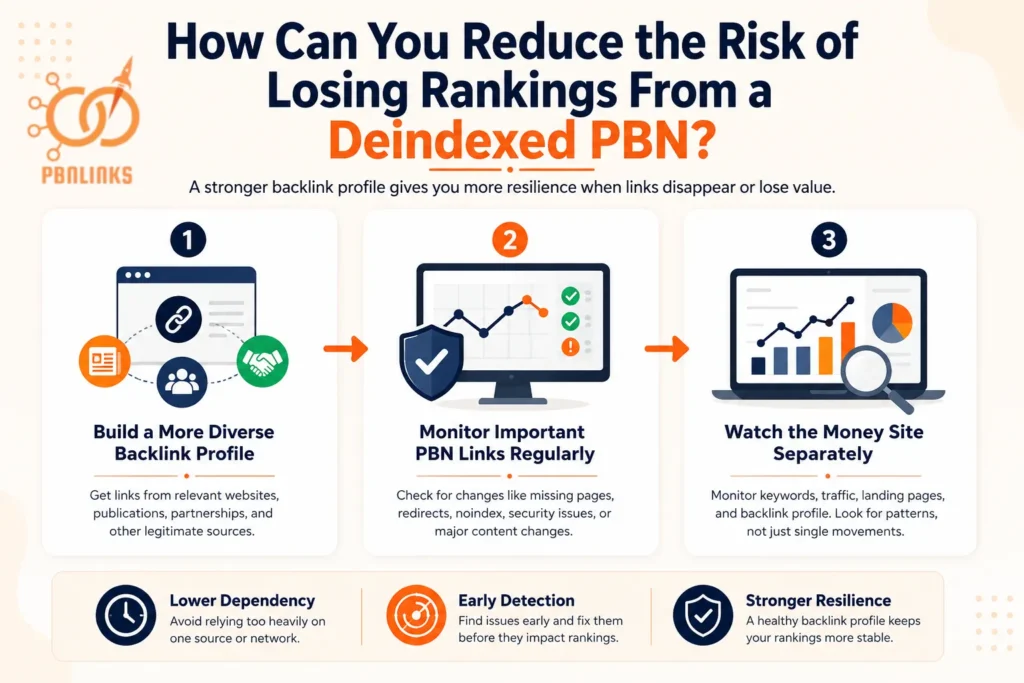
The safest approach is not to depend on a small group of PBN links to carry the entire ranking strategy. If losing a few links can cause a major drop, the bigger problem may be the overall backlink profile rather than the PBN itself.
A stronger profile gives you more resilience when individual links disappear, lose value, or stop being counted.
Build a More Diverse Backlink Profile
A backlink profile should not depend entirely on one type of link or one group of websites. Links from relevant publications, industry websites, partnerships, resources, and other legitimate sources can create a broader foundation.
This does not mean every backlink needs to be powerful. The goal is to avoid putting too much dependence on a single source or network.
Monitor Important PBN Links Regularly
Do not wait until rankings fall to discover that important PBN pages have disappeared. Periodically check the domains and URLs that are responsible for significant links.
Look for changes such as pages disappearing, domains becoming inaccessible, unexpected redirects, noindex directives, security problems, or major changes to the content.
Early detection gives you time to understand what changed before making decisions about the money site.
Watch the Money Site Separately
The PBN and the money site should be monitored as two separate problems. A PBN can lose visibility without causing an immediate ranking change, while rankings can also decline for reasons completely unrelated to the PBN.
Monitor important keywords, organic traffic, affected landing pages, and major changes in the backlink profile. Look for patterns rather than reacting to a single ranking movement.
Do Not Treat Every Lost Link as a Ranking Emergency
One lost PBN link does not automatically require a replacement. If the link was already providing little or no ranking value, replacing it may accomplish nothing.
The better question is whether the lost link was actually contributing to the rankings. Understanding that difference helps prevent unnecessary changes and keeps the focus on the signals that genuinely matter.
When Should You Worry About a Deindexed PBN?
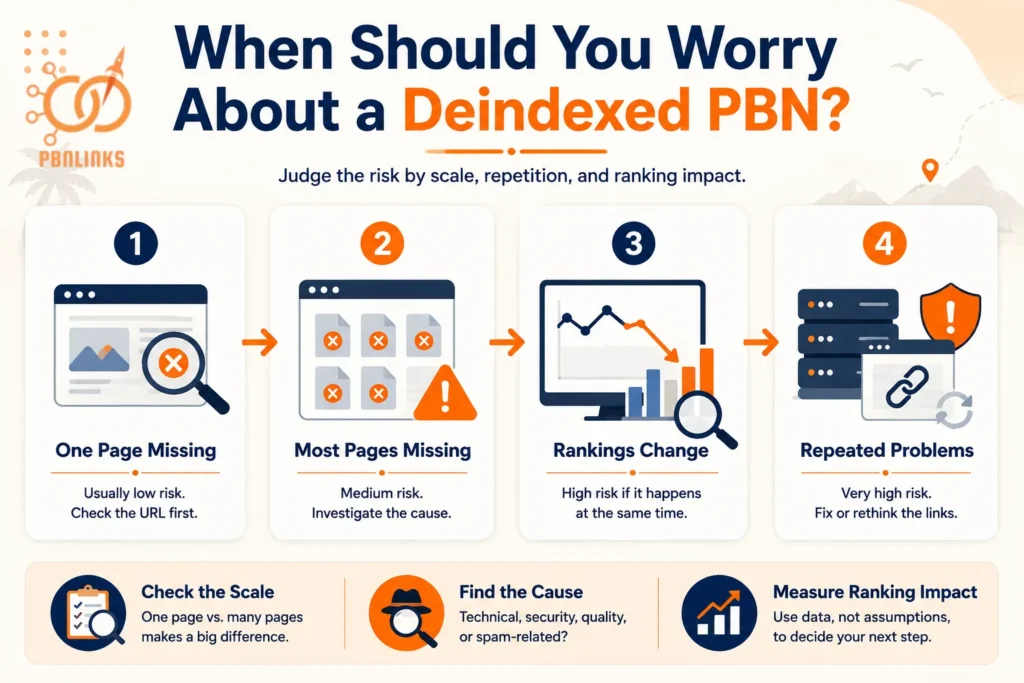
Not every deindexed PBN requires immediate action. One missing article or a temporary indexing problem is very different from an entire domain disappearing from Google after years of activity. The level of concern should depend on what disappeared, why it disappeared, and how important those links were to your rankings.
One Page Disappears
If only one article disappears while the rest of the PBN remains indexed and accessible, there is usually no reason to assume the entire domain has been penalized.
Check the affected URL first. Look for indexing restrictions, technical errors, content changes, redirects, or other issues that could explain why Google excluded that particular page.
Most of the PBN Disappears
The situation deserves more attention when many important pages disappear at the same time. A widespread change can point to a larger technical, security, quality, or spam related problem.
Check Search Console, server responses, crawling access, indexing directives, and the Manual actions and Security Issues reports before making conclusions.
Your Rankings Change at the Same Time
A ranking decline occurring around the same time as widespread PBN deindexing is worth investigating, especially if the affected money pages relied heavily on those links.
But timing alone does not prove that the PBN caused the decline. Compare ranking changes with Search Console data, other backlink changes, algorithm updates, content changes, and competitor movement before assigning a cause.
The PBN Has a History of Problems
Repeated deindexing, hacked content, unexplained redirects, frequent hosting failures, or large numbers of disappearing pages are stronger warning signs than a single isolated indexing issue.
At that point, the question should not simply be how to get the domain indexed again. You need to understand why the problems keep happening and whether the links from that domain should still be part of your SEO strategy.
The main rule is simple: do not panic over one missing page, but do not ignore a widespread or repeated pattern either. The scale, cause, and ranking impact determine how serious the situation really is.
Conclusion
in conclusion. A PBN site can disappear from Google’s index for many different reasons, and deindexing does not automatically mean that the domain received a penalty. Technical problems, thin content, hacked pages, crawling restrictions, and spam related issues can all lead to the same visible symptom.
What matters most is understanding what happened before judging the impact. A backlink can remain live after a PBN page is deindexed, but that does not guarantee Google is still giving the link ranking value. Likewise, a deindexed PBN does not mean rankings will immediately drop. The real impact depends on how Google treats those links and how much the money site relied on them.
The best approach is to confirm the indexing problem, identify its cause, check Search Console, monitor the affected backlinks, and compare any ranking changes against other SEO factors. A diverse backlink profile also reduces the risk of becoming overly dependent on a small number of PBN domains.
If you are reviewing your PBN network, start by checking which domains and links are still indexed, identify any deindexing or technical issues, and assess whether those links are actually contributing to your rankings before making changes.
FAQs About PBN Site Deindexed
1. What does it mean when a PBN site is deindexed?
A PBN site is deindexed when its pages are no longer included in Google’s search index. The website can still be live and accessible, but its pages may no longer appear in normal Google Search results.
2. Does a deindexed PBN mean Google penalized the site?
No, deindexing does not automatically mean a penalty. Technical problems, noindex directives, crawling restrictions, and other indexing issues can also prevent pages from appearing in Google.
3. What happens to PBN links after the site is deindexed?
The links can remain live on the webpages, but their continued existence does not prove that Google still uses them as ranking signals. The SEO value of a link cannot be determined simply by seeing that the link is still present.
4. Will my rankings drop if a PBN site is deindexed?
Not necessarily. Ranking changes depend on whether Google was using those links as ranking signals and how important they were to the site’s overall backlink profile. A deindexed PBN does not guarantee an immediate ranking loss.
5. How can I check if a PBN site is actually deindexed?
Use Google Search Console’s URL Inspection tool to check important URLs and the Page Indexing report to identify broader indexing patterns. These tools provide stronger evidence than relying only on Google searches or site: queries.
6. Can a PBN lose individual pages without losing the entire domain?
Yes. Google can exclude individual URLs while other pages on the same domain remain indexed. One missing article therefore does not prove that the entire PBN domain has been deindexed.
7. Why do PBN sites get deindexed?
Common causes include spam policy violations, manual actions, technical indexing problems, noindex directives, crawling restrictions, hacked content, and server or hosting problems. The actual cause needs to be verified before deciding that Google penalized the site.
8. Can a deindexed PBN site be reindexed?
Yes, sometimes. The underlying problem must first be fixed, after which you can use URL Inspection to request indexing. Google does not guarantee that a submitted URL will be indexed again.
9. Does reindexing a PBN restore the old value of its backlinks?
No guarantee exists. Getting a page back into Google’s index does not prove that Google will assign the same value to its backlinks as before. Indexing and link valuation are separate issues.
10. Should I replace backlinks from a deindexed PBN immediately?
No, not automatically. First determine why the PBN was deindexed and whether the affected links were actually contributing to rankings. Replacing links without understanding the cause can lead to unnecessary changes and may not improve performance.