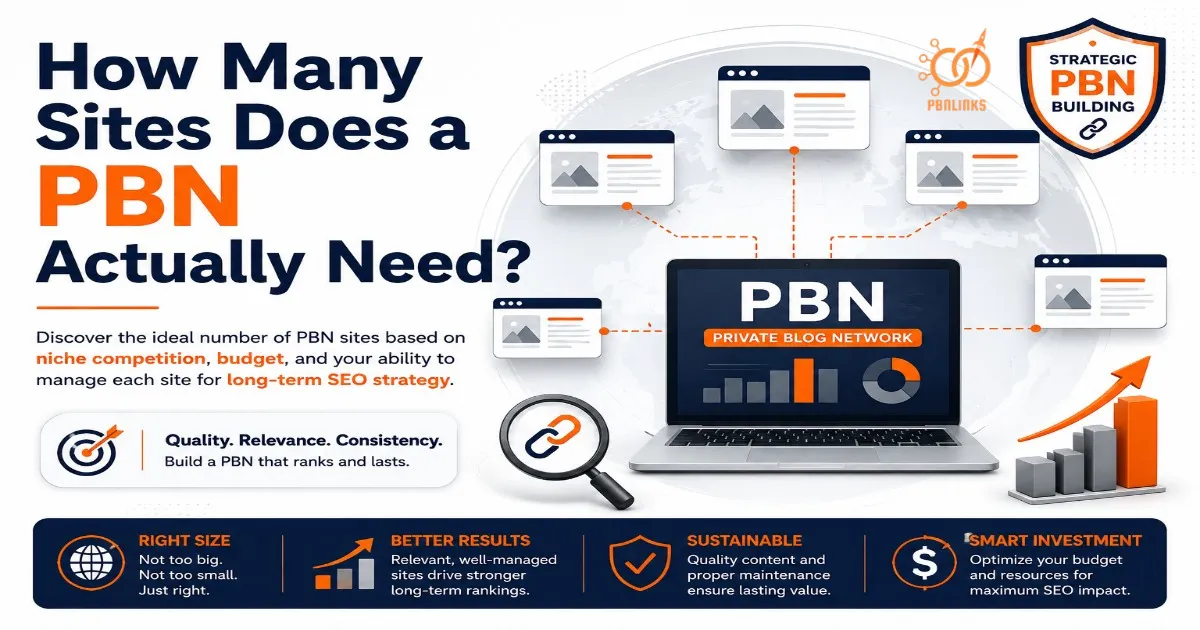
How Many Sites Does a PBN Actually Need?
Building a Private Blog Network (PBN) is about more than simply buying expired domains and creating backlinks. One of the first questions website owners ask is how many sites PBN needs to compete effectively in search results. The answer depends on your niche, competition, budget, and how well you can manage each website over time.
Before deciding on the size of your network, it’s important to understand that the number of PBN sites is different from the number of PBN links. This guide focuses on how many websites should be part of a Private Blog Network, while the number of backlinks required to rank is covered separately because it answers a different SEO question.
At PBNLinks.Agency, we believe that building a successful PBN is not about owning the largest network. A smaller group of relevant, well-maintained websites often delivers better long-term results than a large network that becomes difficult to manage or maintain consistently.
In this guide, you’ll learn how many sites a PBN needs, what influences the ideal network size, how niche competition affects your decision, the ongoing cost of managing additional websites, and how to determine the right network size for your long-term SEO strategy.
Does PBN Network Size Really Matter?
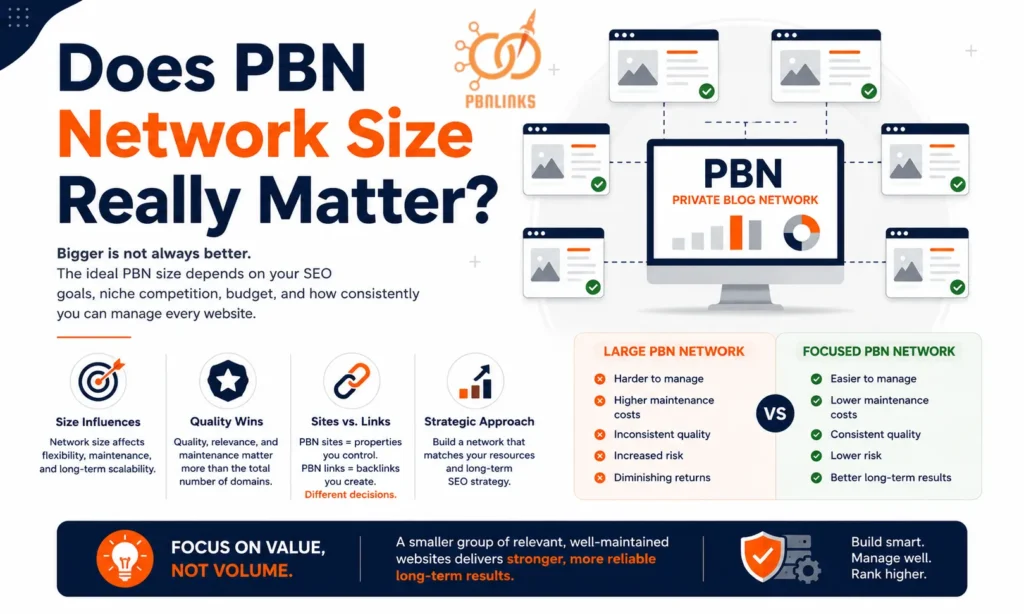
Yes, the size of a Private Blog Network can influence its flexibility, maintenance, and long-term scalability, but bigger does not always mean better. The ideal network size depends on your SEO goals, niche competition, available budget, and how consistently you can manage every website within the network.
Many people assume that adding more websites automatically creates a stronger PBN. In practice, the quality, topical relevance, and maintenance of each website usually have a greater impact than the total number of domains. A smaller network of well-maintained websites often delivers more reliable long-term value than a much larger network that becomes difficult to manage.
Another important distinction is the difference between PBN sites and PBN links. The number of websites in your network determines how many independent properties you control, while the number of backlinks depends on how those websites are used. These are separate SEO decisions and should not be treated as the same thing.
Rather than aiming for the largest possible network, focus on building a Private Blog Network that matches your resources and long-term strategy. The following sections explain the minimum number of websites most projects require, the factors that influence network size, and how to determine when expanding your network is no longer practical.
What Is the Minimum Number of Sites a PBN Needs?
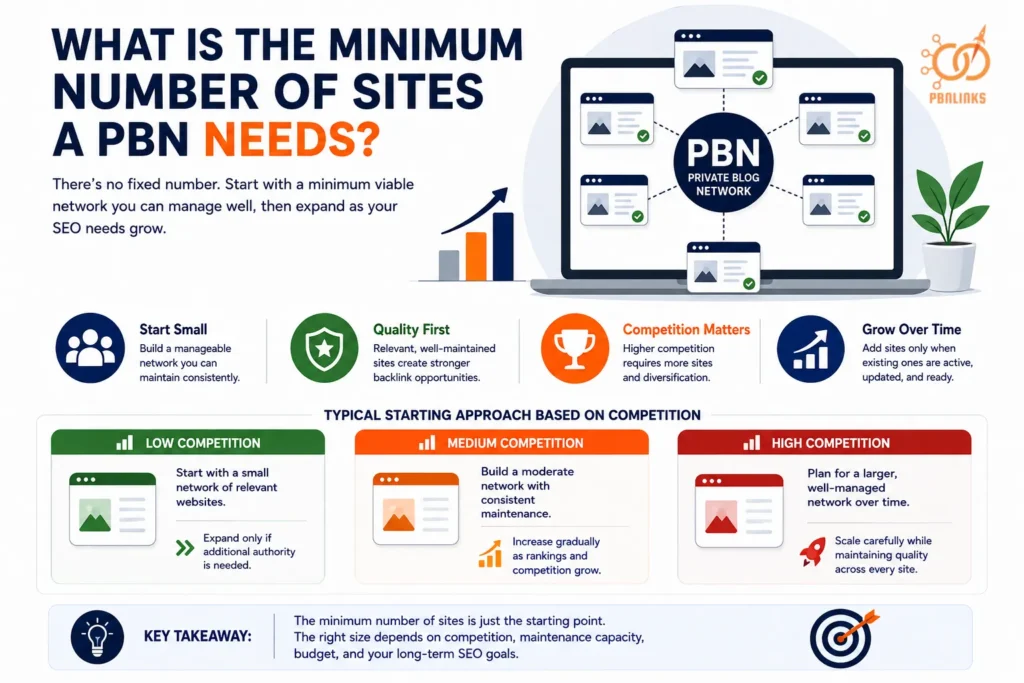
There is no single number of websites that every Private Blog Network should have, but most successful networks begin small and expand as SEO requirements grow. Rather than targeting a fixed number of domains, focus on building a minimum viable network that you can maintain consistently while supporting your backlink strategy.
A minimum viable network is the smallest group of high-quality, topically relevant websites that allows you to create natural backlink opportunities without sacrificing quality or maintenance. Building a manageable network first gives you time to evaluate domain quality, publish useful content, and establish consistent management before investing in additional websites.
The ideal number of sites also depends on the level of competition in your niche. Lower-competition projects generally require fewer supporting websites because they compete against fewer authoritative domains. As competition increases, website owners often expand their networks to create more opportunities for relevant backlinks and long-term growth. The goal is not to own the largest network, but to own enough well-maintained websites to support your SEO objectives.
Instead of deciding on a final network size from the beginning, treat your PBN as a project that grows over time. Add new websites only when your existing sites are active, regularly maintained, and capable of supporting additional expansion. This approach helps control costs, maintain quality, and prevent the network from becoming difficult to manage.
Typical Starting Approach Based on Competition
| Competition Level | Recommended Starting Approach | Expansion Strategy |
| Low Competition | Begin with a small network of relevant websites | Expand only if additional authority is needed |
| Medium Competition | Build a moderate network with consistent maintenance | Increase gradually as rankings and competition grow |
| High Competition | Plan for a larger, well-managed network over time | Scale carefully while maintaining quality across every website |
The minimum number of websites is only the starting point. Choosing the right network size also depends on factors such as niche competition, maintenance capacity, ownership costs, and long-term SEO goals. The next section explains how each of these factors influences how many sites a PBN needs.
How Does Niche Competition Affect PBN Network Size?
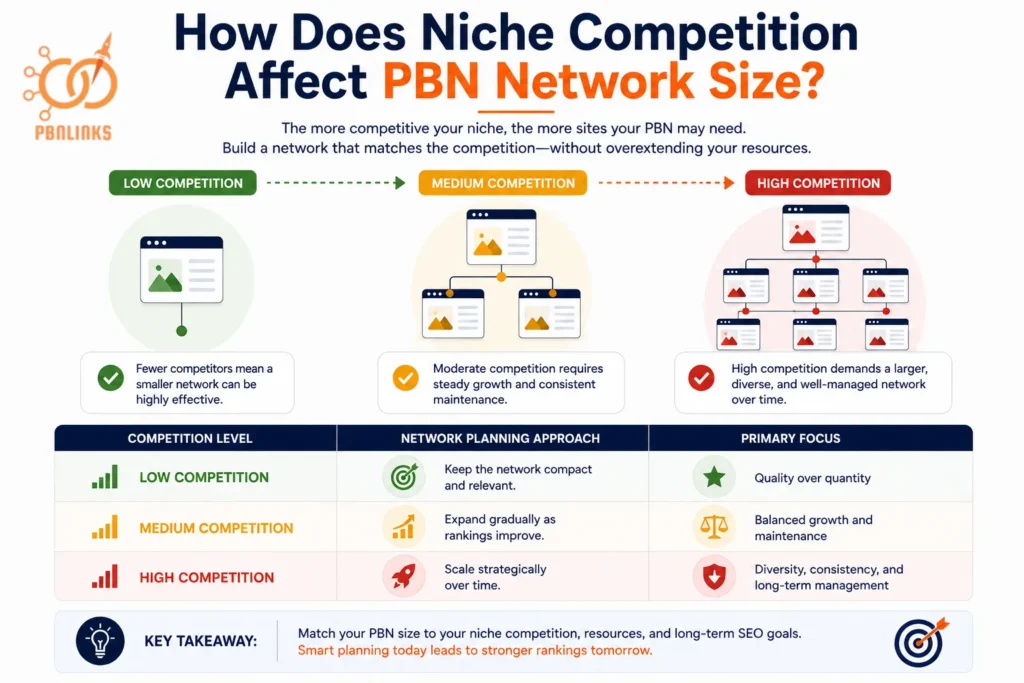
Niche competition is one of the biggest factors that determines how many sites a PBN needs. Websites competing in highly competitive industries often require a broader and more consistent backlink strategy than websites targeting low-competition keywords. As competition increases, website owners may need to expand their network to support long-term SEO growth.
In lower-competition niches, a smaller network of relevant, well-maintained websites is often sufficient because there are fewer authoritative competitors competing for the same search terms. Building additional websites too early may increase costs and management requirements without providing meaningful long-term benefits.
More competitive niches usually require a larger network because websites often compete against stronger backlink profiles, established brands, and authoritative domains. Expanding the network gradually creates more opportunities to publish relevant content, diversify backlink sources, and support multiple SEO campaigns while maintaining quality across every website.
Competition should never be the only factor when deciding network size. Budget, maintenance capacity, domain quality, and long-term SEO goals are equally important. The objective is to build a network that matches both the level of competition and your ability to manage every website effectively.
Typical Network Planning by Competition Level
| Competition Level | Network Planning Approach | Primary Focus |
| Low Competition | Keep the network compact and relevant | Quality over quantity |
| Medium Competition | Expand gradually as rankings improve | Balanced growth and maintenance |
| High Competition | Scale strategically over time | Diversity, consistency, and long-term management |
Niche competition helps determine how many sites a PBN needs, but it is only one part of the equation. The next section explains how ownership costs and ongoing maintenance influence the practical size of a Private Blog Network.
How Does the Cost of Each PBN Site Affect Your Network?
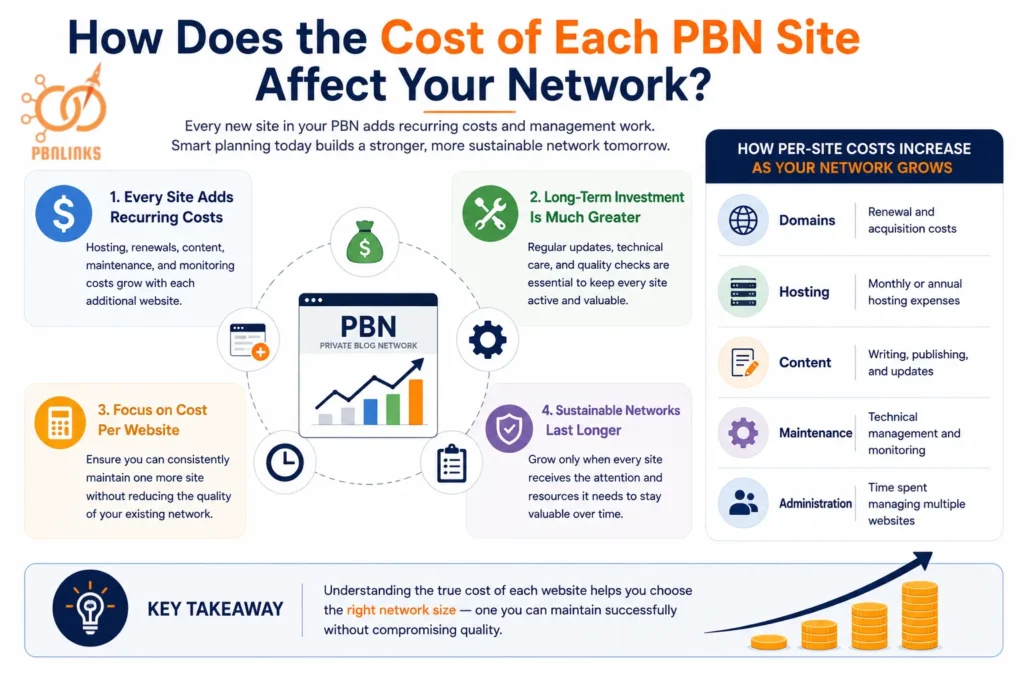
Every additional website in a Private Blog Network increases both your financial investment and your management responsibilities. As your network grows, each new domain adds recurring costs for hosting, renewals, content, maintenance, and monitoring. This is why network size should always be planned alongside your available resources.
Many website owners focus on the initial cost of buying expired domains, but the long-term investment is much greater. Every website needs regular content updatesquality management, technical maintenance, hosting, domain renewals, and periodic quality checks to remain active and useful. These ongoing responsibilities increase with every new website you add.
Thinking in terms of cost per website makes network planning more practical. Instead of asking whether you can afford fifty websites, ask whether you can consistently maintain one additional website without reducing the quality of the rest of your network. If the answer is no, expanding further is unlikely to improve your long-term SEO strategy.
A sustainable Private Blog Network is not built by owning the largest number of websites. It is built by expanding only when every existing website continues to receive the attention, maintenance, and resources needed to remain valuable over time.
How Per-Site Costs Increase as Your Network Grows
| As You Add More Sites | What Increases |
| Domains | Renewal and acquisition costs |
| Hosting | Monthly or annual hosting expenses |
| Content | Writing, publishing, and updates |
| Maintenance | Technical management and monitoring |
| Administration | Time spent managing multiple websites |
Understanding the cost of each website helps you determine a realistic network size. The next section explains when a Private Blog Network becomes difficult to maintain and how to recognize the point where adding more websites may no longer support your long-term SEO goals.
When Should You Stop Expanding Your PBN?
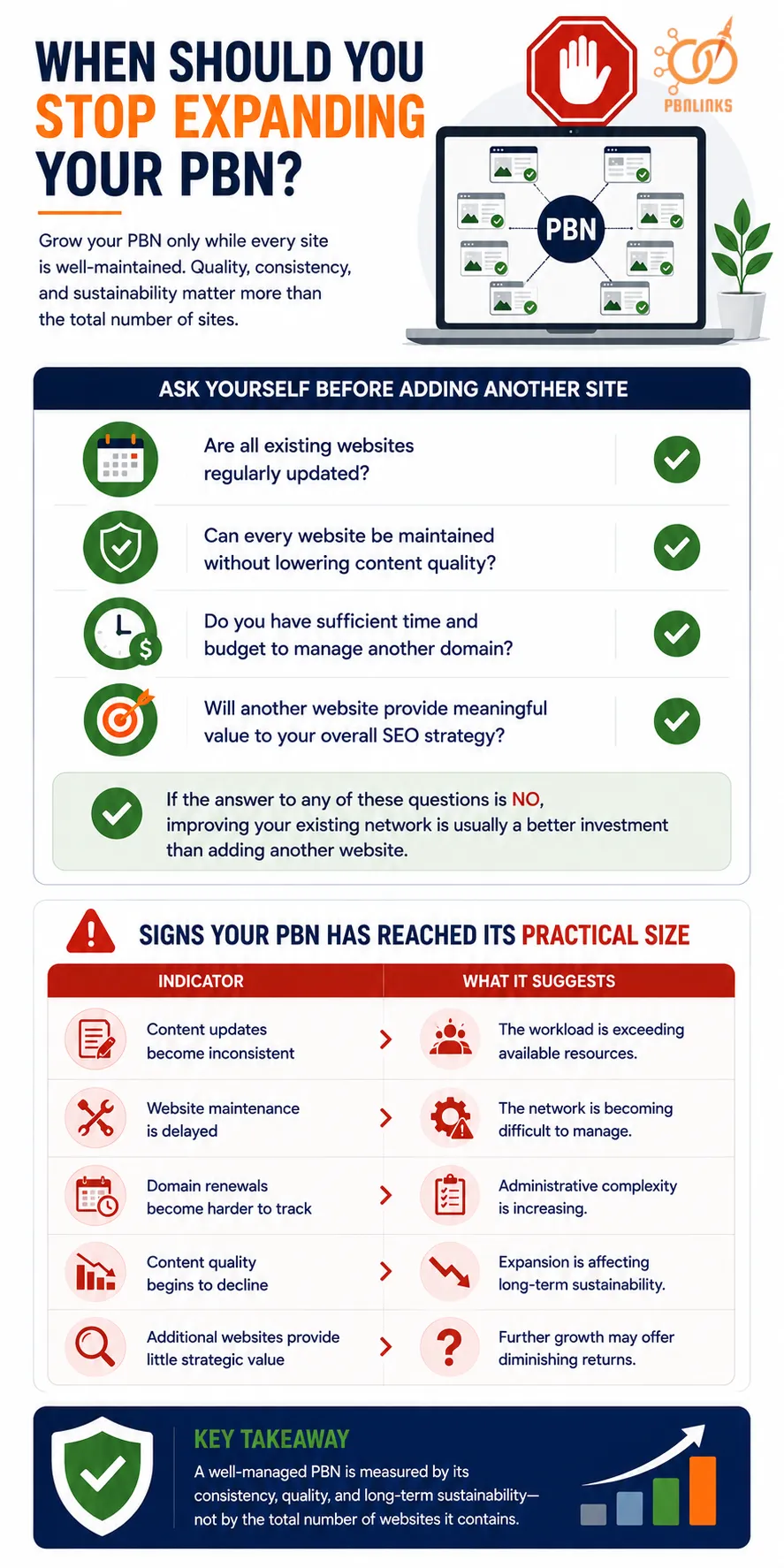
You should continue expanding a Private Blog Network only while every website can be maintained to the same standard of quality. When adding more websites begins to reduce content quality, increase management problems, or stretch your available resources, the network has likely reached its practical size.
A scalable PBN is not defined by the number of websites it contains. It is defined by how consistently those websites are maintained over time. Every additional domain increases the workload for content publishing, technical maintenance, hosting management, domain renewals, and quality monitoring. As these responsibilities grow, expanding further becomes less practical unless your resources also increase.
Before adding another website to your network, evaluate whether your existing websites are receiving regular updates, technical maintenance, and consistent quality control. Expanding before the current network is operating efficiently often creates unnecessary complexity rather than improving long-term SEO performance.
A practical way to evaluate network growth is to ask yourself these questions:
- Are all existing websites regularly updated?
- Can every website be maintained without lowering content quality?
- Do you have sufficient time and budget to manage another domain?
- Will another website provide meaningful value to your overall SEO strategy?
If the answer to any of these questions is no, improving your existing network is usually a better investment than adding another website.
Signs Your PBN Has Reached Its Practical Size
| Indicator | What It Suggests |
| Content updates become inconsistent | The workload is exceeding available resources |
| Website maintenance is delayed | The network is becoming difficult to manage |
| Domain renewals become harder to track | Administrative complexity is increasing |
| Content quality begins to decline | Expansion is affecting long-term sustainability |
| Additional websites provide little strategic value | Further growth may offer diminishing returns |
Knowing when to stop expanding is just as important as knowing when to grow. A well-managed Private Blog Network is measured by its consistency, quality, and long-term sustainability rather than the total number of websites it contains.
How Do You Determine the Right PBN Network Size?
The right PBN network size is determined by your SEO goals, niche competition, available resources, and your ability to maintain every website consistently. Instead of aiming for a specific number of websites, focus on building a network that remains relevant, manageable, and capable of supporting your long-term SEO strategy.
Start by defining what you want your Private Blog Network to achieve. A website targeting a small local market will usually have different network requirements than a project competing in a highly competitive national or international niche. Your network should be large enough to support your SEO objectives without becoming unnecessarily complex.
Next, evaluate whether you have the resources to expand. Every additional website increases the ongoing commitment to content creation, hosting, domain renewals, technical maintenance, and quality management. Expanding before your existing websites are fully maintained often creates more work than value.
Growth should always be gradual. Add new websites only when your current network is operating efficiently and every existing domain continues to receive regular updates and maintenance. Expanding at a sustainable pace helps preserve quality while making future growth easier to manage.
PBN Network Planning Checklist
Before adding another website to your network, ask yourself:
- Does my current network fully support my SEO goals?
- Are all existing websites regularly updated and maintained?
- Can I consistently manage another website without reducing quality?
- Do I have the budget and time to support another domain?
- Will another website add meaningful value to my overall SEO strategy?
If the answer to any of these questions is no, improving your existing network is usually a better investment than expanding it.
Network Size Decision Framework
| Consideration | Recommended Approach |
| SEO goals | Build a network that supports your target market and long-term objectives |
| Competition level | Increase network size gradually as competition becomes stronger |
| Available budget | Expand only when ongoing ownership costs remain manageable |
| Maintenance capacity | Grow only if every website can receive consistent attention |
| Long-term scalability | Prioritize sustainable growth over rapid expansion |
The ideal network size is not defined by reaching a specific number of websites. It is defined by building a Private Blog Network that remains relevant, well maintained, and capable of supporting your SEO strategy as your projects continue to grow.
Best Practices for Building the Right-Sized PBN Network
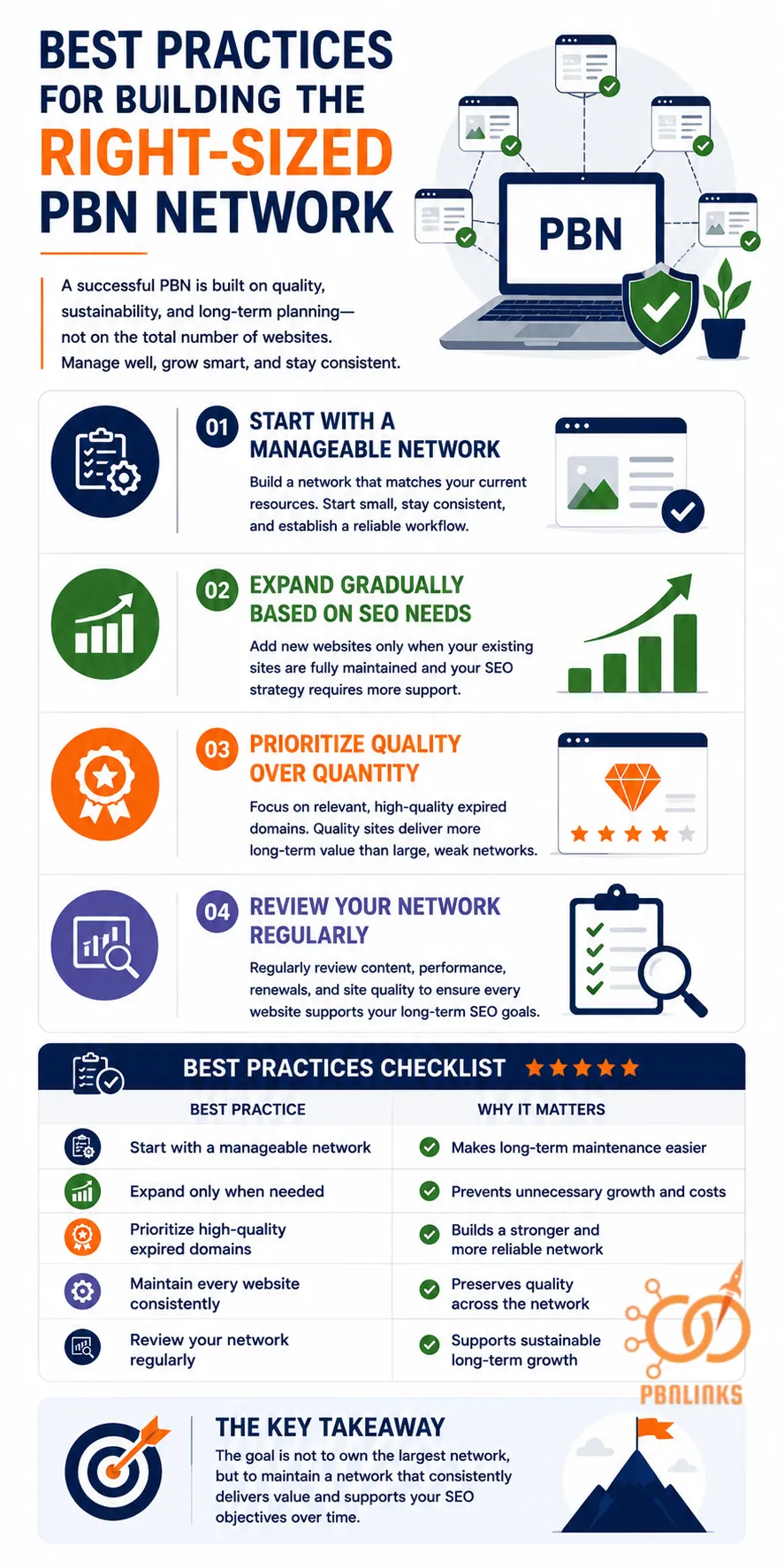
A successful Private Blog Network is built around quality, sustainability, and long-term planning rather than the total number of websites. Choosing the right network size is only the first step. Managing that network effectively is what determines whether it continues to support your SEO goals over time.
Start With a Manageable Network
Build a network that matches your current resources instead of aiming for a specific number of websites. Starting with a manageable network allows you to maintain consistent quality, monitor each website closely, and establish a reliable workflow before expanding further.
Expand Gradually Based on SEO Needs
Grow your network only when your existing websites are fully maintained and your SEO strategy requires additional websites. Expanding gradually helps control costs, maintain quality, and avoid creating unnecessary management challenges.
Prioritize Quality Over Quantity
Focus on acquiring relevant, high-quality expired domains instead of increasing the total number of websites. A well-maintained network with strong domains generally provides more long-term value than a much larger network containing low-quality or unrelated websites.
Review Your Network Regularly
Network planning should not end after the websites are built. Regularly review website quality, content updates, domain renewals, and overall performance to ensure every website continues supporting your long-term SEO strategy. Ongoing evaluation also helps identify when your network is ready for further expansion or when it is better to improve the existing websites instead.
Best Practices Checklist
| Best Practice | Why It Matters |
| Start with a manageable network | Makes long-term maintenance easier |
| Expand only when needed | Prevents unnecessary growth and costs |
| Prioritize high-quality expired domains | Builds a stronger and more reliable network |
| Maintain every website consistently | Preserves quality across the network |
| Review your network regularly | Supports sustainable long-term growth |
Following these best practices helps you build a Private Blog Network that remains practical, scalable, and aligned with your SEO objectives. The goal is not to own the largest network but to maintain a network that consistently delivers value while remaining manageable as your projects grow.
Common Mistakes When Deciding How Many Sites a PBN Needs
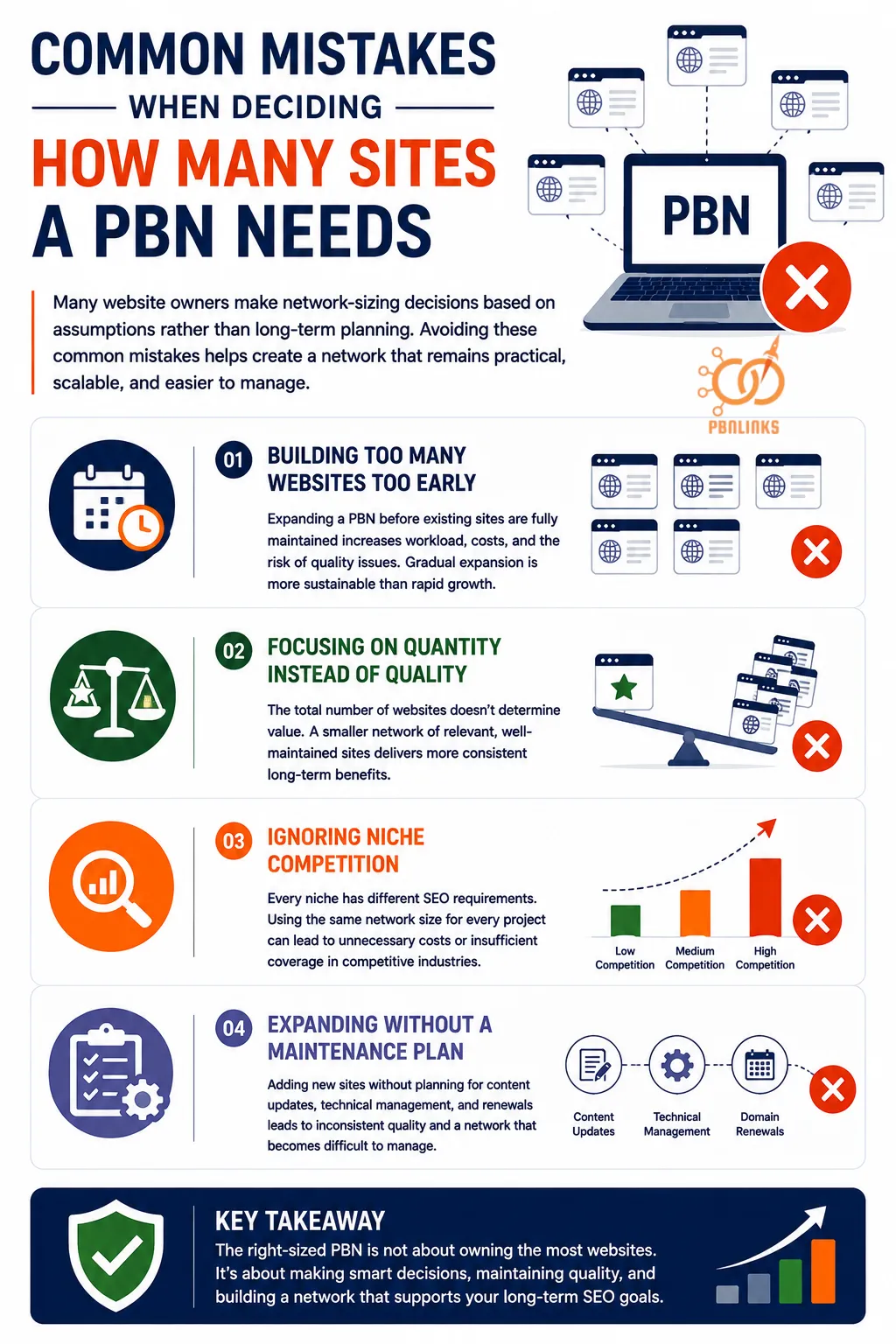
Many website owners make network-sizing decisions based on assumptions rather than long-term planning. Building too many or too few websites without considering competition, maintenance, and available resources can reduce the effectiveness of a Private Blog Network. Avoiding these common mistakes helps create a network that remains practical, scalable, and easier to manage.
Building Too Many Websites Too Early
One of the most common mistakes is expanding a PBN before the existing websites are fully maintained. Purchasing a large number of expired domains may seem like a faster way to grow, but every additional website increases the workload for content creation, hosting, maintenance, and quality control. Gradual expansion is usually more sustainable than rapid growth.
Focusing on Quantity Instead of Quality
The total number of websites in a network does not determine its overall value. A smaller network of relevant, well-maintained websites often provides more consistent long-term benefits than a much larger network containing neglected or low-quality domains.
Ignoring Niche Competition
Every niche has different SEO requirements. Using the same network size for every project can lead to unnecessary costs in low-competition markets or insufficient coverage in highly competitive industries. Network planning should always reflect the level of competition and the goals of the project.
Expanding Without a Maintenance Plan
A growing network requires a structured maintenance process. Adding new websites without planning for regular content updates, technical management, and domain renewals often results in inconsistent quality across the network. Long-term sustainability depends on maintaining every website, not simply increasing the number of domains.
Common Network Planning Mistakes
| Mistake | Better Approach |
| Expanding too quickly | Grow the network gradually |
| Prioritizing quantity | Focus on quality and relevance |
| Using the same network size for every niche | Adjust network size based on competition |
| Adding websites without a maintenance plan | Expand only when existing websites are fully managed |
Avoiding these mistakes creates a stronger foundation for long-term network growth. The next section explains the best practices for building a Private Blog Network that remains scalable, manageable, and aligned with your SEO objectives.
Conclusion
In conclusion, there is no fixed answer to how many sites a PBN needs because the ideal network size varies for every SEO project. The right number depends on your niche competition, SEO objectives, available budget, and your ability to maintain every website over time. A well-managed network of relevant, high-quality websites is generally more valuable than a much larger network that lacks consistency or proper maintenance.
Building a successful Private Blog Network should always be a gradual process rather than a race to acquire more domains. Start with a manageable network, expand only when your existing websites are fully maintained, and make every growth decision based on long-term sustainability instead of arbitrary numbers. This approach helps control costs, maintain quality, and create a stronger foundation for future SEO campaigns.
The most effective PBN is one that remains scalable, practical, and aligned with your long-term goals. Instead of focusing on the total number of websites, concentrate on building a network that consistently delivers value through quality domains, relevant content, and ongoing maintenance.
Ready to Build a Smarter PBN?
Whether you’re starting your first Private Blog Network or planning to scale an existing one, PBNLinks.Agency provides expert guidance, carefully vetted expired domains, and sustainable PBN solutions designed for long-term SEO success. Explore our services to build a high-quality, manageable network that supports your rankings with confidence.
FAQs About How Many Sites PBN Needs
How many sites does a PBN actually need?
There is no fixed number of websites that every Private Blog Network needs. The ideal network size depends on your SEO goals, niche competition, available budget, and your ability to maintain each website consistently over time.
What is a minimum viable PBN network?
A minimum viable PBN network is the smallest number of high-quality websites needed to support your SEO strategy effectively. It focuses on quality, topical relevance, and long-term management rather than owning a large number of domains.
Does a bigger PBN always improve rankings?
No, a larger PBN does not automatically improve rankings. A well-maintained network of relevant websites is generally more effective than a larger network with poor-quality domains or inconsistent maintenance.
How does niche competition affect PBN network size?
Higher competition often requires a larger and more diverse network. Competitive industries usually need broader backlink opportunities, while lower-competition niches can often succeed with a smaller, well-managed network.
Should beginners build a large PBN?
No, beginners should start with a manageable network. Expanding gradually allows you to maintain quality, learn effective management, and avoid unnecessary costs before adding more websites.
What happens if a PBN becomes too large?
A PBN can become difficult to manage if it grows faster than your available resources. Irregular content updates, delayed maintenance, and declining website quality are common signs that the network has expanded beyond a practical size.
How do I know when to expand my PBN?
Expand your PBN only when your existing websites are fully maintained and your SEO strategy requires additional websites. Growing gradually helps preserve quality while keeping the network sustainable.
Is quality more important than the number of PBN sites?
Yes, quality is generally more important than quantity. Relevant expired domains, useful content, and consistent maintenance usually provide more long-term SEO value than simply owning more websites.
Does every PBN website require ongoing maintenance?
Yes, every PBN website should be maintained regularly. Content updates, technical maintenance, domain renewals, and quality reviews help keep each website active and valuable over time.
Can the ideal PBN network size change over time?
Yes, the ideal network size can change as your SEO goals and competition evolve. Expanding gradually based on performance, available resources, and long-term strategy is more effective than targeting a fixed number of websites.