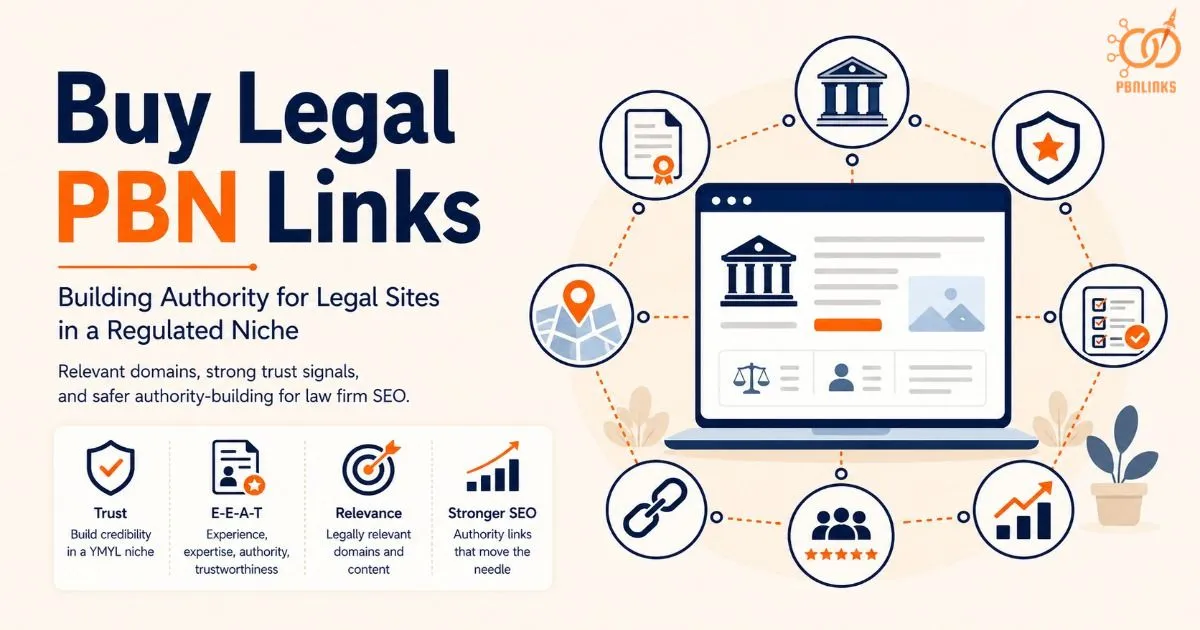
Buy Legal PBN Links: Building Authority for Legal Sites in a Regulated Niche
Building backlinks for a law firm is very different from building backlinks for an eCommerce store, SaaS company, or affiliate website. If you’re planning to buy legal PBN links, understanding this difference is essential. Legal websites belong to Google’s Your Money or Your Life (YMYL) category, where trust, credibility, and professional reputation influence rankings just as much as backlinks.
That doesn’t mean legal PBN links don’t work. They can strengthen authority when they’re used for the right content, supported by legally relevant domains, and combined with a broader SEO strategy. The mistake is expecting them to rank highly competitive practice area pages against established law firms that have spent years building reputation, authority, and trust.
The best opportunities usually come from local law firm pages, city-level service pages, and informational legal guides where independent firms have realistic ranking potential. Highly competitive practice area keywords rely on far more than backlinks, making topical relevance, E-E-A-T, and content quality equally important.
In this guide, you’ll learn where to buy legal PBN links, what types of legal content they can realistically support, how to evaluate trustworthy legal domains, manage anchor text responsibly, and build authority in a way that aligns with the expectations of one of Google’s most closely regulated industries.
Why Legal PBN Links Work Differently Than in Other Niches
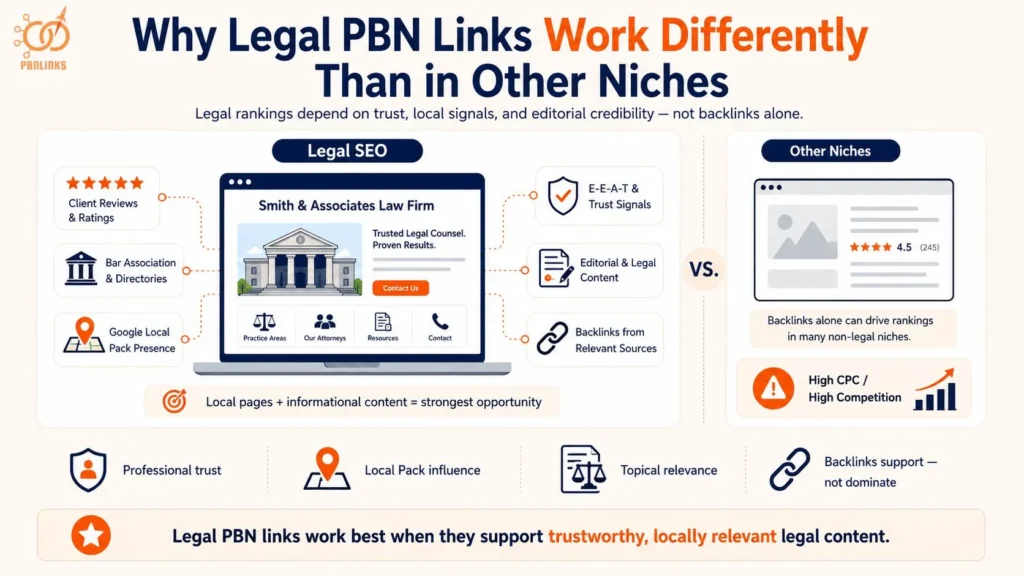
Legal PBN links work differently because legal search rankings depend on far more than backlinks. Established law firms earn trust through professional reputation, client reviews, bar association references, and years of legal credibility. That is why realistic content targeting matters more than simply building additional links.
Legal SEO is one of the most competitive industries in search. Practice areas such as personal injury often have cost-per-click (CPC) rates exceeding $150 in major markets, showing how heavily law firms invest in SEO, advertising, and long-term brand authority to win valuable clients.
Local trust also plays a major role in legal search. Around 42% of legal searchers click a result from Google’s Local Pack, making local law firm pages, Google Business Profile optimization, and city-level authority more realistic opportunities than competing for highly competitive national legal keywords.
For this reason, legal PBN links rarely rank competitive practice area pages on their own. They deliver the best results when they strengthen locally relevant and informational legal content supported by trustworthy domains, topical relevance, and genuine editorial quality rather than relying on backlink volume or high domain metrics alone.
Where to Buy Legal PBN Links and What Content They Can Rank
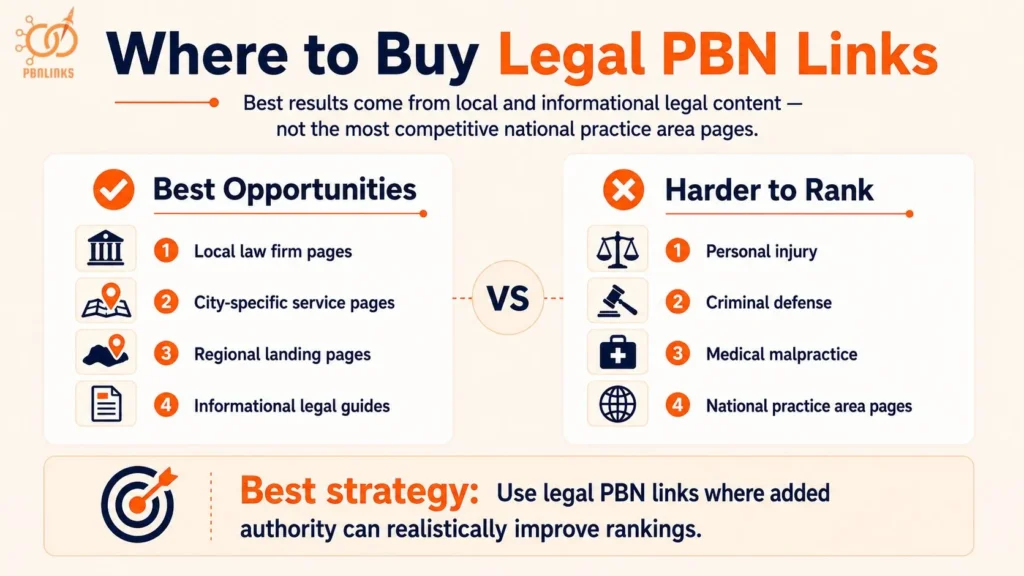
The best place to buy legal PBN links is for local law firm pages and informational legal content, where brand dominance is weaker and independently built websites can realistically compete. Highly competitive national practice area pages require far more than PBN links alone to achieve sustainable rankings.
Choosing the right content matters more than building additional backlinks. Legal search rankings depend on search intent, topical relevance, and professional trust, making realistic content selection far more valuable than simply targeting the most competitive legal keywords.
Understanding this difference helps you invest your link-building budget where legal PBN links can genuinely improve rankings. The sections below explain which content offers realistic opportunities and which requires broader authority signals to compete.
Local and Informational Legal Content
Local law firm pages and informational legal content provide the most realistic opportunities for legal PBN links. These search results often include solo practitioners, regional firms, legal directories, and independent publishers instead of being dominated entirely by nationally recognized law firms.
Legal content where PBN links deliver the strongest results:
- Local law firm pages
- City-specific service pages
- County and regional landing pages
- Informational legal guides
Examples of realistic ranking targets include:
- What to Do After a Car Accident
- How to File a Small Claims Case
- Understanding Your Tenant Rights
- How Probate Works
When these pages are supported by legally relevant domains, strong local citations, Google Business Profile optimization, and authoritative content, carefully placed PBN links can strengthen topical authority and improve organic visibility.
Why Competitive Practice Area Pages Are a Different Challenge
Personal injury, criminal defense, medical malpractice, and other high-value practice area pages compete in the most demanding legal search environments. These rankings are shaped by established law firms with years of professional reputation, bar association references, client reviews, recognized expertise, and long-term trust that extend far beyond backlink profiles.
| More Realistic Targets | Highly Competitive Targets |
| Local law firm pages | Personal injury |
| City-level service pages | Criminal defense |
| Informational legal guides | Medical malpractice |
| Regional legal resources | National practice area pages |
Legal PBN links rarely move these highly competitive practice area keywords on their own. The strongest campaigns focus on supporting pages where additional authority can realistically influence rankings instead of expecting backlinks alone to overcome years of established legal trust and brand authority.
E-E-A-T Signals a Legal PBN Site Needs to Pass Real Authority
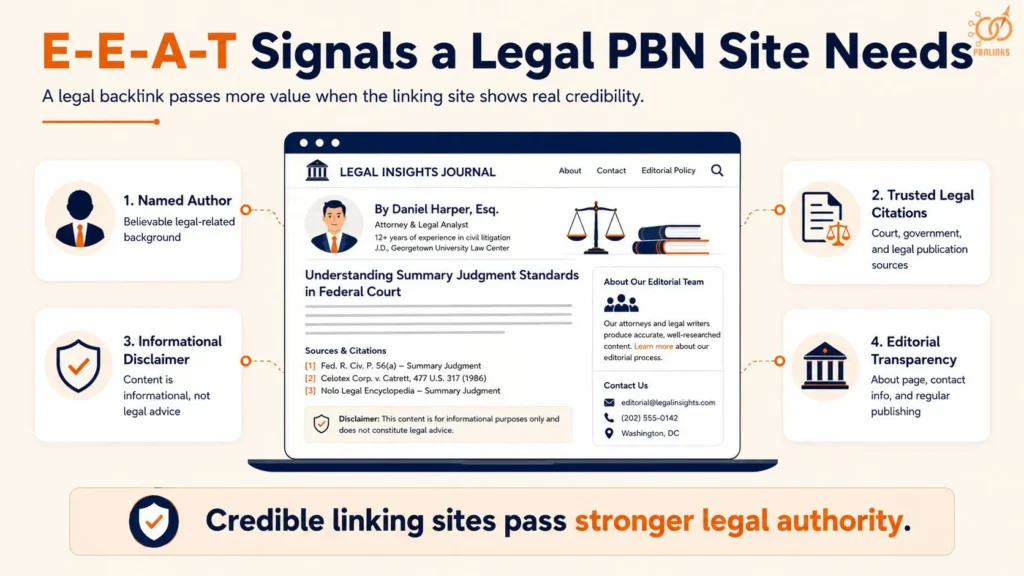
Most E-E-A-T advice focuses on the money site, but the linking PBN site also needs to demonstrate legal credibility. A backlink from a website with no identifiable expertise, editorial standards, or trustworthy legal content passes far less meaningful authority, regardless of the domain’s metrics.
Because legal websites operate in a YMYL niche, the credibility of the referring website matters as much as the backlink itself. Before buying legal PBN links, confirm the linking site demonstrates these essential trust signals:
- A named author with a believable legal-related background.
- Legal claims supported by credible sources such as court decisions, government legal resources, or established legal publications.
- A clear disclaimer stating the content is informational only and not legal advice.
- A genuine editorial identity with an About page, regular publishing, contact information, and content beyond backlink placement.
Author Credibility and Legal Citations
A legal PBN site should feature named authors whose background naturally fits legal publishing. Suitable profiles include paralegals, legal content writers, former law clerks, court reporters, and legal journalists. The goal is a believable editorial identity rather than claiming attorney-level authority.
Legal claims, statutes, and case references should always be supported by trustworthy sources such as government legal resources, court decisions, recognized legal publications, or established law reviews. These references strengthen factual accuracy and topical relevance while helping the linking site appear like a genuine legal publication. For detailed author profile recommendations, refer to the site’s dedicated PBN content strategy guide.
Disclaimers and Editorial Transparency
Articles discussing legal rights, legal procedures, or potential legal outcomes should include a clear disclaimer stating that the content is provided for informational purposes only and should not replace advice from a qualified legal professional.
The website should also operate like a legitimate legal publication rather than a site created only for backlinks. Regular publishing, a detailed About page, visible contact information, editorial policies, and supporting legal content all reinforce editorial credibility and help distinguish the site from a legal-themed link network.
Domain Selection for Legal PBN Links
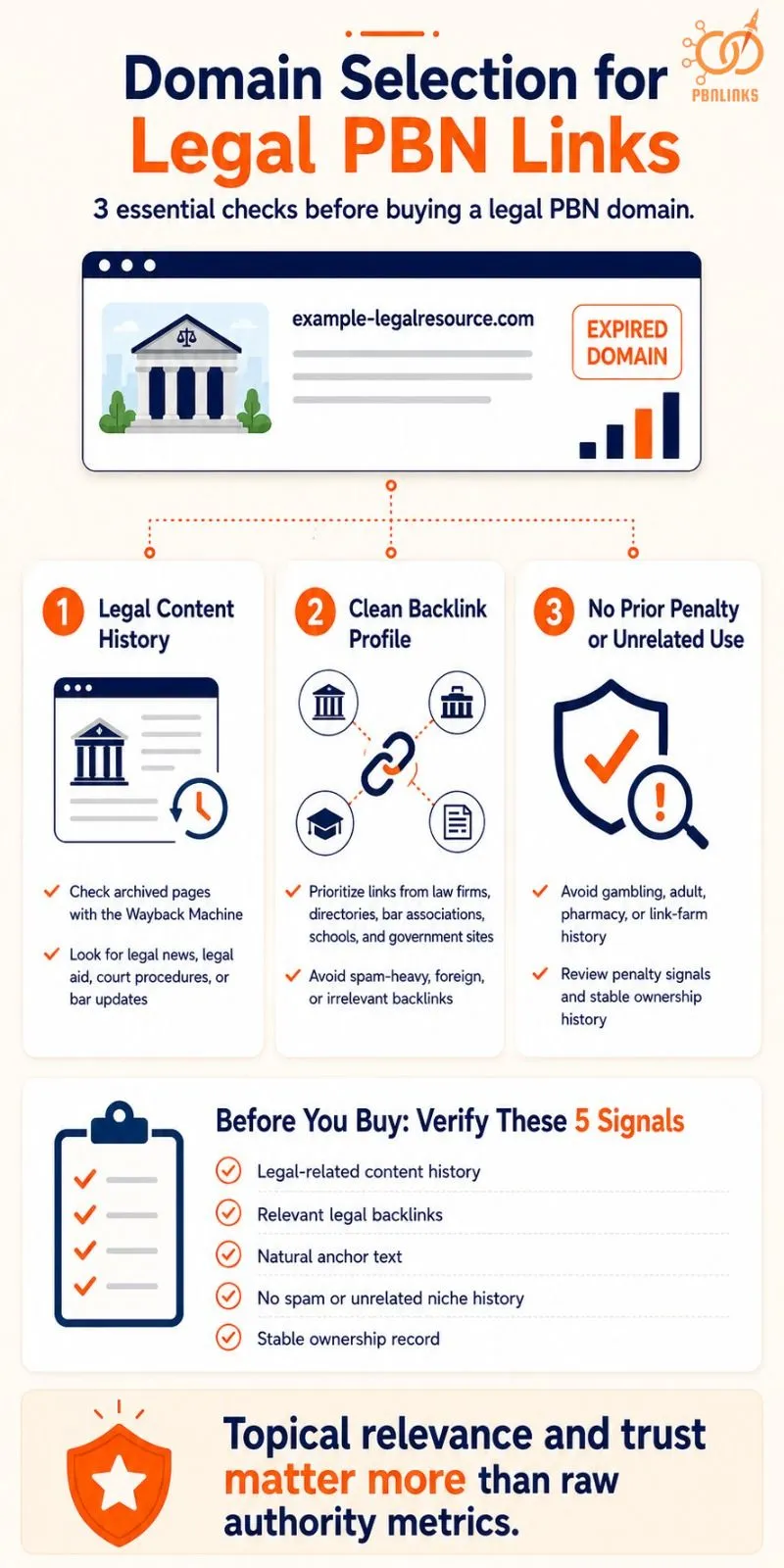
Legal PBN links require domains with a higher quality bar than general PBN domains because the linking website contributes part of the trust signal in a YMYL niche. Before buying a legal PBN domain, focus on three essential checks: previous legal content, a clean legal backlink profile, and a history free from penalties or unrelated use.
Strong legal domains are identified by topical relevance and trust rather than SEO metrics alone. Following a structured evaluation process helps separate genuinely authoritative legal domains from expired domains that only appear valuable because of their domain authority or traffic metrics.
Before buying a legal PBN domain, confirm the following:
- Previous legal or professional-services content verified with the Wayback Machine.
- Backlinks primarily from legal, educational, or professional-service websites.
- Natural anchor text with no spam or foreign-language patterns.
- No history of gambling, adult, pharmacy, or link-farm content.
- Stable ownership history with no repeated re-registrations.
Prior Legal-Adjacent Content History for PBN Domains
The domain should have a verifiable history of publishing legal, paralegal, law news, court reporting, legal aid, bar association, or other professional legal content. Use the Wayback Machine to confirm consistent topical relevance instead of relying only on current SEO metrics.
Look for articles covering court procedures, legal rights, law firm news, paralegal resources, or bar association updates. A domain previously focused on tenant rights or court procedures carries stronger topical relevance than one that previously covered travel or food. Once content history is confirmed, review the backlink profile before making a purchase. You can also explore our pricing page to understand the standards behind professionally vetted legal PBN domains.
A Clean Backlink Profile From Legal Sources
A legal PBN domain should earn backlinks from topically relevant legal or professional-service websites rather than unrelated directories, foreign forums, or spam-heavy sources. Review the domain in Ahrefs or Majestic to evaluate referring domains, anchor text history, and overall topical consistency.
Prioritize backlinks from law firms, legal directories, bar associations, government websites, law schools, and legal news publications. Avoid domains dominated by spam anchors, foreign-language links, forum signatures, blog comments, or automated directories. After confirming backlink quality, the final step is reviewing the domain’s historical reputation.
No Prior Penalty or Unrelated Use History
A domain’s previous use remains part of its history even after ownership changes. Domains previously used for gambling, adult content, pharmacy websites, or large-scale link schemes may continue carrying negative trust signals despite appearing clean today.
Search the domain alongside terms such as “penalty,” “deindexed,” or “manual action,” then review its WHOIS ownership history for repeated re-registrations. Frequent ownership changes often indicate previous abuse, making the domain a higher-risk choice for legal PBN links. Selecting domains with a clean history helps preserve trust and supports stronger long-term SEO performance.
Anchor Text Risk for Legal PBN Links
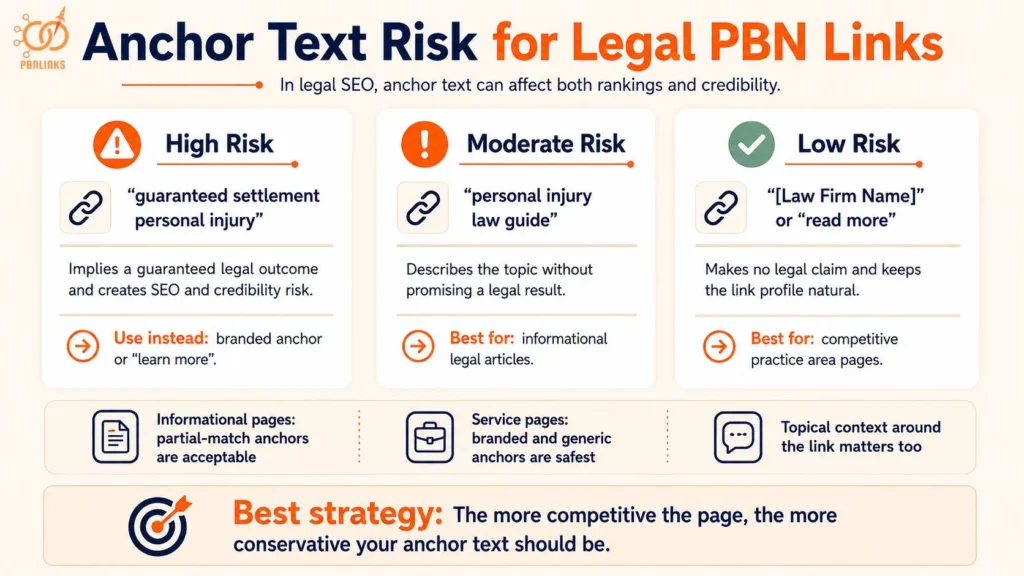
Anchor text carries greater risk in legal SEO because it can act as both an optimization signal and an implied legal claim. The moment an anchor suggests a guaranteed outcome, a specific legal result, or legal advice, it creates both SEO and credibility risks.
Choosing the right anchor depends on the type of content being supported. Informational legal content allows more descriptive anchors, while competitive practice area pages require a far more conservative approach to avoid unnecessary optimization footprints.
| Risk Level | Anchor Example | Why It’s Risky | Safer Alternative |
| High | “guaranteed settlement personal injury” | Implies a guaranteed legal outcome and functions as an unverified legal claim. | Use a branded anchor or a generic phrase such as “[Law Firm Name]” or “learn more.” |
| Moderate | “personal injury law guide” | Describes the topic without promising a legal result, making it suitable for informational content. | Use on educational articles rather than commercial service pages. |
| Low | “[Law Firm Name]” or “read more” | Makes no legal claim and creates a natural backlink profile. | Recommended for competitive practice area pages. |
Anchor text should always match the content being promoted. Informational legal articles can naturally use partial-match anchors such as “tenant rights guide” or “understanding tenant rights” because they describe the topic rather than promise a legal outcome. Search engines also evaluate the surrounding context, making topical relevance just as important as the anchor text itself.
For personal injury, criminal defense, and other competitive service pages, branded and generic anchors remain the safest choice. When combined with realistic content targeting and a Tier 2 linking strategy, conservative anchor selection helps build authority while reducing unnecessary risk across a legal backlink profile.
How PBN Links Support Legal Authority Without Targeting Money Pages
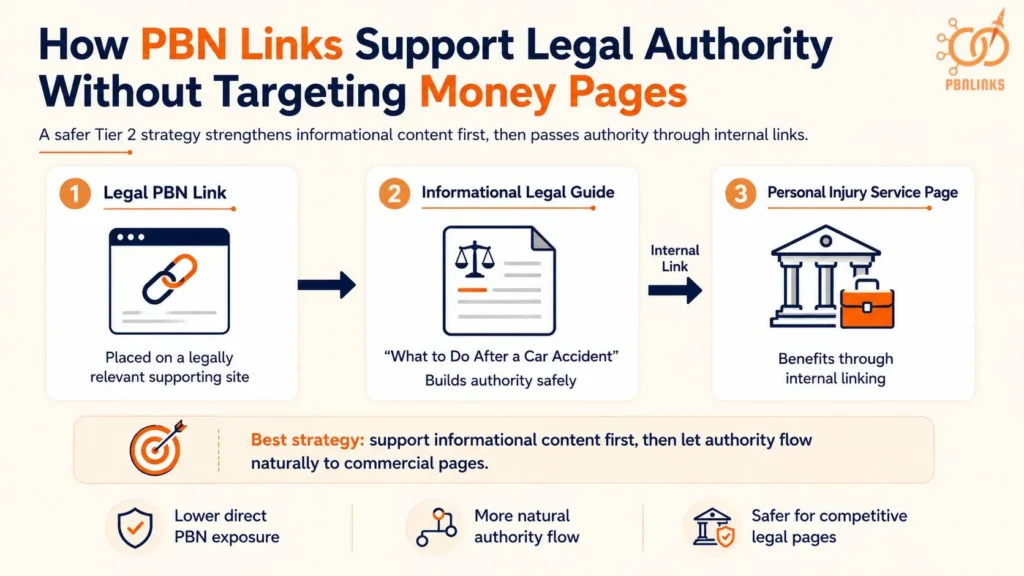
Pointing legal PBN links directly at competitive practice area pages creates the highest level of risk with the lowest realistic ranking return. A safer strategy is to strengthen informational legal content that already supports commercial pages, allowing authority to flow naturally through internal links rather than exposing money pages to direct PBN backlinks.
In simple terms, Tier 1 links point directly to important pages on your website, such as service pages, legal directory listings, guest posts, or bar association mentions. Tier 2 links strengthen those Tier 1 assets instead of linking directly to money pages. This approach increases the authority of supporting content while reducing direct PBN exposure. For a complete explanation, see our Tiered Link Building guide.
For example, imagine an article titled “What to Do After a Car Accident.” A legal PBN link points to that guide, and the guide internally links to a personal injury service page. The informational article gains authority first, allowing some of that value to pass naturally to the service page without placing a direct PBN backlink in its external link profile.
This structure is particularly valuable in legal SEO because practice area pages compete against firms with years of professional reputation, legal citations, client reviews, and established topical authority. Supporting those pages through trusted informational content creates a more natural authority flow while reducing unnecessary risk on the website’s most commercially important pages.
Why Legal PBN Links Cost More
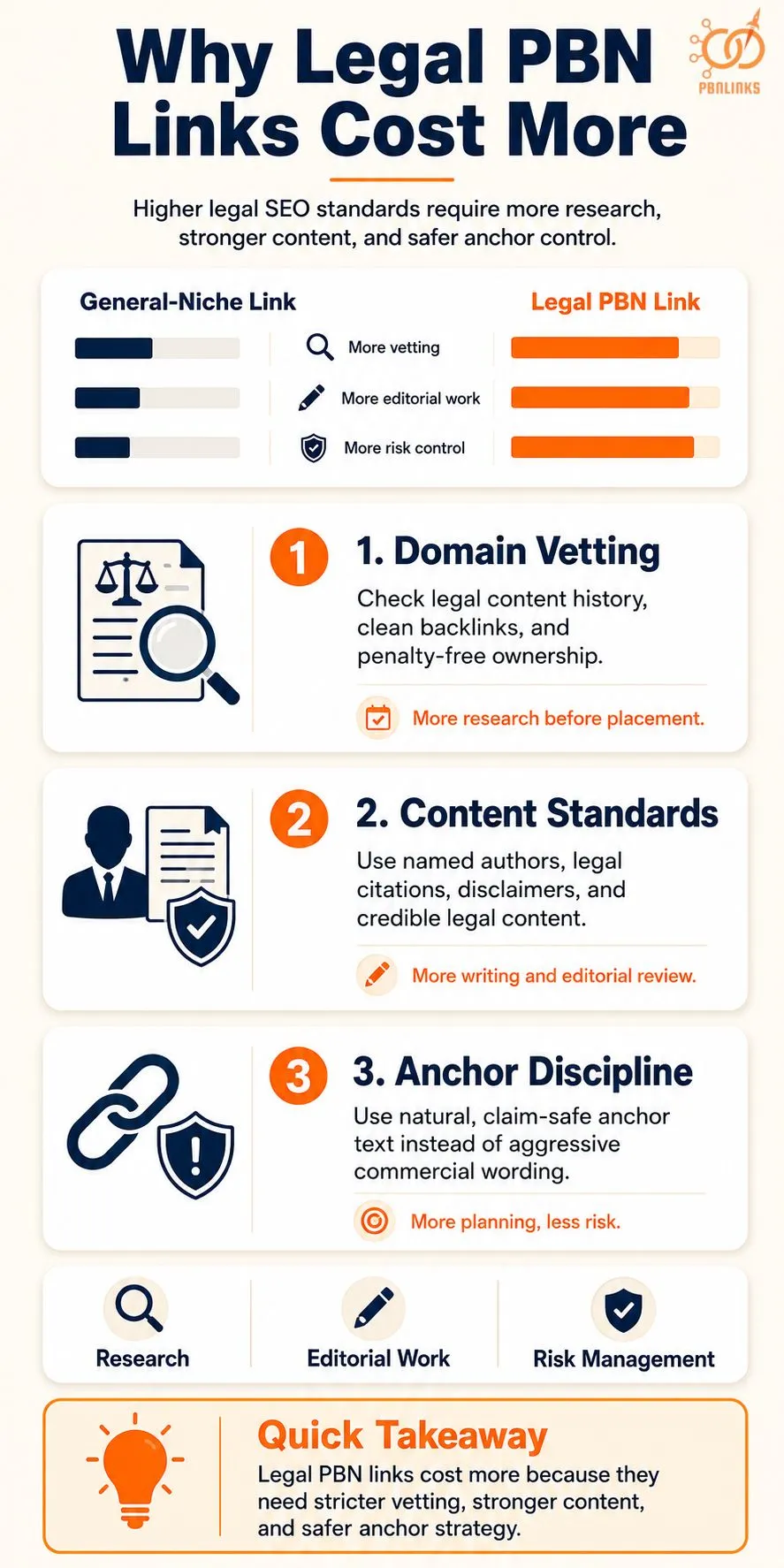
Legal PBN links cost more than general-niche links because every stage of building them requires a higher standard. The domain vetting, named-author content, and conservative anchor strategy required for legal SEO demand more time, research, and editorial oversight than a general PBN network.
The higher price reflects measurable work rather than arbitrary pricing. Every premium legal PBN link is built around three quality requirements already covered in this guide:
- Domain Vetting — Verifying legal content history, backlink quality, and penalty-free ownership.
- Content Standards — Creating credible legal content with named authors, citations, and disclaimers.
- Anchor Discipline — Using natural, claim-safe anchor text that minimizes SEO and legal risk.
Domain Vetting
Legal PBN domains require much stricter evaluation than general expired domains. As covered in the Domain Selection section, each domain must have relevant legal content history, a clean backlink profile, and no record of penalties or unrelated previous use.
Finding domains that satisfy all three requirements takes considerable research because many candidates fail one or more checks. That additional verification increases acquisition costs before a single backlink is ever placed.
Content Standards
Legal content must meet higher editorial standards before it can pass meaningful authority. As explained in the E-E-A-T Signals section, every site needs believable legal authors, credible legal citations, clear disclaimers, and content that reflects genuine legal expertise.
Producing this level of content requires experienced writers, careful editing, and citation verification. Those additional editorial steps increase costs while strengthening the credibility and trustworthiness of the linking site.
Anchor Discipline
Legal anchor text requires greater caution because it can influence both SEO quality and perceived legal claims. As covered in the Anchor Text Risk section, providers avoid aggressive commercial anchors and instead use conservative, claim-safe wording throughout the backlink profile.
Maintaining a natural anchor profile requires continuous planning and editorial oversight rather than repeating commercial keywords. That extra effort reduces unnecessary risk while supporting a stronger and more sustainable legal PBN strategy.
Together, these three quality standards explain why legal PBN links cost more than general-niche links. The higher price reflects the additional research, editorial work, and risk management required to build links that align with the expectations of a regulated legal niche.
Common Mistakes When Using PBN Links for Legal Sites
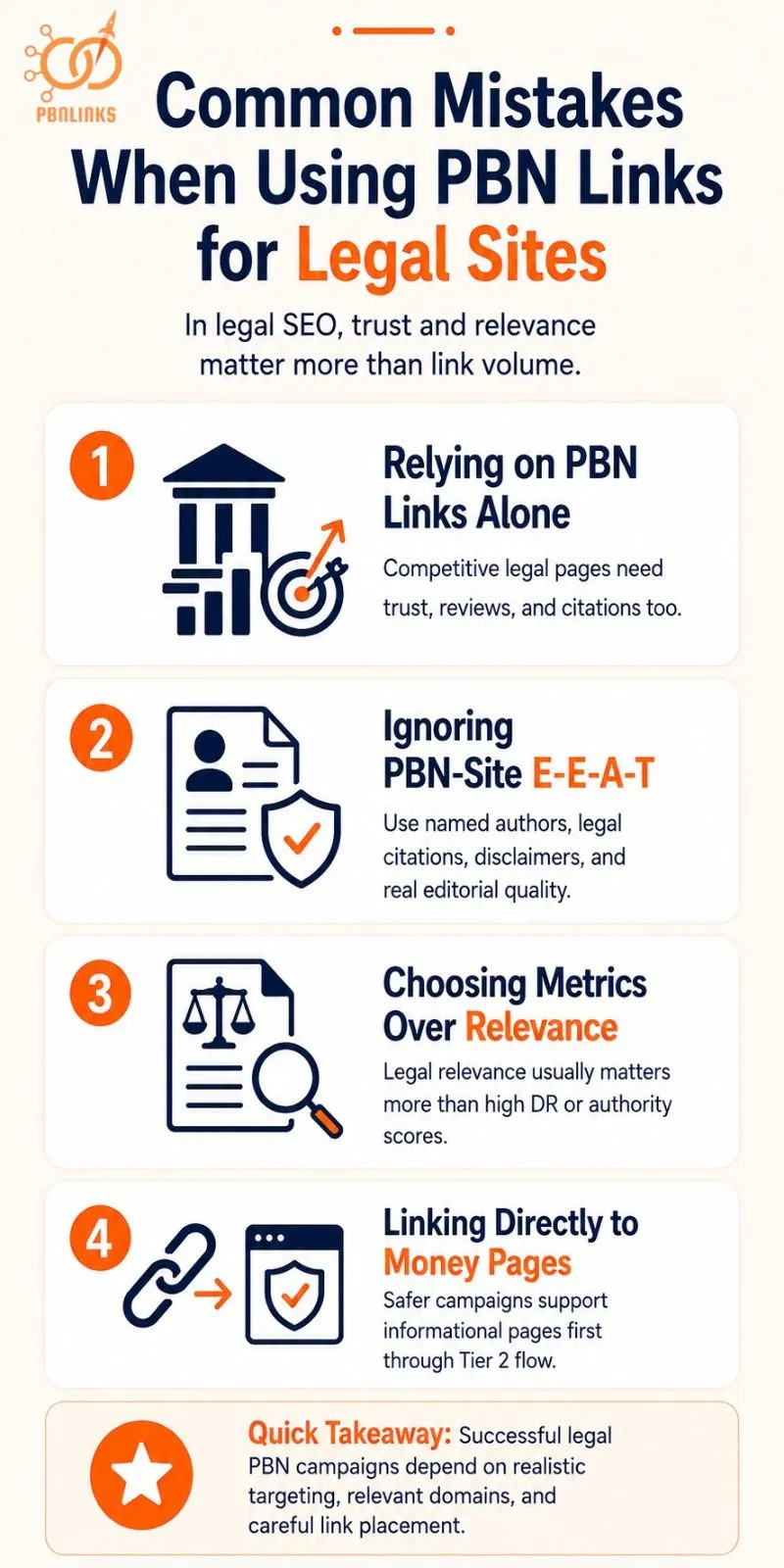
Using legal PBN links successfully depends more on correct targeting than link volume. Most mistakes happen when law firms and SEO professionals apply general link-building strategies to legal websites without considering the higher trust standards, topical relevance, and credibility required in this YMYL niche.
Mistake 1: Expecting PBN Links Alone to Rank Competitive Practice Area Pages
Many campaigns fail because they rely solely on PBN links to rank highly competitive keywords such as personal injury or criminal defense.
These search results are driven by years of professional reputation, legal citations, client reviews, and institutional trust. PBN links can strengthen authority, but they rarely move these competitive pages on their own.
Mistake 2: Ignoring PBN-Site E-E-A-T
Another common mistake is focusing only on the money site while overlooking the credibility of the PBN site providing the backlink.
A legal PBN site should include named authors, credible legal citations, clear disclaimers, and genuine editorial quality. Strong E-E-A-T on the linking site makes backlinks appear more trustworthy and topically relevant.
Mistake 3: Choosing Domains by Metrics Alone Instead of Legal Relevance
High Domain Rating or Authority Score should never be the only reason to purchase a legal PBN domain.
Domains with a verified history of legal or professional-services content and relevant backlinks usually pass stronger topical authority than higher-metric domains from unrelated industries. In legal SEO, relevance consistently matters more than metrics alone.
Mistake 4: Pointing PBN Links Directly at Competitive Money Pages
Sending PBN links directly to competitive service pages increases risk while offering limited long-term value.
A safer strategy is to support informational content through a Tier 2 structure before authority flows to money pages. This approach reduces direct PBN exposure while strengthening the site’s overall topical authority.
The key takeaway is simple: Successful legal PBN campaigns are built on realistic targeting, trustworthy domains, credible linking sites, and careful link placement—not simply acquiring more backlinks.
In Conclusion
In conclusion, legal PBN links can strengthen authority when they are used strategically for local law firm pages and informational legal content rather than relying on them to rank highly competitive practice area pages. Success depends on choosing legally relevant domains, maintaining strong editorial and E-E-A-T signals, using conservative anchor text, and following a realistic Tier 2 linking strategy.
The higher cost of legal PBN links reflects the additional work required to meet the quality standards of a YMYL niche, including domain vetting, credible content, and careful link placement. When every part of the strategy is aligned, legal PBN links can support long-term SEO growth while reducing unnecessary risk.
If you want legal PBN links built with strict quality standards and a long-term SEO approach, pbnlinks.agency can help. Visit pbnlinks.agency to explore legal-focused PBN solutions designed to support sustainable authority and rankings.
FAQs About Buy Legal PBN Links
Do PBN links work for legal websites?
If you plan to buy legal PBN links, they work best for local law firm pages, city-level service pages, and informational legal guides where smaller firms can realistically compete. Competitive practice area pages usually require a broader SEO strategy because PBN links alone rarely provide enough authority.
Why don’t PBN links work for competitive legal keywords?
Competitive legal keywords are dominated by established law firms with years of professional reputation, bar association mentions, authoritative backlinks, and strong brand recognition. While legal PBN links can strengthen supporting content, they rarely outperform these long-established trust signals on their own.
What legal content can PBN links realistically support?
Local law firm pages, city-specific service pages, and informational legal guides are the most effective targets for legal PBN links. Topics such as tenant rights, small claims procedures, or what to do after a car accident offer more realistic ranking opportunities than highly competitive practice area pages.
Why do legal PBN links cost more than other niches?
Legal PBN links require stricter domain vetting, legally relevant content, credible author profiles, trustworthy citations, and conservative anchor text strategies. The higher price reflects the additional work needed to meet legal SEO standards rather than an artificial markup.
What is the difference between legal PBN links and health PBN links?
Both legal and health websites belong to YMYL niches and require strong E-E-A-T signals. The difference is that legal rankings rely heavily on professional reputation, institutional trust, and legal authority, while health rankings place greater emphasis on medical expertise and clinical accuracy.
Can a PBN link hurt a law firm’s trust signals?
Low-quality PBN links, irrelevant domains, or unnatural anchor text can weaken a law firm’s trust signals and reduce SEO performance. Because legal websites receive greater algorithmic scrutiny, quality and relevance are far more important than link volume.
What should a legal PBN site include to look credible?
A credible legal PBN site should feature a named author, citations to reliable legal sources, an informational disclaimer, and consistent legal-focused content. It should also maintain a genuine editorial identity instead of existing solely to publish backlinks.
Is it safe to use exact match anchor text on a legal PBN link?
Exact match anchor text should be used sparingly. Branded, generic, and natural anchors create a healthier backlink profile, while anchors that imply guaranteed legal outcomes or over-optimize commercial keywords increase unnecessary SEO risk.
What happens if Google detects a PBN link on a legal website?
If Google detects a manipulative PBN link, it may ignore or reduce the value of that link. Since legal websites operate in a high-trust YMYL niche, repeated unnatural link patterns can have a greater impact than they would in many other industries.
Should I point legal PBN links directly at my practice area service pages?
Generally,A safer strategy is to use legal PBN links to strengthen informational content that already links to your service pages. This Tier 2 approach passes authority indirectly while reducing direct PBN exposure on competitive commercial pages.
What domains work best for legal PBN links?
Domains with a genuine history of legal, paralegal, law news, court reporting, or professional services content perform best. Always verify archived content with the Wayback Machine and confirm backlink relevance using tools like Ahrefs or Majestic before purchasing a domain.
How is legal PBN link building different from general link building?
Legal PBN link building requires stricter domain selection, stronger E-E-A-T signals on the linking site, conservative anchor text, and realistic content targeting. These higher standards are necessary because legal websites operate in a heavily scrutinized YMYL environment where trust matters as much as backlinks.
SEO ELEMENTS: PBN Links for Legal Sites: Building Authority in a Regulated Niche
Focus Keyword
buy legal pbn links
H1 (unchanged)
PBN Links for Legal Sites: Building Authority in a Regulated Niche
SEO Title (57 characters, exact unbroken focus keyword phrase, reads as natural English)
Buy Legal PBN Links: Safe Authority for Law Firm SEO
Meta Description (156 characters, exact unbroken focus keyword phrase, distinct from H1 and title)
Ready to buy legal pbn links? This guide covers where they genuinely help, what domains to use, and how to avoid anchor text that hurts law firm rankings.
URL
/buy-legal-pbn-links/