How Long and How Many Posts Before a PBN Site Can Link Out?
You’ve built or rebuilt a PBN site, added some initial content, and now comes the practical question: when should it actually start linking out? Should you wait 30 days, publish 5 or 10 posts first, or hold off until the site and its content are indexed?
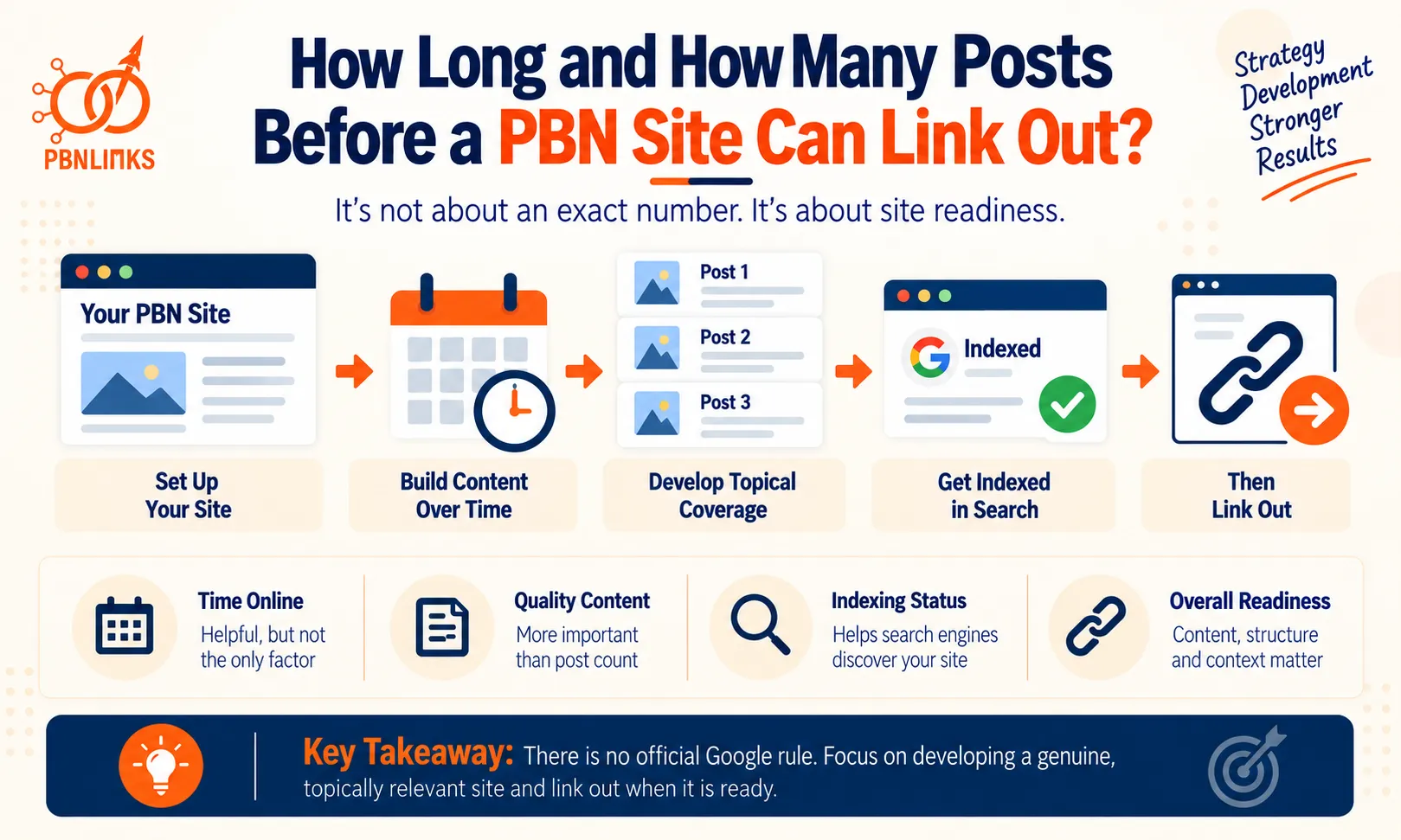
There is no documented Google rule that sets a specific PBN site warm up period or requires a minimum number of posts before a website can link externally. Recommendations such as waiting 30, 60, or 90 days or publishing a certain number of articles are generally PBN practitioner strategies rather than official thresholds.
That does not mean the timing of the first target link should be ignored. A site that has been online for 30 days with little content or development is very different from one that has spent the same period building topical coverage, internal links, a publishing history, and pages that search engines can discover and index. Time online and site readiness are not the same thing.
The same applies to content volume. Reaching an arbitrary number of posts does not automatically make a PBN ready to link out. The depth and relevance of the content, overall site structure, indexing status, linking page, and existing outbound-link context can provide a more useful picture than post count alone.
In this guide, we’ll examine how long a PBN should warm up, how many posts it may need before linking out, what should happen during the warm up period, and whether indexing should come before the first target link. We’ll also look at fresh versus expired domains, publishing and outbound-link patterns, and a practical framework for deciding when a PBN site is ready to place its first link.
What Is a PBN Site Warm Up Period?
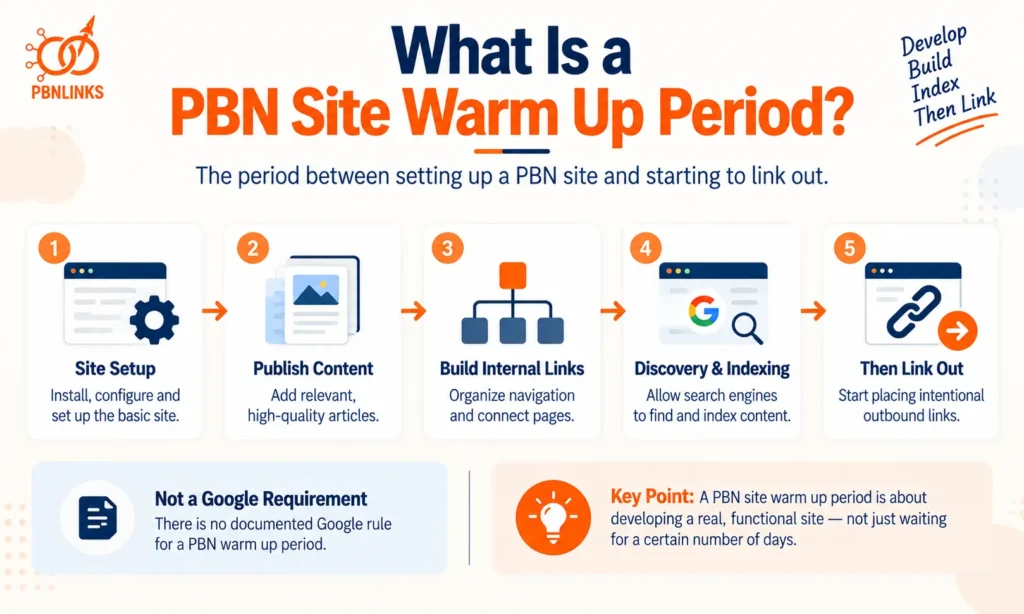
A PBN site warm up period is the period between setting up or rebuilding a PBN site and beginning to use it for intentional outbound links to target websites. During this time, the site is typically developed with content, navigation, internal links, and other elements that establish it as a functioning website rather than a domain created around a single backlink.
The term “warm up” can be misleading if it is understood as simply waiting a certain number of days. There is no documented Google process called a PBN warm up period. In practice, the term describes a site-development approach used by PBN operators before they begin placing target links.
What Does Warming Up a PBN Actually Mean?
Warming up a PBN is better understood as developing the site before relying on it for outbound links, rather than leaving the domain online and waiting for the calendar to move.
The process can include publishing topically relevant content, organizing categories and navigation, creating internal links, allowing pages to be discovered and crawled, and checking whether important content is being indexed.
A simple way to understand the progression is:
Site Setup → Content Development → Internal Linking → Discovery and Indexing → Outbound Linking
Not every site will move through these stages at exactly the same speed. A fresh domain and a rebuilt expired domain may also begin with very different histories, which is why a universal warm up schedule can be misleading.
Site Age vs Active Site Development
Site age tells you how much time has passed. Active site development tells you what has happened during that time. These are not the same thing.
Consider two PBN sites that have both been online for 30 days. One has only a homepage and two basic posts. The other has developed relevant content, organized its site structure, connected related pages through internal links, and had important URLs discovered and indexed. Both sites have the same calendar age, but they do not have the same development history.
This distinction also matters with aged or expired domains. An old registration date does not automatically mean the current version of the website has an established publishing history or is ready to place target links.
For that reason, the PBN site warm up period should not be judged by age alone. Time provides context, but what happens during that time is more useful when evaluating whether a site has developed enough to begin linking out.
Does a PBN Site Actually Need a Warm Up Period?
There is no documented Google requirement that a website must complete a specific warm up period before it can link to another site. Google does not publish a rule saying a PBN must wait a certain number of days, publish a minimum number of posts, or reach a particular age before adding an outbound link.
The idea of a PBN site warm up period comes primarily from PBN and SEO practice. The reasoning is less about satisfying a known Google waiting period and more about developing the site before relying on it as a source of target backlinks.
Is PBN Warm Up a Google Requirement?
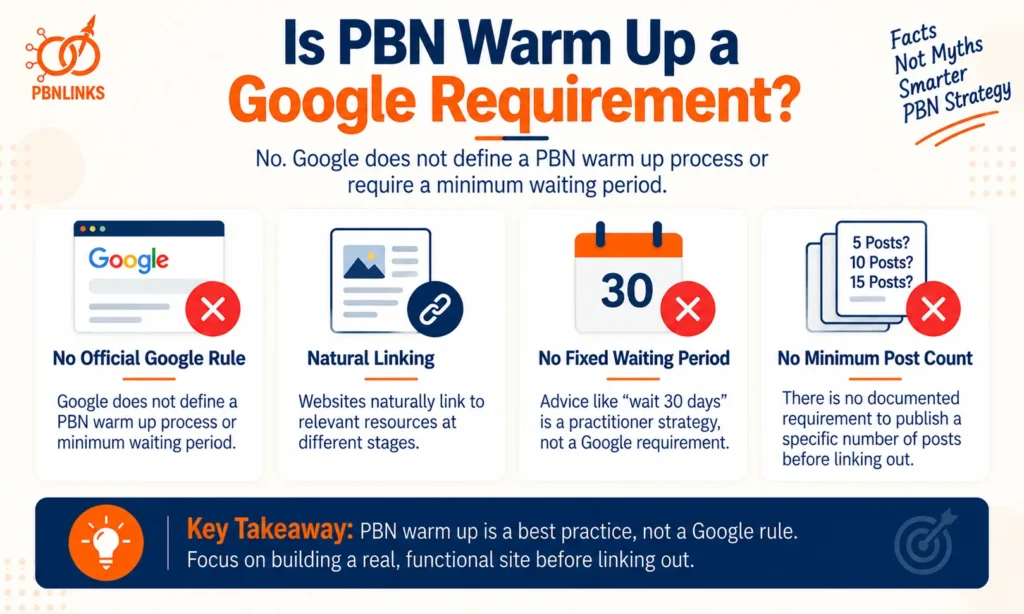
No. Google does not define a PBN warm up process or prescribe a minimum waiting period before a website can begin linking externally.
Websites naturally publish content and link to relevant external resources at different stages of their development. An outbound link appearing on a new website does not, by itself, establish that the site is part of a PBN.
This is why recommendations such as “always wait 30 days” or “never add a target link during the first month” should not be presented as Google rules. They are operational recommendations used by some PBN practitioners.
The same applies to post counts. There is no documented requirement that a site must publish 5, 10, or 15 articles before it is allowed to link out.
Why Do PBN Operators Warm Up Sites Anyway?
The practical reason is to give the website time to develop content, structure, publishing history, and search engine visibility before its primary purpose becomes outbound link placement.
Instead of building a site and immediately centering it around a target backlink, a warm up period can be used to:
- establish the site’s main topic with relevant content
- organize navigation and categories
- create useful internal links between related pages
- allow important URLs to be discovered and crawled
- check whether key pages are being indexed
- develop a publishing history
- evaluate how the eventual target link fits within the site’s content
These activities are different from simply leaving a domain online for several weeks.
For example, a PBN that remains almost empty for 60 days has accumulated time, but very little active website history. A younger site that has developed substantial topical content, a coherent structure, internal links, and crawlable pages has gone through a much more meaningful development process.
The key distinction is therefore:
Warm Up as Waiting → Calendar Time
Warm Up as Development → Content, Structure, Discovery, Indexing and Site History
A PBN warm up period is best understood as an operational site-development practice rather than a Google-defined requirement. This distinction is important before deciding whether the site should wait 30, 60, or 90 days, which brings us to the actual timing question.
How Long Should a PBN Site Warm Up Before Linking Out?
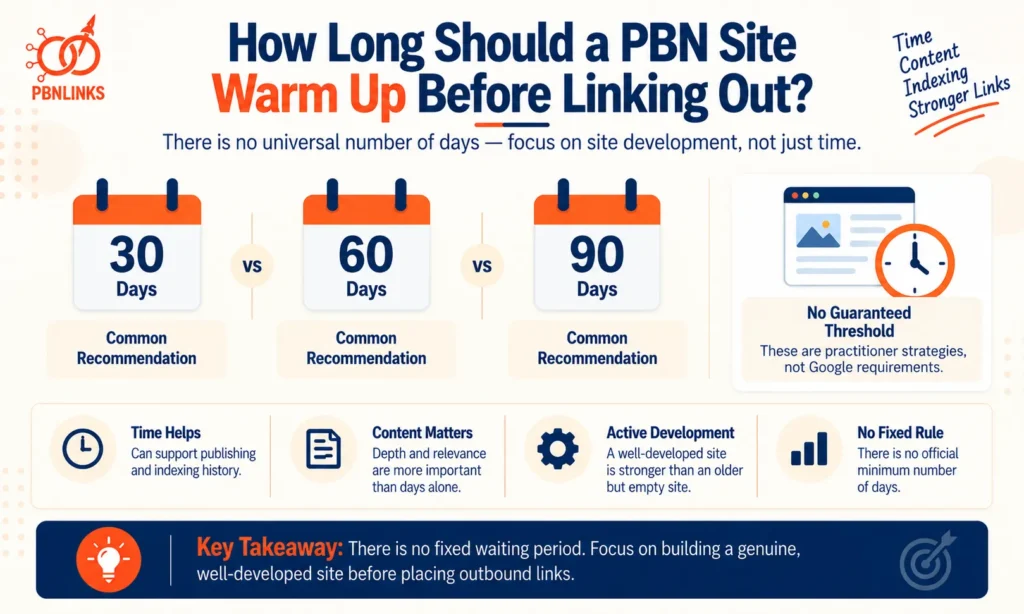
There is no universal number of days a PBN site must wait before linking out. Although recommendations such as 30, 60, or 90 days are common among PBN practitioners, these timeframes are not documented Google requirements and should not be treated as guaranteed thresholds.
A more useful way to judge the PBN site warm up period is to consider what has happened since the site was launched or rebuilt. Time can help a website establish a publishing and indexing history, but simply keeping a domain online for longer does not automatically make it more developed or make its outbound links more valuable.
Is There a Minimum PBN Warm Up Period?
No documented minimum warm up period applies to PBN sites. A website does not need to reach a particular age before it is technically able to publish an external link.
This is important because two questions are often confused:
When can a site link out? Technically, it can link to another relevant website from the beginning.
When should a PBN place its first target link? That depends on the site’s development, content, indexing, and the context in which the link will appear.
Rather than asking whether the domain has crossed a fixed number of days, it is more useful to check whether the site has progressed beyond its initial setup and developed enough context around the page that will contain the link.
Should You Wait 30, 60 or 90 Days?
There is no evidence-based rule that makes 30, 60, or 90 days the correct warm up period for every PBN.
These ranges appear frequently in PBN strategies because they give operators time to build the website before placing target links. The problem begins when a practical waiting period is treated as if crossing a particular day automatically changes how Google evaluates the site.
Consider what can happen during the same 30-day period:
Site A: Published two basic posts and then remained inactive.
Site B: Built its core pages, published relevant supporting content, developed internal links, and had important pages discovered and indexed.
Both sites are 30 days old, but the calendar tells us very little about how far each website has developed.
The same applies to waiting 60 or 90 days. More time can provide an opportunity to establish a longer publishing and crawl history, but elapsed time does not compensate for a poorly developed site.
Does Waiting Longer Make a PBN More Ready?
Not automatically. Waiting longer is useful only to the extent that meaningful site development occurs during that time.
Several factors provide more context than age alone:
- depth and relevance of published content
- topical coverage across the site
- navigation and overall site structure
- internal links between related pages
- publishing history
- discovery, crawling, and indexing of important URLs
- quality and relevance of the intended linking page
- existing outbound-link context
This is also why a site should not be considered “warmed up” simply because the domain has remained online for several months.
A useful way to think about the relationship is:
Time + Active Development = Website History
rather than:
Time Alone = Link Readiness
The practical takeaway is that there is no single best PBN warm up period measured only in days. A timeframe such as 30, 60, or 90 days can provide room for site development, but the decision to link out should ultimately depend on what the site has established during that period.
How Many Posts Should a PBN Have Before Linking Out?
Around 5 to 15 relevant posts is a practical starting range before a PBN links out, but there is no fixed or Google-required number of posts. The appropriate amount depends more on how well the site has developed its topic than on reaching an exact article count.
Publishing several posts before the first target link gives the site room to establish its main subject and build supporting content around the eventual linking page. A tightly focused PBN may achieve this with fewer posts, while a broader website may naturally need more content to cover its topic properly.
Before placing the first target link, the initial posts should ideally help the site:
- establish a clear primary topic and related subtopics
- provide supporting content for the future linking page
- create relevant internal linking opportunities
- develop a logical content structure and categories
- provide useful content beyond pages containing target backlinks
Content quality and topical coverage matter more than simply reaching 5, 10, or 15 posts. Ten thin or loosely related articles may provide less useful context than six substantial posts covering closely connected topics. The linking article should feel like a logical part of the website rather than an isolated page created mainly to place a backlink.
Therefore, 5 to 15 posts is better treated as a practical planning range than a PBN warm up rule. Before linking out, look beyond the number and evaluate whether the site has enough relevant content, topical depth, internal linking, and supporting context for the first target link to fit naturally.
What Should Happen During the PBN Site Warm Up Period?
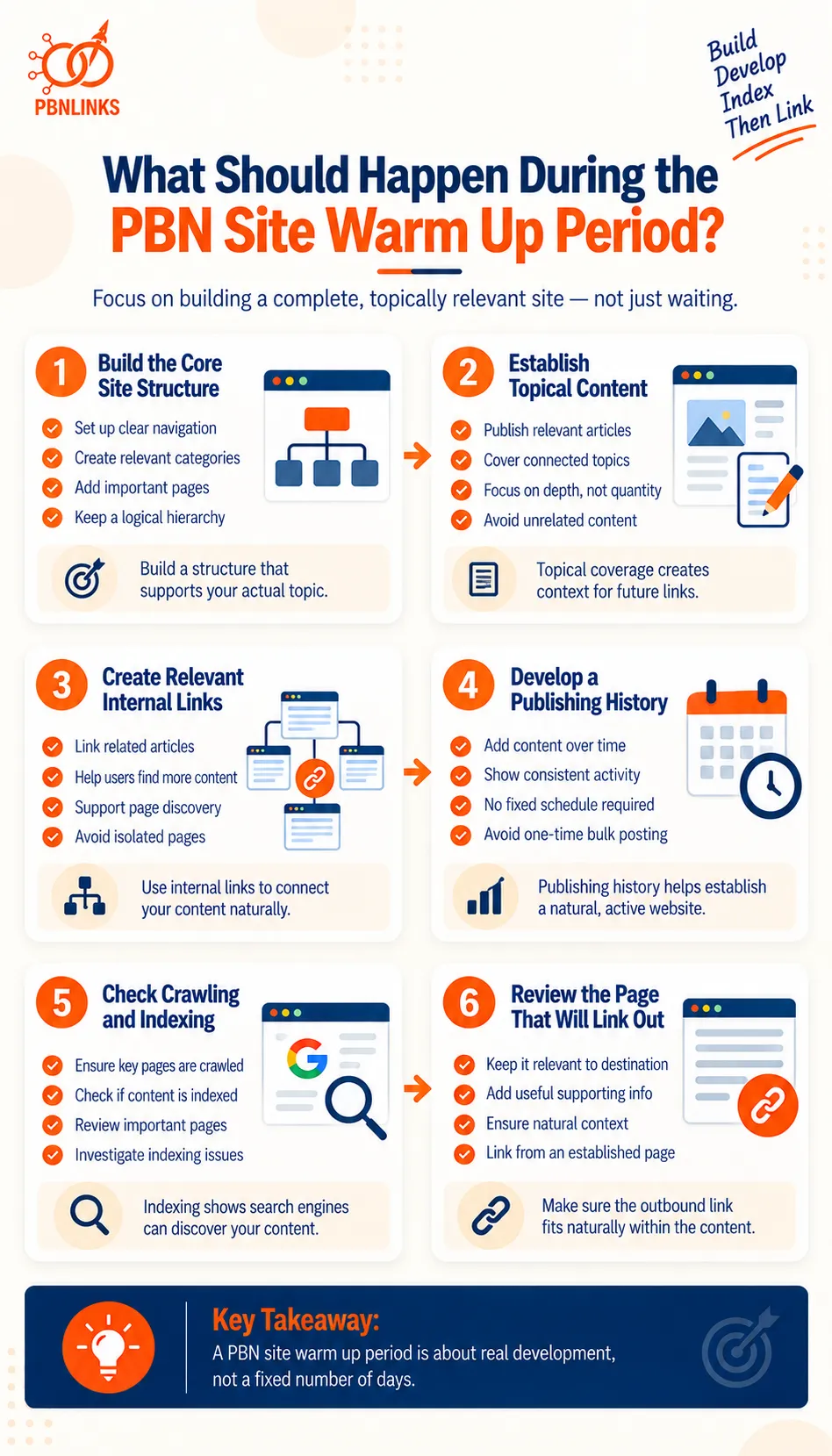
During the PBN site warm up period, the focus should be on developing the domain into a complete, topically relevant website rather than simply waiting a certain number of days before adding the first target link. The site should build content, structure, internal connections, and a crawl and indexing history that provides context for the page that will eventually link out.
A practical way to approach this period is to move through the site-development process step by step.
Step 1: Build the Core Site Structure
Start by establishing the basic structure of the website. The PBN should have clear navigation, relevant categories, important supporting pages, and a logical hierarchy that makes it easy to move between different areas of the site.
The structure should also reflect the site’s actual topic. Creating categories and pages simply to make the website appear larger adds little value if they do not support the content being published.
The goal is to give new articles, including the future linking page, a clear place within the overall website.
Step 2: Establish Topical Content
Publish content that clearly establishes the subject the PBN covers. Instead of filling the site with unrelated articles, develop several connected topics that make sense for the niche.
For example, a PBN focused on home improvement might cover roofing, maintenance, repairs, materials, inspections, and related homeowner questions. This creates supporting context for future articles within those subject areas.
As discussed earlier, there is no required post count. The purpose of the initial content is to establish topical coverage, not simply to reach an arbitrary number of articles.
Step 3: Create Relevant Internal Links
Once several related pages exist, connect them with internal links where those links genuinely help users move between related information.
Internal linking can also help search engines discover pages and understand relationships between content. Important articles should not remain isolated from the rest of the site if there are relevant pages that can naturally reference them.
For the future target-link article, relevant internal links can help establish how that page fits within the site’s broader topic.
Step 4: Develop a Publishing History
A warm up period provides an opportunity to establish some publishing activity rather than treating the website as a one-time content upload followed immediately by target-link placement.
This does not mean every PBN must follow a fixed schedule such as publishing one article every three or seven days. There is no documented Google-approved publishing interval for warming up a PBN.
The important distinction is:
Publishing History ≠ Fixed Drip-Feed Formula
Content should be published according to the site’s needs rather than according to an arbitrary schedule presented as a safe SEO threshold.
Step 5: Check Crawling and Indexing
As the site develops, check whether search engines can discover and crawl its important pages and whether key content is entering the index.
Pay particular attention to the homepage, important supporting content, and the page intended to contain the target link. Persistent indexing problems may indicate technical, content, canonicalization, or discovery issues that deserve investigation.
Indexing should still be interpreted correctly. A page being indexed does not prove that the site is authoritative or that a future backlink will produce rankings. It simply provides useful information about how Google is processing the site’s content.
Step 6: Review the Page That Will Link Out
Before placing the first target link, review the actual page where it will appear. The article should be relevant to the destination, contain useful supporting information, and fit naturally within the site’s established topic.
Check whether the page is internally connected to related content and whether the outbound link genuinely makes sense within the surrounding discussion. The backlink should not feel like the only reason the page exists.
A useful warm up sequence is therefore:
Site Structure → Topical Content → Internal Links → Publishing History → Crawling and Indexing → Linking Page
The purpose of these steps is not to satisfy a hidden Google warm up checklist. They provide a practical way to evaluate what the PBN has actually established during its warm up period before moving from site development to intentional outbound linking.
Should PBN Content Be Published Gradually or All at Once?
PBN content does not need to follow a specific publishing schedule before the site can link out. Publishing posts gradually can create a longer publishing history, while publishing several articles at once can establish the site’s initial content base more quickly. Neither approach is a documented Google requirement for a PBN site warm up period.
The more important question is whether the publishing approach makes sense for the website and results in useful, relevant content. A schedule should support site development rather than becoming an artificial formula that every PBN in a network follows.
Does a PBN Need a Specific Publishing Schedule?
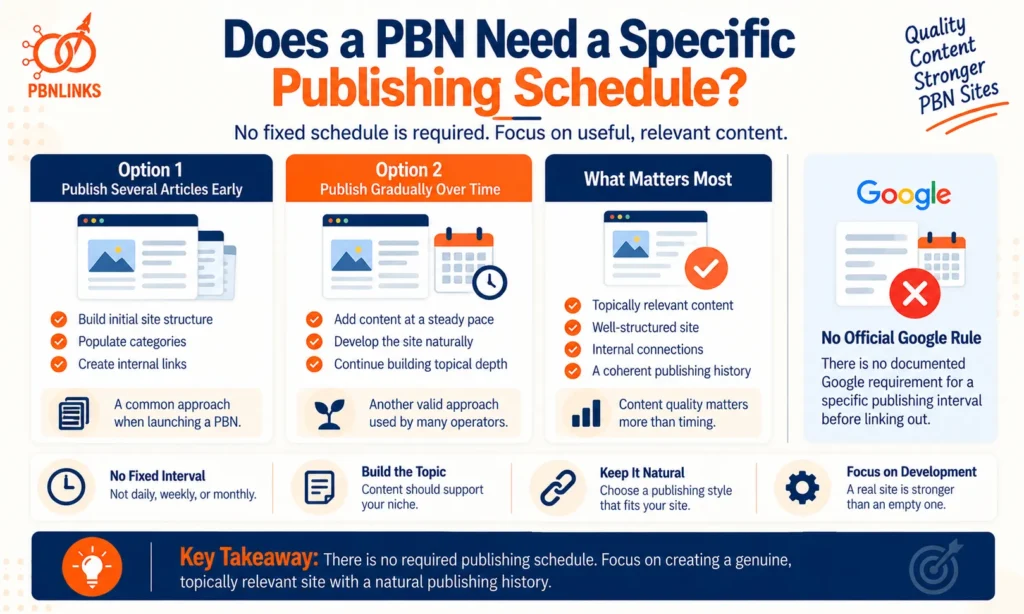
No. There is no documented Google rule requiring a PBN to publish one post every few days, one article per week, or follow any other fixed interval before adding outbound links.
Some PBN operators prefer to publish several initial articles when the site launches and then add more content over time. Others introduce content more gradually throughout the warm up period.
Either approach can build a website. What matters more is whether the content develops the site’s topic, supports related pages, and creates a coherent publishing history.
For example, a PBN might begin with several core articles so that categories and internal links are not empty, then publish additional supporting content as the site develops. This is a practical publishing strategy, not a required SEO formula.
Does Publishing Everything at Once Create a Problem?
Publishing multiple posts at once does not automatically create a problem or prove that a site is a PBN. Legitimate websites can launch with several articles already available, migrate existing content, or publish content in batches.
The concern should therefore not be reduced to a rule such as:
10 Posts in One Day = Unnatural
10 Posts Over 30 Days = Natural
The timing alone does not provide enough context to reach that conclusion.
However, publishing every planned article at launch and then leaving the website completely inactive may create a very different publishing history from a site that continues to develop. If additional topics genuinely need coverage, adding useful content over time can expand the site rather than leaving it static after its initial setup.
Publishing History vs Artificial Drip Feeding
A publishing history simply reflects how content has appeared and developed on a website over time. Artificial drip feeding is different: it involves following a predetermined interval mainly because that schedule is assumed to make the site appear more natural.
For example, there is no established SEO advantage in forcing every PBN to publish exactly one article every seven days. Repeating the same publishing sequence across many sites can also create a consistent operational pattern rather than genuine variation.
A better approach is to let publishing follow the site’s actual content requirements. Initial core content can be published when needed, while additional articles can be added when they expand topical coverage, support existing pages, or address relevant subjects.
The key distinction is:
Gradual Publishing ≠ Automatically Safer
Batch Publishing ≠ Automatically a Footprint
Useful Content Development > Artificial Publishing Schedule
For the PBN site warm up period, publishing frequency should therefore be treated as part of the site’s overall development history, not as a fixed timing formula that determines when the PBN becomes ready to link out.
Does a PBN Need a Specific Publishing Schedule?
No, a PBN does not need a specific publishing schedule during its warm up period. There is no documented Google rule requiring a site to publish daily, weekly, or at any fixed interval before it can begin linking out.
Some PBN operators prefer to publish several core posts when the site is first developed and then add supporting content gradually. Others publish content in smaller batches over several weeks. Both approaches can work as practical site-management strategies, but neither represents a required SEO schedule.
Instead of following an arbitrary publishing calendar, the schedule should reflect how the site is being developed. New content should have a clear purpose, such as:
- expanding coverage of an important subtopic
- supporting existing articles with related information
- creating useful internal linking opportunities
- filling genuine gaps in the site’s content
- strengthening the context around important pages
For example, publishing one article every seven days does not automatically make a PBN more established than publishing several relevant articles during the same week. Publishing frequency alone does not determine the quality, relevance, or readiness of the website.
The practical goal is therefore to build a meaningful publishing history without treating frequency as a fixed PBN warm up formula. How the content develops the site matters more than whether every article was published according to a predetermined schedule.
Should a PBN Be Indexed Before Adding Its First Link?
Ideally, a PBN and especially the page that will contain the target link should be indexed before you rely on that link for SEO value. There is no documented Google rule requiring a PBN to be indexed before adding an outbound link, but indexing provides a useful checkpoint that Google has discovered and processed the page.
It is also important to distinguish site indexing from linking page indexing. A PBN may have its homepage and several articles indexed while the specific page containing the backlink remains outside Google’s index. For link building, the status of the actual linking URL is therefore more relevant than simply confirming that some pages from the domain appear in search.
However, indexing does not prove that a PBN is authoritative, trusted, or capable of passing meaningful link value. A page appearing in Google’s index only tells you that it has been processed and included at that time. It does not guarantee rankings, backlink effectiveness, or protection from future deindexing.
If the PBN or intended linking page is not being indexed, investigate the issue before depending on it for a target backlink. Check crawlability, robots.txt, noindex directives, canonical signals, internal links, sitemap discovery, and the quality of the page itself. During the PBN site warm up period, indexing is best treated as an important readiness checkpoint rather than a guarantee that the site is ready or that its first link will produce SEO results.
How Should a PBN Place Its First Outbound Link?
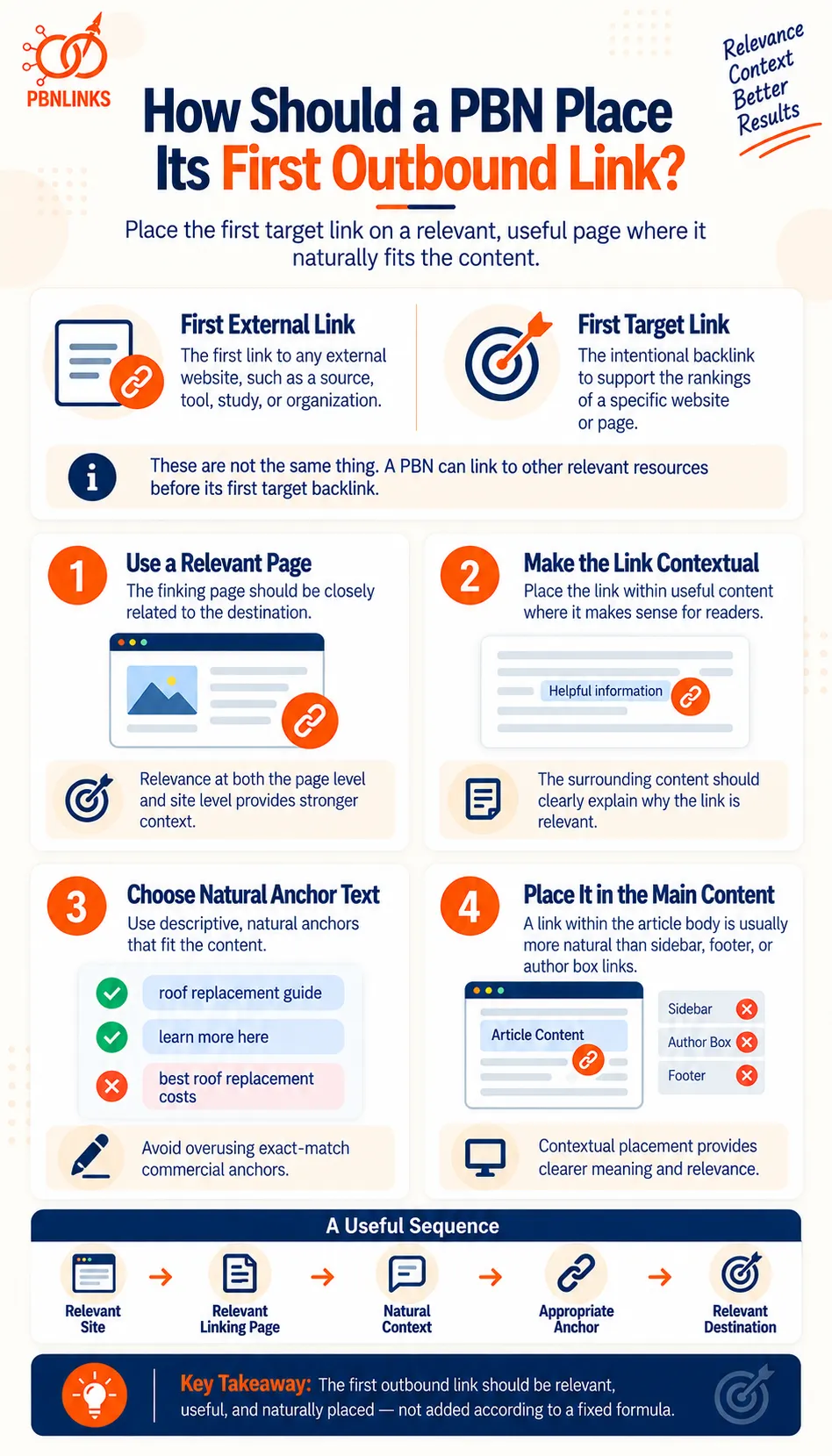
The first target link from a PBN should be placed on a relevant, useful page where the destination naturally supports the surrounding content. There is no special Google rule for a site’s first outbound link, but from a PBN management perspective, relevance, anchor text, page context, and placement are more useful considerations than simply deciding that the warm up period has ended.
The first outbound link also does not necessarily have to be the first intentional SEO target link. A functioning website may naturally reference external resources as part of its content. What matters is whether outbound links make sense for the topic rather than being added according to a fixed formula designed to make the site appear natural.
First External Link vs First Target Link
A first external link is simply the first link from the PBN to another domain. A first target link is the intentional backlink placed to support the rankings of a specific website or page.
These should not automatically be treated as the same thing. A PBN may already link to sources, tools, studies, organizations, or other relevant websites before it places its first target backlink.
The important point is not to manufacture unrelated external links just so the target link is not technically the first one. Outbound links should have a legitimate contextual purpose within the content.
Keep the First Target Link Contextually Relevant
The first target backlink should appear within content that is closely related to the destination page. The surrounding discussion should make it clear why a reader might reasonably follow that link.
For example, if the target page is about roof replacement costs, placing the link within an article discussing roofing prices, replacement decisions, or related homeowner considerations provides stronger topical context than inserting it into an unrelated general article.
The linking page itself should also fit the broader subject of the PBN. Relevance should exist at both the page level and site level, rather than relying only on the anchor text to connect unrelated content.
Anchor Text and Link Placement
The anchor text should describe or naturally relate to the destination without being forced into the sentence. Exact-match commercial anchors can be highly targeted, but repeatedly using optimized anchors across a backlink profile can create an unnecessarily concentrated pattern.
Placement matters as well. A contextual link within the main body of a relevant article usually provides clearer meaning than a link inserted into an unrelated footer, sidebar, author box, or generic section.
A useful sequence is:
Relevant Site → Relevant Linking Page → Natural Context → Appropriate Anchor → Relevant Destination
The goal is for each element to support the same topic rather than relying on the backlink alone to create relevance.
Should a PBN Link to Authority Sites Before the Target Site?
No, a PBN does not need to link to authority websites before adding its first target link. There is no documented Google requirement that a new site must first link to Wikipedia, government websites, major publications, or other authoritative domains before it can link to a target site.
External references can be useful when they genuinely support a claim or give readers access to a valuable source. Adding them mechanically only to make the outbound-link profile appear more natural should not be treated as a required warm up technique.
The better principle is simple: link externally when the content genuinely benefits from the reference, and place the target link where it is contextually justified. The first outbound-link strategy should be driven by relevance and usefulness rather than an artificial sequence of authority links followed by the target backlink.
Do Fresh and Expired PBN Domains Need the Same Warm Up Period?
No, fresh and expired PBN domains do not necessarily need the same warm up period. A fresh domain starts without an established website history, while an expired domain may already have years of content, backlinks, and previous search activity. However, this does not mean an expired or aged domain is automatically ready to link out sooner.
When comparing the PBN site warm up period for fresh and expired domains, consider factors such as:
- the domain’s previous website and content history
- relevance between the old and rebuilt website
- existing backlink profile and its relevance
- how long the domain or website was inactive
- current content depth and topical coverage
- crawling and indexing of the rebuilt site
- development of the page that will contain the target link
A fresh PBN usually requires more ground-up development because its content, structure, internal links, and publishing history are being established from the beginning. An expired domain may start with more historical context, but that history only becomes useful to the evaluation when it remains relevant to the current website. An old registration date by itself should not be treated as a reason to skip site development or immediately place target links.
Therefore, domain type can influence the warm up approach, but it does not create a fixed difference in waiting time. Rather than assuming a fresh PBN needs 60 days while an expired PBN needs only 30, evaluate each domain individually based on its history, relevance, current development, indexing, and linking-page context before deciding when it is ready to link out.
Can PBN Warm Up and Link Timing Create Footprints?
Yes, repeated PBN warm up and link timing patterns can create observable similarities across a network, but a timing match alone does not prove that multiple sites share the same owner. The more useful question is whether the same publishing and linking behavior appears repeatedly across multiple domains and is supported by other specific similarities.
For example, if many PBN sites are launched, publish the same number of articles, wait exactly 30 days, and then place their first target links within a similar timeframe, the repeated sequence becomes more distinctive than one isolated timing match. This is one reason a fixed warm up formula should not be treated as a universal template for every site.
Repeated Publishing Schedules
Using the same publishing schedule across many PBN sites can produce a recognizable operational pattern. This might include publishing the same number of initial posts, using identical intervals between articles, or following the same sequence from site launch to first target link.
One site publishing weekly tells us very little. The pattern becomes more interesting when the same schedule repeatedly appears across a connected group of domains.
This does not mean a shared publishing frequency proves common ownership. Many unrelated websites publish on similar schedules. The significance depends on how specific and consistently repeated the pattern is.
Synchronized First Links
First-link timing can also be compared across multiple sites. For example, several domains might all place their first target backlink exactly 30 days after launch or shortly after reaching the same number of published posts.
A single timing similarity can easily be coincidental. Repeated synchronization becomes more noteworthy when the same domains also link to related target sites, use similar anchors, or share other operational characteristics.
Therefore:
Same First-Link Timing → Weak by Itself
Repeated Timing + Related Targets + Other Similarities → More Meaningful Context
Timing should be evaluated as part of a broader pattern rather than as standalone proof.
Repeated Content and Outbound Link Patterns
Warm up similarities can extend beyond dates. Multiple sites may repeatedly follow the same sequence of publishing content and adding outbound links.
For example, a group of sites might consistently:
- launch with the same number of posts
- publish additional articles at identical intervals
- add external authority links at the same stage
- place the first target link after the same waiting period
- use similar anchor-text or link-placement patterns
None of these characteristics automatically identifies a PBN. Their analytical value increases when several specific patterns repeatedly occur across the same group of sites.
When Does a Timing Pattern Become More Meaningful?
A useful way to evaluate PBN timing similarities is:
Observable → Repeated → Specific → Historical → Corroborated
First, determine whether the pattern can actually be observed. Next, check whether it repeats across multiple domains. Consider how specific the similarity is, whether it persists historically, and whether independent signals such as hosting, DNS, content, link targets, or other infrastructure relationships support the same connection.
This is an analytical framework for evaluating patterns, not a documented Google PBN detection formula. Google does not publish a rule stating that sites using the same warm up period or first-link timing will be classified as a PBN.
The practical takeaway is that one timing similarity means very little on its own. Repeated and unusually specific similarities become more useful for analysis when they occur alongside other independent relationships across the same sites.
Common PBN Site Warm Up Mistakes
The most common PBN site warm up mistakes come from treating warm up as a fixed formula based on days, post counts, indexing, or repeated publishing schedules. A warm up period is more useful when it reflects actual site development rather than a checklist designed to reach a predetermined point before placing backlinks.
- Treating 30, 60, or 90 Days as a Guaranteed Safe Period
Waiting a specific number of days does not automatically make a PBN ready to link out. There is no documented Google threshold that makes a target link safer simply because the domain has passed 30, 60, or 90 days. - Publishing Thin Content Just to Reach a Post Count
Publishing 10 or 15 weak articles solely to reach a target number misses the purpose of initial content development. Fewer substantial and topically connected posts can provide better site context than a larger collection of thin or unrelated articles. - Leaving the Domain Idle and Calling It Warm Up
A domain sitting online for two months without meaningful development has accumulated age, not necessarily website history. The warm up period should involve relevant content, site structure, internal linking, and other genuine development. - Assuming Indexing Proves the PBN Is Ready
Indexing is a useful checkpoint, but it does not prove authority, trust, backlink strength, or overall PBN readiness. The linking page and the rest of the site still need to be evaluated in context. - Assuming an Aged Domain Needs No Redevelopment
An expired domain may have years of history, but age alone does not make its rebuilt website ready for target links. Previous content, topical relevance, backlinks, periods of inactivity, and the development of the current site all matter. - Adding Authority Links Mechanically to Appear Natural
A PBN does not need to link to Wikipedia, government sites, or major publications before linking to its target. External references should be included when they genuinely support the content rather than as a mandatory warm up tactic. - Using the Same Warm Up Formula Across Every PBN
Launching sites with the same number of posts, publishing at identical intervals, waiting exactly the same number of days, and then adding target links can produce repeated operational patterns. A fixed network-wide schedule should not be mistaken for a Google-approved best practice. - Treating One Timing Similarity as Proof of Common Ownership
The opposite mistake is assuming that two sites sharing a publishing date or first-link timing must belong to the same network. A single timing similarity is weak evidence by itself and becomes more meaningful only when repeated, specific, historical, and supported by other independent relationships.
The broader mistake behind all of these approaches is reducing PBN warm up to a number or formula. Days online, posts published, and indexing status can all provide useful information, but the final decision should consider the website’s history, structure, content, internal links, indexing, linking page, outbound links, and timing together.
How to Decide When a PBN Site Is Ready to Link Out
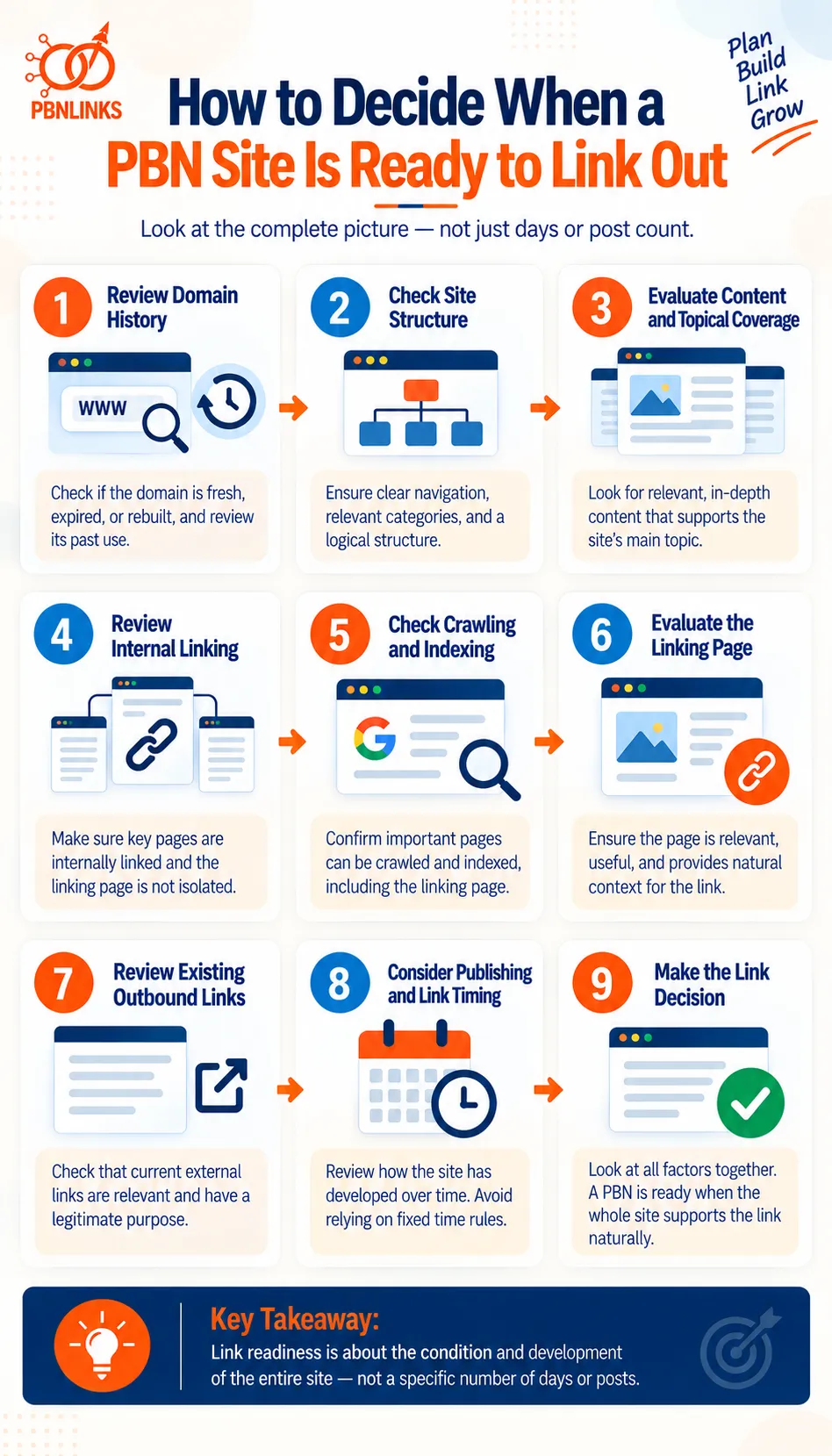
A PBN site is ready to link out when its history, structure, content, internal links, indexing, linking page, and outbound-link context support the link naturally. There is no single number of days or posts that confirms readiness, so the decision should be based on the condition of the whole site rather than one warm up metric.
The following step-by-step framework provides a practical way to evaluate a PBN before placing its first target link.
Step 1: Review the Domain and Website History
Start with the history of the domain. Determine whether it is fresh, expired, or rebuilt and, for an older domain, review what type of website previously existed on it.
Look at whether the previous topic is relevant to the current site, whether the domain experienced long periods of inactivity, and whether its historical backlinks still make sense for its current use.
Domain age alone should not determine link readiness. What happened on the domain before and after the current site was built provides more useful context.
Step 2: Check the Site Structure
Review whether the PBN has developed into a complete and navigable website rather than a collection of disconnected posts.
Important content should fit within logical categories or sections, navigation should make sense, and users should be able to reach relevant pages without relying only on direct URLs.
The intended linking page should also have a clear place within this structure.
Step 3: Evaluate Content Depth and Topical Coverage
Next, assess whether the site contains enough relevant content to establish what it is actually about.
Do not judge this only by whether the PBN has reached 5, 10, or 15 posts. Ask whether those articles cover meaningful parts of the main topic and provide relevant supporting content around the future linking page.
A smaller group of substantial, connected articles can provide stronger context than a larger collection of thin or unrelated posts.
Step 4: Review Internal Linking
Check how the site’s pages connect to one another. Relevant articles should link internally where those connections help users explore related information.
Pay particular attention to the intended linking page. If it is completely isolated from the rest of the website, consider whether relevant existing articles can naturally connect to it.
Internal linking should reflect genuine relationships between topics rather than being added simply to satisfy a predetermined number of links.
Step 5: Check Crawling and Indexing
Confirm that important pages can be discovered and crawled and review whether key URLs are being indexed.
The status of the actual linking page deserves particular attention. Having an indexed homepage does not necessarily mean every article on the site has also been indexed.
If important pages repeatedly remain outside the index, investigate technical, discovery, canonical, or content issues before depending on the site for a target backlink. Remember that indexing is a useful checkpoint, not proof of authority or backlink value.
Step 6: Evaluate the Linking Page
Review the page that will contain the first target link on its own merits.
The page should:
- cover a topic relevant to the destination
- provide useful information beyond the backlink itself
- fit the broader subject of the PBN
- connect naturally with relevant internal pages
- provide appropriate context for the target link
- use anchor text that fits naturally within the surrounding sentence
The target backlink should make sense because of what the page discusses, not simply because the warm up period has ended.
Step 7: Review the Existing Outbound Link Profile
Look at how the website already uses external links. Some articles may naturally reference sources, organizations, tools, studies, or other relevant websites, while other content may not require external references at all.
There is no requirement to manufacture authority links before placing the target backlink. Instead, check whether existing outbound links have legitimate contextual purposes and whether the new target link fits naturally within that overall pattern.
Step 8: Review Publishing and Link Timing
Consider how the website has developed over time. Review when content was published, how the site has expanded, and when the first target link is being introduced.
Avoid reducing this review to a rule such as “30 days means ready.” Also consider whether the same publishing intervals, post counts, and first-link timing are being repeated systematically across multiple PBN sites.
Timing is most useful when evaluated alongside the site’s development rather than as an independent readiness test.
Step 9: Make the Link Decision Based on the Whole Site
Finally, combine the previous checks instead of allowing one metric to determine the decision.
A useful sequence is:
History → Structure → Content → Internal Links → Indexing → Linking Page → Outbound Links → Timing → Decision
For example, an indexed PBN is not necessarily ready if it contains thin content and a poorly related linking page. Likewise, a site should not automatically be rejected simply because it has fewer than 10 posts if those pages provide substantial topical coverage and the rest of the site is properly developed.
This is a practical PBN readiness framework, not a Google-defined warm up checklist. The central principle is that link readiness should be evaluated from the condition and development of the entire website rather than an arbitrary number of posts, days, or indexed URLs.
Conclusion
In conclusion, there is no fixed PBN site warm up period or exact number of posts that makes a site ready to link out. Practitioner ranges such as 30, 60, or 90 days and 5 to 15 initial posts can provide planning references, but they are not Google-defined thresholds or guarantees of link readiness.
What happens during the warm up period matters more than simply letting time pass. Building relevant content, establishing topical coverage, creating useful internal links, developing the site structure and publishing history, and checking whether important pages can be crawled and indexed provide a stronger basis for evaluating the site.
The first target link should also fit naturally within a relevant, well-developed page. Fresh and expired domains may require different levels of development, so readiness should be judged using the site’s history, structure, content, internal links, indexing, linking page, outbound-link context, and timing rather than one isolated metric.
If you want to strengthen your link-building strategy without relying on arbitrary PBN warm up formulas, PBNLinks.agency can help you build relevant, carefully planned PBN backlinks around your SEO goals. Focus on developing links that make contextual sense and support a broader, long-term search strategy.
Frequently Asked Questions About the PBN Site Warm Up Period
What is a PBN site warm up period?
A PBN site warm up period is the development phase before a PBN begins placing intentional target links. It typically involves building relevant content, internal links, site structure, and a publishing and indexing history.
How long should a PBN warm up before linking out?
There is no fixed PBN warm up period. Some practitioners use 30, 60, or 90 days, but these are not Google-defined thresholds. Site development and link context matter more than elapsed time alone.
How many posts should a PBN have before linking out?
Around 5 to 15 relevant posts is a common practitioner starting range, not a Google requirement. The site should have enough useful content to establish its topic and provide supporting context for the page containing the target link.
Can a PBN add a backlink in its first post?
Yes, a PBN can technically add an external link in its first post. Google does not document a minimum post count before a site can link externally, although waiting for supporting content to develop can provide more context around the target-link page.
Should a PBN be indexed before linking out?
Ideally, the page containing the target link should be indexed before you rely on its backlink for SEO value. Indexing shows that Google has processed and included the page, but it does not guarantee authority, rankings, or backlink effectiveness.
Does waiting longer make a PBN backlink stronger?
No. Waiting longer by itself does not make a PBN backlink stronger. Extra time is useful only when it allows the site to develop relevant content, internal links, publishing history, and crawlable and indexable pages.
Does an expired PBN domain need a warm up period?
An expired PBN domain may still need a warm up and redevelopment period. Its previous content, topical relevance, backlink history, inactivity, current content, and indexing should be evaluated rather than assuming domain age makes it immediately ready to link out.
Should PBN content be published gradually or all at once?
There is no required publishing schedule for PBN content. Publishing gradually can establish a longer publishing history, while batch publishing can build the initial content base quickly. Neither method is inherently a Google-approved PBN warm up strategy.
Should a PBN link to authority sites before the target site?
No. A PBN does not need to link to authority sites before placing a target link. External links should be added when they genuinely support the content, not as a mandatory step intended to make the site’s outbound-link profile appear natural.
How do you know when a PBN is ready to link out?
A PBN is better positioned to link out when its history, structure, topical content, internal links, indexing, linking page, outbound links, and publishing history have been reviewed together. There is no single number of days or posts that establishes readiness.