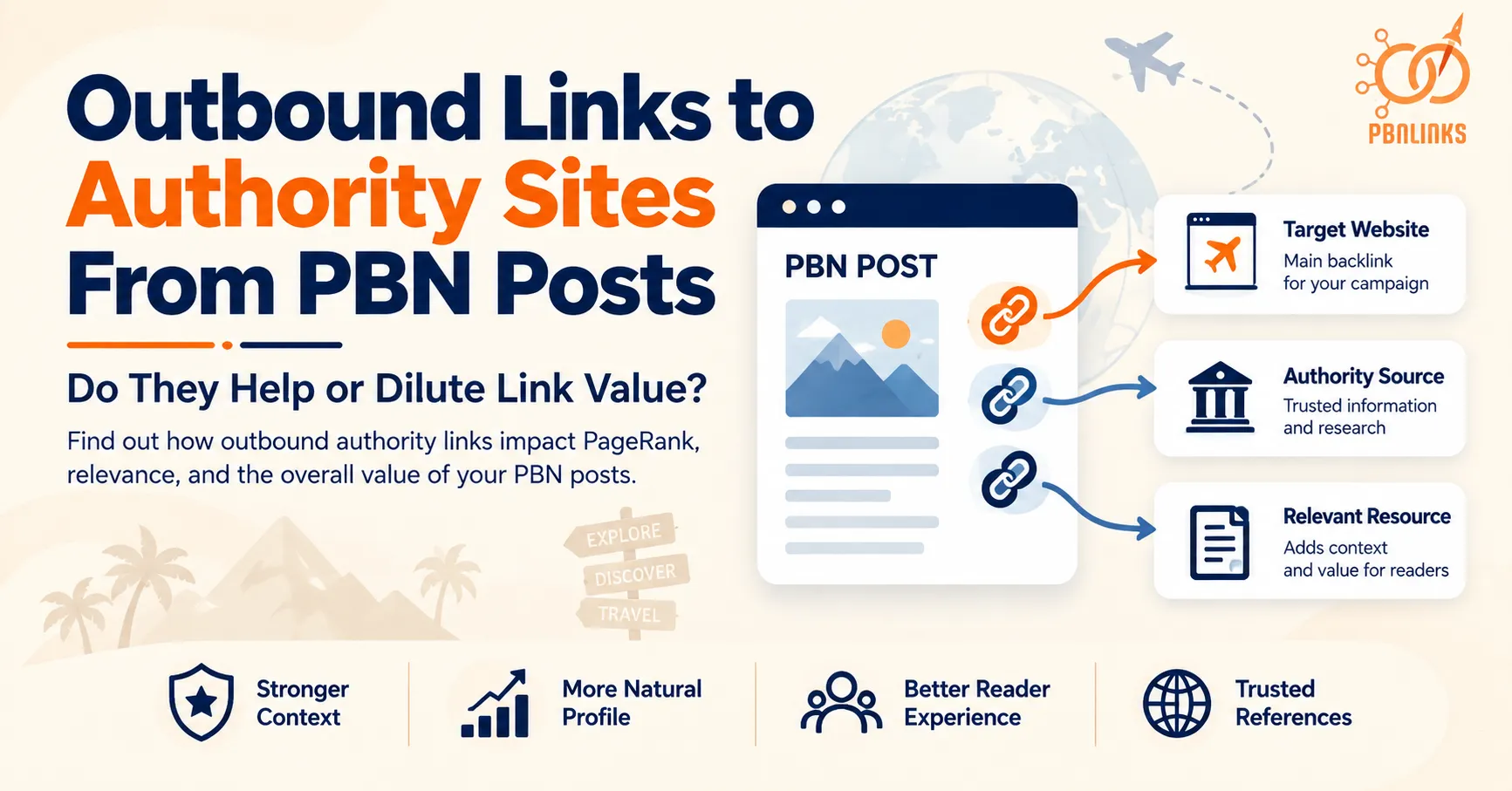
Outbound Links to Authority Sites From PBN Posts: Do They Help or Dilute Link Value?
Outbound links are common in well researched content, but their role becomes less straightforward when the page also contains a backlink intended to support another site’s rankings. Some SEO practitioners add links to established sources because they believe those references improve credibility, strengthen context, or make the article appear more natural. Others limit external links because they are concerned about distributing PageRank away from the target backlink.
The reality is more nuanced. PBN outbound authority links can support useful sourcing and give readers relevant information, but simply linking to a well known website does not create a documented ranking boost. At the same time, followed links participate in how PageRank flows through a page, yet this does not mean backlink value can be calculated using a simple link juice formula.
The more useful question is therefore not whether every PBN post should contain authority links. It is whether a particular external link has a clear editorial purpose, points to a credible and relevant source, and fits naturally within the surrounding content.
This guide examines how outbound authority links relate to PageRank, link equity, topical relevance, source selection, co citation, link attributes, and the wider debate around natural external linking. It also explains when an external reference adds genuine value and when it is simply being inserted to follow an SEO formula.
What Are PBN Outbound Authority Links?
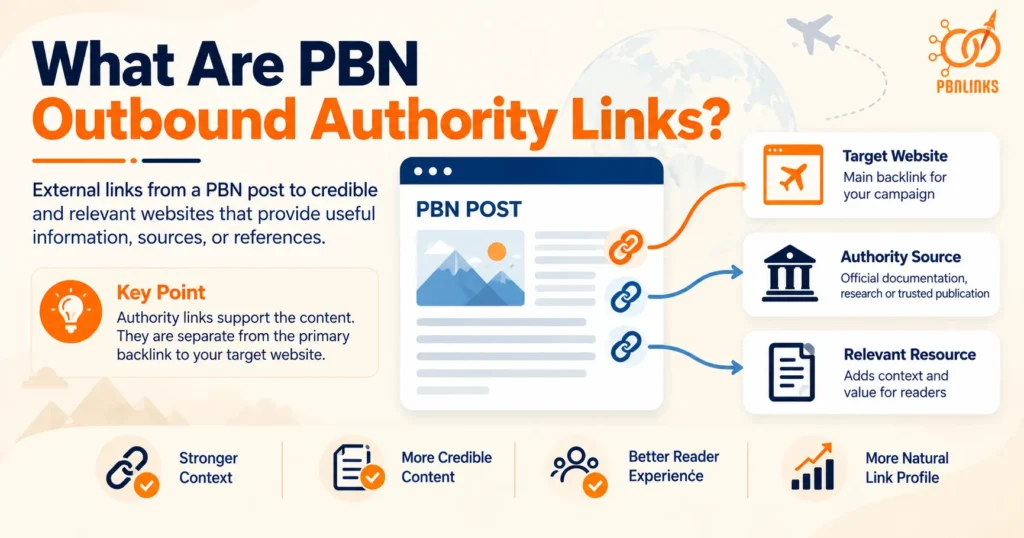
PBN outbound authority links are external links from a PBN post to third party websites that are considered credible, relevant, or useful sources for the topic being discussed. They are separate from the primary backlink placed to support the target website.
For example, a post discussing search engine crawling might reference official Google documentation, while an article covering market statistics could cite the original research behind those figures. In both cases, the external link has a clear reason to exist within the content.
The term “authority site” can be misleading, however. A website does not automatically become the best source simply because it is well known or has strong third party SEO metrics. The relevance and quality of the specific destination page matter as well.
Authority Link Definition
In SEO discussions, an authority link generally refers to an outbound link pointing to a website or page viewed as credible within its subject area. Common examples can include official organizations, original research, established publications, universities, government resources, and respected industry websites.
Authority should therefore be considered in context. A highly recognized website may be authoritative overall but still provide little value if the linked page does not support the subject or claim being discussed.
Authority vs Relevant Source
Authority and relevance often overlap, but they are not the same thing.
A famous website with strong metrics may have little connection to a specific paragraph. A smaller specialist website, original study, or official document may provide much stronger evidence for that particular discussion.
A useful external source should ideally combine:
- topical relevance to the subject
- credible and accurate information
- a clear connection to the surrounding content
- genuine value for readers who follow the link
This is why source selection should not be based on Domain Authority, Domain Rating, or brand recognition alone.
Target Backlink vs Supporting External Link
A PBN post can contain different links serving different purposes. The distinction between the target backlink and supporting external links is particularly important.
The target backlink points to the website or page the link building campaign is intended to support.
A supporting external link points to another resource because that destination provides evidence, documentation, further explanation, or useful information related to the article.
For example, a post may link to a target service page while separately citing an industry study for a statistic mentioned in the content. Those links appear on the same page, but their editorial roles are different.
Keeping this distinction clear makes it easier to evaluate outbound links based on why they are present rather than treating every external link as serving the same SEO purpose.
Why Do PBN Posts Link to Authority Sites?
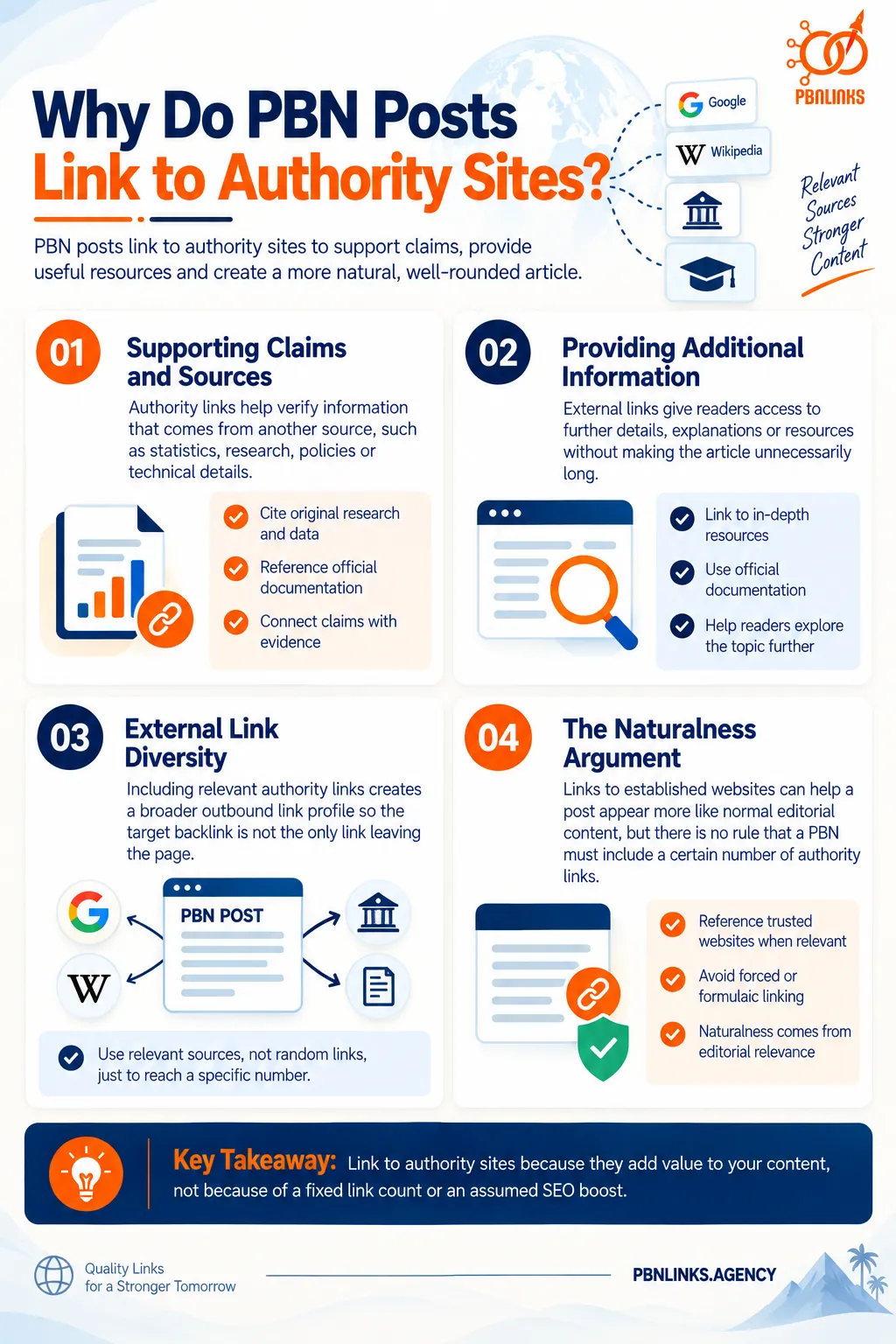
PBN posts commonly link to authority sites to support factual claims, provide additional resources, and connect the article with relevant information elsewhere on the web. Some publishers also use these links to create a more varied outbound link profile or make a post appear more natural, although those goals should not be confused with a proven ranking benefit.
The strongest reason for adding an external link is usually editorial. If a source helps verify a statistic, explain a concept, or give readers access to original information, the link has a clear purpose within the page.
Supporting Claims and Sources
External links are particularly useful when an article refers to information that originates elsewhere. Instead of presenting a statistic, research finding, policy, or technical statement without support, the post can direct readers to the source behind it.
For example, an SEO article discussing Google’s crawling recommendations may reference Google’s own documentation. A post using figures from an industry study can link to the original research rather than leaving readers unable to verify the numbers.
This creates a logical relationship:
Claim → Supporting Evidence → Relevant Source
The purpose of the link is not simply to point at a powerful domain. It is to connect a statement with information that supports or expands it.
Providing Additional Information
Not every useful external link needs to function as a formal citation. Some links help readers explore a subject that would otherwise require an unnecessary explanation inside the article.
A post discussing a technical concept, for example, may direct readers to official documentation containing implementation details. This allows the article to remain focused while still providing a path to deeper information.
The destination should add something useful to the discussion. Linking externally simply because a website is popular provides little editorial value if the destination does not help the reader understand the topic.
External Link Diversity
Some PBN publishers also use supporting external links so that the target backlink is not the only link leaving the page. This creates a broader outbound linking pattern in which a post may reference several relevant resources rather than pointing exclusively to the campaign target.
However, external link diversity should not become a mechanical publishing rule. Adding unrelated destinations simply to increase the number or variety of outbound links can weaken the editorial logic of the page.
A better approach is to let the subject determine which external resources are appropriate. If several sources genuinely contribute to the article, multiple outbound links can make sense. If no supporting source is needed, forcing additional links into the post does not automatically improve it.
The Naturalness Argument
A common PBN practice is to add links to established websites because they are believed to make the post appear more like ordinary editorial content. This is why Wikipedia, government websites, universities, major publications, and recognized industry resources are sometimes added even when they are not essential to the discussion.
The problem is that there is no documented requirement that a PBN post must contain a particular number or type of authority links to appear natural. Repeating the same external linking formula across articles can also turn an editorial decision into a predictable publishing habit.
Natural external linking is better approached from the opposite direction. Start with the content, identify where another source genuinely helps, and then link to the most appropriate destination.
In that model, naturalness is a result of editorial relevance rather than the reason the link was inserted.
Do Outbound Links to Authority Sites Help SEO?
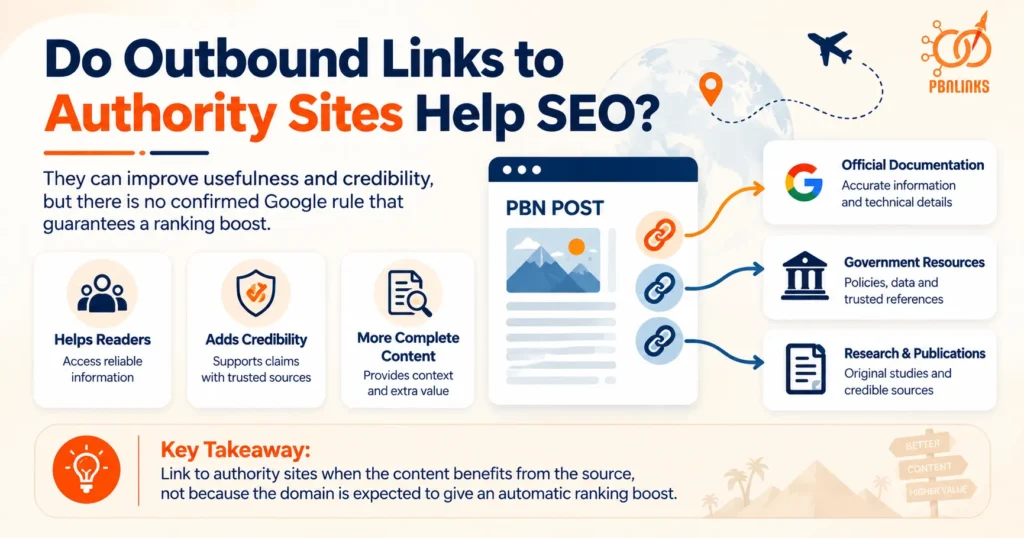
Outbound links to authority sites can improve the usefulness, sourcing, and credibility of a page, but there is no documented Google rule that simply linking to a high authority website gives the linking page a ranking boost. The value depends more on why the link exists and how well the destination supports the content.
This distinction matters for PBN posts. Adding a link to Wikipedia, a government website, or a major publication solely because the domain appears authoritative should not be treated as an SEO shortcut. A relevant source can strengthen the article editorially, but the destination’s reputation does not automatically transfer ranking authority back to the page that links to it.
Reader and Content Value
A useful external link can help readers verify information, explore a subject in greater depth, or access the original source behind a claim. This is particularly valuable when an article includes statistics, research findings, technical documentation, policies, or information that originated elsewhere.
For example, linking directly to an original study allows readers to examine the methodology and findings instead of relying entirely on the article’s interpretation.
External links can therefore make content more complete when they answer a genuine reader need. The benefit comes from providing access to relevant information, not simply from having an outbound link on the page.
Source Credibility
Credible sourcing can also make factual content easier to evaluate. When an article makes a significant claim, readers can see where the information came from and determine whether the source supports it.
The strongest source is not always the largest website. Depending on the subject, the most appropriate destination might be:
- official documentation
- an original research paper
- a government publication
- an industry organization
- a reputable specialist resource
- the original dataset or report behind a statistic
This is why credibility should be evaluated together with relevance and source quality rather than reduced to a domain metric.
Direct Ranking Benefit
The more questionable claim is that linking to an authoritative website directly improves the rankings of the page containing the link.
Google representatives have pushed back on this idea. There is no established formula in which linking to a famous or trusted domain causes Google to assign additional ranking value to the source page simply because of that destination.
This means a pattern such as:
PBN Post → High Authority Website → Automatic Ranking Benefit
should not be treated as an established SEO mechanism.
That does not make external links useless. It means their benefits need to be described accurately. A well chosen link can support evidence, improve context, help readers reach useful information, and strengthen the editorial completeness of an article without requiring an unsupported claim that authority flows backward from the destination.
For PBN posts, the practical principle is simple: link to an authoritative source when the content benefits from that source, not because the domain’s reputation is expected to create an automatic SEO boost.
Do PBN Outbound Authority Links Dilute Link Value?
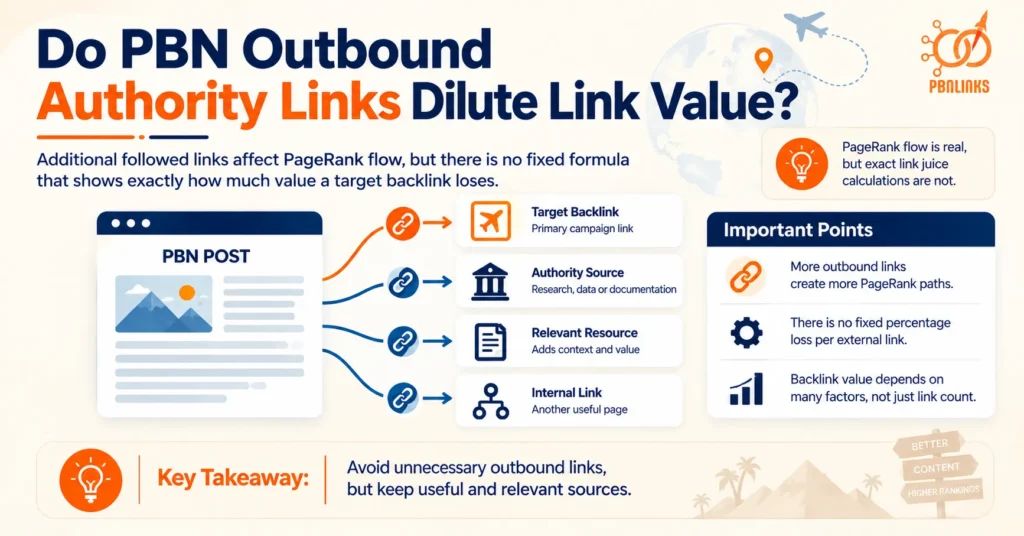
Additional followed outbound links can affect how PageRank flows from a page, but this does not mean every authority link reduces the SEO value of a target backlink by a fixed or directly measurable amount. PageRank distribution is relevant to outbound linking, but the actual ranking impact of an individual backlink depends on much more than the number of links appearing on the page.
In simplified terms, PageRank can flow through the links a page contains. A page with several followed links therefore creates more outgoing paths than a page with only one. This principle is the basis of the concern that adding authority links could leave less PageRank flowing through the primary target backlink. However, PageRank should not be treated as a visible pool of SEO points that can be divided into exact percentages for modern ranking predictions.
The complete link structure of a page also matters. A normal article may contain internal links, navigation links, citations, supporting resources, and contextual external links alongside the target backlink. Their presence does not automatically make the page ineffective. What matters from an editorial perspective is whether those links have a legitimate reason to be there rather than whether the publisher has reduced the page to the smallest possible number of outgoing links.
It is also important to separate PageRank flow from actual ranking impact. The potential value of a backlink can involve the relevance and characteristics of the linking page, the surrounding context, the destination page, and how search engines evaluate the link itself. For that reason, PageRank flow, exact backlink value, and guaranteed ranking change are not interchangeable measurements.
This is where the common idea of “link juice dilution” can become misleading. It is reasonable to recognize that followed links participate in PageRank distribution, but it is not reasonable to claim that adding two authority links reduces the target backlink by a specific percentage. Such calculations may illustrate a simplified concept, but they cannot reliably predict the SEO value that a modern search engine will assign to an individual backlink.
For a PBN post, the practical approach is to avoid unnecessary outbound links without removing useful ones simply to preserve link juice. A relevant citation or supporting resource can have a legitimate editorial purpose, while several authority links inserted only to satisfy an SEO formula add little value. The goal should be a focused page in which every outbound link has a clear reason to exist.
Authority vs Relevance: Which Matters More for an External Link?
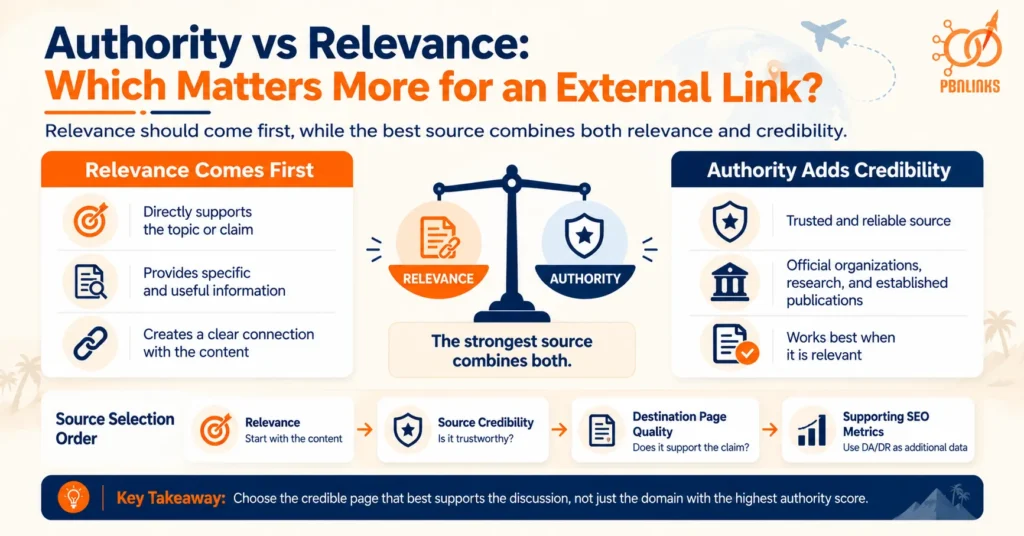
For an external link, relevance should generally come before perceived authority, while the strongest source combines both relevance and credibility. A well known or high metric website is not automatically the best destination if the page being linked to does not directly support the topic, claim, or information surrounding the link.
This distinction is especially important with PBN outbound authority links because “authority” is often reduced to domain metrics. A publisher may choose a major publication, government website, or other established domain simply because it appears powerful. That approach overlooks the more important question: does the destination actually help support the content?
Relevance Creates the Connection
A relevant external link connects the source page with information that logically belongs in the discussion.
Suppose a PBN post mentions a specific Google Search policy. Linking directly to the Google documentation covering that policy creates a clear relationship between the statement and its source. If the article cites an industry statistic, linking to the research or dataset containing that figure provides the same type of connection.
The relationship becomes:
Article Topic → Specific Claim → Relevant External Page
Relevance therefore operates at more than the broad niche level. The destination should ideally relate to the specific point being made where the link appears.
Authority Adds Credibility When It Is Relevant
Authority still matters, but it works best alongside relevance rather than replacing it.
A source should be credible enough to support the information being referenced. Depending on the topic, this could be an official organization, original study, government publication, recognized industry body, established specialist, or reputable publication.
A highly relevant but unreliable page is not automatically a good source. Likewise, a highly credible website is not necessarily useful if the selected page has little connection with the discussion.
The strongest combination is therefore:
Relevant Topic + Credible Source + Useful Information
Page Level Relevance Matters More Than the Domain Name Alone
External link selection should also move beyond evaluating only the domain.
For example, linking to the homepage of a major organization provides little support for a statistic if the organization publishes a separate report containing the actual data. Linking directly to that report gives readers access to the evidence and creates a clearer connection between the claim and destination.
This is why a smaller specialist page can sometimes be more appropriate than a famous homepage. The purpose is not to find the biggest website available. It is to find the most suitable page for the information being referenced.
Where DA and DR Fit Into the Decision
Domain Authority and Domain Rating can provide third party information about a website’s backlink profile, but they should not determine whether an external source is relevant or credible.
Google does not use DA or DR as its own ranking metrics. A high score therefore does not prove that a page is accurate, topically appropriate, or the best source for a particular statement.
These metrics can be considered as supplementary SEO data, but source selection should begin with the content itself.
A practical order is:
Relevance → Source Credibility → Destination Page Quality → Supporting SEO Metrics
For PBN outbound authority links, this leads to a more defensible rule: choose the credible page that best supports the discussion rather than automatically choosing the domain with the highest authority score.
How to Select External Authority Sources for a PBN Post
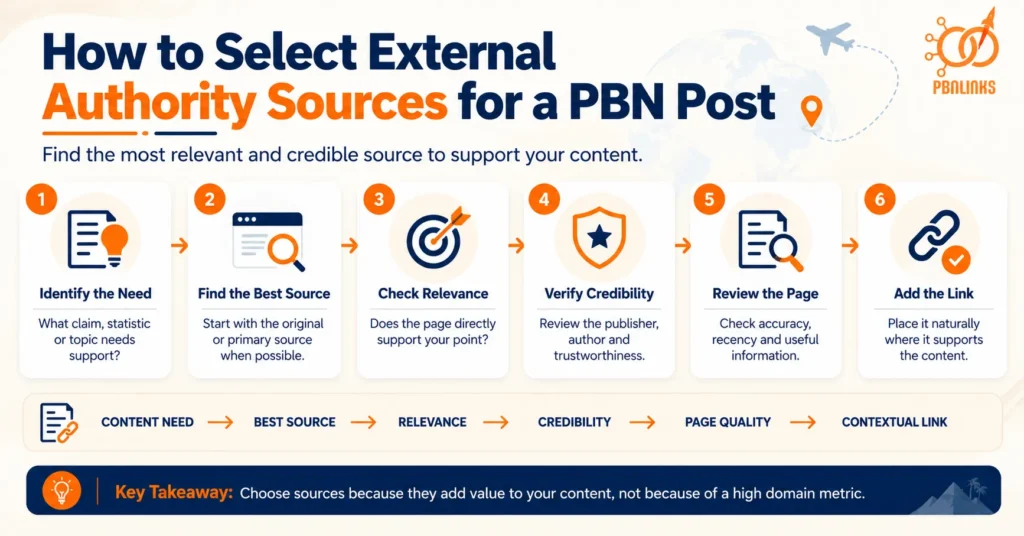
Select external authority sources by starting with the information that needs support, then finding the most relevant and credible page for that specific purpose. Domain reputation can be considered, but it should not replace source relevance, accuracy, originality, or usefulness.
Instead of beginning with a list of high authority websites and looking for places to insert them, work from the content outward. Identify the claim, statistic, definition, technical point, or additional resource that would benefit from a reference, then evaluate potential destinations.
Prioritize Primary and Original Sources
When information originates from a specific organization, study, dataset, or report, the original source is usually the strongest place to start.
For example, if an article cites findings from a research study, linking to the study itself provides a clearer source than linking to another blog that summarizes it. The same principle applies to statistics, surveys, reports, and other data.
Primary sources reduce the distance between the claim and the evidence behind it:
Claim → Original Evidence → Source
This does not mean secondary sources are always unsuitable. It means the original source should be considered first when it is accessible, credible, and directly relevant.
Use Official Documentation for Policies and Technical Information
Official documentation is particularly useful when the article discusses rules, specifications, platform features, policies, or technical processes.
An article discussing Google Search guidance, for example, is generally better supported by the relevant Google documentation than by an unrelated high metric website explaining the same guidance second hand.
The same approach can apply to government regulations, software documentation, standards organizations, and official industry resources.
The important point is specificity. Link to the page containing the relevant information rather than automatically sending readers to the organization’s homepage.
Use Reputable Secondary Sources When They Add Value
Secondary sources can be useful when they explain complex information, provide expert interpretation, compare several primary sources, or cover a subject for which the original material is difficult to access.
A reputable industry publication or specialist resource may therefore be appropriate when it genuinely helps readers understand the point being discussed.
However, the source should still be evaluated on its own merits. A recognizable brand name should not compensate for outdated information, weak sourcing, or a page that only loosely relates to the claim.
Evaluate the Exact Destination Page
Before adding an external link, review the page that readers will actually reach.
Check whether it:
- directly supports the surrounding claim or discussion
- clearly identifies the information being referenced
- comes from a credible publisher or author
- provides original evidence or transparent sourcing where appropriate
- is current enough for a topic where information changes over time
- gives readers useful information beyond what is already stated in the PBN post
This page level review is more useful than relying on domain reputation alone.
A simple source selection process is:
Identify the Need → Find the Original or Best Available Source → Check Relevance → Verify Credibility → Review the Exact Page → Add the Link Where It Supports the Content
For PBN outbound authority links, this approach keeps external linking tied to editorial purpose. The source is selected because it strengthens a particular part of the content, not because the post is expected to contain a predetermined authority link.
Where Should Authority Links Appear in a PBN Post?
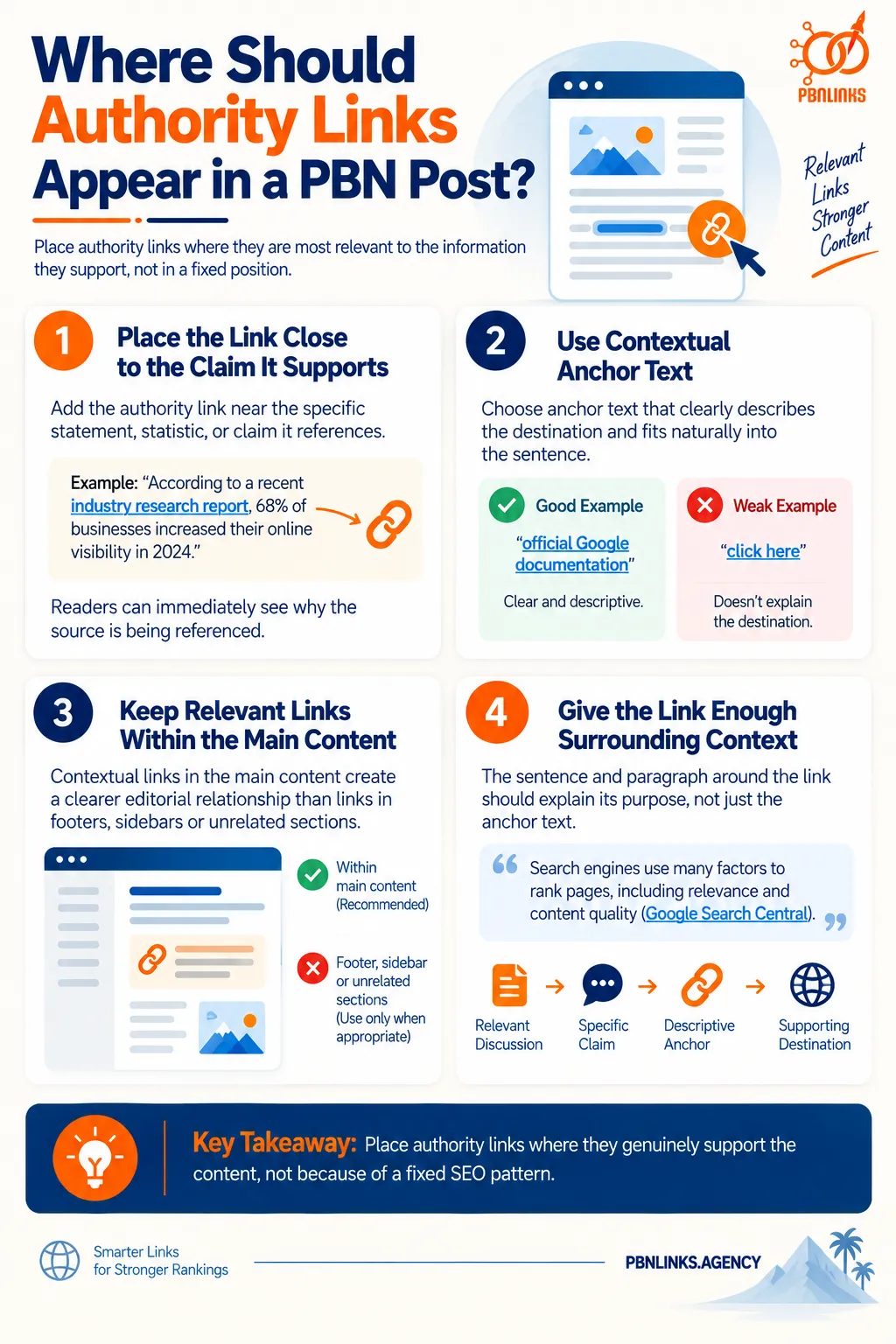
Authority links should appear where they are most relevant to the information they support, usually within the main content and close to the claim, statistic, definition, or resource being referenced. There is no single position in a PBN post that makes an external link more natural or useful in every case.
The placement should make sense to a reader without requiring them to guess why the destination has been linked. This is more useful than placing an authority link in the introduction, middle, or conclusion simply to satisfy a predetermined SEO pattern.
Place the Link Close to the Claim It Supports
When an external source provides evidence for a specific statement, place the link close to that statement.
For example, if a paragraph cites findings from an industry report, the link should appear where those findings are discussed rather than several paragraphs later. The same principle applies to statistics, policies, research findings, definitions, and technical documentation.
This creates a direct relationship:
Claim → Supporting Link → Relevant Source
Readers can immediately understand why the source is being referenced and access it if they want to verify or explore the information.
Use Contextual Anchor Text
The anchor text should help readers understand what they will find after following the link. Generic anchors can sometimes work naturally, but descriptive wording is usually more informative when the surrounding sentence allows it.
For example, an anchor referring to an industry research report communicates more about the destination than an unrelated keyword inserted solely for SEO purposes.
The anchor does not need to reproduce the destination page title exactly. It should fit naturally into the sentence while accurately representing the linked resource.
Keep Relevant Links Within the Main Content
When an authority source directly supports the article, a contextual link within the main content usually creates a clearer editorial relationship than an isolated link placed in a footer, sidebar, or unrelated resource block.
Main content placement allows the link to sit alongside the information that gives it meaning. It also makes it easier for readers to understand why they might want to visit the destination.
This does not mean every external link must appear inside a paragraph. A dedicated references or resources section can be appropriate when the format of the article calls for one. The placement should follow the function of the link.
Give the Link Enough Surrounding Context
A link should not depend on the anchor text alone to explain its purpose. The sentence and paragraph around it should make the relationship between the PBN post and the external destination clear.
A useful placement follows this pattern:
Relevant Discussion → Specific Claim or Resource → Descriptive Anchor → Supporting Destination
This is stronger than inserting an authority link into a sentence simply because the article has reached a particular word count or position.
For PBN outbound authority links, the best placement is therefore the point where the external source contributes most clearly to the content. Placement should follow editorial context rather than a fixed rule about putting authority links near the top, middle, or bottom of every post.
Do Authority Links Make a PBN Post Look More Natural?
Relevant authority links can make a PBN post resemble normal editorial content when those links genuinely support the discussion, but there is no documented Google rule requiring authority links to make a page appear natural. Adding Wikipedia, government, university, or major publication links solely for appearance should therefore not be treated as a proven SEO tactic.
Ordinary articles often link externally because they cite research, reference documentation, support factual claims, or direct readers to useful resources. A PBN post can do the same. The difference is whether the link grows naturally from the content or is inserted because the publisher believes every post needs an authority link.
Editorially Necessary Links
The most natural reason to link externally is that another page contributes something useful to the article.
A statistic may need its original source. A technical statement may benefit from official documentation. A complex subject may have a useful study or resource that readers can explore for additional information.
In these situations, the link has an identifiable editorial function:
Content Need → Relevant Source → Contextual Link
The destination happens to be authoritative because it is a suitable source, rather than being selected simply to create the appearance of authority.
Decorative Authority Links
A decorative authority link works in the opposite direction. The publisher first decides that the article needs an authority link and then searches for a recognizable website to insert.
For example, linking to a government homepage, Wikipedia article, university website, or major news publication adds little editorial value when the destination does not support anything specific in the surrounding content.
The presence of a famous domain alone does not establish that the post is better researched, more relevant, or more useful.
Repeated External Linking Patterns
A fixed external linking formula can also produce repetitive publishing behavior.
If every PBN post contains the same number of authority links, uses the same types of destinations, or places those links in approximately the same positions, the process is being driven by a template rather than by the needs of individual articles.
This does not mean a particular pattern automatically identifies a PBN. There is no public Google formula establishing that. The practical issue is simpler: different topics naturally require different sources and different amounts of supporting information.
A technical guide may need several references, while a straightforward article may need only one or none at all.
Natural Linking Without a Formula
The better approach is to decide on external links after considering what the content actually needs.
Ask whether a source supports a claim, provides original evidence, clarifies a concept, or gives readers useful additional information. If it does, linking to it can be editorially justified. If the only reason for adding the link is that the domain is considered authoritative, the placement deserves reconsideration.
For PBN outbound authority links, natural linking is better treated as the result of genuine editorial decisions rather than something created by adding a predetermined number of high authority domains. The content should determine when and where an external link belongs.
How Many Outbound Authority Links Should a PBN Post Have?
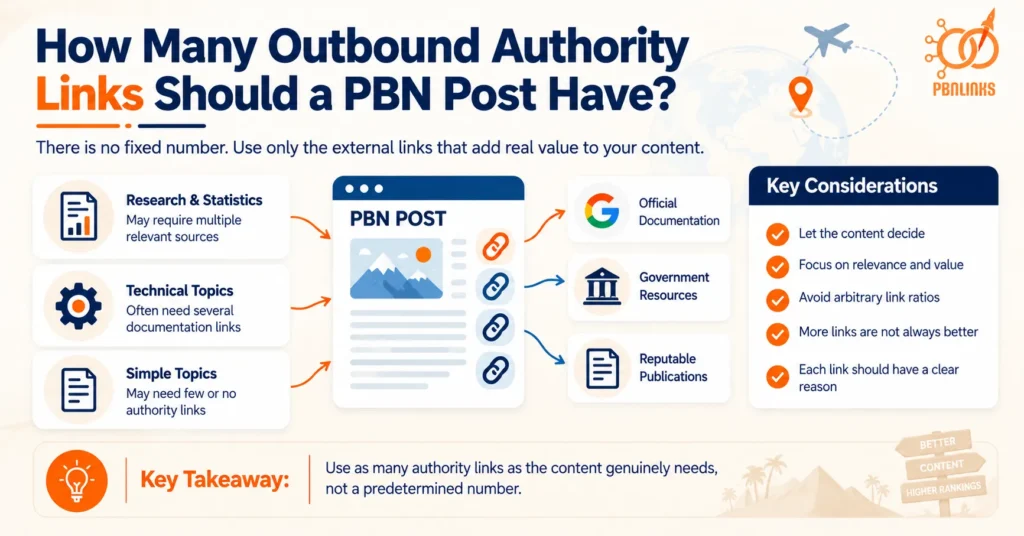
There is no universal number of outbound authority links that every PBN post should contain. The appropriate number depends on the topic, the amount of information requiring external support, and whether each source contributes something useful to the article. A post may need no authority links, while a research focused article may naturally reference several credible external sources.
The content itself should determine how many outbound links are appropriate. Statistics, research findings, policies, technical documentation, and claims based on another organization’s work are common reasons to cite external sources. If several parts of a post require this type of support, using multiple relevant links can make sense. If the article is straightforward and self contained, adding extra authority links simply to reach a target number provides little editorial benefit.
Topic complexity also matters more than word count alone. A detailed technical article may require several references even if it is relatively short, while a longer informational post may need fewer. For this reason, rules such as one authority link per 500 words or exactly two external links per article should be treated as publishing conventions rather than SEO requirements. Google does not specify an ideal number of outbound links that every page should contain.
At the same time, the absence of a fixed limit does not mean more external links are always better. Unnecessary links can interrupt the reading experience, send users to destinations that add little value, and expand the page’s overall outbound link structure without a clear purpose. Followed links also participate in PageRank flow, but this should not be reduced to a formula where every additional authority link is assumed to weaken the target backlink by a predictable percentage.
For PBN outbound authority links, the most practical approach is to use only the external sources the content can genuinely justify. Each link should support evidence, clarify information, provide an original source, or give readers a useful resource. The right number is therefore determined by editorial need and relevance, not by an arbitrary outbound link ratio.
Should Authority Links Be Followed or Nofollowed?
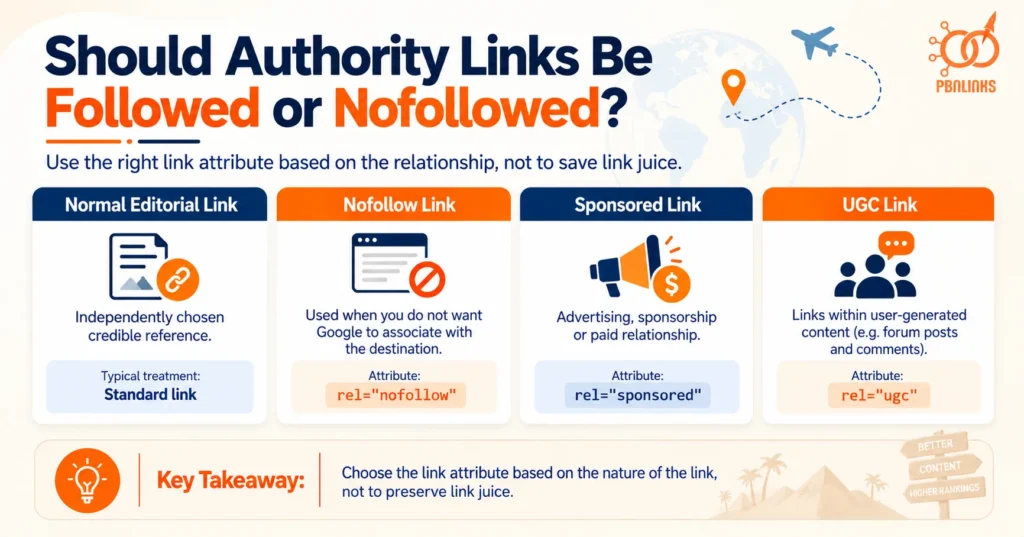
A genuine editorial authority link does not automatically need a nofollow attribute. The appropriate link attribute should reflect the relationship between the PBN post and the external destination, rather than being selected simply to preserve PageRank or reduce the amount of link value leaving the page.
If a source is being referenced normally because it supports a claim, provides documentation, or gives readers useful additional information, the link can generally function as a standard crawlable link. Different treatment becomes relevant when the link involves sponsorship, user generated content, or another relationship that needs to be identified.
Normal Editorial Links
A normal editorial link is appropriate when the publisher independently chooses to reference another page because that destination contributes to the content.
For example, a PBN post might cite an original research report for a statistic or link to official documentation explaining a technical concept. If there is no commercial arrangement or other reason to qualify the relationship, adding nofollow simply because the destination is external is not necessary.
The decision should begin with why the link exists, not with an attempt to retain as much link equity as possible.
Nofollow Links
The nofollow attribute can be used when a publisher does not want Google to associate the site with the linked destination or when other qualification values are not appropriate.
It should not be treated as a default setting for every authority link. Likewise, using nofollow across supporting external links solely because a page also contains a target backlink turns the attribute into a PageRank management tactic rather than a description of the link relationship.
For ordinary credible sources, the fact that a link points away from the PBN does not by itself create a reason to nofollow it.
Sponsored Links
Links involving advertising, sponsorship, payment, or another commercial arrangement require different consideration. Google recommends using rel=”sponsored” for links that are advertisements or paid placements, with nofollow also remaining acceptable for qualifying such links.
This distinction is especially important in link building discussions. A normal citation to an independent source and a link placed because of compensation are not the same type of relationship and should not automatically receive identical treatment.
UGC Links
The ugc value is intended for links within user generated content, such as forum posts and comments. It is therefore unlikely to apply to most editorial authority links placed directly inside a PBN article.
Its relevance depends on where the link originates. If a website allows users to contribute content containing links, ugc can help identify that relationship. It should not be added to ordinary editorial references merely because it is another available link attribute.
For PBN outbound authority links, the practical principle is straightforward: choose the link attribute according to the nature of the link, not according to a formula for conserving link juice. A genuine editorial citation, a sponsored placement, and a user generated link serve different purposes and should be treated accordingly.
What Does Co Citation Mean for PBN Outbound Links?
Co citation describes a relationship created when different pages, websites, or entities are referenced in connection with the same content or sources. In PBN discussions, the concept is sometimes used to argue that linking to a target page alongside authoritative websites can strengthen topical associations. However, there is no established Google rule showing that deliberately adding authority links beside a PBN backlink produces a predictable ranking benefit.
The concept is still useful for understanding how websites and topics can be connected, but it should not become a formula for selecting outbound links.
Co Citation
In its traditional sense, co citation occurs when two documents are cited by another document or share citation relationships. In SEO discussions, the term is often used more broadly to describe websites or resources being referenced within related contexts.
For example, an article about search engine crawling might reference Google documentation, an industry study, and another relevant resource. Those sources become associated through the topic and citation context of the article.
This does not mean that every page mentioned alongside an authoritative source automatically inherits its authority. Co citation describes a relationship between references, not a direct transfer of ranking strength from one destination to another.
Co Occurrence
Co occurrence is related but focuses more on terms, brands, entities, or concepts appearing together within textual context, even when a direct link is not necessarily involved.
If a page consistently discusses related entities within a clearly defined subject, those relationships can help make the topic understandable. This is different from assuming that inserting several famous names or authority links will manufacture topical relevance.
For PBN posts, meaningful co occurrence comes from coherent content in which the entities naturally belong together.
Topical and Entity Relationships
Outbound links can contribute to a broader network of contextual relationships when the destinations genuinely relate to the article.
A useful semantic pattern might look like:
Article Topic → Relevant Entity → Supporting Source → Related Information
For example, a technical SEO article discussing crawling can naturally reference search engines, crawling directives, official documentation, and relevant research because those concepts belong within the same subject.
The strength of that context comes from the relationships between the information being discussed. It should not depend on adding unrelated high authority domains merely to place the target backlink near recognizable websites.
Ranking Claims and Evidence
The largest problem with co citation in SEO is turning a descriptive concept into a guaranteed ranking tactic.
There is no reliable public formula showing that placing a target backlink on the same page as links to Google, Wikipedia, government websites, universities, or other authoritative domains causes additional ranking value to pass to the target.
The same caution applies to claims that authority links automatically create stronger topical relevance simply because the destinations have high authority metrics.
For PBN outbound authority links, co citation is therefore best understood as a way to think about relationships among sources, entities, and topics rather than as a standalone ranking technique. Relevant sources can strengthen the informational context of a page, but deliberately surrounding a target backlink with authority links should not be treated as a proven method for increasing its SEO value.
Can Outbound Links Create SEO or Quality Problems?
Yes, outbound links can create quality or SEO concerns when they point to irrelevant, unreliable, broken, or improperly qualified destinations. The problem is not external linking itself. It is whether the destination and purpose of the link make sense within the page.
A source that was appropriate when an article was published can also change over time. For this reason, outbound links should be treated as part of the content that may require periodic review rather than as permanent references that never need checking.
Irrelevant Destinations
An external link should have a clear relationship with the information surrounding it. Linking to an unrelated website simply because it has strong authority metrics does little to support the article and can create a confusing experience for readers.
The same applies when the broad domain is relevant but the exact destination page is not. A link should ideally lead readers to the information they expect based on the anchor text and surrounding discussion.
For PBN posts, this is another reason to avoid selecting external destinations primarily through DA, DR, or a predetermined list of authority websites.
Low Quality or Changed Sources
External destinations are not static. A useful page can become outdated, substantially change its content, move to another URL, or even change ownership.
This matters because an article may continue recommending or citing the destination long after the original information has disappeared. A once credible reference can therefore become a poor source without any change being made to the PBN post itself.
Important outbound sources should be reviewed periodically, particularly when the article covers topics where policies, statistics, research, or technical information change over time.
Broken External Links
A broken outbound link prevents readers from reaching the resource the article promised to provide.
Broken links can occur when pages are deleted, URLs change, websites close, or content is reorganized without a working redirect. Although an isolated broken link should not automatically be interpreted as a ranking problem, leaving important references broken reduces the usefulness and maintenance quality of the page.
When a linked source disappears, check whether the original publisher has moved the content to another URL. If not, replace it with another credible source when an appropriate alternative exists or remove the reference if it is no longer necessary.
Paid and Manipulative Links
Outbound linking becomes more sensitive when compensation or ranking manipulation is involved.
Google’s spam policies identify buying or selling links for ranking purposes and other links created primarily to manipulate search rankings as link spam. Google also provides sponsored and nofollow attributes for qualifying links where appropriate.
This creates an important distinction for PBN discussions. Adding credible authority links elsewhere on a page does not change the underlying purpose or status of another link. An article cannot make a manipulative backlink compliant with Google’s policies simply by surrounding it with links to reputable websites.
For PBN outbound authority links, the safer editorial principle is to evaluate every destination independently. Check whether the source is relevant, still credible, accessible, accurately represented by its anchor and context, and appropriately qualified when a particular relationship exists. Outbound link quality depends on the purpose and destination of the link, not merely on the authority associated with the domain.
PBN Outbound Authority Link Checklist
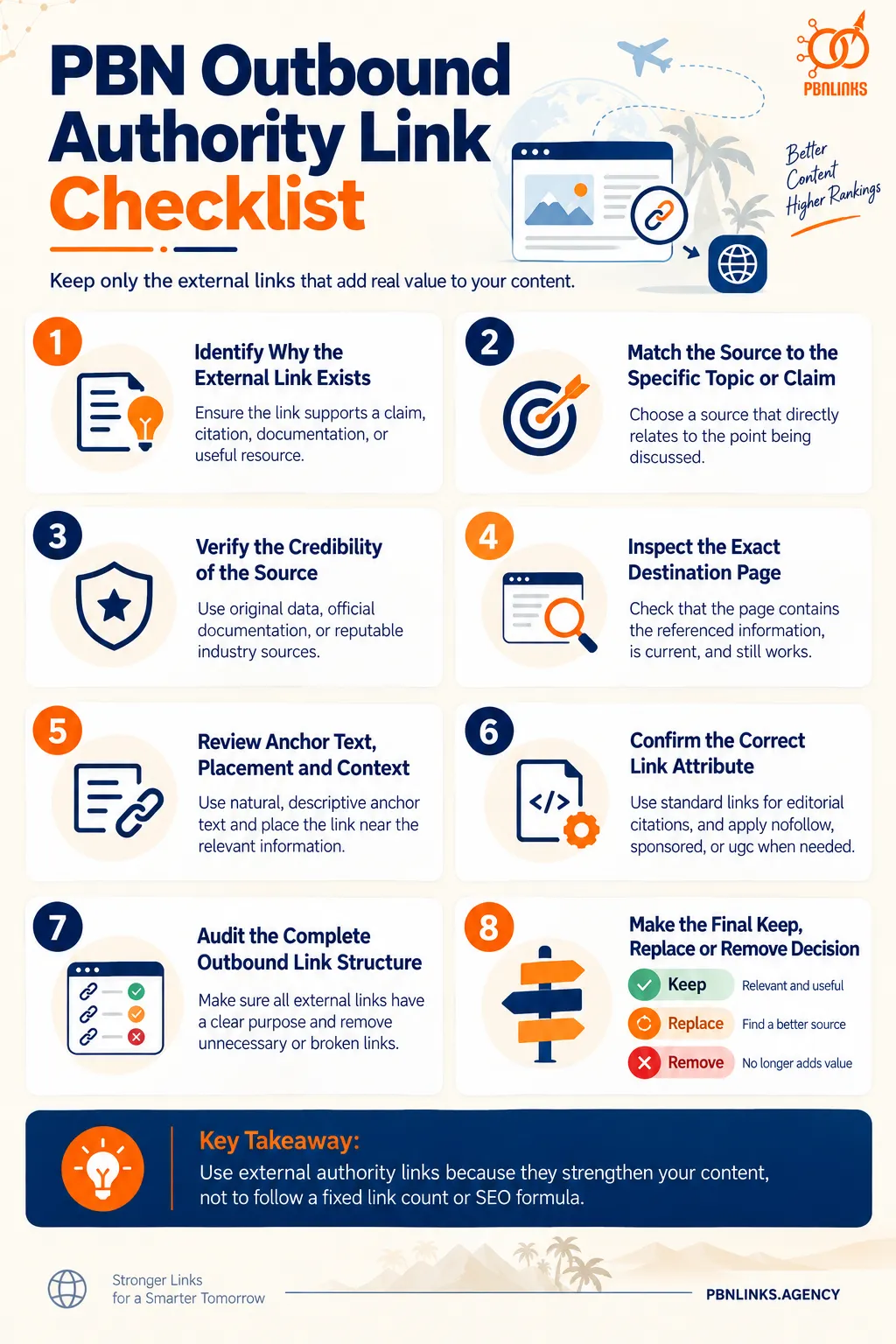
A PBN outbound authority link should remain on the page only when it has a clear editorial purpose, points to a relevant and credible source, fits the surrounding context, and uses an appropriate link attribute. There is no need to reach a predetermined number of authority links. The objective is to review each external link individually and then evaluate how the complete outbound link structure fits the page.
Use the following framework before publishing a new PBN post or when auditing an existing one.
Step 1: Identify Why the External Link Exists
Start with the purpose of the link.
A useful outbound authority link normally performs at least one clear function. It may support a factual claim, identify the original source of a statistic, reference research, point to official documentation, verify information, or give readers a relevant resource for further reading.
Ask:
What does this link add that the paragraph would otherwise be missing?
If the only answer is that every PBN post should contain an authority link, the link does not yet have a strong editorial justification.
Step 2: Match the Source to the Specific Topic or Claim
Next, evaluate relevance at the point where the link appears.
Do not stop at broad niche relevance. A website may belong to the same industry while the specific destination page has little connection with the statement being supported.
A stronger relationship is:
Article Topic → Section Context → Specific Claim → Relevant Source
For example, a statistic should ideally connect to the page containing that data, while a statement about a search engine policy should connect to the documentation covering that policy.
The closer the source matches the information being referenced, the clearer the reason for the link becomes.
Step 3: Verify the Credibility of the Source
Once relevance is established, determine whether the source is credible enough for the information it is being used to support.
Consider who published the material, whether the information can be verified, whether the publisher has appropriate expertise, and whether the source is current where freshness matters.
When available, consider sources in this order:
- Original research or primary data
- Official documentation or organizational publications
- Recognized industry or specialist sources
- Reputable secondary sources that clearly identify their evidence
This is not a rigid ranking system. It is a practical way to move closer to the original evidence whenever possible.
DA and DR can provide supplementary SEO information about a domain, but they should not replace relevance, credibility, or source quality.
Step 4: Inspect the Exact Destination Page
Evaluate the URL readers will actually reach, not just the reputation of its domain.
Open the destination and confirm that the page:
- contains the information being referenced
- still resolves to the intended content
- has not materially changed since it was selected
- provides useful information beyond the PBN post
- is current enough for the subject
- matches what the anchor and surrounding text imply
This check becomes especially important during later audits. External pages can move, disappear, become outdated, redirect elsewhere, or change ownership.
A credible domain does not compensate for an unsuitable destination page.
Step 5: Review Anchor Text, Placement and Surrounding Context
The link should be understandable within the sentence and paragraph where it appears.
Place supporting links close to the claim, statistic, definition, research finding, or resource they relate to. Use anchor wording that accurately represents what readers can expect at the destination.
A useful contextual pattern is:
Relevant Discussion → Supported Information → Descriptive Anchor → Supporting Source
Avoid inserting authority links at predetermined positions such as the first paragraph, middle of the article, or final section merely to create a consistent PBN linking pattern.
The content should determine the placement.
Step 6: Confirm the Correct Link Attribute
Review whether the link relationship requires qualification.
A genuine editorial citation does not automatically need nofollow simply because it points to another website. Where a link involves sponsorship, payment, user generated content, or another relationship requiring qualification, use the appropriate attribute.
The decision should follow:
Link Relationship → Appropriate Attribute
rather than:
Need to Preserve Link Juice → Nofollow External Links
This keeps link qualification connected to what the link represents instead of using attributes as a mechanical PageRank management tactic.
Step 7: Audit the Complete Outbound Link Structure
After reviewing individual links, step back and evaluate the entire page.
Check whether multiple external links serve distinct purposes or simply repeat similar information. Look for irrelevant destinations, decorative authority links, unnecessary commercial links, broken URLs, outdated sources, and external links added only to reach a target count.
Also consider the relationship between supporting external links and the primary target backlink. Additional followed links participate in the page’s overall link structure, but this does not justify removing useful sources solely to maximize perceived link juice.
The goal is not the fewest links possible. It is the fewest unnecessary links while retaining every external reference the content genuinely benefits from.
Step 8: Make the Final Keep, Replace or Remove Decision
Every outbound link should finish the audit with one of three outcomes:
Keep: The link is relevant, credible, useful, contextual, and appropriately qualified.
Replace: The information still needs support, but a more relevant, original, current, or credible destination is available.
Remove: The link adds no meaningful value, no longer supports the content, is broken without a suitable replacement, or exists primarily to satisfy an arbitrary authority link formula.
Before publishing, run one final five point check:
Relevant? → Credible? → Useful? → Contextual? → Correctly Qualified?
If the answer is yes at every stage, the link has a defensible reason to remain.
For PBN outbound authority links, this is more useful than following a fixed link count, authority threshold, or outbound link ratio. A well reviewed PBN post should contain the external links its content genuinely requires, placed where they help the reader and supported by a clear editorial reason.
Conclusion
In conclusion, PBN outbound authority links are most useful when they serve a genuine editorial purpose rather than follow a predetermined SEO formula. Relevant external sources can support claims, improve context, provide evidence, and give readers access to useful information, but simply linking to a high authority website does not guarantee better rankings.
Source selection should prioritize relevance, credibility, and the quality of the exact destination page rather than DA or DR alone. Additional followed links can influence PageRank flow, but their effect should not be reduced to a fixed link juice calculation. Likewise, co citation and authority linking should not be treated as proven methods for increasing the value of a target backlink.
The most practical approach is to use only the external links the content can justify, place them where they naturally support the discussion, apply the correct link attributes, and review them periodically for relevance, accuracy, and accessibility. A strong outbound linking strategy is built around editorial purpose and sound SEO judgment, not arbitrary link counts or repeated authority site patterns.
If you need a more structured approach to building relevant, carefully planned backlink campaigns, PBNLinks.agency can help you develop a link building strategy aligned with your niche, target pages, and SEO goals.
FAQs About PBN Outbound Authority Links
Do PBN Outbound Authority Links Help SEO?
PBN outbound authority links can improve sourcing, context, and usefulness, but linking to an authoritative website does not guarantee a ranking boost. The external link should be included because the destination genuinely supports the content.
Should Every PBN Post Link to an Authority Site?
No, every PBN post does not need an authority link. Add external sources when they support claims, research, statistics, documentation, or useful additional information, not simply to satisfy an SEO formula.
Do Outbound Authority Links Dilute Link Value?
Additional followed links can affect how PageRank flows through a page, but there is no reliable formula for calculating how much SEO value each link receives. PageRank distribution should not be treated as a predictable percentage reduction in backlink value.
How Many Outbound Authority Links Should a PBN Post Have?
There is no ideal number of outbound authority links for every PBN post. Use as many credible external sources as the content genuinely requires, while removing links that add no meaningful value.
Should Authority Links Be Followed or Nofollowed?
Normal editorial links to trusted sources do not automatically need nofollow. Use sponsored or nofollow for paid links where appropriate, and ugc or nofollow for applicable user generated links.
Is Relevance More Important Than Domain Authority for External Links?
Relevance should generally come before Domain Authority when selecting an external source. The best destination directly supports the topic or claim and comes from a credible source. DA is a third party metric, not a Google ranking metric.
Does Linking to Wikipedia Improve Rankings?
Linking to Wikipedia does not automatically improve rankings. Use a Wikipedia page when it provides relevant information for readers, not because the domain itself is assumed to transfer authority back to your page.
Does Co Citation With Authority Sites Improve PBN Backlinks?
There is no confirmed ranking benefit from placing a PBN backlink alongside links to authoritative websites. Co citation can describe relationships among sources and entities, but it should not be treated as a proven method for increasing backlink value.
Can Too Many Outbound Links Hurt a PBN Post?
Too many unnecessary outbound links can reduce clarity and create a poor linking structure, but Google does not specify a universal maximum. Keep links that serve a clear editorial purpose and remove those added only to meet a ratio or pattern.
Can Authority Links Make a Manipulative PBN Backlink Safe?
No, adding authority links does not make a manipulative backlink compliant with Google’s spam policies. Google evaluates links created primarily to manipulate search rankings separately from legitimate editorial citations.