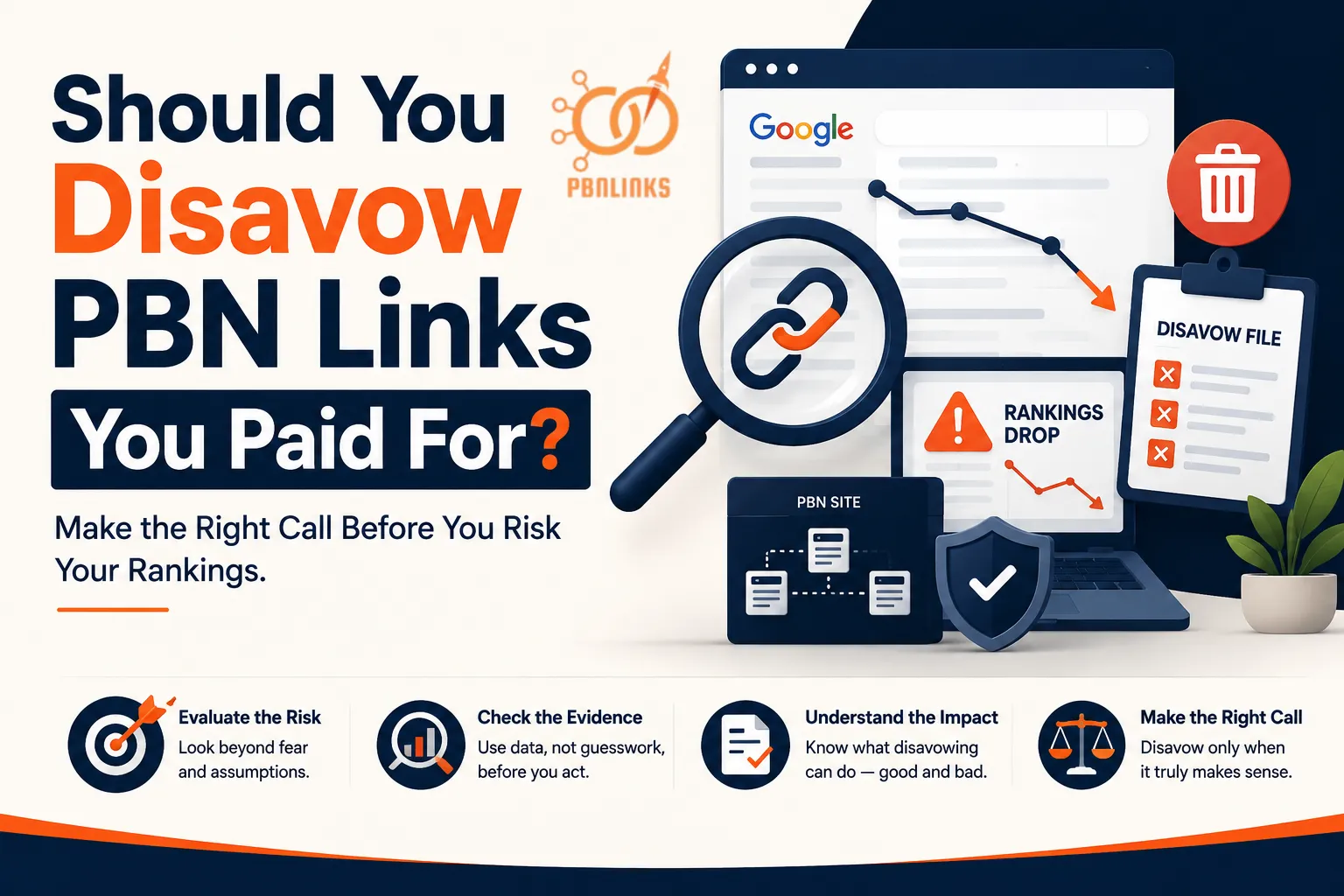
Should You Disavow PBN Links You Paid For?
You paid for PBN links, and now you are wondering if those links could put your website at risk. Maybe your rankings have dropped, you received a warning, or you simply started questioning whether those backlinks should still be part of your profile.
The obvious reaction is to disavow PBN links and move on. But that is not always the right answer.
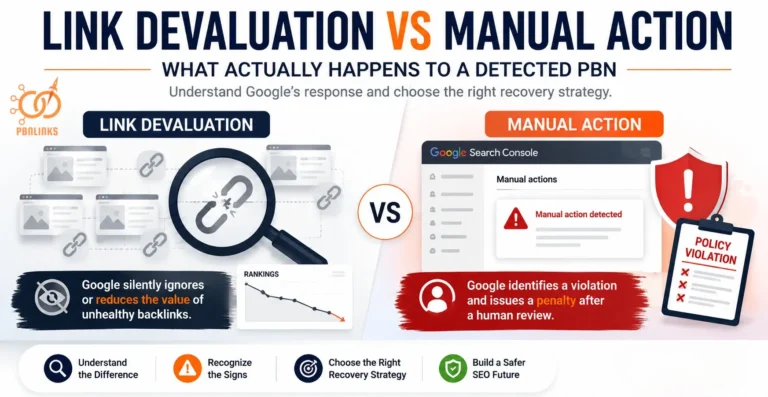
Paying for a backlink does not automatically mean you should submit a disavow file. Google can ignore or devalue links without requiring you to take action, and a ranking drop by itself does not prove that your PBN links caused a problem.
The real question is whether there is a clear reason to disavow those links. That means looking at your backlink profile, checking for manual actions, understanding which links can be removed, and separating actual evidence from assumptions.
Before you submit anything to Google, understand when disavowal makes sense, when it is premature, and what could happen if you disavow links that did not need to be ignored.
What Does It Mean to Disavow PBN Links?
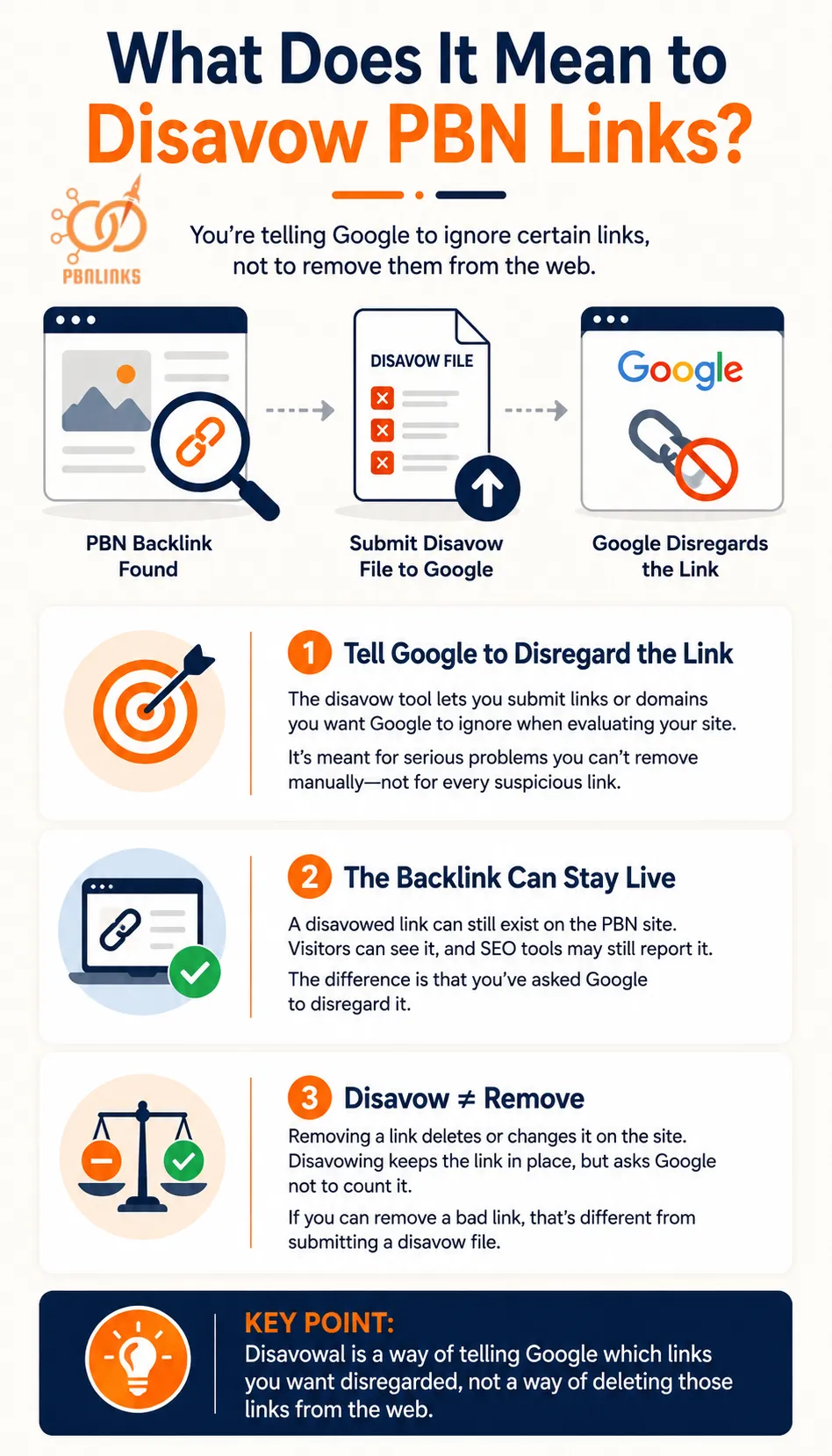
Before deciding whether to disavow PBN links, it is important to understand what the disavow process actually does. Disavowing a backlink does not remove it from the website where it appears. Instead, you are telling Google that you do not want certain links to be considered when evaluating your site.
This makes disavowal very different from asking a webmaster to remove a backlink. The link can remain visible on the referring page even after you submit a disavow file.
What the Disavow Tool Actually Does
Google’s disavow tool allows website owners to submit a file containing backlinks or referring domains they want Google to disregard.
The tool is mainly intended for situations where a site has a significant number of problematic or unnatural links and those links cannot reasonably be removed manually. It is not designed as a routine way to clean up every backlink that looks questionable.
Disavowing a Link Does Not Remove the Link
A disavowed backlink can still exist on the PBN website. Visitors may still see it, and third party backlink tools may continue to report it.
The difference is that you have submitted a request for Google to disregard those links when evaluating your site. This is why disavowal should not be confused with backlink removal.
Disavowing a Link Is Not the Same as Removing It
Removing a backlink means the link itself is deleted or changed on the referring website. Disavowing it means the link remains in place, but you are asking Google not to take it into account.
That distinction matters when dealing with PBN links. If you control the referring site and can simply remove a problematic link, that is a different action from submitting a disavow file.
The key point is simple: disavowal is a way of telling Google which links you want disregarded, not a way of deleting those links from the web. Understanding that difference is the first step before deciding whether you actually need to use it.
Does Paying for a PBN Link Mean You Should Disavow It?
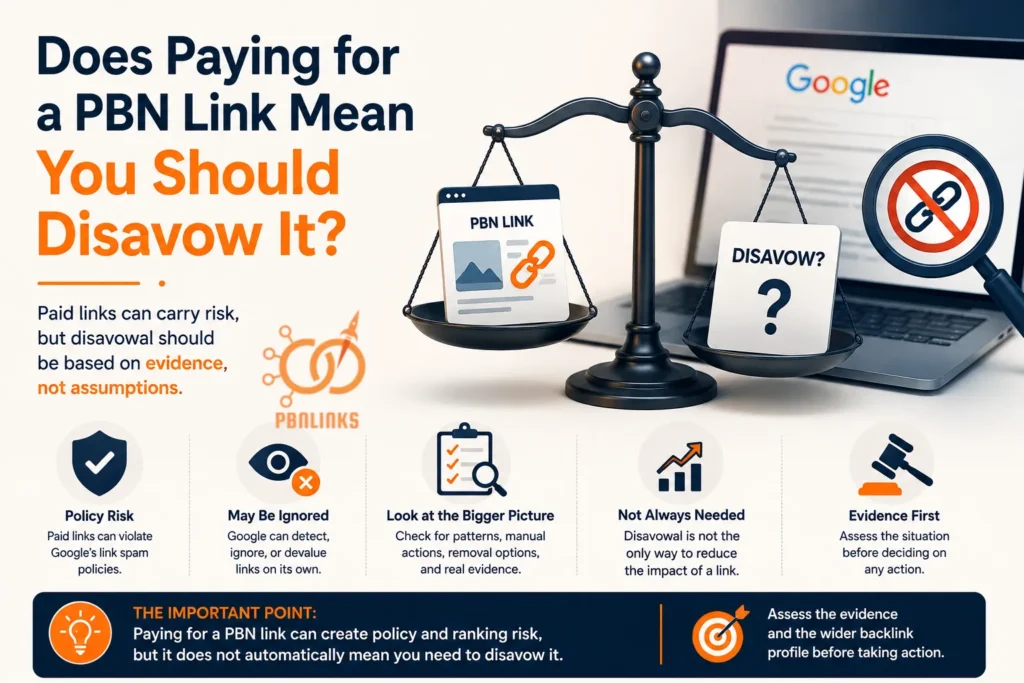
Paying for a PBN link does not automatically mean you should disavow it. The important question is not simply whether money was exchanged, but whether there is a clear reason to believe the links are creating a problem that requires action.
Google’s spam policies are concerned with links created primarily to manipulate search rankings. However, that does not mean every paid or suspicious backlink requires a disavow file.
Paid Links and Google’s Link Spam Policies
Links bought primarily to manipulate rankings can fall under Google’s link spam policies. This is why paid PBN links carry a different level of risk from links that are earned naturally.
But the existence of a paid link does not tell you what Google has done with it. Google’s systems may detect, ignore, or otherwise handle links differently depending on the circumstances.
A Paid Link Is Not Automatically a Disavow Candidate
The fact that you paid for a PBN link is not, by itself, enough reason to submit a disavow file.
You should first look at the wider situation. Ask whether the links are part of a clearly manipulative pattern, whether you have received a relevant manual action, whether the links can be removed, and whether there is any actual evidence that they are causing a problem.
Google May Ignore or Devalue Links Without a Disavow
Google can choose not to use certain links as ranking signals. That means a link can exist on a webpage without necessarily providing the ranking benefit the site owner expected.
This is important because disavowing a link is not the only way for a problematic backlink to lose its influence. You should understand the difference between Google ignoring a link on its own and you submitting a request to have specific links disregarded.
The important point is simple: paying for a PBN link can create policy and ranking risk, but it does not automatically mean you need to disavow it. Assess the evidence and the wider backlink profile before taking action.
When Should You Consider Disavowing PBN Links?
Disavowal makes the most sense when there is a clear link related problem and the problematic links cannot reasonably be removed. It should be a deliberate response to a specific situation, not a routine cleanup step after buying PBN links.
The strongest cases involve clear evidence of unnatural linking and a backlink profile that cannot be cleaned up through normal removal.
You Have a Manual Action for Unnatural Links
A manual action for unnatural links is one of the clearest situations where your backlink profile deserves serious attention. Check the Manual Actions report in Google Search Console to confirm whether Google has actually taken manual action against the site.
If a manual action is present, review the affected links and make reasonable efforts to remove the problematic ones. A disavow file may be appropriate when harmful links cannot be removed.
You Have a Large Number of Manipulative Links You Cannot Remove
A large collection of links created specifically to manipulate rankings can be more concerning than an isolated questionable backlink.
If those links cannot be removed because you do not control the referring sites, a carefully prepared disavow file may be worth considering. The focus should be on the links that genuinely represent a problem rather than disavowing everything that looks imperfect.
You Know the Links Were Created to Manipulate Rankings
Intent matters when assessing paid PBN links. If links were deliberately created to influence rankings rather than to provide genuine editorial value, they deserve closer review.
However, knowing that a link was created for ranking purposes does not mean you should automatically disavow every such link. Look at the scale, pattern, and circumstances before deciding whether action is necessary.
You Have a Clear Reason to Believe the Links Need to Be Disregarded
The best reason to disavow is a specific, evidence based concern rather than general fear about PBNs.
Review your backlink profile, check for manual actions, identify links that cannot be removed, and determine whether the situation actually calls for disavowal. If the evidence is weak, rushing to submit a large file may create more uncertainty than it solves.
The key point is simple: consider disavowal when you have a genuine link related problem, especially one involving substantial unnatural links that cannot be removed. Do not treat the disavow tool as a standard cleanup step for every paid backlink.
When Shouldn’t You Disavow PBN Links?
Not every PBN backlink needs to be disavowed. In fact, submitting a disavow file simply because a link looks suspicious, comes from a weak domain, or was paid for can be an unnecessary response.
The better approach is to look for a clear reason before taking action. If there is no evidence of a link related problem, there may be nothing that needs to be disavowed.
You Are Disavowing Links Just Because They Look Suspicious
A backlink can look unusual without causing a problem. Low domain metrics, unfamiliar websites, or links from pages you would not normally choose do not automatically mean Google considers those links harmful.
Third party SEO tools can help identify backlinks for review, but their toxicity or risk scores are not Google’s own assessment. Use them to investigate links rather than treating their scores as proof that a disavow is necessary.
Your Rankings Dropped and You Are Looking for Something to Blame
A ranking drop alone is not enough evidence that PBN links caused the problem. Rankings can change because of Google’s ranking systems, stronger competitors, content changes, technical issues, or changes in search behavior.
Before disavowing anything, look at when the rankings changed and what else changed around the same time. A backlink audit should help identify evidence of a link problem rather than simply provide something to blame.
You Can Simply Remove the Links
If you control the PBN sites and believe certain links should no longer exist, removing the links directly is different from disavowing them.
Actual removal takes the link off the referring page. A disavow file does not remove the backlink from the web, so do not use disavow as a substitute for straightforward link removal when removal is available.
You Have No Evidence of a Link Related Problem
If there is no manual action, no clear pattern of manipulative links, and no other evidence connecting the backlink profile to a problem, disavowing a large number of links may be premature.
The goal should be to make decisions based on evidence rather than fear. A backlink profile does not need to be perfectly clean to be useful, and not every questionable link requires intervention.
The key point is simple: do not disavow PBN links simply because they look bad, were paid for, or appeared before a ranking decline. Establish a real reason for action first, then decide whether disavowal is actually necessary.
How Do You Know If Your PBN Links Are Actually a Problem?
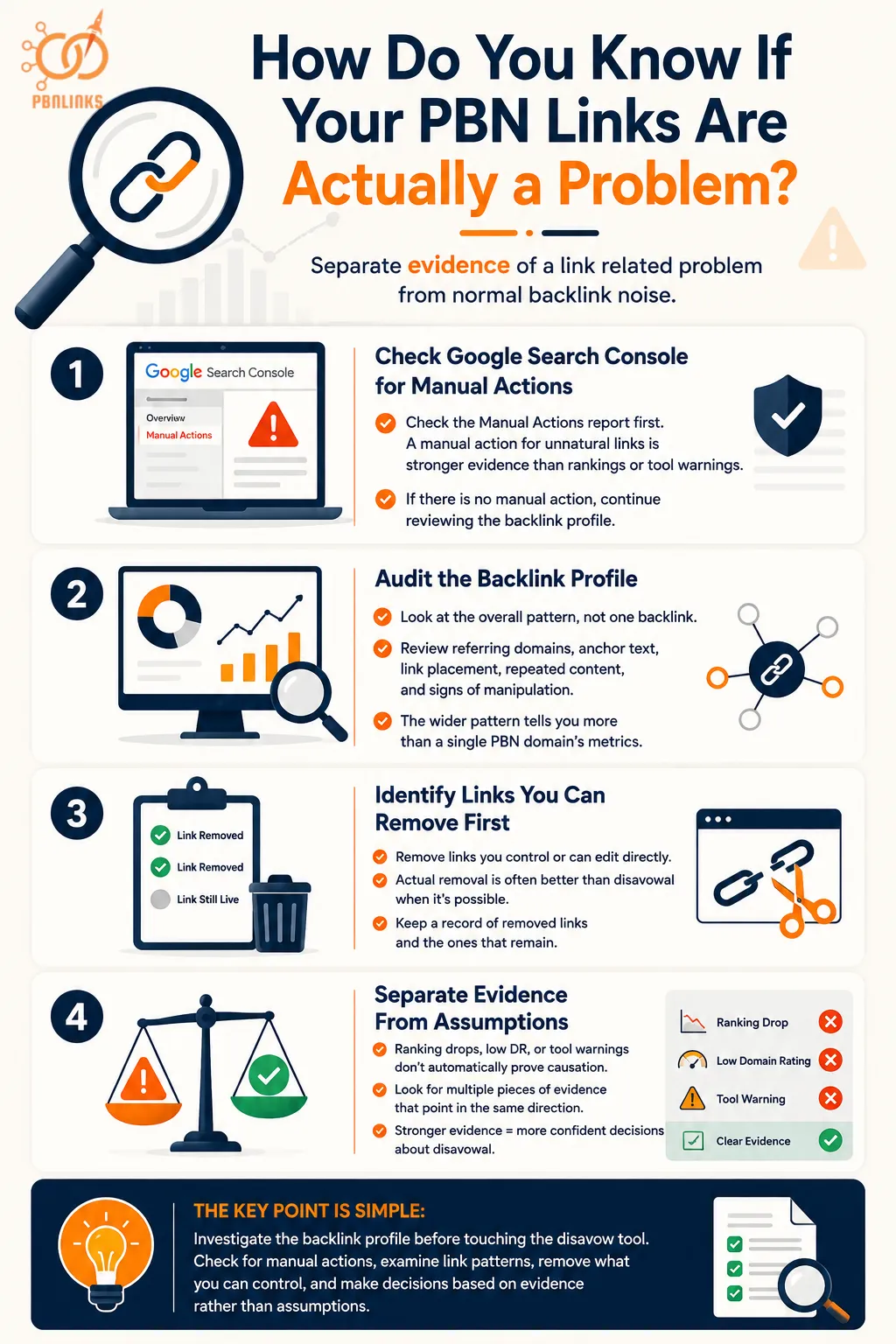
Before you disavow PBN links, you need to establish whether there is a real problem in the first place. A large backlink profile can contain paid, low quality, irrelevant, or unusual links without every one of them requiring action.
The goal is to separate evidence of a link related problem from normal backlink noise.
Check Google Search Console for Manual Actions
Start with Google Search Console and check the Manual Actions report. If Google has issued a manual action related to unnatural links, that is much stronger evidence than a ranking drop or a third party tool warning.
If there is no manual action, do not assume that everything is safe or that everything is harmful. Continue reviewing the backlink profile and the circumstances surrounding the links.
Audit the Backlink Profile
Look at the overall pattern rather than focusing on one backlink.
Pay attention to the number of referring domains, anchor text patterns, link placement, repeated content, and whether a large group of links appears to have been created primarily to manipulate rankings.
The wider pattern can tell you much more than the metrics of a single PBN domain.
Identify Links You Can Remove First
If you control the PBN sites or have access to the people managing them, identify links that can be removed directly.
Actual removal can be preferable to disavowal when it is practical because the backlink is no longer present on the referring page. Keep a record of which links were removed and which ones remain.
Separate Evidence From Assumptions
This is where many backlink cleanup decisions go wrong. A ranking decline, a low domain rating, or a warning from an SEO tool does not automatically prove that a PBN link caused the problem.
Look for several pieces of evidence that point in the same direction. The stronger the evidence, the more confident you can be in deciding whether disavowal is justified.
The key point is simple: investigate the backlink profile before touching the disavow tool. Check for manual actions, examine link patterns, remove what you can control, and make decisions based on evidence rather than assumptions.
What Happens After You Disavow PBN Links?
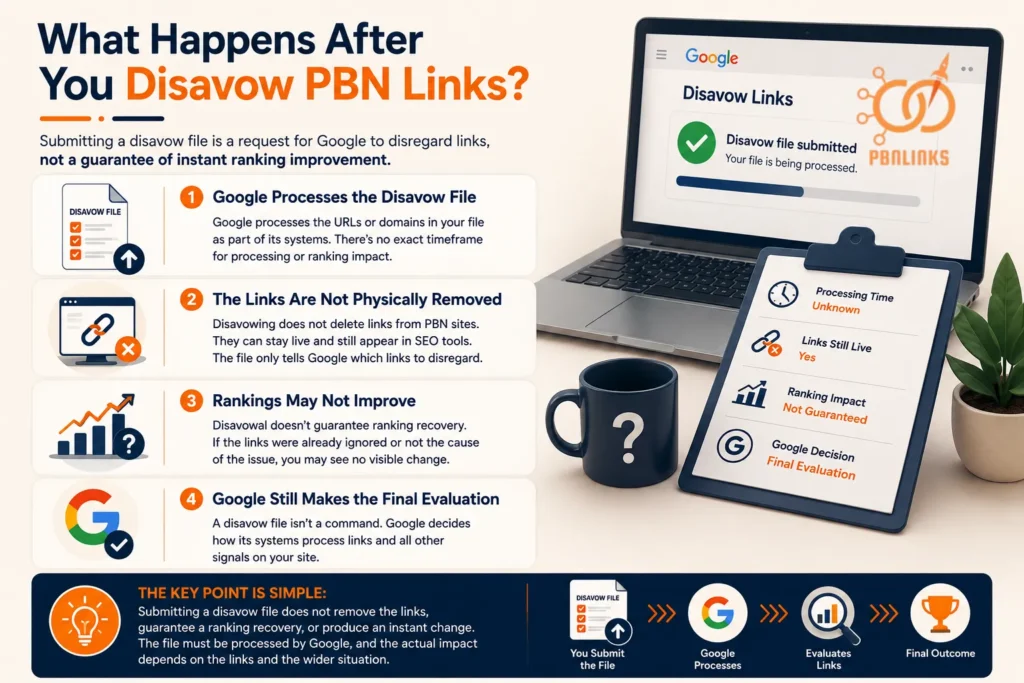
Submitting a disavow file does not instantly remove backlinks or guarantee that your rankings will improve. It is a request for Google to disregard specific links when evaluating your site, so the outcome depends on how Google processes and evaluates those links.
This is why you should not expect an immediate change after submitting the file.
Google Processes the Disavow File
After you submit a valid disavow file, Google can process the URLs or domains included in it as part of its systems for evaluating your site’s links.
There is no reliable timeframe for when a specific disavowed link will be processed or when you will see any ranking effect. Avoid treating the submission itself as proof that the links have already been ignored.
The Links Are Not Physically Removed
Disavowing a link does not delete it from the referring PBN site. The page can remain live, and the backlink can continue to appear in third party backlink tools.
The purpose of the disavow file is to communicate which links you want Google to disregard. It is therefore completely different from having the webmaster remove the backlink.
Rankings May Not Improve
Disavowal does not guarantee a ranking recovery. If the links were already being ignored or were not responsible for the ranking problem, submitting the file may produce no visible change.
This is why it is important to establish a clear reason for disavowal before submitting anything. Otherwise, you may spend time cleaning up links without addressing the actual cause of the ranking issue.
Google Still Makes the Final Evaluation
A disavow file is not a command that guarantees Google will produce a specific ranking outcome. Google ultimately determines how its ranking systems process the links and the rest of your site’s signals.
Think of disavowal as a way to communicate your request to Google, not as a switch that immediately removes the effect of every listed backlink.
The key point is simple: submitting a disavow file does not remove the links, guarantee a ranking recovery, or produce an instant change. The file must be processed by Google, and the actual impact depends on the links and the wider situation.
Can Disavowing PBN Links Hurt Your Rankings?
Yes, disavowing the wrong links can potentially hurt your rankings if Google was using those links as ranking signals and you unnecessarily ask it to disregard them. That is why indiscriminate disavowal is risky.
The goal is not to make your backlink profile look perfectly clean. The goal is to address links that genuinely warrant disavowal.
Incorrect Disavowal Can Remove Links You Did Not Need to Ignore
If you include useful or harmless links in your disavow file, you are asking Google to disregard signals that may have been contributing value.
This is particularly important when disavowing entire domains. A domain may contain one unwanted link while other links from the same domain could be legitimate or useful.
Not Every Low Quality Link Is Harmful
Your backlink profile will naturally contain links from websites with different levels of quality and relevance. A low metric, irrelevant page, or unfamiliar domain does not automatically mean the link is damaging your rankings.
Do not confuse low quality with harmful. The decision should be based on the circumstances and purpose of the links, not simply on third party metrics.
Review the File Before Submitting It
Treat the disavow file as something that deserves careful review. Check every domain and URL you are including and make sure you understand why each one is there.
Pay particular attention to domain wide entries because they can affect all qualifying links from that domain. A rushed or overly broad file can create unnecessary risk.
The key point is simple: disavowal can be useful in the right circumstances, but using it too broadly can remove links you did not need to disregard. Review the evidence carefully before submitting anything.
Should You Disavow an Entire PBN Domain or Individual Links?
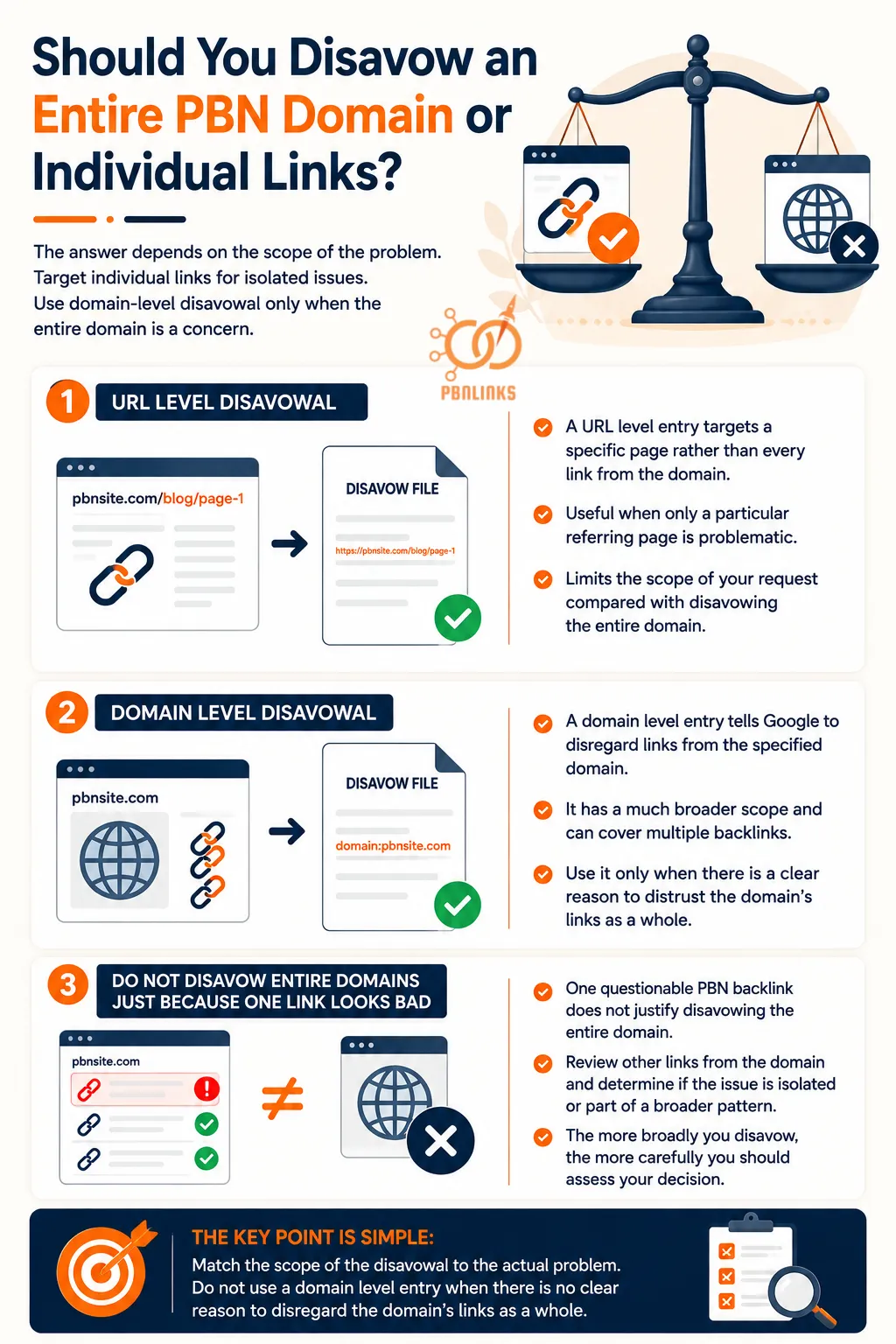
The answer depends on the scope of the problem. If only one or a few specific backlinks are problematic, targeting individual URLs may be more appropriate. If the concern applies broadly to links from an entire domain, a domain level entry may be considered.
The important thing is not to disavow an entire PBN domain simply because one backlink looks questionable.
URL Level Disavowal
A URL level entry targets a specific page rather than every link from the domain.
This can be useful when you have identified a particular referring page as problematic but have no reason to disregard other links from the same domain. It limits the scope of your request compared with disavowing the entire domain.
Domain Level Disavowal
A domain level entry tells Google to disregard links from the specified domain. This has a much broader scope because it can cover multiple backlinks from that domain.
For that reason, domain level disavowal should be based on a clear reason to distrust or disregard the domain’s links as a whole, rather than the presence of one unwanted backlink.
Do Not Disavow Entire Domains Just Because One Link Looks Bad
One questionable PBN backlink does not automatically justify disavowing the entire referring domain.
Review the other links from that domain and consider whether the problem is isolated or part of a broader pattern. The more broadly you disavow, the more carefully you should assess what you are asking Google to disregard.
The key point is simple: match the scope of the disavowal to the actual problem. Do not use a domain level entry when there is no clear reason to disregard the domain’s links as a whole.
What Are the Most Common Mistakes When Disavowing PBN Links?
Most disavow mistakes happen when site owners act too quickly. They see a ranking drop, find a group of PBN backlinks, and assume those links are responsible without first establishing what actually happened.
A good disavow process starts with evidence and ends with a carefully reviewed file.
Disavowing Every PBN Link
Disavowing every PBN backlink simply because it was paid for is one of the easiest ways to overreact.
The fact that a link came from a PBN does not tell you whether it needs to be included in a disavow file. Review the links individually and consider the wider pattern before taking action.
Disavowing Links After Every Ranking Drop
A ranking decline does not prove that backlinks caused the problem. Google’s ranking systems, competitors, content changes, technical issues, and changes in search behavior can all affect organic visibility.
If you automatically disavow links after every decline, you may end up changing your backlink profile without addressing the real cause.
Treating Third Party Toxicity Scores as Proof
SEO tools can help you discover and organize backlinks, but their toxicity or risk scores are not Google’s own assessment of those links.
Use these tools to identify backlinks that deserve investigation. Do not treat a numerical score as proof that a link must be disavowed.
Forgetting to Keep a Record of the Disavow File
Keep a copy of every disavow file you submit, along with the date and reason for the entries.
This makes future audits much easier and helps you understand which domains or URLs were intentionally included if you later need to review or update the file.
Expecting Immediate Ranking Recovery
Submitting a disavow file does not guarantee that rankings will improve. If the disavowed links were not responsible for the problem, you may see no meaningful change.
Avoid making another major SEO change simply because the first disavow submission did not produce the result you expected.
The key point is simple: the biggest disavow mistakes come from acting without enough evidence. Do not disavow everything, rely blindly on third party scores, or expect an immediate ranking recovery. Review the links carefully and understand why each entry belongs in the file.
What Should You Do If You Are Unsure About Disavowing PBN Links?
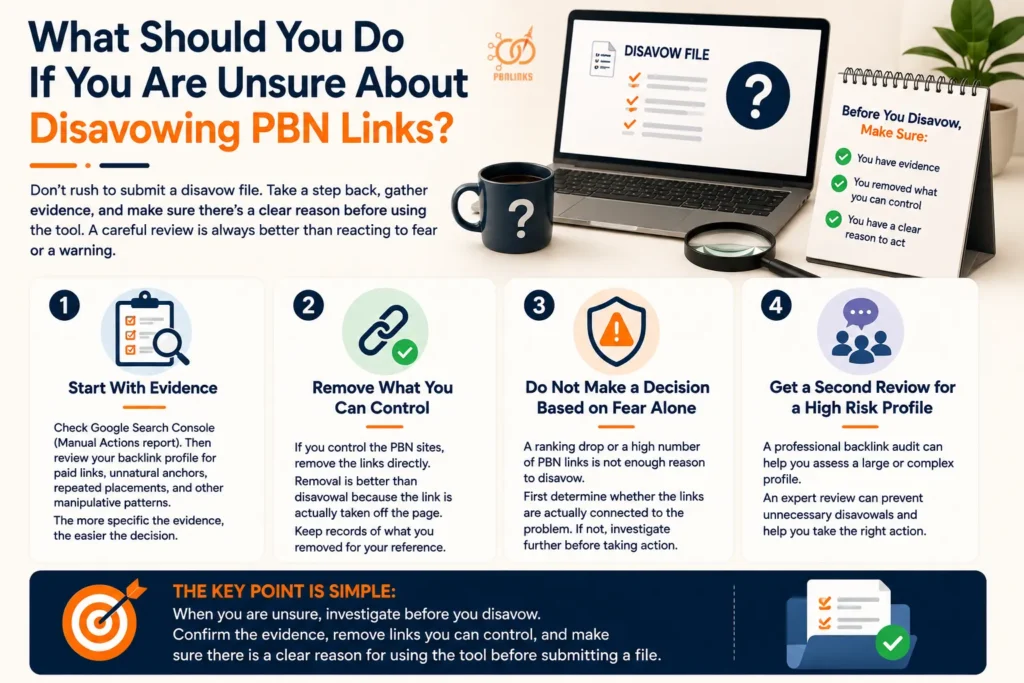
If you are unsure whether to disavow PBN links, do not rush to submit a file. Take a step back and establish whether there is a genuine link related problem before making a change that could affect how Google evaluates your backlink profile.
A careful review is usually more useful than reacting to fear, a ranking fluctuation, or a third party backlink warning.
Start With Evidence
Begin by checking Google Search Console, especially the Manual Actions report. Then review your backlink profile and look for clear patterns involving paid links, unnatural anchors, repeated placements, or other links created primarily to manipulate rankings.
The more specific the evidence, the easier it becomes to decide whether action is justified.
Remove What You Can Control
If you control the PBN sites containing the links and believe those links should no longer exist, consider removing them directly.
This is different from disavowal because the backlink is actually taken off the referring page. Keep records of what you removed so you can distinguish removed links from links that were later disavowed.
Do Not Make a Decision Based on Fear Alone
Seeing a ranking decline or discovering that you have many PBN links can be concerning, but concern alone is not enough reason to submit a disavow file.
First determine whether the links are actually connected to the problem. If you cannot establish a clear reason for disavowal, further investigation may be more appropriate than immediate action.
Get a Second Review for a High Risk Profile
If your site has a large and complicated backlink profile, a professional backlink audit can help you assess the situation more carefully.
An experienced SEO can review the link patterns, manual actions, removal options, and proposed disavow entries before anything is submitted. This can be particularly useful when a large number of domains would be included.
The key point is simple: when you are unsure, investigate before you disavow. Confirm the evidence, remove links you can control, and make sure there is a clear reason for using the tool before submitting a file.
Conclusion
in conclusion. You should not disavow PBN links simply because you paid for them. The right decision depends on the actual condition of your backlink profile, whether the links were created to manipulate rankings, whether they can be removed, and whether there is clear evidence that they need to be disregarded.
Start by checking Google Search Console for manual actions, reviewing your backlink profile, and identifying links you can remove directly. If disavowal is justified, keep the scope precise and review the file carefully before submitting it. Avoid disavowing entire domains or large groups of links simply because they look suspicious or a ranking drop occurred.
The goal is not to create a perfectly clean backlink profile. It is to make a measured decision based on evidence rather than fear.
Need help reviewing questionable PBN backlinks before you disavow them? Contact PBNLinks Agency for a detailed backlink assessment and a clear recommendation on which links, if any, deserve action.
FAQs About Disavow PBN Links
Should I disavow PBN links I paid for?
No, not automatically. Paying for PBN links does not by itself mean you need to submit a disavow file. First assess the links, your backlink profile, and whether there is a clear reason they need to be disregarded.
When should I disavow PBN links?
Consider disavowal when you have a substantial number of problematic or unnatural links that you cannot reasonably remove, particularly when there is a clear link related issue requiring action.
Can PBN links hurt my rankings?
PBN links can create SEO risk when they are used to manipulate rankings, but a ranking decline does not prove that specific PBN links caused it. Review the wider backlink profile and other possible causes before taking action.
Does Google automatically ignore PBN links?
Google can choose to ignore links that its systems determine should not contribute to ranking, but you cannot assume that every PBN link is automatically ignored. Google’s treatment of individual links is not publicly disclosed in full.
Can disavowing PBN links hurt rankings?
Yes, unnecessary disavowal can potentially remove links from consideration that Google may otherwise have used as ranking signals. This is why broad or speculative disavowal should be avoided.
Should I remove PBN links instead of disavowing them?
If you control the links and believe they should no longer exist, direct removal is an option. Removing a link takes it off the referring page, while disavowal does not remove the link itself.
Should I disavow an entire PBN domain?
Not automatically. A domain level disavow affects links from that domain, so it should generally be used only when there is a clear reason to disregard the domain’s links rather than because one backlink looks suspicious.
Does a ranking drop mean I should disavow my PBN links?
No. Ranking drops can have many causes, including changes to Google’s systems, competitors, content, technical issues, and search behavior. A ranking decline alone is not enough evidence to justify disavowal.
Does a manual action mean I should disavow PBN links?
A manual action for unnatural links is a strong reason to review your backlink profile and address the affected links. Remove links where possible and consider disavowal when problematic links cannot reasonably be removed.
How do I know if I really need to disavow PBN links?
Start by checking Google Search Console for manual actions and auditing your backlink profile for clear patterns of manipulative links. If there is no strong evidence of a link related problem, immediate disavowal may be unnecessary.