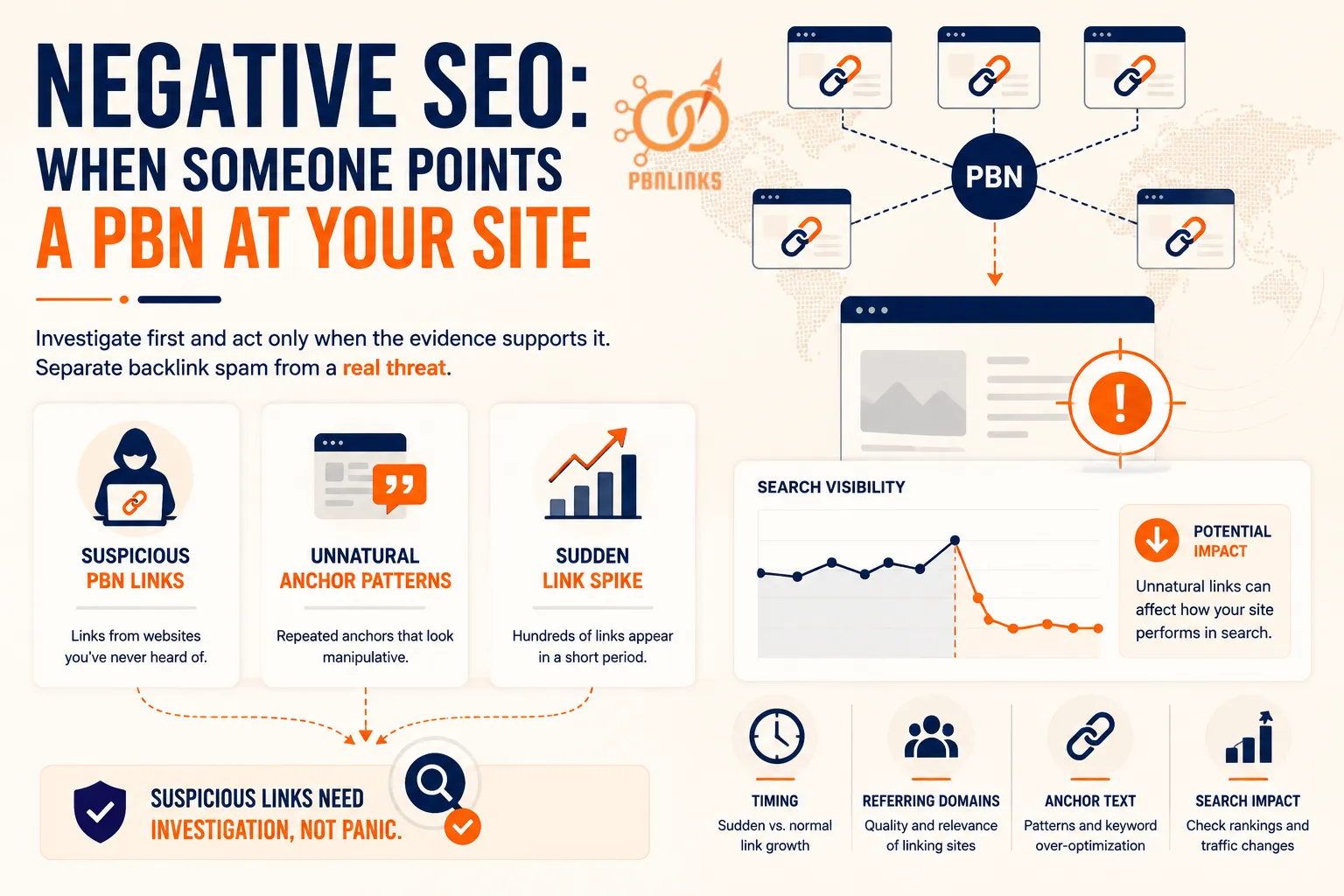
Negative SEO: When Someone Points a PBN at Your Site
You open your backlink report and suddenly see hundreds of links from websites you have never heard of. Many look like PBNs, the anchor text seems unnatural, and the links appeared within a short period. Your first thought is simple: Is someone trying to hurt my rankings?
A negative SEO PBN attack can look serious, but suspicious backlinks do not automatically mean that someone is targeting your website. Google can encounter unwanted links without treating them as a reason to penalize the site receiving them.
Before you remove links, contact webmasters, or consider using the disavow tool, you need to understand what the backlink activity actually shows. The timing, referring domains, anchor text, link patterns, and your site’s search performance can provide much stronger evidence than a list of bad looking links alone.
The right approach is to investigate first and act only when the evidence supports it. This helps you separate ordinary backlink spam from a genuine negative SEO concern and avoid making unnecessary changes that could create additional SEO problems.
What Is a Negative SEO PBN Attack?
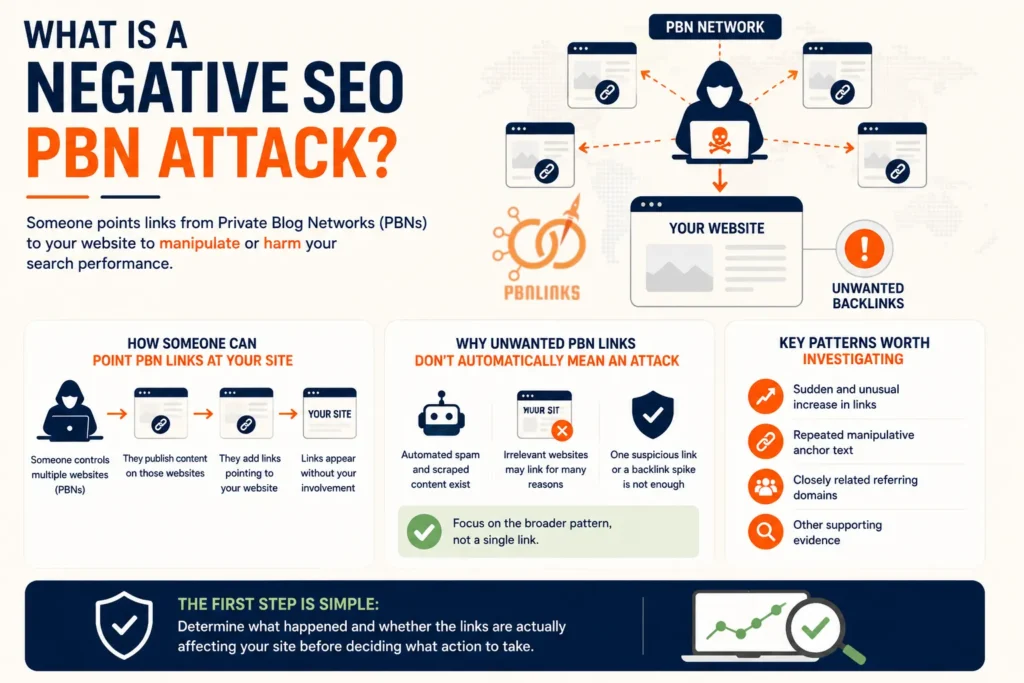
A negative SEO PBN attack happens when someone points links from private blog networks toward your website without your involvement, usually with the intention of manipulating or harming your search performance. The important part is intent, because simply receiving unwanted PBN links does not prove that someone is deliberately targeting your site.
Understanding this distinction matters because Google can encounter and evaluate links that you never created or requested. Before treating suspicious backlinks as a negative SEO attack, you need to look at where the links came from, how they appeared, what patterns they follow, and whether there is any evidence that they are actually affecting your website.
How Someone Can Point PBN Links at Your Site
Someone does not need access to your website to create backlinks pointing toward it. They can publish links on websites they control and choose your domain as the destination.
In a PBN setup, this could involve links across multiple domains, similar anchor text, unrelated content, or a large number of links appearing within a short period. If those links appeared without your involvement, they are third party links, but that alone does not establish malicious intent.
Why Unwanted PBN Links Do Not Automatically Mean an Attack
Unwanted backlinks are common, and some can come from automated spam, scraped content, or websites with little relevance to your business. Their presence does not automatically mean that a competitor or another person deliberately targeted your site.
What matters is the broader pattern. A sudden and unusual increase in links, repeated manipulative anchors, closely related referring domains, and other evidence may justify further investigation, but one suspicious link or a simple backlink spike is not enough to prove a negative SEO PBN attack.
The first step is therefore to determine what happened and whether the links are actually affecting your site before deciding what action to take.
What Are the Warning Signs of a Negative SEO PBN Attack?
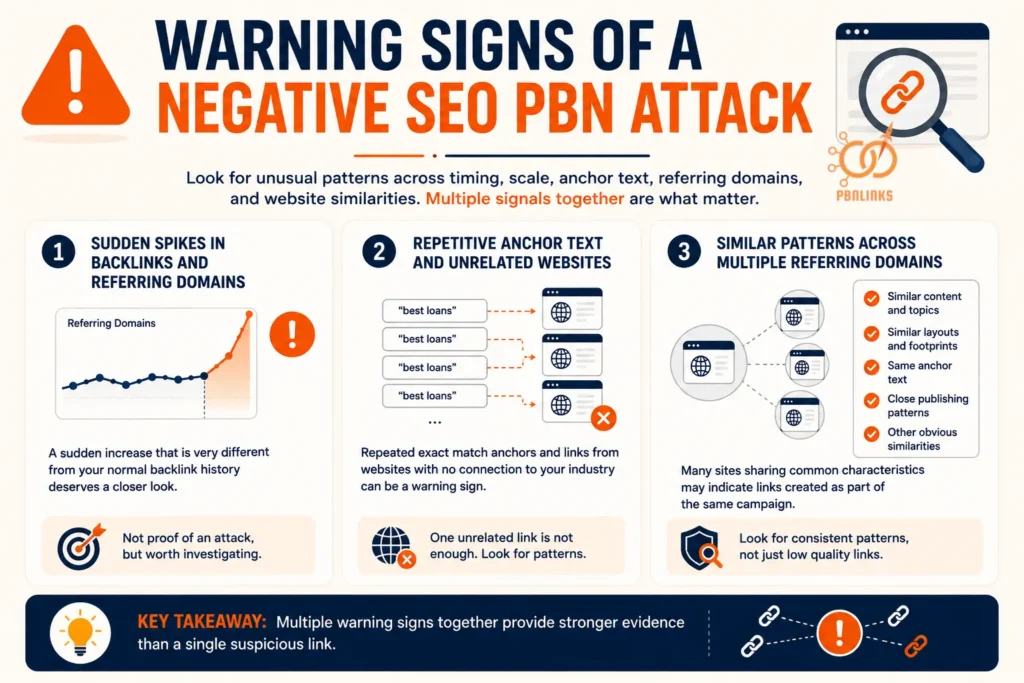
Not every unwanted PBN backlink is a sign of negative SEO. The important thing is to look for unusual patterns that make the backlink activity worth investigating.
A single suspicious link rarely tells you much on its own. The timing, scale, anchor text, referring domains, and similarities between websites can provide much stronger evidence when several signals appear together.
Sudden Spikes in Backlinks and Referring Domains
A sudden increase in backlinks or referring domains can be worth investigating, especially when the growth is very different from your site’s normal backlink history.
For example, a website that normally gains a few referring domains each month may suddenly receive hundreds of links from unfamiliar sites within a few days. This does not prove a negative SEO attack, but the unusual change deserves a closer look.
Repetitive Anchor Text and Unrelated Websites
Repeated exact match anchor text across many unfamiliar websites can be another warning sign. Links from websites with no meaningful connection to your industry may also deserve attention when they appear in large numbers.
However, one unrelated backlink is not enough to establish a problem. The pattern becomes more meaningful when similar anchors, unrelated sites, and unusual link growth occur together.
Similar Patterns Across Multiple Referring Domains
Multiple referring websites may deserve closer investigation when they share similar content, layouts, anchor text, publishing patterns, or other obvious characteristics.
The goal is not to prove that every low quality backlink is harmful. Instead, look for a consistent pattern that suggests the links may have been created as part of the same campaign.
Can PBN Links Actually Hurt Your Rankings?
Seeing a large number of PBN links pointing to your website can be concerning, but their presence alone does not prove that your rankings will suffer. The important question is how Google evaluates those links and whether there is evidence of an actual ranking problem.
A ranking drop should also be investigated from several angles. Changes in algorithms, competitors, content, technical SEO, and search intent can all affect visibility, so blaming PBN backlinks without evidence can lead to the wrong conclusion.
How Google Handles Links You Did Not Build
Google can encounter links that a website owner did not create or request. Its systems are designed to evaluate links and identify attempts to manipulate rankings, rather than simply assuming that every link pointing to a site was intentionally built by that site owner.
This means receiving unwanted PBN links does not automatically mean Google will penalize your website. The existence of those links should be evaluated in the context of your overall backlink profile and other search signals.
Why a Ranking Drop Does Not Prove Negative SEO
A ranking decline by itself is not proof that someone used PBN links against your site. Rankings can change because of algorithmic updates, stronger competitors, content changes, technical problems, changes in search intent, or normal fluctuations.
Before connecting a ranking drop to suspicious backlinks, compare when the decline happened with when the links appeared. Look for other changes that happened around the same time and determine whether there is enough evidence to support a link related explanation.
When Suspicious Links Deserve More Attention
Suspicious PBN links deserve closer investigation when they appear as part of a clear and unusual pattern rather than as isolated backlinks.
For example, a sudden large-scale increase across many similar domains, repeated manipulative anchor text, and a noticeable change in organic performance occurring around the same period may justify a deeper backlink audit. Even then, the evidence should be assessed carefully before concluding that a negative SEO attack caused the problem.
How Can You Tell If You Are Facing a Negative SEO PBN Attack?
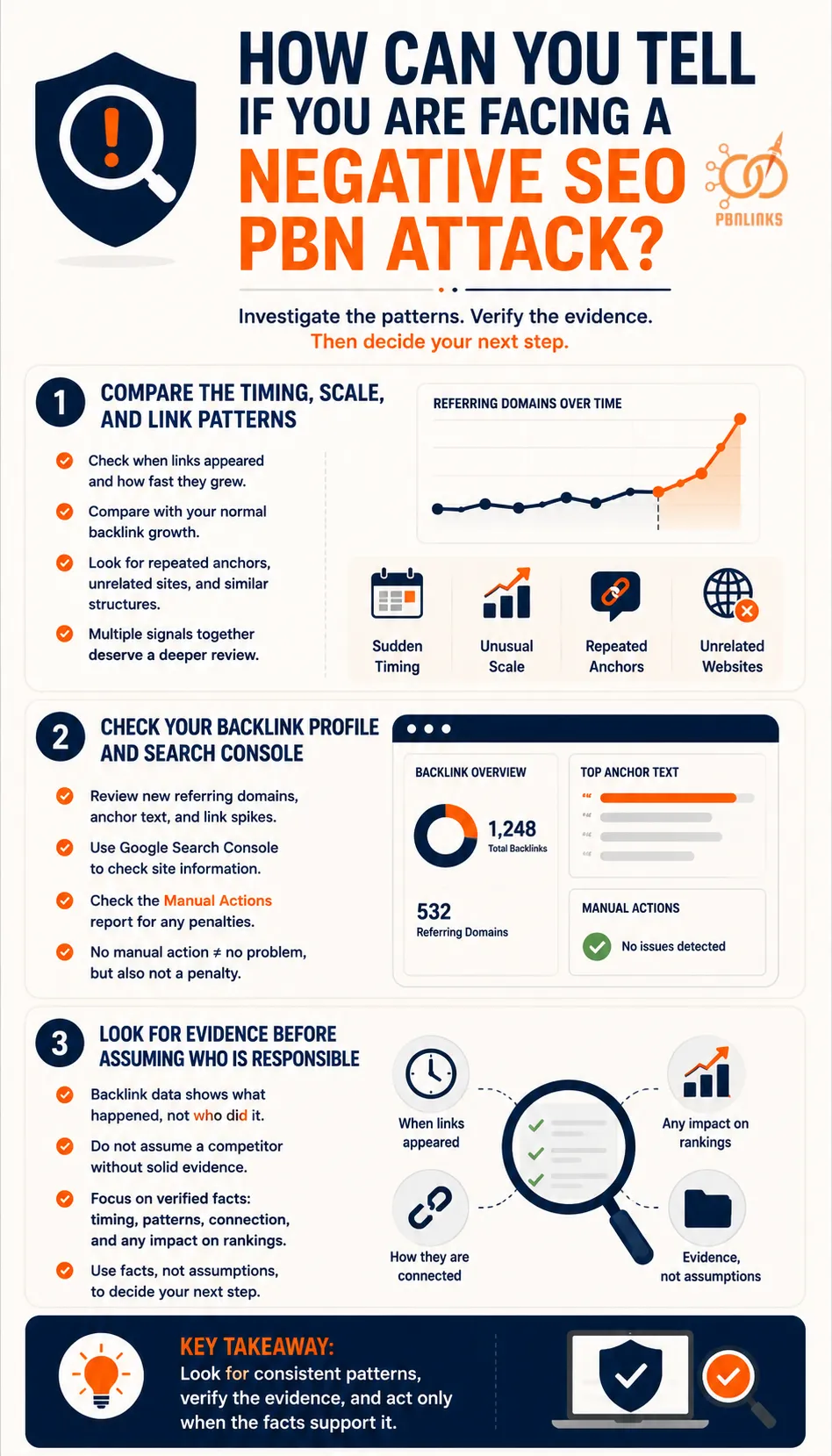
Finding suspicious PBN links is only the beginning. To determine whether you are actually facing a negative SEO attack, you need to compare the backlink activity with your site’s history, ranking changes, and other available evidence.
The goal is to establish whether there is a meaningful pattern rather than reacting to a few unusual links. A careful review can help you separate ordinary backlink spam from activity that genuinely deserves further investigation.
Compare the Timing, Scale, and Link Patterns
Start by looking at when the suspicious links appeared and how quickly they accumulated. Compare that activity with your normal backlink growth and check whether many domains started linking to your site at roughly the same time.
Then examine the links themselves. Repeated anchors, unrelated websites, similar site structures, and links placed across many domains can provide additional context. None of these signals proves an attack individually, but several occurring together can justify a deeper review.
Check Your Backlink Profile and Search Console
Review your backlink data to identify new referring domains, unusual anchor text, sudden link growth, and other changes in your profile. Google Search Console can also help you check important site information and whether Google has reported a Manual Action against your website.
A manual action is different from a normal ranking decline. If there is no manual action, that does not prove that everything is fine, but it does mean you should not assume that suspicious backlinks have resulted in a manual penalty.
Look for Evidence Before Assuming Who Is Responsible
Backlink data can show unusual linking activity, but it generally cannot tell you who created those links. Even if the links appear deliberate, identifying a competitor or another person as the source without reliable evidence would be speculation.
Focus first on what you can verify: when the links appeared, how they are connected, whether they form a clear pattern, and whether your website experienced any corresponding changes. That gives you a much stronger basis for deciding what to do next.
What Should You Do If You Find Suspicious PBN Links?
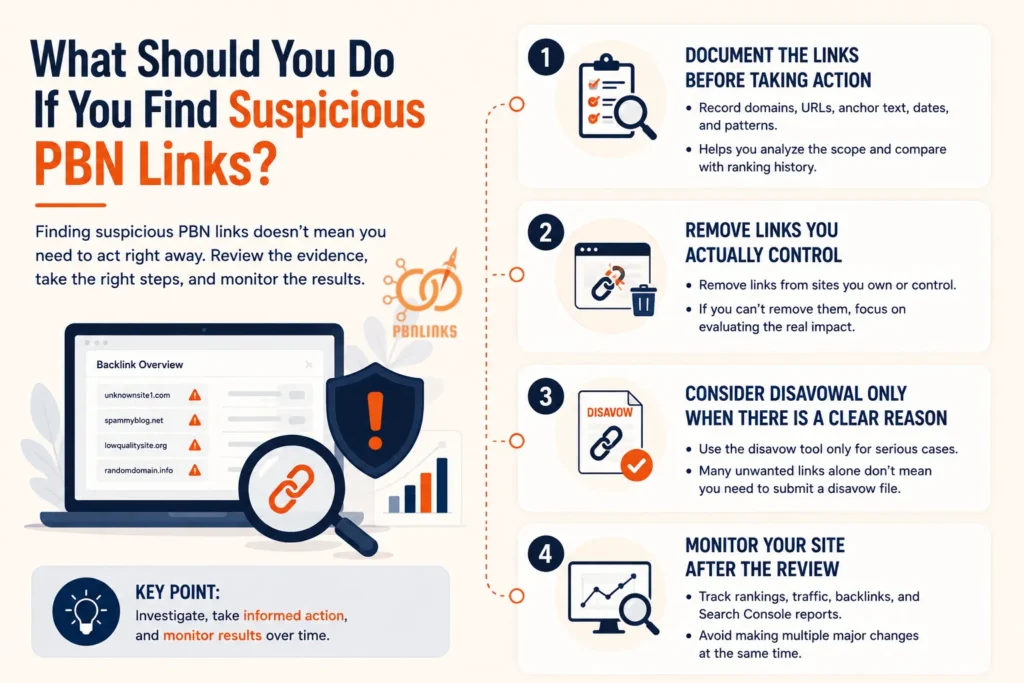
Finding suspicious PBN links does not mean you need to take immediate action. First determine whether the links are simply unwanted, part of a broader spam pattern, or connected to a genuine SEO problem.
The safest approach is to document what you find, review the evidence, and avoid making large changes based on assumptions. This is especially important when considering link removal or Google’s disavow tool.
Document the Links Before Taking Action
Record the referring domains, URLs, anchor text, dates, and any noticeable patterns in the links. Keeping this information gives you a clear reference point if the backlink profile changes later.
It can also help you compare the suspicious links with your site’s ranking history and determine whether the activity was isolated or part of a larger pattern.
Remove Links You Actually Control
If you created the links yourself or have direct control over the websites where they appear, removing them may be an option. Actual removal is different from disavowing a link because removal eliminates the backlink from the source page.
If you have no control over the referring websites, however, you may not be able to remove the links directly. In that situation, focus on assessing whether further action is actually necessary.
Consider Disavowal Only When There Is a Clear Reason
The disavow tool should not be treated as a routine response to every suspicious backlink. Google recommends using it carefully, particularly when there is a substantial number of spammy or artificial links and those links have caused or are likely to cause a manual action.
A large number of unwanted PBN links alone does not automatically mean you need to submit a disavow file. Review the evidence and your specific situation before making that decision.
Monitor Your Site After the Review
Continue watching your rankings, organic traffic, backlink profile, and Search Console reports after identifying suspicious links. This gives you a better view of whether anything meaningful changes over time.
Avoid making several major SEO changes at once. If you change your backlink strategy, content, technical setup, and other factors simultaneously, it becomes much harder to determine what actually affected your site’s performance.
Should You Disavow PBN Links Pointing to Your Site?
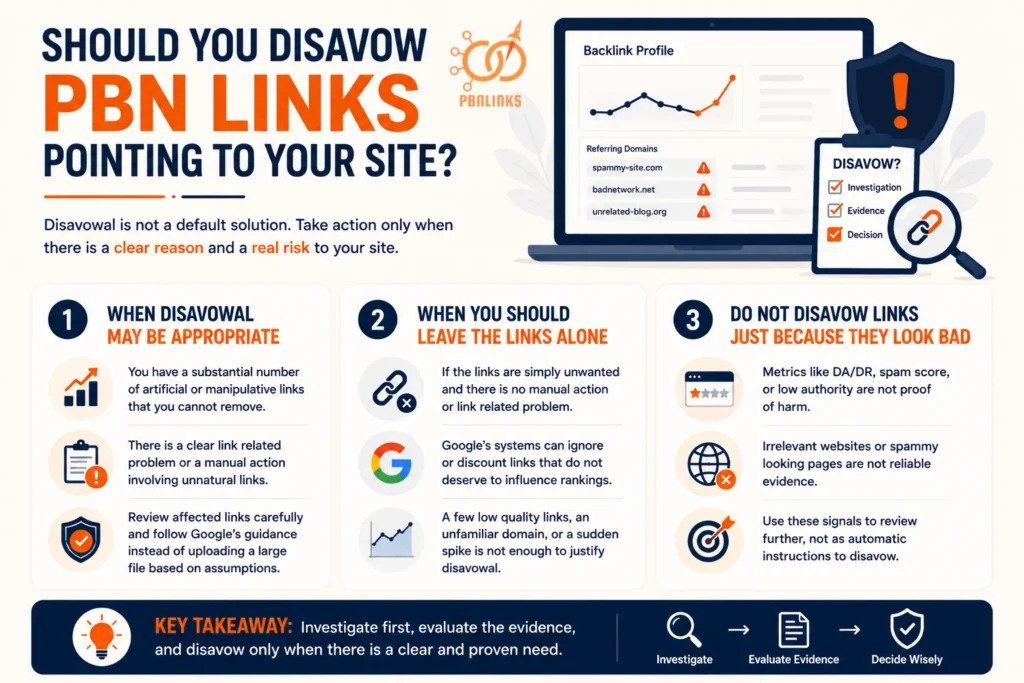
Not necessarily. You should not disavow PBN links simply because they look suspicious or because someone else appears to have created them. First determine whether there is a clear reason for disavowal and whether the links represent a genuine risk to your site.
Google can encounter and evaluate links you did not create, so an unwanted backlink does not automatically require action. Disavowal should be considered carefully rather than used as a routine response to backlink spam.
When Disavowal May Be Appropriate
Disavowal may be worth considering when you have a substantial number of artificial or manipulative links that you cannot remove and there is a clear link related problem.
A manual action involving unnatural links is a particularly important signal to investigate. In that situation, review the affected links carefully and follow Google’s guidance rather than submitting a large file based on assumptions.
When You Should Leave the Links Alone
If the links are simply unwanted and there is no evidence of a manual action or meaningful link related problem, disavowing them may be unnecessary.
Google’s systems can ignore or discount links that do not deserve to influence rankings. A few low quality backlinks, an unfamiliar referring domain, or a sudden backlink spike is not enough by itself to justify disavowal.
Do Not Disavow Links Just Because They Look Bad
Third party metrics, low domain authority, irrelevant websites, or spammy looking pages are not reliable proof that Google considers a backlink harmful.
Use those signals to identify links for further review, not as automatic instructions to add domains to a disavow file. The decision should be based on the broader evidence and your specific situation.
Can a Negative SEO PBN Attack Cause a Google Penalty?
A negative SEO PBN attack does not automatically result in a Google penalty. Google can encounter links pointing to your site that you did not create, and the presence of those links alone does not prove that your website has violated Google’s spam policies.
The important distinction is between unwanted links and evidence of a policy violation by your site. Before assuming a penalty, check whether Google has actually taken a manual action and investigate other possible reasons for any ranking changes.
Unwanted Links Are Not the Same as a Manual Action
A backlink pointing to your website does not automatically mean Google believes you created or approved it. This is why suspicious PBN links should not immediately be treated as proof of a penalty.
If Google issues a manual action, you can find it in the Manual Actions report in Google Search Console. A ranking drop without a manual action can have many other causes and should be investigated separately.
Google Can Ignore Links Without Penalizing Your Site
Google’s systems can choose not to count or pass value through links that it identifies as spammy or manipulative. This means a suspicious PBN link may have little or no ranking effect even if it remains visible on the referring website.
However, you should not assume that every PBN link is automatically ignored. The safest approach is to assess the overall link pattern rather than making conclusions from individual backlinks.
When a Manual Action Requires Attention
If your Search Console account shows a manual action related to unnatural links, treat it as a serious signal that requires investigation. Review the affected links, identify what can be removed, and follow Google’s recommended process for resolving the issue.
Do not confuse a manual action with an algorithmic ranking decline. The two situations can look similar from a traffic report, but they require different types of investigation and response.
How to Monitor Your Site for Future PBN Attacks
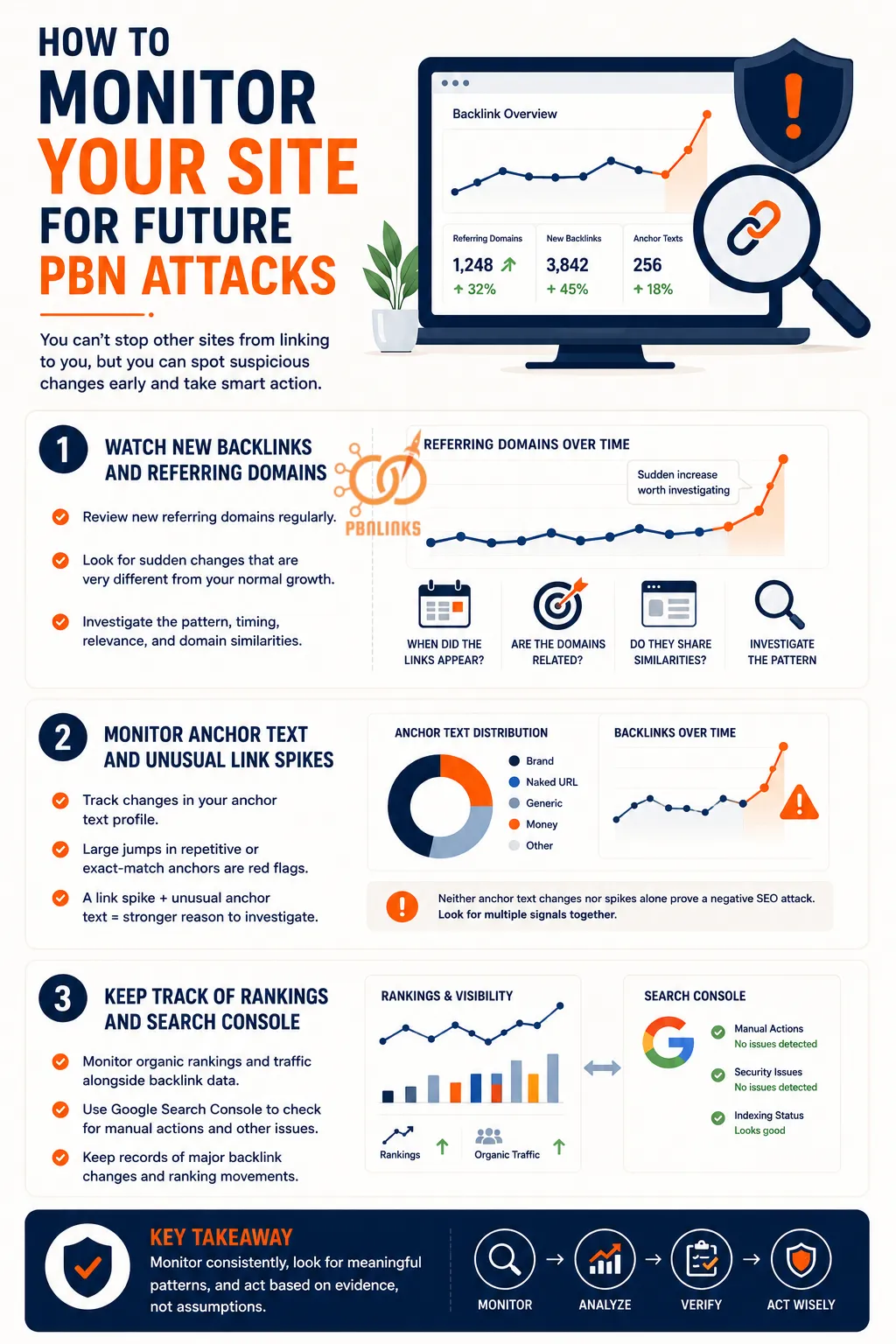
You cannot prevent other websites from linking to your domain, but you can make suspicious changes easier to identify. Regular backlink monitoring helps you spot unusual patterns before you make decisions based on incomplete information.
The goal is not to check every new backlink obsessively. Instead, focus on meaningful changes in referring domains, anchor text, link volume, and your site’s overall search performance.
Watch New Backlinks and Referring Domains
Review new referring domains periodically and pay attention to sudden changes that are very different from your site’s normal backlink growth.
If hundreds of unfamiliar domains suddenly begin linking to your site, investigate the pattern rather than assuming it is an attack. Look at when the links appeared, whether the domains are related, and whether they share obvious characteristics.
Monitor Anchor Text and Unusual Link Spikes
Keep an eye on significant changes in your anchor text profile, particularly large increases in repetitive or highly targeted phrases.
A sudden backlink spike combined with unusual anchor text can provide a stronger reason for investigation than either signal alone. However, neither signal by itself proves that a negative SEO campaign is taking place.
Keep Track of Rankings and Search Console
Monitor organic visibility alongside your backlink data so you can compare unusual link activity with changes in search performance.
Google Search Console can also help you check for manual actions and other important search-related information. Keeping a record of major backlink changes and ranking movements makes it easier to investigate problems without relying on assumptions or memory.
Common Mistakes When Dealing With Negative SEO PBN Links
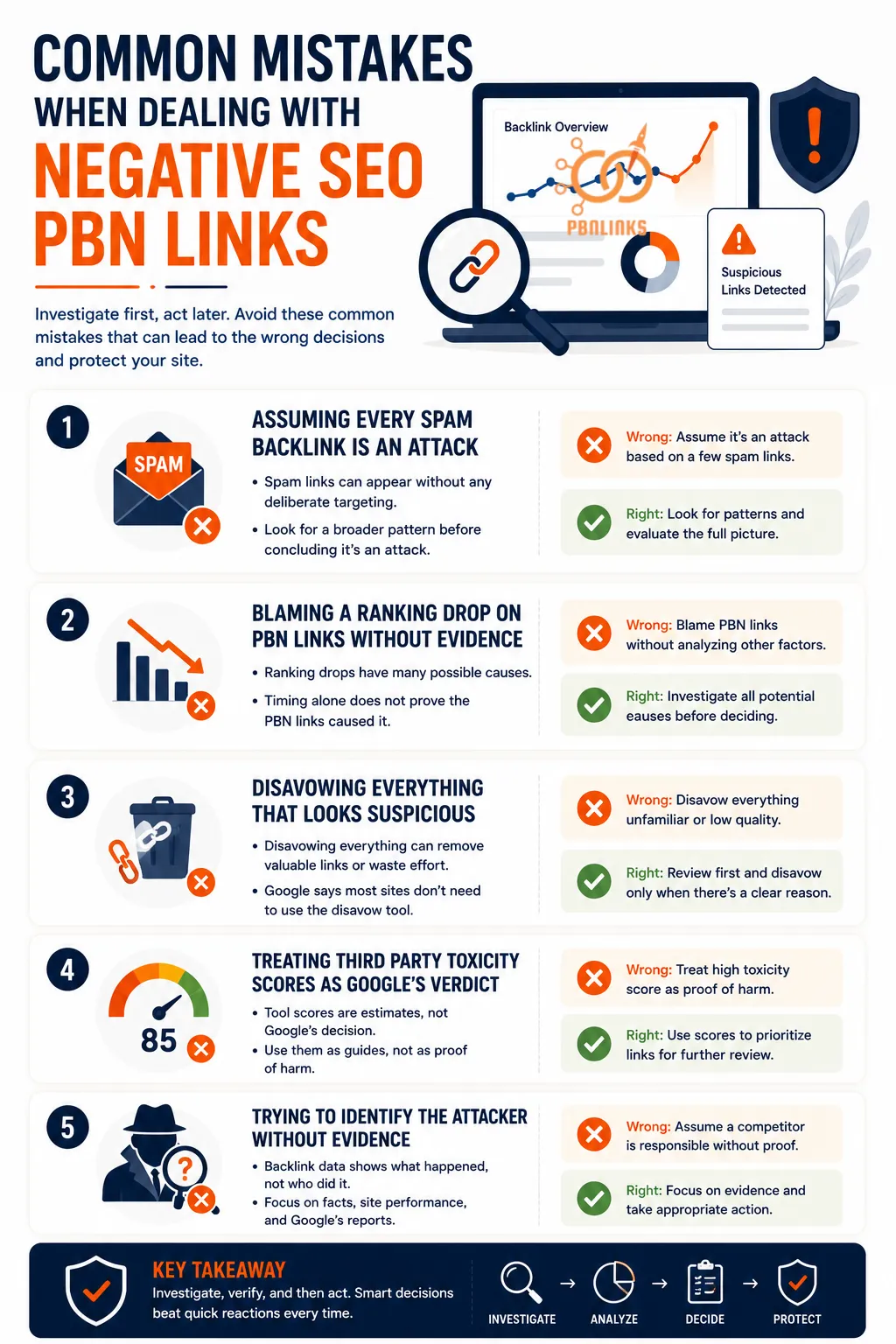
The biggest mistake is reacting to suspicious backlinks before establishing whether they are actually causing a problem. Negative SEO concerns can lead site owners to remove useful links, submit unnecessary disavow files, or blame competitors without enough evidence.
A better approach is to treat suspicious PBN links as something to investigate first. Once you understand the pattern and the actual risk, you can decide whether any action is necessary.
Assuming Every Spam Backlink Is an Attack
Spam backlinks can appear on websites without any deliberate targeting. Automated systems, scraped content, and other forms of web spam can create unwanted links to your domain.
Seeing these links in a backlink report does not prove that someone is running a negative SEO campaign against you. Look for a broader pattern before reaching that conclusion.
Blaming a Ranking Drop on PBN Links Without Evidence
A ranking decline can happen for many reasons, including algorithm changes, stronger competitors, content changes, technical problems, and shifts in search intent.
If suspicious PBN links appeared around the same time, they may be worth investigating, but timing alone does not prove that they caused the decline.
Disavowing Everything That Looks Suspicious
Adding every unfamiliar or low quality backlink to a disavow file is not a sensible default. Google says most sites do not need to use the disavow tool, and it should be used carefully.
Review the links first and determine whether there is a clear reason to disavow them. Avoid turning a normal backlink cleanup into a large, unnecessary disavowal.
Treating Third Party Toxicity Scores as Google’s Verdict
SEO tools can help identify unusual backlinks and prioritize links for review, but their toxicity or risk scores are not Google’s own assessment.
Use these tools as investigative aids rather than treating a third party score as proof that Google considers a link harmful.
Trying to Identify the Attacker Without Evidence
Backlink patterns may show that unusual links appeared, but they usually cannot prove who created them. Assuming that a competitor is responsible without reliable evidence can lead to the wrong conclusion.
Focus on the backlink evidence, your site’s performance, and Google’s reports first. Knowing exactly who created the links is not always necessary to determine the appropriate response.
What Should You Do If You Are Still Unsure About a Negative SEO PBN Attack?
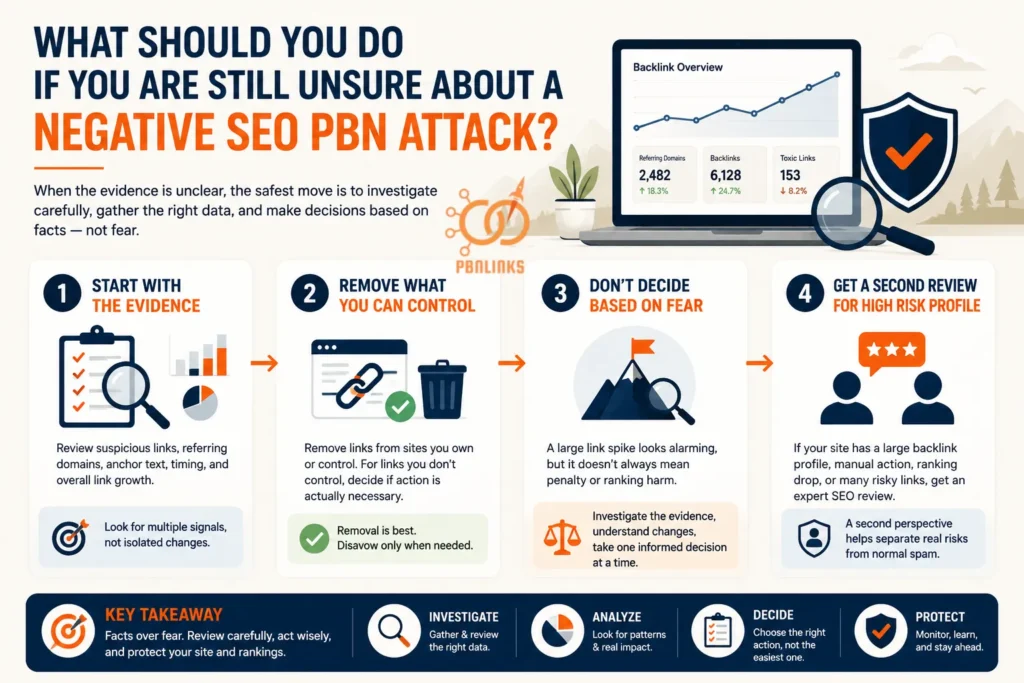
If the evidence is unclear, do not rush into a disavow file or assume that your competitors are responsible. A careful review is usually more useful than reacting to suspicious links before you understand what they mean.
The goal is to make the decision based on evidence rather than fear. If the backlink pattern is large or complicated, getting an experienced SEO professional to review the data can also provide a second perspective.
Start With the Evidence
Review the suspicious backlinks, referring domains, anchor text, timing, and overall link growth. Then compare those findings with your ranking history, organic traffic, and Google Search Console data.
Look for several signals pointing in the same direction instead of relying on one unusual backlink or one ranking change.
Remove What You Can Control
If you control any of the websites containing problematic links, removing those links may be the simplest solution. This is different from using Google’s disavow tool because removal eliminates the backlink from the source.
For links you do not control, first determine whether there is actually a reason to take further action rather than assuming every unwanted link needs to be removed or disavowed.
Do Not Make a Decision Based on Fear Alone
A large backlink spike can look alarming, especially when many of the domains appear to be PBNs. But an alarming backlink profile does not automatically mean Google has penalized your site or that your rankings are being harmed.
Investigate the evidence, understand what has actually changed, and make one informed decision at a time.
Get a Second Review for a High Risk Profile
If your site has a large backlink profile, a manual action, a major ranking decline, or a substantial number of potentially manipulative links, consider having the profile reviewed by an experienced SEO professional.
A second review can help distinguish genuine risks from normal backlink spam and reduce the chance of making unnecessary changes to your site’s link profile.
What Can You Do to Reduce the Risk of Future Negative SEO Problems?
You cannot control who links to your website, but you can control how well your site is prepared to handle suspicious backlink activity. A strong website, a natural link profile, and a clear response process make it easier to deal with unwanted links without overreacting.
The goal is not to eliminate every bad backlink. It is to build a site that does not depend on questionable links and to have a sensible process for investigating unusual activity when it appears.
Build a Stronger Link Profile
Focus on earning relevant, legitimate backlinks rather than relying heavily on manipulative link-building tactics. A diverse link profile built from genuinely useful content and relevant websites provides a stronger long-term SEO foundation.
This also makes unusual backlink activity easier to identify because you have a clearer understanding of what normal growth looks like for your site.
Strengthen Your Website Beyond Backlinks
Improve the areas you can control, including content quality, technical SEO, internal linking, site security, and overall user experience.
A website should not depend entirely on backlinks for its search visibility. Building strength across multiple SEO factors gives you a more stable foundation when unexpected link activity occurs.
Keep a Clear Response Process
If suspicious PBN links appear, follow the same process each time: document the links, investigate the pattern, check Search Console, assess whether there is a genuine problem, and only then consider further action.
Having a defined process helps prevent rushed decisions, especially when a sudden backlink spike initially looks more serious than it actually is.
Avoid Overreacting to Normal Spam
Some unwanted backlinks are simply part of the wider web and may have little practical impact on your website. Trying to remove or disavow every unfamiliar link can create unnecessary work without solving a real problem.
Focus your attention on unusual patterns and situations supported by evidence. That keeps your response proportionate and helps you avoid turning ordinary backlink spam into an SEO crisis.
What Should You Do If a Competitor Is Behind the PBN Links?
You usually cannot determine with certainty who created unwanted PBN links simply by looking at your backlink profile. Even when the links appear deliberate, assuming that a competitor is responsible without reliable evidence can lead to the wrong response.
The priority should be protecting your website and understanding the backlink activity, not trying to identify or confront a suspected attacker. Focus on what you can verify and control.
Do Not Assume a Competitor Is Responsible
Similar anchor text, sudden link growth, and networks of related domains may make the links look deliberate, but these signals do not identify who created them.
Backlink tools can show where links came from, but they generally cannot prove who owns or controls the referring websites. Treat accusations about competitors as speculation unless you have independent evidence.
Document the Suspicious Activity
Keep records of the referring domains, URLs, anchor text, dates, and other unusual patterns you identify. Screenshots and exported backlink reports can also help preserve evidence as the link profile changes.
A clear timeline makes it easier to compare the link activity with changes in rankings, traffic, or other events affecting your website.
Focus on the Links Rather Than the Suspected Attacker
You do not need to know exactly who created the links before you can decide how to respond. The more important questions are whether the links form a meaningful pattern, whether your site has experienced a related problem, and whether Google has taken any action.
If there is no clear evidence of harm, avoid escalating the situation based on assumptions. Continue monitoring the backlink profile and respond only when the evidence supports a specific action.
How Should You Respond to a Suspected Negative SEO PBN Attack?
The right response is to investigate the backlink activity before taking corrective action. Start by documenting the links, checking for unusual patterns, reviewing your search performance, and checking Google Search Console for any manual action.
Do not treat a suspected attack as proof that your site has been penalized. Your response should depend on what the evidence actually shows.
Confirm That the Links Are Actually Unwanted
Review the referring domains, URLs, anchor text, dates, and link patterns before deciding that the links were deliberately created against your site.
Make sure the links were not created by you, an agency, a previous SEO provider, or another person who had permission to build links for the website.
Check for an Actual SEO Impact
Compare the timing of the suspicious links with changes in rankings, organic traffic, and other important search signals.
A backlink spike without a corresponding SEO problem may simply be spam that Google does not use. A ranking decline also needs to be investigated against other possible causes before you connect it to the PBN links.
Check Google Search Console
Review the Manual Actions report and other relevant Search Console data. A manual action provides much stronger evidence of a Google enforcement issue than a ranking decline or suspicious backlink profile alone.
If there is no manual action, continue investigating the broader situation rather than assuming that Google has penalized your website.
Take Action Only When the Evidence Supports It
If you identify links that you control, consider removing them. If there is a substantial pattern of artificial links that cannot be removed and a clear reason to use Google’s disavow process, evaluate that option carefully.
The key is to match the response to the evidence. Do not remove, disavow, or escalate based solely on the fact that unfamiliar PBN links are pointing to your site.
Does Google Ignore PBN Links Pointing to Your Site?
Google can ignore or discount links that its systems determine are spammy or manipulative, so an unwanted PBN link does not automatically transfer ranking value or create a penalty for the site receiving it.
However, you should not assume that every PBN link will automatically be ignored. Google evaluates links as part of its broader ranking and spam systems, and the exact signals it uses are not publicly disclosed.
Google Can Discount Links It Does Not Trust
A link can remain visible on the referring website while having little or no influence on your rankings. This means seeing a PBN backlink in a third party SEO tool does not tell you whether Google is actually using that link as a ranking signal.
The important distinction is between a link existing and a link influencing Google’s systems.
Unwanted Links Do Not Automatically Make Your Site Responsible
If someone else creates links pointing to your website, that does not automatically mean Google will treat those links as links you deliberately built.
This is why a sudden increase in suspicious backlinks should be investigated rather than treated as proof that your site has violated Google’s spam policies.
Do Not Rely on Google Ignoring the Links as Your Only Strategy
Although Google may ignore spammy links, that does not mean you should stop monitoring your backlink profile. A large or unusual link pattern can still be worth investigating, particularly if you have other evidence of a search-related problem.
The safest approach is to understand what happened, check for an actual impact, and take action only when the evidence gives you a clear reason to do so.
Conclusion
In conclusion, a negative SEO PBN attack should be investigated carefully rather than treated as an automatic threat to your rankings. Unwanted PBN links can look alarming, especially when they appear suddenly or use repetitive anchor text, but their presence alone does not prove that someone is trying to harm your site or that Google will penalize you.
Start by reviewing the timing, referring domains, anchor text, link patterns, rankings, and Google Search Console data. Look for clear evidence of unusual activity and separate genuine concerns from normal backlink spam. Do not assume a competitor is responsible without proof, and do not remove or disavow links simply because they look suspicious.
You cannot control who links to your website, but you can control how you respond. Regular backlink monitoring, a strong website, and an evidence based response process can help you handle suspicious PBN activity without creating unnecessary SEO problems.
If you need help evaluating a suspicious backlink profile or determining whether a PBN link pattern requires action, review the links carefully before making any changes and get a professional SEO assessment when the situation is complex.
FAQs About Negative SEO PBN Attack
1. What is a negative SEO PBN attack?
A negative SEO PBN attack is an attempt to point manipulative links from private blog networks toward another website to harm or manipulate its search performance. However, unwanted PBN links alone do not prove that an attack is taking place.
2. Can someone hurt my rankings by pointing PBN links at my site?
Usually, simply receiving unwanted PBN links does not mean your rankings will be harmed. Google says its systems are designed to prevent other sites from being able to harm a site’s ranking through unwanted links.
3. How can I tell if someone is building PBN links to my site?
Look for unusual patterns such as a sudden increase in referring domains, repetitive anchor text, similar websites, and links appearing within a short period. These signals justify investigation but do not independently prove a negative SEO attack.
4. Should I disavow PBN links I did not create?
Usually, no. Google says most sites do not need to use the disavow tool, and unwanted links you did not create generally do not require cleanup.
5. Can Google ignore unwanted PBN links?
Yes, Google can ignore or otherwise reduce the impact of links it determines should not influence its ranking systems. A backlink appearing in an SEO tool therefore does not prove that Google is counting it as a ranking signal.
6. Does a sudden backlink spike mean I have been attacked?
No. A sudden backlink spike can be a warning sign worth investigating, but it can also result from spam, scraping, or other automated activity. You need additional evidence before calling it a negative SEO attack.
7. Can a competitor be identified from PBN backlinks?
Usually, no. Backlink data can show referring websites and link patterns, but it generally cannot prove who created the links. Avoid accusing a competitor without reliable evidence.
8. Should I contact websites linking to me with PBN links?
You can request removal when you have a clear reason to remove specific links, but you do not need to contact every site that sends an unwanted backlink. Google notes that site owners generally have little control over who links to them.
9. Can a negative SEO attack cause a Google manual action?
Unwanted links alone do not prove that your site has received a manual action. If Google takes a manual action against your site, you can check the Manual Actions report in Google Search Console for confirmation.
10. What should I do if I find hundreds of suspicious PBN links?
First document and investigate the links rather than immediately disavowing them. Check the timing, referring domains, anchor text, ranking history, and Search Console for evidence of an actual problem, then choose an appropriate response based on what you find.