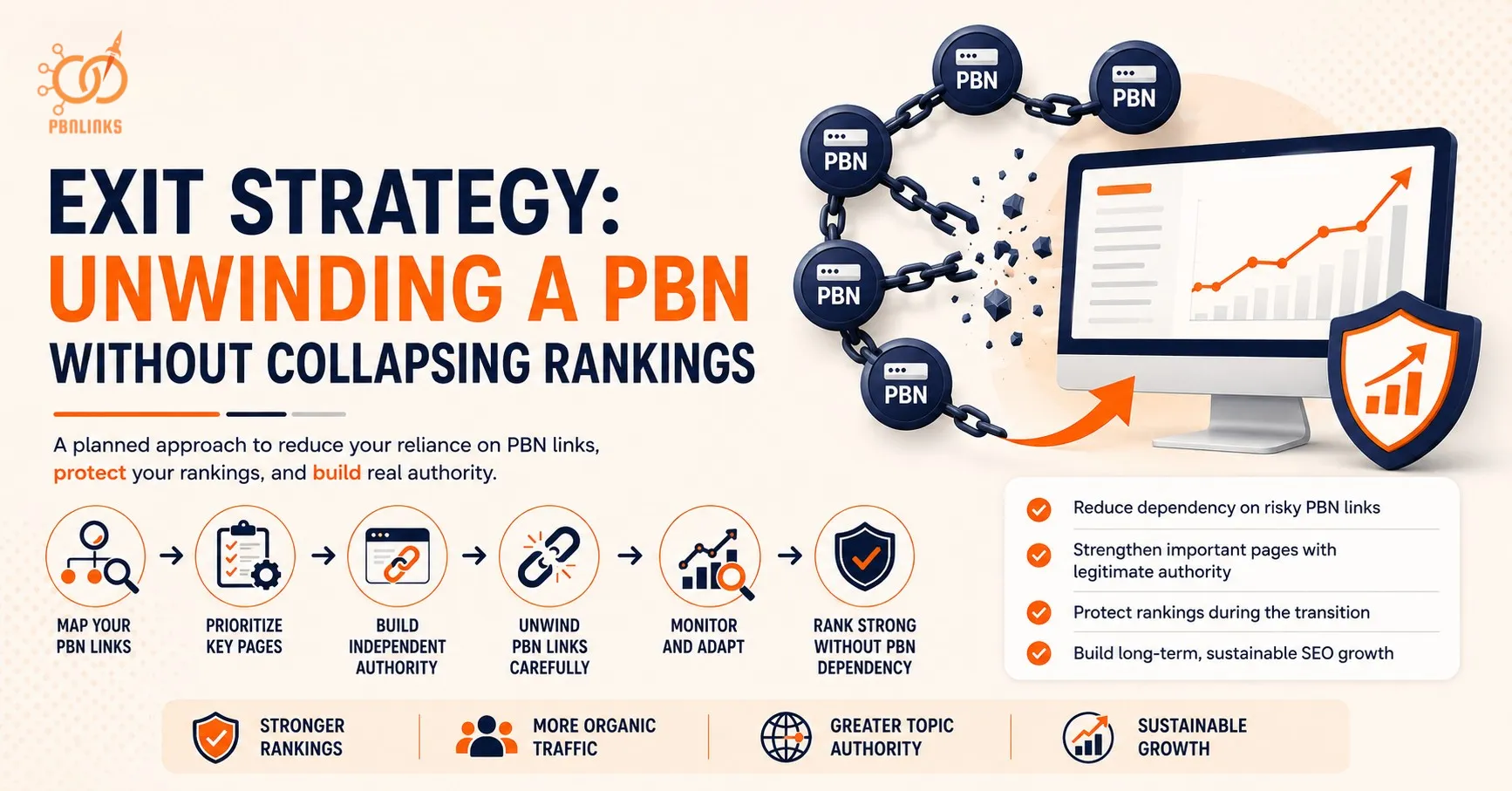
Exit Strategy: Unwinding a PBN Without Collapsing Rankings
PBN links may have helped your rankings for months or even years. But once you decide to stop relying on them, a difficult question appears: how do you unwind those links without putting the rankings they helped support at unnecessary risk?
A PBN exit strategy gives you a planned way to reduce that dependency instead of removing links without understanding what they support. The first step is knowing which PBN domains link to your site, which pages receive those links, what anchors they use, and where your site still lacks independent authority.
The goal is not to replace every PBN backlink one for one or follow an arbitrary removal schedule. It is to strengthen important pages with legitimate referring domains, decide what should happen to existing PBN links, and monitor how the site responds as its reliance on the network decreases.
This guide explains how to map your PBN links, prioritize the pages that need stronger independent support, build replacement authority, unwind existing links, respond if rankings decline, and determine when your site no longer depends on the network.
What Is a PBN Exit Strategy?

A PBN exit strategy is a planned process for reducing a website’s reliance on private blog network links. Instead of removing links without knowing what they support, you first identify where the dependency exists, strengthen legitimate sources of authority, and then decide what should happen to the existing PBN links.
The purpose is not simply to make every PBN backlink disappear. It is to reach a point where important pages and rankings no longer depend heavily on links from the network.
Stopping New PBN Links Is Not the Same as Exiting
You can stop buying or building new PBN links today and still have a site that depends heavily on existing ones. Those links may continue pointing to important pages, providing keyword focused anchors, or representing a large part of the site’s referring domain profile.
A real exit therefore goes beyond stopping new placements. You need to understand what the existing network supports and gradually move the site’s link authority toward independent, relevant websites.
What a Successful PBN Exit Should Achieve
A successful exit should leave the site with stronger independent support than it had before. Important pages should have legitimate referring domains, the backlink profile should be less concentrated around the network, and the SEO strategy should no longer require continued PBN placements.
Success does not depend on reaching a fixed PBN percentage or removing every network link by a certain date. The real objective is reducing dependency until the site can compete without relying heavily on the PBN to support its search visibility.
Why Should You Plan the Exit Before Removing PBN Links?
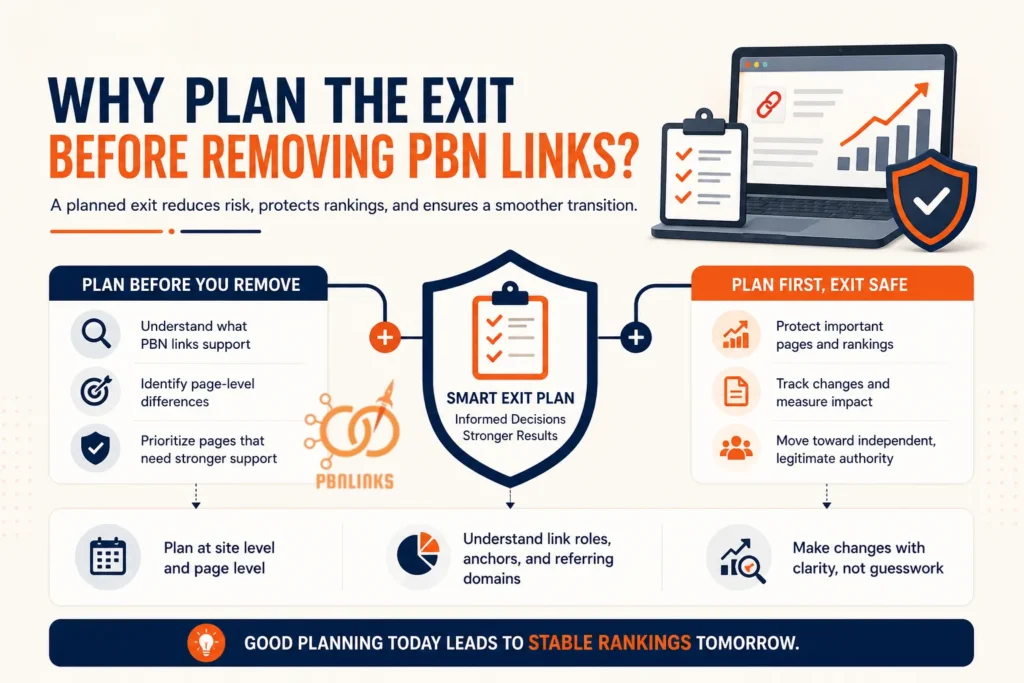
Removing PBN links before understanding what they support can create unnecessary uncertainty. Some links may point to pages that already have strong independent backlinks, while others may support pages with very little authority outside the network.
A clear exit plan helps you identify those differences before making changes. You can then prioritize the pages that need stronger independent support and keep a record of what changes during the transition.
PBN Links May Support Different Pages in Different Ways
Not every PBN link plays the same role in the backlink profile. Some may point to the homepage, while others target product, service, category, or informational pages. The anchor text and number of independent referring domains supporting those pages can also vary significantly.
For example, one page may have links from 20 independent domains plus two PBN sites, while another relies on eight PBN domains and has only one independent referring domain. Removing links from those pages creates very different situations.
This is why the exit should be planned at both the site level and page level.
Removing Links Without a Plan Makes the Impact Harder to Evaluate
If you remove many PBN links at the same time without documenting them, it becomes harder to understand what happened afterward. A ranking decline may affect only certain pages or queries, but you may not know which link changes were relevant.
Before making major changes, record the PBN domains, linking URLs, anchors, target pages, and current search performance of important pages. This gives you a baseline you can compare against later.
Planning does not guarantee that rankings will remain unchanged. It gives you a clearer way to make informed changes, measure the results, and avoid treating every ranking movement as proof that the PBN exit caused it.
How Do You Build a PBN Exit Map?
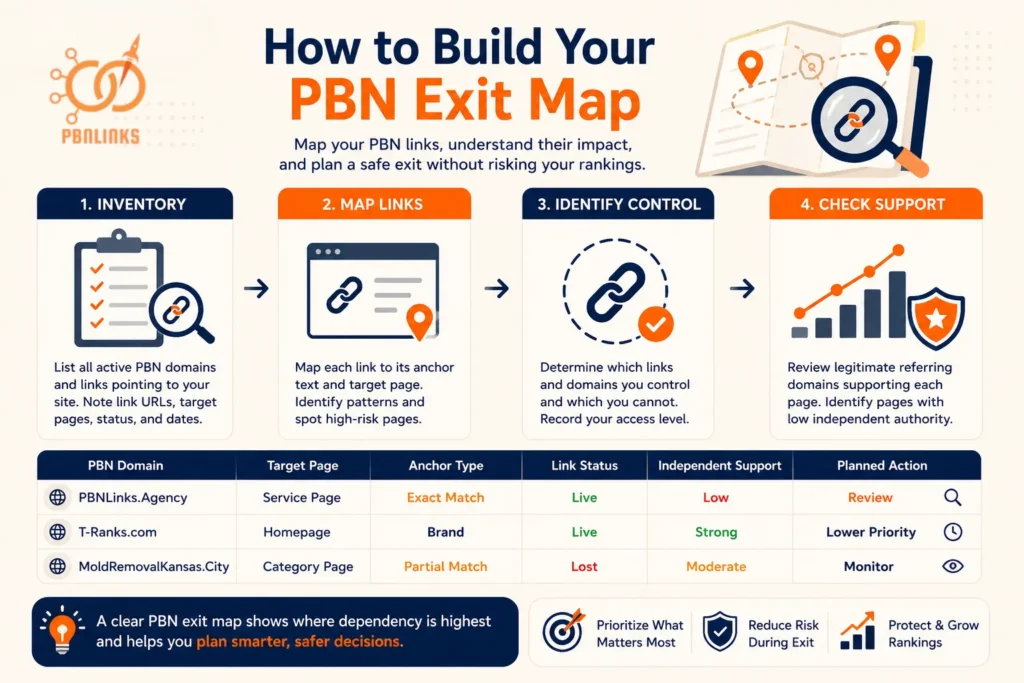
A PBN exit map shows exactly how the network connects to your site before you start changing links. Instead of looking at the PBN as one large group of backlinks, map each important link to the page it supports, the anchor it uses, and the legitimate links already supporting that page.
The goal is to turn a complicated backlink profile into a clear working plan. Once the connections are visible, you can identify which pages need attention first and decide what should happen to each group of PBN links.
Inventory Your Active PBN Domains and Links
Start by creating a list of known PBN domains linking to your site. Record the linking URL, target URL, whether the backlink is still live, and when it was first discovered if that information is available.
Use your own network records alongside backlink data from Google Search Console and third party tools. No single backlink tool necessarily shows every link, so comparing available sources can give you a more complete inventory.
Also mark links that have already disappeared or domains that are no longer active. They can provide useful context when you later compare backlink changes with ranking history.
Map Each Link to Its Anchor Text and Target Page
Next, record the anchor text used by each PBN backlink and the page receiving it. This helps reveal whether the network is concentrated around specific commercial pages, keywords, or sections of the site.
A simple exit map might contain:
| PBN Domain | Target Page | Anchor Type | Link Status | Independent Support | Planned Action |
| PBNLinks.Agency | Service Page | Exact match | Live | Low | Review |
| T-Ranks.com | Homepage | Brand | Live | Strong | Lower priority |
| MoldRemovalKansas.City | Category Page | Partial match | Lost | Moderate | Monitor |
The purpose is not to assign an automatic action based on anchor type. It is to make the site’s dependency visible.
Identify Which Links You Control
Separate links you can directly edit or remove from links you cannot control. If you own the PBN or still have access to the placement, you have more options when it is time to unwind that part of the network.
Also record whether you control the entire referring domain or only the individual placement. This prevents confusion later when deciding whether a link can be changed, removed, or requires another approach.
Record the Legitimate Links Supporting the Same Pages
Finally, examine how much independent backlink support each target page already has. Record relevant referring domains outside the PBN and pay particular attention to pages with little legitimate authority.
This turns the exit map into more than a list of PBN backlinks. It shows where removing network support could matter most and where stronger independent authority may be needed before the site can rely less on the PBN.
Which Pages Should You Prioritize During a PBN Exit?
Not every page needs the same attention during a PBN exit. Some pages may already have strong backlinks from independent websites, while others may depend heavily on PBN links for most of their external support.
Start with the pages where losing network links could create the greatest exposure. This usually means looking at both the importance of the page and how concentrated its backlink profile is around the PBN.
Find Pages With Heavy PBN Link Concentration
Group your PBN backlinks by target URL and compare them with the independent referring domains pointing to the same pages. This helps identify pages where PBNs make up a large part of the meaningful backlink support.
For example, a service page supported by several PBN domains but very few independent websites may deserve more attention than a homepage that already earns links from many relevant sources.
Do not use a fixed percentage to decide whether a page is safe or risky. The purpose is to identify relative dependency across your own site, not to find a universal PBN ratio.
Prioritize Important Pages With Little Independent Authority
Next, consider the business and search value of each page. High value service pages, product pages, category pages, and other pages responsible for important organic traffic or conversions may deserve priority when they have little legitimate backlink support.
This does not mean every commercial page needs a large number of backlinks before you can change its PBN links. It means pages that are both important and heavily dependent on the network should receive closer attention during the transition.
Look for Pages With PBN Heavy Anchor Text
A page may appear reasonably diversified by referring domain count but still rely on PBNs for most of its keyword focused anchor text. Review which anchors come from the network and compare them with anchors from independent websites.
If PBNs provide most of the exact match or commercially focused anchors, do not try to reproduce the same pattern with replacement links. Legitimate editorial links may use brand names, URLs, page titles, or descriptive phrases naturally.
Once you identify the pages with the highest combination of PBN concentration, limited independent authority, and business importance, you have a much clearer order for the next stage of the exit: building stronger independent support before reducing reliance on the network.
Should You Build Replacement Links Before Removing PBN Links?
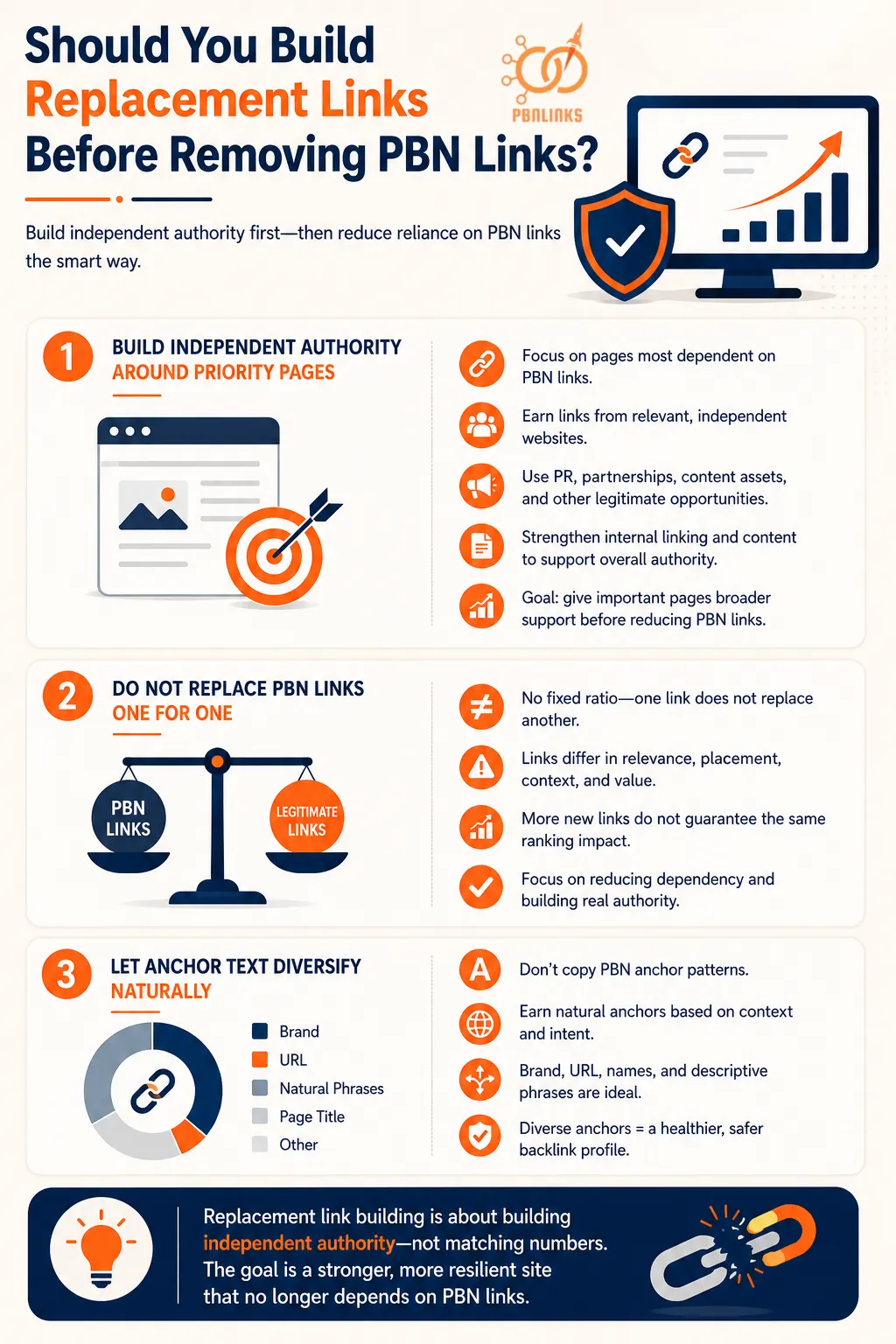
Building legitimate backlinks before reducing PBN support can make sense when important pages still rely heavily on the network. The purpose is not to guarantee that rankings will stay unchanged. It is to build independent authority so those pages are less dependent on PBN links when changes are made.
However, there is no universal rule that replacement links must always come first. If a confirmed manual action requires link cleanup, addressing the violating links takes priority over keeping them simply because they may still support rankings.
Build Independent Authority Around Priority Pages
Start with the pages identified as most dependent in your exit map. Focus on earning links from relevant websites that are genuinely independent of the PBN network.
Depending on the site and industry, this may include editorial mentions, digital PR, industry resources, useful content assets, partnerships, and other legitimate link opportunities. Internal linking and stronger page content can also improve the site’s overall foundation, although they are not direct replacements for external backlinks.
The objective is to give important pages broader support before they rely less on the network.
Do Not Try to Replace PBN Links One for One
There is no reliable formula where one legitimate backlink replaces one PBN backlink. Links differ in relevance, placement, source, context, and how search engines evaluate them.
If a page has ten PBN links, that does not mean you need exactly ten new links before changing anything. Likewise, gaining ten new backlinks does not guarantee that they will reproduce the ranking effect previously associated with ten PBN links.
Think in terms of reducing dependency and building independent authority, not matching backlink counts.
Let New Links Diversify Anchor Text Naturally
Do not try to recreate the PBN’s anchor text pattern on replacement links. If the network heavily used exact match or keyword focused anchors, copying those same anchors onto new placements simply carries the controlled pattern into the new backlink profile.
Legitimate links may naturally use your brand, URL, page title, product or service name, or descriptive phrases based on the surrounding content. You do not need to force those links toward a predetermined anchor percentage.
The aim of replacement link building is therefore broader than replacing lost link numbers. It should leave important pages supported by a wider range of independent websites and less reliant on the links you are preparing to unwind.
What Should You Do With Your Existing PBN Links?
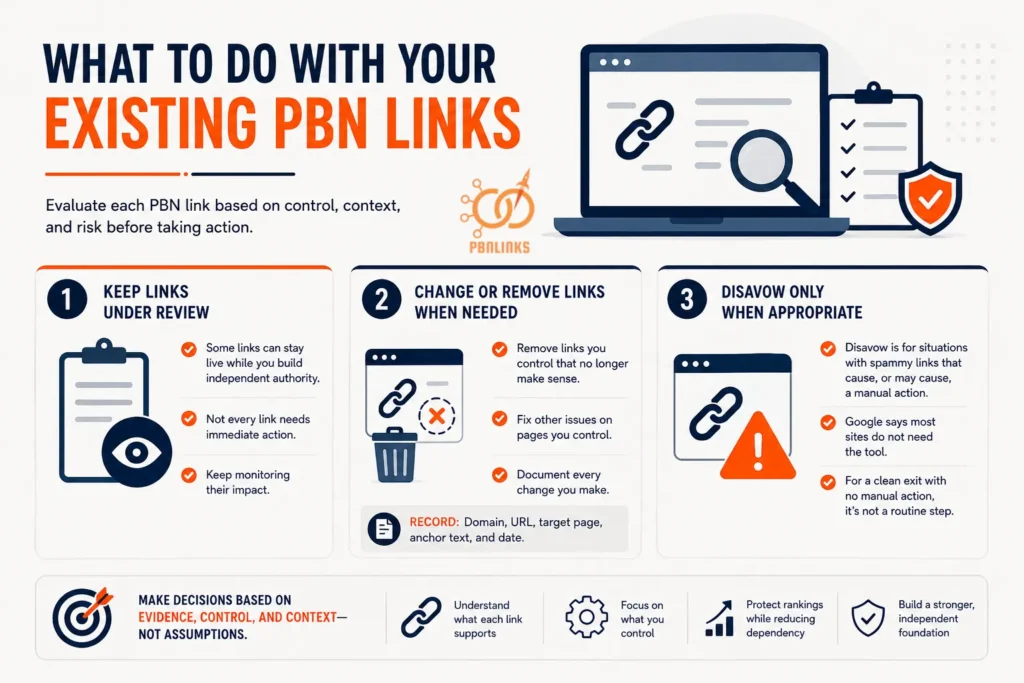
Once you have mapped the network and strengthened priority pages, you can decide what should happen to the PBN links that remain. The right action is not automatically the same for every backlink.
Review links in context. Consider whether you control them, which pages they support, whether they are part of an obvious manipulative pattern, and whether there is a confirmed link related manual action before making broad changes.
Decide Which Links Can Stay Under Review
Not every existing PBN link needs an immediate action simply because you have started an exit. Some links may remain live while you continue building independent authority and evaluating how dependent the target pages are.
Keeping a link under review does not mean treating it as safe or planning to rely on it permanently. It simply means you are not making a change before you have a clear reason and understand what the link currently supports.
Change or Remove Links When There Is a Clear Reason
If you control a PBN link and decide it should no longer point to the money site, you can remove it directly. In some situations, you may also need to correct other issues on pages you control rather than continuing a placement created primarily to influence rankings.
Record what you change, including the referring domain, linking URL, target page, anchor text, and date. This makes it easier to compare later ranking or traffic changes with the actions taken during the exit.
Consider Disavowal Only When Appropriate
Removing and disavowing a backlink are different actions. Removal takes the link off the referring page, while disavowal asks Google to disregard specified backlinks when assessing your site.
Google says most websites do not need the Disavow Links tool. It is intended for situations involving a considerable number of spammy, artificial, or low quality links when those links have caused, or are likely to cause, a manual action. Using it without understanding the consequences can negatively affect search performance.
For a planned PBN exit with no confirmed link related problem, disavowal should therefore not be treated as a routine final step. If you receive an unnatural links manual action, the situation changes and addressing violating links becomes a priority.
The goal is to make each decision based on what the link supports, what you control, and what evidence you have, rather than treating the entire PBN as one group that must receive the same action.
Should You Remove All PBN Links at Once or Unwind Them Gradually?
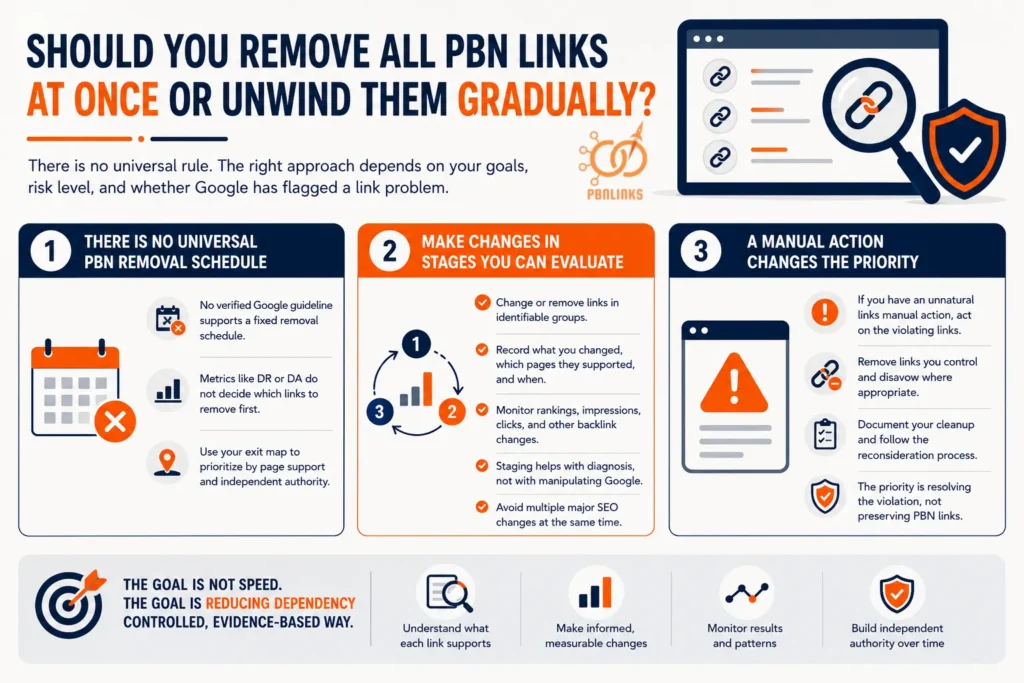
There is no universal rule that says PBN links must be removed all at once or gradually. The right approach depends on why you are exiting the network, how heavily important pages still rely on those links, and whether Google has identified a link related violation.
For a planned PBN exit strategy, making changes in controlled stages can make the results easier to evaluate. However, gradual removal should not be treated as a proven way to prevent ranking loss.
There Is No Universal PBN Removal Schedule
You may see recommendations to remove a certain percentage of PBN links every week or month. There is no verified Google guideline supporting a fixed schedule such as removing 10 percent of links every 30 days.
The same problem applies to choosing a removal order based only on backlink metrics. A lower DR or DA does not automatically mean that a particular PBN link should be the first one removed.
Use your exit map instead. Consider which pages the links support, how much independent authority those pages have, and what other changes are happening to the site.
Make Changes in Stages You Can Evaluate
For a voluntary exit with no confirmed manual action, making identifiable groups of changes can make monitoring easier. Record which links were changed or removed, the pages they supported, and when the changes occurred.
Then monitor the affected pages alongside rankings, impressions, clicks, and other backlink changes. The purpose of staging is better diagnosis, not trying to manipulate Google with a particular removal speed.
Avoid making multiple major SEO changes at the same time when possible. If links, content, internal linking, site structure, and technical settings all change together, it becomes much harder to understand what influenced the results.
A Manual Action Changes the Priority
If Google Search Console shows an unnatural links manual action, preserving questionable PBN links simply to avoid a possible ranking decline should not drive the strategy.
In that situation, focus on addressing the links involved in the violation, documenting the cleanup, using disavowal where appropriate, and following the reconsideration process. The objective shifts from managing a voluntary transition to resolving a confirmed spam policy issue.
A planned exit can therefore be gradual when that helps you evaluate changes, but gradual removal is not the goal itself. The goal is to reduce PBN dependency in a controlled, evidence based way until the site no longer needs the network to support its rankings.
Can You Remove PBN Links Without Losing Rankings?
You can remove PBN links without necessarily losing rankings, but there is no guarantee that rankings will remain unchanged. The outcome depends partly on whether those links were contributing meaningful signals and how much independent authority the affected pages already have.
This is why a PBN exit strategy should focus on reducing dependency before assuming links can be removed with no effect. The less a page relies on the network, the less important any individual PBN link may become to its overall backlink support.
Why Removing PBN Links Can Affect Rankings
If PBN links were contributing signals that helped a page rank, removing them means those signals are no longer available. A page that receives most of its external support from the network may therefore be more exposed than one with links from many independent, relevant websites.
The effect may not appear immediately, and a ranking change after link removal does not prove that the removed links were the only cause. Google still has to recrawl pages and process changes, while competitors, content, search intent, technical issues, and other ranking signals can change at the same time.
Why Replacement Authority Can Reduce Dependency but Cannot Guarantee Stability
Building legitimate backlinks to important pages can reduce how much those pages depend on PBN links. Relevant editorial links, independent referring domains, useful citations, and stronger overall site signals create a broader foundation outside the network.
However, replacement links should not be treated as guaranteed substitutes. There is no formula showing that a particular number of new backlinks will preserve the rankings previously associated with a particular group of PBN links.
The objective is to make the page less dependent on any single source of link authority, not to reproduce the exact ranking effect of the old network.
Avoid Treating Ranking Stability as Proof That a Link Was Safe
If you remove a PBN link and rankings remain stable, that does not prove the link was safe, harmful, ignored, or providing no value. Other signals may simply be sufficient to support the page.
The reverse is also true. If rankings decline after removing a PBN link, timing alone does not prove that the removal caused the entire drop.
Use ranking changes as part of the evidence, not as the only evidence. A successful exit is ultimately about building enough independent authority that the site’s search visibility no longer depends heavily on whether individual PBN links remain in place.
What Should You Do If Rankings Drop During the PBN Exit?
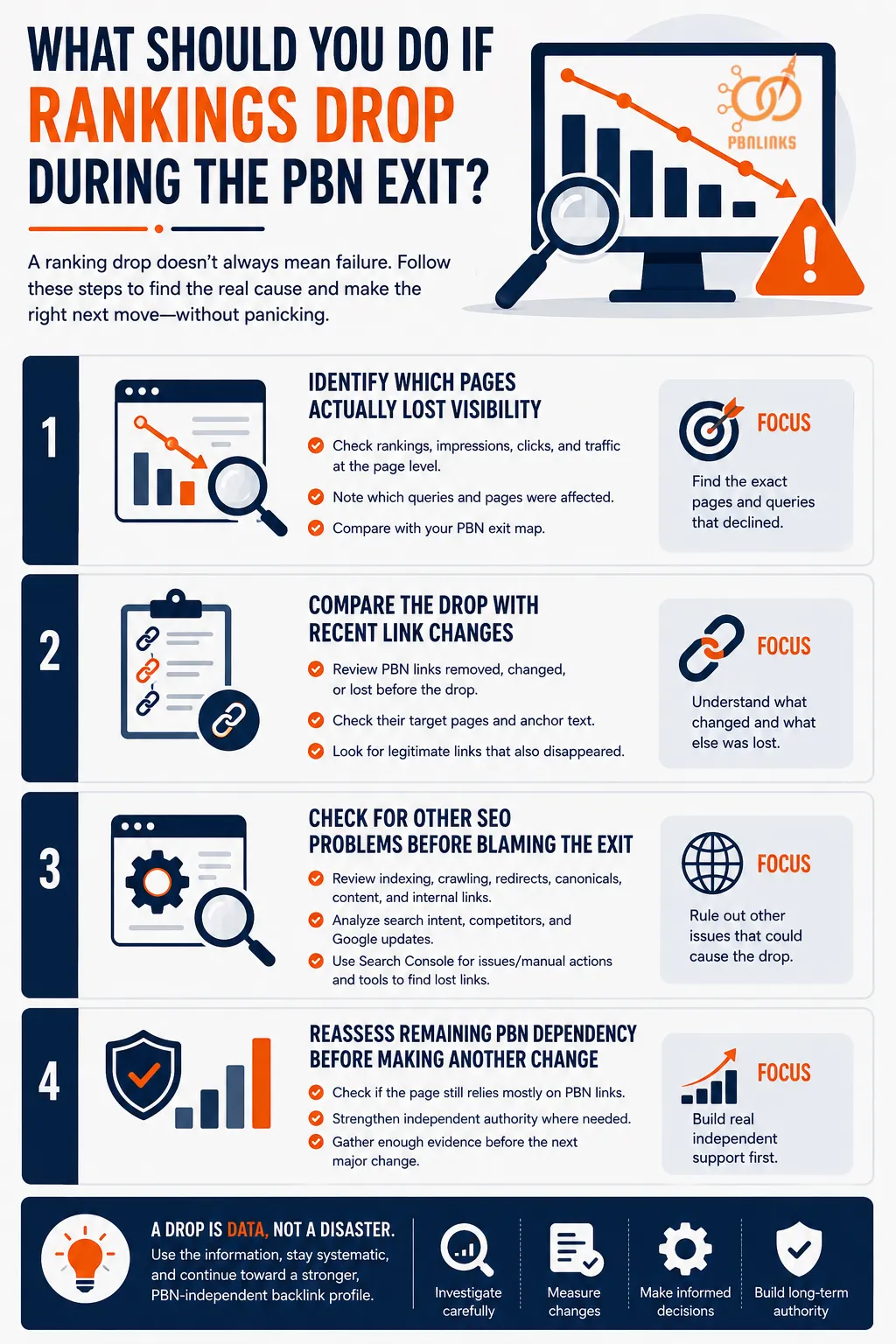
A ranking drop during a PBN exit does not automatically mean the strategy has failed. If recently changed links were contributing useful signals, their loss may be relevant, but rankings can also move because of content changes, technical problems, competitors, search intent, or broader Google updates.
Do not immediately restore every removed link or stop the entire exit. First identify what changed, which pages were affected, and whether the timing supports a connection with the PBN changes.
Identify Which Pages Actually Lost Visibility
Start at the page level rather than looking only at total organic traffic. Determine which URLs lost rankings, impressions, clicks, or traffic and which queries were affected.
Compare those pages with your PBN exit map. If the decline is concentrated on pages where PBN support was recently reduced, that deserves closer investigation. If unrelated sections of the site also declined, the cause may be broader.
Compare the Drop With Recent Link Changes
Review exactly which PBN links were removed, changed, or lost before the decline. Check their target pages, anchor text, and the independent referring domains supporting those pages.
Also look for legitimate backlinks that disappeared during the same period. A page may have lost several types of links, making it misleading to attribute the entire ranking change to the PBN exit.
Check for Other SEO Problems Before Blaming the Exit
Review other changes that could explain the decline. Check indexing, crawling, redirects, canonicals, content updates, internal links, search intent, competitor improvements, and relevant Google ranking changes.
Google Search Console can help you compare impressions and clicks, identify indexing problems, and check whether a manual action exists. Backlink tools can help identify lost links, but their metrics cannot tell you exactly how Google valued each backlink.
Reassess the Remaining PBN Dependency Before Making Another Change
If the affected page still receives most of its meaningful external support from PBNs, it may not yet have enough independent authority for further reductions in network links.
That does not automatically mean you should restore removed PBN links. Instead, reassess the page, strengthen legitimate support where appropriate, and gather enough evidence before making the next major change.
A ranking decline should become information for the next decision, not a reason to panic. The purpose of a controlled PBN exit is to understand how the site responds while continuing toward a backlink profile that no longer depends heavily on the network.
How Do You Monitor Whether Your PBN Exit Strategy Is Working?
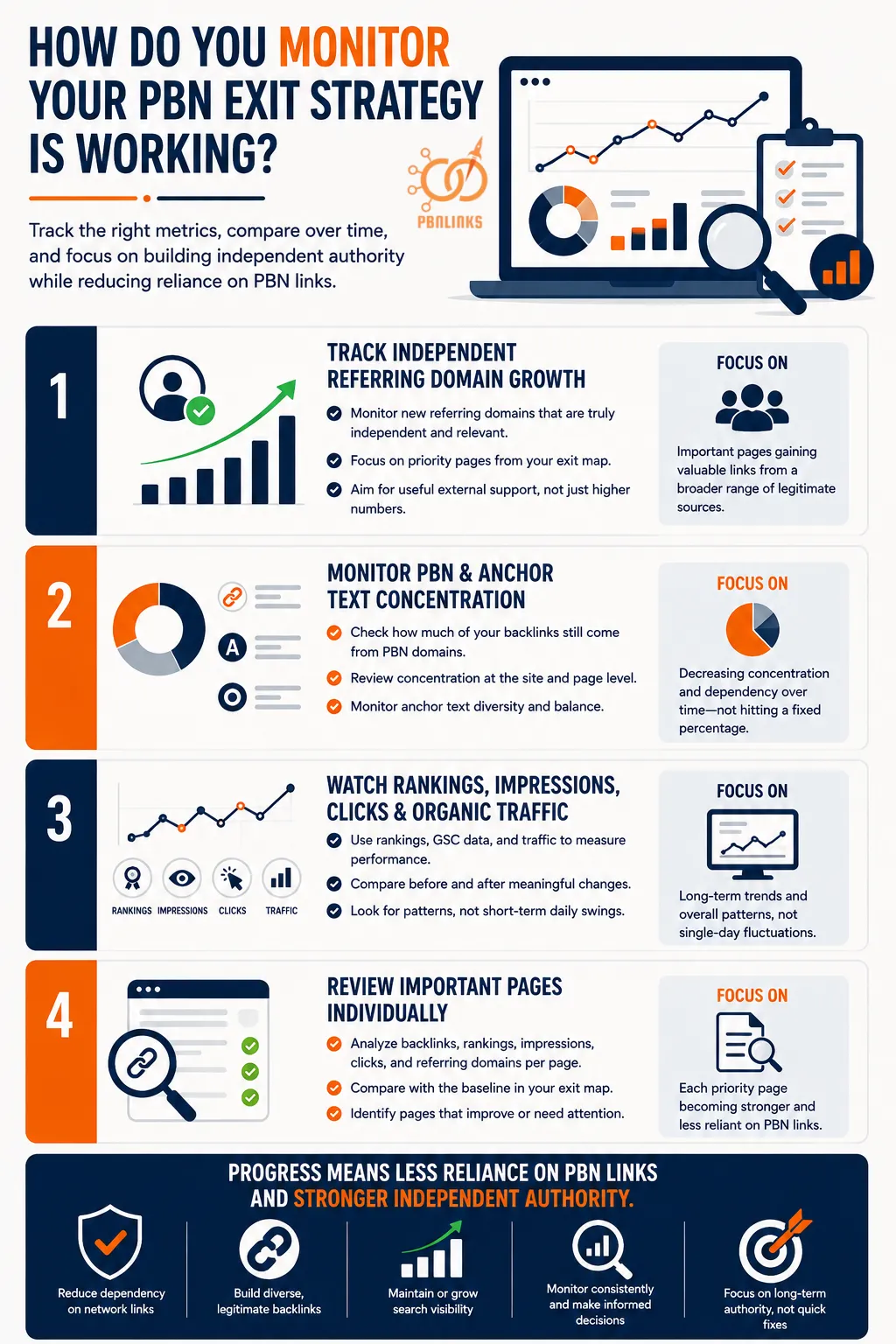
A PBN exit strategy is working when the site becomes less dependent on network links while important pages maintain or develop stronger support from independent sources. Rankings are important, but they should not be the only measure of progress.
Monitor the backlink profile and search performance together. This helps you see whether legitimate authority is growing, PBN concentration is decreasing, and important pages are becoming less reliant on the network.
Track Independent Referring Domain Growth
Monitor new referring domains that are genuinely independent of the PBN and relevant to your site. Pay particular attention to the priority pages identified in your exit map.
The goal is not simply to increase the number of referring domains. A large number of weak or irrelevant links can change the numbers without creating meaningful diversification. Focus on whether important pages are gaining useful external support from a broader range of legitimate sources.
Monitor PBN and Anchor Text Concentration
Compare how much of the backlink profile still comes from PBN domains and where those links are concentrated. Review both the site as a whole and individual pages that previously relied heavily on the network.
Also monitor anchor text. If PBNs once supplied most of the exact match or keyword focused anchors, check whether the overall profile is becoming broader as independent links are earned.
Do not aim for a fixed PBN or anchor text percentage. The purpose is to measure whether concentration and dependency are decreasing.
Watch Rankings, Impressions, Clicks, and Organic Traffic
Use ranking data together with Google Search Console impressions and clicks and your organic traffic data. Compare performance before and after meaningful changes made during the exit.
Look for patterns rather than reacting to normal daily movement. A single keyword dropping a few positions does not establish that the exit is failing, just as a short term ranking increase does not prove that the transition is complete.
Review Important Pages Individually
Sitewide averages can hide problems. A domain may appear stable overall while one important service, product, or category page loses visibility after its PBN support changes.
Review priority pages separately and compare their backlinks, rankings, impressions, clicks, and independent referring domains with the baseline recorded in your exit map.
There is no universal period you must wait between every change. The important thing is to collect enough meaningful data to understand what happened before making another major decision. Progress means the site is becoming less reliant on the network while building stronger independent support for the pages that matter most.
What Should You Do With PBN Sites You No Longer Need?
Once your money site no longer depends heavily on the network, the exit process moves beyond individual backlinks. You also need to decide what happens to the PBN sites themselves.
There is no requirement to keep maintaining network sites simply because they once provided backlinks. The decision should depend on whether a site still has a legitimate purpose, whether links to the money site remain, and whether you want to continue owning the domain.
Remove Remaining Money Site Links Where Appropriate
Review each PBN site for links still pointing to the money site. If those links are no longer part of your strategy and you control them, you can remove them directly.
Keep a record of what was removed and when. This helps preserve the history of your exit and makes it easier to investigate later changes without relying on memory or incomplete backlink data.
Decide Whether Individual Sites Have a Legitimate Purpose
A former PBN site may contain useful content or have value independent of its previous role in the network. If you plan to keep a site, evaluate whether it has a genuine purpose for users rather than maintaining it simply to preserve artificial links.
The key distinction is whether the website can stand on its own. Keeping a domain does not mean it needs to continue functioning as part of a private blog network.
Decommission Network Assets You No Longer Need
If a PBN site has no legitimate purpose and no reason to remain part of your broader web properties, you may decide to stop maintaining it or allow the domain to expire.
Before doing so, document any remaining links, redirects, content, or other connections that could affect the money site. Shutting down several domains without knowing what they still support can make later ranking changes harder to evaluate.
Decommissioning the network is not about hiding old PBN footprints or rebuilding them elsewhere. It is the final operational step in moving away from a link strategy your main site no longer needs.
How Do You Know When Your PBN Exit Is Complete?
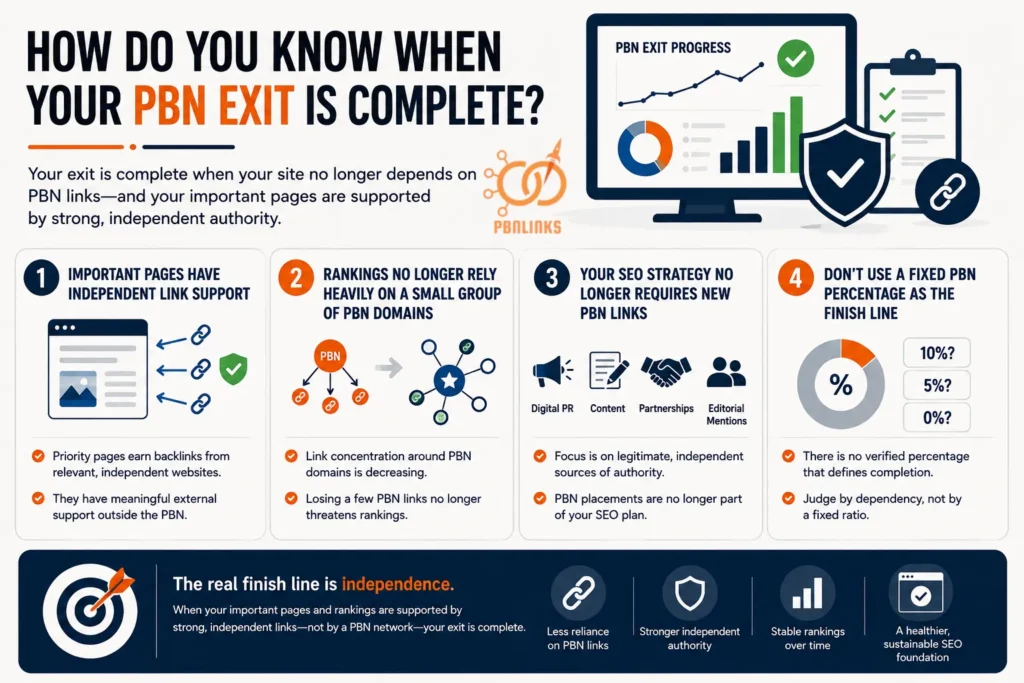
A PBN exit is complete when your SEO strategy no longer depends on the network to support important pages and rankings. Simply stopping new PBN placements or removing a certain number of links does not necessarily mean the dependency is gone.
Use the exit map and monitoring data to compare where the site started with where it stands now. The strongest signs are broader independent link support, lower concentration around PBN domains, and less reliance on controlled links for important pages.
Important Pages Have Independent Link Support
Return to the pages you identified as priorities at the beginning of the exit. Check whether they now receive relevant backlinks from independent websites rather than relying mainly on PBN domains.
This does not mean every page needs a specific number of backlinks. The important question is whether the pages that matter most have developed meaningful external support outside the network.
Rankings No Longer Rely Heavily on a Small Group of PBN Domains
A site is still dependent if losing a small group of network links would remove a large part of the external support behind its important pages.
As the exit progresses, that concentration should decrease. Rankings may still change when backlinks are lost, but the site’s broader link profile should no longer be built around continued support from a small controlled network.
Your SEO Strategy No Longer Requires New PBN Links
Another strong sign is that new PBN placements are no longer needed to support your SEO plan. Link acquisition can instead focus on relevant editorial mentions, useful content, digital PR, partnerships, and other legitimate sources of independent authority.
At this point, the network is no longer a necessary part of maintaining or growing the site’s backlink profile.
Do Not Use a Fixed PBN Percentage as the Finish Line
There is no verified percentage that determines when a PBN exit is complete. Reaching 10 percent, 5 percent, or even zero PBN links does not automatically tell you whether the site’s backlink profile is strong or whether rankings are stable.
Judge the exit by dependency rather than a fixed ratio. The real finish line is when the site has enough independent support that its SEO strategy and important pages no longer rely heavily on the PBN network.
Conclusion
In conclusion, a successful PBN exit strategy starts with understanding exactly where the site still depends on the network. Map existing PBN links, identify the pages most exposed, build stronger independent authority, and decide what to do with each link based on evidence rather than arbitrary percentages or removal schedules.
There is no guaranteed way to remove PBN links without ranking changes. The safer approach is to make measurable changes, monitor important pages, and investigate any decline before assuming the exit itself is responsible. If a manual action exists, resolving the link related violation should take priority.
The exit is complete when important pages have meaningful support from independent sources and continued PBN placements are no longer necessary for the SEO strategy. The goal is not simply to reach zero PBN links, but to build a site whose search visibility no longer depends heavily on the network.
If you are planning to unwind a PBN but are unsure which links or pages should be addressed first, get a professional backlink assessment and build a clear exit plan before making major changes.
FAQs About PBN Exit Strategy
What is a PBN exit strategy?
A PBN exit strategy is a planned process for reducing a site’s reliance on private blog network links. It focuses on mapping existing links, building independent authority, managing current PBN links, and monitoring performance during the transition.
Can I remove PBN links without losing rankings?
Yes, rankings can remain stable, but there is no guarantee. The outcome depends partly on whether those links were contributing ranking signals and how much independent authority the affected pages already have.
Should I remove all PBN links at once?
Not automatically. There is no Google rule requiring immediate or gradual removal, so the approach should depend on your link profile, page level dependency, and whether a manual action exists.
Should I build replacement backlinks before removing PBN links?
It can make sense when important pages still depend heavily on PBNs. Building legitimate independent authority first can reduce dependency, but it does not guarantee that removing the old links will have no ranking impact.
Do I need to replace every PBN backlink?
No. There is no one for one replacement formula for backlinks because links differ in relevance, context, source, and potential value. Focus on building meaningful independent authority rather than matching link counts.
Should replacement links use the same anchor text as PBN links?
No. Do not automatically reproduce PBN anchor patterns. Legitimate links should use anchors appropriate to their context, which may include brand names, URLs, page titles, or descriptive phrases.
Should I disavow PBN links during an exit?
Not automatically. Google says most sites do not need the Disavow Links tool; it is mainly intended for substantial spammy or artificial link problems that caused, or are likely to cause, a manual action.
What should I do if rankings drop after removing PBN links?
Investigate the affected pages before assuming the removed links caused the decline. Compare recent link changes with lost backlinks, content and technical changes, Search Console data, competitors, and broader ranking changes.
How long does a PBN exit take?
There is no fixed timeline for a PBN exit. It depends on the site’s PBN dependency, ability to build legitimate authority, links that require action, and how search performance changes during the transition.
How do I know when my PBN exit strategy is complete?
Your PBN exit is effectively complete when important pages and your ongoing SEO strategy no longer rely heavily on the network. There is no verified PBN percentage or backlink count that defines the finish line.