Which Pages Should You Avoid Pointing PBN Links To?
Many people think a strong PBN link can help any page rank. Find the page you want to push, add the backlink, and rankings should improve. In reality, the wrong target page can waste much of the value of that link.
When deciding which pages to avoid with PBN links, the first step is to separate pages that should not be targeted from pages that simply need to be fixed first. Noindex pages, broken URLs, weak content, duplicate targets, and heavily over-linked pages all need different treatment.
Some pages also require more judgment. A homepage, product page, category page, seasonal page, or redirected URL can still be a valid PBN target when it matches search intent, supports the campaign goal, and has long-term value.
Choosing the right target is therefore just as important as choosing the right PBN site. This guide explains which pages to avoid, which pages to improve before link building, when selective targeting makes sense, and how to check whether a page is ready for the next PBN link.
Which Pages Should You Avoid With PBN Links?
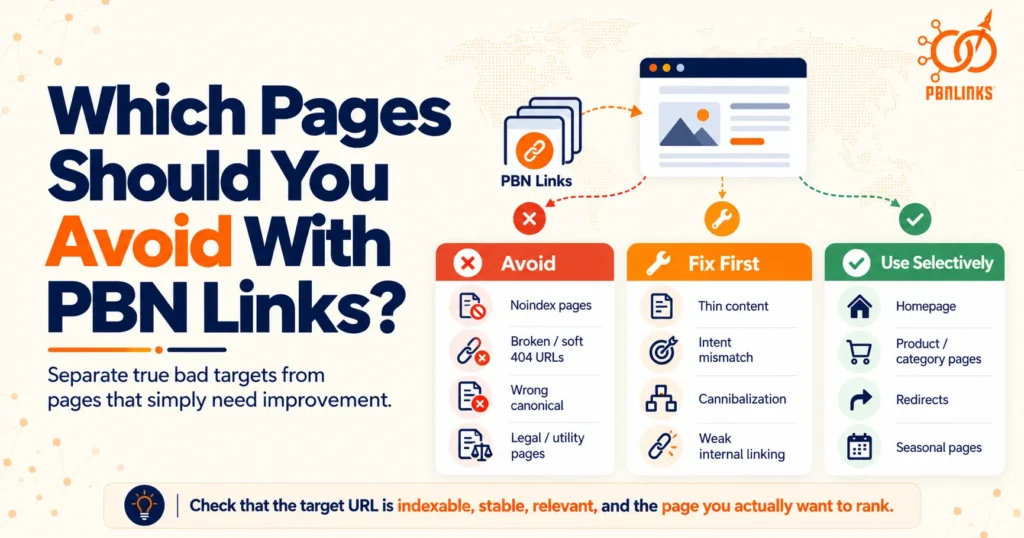
You should avoid pointing PBN links to pages that are not meant to rank, are technically unstable, or are clearly the wrong URL to strengthen. Other pages may still be usable, but only after their content, targeting, or link profile is improved.
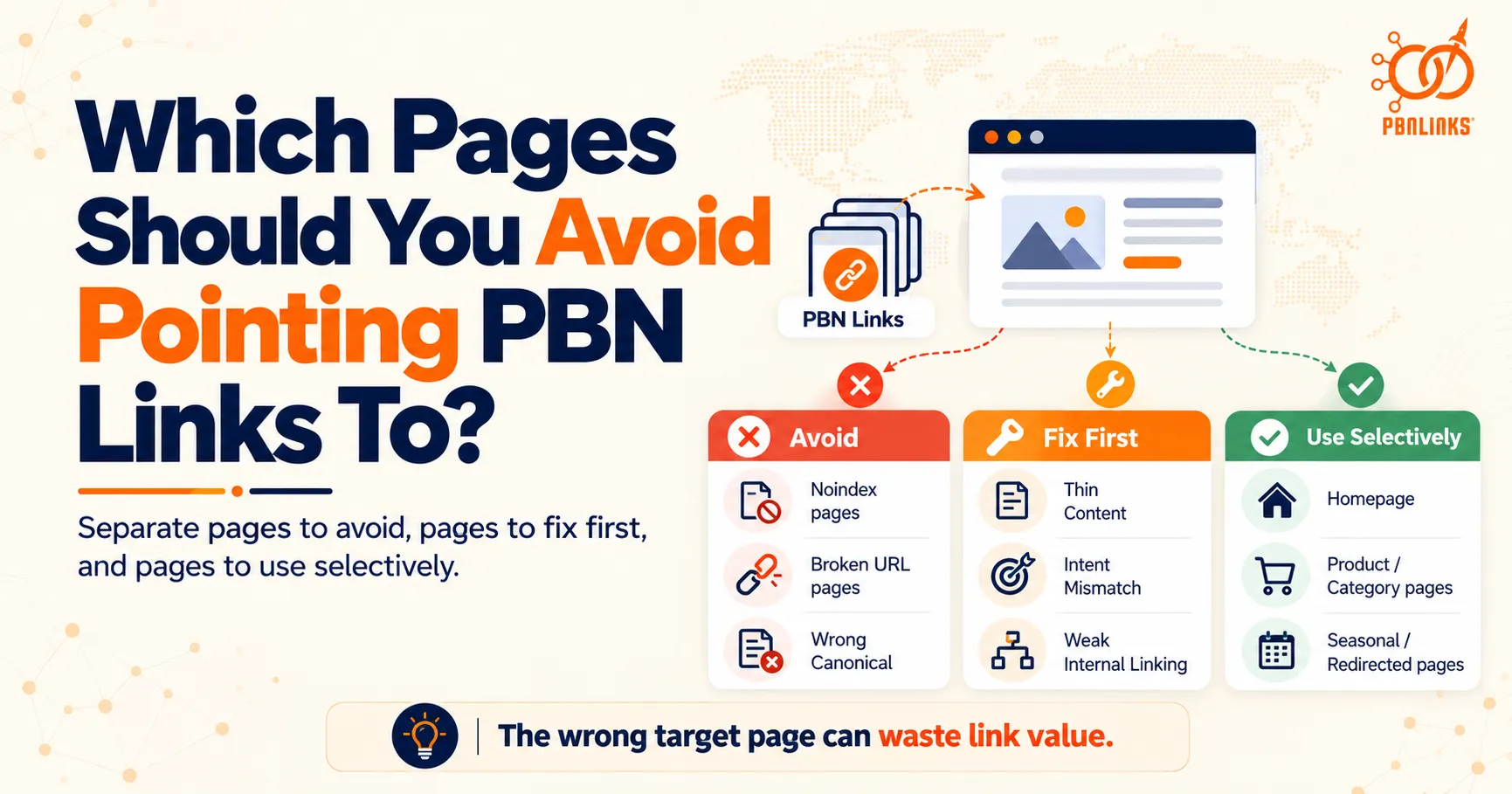
The easiest way to judge a target page is to place it into one of three groups.
| Page Type | Recommended Action | Why |
| Noindex, broken, soft 404, wrong canonical, legal or utility pages | Avoid | These pages are usually poor direct ranking targets |
| Thin content, intent mismatch, cannibalization, weak internal linking | Fix First | The page may be suitable once the underlying problem is corrected |
| Homepage, product pages, category pages, redirects, seasonal pages | Use Selectively | These can work when they match the campaign goal and search intent |
The key difference is that a bad page and a bad target are not always the same thing. A privacy policy may be technically healthy, but it usually has little value as a PBN target. A thin service page may be a poor target today, but it can become suitable after the content is improved.
Before adding a PBN link, confirm that the target URL is indexable, stable, relevant, and actually the page you want Google to rank.
Pages You Should Usually Avoid Pointing PBN Links To
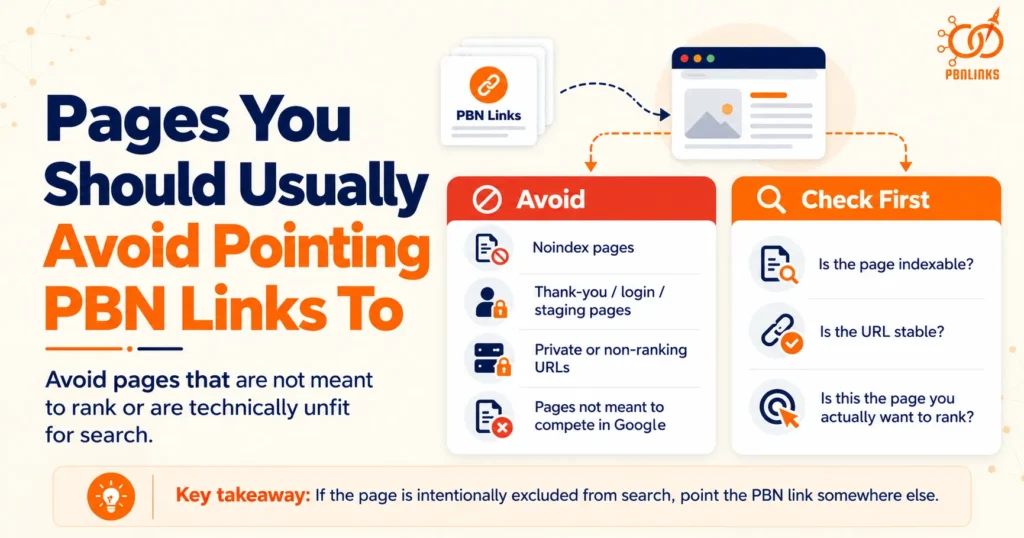
Some pages are poor PBN targets because they are not designed to rank, are technically unstable, or are not the URL Google should treat as the main version. Sending a strong backlink to the wrong page can waste authority that would have been more useful on a page with clear ranking potential.
The first step is to check whether the target page is actually eligible and suitable for search. Before thinking about anchor text, link strength, or how many PBN links to build, confirm that the page can be indexed, has a stable URL, and is the version you want Google to rank.
This is especially important because not every weak target should be treated the same way. Some pages should be avoided completely, while others simply need a technical issue fixed before they become suitable for link building.
Noindex and Non-Ranking Pages
You should generally avoid pointing PBN links to pages that are intentionally set to noindex when the goal is to rank that exact page in Google.
A noindex directive tells Google that the page should not appear in search results. If the page is deliberately excluded from the index, adding external authority to it usually has little strategic value for a ranking campaign because the target itself is not intended to compete in the SERPs.
Common examples include thank-you pages, login pages, private campaign pages, staging URLs, and other pages created for users or internal workflows rather than organic search.
The important distinction is whether the noindex status is intentional or accidental. A service page may be noindexed because of a development mistake, plugin setting, or migration issue. In that case, the page may still be a good PBN target once the indexing problem is corrected.
If the page is intentionally excluded from search, a different target URL usually makes more sense. For example, instead of linking to a thank-you page after a form submission, the PBN link would normally be better directed to the relevant service page, category page, or other URL that is actually intended to rank.
The same logic applies to other non-ranking pages. A page may exist for navigation, account access, tracking, or conversion completion without having any meaningful organic search purpose. These pages can be perfectly valid parts of the site and still be poor places to allocate PBN authority.
The practical rule is simple. Before adding a PBN link, ask whether the target page is supposed to appear and compete in Google Search. If the answer is no, the link should usually point somewhere else.
Wrong Canonical or Duplicate URLs
You should avoid pointing PBN links to a duplicate or alternate URL when another page is the version you actually want Google to rank. The issue is not simply that two pages contain similar content. The real problem is strengthening the wrong URL.
Google may find several similar versions of the same page and choose one as the canonical version. This often happens with URL parameters, filtered category pages, duplicate location pages, HTTP and HTTPS versions, or other alternate URLs created by the site.
If a page has a canonical tag pointing to another URL, that is also a strong sign that the other page is intended to be the main version. In that situation, directing a PBN link to the canonical URL usually makes more sense than building authority to the alternate page.
For example, imagine an ecommerce site has a main category page and several filtered versions of that category. If the filtered URLs all point back to the main category with canonical tags, the main category is normally the better PBN target because it is the page intended to compete in search.
This does not mean a backlink to a duplicate or non-canonical URL automatically loses all value. Google can consolidate signals between duplicate pages. However, when you control the PBN placement, linking directly to the preferred URL keeps the campaign simpler and makes it clear which page you are trying to strengthen.
The same principle applies to duplicate service or location pages. Before adding a PBN link, decide which page should rank for the target query. Then make sure the canonical tag, search intent, and other site signals support that same URL.
The practical rule is simple. Do not build authority to an alternate version of a page when you already know which URL should rank. Point the PBN link to the preferred canonical page whenever possible.
Broken, Soft 404, and Unstable Target URLs
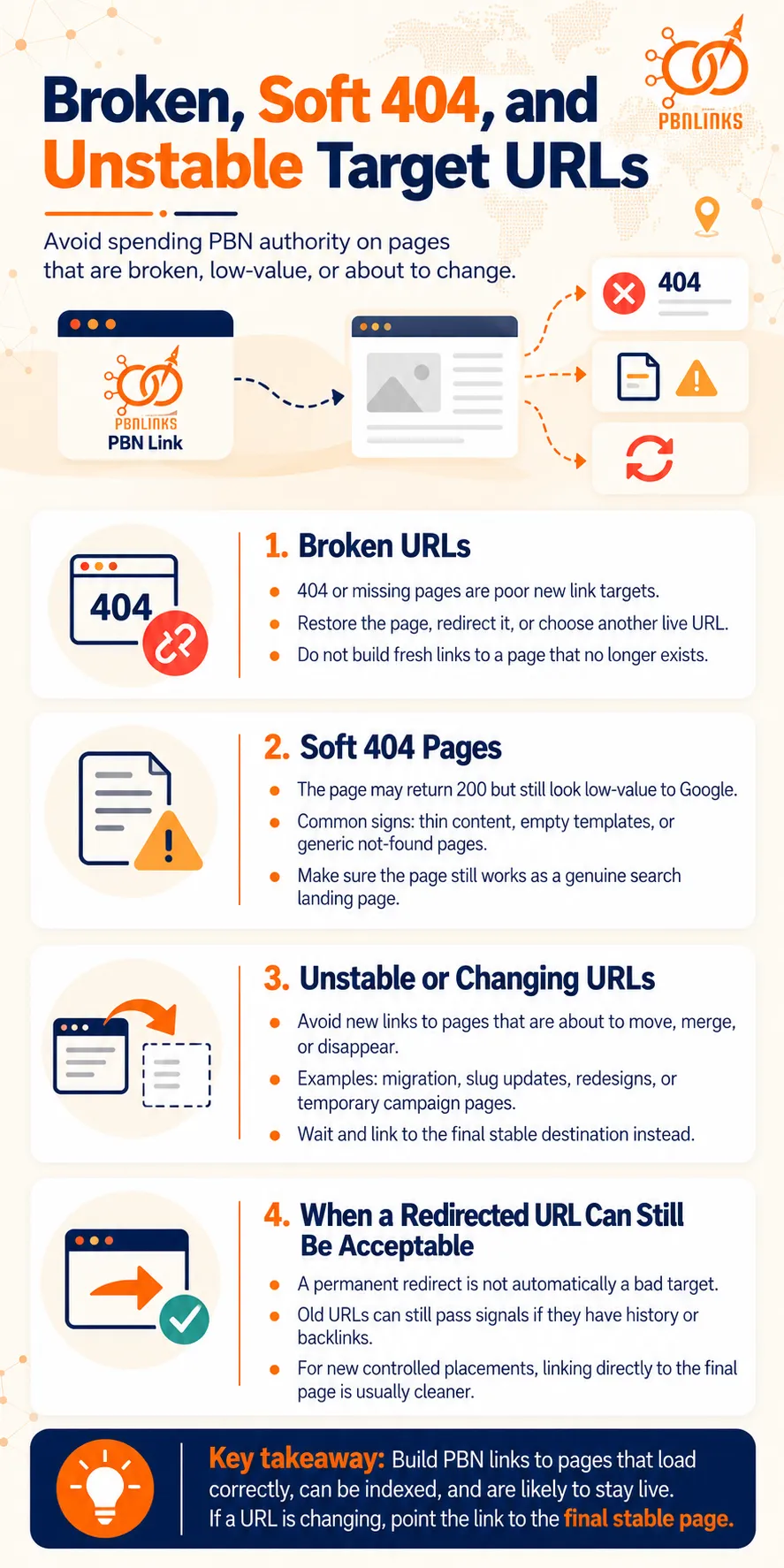
You should avoid pointing PBN links to broken, soft 404, or unstable URLs because the target may not remain a valid ranking destination. A backlink is more useful when it supports a page that loads correctly, can be indexed, and is expected to stay live.
Broken URLs
A broken page is the clearest case. If the target returns a 404 error or no longer exists, there is little reason to build new PBN links to it.
The better option is to:
- restore the original page if it still has value,
- redirect it to the most relevant replacement,
- or choose another live URL that is already suitable for search.
Building fresh links to a page that no longer exists only adds unnecessary complexity to the campaign.
Soft 404 Pages
Soft 404s are less obvious because the page may return a normal 200 status code while Google still treats it like a missing or low-value page.
This can happen when the page:
- contains almost no useful content,
- shows a generic “not found” style message,
- has an empty product or category template,
- or no longer satisfies the purpose of the original URL.
Before adding a PBN link, make sure the page has enough real content and still functions as a genuine search landing page.
Unstable or Changing URLs
A page can also be a poor target if the URL is about to change. This may happen during a site migration, slug update, content consolidation, redesign, or page removal.
For example, if a service page will move from /old-service/ to /new-service/ next week, it usually makes more sense to wait and build the PBN link to the final URL instead of creating a new link that immediately has to pass through a redirect.
Temporary campaign pages need the same caution. A short-term landing page may be useful during a promotion, but if the URL will disappear afterward, it may not be the best place to invest a strong backlink.
When a Redirected URL Can Still Be Acceptable
A redirected URL is not automatically a bad target. Permanent redirects can pass ranking signals, especially when the old URL already has useful backlinks or historical value.
However, when you control a new PBN placement, linking directly to the final stable destination is usually cleaner. It reduces unnecessary redirect hops and makes the target of the campaign easier to manage.
Before building the link, confirm that the page loads correctly, is indexable, and is likely to remain part of the site. If the URL is about to change, stabilize the destination first and then point the PBN link to the page that will remain.
Fix Thin or Weak Pages Before Adding PBN Links
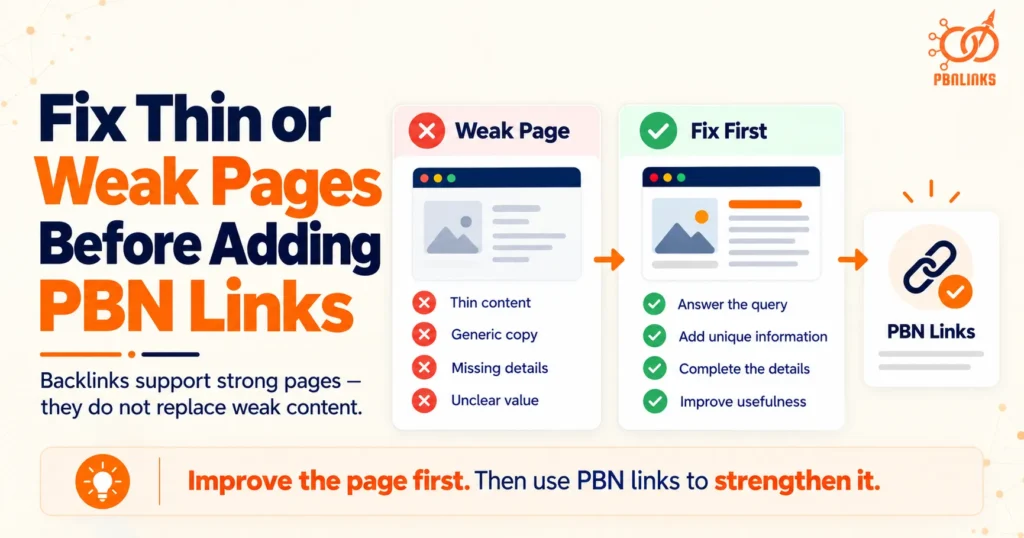
Thin or weak pages should usually be improved before you point PBN links to them. A strong backlink can support a good page, but it cannot turn an incomplete or low-value page into a strong search result by itself.
The problem is not simply that a page has too few words. A short page can still perform well if it answers the query clearly and gives the user what they need. A long page can still be weak if most of the content is generic, repeated, or unrelated to the search.
What Makes a Page Too Weak for PBN Links?
A page may need improvement first if it has:
- very little original information,
- copied or heavily repeated content,
- missing service or product details,
- generic text that could appear on any competing site,
- unclear value for the searcher,
- or content that does not fully answer the main query.
For example, a local service page with only a city name, a short paragraph, and a phone number may be too weak to compete against pages that explain the service, process, pricing factors, common problems, and local coverage in more detail.
The same issue can appear on ecommerce sites. A product page with a manufacturer description copied from several other websites may receive a strong backlink, but the page still offers little unique value compared with other results.
Why More Backlinks May Not Solve the Problem
If the target page itself is weak, adding more PBN links may increase authority without fixing the main reason the page is struggling.
The page still has to give Google and users a clear reason to choose it over competing results. If competitors provide better information, stronger service details, clearer product information, or a more complete answer, backlink strength alone may not be enough to close that gap.
This is why link building should normally support a page that is already prepared to compete.
Improve the Page Before Strengthening It
Before adding a PBN link, review the target page as if backlinks did not exist.
Ask:
- Does the page answer the main search query?
- Does it provide useful information that competitors do not?
- Is the content complete enough for the page type?
- Would a searcher have a reason to stay on this page?
- Is this a page worth strengthening for the long term?
If the answer to several of these questions is no, improve the page first.
The practical rule is simple. PBN links should strengthen a page that is already useful and competitive, not act as a substitute for weak content.
Fix Search Intent and Keyword Cannibalization Before Link Building
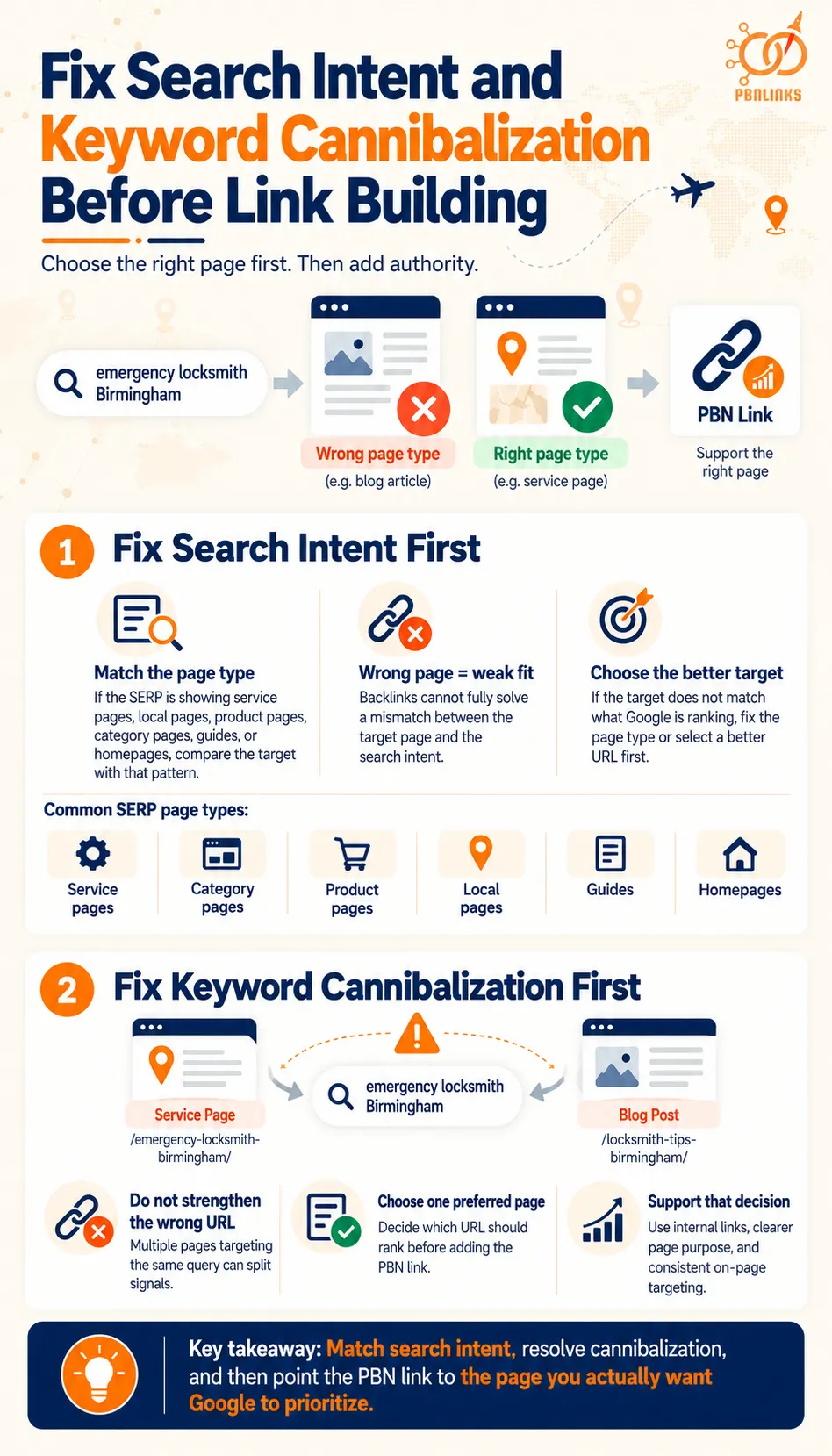
A page should match the search intent before you point PBN links to it. If the wrong type of page is targeting the keyword, more backlinks may strengthen the URL without solving the reason it is struggling to rank.
The same problem appears when two or more pages compete for the same query. In that situation, adding a PBN link before deciding which URL should rank can make the targeting less clear.
Fix Search Intent Before Adding Authority
Search intent is the reason behind a query and the type of result users expect to see.
For example, a person searching for “emergency locksmith Birmingham” is likely looking for a local service page, not a general blog post explaining how locks work. If the wrong page type is targeting that query, backlinks may not be enough to make it competitive.
Before adding a PBN link, compare the target page with the pages already ranking. Look at whether Google is mainly showing:
- service pages,
- category pages,
- product pages,
- local landing pages,
- informational guides,
- or homepages.
If the target page does not match that pattern, fix the page type or choose a better target before adding more links.
Fix Keyword Cannibalization First
Keyword cannibalization happens when multiple pages on the same site compete for the same or very similar search terms.
For example, a site may have one service page and one blog post both targeting the same commercial keyword. Google may switch between the two URLs or rank the weaker page instead of the one you actually want to promote.
Adding a PBN link without resolving this first can strengthen the wrong URL or make it harder to judge which page should receive authority.
Before link building, decide which page is the preferred target. Then support that decision with stronger internal links, clearer page purpose, and consistent on-page targeting.
The practical rule is simple. Do not use PBN links to force the wrong page to rank. Make sure the target matches the search intent and is the URL you actually want Google to prioritize before adding external authority.
Avoid Legal and Utility Pages for Direct Ranking Campaigns
Legal and utility pages should usually be avoided when the goal of a PBN campaign is to improve rankings for commercial or informational keywords. These pages may be important for trust, compliance, or site functionality, but they are rarely the URLs you actually want to strengthen in search.
Privacy policies, terms and conditions, cookie policies, login pages, checkout pages, thank-you pages, and account pages are all good examples. There is nothing inherently wrong with these pages. The issue is that they usually have little direct search or business value compared with a service page, category page, product page, or other URL designed to attract organic traffic.
Important Page Does Not Mean Important PBN Target
A page can be important to the website without being a strong target for external authority.
For example, a local business may need a privacy policy and contact page, but neither is likely to be the best place for a strong PBN link if the real goal is to improve rankings for services such as emergency locksmith work, water damage restoration, or another commercial query.
The same principle applies to ecommerce sites. A checkout page or customer account page is essential for the buying process, but a category or product page usually has far more ranking value because that is where search demand and commercial intent are concentrated.
There can be exceptions. A contact page may occasionally rank for branded or local searches, and some utility pages may attract natural links for specific reasons. But that does not automatically make them the best targets for a deliberate PBN campaign.
The practical rule is simple. Before pointing a PBN link to a page, ask whether that URL is actually supposed to attract search traffic and support a meaningful ranking goal. If it mainly exists for compliance, navigation, account access, or conversion completion, another page will usually be a better target.
Review Over-Linked Pages and Aggressive Anchor Profiles Before Adding More Links
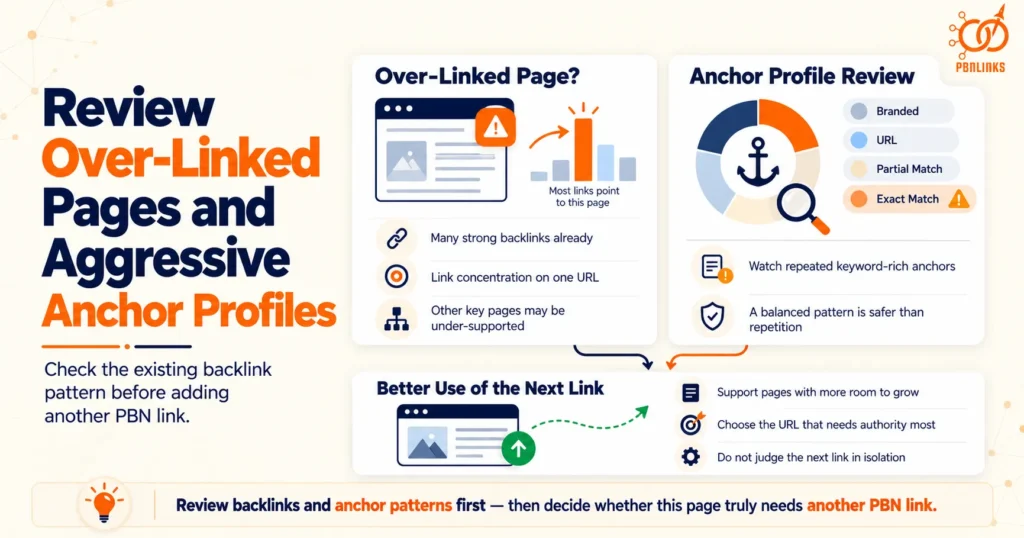
A page that already has a strong backlink profile may not be the best place for the next PBN link. More links do not automatically create more value, especially when the same URL already receives most of the site’s external authority.
The better approach is to review what the page already has before adding another placement. Look at the number and quality of referring domains, how concentrated the links are around one URL, and whether other important pages on the site have much less support.
For example, if one service page already has several strong backlinks while another commercially important page has very little authority, the second page may offer a better opportunity. The goal is not to spread links evenly, but to avoid adding more links without a clear reason.
Watch the Existing Anchor Profile
Anchor text also matters when deciding whether a page should receive another PBN link.
If the target page already has many keyword-rich or exact-match anchors, another similar PBN link may make the profile look more concentrated. In that situation, the issue is not that the page has reached a fixed percentage or threshold. There is no universal safe ratio.
What matters is the overall pattern. A page with a mix of branded, URL, partial-match, and contextual anchors is different from a page where most links repeat the same commercial keyword.
This is especially important for pages already ranking well. If a page is already performing strongly and has a concentrated anchor profile, adding another aggressive PBN link may provide less benefit than strengthening a different URL with more room to grow.
The practical rule is simple. Do not judge the next PBN link in isolation. Review the target page’s existing backlinks and anchor pattern first, then decide whether another link is genuinely needed or whether another page would be a better use of that authority.
When the Homepage Is and Is Not a Good PBN Target
The homepage can be a strong PBN target, but it should not be the default choice for every campaign. The right decision depends on the search intent, the page already ranking, and what the campaign is trying to improve.
A homepage often makes sense when it is the main page representing the business and already targets broad commercial or branded terms. It can also be useful when the goal is to strengthen the site more generally rather than push one specific service or product page.
For example, a local business homepage that already ranks for broad terms such as “locksmith Birmingham” or “water damage restoration Kansas City” may be a reasonable target if those are the primary queries the site is built around.
When an Inner Page Is the Better Target
An inner page is usually the better choice when the keyword has a more specific intent.
If someone searches for “car key replacement Birmingham,” a dedicated car key service page may be a stronger target than the homepage. The same applies to product categories, individual services, city pages, and other URLs designed around a specific search need.
In these situations, sending the PBN link to the homepage may strengthen the site generally, but it may not give the most direct support to the page that actually needs to rank for that query.
Homepage targeting also deserves more caution when the homepage already has a heavy backlink profile or a concentrated anchor pattern. If another important page has less authority and clearer relevance to the target keyword, that inner page may be a better use of the next PBN link.
The practical rule is simple. Do not point PBN links to the homepage just because it is the strongest page on the site. Choose the homepage when it matches the campaign goal and search intent, and choose an inner page when that URL is the better match for the keyword you want to rank.
Product, Category, Seasonal, and Redirected Pages
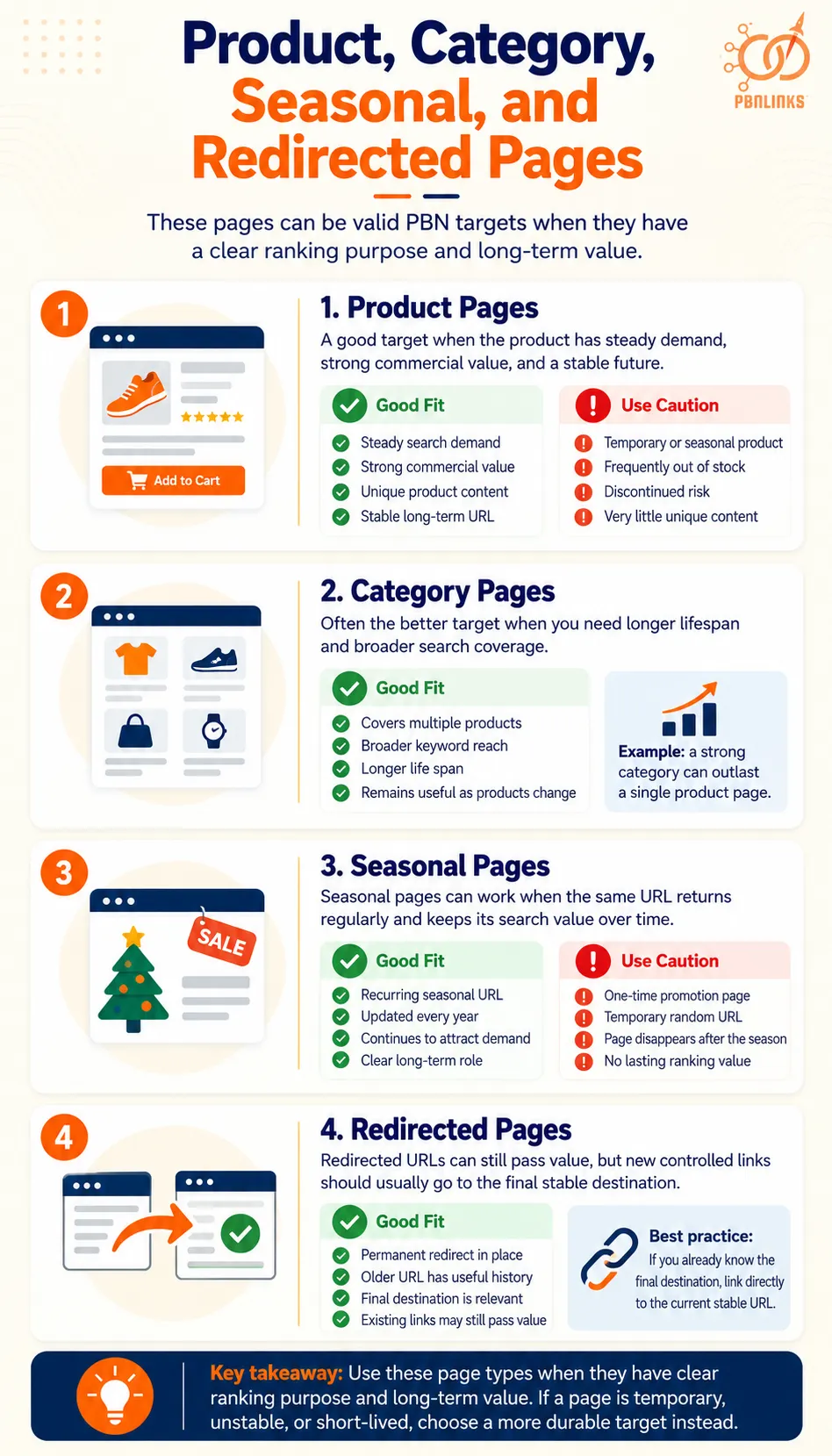
Product, category, seasonal, and redirected pages can all be valid PBN targets, but they should be evaluated more carefully than a stable service or evergreen commercial page. The main question is whether the URL has long-term ranking value and is likely to remain useful after the campaign ends.
Product vs Category Pages
Product pages can be good targets when the product has steady search demand, strong commercial value, and a stable URL. The problem comes when the product is temporary, often out of stock, discontinued, or supported by very little unique content.
In those cases, a broader category page may be the better target. Category pages often have longer life spans, cover more related searches, and remain relevant even when individual products change.
For example, an ecommerce site selling office chairs may get more long-term value from strengthening a well-developed “ergonomic office chairs” category than a single model that could disappear from stock in a few months.
This does not mean category pages are always better. If a specific product has strong demand, unique content, and a stable future, the product page can still be a strong target.
Temporary and Seasonal Pages
Seasonal pages need the same kind of judgment.
A temporary promotion page that disappears after a few weeks may not be the best place to invest a strong PBN link. A recurring seasonal page can be different if the same URL is reused every year and continues to build search value over time.
For example, an annual Black Friday page that remains live and is updated each year can have long-term value. A one-time discount page with a random URL that is deleted after the promotion ends is much less attractive as a link target.
The important factor is not whether the content is seasonal. It is whether the URL itself has a long-term role.
Redirected URLs
A redirected URL is not automatically a bad PBN target. Permanent redirects can pass ranking signals to the final destination, especially when an older URL already has useful backlinks or historical authority.
However, if you are placing a new PBN link and already know the final destination, linking directly to that page is usually cleaner. It avoids an unnecessary redirect and makes it easier to manage the campaign.
The same logic applies to old service URLs, replaced product pages, and pages moved during a site restructure. Existing backlinks can continue pointing through the redirect, but new controlled links should usually go directly to the current URL.
The practical rule is simple. Use product, category, seasonal, and redirected pages when they have a clear ranking purpose and long-term value. If the page is temporary, unstable, or likely to disappear, choose a more durable target instead.
Be Careful With Pages Under Manual Action, Cleanup, or Recovery
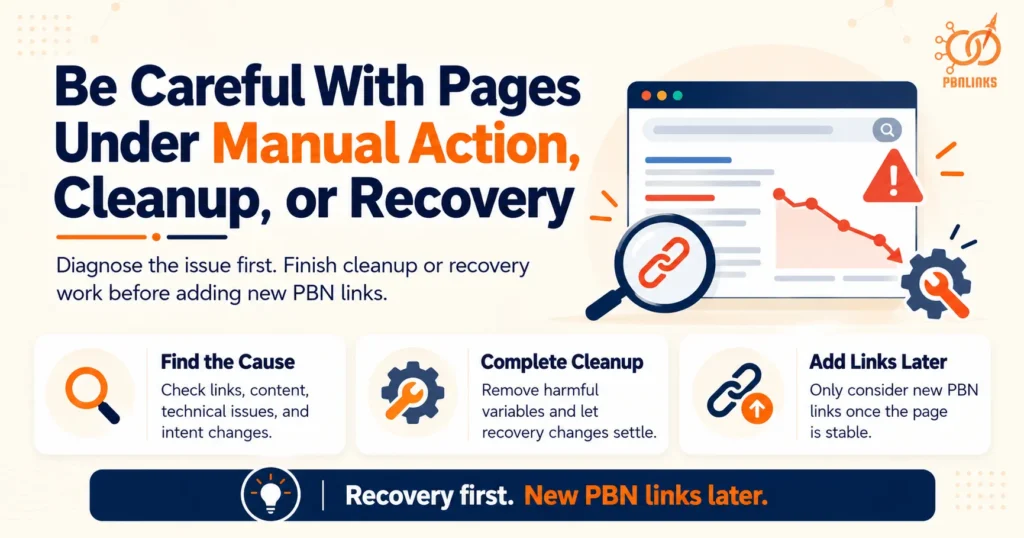
Pages under manual action, active link cleanup, or broader SEO recovery should be treated carefully before you add new PBN links. The first priority should be understanding why the page or site lost visibility and whether the problem is related to links, content, technical issues, or something else.
A ranking drop does not automatically mean a penalty. Search visibility can decline because competitors improve, search intent changes, technical problems appear, or Google reassesses the page. Adding new PBN links before the cause is clear can make the situation harder to evaluate.
If the site has a confirmed manual action or is already reviewing unnatural backlinks, adding more manipulative links is especially difficult to justify. It introduces new variables at the same time you are trying to understand or clean up the existing link profile.
The same caution applies during a major recovery project. If content is being rewritten, URLs are changing, internal links are being rebuilt, or old backlinks are under review, it is usually better to let those changes settle before adding new external authority.
The practical rule is simple. Diagnose the problem first, complete the necessary cleanup or recovery work, and only then decide whether the page is ready for new PBN links.
Fix Weak Internal Linking Before Adding External Authority
A page with weak internal linking should usually be strengthened inside the site before you point PBN links to it. External backlinks can add authority, but the target page should already have a clear place in the site structure and be connected to other relevant pages.
Internal links help search engines discover pages, understand relationships between topics, and identify which URLs are important within the site. They also help move users naturally from broader pages to more specific services, products, or supporting content.
For example, a strong service page may still be poorly supported if it can only be reached through the XML sitemap or a direct URL. If related service pages, category pages, or supporting articles never link to it, the page is disconnected from the rest of the site’s topical structure.
An orphan page is an even clearer warning sign. A page can have good content and even receive external backlinks, but if no meaningful internal path leads to it, the site itself is giving very little indication that the page matters.
What to Fix Before Adding the PBN Link
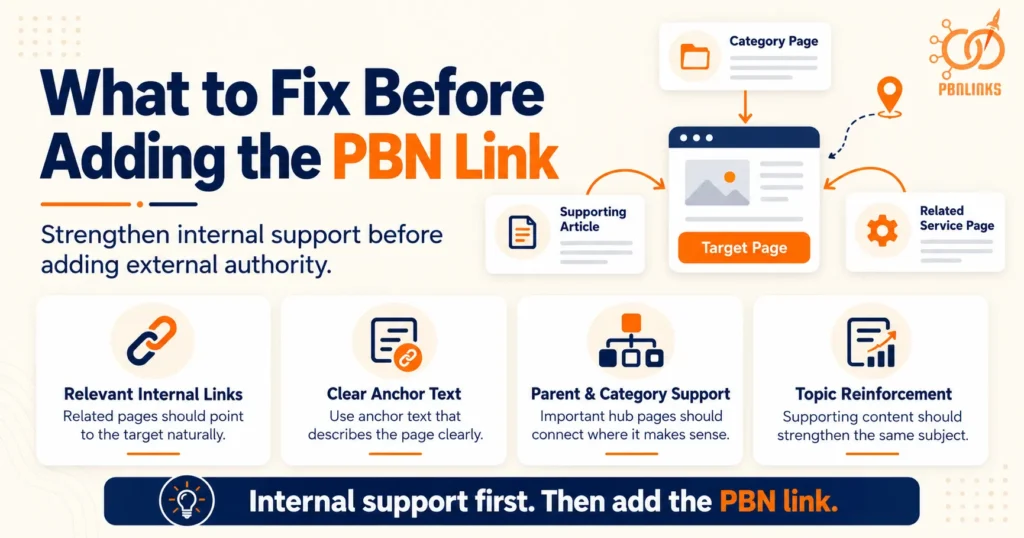
Before adding external authority, review whether the target page has enough internal support.
Check whether:
- relevant pages naturally link to the target,
- the anchor text describes the page clearly,
- important parent or category pages connect to it,
- supporting articles reinforce the same topic,
- and users can reach the page without relying on search or the sitemap.
For example, if a site has a main water damage restoration page with separate pages for basement flooding, sewage cleanup, and burst pipe damage, those related pages should connect where it makes sense. The internal structure helps establish how those services relate before outside links are added.
The goal is not to force internal links from every page. A few relevant links from strong, closely related pages are usually more useful than placing the same target link across unrelated sections of the site.
Once the target page is properly connected, a PBN link becomes an additional layer of external support rather than the only strong signal pointing toward the page.
The practical rule is simple. If the target page is isolated inside its own website, fix the internal path first. PBN links should strengthen a page that already has clear relevance, internal support, and a defined role in the site structure.
Should You Keep Adding PBN Links to Pages Already Ranking Well?
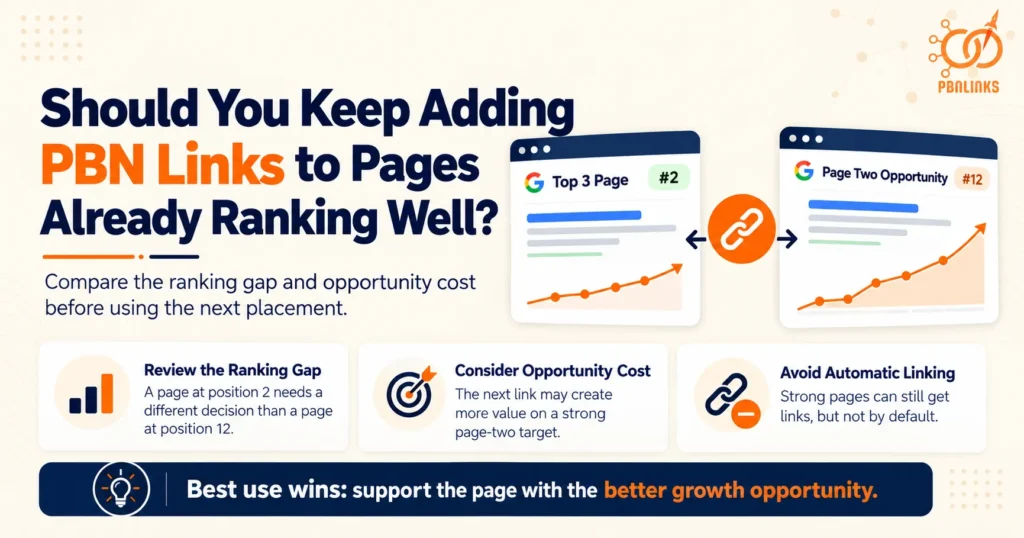
A page that already ranks well may not need the next PBN link. Additional backlinks can still help, but the value of each new link may become smaller when the page already has strong authority and a stable position.
The better question is not whether a high-ranking page can receive more links. It is whether another link to that page is the best use of the next placement.
For example, a service page already ranking in the top three for its main keyword may have less room to improve than another important page sitting on page two. In that situation, strengthening the weaker page may create more overall value for the site.
Review the Ranking Gap Before Adding Another Link
A page at position 2 is in a very different situation from a page at position 12.
If the page is already close to the top, review what separates it from the pages above it. The gap may be caused by content quality, brand strength, user intent, internal support, or stronger competing backlink profiles. Another PBN link may help, but it should not be added automatically.
The same principle applies to pages with strong visibility across several related keywords. If the page is already performing well, adding more authority to the same URL may produce less noticeable improvement than supporting another commercially important page.
Consider the Opportunity Cost
Every PBN link has an opportunity cost. A link placed on one target cannot be used on another page at the same time.
Before adding another link to a strong URL, compare it with other pages that:
- have clear commercial value,
- already rank within reach of page one,
- have weaker backlink support,
- and are strong enough to compete if given more authority.
This does not mean links should be spread evenly across the site. Some pages deserve more support than others. The goal is to place each new link where it has the best chance of creating meaningful ranking or business value.
The practical rule is simple. Do not keep adding PBN links to a page just because it already performs well. Review the remaining ranking gap, the existing link profile, and the opportunity available on other pages before deciding where the next link should go.
Target Page Readiness Checklist Before Building a PBN Link
Before pointing a PBN link to any page, make sure the target is actually ready to receive external authority. A strong backlink works best when the page is technically sound, useful, stable, and clearly positioned to rank for the intended query.
This check should happen before choosing anchor text or deciding how many links to build. It helps prevent strong PBN placements from being spent on pages that still have basic SEO or targeting problems.
Is the Page Indexable?
The target should normally be eligible to appear in Google Search. Check that it is not intentionally set to noindex, blocked from crawling, or affected by another technical issue that prevents normal indexing.
If the page is supposed to rank but cannot be indexed, fix that first.
Is It the Preferred Canonical URL?
Make sure the target is the version of the page you actually want Google to rank.
If another URL is set as the canonical, or several duplicate versions exist, resolve the preferred version before building new links. There is little value in strengthening an alternate URL when the campaign is really intended to support another page.
Is the URL Stable?
The target should have a reasonable chance of remaining live over the long term.
Avoid building new PBN links to a page that is about to be deleted, merged, moved to a new slug, or replaced. If a migration or restructuring is already planned, it is usually cleaner to wait and link to the final destination.
Is the Content Strong Enough?
The page should already provide enough useful information to compete for its target query.
Review whether the content is complete, original, relevant, and strong enough for the page type. A backlink can support a good page, but it should not be used as a substitute for weak or incomplete content.
Does the Page Match Search Intent?
The target page should be the type of result users expect for the query.
If Google is mainly ranking service pages, a general blog post may be the wrong target. If the search is informational, a highly commercial landing page may also be a poor fit.
Backlinks work better when they support a page that already matches the intent of the SERP.
Is the Page Internally Supported?
Check whether relevant pages on the site link naturally to the target.
An important page should not depend only on external backlinks. It should have a clear place in the site structure and receive internal support from related pages, categories, services, or supporting content.
Is the Existing Backlink Profile Healthy?
Review what the target page already has before adding another PBN link.
Look at the overall strength and concentration of referring domains. A page with very little external support may benefit from another strong placement, while a heavily linked page may offer less opportunity than another important URL.
Is the Anchor Profile Reasonable?
The existing anchor pattern should also be reviewed before choosing the next PBN anchor.
If the page already has many exact-match or commercial anchors, repeating the same pattern may create unnecessary concentration. The next link should be evaluated in the context of the whole profile, not as an isolated placement.
Is This the Page You Actually Want to Rank?
This may be the most important question.
If another URL better matches the search intent, converts better, or has stronger long-term value, that page may be the better target. Do not strengthen a page simply because it already exists or is currently ranking.
Is This Page Worth the Next PBN Link?
The final decision should be strategic.
Before placing the link, ask whether this page offers enough ranking potential, business value, and long-term stability to justify the placement. If another page has more room to grow and a clearer commercial purpose, the next PBN link may be more valuable there.
A good target page should pass most of these checks before external authority is added. The goal is not to find a perfect page, but to make sure the PBN link supports a URL that is ready, relevant, and worth strengthening.
Practical PBN Target Page Examples
The easiest way to apply these rules is to look at real target-page situations. The same PBN link can be a smart placement on one page and a poor choice on another depending on indexability, content quality, search intent, and existing link support.
Example 1: Thin Local Service Page
A local service page is indexed and targets a valuable commercial keyword, but the content is very weak. It has only a short introduction, a phone number, and almost no useful service detail.
Best action: Fix the page first.
The page may still be a good long-term PBN target, but it should be improved before external authority is added. Strengthening weak content with backlinks does not solve the underlying ranking problem.
Example 2: Noindex Page
A landing page is well designed and useful for paid traffic, but it has a noindex directive because the business does not want it appearing in organic search.
Best action: Avoid it for a ranking campaign.
If the goal is organic rankings, the PBN link should usually go to another page that is intended to appear in search results.
Example 3: Homepage vs Service Page
A local business homepage targets broad terms, while a dedicated service page targets a specific keyword such as “emergency locksmith Birmingham.”
Best action: Match the link to the campaign goal.
If the campaign is focused on the specific service keyword, the service page may be the more direct target. If the goal is broader site authority or the homepage itself is the main ranking page, the homepage may make more sense.
Example 4: Over-Linked Ranking Page
A service page already ranks in the top three and has several strong backlinks with repeated commercial anchors. Another important page on the site is ranking around position 12 with far less external support.
Best action: Review whether the next link would create more value on the second page.
The high-ranking page may still benefit from another link, but adding more authority to the same URL should not be automatic. The existing backlink profile, anchor concentration, and ranking opportunity on other pages should guide the decision.
These examples show why target-page selection should not be based on page type alone. The better question is whether the page is ready, relevant, stable, and strategically worth strengthening.
Common PBN Targeting Mistakes
Most PBN targeting mistakes happen because the backlink is chosen before the target page is properly reviewed. A strong link can still be wasted if it points to the wrong URL, supports a weak page, or adds more pressure to a page that already has enough external authority.
One common mistake is sending every PBN link to the homepage. The homepage can be a strong target, but it should only be used when it matches the keyword, ranking goal, and wider campaign strategy. A specific service, category, or product page may be a better choice when the search intent is more focused.
Another mistake is building links before fixing the target page itself. Thin content, poor search intent, weak internal linking, or keyword cannibalization should usually be addressed first. Backlinks work best when they strengthen a page that is already ready to compete.
Targeting the wrong URL is also a frequent problem. This can happen when the chosen page is noindex, canonicalized to another URL, scheduled for a redirect, or not the page the site actually wants to rank. Checking the technical setup before link building can prevent this.
Over-concentrating PBN links on one page is another issue. A page may already have strong backlinks, repeated commercial anchors, and stable rankings. In that case, another important URL may offer a better opportunity for the next placement.
It is also a mistake to assume that more links will fix every ranking problem. If the issue is poor content, the wrong page type, weak internal structure, or low commercial value, adding more external authority may not solve the real problem.
The practical takeaway is simple. Choose the target page first, confirm that it is technically and strategically ready, and only then decide where the next PBN link should go.
Final Verdict: Which Pages Should You Avoid With PBN Links?
In conclusion, the main pages to avoid with PBN links are pages that are not intended to rank, are technically unstable, point to another canonical URL, or have little strategic value as search targets.
Some pages should not be treated as permanent exclusions. Thin content, keyword cannibalization, weak internal linking, poor search intent, and aggressive anchor profiles are often problems that should be fixed before more backlinks are added.
Other pages need more judgment. A homepage, product page, category page, seasonal page, or redirected URL can still be a good PBN target when it matches the search intent, supports the campaign goal, and has long-term value.
The safest approach is to review the target page before choosing the link. Check whether it is indexable, canonical, stable, useful, internally supported, and actually the URL you want Google to rank.
If you want PBN links placed with proper target-page selection, anchor planning, and campaign structure, explore the managed link-building services available at PBNLinks.Agency.
FAQs About Pages to Avoid With PBN Links
Which pages should you avoid pointing PBN links to?
Avoid pages that are not intended to rank, such as noindex pages, broken URLs, wrong canonical versions, and low-value utility pages. Thin, unstable, or poorly targeted pages should usually be fixed before receiving PBN links.
Should PBN links point to noindex pages?
No, not when the goal is to rank that page in Google. A noindex directive prevents the page from appearing in Google Search, so an indexable ranking page is usually a better target.
Can PBN links fix thin content?
No, PBN links cannot replace weak content. Improve the page so it properly satisfies the search query, then use backlinks to support a target that is already ready to compete.
Should PBN links point to duplicate or canonicalized pages?
Usually not if another URL is the preferred canonical version. When you control the placement, pointing the link directly to the URL you want indexed and ranked provides a cleaner targeting setup.
Can PBN links point through a 301 redirect?
Yes, ranking signals can pass through a properly implemented 301 redirect. However, for a new controlled placement, linking directly to the final destination is usually simpler and avoids an unnecessary redirect.
Should PBN links point to privacy policy or legal pages?
Usually no for a ranking campaign. Privacy policies, terms pages, and similar utility URLs are important for the website but normally have less organic search value than service, product, category, or informational pages.
When should you avoid pointing PBN links to the homepage?
Avoid using the homepage as the default target when a more relevant inner page better matches the search query. The homepage makes more sense when it is the intended ranking page or supports a broader campaign goal.
Should you add more PBN links to an already over-linked page?
Not automatically. Review the page’s existing backlinks, anchor profile, ranking position, and the opportunities available on other important URLs before deciding where the next link should go.
Should keyword cannibalization be fixed before building PBN links?
Yes, resolve the preferred ranking URL first. If two pages compete for the same keyword, adding PBN authority to the wrong one can strengthen a page you do not want Google to prioritize.
How do you choose the best target page for a PBN link?
Choose a page that is indexable, canonical, stable, useful, relevant to search intent, internally supported, and worth ranking. Also review its existing backlink and anchor profile before adding more external authority.