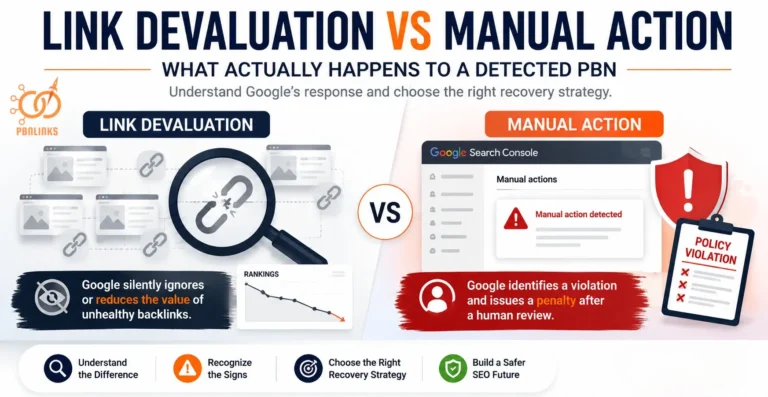
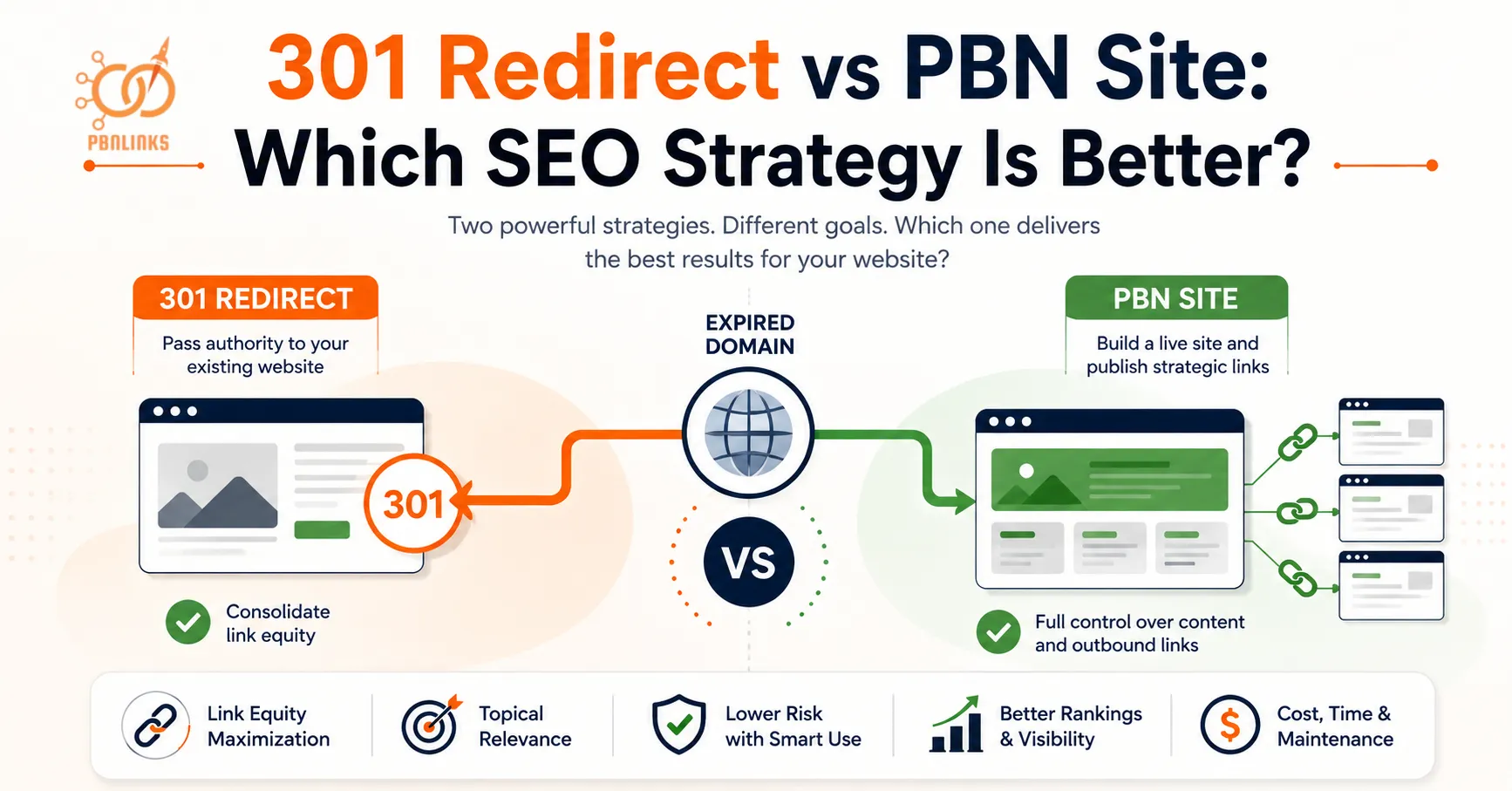
301 Redirect vs PBN Site: Which SEO Strategy Is Better?
You bought an expired domain. Now comes the most important question. Should you redirect it to your existing website or rebuild it as a live website? The answer can affect your SEO results, your budget, and the long term value you get from the domain.
The 301 Redirect vs PBN Site decision is one of the biggest choices SEO professionals face when working with expired domains. Both strategies use the same domain, but they are designed for different goals. Choosing the right approach depends on how you want to use the domain and what you expect it to achieve.
There is no single strategy that works for every website. The best choice depends on factors such as the quality of the expired domain, its topical relevance, your website’s goals, your available budget, and the amount of time you can invest in managing the project. Understanding these factors helps you make a smarter SEO decision instead of relying on assumptions.
This guide provides a complete comparison of 301 Redirect vs PBN Site, including how each strategy works, how search engines evaluate them, how link equity is handled, the costs, risks, maintenance requirements, and the situations where each approach is most effective. You’ll have a clear framework to decide which strategy best fits your SEO goals.
What Is a 301 Redirect for an Expired Domain?
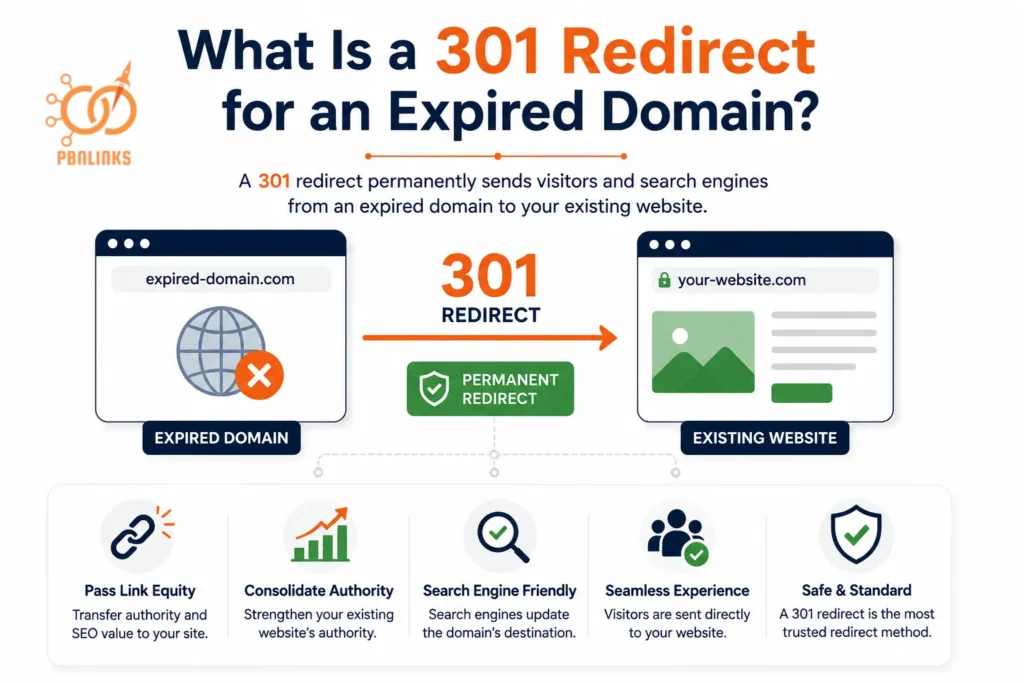
A 301 redirect is a permanent redirect that sends visitors and search engines from an expired domain to another website. It tells search engines that the expired domain has permanently moved to a new destination, allowing all traffic to be directed to the new website automatically.
When an expired domain is redirected, it no longer operates as a standalone website. Instead, anyone who visits the domain is taken directly to the destination website without any additional action. Search engines also process the redirect and update their understanding of where the domain now points.
Many website owners use a 301 redirect after purchasing an expired domain because it allows them to integrate the domain into an existing website instead of rebuilding it. Before implementing a redirect, it is important to review the expired domain’s backlink profile, topical relevance, and history to ensure it aligns with the destination website.
A 301 redirect is one of the most common ways to use an expired domain, but it is not the only option. Another approach is to rebuild the expired domain as a live website, which follows a different SEO strategy and is explained in the next section.
What Is a PBN Site Built From an Expired Domain?
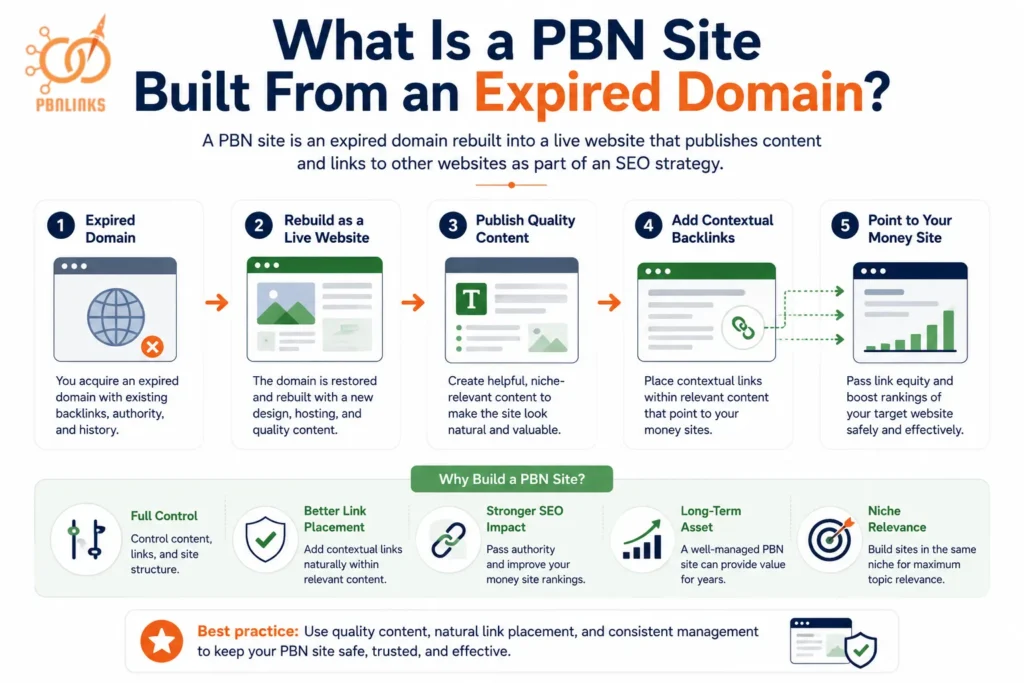
A PBN site is an expired domain that has been rebuilt into a live website instead of being redirected to another site. Rather than sending visitors and search engines to an existing website, the expired domain continues operating as an independent website that publishes content and links to other websites as part of an SEO strategy.
Most PBN sites are created using expired domains because they may already have backlinks, topical relevance, and an established history. Instead of allowing the domain to expire or using a 301 redirect, website owners restore the site with new content and continue managing it as a standalone property.
Building a PBN site gives website owners full control over the site’s content, pages, internal links, and outbound backlinks. Since the website remains live, it can be updated over time and managed like any other website. The quality of the content, the relevance of the niche, and the overall management of the site all influence how effectively it supports an SEO strategy.
A PBN site is one of the two most common ways to use an expired domain. The other approach is to redirect the domain to an existing website using a 301 redirect. The next section compares 301 Redirect vs PBN Site to explain how these two strategies work differently and when each approach is most appropriate.
301 Redirect vs PBN Site: What’s the Difference?
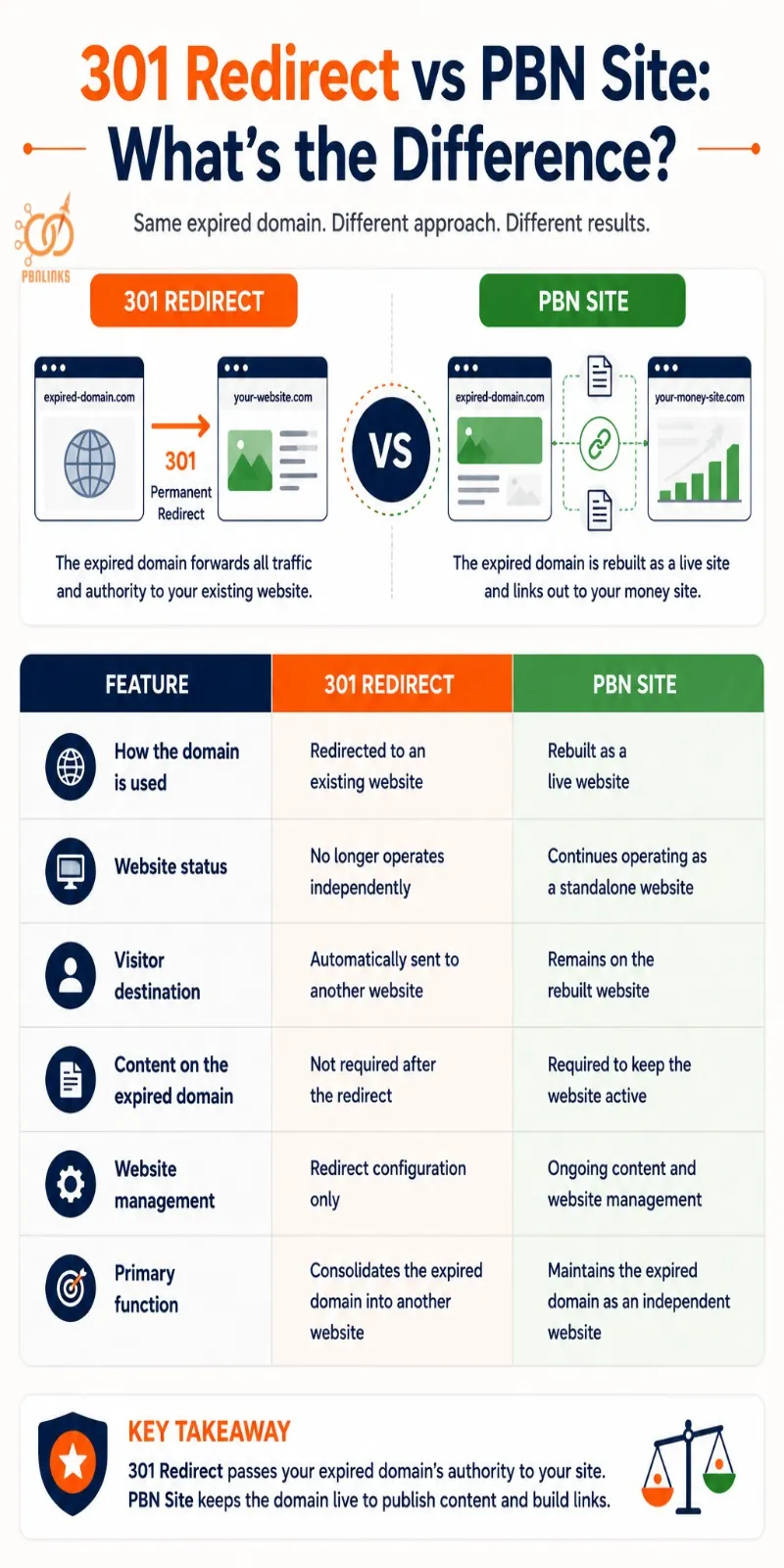
A 301 redirect and a PBN site both use expired domains, but they apply them in different ways. A 301 redirect permanently points an expired domain to an existing website, while a PBN site restores the expired domain as a live website that continues publishing content. Understanding these core differences makes it easier to evaluate each strategy throughout the rest of this guide.
| Feature | 301 Redirect | PBN Site |
| How the domain is used | Redirected to an existing website | Rebuilt as a live website |
| Website status | No longer operates independently | Continues operating as a standalone website |
| Visitor destination | Automatically sent to another website | Remains on the rebuilt website |
| Content on the expired domain | Not required after the redirect | Required to keep the website active |
| Website management | Redirect configuration only | Ongoing content and website management |
| Primary function | Consolidates the expired domain into another website | Maintains the expired domain as an independent website |
With a 301 redirect, the expired domain becomes part of an existing website through a permanent redirect. The domain itself no longer serves visitors with its own pages because anyone who enters the domain is automatically taken to the destination website.
A PBN site follows a different approach by keeping the expired domain active. The website is rebuilt with its own pages and content, allowing it to function independently while becoming part of a broader SEO strategy.
Although both strategies begin with the same expired domain, they differ in how they are implemented and managed. The following sections compare 301 Redirect vs PBN Site in greater detail, including how they handle link equity, Google’s evaluation, redirect chains, costs, risks, and the situations where each approach is most appropriate.
How Link Equity Differs Between 301 Redirects and PBN Sites
Link equity is one of the main reasons SEO professionals invest in expired domains. Whether you choose a 301 redirect or a PBN site, the objective is to use the authority already associated with the expired domain to strengthen another website. The difference lies in how that SEO value is transferred and how much control you have over the process.
What Is Link Equity?
Link equity is the SEO value that one webpage or website passes to another through links. It is influenced by factors such as backlink quality, topical relevance, page authority, and the trust of the referring website. When an expired domain has earned strong backlinks over time, that existing authority becomes one of its most valuable assets.
The amount of link equity available is not determined by Domain Rating alone. A domain with relevant, high-quality backlinks and a clean history is generally more valuable than a domain with hundreds of low-quality or unrelated backlinks. This is why evaluating an expired domain before using it is an important part of any SEO strategy.
How Does a 301 Redirect Transfer Link Equity?
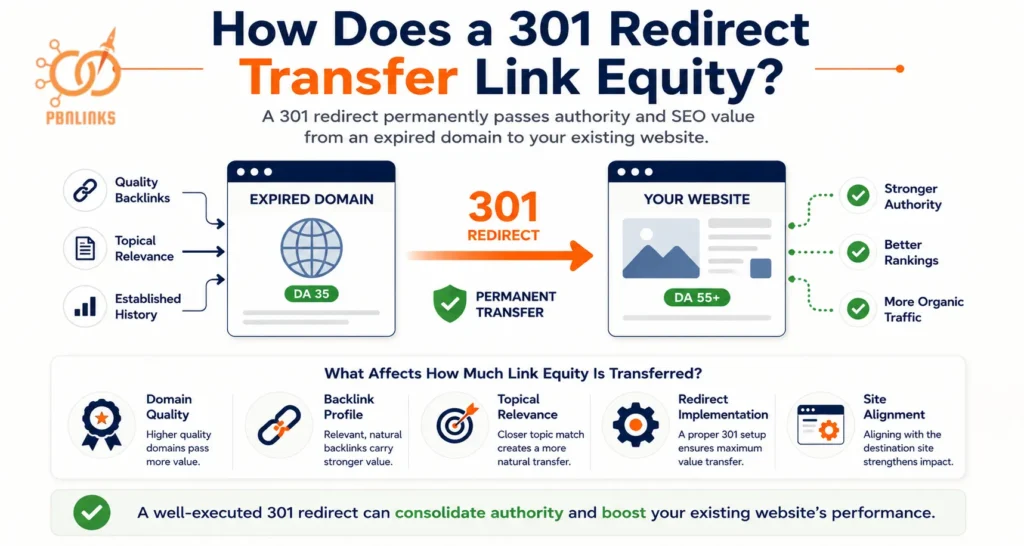
A 301 redirect transfers link equity by permanently pointing an expired domain to an existing website. Instead of operating as a separate website, the expired domain becomes part of the destination website through a permanent redirect.
The amount of SEO value that may be transferred depends on several factors, including the quality of the expired domain, the relevance of its backlink profile, the implementation of the redirect, and how closely the destination website matches the original topic of the expired domain. When these elements are closely aligned, the redirect creates a more natural connection between the two websites.
How Does a PBN Site Pass Link Equity?
A PBN site transfers link equity through contextual backlinks published on a live website. Rather than redirecting the expired domain, the website is rebuilt with relevant content and continues operating as an independent website that links to another site.
Because the domain remains active, website owners have greater control over content, backlink placement, internal linking, and future updates. This flexibility allows backlinks to be added naturally within relevant pages while keeping the expired domain separate from the destination website.
Why Does Topical Relevance Matter?
Topical relevance plays an important role regardless of which strategy you choose. An expired domain that shares a similar topic with the destination website creates a stronger relationship between its existing backlinks, historical content, and the website receiving the SEO value.
Whether you implement a 301 redirect or rebuild the domain as a PBN site, selecting an expired domain with a relevant niche and a high-quality backlink profile helps preserve more of its long-term SEO value.
Link Equity Comparison at a Glance
| Factor | 301 Redirect | PBN Site |
| How link equity is transferred | Through a permanent redirect | Through contextual backlinks |
| Website status | Redirected to another website | Remains a live website |
| Control over backlink placement | Limited after implementation | Full control over backlink placement |
| Ability to publish new content | No | Yes |
| Internal linking opportunities | No | Yes |
| Depends on topical relevance | Yes | Yes |
Understanding how link equity moves is only one part of the decision. Search engines also evaluate 301 redirects and PBN sites differently based on website quality, relevance, and implementation. The next section explains how Google assesses both strategies and why those differences matter for long-term SEO.
How Google Evaluates 301 Redirects and PBN Sites
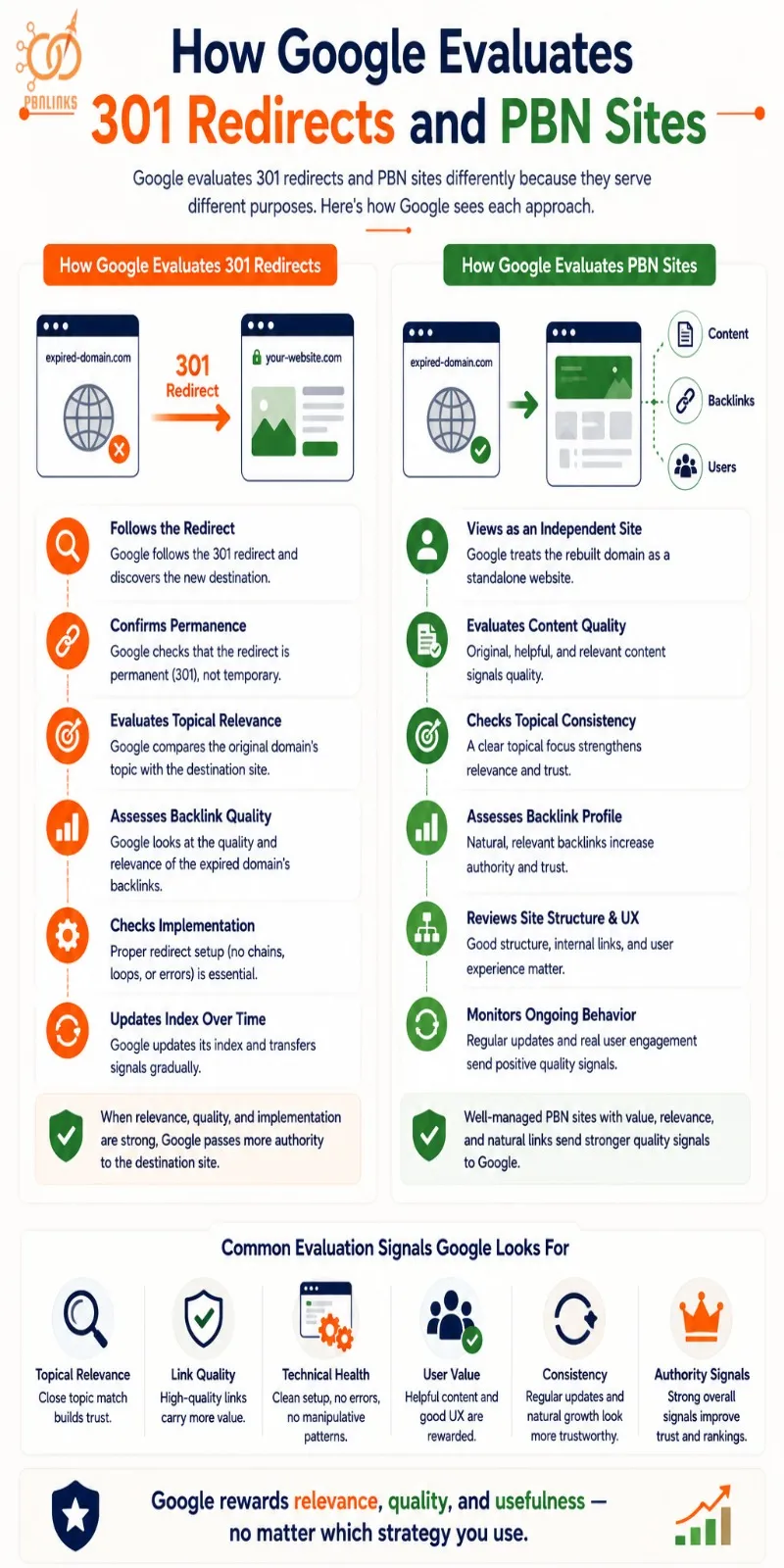
Google evaluates 301 redirects and PBN sites differently because they serve different purposes. A 301 redirect tells Google that an expired domain has permanently moved to another website, while a PBN site continues operating as a live website with its own content and backlinks. Understanding how Google evaluates each approach helps you make better decisions when using expired domains.
How Google Evaluates 301 Redirects
A 301 redirect signals that an expired domain or webpage has permanently moved to a new location. Google follows the redirect, updates its index over time, and evaluates whether the destination website is a logical replacement for the original domain.
When assessing a redirected expired domain, Google considers factors such as topical relevance, backlink quality, redirect implementation, and the relationship between the original domain and the destination website. Redirecting an expired domain to a closely related website generally creates a stronger contextual connection than redirecting it to an unrelated topic.
How Google Evaluates PBN Sites
A PBN site is evaluated as an independent website because it remains live after the expired domain is rebuilt. Google assesses the site’s content, topical consistency, website structure, internal linking, backlink profile, and overall usefulness in the same way it evaluates other websites.
A rebuilt expired domain should provide relevant, original content and maintain a clear topical focus. Websites that are regularly updated and offer value to users generally present stronger quality signals than sites built solely to publish backlinks.
Factors That Influence Google’s Evaluation
Regardless of whether you choose a 301 redirect or a PBN site, Google evaluates several important factors, including:
- Topical relevance between the expired domain and the destination website
- Quality and history of the expired domain
- Relevance of the existing backlink profile
- Content quality and topical consistency
- Website structure and internal linking
- Proper technical implementation
Focusing on these factors creates a stronger SEO foundation than relying only on authority metrics or backlink counts.
Google Evaluation Comparison
| Evaluation Area | 301 Redirect | PBN Site |
| Primary focus | Redirect implementation and destination relevance | Overall website quality and content |
| Topical relevance | Evaluated | Evaluated |
| Backlink profile | Reviewed | Reviewed |
| Domain history | Considered | Considered |
| Content quality | Evaluated on the destination website | Evaluated on the rebuilt website |
| Technical implementation | Reviewed | Reviewed |
Redirect Chains, Topical Relevance, and Common 301 Redirect Mistakes
A 301 redirect is most effective when it is implemented correctly from the beginning. While redirects are a normal part of website management, technical issues such as redirect chains, poor URL mapping, and weak topical relevance can reduce their overall effectiveness. Understanding these implementation factors helps you get better results from an expired domain.
What Is a Redirect Chain?
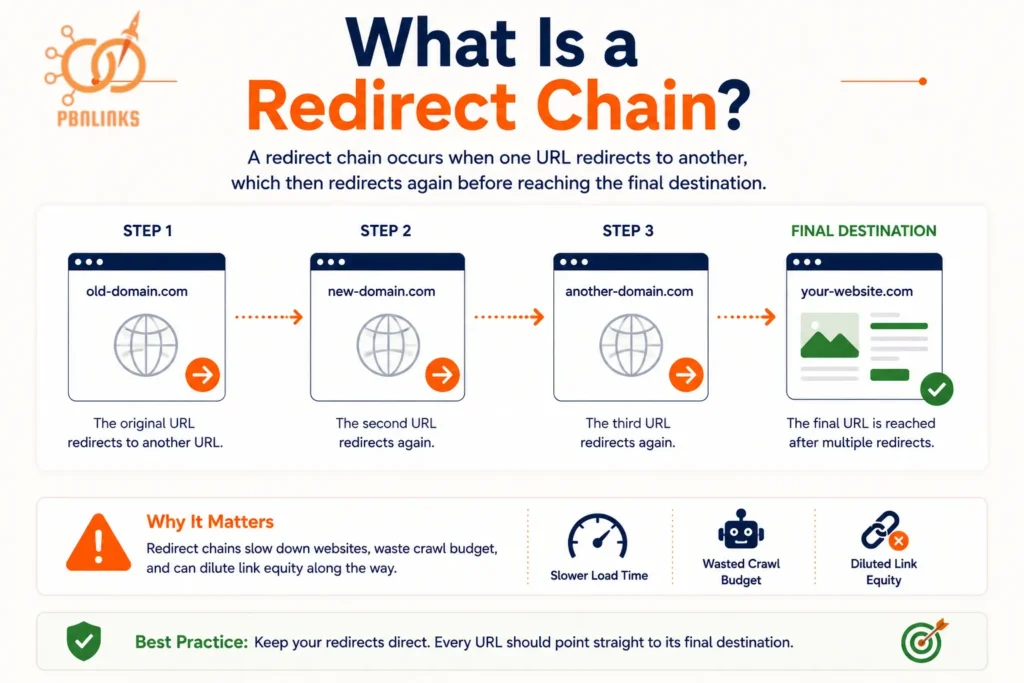
A redirect chain occurs when one URL redirects to another URL, which then redirects again before reaching the final destination. Instead of taking a direct path, both users and search engines must follow multiple redirects to access the final page.
Redirect chains often develop naturally over time. Website migrations, domain changes, content consolidation, HTTP to HTTPS migrations, and repeated URL updates can all create additional redirect steps if older redirects are not updated. Keeping every redirect pointed directly to its final destination creates a cleaner website structure and reduces unnecessary complexity.
How Topical Relevance Affects a 301 Redirect
Topical relevance helps search engines understand whether the destination website is a logical continuation of the expired domain. When the subject matter, historical content, and backlink profile closely match the destination website, the redirect provides stronger contextual signals.
For example, redirecting an expired digital marketing website to another marketing website is generally more consistent than redirecting it to an unrelated niche such as travel or health. Selecting an expired domain with a closely related topic helps preserve the context of its existing backlinks and creates a more natural transition.
Common 301 Redirect Mistakes
Even a high-quality expired domain can produce weaker SEO results if the redirect is implemented incorrectly. Some of the most common mistakes include:
- Allowing redirect chains to accumulate after multiple website updates or migrations
- Redirecting unrelated expired domains to an existing website
- Redirecting every URL to the homepage instead of the most relevant page
- Ignoring the domain’s backlink profile and historical content
- Leaving outdated redirects in place after structural website changes
Reviewing redirects regularly and updating older redirect paths helps simplify website architecture while making it easier for search engines to crawl the final destination.
301 Redirect Best Practices
| Best Practice | Why It Matters |
| Redirect directly to the final destination | Eliminates unnecessary redirect chains |
| Choose a topically relevant expired domain | Maintains stronger contextual relevance |
| Map important URLs to relevant destination pages | Preserves page-level context |
| Review the domain’s backlink profile and history | Confirms quality before implementation |
| Audit redirects after website migrations | Prevents outdated redirect chains from accumulating |
A well-planned 301 redirect involves more than pointing one domain to another. Direct redirect paths, relevant destination pages, and careful implementation help create a stronger technical foundation before evaluating the long-term costs and maintenance of each strategy.
Cost Comparison: 301 Redirect vs Building a PBN Site
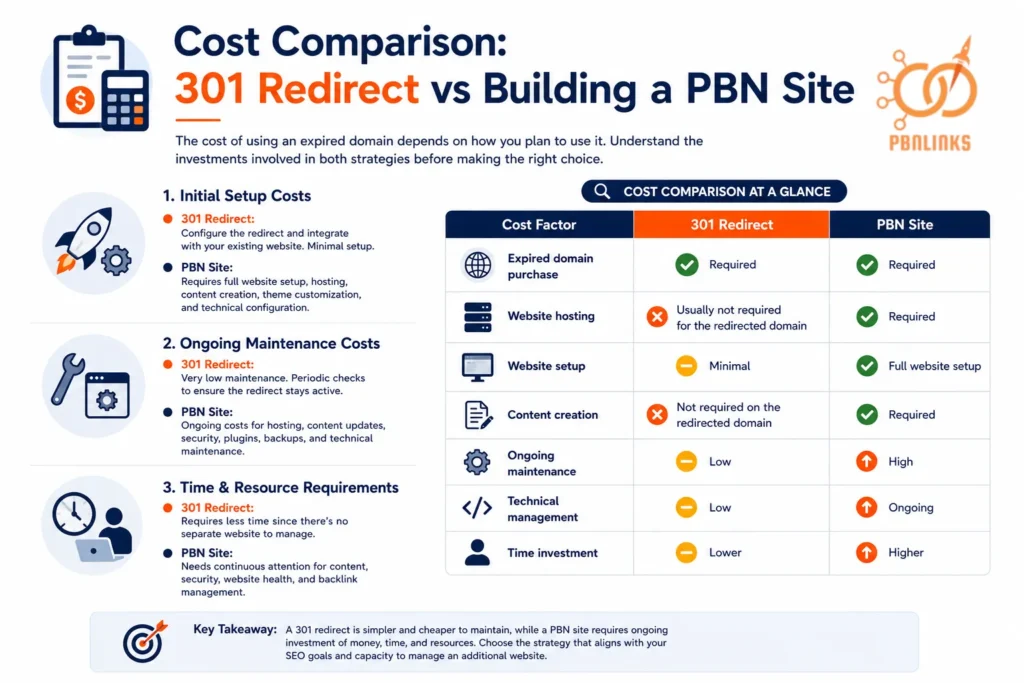
The cost of using an expired domain depends on how you plan to use it. A 301 redirect usually requires a one-time implementation after purchasing the domain, while a PBN site involves ongoing expenses for hosting, content, maintenance, and website management. Understanding these costs helps you choose a strategy that fits both your SEO objectives and available resources.
Initial Setup Costs
The first investment for both strategies is acquiring a quality expired domain. Beyond that point, the setup process becomes different.
A 301 redirect generally requires configuring the redirect and integrating the expired domain with an existing website. Since the domain is not rebuilt as a standalone website, additional setup costs are usually limited.
A PBN site requires a complete website setup, including hosting, website installation, content creation, theme customization, and technical configuration before it can begin supporting another website.
Ongoing Maintenance Costs
One of the biggest differences between the two strategies is long-term maintenance.
A 301 redirect requires very little ongoing management after implementation. Periodic reviews may still be necessary to ensure the redirect remains functional and continues supporting the intended website.
A PBN site requires continuous investment. Hosting, content updates, website security, plugin maintenance, backups, and regular technical reviews all become part of managing the website over time.
Time and Resource Requirements
Cost is not limited to money. Time is also an important investment.
Managing a 301 redirect typically requires less time because there is no separate website to maintain.
Building and operating a PBN site demands more ongoing attention. Publishing content, monitoring website health, maintaining security, and managing backlinks all require regular effort.
Cost Comparison at a Glance
| Cost Factor | 301 Redirect | PBN Site |
| Expired domain purchase | Required | Required |
| Website hosting | Usually not required for the redirected domain | Required |
| Website setup | Minimal | Full website setup |
| Content creation | Not required on the redirected domain | Required |
| Ongoing maintenance | Low | High |
| Technical management | Low | Ongoing |
| Time investment | Lower | Higher |
The overall investment extends beyond the initial purchase of an expired domain. While a 301 redirect is generally simpler to implement and maintain, a PBN site requires continuous management to keep the website active and functioning effectively. Choosing the right approach depends on your available resources, long-term SEO goals, and willingness to manage an additional website.
Risk Comparison: 301 Redirects vs Live PBN Sites
Every SEO strategy carries some level of risk, but the source of that risk is not the same for every approach. With a 301 redirect, the primary risks are usually related to implementation, topical relevance, and domain quality. With a live PBN site, the risks extend to ongoing website management, content quality, and maintaining the site as a legitimate standalone website. Understanding these differences helps you make more informed SEO decisions.
Risks Associated With 301 Redirects
A 301 redirect is a standard method for permanently moving a domain or webpage, but the quality of the implementation still matters. Redirecting unrelated expired domains, using domains with poor backlink profiles, or creating unnecessary redirect chains can reduce the overall effectiveness of the strategy.
Before implementing a redirect, it is important to review the expired domain’s history, backlink profile, topical relevance, and destination pages. Careful planning helps reduce technical issues and creates a stronger relationship between the original domain and the destination website.
Risks Associated With Live PBN Sites
A live PBN site requires continuous management because it operates as an independent website. Poor-quality content, neglected website maintenance, outdated software, inconsistent publishing, or weak topical focus can reduce the overall quality of the website over time.
Since the website remains active, regular updates, relevant content, and proper technical maintenance are all important parts of managing the site effectively.
How to Reduce Risk With Either Strategy
Regardless of which approach you choose, following established SEO best practices helps reduce unnecessary risks.
- Select expired domains with a clean and relevant history.
- Review backlink quality before purchasing a domain.
- Match the expired domain with a closely related niche.
- Maintain high-quality, relevant content where applicable.
- Audit redirects, backlinks, and website performance regularly.
- Monitor the technical health of your websites over time.
Building a well-planned strategy is generally more effective than relying on authority metrics or expired domains alone.
Risk Comparison at a Glance
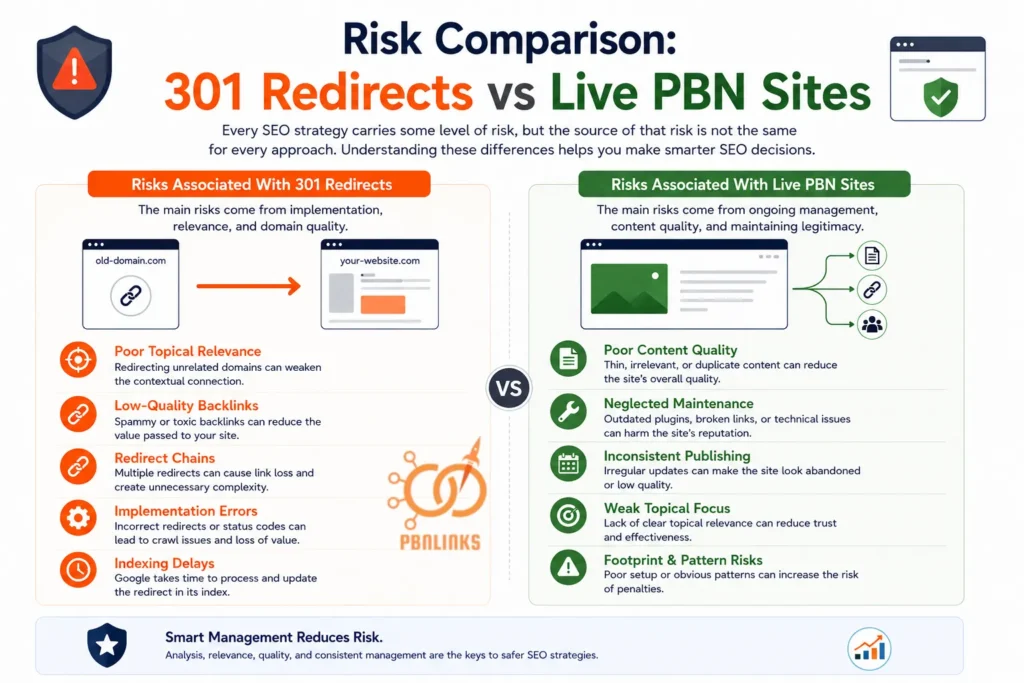
| Risk Factor | 301 Redirect | Live PBN Site |
| Depends on domain quality | Yes | Yes |
| Depends on topical relevance | Yes | Yes |
| Requires ongoing content management | No | Yes |
| Requires ongoing website maintenance | Minimal | Continuous |
| Technical implementation affects performance | Yes | Yes |
| Long-term management required | Low | High |
Every SEO strategy involves trade-offs. A 301 redirect generally requires less ongoing management after implementation, while a live PBN site demands continuous attention to content, maintenance, and website quality. Understanding these differences helps you evaluate which approach best aligns with your resources, workflow, and long-term SEO objectives.
When Should You Choose a 301 Redirect?
A 301 redirect is often the better choice when your goal is to strengthen an existing website without managing another standalone site. Instead of rebuilding an expired domain, you permanently redirect it to an established website, making it part of your existing SEO strategy. This approach is generally simpler to manage and requires less ongoing maintenance than operating a separate website.
When a 301 Redirect Makes Sense
A 301 redirect is commonly used when the expired domain closely matches the topic of the destination website and can naturally support its existing content. It is also a practical option for website owners who want to consolidate SEO value without investing time in building and maintaining another website.
Typical situations where a 301 redirect may be appropriate include:
- Expanding an existing website with a closely related expired domain
- Consolidating multiple websites into a single primary website
- Rebranding a website or changing to a new domain
- Recovering traffic after a domain migration
- Strengthening an established website with a relevant expired domain
Questions to Ask Before Choosing a 301 Redirect
Before implementing a 301 redirect, consider the following questions:
- Is the expired domain topically relevant to my website?
- Does the domain have a clean and trustworthy backlink profile?
- Can important pages be redirected to relevant destination pages?
- Does this strategy support my long-term SEO goals?
- Would maintaining another website provide any additional value?
Answering these questions helps determine whether a 301 redirect is the most suitable approach for your project.
Is a 301 Redirect the Right Choice?
| Consideration | 301 Redirect |
| You already have an established website | ✓ Well suited |
| You prefer minimal ongoing maintenance | ✓ Yes |
| You don’t want to manage another website | ✓ Yes |
| Your expired domain closely matches your niche | ✓ Recommended |
| You need a simple implementation | ✓ Suitable |
A 301 redirect is generally most effective when it supports an existing website with a relevant expired domain and a clear long-term SEO strategy. If your objective is to keep the expired domain active, publish new content, and maintain greater control over backlink placement, a different approach may be more appropriate.
When Should You Build a PBN Site Instead?
Building a PBN site may be the better choice when you want to keep an expired domain active instead of redirecting it to an existing website. Rather than transferring the domain through a 301 redirect, you rebuild it as a standalone website that publishes relevant content and provides greater control over backlink placement and future updates.
When Building a PBN Site Makes Sense
A PBN site is often suitable when the expired domain has a strong backlink profile, a relevant history, and enough value to operate as an independent website. Keeping the domain live allows you to publish new content, manage internal links, and decide how backlinks are added over time.
Typical situations where building a PBN site may be appropriate include:
- Managing long-term link-building campaigns
- Maintaining full control over backlink placement
- Publishing niche-relevant content on the expired domain
- Supporting multiple pages through contextual backlinks
- Building a portfolio of independently managed websites
Questions to Ask Before Building a PBN Site
Before rebuilding an expired domain as a PBN site, consider the following questions:
- Does the expired domain have a clean and relevant backlink profile?
- Can you create and maintain high-quality content consistently?
- Do you have the time and resources to manage another website?
- Does the domain align with your long-term SEO strategy?
- Will operating the domain as a standalone website provide more value than redirecting it?
Answering these questions helps determine whether rebuilding the expired domain is the right approach for your project.
Is a PBN Site the Right Choice?
| Consideration | PBN Site |
| You want to keep the expired domain active | ✓ Well suited |
| You want full control over backlink placement | ✓ Yes |
| You can manage another website long term | ✓ Recommended |
| You plan to publish relevant content regularly | ✓ Yes |
| You have the resources for ongoing maintenance | ✓ Suitable |
Building a PBN site offers greater flexibility because the expired domain continues operating as an independent website. However, it also requires continuous investment in content, maintenance, and technical management. Choosing this approach is generally most appropriate when you are prepared to manage the website as a long-term asset rather than a short-term SEO project.
Best Practices for Using Expired Domains
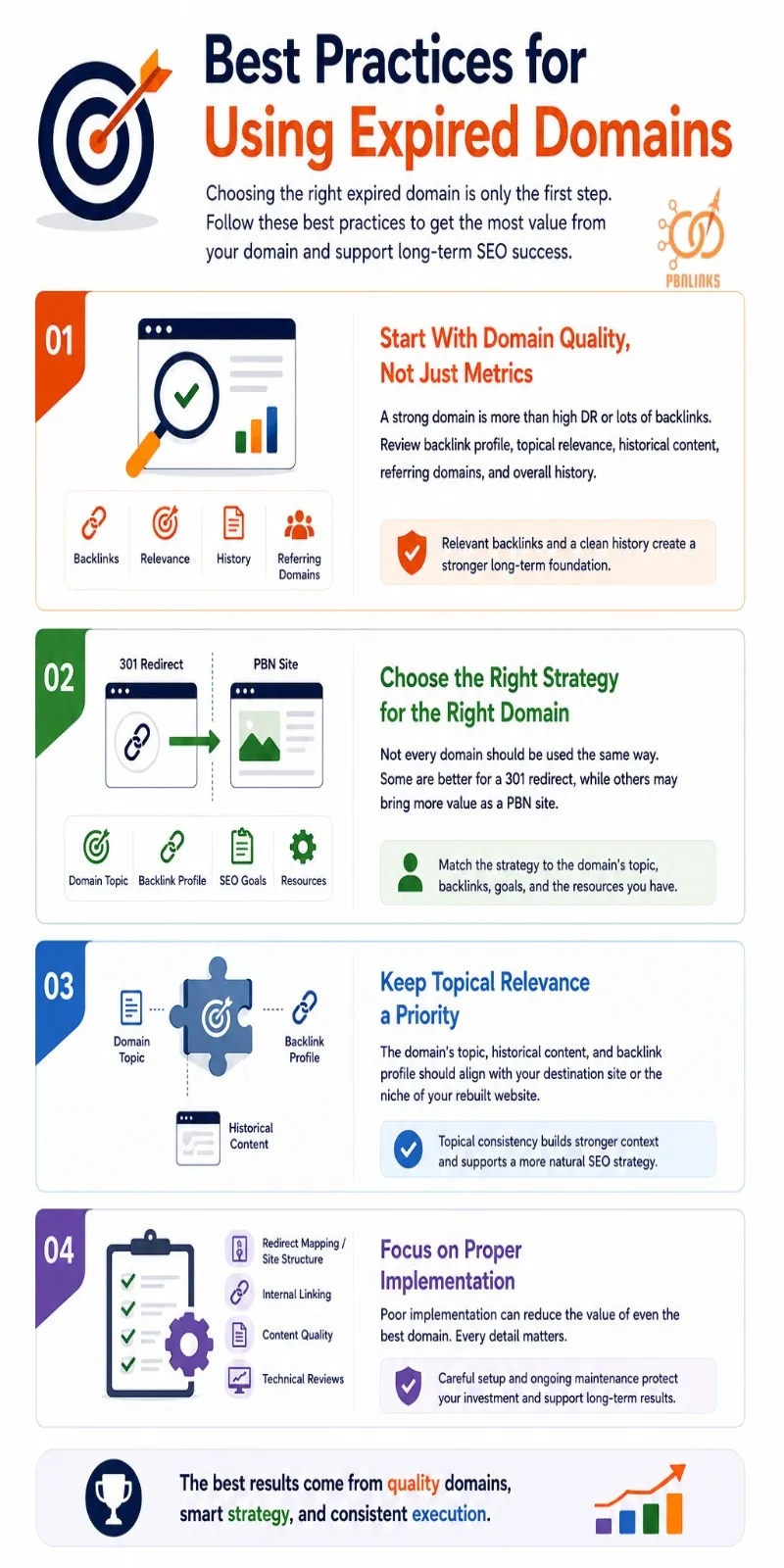
Choosing the right expired domain is only the first step. Whether you use a 301 redirect or build a PBN site, long-term success depends on selecting the right domain, matching it to the right strategy, and implementing it correctly. Following a structured process helps you make better decisions while avoiding many of the common issues discussed throughout this guide.
Start With Domain Quality, Not Just Metrics
A strong expired domain is more than a high Domain Rating (DR) or a large number of backlinks. Before purchasing a domain, review its backlink profile, topical relevance, historical content, referring domains, and overall history.
A domain with relevant backlinks and a clean history generally provides a stronger long-term foundation than one with impressive metrics but poor relevance or questionable ownership history.
Choose the Right Strategy for the Right Domain
Not every expired domain should be used in the same way. Some domains are better suited for a 301 redirect, while others may provide greater value as a PBN site.
Your decision should be based on factors such as the domain’s topic, backlink profile, long-term SEO objectives, available resources, and whether maintaining another website adds value to your overall strategy.
Keep Topical Relevance a Priority
Topical relevance should guide every stage of the implementation process. The subject of the expired domain, its historical content, and its backlink profile should closely align with the destination website or the niche of the rebuilt website.
Maintaining this consistency creates stronger contextual signals and supports a more natural SEO strategy over time.
Focus on Proper Implementation
Even an excellent expired domain can lose value if it is implemented poorly. Redirect mapping, website structure, internal linking, content quality, and regular technical reviews all contribute to a stronger long-term outcome.
Whether you’re implementing a 301 redirect or managing a PBN site, careful planning and ongoing maintenance are just as important as the quality of the domain itself.
Use This Checklist Before Buying or Using an Expired Domain
Before moving forward, ask yourself:
- Is the domain topically relevant to my website or niche?
- Does the domain have a clean backlink profile and history?
- Have I reviewed the historical content and ownership of the domain?
- Is a 301 redirect or a PBN site the better fit for my long-term SEO strategy?
- Can I implement the strategy correctly and maintain it over time?
- Does this expired domain support my overall SEO objectives rather than simply adding more backlinks?
Answering these questions before purchasing or implementing an expired domain helps reduce unnecessary mistakes and creates a stronger foundation for long-term SEO success.
Best Practices Summary
| Best Practice | Why It Matters |
| Prioritize domain quality over metrics | Strong foundations outperform inflated metrics |
| Match the strategy to the domain | Not every expired domain should be used the same way |
| Maintain topical relevance | Preserves contextual consistency |
| Review backlink profile and domain history | Helps identify quality before implementation |
| Implement redirects or PBN sites carefully | Reduces technical and strategic mistakes |
| Think long term | Sustainable SEO depends on planning, not shortcuts |
Applying these best practices helps you get more value from expired domains while making better strategic decisions. Whether you choose a 301 redirect or a PBN site, success comes from combining quality domain selection, relevant implementation, and consistent long-term management rather than relying on authority metrics alone.
Common Mistakes to Avoid When Using Expired Domains
Many SEO problems begin before an expired domain is ever implemented. Selecting the wrong domain, choosing the wrong strategy, or overlooking important technical and quality factors can reduce the long-term value of both 301 redirects and PBN sites. Avoiding these common mistakes helps build a stronger, more sustainable SEO strategy.
Don’t Judge an Expired Domain by Metrics Alone
A high Domain Rating (DR), Domain Authority (DA), or backlink count does not automatically mean an expired domain is a good investment. Before purchasing a domain, review its backlink profile, topical relevance, historical content, referring domains, and ownership history.
A domain with fewer but highly relevant backlinks often provides a stronger long-term foundation than a high-metric domain with unrelated or low-quality links.
Don’t Ignore the Domain’s History
Every expired domain has a history, and that history matters. Before using a domain, review how it was previously used, whether it maintained a consistent topic, and whether its backlink profile appears natural.
Understanding the domain’s past helps you identify potential quality issues before they affect your SEO strategy.
Don’t Use the Same Strategy for Every Expired Domain
Not every expired domain should be redirected, and not every domain should become a PBN site. The most suitable approach depends on the domain’s topical relevance, backlink profile, historical quality, and your long-term SEO objectives.
Matching the strategy to the characteristics of the domain creates a more effective and sustainable implementation.
Don’t Overlook Technical Implementation
Even a high-quality expired domain can deliver weaker results if the implementation is poorly planned. Redirect chains, inaccurate URL mapping, broken internal links, and inconsistent website structure can reduce the effectiveness of both 301 redirects and PBN sites.
Reviewing these technical elements before and after implementation helps maintain a cleaner website architecture and a stronger user experience.
Don’t Neglect Ongoing Website Management
If you rebuild an expired domain as a PBN site, the work does not end after launch. Regular content updates, website maintenance, technical reviews, and backlink monitoring all contribute to the long-term quality of the website.
Treating the site as a genuine, well-maintained website creates a stronger foundation than viewing it as a short-term SEO asset.
Before You Use an Expired Domain
Before implementing any expired domain strategy, confirm that you have:
- Evaluated the domain beyond authority metrics alone.
- Reviewed the backlink profile and historical content.
- Verified topical relevance with your target website.
- Selected the strategy that best fits the domain.
- Planned redirects or website structure carefully.
- Considered the long-term maintenance required.
Taking time to review these factors before implementation helps reduce avoidable mistakes and creates a stronger foundation for long-term SEO success.
Which Strategy Is Better for Your SEO Goals?
The better strategy depends on how you plan to use the expired domain. A 301 redirect is generally more suitable when your goal is to strengthen an existing website with minimal ongoing management, while a PBN site is often more appropriate when you want to keep the expired domain active and maintain greater control over content and backlink placement. The right choice depends on your objectives, resources, and long-term SEO strategy rather than a single ranking factor.
Start by Defining Your SEO Objective
Before deciding how to use an expired domain, identify what you want to achieve. Some projects benefit from consolidating authority into an existing website, while others benefit from managing the expired domain as a separate website that can publish content and support long-term link building.
Your SEO objective should always determine the strategy, not the other way around.
Evaluate These Factors Before Making a Decision
Before choosing between a 301 redirect and a PBN site, consider the following:
- The quality and history of the expired domain
- Topical relevance to your existing website
- Your long-term SEO objectives
- The amount of time available for ongoing management
- Your budget for hosting, content, and maintenance
- Whether you want to manage another standalone website
Looking at these factors together creates a more reliable decision than focusing on authority metrics or backlinks alone.
When a 301 Redirect Is Usually the Better Choice
A 301 redirect is generally well suited for projects where you already have an established website and want to integrate a relevant expired domain into your existing SEO strategy. It is commonly used during website consolidation, domain migrations, rebranding, or when reducing long-term management is a priority.
Because the expired domain is permanently redirected, ongoing maintenance requirements are usually lower than maintaining another independent website.
When a PBN Site Is Usually the Better Choice
A PBN site may be more appropriate when you want the expired domain to remain active as an independent website. This approach provides greater flexibility for publishing relevant content, managing internal links, and placing contextual backlinks over time.
Keeping the website active also requires continuous content creation, technical maintenance, hosting, and regular website management, making it better suited for long-term projects with dedicated resources.
Strategy Comparison at a Glance
| Decision Factor | 301 Redirect | PBN Site |
| Primary objective | Strengthen an existing website | Operate a standalone website |
| Website remains live | No | Yes |
| Content publishing | Not required | Required |
| Control over backlink placement | Limited | High |
| Ongoing maintenance | Low | High |
| Hosting requirements | Minimal | Continuous |
| Long-term management | Simple | More involved |
| Best suited for | Website consolidation and migrations | Long-term content and backlink management |
Choosing between a 301 redirect and a PBN site is ultimately a strategic decision rather than a technical one. Evaluating the quality of the expired domain, your available resources, and your long-term SEO objectives will help you select the approach that best supports sustainable growth.
FAQs About 301 Redirect vs PBN Site
Is a 301 redirect better than building a PBN site?
Neither strategy is universally better because they serve different SEO goals. A 301 redirect is commonly used to consolidate an expired domain into an existing website, while a PBN site keeps the domain active as a standalone website that can publish content and contextual backlinks.
Does a 301 redirect pass link equity from an expired domain?
Yes, a properly implemented 301 redirect can transfer SEO value from an expired domain. The amount of value depends on factors such as backlink quality, topical relevance, domain history, and how closely the destination website matches the original subject of the expired domain.
Can a PBN site pass more control than a 301 redirect?
Yes, a PBN site provides greater control over content and backlink placement. Because the website remains live, you can publish new content, manage internal links, and decide where backlinks are placed over time.
Should I redirect every expired domain I buy?
No, not every expired domain is suitable for a 301 redirect. Before redirecting a domain, review its backlink profile, topical relevance, history, and overall quality to determine whether it aligns with your existing website.
Does topical relevance matter for both strategies?
Yes, topical relevance is important for both 301 redirects and PBN sites. An expired domain that closely matches the destination website’s subject creates a stronger contextual relationship than one from an unrelated niche.
What is the biggest advantage of a 301 redirect?
The biggest advantage of a 301 redirect is its simplicity. It allows an expired domain to become part of an existing website without requiring separate hosting, content creation, or ongoing website management.
What is the biggest advantage of building a PBN site?
The biggest advantage of a PBN site is long-term control. Keeping the expired domain active allows you to publish relevant content, manage backlinks, and update the website whenever needed.
Can Google distinguish between a redirected domain and a live PBN site?
Yes, Google evaluates them differently because they function differently. A 301 redirect is processed as a permanent move to another website, while a PBN site is assessed as an independent website based on its content, relevance, structure, and overall quality.
How do I choose between a 301 redirect and a PBN site?
Choose the strategy that best matches your SEO objectives and available resources. Consider the expired domain’s relevance, backlink profile, website goals, budget, and the amount of time you can invest in ongoing management before making a decision.
Can I use both 301 redirects and PBN sites in the same SEO strategy?
Yes, both strategies can be used together when they serve different purposes. Some SEO professionals redirect highly relevant expired domains to existing websites while rebuilding other domains as standalone PBN sites, depending on the role each domain plays within the overall SEO strategy.