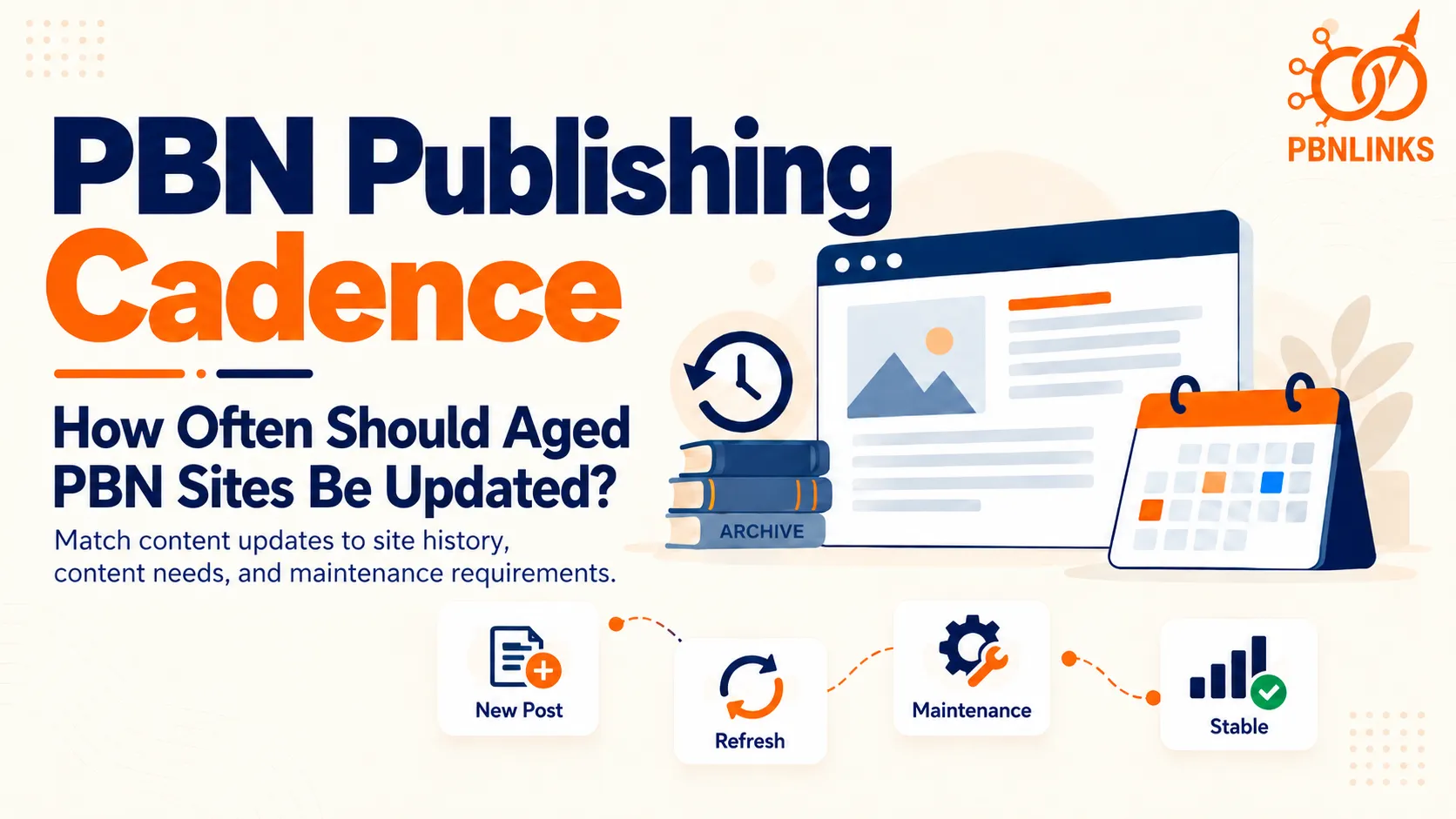
PBN Publishing Cadence: How Often Should Aged PBN Sites Be Updated?
Many people think a PBN site needs a new post every week or every month to stay active. Keep publishing, and the site should look stronger. In reality, that approach can create unnecessary content and an unnatural maintenance routine.
PBN publishing cadence is not about following one fixed schedule. It is about matching content activity to how the aged site originally behaved, what type of website it is, and what actually needs updating. Some sites need new articles. Others need old content refreshed, broken elements fixed, or no content change at all.
This guide explains PBN publishing cadence in simple terms. You will learn how to use historical publishing patterns, decide when to publish or refresh content, manage updates across multiple PBN sites, and avoid treating every domain in the network the same way.
What Is PBN Publishing Cadence?
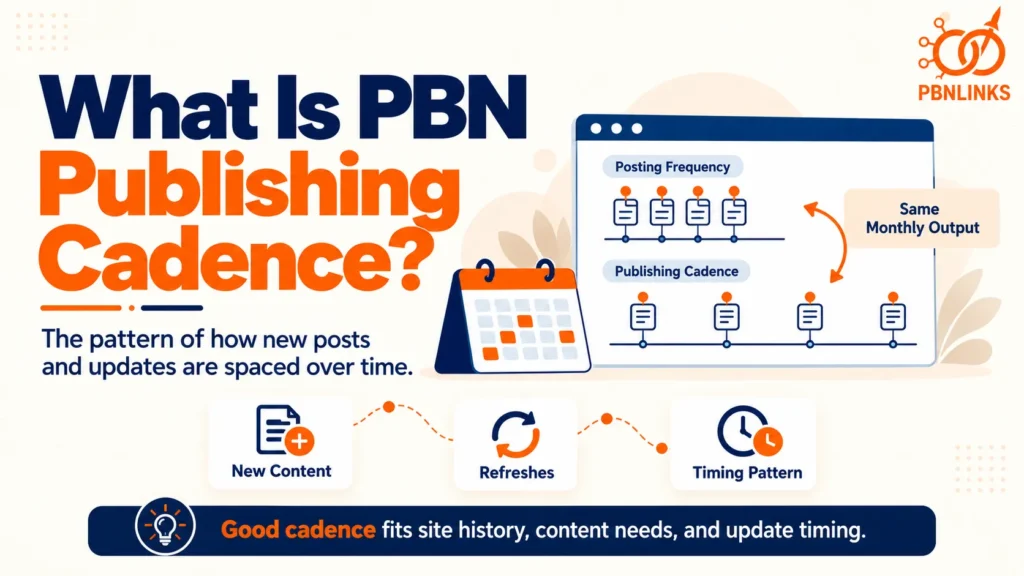
PBN publishing cadence is the pattern used to publish or update content on a site within a private blog network over time. It includes how often new content appears, how updates are spaced, and whether the site is adding new pages or improving existing ones.
Publishing cadence matters because aged PBN sites do not all behave the same way. Some domains historically published content every week, while others only added a few articles each year. A local business site may remain mostly static, while an old magazine or editorial domain may have a much more active publishing history.
The goal is not to publish as often as possible. The goal is to use a content pattern that fits the site, supports useful content, and avoids unnecessary publishing just to meet a fixed schedule.
PBN Publishing Cadence vs Posting Frequency
Posting frequency tells you how often new articles are published. Publishing cadence looks at the broader pattern of how those posts appear over time.
The difference can be understood like this:
- Posting frequency: how often new posts are published.
- Publishing cadence: how those posts are spaced and patterned over time.
- Monthly output: the total number of posts published during that period.
For example, one site may publish four articles on the first day of every month. Another may spread four articles across the month. Both sites publish the same monthly volume, but their publishing cadence is different because the timing and spacing are different.
This distinction matters when managing aged PBN sites. Looking only at the number of posts can hide the bigger picture. The publishing pattern should also make sense for the site’s history, content type, and actual need for new material.
Publishing Cadence vs Content Velocity
Content velocity measures how much content is produced or published during a specific period. Publishing cadence focuses more on when that content appears and how the activity is distributed.
The three concepts are different:
- Content velocity: how much content is produced within a set period.
- Publishing cadence: when and how that content is released.
- Content refresh: improving an existing page without creating a new URL.
For example, publishing eight articles in one week creates concentrated activity. Publishing the same eight articles over four months creates a slower and more distributed pattern. The total content volume is the same, but the way the site behaves over time is very different.
Content velocity can be useful when planning a larger content project, but it should not be confused with a good publishing cadence. Producing more content does not automatically make an aged PBN stronger. If the site already covers its main topics well, refreshing older pages may be more useful than continuously adding new ones.
The better approach is to balance content volume with timing, site history, and actual content needs instead of treating publishing activity as a numbers game.
How Often Should an Aged PBN Site Be Updated?
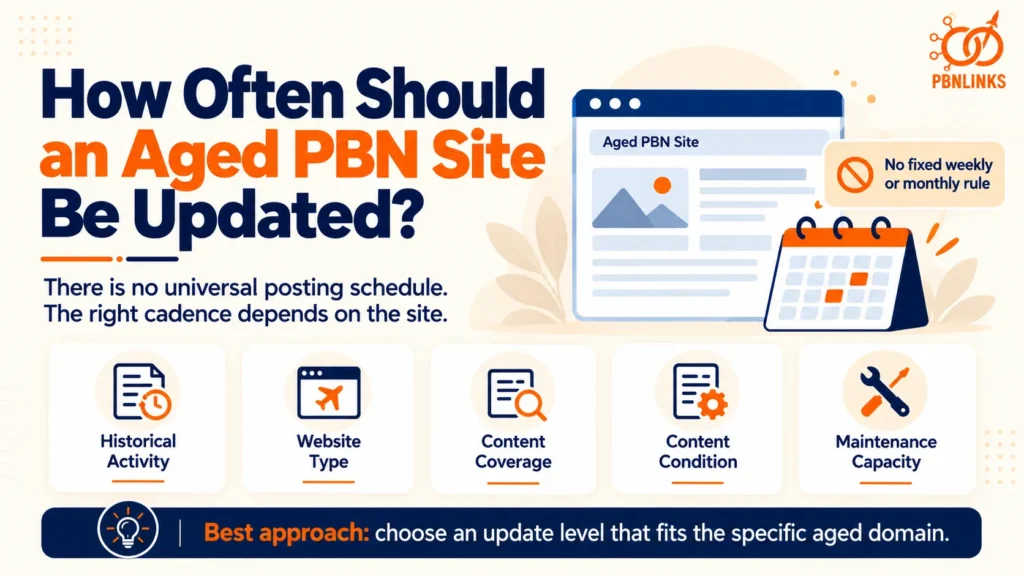
There is no fixed weekly or monthly posting schedule that works for every aged PBN site. The right update frequency depends on how the site behaved historically, what type of website it is, how much useful content already exists, and what actually needs attention.
A practical cadence should consider:
- Historical activity: how often the site published before.
- Website type: whether it is a local business site, evergreen resource, hobby blog, or editorial publication.
- Existing content coverage: whether the important topics are already well covered.
- Content condition: whether older pages are still accurate, useful, and properly maintained.
- Maintenance capacity: whether the schedule can be sustained without lowering quality across the network.
The goal is not to force every site into the same calendar. It is to choose a level of activity that makes sense for that specific aged domain.
Why There Is No Universal PBN Posting Frequency
Fixed posting rules fail because aged PBN sites can have very different structures and content needs.
A site with only a small number of evergreen pages may not need frequent new articles. A larger publication with hundreds of dated posts may naturally need more ongoing activity. In both cases, the correct cadence depends more on the site itself than on a generic number such as one post per week or two posts per month.
This is why common frequency recommendations should be treated as rules of thumb, not universal SEO requirements. The better approach is to first understand the site’s content model, then decide how much new publishing is actually justified.
Is One Post per Month Enough for a PBN?
One post per month can be enough for some aged PBN sites, but it should not be treated as a default benchmark.
A monthly post makes more sense when:
- there is a genuine topic gap to cover,
- the new article fits the site’s existing niche,
- existing pages do not already satisfy the same intent,
- and the publishing schedule can be maintained without lowering quality.
If those conditions are missing, adding another post may not be the best use of resources. In some cases, refreshing an old page, fixing broken elements, or leaving a stable site unchanged can be more appropriate.
The key point is that PBN publishing cadence should be based on the site’s history and content needs, not on a fixed number applied across the entire network.
Use the Aged Domain’s Historical Publishing Pattern as the Baseline
An aged PBN site should not be given a new publishing schedule without first reviewing how the original website behaved. Its historical publishing pattern can show whether the site was mostly static, updated occasionally, seasonal, or built around frequent editorial content.
The goal is not to copy the old schedule exactly. It is to understand the site’s original publishing rhythm and use that as context when deciding how active the site should be now.
A useful historical review should look at:
- Publication dates: how often new posts or pages appeared.
- Content volume: whether the site had a small evergreen library or a large editorial archive.
- Posting gaps: whether long inactive periods were normal.
- Seasonality: whether publishing increased during certain months or events.
- Category structure: whether the site behaved like a business site, hobby blog, resource hub, or publication.
- Content format: whether it mainly used service pages, guides, news updates, short posts, or long-form articles.
- Topic continuity: whether new content stayed close to the site’s original subject.
Review the Original Publishing History
Start by checking historical pages, old URLs, publication dates, archive pages, and category structure where records are available. These signals can show whether the site published frequently, occasionally, seasonally, or only when there was a genuine reason to add content.
For example, a contractor website may have had only a few service pages and occasional blog posts. An old industry magazine may have published several articles each month. These two sites should not automatically be given the same future publishing schedule.
The important point is not the exact number of old posts. It is the pattern behind them. That pattern helps show what kind of publishing behavior was normal for the site before it became part of a PBN.
Match Cadence to the Site’s Historical Identity
Historical identity includes more than posting frequency. It also includes the type of content the site published, the topics it covered, the way sections were organized, and the role the website appeared to serve.
A local business website may have been mostly static, with service, location, and company pages. A hobby blog may have published irregularly around projects or seasonal topics. An evergreen resource site may have relied on long-lasting informational pages, while an editorial publication may have used frequent dated articles across recurring categories.
If the original site was mostly static, suddenly turning it into a high-volume publication can make the content model feel disconnected from its history. If it was historically active, leaving it almost unchanged may also fail to reflect how the site previously operated.
Use the historical pattern as a baseline, then adjust it according to the site’s current content gaps, accuracy, and maintenance needs. The goal is to preserve editorial continuity while making practical decisions for the site today.
How Publishing Cadence Changes by Website Type
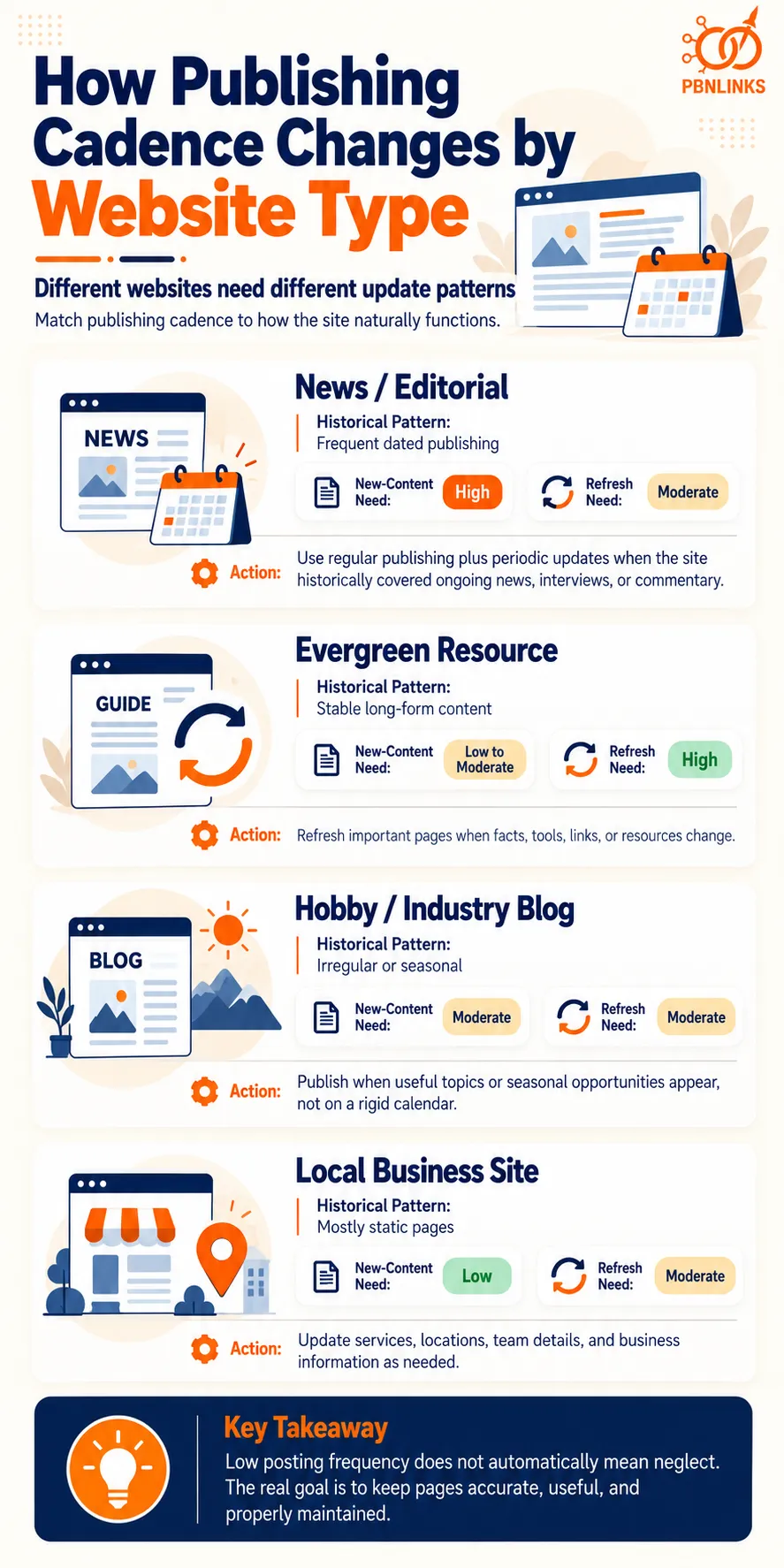
Publishing cadence should change with the type of website. A news site, evergreen resource, hobby blog, and local business site do not serve the same purpose, so they should not be expected to publish at the same pace.
The key is to match the update pattern to how the site naturally functions. Some sites depend on frequent dated content. Others can remain useful for long periods with only occasional updates or selective content refreshes.
| Site Type | Historical Pattern | New-Content Need | Refresh Need | Typical Maintenance Approach |
| News / Editorial | Frequent dated publishing | High | Moderate | Ongoing publishing plus periodic updates |
| Evergreen Resource | Stable long-form content | Low to Moderate | High | Refresh important pages when facts or resources change |
| Hobby / Industry Blog | Irregular or seasonal | Moderate | Moderate | Publish when useful topics or seasonal opportunities appear |
| Local Business Site | Mostly static pages | Low | Moderate | Update service, location, team, and business information as needed |
News and Editorial Sites
News and editorial sites usually have a higher natural publishing cadence because regular dated content is part of how the site operates.
If an aged domain historically published news, industry updates, interviews, or commentary several times each month, leaving it almost completely inactive may not reflect its previous publishing model. In this case, more regular content can make sense when it continues the same subject and editorial role.
The goal is not to create artificial news just to increase volume. New content should still be relevant, useful, and consistent with the site’s historical categories.
Evergreen, Hobby, and Industry Blogs
Evergreen and specialist blogs often need a slower or less predictable cadence.
A gardening blog may publish more often during planting season. An automotive blog may add content when new maintenance topics or model-specific issues appear. An evergreen resource site may keep the same core pages for years and update them only when information changes.
For these sites, publishing quality matters more than following a rigid calendar. If there is no useful new topic to cover, refreshing an existing article may be a better decision than adding another similar page.
Local Business Websites
Local business websites are often the least dependent on frequent blogging. Their most important pages may be services, locations, contact information, company details, and other evergreen business content.
For example, an aged roofing company site may only need updates when services change, a new service area is added, staff information changes, or an existing page becomes outdated. Publishing several new blog posts every month may add little value if the core content already covers what users need.
This is why low publishing frequency does not automatically mean a local business-style PBN site is neglected. The more important question is whether its key pages remain accurate, useful, and properly maintained.
Publish, Refresh, Maintain, or Stay Stable?
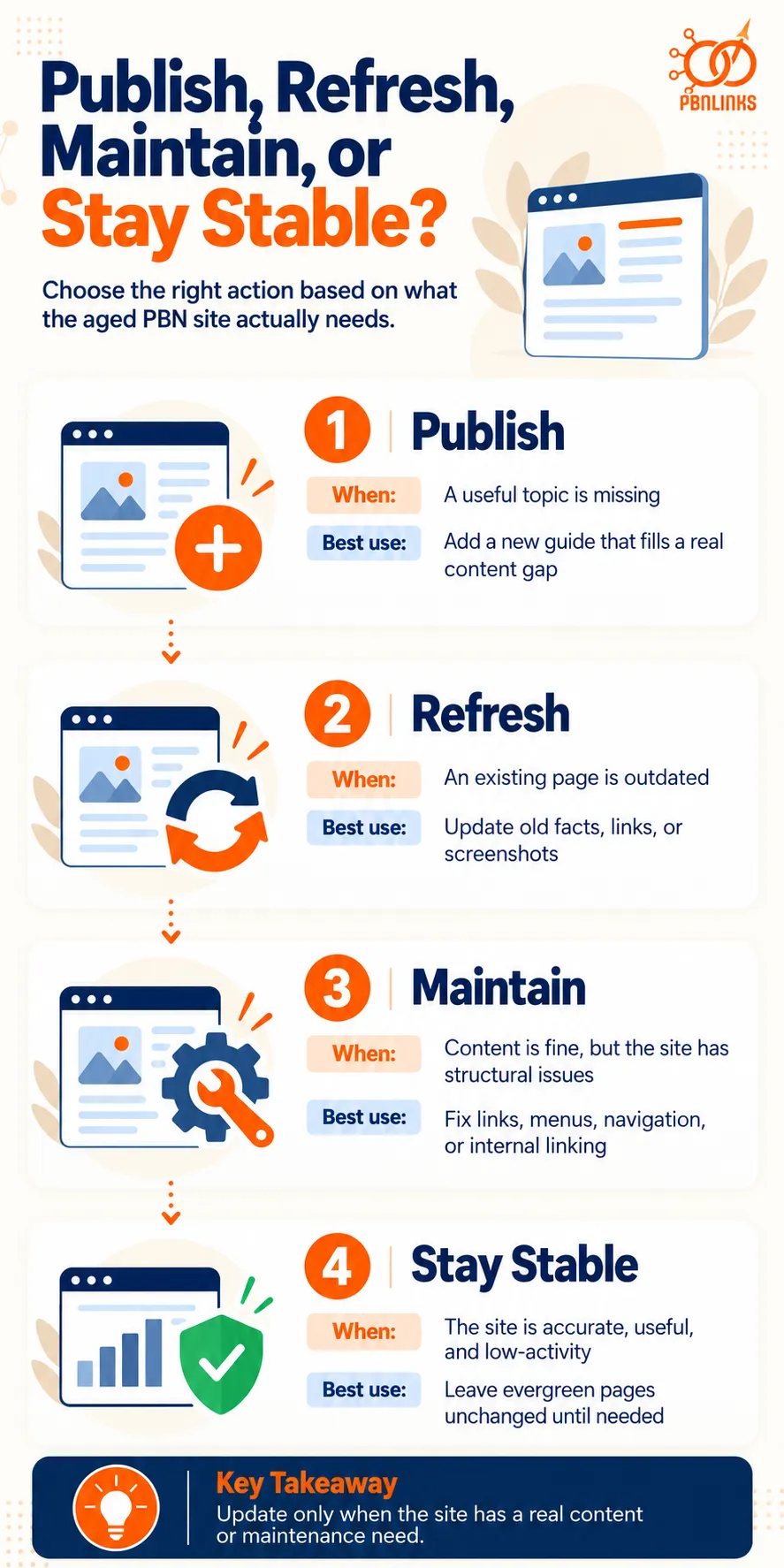
Before adding another post to an aged PBN site, first decide what the site actually needs. In many cases, the right action is not new content. It may be more useful to refresh an old page, fix site issues, or leave the content unchanged.
A simple way to make that decision is to use four options:
| Site Condition | Best Action | Why | Example |
| A useful topic is missing | Publish | The site has a genuine content gap | Add a new guide that fits the site’s existing subject |
| An existing page is outdated | Refresh | The topic is already covered but the page needs improvement | Update old statistics, links, or screenshots |
| The content is accurate but the site has structural issues | Maintain | The problem is not content volume | Fix broken links, menus, or internal linking |
| The site is accurate, useful, and historically low-activity | Stay Stable | No meaningful update is needed | Leave evergreen pages unchanged until there is a real reason to edit them |
Publish
Publish new content when there is a real topic gap and the new page adds something the site does not already cover.
For example, an aged home-improvement blog may have several roof-repair articles but no useful guide about roof ventilation. Adding that page can make sense because it fits the existing niche and serves a distinct user need.
New content is most useful when:
- the topic fits the site’s historical subject,
- existing pages do not already cover the same intent,
- the article adds useful depth,
- and the topic belongs naturally within the site’s current structure.
Publishing just to hit a weekly or monthly quota is a weaker reason.
Refresh
Refresh an existing page when the topic is still useful but the content has become outdated, incomplete, or less accurate.
Common reasons to refresh include old statistics, broken references, outdated screenshots, obsolete tools, weak examples, or missing internal links.
For example, an old SEO guide may still target the right topic but mention tools or practices that are no longer current. In that case, improving the existing page is usually more logical than creating another article on the same subject.
A refresh should make a meaningful change to the page. Simply changing the date or rewriting a few sentences without improving the content adds little value.
Maintain
Use maintenance when the content itself is still accurate but the site has structural or technical problems.
This can include fixing broken links, repairing menus, reconnecting orphaned pages, updating navigation, replacing missing media, or improving internal linking.
For example, a well-written evergreen article may not need new information, but if important links are broken or the page is difficult to reach from the rest of the site, maintenance should come before publishing another post.
This distinction matters because site quality is not only about how much content exists. A well-maintained site with fewer useful pages can be stronger than a larger site with poor structure and neglected content.
Stay Stable
Sometimes the best decision is to make no content change at all.
If the site is accurate, useful, technically sound, and historically low-frequency, there may be no reason to publish another article simply to keep the calendar active.
An evergreen page that still answers the same question well does not need to be rewritten every few months. In the same way, a small local business-style site may remain stable for long periods if its services, contact details, and core information have not changed.
The key is to avoid unnecessary activity. Aged PBN sites should be updated when there is a clear content or maintenance reason, not just because a fixed schedule says another post is due.
What Makes an Aged PBN Site Look Neglected?
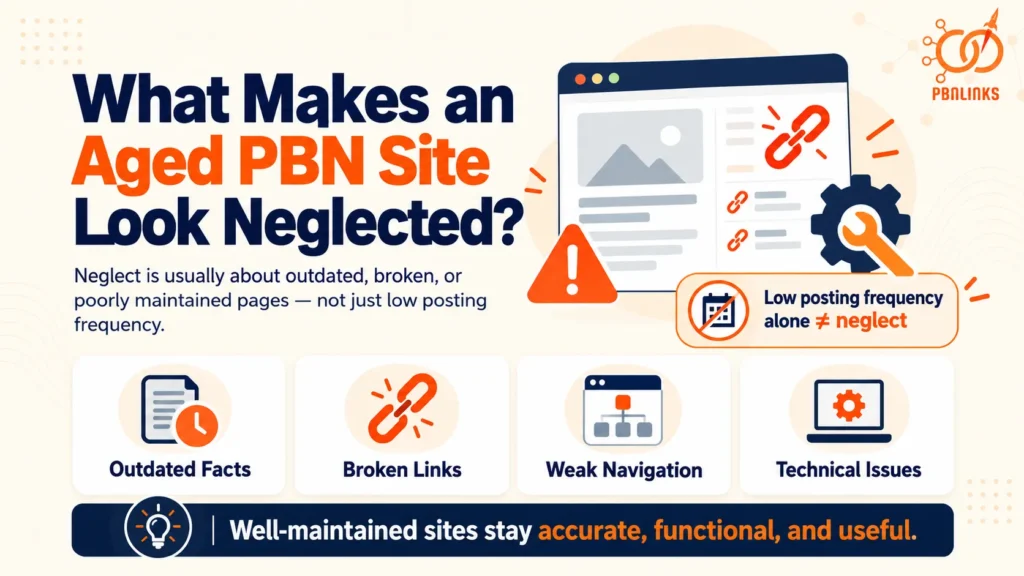
An aged PBN site can look neglected even if it still publishes occasionally. The stronger signals of neglect are usually outdated information, broken site elements, weak navigation, and content that no longer reflects the site’s current structure.
Low posting frequency by itself does not make a site abandoned. A mostly static business site may remain useful for months without new articles. The problem appears when important pages, links, references, or site information are left outdated for too long.
Common signs of neglect include:
- Outdated facts and references: old statistics, obsolete tools, expired recommendations, or information that is no longer accurate.
- Broken internal or external links: dead resources, missing pages, or links that interrupt navigation and user flow.
- Old author or business information: former staff, outdated contact details, closed services, or inaccurate company information.
- Missing media or broken page elements: images that no longer load, broken embeds, or damaged page layouts.
- Weak navigation and internal linking: important pages that are difficult to reach or no longer connected properly.
- Technical issues: redirect problems, server errors, broken menus, or mobile usability problems.
A site can publish new articles every month and still look poorly maintained if these problems remain unresolved. In contrast, an aged site with fewer updates can still look well managed if its main pages remain accurate, functional, and useful.
This is why PBN maintenance should not be measured only by how many new posts are published. The better question is whether the site still works properly and whether its existing content remains worth keeping.
Does Publishing Frequency Affect Crawling and Indexing?
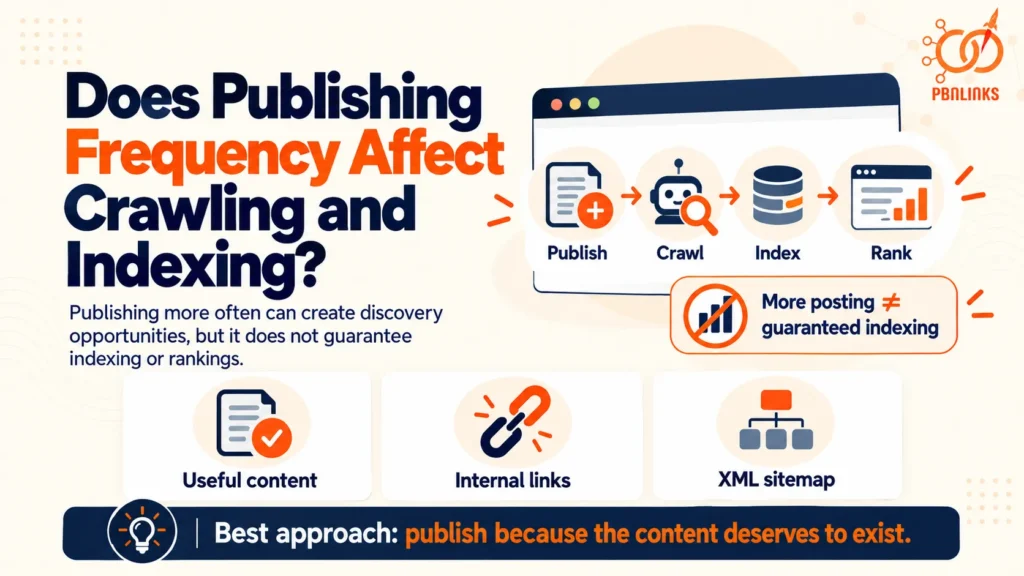
Publishing new content or making meaningful updates can create new opportunities for Google to discover and crawl pages, but publishing more often does not guarantee better indexing or higher rankings.
These are separate stages:
- Publishing: a new or updated page becomes available on the site.
- Crawling: Googlebot discovers and visits the page.
- Indexing: Google decides whether to include the page in its search index.
- Ranking: an indexed page may appear for relevant searches.
A higher publishing frequency can create more URLs for Google to discover, but there is no documented weekly or monthly posting requirement. Google’s guidance focuses on useful, people-first content and specifically warns against adding large amounts of content simply to make a site appear “fresh.” (developers.google.com)
Google Does Not Require a Fixed Posting Frequency
Google does not publish a rule saying a website must add new content once a week, twice a month, or at any other fixed interval to remain indexed.
For aged PBN sites, this means posting frequency should not be treated as a technical indexing requirement. A historically low-activity site does not automatically need constant publishing after it is rebuilt.
The better approach is to add new content when there is a genuine topic to cover and refresh existing pages when information has become outdated or incomplete. That keeps the focus on usefulness instead of publishing simply to maintain an artificial schedule.
Why More Publishing Does Not Guarantee Better Indexing
Publishing a page is only the first step. Google still needs to discover the URL, crawl it, decide whether to index it, and then determine whether it should appear for relevant searches.
This is why adding more pages does not automatically create more organic visibility.
For aged PBN sites, new or updated pages should be:
- Discoverable: connected through relevant internal links and normal site navigation.
- Distinct: different enough from existing pages to serve a clear purpose.
- Useful: able to add information or value beyond what is already on the site.
- Integrated: placed naturally within the site’s categories and overall content structure.
Internal links and XML sitemaps can help Google discover new or updated URLs, but neither guarantees indexing.
The practical takeaway is simple: publish because the content deserves to exist, not because you expect a fixed posting schedule to force Google to crawl or index the site more often.
Should Every PBN Site Follow the Same Publishing Schedule?
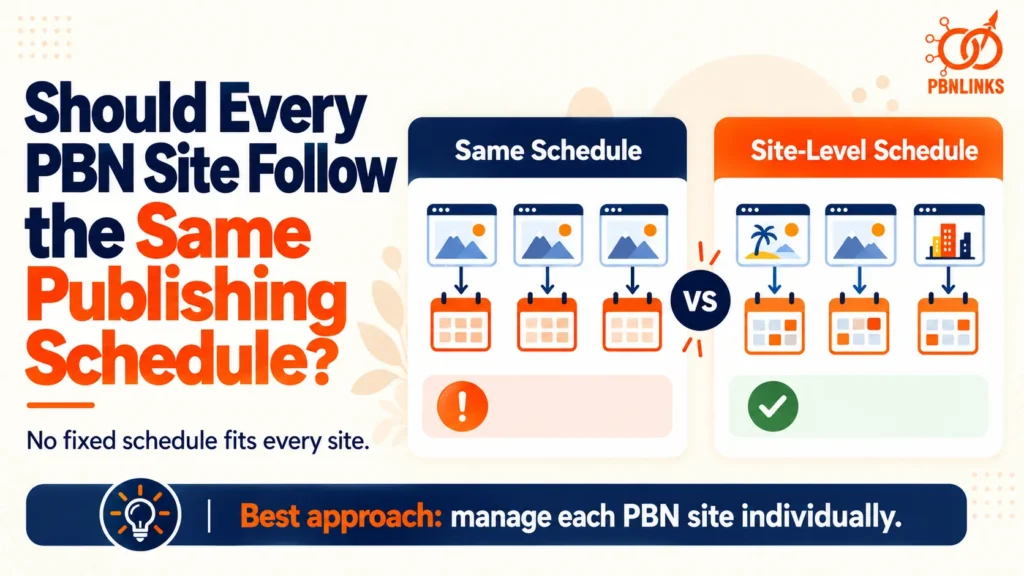
No. Using one fixed publishing schedule across every PBN site ignores differences in site history, niche, content inventory, and actual maintenance needs.
One site may have historically published every week, while another may have added only a few articles each year. Applying the same calendar to both sites can make the network easier to manage, but it does not necessarily make sense for the individual domains.
The better approach is to let each site follow a publishing pattern that matches its own role and condition.
Avoid Mechanical Network-Wide Scheduling
A mechanical schedule is one where every site receives the same amount of content at the same interval.
For example, a network might publish:
- two posts on every site each month,
- content on the same weekday,
- articles at similar intervals,
- or the same amount of content regardless of site type.
The problem is not that Google has publicly confirmed these patterns as a specific PBN detection signal. The problem is that a rigid network-wide system ignores how different websites naturally behave.
A local business site, evergreen resource, and editorial publication should not automatically receive the same number of new posts simply because they belong to the same network.
Let Each Site’s History and Role Guide Its Activity
A more practical approach is to make publishing decisions at the site level.
For each domain, look at:
- its historical publishing pattern,
- the type of site it represents,
- the amount of useful content already published,
- whether existing pages need refreshing,
- and whether there is a real reason to add something new.
For example, an editorial-style domain may justify regular new posts, while a stable evergreen site may need only occasional refreshes. A local business-style site may require updates mainly when services, locations, or business information change.
This does not mean publishing schedules need to be random. It means the schedule should come from the needs of the site rather than from one rule applied across the whole network.
The goal is simple: manage each PBN site as an individual website, not as one repeated template inside a larger system.
How to Manage PBN Publishing Cadence at Network Scale
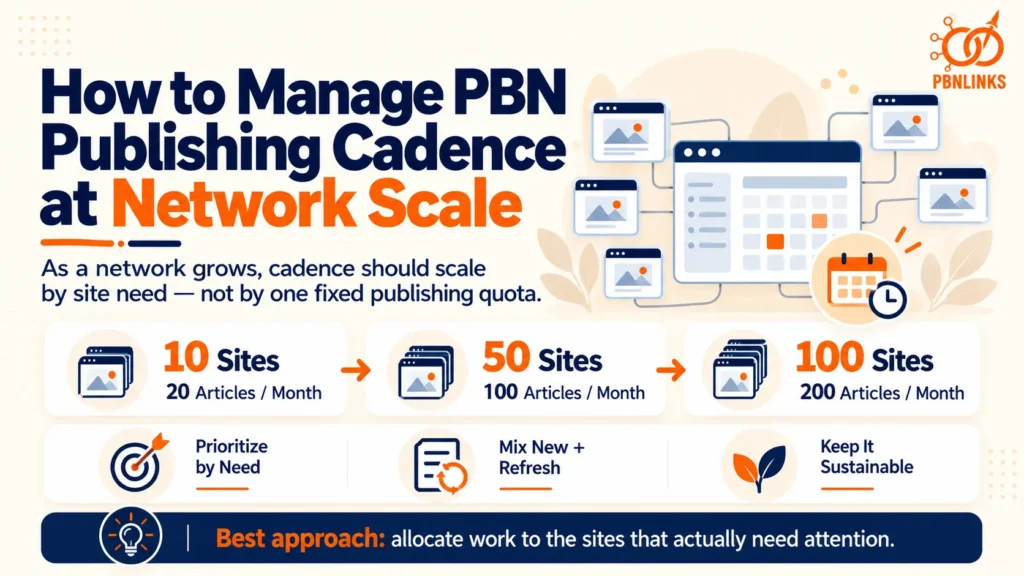
Publishing cadence becomes harder to manage as a PBN network grows. A schedule that works across 5 or 10 sites can create hundreds of writing, editing, publishing, refresh, and maintenance tasks when the same rule is applied across 50 or 100 domains.
A scalable network does not give every site the same publishing quota. It allocates content work according to site history, content condition, maintenance needs, and priority. When cadence is managed well, effort goes to the domains that actually need attention instead of producing unnecessary content across the whole network.
How to Scale Publishing Without Overloading the Network
A practical network-level cadence should balance content production with maintenance and available resources:
- Calculate the True Workload
A small posting quota multiplies quickly at scale. Two posts per month across 10 sites creates 20 articles. Across 50 sites, it becomes 100. Across 100 sites, it becomes 200. Each article still needs topic research, writing, editing, formatting, publishing, internal linking, quality checks, and ongoing monitoring. - Prioritize Sites by Actual Need
Not every domain needs the same level of work. Sites with outdated content, broken links, important existing backlinks, clear content gaps, declining visibility, or urgent maintenance issues may deserve earlier attention. Stable evergreen sites may need much less intervention. - Balance New Content With Refreshes
Large networks become inefficient when every update is treated as a new article. Some sites need new topics, while others may benefit more from updating old statistics, fixing broken references, improving internal links, or strengthening existing pages. - Keep the Cadence Sustainable
An aggressive publishing schedule can lead to repetitive topics, rushed content, weak editing, skipped maintenance, and inconsistent quality. The schedule should be realistic enough that research, publishing, refresh work, QA, and monitoring can all be handled properly.
The goal is not to maximize article count. A scalable PBN network is one that allocates the right level of work to the right sites instead of forcing every domain into the same publishing routine.
Common PBN Publishing Cadence Mistakes
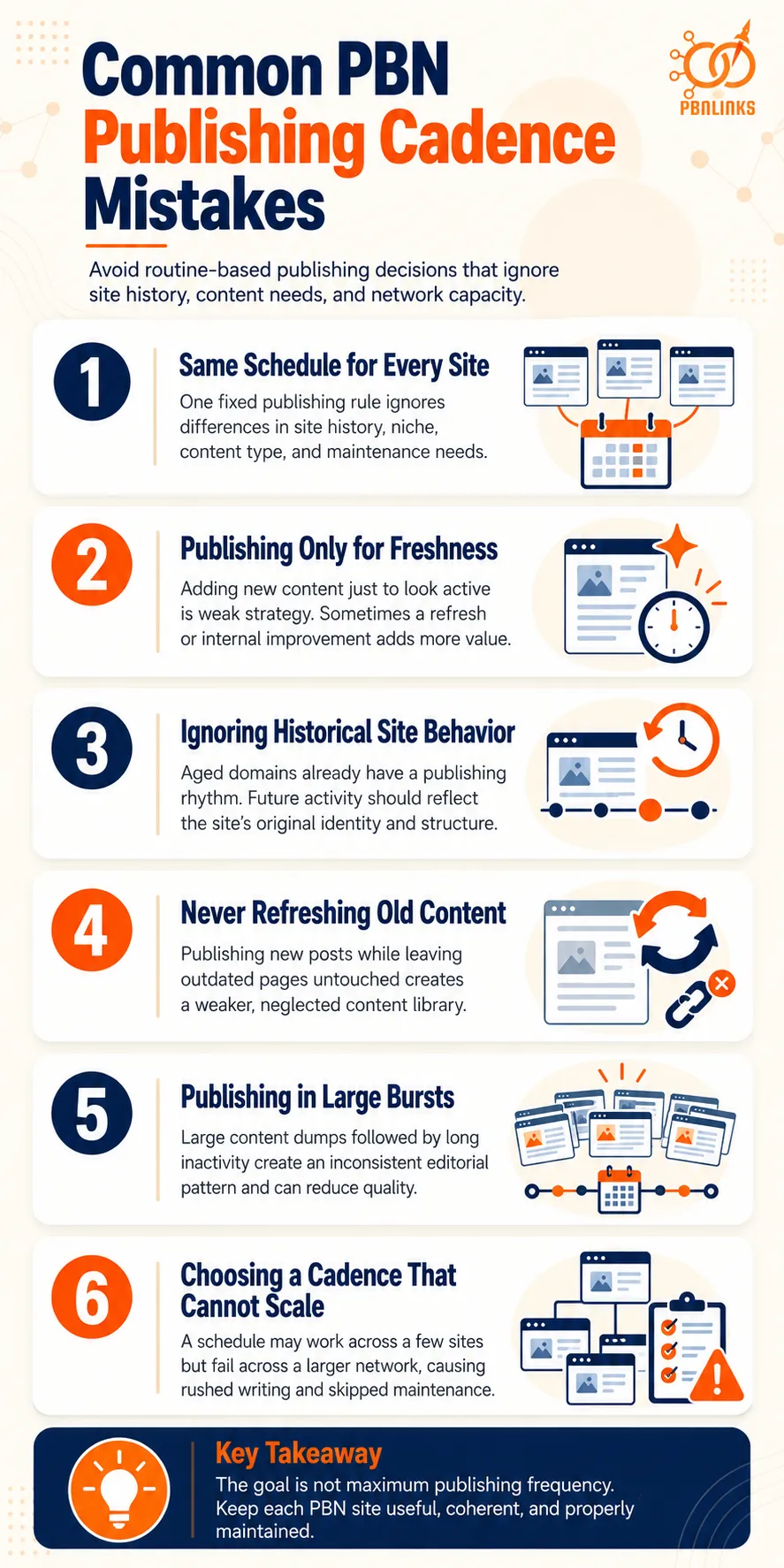
PBN publishing cadence problems usually come from treating content production like a fixed routine instead of a site-level decision. The biggest mistakes happen when site history, existing content, maintenance needs, and network capacity are ignored.
A strong cadence should support the individual site while remaining practical across the wider network.
Using the Same Schedule for Every Site
Applying one publishing rule across an entire network is easy to manage, but it ignores differences in site history, niche, content type, and maintenance needs.
A local business site and an editorial publication should not automatically receive the same number of new posts just because they belong to the same network. The schedule should reflect how each site actually functions.
Publishing Only to Create a Freshness Signal
Adding new content just to make a site look active is a weak publishing strategy.
If there is no real topic gap, another article may add little value. In many cases, refreshing an existing page, correcting outdated information, or improving internal links is more useful than creating another URL.
The goal should be meaningful updates, not activity for the sake of activity.
Ignoring Historical Site Behavior
Aged domains already have a publishing history. Ignoring that history can create a content model that feels disconnected from how the original site operated.
A website that historically published only a few times per year should not automatically become a high-volume blog. The original publishing rhythm, content types, and topic structure should provide context for future activity.
Historical behavior does not need to be copied exactly, but it should not be ignored.
Never Refreshing Old Content
Publishing new posts while leaving older pages untouched can create a growing library of outdated content.
Old pages may contain broken references, outdated statistics, obsolete tools, weak internal links, or information that is no longer accurate. In these cases, refreshing the existing page can be more useful than publishing a similar new article.
A balanced cadence should include both new content and meaningful updates to existing pages.
Publishing in Large Bursts
Publishing many articles in a short period and then leaving the site inactive for months creates an inconsistent editorial pattern.
Large bursts can also create operational problems. Writers may rush topics, editing may become weaker, internal linking may be overlooked, and multiple low-value pages may be published simply to meet a volume target.
A better approach is to spread useful work according to the site’s actual content needs instead of forcing large publishing batches.
Choosing a Cadence That Cannot Scale
A schedule may look reasonable across a few sites but become difficult to maintain across a larger network.
When content volume grows too quickly, common problems include:
- repetitive topics,
- rushed writing,
- weak editing,
- missed refresh work,
- poor internal linking,
- and skipped maintenance.
The better approach is to choose a cadence that can be sustained without lowering quality.
The biggest mistake is treating publishing frequency as the goal. The real goal is to keep each PBN site useful, coherent, and properly maintained over time.
Practical PBN Publishing Cadence Examples
PBN publishing cadence becomes easier to understand when it is applied to real site types. The same posting schedule should not be used across every domain because each site can have a different history, content structure, and maintenance need.
The examples below show how publishing decisions can change depending on the site.
Example 1 — Aged Local Business Site
Imagine an aged roofing website that historically had a homepage, service pages, location pages, and only a few blog posts.
The site does not need to become a high-volume blog after being rebuilt. A better approach may be to keep the main service content accurate, update business information when needed, and add new articles only when there is a genuine topic gap.
For example, new content may make sense if the site has strong roofing service pages but no useful guide about storm damage, roof ventilation, or seasonal maintenance.
Best approach: low-frequency publishing, occasional content refreshes, and regular maintenance of core pages.
Example 2 — Evergreen Informational Blog
Consider an aged informational site with 80 older articles covering stable topics. Most of the content is still useful, but some pages contain old statistics, broken links, outdated screenshots, or weak internal linking.
Publishing several new articles every month may not be the best first step. The existing content already gives the site topical depth, so refreshing important pages can create more value than continuously expanding the URL count.
The first priority may be to update older articles, improve references, strengthen internal links, and only add new pages when a real content gap exists.
Best approach: refresh existing assets first, then publish selectively.
Example 3 — Editorial or Magazine-Style Domain
An aged magazine-style site may have hundreds of dated articles and a history of frequent publishing across recurring categories.
In this case, a very low level of activity may not match the way the site originally operated. New articles can make sense when they continue the same topic areas, editorial style, and content format.
The goal is not to recreate the exact historical schedule. It is to maintain a level of activity that still fits the site’s editorial identity.
Best approach: more regular publishing, supported by periodic refreshes of older content.
Example 4 — Large Multi-Site PBN Network
Now consider a network with 100 aged domains across different niches. Some sites are local business-style properties, some are evergreen blogs, and others are editorial publications.
Giving every site two new posts per month would create 200 articles every month, even though many of those domains may not need new content.
A better system is to group sites by actual need. Some may require new posts, others may need old content refreshed, and stable sites may only need routine checks.
Best approach: site-level prioritization instead of one universal publishing quota.
These examples show why PBN publishing cadence should be treated as a flexible decision rather than a fixed number. The right schedule is the one that fits the site’s history, content condition, and role within the network.
Final Verdict: How Often Should Aged PBN Sites Be Updated?
In conclusion, aged PBN sites should be updated based on their historical publishing pattern, website type, content condition, and maintenance needs rather than a fixed weekly or monthly schedule.
The most effective approach is to review how the site originally behaved, identify whether it needs new content or a refresh, maintain important pages and links, and keep the publishing workload sustainable across the wider network. Some sites may need regular new articles, while others may only require occasional updates or no change at all.
A strong PBN publishing cadence is not about publishing more. It is about giving each site the right level of attention at the right time.
If you want to build or manage aged PBN links with a more controlled, site-specific approach, explore the PBN services available at PBNLinks.Agency.
FAQs About PBN Publishing Cadence
How often should a PBN site be updated?
There is no universal PBN update frequency. The right cadence depends on the site’s historical publishing pattern, website type, existing content, and whether it currently needs new content, a refresh, or maintenance.
Is one post per month enough for a PBN?
Yes, one post per month can be enough for some PBN sites, but it is not a universal benchmark. A historically static site may need less, while an editorial-style domain may justify more frequent publishing.
Does a PBN need fresh content regularly?
No, a PBN does not always need new content regularly. Existing pages can be refreshed, outdated information corrected, broken links fixed, or the site left stable when no meaningful update is needed.
What happens if a PBN stops publishing new posts?
Stopping new posts does not automatically mean the site will lose rankings or become deindexed. The impact depends on whether its existing content remains useful, accurate, accessible, and appropriate for the type of site.
Should old PBN posts be updated?
Yes, old PBN posts should be updated when their facts, links, statistics, screenshots, tools, or recommendations become outdated. If the page is still accurate and useful, an update may not be necessary.
Is it better to publish new content or refresh old PBN content?
Publish new content when a genuine topic gap exists. Refresh an existing page when it already covers the correct topic but needs updated information, better explanations, stronger internal links, or improved accuracy.
Does publishing more often make Google crawl a PBN more frequently?
Not necessarily. New or meaningfully updated pages can create additional crawl opportunities, but higher publishing frequency does not guarantee crawling, indexing, or rankings. Google does not specify a required weekly or monthly posting schedule.
Should every site in a PBN use the same publishing schedule?
No, every PBN site should not automatically use the same publishing schedule. Cadence should reflect each domain’s history, website type, content inventory, maintenance needs, and role within the network.
Can publishing too much content hurt a PBN site?
Publishing more content is not inherently harmful, but unnecessary volume can lead to repetitive topics, thin pages, weaker editing, and poor maintenance. Content should be added because it serves a clear purpose, not simply to increase page count.
How should publishing cadence be managed across a large PBN network?
Manage large PBN networks by prioritizing sites according to actual need rather than assigning one universal quota. Allocate resources between new content, refreshes, technical maintenance, and stable sites so the workload remains sustainable.