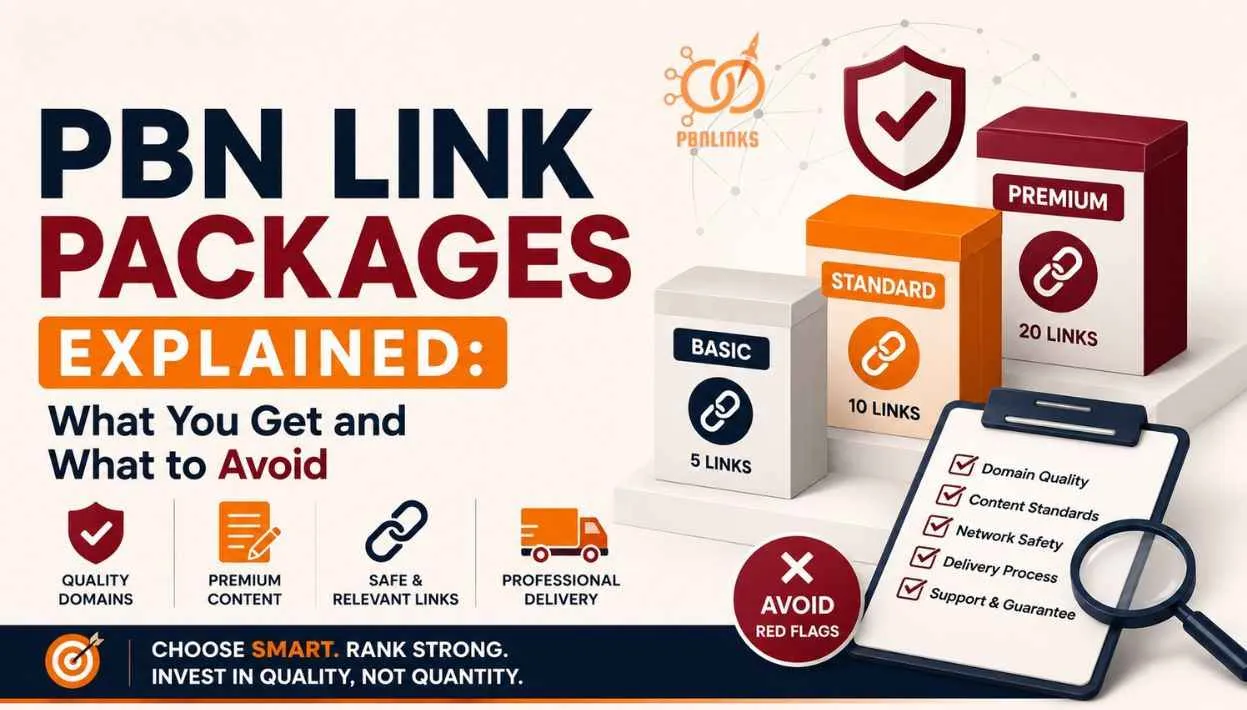
PBN Link Packages Explained: What You Get and What to Avoid
PBN link packages explained means knowing exactly what you get when you pay for a bundle of PBN links. Not just the link count. The domain quality, the content standards, the delivery process, and what happens if something goes wrong.
Most packages look identical on the surface. Five links for $500, ten links for $900, twenty links for $1,500. The price scales but the quality does not always follow.
You are not paying for DR alone. You are paying for domain history, network safety, and content quality. At PBN Links Agency we have seen buyers make this mistake repeatedly — choosing a package based on price and link count and receiving nothing that moves rankings.
Every tier is broken down below with what it should include, the red flags that disqualify a package before you buy, and a complete evaluation checklist for 2026.
What Is a PBN Link Package
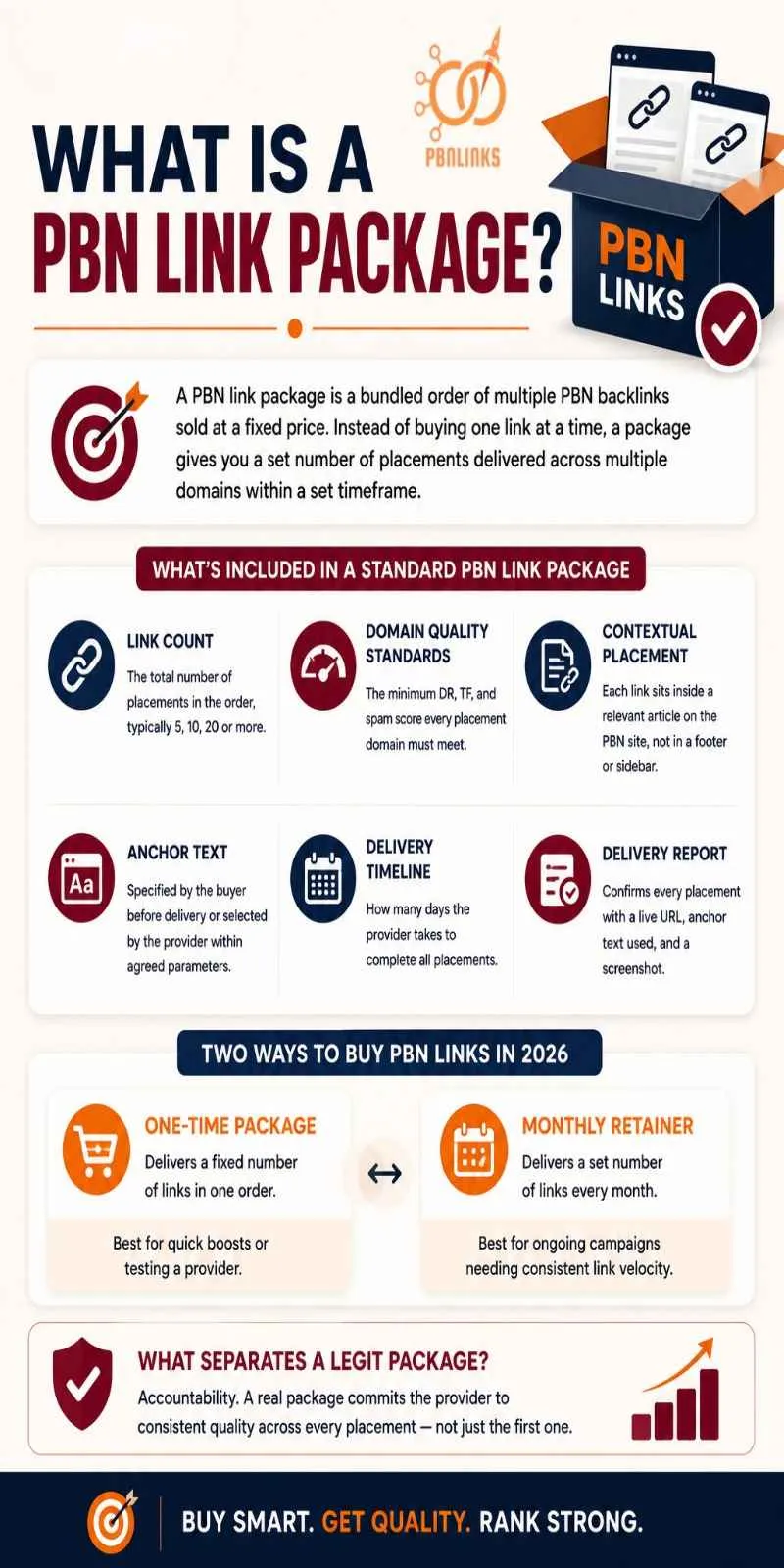
A PBN link package is a bundled order of multiple PBN backlinks sold at a fixed price. Instead of buying one link at a time a package gives you a set number of placements delivered across multiple domains within a set timeframe.
Most SEO campaigns need more than one link to move rankings. A package puts everything into one order with defined quality standards, a delivery timeline, and a report confirming every placement.
Here is what a standard PBN link package includes:
- Link count — the total number of placements in the order, typically 5, 10, 20 or more
- Domain quality standards — the minimum DR, TF, and spam score every placement domain must meet
- Contextual placement — each link sits inside a relevant article on the PBN site, not in a footer or sidebar
- Anchor text — specified by the buyer before delivery or selected by the provider within agreed parameters
- Delivery timeline — how many days the provider takes to complete all placements
- Delivery report — confirms every placement with a live URL, anchor text used, and a screenshot
There are two ways to buy PBN links in 2026. A one-time package delivers a fixed number of links in one order. A monthly retainer delivers a set number of links every month.
A one-time package suits campaigns that need a quick authority boost or want to test a provider before committing. A monthly retainer suits ongoing campaigns that need consistent link velocity over time.
What separates a legitimate package from a bulk link dump is accountability. A real package commits the provider to consistent quality across every placement not just the first one.
What a PBN Link Package Should Include
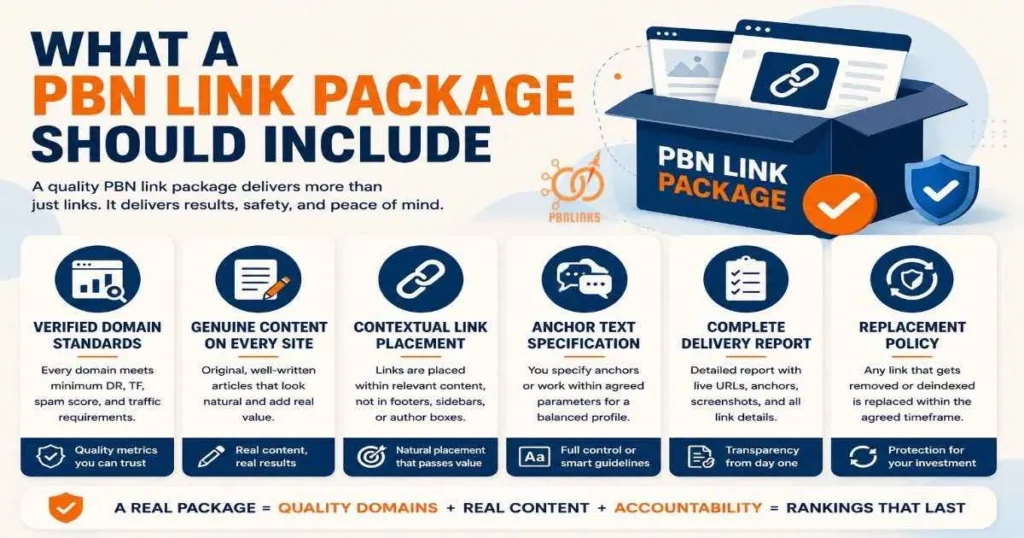
A quality PBN link package should include verified domain standards, genuine content on every placement site, and contextual link placement. It should also include anchor text specification, a complete delivery report, and a replacement policy for any link that fails after delivery.
Most packages look similar on paper. The difference shows up in what the provider is actually committing to deliver and what they leave vague. Here is what every standard in a legitimate package should mean in practice.
Domain and Content Standards
Domain Rating and Trust Flow minimums
Every placement domain in the package should meet a minimum DR and TF threshold before the provider accepts it into the network. A package that does not specify these thresholds is not guaranteeing quality. It is guaranteeing a number of links with no commitment to the authority behind them.
What good looks like: DR 20 plus for low competition packages. DR 30 plus for mid to premium packages. TF minimum 15 with a TF to CF ratio of 0.8 or above. Knowing the exact PBN domain metrics to verify before accepting any placement helps you hold providers accountable to the standards they advertise.
Red flag: A package that only lists link count and price with no mention of domain metric minimums.
Spam Score limits
Every placement domain should have a Spam Score below 5 percent. Domains above 10 percent carry a risk of devaluation that no DR number can offset.
What good looks like: Spam Score confirmed below 5 percent for every domain in the package before placement.
Red flag: No Spam Score threshold mentioned anywhere in the package description.
Content quality on placement sites
Content on PBN sites in 2026 needs to be good enough that if you stripped out the link to your money site the page would still pass as a real piece of writing on the topic. Every placement post should be minimum 600 words of genuine on topic content written for real readers not for the link.
What good looks like: Posts with specific depth, original perspective, and natural internal linking. No AI generated thin content. No spun articles.
Red flag: Generic short posts that read like templates. Content that makes no sense without the outbound link.
Niche relevance
The placement domain should operate in a niche relevant to your money site. A link from a gardening site pointing to a finance site passes less value than a link from a finance adjacent domain.
What good looks like: The provider matches placement domains to your money site niche or an adjacent topic area.
Red flag: A package that places links on general multi-topic sites with no relevance filter.
Delivery and Replacement Standards
Complete delivery report
Every placement in the package should be confirmed with a live URL, a screenshot showing the link in context, the anchor text used, and the domain metrics at time of delivery.
What good looks like: A report that lets you independently verify every element without contacting the provider.
Red flag: A report that only shows a domain name and a DR score. No live URLs. No screenshots.
Replacement policy
A legitimate package includes a clear replacement policy for links that get deindexed or removed after delivery. A provider with no replacement policy has no accountability after payment.
What good looks like: A written guarantee that deindexed or removed links will be replaced within 30 to 60 days after delivery.
Red flag: No replacement policy mentioned. Or a policy that only covers links deindexed within 7 days of delivery.
Anchor text specification
The package should allow the buyer to specify anchor text before delivery. Anchor text directly affects topical relevance and over-optimisation risk. Leaving anchor text to the provider without buyer input is one of the most common mistakes in PBN package buying.
What good looks like: The provider requests your target anchor text as part of the order process and confirms it in the delivery report. Planning your anchor text distribution before placing any order ensures each placement fills a gap in your profile rather than repeating what already exists.
Red flag: No anchor text specification option. Provider selects anchor text without buyer input.
PBN Link Package Tiers Explained
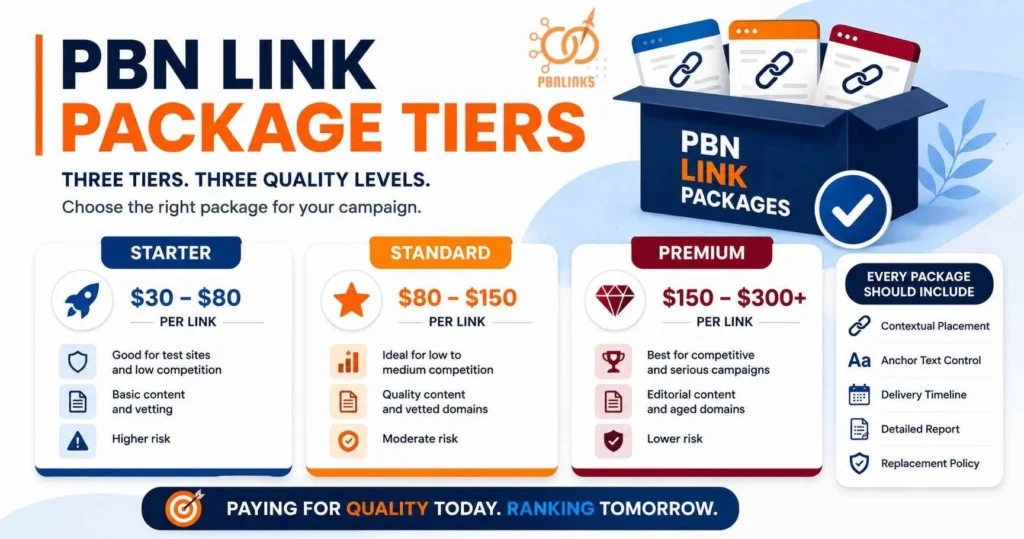
PBN link packages in 2026 fall into three tiers — Starter, Standard, and Premium. The price difference between tiers is significant. The quality difference is even bigger. Understanding what each tier actually delivers helps you match the right package to your campaign without overpaying or underbuying.
| Tier | Price Per Link | Best For | Risk Level |
| Starter | $30 to $80 | Test domains, low competition, provider testing | High |
| Standard | $80 to $150 | Low to medium competition, established sites | Moderate |
| Premium | $150 to $300 plus | Medium to high competition, serious campaigns | Lower |
Starter PBN Packages
Starter packages are priced between $30 and $80 per link. At this price point the underlying economics force corner cutting on domain acquisition, content quality, and footprint isolation.
What you typically get:
- Expired domains with basic metrics but limited vetting
- Short generic content that passes a surface check but lacks real depth
- Some hosting separation but not consistent across the network
- Basic delivery report with domain name and DR score only
Who it suits: Starter packages are best for test domains, throwaway affiliate sites, or buyers who want to understand how PBN links behave before committing to a real campaign. They are not suitable for money sites you care about protecting.
Honest verdict: Links at this tier work in the short term. They pass equity until the network gets reviewed. Survival rates are notably weaker than Standard or Premium tier. Detection risk is measured in months not years.
Standard PBN Packages
Standard packages are priced between $80 and $150 per link. This is where most buyers land and where the quality gap between providers becomes most visible. The best ROI usually comes from Standard tier niche-relevant PBN sites that maintain trust and avoid footprints regardless of the price tag.
What you typically get:
- Vetted expired domains with DR 20 to 40 and basic TF checks
- Functional content of 500 to 700 words — readable but not editorial grade
- Hosting diversification across multiple providers
- Delivery report with live URLs and screenshots
- Basic replacement policy for deindexed links
Who it suits: Low to medium competition niches, established sites that already have some backlink profile, and agencies testing a new provider before scaling.
Honest verdict: The economics of $50 per link cannot support the same domain quality and content production that $100 plus providers can deliver. The difference shows up in how long links stay live after Google reviews. At the upper end of this tier quality starts to approach Premium. At the lower end it approaches Starter level risk.
Premium PBN Packages
Premium packages are priced at $150 to $300 plus per link. This tier requires significantly more investment from the provider in domain acquisition, content production, and network management. That investment shows up in link longevity and campaign performance.
What you typically get:
- Aged domains with clean backlink histories, DR 30 plus, and TF 15 plus
- Editorial quality content of 800 words or more with genuine depth and original perspective
- Strong hosting diversification across multiple providers and IP ranges
- Deep niche matching with placement domains relevant to your money site topic
- Complete delivery report with full metrics and screenshots
- Clear replacement policy with 30 to 60 day guarantee
Who it suits: Medium to high competition niches, serious campaigns where link longevity matters, agencies managing multiple client campaigns, and any site where a manual penalty would be catastrophic.
Honest verdict: Premium packages cost more because they actually cost more to build. The domains are harder to find. The content takes longer to produce. The network requires more infrastructure investment. For competitive campaigns that need links to hold rankings for 12 months or more Premium tier is the only tier worth considering. Campaigns in competitive niches like tech PBN links and finance PBN links almost always require Premium tier standards to move and hold page one rankings.
Monthly Retainer vs One-Time PBN Package
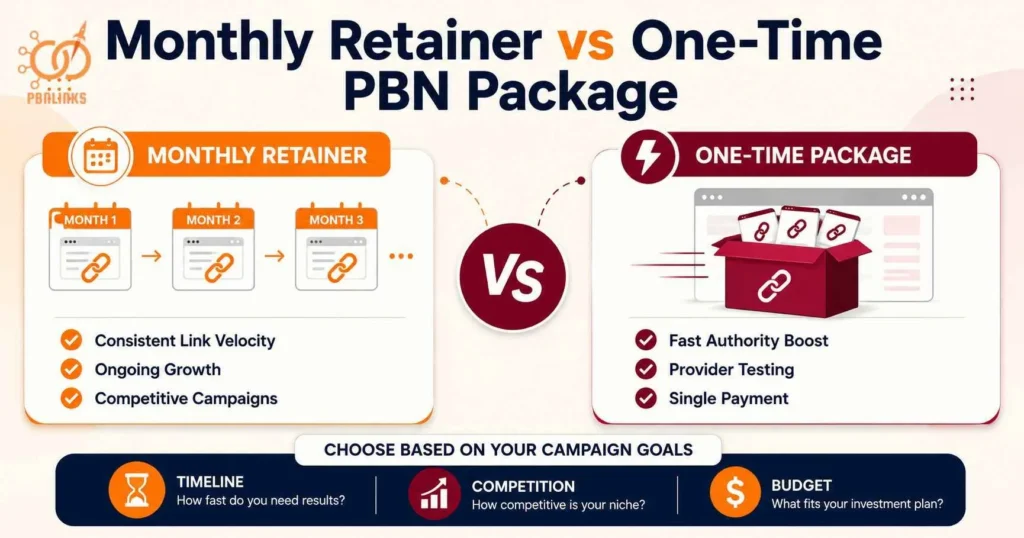
A monthly retainer delivers a set number of PBN links every month on an ongoing basis. A one-time package delivers a fixed number of links in a single order. Both models work but they serve completely different campaign needs.
The wrong model for your situation wastes budget or leaves rankings stalled. Here is how to choose the right one.
| Factor | Monthly Retainer | One-Time Package |
| Link delivery | Set number every month | Fixed number in one order |
| Budget commitment | Recurring monthly fee | Single payment |
| Link velocity | Controlled and consistent | Front loaded in one batch |
| Best for | Ongoing competitive campaigns | Quick boosts or provider testing |
| Flexibility | Lower — ongoing commitment | Higher — no ongoing obligation |
| Cost per link | Often lower at volume | Standard per link pricing |
Monthly Retainer Packages
A monthly retainer is a recurring arrangement where you pay a fixed fee every month and receive a set number of PBN link placements in return. The provider delivers links consistently across the month rather than all at once.
Monthly retainers suit campaigns that need sustained link velocity over time. A single batch of 10 links placed in one week looks different to Google than 10 links placed steadily over a month. The retainer model mirrors natural link acquisition patterns which reduces velocity spike risk.
What a monthly retainer typically includes:
- A fixed number of links per month at an agreed quality tier
- Consistent domain vetting and content standards across every delivery
- Monthly delivery report confirming all placements
- Ongoing anchor text management across the campaign
- Replacement guarantee for any links lost during the retainer period
Who it suits: Sites in competitive niches that need consistent link growth over 6 to 12 months. Agencies managing ongoing campaigns for multiple clients. Any campaign where link velocity consistency matters more than speed.
One-Time PBN Packages
A one-time package is a fixed order of PBN links delivered in a single batch. You pay once, receive a set number of placements, and have no ongoing commitment after delivery.
One-time packages suit campaigns with a specific short-term goal. A new page that needs an authority boost before a product launch. A provider you want to test before committing to a retainer. A seasonal campaign that needs fast ranking movement in a limited window.
What a one-time package typically includes:
- A fixed number of links delivered within an agreed timeframe
- Delivery report confirming all placements after completion
- Basic replacement guarantee for deindexed links within 30 days
- Anchor text specified by the buyer before delivery
Who it suits: New sites testing a provider for the first time. Campaigns with a specific short-term ranking goal. Buyers with a limited budget who want to see results before committing to a retainer.
Which model should you choose?
Choose a monthly retainer if your campaign needs consistent link velocity over 6 months or more and you are in a competitive niche where competitors are building links every month.
Choose a one-time package if you want to test a provider before committing, need a fast authority boost for a specific page, or have a limited budget and want to see results before investing further. A structured PBN link velocity plan helps you decide how many links per month your campaign needs before choosing between both models.
How to Use a PBN Link Package Correctly
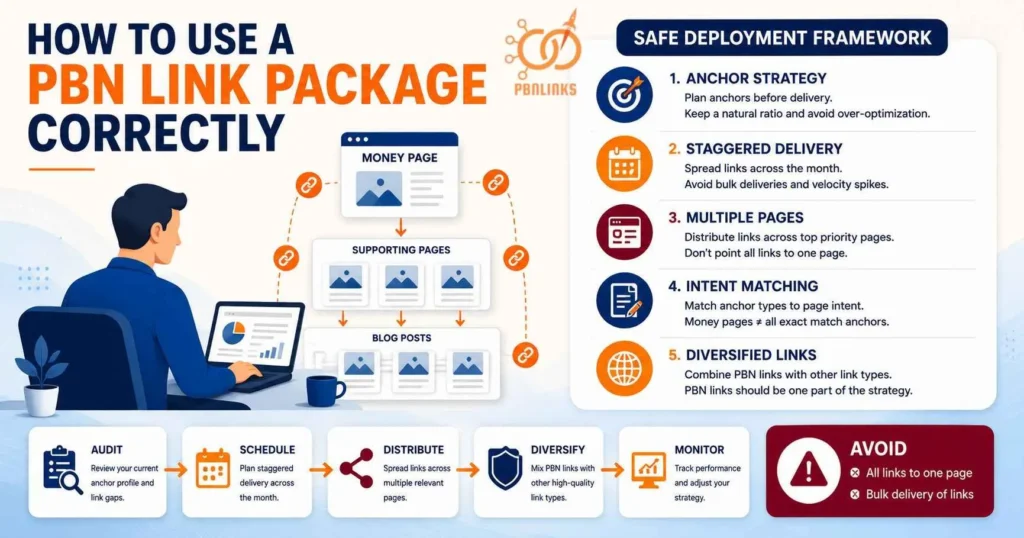
Using a PBN link package correctly means managing anchor text, controlling link velocity, distributing links across multiple pages, and combining PBN links with other link types in a diversified strategy.
Most buyers make two mistakes. They point all links at one page. And they activate the full package too quickly. Both decisions create detectable patterns that Google flags and devalues.
Follow these five steps to deploy any PBN link package correctly:
1. Audit your anchor profile before ordering
Check your current anchor text ratio in Ahrefs before the package is delivered. Your package should fill gaps in your existing profile not repeat patterns that already exist. Specify the anchor text for every link before delivery. Never leave anchor selection to the provider.
A safe ratio for most campaigns is 60 percent branded, 30 percent partial match, and 10 percent exact match. Keep exact match usage below 10 percent of the total backlink profile for every target page.
2. Request staggered delivery across the month
Ask your provider to spread deliveries across the full month rather than delivering all links in one batch. Google SpamBrain processes link signals continuously in 2026. A pattern detected today gets devalued today.
For new sites space links 7 to 10 days apart. For established sites 5 to 7 days apart is safe without triggering velocity flags.
3. Distribute links across multiple pages
Never point every link in the package at the same page. Spread the package across your top target pages based on ranking priority.
Point 50 to 60 percent of links at your primary money page. Distribute the remaining 40 to 50 percent across supporting pages including category pages, blog posts, and service pages.
4. Match anchor type to page intent
Money pages benefit most from partial match and exact match anchors used within the 10 percent threshold. Supporting pages benefit from branded and generic anchors that build domain authority without triggering over-optimisation signals on commercial pages.
5. Combine package links with other link types
PBN links should represent roughly 20 percent of your total link building activity. A profile made up entirely of PBN links is easier to detect than one where PBN links sit alongside guest posts, niche edits, and natural citations.
Use the package as one layer in a diversified strategy not as the entire strategy. Knowing exactly where each link should sit inside a post maximises the authority each placement transfers — the full positioning framework is in our PBN link placement strategy guide.
Red Flags in PBN Link Packages
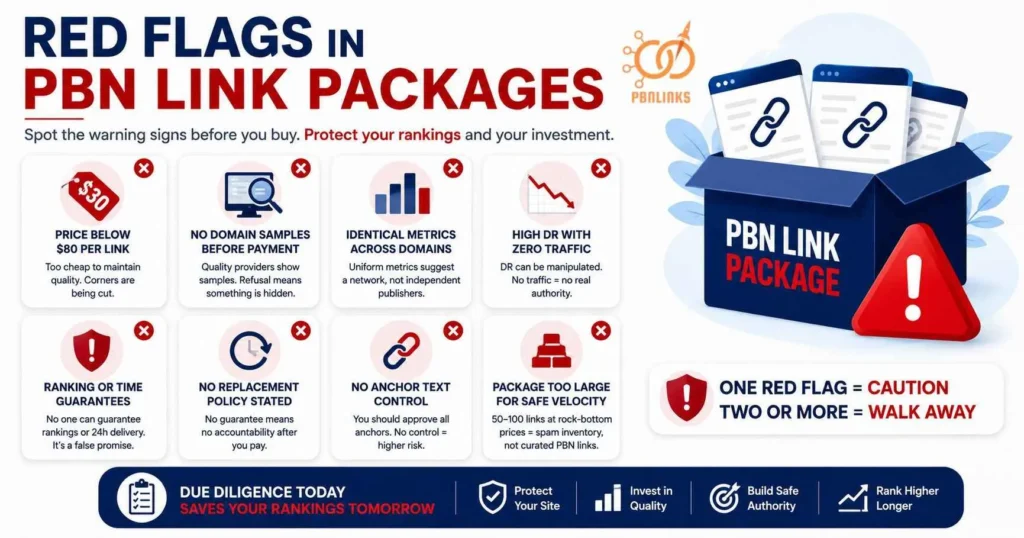
A red flag in a PBN link package is a signal that the provider is cutting corners on domain quality, content standards, or network safety. One red flag warrants caution. Two or more red flags in the same package is an automatic disqualifier.
Here are the signals that tell you to walk away before spending a dollar:
Pricing below $80 per link across the full package
At this price point the economics make quality impossible to maintain. Domain acquisition, hosting, content production, and vetting all cost money. A provider charging $30 to $50 per link in a package is cutting corners on at least one of those stages. The question is which one — and the answer is usually all of them.
No domain samples available before payment
A provider that cannot show you example domains before you commit to a package has something to hide. Quality networks share 5 to 10 sample domains with verifiable Ahrefs metrics before any order is placed. Refusal to share samples before payment is the strongest single disqualifier in PBN package buying.
Identical metrics across all package domains
If several available sites in the package all show identical or very similar DR ranges, traffic ranges, and spam scores this pattern suggests a shared network rather than independent publishers. Natural sites have diverse metric profiles. Artificial networks tend toward uniformity because they are managed by the same operator.
High DR with zero organic traffic
Domain Rating can be artificially inflated by PBN links. If a site shows DR 60 but has fewer than 200 monthly organic visitors the DR is almost certainly not earned from real editorial links. A package full of high DR domains with no organic traffic is a package full of manipulated metrics not genuine authority.
Guaranteed rankings or guaranteed turnaround times
No legitimate PBN provider can guarantee specific ranking outcomes. Any package description that includes ranking guarantees is either dishonest or naive about how SEO works. Guaranteed delivery in 24 hours is an equally strong red flag. Real placement takes time. If a provider guarantees a link in 24 hours it is likely a site they own rather than an independent editorial placement.
No replacement policy stated
A provider with no replacement policy has no accountability after payment. Quality PBN packages include a written guarantee that deindexed or removed links will be replaced within 30 to 60 days. If the package description does not mention a replacement policy ask directly. If the provider cannot confirm one in writing walk away.
No anchor text specification allowed
Any package that does not allow the buyer to specify anchor text before delivery is a package built around the provider’s convenience not the buyer’s campaign needs. Anchor text determines topical relevance and over-optimisation risk. A provider that selects anchor text without buyer input is not managing campaigns responsibly.
Package size too large for safe velocity
A package offering 50 or 100 links for $200 is not a discount. It is a warning. Sellers offering 50 to 100 backlinks for $100 to $200 universally operate PBN networks or automated blog comment spam. No quality network can produce 50 genuinely vetted placements at that price point. What you receive is link farm inventory not curated PBN links. For a complete framework of what to check before committing to any package visit our buy PBN links checklist.
How to Compare PBN Link Packages Before Buying
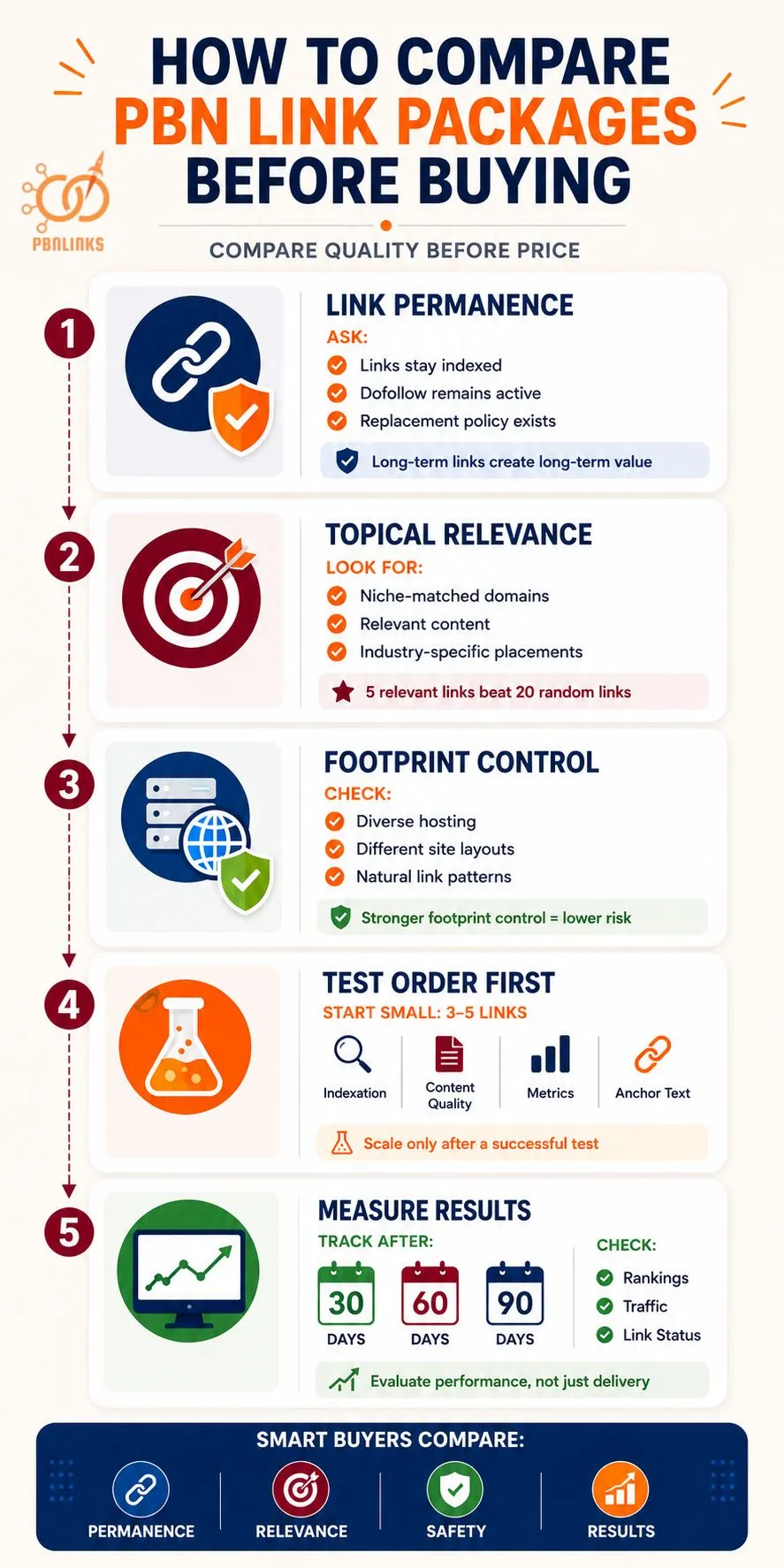
Comparing PBN link packages correctly means evaluating three things before price — link permanence, topical relevance, and footprint control. A package that scores well on all three is worth paying for. A package that scores poorly on any one of them is a risk regardless of the price.
Most buyers compare packages on link count and price alone. That comparison tells you almost nothing about whether the links will hold rankings or get devalued within months of delivery.
Use this framework before committing to any package:
1. Evaluate link permanence
Link permanence means how long the links in the package stay live, indexed, and dofollow after delivery. A link that disappears three months after delivery has zero long-term value regardless of how strong the domain was.
Ask every provider these questions before ordering:
- What is your replacement policy for deindexed or removed links?
- What percentage of your links remain indexed after 6 months?
- Do you monitor link health after delivery or only at time of placement?
A provider that cannot answer these questions confidently is not tracking the longevity of their own placements.
2. Evaluate topical relevance
A smaller number of highly relevant placements often provides more meaningful results than a larger collection of unrelated links. A package of 5 links from niche-relevant domains in your exact topic area will almost always outperform a package of 20 links from general multi-topic sites.
Ask every provider:
- How do you match placement domains to my money site niche?
- Can I see sample domains from my niche before ordering?
- What percentage of your network is topically relevant to my target keywords?
If the provider cannot show niche-matched sample domains before payment move to the next provider.
3. Evaluate footprint control
Footprint control means how well the provider manages hosting diversity, site structure variation, anchor text distribution, and outbound link patterns across the network. A network with strong footprint control is significantly harder for Google SpamBrain to identify and devalue.
Ask every provider:
- How do you diversify hosting across the network?
- Do domains in the package share IP ranges or nameservers?
- How do you vary site themes, plugins, and layouts across the network?
A provider that deflects or gives vague answers to these questions is not managing footprints to a safe standard.
4. Place a test order before committing to a full package
Before committing to a full package order 3 to 5 links from the same provider as a test. Verify every link manually after delivery. Check indexation, content quality, anchor text accuracy, and domain metrics against what was promised.
Only scale with a provider after a test order passes every check. A provider that delivers a quality test order will almost certainly deliver a quality full package. A provider that cuts corners on a test order will cut corners at every scale.
5. Evaluate ROI after the campaign
Track ranking movement on every target page at 30, 60, and 90 days after package delivery. A quality package should produce measurable ranking movement within 4 to 8 weeks in low to medium competition niches. High competition niches may take 3 months or more.
If rankings have not moved after 90 days check whether all links are indexed before concluding the package did not work. An unindexed link passes zero authority. Fix indexation issues before evaluating package performance.
The Complete PBN Link Package Checklist
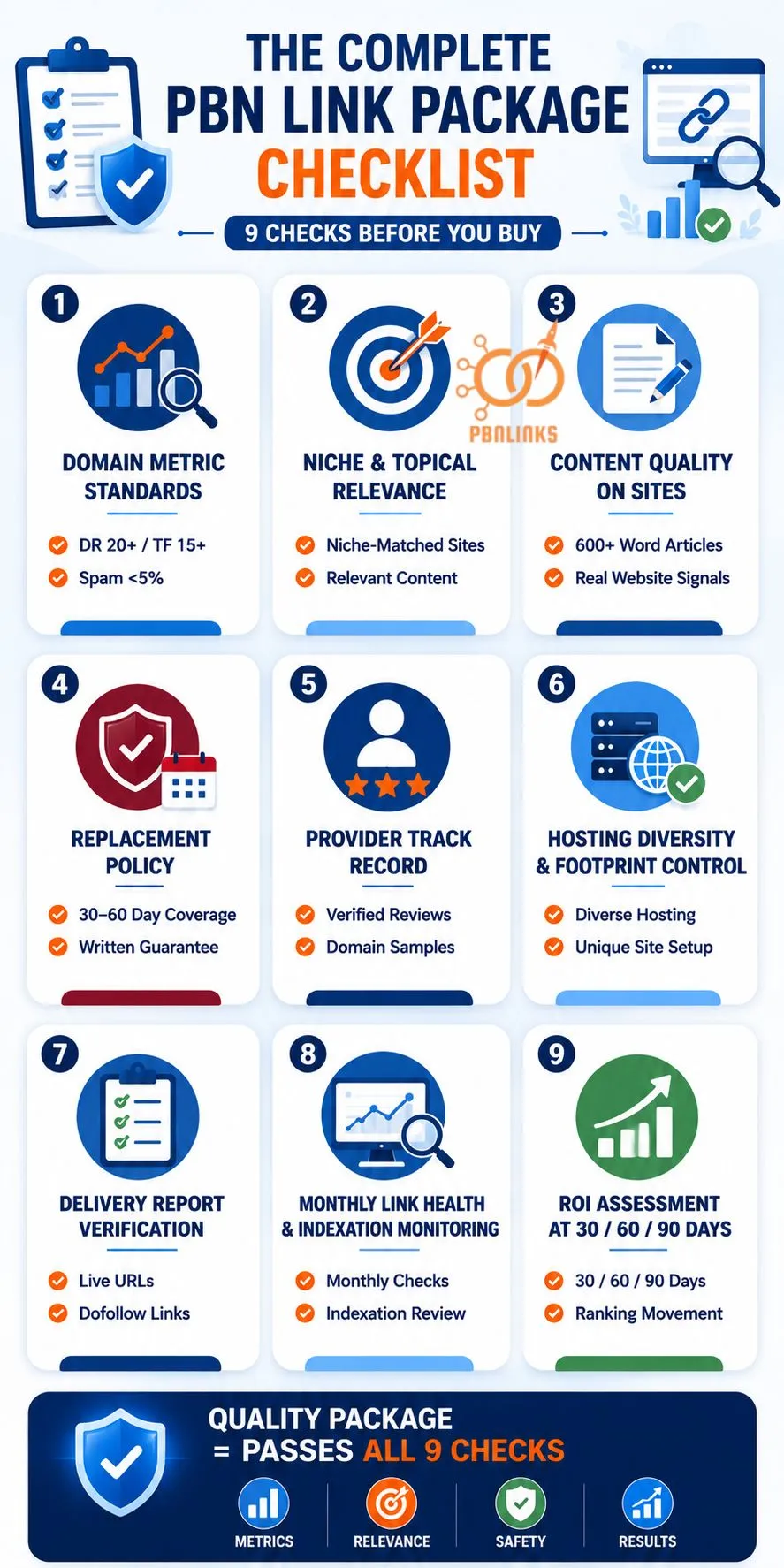
A PBN link package checklist is a structured set of checks that helps you decide if a package is safe, relevant, and worth your investment. Follow a structured review before every purchase. It helps you understand what the provider is committing to deliver and whether the links will pass genuine link equity to your money site.
Run every package through all nine checks before spending a dollar.
1. Domain Metric Standards
Domain metrics are the starting point for every package evaluation. They tell you whether the placement domains have genuine authority or just the appearance of it. A high DR domain with no organic traffic and a weak Trust Flow is not a quality placement. It is a metric inflated through low quality link building.
- Confirm DR threshold is stated. DR 20 plus for low competition and DR 30 plus for medium to high
- Confirm Trust Flow minimum is stated. TF 15 plus with a TF to CF ratio of 0.8 or above
- Confirm spam score limit is stated. Below 5 percent for every placement domain
- Verify organic traffic history on sample domains. Zero traffic on a high DR domain signals an artificially inflated profile
Metrics are a filter not a final decision. A domain that passes metric checks still needs to pass content, history, and relevance checks before any placement is accepted. When all four metric signals are clean the domain is worth investigating further.
2. Niche and Topical Relevance
Once domain metrics pass move to topical relevance. A package that passes metric checks but places links on unrelated sites passes weaker link equity. It also creates a more detectable outbound link pattern across the network. In 2026 Google evaluates topical context around every link. The authority of the domain alone is not enough.
- Confirm the provider matches placement domains to your money site niche or a closely adjacent topic
- Request sample domains from your niche before ordering not after payment
- Check that outbound links on sample sites point to topically related sources not unrelated commercial pages
- Ask the provider directly how they manage niche matching across the network
Topical relevance is not optional. A link from a domain covering your exact niche passes stronger contextual signals than a link from a high DR general site with no topical connection. A relevant package reinforces your topical authority map and supports long-term ranking stability.
3. Content Quality on Placement Sites
After confirming niche relevance check content quality on every sample domain. Content is the clearest signal of whether a PBN site behaves like a real website or a link vehicle. Google reads content semantically in 2026. It can identify when an article has no real meaning beyond the link it contains.
- Posts should be minimum 600 words of genuine on topic content with real depth and original perspective
- Check for About, Contact, and Privacy pages. Their absence signals a rushed low-effort setup
- Verify content reads naturally and covers the topic specifically. Generic filler is a red flag
- Avoid any package where sample sites show AI generated or spun content patterns
Content that feels authentic signals a network managed to a standard worth paying for. Thin content on placement sites reduces the authority the link passes. It also increases detection risk at the same time. When content passes this check the link is safer for long-term placement.
4. Replacement Policy
Before committing to any order confirm the replacement policy in writing. A package without a replacement policy has no accountability after payment. Research from PBN Links Agency’s rent vs own analysis confirms approximately 15.5 percent of expired domains used in PBNs drop within a year. A replacement policy is not optional. It is essential.
- Confirm replacement policy is stated in the package description before ordering
- Confirm the replacement window covers at least 30 to 60 days after delivery
- Ask directly if no policy is visible. A legitimate provider answers immediately and confidently
- Walk away from any provider that only replaces links deindexed within 7 days of delivery
A replacement policy tells you more about a provider’s confidence in their own network than any metric or sample domain. A provider who stands behind their placements with a clear written guarantee is managing the network to a high standard. When the replacement policy is confirmed in writing your investment is protected.
5. Provider Track Record and Credibility
Domain metrics and content standards only matter if the provider delivers them consistently. Vet the provider directly before placing any order. A bad provider makes every other check on this list pointless. This is true regardless of how strong their package description looks.
- Look for a long verified review history on a transparent marketplace or platform
- Confirm the provider owns and manages the network directly not a broker or reseller
- Ask how they vet domains, manage hosting diversification, and produce content. A specific confident answer signals a real network
- Walk away from any provider that refuses to share domain samples before payment
A provider’s track record is the single strongest predictor of package quality. Verified reviews from real buyers over an extended period tell you more than any pricing page. When the provider is transparent, accountable, and willing to share evidence before payment you can trust the process that follows. The full provider vetting framework is covered in the buy PBN links checklist.
6. Hosting Diversity and Footprint Control
After confirming provider credibility check hosting diversity across the network. Shared hosting patterns across multiple domains are one of Google SpamBrain’s most reliable detection signals in 2026. The more links placed from the same network the more visible shared infrastructure patterns become. Every link in the package becomes more vulnerable as those patterns grow.
- Confirm no two domains in the package share a C-class IP range or nameserver configuration
- Ask how the provider diversifies hosting across the network. A specific answer signals proper infrastructure management
- Confirm WHOIS privacy is enabled on every domain. Identical registration details across multiple domains is a trivial detection trigger
- Confirm site themes, plugins, and layouts vary across domains in the network
Footprint control is an infrastructure problem that compounds over time. A network that looks safe at 10 domains may show detectable patterns at 50. Strong hosting diversity protects every link in the package. A provider who cannot explain their hosting strategy in specific detail is not managing the network safely enough to trust with your campaign.
7. Delivery Report Verification
Once the package is delivered verify every element of the delivery report before marking the order complete. A delivery report is your only quality control document after payment. Every element should be independently verifiable without contacting the provider. If you need to ask the provider to confirm something that should already be in the report the report is incomplete.
- Confirm live URL is provided for every placement immediately after delivery
- Check every link is dofollow. No nofollow, sponsored, or UGC attribute present on any link
- Verify anchor text in the report matches exactly what was ordered for every placement
- Confirm every link points to the correct target page on your money site
- Check domain metrics in the report match what was advertised before purchase
- Verify every placement post is indexed using the site: operator in Google within 4 weeks
Do not mark any package complete until every element has been independently verified. A link you cannot see is a link you cannot confirm exists. When every element in the delivery report matches what was ordered the package is confirmed and ready for ongoing monitoring.
8. Monthly Link Health and Indexation Monitoring
Delivery verification is not the final step. Ongoing monthly monitoring ensures every link in the package continues to pass link equity over time. Most link losses happen silently. A post gets deleted, a domain gets deindexed, or a link gets changed to nofollow weeks after delivery without any notification from the provider.
- Set a monthly reminder to recheck live URLs and indexation status for every package link
- Use Ahrefs to confirm every link remains live, dofollow, and pointing to the correct page
- Watch DR, Trust Flow, and organic traffic trends on every placement domain quarterly. A sudden drop signals a weakening or penalised domain
- Record each placement in a tracking sheet including date, anchor text, target URL, and provider details
- Raise a replacement request within 7 days if any link is removed, deindexed, or changed to nofollow
A link you are not monitoring is a link you are not protecting. Consistent monthly monitoring catches silent link losses before they damage ranking momentum. It also gives you a clear performance record across providers. This helps you identify who consistently delivers and who does not.
9. ROI Assessment at 30, 60, and 90 Days
The final check is ROI. Package evaluation does not end at delivery. It ends when you confirm whether the links produced measurable ranking movement. A package that passes every quality check but produces no ranking movement after 90 days needs investigation. Address it before placing the next order.
- Record baseline rankings for every target page before the package is delivered
- Track weekly ranking movement using Ahrefs or AccuRanker after the delivery window closes
- Confirm all links are indexed before concluding the package did not work. Unindexed links cause most perceived underperformance
- Evaluate each provider separately. Consistent ranking movement across multiple packages signals a long-term partner worth scaling with
ROI assessment closes the loop on every package purchase. It tells you whether the investment was justified and whether the provider should receive future orders. A package that passes all nine checks before purchase and delivers measurable ranking movement after delivery is a quality investment worth repeating.
Conclusion
In conclusion PBN link packages are not all equal and the difference between a package that builds rankings and one that wastes budget comes down to what you check before you pay.
Quality starts with the provider. A transparent seller who shares domain samples, explains their methodology, and backs placements with a replacement policy is worth paying more for. Domain metrics, niche relevance, content quality, and hosting diversity all matter. Not one of them alone but all of them together.
Choosing the right tier for your competition level, deploying links at the right velocity, and monitoring placements every month are what separate campaigns that hold rankings from ones that spike and drop.
A Starter package suits testing. A Standard package suits established sites in low to medium competition. A Premium package is the only tier that makes sense for serious competitive campaigns where link longevity matters.
If you are ready to order a PBN link package built to these standards explore our packages at PBN Links Agency and start building authority that holds.
FAQs About PBN Link Packages Explained
What is a PBN link package?
A PBN link package is a bundled order of multiple PBN backlinks sold at a fixed price. Instead of buying one link at a time a package delivers a set number of placements across multiple domains within an agreed timeframe and quality standard.
What is included in a PBN link package?
A quality PBN link package includes a fixed number of links, domain quality standards, contextual placement inside relevant articles, anchor text specification, a delivery timeline, and a delivery report. It should also include a replacement policy for deindexed or removed links.
How much does a PBN link package cost in 2026?
PBN link packages cost between $30 and $300 plus per link depending on the quality tier. Starter packages run $30 to $80 per link, Standard packages $80 to $150, and Premium packages $150 to $300 plus. Anything below $80 per link is almost certainly low quality inventory.
What is the difference between Starter, Standard, and Premium PBN packages?
Starter packages use basic domains with limited vetting and are best for testing only. Standard packages use vetted domains with functional content and suit low to medium competition niches. Premium packages use aged domains with editorial content, deep niche matching, and full replacement guarantees for serious competitive campaigns.
What are the red flags in a PBN link package?
The biggest red flags are pricing below $80 per link, no domain samples available before payment, identical metrics across all package domains, guaranteed rankings, and no replacement policy. Two or more of these signals in one package is an automatic disqualifier.
Are monthly PBN link packages better than one-time orders?
Monthly retainers are better for ongoing competitive campaigns that need consistent link velocity over 6 months or more. One-time packages are better for testing a provider, quick authority boosts, or campaigns with a specific short-term goal.
What metrics should PBN link packages guarantee?
A quality PBN package should guarantee DR 20 plus for low competition and DR 30 plus for medium to high competition. Trust Flow should be 15 plus with a TF to CF ratio of 0.8 or above and spam score below 5 percent for every placement domain.
Can Google detect PBN link packages in 2026?
Yes. Google SpamBrain detects PBN patterns through shared hosting clusters, identical site structures, and unnatural anchor text distributions. Well managed packages from networks with diverse hosting, genuine content, and varied anchors are significantly harder to detect.
What happens if links in a PBN package get deindexed?
Deindexed links pass zero authority to your money site. Contact the provider within 7 days and request a replacement. A quality provider replaces deindexed links within 30 to 60 days of delivery.
What happens if I buy a large PBN package all at once?
Activating a large package in one batch creates a sudden spike in referring domains which triggers Google’s manipulation detection. Always request staggered delivery across the full month and never place more than 30 percent of a month’s links within a 72 hour window.
How long does a PBN link package take to show results?
PBN link packages typically show ranking movement within 4 to 8 weeks of all links being indexed in low to medium competition niches. High competition niches may take 3 months or more. Confirm all links are indexed before evaluating package performance.
Is a PBN link package worth buying in 2026?
Yes when purchased from a vetted provider at Standard or Premium tier with verified domain quality, niche relevant placements, and a clear replacement policy. Starter tier packages carry high detection risk and are only suitable for test domains not money sites.